BOOK OF LANGUAGE AND LITERATURE (continued 4)
Reading edition
In statu pupillari (stā´tū pupillār´ī).—In the state of being a ward (legal).
In statu quo (kwō).—In the state in which it was, we were, etc. (legal).
In tenebris (ten´e-brīs).—In darkness.
Inter alia (in´ter al´i-a).—Among other things (legal).
Inter nos (nōs).—Between ourselves.
Inter pocula (pō´ku-la).—At one’s cups.
Inter se (in´ter sē).—Among themselves.
In toto (tō´tō).—In the whole; entirely.
Intra muros (in´trā mū´rōs).—Within the walls.
In transitu (trans´i-tū).—On the passage.
In vacuo (vak´u-ō).—In a space devoid of air.
In vino veritas (vī´no ver´i-tas).—There is truth in wine—i. e., the truth comes out under its influence.
Ipse dixit (ip´se dix´it).—He himself said it: dogmatic assertion.
Ipsissima verba (ipsīss´i-ma ver´ba).—The very words.
Ipso facto (ip´so fak´to).—In the fact itself.
Ipso jure (ip´so ju´re).—By the law itself.
Ira furor brevis est—Horace (ī´ra fū´ror brev´iss est).—Anger is a short madness.
Ita lex scripta est (it´a lex scrip´ta est).—Thus the law is written.
J
Jacta alea est (jak´ta ā´le-a).—The die has been cast. Famous phrase said to have been used by Julius Cæsar on crossing (49 B. C.) the Rubicon, the sacred boundary of the domestic Roman Empire, by which act he declared war against Pompey and the Senate.
Jure divino (jū´re dīvī´no).—By divine law.
Jure humano (humā´no).—By human law.
Jus civile (jus sīvī´le).—The civil law. The term commonly used to describe the Roman law and the various modern systems based upon it, as contrasted with the English common law.
Jus divinum (dīvī´num).—The divine law; the law which is right with respect to things divine.
Jus gentium (jen´shium).—The law of nations; the law that all nations esteemed to be equitable.
L
Laborare est orare (laborār´e est orār´e).—To labor is to pray (or Work is worship).
Labore et honore (labōr´e et honōr´e).—By industry and honor.
Labor ipse voluptas (lab´or ip´se vo-lup´tas).—Labor itself a pleasure.
Labor omnia vincit (lab´or om´ni-a vin´sit).—Labor conquers all things.
Lapsus calami (lap´sus cal´a-mi).—A slip of the pen.
Lapsus linguæ (lin´gwē).—A slip of the tongue.
Lapsus memoriæ (mem-ōr´i-ē).—A slip of the memory.
Lares et Penates (Lār-ēs et Penā´tēs).—Household gods.
Latet anguis in herba—Virgil (la´tet an´gwis in her´bā).—A snake is concealed in the grass.
Laus Deo (laws Dē´o).—Praise to God.
Lex non scripta (skrip´ta).—The unwritten law—i. e., the common law.
Lex scripta.—The written law—i. e., the statute law.
Lex talionis (tal-i-ō´niss).—The law of retaliation.
Lex terræ (ter´rē).—The law of the land.
Loco citato—loc. cit. (lok´ō sit-ā´tō).—In the place quoted.
Locus in quo (kwō).—The place in which (legal).
Locus sigilli (si-jill´ī).—The place of the seal.
Lusus naturæ (lū´sus natū´rē).—A freak of nature.
M
Magna est veritas, et prævalebit (mag´na est very´tass et prē-val-ē´bit).—Great is truth, and it will prevail.
Magni nominis umbra (mag´nī nom´i-niss um´bra).—The shadow of a great name.
Magnum bonum (mag´num bō´num).—A great good.
Magnum opus (op´us).—A great work. The chief work of a distinguished author is frequently so called.
Mala fide (mā´lā fī´dē).—In bad faith.
Mandamus (mandā´mus).—We command: a law writ.
Manibus pedibusque—Terence (man´i-bus pedi-bus´kwe).—With hands and feet—i. e., with might and main.
Materia medica (mā-ter´i-a med´ic-ca).—Substances used in medicine.
Mea culpa (mē´ā kul´pā).—By my fault.
Medio tutissimus ibis (med´i-o tū-tiss´imus ī´bis).—The middle is the safest course.
Me judice (jū´di-se).—I being judge; i. e., in my own opinion.
Memento mori (me-men´tō mor´ī).—Remember that you must die. Words used at Egyptian banquets to remind the guests of their mortality.
Memorabilia (memorabil´i-a).—Things to be remembered. The name of a work by Xenophon, the Athenian general, historian, and philosopher (c. 445-359 B. C.).
Mensa et thoro (men´sā et thor´ō).—From bed and board.
Mens conscia recti (mens con´shia rek´tī).—A mind conscious of rectitude.
Mens sana in corpore sano (mens sā´na in kor´por-e sā´no).—A sound mind in a healthy body.
Meo animo (mē´o an´im-o).—In my opinion.
Meo periculo (per-ī´kulo).—At my own risk.
Meum et tuum (mē´um et tū´um).—Mine and thine.
Mirabile dictu—Virgil (mī-rā´bil-e dik´tū).—Wonderful to tell.
Mirabile visu (vī´su).—Wonderful to see.
Mirabilia (mī-ra-bil´i-a).—Wonderful things.
Mittimus (mit´i-mus).—We send. A writ by which a culprit is committed to jail. A legal phrase for the writ transferring records from one court to another.
Modo et forma (mod´o et for´mā).—In manner and form.
Modus operandi (mod´us operan´dī).—The manner of operation.
More suo (su´o).—In his own way.
Mors janua vitæ (maws jan´u-a vī´tē).—Death the gate of life.
Mors omnibus communis (om´nibus kommū´nis).—Death is common to all of us.
Mors ultima linea rerum est—Horace (ul´tim-a lī´ne-a rēr´um est).—Death is the boundary line of all things.
Mos pro lege (mōs pro lē´je).—Custom for law (a law phrase).
Motu proprio (mō´tū prō´priō).—Of his own accord.
Multum in parvo (mul-tum in par´vō).—Much in little.
Mutatis mutandis (mu-tā´tis mu-tan´dis).—Things being changed which ought to be changed; i. e., with necessary changes.
N
Necessitas non habet legem (necess´it-ass non hab´et lē´jem).—Necessity has no law.
Ne fronti crede (nē front´tī krē´de).—Trust not to appearances.
Nem. con.—abbreviation for nemine contradicente (nem´in-e contra-dī-sent´e).—No one speaking in opposition: without opposition.
Nem. dis.—abbreviation for nemine dissentiente (dis-sen-shi-en´te).—No one dissenting: without a dissenting voice.
Ne plus ultra (nē plus ul´trā).—No more beyond: i. e., perfection.
Ne quid nimis—Terence (nē kwid nim´iss).—Not too much of anything; i. e., shun extremes.
Nescit vox missa reverti—Horace (nes´sit vox miss´a rever´tī).—The spoken word cannot be recalled.
Ne sutor ultra crepidam—Pliny (sū´tor ul´tra crep´i-dam).—Let the cobbler stick to his last; i. e., let everyone attend to his own business.
Nihil ad rem (ni´hil ad rem).—Nothing to the point.
Nullum quod tetigit non ornavit (kwod tet´i-git non ornā´vit).—He touched nothing which he did not adorn. These Latin words form part of Dr. Johnson’s epitaph on Oliver Goldsmith in Westminster Abbey.
Nil conscire sibi—Horace (con-sī´re sib´ī).—To be conscious of no wrong.
Nil desperandum.—Never despair.
Nisi Dominus frustra (ni´si dom´in-us frus´trā).—Unless the Lord be with us, we strive in vain. Motto of the City of Edinburgh.
Nisi prius (ni´si prī´us)—literally, Unless previously. A trial at Nisi Prius may be defined as a trial, before a judge and jury, of a civil action that has been brought in one of the superior courts.
Nolens volens (nō´lens vō´lens).—Whether he will or not.
Noli me tangere (nō´lī me tan´jer-e).—Don’t touch me.
Nolle prosequi (noll´e prō´sek-wī).—To be unwilling to proceed (legal term). An undertaking by a plaintiff that he will not proceed with part or the whole of his suit.
Non compos mentis (kom´poss men´tiss).—Not sound in mind.
Non constat (kon´stat).—It does not appear.
Non est inventus (inven´tus).—He has not been found.
Non licet (liss´et).—It is not lawful.
Non multa, sed multum (mul´ta sed mul´tum).—Not many things, but much.
Non obstante (ob-stan´te).—Notwithstanding.
Non omnia possumus omnes—Virgil (om´ni-a poss´u-mus om´nēs).—We cannot, all of us, do all things.
Non quo sed quomodo (kwō sed kwō´mod-ō).—Not by whom, but in what manner.
Non sequitur (sek´wit-ur).—It does not follow.
Non sibi, sed patriæ (sib´i sed pat´ri-ē).—Not for himself, but for his country.
Nosce teipsum (nos´se tē-ip´sum).—Know thyself. The Latin form of the Greek inscription over the portico of the Temple of Apollo at Delphi.
Noscitur ex sociis (noss´i-tur ex sō´si-īs).—He is known by his companions.
Nota bene (N. B.) (nō´tā bē´nē).—Mark well.
Novus homo (nov´us hom´o).—A new man—one who has raised himself from obscurity. Term applied to men who in the days of the Roman Republic and Empire rose to distinction but did not belong to an ancient gens.
Nulli secundus (null´ī se-kun´dus).—Second to none.
Nunc aut nunquam (nunk awt nun´kwam).—Now or never.
O
Obiit (ob´i-it).—He (or she) died. An inscription on tombs, indicating the fact of the death of the person interred.
Obiter dictum (ob´it-er dik´tum).—A thing said by the way, incidentally; plural, obiter dicta.
Odium theologicum (ō´di-um theo-loj´i-kum).—Hatred among divines. Theological controversy usually provoking great bitterness on the part of the disputants.
Omnia ad Dei gloriam (om´ni-a ad Dē´ī glor´i-am).—All things to the glory of God.
Omnia bona bonis (om´ni-a bō´na bō´nīs).—To the good all things are good.
Onus probandi (ō´nus pro-ban´dī).—The burden of proving (legal).
Optimates (op-ti-mā´tēs).—Aristocrats. Literally, the best. In ancient times the aristocracy was composed of men selected for their superior vigor as the best in the tribe.
Opum furiosa cupido—Ovid (op´um furi-ō´sa ku-pī´dō).—The ungovernable greed for wealth.
Ora et labora (ōr´ā et lab-ōr´ā).—Pray and work.
Ora pro nobis (ōr´ā pro nō´bis).—Pray for us. The words of the refrain of the well-known hymn in the Roman Catholic mass.
Ore rotundo (ōr´ē rō-tun´dō).—With round, full voice.
O tempora! O mores!—Horace (tem´por-a mor´ēz).—O the times! O the manners!
Otium cum dignitate (ō´shi-um kum dig-ni-tā´te).—Ease with dignity.
Otium sine dignitate (sin´e).—Ease without dignity.
P
Pace tua (pā´se tū´ā).—With your permission.
Pacta conventa (pak´ta con-ben´ta).—Terms agreed on.
Pari passu (par´i pass´u).—With equal pace; in equal proportion.
Pariter pax bello—Cornelius Nepos (par´it-er pax bell´o).—Peace is produced by war: i. e. by a show of hostile preparations war is often averted.
Particeps criminis (par´ti-seps krī´min-iss).—A sharer in the guilt: an accomplice (legal).
Passim (pas´sim).—Everywhere.
Pater noster (pat´er nos´ter).—Our father. The two first words at the commencement of the Lord’s Prayer.
Pater patriæ (pat´er pat´ri-ē).—The father of his country. The name given to Cicero by the Roman Senate. The term was also applied to some other distinguished Romans. In later times Andrea Dorea and George Washington were thus distinguished.
Patres conscripti (pat´rēz kon-skrip´tī), i. e. patres et conscripti.—Fathers and elect—the title of the assembled Senate.
Patria cara, carior libertas (pat´ri-a cār´a cār´i-or lib´er-tas).—My country is dear, but liberty is dearer.
Pax in bello (bell´o).—Peace in war—i. e., a weak prosecution of hostilities.
Pax vobiscum (vo-bis´kum).—Peace be with you.
Peccavi (pek-kā´vī).—I have sinned.
Pendente lite (pen-den´te lī´te).—While the lawsuit is pending (legal).
Peraget angusta ad augusta (per-ag´et an-gus´ta ad aw-gus´ta).—Through difficulties to grandeur.
Per annum.—By the year.
Per centum.—By the hundred.
Per contra.—Contrariwise.
Per diem (dī´em).—By the day.
Per fas et nefas (fass et nef´ass).—Through right and wrong.
Per mare, per terras (mar´e ter´ras).—By sea and by land: i. e., everywhere.
Permitte Divis cetera (per-mitt´e dī´vīs sē´ter-a).—Leave the rest to the gods.
Per saltum (salt´um).—By a leap. A legal phrase frequently used.
Per se.—By itself (legal).
Perseverando (per-sev-er-an´dō).—By perseverance.
Petitio principii (pet-ī´shi-o prin-sip´i-i).—A begging of the question.
Pinxit (pinks´it).—He painted it; word placed in the corner of a canvas after the signature of the artist.
Plebs (pleb´s).—Common people. The name given to the third and lowest rank of the orders into which the Roman state was divided.
Pleno jure (plē´no jū´re).—With full authority.
Pluries (plū´ri ēz).—Often, frequently.
Poeta nascitur, non fit—Horace (po-ē´ta nass´it-ur non fit).—A poet is born, not made.
Pons asinorum (ass´in-or´um).—The bridge of asses (applied to Euclid i. 5).
Posse comitatus (poss´e com-i-tā´tūs).—The power of the county. A legal phrase expressing the power of the county or citizens, who are summoned to assist an officer, as the sheriff, in suppressing a riot or executing any legal process.
Post bellum auxilium (pōst bell´um awx-il´i-um).—Help after the war.
Postea (post´e-ā).—Afterwards.
Post factum nullum consilium (fak´tum null´um con-sil´i-um).—After the deed is done there is no need for consultation.
Post meridiem—P. M. (mer-ī´di-em).—After mid-day.
Post mortem.—After death. Term applied to the examination of a body to discover the cause of death.
Post nubila Phœbus (nū´bil-a fē´bus).—After clouds the sun shines. Phœbus Apollo, “the radiant Apollo,” a god who personified the sun.
Post obitum (ob´it-um).—After death. An undertaking given to a usurer to repay a loan on the death of a relative, from whom money is expected, is called a post obit.
Post tenebras lux (ten´e-bras).—After darkness comes light.
Postulata (post-u-lā´ta).—Things demanded.
Prima facie (prī´mā fā´si-ē).—On the first view or appearance. A legal term frequently employed to denote that on the evidence already given there is a good case for further investigation.
Primum mobile (prī´mum mō´bil-e).—The source of motion: the mainspring.
Primus inter omnes (prī´mus in´ter om´nēs).—The first among all.
Primus inter pares (par´ēs).—The first among his equals or peers: e. g., an archbishop among bishops.
Principia, non homines (prin-sip´i-a non hom´in-ēs).—Principles, not men.
Principiis obsta (prin-sip´i-īs ob´sta).—Withstand the beginnings (i. e. of evil).
Pro aris et focis (ar´is et fō´sīs).—For our altars and our hearths.
Pro bono publico (prō bōnō pub´li-kō).—For the public good.
Pro et con.—For and against.
Profanum vulgus—Horace (pro-fā´num vul´gus).—The common herd.
Pro forma (for´mā).—For the sake of form.
Pro hac vice (hak vi´se).—For this time.
Pro patria (pat´ri-ā).—For our country.
Pro rata (rā´ta).—Proportionally.
Pro rege, lege, et grege (rē´je lē´je et grej´e).—For the king, the law, and the people.
Pro re nata (rē na´tā).—Under the present circumstances, as matters are.
Pro salute animæ (sal-ū´te an´im-ē).—For the welfare of the soul.
Pro tanto (tan´to).—As far as it goes.
Pro tempore—pro. tem. (tem´por-e).—For the time being.
Punica fides (pū´nik-a fīdēs).—Punic (or Carthaginian) faith, i. e. treachery.
Q
Quantum (kwan´tum).—As much, so much.
Quantum sufficit (kwan´tum suf-fī´sit).—As much as is sufficient. A term frequently used in medical prescriptions, as Q. S.
Quasi (kwā´si).—As if, just as, as it were.
Quid nunc? (kwid nunk).—What now? What news? Also applied as a name to a person who is always seeking to satisfy his curiosity as to current news.
Quid pro quo (kwid prō kwō).—One thing for another.
Quoad hoc (kwō´ad hok).—To this extent.
Quo animo? (kwō an´im-ō).—With what purpose or intention?
Quod erat demonstrandum—Q. E. D. (kwod er´at dem-on-stran´dum).—Which was to be proved. A term used in geometry at the end of propositions, to indicate that the theorem is proved.
Quod erat faciendum—Q. E. F. (fas-i-en´dum).—Which was to be done. A term used in geometry at the end of problems, to show that they have been solved.
Quod scripsi, scripsi (skrip´sī).—What I have written, I have written. Words used by Pilate when he refused to alter the inscription he had written over the crucified Savior.
Quod vide—q. v. (vī´de).—Which see.
Quo jure (kwō jū´re).—By what right.
Quomodo (kwō-mod-o).—In what manner, how.
Quondam (kwon´dam).—At one time, once, formerly.
Quos Deus vult perdere, prius dementat (kwōs dē´us vult per´der-e, prī´us dē-men´tat).—Those whom God has a mind to destroy, He first deprives of their senses.
R
Rara avis in terris, nigroque simillima cygno—Ovid (rār´a av´iss in ter´rīs nī-grō´kwe sim-ill´im-a sig´no).—A rare bird on the earth, and very like a black swan: i. e., a prodigy. This species being almost entirely unknown in the time of the Romans.
Recipe (res´ip-e).—Receive.
Recte et suaviter (rek´tē et swa´vit-er).—Justly and pleasantly.
Redeunt Saturnia regna (red´e-unt sat-ur´ni-a reg´na).—The age of Saturn (i. e. the golden age) returns.
Reductio ad absurdum (re-duk´shi-o ad ab-surd´um).—A reducing a position to an absurdity.
Rem acu tetigisti (rem ak´ū teti-gist´ī).—You have hit the nail on the head (lit. touched the matter with a needle-point).
Requiescat in pace—R. I. P. (rek-wi-ess´kat in pā´se).—May he (or she) rest in peace. Symbol used on monuments, expressing a prayer for the repose of the soul.
Res gestæ (rēs jest´ē).—Exploits.
Res judicata (jūdi-ka´ta).—A case or suit already decided.
Respice finem (res´-piss-e fī´nem).—Look to the end.
Respublica (rēs-pub´lik-a).—The common weal; the commonwealth. Name applied to the Roman state prior to the time of the Empire.
Resurgam (re-sur´gam).—I shall rise again. Frequently inscribed on memorials to the dead.
Ride si sapis (rī´de sī sap´iss).—Laugh if you are wise; i. e., the wise cultivate a cheerful habit of mind.
Ruat cœlum (rū´at sē´lum).—Let the heavens fall.
Rus in urbe (russ in ur´be).—The country in town.
S
Sal atticum (sal at´tik-um).—Attic salt—i. e., wit. Salt was used both by the Greeks and Romans as the common term for wit; Attic (i. e. Athenian) wit being especially delicate and elegant.
Salus populi suprema est lex (sal´us pop´u-li su-prē´ma est lex).—The welfare of the people is the supreme law.
Salve (sal´vē).—How are you? I hope you are well. A form of familiar salutation among the Romans.
Salvo jure (sal´vō jū´re).—Saving the right.
Sanctum sanctorum (sank´tum sank-tor´um).—The holy of holies. In ecclesiastical law the chancel of a church is so called; also frequently applied to a private room or study.
Sartor resartus (sar´tor re-sar´tus).—The tailor patched. The title of Carlyle’s well-known work.
Satis superque (sat´iss su-per´kwe).—Enough and more than enough.
Satis verborum (ver-bor´um).—Enough of words.
Secundum artem (sek-un´dum ar´tem).—According to rule.
Secundum naturam (na-tūr´am).—According to nature.
Semper avarus eget—Horace (sem´per av-ār´us ej´et).—The covetous man is ever in want.
Semper felix (fē´lix).—Always happy.
Semper fidelis (fid-ē´liss).—Always faithful.
Semper idem (ī´dem).—Always the same. (This is the masculine form; the feminine form is e´a-dem, and the neuter id´em—all three singular.)
Semper paratus (par-a´tus).—Always ready.
Senatus populusque Romanus—S. P. Q. R. (sen-ā´tus popu-lus´kwe Ro-mā´nus).—The senate and the Roman people.
Seniores priores (sen-i-or´ēz pri-or´ēz).—Elders first. Elderly persons being accorded in ancient times special reverence. Cicero (106-43 B. C.) wrote a work, De Senectute, in praise of old age.
Seriatim (ser-i-ā´tim).—In a series.
Servabo fidem (ser-vā´bō fid´em).—I will keep faith.
Sic (sik).—Thus: so. Generally used ironically to call attention to a literary error.
Sic itur ad astra—Virgil (sik it´ur ad ass´tra).—Such is the way to immortality (lit., to the stars).
Sic passim (pas´sim).—So everywhere.
Sic transit gloria mundi (sik trans´it glor´i-a mun´dī).—Thus passes away earthly glory. Words said to have been used at the inauguration of the early Popes.
Sic vos non vobis—Virgil (sik vōs non vō´biss).—Thus you toil, but not for yourselves. The poet here refers to bees, who make honey, but not for their own use.
Similia similibus curantur (sim-il´i-a sim-il´i-bus ku-ran´tur).—Like things are cured by like. Motto of homœopathic school of medicine.
Sine die (sin´e dī´ē).—Without a day being appointed: indefinitely.
Sine invidia (in-vid´i-ā).—Without envy.
Sine odio (ō´di-ō).—Without hatred.
Sine qua non (sin´e kwā non).—An indispensable condition.
Siste, viator (sis´te vi-ā´tor).—Stop, traveler.
Si vis pacem, para bellum (sī viss pā´sem par´ā bell´um).—If you wish for peace, prepare for war.
Sola nobilitas virtus (sō´la no-bil´itas vir´tus).—Virtue alone is true nobility.
Sola virtus invicta (sō´la vir´tus in-vik´ta).—Virtue alone is invincible.
Spectemur agendo (spek-tē´mur a-jen´dō).—Let us be tried by our actions.
Spes mea in Deo (spēs mē´a in Dē´o).—My hope is in God.
Spes tutissima cœlis (spēs tu-tiss´im-a sē´līs).—The safest hope is in heaven.
Sponte sua (spon´te su´ā).—Of one’s own accord.
Stat magni nominis umbra—Lucan (stat mag´nī nom´in-iss um´bra).—He stands the shadow of a mighty name.
Status quo (stā´tus kwō).—The state in which. A legal term indicating the position in which a case stood before certain action was taken in it.
Status quo ante bellum (an´te bell´um).—The state in which both parties were before the war.
Stet.—Let it stand—i. e., remain as it was.
Sua cuique voluptas (sū´a ku-ī´kwe vol-up´tas).—Every man has his own pleasures.
Suaviter in modo, fortiter in re (su-ā´vit-er in mod´o for´ti-ter in rē).—Gentle in the manner, but vigorous in the deed.
Sub judice (jū´diss-e).—Under consideration. A legal phrase used to indicate that a case is still under consideration, during which time it is held to be contempt of court to comment upon the case in the public press or elsewhere.
Sub pœna (pē´nā).—Under a penalty.
Sub rosa (rō´sā).—Under the rose: privately. The rose in ancient times was the emblem of silence, and was used in decorations to show that anything said during the entertainment was not to be divulged. Cupid presented Harpocrates (the god of Silence) with a rose, not to betray the amours of Venus.
Sub silentio (sil-en´shi-o).—In silence.
Sufficit (suf-fī´sit).—It is enough.
Sui generis (sū´ī jen´er-iss).—Of its own kind; i. e., not referable to any particular class.
Summum bonum (sum´mum bō´num).—The chief good.
Suo marte (sū´o mar´te).—By one’s own exertions, without the assistance of others.
Suppressio veri (sup-press´i-o vēr´ī).—Suppression of the truth.
Suum cuique (su´um ku-ī´kwe).—Let every man have his own.
T
Tabula rasa (tab´u-la rā´sa).—A smooth or blank tablet. From the waxen tablets on which the ancients wrote with a sharp instrument called a stilus or style, and with the broad upper end of which writing was erased.
Tanto melior! (tan´tō mel´i-or).—So much the better! well done! excellent!
Telum imbelle sine ictu—Virgil (tē´lum im-bell´e sin´e ik´tū).—A feeble weapon, thrown without effect.
Tempora mutantur, et nos mutamur in illis (tem´-por-a mū-tan´tur et nōs mū-tā´mur in ill´īs).—The times are changed, and we with them.
Tempus fugit (fū´jit).—Time flies. A Latin inscription frequently seen upon sun-dials and old church clocks.
Tempus omnia revelat (om´nia re-vē´lat).—Time unveils all things.
Terra firma (ter´ra firm´a).—Solid earth; a safe footing.
Terra incognita (ter´ra in-kog´nit-a).—An unknown country.
Tertium quid (ter´shi-um kwid).—A third something. A logical term.
Toga virilis (tog´a vir-ī liss).—The garb of manhood, assumed by Roman youth in their sixteenth year with considerable ceremony, usually at the feasts of Bacchus in March.
Totidem verbis (tot´id-em ver´bis).—In just so many words.
Toto cœlo (tō´tō sē´lō).—By the whole heavens: diametrically opposite.
Tria juncta in uno (trī´a junk´ta in ū´no).—Three joined in one.
Troja fuit (Trō´ja fū´it).—Troy was—i. e., exists no longer. Refers to the destruction of Troy by the Greeks (1184 B. C.).
Tu quoque, Brute! (tū kwō´kwe Brū´tē).—And thou too, Brutus! When Brutus, the friend and favorite of Julius Cæsar, struck the latter at his assassination, he uttered the words Tu quoque, Brute! pulled his toga over his face, and sank, pierced with wounds, at the foot of Pompey’s statue.
U
Ubique (ub-ī´kwe).—Everywhere.
Ubi supra (ub´i su´prā).—Where above mentioned.
Ultima ratio regum (ul´tim-a rā´shi-o rē´jum).—The last argument of kings. Louis XIV. placed this inscription on his great guns.
Ultima Thule (ul´tim-a Thū´lē).—The utmost boundary or limit. Thule was an island regarded by the ancients as the most northerly point in the whole earth, and variously supposed to have been Iceland and one of the Shetland group.
Ultimus Romanorum (ul´tim-us Ro-man-or´um).—The last of the Romans.
Ultra vires (ul´trā vī´rēs).—Beyond one’s powers; beyond the rights possessed (legal).
Uno animo (ū´no an´im-o).—Of the same opinion.
Usque ad nauseam (us´kwe ad naw´se-am).—To utter disgust.
Ut infra (in´frā).—As below.
Ut supra (su´prā).—As above.
V
Vade mecum (vā´de mē´cum).—Go with me: a constant companion. Title given to medical and other handbooks for convenient reference.
Vale (valē´), or Valeas (val´e-ass).—Farewell, adieu. The usual parting salutation of the Romans.
Valeat quantum valere potest (val´e-at kwant´um val-ēr´e pot´est).—Let it pass for what it is worth.
Valete, ac plaudite (val-ē´te ak plaud´it-e).—Farewell, and clap. (The concluding words of a Latin comedy.)
Vanitas vanitatum (van´it-ass van-it-ā´tum).—Vanity of vanities.
Variæ lectiones (var´i-ē lek-shi-ō´nēs).—Various readings.
Variorum notæ (var-i-or´um nō´tē).—The notes of various authors.
Varium et mutabile semper femina—Virgil (var´i-um et mū-tā´bil-e sem´per fē´min-a).—A woman is ever changeable and capricious.
Velis remisque (vē´līs rē-mīs´kwe).—With sails and oars—i. e., with tooth and nail, with might and main.
Veni, vidi, vici (vē´nī, vī´dī, vī´sī).—I came, I saw, I conquered. By these three words—so easy was the victory—Julius Cæsar informed the Senate of his having defeated Pharnaces near Zela, 47 B.C.
Ventis secundis (ven´tīs se-kun´dīs).—With favorable winds.
Verbatim et literatim (ver-bā´tim et lit-er-ā´tim).—Word for word and letter for letter.
Verba volant, scripta manent (ver´ba vol´ant, scrip´ta man´ent).—Words fly, writings remain.
Verbum sat sapienti (ver´bum sat sap-i-en´tī).—A word is enough to a wise man.
Veritas odium parit—Terence. Truth procures hatred.
Veritas vincit (very´tass vin´sit).—Truth conquers.
Versus (ver´sus).—Against. A legal term.
Vestigia (ves-tī´ji-a).—Tracks; traces.
Vestigia nulla retrorsum (ves-tī´ji-a null´a ret-ror´sum).—No steps backward.
Vetera extollimus, recentium incuriosi—Tacitus (vet´er-a ex-toll´im-us re-sen´shi-um in-ku-ri-ō´sī).—We exalt the deeds of old, being indifferent to those of recent times.
Vexata quæstio (vex-ā´ta kwēs´ti-o).—A much-debated question.
Via (vī´ā).—By way of.
Via media (vī´a med´i-a).—A middle course.
Vice (vi´se).—In the place of.
Vice versa (vi´se ver´sā).—The terms being exchanged.
Vide (vī´dē)—See.
Vide et crede (vī´de et krē´de).—See and believe.
Vide ut supra (vī´de ut sū´prā).—See as above; see the preceding statement.
Videlicet—viz. (vid-ē´liss-et).—To wit; namely.
Vi et armis (vī et ar´mīs).—By force and arms—i.e., by main force.
Vincit amor patriæ (vin´sit am´or pat´ri-ē).—The love of our country prevails.
Vincit omnia veritas (vin´sit óm´ni-a very´tass).—Truth conquers all things.
Vincit veritas (vin´sit very’tass).—Truth conquers.
Vinculum matrimonii (vin’ku-lum mā-tri-mō´ni-i).—The bond of marriage.
Vindex injuriæ (vin’dex in-jū´ri-ē).—An avenger of injury.
Vir sapit qui pauca loquitur (vir sap´it kwī paw´sa lok´-wit-ur).—He is a wise man who says but little.
Virtus est vitium fugere—Horace (vir´tus est vish´i-um fū´jer-e).—It is virtue to avoid vice.
Virtuti nihil obstat et armis (vir-tū´tī ni´hil ob´stat et ar´mīs).—Nothing can resist valor and arms.
Virtuti non armis fido (vir-tū´tī non ar´mīs fī´dō).—I trust to virtue, and not to arms.
Virtutis amor (vir-tū´tiss am´or).—The love of virtue.
Vis inertiæ (viss in-er´shi-ē).—The power of inertia: passive resistance.
Vivat regina! (vī´vat rē-jī´na).—Long live the Queen! The phrase formerly used at the conclusion of royal proclamations.
Vivat rex! (vī´vat rex).—Long live the King!
Viva voce (vī´vā vō´se).—By the living voice: by oral testimony. That portion of an examination in which the candidate is tested as to his knowledge of the subject by an examiner who personally interrogates him.
Vivida vis animi (vī´vid-a viss an´im-ī).—The vigorous strength of intellect: the lively vigor of genius.
Vivit post funera virtus (vi´vit post fū´ner-a vir´tus).—Virtue survives the grave.
Vox et præterea nihil (vox et prē-ter´e-ā ni´hil).—A voice and nothing more.
Vox populi, vox Dei (pop´u-lī, Dē´ī).—The voice of the people is the voice of God. Quoted as a proverb by William of Malmesbury, author of “De Gestis Regum Anglorum,” twelfth century.
Vulgo (vul´gō).—Generally, commonly.
Vultus est index animi (vul´tus est in´dex an´im-ī).—The countenance is the index of the mind.
LITERATURE
Literature, in the widest sense, is the record of the impressions made by external realities of every kind upon great men, and of the reflections which these men have made upon them.
VAST RANGE OF LITERATURE
The subject matter of literature covers the whole range of human life and activity, as well as every known manifestation of physical nature. For not only are actual events and the doings and sayings of actual persons reproduced in it, but the rules deduced from the observation of the conditions of man’s life are included in its records. Similarly it presents to us not merely what individual men found to interest them in particular countries in a particular epoch, but also the general laws which have been gradually formulated by long-continued observation of the processes of nature.
Literature, therefore, plays a very important part in the life of man. It is the greatest of the secondary sources of knowledge, and it makes an immense contribution to the sum total of facts—the joint result of the experience of the individual and of the race—which gives to each one of us a wide outlook upon the world at large. But we must remember that literature—as literature—is concerned solely with the subjective outlook upon the world.
WHY WE STUDY LITERATURE
In order to realize to how large an extent the subjective existence of man is made up of the material of books, we will pause a moment to consider what literature does for us. Through literature we converse with the great dead, with Plato, with Buddha, with Montaigne, with Addison; we walk the streets of Babylon, of Athens, of Rome, of Alexandria; we see great monuments, reared ages ago and long since crumbled to the dust; we recreate the life of distant epochs, and thus by comparison gauge the progress achieved by the men of today. Through literature we learn wisdom from Aristotle, geometry from Euclid, law from Justinian, morality from Christ and St. Paul. Literature makes the physical features, the inhabitants, the climate, the products of the antipodes as familiar as those of the neighboring county.
HOW IT HAS CREATED NEW WORLDS AND PEOPLES
More than this, the masters of creative literature have made regions of their own which they have peopled with the children of their genius. Homer has given us an Ægean of sunlit islands and purple seas; Dante, a dark and mysterious Inferno; Milton, a Garden of Eden; Shakespeare, an Elizabethan England, with landscapes more brightly hued, and men and women more finely real, than the landscapes or the people of the England of Elizabeth; Molière, a France more natural and more vivid than the France of the Grand Monarque. And so it is that Odysseus, Antigone, Beatrice, Hamlet, Tartufe and the rest, these spiritual offspring of great souls, live side by side with Moses, Alexander, Cæsar, Joan of Arc, Henry VIII., and Washington: for literature has made the personalities of each almost as familiar to us as those of our dearest or most intimate friends.
HOW LITERATURE HELPS US INTERPRET LIFE
There is one other important point which must be noticed. It is this: the subjective outlook reacts upon the objective. The knowledge of the world which we gain through our own previous experiences, and through literature, increases our capacity for understanding the objective world, and heightens and intensifies the pleasure which we derive from the contemplation of works of art or of nature. It is this principle which underlies the truth which Goethe states when he says that a traveler does not take anything out of Rome which he has not first brought into it.
LITERATURE IS THE BRAIN OF HUMANITY
Just as in the individual the brain preserves a record of his previous sensations, of his experience, and of his acquired knowledge, and it is in the light of this record that he interprets every fresh sensation and experience, so the race at large has a record of its past in literature, and it is in the light of this record alone that its present conditions and circumstances can be understood. The message of the senses is indistinct and valueless to the individual without the co-operation of the brain; the life of the race would be degraded to a mere animal existence without the accumulated stores of previous experience which literature places at its disposal.
BOOKS AS LIBERAL EDUCATORS
So great is the part that books play in our life, or, at least, in the formation of our several personalities, that to master the contents of certain books of admitted excellence has always been considered a chief element in a liberal education; that is to say, it is a recognized method of introducing the mind to the world at large. We must, nevertheless, recognize a broad distinction in the manner in which books render us this assistance. In the case of some books the value of the contribution consists mainly, though not exclusively, in the actual facts which they contain; in others, the actual facts are of secondary importance and their chief value consists in the manner in which these facts are brought before our minds. No hard and fast line can be drawn between the two classes, but the difference may be broadly indicated by saying that while the former give us the facts of life, the latter give us pictures of life.
The distinction may be illustrated by one or two examples. Such works as Locke’s Essay on the Human Understanding, and Gibbon’s Decline and Fall of Rome, must obviously be placed under the head of books in which the facts are of first importance. Equally, the novels of George Eliot, in which she gives us a full and truthful picture of English midland life, must be included among those books where the presentation of the facts is of more importance than the facts themselves. And so, too, in the case of The Story of an African Farm, where we have a picture of rural life in South Africa, or in Diana of the Crossways. Only in the latter work the personality of the central character is so commanding that the book is not so much a picture as a portrait—a portrait of a beautiful and wayward woman exposed to temptation by the very abundance of her own gifts.
Here, then, we have two distinct elements, matter and manner; and it is upon the degree in which these elements are respectively present in any given work that the main divisions of literature—the division which separates works of creative literature from works of literature, simply so-called—is based.
Poetry, drama, history, biography, essays, description, criticism, the great masterpieces of fiction—all open up to us the untold wealth of reality and imagination.
ENGLISH LITERATURE
The English is the most remarkable as well as the most prolific of modern literatures. Before the Saxons invaded Britain there was a Celtic literature of a rhythmic character, preserved, in the main, orally by the Gaelic and Cymric elements of the population. Gaelic literature is associated with Fionn, Ossian, and the battle of Gabhra, alleged to have been fought A. D. 284, while Cymric literature finds powerful utterance in Aneurin’s poem, the Gododin, which celebrates the battle of Cattraeth, fought, according to tradition, in the year 570. During the fifth and sixth centuries various Teutonic tribes effected a settlement in Britain, and the island was ultimately subjugated by the Saxons. In the middle of the eleventh century it again suffered conquest at the hands of the Normans. The institutions and language of the conquerors were largely imposed upon the natives, and so great has been the vitality of the Saxon speech that about two-thirds of the words now composing the English language are, radically or derivatively, of Saxon origin.
So, the fabric of English literature is colored with the varying tints of racial characteristics—the somber imagination of the Celt, the flaming passion of the Saxon, the golden gaiety of France, and the prismatic fancy of the South. There have been many influences brought to bear upon its speech; yet, in this composite texture, the Anglo-Saxon element is dominant. That is the first outstanding fact of importance.
THE ANGLO-SAXON PERIOD, 449-1066
The existing remains of Anglo-Saxon literature include compositions in prose and poetry, some of which must be referred to a very early period, one or two perhaps to a time before the Angles and Saxons emigrated to England. Gildas, the author of a Latin treatise on British history, is the precursor of the Anglo-Saxon writers, but the earliest author of real distinction is St. Columbanus, an Irish missionary to western Europe, who wrote religious treatises and Latin poetry, and died in 615.
Cædmon, a monk of Whitby, was the first Anglo-Saxon writer of eminence who composed in his native tongue. Encouraged by the Abbess Hilda, he wrote his Paraphrase, in which he discoursed of the Creation and the Fall, and other Biblical themes. His verse was constructed neither in measure nor rhyme, but it was differentiated from prose by a kind of rough poetic alliteration.
The most important Anglo-Saxon poem is that called Beowulf, after its hero, extending to more than six thousand lines. This poem may be described as the heathen complement to Cædmon’s Christian Paraphrase. Beowulf is a Scandinavian prince, who slays a fiendish cannibal, after encountering supernatural perils, and is at last slain in a contest with a frightful dragon. Its scene appears to be laid entirely in Scandinavia. Its date is uncertain; parts of it may have been brought over at the emigration from Germany, though in its present form it is much later than this.
The next great name in the early literature is that of the Venerable Bede, who was born at Jarrow, and became the great monastic teacher of Wearmouth, dying in 735. He wrote numerous works in Latin, the chief of which was his famous Ecclesiastical History of the Anglo-Saxons.
Alcuin, a native of northern England and an earnest student and teacher, became the chief intellectual light in the court of Charlemagne. John Scotus Erigena wrote, among other things, a work on the Division of Nature, which is regarded as laying the foundation of the scholastic philosophy. King Alfred (901), great in arms and noble and enlightened in character, translated into Anglo-Saxon the histories of Bede and Orosius, and Boethius’s Consolations of Philosophy. Other contributions to literature are likewise attributed to him. Ælfric, the grammarian, who died in 1006, wrote his eighty Homilies for the use of the common people.
The well-known Saxon Chronicle is a survey of early English history, written by various authors. It began soon after the time of Alfred, and continued to the death of Stephen in 1154. Among its entries in verse is a spirited poem on the battle of Brunanburh, fought victoriously by Athelstan against his combined Danish and Celtic foes in 937. Besides the leading writers above cited, there were others of less importance who graced the Anglo-Saxon period—a period embracing some five hundred years from the time of Columbanus to the Norman Conquest.
THE NORMAN-FRENCH PERIOD, 1066-1400
New conditions were imported into the learning and literature of England by the Norman Conquest. Although the Anglo-Saxon Chronicle, referred to above, was continued until 1154, the native language practically ceased for a time to be employed in literature. For nearly a century and a half the old language was supplanted, Latin being employed in law, history, and philosophy, French in the lighter forms of literature. Monastic chronicles were the order of the day, and these were only of real value as they drew near to, and actually dealt with, contemporary events. The Norman trouvère displaced the Saxon scop, or gleeman, introducing the Fabliau and the Romance.
English literature was not greatly influenced by the Fabliau until the time of Chaucer; but the Romance attained an early and striking development in the Arthurian cycle, founded upon the legends of Geoffrey of Monmouth, Bishop of St. Asaph, who wrote the History of British Kings.
Much of this Latin chronicle is imaginative. It began with a mythical Brutus of Troy, and ended with Cadwallader. King Arthur was a prominent figure in the book, and from this time the romantic legends concerning him and his court became a prominent feature in the Anglo-Norman literature. Geoffrey of Monmouth’s Chronicle was abridged by Alfred of Beverley, and rewritten in French verse by Geoffrey Gaimar and “Maistre” Wace, the latter version becoming permanent as the Roman de Brut. Wace, who died in 1184, was also the author of the Roman de Rou.
Walter Map or Mapes, poet and prose writer, gave form and substance to the Arthurian legends, uniting them into a harmonious whole as the spiritual allegory of the Holy Grail. Map attacked the abuses and corruptions of the Church in a series of witty and vigorous Latin poems. Hitherto there had been no man of such genius among the early writers.
Two of the most important of the monastic chroniclers were Ordericus Vitalis, who wrote the Ecclesiastical History of England and Normandy, a conscientious if disorderly record, and William of Malmesbury, who flourished at the same time and wrote a History of English Kings. The latter writer has been placed by Milton next to Bede.
Early in the thirteenth century English began to recover its position, and Layamon’s Brut was the first important piece of literature in transition English. Layamon, who was “a priest of Ernleye-upon-Severne,” wrote in English verse, and he interpolated many things into Wace’s narrative. His work was completed about 1205. A St. Augustine canon, named Ormin, was the author of Ormulum, a metrical paraphrase, with expositions, of the Gospel of the day. To the same period belong the early ballads of the Robin Hood type and the rendering into English verse of Havelok the Dane and other metrical romances.
Roger Bacon, the great scientific investigator, was a Franciscan who settled at Oxford. Bacon enshrined the results of his knowledge in his Opus Majus, Opus Minus, and Opus Tertium. Robert of Gloucester was a monk in the time of Henry III. and Edward I. who wrote in English rhyme a chronicle from the siege of Troy to the death of Henry III.
Period of Chaucer.—The first great era of English literature may be said to begin about the year 1300, and to extend to the introduction of printing by Caxton in 1477. The overshadowing name in this period is that of Chaucer, who has been styled the Father of English Poetry.
The accounts of Chaucer’s early life are uncertain, but he acquired the favor of Edward III. through John of Gaunt. In the reign of Richard II., however, he fell upon evil times, and he died in the year 1400 at the age of seventy-two. His Canterbury Tales are immortal, alike for their poetic qualities, their unrivaled delineations of character, and their pictures of the middle-class English life of the period. Although the poet was influenced in his style and choice of subject by Dante and Boccaccio, he infused into his creations a dramatic force and a breath of sympathy which are the characteristics of the highest genius. His earlier and minor poems—such as The Romaunt of the Rose, The Court of Love, and The House of Fame—were the fruit of his French and Italian studies. Hallam classes Chaucer with Dante and Petrarch in the mighty poetic triumvirate of the Middle Ages.
John Gower, next in contemporary importance to Chaucer, wrote the Confessio Amantis, an English poem, which included a number of tales that were moralized to illustrate the seven deadly sins.
Langlande, or Longlande, author of The Visions of Piers Plowman—a poem which stands out for its graphic force—“sought to animate men to the search for Christ, and battled vigorously with Church corruptions.” Langlande is more distinctly English in his language than Chaucer, and his poem was a representative one as showing the workings of the national mind in religion and politics.
James I. of Scotland takes high rank for The King’s Quhair, and Lawrence Minot for his series of poems on the victories of Edward III. Barbour’s heroic poem of the Bruce also calls for mention. Thomas Occleve, author of a poem on the duty of kings, and John Lydgate, to whom we owe the Falls of Princes, and other compositions, were likewise considerable poets.
For a long period Sir John de Mandeville was regarded as “the father of English prose,” but this claim is now abandoned. The larger portion of his Travels was borrowed from a worthy Friar Odoric and from other writers, while the whole narrative is more entertaining than veracious. John Wyclif, who gave to his countrymen the first English version of the whole Bible, has been not inaptly styled the “Morning Star of the English Reformation.” Sir John Fortescue, Chief Justice in the reign of Henry VI., was the author of a fine legal treatise, De Laudibus Legum Angliæ, and of an admirable constitutional work on the Difference Between Absolute and Limited Monarchy, in which he contrasted the French rule with the English to the disparagement of the former.
Influence of Caxton.—William Caxton, who introduced the art of printing into England, gave an impetus to literature whose effects have been of incalculable value. The earliest work which can with certainty be maintained to have been printed in England was the Dictes and Sayings of the Philosophers, published in 1477. In 1474, however, Caxton had issued at Bruges the first book printed in the English tongue, the Recuyell of the Historyes of Troye, and soon after this he printed the Game and Playe of the Chesse. Caxton was a most assiduous workman, and produced editions of Chaucer, Lydgate, Gower, and Sir Thomas Mallory’s King Arthur, translations of Cicero’s De Senectute and De Amicitia, and other works.
William Dunbar, the Chaucer of the North, is placed by Sir Walter Scott at the head of the roll of Scottish poets. Dunbar led a checkered life, and his works are remarkable for their strong human lights and shadows. His allegorical poem, The Thistle and the Rose, was written in celebration of the marriage of James IV. with Henry VII.’s daughter Margaret. The Golden Terge, another of his poems of fantasy, is very descriptive and rhetorical. The Dance of the Seven Deadly Sins powerfully depicts—under the lead of Pride—a procession of the seven deadly sins in the infernal regions. Dunbar was equally remarkable in the comic as in the serious vein.
At the close of the fifteenth century many of the best spirits of the age were drawn to Oxford for the study of Greek. It was taught by William Grocyn and the physician Linacre. Erasmus came over from Paris to acquire it, and while at Oxford he made the acquaintance of young Thomas More, who wrote a defense of the new branch of learning. More afterwards entered upon the thorny paths of statecraft, and paid for his opposition to Henry VIII. with his head. More was the leading prose writer of his time, and his Life and Reign of Edward V.—in which he draws a somber picture of the usurper Richard—is the earliest specimen of classical English prose; but his real fame rests upon the Utopia, in which he imagines an ideal commonwealth in the New World, discovered by a supposed companion of Amerigo Vespucci. The root idea was borrowed from Plato.
When William Tyndale completed his famous translation of the New Testament in 1525, More adversely criticized it on the ground of its Lutheran bias in the choice of words. Tyndale replied with spirit, however, and also defended against More the exposition of the Lord’s Supper published by John Frith. In 1530 Tyndale completed, with the help of Miles Coverdale, his translation of the Pentateuch, and six years later he was put to death for heresy in Belgium. Coverdale’s translation of the whole Bible appeared in 1535.
Many Church writers and reformers flourished at this time. To Cranmer was largely due The Book of Common Prayer, a work which contains some of the noblest specimens of English in our literature. He was also responsible for a book of Twelve Homilies and a revised translation of the Scriptures, known as Cranmer’s Bible. The martyr Latimer was the author of sermons which are rare specimens of vigorous eloquence, while Bishop Fisher preached and wrote trenchantly on the other side. John Knox, the great Scottish reformer, wrote a History of the Scottish Reformation, and he was so indignant at the fact that three ruling sovereigns were women that just before the accession of Elizabeth he issued from Geneva his First Blast of the Trumpet against the Monstrous Regiment of Women. John Foxe, the martyrologist did much for Protestantism by his work on the Acts and Monuments of the Church; and Roger Ascham, classical tutor to Queen Elizabeth, and author of Toxophilus and The Schoolmaster, was the first writer on education in the language. Mention must not be omitted here of the unfortunate Earl of Surrey, who was the first writer of blank verse in England, and who did much to invest English poetry with accuracy, polish, and a general spirit of refinement. Surrey used the medium of blank verse in translating two books of the Æneid. With his friend, Sir Thomas Wyatt, he also transplanted the sonnet into the garden of English verse.
THE ELIZABETHAN AND PURITAN PERIODS, 1559-1660
The most brilliant, as well as the most virile, era in English literature was that extending from the accession of Elizabeth in 1558 to the closing of the theaters by the Long Parliament in 1648. No other period of ninety years in English history exhibits such a profusion of literary effort and achievement, especially on the dramatic and imaginative sides. The former portion of this period, however, known as the Elizabethan age—but really extending to the middle of the reign of James I.—was the greater in conception. It witnessed not only the rise but the culminating splendor of the drama. Miracle plays or mysteries were the forerunners of the drama. They were acted in churches and convents, and by their dramatic representations of Biblical episodes it was sought to influence the people in favor of virtue.
There was something grotesque, however, in the choice of Satan as the first comedian, while the general treatment of sacred subjects was most objectionable. In course of time the plays changed into moralities, in which abstract qualities such as Justice and Vice took the place of Scripture characters. Next to these, and before the drama proper, came a series of farcical productions, of which Heywood’s Interludes may be taken as a type.
Edmund Spenser.—One great name interposes between these early plays and the drama, namely, that of Edmund Spenser. He restored the glory of English poetry from the long eclipse it suffered after the death of Chaucer. Spenser’s Shepherd’s Calendar applied pastoral images to the religious conflicts of the time, and under the name of Algrind he introduced Archbishop Grindal, whose firmness in encouraging free search for Scripture truth he applauded. To his master, Chaucer, the poet paid tribute under the name of Tityrus. In 1590 Spenser published his great but unfinished allegorical epic The Faerie Queene, in which he depicted man with all his capacity for good striving heavenwards. The work is “an intense utterance of the spiritual life of England under Elizabeth.” Spenser’s Colin Clout Come Home Again was written in memory of his friendship for Sir Walter Raleigh. The purely poetic qualities were redundant in Spenser, and these have made him a favorite with all his singing brethern since his death.
Sir Philip Sidney has gained a reputation as an English classic for his Defense of Poesie, but his romance of Arcadia is the more widely known, as it was the more warmly appreciated on its publication. Later critics have censured it, but it is rich and highly finished in its phrases, and “full of fine enthusiasm and courtesy of high sentiment, and of the breath of a gentle and heroic spirit.”
Beginning of English Comedy and Tragedy.—The first English comedy, Ralph Roister Doister, was written by Nicholas Udall, Master of Eton, between 1534 and 1541. It was avowedly modeled upon Plautus, and intended for the edification of Eton boys.
The first tragedy was Gorboduc, a new rendering of the old British story of Ferrex and Porrex by Thomas Sackville (Lord Buckhurst), and Thomas Norton. It was acted at the Inner Temple in 1561, and also before the queen by command. It substituted English for Latin in a play constructed after the manner of Seneca, and “its grave dwelling upon the need of union to keep a people strong, a truth of deep significance to England at that time, pleased Elizabeth.” But nearly twenty years yet elapsed before the drama obtained a stable hold, and theaters began to be built.
John Lyly, author of the Euphues, wrote a number of mythological plays, and George Peele produced The Arraignment of Paris and The Device of the Pageant in 1584-1585; but Christopher Marlowe, with his “mighty line,” was the first great Elizabethan dramatist. His genius was somber, and his tragedies dark and terrible. His Tamburlaine the Great was produced in 1587, but his Doctor Faustus was not published until ten years after his death, which occurred in 1593.
William Shakespeare.—In the latter part of the sixteenth century began the career of the greatest poet the world has ever seen, William Shakespeare. A period of less than twenty-five years covers the production of all those comedies and histories which are the wonder of modern literature. We marvel what kind of man that could be whose intellect could conceive such widely different works as A Midsummer Night’s Dream, Venus and Adonis, Romeo and Juliet, The Rape of Lucrece, the famous Sonnets, The Merchant of Venice, Othello, Macbeth, King Lear, and Hamlet. Shakespeare seems to sum up within himself the whole of poetry and of human philosophy. His power and universality are unique, and will probably ever remain so.
Ben Jonson, the greatest and most scholarly of his contemporaries, wrote from 1596 to 1637; but he lacked the freedom and naturalness of Shakespeare. Beaumont and Fletcher worked in unison with a success rarely attained by collaborators. Massinger was a dramatist of undoubted power, as his New Way to Pay Old Debts testifies; and Dekker, Heywood, Marston, and Middleton would all have taken a higher niche in the temple of fame had they lived in a less prolific age. Ford and Webster produced plays of a dark and terrible cast, and the list of Elizabethan dramatists closes with James Shirley who was purer in thought and expression than any of his predecessors. Other poets of this period were Thomas Tusser, who gave an excellent picture of English peasant life in his Five Hundred Points of Good Husbandry, and Michael Drayton described this favored isle itself in his Polyolbion. The learned John Donne gave utterance to his metaphysical conceits, while Drummond of Hawthornden attested his claim to the title of the finest Scottish poet of his day. Carew, Herrick, and Suckling produced their exquisite lyrics, and Herbert chanted the solemn strains of The Temple.
Elizabethan Prose Writers.—The great prose writers of the period must be headed with the illustrious name of Francis Bacon. The father of the inductive philosophy was regarded by those of his contemporaries who knew him best as “one of the greatest men and most worthy of admiration that had been for ages.” His adventurous intellect could not be bound by mere tradition. He brought his keen analytical faculty to bear upon the study of man and nature, so that in his matchless Essays we have the result of his penetration into the human mysteries, while his philosophy of nature stands revealed in the two books of the Advancement of Learning, in which he laid the basis for his New Organon.
“Who is there,” Burke demands, “that upon hearing the name of Lord Bacon does not instantly recognize everything of genius the most profound, everything of literature the most extensive, everything of discovery the most penetrating, everything of observation of human life the most distinguishing and refined?”
George Buchanan ranks as the Scottish Virgil from the elegance of his Latin verse, while he exhibited equal command over Latin prose. Richard Hooker gave a new elevation and dignity to English prose by his Laws of Ecclesiastical Polity. Sir Walter Raleigh, the admirable Crichton of his age, carried the English name abroad, but returned only to find imprisonment and the scaffold. He glorified his prison life by the production of his great History of the World, which is especially memorable for its vivid recital of the histories of Greece and Rome. Camden the antiquary constructed his Britannia, and Hakluyt and Purchas indited their wonderful records of travel. James I. threw his ill-digested learning into treatises on Divine Right, Witchcraft, etc.; Burton wrote his quaint and erudite work, The Anatomy of Melancholy; Selden, the chief of the learned men of his time, according to Milton, alternated politics with the production of his Treatise on Titles of Honour and his History of Tithes; Hobbes of Malmesbury, the terseness of whose style is unique, promulgated his theory of action and morals, as well as his absolutism in politics, in The Leviathan; Howell first showed what correspondence might become in his Familiar Letters, and genial old Izaak Walton wove an immortal spell over all lovers of good literature by his Lives of Donne, Hooker, and others, and The Complete Angler. Altogether the age was one eminently full of intellectual life.
The Puritan Period.—The decline of the drama, and the end of what we may call the Pagan Renaissance, were contemporaneous with the birth of the great constitutional struggle which began with James I. and did not terminate until the English Revolution.
It is strange that such a time of upheaval should have produced the greatest Christian epic, The Paradise Lost, and the greatest Christian allegory, The Pilgrim’s Progress, which are to be found in any literature. Three great men represented the various forms of the religious struggle going forward; the saintly Jeremy Taylor, a poet among preachers, upheld the cause of Episcopacy; Richard Baxter, while desiring the church discipline and the form of belief, advocated a greater liberty for the individual conscience; and John Milton was a type of the religious freedom and toleration which found best exposition in the principles of the Independents. Milton’s Eikonoklastes broke down the buttresses of kingly authority; his Areopagitica was a noble argument in behalf of intellectual liberty; while his Paradise Lost, Paradise Regained, and Samson Agonistes were not merely magnificently great as poetry, but Christian evidences of the most sublime type.
John Bunyan, a man of the people, came forward with words that burn and images that enthrall, to show the way from a world of vice to a pure and Holy City. Thomas Fuller, remembering that “blessed are the peacemakers,” sought to heal that strife between king and people which was beyond all healing save that of the sword. Some men held themselves aloof from violent controversy while yet maintaining independence of thought—as, for example, Thomas Browne in the Religio Medici, published in 1642.
The anti-Puritans had their champions in Samuel Butler, whose fierce wit blazed forth in Hudibras; in the great Royalist writer, Clarendon; and in that staunch Royalist and Churchman, Bishop South, whose antipathy to the Nonconformists may be partly condoned by his brilliant wit. Among other writers of the time may be mentioned the versatile Barrow; the powerful satirists Wither, and Bishop Hall; Harrington, the author of the Oceana; the patriotic Algernon Sidney, with his admirable Discourses on Government; and those garrulous but inimitable chroniclers, Pepys and Evelyn.
The poets were many and varied, including Waller, Davenant, Denham, Marvell, Lovelace, and Cowley.
PERIOD OF THE RESTORATION TO THE RISE OF THE NOVEL, 1660-1740
Extremes always lead to revulsion, and from Puritanism we pass to the licentious court of Charles II., with the songs of Rochester, and the works of Etherege. The comic dramatists of the Restoration and the period immediately succeeding—Wycherley, Congreve, Vanbrugh, and Farquhar—vividly and wittily reflect the glittering life and base morality of the age. One stronger intellect did bring with it for a time the sense of a fresher and diviner air, when John Dryden sang with vigor and insight, and also produced his best comedies and tragedies. Otway likewise showed a momentary gleam of the old Elizabethan dramatic fire. In the sphere of mental and natural philosophy, Locke, Newton, and Boyle grappled with problems hitherto considered unsolvable, and illumined for the world the devious and mysterious paths of scientific inquiry. The selection of names in every branch of English literature, and in every age, can, of course, only be illustrative, not exhaustive.
Period of Dryden and Pope.—The eighteenth century witnessed a great revolution in English literature, especially on the poetic side. Imagination, passion, and nature were dethroned, and poetry became didactic, philosophical, and political.
Dryden manifested something of the qualities of both schools, but when Alexander Pope arose the new order triumphed. Everything was sacrificed to precision and artificiality.
Pope was the most brilliant and impressive of the new writers. His Essay on Man and his Essay on Criticism enshrined many old philosophical truths in epigrammatic form. The heroic couplet became in his hands an instrument for cutting diamonds, but the lover of poetry longs after a time to exchange his dazzling couplets for the flowers of poesy. In all that he did, however, whether the work took the form of satires, essays, epistles, or translations, Pope was the finished artist.
The minor poets of Pope’s period included John Philips, known by his Splendid Shilling; John Gay, the author of the Shepherd’s Week, and the Fables; Samuel Garth, the writer of the mock heroic poem of The Dispensary; and Richard Blackmore, who tried to restore the epic in Prince Arthur.
Prose literature had many distinguished exponents. Jonathan Swift looms up before us as a gloomy, overshadowing figure, whose saturnine genius found bitter yet powerful expression in Gulliver’s Travels, the Battle of the Books, and the Tale of a Tub. His command of English was masterly, but his wit was coarse, his life hopelessly sad, and his death miserable.
Daniel Defoe was not only one of the most vigorous of political pamphleteers, but practically the father of the English novel by his Robinson Crusoe, a work which has surpassed almost every other in its uninterrupted popularity. Defoe invested fictitious events with an unapproachable semblance of truth. Metaphysical literature had its best representative in the philosopher Bishop Berkeley, the founder of Idealism in English philosophy; Bernard de Mandeville unfolded a new satirical philosophy in The Fable of the Bees, which was intended to prove that the vices of society are the foundation of civilization; and Bishop Butler sought to reconcile reason and revelation by his closely argumentative work, the Analogy of Religion.
Rise of the Essay and Modern Newspaper.—A new and interesting form of literary effort, which popularized letters and criticism, was the periodical essay, instituted by Joseph Addison and Sir Richard Steele.
The latter began the Tatler, which dealt in humorous and incisive fashion with the social and political life of the times. Steele was aided by Addison, and they afterwards founded the more famous Spectator, which was inimitable in its humor and criticism. The Guardian and the Freeholder followed, and a higher tone was given to both literature and manners by these admirable publications.
The modern newspaper had its origin in the Public Intelligencer, begun in August, 1663, by Sir Roger L’Estrange. The Oxford Gazette began in November, 1665, and the London Gazette on the 5th of February, 1666. Defoe, while in prison, began the publication of the Review (February, 1704).
The drama at the close of the seventeenth century had, besides the greater names already mentioned, Sedley, Shadwell, Mrs. Behn, and Mrs. Centlivre, all of whose comedies, however, were licentious. Nicholas Rowe wrote heavy tragedies, which are no more likely to rise again in popularity than Addison’s Cato. Foote, Cibber, and Fielding reproduced the follies of the times in their comedies and farces; and the Beggar’s Opera, by Gay, produced in 1728, was the first specimen of the English ballad opera. Sentimental comedy is associated with Macklin, the Colmans, Murphy, Cumberland, and others; but the two greatest names in English comedy in the eighteenth century are Goldsmith and Sheridan. The delightful humor of The Good-natured Man and She Stoops to Conquer is only to be matched by the sparkling wit of the Rivals and the School for Scandal.
Samuel Johnson, born in 1709, began to write in 1744, and from that period until his death in 1784 he was an acknowledged leading power in letters. His Lives of the Poets, his Rasselas, The Rambler, and the great Dictionary were remarkable undertakings in various fields; while the world could afford to part with a thousand masterpieces rather than lose that immortal Biography by Boswell which has enshrined his master’s opinions and conversations. The Letters of Junius remind us of the right of criticism over public events and public men, and of the struggle by which the freedom of the press was ultimately won.
RISE OF THE NOVEL AND PERIOD OF ROMANTICISM, 1740-1837
The modern novel of actual life and manners dates from 1740, when Samuel Richardson published his Pamela, a story that was the talk and wonder of the town. It was followed by Clarissa Harlowe, its author’s masterpiece—a book charged with pathos, and instinct with tenderness and morality. Henry Fielding, “the prose Homer of human nature,” and, if not so delicate, a more powerful artist than Richardson, issued his Joseph Andrews in 1742, and his world-famous Tom Jones in 1749. Tobias Smollett wrote his Roderick Random in 1748, and this was followed by other stories as realistic as Fielding’s but much more marred by caricature. Laurence Sterne’s Tristram Shandy and the Sentimental Journey were novelties in prose writing, and, although they are thin as novels, they will live for their peculiar wit and pathos. Goldsmith’s Vicar of Wakefield, published in 1766, stands alone for its idyllic beauty and charming simplicity. Fanny Burney’s Evelina and Cecilia were noticeable for invention and observation and skill in portraiture.
The poetry of the second half of the century was varied in character, but it closed with a noble elevation in Burns. To the heavy religious poems of Blair and Young succeeded the more artistic strains of Gray and Collins and Goldsmith, and the mystical yearnings and Elizabethan fervor of Blake. Thomson, one of the most excellent of descriptive poets, had given place to Shenstone, who had less genius but more taste, and a third writer of the Spenserian stanza was found in Beattie. Percy’s Reliques of Ancient English Poetry brought the ballad again into favor; while Chatterton deceived the very elect by his marvelous imitation of the older forms of poetry.
William Cowper, notwithstanding his fastidiousness and over-refinement, was a poet of a high and genuine order. He let nature have its way in such exquisite poems as the Lines to His Mother’s Picture and the Loss of the “Royal George,” while any humorist might envy the delightful abandonment of John Gilpin. His larger poems are severer in style, yet many of their pictures, testifying to a reverent love of nature, remain imprinted on the memory; and they are full of happy phrases and turns of expression.
The new life infused into Scottish poetry was heralded by Michael Bruce, a sweet singer who died at twenty-one, and by Allan Ramsay, whose pastoral drama of the Gentle Shepherd affords one of the most beautiful and tender pictures of Scottish rural life. The ballad acquired a new pathos and interest in such productions as Lady Anne Barnard’s Auld Robin Gray.
But the poetic genius of Scotland found its ripest and fullest expression in Robert Burns. His love songs have the freshness and fervor of the Elizabethan lyrics; his poems of man and of nature, like those of Cowper, reveal the highest aspirations for the welfare of humanity; his humorous compositions are as lifelike in their character-painting as they are full to overflowing of fun; and his serious poems reveal a pathos which has never been excelled. Nature seemed to put on new beauties when Robert Burns chanted her praises, and the daisy can never again seem commonplace since he immortalized it. The poor at length acquired their laureate in this sweet singer of the North.
Historical and philosophical literature attained a high level at this period. Edward Gibbon, though lacking human sympathy, had great creative power and originality, and his Decline and Fall of the Roman Empire is one of the most massive of historical conceptions, worked out with stately eloquence. David Hume, whose History of England does not take such high rank, was more original in his philosophical speculations, referring all actual knowledge to experience, and making utility the standard of virtue.
Adam Smith, by his Wealth of Nations, established his claim to be regarded as the founder of the modern system of political economy, and one of the benefactors of his species. All questions of labor and capital were placed by this work on a scientific basis, and it paved the way for the doctrine of free trade.
Edmund Burke’s Reflections on the French Revolution caused a revulsion of feeling against France, while his Letters on a Regicide Peace increased the war fever in England. The former work was answered by Thomas Paine in his Rights of Man, and the latter by Sir James Mackintosh in his Vindiciæ Gallicæ. Burke’s philosophical works are models of eloquence and construction. William Paley, in his Evidences of Christianity and other works, skillfully defended revealed religion against the attacks of its enemies.
Towards the close of the century the newspaper press received a strong impetus by the establishment of The Times and other important journals; knowledge likewise began to be condensed and methodized in Cyclopædias; while criticism took a wider as well as a more popular range in the first decade of the nineteenth century by the foundation of the Edinburgh and Quarterly Reviews.
We cannot pass from the eighteenth century without noticing the remarkable development in hymnology. George Wither issued the earliest English hymn-book in 1623, Hymns and Songs of the Church; but the first hymn-book of the modern type was published by John Wesley for use in the Church of England in 1737. Among the hymnologists of the eighteenth century whose compositions remain in general use until this day may be mentioned A. M. Toplady, John Newton, the Wesleys, Isaac Watts, William Cowper, and Philip Doddridge.
Romanticism and the Early Nineteenth Century.—The literature of the nineteenth century is almost overwhelming in its magnitude and variety. In nearly every branch it has attained a higher level than in the preceding century, and in nothing is this more noticeable than in poetry. Although the century opened when Crabbe, the reporter of rural life, was painting his Dutch-like pictures, we soon pass on to higher things. There was a great revival in imaginative poetry before 1820.
Byron, with his precociousness in love and genius, took a high flight in his Childe Harold, and although all his works—Don Juan, Manfred, Cain, etc.—were impressed by his own gloomy personality, he yet made living verse.
Shelley, imbued with revolutionary ideas and aspirations after an ideal being, was one of the greatest poets of the age, now Miltonic in his elegiac verse in Adonais, and now unapproachable in his lyrics. No singer has ever drawn deeper from the wells of poetic inspiration.
Wordsworth, contemplative and philosophic the patriarch of the Lake School, taught the dependence of the poet on nature, and from the Lyrical Ballads to the Excursion he illustrated his own saying in his works, that “poetry is emotion recollected in tranquillity.” He threw off the conventional, and endeavored to pierce to the heart of things, whether in man or in nature.
Fancy and imagination were made perfect in the exquisite creations and sensuous verse of Keats; wit and pathos abounded in Thomas Hood; while historic and romantic poetry found notable exemplars in Southey, Scott, Rogers, Campbell, and Coleridge. Hannah More and Joanna Baillie sought to galvanize the classical drama; Cunningham sang his Scottish songs; and Keble consecrated sacred hopes in the Christian Year.
The historic novel was made memorable by Sir Walter Scott, whose extraordinary fecundity was the wonder of his generation. His novels were the first and greatest prose result of the revived spirit of romanticism. Jane Austen did for the domestic novel what Scott did for the historical. The pictures of English life in Pride and Prejudice, Mansfield Park, and the remaining stories by this writer, have never been excelled. Her painting of manners was exquisite, and while her characters and incidents were of the most every-day description, she lifted them out of the commonplace by her exquisite touch and her absolute truthfulness to nature.
THE VICTORIAN PERIOD TO THE PRESENT, 1837- ——
The Victorian age may justly be called great in history, philosophy, biography, fiction, and poetry. Macaulay, in the earlier half of the Victorian period, illumined history by the brilliant glow of his imagination; while in the latter half Carlyle was not only his equal in history, but the first man of letters of his time. In his prose epic, The French Revolution, there was the vigor of a Rembrandt; biography was ennobled by his Cromwell; while throughout all his works—from Sartor Resartus to the latest of his utterances—he upheld the dignity of labor, and the sacredness of duty.
English history in all periods, and the progress and growth of the constitution, found brilliant chroniclers or scholarly interpreters in Hallam, Freeman, Froude, Green, Stubbs, Brewer, and Gardiner; while the philosophical aspects of history have been vividly presented by Buckle and Lecky. Rome lived again in the pages of Merivale; the Jewish race in those of Milman; and Greece in those of Grote and Thirlwall.
Turning to philosophy and science, John Stuart Mill exercised a profound influence upon the age as metaphysician, logician, politician, and moralist. Charles Darwin revolutionized scientific thought by promulgating the theory of evolution, which Herbert Spencer, its most conspicuous philosophical exponent, applied to psychology, morals, and politics. Logic and science had other exponents in Brewster, Whately, Bain, Hugh Miller, John Tyndall, T. H. Huxley, T. G. Tait, and W. K. Clifford. John Ruskin has eloquently wedded art and morality, while biography and criticism have found representative writers in Lockhart, Forster, De Quincey, Masson, Arnold, “Christopher North,” Lewes, Helps, Trevelyan, John Morley, and others. Religious thought was deeply impressed by the school of religious literature which arose with the Oxford movement. In poetry, its greatest result was Keble’s Christian Year, while its greatest product in prose was the beautiful and haunting style of Cardinal Newman, best shown in his Apologia.
Pusey, Arnold, Maurice, Robertson, Stanley, Liddon, Martineau, Gladstone, Spurgeon, and many more of all creeds contributed in a lesser degree.
ALFRED TENNYSON’S BEAUTIFUL “LADY OF SHALOTT”
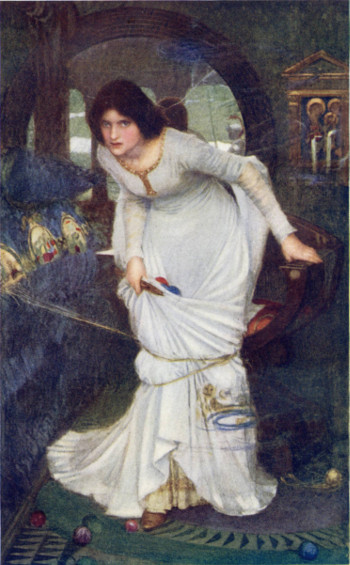
From the exquisite painting of J. W. Waterhouse, who has interpreted for us in flesh and blood Tennyson’s far-famed poem. This is the dramatic moment when the curse is falling upon the lady of the silent isle.
The literature of fiction was surprising in its growth, and practically limitless in its variety. Thackeray showed to what a pitch of literary excellence and finish the novel might attain, and also demonstrated its power as a moral scourge. Dickens, the Hogarth of modern novelists, evoked smiles and tears in myriads of homes by his vivid pictures of life; and George Eliot reflected much of the sadness and unrest of the time in her searching and minutely conscientious works. Charlotte Brontë uttered a passionate note on behalf of her suffering sisters; and Mrs. Gaskell proved herself a genuine artist in the delineation of human life.
Of later women writers, mention must be made of Mrs. Oliphant, Miss Braddon, Mrs. Henry Wood, and “Ouida”—all different in style, yet all equally prolific. Marryat, James, Ainsworth, Warren, and others still find readers.
Charles Kingsley struck a sympathetic human note in his fictions; Anthony Trollope was the most interesting even of all his brethren; Wilkie Collins was a master of mystery; Richard Jefferies was the interpreter of nature; Charles Reade was an intense moral reformer; George Meredith has delighted and puzzled his admirers by his brilliant powers and genius; Lord Lytton is still read for two or three of his healthiest works; and Lever and Lover for their rollicking Irish wit.
It would be invidious to attempt to give a catalogue of all contemporary novelists worthy of mention; but in addition to those already mentioned the names will occur of R. D. Blackmore, Thomas Hardy, Robert Buchanan, George Macdonald, and William Black—all widely different in their gifts and work, but all imbued with a sense of the dignity of the novelist’s art. Newer writers of imaginative and adventurous fiction have sprung up in Hall Caine, J. M. Barrie, Rider Haggard, R. L. Stevenson, and Rudyard Kipling.
Tennyson and Other Poets.—In poetry two names stand out above the rest through the Victorian age. Tennyson, the most artistic of all poets, deservedly occupies the first place from the breadth of his range. His lyrics are the finest since Shelley; his Idylls of the King deserve the name of epic poetry; his dramas are finely conceived; and his In Memoriam sums up the religious aspirations of the time.
Robert Browning, massive and profound in thought, was of all modern poets the most full of pith, energy, and moral aspiration. Mrs. Browning may well be called the daughter of Shakespeare, for never did poet play more divinely upon the Æolian harp of the human heart. Walter Savage Landor exhibited the classical spirit, and Matthew Arnold had an unbroken elevation in his verse. Swinburne is a master of music and rhythm, Rossetti is a perfect artist in construction, while William Morris is a Spenserian singer cast upon a later age.
Among later poets of undoubted gifts are Alfred Austin, William Watson, Clough, Christina Rossetti, Coventry Patmore, and Sir Lewis Morris.
The dramas of Talfourd, Sheridan Knowles, R. H. Horne, Lord Lytton, and Sir Henry Taylor exhibited striking but widely varying merits.
The minor poetic singers and writers of fugitive verse of both sexes are too numerous for particularization.
SUMMARY OF ENGLISH LITERATURE
Note.—Titles of words in italics indicate that they are poetic or dramatic.
I. THE ANGLO-SAXON PERIOD, 449-1066
Author and Dates Representative Works Literary Characteristics
Unknown 700 Traveller’s Song Illustrates the sentiment of a wandering singer and the Anglo-Saxon’s love of home.
Unknown Beowulf An epic song, illustrating the powerful imagination of the race.
Unknown 700-1154 Anglo-Saxon Chronicle Contains in addition to historical data, one or two war-songs: Battle of Malden, etc.
Caedmon 600-? Paraphrase of Scripture Showing how strong an appeal the Bible Story made to the reverence of the race.
Bede 673-735 Ecclesiastical History; Poems Inspired by early Christian sentiment.
Unknown 710-? Judith Paraphrase of Bible narrative.
Cynewulf 750-? Poems Serious poems of moral simplicity and power.
Alfred the Great 849-901 Translations Some original matter interpolated, e. g., narrative of Othere, versified by Longfellow.
Alcuin 735-804 Letters, Biographies; Christ, Elene Andreas, etc. Friend of Charlemagne. Wrote a comparatively pure Latin.
Ælfric 955-1020 Homilies, Grammar Writings in Latin; a man of power and sincerity.
II. THE NORMAN-FRENCH PERIOD, 1066-1400
William of Malmesbury 1095-1142 History of Kings of England Of some value as an original.
Geoffrey of Monmouth 1154 History of English Kings Largely legendary. The stories are rehashed in subsequent authors down to Spenser, Shakespeare and Milton.
Wace, Richard 1112-1184 Romance of Rollo; Brut d’Angleterre In reality a French trouvere though a subject of the King of England. First mention of Arthur’s Round Table.
Mapes, Walter 1143-1210 De Nugus Curialium; Queste de Saint Graal, etc. First mention of the Holy Grail.
Layamon 1150-1210 Chronicles of Britain A devout priest and the first to make the new English a literary medium.
Orm 1187-1237 Ormulum (paraphrase) Also English. Some of the homilies are simple and touching expressions of devotion.
Bacon, Roger 1214-1294 Natural Science Philosophy A man in advance of his age, he is said to have anticipated Francis Bacon in making experiment the basis of knowledge.
Gloucester, Robert of 13th Century Chronicle of England Valuable for giving outlines of history of Norman England.
Mandeville, Sir John 1300-1371 Travels Possibly a pen-name. His travels are an extraordinary farrago of invention and report.
Barbour, John 1316-1395 The Bruce Spirited and patriotic, loved by true Scotchmen.
Langland, William 1330-1400 Piers, the Plowman Extraordinary man of broad humanity. First expression of the voice of the poor.
Wycliffe, John 1324-1384 Translation of Bible A man of great power and sincerity. A philosopher and scholar.
Gower, John 1325-1408 Ballads; Lover’s Confession Friend of Chaucer. A voluminous poet, not of high rank.
CHAUCER, GEOFFREY 1330-1400 Canterbury Tales; Short poems A scholar. A poet of chivalry and a witty narrator of stories in verse. Introduced French and Italian metres. Equally eminent in description and characterization.
III. ENGLISH PERIOD TO THE TIME OF ELIZABETH, 1400-1559
James I. of Scotland 1394-1437 The King’s Quhair, (Choir, etc.) A decided poetic talent in the chivalric fashion.
Malory, Sir Thomas 1430 Morte d’Arthur Worked over a large part of the Arthurian legends in prose. The original for Tennyson’s “Idylls of the King.”
Caxton, William 1422-1492 The Game of Chess; Translation of the Æneid Introduced the Art of printing, brought out Malory’s book and made and published many translations and adaptations.
Dunbar, William 1460-1530 Thistle and Rose; Golden Terge The Scotch Chaucer; much inferior to Chaucer and less of a popular poet.
More, Sir Thomas 1478-1535 Utopia, Life of Edward V. A man of fine character. “Utopia” first written in Latin and translated into nervous English. Plan suggested, perhaps, by Plato’s “Republic.”
Tyndale, William 1484-1536 Translation of Bible On his translations of the Scriptures, later versions are founded.
Wyntoun, Andrew 15th Century Chronicle of Scotland Story of Wallace. Much admired by Walter Scott.
IV. THE ELIZABETHAN AND PURITAN PERIODS, 1559-1660
Wyatt, Sir Thomas 1503-1542 Sonnets and Lyrics Introduced with Howard the Italian forms; sonnet and madrigal, made Italian literature a new force in England.
Howard, Henry, Earl of Surrey 1517-1547 Translation of the Aeneid; Songs and Sonnets Introduced Italian forms and blank verse.
Foxe, John 1517-1587 Book of Martyrs His book had great influence in strengthening the reformers and was one of the literary influences on the Puritans who came to America.
Sackville, Thomas 1536-1608 Mirror for Magistrate A poet of force and imagination. Afterwards, as Lord Buckhurst, a courtier and politician, worked in collaboration with others and had a hand in first English Tragedy.
SPENCER, EDMUND 1552-1599 Fairie Queen; Shepherd’s Calendar Called the “poet’s poet.” Great in romantic allegory, the ode, and the sonnet.
Raleigh, Sir Walter 1552-1618 History of the World A politician and adventurer; friend of Spenser. Some fine passages in his work.
Hooker, Richard 1553-1600 Ecclesiastical Polity His prose has dignity and force. His book is the authority for the Church of England.
BACON, FRANCIS 1561-1626 Essays, Novum Organum Many beautiful and acute things in his essays and his philosophical works.
SHAKESPEARE, WM. 1564-1616 Dramas, Sonnets, (37 plays) Compounded of all writers best: wit, humor, characterizations, philosophy, musical phrase, power and construction.
Chapman, George 1559-1634 Translation of Homer Full of vigor and verve, especially his Homer.
JONSON, BEN 1574-1637 The Alchemist; Sejanus; Timber, etc. A scholar and literary man. A learned constructor of plays, had also the true lyrical faculty.
Beaumont, Francis 1584-1616 Dramas: Philaster; Maid - Well constructed plays but of a decidedly low moral tone. Beaumont is supposed to have been the more promising but died before Fletcher, who continued to produce plays alone, about forty.
Fletcher, John 1579-1625 Tragedy: Woman Hater; etc.
Burton, Robert 1577-1640 Anatomy of Melancholy Full of out-of-the-way learning and quotations bearing on the subject.
Herbert, George 1593-1633 The Temple, etc. Animated by a devotional spirit and an aesthetic spiritualism.
Herrick, Robert 1591-1674 Poems Lyrics, many of them of charming quality and ingenious construction.
Walton, Isaak 1593-1683 The Compleat Angler Prose of a delightful character, full of simple piety and love of out-door nature.
Fuller, Thomas 1608-1661 Church History of England, etc. A chronicle, with passages of wit or natural pathos.
MILTON, JOHN 1608-1674 Areopagitica: L’Allegro and Il Penseroso; Comus; Paradise Lost; Paradise Regained, etc. A poet, grave, learned, of mental dignity but gifted with musical power as much as Shakespeare.
Taylor, Jeremy 1613-1667 Holy Living, etc. The “Shakespeare of Divines.” Passages of rare poetic beauty and organ-like volume.
Baxter, Richard 1615-1691 Saint’s Rest One of the “Vade mecums” of the later Puritans. Earnest and sincere.
V. PERIOD OF THE RESTORATION TO THE RISE OF THE NOVEL, 1660-1740
BUNYAN, JOHN 1628-1688 Pilgrim’s Progress; Holy War Simple, idiomatic, with passages of rare beauty. Animated by simple, natural piety. A classic too much neglected.
Butler, Samuel 1612-1680 Hudibras A rhyming jingle, destitute of elevation but with here and there a witty couplet. Anti-Puritan throughout—favorite book of Charles II.
DRYDEN, JOHN 1631-1700 Virgil Translated; St. Cecilia’s Day, etc. A fine critic. The father of fluent prose. Many energetic lines of verse, especially in his satires. A man of fine talent but limited genius.
Pepys, Samuel 1633-1703 Diary His Diary, not intended to be public, throws light on the life and habits of a capable business man of the 18th century.
LOCKE, JOHN 1632-1704 On Human Understanding; Essays; Thoughts on Education, etc. A sound, practical thinker, whose works illustrate the common sense and unspiritual tone of his age.
Newton, Sir Isaac 1642-1727 Principia, etc. A great mathematician, he laid the foundation of our understanding of the mechanical structure of the universe.
Defoe, Daniel 1661-1731 Robinson Crusoe A born story-teller and pamphleteer.
Swift, Jonathan 1667-1745 Tale of a Tub; Gulliver’s Travels Unequalled as a satirist, and writer of allegories, in simple, nervous, idiomatic English.
Steele, Sir Richard 1672-1729 Essays (established the Tatler) A good second to Addison.
Addison, Joseph 1672-1719 Essays in The Tatler and The Spectator Originator of the Social essay marked by kindly, gentlemanlike humor in the urbane style.
Berkeley, Bishop 1684-1753 Philosophy A very acute thinker. English founder of one form of idealism.
Young, Edward 1683-1765 Night Thoughts Rather a ponderous poet, on semi-doctrinal subjects.
POPE, ALEXANDER 1688-1744 Essays on Man, etc. The model poet of his time and century. Used the decasyllabic couplet almost exclusively, but imparted to it vigor, pungency and some variety.
Butler, Bishop 1692-1752 Natural and Revealed Religion The orthodox moralist of his day, ponderous in style and commonplace in method.
Carey, Henry 1700-1743 Sally in our Alley, etc. A light gift of doggerel satire.
Thompson, James 1700-1748 The Seasons, etc. A delicate feeling for the quieter aspects of nature, harmoniously expressed.
VI. RISE OF THE NOVEL AND PERIOD OF ROMANTICISM, 1740-1837
Richardson, Samuel 1689-1761 Clarissa Harlowe; Pamela; Sir Chas. Grandison Sentimentally moral, but gifted with the story-telling faculty.
FIELDING, HENRY 1707-1754 Tom Jones; Amelia; Jonathan Wild, etc. Depicts life broadly and faithfully. The first great realistic novelist.
Johnson, Samuel 1709-1784 Dictionary; Rasselas; Lives of the Poets A man of eighteenth century learning and letters. The critical authority of his day.
HUME, DAVID 1711-1776 History of England The first learned historian of England. A philosopher of acumen.
Sterne, Laurence 1713-1768 Tristram Shandy; Sentimental Journey A writer in whom affectation becomes an art. Some pathetic passages have become classic.
Gray, Thomas 1716-1771 Elegy in Country Churchyard, etc. A scholar-poet. Production limited, but of fine workmanship.
Smollet, T. George 1721-1771 Humphrey Clinker, Roderick Random, etc. Originator of the Sea-Story. Inclined to vulgar coarseness.
Akenside, Mark 1721-1770 Pleasures of the Imagination A man of scholarship and culture, who wrote poetry without a decided gift.
Smith, Adam 1723-1790 Wealth of Nations The first great economist. The moderns hardly equal to him in natural keenness of insight.
Goldsmith, Oliver 1728-1774 Vicar of Wakefield; Essays; She Stoops to Conquer; Deserted Village, etc. A true and graceful touch both in prose and poetry. Makes hack-work literature. Supposed to be the original compiler of “Mother Goose’s Melodies.”
Blackstone, Sir William 1723-1780 Commentaries on Laws of England Learned and careful, with conception of the dignity of law.
Burke, Edmund 1729-1797 Essays, Orations Prose, sometimes musical and poetical and at the same time, a statesman’s grasp of principle.
GIBBON, EDWARD 1737-1794 Decline and Fall of Roman Empire A pains-taking and learned historian. Constructive powers of broad scope.
Boswell, James 1740-1795 Life of Samuel Johnson The true reporter’s instinct for the point of a story. Otherwise, a toady.
COWPER, WILLIAM 1731-1800 The Task; John Gilpin; etc. Divests poetry of the affectations of Pope. Writes on simple themes.
Paley, William 1743-1805 Evidence of Christianity, Natural Theology A cognent reasoner on the old premises.
More, Hannah 1745-1833 Coelebs in Search of a Wife; Sacred Dramas Something of a minor poet, something of a dramatist and story-teller.
Sheridan, Richard B. 1751-1816 Speeches; The Rivals; School for Scandal; Song; etc. Writer of witty dialogue and constructor of telling stage situations. Comedies still acted.
BURNS, ROBERT 1759-1796 Cotter’s Saturday Night, etc. Lyrics, songs and satires in Scotch dialect, marked by music, pathos and wit.
Edgeworth, Maria 1767-1849 Popular Tales, etc. Stories of middle-class domestic life of excellent moral tone and some power of characterization.
WORDSWORTH, WM. 1770-1850 The Excursion; Poems Nature poems and descriptive poems. Many fine sonnets. First expression of modern feeling for nature.
Hogg, James 1770-1835 Shepherd’s Calendar; Pastorals Scotch verses. One or two lyrics of sweetness and simplicity.
Montgomery, James 1771-1854 Hymns, Poems A man universally esteemed; best remembered now for his hymns of which some hundred are found in our Hymnals.
SCOTT, SIR WALTER 1771-1832 Waverly Novels, etc. Lady of the Lake, etc. Originator of the historical novel. Tone natural and wholesome. Secure in the estimation of posterity.
Smith, Sidney 1771-1845 Sermons, Essays, etc. A witty divine. Master of the expository style.
Coleridge, Samuel T. 1772-1834 Essays; Rhyme of Ancient Mariner, etc. A man of remarkable gifts, both intellectual and poetic; a natural master of verbal melody.
Southey, Robert 1774-1843 Biographies of Nelson, Wesley; Poems, etc. A man of industry and worth. Better as a prose stylist than a poet.
Lamb, Charles 1775-1834 Essays of Elia, etc. A quaint and delicate essayist— friend of Coleridge.
Landor, Walter Savage 1775-1864 Imaginary Conversations, etc. Count Julian; Heroic Idyls, etc. Classic scholar and writer. Reactionary and old-fashioned in his thought but a remarkable stylist.
Austen, Jane 1775-1817 Pride and Prejudice, Emma, etc. Her novels depicting upper middle-class life are delightfully realistic and full of quiet life.
Porter, Jane 1776-1850 Scottish Chiefs, Thaddeus of Warsaw Novels in an antiquated style of exaggerated romance.
Campbell, Thomas 1777-1844 Pleasures of Hope, Lyrics, etc. Something of a critic, his lyrics have much vigor and verve.
Hallam, Henry 1777-1859 Europe during Middle Ages, Introduction to Literature, Constitutional History of England Strong, vigorous, historical writing from a standpoint now antiquated.
Hazlitt, William 1778-1830 Table Talk, English Poets, etc. Critical essays; contain some true eloquence, and many powerful phrases.
Moore, Thomas 1779-1852 Biographies; Lalla Rookh, Irish Melodies, etc. Songs of much melody, but of an unreal sentimentality.
De Quincey, Thomas 1785-1859 Confessions of an Opium Eater, etc. Passages of magnificent color. A learned man, lacking in sound realistic judgment.
Hunt, Leigh 1784-1859 Essays, Sketches, Memoirs; Poems A minor poet. A literateur of appreciation rather than of creative power.
Wilson, John 1785-1854 Noctes Ambrosiannae, etc.; Poems A virile man. As a writer, “of his age, not for all time” nor indeed for an entire century.
Peacock, Thos. L. 1785-1866 Crotchet Castle, Rododaphne, etc. A literatteur, novel writer, and verse writer of wit and epigrammatic power but no constructor.
Byron, Lord 1788-1824 Poems Vigorous, eloquent, sardonic, iconoclastic, lacking in divine sympathy. A great satirist, and in many regards a great poet.
SHELLEY, PERCY BYSSHE 1792-1822 Queen Mab, Adonais, The Sky Lark, etc. A remarkable gift of lyrical melody. Full of generous impulse and the unbalanced judgment of youth. A genius.
Marryat, Capt. Fred 1792-1848 Peter Simple, Jacob Faithful, etc. Boy’s stories but evincing considerable narrative skill.
Hemans, Felicia 1793-1835 Lyrics A minor poet of grace, sweetness and tenderness.
Grote, George 1794-1871 History of Greece A learned and sound historian, but superseded by modern exact research.
Arnold, Thomas 1795-1842 Roman History, Sermons, Essays A man of wide influence as head-master of Rugby. An historian of the old school.
Keats, John 1795-1821 Endymion, Hyperion, etc. A true poet, dying too young to reach full fruition of his remarkable artistic powers.
Pollock, Robert 1798-1827 Course of Time A poet, sound, serious and heavy; suits Scotch theologians.
Hood, Thomas 1798-1845 Poems A humorous poet of the first rank; some pathetic verses of high quality.
VII. THE VICTORIAN PERIOD TO THE PRESENT, 1837- ——
Lover, Samuel 1797-1868 Handy Andy, Rory O’More; Songs, Ballads A writer of slap-dash Irish and other good stories.
CARLYLE, THOMAS 1795-1881 French Revolution, Cromwell, etc. A very great though one-sided man. A prose poet, an historian of insight and industry, impatient of shams.
Macaulay, Thomas B. 1800-1859 Essays, History of England; Lays of Ancient Rome He makes history alive and readable. A partisan but on the right side.
James, G. P. R. 1801-1860 Novels (historical) Historical novels of an antiquated pattern, popular in their day for good reasons.
Miller, Hugh 1802-1856 Old Red Sandstone, Schools and Schoolmasters, etc. A self-made scientific geologist, who did good service in popularizing science.
Praed, Winthrop Mackworth 1802-1839 The Vicar; The Red Fisherman The best writer of “Society Verse,” urbane, cultured, witty. His verses are beautifully finished.
Martineau, Harriet 1802-1876 Political Economy, etc. A woman of remarkably strong intellect. Her positions well argued but perhaps too radical.
Lytton, Sir Edward Bulwer 1803-1873 Last Days of Pompeii, Last of the Barons, etc. A versatile and successful literatteur, successful in several forms of the novel, but pre-eminent in none.
Disraeli, Benjamin 1804-1881 Lothair, Vivian Grey, etc. Society novels eminently readable but thoroughly artificial.
Martineau, James 1805-1900 Philosophical Works, etc. A philosophical thinker of insight and honesty.
Mill, John Stuart 1806-1873 Political Economy Of thorough intellectual honesty and diamond-clear intellect, he furthered the cause of political justice and personal freedom.
Lever, Charles 1806-1872 Tom Burker, Charles O’Malley, etc. Irish tales full of pith and spirit.
DARWIN, CHARLES 1809-1882 Origin of Species, Descent of Man Lucid and attractive in style, and an unflinching lover of truth; he has had a greater influence on thought than any man of his time.
Milnes, Richard Monckton (Lord Houghton) 1809-1885 Life and Remains of Keats; Poems, legendary and historical A man of culture not without distinction as a minor poet. A true lover of literature.
FitzGerald, Edward 1809-1883 Euphranor, etc.; The Rubaiyat The Rubaiyat is the only instance where a translation of a classic equals the original.—FitzGerald was one of the last of the “Letter Writers.”
Browning, Elizabeth Barrett 1806-1861 Aurora Leigh, Poems A pleasing lyrical gift and warm, human sympathy made her a favorite poetess in the Victorian era.
TENNYSON, ALFRED 1809-1892 In Memoriam, Idyls of the King The national poet of the late 19th century; a painstaking artist and master of verbal melody.
Kinglake, Alex. William 1809-1890 Eothen A brilliant historian of the Crimean war.
Gaskell, Elizabeth 1810-1865 Cranford, Mary Barton, etc. A writer of charming quiet feminine humor. One of the first to make the economic problems the basis of a story.
Thackeray, William Makepeace 1811-1863 Vanity Fair, The Newcomes Satirist and humorist, but with great powers of characterization, especially of the every-day social elements.
Dickens, Charles 1812-1870 David Copperfield, Oliver Twist, etc. A broader humorist than Thackeray, appealing to the common human sympathies and the ordinary sense of the ridiculous.
BROWNING, ROBERT 1812-1889 Dramatic Lyrics, Poems, The Ring and the Book A powerful poet, intent more on subtlety than lucidity, intellectual rather than sympathetic.
Reade, Charles 1814-1884 Peg Woffington, Cloister and Hearth, etc. A vigorous narrator, animated by hatred of injustice. Analysis of human motives, superficial.
Rawlinson, George 1815-1902 Five Great Monarchies A learned Assyrian and Oriental scholar.
Trollope, Anthony 1815-1882 Barchester Towers, etc. Admirably realistic presentation of English society, political and ecclesiastical.
Froude, James Anthony 1818-1894 History of England A brilliant prose writer, makes history human and interesting and suggestive.
Kingsley, Charles 1819-1875 Hypatia, etc.; Poems His novels, in spite of slight affectations and a taint of sentimentality, are vigorous and wholesome.
Ruskin, John 1819-1900 Stones of Venice, Modern Painters A great stylist. As art-critic too subjective and governed by the moral suggestiveness of the object. As political economist, too idealistic and regardless of human nature.
Bronte, Charlotte 1816-1855 Jane Eyre, The Professor, etc. Great power in her novels which, however, are based on narrow experience.
SPENCER, HERBERT 1820-1903 First Principles, etc. Applied principle of evolution to sociology, history, etc. A thinker, but ponderous in style.
Eliot, George 1819-1880 Silas Marner, etc., Spanish Gypsy, Poems The greatest woman novelist. A realist with insight. Powers of wit and characterization; construction not remarkable.
Tyndall, John 1820-1893 Scientific Papers Unsurpassed as a popularizer of Darwin’s ideas, unless it be by Huxley.
Arnold, Matthew 1822-1888 Essays and Criticisms; Sohrab and Rustum, etc. Critic and poet. Liberal in thought but dominated by aristocratic prejudice on the literary side. As a poet, inclined to despairing pessimism; weak in the power of verbal melody.
Muller, Max 1823-1900 Science of Language, etc. Did much to spread knowledge of the general facts and principles of philology and Oriental learning.
Freeman, Edward A. 1823-1892 Histories A conscientious, honest, painstaking historian, destitute of the power to make his subject interesting except to himself.
Hughes, Thomas 1823-1896 Tom Brown at Oxford, etc. A manly, breezy person, who wrote one good book for boys.
Collins, Wilkie 1824-1889 Woman in White, etc. Unsurpassed as a constructor of plots, i. e. born story-teller, not misled by psychological analysis.
Macdonald, George 1824-1905 Sir Gibbie, Alec Forbes, etc. Wrote many novels showing some power of writing dialogue. Essentially of his day.
Huxley, Thomas Henry 1825-1895 Man’s Place in Nature A master of exposition and, with Tyndall, very effective in presenting the idea of evolution.
Blackmore, R. D. 1825-1900 Lorna Doone, etc. Infused an element of romance into the modern novel, “Lorna Doone.”
Bagehot, Walter 1826-1877 Physics and Politics Original, sound, and striking on political and economic topics.
Mulock, Dinah Naria 1826-1887 John Halifax, etc. Author of some twenty novels of which “John Halifax” is the best. Also of pleasing minor verse.
Rossetti, Dante Gabriel 1828-1882 The Blessed Damozel, etc. A highly imaginative poet; a master of color in verse and on canvas.
Oliphant, Margaret 1828-1897 Chronicles of Carlingford, etc. Novels of middle-class life, of excellent tone, full of quiet observation. Plots, slight, but hold the attention.
Meredith, George 1828-1910 The Egoist, Diana of the Crossways, etc. Novels of extraordinary power. Style epigrammatic and not attractive.
McCarthy, Justin 1830-1912 History of our own Times, Novels A prolific journalist, novelist and historian of modern times.
Ingelow, Jean 1820-1897 Poems, High Tide on Coast of Lincolnshire A charming lyrical talent, of limited productive power.
Meredith, Owen 1831-1891 Biography of Bulwer Lytton; Lucile Fluent writer of light verse and society verse.
Arnold, Edwin 1832-1904 Light of Asia, Poems An able journalist and prolific minor poet.
Seeley, John Robert 1834-1895 Ecce Homo, etc. An able historical writer, his “Ecce homo” had considerable influence on contemporary philosophies—religious thought.
Morris, William 1834-1896 Essays on Art, etc.; Poems, Earthly Paradise Prolific as a narrative poet, fond of classic and medieval legends. As a poet, more fluent than thoughtful.