BOOK OF THE SCIENCES AND INVENTION (continued 5)
Reading edition
Kinds of X-rays.—It is now known that these rays are not all by any means of the same kind or of the same penetrative power. Moreover, these differences can be still augmented by altering what is known as the induction in the circuit, the degree of exhaustion in the tube, and the nature of the emitting surface. The emitting surface is not the glass walls of the tube, as many suppose; and the canary colored light emitted by the tube is not the X-rays, which are themselves invisible. They originate from the anode of the tube owing to the fierce bombardment to which the cathode rays subject it. Where the cathode rays, which travel in straight lines, first strike any material object, from that same object the X-rays originate.
Uses of X-rays.—In the early days of radiography the X-rays in medical work were confined almost solely to the detection of fractured or injured bones, and abnormal bone growth. At the present time, however, even a careful examination on the fluorescent screen is sufficient to enable an expert medical radiographist to diagnose with a considerable degree of exactitude the condition of the heart, the lungs, and the stomach. In making such examination a tube must be chosen which has the lowest vacuum, in order to obtain the maximum amount of contrast between fleshy tissue not differing greatly in density.
In some cases even the liver has been outlined and part of the kidneys.
Still more important is the fact that the rays have been applied successfully in the treatment of certain diseases which by other means have been deemed, if not incurable, at any rate extremely difficult to cure. Claims have been made for cancer cures by means of these same rays; whether these have really been complete cures or not is perhaps open to question.
X-ray Dermatitis.—A painful and incurable disease, of a cancerous nature, to which radiographers are liable, caused by frequent and prolonged exposure to X-rays. Many of the pioneers of radiography have fallen victims to this complaint, but greater precautions are now taken to protect the operators from the X-rays. There is little danger of contracting this disease in X-ray photography, as the exposures are short and the operator need not stand directly in front of the tube. The chief risk is entailed by visual examination with the fluorescent screen. The disease first makes its appearance in the hands and gradually spreads to the arms and body. The skin at first appears as if it had been burned, hence the term “X-ray burning.”
THE LIGHT THAT REVEALS THE UNSEEN IN THE HUMAN BODY
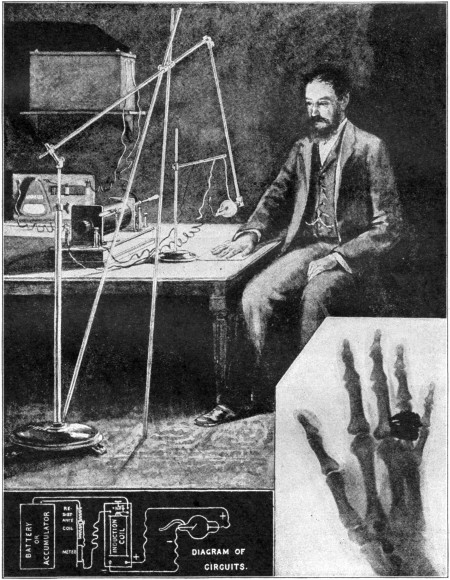
Illustration and diagram showing the apparatus ordinarily used in X-ray photography, together with the course of the electric circuits, and a radiograph of the hand.
Large diagram (46 kB)
LIQUID AIR AND ITS MARVELS OF LOW TEMPERATURE
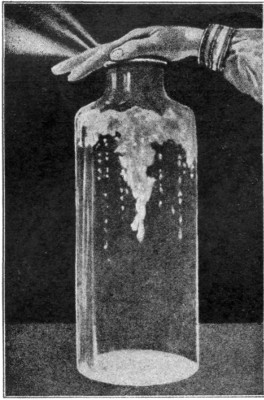
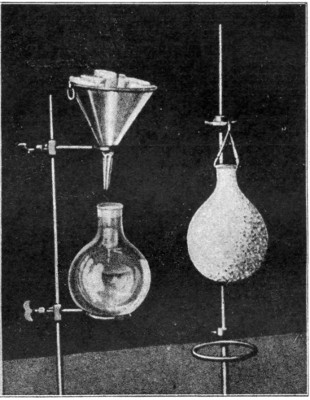
Liquid Air in water. The silvery bubbles are liquid oxygen; the nitrogen boils away. Filtered Liquid Air in a Dewar bulb, and Liquid Air in an ordinary glass bulb (which has collected a coating of frost).
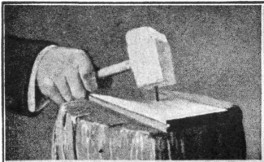
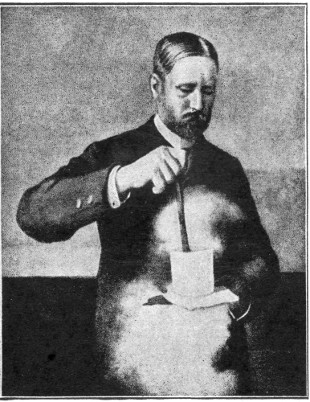
Driving a nail with a hammer made of mercury frozen by Liquid Air.
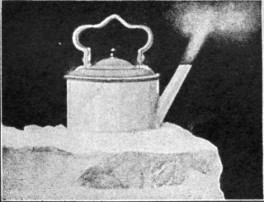
Liquid Air boiling on a block of ice, caused by the difference of temperature. Burning steel in an ice tumbler partly filled with Liquid Air.
Liquid Air is simply its gaseous form brought into liquid condition by the combined effect of lowering its temperature and subjecting it to an extreme expansion. When protected from external heat and highly exhausted it becomes a transparent, jelly-like, mass. By means of liquid hydrogen it may be condensed into a white solid with a faint blue tint.