BOOK OF THE VEGETABLE KINGDOM
Reading edition
REALMS OF LIFE UPON THE EARTH
CHIEF DIVISIONS OF THE PLANT KINGDOM:
(1) Cereals, Grasses and Forage Plants
(2) Kitchen Vegetables
(3) The Fruit Trees
(4) Fruit-bearing Shrubs and Plants
(5) Flowers and Other Ornamental Plants
(6) Wild Flowers and Flowerless Plants
(7) Trees of the Forest
(8) Fiber and Commercial Plants
(9) Poisonous Plants
(10) Some Wonders of Plant Life
BOTANICAL CLASSIFICATION OF PLANTS
SCIENTIFIC TERMS USED IN BOTANY, ILLUSTRATED
WORLD MAP SHOWING DISTRIBUTION OF PLANT LIFE
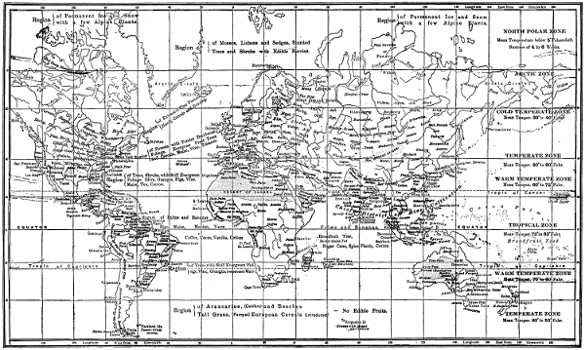
MAP INDICATING THE DISTRIBUTION OF PLANT LIFE THROUGHOUT THE WORLD
Large map (400 kB)
THE VEGETABLE KINGDOM
RELATION AND DISTRIBUTION OF PLANT AND ANIMAL LIFE
Life in the world is represented by the Vegetable and Animal kingdoms. Plants and animals, unlike minerals, grow from germs, and develop into individuals with definite forms and organs. After a limited existence they die, their species being perpetuated by seed or offspring. The functions of plants and animals in nature are, however, entirely unlike. Plants are rooted in the soil; animals are free to move over the land, through the water or air. The plant, moreover, transforms the lifeless, inorganic elements (earth and air) into organic matter and thus prepares food for the animal. In its quiet, steady growth it gathers a store of force which the animal uses up in action. Thus the distribution of vegetation regulates that of animal life. Besides, vegetation clothes the surface of the land with that rich mantle of verdure and flowers which is its greatest ornament.
All living things are termed organisms, and the science which takes account of them with special regard to their common characteristics is termed Biology, or Life-lore. The classification and life-history of plants are the objects of that part of biology known as Botany. That part similarly occupied with the study of animals is known as Zoology.
Throughout the entire realm of nature, in the animal world as well as in the vegetable, the development of life increases in energy, and in the variety and perfection of the types, with the increasing intensity of light and heat, from the poles to the equator.
TROPICAL LIFE
Within the tropics, under the stimulating rays of a vertical Sun, grow the most dense and varied forests, the most expanded foliage, and the largest and the most brilliant flowers. Here, also, are found the most delicious fruits, the most powerful aromatics, the greatest variety of plants capable of affording sustenance to man, and the largest number of those which contribute to the luxuries of civilized life.
In the tropical regions, also, are found the greatest variety of land animals; with the highest types, the greatest stature, the most intense activity, and the keenest intelligence exhibited in the brute creation.
WHERE THE MOST POWERFUL ANIMALS ARE FOUND
This zone is the home of the gigantic elephant and giraffe; of the lion and the tiger, the most powerful of all the beasts of prey; and of the gorilla, chimpanzee, and ourang-outang, of all animals most resembling men.
Here, also, are the ostrich, the largest and most powerful of birds; the condor, surpassing in size all other birds of flight; and the humming-birds of South America, the smallest of the feathered tribes, unsurpassed in brilliancy of coloring, rapidity of motion, and grace of form.
In the same zone are those enormous reptiles, the crocodile and the boa-constrictor, with the hooded snakes and other serpents of most deadly venom; and insects of all sizes in indescribable profusion.
LIFE IN THE TEMPERATE ZONES
In the Warm-Temperate Zone, though the Sun never reaches the zenith, yet during the long summer his rays are almost vertical; while the winter is so mild that snow and ice are of rare occurrence.
Here the vegetable world is less prodigal in species, and less luxuriant in growth, than in the tropical regions; still, verdure is continuous throughout the year, and fruits and flowers succeed each other almost without interruption.
The animal world shows a similar, though less marked, decrease in the exuberance of life. The higher orders are less numerous, the individuals less gigantic and powerful; yet the antelopes, among the most graceful of animals, and the camel, one of the most useful, especially characterize this zone.
HOW THE LIFE OF THE TEMPERATE ZONE DIFFERS FROM THAT OF WARMER ZONES
In the Temperate Zone, farther from the tropics, and receiving the Sun’s rays with greater obliquity, all the forms of vegetable growth are more modest than in the preceding. The forests are less dense and varied, the foliage is less luxuriant, and flowers of brilliant hues are confined to shrubs and herbaceous plants.
Though useful plants are numerous, yet scarce a species is of value in its spontaneous growth; and, above all, the long dormant season, when the trees and shrubs are bare and apparently lifeless, stamps the vegetation of this zone with an aspect of inferiority.
The animal world still shows a large number of noble species; yet there are some orders which, like the plants, are dormant during the winter; while many of the birds migrate to warmer climes. Associated with deciduous forests, boundless fertile prairies, and arid steppes—are the bear, the wolf, the lynx, the bison, and many species of elk and deer.
ORIGINAL HOME OF OUR DOMESTIC ANIMALS
Here is the home of the horse, the ass, and many varieties of oxen, sheep, and goats,—those animals which, domesticated by man, have accompanied him to all climes, adapting themselves to all circumstances. The American turkey, the European pheasant, and the Asiatic parents of many of our domestic fowls, also belong to the temperate zone; together with a multitude of song birds, whose sober plumage, contrasting so gloomily with the brilliant colors of their neighbors of the tropics, is compensated by the sweetness of their notes. Here, also, is the home of the honey-bee, and of the silk-worm, almost the only insects directly useful to man.
LIFE IN THE COLD ZONES
In these regions, where the sun is always low, and in winter is above the horizon but a small part of the time, all nature becomes increasingly monotonous. The conifers, with their stiff forms and sombre hues, impart a dreary aspect even to the summer landscape; and, during the long winter, all life seems suspended.
The animal world, however, is more rich and varied than the vegetable.
Here we meet the great moose and the brown bear, the beaver and other rodents, in large numbers; the sable, the mink, the ermine, and a host of other animals whose fine, soft furs form one of the main resources of this inhospitable clime.
In the Arctic Zone—where the forests give place to dwarf trees, stunted or creeping shrubs, mosses, and lichens—the reindeer, the musk-ox, and the white bear are the only representatives of the larger land animals, though the smaller furry tribes are still numerous.
The sea, however, more genial in its temperature than the land, swarms with living creatures of innumerable species, among which are the largest representatives of the animal kingdom. The whale, the walrus, and the seal, inhabit the Arctic seas; with every grade of marine life, down to the animalculæ, which are so numerous as to give their color to great areas of sea-water; and water-fowl, without number, and of many varieties, enlivens the icy shores.
CHIEF DIVISIONS OF THE PLANT KINGDOM
The great divisions of the science of plant life, or botany, are: Structural Botany which treats of the gross anatomy of plants; Plant Histology, of their minute anatomy; Plant Morphology, of the forms of plants and their organs; Plant Physiology, of the functions of these organs; Systematic Botany, of the relationship and classification of plants; Geographical Botany, of the distribution of plants over the surface of the globe; Paleobotany, of the vegetable life of past ages and the successive appearance in the world of the great classes of plants, as traced in their fossil remains; and Economic Botany, which deals with the products of plants and their uses.
It is in the last division of the subject that our greatest practical interest lies, and, consequently, it is best to reverse the general order of treatment pursued by many botanists. Foremost in importance are those plants grown for food, which form the great products of agriculture, gardening and horticulture. Scarcely less important are those which yield fibers used for industrial purposes, such as cotton, flax, jute and hemp; nor must we forget those producing vegetable oils, rubber, and the large number of drugs so valuable to the science of medicine in the alleviation of suffering.
(See page 176 for scientific classification of the Vegetable or Plant Kingdom.)
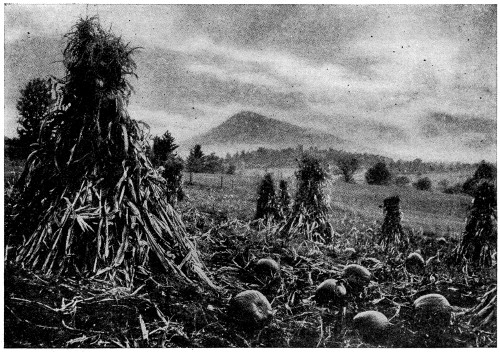
AN AUTUMN HARVEST OF BEAUTY AND PLENTY
I. CEREALS, GRASSES AND FORAGE PLANTS
Among all the plants in the world, the first place must be given to the food-producing cereals upon which our very existence depends. The most important among these are undoubtedly wheat, barley, oats, rye, rice, Indian corn or maize, millets, sorghum and others less widely used. More than one-half the whole population of the world subsists to a great extent on rice, and the vital importance of wheat needs no demonstration. For our present purposes the use of the word “cereal” is extended to include buckwheat and other starch-yielding plants, but these are not true cereals.
HOW OUR CEREALS WERE DEVELOPED
The cereals are members of a great family of the grasses which have been cultivated by man from time immemorial. Originally, no doubt, they were wild plants which attracted attention owing to the comparatively large quantities of foodstuffs they yielded, the ease with which they could be collected, and their edible qualities. Now, in the majority of cases, the original wild forms are no longer known, and as is common with plants cultivated in many lands and during long periods, innumerable species and varieties have been evolved as the result of selection by man of the forms which appeared desirable for one or other of their qualities.
HOW THE WORD “CEREAL” ORIGINATED
Their very name—cereals or cerealia—indicates the great value attached to them in early historic times. These are so named after the goddess Ceres, as the Romans called her—Demeter of the Greeks—the patroness of agriculture and all the fruits of the earth.
WHERE THE CEREALS GROW
In the temperate regions of the world wheat is the principal cereal grown, and there are many different varieties suited to varying conditions. As we go farther north, barley, oats and rye increase in importance, and although they are grown for special purposes along with wheat, it is important to note that they will thrive in countries and under conditions not suited to wheat. Starting again from the temperate zones and traveling north or south, as the case may be, we enter the warmer countries where wheat cultivation is often associated with that of rice, corn, sorghum, etc. In the tropics, however, wheat will not thrive at low elevations, but rice, corn, sorghum and various millets form the great cereal crops, their relative importance varying in different countries.
The grasses proper grow upon our meadows, pastures, fields and in the woods and are only used as food for cattle.
HOW THE BOTANIST DESCRIBES CEREALS AND GRASSES
The roots of most kinds of grasses are persistent; the stems are hollow and knotty, and the leaves consist of sheaths and discs. Their flowers are arranged either in spikes or panicles, and are essentially the same in form as those of the herbs. In the interior there is an ovary, from which project two pistils with feathery styles. Close to the ovary are three stamens, with very long filaments and large anthers. These internal organs are generally surrounded by two tender bracts called the paleæ, and two harder outer bracts forming the glumes. In the grasses also self-fertilization does not take place, the wind here taking the place of the insects. Consequently the anthers are suspended from long filaments, and contain a quantity of pollen. As the grasses do not need to attract insects, their flowers are small with little color, and have no scent; nor do they secrete honey. The fruit is enclosed in a husk.
Alfalfa (Medicago sativa) is a cultivated hay and pasture plant, yielding per annum, without reseeding, three to six or more cuttings of hay, averaging a ton each and often much more, for an indefinite period. It is the richest forage plant known, and while old in history is comparatively new to the agriculture of North America.
Alfalfa thrives on all soils except those too wet or having too much acidity. The former calls for drainage and the latter demands lime. Besides its abundance of rich forage, the leaves of which approximate the value of wheat bran in animal rations, it is highly prized as a soil improver, as it restores and enriches the land in which it grows, and improves extraordinarily the physical character of the soil. Its roots reaching to great depths, make it drought-resistant; they also gather much nitrogen from the air, and it yields assuredly whether the season be wet or dry. It has been demonstrated the greatest fertilizing and soil renovating plant known to agriculture.
For hay it is cut whenever the first blossoms appear or when sprouts for a new growth from the root crowns are discovered, which in some regions is every month in the year. It is relished by all live stock, and is particularly valuable in dairy husbandry, affording at lowest cost important ingredients of the well balanced feeding ration. As pasturage it is excellent for hogs and horses, but ruminants, such as cattle and sheep are not safely grazed upon it, owing to its liability to cause bloat, which if not promptly treated may bring speedy death.
Alfalfa requires a carefully prepared seedbed, with a thoroughly fine, smooth surface, as the seeds are small. From fifteen to twenty pounds of seed per acre are generally sown, although often much more, or less, either with drills or broadcast, preferably in early fall and without a nurse crop. Where the winters are long or severe from two to ten tons of hay per acre in a season, and from two to seven bushels of seed.
Blue-Grass (Poa pratensis), frequently designated Kentucky Blue Grass, is a perennial, and the most highly prized pasture grass, but is not a profitable hay plant. Its growth has a wider range than timothy. It is sown in autumn or spring, the former being preferable, as it can endure cold better than heat, and thrives rather best when partially shaded. One approved way is to sow the seed on snow, where the ground is free from weeds. It is broadcasted at the rate of about one bushel of seed in the chaff to the acre. Blue-grass is an extremely aggressive and persistent plant voluntarily spreading among and displacing others where it has not been sown. Its taking possession of and thriving on land that has not been cultivated is not uncommon. The seed weighs fourteen pounds to the bushel.
English Blue-Grass or Meadow Fescue (Fescuta elatior) is a valuable and hardy grass either for mowing or pasture. It thrives on soils not too dry, and being long lived, is especially valuable for permanent pastures. It is sown either in the spring or fall, by drilling or broadcasting from one to three pecks per acre if for seed, and three pecks to an acre if for pasture. It is harvested and handled much the same as wheat. Kansas produces nearly seventy-five per cent of the seed raised in America and ninety per cent of the total for the United States is exported, Germany being the largest taker. This grass is very nutritious and grazing animals are fond of it. A bushel of seed weighs twenty-two pounds, and the yield of seed per acre is from five to fifteen bushels.
Brome-grass (Bromus inermis) is a vigorous, hardy perennial pasture and hay plant, with strong, creeping rootstocks, and is valuable for dry regions. It is not adapted to a rotation, as its sod becomes too matted and tough for comfortable cultivation. Owing to this tendency, after three or four years of hay cropping its better use is for pasture. It yields luxuriantly, is rich in flesh-forming elements, and much relished by farm animals. It is sown broadcast, in spring or fall, eighteen to twenty pounds of seed to the acre. The seed is chaffy and weighs but fourteen pounds per bushel.
Barley is grown chiefly in the states of Minnesota, California, Wisconsin, North and South Dakota, in the order named, these states raising seventy-five per cent of the output grown in the United States. It is used as food for live stock, and as an article of commerce is in demand principally for the making of malt in brewing beer, but in California and other western states, where Indian corn does not flourish, barley is used as a substitute grain for horses and mules. About two bushels to the acre are sown in the spring, with a drill or a broadcast seeder. It is admirably adapted as a nurse crop, as it stands up well and does not shade the ground so much as many other plants.
Barley for malting should be cut before fully ripe and put in well-capped shocks to cure; the price paid is largely governed by the color acquired in curing, which should be bright. A bushel weighs forty-eight pounds, and the yield is from twenty-five to forty bushels per acre.
Buckwheat (Fagopyrum esculentum) is a grain of minor importance, its flour being used as human food, mostly in the form of griddle cakes. The plant is esteemed for plowing under in summer, to supply humus, and its blossoms for the honey bee. Most of it is grown in New York and Pennsylvania, and it does well in soils too poor for most other crops. It is sensitive to frost, and used as a sort of catch crop, sown generally about the beginning of July, broadcast. Forty bushels, weighing forty-eight pounds per bushel, is a maximum yield.
Clover (Trifolium pratense). In the states east of the Missouri river red clover is highly esteemed. It has much the same qualities as alfalfa, except it is a biennial, enduring but two years without re-seeding and at best gives two cuttings of hay per year, aggregating two to three tons. It is from the second cutting that seed is usually saved. Four quarts of seed is a common quantity to sow per acre. Red clover makes excellent hay, except for horses. Its seed, like that of alfalfa, weighs sixty pounds per bushel, and its yield is from one to five bushels per acre.
White Clover (Trifolium repens) is a very useful pasture and honey plant, but is not used for hay. It spreads rapidly, and is widely used for sowing with other pasture grasses.
Alsike Clover (Trifolium hybridum) is largely sown on lands not well adapted to red clover, where land is either too wet or too dry for the latter, and it does not require so sweet a soil.
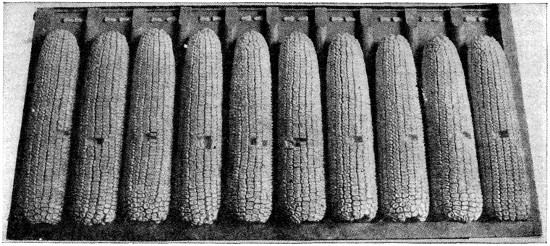
THE COSTLIEST EARS OF CORN IN THE WORLD
The champion ten ears of corn shown in the illustration average ten and one-half inches in length and seven and three-quarters in circumference, each ear carrying twenty rows of kernels, the depth of the kernels being three fourths of an inch, and the average weight of each ear was twenty ounces. They were sold at the rate of $2,345 per bushel or $335 for the ten ears. The champion single ear of corn was sold at the Omaha National Corn Show for $85.
Corn (Zea mays). Indian corn, or maize is a product native to America, an annual, and is the most important member of the grass family. It is America’s foremost cereal, with a wider adaptability than any other, and is grown in every state and territory. The temperate climate of the Central States is most favorable to it, and Illinois, Iowa, Nebraska, Missouri, Indiana, Kansas and Ohio are the leading states in its planting. The bulk of the world’s production of maize is grown in this country, although it is an important crop in Hungary, Italy, Egypt, South Africa, and other parts of the world.
Economic Uses.—Corn is of primary importance as a food for live stock, enormous quantities being used to fatten cattle and swine.
The manufacture of starch and other products from corn is an industry of increasing magnitude. The chief starch derivatives are dextrine and glucose or grape sugar (used in brewing beer and as a substitute for true sugar).
Corn oil may be called a by-product in starch manufacture, yet the annual value of corn oil is greater than that of cornstarch produced in the United States. It is used in soap and paints. Vulcanized by heating with sulphur, it forms a widely used adulterant and substitute for rubber.
Among the dozens of useful products made from corn are corn meal, corn grits, hominy, breakfast foods, beer, whisky, alcohol, cologne spirits, cornstarch, dextrine, glucose, grape sugar, corn sirup, corn oil, soap, rubber substitute and cattle foods.
A special variety of corn is raised to make cob pipes. Compressed corn pith is packed between the double hulls of warships. Corn husks are used in mattresses and paper is made in very limited amount from the leaves and stalks. Large amounts of popcorn, plain and candied, are eaten in the United States.
Methods of Cultivation.—Owing to its widespread growing, the methods of corn culture vary greatly, and no rigid rules can be laid down for all conditions. For maximum results the cornfield must be rich in humus, its soil finely pulverized, mellow and well drained. Many successful growers in the so-called corn states find these conditions best assured by plowing deeply in the fall, turning under liberal quantities of organic matter such as stable and barnyard manure and leaving the subsoil upturned to benefit from the action of the elements during winter, following with the disk harrow or other like implement in the spring. Planting is done when the soil is thoroughly warmed and when danger of frost is past.
There are two methods of planting commonly practiced, one by drilling or dropping the seed (three or four grains) in hills with a machine drawn by horses and completing two rows at once. The other is planting with an implement known as a lister, dropping and covering one grain in a place in the bottom of a furrow, at intervals of eight to twelve inches. The latter method is quite extensively followed in the more western of the corn states, such as Kansas, Oklahoma and Nebraska. The lister is a plow and planter combined, with moldboards at once turning the soil to the right and left, opening a furrow, dropping and covering the seed at the same time, economizing labor, time and expense. Corn is planted about two inches deep, and if in hills or rows generally three and one-half feet apart each way. A bushel of fifty-six pounds of seed suffices for planting nearly eight acres. For soiling, forage or ensiling it is planted more thickly.
Cultivation, with horse-drawn cultivators, cleaning one row at a time, and by some implements two rows, repeated three or four times in a season, is given to kill weeds, aid in the retention of moisture, and aerate the soil. This begins in many instances before the plants appear, and often in the earlier stages is done with a harrow and later by using the cultivator, upon which the operator usually rides.
Harvesting, done after the grains have become hardened is by cutting the stalks from the hills where grown, by hand or machinery, and standing them in large shocks to be husked later, or, husking the ears directly from the stalks without cutting or shocking. No machine equal to human hands has yet been invented for husking corn. The yield ranges from twenty-five to one hundred bushels of sixty pounds, shelled, or seventy pounds unshelled, per acre. The stalks and husks, whether harvested or not are used as food for live stock, and somewhat in manufactures.
Emmer. See Spelt.
Johnson Grass (Sorghum halapense) is a coarse perennial, most extensively grown in the South or the Gulf States, for hay. It spreads so persistently and is so difficult to eradicate that its growing is frowned upon by most of the best authorities. One bushel of seed, or thirty-five pounds per acre is about the quantity sown. It is propagated by roots also. Never plant Johnson grass with the expectation of destroying it.
Millet (Panicum miliaceum) is a native of the East Indies, and is about three feet high; each panicle contains five to six hundred grains. Hungarian grass is one of the most common grown for hay and grain. In the United States they are principally grown for forage. It is a general rule to sow after corn planting has been done but they may be safely sown considerably later, as a catch crop when the regular hay crop is short or a probable failure. Millets are excellent for ensilage, and a succession of cuttings for that purpose or for soiling can be easily secured by sowing at intervals of two or three weeks from early May to late July. The seed is sown broadcast or with grain drills, mostly broadcast, at the rate of two to three pecks per acre, for hay and somewhat less for seed. The hay is harvested and handled after the manner of other hay crops, and the seed crop as that of other small grains. Well drained, rich, warm, loam soils are preferable for millet, and it does not prosper on thin or poor land. A crop of millet leaves the soil where it grew in a delightful condition of tilth. Its yield of seed is from twenty to forty bushels per acre.
Oats (Avena sativa) have a broad panicle; the individual ears are two-rowed, with and without beards. Another much-cultivated species are the bearded oats (A. orientalis). The greater portion of the oats crop of the United States is grown in the north central states, more than one-half in the six states of Illinois, Iowa, Minnesota, Wisconsin, Nebraska and Ohio, ranking in order named. Russia is also a large producer and it is cultivated throughout the temperate parts of the civilized world. The yield per acre ranges from twenty-five to one hundred bushels, weighing thirty-two pounds. Oats thrives best in cool weather with abundant moisture, and in the principal oats territory should be sown as early as possible in the spring—earlier than any other spring grain. The ground for oats should be plowed, but it is not uncommon to merely disk harrow the land before sowing. If the latter, about four bushels is sown to the acre, broadcast or drilled, but on well prepared ground ten to twelve pecks of clean, graded seed is sufficient. In the main the oats crop is harvested, stacked and threshed as other small grains.
Oats is used chiefly for horse feed, and in lesser amounts for making oatmeal and breakfast foods.
The manufacture of oatmeal is of relatively small importance since the more nourishing products of wheat are increasingly used.
Orchard Grass (Dactylis glomerata) is a hardy, nutritious perennial, growing two to five feet high, that does well in either shade or sunshine. It flourishes in nearly every state between the Mississippi River and the Rocky Mountains, and is profitably grown in all the states east of the Mississippi River lying between thirty-five degrees and forty-seven degrees north latitude, but is partial to a rich soil. Two to three bushels of seed are sown to the acre, from about the middle of March to the middle of April. It provides either hay or pasturage, and is prized for the latter, as “it comes early and stays late.”
Rape (Brassica napus) is a valuable farm crop, supplies an abundance of succulent green food in a short time, for soiling or pasture, especially for sheep and swine, being ready to use ordinarily six weeks after sowing, and is prized chiefly as a catch crop. Three pounds of seed per acre sown in rows thirty inches apart is customary, and the favorite is the Dwarf Essex.
Redtop, or Herd’s Grass (Agrostis alba) is a meadow grass and also one of the best pasture plants. It prospers on land where blue-grass, timothy and clover are not thrifty. It is most at home in a moist soil, flourishing in swampy places unfit for almost any other useful grass, and it also has ability to withstand severe drought. On thin soil it makes excellent pasture, but yields lightly of hay. It may be sown in the fall or spring, alone, or with a nurse crop. For meadow, it is best sown alone, using one bushel of seed in the chaff, or half as much if winnowed. A bushel of recleaned seed weighs thirty-five pounds.
Rice (Oryza sativa) is grown in nearly all the warmer countries of the earth, and forms the daily food of many millions of people. It is estimated that one-third of the people of the world live principally on rice.
There are two general varieties—the mountain rice and the marsh rice, the latter being the most cultivated. It is usually grown in swampy land or else on irrigated fields. In most countries rice is grown in the most primitive fashion. Immense irrigating plants and modern agricultural machinery make possible the large production in parts of the United States.
It is the chief crop in southeastern Asia, from India through Indo-China, a great part of China, southern Japan and many islands of the Pacific. Rice of excellent quality is raised in Texas, Louisiana and South Carolina, and an amount about equal to the production of this country is imported from eastern Asia.
Economic Uses.—Rough rice or paddy (rice in the hull) is first hulled by machinery and then the grains are polished or whitened. The rice polish, which consists of the powdered outer coats, is a very nourishing cattle food. Saké, the national drink of Japan, is a weak alcoholic liquor brewed from rice. Rice straw is of enormous use in Asia, being employed for hundreds of purposes, some of them as unexpected as the making of bags, ropes and sandals. Rough rice and clean rice are the common commercial articles.
Rye (Secale cereale) is cultivated in all northern countries. The stalk grows up to six feet, and the ears are double-rowed with a long beard. The grain is dark green and very mealy, and furnishes a good bread. It is cultivated in the cold climates of northern Europe, especially in Russia. Only small amounts are grown in the United States.
The leading rye states, in order of yields, are Pennsylvania, Michigan, Wisconsin, New York and Minnesota, which together raised nearly two-thirds of the crop.
It is usually sown at the same time as winter wheat, or earlier, one and a half to two bushels of seed per acre, and its habits and treatment are essentially the same. Its yield per acre is from twenty to fifty bushels, weighing fifty-six pounds. It is noted for its ability to thrive and yield fairly on soils too poor for the more important cereals. Rye is used for breadmaking, live stock food, and in the manufacture of malt and alcoholic beverages. It is the chief breadstuff in parts of Russia, Scandinavia and Germany. It also furnishes valuable pasturage late in the fall and early spring, for which it is extensively sown where early tame grasses do not prosper. Its straw is in considerable demand for various uses, such as the making of paper, filling horse collars, for packing and otherwise.
Sugar-Cane (Saccharum officinarium), a tree-like grass, grows nine to fifteen feet high, and contains in its pith a sweet sap, from which our raw sugar is obtained. The sugar-cane is a native of the East Indies, but it is now grown in India, Cuba, Hawaii, Java, Brazil, Mauritius, Louisiana and other parts of the tropics and subtropics. India’s large production is consumed locally and enters little into export trade. Louisiana produces all made in the United States, except ten thousand to fifteen thousand tons, annually, from Texas. Cane for molasses and sirup is grown more or less in all of the Gulf Coast states.
Method of Cultivation.—It requires a fertile soil, rich in humus. Sandy and clay loams are both good, but alluvial soils are best. In preparing for sugar cane the soil is thrown up by plows in beds six to seven feet wide. In planting, furrows are opened, and in these the cane stalks, one, two or three are laid side by side, covering by plows. It is cultivated largely after the manner of corn, care being taken to leave the rows well ridged up by the last cultivation, to facilitate drainage. The quantity of cane required for planting an acre ranges from four to six tons. Two and sometimes three crops or cuttings are had from one planting. Yields of forty to forty-five tons of stripped cane per acre are not uncommon, although half those quantities are considered creditable averages for large plantations.
Manufacture.—After harvesting, sugar cane is carried (usually by rail) promptly to the mill, where the juice is pressed out. Modern mills have nine rollers, arranged in three sets. The trash, or bagasse, is almost dry when it leaves the last rollers and is used as fuel to run the mill. The juice is boiled down, generally in vacuum pans heated by steam, and the sugar crystals which form are separated from the molasses in centrifugals.
Products.—Raw cane sugar, brown to yellowish in color, produced by evaporation of the juice in open pans (muscovados), and crystals from vacuum pans are both important commercially. White sugar, granulated, loaf and pulverized, as commonly sold, is more nearly chemically pure than most other articles of commerce. Molasses, from cane juice boiled in open pans, is palatable for human food, and, like all cane molasses, is fermented and distilled to make rum.
Sorghum is a cultivated grass of many varieties (Panicum, Setaria, Andropogon, etc.) Guinea corn, kaffir corn, broom corn and other names are employed to distinguish the different kinds. They may, however, be divided into two classes: the saccharine or sweet sorghums and the non-saccharine. The sweet sorghums are grown for making sirup, but principally for forage and hay, and yield heavily, from five to fifteen tons per acre. The seed being somewhat bitter is not entirely relished by animals, but it finds a ready market for seeding purposes. For hay about a bushel of seed is sown to the acre, and for fodder and seed about ten pounds per acre is planted in rows and cultivated.
Kaffir Corn is by far the most valuable of the non-saccharine sorghums. Its grain, of which it yields from thirty to sixty bushels per acre, has a feeding value approximating that of Indian corn, and its forage after the seed heads have been removed is valuable feed for live stock.
Milo is one of the non-saccharine sorghums especially adapted to dry regions, and the most successful summer grain crop for the southern half of the plains country. It does not rank with the sweet sorghums and Kaffir corn as forage, being principally valued for its seed, which makes a satisfactory substitute for Indian corn.
Jerusalem Corn is also a non-saccharine sorghum. It is cultivated mostly in the cooler climates of the dry regions. It will mature in a short season, and is quite productive of seed, but its fodder yield is light.
Broom-Corn, a non-saccharine sorghum, is grown only for its brush for making brooms. It is a hardy plant, withstanding dry weather well, and is grown chiefly in Oklahoma, Illinois and Kansas. There are two varieties—the Standard and Dwarf, the former growing taller and producing the longer brush.
In adaptability sorghums cover about as wide a range of soils and climate as corn, and are noted for their drought-resisting powers. Kaffir corn is especially adapted to hot, dry and semi-arid portions of the West, where corn is uncertain, and there it is regarded with increasing appreciation.
In some places the juice of sorghum is boiled down to make sirup or sugar. Common brooms are made of the tops of the Broom-corn.
Spelt (Triticum Spelta) is chiefly cultivated in south Germany, but is also grown in a small way in some of our northwestern states. It is sown in both fall and spring, dealt with the same as other wheats, and some authorities recommend it as a very hardy drought-resistant grain for semi-arid regions. About seven pecks of seed are sown to the acre, and the yield is from twenty-five to sixty bushels per acre. The small ears are arranged on a brittle stalk, and consist of three or four blooms, of which, as a rule, only two are fruitful. Spelt is, generally, not bearded. The corn furnishes a white bread. When unripe, it is manufactured into a soup, which is highly esteemed.
Timothy (Phleum pratense) is a popular and most widely used hay plant in America, and also extensively seeded with other grasses for pasture, prospering best in moist loams. It yields the year following its sowing, grows from one and a half to four feet high, and twelve to fifteen pounds of seed are sown per acre. The chief timothy region is the northern half of the United States, east of the 100th meridian, where it is usually sown in the fall with winter wheat, or in the spring with oats. Forty-five pounds of seed make a bushel.
Wheat (Triticum vulgare), does not grow as high as the rye, but has a thicker stalk and thicker ears, which are composed of several small ears. In each little ear there are generally four seeds. There are, as a rule, no beards; but, on the other hand, there is often a short spur at the top of the ears. It grows in temperate climates, the largest crops being raised in United States (especially in Minnesota, North Dakota, Ohio, South Dakota and Kansas); Central Europe (Russia, France, Austria-Hungary and Italy); India, Argentina, Canada and Australia. The area of wheat production is steadily increasing and wheat raising has become an important industry in newly developed countries, such as parts of British America, West Australia and Manchuria.
Cultivation.—The soil conditions in the Middle West are most favorable for giving quality. Its rich prairies contain large amounts of decaying vegetable matter, and because of the lime and alkaline substances in these soils, the elements of plant food are readily available, particularly the nitrogen in the soil, that contributes so largely to the glutinous character of the wheat.
Wheat is more than ordinarily adapted to machine farming and the invention of the successful reaper was largely responsible for the rapid increase of wheat acreage in America. In many parts of the wheat region immense plows drawn by traction engines and turning six to twelve and more furrows are employed. In other portions where operations are large many fields are plowed only once in two or three years. For various reasons, among which may be mentioned the control of weeds and the conserving of moisture in the soil, early plowing for winter wheat is preferable, and where the rainfall is scant very satisfactory conditions are obtained by stirring the surface soil with disc harrows only.
The average quantity of seed sown per acre is between four and five pecks, varying with the quality, the locality, method and time of seeding and the whim of the sower. The yield ranges from ten to sixty bushels per acre, the bushel weighing sixty pounds.
Wheat is mostly sown with drills, the old method of sowing broadcast having been mostly abandoned. By drilling a more even distribution and covering of the seed, and a better stand and yield of grain may be confidently expected.
In harvesting small areas the self-binding reaping machine is popular. This cuts the standing grain and binds it in sheaves of convenient size which are stood in shocks of three or four dozen bundles each, whence it is either threshed direct or put in stacks for threshing at a more convenient season. On larger areas and especially where the wheat is quite ripe, the header is commonly and widely used. This clips off the heads of grain, and elevates them into large receptacles called barges, set on wagons, leaving the straw standing. Usually when headed the grain is put directly into stacks, and threshed at convenience.
Economic Products.—Its commercial varieties, hard, soft, red, white, etc., differ in percentage of starch and gluten.
The whole grain is ground into graham flour, made into breakfast foods and used in brewing.
From parts of the grain are prepared whole wheat flour, white flour, middlings, bran, wheat grits, wheat starch, macaroni, spaghetti, etc.
Wheatflour may be said to be the standard foodstuff of modern civilized man.
Macaroni is made from special varieties of hard, glutinous wheat.
Wheat straw is plaited into braids (Leghorn, etc.) for hat making, and is used like the straw from other grains for packing material and as bedding for animals.
Straw braids come largely from Italy, China and Japan.
The principal countries exporting wheat are United States, Russia, Argentina, Canada, Roumania, India and Australia.
II. KITCHEN VEGETABLES
Among the commercial products of the world, vegetables are a most important item, and their value as foodstuffs needs no emphasizing. The inhabitants of the world could subsist without animal-flesh, could scarcely subsist entirely on cereals, but they most certainly could not subsist without vegetables. Practically every nation, savage and civilized alike, cultivates a few plants for use as vegetables. The vegetables we know and prize most are one and all the result of long cultivation, the origin of most being lost in antiquity. The world has been ransacked, and for the vegetables cultivated in America nearly every country under the sun has been laid under contribution.
Asparagus (Asparagus officinalis). The common Asparagus is a native of Great Britain, Russia and Poland. It is one of the oldest as well as one of the most delicious of our garden vegetables. It was cultivated in the time of Cato the Elder, 200 B. C.; and Pliny mentions a sort that grew in his time near Ravenna, of which three heads would weigh a pound. As many of our best gardeners contend, adaptation of soil, together with thorough cultivation, alone explains the difference in this vegetable, as offered in our markets or seen in our gardens.
Bean (Phaseolus vulgaris) is cultivated in many countries for the sake of its seed and husks. By cultivation many varieties have been produced, of which the following are the best known: Broad Bean, an important article of food in Europe and western Asia, and valuable forage plant, grown in gardens and as a field crop. All species of the bean have a very high food value; are relatively cheap in price, but much less easily digested than cereals. Lima Bean, widely cultivated in tropical Africa, sparingly in temperate regions. Production in the United States most extensive in California. Navy or Kidney Bean, extensively grown in the United States, over one hundred and fifty varieties of which are in cultivation as a garden vegetable, “string beans,” fodder and for food. The closely related “frijole” is universally grown in Mexico and Spanish American countries where it ranks next to maize as a staple food. Soy Bean, the common bean of China and Japan is grown in immense quantities. Various preparations form a part of the daily food. It is now grown in Europe and southern and southwestern United States as forage and soiling crop.
NEWEST VEGETABLES GROWN IN AMERICAN GARDENS
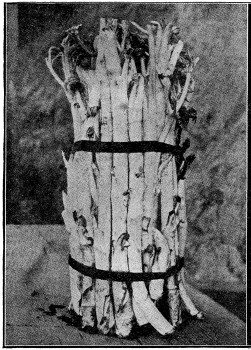
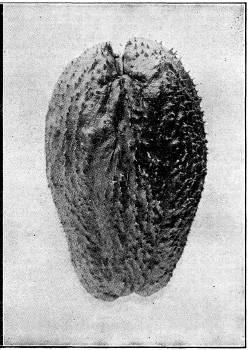
UDO—This fine salad vegetable comes from Japan, is similar to asparagus, and much easier to grow. It has a fresh taste like lettuce with an agreeable flavor. There are numerous ways of serving it, but it is possibly best simply boiled and seasoned like asparagus. It will grow in any soil suitable for asparagus. THE CHAYOTE, or Vegetable Pear, is large, green and pear-shaped, with a texture somewhat like a squash, and a flavor more delicate than a cucumber. It is grown on lowlands near the coast, in a moderately warm climate. Its keeping qualities are remarkable, making it an excellent winter vegetable. Both roots and stalks are also edible.
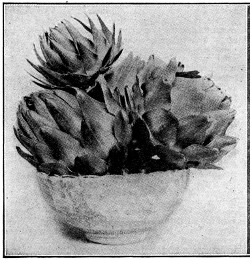
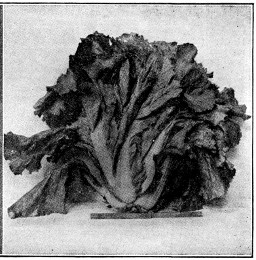
THE BUR ARTICHOKE, long imported from France, may now be successfully grown in this country. It is used like the cauliflower in many ways but commands a higher price. The scalelike leaves make a delicious salad when pulled apart after boiling, and may be served on lettuce with either mayonnaise or French dressing. THE PETSAI, or Odorless Cabbage, is much superior to the ordinary cabbage, and is wholly without disagreeable odor. It does not closely resemble cabbage in appearance; it is rather tall than squatty, and the leaves cluster around the stalk compactly. It requires cultivation similar to cabbage but is not transplanted. It is served after the fashion of cabbage.
Brussels Sprouts, or Bud-bearing Cabbage (B. oleracea bullata minor) originated in Belgium, and has been cultivated around Brussels from time immemorial, although it is only within the last fifty years that it has become generally known in this country. It is so named on account of its peculiar habit, producing a bud-like cluster of leaves in the axil of each leaf from the base to the top of the stem. These buds or sprouts are the parts of the plant that are eaten, and are highly esteemed for their delicate flavor and wholesome quality. Brussels sprouts is one of the hardiest of green winter vegetables. As a rule, the shorter-stemmed strains have the largest and most compact sprouts, and are consequently the most favored. As regards cultivation, the plant, like all of the cabbage tribe, requires deep, rich soil to bring it to fullest perfection.
Cabbage (Brassica oleraceæ) is found in a wild state in various parts of Europe and in southern England, always on maritime cliffs. It is a biennial, with fleshy lobed leaves covered with a glaucous bloom; altogether so different in form and appearance from the cabbage of our gardens that few would believe it could possibly have been the parent of so varied a progeny as are comprised in the Savoy, Brussels Sprouts, Cauliflower, Broccoli and other numerous varieties. Over one hundred fifty varieties are enumerated. The common or cultivated cabbage is well known, and from a very early period has been a favorite culinary vegetable in almost daily use throughout the civilized world.
Carrot (Daucus) of which there are about twenty species are mostly natives of the Mediterranean countries. The common carrot is a biennial plant and is universally cultivated for the sake of its root. In all varieties of the wild plant this is slender, woody and of a very strong flavor; and that of the cultivated variety is much thicker and more fleshy, much milder in its flavor and qualities. Its color is generally red, but sometimes orange or yellowish white.
Cauliflower (B. oleracea botrytis cauliflora) is of great antiquity, but its origin is unknown, although it is usually ascribed to Italy. To the English and Dutch gardeners we are chiefly indebted for the perfection it has attained. Heads of immense size are now grown for the market. It is by no means uncommon to see a head perfectly sound and smooth, fully ten inches in diameter, and, contrary to the usual rule, size is not obtained at the expense of quality, the larger, if differing at all, being more tender and delicious. The varieties of the Cauliflower are numerous.
Celery (Apium graveolens). The plant is hardy, and is largely cultivated in the United States, Canada and Europe. In cultivation, however, abundant nutrition has greatly mollified its properties, and two principal forms have arisen. The first sort is the common celery, where the familiar long blanched succulent stalks are produced by transplanting the seedlings into richly manured trenches, which are filled up as the plants grow, and finally raised into ridges over which little more than the tops of the leaves appear; and a supply is thus insured throughout the whole winter. The other form is the turnip-rooted celery, or celeriac.
Cucumber (Cucumis sativus). The common cucumber is distinguished by heart-shaped leaves, which are rough with hairs approaching to bristles, and oblong fruit. It is a native of the middle and south of Asia, and has been cultivated from the earliest times. Its fruit forms an important article of food in its native regions, the south of Europe, etc., and an esteemed delicacy in colder countries, where it is produced by the aid of artificial heat. Many varieties are in cultivation, with fruit from four inches to two feet long, rough, smooth, etc.
Vegetable Marrow (Cucurbita ovifera) is closely allied to the cucumber, and is supposed to have been originally brought from Persia. Like the cucumber it is a tender annual, but succeeds out of doors in summer in this country.
Many other members of the cucumber family are cultivated as esculents, notably in the warmer parts of the world. Of these the chief are Pumpkins, Melon Pumpkin, Water Melon, Chocho, Bottle Gourd, Squash.
Egg-plant (Solanum melongena). The egg-like fruit known as egg-apple, etc., is a favorite article of food in the East Indies, and has thence been introduced to most warm countries. It varies in size from that of a hen’s egg to that of a swan’s egg, in color from white or yellow to violet. Egg-plants are much grown in the United States, where “Jew’s-apple” is one of the names for the fruit.
Kale, or Borecole (B. oleracea acephala) is distinguished by its leaves being beautifully cut and curled, of a green or purple color, or variegated with red, green, and yellow, never closing so as to form a heart, nor producing edible flower heads like a Cauliflower. Its leaves and tender shoots are not only edible but form one of the most useful green vegetables.
Lentils (Ervum Lens), a slender plant supposed to be native of Western Asia, Greece and Italy. The Lentil was introduced into Egypt as a cultivated plant at an early date, and from this center spread east and west. It is a weak, straggling plant, rarely exceeding eighteen inches high, often much more dwarfed, having pinnate leaves terminating in tendrils. The flowers are white, lilac, or pale blue, small and formed like those of a pea. There are three varieties of lentil recognized in the countries in which it is cultivated: the small brown, which is the lightest flavored and the best esteemed for soups and haricots; the yellow variety, which is slightly larger; and the lentil of Provence, France, which has seeds as large as a small pea, but is better appreciated as fodder for cattle than for food for man.
Lettuce (Lactuca sativa). The garden lettuce is supposed to be a native of the East Indies, but is not known to exist anywhere in a wild state, and from remote antiquity has been cultivated as an esculent and particularly as a salad. It has a leafy stem, oblong leaves, a spreading, flat-topped panicle, with yellow flowers, and a fruit without margin. It is now generally cultivated in all parts of the world where the climate admits of it.
Melon (Cucumis melo), a plant of the same genus with the cucumber, much cultivated for its fruit. The melon is an annual, with trailing or climbing stems, lateral tendrils, rounded, angular leaves, small, yellow flowers and large round or somewhat ovate fruit. The varieties in cultivation are very numerous, some of them distinguished by a thick and warty rind, some by a rind cracked in a net-like manner, some by ribs and furrows, some by a perfectly smooth and thin rind; they differ also in the color of the flesh of the fruit, which is green, red, yellow, etc.; and in the size of the fruit, which varies from three or four inches to a foot or more in diameter. They are widely cultivated in the United States, ranking fifth in acreage among vegetables. New Jersey leads in production, growing about one-seventh of entire crop. Cultivation under irrigation is highly developed in Colorado. They are often called cantaloupe in the markets.
Mushroom. See Cryptogams.
Okra or Gumbo (Hibiscus esculentus) is a generally used food plant most commonly employed in soups in the East and West Indies and also in the southern United States. It was anciently grown in tropical Africa and Egypt, and is now diffused in tropical countries and in the southern United States.
Onion (Allium Cepa) is extensively cultivated throughout the world, and is grown in every state in the United States, New York and Ohio leading in production. Bermuda and Spanish varieties are now grown in California. It was cultivated by the ancient Egyptians; also by the Greeks and Romans. Many other important vegetables are allied to the onion, viz.: Leek, Shallot, Onion, Chives and Garlic. All of these are highly esteemed in cookery.
Parsnip (Pastinaca), an annual, biennial, or perennial herb, with carrot-like, often fleshy root and pinnate leaves. The parsnip has long been cultivated for the sake of its root, which in cultivation has greatly increased in size and become more fleshy. The flavor is disliked by some, as well as the too great sweetness, but highly relished by others; and the root of the parsnip is more nutritious than that of the carrot. The crop is also on many soils of larger quantity; and although the parsnip delights in a very open, rich soil, it will succeed in clayey soils far too stiff for the carrot.
Pea (Pisum sativum) has been cultivated from very remote times. The pea plant is covered with a delicate, glaucous bloom, and its white or pale violet flowers are familiar to all. The pods are pendulous, smooth, deep green and variable in size and may contain any number up to thirteen (rarely more) peas. The peas when ripe are also variable, some being white and round, others blue and wrinkled, and a few large, irregular, and dull green. They are cultivated in Europe, Asia and the United States. Chiefly used as green vegetable, but also for fodder. Ranks seventh in acreage among minor vegetables in the United States.
Peppers or Capsicums or Chillies (Capsicum annum and C. frutescens) are widely cultivated in the warmer parts of both hemispheres. The fruits vary considerably in shape and size, and when green are cooked and eaten as a vegetable.
Potato (Solanum tuberosum) is the greatest of vegetable gifts to man. Its cabbage-like stalks have a height of from eighteen to twenty inches; its leaves are solitary and pennate; its large pentagonal blossoms are white, reddish or violet; its fruit is a green berry. Attached to its underground runners are those bulbs which serve as food to many millions of people, and from which starch, sago, sugar of grapes and brandy are prepared.
The potato stands second only to corn as the most important contribution of America to the food plants of the world. Preëminently the most important vegetable grown in Europe and America. The world crop is enormous, exceeding five billion bushels; in bulk surpassing by about one-half the world crop of wheat, corn or oats. Germany, Russia, Austria-Hungary, France, the United States and Great Britain are the chief producers in order named. Germany grows one-third of the world crop, Russia one-fifth. In the United States they are grown in every state and territory; also in Hawaii and Alaska.
Their cultivation was even ancient in Peru. It was widely diffused from Chile to Colombia at time of Spanish discovery, but there were no evidences of culture in Mexico or by North American Indians. It was introduced into what is now North Carolina and Virginia late in the sixteenth century; taken to Europe first by the Spaniards early in the sixteenth century and to England by Sir Walter Raleigh in 1585. Sweet Potatoes are the thickened roots of Ipomoea Batatas, a climbing plant. This plant is extensively cultivated in most tropical countries, although not known in a wild state. The root contains much starch and saccharine matter. They are second only to the potato in the United States, being widely grown in the South—Georgia, North Carolina, Alabama, South Carolina and Tennessee producing over half of the total crop, which in acreage and value is about one-fifth that of the potato.
Radish (Raphanus sativus) is a well-known plant, the root of which is a valuable salad; it has been cultivated from a remote period. It is now possible to have a supply the whole year round. Crisp, tender radishes with delicate flavor are only obtained by quick growth on rich, moist soil. The earliest crops are grown in frames on hotbeds, the crop being ready about five weeks from sowing. The earliest sowing outdoors can be made from December to February in sheltered sunny positions, the beds being covered with a thick layer of litter. There are round, oval and long-rooted varieties.
Tomato or Love-apple (Lycopersicum esculentum). The fruit of this plant is fleshy, usually red or yellow, divided into two, three or more cells containing numerous seeds imbedded in pulp. The tomato is one of a genus of several species, all natives of South America, chiefly on the Peruvian side. In the warmer countries of the United States, Europe and other countries in which the summer is warm and prolonged, it has long been cultivated for the excellent qualities of the fruit as an article of diet. The tomato is extensively grown as a field crop for canneries in the United States, and in the North is one of the chief winter-forcing crops. It is exceeded in acreage only by the watermelon and sweet corn among the minor vegetables. In the United States the crop exceeds thirty million bushels, nearly half of which is grown in Maryland and New Jersey.
Turnip (Brassica rapa). Although the turnip is of great value for feeding stock, it is not very nutritious, no less than nine to ninety-six parts of its weight actually consisting of water. One of the best early varieties is purple top strap leaf. Early flat Dutch is also good. The Swedish turnip, or ruta baga, which was introduced into cultivation from the north of Europe more recently than the common turnip, and has proved of very great value to the farmer, is regarded by some botanists as a variety of the same species, and by some as a variety of B. napus, but more generally as a variety of B. campestris, a species common in cornfields and sides of ditches in Britain and the north of Europe.
Watermelon (Citrullus vulgaris). The most popular melon in cultivation, is extensively grown in warm climates throughout the world, but most abundantly in southern Russia and the southern United States. It leads all minor vegetables in acreage, being surpassed only by the major vegetables, potato and sweet potato. Texas, Georgia, North Carolina and Missouri are the chief growers in the order named. Very anciently it was cultivated by Egyptians.
Yam (Dioscorea alata). Yams, the tubers of various species of Dioscorea, are cultivated in nearly all tropical countries. Yam tubers abound in farinaceous matter and often reach a large size. They resemble but are inferior to the sweet potato.
PLANTING TABLE FOR GARDEN VEGETABLES
Time given is for latitude of New York. Each one hundred miles north or south will make a difference of from five to seven days in the season. The distances given here indicate the distance apart the plants should stand after thinning. The seed should be sown much nearer together. Class A. These plants may be started early (in the greenhouse or hotbed, in early spring, or outdoors in the seedbed later), and afterwards transplanted to their permanent location. Class B. These crops usually occupy the ground for the entire season. Class C. These are quick maturing crops which, for a constant supply, should be planted at several different times in “succession”—a week or two weeks apart. Class D. These are crops which often may be cleared off in time to permit planting another quickly maturing crop, usually of some early variety. Class E. These crops are supplementary to those in Class D and may be used to obtain a second crop out of the ground from which early crops have been cleared.
Name and Variety Time to Plant Class How to Plant and Care for
Asparagus (Plant). April. B Plant 4 inches deep, at distance of 1 foot; in rows 3 feet apart; heavily manured, spreading the roots out evenly. Do not cut for use until second spring. Keep bed clean; cut off tops in the fall. Transplant third spring.
Asparagus (Seed). April-May. B Seed 2 to 4 inches apart, in rows 15 inches apart; 1 inch deep.
Beans, Bush Lima. Burpee Improved. March 15, under glass. May 1, outside. B Tender. Set out in May. Plant 2 inches deep in rows 2 feet apart.
Beans, Pole Lima. King of Garden. May 15, outside. Ready in 10 weeks. B Tender. Plant 2 inches deep in hills 4 feet apart. Pinch off at 6 feet high. 1 pint of seed to 50 hills.
Beans, String. Bountiful. Hodson Wax. Bountiful. Hodson Wax. Bountiful. Hodson Wax. Bountiful. April 15, outside. May 1, outside. May 15, outside. June 1, outside. June 15, outside. July 1, outside. July 15, outside. Ready in 6 weeks. C Tender. Plant 2 inches deep in rows 2 feet apart, 6 inches apart in row. 1 pint of seed to 75-foot row.
Beets. Eclipse. Crimson Globe. March 1, under glass. April 15, outside. May 15, outside. June 15, outside. July 15, outside. Ready in 9 weeks. A-D B-E Transplant outside in April. Hardy. Plant 1 inch deep in rows 2 feet apart, 6 inches apart in row. Soak seed over night. 1 ounce of seed to 50 feet. Winter in sand or pits.
Brussels Sprouts. L. I. Half Dwarf. March 15, under glass. May 1, under glass. Ready in 20 weeks. A-E Plant 1⁄2 inch deep in rows 2 feet apart, 1 foot apart in row. 1 ounce of seed to 1500 plants. Hang in cellar for winter.
Cabbage. Copenhagen Market. Drumhead Savoy. March 1, under glass. March 1, under glass. May 1, under glass. Transplant to garden. Ready in 18 weeks. A-C Hardy. Plant 1⁄2 inch deep in rows 3 feet apart, 2 feet apart in row. Manure well. 1 ounce of seed to 2500 plants. Winter in pits upside down.
Carrot. Half-long Danvers. April 1, outside. June 1, outside. Ready in 15 weeks. C-B Hardy. Plant 1⁄2 inch deep in rows 11⁄2 feet apart, 6 inches apart in row. 1 ounce of seed to 100 feet. Winter in sand or pits.
Cauliflower. Dwarf Erfurt. March 1, under glass. April 1, under glass. May 1, under glass. Transplant to garden. A-C-E Hardy. Plant 1⁄2 inch deep in rows 3 feet apart, 2 feet apart in row. 1 ounce seed to 2500 plants. Manure well.
Chard. Lucullus. April 15, outside. Ready in 8 weeks. ... Hardy. Plant 1 inch deep in rows 2 feet apart, 1 foot apart in row. 1 ounce of seed to 50 feet.
Celery. Golden Self-blanching. Fin de Siecle. March 1, under glass. April 15, under glass. Ready in 18 weeks. A-E Hardy. Set out in May. Barely cover. Rows 3 feet apart, 1⁄2 feet apart in row. Rich, moist soil. Transplant twice. 1 ounce of seed to 3000 plants. In August bank up to blanch. Winter in pits.
Corn. Golden Bantam. Evergreen. Country Gentleman. Mexican. Country Gentleman. April 1, under glass. April 15, outside. May 1, outside. May 1, outside. May 15, outside. June 1, outside. June 1, outside. June 15, outside. July 15, outside. Ready: Early 9 weeks. Ready: Late 11 weeks. B-E Tender. Set out in May. Plant 2 inches deep in rows 4 feet apart, 2 feet apart in row. Manure and remove suckers. 1 quart of seed to 200 hills.
Cucumber. Cool and Crisp. March 15, under glass. May 1, outside. June 1, outside. July 1, outside. Ready in 9 weeks. A-B Tender. Set out in May. Plant 1 inch deep, 4 feet apart. 1 ounce of seed to 50 hills.
Endive. Green Curled. July 1. Ready in 8 weeks. A-E Hardy. Plant in rows 2 feet apart, 1 foot apart in row. 1 ounce of seed to 100-foot row. Transplant to dark cellar to blanch for winter.
Eggplant. Black Beauty. March 1, under glass, with good heat. Transplant to garden. Ready in 15 weeks. A-B Very tender. Plant 1⁄2 inch deep in rows 3 feet apart, 2 feet apart in row. Rich and moist soil. 1 ounce of seed to 1000 plants. Store dry for late fall use.
Kale. Dwarf Scotch. Siberian. May 15, under glass. Transplant to garden like cabbage. July 1, outside. Ready in 20 weeks. E Hardy. Plant 1⁄2 inch deep in rows 2 feet apart, 1 foot apart in row. 1 ounce of seed to 200 feet. Mulch for winter.
Lettuce. May King. March 1, under glass. March 15, under glass. Outside every 2 weeks to Sept. 1. Ready in 6 weeks. C Hardy. Plant 1⁄4 inch deep in rows 11⁄2 feet apart. Rich soil. 1 ounce of seed to 3000 plants. Shade and water in summer.
Muskmelon. Emerald Gem. Osage. Early Hackensack. May 1, outside. May 1, outside. May 1, outside. Ready in 6 weeks. A-B Plant 1 inch deep in hills four feet apart. Pinch off ends of shoots. Make special soil of sand and manure. 1 ounce of seed to 50 hills.
Watermelon. Cole’s Early. Halbert Honey. Cole’s Early. Halbert Honey. May 1, outside. May 1, outside. B Tender. Plant 1 inch deep in hills 6 feet apart. Make special soil of sand and manure. Pinch off ends of shoots. 1 ounce of seed to 30 hills.
Onion. Yellow Danvers. Prizetakers. April 1, plant sets. Seeds April 15, outside. Seeds April 15, outside. Ready in 18 weeks from seed. A-B Hardy. Plant seeds 1⁄2 inch deep; sets 2 inches deep in rows 2 feet apart. 1 ounce of seed to 150 feet. Dig and dry for winter. 1 quart sets to 100 feet.
Parsley. Triple Curled. April 15, outside. Ready in 8 weeks. B Hardy. Plant 1⁄2 inch deep in rows 2 feet apart, 6 inches apart in row. Soak seeds over night. Seeds are slow to start. 1 ounce of seed to 150-foot row.
Parsnip. Hollow Crown. April 15, outside. Ready in 15 weeks. B Hardy. Plant 1⁄2 inch deep in rows 11⁄2 feet apart. Seeds start slowly. 1 ounce seed to 200 feet. Winter in place or in pits. Improved by frost.
Peas. Thomas Laxton. Juno. Telephone. April 15, outside. May 1, outside. May 1, outside. May 15, outside. June 1, outside. June 15, outside. July 1, outside. July 15, outside. Ready in 8 weeks. B-E Hardy. Plant early varieties 4 inches deep and late varieties 3 inches deep. Early in double rows and late in rows 3 feet apart. Moist soil. 1 quart of seed to 150 feet.
Pepper. Chinese Giant. March 1, under glass. Set out in May. Ready in 20 weeks. A Very tender. Plant 1⁄2 inch deep in rows 2 feet apart. Start in good heat. Hang in cellar for winter.
Potatoes. Noroton Beauty. Gold Coin. April 1 (early). May 1 (early). May 15 (main crop). Ready in 12 weeks. B Plant early varieties 2 inches deep, and late varieties 5 inches deep in rows 3 feet apart. 1 peck to 100-foot row. 8 or 10 bushels to acre. Sprout before planting.
Pumpkin. Winter Luxury. May 15, outside. Ready in 15 weeks. B Tender. Plant 6 feet apart. Manure. 1 ounce of seed to 50 hills. Winter warm and dry.
Radish. French Breakfast. March 7, under glass and every 2 weeks. Ready in 4 weeks. C Hardy. Plant 1⁄2 inch deep. 1 ounce of seed to 100 feet. Soil light and rich.
Rhubarb (Plant). April. B Set out root-clumps at distance of 2 to 3 feet, in rows 3 to 4 feet apart. Give them dressing of bone meal and soda in the spring.
Salsify. Mammoth Sandwich Island. April 15, outside. Ready in 18 weeks. B Hardy. Plant 1⁄4 inch deep in rows 2 feet apart. 1 ounce of seed to 100 feet. Winter in place or in pits.
Spinach. Victoria. New Zealand. April 1, outside. April 15, outside. May 1, outside. May 1, outside. June 1, outside. Sept. 1, outside. Ready in 5 weeks. A-B-E Hardy. Plant 1 inch deep in rows 11⁄2 feet apart. 1 ounce of seed to 200 feet. Very rich soil. Winter under straw cover.
Squash. Crookneck. Delicata. Early Golden Custard. Crookneck. Hubbard. March 15, under glass. May 15, outside. May 15, outside. May 15, outside. Ready in 7 weeks. May 15, outside. Ready in 15 weeks. B Tender. Plant 1 inch deep, 4 feet apart. Hubbard 6 feet apart. Winter warm and dry. 1 ounce of seed for 25 hills. For Hubbard make special soil of sand and manure.
Tomato. Earliana. Crimson Cushion. March 1, under glass. April 1, under glass. Set out in May. Ready in 18 weeks. B-A Tender. Plant 1⁄2 inch deep in rows 3 feet apart, 3 feet apart in row. Keep hotbed cool. Pinch off side shoots. 1 ounce of seed to 2000 plants. Hang in cellar for early winter.
Turnip. Early Milan White. April 17, outside. June 15, outside. Ready in 9 weeks. C Hardy. Plant 1⁄2 inch deep in rows 11⁄2 feet apart. 1 ounce of seed to 200 feet. Winter in pits.
PLANTING TABLE FOR GARDEN VEGETABLES—Continued Especially Adapted to Southern United States
Name and Variety Time to Plant Class How to Plant and Care for
Artichoke, Jerusalem. March 1, outside. Ready in 6 to 8 months. ... Hardy Perennial. Plant tubers 6 inches deep in rows 5 feet apart, 2 feet apart in row. Light soil and sun. 2 quarts of tubers to 100 feet. Fine for soup or boiled and creamed, or salad or pickles.
Asparagus. Palmetto. December, outside. Ready in February or March. B Hardy. Plant 2-year roots 8 inches deep in rows 2 feet apart, 1 foot apart in row. Rich and moist mulch with manure all summer, salt well.
Beans. Valentine or Refugee or Golden Wax. Cold-frames or green- house. September 1 and every two weeks there- after. Ready in 6 weeks. B-C Tender. Plant seeds 2 inches deep in rows 11⁄2 feet apart, 4 inches apart in row. Not too rich soil. 1 quart for 150 feet.
Beets. Eclipse or Crimson Globe. Sept. 1, outside. Oct. 1, outside. Ready in 9 weeks. A-D B-E Hardy. Plant 1 inch deep in rows 11⁄2 feet apart. Thin to 4 inches apart. Deep soil, no fresh manure. 1 ounce to 50 feet. Soak seed over night.
Chard. Lucullus. Sept. 15, cold-frame. ... Almost hardy. Grow like beets. Use outside leaves, leaving crown to grow. Use for greens, or leaf stalks like asparagus.
Brussels Sprouts. Seed-bed August 1. Transplant outside September 15. Ready in 4 months. A-E Hardy. Plant seeds 1⁄2 inch deep in rows 2 feet apart, 11⁄2 feet apart in row. Cultivate like cabbage. 1 packet of seed enough.
Cabbage. Wakefield or Savoy or Winningstadt. Seed-bed August 15. Transplant outside September. Ready in 4 months. A-C-E Hardy. Plant seeds 1⁄2 inch deep. Plant rows 3 feet apart; 11⁄2 feet apart in rows. Moist, manure and cultivate well. 1 packet of seed enough. Set plants deep.
Carrots. Half Long or Long Orange. Aug. 15, outside. Oct. 1, outside. Ready 12 to 15 weeks. C-B Hardy. Plant 1⁄2 inch deep in rows 11⁄2 feet apart, 4 inches apart in row. 1 ounce for 200 feet. Seed slow to start.
Cauliflower. Early Snowball or Dwarf Erfurt. Seed-bed September 1. Transplant to cold- frames October 1. Ready in 4 months. A-C-E Almost hardy. Plant seed 1⁄2 inch deep in rows 2 feet apart, 11⁄2 feet apart in row. Moist, rich and manure. 1 packet of seed enough. Blanch heads by tying up.
Collards. Cultivate like cabbage. ... A non-heading cabbage not equal to it in quality.
Cucumber. English Telegraph. Sept. 15, greenhouse. Oct. 15, greenhouse. Nov. 15, greenhouse. Dec. 15, greenhouse. Day heat, 85°. Night heat, 65°. Ready in 6 to 8 weeks. A-B Tender. Plant 1 inch deep, 5 feet apart. 1 ounce for 50 hills. Moist, rich soil. Pinch out main stem when 2 feet long. Pinch outside branches at 6 or 8 feet. Leave only 3 side branches to a plant and only half the fruit. Do not fertilize blossoms.
Cress, Water. Outside in water. September 1. Ready in 3 months. ... Hardy. Sow in quiet pool near running water. Start seed on mud, then flood 3 inches deep. 1 packet of seed enough.
Endive. Green curled or Self-blanching. Sept. 1, outside. Nov. 1, outside or in cold-frames. Ready in 3 months. A-E Hardy. Plant 1⁄2 inch deep in rows 11⁄2 feet apart. Thin to 10 inches apart in row. Light, rich soil, deep. 1 ounce for 100 feet. Can transplant like lettuce. Tie up heads for blanching 2 weeks before use.
Eggplant. Round Purple. Aug. 15, greenhouse. Dry heat, day, 90°. Dry heat, night, 65°. Ready in 4 or 5 months. A-B Very tender. Plant 1⁄2 inch deep, 2 feet apart. Rich and moist soil. 1 packet enough. Blossoms should be fertilized by hand.
Kale. Dwarf Scotch or Tall Scotch. Aug. 15, seed-bed. Sept. 15, set outside. Sept. 15, start some. October, set outside. Ready in 3 or 4 months. E Hardy. Plant 1⁄2 inch deep in rows 11⁄2 feet apart, 1 foot apart in row. Deep sand and mold. 1 ounce to 200 feet. When top is cut off for use, side shoots will start.
Kohlrabi. Early Vienna. October 1, outside. Ready in 2 to 3 months. C Hardy. Plant 1⁄2 inch deep in rows 11⁄2 feet apart, 6 inches apart in row. 1 ounce for 150 feet. Grow and use like turnip.
Lettuce. May King or California Butter or Boston Market. Seed-bed September 15 and every 2 weeks after. Transplant into cold- frames. C Almost hardy. 1⁄4 inch deep, 6 inches apart each way. Light, rich soil. 1 ounce for 2000 plants.
Muskmelon. English: Sutton’s Ar. Sutton’s Emerald Gem. August 15, greenhouse. Dry heat, day 90°. Dry heat, night, 70°. Ready in 4 to 5 months. Sets ready 2 months. A-B Tender. Plant 1 inch deep in hills 5 feet apart. Manure. Light soil. 1 ounce for 50 hills. Blossoms to be fertilized by hand. Pinch off tip of vine when first blossoms come.
Onions. Prizetaker or Multiplier or Globe. July 1, outside, seed. Sept. 1, outside, sets. Ready in 4 to 5 months. A-B Hardy. Plant seed 1⁄2 inch deep, sets 2 inches deep in rows 11⁄2 feet apart. Moist, rich soil and sun. 1 ounce of seed for 150 feet. 1 quart of sets for 100 feet.
Parsley. September 1, outside. Soak seeds over night. Ready in 2 months. B Hardy. Plant 1⁄4 inch deep in rows 11⁄2 feet apart. 1 packet seed enough. Seeds slow to start.
Parsnip. Hollow Crown. September 1, outside. B Hardy. Plant 1⁄2 inch deep in rows 11⁄2 feet apart, 3 inches apart in row. Seeds slow to start. Rich, deep soil. 1 ounce for 200 feet.
Peanuts. Virginia or Georgia. April 1, outside. ... Plant 3 inches deep in hills 2 feet apart. Light, deep soil. Shell before planting.
Peas. Nott’s Excelsior. Gradus or Tom Thumb. Extra Early (smooth varieties). Marrow Fat. In cold-frames. September 15 and every 2 weeks. Ready in 2 to 3 months. Outside same dates (always an uncertain crop). Outside, December 1 (more hardy, less quality). B-E Almost hardy. Plant 4 inches deep in rows 2 feet apart. Moist, not too rich. Soak over night. 1 pint to 100 feet.
Pepper. Sweet Spanish or Sweet Mountain. August 1, greenhouse. Moist heat, day, 90°. Moist heat, night, 70°. Ready in 4 months. B Tender. Plant seeds 1⁄2 inch deep, 2 feet apart. 1 packet of seed enough. Need not fertilize blossoms.
Potato. Irish Cobbler or other earlies. August 1, outside. For new potatoes all winter. Ready in 3 months. B Hardy. Plant whole in rows 3 feet apart, 1 foot apart in row. Moist, light, rich soil. 8 bushels per acre.
Potato, Sweet. Yellow Yam or Georgia Yam. Bed thickly in March. Transplant the sprouts outside May 1. Ready in 6 months. ... Very deep sand. Rows 3 feet apart, 2 feet apart in row. 3 pounds to 100-foot row. Dig as wanted through the winter.
Radish. French Breakfast or Scarlet Turnip. Oct. 1, outside. Oct. 15, outside. Nov. 1, outside. Cold-frames November 1 and every 10 days. Ready in 6 weeks. C Hardy. Plant 1⁄2 inch deep in rows 8 inches apart. 1 ounce to 100-foot row.
Salsify. Sandwich Island. Outside, August 1 and September. (A difficult crop in the South). Ready in 5 months. B Hardy. Plant 1⁄4 inch deep in rows 11⁄2 feet apart, 4 inches apart in row. Water freely.
Spinach. Viroflay. New Zealand. Sept. 1, outside. Oct. 1, outside. Nov. 1, outside. (doubtful crop). Sept. 1, cold-frame. (A sure abundant product all winter). A-B-E Almost hardy. Plant 1 inch deep in rows 11⁄2 feet apart, 3 inches apart in row. 1 ounce for 150 feet.
Strawberries. Lady Thompson or Hefflin or Hoffman. Transplant every year in October. Ready in February or March. ... Hardy. Rows 2 feet apart, 1 foot apart in rows. Rich, sandy loam. Mulch in summer. No stable manure. Confine to single crowns.
Tomato. Beauty or Perfection. Aug. 15, greenhouse. Sept. 15, greenhouse. Oct. 15, greenhouse. Ready in 4 months. B-A Tender. Plant 1⁄2 inch deep, 11⁄2 feet apart. 1 packet of seed enough. Pinch out tips at desired height. Pinch out all side shoots. Fertilize blossoms by hand.
Turnip. Early Milan. October 1, outside. Ready in 2 to 3 months. C Hardy. Plant 1⁄2 inch deep in rows 11⁄2 feet apart, 3 inches apart in row. 1 ounce for 200 feet. Moist and rich soil.
III. THE FRUIT TREES
The fruit trees are cultivated for the sake of their fruit. They bear either kernel fruit, when their seed kernels are enclosed in cores of parchment-like formation; or stone fruit, when the seed kernel is enclosed in a hard shell, which is in its turn enclosed in some succulent pulp; or shell fruit, when the fleshy interior is enclosed in a hard shell.
Almond, a small tree belonging to the rose family, native to northwest Africa. The flowers are solitary and generally pink, and appear before the lance-shaped leaves. The fruit is egg-shaped, downy externally, with a tough, fibrous covering and a wrinkled stone. It has long been widely cultivated, and many varieties exist, differing in the hardness of the stone and in the flavor of the seed. Sweet Almonds include the large thin-shelled Jordan (from the French jardin), the Valencia almond, imported as a dessert fruit from Malaga, the smaller Barbary and Italian forms, and the California product. The Bitter Almond yields an essential oil, employed in confectionery, but dangerous from sometimes containing prussic acid.
Apple (Pyrus Malus), grows wild in forests, but it is found artificially improved everywhere in gardens and orchards. Its bark is generally smooth; its wood somewhat soft; its leaves oval-shaped and about double the length of their stalks; its blossoms are white with reddish margins. Fruit horticulture has produced many species of apples in the course of time, and they are now the most important fruit of the temperate zone, area of production, consumption, and variety of product being considered, ranking with the grape, olive, orange, lemon and banana, among the six leading fruits of the world. North America is preëminently the leading apple growing region. In the United States, New York, Pennsylvania, and Ohio produce about one-third of the total crop.
The cultivation of the apple is prehistoric. Abundantly used by Lake Dwellers of the Stone Age in Italy and Switzerland.
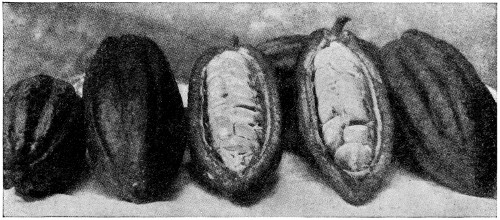
CACAO FRUIT OR PODS
Each pod contains some sixty seeds, arranged in five or eight rows (mostly five); the seeds are white when they are fresh, but brown and covered with a fragile skin or shell when dried. These seeds, which are not unlike beans or almonds, are imbedded in a mass of mucilaginous pulp, of a sweet but acid taste. The seeds only require to be extracted, cured and dried, to become the cacao-beans of commerce.
Apricot (Prunus Armeniaca). The tree attains a height of thirteen to sixteen feet, and shows its blossoms in the months of March and April. Its smooth leaves are oval, doubly serrated; and its white blossoms have a tinge of red. Its globular, velvet-like, downy fruits are a favorite dish for dessert.
Apricots are extensively grown in north India, Persia, south Europe and Egypt. Although grown in New York, the crop is only commercially important in California and Oregon, whence large quantities of the fresh and dried fruit are shipped to the eastern states and abroad.
HOW THE COCOA BEANS ARE DRIED AND ROASTED
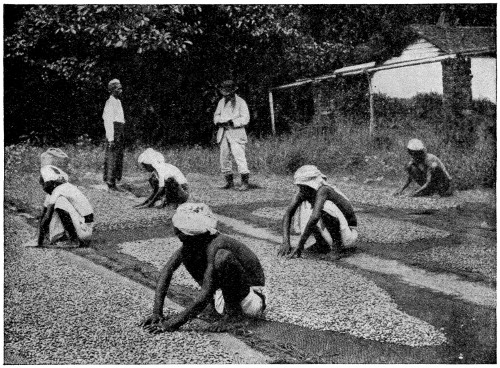
Small crops of beans are spread out on the ground, or on a tray, or on a piece of matting, and dried in the sun. In other cases, artificial heat is used in specially constructed and equipped drying-houses.
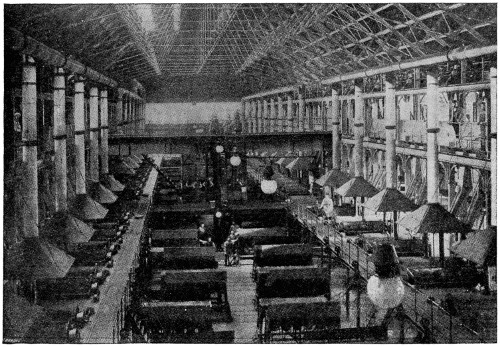
The beans are roasted, similar to coffee, in large iron drums to increase the aroma, make them more soluable in water, and improve their flavor. After being ground, and mixed with sugar, the product becomes chocolate—and is used in many ways.
Cultivation in China antedates 2000 B. C. It was introduced into Europe at the time of Alexander the Great, about 325 B. C.
Bread-fruit (Artocarpus incisa), grows upon the islands of the Pacific Ocean, and has also been transplanted to those parts of America which lie in the Torrid Zone. It attains a very great height, and bears fruits weighing from three to four pounds. The latter are cut into slices, and after being dried and roasted are used as food. These fruits, when pounded and mixed with milk of the cocoanut, form a dough, which is either consumed raw or baked into bread. All parts of this tree are useful; its yellow wood is used for the construction of houses, from its fibres articles of clothing are made, and its sap is used for making birdlime. Its large leaves serve as tablecloths and napkins, and its blossoms when dried are an excellent tinder. The bread-fruit tree is therefore much cultivated.
Butternut (Juglans cinerea), a North American species of walnut. Its dark yellow wood takes a fine polish, and is used in cabinet work; the bark yields a brown dye, and the brown-husked, rugged nuts contain oil, and are very pleasant in flavor.
Cacao (Theobroma cacao), a small tree, native to Mexico, Central America and the north of South America, is cultivated also in Brazil, Guiana, Trinidad and Grenada. It has large, oblong, pointed, entire leaves and clusters of flowers with rose-colored calyx and yellowish petals. The fruit is yellow, from six to ten inches long, and from three to five broad, oblong, blunt, with ten longitudinal ridges externally, and five chambers, containing ten or twenty seeds each, internally. The thick, tough rind is almost woody. The seeds are dried, roasted, bruised, and winnowed, so as to remove their testa from the cocoa-nibs or cotyledons. These contain more than fifty per cent of fat or cocoa-butter, part of which is generally removed in the process of “preparing” cocoa. It is used in making chocolate “creams.” Cocoa is also a valuable article of food; contains a gently stimulating alkaloid, theobromine, a fragrant essential oil and a red coloring matter. Sugar and vanilla or other flavoring are added in the preparation of chocolate.
Cherry (Prunus avium), is a stately tree of from twenty-five to forty-five feet in height. It has a pyramidal crown; its smooth bark splits crosswise; its leaves are elliptical, and covered with down on their lower sides; its blossoms are snowy white and its fruits sweet and of different colors. The latter furnish an agreeable nourishment, whether consumed raw, boiled, or preserved. Cherry-brandy is also made from them. The Cherry is cultivated in temperate regions of Europe, Asia, and the United States, and included among the fifteen leading fruits of the world. Ranks about eighth among fruits of the United States. Pennsylvania and California lead in production.
It was grown before the Christian Era in western Asia and southern Europe, and is mentioned in Vergil’s Georgics.
Cinnamon (Cinnamomum zeylanicum), is largely grown in Ceylon. The bark is stripped off two-year-old shoots in May and November and dried in the sun, undergoing a slight fermentation. It rolls up into quills, the thinnest being the best. Cinnamon contains a fragrant essential oil and has long been valued as a spice. It has also some medicinal value as a cordial and stomachic. It is also cultivated for bark in Brazil, West Indies, Egypt, and Java, but cultivation is now declining in favor of coffee.
Clove (Eugenia caryophyllata), a small evergreen spice tree, native of the Moluccas. The fruits are imported as mother cloves, and the stalks are used to adulterate the spice when ground. The whole plant is aromatic from the presence of the essential oil of cloves, which occurs to the extent of sixteen to eighteen per cent in the flower-buds. The dried flower buds are the cloves of commerce. Cultivated on many tropical islands and coasts, chiefly in the Moluccas, Sumatra, Java, Mauritius, Zanzibar, Jamaica, and French Guiana. The oil of cloves is widely used in flavoring and perfumery and also in medicine.
Cocoa-nut (Cocos nucifera), a small genus of palms. The cocoa-nut palm is apparently a native of the Indian Archipelago, but has been dispersed throughout the tropics from early times, flourishing especially near the sea. It has a cylindric stem reaching two feet in diameter, and from sixty to one hundred feet in height; a crown of pinnate leaves, each eighteen to twenty feet long, with a sheathing and fibrous base, succeeded by bunches of from ten to twenty fruits. These are about a foot long, six or eight inches across, three-sided, with a stony shell and one seed filling its cavity. The seed contains a fleshy kernel and a milky liquid. No tree of the tropics has so many uses, every part of it being employed, and in southern India furnishing several of the chief necessaries of life. The wood of the outer part of the stem is used, under the name of Porcupine wood, for inlaying; the leaves for thatch, mats, hats, etc.; the fibrous part under the name of coir, for cordage, etc.; the shell for bottles, cups, spoons, and when properly burned, for excellent charcoal and lamp-black. The solid white kernel contains thirty-six per cent of oil known as copra oil, from which, by pressure, the solid stearine used for candles is separated from the liquid lamp-oil. The “milk,” when fresh, is an agreeable drink; and from the sap sugar is obtained, and, by fermentation, toddy, from which vinegar and by distillation, arrack are prepared. It is extensively cultivated on the coasts of India, the East and West India Islands, and Brazil, and recently in Florida.
Coffee Tree (Coffea Arabica), originally a native of Africa attains a height of twenty-five to thirty feet. It is generally, however, kept at a much inferior height, in order to facilitate the collection of the fruit. Its leaves are evergreen; its blossoms white and fragrant. The fruit is a red berry about the size of a cherry, which contains two kernels, lying closely side by side: the coffee beans. These coffee beans are used everywhere for the preparation of that coffee which has become an indispensable beverage for many millions of people. Commercially it is of great importance, being largely grown in Brazil, Mexico, Central America, West Indies, Arabia, Java, Sumatra, Ceylon, India, and Hawaii. Brazil leads with a production of over one-half of the world’s crop. In the United States the consumption greatly exceeds that of tea.
Beginning of its cultivation is uncertain, but not ancient. It was introduced for cultivation in South America by the Dutch in 1718.
Date or Date-Palm (Phœnix dactylifera), a tree sixty to eighty feet high, with large pinnate leaves, cultivated in immense quantities in north Africa, western Asia and southern Europe. The stem is covered with leaf scars, and the flowers each have three sepals and three petals. The wood of the stem is used in building; huts are built of its leaves; the petioles are made into baskets and the fibre surrounding their bases into ropes and coarse cloth; the young leaf-bud or “cabbage” is sometimes eaten as a vegetable, or, if tapped, it yields a sugary sap which may be fermented; and even the seeds are ground into meal for camels. In central Arabia and some parts of north Africa the fruit forms the staple food of the inhabitants, camels, horses, and dogs. It is the chief source of wealth in Arabia. It was very anciently cultivated in Egypt and Babylonia and is the palm of the Bible.
SCENES IN THE PRODUCTION OF THE COFFEE BERRY
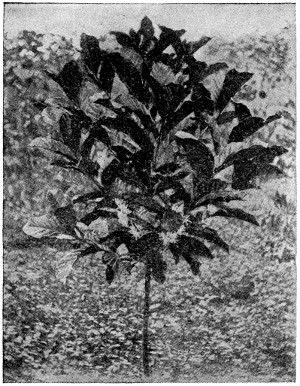
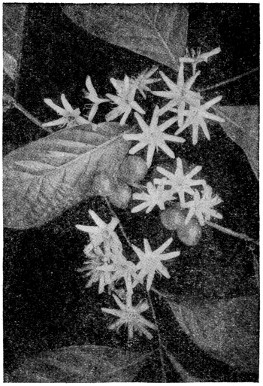
THE COFFEE PLANT IN FLOWER FROM FLOWER TO RIPE “CHERRIES”
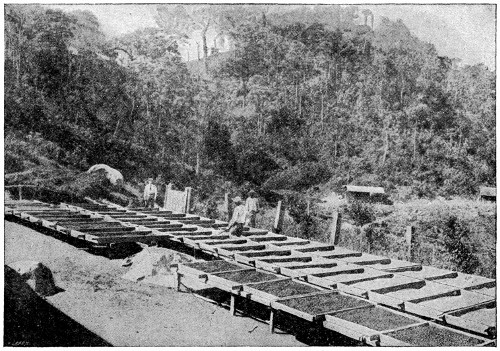
METHOD OF DRYING COFFEE ON WOODEN TRAYS IN THE OPEN AIR, AS STILL PRACTICED IN ARABIA AND OTHER ORIENTAL COUNTRIES
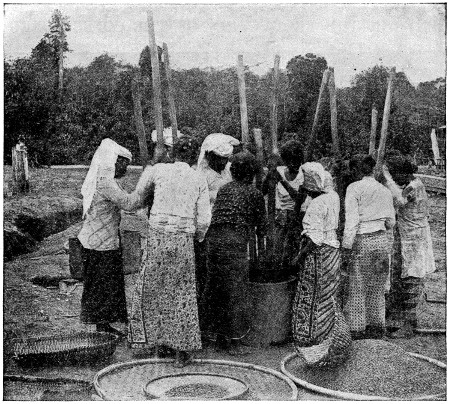
WOMEN OF JAVA HULLING COFFEE
The “cherries” when gathered contain two seeds, or coffee beans. The coverings are removed from the seeds by “hulling.”
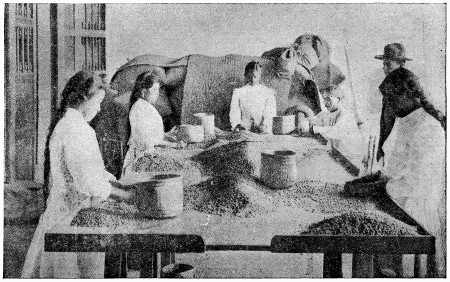
SIZING, OR SORTING THE COFFEE BEANS FOR THE MARKET BY PASSING THEM THROUGH SIEVES MESHES
Fig (Ficus Carica). The common fig is a native of the East. It is a low deciduous tree or shrub (fifteen to twenty-five feet), with large, deeply-lobed leaves, which are rough above and downy beneath. The branches are clothed with short hairs, and the bark is greenish. The fruit is produced singly in the axils of the leaves, is pear-shaped, and has a very short stalk; the color in some varieties is bluish-black; in others, red, purple, yellow, green or white. The fig is extensively cultivated in subtropical countries, particularly in Spain, Italy, and southern France, in Europe, and in southwestern Asia. It is also grown in the Gulf States and in California. All dried figs in the United States are produced in California. Commercial figs come largely from Asiatic Turkey, though Smyrna figs are now established in California.
Grape-fruit or Shaddock (Citrus decumanus), a tree, which, like the other species of the same genus, is a native of the East Indies, and has long been cultivated in the south of Europe. It is readily distinguished by its large leaves and broad-winged leaf-stalk; it has very large white flowers, and the fruit is also very large, sometimes weighing ten or even fourteen pounds, roundish, pale yellow; the rind thick, white, and spongy within, bitter; the pulp greenish and watery, subacid and subaromatic. It is a pleasant, cooling fruit, and much used for preserves. Finer and smaller than the shaddock proper is the Pomelo (also called Pummelo, and grape-fruit) a variety rather larger than an orange which bears its fruit in clusters. It was anciently cultivated and much prized fruit in India, China, East Indies and Pacific Islands. Now successfully established in Florida and California, and rapidly becoming popular table fruit in the United States.
Lemon (Citrus Limonum), a small tree or shrub closely related to the orange, apparently truly indigenous in the north of India, carried to Palestine and Egypt by the Arabs, and to Italy by the Crusaders, and now naturalized in the West Indies and elsewhere. The fruit is oval, and ends in a nipple-like point; the rind is thin, smooth, and not readily separable; and the juice is acid. There are numerous varieties, including the citron, bergamot, lime, and sweet lime. Cultivation in the United States is limited mostly to Southern California.
Lime (Citrus acida), is a variety of orange with small flowers, and small, very acid, fruit, varying in form but ending, like the lemon, in a nipple-like boss. It is said to have been anciently cultivated in India, from whence it has been widely diffused in tropical countries. It is widely imported in temperate regions, but sparingly used, being much less popular than the lemon. Now successfully grown in Florida, which produces a small crop.
Mango (Mangifera indica), a small tree indigenous to tropical Asia, but now cultivated throughout the tropics. It has scattered, entire leaves and small pink or yellow flowers. Though its glossy leaves make it valuable for shade, it is chiefly valued for its fruit, which varies considerably in size and flavor. In an unripe state it is used in pickles; but in India is largely eaten when ripe as a dessert fruit. The seeds, bark and resin have some medicinal value, apparently as astringents, and the wood, though soft, is used as timber.
Maté or Paraguay Tea (Ilex paraguayensis), a species of holly growing in Paraguay and south Brazil, which furnishes the chief non-alcoholic drink of South America. Though used immemorially by the Indians, the tree was first cultivated by the Jesuits. The dried leaves are packed in scrons or raw hides containing about two hundred pounds each. The infusion is prepared in a calabash or maté, usually silver-mounted, boiling water and sugar, with milk or lemon-juice, being added to the leaves (yerba), and the beverage taken very hot through a metal or reed tube or bombilla with a strainer at one end. Maté contains 1.85 per cent of caffein, acting as a restorative, much as tea does; but, being bitter, the taste for it has to be acquired.
Mulberry (Morus), allied to the nettle, hemp, and elm families. The Black Mulberry, mainly cultivated for its fruit, is perhaps a native of Armenia, but was early introduced into Greece, where its leaves are still used for feeding silkworms. The Asiatic species, or the White Mulberry, of which there are numerous varieties, mostly with white fruit, is that mainly cultivated in Japan, China, India and Italy for the silkworm. The fibrous inner bark of the Paper Mulberry is made into paper by the Chinese and Japanese, and into tapa cloth in the South Sea Islands. The so-called fruit is formed from a whole cluster of flowers which become fleshy, turn color and sweeten while they enlarge until they meet those of the other flowers, enclosing the true fruits, small dry capsules. Extensively grown for market near large cities in Europe and the United States.
Nutmeg (Myristica fragrans), an evergreen tree native to the East Indies, and now in cultivation in the East and West Indies and Brazil. The fruit is pear-shaped and about two inches across. The seed has a thin, hard shell enclosing the nutmeg, which is mottled in appearance. The largest and roundest nutmegs are the best, and though generally about one hundred and ten to the pound, they may be as few as sixty-eight. Nutmegs contain about twenty-five per cent of nutmeg butter or oil of mace, a vegetable fat now considerably employed in soap-making.
Olive (Olea europæa), a very valuable small tree, seldom more than thirty feet high, of slow growth, but sometimes exceeding twenty feet in girth and seven centuries in age. The wild olive has squarish, spinous branches; opposite evergreen, leathery, shortly-stalked leaves, hoary on their under surface, and small white flowers. The cultivated olive (var. sativa) differs in its rounder branches which have no spines, longer leaves and larger fruit. For pickling, the fruits are gathered unripe, soaked in an alkaline lye, and then bottled in brine. For oil, the ripe fruit, which usually yields sixty to seventy per cent, is squeezed, yielding virgin oil, and the marc or cake is wetted and re-pressed, and the kernels crushed and boiled to yield a second and third quality. The tree grows best on light or calcareous soils near the sea, and the value attached to its oil as an article of food in countries where butter can with difficulty be preserved made the tree from early times the symbol of peace and good-will. It is extensively cultivated in Mediterranean Europe, Syria, South Africa, Australia and California.