The Roll of Honour. (continued 43)
Reading edition
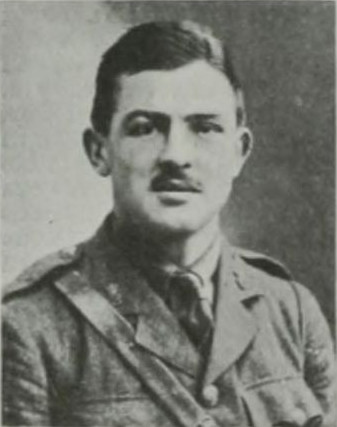
William G. F. Smith.
SMITH, WILLIAM HENRY, Mechanician, 292066, H.M.S. Pathfinder; lost when that ship was sunk by a mine, about 20 miles off the East Coast, 5 Sept. 1914.
SMITH, WILLIAM OLIVER, Stoker, 1st Class, 307471, H.M.S. Pathfinder; lost when that ship was sunk by a mine, about 20 miles off the East Coast, 5 Sept. 1914.
SMITH, WILLIAM WILTON, A.B., 235327, H.M.S. Good Hope; lost in action off Coronel, on the coast of Chili, 1 Nov. 1914.
SMITH, WILLIAM JOSEPH, Mechanician, 283349, H.M.S. Good Hope; lost in action off Coronel, on the coast of Chili, 1 Nov. 1914.
BRICE-SMITH, JOHN KENNETH, 2nd Lieut., 7th (Service) Battn. Lincolnshire Regt., yst. s. of the Rev. Brice Brice-Smith, Rector of Hameringham, with Winceby, Horncastle, by his wife, Kate Emily, 3rd dau. of the late John Middleton, of Benton House, Newcastle-On-Tyne; b. Hameringham, co. Lincoln, 2 Nov. 1894; educ. Quy Vicarage, Cambridge; Cranleigh School, Surrey, and entered at St. John’s College, Cambridge; after the outbreak of war he was given a commission in the 7th Lincolnshires, 27 Nov. 1914; went to France in July, 1915, and died 11 Sept. following, from wounds received in action the previous day, S.W. of Ypres; unm. Buried at Poperinghe. While at Cranleigh he was senior prefect, Colour-Sergt. in the O.T.C., a member of the School Shooting Eight, and captain of both cricket and football teams.
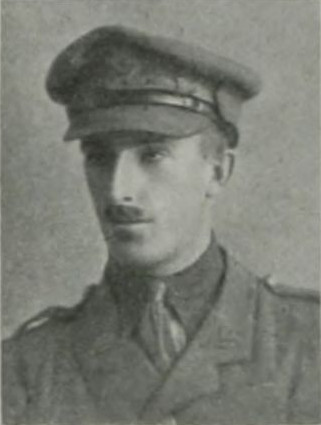
John Kenneth Brice-Smith.
BROADLEY-SMITH, ALAN FRANCIS, Major, 5th Battn. Border Regt. (T.F.), only s. of William Herbert Broadley-Smith, of Ambleside, by his wife, Mary Matilda, dau. of Capt. Arthur Trollope, 36th Foot; b. Derby, 24 March, 1876; educ. Repton and Bruges; joined the 5th Border Regt. (T.F.) as a 2nd Lieut., 28 Jan. 1909, and was promoted Lieut. 24 Dec. following; Capt. 8 Aug. 1910, and Major 18 April, 1915; acted as Instructor of Musketry from 1910 to 1915; and was Intelligence Officer and Provost Marshal for the Barrow District; volunteered for Imperial Service on the outbreak of war, and was appointed a General Staff Officer of the 3rd Grade, on the 5 Aug. 1914; went to France, 25 Oct. 1914, and was killed in action near Hooge, 16 June, 1915, while making a reconnaissance; unm. Buried on the outskirts of Zouave Wood, near the Chateau there. Lieut.-Col. J. A. Milburn, Commanding 5th Border Regt. wrote: “Not only was he a great personal friend of mine, but also he was my best officer, and his death has come as a very great shock to me. His company would have followed him to the ends of the earth, and he was loved by both officers and men of the Battn. alike.” He was a fine all-round sportsman, and held the position of amateur huntsman to Mr. Curwen’s (Workington Hall) Foxhounds.
COMPTON-SMITH, ROGER NOEL, 2nd Lieut., 6th Battn. Manchester Regt. (T.F.), 2nd s. of William Compton-Smith, of Tudor Place, Richmond Green, co. Surrey, LL.B., Barrister-at-Law of the inner Temple; b. Hampton Court, 16 July, 1894; educ. Horton School, co. Bedford, and Heidelberg College; entered the Manchester House of Tootal Broadhurst Lee Company, Ltd., on leaving school, and in July, 1914, had arranged a tour with the representative of the firm throughout America and Canada, but, war breaking out in the following Aug. he volunteered and was given a commission in the 6th Manchesters, 5 Sept. 1914; left for Egypt a few days later; went to the Dardanelles, 2 May, 1915, and was killed in action there on the 27th. He was at the time warning his men to evacuate the trench they were in, as it had been condemned as dangerous, being enfiladed by the enemy; unm. Brig.-Gen. Noel Lee, who was himself shot on 4 June, and died in Malta, wrote on the 25 May: “In his duties since he joined the regt., there are none who have done better and very few as well. His whole heart was in what he undertook and as an officer he was one of the most useful and dependable in a regt. which is noted for efficiency. With the mess he was always popular and more than respected on account of his character. His men of No. 15 Platoon literally worshipped him, as he was not only their officer but their leader, who never spared himself, and their friend upon whom they could always rely for help and assistance in their work. His loss is great indeed.” While spending his school holidays at Brixham, he became a bold and skilful small boat sailor and a strong swimmer, and at Alexandria saved the life of one of his men who, while bathing, had ventured beyond the reef. He was a good all-round athlete, and a keen fisherman.
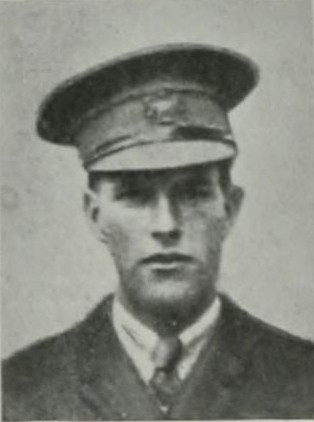
Roger N. Compton-Smith.
DENROCHE-SMITH, ARCHIBALD JOHN, Lieut., 18th (Queen Mary’s Own) Hussars, elder s. of Thomas Denroche-Smith, of Balhary, Meigle, co. Perth, late Judge Bengal Civil Service, by his wife, Florence Elizabeth, dau. of the late Gen. John Bayly, C.B., Col. Commandant, R.E.; b. Balhary, aforesaid, 30 Sept. 1890; educ. Evelyns; West Drayton, and Cheltenham College; gazetted 2nd Lieut. 18th Hussars, 23 Feb. 1910, and promoted Lieut. 10 April, 1912; went to France, 16 Aug. 1914, and was killed in action near Vendresse, during the Battle of the Aisne, 13 Sept. 1914, while leading his troop to the assistance of the 4th Dragoon Guards; unm. His Col. wrote: “As a soldier he had a very good chance of rising high in his profession, as he was very fond of his work, and we shall greatly miss him from among our circle, as a friend, as a soldier and as a sportsman. We had great hopes of his success in the polo world,” and his Squadron Major: “I never want to have a better officer in my squadron in time of war or peace. He was the best young officer that had joined us for a long time. I had recommended him for a decoration given by the French Government to our officers. I only hope I may meet death as gallantly as your son did, if it comes my turn.” He was Captain of the 18th Hussars polo team; had jumped at Olympia on several occasions, and won point-to-point races, and also steeplechases.
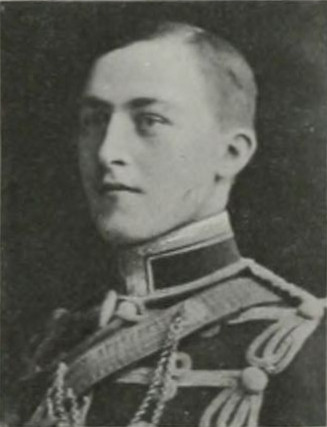
A. J. Denroche-Smith.
LAWSON-SMITH, JOHN, Lieut., 1st Battn. West Yorkshire Regt., yr. s. of Edward Maule Lawson-Smith, of Colton Lodge, Tadcaster, B.A., J.P., by his wife, Ethel Mary, dau. of the late Gen. Sir William Davies; b. Colton, co. York, 24 March, 1892; educ. Warren Hill, Eastbourne; Stubbington (Foster’s); Royal Naval College, Osborne (Cadet, 1902–3); Repton, and the Royal Military College, Sandhurst; gazetted 2nd Lieut. West Yorkshire Regt., 3 Sept. 1913, and promoted Lieut. Oct. 1914; went to France in Sept. 1914, and was killed in action near Bois Grenier, 20–21 Oct. following; unm. He was mentioned in F.M. Sir John (now Lord) French’s Despatch of 20 Nov. 1914 [London Gazette, 17 Feb. 1915], for gallant and distinguished service in the field. His brother, Lieut. T. E. Lawson-Smith, was killed in action, 30–31 Oct. 1914 (see following notice).
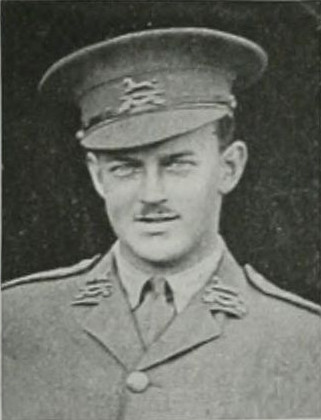
John Lawson-Smith.
LAWSON-SMITH, THOMAS EDWARD, Lieut., 13th, attd. 11th, Hussars, eldest. s. of Edward Maule Lawson-Smith, of Colton Lodge, Tadcaster, B.A., J.P., by his wife, Ethel Mary, dau. of the late Gen. Sir William Davies; b. Colton, co. York, 14 March, 1889; educ. Warren Hill, Eastbourne, Stubbington (Foster’s), Harrow, and the Royal Military College, Sandhurst; gazetted 2nd Lieut. 13th Hussars, 15 Sept. 1909, and promoted Lieut. 6 Dec. 1913; went to France attd. to the 11th Hussars, Oct. 1914, and was killed in action near Messines, 30–31 Oct. following; unm. His brother, Lieut. John Lawson-Smith, was killed in action, 20–21 Oct. 1914 (see preceding notice).
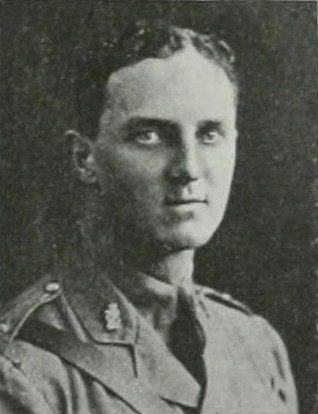
Thomas E. Lawson-Smith.
MANNERS-SMITH, FREDERICK, Major, 2nd Battn. 3rd (Queen Alexandra’s Own) Gurkha Rifles, yst. s. of the late Surg.-Gen. Charles Manners-Smith, formerly of Oakfield, Kempsey, co. Worcester, I.M.S., by his wife, Lydia, dau. of Dr. Samuel Davies; b. Kempsey, 15 Nov. 1871; educ. Norwich and Sandhurst; gazetted 2nd Lieut. Gloucester Regt., 2 May, 1891, promoted Lieut. 19 Oct. 1892, transferred to the Indian Army in 1893, and joined the 3rd Gurkhas in 1895; became Capt. 10 July, 1901, and Major 2 May, 1909, being Adjutant of his battn. 1901–5; served with the relief force in the Chitral Campaign, 1895 (medal with clasp), and with the Expeditionary Force in France, 1914; died of wounds received the same day in the trenches near La Bassée, 3 Nov. 1914; buried at Bethune. He m. at Lucknow, 25 Jan. 1902, Hilda Clara Frances, yst. dau. of the late Henry Carnsew, formerly of Summers Place, Billingshurst, co. Sussex; s.p.
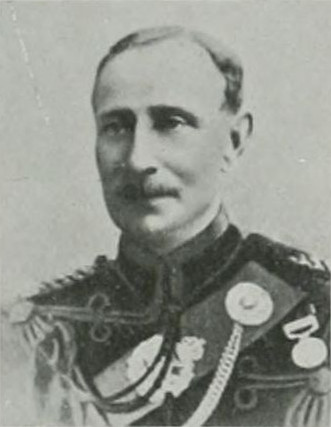
Frederick Manners-Smith.
SOMERS-SMITH, RICHARD WILLINGDON, 2nd Lieut., 7th (Service) Battn. King’s Royal Rifle Corps, eldest s. of Robert Vernon Somers-Smith, of Bur Lea, Walton-on-Thames, J.P., C.C., Clerk to the Grocer’s Company, by his wife, M. Gertrude, dau. of John A. Radcliffe, of Cobham; b. Hersham, co. Surrey, 27 Oct. 1882; educ. Eton, and Merton College, Oxford; went to Ceylon, and became a Tea Planter, but on the outbreak of the European War in Aug. 1914, returned to England, and obtained a commission as 2nd Lieut. in the King’s Royal Rifles, 1915; served with the Expeditionary Force in France, and was killed in action near Hooge, 30 June following, while running forward to help dig out some of his men who were buried by a shell; unm. Buried there. Like his father and brother, he was a distinguished Eton and Oxford athlete. At Eton he rowed in the Eight at Henley, and at Oxford, during his first year he won the Freshmen’s miles, rowed in the “Trials,” stroked his Torpid up five places, stepped straight from the Torpid into the ’Varsity eight, where he rowed two, stroked his College eight, and won the University pairs with Graham, of Balliol. The next year he stroked his College into the final of the coxwainless fours, coached the Torpid up three, rowed bow in the winning University crew, rowed seven to Bucknall’s stroke in the College eight, reached the final of the University pairs with Brocklebank, and only lost to a heavier pair by re-rowing after a dead heat with only a short rest, and as captain, rowed in four events at Henley for his College, besides sweeping the board at the College sports. He had his rowing Blue and was also offered his running Blue, but could not both row and run. His brother, Capt. John Robert Somers-Smith, London Regt., gained the Military Cross at the Second Battle of Ypres, 13 May, 1915, and was killed in action at Gommecourt, 1 July, 1916.
SELBY-SMYTH, MILES BURY, Capt., 4th Battn. The Rifle Brigade, only s. of the late Lieut.-Col. Edward Guy Selby-Smyth, of Darby House, Sunbury-on-Thames, Royal Irish Rifles, by his wife, Georgina Florence (42, Cornwall Gardens, London, S.W.), 2nd dau. and co-h. of Capt. the Hon. John James Bury, R.E. [2nd s. of Charles William, 2nd Earl of Charleville], and grandson of Gen. Sir Edward Selby-Smyth, K.C.M.G.; b. Halifax, Nova Scotia, 17 Nov. 1884; educ. Rottingdean (Mr. Stanford’s) and Bradfield College, co. Berks; gazetted 2nd Lieut. Rifle Brigade, from the Militia, 16 May, 1908, and promoted Lieut. 23 Jan. 1911, and Capt. 30 Nov. 1914; was A.D.C. (extra) to the Governor of Western Australia from 20 April, 1910, to 10 Feb. 1912; went to France, 20 Dec. 1914, and was killed in action at St. Eloi, 15 March, 1915, leading his company in a counter-attack on the Germans. Buried near the Church of Dickebusche. He m. in London, 8 Oct. 1912, Violet Emily (4, Tite Street, Chelsea, S.W.), yst. dau. of the late Capt. Cecil Drummond, R.B., and had a dau.: Pamela Dorothy Beaujolois, b. 25 Aug. 1913.
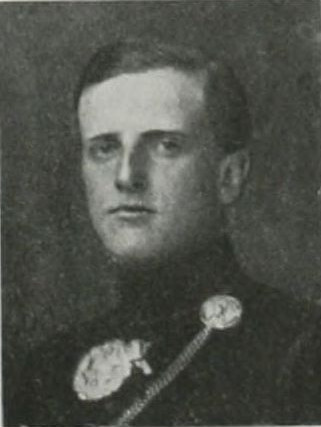
Miles B. Selby-Smyth.
SMYTH, RICHARD ALEXANDER NOEL, Capt., Royal Garrison Artillery, 2nd s. of Lieut.-Col. Frederick Augustus Smyth, of Weymouth, Brig.-Surgeon, I.M.S., late of Queen Alexandra’s Own Gurkha Rifles (who served in the Afghan, Burma, Chin Lushai and Chitral Campaigns, also in the attack and siege of the Malakand), by his wife, Elizabeth, dau. of the Rev. John Cole, Vicar of Isle Brewers, Somerset; b. Morar, Gwalior, India, 18 Dec. 1888; educ. Weymouth College, and the Royal Military Academy, Woolwich; gazetted 2nd Lieut., R.G.A., 31 July, 1902, and promoted Lieut. 31 July, 1905, and Capt. 30 Oct. 1914, was for some time on garrison duty in England, and then served for six years in Ceylon; went to the Front with the 5th Battery Siege Artillery, in Sept. 1914, doing valuable work as “forward observing officer,” and was killed in action, being shot by a sniper, while in the act of helping a wounded infantry soldier, near Armentières, France, 7 Nov. 1914; unm. Buried at Bac St. Maur on the River Lys. Lieut.-Col. M. B. Roberts, Commanding 2nd Siege Brigade, wrote: “If he was as good a son as he was an officer, you have every reason to be very proud of him. I can truthfully say ever since we have been in action (a fortnight) your son had been doing most excellent work—cheerfully, keen and always ready for anything, and for some days past I had fully made up my mind to forward his name to higher authority for the manner in which he carried out his work. I miss the best of officers—the very best in the battery, his loss is irreparable.” He was mentioned in F.M. Sir John French’s Despatch of 20 Nov. 1914 [London Gazette, 17 Feb. 1915], and was awarded the Military Cross [London Gazette, 18 Feb. 1915]; but both honours were gazetted in error to Lieut. R. A. E. Smyth, Antrim Reserve R.G.A., who had never been at the Front. As Capt. Smyth has been killed and the Military Cross is not conferred posthumously the latter announcement was cancelled.
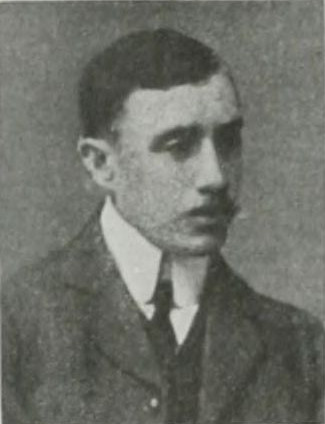
Richard A. N. Smyth.
SNARE, ALBERT, S.P.O. (R.F.R., A. 936), 125421, H.M.S. Hawke; lost when that ship was torpedoed in the North Sea, 15 Oct. 1914.
SNEATH, CLAUDE DAVIS, Lieut., 4th Battn. Duke of Cambridge’s Own Middlesex Regt., s. of George Sneath, of Gloucester Lodge, Golder’s Green, Hendon, J.P., by his 2nd wife, Marian Eliza Harriett, dau. of Charles William James Davis; b. Greta House, Finchley, 18 Jan. 1889; educ. Christ’s College, Finchley, and London University (where he was in the O.T.C.), and was gazetted 2nd Lieut. to the 6th Battn. of the Middlesex Regt. in 1912, and promoted Lieut. 15 Dec. 1912. On the outbreak of war he was transferred to the 4th Battn. which was one of the first regts. to go to the Front; was at the Battle of Mons, 23 Aug. 1914, also at Cambray and Le Cateau, 26 Aug. 1914; afterwards in the retreat, and then at the Battle of the Marne and on the Aisne, and was killed in action at Croix Barber, 14 Oct. 1914; unm. He was a fine hockey player, and played back for the Hendon Hockey Club, also for Middlesex and the Philistines on many occasions. He was also a good cricketer, and was president of the Golder’s Green Working Men’s Club.
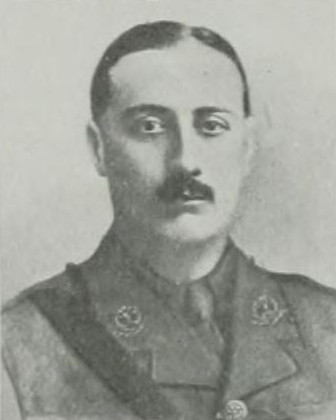
Claude D. Sneath.
SNEDDON, JAMES, Private, No. 18547, 13th (Service) Battn. Royal Scots (Lothian Regt.), s. of John Sneddon; b. Bellshill, co. Lanark, 11 July, 1887; educ. Bellshill; enlisted at Stirling, 19 Jan. 1915; served with the Expeditionary Force in France, etc., and died in No. 1 Casualty Clearing station, 8 Feb. 1916, from wounds received in action the previous day. He m. at Bellshill, 30 Nov. 1906, Christina Leggatt (2, St. Mary’s Wynd, Stirling), dau. of (—) Graham, and had issue: Andrew Graham, b. 20 Nov. 1909; John Graham, b. 23 Dec. 1911; Euphemia, b. 22 Oct, 1907; and Christina Clark, b. 26 May, 1914.
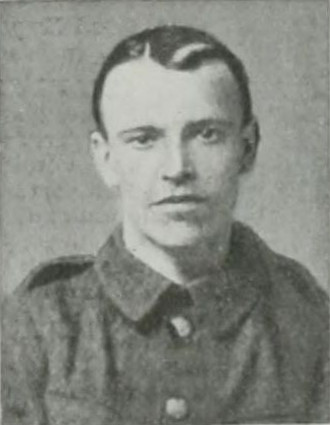
James Sneddon.
SNELGROVE, SIDNEY HENRY, Lieut., 14th (Service) Battn., attd. 7th Battn., King’s Royal Rifle Corps, yr. s. of John Sidney Snelgrove, of Kingswood, Tunbridge Wells, Barrister-at-Law, by his wife, Gertrude Emily, dau. of the late John Henry Chatteris; b. Tunbridge Wells, 7 Dec. 1891; educ. Hurstleigh, Tunbridge Wells; Rugby (Mr. Brooke’s House), and Trinity College, Cambridge; gazetted 2nd Lieut. 14th Battn. King’s Royal Rifle Corps, 21 Nov. 1914, and promoted Lieut. 2 Feb. 1915; was attd. 7th Battn. King’s Royal Rifle Corps, and went to France 16 July following, and was killed in action 31 July, 1915, while leading his platoon under heavy shell fire in support of another company, in the counter-attack at the Chateau Hooge. Buried Sanctuary Wood, south of Hooge: unm. Lieut.-Col. G. A. P. Rennie, D.S.O., Commanding 7th King’s Royal Rifle Corps, wrote: “He was leading his men splendidly at the time,” and Lieut.-Col. Sir Thomas Milborne-Swinnerton-Pilkington, Bart., Commanding 14th Battn. King’s Royal Rifle Corps: “... one of my smartest officers. I was quite sure he would distinguish himself when he went to the Front.” Letters from other officers and men all speak in the highest terms of his courage, energy and great capability. At Hurstleigh he was head of the School and captain of the cricket and the hockey elevens, and at Rugby was in his house eleven, and a signaller in the O.T.C. His elder brother, Capt. John Sidney Norman Snelgrove, Royal West Kent Regt., is now (1916) on active service.
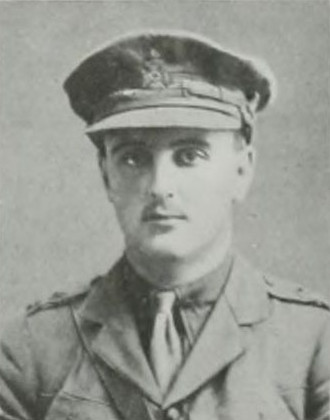
Sidney Henry Snelgrove.
SNELL, GEORGE NOWELL, Stoker, 3rd Class, K. 21993, H.M.S. Monmouth; lost in action off Coronel, on the coast of Chili, 1 Nov. 1914.
SNELL, WILLIAM JOHN, Gunner, R.M.A., 12869, H.M.S. Aboukir; lost in action in the North Sea, 22 Sept. 1914.
SNEYD, THOMAS HUMPHREY, Capt., 4th. attd. 2nd. Battn. Lancashire Fusiliers, only s. of Major-Gen. Thomas William Sneyd, of Ashcombe Park, Belmont, and Onecote, co. Stafford, late Commanding Queen’s Bays (1877–82), by his wife, Charlotte Marion, dau. of Capt. William Wheatley Repton, Bengal N.I.; b. Lightoaks, near Cheadle, co. Stafford, 20 Oct. 1883; educ. Sandroyd, Wellington College, and Sandhurst; gazetted 2nd Lieut. 2nd Dragoon Guards (Queen’s Bays), 22 April, 1903; and promoted Lieut. 14 May, 1904; joined his regt. in South Africa in Aug. 1903, and acted as A.D.C. to the Commander-in-Chief, Gen. Sir Henry Hildyard; retired in July, 1910, and after a year and a half spent in the Argentine, returned to England in Jan. 1912, and joined the 4th (Special Reserve) Battn. Lancashire Fusiliers as Capt. 30 Oct. 1912; went to France attd. to the 2nd Battn., and was killed in action at Ploegsteert, Belgium, 2 Nov. 1914. Buried in Ploegsteert Wood. He m. at St. John’s Church, Forfar, 3 June, 1914, Phœbe Marianne, yr. dau. of John Sharp Callender-Brodie, of Idvies, Forfar, and had a dau., Averil Marion Anne, b. 7 April, 1915.
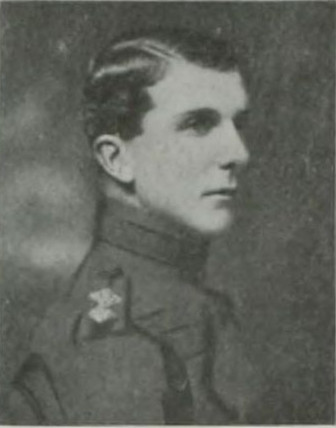
Thomas Humphrey Sneyd.
SNOSWELL, THOMAS EMDEN, Petty Officer, 1st Class (R.F.R., B. 1467), 146107, H.M.S. Hogue; lost in action in the North Sea, 22 Sept. 1914.
SNOW, WILLIAM CHARLES, A.B. (R.F.R., B. 4628), 195194, H.M.S. Good Hope; lost in action off Coronel, on the coast of Chili, 1 Nov. 1914.
SNOWDEN, HARCOURT JOHN, Lieut., 1st Battn. Hertfordshire Regt. (T.F.), yr. s. of the Rev. Harcourt Snowden, of St. Peter’s, Broadstairs, by his wife, Augusta, dau. of Martin Daniel; b. Ramsgate, 12 Dec. 1887; educ. Hildersham House, St. Peter’s; Parkfield, Haywards Heath; Rugby and Trinity College, Oxford. He joined the Hertfordshire Regt. under Lieut.-Col. Viscount Hampden’s command, 2 June, 1913, and was promoted Lieut. 26 Sept. 1914. On the outbreak of war he volunteered for foreign service, served in France and Flanders, and was killed in action while visiting sentries early in the morning of 11 Jan. 1915; unm. He was buried near Richebourg l’Avoué. His Major said: “I had such confidence in him that, when I knew that he was the officer on duty, I never went round the posts to see that all was well.” Another officer wrote: “He was a fine example to us all of a good and straight living Englishman.”
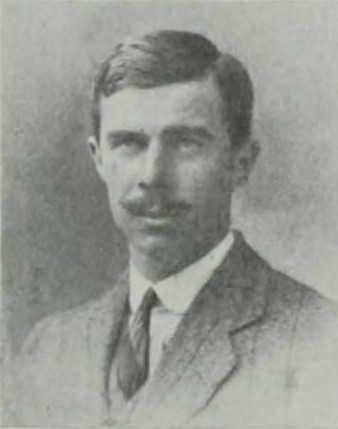
Harcourt John Snowden.
SOLLEY, ALFRED JOHN GEORGE, Stoker, 2nd Class, K. 20426, H.M.S. Good Hope; lost in action off Coronel, on the coast of Chili, 1 Nov. 1914.
SOLLITT, GEORGE WILLIAM, A.B. (R.F.R., Ch. B. 3544), H.M.S. Aboukir; lost in action in the North Sea, 22 Sept. 1914.
SOMERTON, CHARLES ENOS, Ship’s Steward, 341939, H.M.S. Good Hope; lost in action off Coronel, on the coast of Chili, 1 Nov. 1914.
SOMERTON, FREDERICK CHARLES, Private, No. 1342, A Coy. 1st Newfoundland Regt., s. of Frederick Somerton, of Trinity, Newfoundland, Magistrate, by his wife, Caroline Augusta, dau. of Charles Soule Hibbert, of Bromley, Kent; b. Bruges, Newfoundland, 31 March, 1888; educ. Bishops Field College, St. John’s, Newfoundland, and on leaving there engaged in Scholastic pursuits and taught for three years at Salvage, Newfoundland, and afterwards at Cape Ray. He then went to Canada, but when the European War broke out returned home; volunteered and joined the Newfoundland Expeditionary Force in Feb. 1915; left for England in April, 1915; went to the Dardanelles Sept. and died on board the Guildford Castle, 25 Nov. 1915, of wounds received in action at Gallipoli on the 20th; unm.
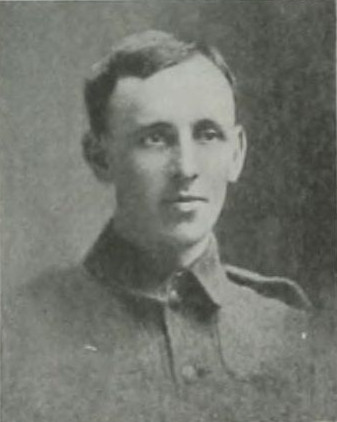
Frederick C. Somerton.
SONES, HERBERT JAMES, Signal Boy, J. 24586, H.M.S. Pathfinder; lost when that ship was sunk by a mine, about 20 miles off the East Coast, 5 Sept. 1914.
SORSBY, WILLIAM, Private, No. 4637, 3rd Battn. Coldstream Guards; b. co. York; enlisted 19 March, 1902; served with the Expeditionary Force in France and Flanders, from 30 Aug. 1914; killed in action at Soupir, 14 Sept. 1914; m.
SOURBUTTS, RICHARD, Ch. E.R.A., 2nd Class, 269610, H.M.S. Cressy; lost in action in the North Sea, 22 Sept. 1914.
SOUGHTON, THOMAS EDWARD, Gunner, No. 686, 2nd Home Counties, 1/6th Battery, R.F.A. (T.F.); b. Hellingly, co. Sussex, 23 March, 1893; educ. Horsebridge, Hellingly; was an employee in the firm of Messrs. Howard Bros., Hellingly; enlisted soon after the outbreak of war, Oct. 1914; went to India, and died in Ferozepore Barracks there, 3 Dec. 1915, from internal injuries caused by a fall from an ammunition wagon on the 1st, while on service; unm.
SOUTER, CHARLES JESSE, Chief Petty Officer, 169027, H.M.S. Good Hope; lost in action off Coronel, on the coast of Chili, 1 Nov. 1914.
SOUTH, FREDERICK, Leading Seaman, 224839, H.M.S. Pathfinder; lost when that ship was sunk by a mine, about 20 miles off the East Coast, 5 Sept. 1914.
SOUTHERN, HENRY WALTER, Boy, 1st Class, J. 25688, H.M.S. Hawke; lost when that ship was torpedoed in the North Sea, 15 Oct. 1914.
SOUTHERN, JOHN GEORGE, Private, No. 3097, 7th Battn. Durham L.I. (T.F.), eldest s. of the late George Southern, of Southwick, Miner, by his wife, Alice (Walter Tom Street, Southwick, Sunderland), dau. of John Lathon; b. Southwick, 27 March, 1891; educ. High Southwick Council School; was employed at the Hylton Colliery; enlisted 9 Nov. 1914; trained at Sunderland, and went to the Front, 19 April, 1915, coming into action a few days later at Ypres on Whit Monday, when the 7th Durhams were severely cut up. He was killed in action at Armentières, 31 July, 1915; unm. He was a regular Sunday School teacher at a Primitive Methodist Church, and was engaged in Christian Endeavour work. His great ambition was to become a foreign missionary, and a few days before his death he wrote intimating that if spared to return home his future would be devoted to that cause. One of his officers, writing to his mother, said: “In the past his presence among us inspired all that was good. In the future, if God spares us, we will retain a lasting memory of his goodness.”
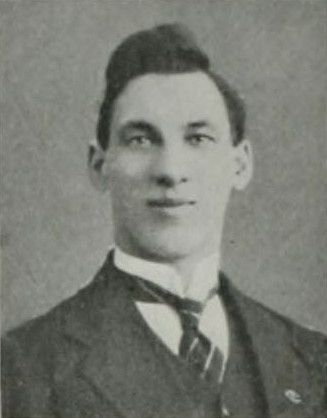
John George Southern.
SOUTHERTON, HARRY PERCY, Stoker, 1st Class, K. 14664 (Ports.), H.M.S. Aboukir; lost in action in the North Sea, 22 Sept. 1914.
SOUTHWICK, CHARLES THOMAS, Sergt., No. 1212, 13th Battn. (Princess Louise’s Kensington) The London Regt. (T.F.), only s. of Charles Southwick, of Heatherlands, Poole, Schoolmaster, by his wife, Mary Annie, dau. of the late Thomas Harland; b. Kinson, co. Dorset, 27 Feb. 1887; educ. Secondary School, Broughty Ferry, and St. Mark’s College, Chelsea, and on leaving there became Assistant Master at the Vineyard School, Richmond, under Mr. Lancaster; joined the 13th Kensingtons in 1907; volunteered for foreign service on the outbreak of war in Aug. 1914; went to France, 3 Nov., and was killed in action in the attack on Aubers Ridge, 9 May, 1915. In letters received from the Front it was stated that in this action Sergt. Southwick with his platoon reached the second German trench, where a piece of shrapnel broke the glasses he was wearing. Then, a volunteer being called for to return to the English lines for reinforcements, he undertook the dangerous task, was seen to start on his errand, and from that time seems to have completely disappeared. He had a fine baritone voice, and was successively bass singer in the Petersham, Chelsea (Sidney Street), and St. Peter’s (Bayswater) Choirs, and also a member of the Queen’s Hall Choir. He m. at Stratford, Essex, 12 Sept. 1914, Lilian Francis (Ashleigh, The Bridle Path, Woodford Green), dau. of William Webster, of Ashleigh, Woodford Green; s.p.
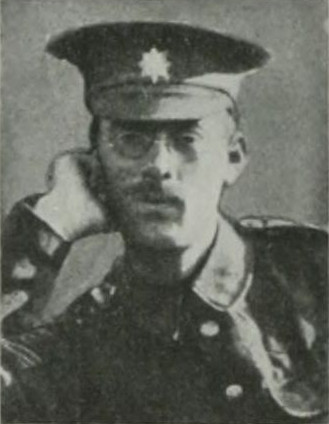
Charles T. Southwick.
SOUTHWOOD, HORACE GEORGE, E.R.A., 4th Class, 271932, H.M S. Good Hope; lost in action off Coronel, on the coast of Chili, 1 Nov. 1914.
SPACKMAN, HAROLD JOHN, Private, No. 13845, 10th (Service) Battn. Devonshire Regt., s. of Frederick William Spackman, of The Dairy, Manningford, Bohune, by his wife, Eliza Catherine, dau. of Alfred Manners, of Heddington, Calne, Wilts; b. Manningford, Bohune, Pewsey, co. Wilts, 24 May, 1897; educ. Woodborough School; enlisted 17 Sept. 1914, and died at the Red Cross Hospital, Bath, 12 March, 1915, of meningitis contracted while on service; unm.
SPAIN, EDWARD SYDNEY STEPHEN, Leading Seaman, 235099, H.M.S. Pathfinder; lost when that ship was sunk by a mine, about 20 miles off the East Coast, 5 Sept. 1914.
SPALDING, FRANK, Coy. Quartermaster-Sergt., No. 6896, 1st Battn. Coldstream Guards, s. of John Spalding, of 70, Scorer Street, Lincoln; b. Lincoln, 1890; educ. there; was apprenticed to Messrs. Robey, Blacksmiths, but before his time expired gave this up and enlisted in the Coldstreams, 20 Aug. 1906; was appointed L.-Corpl. 19 Aug. 1907; Corpl. 17 Oct. 1908; L.-Sergt. 17 March, 1910; Sergt. 15 Aug. 1913, Pioneer Sergt. the same day; and acting Coy. Quartermaster-Sergt. (for meritorious conduct at the Front), 20 Nov. 1914; went to France with the Expeditionary Force, 13 Aug. 1914, and died at Ecquedecques, Belgium, 1 Jan. 1915, from an accident while on active service. Buried in field opposite Delalean Farm, Ecquedecques, about 2 kilometres from Lillers. He was an enthusiastic footballer, being at one time a member of the Lincoln Wednesday Team, and while in the Army was one of the Battn.’s Soccer representatives; he was also a member of the old Lincoln Volunteers for some time. Coy. Q.M.-Sergt. Spalding m. at St. Thomas’s, Lambeth, 6 Aug. 1911, Kate (128, Ash Street, Walworth, London), dau. of (—) Skinner, and had two sons: Eric Arthur, b. 23 July, 1912; and Leslie Stuart, b. 30 Oct. 1914.
SPARKES, CHARLES, Private, R.M.L.I., Ch./12476, H.M.S. Cressy; lost in action in the North Sea, 22 Sept. 1914.
SPARKS, HARRY ROBERT, Stoker, 1st Class (R.F.R., B. 8408), S.S. 104457, H.M.S. Hawke; lost when that ship was torpedoed in the North Sea, 15 Oct. 1914.
SPEAREY, FREDERICK WILLIAM, A.B. (Coastguard), 194745, H.M.S. Cressy; lost in action in the North Sea, 22 Sept. 1914.
SPEKE, THE REV. HUGH, Major, 10th (Service) Battn. Lancashire Fusiliers, 7th s. of the Rev. Benjamin Speke, Rector of Dowlish Wake, by his wife, Caroline Sophia, elder dau. of John Bird Fuller, of Neston Park, Wilts, grandson of William Speke, of Jordans, co. Somerset, J.P., D.L., and nephew of John Hanning Speke, the African Explorer; b. Dowlish Wake, co. Somerset, 24 Feb. 1878; educ. Uppingham, and Keble College, Oxford; served in the South African War, 1899–1901, with the Wiltshire Yeomanry; afterwards continuing his preparation for Holy Orders at Wells Theological College in 1901. He was ordained at St. Paul’s Cathedral, Advent, 1902; was for three years curate at St. Michael’s, Bromley-by-Bow, and was then Vicar of Curry Rivel from 1905 to 1910, and in the autumn of that year left to take up work in Western Canada, where he was on the Mission Staff at Edmonton, and subsequently worked at Bow Island, Alberta, and was finally in charge of the district of Athabasca, but, after the outbreak of the European War in Aug. 1914, he returned to England in Oct.; and was given a commission as Capt. in the 3rd Battn. of the Somerset L.I., 23 Oct. 1914. He transferred to the 9th Battn., and was promoted Major 21 Dec. following, and after training with it at St. Austell and Wareham, exchanged into the 10th Lancashire Fusiliers in July, 1915, in order to go to the Front. He went to France at the end of the month, and was killed on reconnaissance at Vierstaat 11 Aug. following. Buried in the cemetery at Dickebusch. A brother officer wrote: “It happened about 11.30 on Wednesday night. He went out to reconnoitre the German trenches with a Sergt.; he was away about an hour and a half, and procured some very useful information; they were on their way back when he was shot; he must have been shot at least three times in the head and neck, and can have suffered no pain”; and another: “He was one of the bravest and best, and in the short time he had been with us had endeared himself to everybody. I am sure there is not an officer or man who does not feel his loss. His own company is cut up terribly.” Another also wrote: “We laid the Major to rest reverently with a short service last night (Thursday) in a small cemetery near here and placed a wreath on the grave, and are putting up a cross in a few days so as to mark it. All the officers and the whole company are very cut up over our loss as we were all very fond of him indeed. One of the men remarked in a letter referring to the death of Major Speke, ‘he was a brave and fearless man,’ which is very true, and we all had a great respect for him,” and: “Your gallant husband died, not merely doing his duty, but, as I judge, for another, for I feel pretty sure that he undertook a dangerous job which he would not let one of his junior officers undertake.” In Canada he proved himself a born pioneer. Even the small prairie towns were irksome to him, and he would contrive to spend most of his time in a shack out on the far-flung prairie. As though his own wide field were not large enough he would, from time to time, find that his duty called him on an expedition to the Sweet Grass Hills, across the boundary line to the south, to the Cypress Hills away to the east, or to the irrigated belt away to the north. Loth as he was to leave S. Alberta, it was the same spirit that led him to accept the offer to establish a pioneer mission in Athabasca, and so patiently to face the vexing difficulties raised by others that would have led most men to draw back before embarking on the task, and later to resign when the conditions of service were so changed. One winter he spent in a tiny shack measuring 10 ft. by 8 ft., having as his companion a lad from his own village at home who in days gone by had carried his gun. He m. at Tarrant Crawford Church, Dorset, 8 April, 1915, Ruth Lettice, dau. of the Rev. Charles Lewis Kennaway, of Stephen’s Plot, Spetisbury, Blandford, late Rector of Garboldishham, co. Norfolk; s.p.
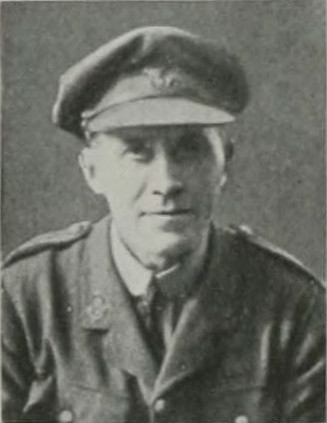
Hugh Speke.
SPENCE, JAMES MCKENZIE, Sergt., No. 12/218, 15th North Auckland Regt., Signalling Division, Headquarters Staff, New Zealand Expeditionary Force, s. of James Mearns Spence, of Deveron Street, Whangarei, New Zealand; b. Whangarei aforesaid, 16 June, 1886; educ. there; was for some years a Reporter on the Staff of the Whangarei “Northern Mail” and “Northern Advocate,” subsequently becoming sub-editor of the “North Auckland Times” at Dargaville; volunteered for Imperial service on the outbreak of war; joined the New Zealand Expeditionary Force, 15 Aug. 1914; left for Egypt as a signaller with the main body, was successively promoted Corpl. and Sergt., and was killed in action at the Dardanelles, 16 Nov. 1915; unm.
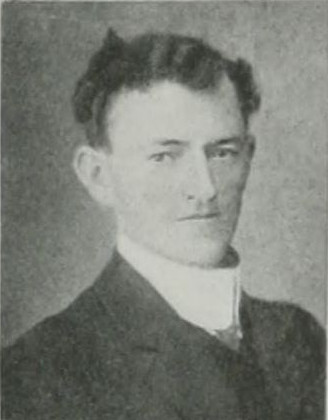
James McKenzie Spence.
SPENCER, CHARLES JAMES, Capt., 2nd Battn. Devonshire Regt., eldest s. of Charles Alfred Spencer, of Stoughton Lane, Leicester, by his wife, Mary, dau. of James Warwick, of Longthorpe, near Peterborough; b. Leicester, 10 Jan. 1879; educ. Charterhouse; joined the Cardigan Artillery Militia in 1898; gazetted 2nd Lieut. to the Devonshire Regt., 18 Oct. 1899, and promoted Lieut. 11 May, 1901, and Capt. 14 July, 1908; served in the South African War, 1899–1902; took part in the advance on, and relief of Ladysmith, being with the 2nd Battn. in Major-Gen. Hildeyard’s Brigade, while the 1st Battn. was shut up in the town; operations of 17–24 Jan. 1900, and action at Spion Kop; operations of 5–7 Feb. 1900, and action at Vaal Kranz; operations on Tugela Heights (14–27 Feb. 1900) and action at Pieters Hill; operations in Natal, March to June 1900, including action at Laings Nek (6–9 June); and those in the Transvaal, Nov. 1901 to 31 May, 1902; was severely wounded and received the Queen’s medal with five clasps and King’s medal with two clasps. He was Adjutant of the 7th (Territorial) Cyclist Battn. of the Devonshires from 14 July, 1908 to 29 Feb. 1912. On the outbreak of war he went to France with the Expeditionary Force, 5 Nov. 1914, and was killed in action, 18 Dec. 1914, while leading his company in an attack on the German trenches. Buried near Estaires. Capt. Spencer m. at Pennycross Church, near Plymouth, 20 Oct. 1909, Katherine Margaret (Crapstone House, Yelverton, South Devon), yst. dau. of the late Robert Bayly, of Torr, Plymouth, and had a son, Charles Richard, b. 5 Dec. 1910.
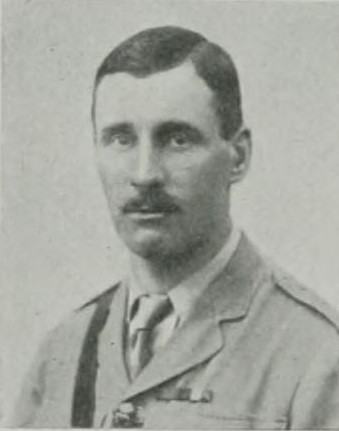
Charles James Spencer.
SPENCER, JOHN, Private, No. 572, 5th Coy., 2/5th Battn. King’s Liverpool Regt. (T.F.), s. of William Spencer, of Liverpool, Watch Finisher; b. Liverpool, 1854; educ. Corporation School there; enlisted in the R.G.A. (Militia) and served with them 22 years (Long Service medal and certificate); re-enlisted in Oct. 1914, and was accidentally drowned in Carrier’s Dock, Liverpool, 27 Dec. following, while on service. He m. at St. Nicholas Church, Liverpool, Mary Jane (23, Back Strickland Street, Liverpool), dau. of (—) Young, and had five children: William, b. 28 Oct. 1878; John, b. 22 July, 1891, R.N.; George, b. 30 Jan. 1896; Margaret, b. 5 June, 1882; and Emily, b. 14 May, 1898.
SPENDLOW, JOHN JAMES, Leading Seaman, 237135, H.M.S. Cressy; lost in action in the North Sea, 22 Sept. 1914.
SPICE, ALBERT, Cook’s Mate, 1766, H.M.S. Good Hope; lost in action off Coronel, on the coast of Chili, 1 Nov. 1914.
SPICE, ROBERT WILLIAM, Stoker, 1st Class, K. 9019, H.M.S. Pathfinder; lost when that ship was sunk by a mine, about 20 miles off the East Coast, 5 Sept. 1914.
SPICER, ARTHUR JOHN, Stoker, 1st Class (R.F.R., B. 2214), 301561, H.M.S. Good Hope; lost in action off Coronel, on the coast of Chili, 1 Nov. 1914.
SPICER, GEORGE HENRY, Gunner, 35031, 41st Battery, 42nd Brigade, Royal Field Artillery, 3rd s. of George Spicer, of Frindsbury, Rochester, Kent, by his wife, Jane; b. Frindsbury, 23 Jan. 1885; enlisted 1 Feb. 1905; served seven years with the Colours then passing into the Reserve, was employed at Messrs. Lysaght’s Works, Newport, Mon.; mobilised 5 Aug. 1914; went to France, 20 Aug. 1914, and died in No. 7 Stationary Hospital, Boulogne, 9 Nov. following, of wounds received in action at Neuve Chapelle in a gallant attempt to save Lieut. Towell. Major H. A. Hamilton, Commanding 41st Battery, wrote: “I am sure you would like to know how your husband gave his life for his country. I need not say how much I and all his comrades sympathise with you in your great loss, but you may have a little consolation in knowing that he was severely wounded in performing a gallant act, which was reported to his commanding officer and brought to the notice of the general officer commanding the division.” He m. at St. Woolo’s Church, Newport, Mon., 1 June, 1914, Beatrice Amelia, dau. of Henry George Evans, of 19, Victoria Crescent, Newport; s.p.
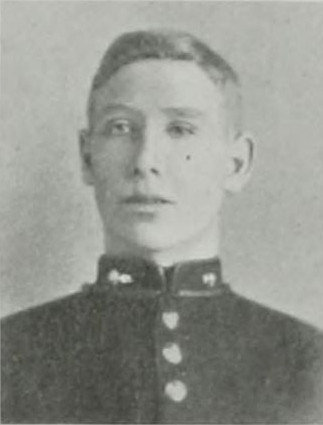
George Henry Spicer.
SPICER, MAURICE ARNOTT, Corpl., No. 81840, 32nd, attd. 10th, Battn. Canadian Expeditionary Force, 5th s. of the late Herbert Spicer, of Cranbourne, St Margarets near Ware, by his wife, Martha McMurray, dau. of David Arnott; b. Hambledon, co. Surrey, 23 April, 1882; educ. Mill Hill; was sisal growing in the West Indies from 1900 to 1903, afterwards farming in Canada until the outbreak of the European War; enlisted in the 32nd Battn. 21 Oct. 1914; came over with the reinforcements for the first contingent in March, 1915; went to France with a draft for the 10th Battn. early in April, 1915, and was killed in action at Festubert, 22 May, 1915; unm.
SPIELMANN, HAROLD LIONEL ISIDORE, Capt., 1/10th Battn. Manchester Regt. (T.F.), yr. s. of Sir Isidore Spielmann, of 56, Westbourne Terrace, Hyde Park, W., C.M.G., F.S.A., by his wife, Emily, dau. of the late Sir Joseph Sebag-Montefiore; b. London, 12 Jan. 1893; educ. Clifton and Pembroke College, Cambridge (B.A. June, 1914); gazetted 2nd Lieut., 2/10th (Oldham) Battn. Manchester Regt., from the University O.T.C., 14 Oct. 1914; was promoted Capt. in March, 1915, to date as from 28 Nov. 1914; volunteered with the greater part of the battalion for foreign service; landed in Gallipoli, in command of a draft, 25 July, 1915, and was killed in an attack on the Turkish position, 13 Aug. following; unm. Lieut.-Col. G. Robinson, commanding 10th Manchesters, wrote: “He only joined us about three weeks ago, when he arrived in command of a draft of 248 men, and I was so impressed with his keenness and energy that I put him in command of a company. My judgment was fully borne out. Your son worked hard, and I felt I could always rely on him. On the evening of the 12th inst. a battalion next to us in the fire trenches lost a portion of a trench on their front, and I was forced to organise a counter-attack by one hundred men of my battn. under your son and two other officers. Your son was in command of his section of the attack, and carried out his orders with skill and gallantry. He reached his objective, but was immediately killed, and his men had eventually to fall back under strong opposition. His death, by bullets, was instantaneous.... Our men had done well, and we regained most of what had been lost, but they were ‘done,’ and I lost many of them besides my excellent young officer Spielmann.... It was crushing to me losing him. He was a ‘gentleman officer’ with such high notions of chivalry, honour and esprit de corps. I considered him one of my best officers, and had just recommended him for a permanent captaincy, as I had such a high opinion of his capabilities. Your boy died a hero’s death in his country’s cause, and that must ever be a source of satisfaction and comfort to you, and one in which you must all take a pride—falling in action gallantly leading his men. What more can a soldier ask for?”
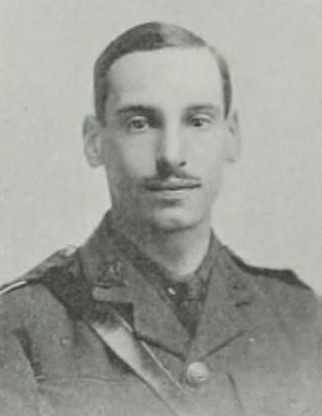
Harold L. I. Spielmann.
SPIERS, HAROLD ALFRED, Boy, 1st Class, J 23568 (Ports.), H.M.S. Hawke; lost when that ship was torpedoed in the North Sea, 15 Oct. 1914.
SPIERS, WILLIAM JOHN, Stoker, Petty Officer (R.F.R., A. 2103), 131072 (Ports.), H.M.S. Hogue; lost in action in the North Sea. 22 Sept. 1914.
SPILLARNE, CORNELIUS WILLIAM, Stoker, 1st Class, 308380, H.M.S. Pathfinder; lost when that ship was sunk by a mine, about 20 miles off the East Coast, 5 Sept. 1914.
SPINDLER, DAVID, Stoker, 1st Class, 289816, H.M.S. Cressy; lost in action in the North Sea, 22 Sept. 1914.
SPINKS, FREDERICK HERMAN VICTOR, Rifleman, No. 10489, B Coy., 1st Battn. King’s Royal Rifle Corps, 2nd s. of Thomas Samuel Spinks, of 114, Leucha Road, St. James’ Street, Walthamstow, by his wife, Clara, dau. of Frederick Herman Greenslade; b. Clapton, N., 29 Oct. 1896; educ. Coppermill Road Council School, Walthamstow; enlisted 27 Jan. 1912; served with the Expeditionary Force in France and Flanders from 13 Aug. 1914; served through the retreat from Mons, etc., and was killed in action two days before his 18th birthday, near Ypres, 27 Oct. 1914. A comrade wrote: “He was killed in action the same day as Prince Maurice of Battenberg. His company had advanced against the Germans and taken up a position for the night. He could have lain down and gone to sleep, because he was a signaller, but the man next him had to do two two hours on duty looking through the porthole in the trench, and as he felt a bit bad, your poor boy offered to do it for him. Well, Fred had not been looking out for more than ten minutes when a bullet struck him in the head, and he must have died instantaneously. I cannot tell you more particulars now, but I know it was near Ypres. I was entrusted to write your letter because Fred was a signaller, and I am one of the few that are left.” He gained the 3rd class certificate for education, 23 Feb. 1912, and the 2nd class, 2 April, 1912.
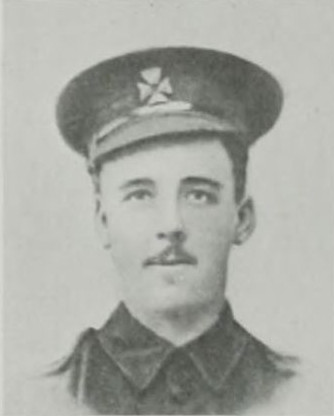
Frederick H. V. Spinks.
SPITTLE, FRANK THOMAS, Rifleman, No. 2857, A Coy., 1/9th Battn. (Queen Victoria’s Rifles) The London Regt. (T.F.), yst. s. of Augustus Alfred Spittle, of 41, Manby Road, Leyton Road, Stratford, Essex, by his wife, Ellen Emily, dau. of George Abbott, of Maldon, Essex; b. Stratford, 25 April, 1896; educ. Downsell Road Council School, Leyton, and County High School, Leytonstone; volunteered and joined Queen Victoria’s Rifles on the outbreak of war; went to France, 22 Jan. 1915, and was killed in action, 23 Feb. 1915. Buried Wulverghem Cemetery. Major Lees (since killed in action) wrote; “He was one of a working party repairing the parapet of the trench during a mist, which suddenly lifted, and the Germans opened fire, and he was hit before he could get under cover, and died a few minutes later. He was very popular with his comrades and will be sadly missed.”
SPITTLES, THOMAS ROBERT, Stoker, 1st Class, No. K. 726, 3rd s. of Francis Edward Spittles, of South Hayling, by his wife, Elizabeth Bessie, dau. of Robert Applin; joined the Royal Navy about May, 1907, and was lost on H.M.S. Lynx, 9 Aug. 1915, when that ship was sunk by a mine in the North Sea. He m. at Portsmouth, Alice Georgina May (Rose Cottage, South Mundham), dau. of George Horne.
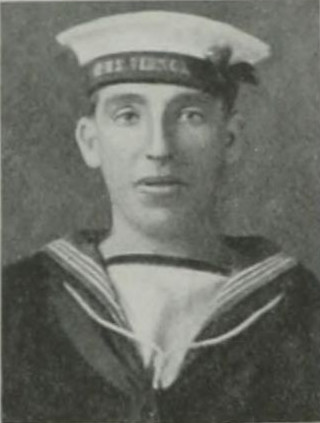
Thomas Robert Spittles.
SPOONER, ALEXANDER, Leading Stoker, K. 114, H.M.S. Pathfinder; lost when that ship was sunk by a mine, about 20 miles off the East Coast, 5 Sept. 1914.
SPOONER, CHARLES ALBERT VICTOR, Boy, 1st Class, J. 26754, H.M.S. Hawke; lost when that ship was torpedoed in the North Sea, 15 Oct. 1914.
SPOONER, WILLIAM CHARLES, Private, R.M.L.I., Ch./16147, H.M.S. Hawke; lost when that ship was torpedoed in the North Sea, 15 Oct. 1914.
SPORTON, GEORGE HERBERT, A.B. (Coastguard), 206749, H.M.S. Cressy; lost in action in the North Sea, 22 Sept. 1914.
SPRINGALL, WILLIAM EGLETON, Leading Seaman (R.F.R., Ch. B. 5437), 178793, H.M.S. Cressy; lost in action in the North Sea, 22 Sept. 1914.
SPRUNT, ALEXANDER DALZELL, 2nd Lieut., 4th Battn. Bedfordshire Regt., attd. 2nd Battn. South Staffordshire Regt., 2nd s. of John Dalziel Sprunt, of 3, East India Avenue, London, E.C., and Montgomerie, Berkhampsted, by his wife, Jane, dau. of John Naismith; b. Hampstead, London, 7 Jan. 1891; educ. Berkhampsted School, and New College, Oxford, where he graduated with honours in July, 1914, and was nominated Assistant Professor of Natural History at Glasgow University, obtaining his degree the week that war was declared. Having served for about 10 years in the Officers Training Corps, he and his brother (also killed in action) were offered commissions. He accepted and was gazetted 2nd Lieut., 4th Bedfordshire Regt., 15 Aug. 1914, being ordered to join his Regt. at once at Dovercourt. Later he was detailed to take out a draft to the Base at Havre, and from there took up a draft of the Guards to the trenches, where he was attd. to the 2nd South Staffordshires, with whom he remained till he was mortally wounded, bring shot down about 15 yards from the enemy’s lines. He died in hospital at Lillers, France, 17 March, 1915, of wounds received in action on the 10th, near Neuve Chapelle. His company had been chosen to lead the attack, and he was shot down about 15 yards from the enemy’s lines, where he seems to have lain from morning till night, when he was rescued and finally taken to Lillers. He was buried in the cemetery there; unm.
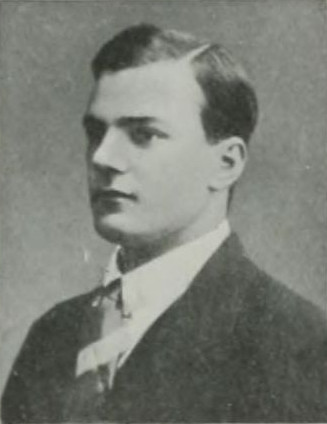
Alexander Dalzell Sprunt.
SPRUNT, EDWARD LAWRENCE, Private, No. 1510, 1st Battn. Honourable Artillery Coy. (Stretcher-bearer Section), 3rd s. of John Dalziel Sprunt, of 3 East India Avenue, London, E.C., and Montgomerie, Berkhampsted, by his wife, Jane, dau. of John Naismith; b. Hampstead, London, 28 Aug. 1892; educ. Berkhampsted School, and Jesus College, Oxford, at which latter he held an open exhibition. Having served about nine years in the O.T.C., he was offered a commission on the outbreak of war, but being eager to go to the Front as soon as possible, and thinking he would probably be sent for months to a regimental depôt to train recruits (as his elder brother was), he enlisted as a Private in the Honourable Artillery Coy., and went to the Front with them and served through the winter of 1914–15. Later was again offered a commission and the War Office instructed his Col. to send him home that he might take it up. After getting his discharge he went back to the Col. and said he had heard there was to be a battle next day, and as he did not wish to leave on the eve of it, he asked permission to remain and see his comrades through it. The Col. replied that as he had put it so gallantly he could not refuse his request, and so he might remain. That evening the Battn. went up to the trenches and was under fire about 36 hours, including the fierce fight of 16 June, 1915, losing about half its numbers. On 17 June, about 2 a.m., near Chateau Hooge, Belgium, he was helping to carry a wounded comrade on a stretcher, and had got within about 15 yards of the dressing station, when a shell came over and exploded underneath the stretcher, killing him and two others, and wounding the remaining two stretcher-bearers. He was buried on the battlefield, near the Ypres-Menin Road; unm. His commanding officer wrote: “Your son had the opportunity of not going up (to the trenches) and of returning home, but refused to leave his comrades at such a time, and so showed a magnificent spirit—worthy of a man in this Regt. He discharged his duties with great valour under great danger. The circumstances were such as to lead me to specially recommend him for gallant conduct, and the enclosed card has been received from the General. I have pleasure in sending it to you, while regretting very much the circumstances which have been greatly appreciated by his comrades.” The card is of the first class, being printed in gilt letters, the ordinary card being in black letters. It reads: “Third Division, British Expeditionary Force, 1510, Private E. L. Sprunt, Hon. Artillery Coy. Your commanding officer and brigade commander have informed me that you distinguished yourself by your conduct in the field on 16 June, 1915. I have read their report with much pleasure, and have brought it to the notice of higher authority.” Later the Assistant Military Secretary wrote that he had been mentioned in a despatch from F.M. Sir John French “for gallant and distinguished service in the field.” “I am to express to you the King’s high appreciation of these services, and to add that His Majesty trusts that their public acknowledgment may be of some consolation in your bereavement.”
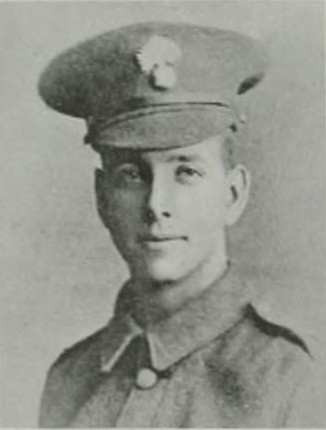
Edward Lawrence Sprunt.
SPRY, ERNEST JOHN, A.B. (R.F.R., B. 2224), 181820, H.M.S. Good Hope; lost in action off Coronel, on the coast of Chili, 1 Nov. 1914.
SPURDEN, WILLIAM, Private, No. 7194, 1st Battn. Royal West Kent Regt.; served with the Expeditionary Force in France, etc.; killed in action, 17 Nov. 1914; m.
SQUIBB, FRED, Private, G. 909, 1st Battn. Royal West Surrey Regt., s. of Frederick Squibb, of West Clandon, Surrey; served with the Expeditionary Force in France, etc.; died 5 Sept. 1915, of wounds received in action.
SQUIRE, ALAN RICHARD, Sergt., No. 10/782, Wellington Infantry Battn., eldest s. of Richard Jas. Squire, of Hawera, Taranaki, New Zealand, by his wife, Charlotte Louisa, dau. of the late Josiah Claridge, Carpenter; b. Hawera, 12 Sept. 1892; educ. Hawera, N.Z.; was a Painter and Signwriter; volunteered on the outbreak of war and joined the New Zealand Expeditionary Force, 7 Aug. 1914; left for Egypt with the main body as a gunner; arrived at Gallipoli, 7 May, 1915, and served there for three months, taking part in the severe fighting during that period; was promoted Sergt. the beginning of Aug., and was killed in action there a few days later, 7 Aug. 1915; unm. At the time he was killed he was temporarily in charge of the machine-guns, most of the officers having been killed or wounded.
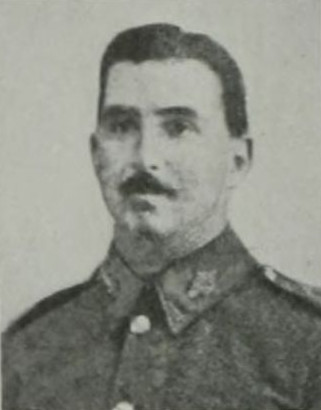
Alan Richard Squire.
SQUIRE, STANLEY CHARLES, Lieut., 7th (Service) Battn. Gloucestershire Regt., 2nd s. of the Rev. Charles Edward Squire, M.A., Vicar of Southrop, Lechlade, co. Gloucester, by his wife, Florence Charlotte, dau. of Morgan Yeatman, of Shawfield, Bromley, Kent; b. Llangrove Vicarage, near Ross, co. Hereford, 26 June, 1893; educ. St. John’s School, Leatherhead, and Corpus Christi College, Oxford (Science Scholar); gazetted 2nd Lieut. to the Gloucestershire Regt., 26 Aug. 1914; promoted Lieut., 27 Jan. 1915; sailed on 22 June for the East; was at Cape Helles on 8 July for a few weeks, then took part in the Expedition to Suvla Bay, where he was killed in action while in charge of the machine-gun section, 9 Aug. 1915, on Chanak Bair. They occupied an exposed position, and he was hit by a bullet after bandaging a wounded man, and killed instantaneously, early in the day. The only two survivors (Stokes and Bennett), who returned later on with the last machine gun, received the D.C.M. He was unm. His brother, Capt. G. F. Squire, of the same Battn., was wounded the same day.
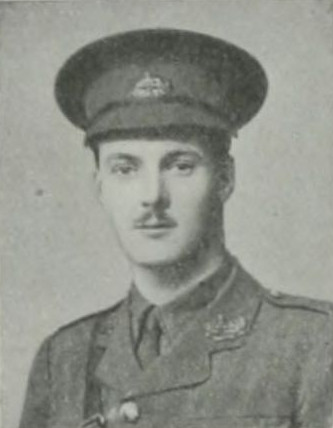
Stanley Charles Squire.
SQUIRES, FRANCIS CHAVASSE, Capt. and Adjutant, 23rd Sikh Pioneers, Indian Army, yr. s. of the late Rev. Henry Charles Squires, M.A., for 20 years Church Missionary Society Missionary, Western India, and afterwards Vicar of Holy Trinity, Richmond, Surrey, by his wife, Ada Martha (23, West Park, Eltham, S.E.), dau. of Thomas Chavasse, of Wylde Green House, Sutton Coldfield, Birmingham, F.R.C.S., and nephew of the Right Rev. Francis James Chavasse, D.D., Lord Bishop of Liverpool; b. West Chiltington Rectory, co. Sussex, 22 Feb. 1885; educ. St. Paul’s School (Foundation Scholar) and Sandhurst; gazetted 2nd Lieut. 5 Aug. 1905, and attached to the East Surreys in India, and the following year transferred to the Indian Army and posted to the 23rd Sikh Pioneers. He became Lieut. 5 Aug. 1907, and was appointed Adjutant, 25 Oct. 1912. He served in the Zakka Khel Expedition, 1908, for which he received a medal, and on the outbreak of the European War obtained his Company, 5 Aug. 1914. Capt. Squires was wounded in action at Lahej, 5 July, 1915, and died at Aden on the 7th; unm. His commanding officer wrote: “His high and sterling qualities were never better shown that on the extremely hard march to Lahej, in intense heat, when he was indefatigable and untiring in going back along the column, assisting men and getting them water, etc., and keeping me informed of everyone’s position. He reached me at Lahej just as the Turkish attack began, and throughout the early part of the night did magnificent work conveying orders to different units, and keeping me informed of their positions.... At about 11 p.m. the advanced line was withdrawn to an enclosure.... At your son’s urgent request I allowed him to go out with some men to keep clear a portion of the road near at hand. It was while carrying out this order that he received a gunshot wound.... He died on 7 July, and was buried in Aden that evening.... As a regt. we mourn the loss of a gallant officer and a kindly friend. Indian officers and men all express their deep grief. I lose a trusted Adjutant, and one whose sincere friendship I am proud to know I always held. His was a fine end, and I know he was contented it came thus in action.” He was an enthusiastic soldier, devoted to the well-being of his men, a good linguist and an excellent musician.
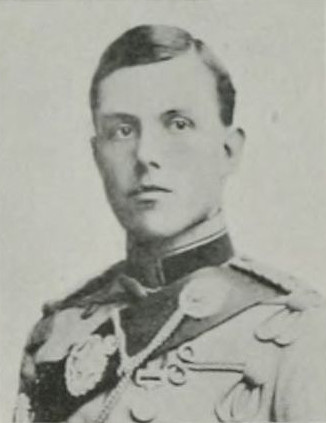
Francis Chavasse Squires.
SQUIRRELL, JOHN WILLIAM, Private, No. 16149, 1st Battn. The Suffolk Regt., 3rd s. of James William Squirrell, of Hill Cottage, Hintlesham, by his wife, Emma, dau. of the late John (and Ann) Percy; b. Hintlesham, co. Suffolk, 15 June, 1884; educ. there; was a Stockman; enlisted after the outbreak of war, 6 Nov. 1914; went to France about 20 May, and was killed in action at Ypres, 25 May, 1915. He m. at Hintlesham, 28 Dec. 1908, and had two sons: Stanley William, b. 12 Jan. 1910; and Jack Reggie, b. 21 Jan. 1914.
STABLE, LOSCOMBE LAW, Capt., 2nd Battn. Royal Welch Fusiliers, eldest surviving s. of Daniel Wintringham Stable, of Plas Llwyn, Owen, Llanbrynmair, co. Montgomery, and of Holly Lodge, Wanstead, co. Essex, LL.B., J.P., Barrister-at-Law, and a Director of the Prudential Assurance Company, by his wife, Gertrude Mary, dau. of George Still Law, M.A., Barrister-at-Law, of Lincoln’s Inn; b. Wanstead, 21 March, 1886; educ. The Wells House, Malvern Wells, Winchester (Fort’s House), and the Royal Military College, Sandhurst, and passed out with honours; gazetted 2nd Lieut., Royal Welch Fusiliers, 2 Feb. 1907, and promoted Lieut. 11 April, 1911, and Capt. 21 Oct. 1914; went to France, 10 Aug. 1914, and was killed in action in the trenches about four miles south of Armentières, facing the village of Vertouquet and Rouge Bancs, 26 Oct. 1914; unm. Buried in La Cordonnerie Farm, close to Armentières, and about two miles from Fromelles. Col. H. Delmé Radcliffe wrote: “About your gallant son, who was one of the subalterns in the Battn. under my command. He was a most excellent soldier—fearless to a degree, and always the most cheerful of companions, and was therefore most popular with his brother officers, and in his death is most deeply regretted by all ranks. He received his death wound, so it was reported to me, going to the assistance of one of the men who was wounded and lying outside of the trenches. This was just like him, as he was always a model of unselfishness and thoughtfulness for others.” Private Ellis, the wounded man, was saved. Capt. Stable had some experience of mountaineering and winter Alpine sports, and was a fine polo player, having played for his regt. at Meiktila, Shwebo, Bhamo, Maymyo, Mandalay, Quetta, Bareilly, Meerut, Allahabad, Cawnpore, Lucknow, and finally in the winning team for the Infantry Polo Tournament at Delhi in 1913.
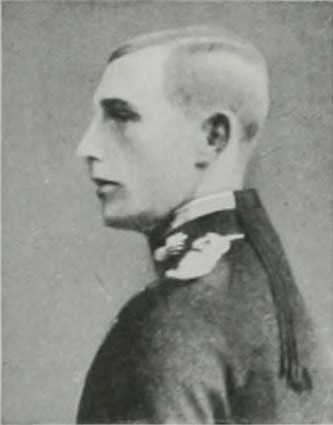
Loscombe Law Stable.
STACEY, JAMES, Private, No. 11395, 1st Battn. Coldstream Guards, s. of George Stacey, of 62, Fergusson Road, Attercliffe, Sheffield, by his wife, Emily, dau. of William Hancock; b. Attercliffe, 27 Feb. 18—; educ. Council School there; enlisted in the 4th Reserve Battn. 1 Sept. 1914, and was posted to the 1st Battn. after action at Givenchy, 22 Dec. 1914. He was reported missing, and is now assumed to have been killed on that date; unm.
STACEY, RICHARD JOHN, Officer’s Cook, 2nd Class, L. 1597, (Dev.), H.M.S. Good Hope; lost in action off Coronel, on the coast of Chili, 1 Nov. 1914.
STACKHOUSE, WILLIAM THOMAS, Capt., 2nd, attd. 1st, Battn. Sherwood Foresters, elder s. of the late William Anthony Stackhouse, of Taitlands, Settle, J.P., V.D., Major, 3rd Duke of Wellington’s West Riding Regt., by his wife, Marian Frances (Casterton Grange, Kirkby Lonsdale), dau. of the late William Hodgson Hale, of Arrerille, Kirkby Lonsdale; b. Settle, co. York, 8 Aug. 1883; educ. Riber Castle, Matlock; Harrow, and the Royal Military College, Sandhurst; gazetted 2nd Lieut., Lancashire Fusiliers, 4 Nov. 1903; and promoted Lieut. 13 March, 1907, and Capt. 21 Jan. 1913; served with the 4th Lancashires at the Curragh and in Tipperary, but on its disbandment under the Territorial scheme was posted to the 1st Battn. at Malta, from which he was specially promoted to the Sherwood Foresters in 1907, and served with the 2nd Battn. at Kinsale, Aldershot, Plymouth and Sheffield. When his Battn. went to France in Sept. 1914, he was left at home to train the New Army, and was made Adjutant of the 10th Battn., 7 Sept. 1914; was transferred to the Royal Berkshires in Oct., but eventually went to France in Nov., attd. to the 1st Sherwood Foresters, and was killed in action at Neuve Chapelle, 11 March, 1915. Buried there. He was a keen sportsman—shooting, tennis, polo and motoring being among his favourite pursuits. The following are extracts taken from letters received from his commanding officer and others: “He was one of the most popular men in the Battn., and his death is indeed a great blow to all of us. He was always so cheery, even under the most adverse circumstances, and I ... had a high appreciation of his many good qualities.” “He really performed most gallant service the whole time, and although I know he was not a strong man, he stuck it, and showed us all an excellent example, we all loved him.” He m. at All Souls, Langham Place, London, 7 Dec. 1912, Theodora Charlotte, 2nd dau. of Alfred Reginald Norrington, of Abbotsfield, Plymouth; s.p.
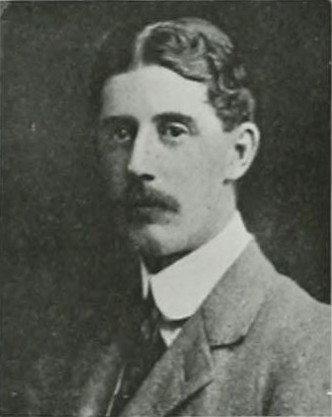
William T. Stackhouse.
STACPOOLE, GEORGE ERIC GUY, Lieut., 1st Battn. Royal Irish Regt., eldest s. of Richard George Stacpoole, of 26, Walton Street, Hans Place, London, and of co. Clare, by his wife, Edith Maude, dau. of Sir Edward Dean Paul, 4th Bart., and great grandson of the late Richard John de la Zouche Stacpoole, of Eden Vale, co. Clare; b. Sefton Park, Liverpool, 10 Jan. 1892; educ. Eton and the Royal Military College, Sandhurst; gazetted 2nd Lieut., Royal Irish Regt., 4 Nov. 1911, and promoted Lieut. 16 Aug. 1914; joined his Regt. at Nasirabad, India, in Jan. 1912, and while stationed there went in for transport work, and passed the appointed course; returned to England in Nov. 1914; went to France in Dec. with the 27th Division, and was killed in action at St. Eloi, 27 Jan. 1915; unm. Buried in Dickebusch Cemetery. His commanding officer wrote: “I very much deplore his loss, as a gallant officer, fearless, true and upright, and popular with all ranks of his Battn.”
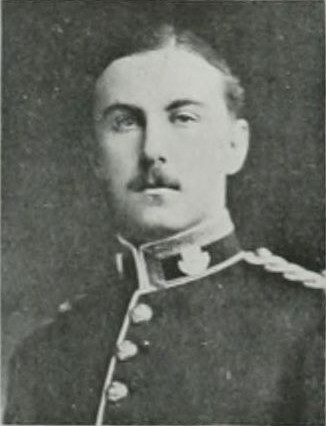
George Eric G. Stacpoole.
STAFF, SAMUEL ROYAL, Leading Seaman (R.F.R., Ch. B. 10485), 215096, H.M.S. Aboukir; lost in action in the North Sea, 22 Sept. 1914.
STAFFORD, ALFRED, Private, R.M.L.I., Ch./16390, H.M.S. Aboukir; lost in action in the North Sea, 22 Sept. 1914.
STAFFORD, ROWLAND HERBERT, Stoker, 1st Class, K. 3801, H.M.S. Aboukir; lost in action in the North Sea, 22 Sept. 1914.
STAGG, JOSEPH ALBERT EDWARD, 2nd Yeoman of Signals (R.F.R., Ch. B. 2117), 182790, H.M.S. Cressy; lost in action in the North Sea, 22 Sept. 1914.
STAHL, ERNEST FRANK, Private, No. 2685, 1/21st Battn. (1st Surrey Rifles) The London Regt. (T.F.), yst. s. of the late Councillor George Peter Stahl, of Lambeth, by his wife, Elizabeth Ada (26, Herbert Road, Stockwell Road, Brixton, S.W.), dau. of Charles Payne, of Southampton; b. Berkeley Street, Lambeth, S.E., 28 Nov. 1894; educ. Lambeth Parochial Schools; was an assistant at the Times Book Club, Oxford Street, W.; volunteered on the outbreak of war in Aug. 1914, and joined the Surrey Rifles in Sept.; went to France, 15 March, 1915, and was killed in action at Givenchy, 25 May, 1915, whilst trying to rescue a wounded comrade; unm. Buried near Givenchy. Capt. Arthur Hutchence hence wrote: “Your son’s death was a noble one; he was shot whilst trying to bring a wounded comrade into safety under a heavy fire. His loss is felt by all ranks of my company, and we all unite in offering you our sympathy.” He was a good all-round athlete.
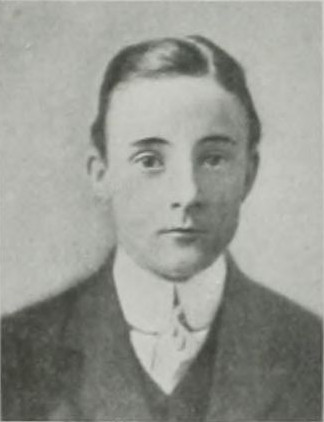
Ernest Frank Stahl.
STALLARD, WILLIAM HAROLD, A.B., 240992, H.M.S. Aboukir; lost in action in the North Sea, 22 Sept. 1914.
STANDING, GEORGE WILLIAM, Stoker, 1st Class, K. 12613, H.M.S. Pathfinder; lost when that ship was sunk by a mine, about 20 miles off the East Coast, 5 Sept. 1914.
STANDLEY, ERNEST GEORGE, A.B., J. 7789, H.M.S. Good Hope; lost in action off Coronel, on the coast of Chili, 1 Nov. 1914.
STANLEY, FREDERICK HARRY, Rifleman, No. 2851, C Coy., 12th Battn. (The Rangers) The London Regt. (T.F.), eldest s. of Harry Lawrence Stanley, of 111, Woodgrange Road, Forest Gate, by his wife, Elizabeth, dau. of George Cockburn; b. 14, Sebert Road, Forest Gate, Essex, 24 Nov. 1893; educ. Cooper’s School, Bow; was a Clerk; volunteered after the outbreak of war and joined The Rangers, 7 Sept. 1914; went to France, 24 Dec. 1914, and was killed in action near Ypres, 27 April, 1915; unm. Buried, Verlorenhoek.
STANLEY, GEORGE THOMAS, S.B.A., M. 2392, H.M.S. Hawke; lost when that ship was torpedoed in the North Sea, 15 Oct. 1914.
STANLEY, ROBERT GEORGE, Chief Ship’s Cook, 176645, H.M.S. Pathfinder; lost when that ship was sunk by a mine, about 20 miles off the East Coast, 5 Sept. 1914.
STANNARD, GORDON, L.-Corpl., No. 7995, 2nd Battn. Essex Regt., s. of David Stannard, of Kirton, near Ipswich, by his wife, Cecelia; b. Kirton, near Ipswich, 29 Dec. 1886; educ. Trimley Road School; enlisted at Ipswich, 5 July, 1904; went to France, 6 Jan. 1915, and died in Boulogne Hospital, 21 Feb. 1915, of wounds received in action. He m. at All Saints’ Church, Dovercourt, 9 Sept. 1914, Evelyn May (Red House Farm, Trimley St. Martin, near Ipswich), dau. of John (and Ellen) Churchyard, and had a dau.: Victoria Gladys May, b. 19 Dec. 1914, and d. 29 July, 1915.
STANNETT, ROBERT, Bugler, Ch./12775, H.M.S. Hogue; lost in action in the North Sea, 22 Sept. 1914.
STAPLES, JOHN, Leading Stoker, K. 1806, H.M.S. Good Hope; lost in action off Coronel, on the coast of Chili, 1 Nov. 1914.
STARKE, HARRY, Sapper, No. 2385, 1/3rd Coy. Kent Fortress R.E. (T.F.), only child of James Starke, of 9, Kenwood Road, Highgate, N., for 48 years Carman on G.N. Railway, by his wife, Martha, dau. of Andrew (and Mary) Smith; b. Holloway, 27 March, 1871; educ. Blundell Street L.C.C. School, Caledonian Road, Holloway, N.; was a Carpenter by trade; served in the 17th North Middlesex Rifle Volunteer Corps from 19 Feb. 1890 to 5 Jan. 1893, and after the outbreak of war enlisted, 31 May, 1915; went to the Dardanelles in the transport Hythe, and was drowned in a collision off Gallipoli, 28 Oct. 1915. He m. at St. Saviour’s Church, Hornsey Rise, 20 Feb. 1892, Emily (8, Montem Street, Upper Holloway, N.), dau. of William Root, Gardener for over 30 years to Mr. R. Gaskell, North Hill, Highgate, N., and had issue: Frederick James, b. 5 June, 1893; Harry William Alfred, b. 20 Oct. 1894; Emily Martha, b. 6 Nov. 1897; Florence Ivy, b. 17 June, 1899; and Catherine Alice, b. 9 Feb. 1901.
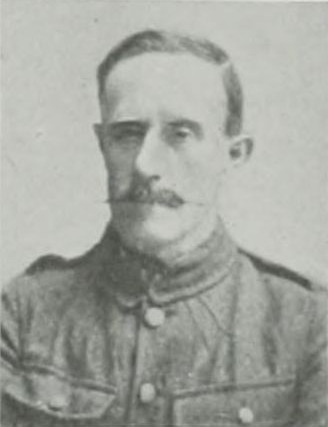
Harry Starke.
BARBER-STARKEY, WILLIAM HENRY JOSEPH, Capt., 52nd Battery, Royal Field Artillery, eldest s. of William Joseph Starkey Barber-Starkey, Aldenham Park, Bridgenorth, co. Salop, J.P., B.A., by his wife, Margaret Aimeé, 3rd dau. of Sir George Kinloch, of Kinloch, 1st Bart., J.P., D.L.; b. The Hall, Huttons Ambo, co. York, 4 March, 1880; educ. Harrow, and Trinity College, Cambridge; gazetted 2nd Lieut. in the R.F.A. from the Militia, 6 Oct. 1900; promoted Lieut. 24 Oct. 1903, and Capt. 9 May, 1912; served with the Expeditionary Force in France, etc., from 17 Aug. 1914, and died a prisoner of war in a German Field Hospital, 10 Sept. following, from wounds received in action at Le Cateau, 26 Aug. previously; unm. Buried at Le Cateau.
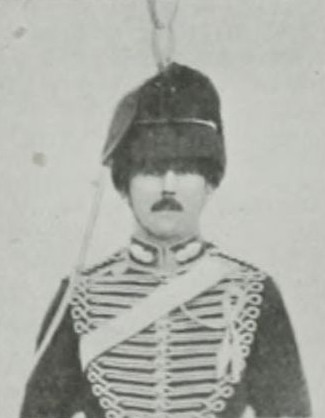
W. H. J. Barber-Starkey.
STARR, FRANCIS JAMES, Stoker, 1st Class (R.F.R., B. 2714), S.S. 50, H.M.S. Good Hope; lost in action off Coronel, on the coast of Chili, 1 Nov. 1914.
STARR, THOMAS ADIN, Private, No. 11380, 8th Battn. Welsh Regt., only s. of Thomas Starr, of 2, Bolt Street, Newport, Monmouth; b. 4 Sept. 1887; served with the Mediterranean Expeditionary Force at the Dardanelles from 14 June to 8 Aug. 1915, on which date he was killed in action there; unm.
STATHAM, LOUIS FORSYTH, Seaman, R.N.R., 2028D, H.M.S. Hogue; lost in action in the North Sea, 22 Sept. 1914.
STEADMAN, ALBERT, Private, No. 2289, 1/4th Battn. East Kent Regt. (The Buffs), eldest s. of Frederick Steadman, of 70, Beaver Road, South Ashford, Kent, employee in S. E. & C. Railway Works, Ashford, by his wife, Hannah Jane, dau. of Robert Hatton, of Dover; b. South Ashford aforesaid, 9 Dec. 1893; educ. S. E. & C. Railway Schools there; was a Clerk in the Ashford Branch of the Commercial Union Assurance Co., Ltd.; enlisted 4 Sept. 1914; went to India with his regt. in Dec. which was stationed at Mhow, Central India, till July 1915, when it was sent to Aden. He died of heatstroke at As Sela Sheikh Othman, 25 Sept. 1915, while taking part in the repulse of the Turkish attack on Aden; unm. He was fond of swimming, and represented his company in the regimental swimming contests at Mhow.
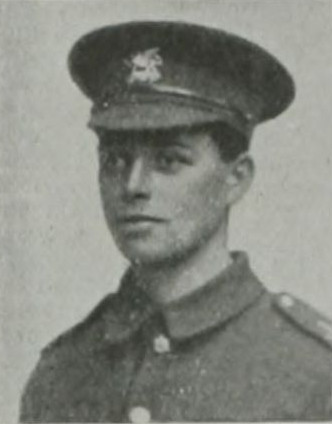
Albert Steadman.
STEANE, PERCY HOWARD, Private, No. 2631, 15th Battn. (Prince of Wales’s Own Civil Service Rifles) London Regt. (T.F.), only s. of Frederick Houston Steane, Solicitor’s Managing Clerk; b. Balham, 31 Oct. 1892; educ. Balham Grammar School; was in the service of the Ocean Insurance Company, but on the outbreak of war enlisted Aug. 1914, and was killed at Festubert, 18 May, 1915, while on sentry duty in the trenches. Capt. H. B. Farquhar wrote: “Your son was ever of the most conscientious character, doing his duty thoroughly and cheerfully, was ready to share all hardships and lighten the burdens of others.”
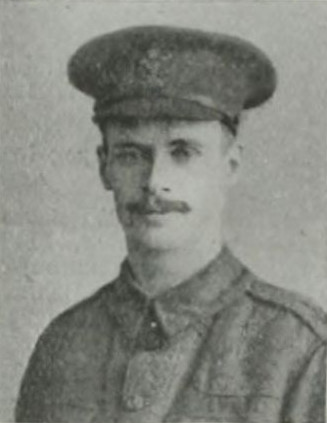
Percy Howard Steane.
STEARNS, ERIC GORDON, 2nd Lieut., 4th Battn. Royal Fusiliers, yr. s. of Thomas Robert Stearns, of Lansdowne, Woodridings, Hatch End, co. Middlesex, Insurance Official, by his wife, Alice, dau. of James Grant, of Ipswich and Belize; b. Hornsey, 25 March, 1895; educ. St. John’s College, and Lower School, Harrow; was a Clerk in the Sun Insurance Office; joined the Artists’ Rifles (28th London Regt.) in 1912; volunteered for foreign service on the outbreak of war; was given a commission as 2nd Lieut. 6 April, 1915, and posted to the Royal Fusiliers; went to France in Oct. 1914, and died at Abeele of wounds received in action in Belgium, while in charge of a party digging a new trench; unm. His commanding officer, Lieut.-Col. W. F. Sweny, wrote: “I have seen enough of your son to realise what a useful and cool officer he was”; Sergt. F. H. Smith: “Mr. Stearns was almost worshipped by the men under his command; they would have followed him anywhere, for they knew he was a man. He had not an atom of fear in him, and he had always a smile and a cheery word for everybody. I do not think anybody could be more liked and respected than he was”; and Private W. H. Leighton: “The bullet caught him just above the hip and passed upwards. We did everything we possibly could but all in vain, worse luck. He bore it extremely well, as he always did everything, being a very brave officer and one whom the men had the greatest confidence in and would have followed him anywhere.”
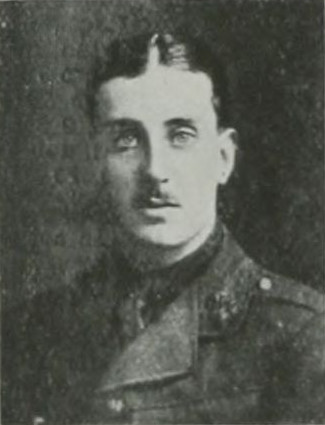
Eric Gordon Stearns.
STEEL, JOHN, Mechanical Stoker (R.F.R., B. 1557), 276964; b. Dublin, 25 Dec. 18—; served in the European War, and was lost in H.M.S. Goliath at the Dardanelles, 12 May, 1915. He m., 22 Sept. 1900, Fanny (10, Harbour Village, Goodwick, co. Pembroke), dau. of (—), and had two sons: Richard John, b. 28 June, 1901; and Edward James, b. 31 Oct. 1906. He had the medal for saving life.
STEELE, MATTHEW JAMES, L.-Corpl., No. 2476, 1/4th Battn. East Yorkshire Regt. (T.F.), 3rd s. of Thomas Steele, of Hull, Cab Proprietor, by his wife, Maria Elizabeth, dau. of James Outram; b. Hull, 27 April, 1892; educ. Warne Street Council School there; was an Assistant Steward, Hull and Barnsley Railway Head Offices; volunteered on the outbreak of war in Aug. 1914, and joined the 4th East Yorkshires; went to France, 17 April, 1915, and was killed in action east of Ypres, 26 May, 1915. From letters received it appears that one of his comrades had been shot by a sniper, and that Steele, thinking he might still be alive, went to his assistance and was himself shot through the heart. He m. at St. Stephen’s Church, Hull, 1 March, 1913, Kathleen (76, Portland Street, Hull), dau. of John (and Ada) Moorhead, and had a son, Kenneth James, b. 13 June, 1914.
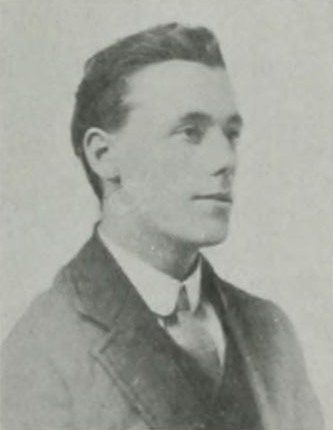
Matthew James Steele.
STEELE, WILSON, Stoker, 1st Class, K. 11446 (Ports.), H.M.S. Hogue; lost in action in the North Sea, 22 Sept. 1914.
STEER, GEORGE, Leading Seaman, 190537, H.M.S. Good Hope; lost in action off Coronel, on the coast of Chili, 1 Nov. 1914.
STENNING, LESLIE GERALD, Lieut. and acting Capt., 6th Battn. The Essex Regt. (T.F.), yst. s. of Henry Stenning, of 16, Norfolk Road, Seven King’s, Civil Servant, by his wife, Selina, dau. of Richard Coleman; b. Ilford, co. Essex, 25 Feb. 1894; educ. County High School there; was a Bank Clerk; obtained a 2nd Lieutenancy in the Essex Territorials 1 Oct. 1913, and was promoted Lieut. 16 Oct. 1914; volunteered for Imperial service on the outbreak of war in Aug. 1914; went to the Dardanelles, 24 July, 1915; acted as Capt. from 3 Aug., and died on H.M. Hospital Ship Soudan on the 13th, from wounds received in action there; unm.
STENT, JAMES JOHN, A.B. (R.F.R., B. 1456), 196002, H.M.S. Good Hope; lost in action off Coronel, on the coast of Chili, 1 Nov. 1914.
STEPHENS, GEORGE ERNEST, Stoker, 1st Class, K. 14049, H.M.S. Aboukir; lost in action in the North Sea, 22 Sept. 1914.
STEPHENS, JOHN, A.B. (R.F.R., Ch. B. 9680), 201448, H.M.S. Aboukir; lost in action in the North Sea, 22 Sept. 1914.
STEPHENSON, HAROLD, Private, No. 4020, 10th Battn. (Liverpool Scottish) King’s Liverpool Regt. (T.F.), s. of John James Stephenson, of Shepstone Avenue, Walton, Liverpool, by his wife, Isabella, dau. of James Rigby; b. Liverpool, 7 March, 1893; educ. Venice Street School there; was a Pattern Maker; volunteered after the outbreak of war and joined the Liverpool Scottish, 2 Nov. 1914; went to France end of Jan., and was killed in action at Hooge, 16 June, 1915; unm.
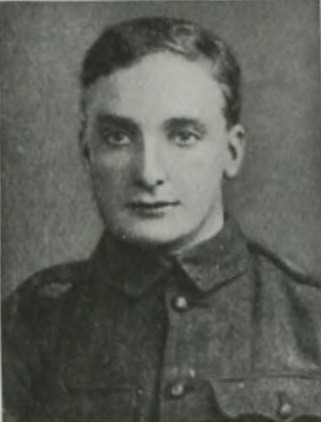
Harold Stephenson.
STERLING, ROBERT WILLIAM, Lieut., 3rd, attd. 1st, Battn. Royal Scots Fusiliers, elder s. of John Lockhart Sterling, of 30, Ashton Gardens, Glasgow, by his wife, Clara Frances, dau. of James Lowe, of Lancashire; b. Glasgow, 19 Nov. 1903; educ. Glasgow Academy; Sedbergh School, and Pembroke College, Oxford (scholar), where he took a second in Honour Mods., and had just completed his second year when war was declared in Aug. 1914; volunteered for foreign service and was given a 2nd Lieutenancy in the Royal Scots Fusiliers, 15 Aug. 1914, and promoted Lieut. — March, 1915; took a draft of his regt. to France in the middle of Feb. 1915; was attd. to the 1st Battn., and was killed in action near Ypres, 23 April, 1915; unm. Buried in the Military Cemetery, Dickebusche. His commanding officer wrote: “He was in command of a trench which was of the utmost importance, and had held it most gallantly all day. He was killed about 8 p.m. I cannot tell you how much the Scots Fusiliers mourn his loss. He was quite one of my best.” In 1914 he wrote the Newdigate prize poem on the Burial of Sophocles, which he read at the Encaenia in the June of that year. His younger brother, 2nd Lieut. John Lockhart Sterling, 3rd Battn. R.S.F., attd. 2nd Battn. R.S.F, was killed on 28 Sept. 1915, before Hulluch, France. Two editions of “The Poems of Robert Sterling” were published by Oxford friends in 1916.
STERLING, WILLIAM, Private, No. 9097, West Yorkshire Regt., s. of William Sterling, of Hebburn, Joiner, by his wife, Isabella, dau. of James Turner; b. Hebburn New Town, co. Durham, 13 Feb. 1897; educ. there; enlisted on outbreak of war, 1914, and went with his regt. to France, 9 Jan. 1915. He died of wounds received while in action at Neuve Chapelle, 14 March, 1915, buried in Bailleul Cemetery; unm. A comrade wrote: “We fought hard all day, not having time to eat, and late at night we went about 50 of us to a billet to eat. Shortly afterwards the Germans shelled our place, and mostly all were either killed or wounded, Private W. Sterling being hit in the back with shrapnel and died two hours afterwards in a hospital near by.”
STERN, LEONARD HERMAN, 2nd Lieut., 13th Battn. (Princess Louise’s Kensington Battn.) The London Regt. (T.F.), elder s. of the Rev. Joseph Frederick Stern, Minister of the East London Synagogue, Stepney, since 1887; b. Synagogue House, Stepney, 12 Sept. 1891; educ. at The Preparatory School, Holly Hill, Hampstead, and University College School. Proceeding to Cambridge in 1910 as an Exhibitioner in Classics of Magdalene College, he was elected a Scholar of his College in the following year. He also held the Cambridge Jewish Exhibition. He graduated B.A. in 1913, taking a First-Class in the Honours Classical Tripos in that year. In the following year he gained Second-Class Honours in the History Tripos. He obtained his college football colours in 1912, in which year he played in the College team against Magdalene College, Oxford. He was a member of his school Cadet Corps, and subsequently joined the Cambridge O.T.C., in which he obtained the rank of Sergt. Throughout his stay at the University he took an active part in the affairs of the Cambridge Hebrew Congregation, holding in succession the several Synagogue offices. He was an occasional speaker at the Union Society, and read several papers at college societies. He devoted a considerable part of his vacations to social work in East London, being a manager of the Stepney Jewish Lads’ Club and the Oxford and St. George’s Lads’ Club. He also took a keen interest in the Boy Scouts movement, and became a scout-master of the 7th Stepney Troop B.P. Scouts. On the outbreak of war he co-operated with other Toynbee Hall workers in the organisation of the East London Scouts for public service in the Metropolis. He enlisted in the ranks of the Kensington Battn. of The London Regt. with a number of the lads of his troop, and shortly after was made a sergt. of his company. He obtained his commission as 2nd Lieut. in the same regt. 6 Feb. 1915, and left for France on 7 March, was wounded several times, and was killed in action at the Battle of Fromelles, 9 May, 1915; unm. Col. Fred E. Lewis wrote: “He fell gallantly. He had a dangerous job, but he went through with it, setting a fine example to his men. I grieve to think it cost him his life. We have lost a promising officer.” And Major N. E. Stafford, in notifying his death to the Depot Officer of the regt., said: “He met his death leading his men in the true British way. Although he had only been with us a short time, he had already won the esteem of his brother officers, and gave great promise as an officer. He was put in charge of the bombers, and he showed zeal and initiative in his work. Col. Lewis, who has gone to hospital very ill, desires me to express his great regret at the loss of so promising an officer.”
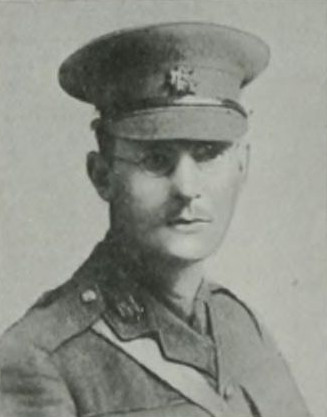
Leonard Herman Stern.
STERN, WILLIAM, Stoker, 1st Class, K. 5331, H.M.S. Pathfinder; lost when that ship was sunk by a mine, about 20 miles off the East Coast, 5 Sept. 1914.
STEUART, ALAN JOHN, Sergt., No. 43209, Royal Canadian Engineers, 3rd Field Coy., Canadian Expeditionary Force, 5th s. of the late Capt. Robert Steuart, of Westwood, Linlithgowshire, H.E.I.C.S., J.P., D.L. (died March, 1913), by his wife, Alice Mary (Westwood, West Calder), dau. of Patrick W. V. Dudgeon, and grandson of Robert Steuart, of Carfin and Westwood; b. Westwood House, co. Linlithgow, 6 May, 1888; educ. Blairlodge School, Stirling, and Bromsgrove, co. Worcester; was an Electrical Engineer; went to British Columbia in 1912, and settled at Vancouver, but on the outbreak of war in Aug. 1914 at once enlisted in the Canadian Engineers, was promoted L.-Corpl. in Nov. 1914, and Sergt. in Jan. 1915; came over with the first contingent in Oct.; went to France in Feb. 1915, and was killed in action at Vlamertinghe, 24 April following, during the gas attack by the Germans at the second Battle of Ypres, when the Canadian Engineers (who were in the 3rd Infantry Brigade, establishing contact with the Allies, at the terminus to the north-west of Ypres) were ordered forward to dig protection trenches in front of the oncoming enemy; unm. Buried in Vlamertinghe Cemetery. His commanding officer wrote: “He was a very keen, good soldier, of untiring effort and unfailing cheerfulness.... As popular with the men as with the officers.”
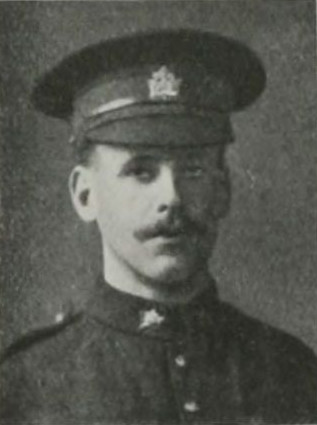
Alan John Steuart.
STEVENS, ARTHUR, Petty Officer, 2nd Class (R.F.R., B. 2087), 190224, H.M.S. Good Hope; lost in action off Coronel, on the coast of Chili, 1 Nov. 1914.
STEVENS, FRED, Stoker, 1st Class (R.F.R., B. 7115), S.S. 101839, H.M.S. Hawke; lost when that ship was torpedoed in the North Sea, 15 Oct. 1914; m.
STEVENS, FREDERICK AUGUSTUS, Ch. E.R.A., 1st Class (Pensioner), 148212, H.M.S. Cressy; lost in action in the North Sea, 22 Sept. 1914.
STEVENS, JOHN, Stoker, 1st Class (R.F.R., B. 7057), S.S. 101670, H.M.S. Hawke; lost when that ship was torpedoed in the North Sea, 15 Oct. 1914; m.
STEVENS, LOTHIAN BASIL, 2nd Lieut., 3rd Battn. South Staffordshire Regt., attd. 2nd Battn. Scottish Rifles, yst. s. of Col. George Morton Stevens, late R.A., by his wife, Mary, dau. of Surg.-Gen. William Campbell Maclean, C.B., M.D., LL.D.; b. Southampton, 13 March, 1894; educ. Blundells School, Tiverton, and Balliol College, Oxford (Mathematical Scholar); where he took a first-class in moderations in mathematics, July, 1914; joined the Public Schools Battn. of the Middlesex Regt. in Sept. 1914, and obtained a commission in the 3rd South Staffordshires, 3 Oct. 1914; went to France in March, 1915; was attd. to the 2nd Scottish Rifles; was reported wounded and missing after the fighting at Fromelles, 9 May following, and is now assumed to have been killed in action that day; unm. The officer commanding the 2nd Scottish Rifles wrote: “I am afraid your son must have died from his wound. It is a great distress to us all, as he was so keen and interested in his work, and such a bold and reliable leader.” His brother, Capt. R. W. M. Stevens, died of wounds, 27 Aug. 1914.
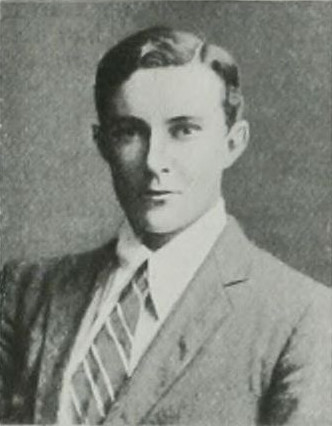
Lothian Basil Stevens.
STEVENS, REGINALD WALTER MORTON, Capt., Royal Irish Rifles, and Brigade Major, 9th Infantry Brigade, 2nd s. of Col. George Morton Stevens, late R.A., by his wife, Mary, dau. of Surg.-Gen. William Campbell Maclean, C.B., M.D., LL.D.; b. Dover. 18 Dec. 1876; educ. Mr. T. Eastman’s, Stubbington; Appuldurcombe, I.W., and the Royal Military College, Sandhurst; gazetted 2nd Lieut., Royal Irish Rifles, 5 Sept. 1896, and promoted Lieut. Aug. 1898; and Capt. 2 Jan. 1904; joined the 2nd Battn. at Poona in Oct. 1896; served in the South African War, Oct. 1890–1902; took part in operations in Cape Colony, 1899 to 1900 (was severely wounded at Stormberg, 10 Dec. 1899) and Nov 1900, to April, 1901 (Assistant Staff Officer to Assistant Inspector-Gen., Western Section, Lines of Communication), and in Orange River Colony, April, 1901, to 21 May, 1902 (Queen’s medal with two clasps, King’s medal with two clasps); and (2) in East Africa; was Special Service Officer on Staff during operations in Somaliland, 7 May, 1903, to 12 June, 1904; present at action at Jedballi (medal with two clasps); was Adjutant 25 Jan. 1905 to 25 Jan. 1908, and Officer of a company of Gentlemen Cadets at the R.M.C., Sandhurst, 25 Jan. 1908 to 21 Jan. 1910; joined the Staff College in 1910; was attd. to the Naval War College, Portsmouth, 1912, and 1 Nov. of that year was appointed Brigade Major, 9th Infantry Brigade, Southern Command, an appointment he continued to hold until his death. He went to the front 13 Aug. 1914; was in action at Le Cateau on the 26th, and an urgent order to retire instantly having been received, to ensure its reaching the front line and being acted on without delay, Capt. Stevens rode himself to deliver it and was mortally wounded in doing so, and died in a farmhouse the following day, 27 Aug. 1914. He was mentioned in F.M. Sir John (now Lord) French’s Despatch of 8 Oct. [London Gazette, 19 Oct.], 1914, for gallant and distinguished service in the field. He m. at Alverstoke, Hants, 1912, Elisabeth (Cambridge Cottage, Alverstoke), dau. of the late Rev. J. C. Mace, of Hawley, Blackwater, and had a dau., Agnes Desirée, b. 11 Sept. 1914—two weeks after her father’s death.
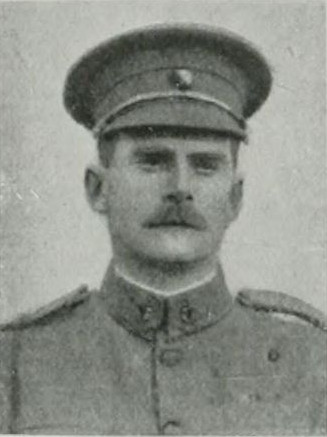
Reginald W. M. Stevens.
STEVENS, WILLIAM FREDERICK, Petty Officer (N.S.), 23397, H.M.S. Aboukir; lost in action in the North Sea, 22 Sept. 1914.
STEVENS, WILLIAM HENRY, Petty Officer, 226024, H.M.S. Hogue; lost in action in the North Sea, 22 Sept. 1914.
STEVENSON, CHARLES, Lc.-Corpl., No. 1803, 3/1st Battn. R.A.M.C. (T.F.), s. of Charles Stevenson, Ex-Provost of South Queensferry, West Lothian, by his wife, Jeanie, dau. of Robert Gibb, of Paisley, Scotland and Manitoba, Canada; b. Milngavie, 1873; educ. South Queensferry Public School; was an Organist and Choirmaster (retired); volunteered after the outbreak of war; left England for the Dardanelles, 30 July, 1915, and was drowned when H.M. Transport Royal Edward was sunk in the Ægean Sea, 13 Aug. 1915, by an enemy submarine; unm.
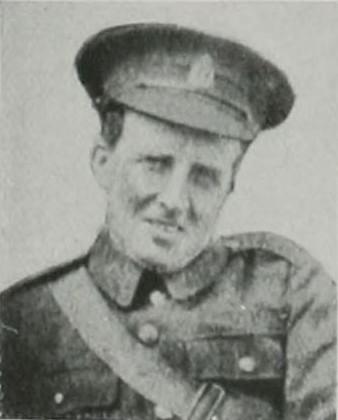
Charles Stevenson.
STEVENSON, GEORGE, Corpl., No. 9137, B. Coy., 1st Battn. Cameron Highlanders (Machine Gun Section), 3rd s. of the late John Kay Stevenson, 41, Muirpark, Eskbank, Dalkeith, late Sergt., 2nd Argyll and Sutherland Highlanders (died 23 Nov. 1915), by his wife, Jessie, dau. of the late Charles Graham, of Kirkcaldy, Master Painter; b. Eskbank, Dalkeith, co. Midlothian, 31 Aug. 1893; educ. Dalkeith High School; enlisted 4 Oct. 1911; went to France with his regt., and was killed in action, 14 Sept. 1914, at the Battle of the Aisne; unm. Mrs. McLachlan, wife of the Col. Commanding 1st Camerons, wrote: “To-night an officer of the Camerons has just been to see me, and I asked him about your George. He says that he was killed and buried on the battlefield during a lull in the fighting. He also said that George was a very fine soldier, and a great loss to the Machine-Gun Section.”
STEWART, CHARLES, Private, No. 9511, 2nd Battn. Scots Guard; b. Anderston, Glasgow; enlisted 26 Aug. 1914; served with the Expeditionary Force in France, etc.; killed in action, 16 May, 1915.
STEWART, DONALD, Private, No. 4576, 2nd Battn. Scots Guards, s. of P. Stewart, of the Isle of Skye; b. Skye; enlisted 21 Aug. 1902; served with the Expeditionary Force in France, etc.; killed in action, 4 Nov. 1914.
STEWARD, EDMUND, A.B. (R.F.R., Ch. B. 9115), 200012, H.M.S. Cressy; lost in action in the North Sea, 22 Sept. 1914.
STEWART, DOUGLAS EVERARD MACBEAN, Lieut.-Col. 1st Canterbury Regt., New Zealand Expeditionary Force, s. of Francis Macbean Stewart, L.R.C.P., L.R.C.S., of Canterbury, New Zealand, formerly of Inverness, Scotland, by his wife, Annie Stevens (Bealey Avenue, Christchurch, N.Z.), dau. of S. C. Farr; b. Ashburton, Canterbury, 25 May, 1877; educ. Boys’ High School, Christchurch. On leaving school was for several years accountant for Messrs. Kempthorne, Prosser & Co., and later joined in establishing the firm of Stevenson, Stewart & Co., shipping agents. In 1900 was Lieut. Canterbury Highland Rifles, 10 months later becoming Capt. Commanding. When the Territorial scheme came into operation he was offered and accepted the Captaincy of the 1st (Canterbury) Infantry Regt., and in May, 1912, was promoted Major. On the outbreak of war he volunteered for foreign service, was given the command of his regt. 12 Aug. 1914, and was killed in action in the landing at the Dardanelles, 25 April, 1915. Col. Stewart held the medal for 12 years’ service with the New Zealand Volunteer and Territorial Forces, and was mentioned in Sir Ian Hamilton’s Despatch of 12 June, 1915. In announcing his death, Major A. E. Loach, who succeeded to the command, wrote: “From first to last Col. Stewart evinced an unfailing interest in the efficiency and welfare of his command, and his loss is most keenly felt by one and all, not only in a personal sense, but in that the regt. has been deprived, at this early stage, of that able leadership, confidence in which means so much to any regt. on active service.... I enclose with this letter reports from Lieut. Lawry and Corpl. McInnis, who were with the Colonel at the time of his death. On Sunday last, after a landing had been effected, Col. Stewart pushed on to the rendezvous with the 1st and 2nd Companies, leaving me behind to bring on the remainder of the battn. The Colonel was accompanied by the Adjutant, but on attaining the ridge occupied by our troops he was separated from the majority of his men, the difficult nature of the country and the disposition of the troops being such that it was impossible to maintain touch. From Lieut. Lawry’s account it is evident that the Colonel, regardless of danger, gallantly pushed right into the firing line, with the object of steadying and encouraging the men preparatory to withdrawing them to a more suitable position. The circumstances under which your husband so bravely met a soldier’s end make the regt. proud, indeed, to have served under so gallant an officer, and his example will prove an incalculable stimulus to his regt. throughout the campaign.” The reports above referred to are as follows: “Gallipoli, 27 April, 1915.—Sir, On the afternoon of Sunday, the 25th instant, I found myself left with a mere handful of some six or eight men on the extreme left of the firing line, about the spot ‘Gallipoli 237-z-6.’ This ridge was so strongly occupied by Turks that I had to shelter my men down the side of the cliff. On the opposite bank shrapnel was raining torrents of lead, and we saw Col. Stewart nearly struck. He called to us, ‘What are you doing?’ and learning that I had so few men, said, ‘Lie doggo where you are, I am sending for reinforcements.’ Shortly afterwards he joined us, and about 100 reinforcements—Australians, Aucklanders and Canterbury men—soon came up. Col. Stewart took charge, and with great coolness led us on to successive positions till we were within 150 yards of the crest where he decided to await the enemy. An Australian said to him, ‘Sir, we took this hill six times to-day, and six times we have been driven back.’ With characteristic coolness the Colonel replied, ‘Very well, we will take it a seventh time, and this time with the help of God and the battery we will hold it. But this is a better position than on the top, so we will await them here.’ The hillside was covered with scrub, and as the Turks came on the Colonel moved with great daring from bush to bush, controlling fire and encouraging the men. At one time an Australian Capt. urged him to retire, but he replied, ‘No, if we lose this hill we are done. We must hold on.’ There seemed to be snipers about picking off the officers. Possibly the Colonel was too unmindful of his own safety, and about 4 p.m. he was killed instantaneously by a bullet which passed through both temples. Immediately after the Turks made a bayonet charge. Finding myself the only officer on the ridge, I ordered rapid fire, which the men gave heartily, the Turks retiring to their trench. In a few minutes they charged again, and again rapid fire held them back, but as they fell back they rushed round our left flank. We swung our thin line round and a third time drove them back. But by now—4.45 p.m.—the ranks were sorely depleted. I had only a dozen men able to fire, and we took the opportunity to get away down into the valley with the wounded. I am sure that Col. Stewart’s cheery coolness under so very hot a fire enabled our men to do valuable and desperate work against vastly superior numbers. (Signed:) R. A. R. Lawry, Lieut., Canterbury Infantry Battn.” “Gallipoli, 26 April, 1915.—Sir, I was with Col. Stewart yesterday afternoon (25 April, 1915) when he was killed. It was about 4 in the afternoon, and we were very hard pressed trying to hold the top of ridge 237-z-6. We were on the point of retiring when Col. Stewart arrived with about 30 men, Australians and New Zealanders, and said, ‘Hullo, Corporal, how’s things?’ I told him things were pretty hot and we were thinking of retiring. ‘Well, come on boys,’ he said, ‘we’ll give them a bit more before we leave,’ and although I told him it was not safe for him to come on the top as men were falling all round us, he came and knelt down beside me, and a few seconds later a bullet struck him in the temple, passing clean through his head, killing him instantly. I was hit twice myself then, one grazing my shoulder and another hitting the cartridges in my belt, but doing no damage. There were only about a dozen of us left then. Col. Stewart died fighting, Sir, like the brave man he was. (Signed) Corpl. A. McInnis, 2nd South Canterbury Coy., Canterbury Infantry Battn.” Col. Stewart m. Christchurch, Canterbury, New Zealand, 9 April, 1902, Edith Ilia (Zeitoun, Merivale Lane, Christchurch, New Zealand), eldest dau. of Richard Hill Fisher, of Canterbury, New Zealand, and had issue two sons and a dau.: Ian Warren, b. 30 March, 1903; Donald Macbean, b. 16 March, 1905; Patricia Joan Hill, b. 24 Feb. 1910.
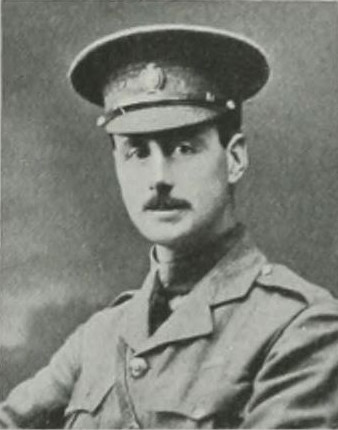
Douglas E. M. Stewart.
STEWART, GEOFFREY, Capt., 1st Battn. Coldstream Guards, elder and only surviving s. of the late Major-Gen. Sir Herbert Stewart, K.C.B., by his wife, Georgina Janet, widow of Major-Gen. Sir Henry Tombs, K.C.B., and dau. of Admiral Sir James Stirling, and great grandson of the Hon. Edward Richard Stewart [7th s. of John, 7th Earl of Galloway, K.T.]; b. Binfield, co. Berks, 28 Oct. 1878; educ. Eton; gazetted 2nd Lieut. Coldstream Guards, 13 July, 1898, and promoted Lieut. 12 Dec. 1899, and Capt. 3 Feb. 1907; served in the South African War, 1899–1902; took part in the advance on, and relief of, Kimberley, including actions at Belmont, Enslin, Modder River, and Magersfontein; operations in the Orange Free State, Feb. to May, 1900; including actions at Vet River and Zand River; operations in the Transvaal in May and June, 1900, including actions near Johannesburg, Pretoria and Diamond Hill; operations in the Transvaal, east of Pretoria, July to Oct. 1900, including action at Belfast, and operations in the Transvaal, west of Pretoria, Nov. 1900; operations in the Transvaal, 30 Nov. 1900, to Sept. 1901, and those in Cape Colony, Sept. 1901, to 31 May, 1902, receiving the Queen’s medal with two clasps. He was employed with the Egyptian Army from 26 Oct. 1905, to 25 Oct. 1907; retired from the Coldstream Guards in 1910, and joined the Reserve of Officers, 23 July, 1910, joining the Leicestershire Yeomanry (T.F.) as Capt. in 1911, being promoted Major, 18 Feb. 1914. When war broke out was on the North Midland Mounted Brigade Staff, but rejoined the Coldstream Guards in Dec.; went to France at once, and was killed in action at Givenchy, on the 22nd of that month. He was mentioned in F.M. Sir John (now Lord) French’s Despatch of 5 April [London Gazette, 22 June], 1915. He was at one time Page of Honour to Queen Victoria. Capt. Stewart m. at the Guards Chapel, Wellington Barracks, 2 June, 1908, Violet (Winwick Manor, Rugby), dau. of William Clarence Watson, of Colworth, co. Beds., and had two children: Malise Herbert, b. 16 Feb. 1911, and Jean Violet, b. 25 March, 1909.
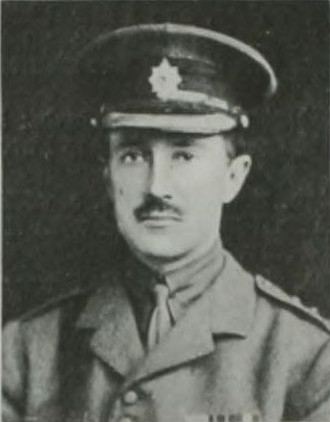
Geoffrey Stewart.
STEWART, JAMES ALEXANDER LOGAN, of Alltyrodyn, Lieut., 1st Battn. The Rifle Brigade, elder s. of the late Lieut. James Logan Stewart, 7th Hussars (died v.p. 29 June, 1898), by his wife, the Hon. Eveline Mary (Alltyrodyn, Llandyssul, co. Cardigan), sister of Roland John, 13th Baron Dormer, and dau. of the Hon. Sir James Charlemagne Dormer, K.C.B., and grandson of the late James Stewart, of Alltyrodyn, J.P., D.L.; b. Bombay, India, 7 March, 1893; educ. Winchester, and Trinity College, Cambridge; suc. his grandfather, 23 April, 1908; gazetted 2nd Lieut. in the Reserve Battn. of the Rifle Brigade, 2 Sept. 1913; and promoted Lieut., 1st Battn., 30 Nov. 1914; went to France and joined his regt. at Ploegsteert Wood in Dec. following, and was killed in action at Shell Trap Farm, near Ypres, 13 May, 1915. On this occasion the position he was in command of was heavily shelled and temporarily captured, by the Germans, and on the Rifle Brigade subsequently, retaking the position, no trace could be found of his body or of those of his men; unm. In 1911, he played for Winchester against Eton; was a good all-round sportsman, being a first-rate shot, fisherman and cricketer. His brother, 2nd Lieut. Douglas Stewart, is now (1916) on active service with the Royal Hussars.
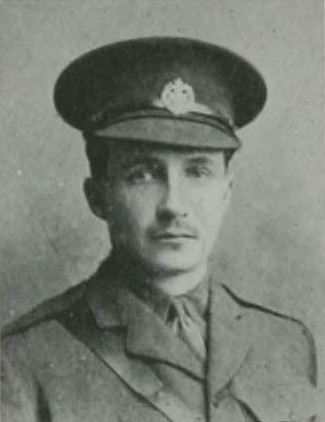
James A. L. Stewart.
STEWART, JAMES AUGUSTUS, Lieut., 2nd Battn. The Royal Munster Fusiliers, only s. of James Augustus Stewart, of Buncrana, Loch Swilly, co. Donegal, J.P. (who has since died), by his wife, Ann Wilhelmina Jean, dau. of the late William Wray, of Oakpark, co. Donegal, and nephew of the late Sir Augustus Abraham James Stewart, of Fort Stewart, 9th Bart.; b. Fort Stewart, Rathmelton, co. Donegal, 17 Aug. 1894; educ. at Rossall and Royal Military College, Sandhurst, from which he was gazetted to the 2nd Battn. Royal Munster Fusiliers, 12 Aug. 1914, being attached to the 3rd Battn. for a short time, and promoted Lieut. 28 Nov. following. He went to the Front, 4 Jan. 1915, was wounded in action at [place unknown], and had only rejoined his battn. on recovery a few days, when he was returned as wounded and missing after the fighting at Neuve Chapelle on 9 May, 1915. His company officer, Capt. T. W. Filgate, wrote: “On Sunday morning, the 9th, we made an attack on the German trenches just south of Neuve Chapelle. Your son was seen to fall while very gallantly leading his platoon to the assault. I very much regret that nothing further is known of him. His manner, coolness and dash was a splendid example to all. It may be a little consolation to you to know that we were the only regt. to reach a part of the German first line, and this was largely due to the bravery of a few officers and men like your son, who so gallantly led the assault. His name will never be forgotten in the regt., and we are all very proud of the many officers and men who fell.” The following passage is taken from a letter which appeared in the “Cork Examiner” of 17 Jan. 1915: “Two minutes later I, too, followed in his wake (i.e., over the parapets). I was happy to follow in the trail of another brave Munster officer. There was no hesitation about him—no halting—no get here nor there, but simply ‘Follow me, men.’ As to his subsequent fate I know nothing. I have not seen him since, and I would not commit myself to any statement. He was Lieut. Stewart, 2nd Battn. Royal Munster Fusiliers.” Lieut. Stewart was unm.