The Roll of Honour. (continued 36)
Reading edition
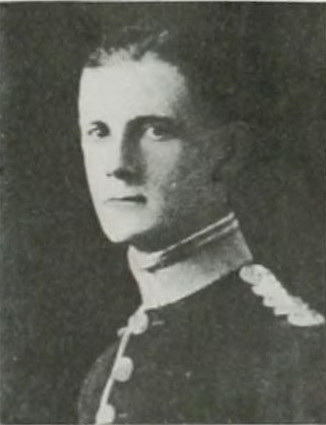
William Hamilton Padday.
PADDOCK, GEORGE WILLIAM, Stoker, 1st Class, S.S. 109803, H.M.S. Hawke; lost when that ship was torpedoed in the North Sea, 15 Oct. 1914; m.
PADDY, ALFRED, A.B. (R.F.R., Ch. B. 10197), S.S. 2639, H.M.S. Cressy; lost in action in the North Sea, 22 Sept. 1914.
PAGE, ALBERT, Private, No. 7345, 2nd Battn. Coldstream Guards, s. of the late William Page, by his wife, Jane (12, Andover Road, Hornsey Road, Holloway), dau. of William Finch; b. Highgate, 27 Nov. 1887; educ. St. Mary’s School there; enlisted 12 July, 1907; served three years with the Colours and then passed into the Reserve, and worked as a Carman; was mobilised 5 Aug. 1914; served with the Expeditionary Force in France, etc., and was killed in action 30 Oct. following; unm. Buried in Rentel Woods. His brother, Private Frederick Page, 2nd Battn. Middlesex Regt., was killed in action, 10–14 March, 1915, and his two other brothers are now (1916) on active service.
PAGE, ALFRED, Leading Seaman (R.F.R., B. 8840), 198471, H.M.S. Hawke; lost when that ship was torpedoed in the North Sea, 15 Oct. 1914.
PAGE, DAVID, Gunner, R.M.A., 10386, H.M.S. Aboukir; lost in action in the North Sea, 22 Sept. 1914.
PAGE, FREDERICK, Private, No. 11334, 2nd Battn. Middlesex Regt., s. of the late William Page, by his wife, Jane (12, Andover Road, Hornsey Road, Holloway), dau. of William Finch; b. 4 May, 1889; educ. Arkley School, Barnet; enlisted 15 Oct. 1906; served seven years with the Colours (including five years in India), then became a Carman with Carter Patersons; mobilised Aug. 1914; went to France in Sept., was wounded 15 Oct. (the same month his brother, Private Albert Page, was killed, see his notice), and invalided home; returned to the Front in Feb., and was killed in action between 10–14 March, 1915; unm.
PAGE, JOHN, Petty Officer (T.), 194013, H.M.S. Aboukir; lost in action in the North Sea, 22 Sept. 1914.
PAGE, THOMAS, Colour-Sergt., R.M.L.I. (R.F.R., A. 589), H.M.S. Hogue; lost in action in the North Sea, 22 Sept. 1914.
PAGE, WILLIAM THOMAS, Leading Stoker (R.F.R., Ch. B. 7537), 291867, H.M.S. Aboukir; lost in action in the North Sea, 22 Sept. 1914.
PAGE, WILLIAM WILLIE, A.B. (R.F.R., Ch. B. 9632), S.S. 2347, H.M.S. Aboukir; lost in action in the North Sea, 22 Sept. 1914.
PAGET, GEORGE GODFREY BRANDRETH, 2nd Lieut., 1st Battn. Northamptonshire Regt., only child of Charles Edward Paget, of Great Houghton House, near Northampton, by his wife, Ethel Pilkington, dau. of the late Rev. Canon William Harper Brandreth, Rector of Standish, Lancs.; and gdson. of the late Sir George Edward Paget, K.C.B., M.D., F.R.S.; b. North Bentcliffe, Eccles, co. Lancaster, 6 April, 1891; educ. St. Andrew’s School, Eastbourne (1901–05), and Charterhouse (1905–08); joined the 3rd (Militia) Battn. of the Northamptonshire Regt. as 2nd Lieut., 29 April, 1908, and was promoted Lieut. in the Special Reserve, 26 July, 1910; gazetted 2nd Lieut, to the 1st Battn., 14 Aug. 1914, having crossed with it to France on the 12th; served through the retreat from Mons and the Battle of the Marne, and was killed in action at the Battle of the Aisne, 14 Sept. 1914; unm. “His Coy. were attacking under a very heavy shell fire and rifle fire also,” wrote Lieut. Farrer. “They had just halted in a bit of a dip, where they were out of rifle fire; he moved forward to see if they could go on, when he was hit. The men of his Platoon say he didn’t seem to mind the lead that was flying round, and was urging them on all the time.” The Adjutant, Capt. Lloyd, also wrote: “You know he died doing his duty, and that his name will be handed down to posterity, amongst the others of the Regt., as being one who assisted to uphold the glorious traditions of our Regt., and who emulated the deeds of times gone by.” His body was not recovered, but was seen on 17 Sept. about 40–50 yards from the German trench, when a Coldstream officer succeeded in getting some letters out of his pocket by which his body was identified. The body was lying about 300 yards in front of our trenches.
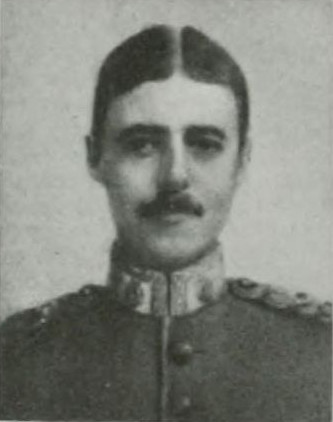
George G. B. Paget.
PAINE, CHARLES PERCIVAL, Corpl., No. 554, Army Service Corps. (Motor Transport Section), s. of Charles Paine, Master Tailor, by his wife, Emma; b. Old Kent Road, E., 19 May, 1876; educ. Dulwich; joined the 22nd Middlesex Volunteers about 1894; attaining the rank of Sergt.; served in the South African War, 1899–1900, with the C.I.V. Mounted Infantry (Queen’s medal with three clasps); joined the Motor Transport Special Reserve in Oct. 1912; was called up on the outbreak of war in Aug. 1914; went to France with the Expeditionary Force on the 6th; was promoted Corpl. in Dec. for valuable services rendered in the field, and died in No. 10 Military Hospital, St. Omer, 17 Feb. 1915, from cerebro-spinal meningitis. Buried in the Cemetery of Remembrance there. He m. at the Baptist Church, Attleborough, 17 Sept. 1901, Harriet Jane (52, Thorpebank Road, Shepherd’s Bush, W.), eldest dau. of Francis (and Harriet) Smith-Newby, of Attleborough, co. Norfolk, and had four children: Francis Percival, b. 11 Oct. 1902; Charles George, b. 21 Oct. 1905; Geoffrey Herbert, b. 24 Feb. 1908; and Evelyn Hattie, b. 16 Feb. 1904.
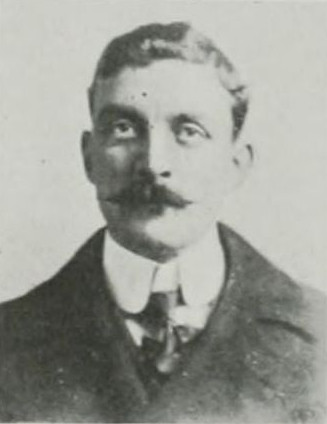
Charles Percival Paine.
PAINE, CHARLES WILLIAM STANLEY, Capt., Royal Marine L.I., eldest s. of William Henry Paine, of Derwent House, Canterbury, by his wife, Mary, dau. of James Buss; b. Canterbury, 22 Dec. 1876; educ. Tonbridge (The School House, 1891–95); and on leaving there qualified as an Electrical Engineer. After being some time in Queensland, he went to South Africa, and took part with the Border Police in putting down the native rising in Bechuanaland. When the South African War broke out he was in England. He volunteered and went out with the Electrical Engineers, serving later with Steinecker’s Horse, and receiving the Queen’s medal with four clasps. At the end of the war he returned to England, and was for some time once more at the electrical power station in the Isle of Thanet. In May, 1905, he returned to South Africa, and cleared and farmed a large tract of land in Mashonaland. Towards the end of 1909 he returned to England, and was farming in Hampshire when war began. The day after war was declared he left home to serve with the Legion of Frontiersmen, but after three months of duty at Southampton, finding that the Legion had little chance of being sent to the Front, he applied for a commission and was gazetted 2nd Lieut., R.N.D., 19 Nov. 1914. He was promoted Lieut., R.M. attd. R.N.D., 23 Nov., and Capt., R.M., on 8 Dec. 1914. He went out to the Dardanelles in May with the Benbow Battn. of the R.N.D., and was in action almost immediately. On the disbanding of the Benbow Battn. he was transferred to the Hood Battn., and was instantaneously killed in action, 17 July, 1915, being shot by a sniper while attempting to get help for a wounded man. He was buried in the trench—Ferril Gap, where he fell. “He was,” wrote one who knew him well, “a thorough sportsman, a man of unfailing courage and cheerfulness, equally ready to share his purse and his last meal, not only with friends, but with anyone who seemed in need of either. No one has ever more cheerfully and unassumingly lived the golden rule than he, as scores of men down on their luck, and many a tired animal too, could testify.” He had a distinct literary and poetical bent, and published, as a rule, anonymously, a good many things, mostly short stories, both in English and in Rhodesian magazines. Two of his short poems, one entitled “The Dead,” appeared in the “Westminster Gazette” in 1915. He m. at St. George’s Cathedral, Capetown, 24 Aug. 1908, Lilian Josephine (Barnfield, Medstead, Hants), 2nd dau. of the late Joseph Naylor, of Hull, and had three children: Geoffrey William Wright Halden, b. Umbali, Rhodesia, 27 Aug. 1909; Catherine Mary, b. 27 Dec. 1910; and Josephine Halden, b. 8 Feb. 1914.
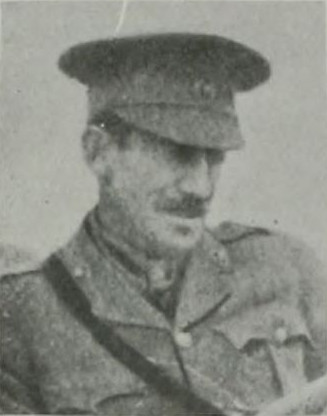
Charles William S. Paine.
PAINE, SYDNEY WILLIAM, 2nd Lieut., 1st Divisional Field Coy. New Zealand Engineers, only s. of William John Paine, of Ashton Road, Mount Eden, Auckland, New Zealand, Accountant, by his wife, Constance, dau. of Shadrick Moordaff; b. Auckland, 9 April, 1891; educ. Maungakaramea County School, Wellesley Street City School, and Auckland Grammar School; joined the New Zealand Engineers (Volunteers) in 1906, and was given a commission as 2nd Lieut. in No. 3 (Auckland) Coy. 21 Feb. 1911; volunteered for Imperial Service on the outbreak of war and joined the Expeditionary Force as a Sapper, but was shortly afterwards given a commission, and was killed in action in Gallipoli, 20 May, 1915; unm. Buried there. Lieut.-Col. Pridham wrote: “It may be some consolation to you to know that he had done wonderfully good work ever since he landed here, and the loss to the Engineers will be very severely felt. He was absolutely trusted by the men under him and was, I think, the most unconcerned under fire of us all. He died on duty, reconnoitring for a fresh advance against the enemy”; and Capt. W. Limm: “Your son was with me—I knew him really well, and he was a personal friend of mine and was a splendid chap. I cannot tell you all I know of him in a letter, but you can be very proud of him.” Sapper F. Leyland also wrote: “We got a shock last night, for we lost our section officer, Lieut. S. W. Paine. He was the best officer we had, and I had known him for years. He was at the Grammar School when I was, and was in the same company of Engineers as I was in Auckland. A finer chap I never met—his first thoughts were always for the men, and he always mixed up with them. Just before he was shot he was laughing and joking with us. When the news came down that he was shot and had rolled down the gully, we rushed up to get him, but by the time we found him he was dead. We feel lost without him, and are feeling pretty miserable.” He was awarded the Royal Humane Society’s Bronze Medal for saving a comrade from drowning at Fort Cantley, and was congratulated by Col. Wolffe on being the first Territorial in camp to receive it.
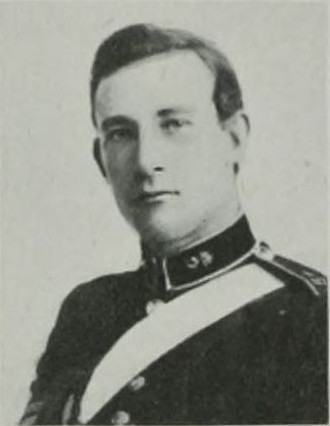
Sydney William Paine.
PAINE, THOMAS HARRY, Leading Telegraphist, 239741, H.M.S. Aboukir; lost in action in the North Sea, 22 Sept. 1914.
PAINTIN, SHAYLER, Sergt., No. 9784, 1st Battn. The Royal Scots, yst. s. of the late Joseph Paintin, of West End, Witney, Carpenter, by his wife, Isabella, dau. of J. Mann, of Witney; b. Witney, co. Oxon, 5 April, 1885; educ. Wesleyan Higher Grade School there; was a Grocer; enlisted in the Royal Scots, 17 Sept. 1906; went to India with the 1st Battn. in 1909; served there until the outbreak of war; returned to England, Nov. 1914; went to France the following month, and was killed in action at the Second Battle of Ypres, 12 May, 1915; unm. His Coy. Sergt.-Major wrote: “He was highly respected by the officers, N.C.Os. and men, and a better soldier never wore the uniform. He died like a good British soldier in the trench not far from the machine gun he was in charge of. We buried him in the Bellewarde Wood, near the village of Hooge, about 4 kilometres from the now ruined city of Ypres.” Sergt. Paintin was a keen sportsman and a first-class shot, and at the Royal Scots Rifle Meeting he won the championship medal, India, 1912; he was in C Coy. hockey team, which won the Meay Ahmed Hockey Cup, 1911–12, and at the Royal Scots Rifle Meeting he won third prize, aggregate, 1914.
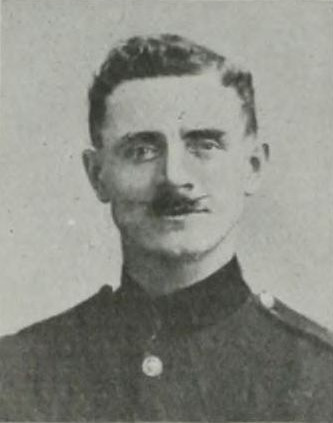
Shayler Paintin.
PAKENHAM, CHARLES JOHN WINGFIELD, Lieut., 2nd Battn. Hampshire Regt., s. of Major Charles Pakenham, of Headon Hall, Alum Bay, I.W., late 101st Royal Bengal Fusiliers and Royal Irish Fusiliers [gdson. of the Hon. Sir Thomas Pakenham, G.C.B., Admiral of the Red, 3rd s. of Thomas, 1st Earl of Longford], by his 2nd wife, Gertrude Edith Mary, yst. dau. of William Wingfield; b. Northam, near Bideford, co. Devon, 25 April, 1892; educ. Royal Naval College, Osborne, and Victoria College, Jersey; joined the 3rd (Special Reserve) Battn. of the Hampshire Regt., in Aug. 1910; gazetted 2nd Lieut. to the 2nd Battn., then at Mhow, India, 21 Jan. 1914, and promoted Lieut. 1 Nov. following; took part in the landing at the Dardanelles, 25 April, 1915, and was killed in action there three days later (28 April); unm.
PAKENHAM, ROBERT EDWARD MICHAEL, Capt., 2nd Battn. Munster Fusiliers, 2nd s. of Major Charles Pakenham, of Headon Hall, Alum Bay, I.W., late 101st Royal Bengal Fusiliers and Royal Irish Fusiliers [gdson. of the Hon. Sir Thomas Pakenham, G.C.B., Admiral of the Red, 3rd s. of Thomas, 1st Earl of Longford], by his wife, Emily Blanche, dau. of Charles Hercules Harrison, of Singapore; b. Armagh, 27 July, 1874; educ. Lausanne House, Worthing, and United Service College, Westward Ho!; gazetted 2nd Lieut. 24 March, 1897, and promoted Lieut. 9 Nov. 1898, and Capt. 1 May, 1902; served (1) in the South African War, 1899–1900, 1902; took part in the advance on Kimberley, including action at Belmont; operations in the Orange Free State, April to May, 1900, and those in Orange River Colony, May to June, 1900 (Queen’s medal with three clasps and King’s medal with two clasps); and (2) with the Expeditionary Force in France and Flanders, and died in the Military Hospital, Boulogne, 17 Jan. 1915, of wounds received in action. He m., 12 Sept. 1900, Nancye (Ballinacurragh, co. Cork), 2nd dau. of William Fowler, of Broadlands Park, Liverpool, and had three children: Ivo Robert Lygon, b. 4 Dec. 1903; Osmund Edward Michael, b. 20 April, 1905, d. 13 April 1906; and Emilie Estelle Rosemary, b. 4 Feb. 1907. His yr. brother, Lieut. C. J. W. Pakenham, was killed in the Dardanelles (see his notice).
PAKENHAM, WILLIAM HENRY, L.-Corpl., No. 7765, 2nd Battn. Connaught Rangers, only s. of the late Henry Pakenham, by his wife. Maria; b. Granard, co. Longford, 4 June, 1885; enlisted 5 March, 1903; served eight years in India; went to France 13 Aug. 1914, and died in the Military Hospital, Colchester, 26 Feb. 1915, from a shrapnel wound in the right shoulder received in action near Ypres, 29 Oct. 1914. He m. at Holy Trinity Church, Culmore, co. Londonderry, 20 Jan. 1914, Caroline (Burgage, Blessington, co. Wicklow), dau. of Michael Bryant, of Tallamore, King’s Co., and had a dau., Violet Charlotte, b. 5 Oct. 1914.
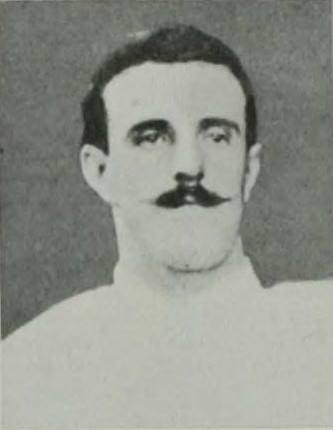
William H. Pakenham.
PALIN, ARCHIBALD EDWIN (“Blue”), Private, No. 938, 13th Battn. 4th Infantry Brigade, Australian Imperial Force, foster child of Mrs. Ann Charman; b. Dorking, Surrey, 7 Jan. 1872; educ. Dorking National Schools; afterwards going to Australia; volunteered on the outbreak of war, and was killed in action at the Dardanelles, 3 May, 1915; unm. A comrade wrote: “He proved himself thoroughly brave and courageous in action and always put his duty before personal safety. He did invaluable work in his capacity as a scout and set a great example to the other men by his coolness under heavy fire.”
PALLANT, HERBERT, Sergt., No. 7001, 2nd Battn. Lancashire Fusiliers, s. of Harry Pallant, Ipswich, employee on the Ipswich Corporation Tramways Co., by his 1st wife; b. Ash Bocking, co. Suffolk, 14 May, 1879; educ. Ipswich; enlisted 5 Oct. 1898; became L.-Corpl. 1 May, 1900; Corpl. 1 Feb. 1901, and Sergt. 28 Feb. 1904; served in Malta, Crete and South Africa (Queen’s medal with four clasps); was seven years with the Colours and five with the Reserve, at the end of which time he again signed on for four years, during which period he was employed as a Postman at the G.P.O.; mobilised 5 Aug. 1914; went to France on the 30th, and was killed in action at Messines, 2 Nov. following. Buried on the Eastern Edge of Ploegsteert Wood. Qrmr.-Sergt. Clague, 2nd Battn. Lancashire Fusiliers, wrote: “I did not know Sergt. Pallant previous to his joining the company on active service, but what I saw of him convinced me that he had no fear and died a glorious death, he was always willing to do any duty he was called upon to do, and was a great help to the officers of company when any trying work was to be carried out. He was liked very much by the men of his platoon and they miss him very much now.” He m. at Ipswich, 3 June, 1906, Helen (38, Newton Street, St. Helen’s, Ipswich), dau. of the late William (and Elizabeth) Cunningham, and had a son, Herbert, b. 4 Aug. 1907.
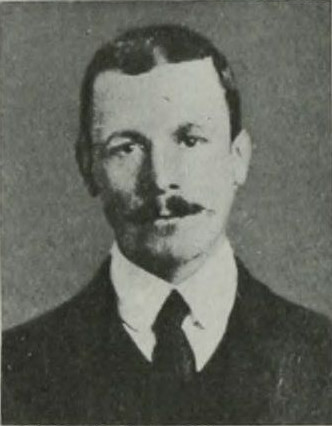
Herbert Pallant.
PALMER, FREDERICK ERNEST, A.B., 236457 (Ports.), H.M.S. Hogue; lost in action in the North Sea, 22 Sept. 1914.
PALMER, GEORGE, Stoker, 2nd Class, K. 22186, H.M.S. Pathfinder; lost when that ship was sunk by a mine, about 20 miles off the East Coast, 5 Sept. 1914.
PALMER, GEORGE, A.B. (R.F.R., B. 1317), 197816, H.M.S. Good Hope; lost in action off Coronel, on the coast of Chili, 1 Nov. 1914.
PALMER, GEORGE EDWARD, Boy, 1st Class, J. 23449, H.M.S. Hawke; lost when that ship was torpedoed in the North Sea, 15 Oct. 1914.
PALMER, JOHN, Gunner, R.M.A., 12655, H.M.S. Good Hope; lost in action off Coronel, on the coast of Chili, 1 Nov. 1914.
PALMER, JOHN JOSEPH, 2nd Writer, 346138, H.M.S. Aboukir; lost in action in the North Sea, 22 Sept. 1914.
PALMER, MAURICE WESTON, L.-Corpl., No. 1104, 5th Battn., Australian Imperial Force, 2nd s. of Attwell Lynch Palmer, of Pentney, Swaffham, co. Norfolk, Engineer, by his wife, Frances, dau. of William Daniel Weston, of the Lenwades, Moulton, near Newmarket; b. Letcham, Swaffham, 4 July, 1894; educ. Grammar School, Swaffham; went to Australia in Dec. 1913; was a 1st Class Steward in the Orient S.S. Co.; volunteered for Imperial service after the outbreak of war and joined the 5th Battn., A.I.F., in Sept. 1914; left for Egypt in Dec; went to the Dardanelles in June, 1915, and was killed in action there, 20 July following; unm.
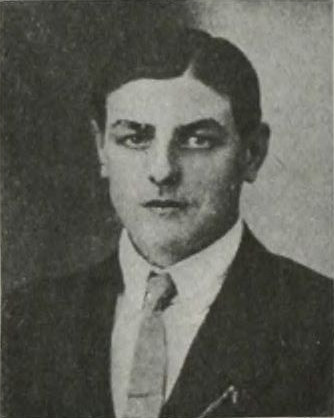
Maurice W. Palmer.
PALMER, PERCY VICTOR, A.B. (R.F.R., Ch. B. 9038), No. 206273, R.N., s. of William Palmer, of Towersey, near Thame, co. Oxford, by his wife, Harriett, dau. of John Rumble, of Norfolk; b. Kensington Gore, W., 12 Jan. 1883; educ. St. Barnabas’ Church School, Pimlico, and was a chorister at St. John’s, Wilton Road; entered Navy, 1899, and was lost on board H.M.S. Cressy when that ship was torpedoed in the North Sea, 22 Sept. 1914; unm. For services rendered during the Messina earthquake, while serving in H.M.S. Euryalus, he received a letter of thanks from the King of Italy, and was awarded the Messina silver medal. Palmer was also at Martinique when that earthquake happened.
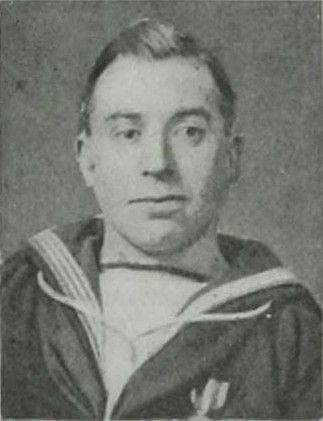
Percy Victor Palmer.
PALMER, RONALD WILLIAM POULTON, B.A. Oxon, Lieut., 4th Battn. Berkshire Regt. (T.F.), yr. s. of Edward Bagnall Poulton, D.Sc., F.R.S., Hope Professor of Zoology, Oxford University, and Fellow of Jesus College, by his wife, Emily, eldest dau. of the late George Palmer (of Huntley & Palmer, Ltd.), some time M.P. for Reading, and nephew of the late Right Hon. George William Palmer, also at one time M.P. for Reading, and of the late Sir Walter Palmer, Bart., M.P. for Salisbury; b. Oxford, 12 Sept. 1889; educ. Oxford Preparatory School, Rugby (School House), and Balliol College, Oxford, where he matriculated with an exhibition in 1908; took 2nd Class Honours in the Final Honour School of Natural Science (Engineering), and graduated B.A. 1911. On leaving Oxford he entered Huntley & Palmer’s factory in Jan. 1912, to qualify himself for a Directorship, and after 18 months there, went to Manchester and continued his engineering studies in Mather & Platt’s, attending courses at the Municipal School of Technology. On the death of the Right Hon. G. W. Palmer, in Oct. 1913, he became the heir and, had he lived, would have succeeded his uncle in the Marlston Estates, and by the terms of the will he took the name of Palmer. At Oxford he had served with the O.T.C. from 4 Dec. 1908 to 29 Dec. 1911, and on going to Reading was given a commission as 2nd Lieut., in the Berkshire Territorials, 30 April, 1912; and on the outbreak of war volunteered with his Battn. for foreign service, and was promoted Lieut. He went to the Front at the end of March, and was killed by a stray bullet, or by a sniper, at 12.20 a.m., 5 [not 4] May, 1915, while superintending work on the trenches in front of Ploegsteert Wood, Belgium. He was buried in the wood, close to “Hyde Park Corner”; unm. Col. O. P. Serocold wrote: “He was killed instantaneously, while on duty in the trenches, about 12.20 a.m. this morning, and as it was quite dark at the time, and before the moon rose, we think it must have been an unaimed chance bullet which struck him. Naturally Ronald was the most beloved and popular officer with all ranks, and one of those whom we could least spare. I shall miss him sorely, as he was a most trustworthy and capable officer, and would have gone high in soldiering, had he been spared”; and Capt. Thorne: “Ronald was engaged on work of trench repair, in company with Sergt. Brant, and was hit by an enemy sniper at 12.20 a.m. Death, mercifully, must have been instantaneous. This I am sure of, as I reached him a moment after he was shot; he never spoke or moved again, and the Doctor, who shortly after arrived, is of the same opinion. Sergt. Brant did everything that could be done, but it was obviously all in vain. I cannot express what we feel about it, men and all were devoted to him, and there is not one of us who would not have cheerfully exchanged our lives for his. He never shirked a job, whatever the risk was, and he fell, as he would have liked to do, in the execution of his duty. The regt. has lost one it could ill afford.” Lieut. O. B. Challenor also wrote: “He was our company works manager, i.e., he looked after the trench, and found out what work on the parapet or elsewhere was necessary for the safety of the men. He was shot at 12.20 a.m. to-day, 5 May. It was a foggy night, and he was on the roof of a dug-out, looking at work that had been done, when a stray shot, which I think was a ricochet off our wire in front of the trench, hit him. It entered his right side, just below the armpit; death was instantaneous.” He was a noted Rugby International, and captained the English Team which won all the International matches in the season before the war. The “Times” said: “By the death of Lieut. Poulton Palmer Rugby football has lost one of its most brilliant exponents. As a three-quarter back—he could play either in the centre or on the wing—his name will go down to posterity as probably the greatest player of all time. He was decidedly of the unorthodox type, and, although he had many imitators, was unequalled in his distinctive style and opportunism. The strongest points of his game were his resolute running and wonderful swerve. At the beginning of his career he was rather weak in his tackling, but this weakness was remedied by experience. As a captain he was a born leader; he was never flurried, and was always seen at his best when the score was against his side. Like all great players, he had his off days, but he was just the man to win games by his individual flashes of brilliance, and no English side could have been considered at full strength without him. Between the seasons of 1909 and 1914 he gained 17 International caps—five against Scotland, four against Ireland, four against Wales, three against France, and one against South Africa. He failed to get his Blue at Oxford as a Freshman in 1908, when the three-quarter line consisted of four old Blues and International players—H. H. Vassall, F. N. Tarr, C. M. Gilray, and H. Martin but in the following year, when Oxford beat Cambridge by four goals and five tries to one try, he scored five tries—the other four being gained by Martin. In 1910 and 1911 he was also on the winning side, and was captain in the latter year, he also did splendid service for the Harlequins, and it was in a large degree due to him that the three-quarter line reached its high standard of excellence. In addition to his skill as a Rugby football player he was a fine exponent at hockey, and he played against Cambridge in 1909, 1910, and 1911.” Early in his school days at Rugby he began to feel that love for work in boys’ clubs which was to become the chief among his many interests. It was further developed at Oxford in the Balliol Boys’ Club, in the Rugby School Mission and by contact with kindred spirits of whom the brightest have, with him, given their lives for their country. When in 1912 he went to Reading, with all his strenuous work at the Factory, he found time to help in the management of a Boys’ Club in the parish of St. John’s, and in Manchester he gave time and thought to the same absorbing interest. His friends have felt that to write of him, as many of the papers did. as a football player and nothing else, was to give an entirely false impression of the man, and to miss what to him was the paramount duty as well as the keenest pleasure of life.
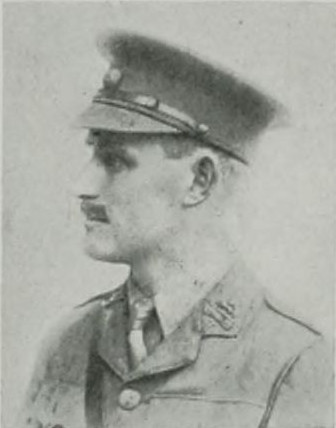
Ronald W. Poulton Palmer.
PALMER, SAMUEL EDWARD, Private, No. 3234, Royal Sussex Regt. (T.F.), s. of William Owen Palmer, of Durgates, Wadhurst, Gardener, by his wife, Mary Ann, dau. of William Manktelow, of Woods Green, Wadhurst; b. Wadhurst, co. Sussex, 12 Jan. 1895; educ. Boys’ School there; was employed by Miss Olvir, Durgate’s Farm, Wadhurst, Farm Hand; joined the Church Lads’ Brigade, and became a member of the Wadhurst Fire Brigade; joined the 5th Sussex, 22 Feb. 1915; left Woolwich for France, 10 July, 1915, and was killed in action 2 Jan. 1916, by the bursting of a German shell, while on duty with a fatigue party; unm.
PALMES, GUY NICHOLAS, Lieut., 1st Battn. King’s Own Yorkshire L.I., 4th s. of the Rev. George Palmes, Vicar of Naburn, Squire and Lord of the Manor of Naburn, by his wife, Eva Blanche, yr. dau. of Henry Dalbiac, of Holbrook Park, Sussex; b. Naburn Hall, co. York. 14 July, 1894; educ. Malvern College, and the Royal Military College, Sandhurst, and on leaving there was gazetted 2nd Lieut. to the K.O.Y.L.I. 1 Oct. 1914, and promoted Lieut. Nov. following; went to France, Jan. 1915, and was killed in action near Ypres, 8 May, 1915; unm.
PANNELL, WILLIAM FRANCIS, Stoker, 1st Class (R.F.R., B. 4661), 307771, H.M.S. Good Hope; lost in action off Coronel, on the coast of Chili, 1 Nov. 1914.
PANTLAND, ROBERT WILLIAM, Pensioner, Ch. E.R.A., 118003, H.M.S. Hawke; lost when that ship was torpedoed in the North Sea, 15 Oct. 1914; m.
PARAGREEN, FREDERICK ARTHUR, Gunner, R.M.A. (R.F.R., I.C. 41), 10860, H.M.S. Good Hope; lost in action off Coronel, on the coast of Chili, 1 Nov. 1914.
PARDOE, HARRY JAMES, Boy, 1st Class, J. 26738 (Ports.), H.M.S. Hawke; lost when that ship was torpedoed in the North Sea, 15 Oct. 1914.
PARFITT, HERBERT EDWARD, No. 725, 2nd Class Air Mechanic, Royal Flying Corps; killed while acting as Pilot to 2nd Lieut. E. W. C. Perry on a B.E. 8 machine at Amiens, 16 Aug. 1914. Buried in the Cemetery at St. Acheuil.
PARHAM, FREDERICK, Leading Stoker, C.G., 286907, H.M.S. Good Hope; lost in action off Coronel, on the coast of Chili, 1 Nov. 1914.
PARKE, WALTER EVELYN, Lieut., 2nd Battn. Durham L.I., 2nd s. of Lieut.-Col. Lawrence Parke, of Moreton Heath, Moreton, co. Dorset, 7th Hampshire Regt., late Durham L.I., by his wife, Evelyn, dau. of the late T. Evans Lees; b. Wimborne, co. Dorset; educ. Swanage (Mr. Pellatt) and Winchester College; was gazetted 2nd Lieut. in the Durham L.I., 16 Aug. 1911, and promoted Lieut. 5 Aug. 1914; went to France, Sept. 1914, and was killed in action at Hazebrouck, 13 Oct. following, while acting as Machine Gun Officer; unm. Buried near Hazebrouck. Lieut. Parke was mentioned in F.M. Sir John (now Lord) French’s Despatch of 14 Jan. [London Gazette, 17 Feb.] 1915. While at Winchester he was captain of the Cricket XI.
PARKER, ARTHUR, Private, R.M.L.I., Ch./17068, H.M.S. Cressy; lost in action in the North Sea, 22 Sept. 1914.
PARKER, BASIL STEWART, Capt., 2nd Battn. The Hampshire Regt., eldest s. of the late Rev. George Parker, Rector of Quainton, co. Bucks, and Tickencote, co. Rutland, by his wife, Elizabeth Maria Hislop (47, Sea Road, Boscombe, Bournemouth), dau. of the late John Lorimer, of Edinburgh; b. Oxford, 2 July, 1878; educ. Oxford Preparatory School and Bedford Grammar School. He served through the South African War, first with the Imperial Yeomanry, and afterwards in the Hampshire Regt., to which he was gazetted 2nd Lieut. 27 July, 1901. He took part in the operations in Cape Colony, North of the Orange River, May, 1900, and in those in the Transvaal, 30 Nov. 1900 to 31 May, 1902, receiving the Queen’s medal with two clasps, and the King’s medal with two clasps, and was promoted Lieut. 20 Aug. 1904, and Capt. 12 June, 1909. From March, 1906–09 he was Adjutant of his Battn., and from 1912–13 held a similar appointment in the Mounted Infantry in South Africa. In 1911, at Harrismith, he was a member of the 2nd M.I. Polo Team which won the Inter-Coy. Polo Cup. When the Dardanelles Expedition was organised the 2nd Hants. formed part of the 29th Division, which did such splendid work, that it became to be known as the “Old Guard of the Army.” He left England with his regt. 20 March, 1915, and took part in the first attack on 25 April. His Coys. W and X, under Major Leigh, landed about 10 a.m. that morning, from boats on W beach, and proceeded to the first ridge and there took up a position, where they stopped practically the whole day covering the other regts. landing. His Commanding Officer writing home on 30 April said: “Basil Parker is going strong, he is doing orderly runner for me as we have not got our horses yet; he did splendidly.” And on 1 May, Capt. Parker wrote: “What we call a quiet day, and only being shelled. It is a glorious day, sitting in the trenches, and a gentle trickle of sand falling on you all the time. We moved yesterday into reserve, but at 4 a.m. were sent back into the firing line. So much for our rest cures out here. This life seems to suit me. I never felt better in my life. Reveille at 4 a.m. and bed at 8 p.m. daily. I drink unlimited tea, no sugar or milk in it, and biscuits; can’t get bread at any price. I am as filthy as I feel, black with dust and exposure. We still wear caps. Isn’t it sad about the Col. and Deane; they were both shot dead, not wounded. I have to write early here as we neither have electric light or candles in this trench, and go to bed and rise with the sun”: and the following day: “We had a vile night, an attack which lasted from 10.30 p.m. to 2 p.m. to-day. As usual we have caught it fairly hot. Leigh and Reid were both killed during the night, and three more subs. were wounded to-day. We were under awful shrapnel fire to-day in the open. I feel a bit more filthy than usual; have not had my clothes or boots off for fourteen days.” He was wounded in the head on 6 May, or as he puts it, “Got myself into trouble yesterday, and got a bullet in my head, or very near it. It came in absolutely in the centre of my cap (was fired from the right), and came out where the top of the cap and the part that fits your head joins. I have had luck, because on its way through it took a piece out of my head like a cheese scoop down to the bone without damaging the skull. I could not at first make out what had happened. I felt a huge bang on the head, as if a polo ball had hit me, and asked the man next me, ‘What on earth is that?’ ‘You’re hit on the head, sir.’ It began to bleed badly, so I went back a little and got it tied up with the dressing you had sewn in my coat. I was hit at noon, but commanded my company till dark.” He was able to rejoin on 3 July, and after being continuously in action since landing, the 2nd Hants were sent to Lemnos for rest and refreshment on 7 July. Here they were joined by fresh drafts and returned to Gallipoli on 28 July, about 900 strong. They remained “on the beach” eight days and then moved up to the front trenches—the intention being to create a diversion in the Southern part of the peninsula whilst a new attack was made at Suvla Bay, six or seven miles to the north. The 2nd Hants were told on the evening of 5 Aug. that they would go up next day, and all were in excellent spirits. Cooks were sent on to prepare food, etc., and at 5.30 a.m. on Aug. 6 the advance began, the force going up the communication trenches, and the distance from the front trench being about three or four miles, and Achi Baba being about three-quarters mile distant. The trenches were close to the village of Krithia and very near the great Gully. By 7 a.m. the 2nd Hants had occupied three lines of trenches, having on their right the 4th Worcesters, and on their left the 1st Essex. The front Turkish trench ran forward at an angle and was about 50 yards distant on the left and 100 yards more on the right. The space between the opposing trenches was swept by gun fire from a distance, as well as from the trenches themselves. It was known that an attack on the Turkish trenches would be made at 4 p.m., and until that time many of the force rested. The General sent up an encouraging message to the Hants saying that this would be the last time he would call upon them to make a great charge. Exactly at 4 p.m. Capt. Parker, who was in command, called out: “Time’s up, my lads,” and those in the first trench immediately leapt out, those in the second at once taking their places and leaping out a minute later, and those in the third doing the same. All were well up in a good deal less then five minutes, and with a cheer they rushed forward. It was a glorious charge, and every one showed splendid courage. The Turks were startled, and took a minute or two—not much more—to get their machine-guns (of which they had one for about every five yards, and which during the bombardment they had hidden in the trenches) into position, so that our men got some way across the open space. Apparently, however, none reached the Turkish trench. All were mown down. Of the second line, a few got across. Of the third line, which had fewer men, more than half got through, and those who were left of the battn. held the trench until they were relieved by the Royal Scots and Royal Fusiliers. A private said positively that the Turks were driven from their front trench which remained in our hands, as perhaps did some others. The open ground was so heavily swept by gun fire that it was impossible to bring in the wounded or the dead, even at night. Some may have crawled in, but the severely wounded must have died. As none could be recovered and identified, they were posted as missing. In the evening of the 6th only 250 out of 900 of the Hants answered their names. It was in this action that Capt. Parker was killed about 4 p.m. He had gone forward out of the trench to direct a portion of the line and was hit by a bullet in the left side; the bullet coming out near the left breast was deflected by his cigarette case and again entered his body and came out on his right side. He died four minutes afterwards with his head resting on the leg of a lieutenant. He was brought back to the dressing station, and buried at 7.10 a.m. on the following morning in C. Communicating trench between the firing line and twelve tree copse. He never spoke after he was hit, and was unconscious until he died. He was carried to his last resting-place by men of the Battn. he had commanded, and in which he was so much liked. A cross made by the Royal Engineers marks the spot. Capt. Parker m. at St. George’s Cathedral, Cape Town, 5 April, 1913, Kathleen Lambert (“Lausanne,” Leigh Road, Cobham, Surrey), dau. of Lawrence Newman-Walker of Cape Colony, M.D., F.R.C.S., and had a son, Gerald Stewart, b. Indore, Central India, 3 April, 1914.
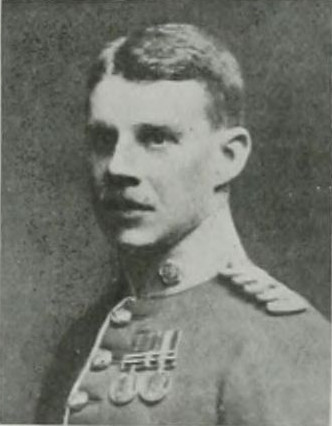
Basil Stewart Parker.
PARKER, BERTIE CLARENCE, A.B., J. 10893, H.M.S. Good Hope; lost in action off Coronel, on the coast of Chili, 1 Nov. 1914.
PARKER, CHARLES WILLIAM, Private, R.M.L.I. (R.F.R.), Ch. 12829, H.M.S. Hawke; lost when that ship was torpedoed in the North Sea, 15 Oct. 1914.
PARKER, CYRIL EDMUND, 2nd Lieut., 6th (Reserve), attd. 2nd Battn. King’s Royal Rifle Corps, eldest s. of the Hon. Edmund William Parker, of Westfield House, Rugby, by his wife, Fanny Emma, dau. of Capt. William Baldwin, of Dunedin, and grandson of Thomas Augustus, 6th Earl of Macclesfield; b. Christchurch, New Zealand, 15 May, 1884; educ. Eton, and on leaving there joined the London Stock Exchange in 1903, where he remained for 10 years; went to British Columbia in 1913, and became a Financial Agent at Vancouver, British Columbia, but on the outbreak of the European War in Aug. 1914, immediately proceeded to Vancouver and volunteered for Imperial service. He obtained a commission in the 6th Regt., the Duke of Connaught’s Own Rifles, Vancouver, and proceeded to Valcartier with the detachment from that regt. which, with detachments from other regts. from the same province, eventually formed the 1st British Columbia Regt., Canadian Expeditionary Force. Lieut. Parker qualified for the rank of Lieut. while at Valcartier, but owing to there being a surplus of officers in the regt., he could not be placed, all the others being senior to him. He came over with the first contingent in Oct. and was gazetted 2nd Lieut. to the 6th Battn. King’s Royal Rifle Corps, 23 Nov. following; went to France in Dec. with a draft for the 2nd Battn., and was killed in action at Cuinchy, 1 Jan. 1915, in an attack on the German trenches; unm.
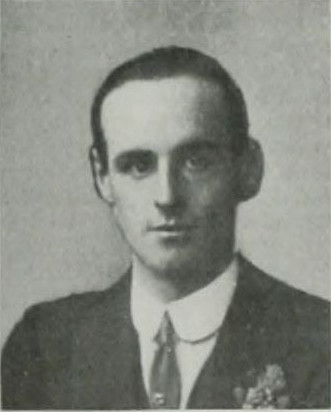
Cyril Edmund Parker.
PARKER, ERNEST ALBERT, A.B. (R.F.R., Ch. B. 10532), S.S. 2799, H.M.S. Cressy; lost in action in the North Sea, 22 Sept. 1914.
PARKER, FRANK VIRLAND, Chief Petty Officer, 154010, H.M.S. Cressy; lost in action in the North Sea, 22 Sept. 1914.
PARKER, FREDERICK JOHN BUSH, Private, No. 13215, 3rd Battn. Coldstream Guards, only s. of the Rev. Frederick Talbot Parker, Vicar of Knowle, Bristol, by his wife, Marion Einene, dau. of Edward Thomas, of Bristol, Solicitor; b. Bristol, 14 Aug. 1896; educ. Clifton College; enlisted after the outbreak of war, in Sept. 1914; went to France, April, 1915; and was killed in action at Givenchy, 8 Aug. 1915. Buried in the Guards Cemetery there.
PARKER, FREDERICK NEVILLE, 2nd Lieut., 1st Battn. King’s Royal Rifle Corps, yst. s. of the late Major-General Neville Fraser Parker, of Craymead, High View Road, Sidcup, co. Kent, Indian Army, by his wife, Emily Annie, dau. of Richard Abbatt; b. Torquay, 8 Nov. 1892; educ. Elizabeth College, Guernsey; volunteered and joined the Artists Rifles on the outbreak of war in Aug. 1914; went to France with them 27 Oct. 1914, was selected for a commission and gazetted 2nd Lieut., K.R.R.C., 3 March, 1915; and was accidentally killed at Bethune, 28 April, following, while in charge of trench mortars; unm. Buried in Bethune Civil Cemetery.
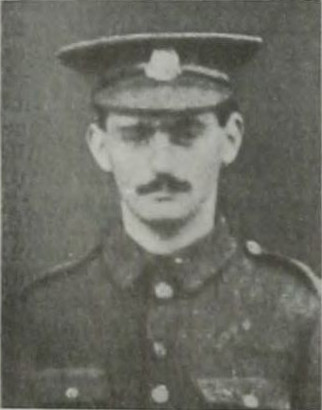
Frederick N. Parker.
PARKER, HARRY BOTTOMLEY, Ship’s Petty Officer, 307254, H.M.S. Good Hope; lost in action off Coronel, on the coast of Chili, 1 Nov. 1914.
PARKER, JOHN, A.B. (R.F.R., B. 5701), 204310, H.M.S. Good Hope; lost in action off Coronel, on the coast of Chili, 1 Nov. 1914.
PARKER, JOHN WILLIAM, Stoker, 1st Class (R.F.R., B. 3135), S.S. 100777, H.M.S. Good Hope; lost in action off Coronel, on the coast of Chili, 1 Nov. 1914.
PARKER, JOSEPH, A.B. (R.F.R., Ch. B. 1024), 145222, H.M.S. Cressy; lost in action in the North Sea, 22 Sept. 1914.
PARKER, HARRY, 2nd Lieut., 2nd Battn. The Hampshire Regt., eldest and only surviving s. of Capt. and Quarter-Master Henry John Porteus Parker, The Worcestershire Regt., by his wife, Kate, dau. of Henry Stubbs; b. Limerick, 25 June, 1889; educ. Army Schools; enlisted in the Worcestershire Regt. in 1903, and at the time war was declared in Aug. 1914 was Sergt., 4th Battn. of that regt., and employed as Assistant Instructor of Signalling; gazetted 2nd Lieut. in the Hampshire Regt., 7 Nov. 1914; took part in the landing at the Dardanelles, 25 April, 1915, and died on the Hospital ship Delta, 30 April, 1915, of wounds received in action on the Gallipoli Peninsula two days previously; unm.
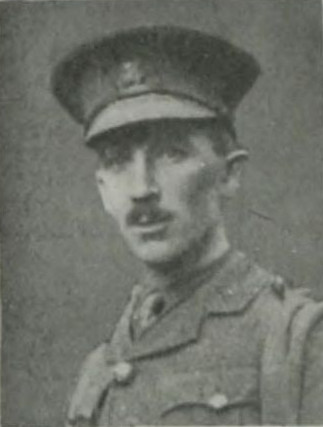
Harry Parker.
PARKER, ROBERT BURTON, Capt., 2nd, attd. 1st Battn. Northamptonshire Regt., only s. of the late Robert Parker, of Cressington Park, Liverpool, Merchant, by his wife, Emma Catherine, dau. of James Rawlence, of Bulbridge House, Wilton, Salisbury; b. Cressington afsd., 3 July, 1879; educ. St. Edward’s School, Oxford, and Wellington College; joined the Montgomeryshire Imperial Yeomanry in Feb. 1900, and was given a commission as 2nd Lieut. in the Northamptonshire Regt. 27 July, 1901, and promoted Lieut. 14 Aug. 1903, and Capt. 14 Feb. 1910; served in the South African War, 1900–2, being attd. to the Army Service Corps, and was mentioned in despatches, and received the Queen’s medal with three clasps and the King’s medal with two clasps. On his return to England he was adjutant of the Mounted Infantry and in command of Maxim guns at Borden and Longmoor; went to the Depôt in Northampton, 1907–10, and was then Adjutant of the local Territorials there for three years, after which he rejoined his old regt. at Alexandria. On the outbreak of the European War he was on leave in England; exchanging into the 1st Battn. he went to France with the first Division, 12 Aug. 1914; served through the retreat from Mons, and was killed in action at the Battle of the Aisne, 17 Sept. 1914, while leading his men in an attack on the German trenches; unm. He was buried near the village of Bourg, on the Aisne. His Col. wrote: “He was the most gallant man I ever met, he did not know what fear was. He was greatly loved by all ranks and a most able and energetic officer, always thinking of the comfort of others”; and a Sergt. of his regt.: “We shall never forget him; he was a brave fellow, absolutely fearless, and beloved by his men. It was grand to serve under an officer like him.” During his residence at Northampton, Capt. Parker was a regular follower of the Pytchley Hounds, and his brilliant horsemanship will not readily be forgotten by the members of the hunt.
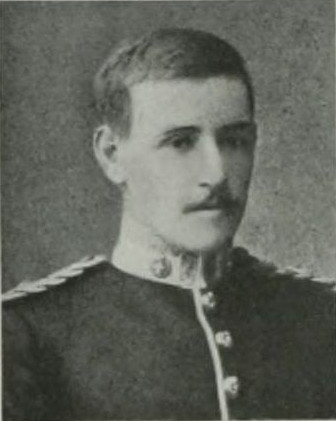
Robert Burton Parker.
PARKER, RONALD ELPHINSTONE, Lieut., D Battery, Royal Horse Artillery, yst. s. of Robert Gabbett Parker, of Bally Valley, Killaloe, co. Clare, J. P., by his wife, Louisa, dau. of John C.... Whitty, of Broadwater Down, Tunbridge Wells; b. Bally Valley, aforesaid, 5 Jan. 1886; educ. The Abbey, Tipperary, and Clifton College; joined the Clare Artillery Militia, 11 Feb. 1905; gazetted 2nd Lieut., Royal Artillery, 25 May, 1907, and posted to the 87th Howitzer Battery; promoted Lieut., 25 May, 1910; went to France, 16 Aug. 1914, and was killed in action at the Battle of the Marne, 8 Sept. following. Four guns of D Battery, R.H.A., were supporting the 3rd Cavalry Brigade in the advance to the Marne. The Germans brought back some 12 guns against them, but the battery held its ground, and eventually the enemy drew off. The battery lost its Major, wounded, and both its subalterns, killed. He was unm., and was buried at the Hotel de Bois, Jonarre, Meaux. His brigade commander wrote: “He died like a man, fighting his guns at great odds to the last.” The officer commanding his R.H.A. battery wrote: “He was indefatigable, undaunted even in the darkest moments; his good temper and high spirits were worth anything to us all”; and the officer commanding his R.F.A. battery: “In 20 years I have never met a better subaltern and a keener sportsman, in both of which capacities he won my complete respect and affection, as he did that of every man or horse that came into his care.” Lieut. Parker excelled at all field sports and was a fine horseman and whip.
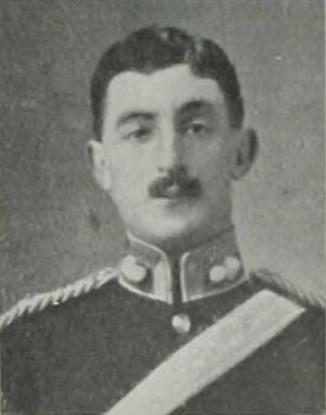
Ronald E. Parker.
PARKES, CHARLES, A.B. (R.F.R., B. 5224), 203456, H.M.S. Good Hope; lost in action off Coronel, on the coast of Chili, 1 Nov. 1914.
PARKES, SAMUEL, Private, No. 13627, 4th Battn. Worcestershire Regt., eldest s. of Private Henry Parkes, of the North Staffordshire Regt. (now on home defence work at Southampton), by his wife, Emily Louisa (21, Reform Street, West Bromwich), dau. of Samuel Southern; b. West Bromwich, 18 Oct. 1897; educ. Christ Church School there; entered the employ of Messrs. Salters at West Bromwich when he was 14; volunteered on the outbreak of war and enlisted in the 4th Worcesters, 7 Aug. 1914, with several others from Salters; served in Malta and Egypt; went to the Dardanelles, 7 July, and was killed in action there, 7 Aug. 1915; unm.
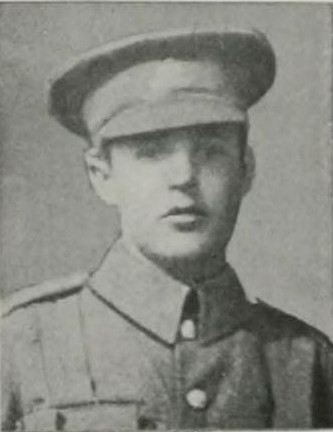
Samuel Parkes.
PARR, ARTHUR, Leading Stoker, R.F.R., B. 6439, 287527, H.M.S. Hawke; lost when that ship was torpedoed in the North Sea, 15 Oct. 1914; m.
PARR, CECIL, Private, R.M.L.I., Ply./10884, H.M.S. Good Hope; lost in action off Coronel, on the coast of Chili, 1 Nov. 1914.
PARR, SYDNEY LANGFORD, L.-Corpl., No. 2845, 12th Battn. (The Rangers) The London Regt., only s. of Thomas Parr, of 8, Vernon Gardens, Seven Kings, N., by his wife, Caroline; b. Manor Park, East Ham, 8 Jan. 1891; educ. East Ham, Technical College; enlisted, Sept. 1914; went to France, 28 Jan. 1915, and died of wounds at St. Julien, 26 April, 1915.
PARRETT, CHARLES ERNEST, A.B. (R.F.R, Ch. B. 8951), 203270, H.M.S. Cressy; lost in action in the North Sea, 22 Sept. 1914.
PARRISS, WALTER FREDERICK, 2nd Lieut., 3rd Battn. Middlesex Regt. (Duke of Cambridge’s Own), yst. s. of the late John William Parriss, of Ardagh, Willesden Lane, N.W.; b. Ardagh afsd., 17 Nov. 1893; educ. Harrow School; joined the H.A.C. on the outbreak of war, 11 Aug. 1914, and served with them with the Expeditionary Force in France from 18 Sept. until he received a commission, 14 Feb. 1915. He was killed in action in Flanders, while holding an advanced trench, 15 March, 1915; unm. Buried at Kemmel. His Commanding Officer, Lieut.-Col. Stephenson (since killed), wrote of him: “He was so willing, so ready to do anything, so brave, so keen, that we shall miss him very much, although he has been so short a time with us ... a gallant boy, with all the courage of his race.”
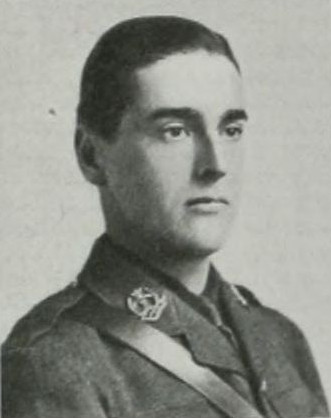
Walter F. Parriss.
PARRY, ARTHUR CROOSE, Private, No. 2322, Honourable Artillery Company, 3rd s. of William Rowland Parry, of Ladye Grove, near Leominster, and grandson of the late Thomas Croose Parry, of Birley Court, co. Hereford; b. Lye Court, Birley, 16 March, 1888; educ. King’s School, Grantham; joined the H.A.C. after the outbreak of war 4 Sept. 1914; went to France, Dec. 1914, and was killed in action near Ypres, 12 March, 1915; unm. Buried in the Chateau Grounds at Kemmel.
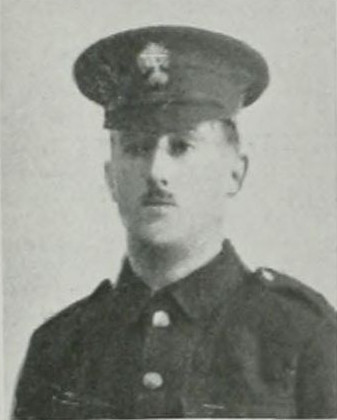
Arthur C. Parry.
PARRY, JAMES HERBERT, Stoker, 1st Class (R.F.R., B. 2976), S.S. 100333, H.M.S. Good Hope; lost in action off Coronel, on the coast of Chili, 1 Nov. 1914.
PARRY, NORMAN CECIL, Lieut., 1st Battn. York and Lancaster Regt., yst. s. of Edward Parry, of Rossmore, Leamington, formerly of Woodthorpe Grange, Nottingham, a member of the Institute of Civil Engineers, by his wife, Mary Elizabeth; b. Nottingham, 19 Sept. 1887; educ. Rugby, and Trinity College, Cambridge, where he passed the Natural Science Tripos in Honours; afterwards obtaining a Diploma in Mining Engineering at the Sheffield University, and First Class Certificate as a Colliery Manager from the Home Office, and was an Assistant of Mr. Maurice Deacon, M.Inst.C.E., Managing Director of the Sheepbridge Coal and Iron Coy. Immediately on the outbreak of war he joined the Army; was gazetted 2nd Lieut. 15 Aug. 1914, and Lieut. to the 3rd (Reserve) Battn. 2 Feb. 1915, being afterwards attd. to the 1st Battn.; went to the Front early in March, 1915, and was killed in action at Ypres, 25 July, 1915, by the bursting of a shell, while he was endeavouring to get his men under cover, during a sudden attack upon his section of the trenches; unm. He was buried in the churchyard of St. Jean, Ypres.
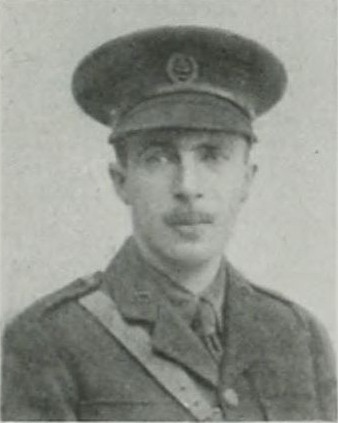
Norman Cecil Parry.
PARSONS, CHARLES FRANCIS, Private, No. 3769 D Coy. 1/7th. Battn. Middlesex Regt. (T.F.), s. of the late William Henry Parsons, by his wife, Sarah (54, Graham Road, Wealdstone, Middlesex), dau. of George Tillay; b. Haggerston, London, 4 May, 1893; educ. Wealdstone; was a Piano Polisher; joined the Middlesex Territorials about 1909; mobilised, 5 Aug. 1914, and volunteered for Imperial Service; went to France in Jan. 1915, and was killed in action at Larbartier, 24 July, 1915; unm.
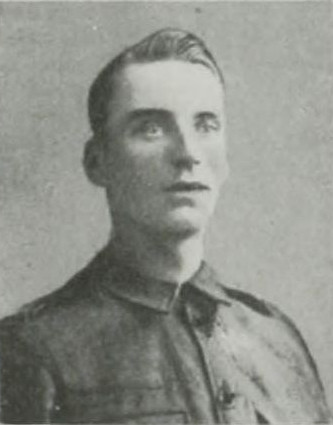
Charles Francis Parsons.
PARSONS, EDWARD JOSEPH, A.B. (R.F.R., Ch. B. 3656), 201013, H.M.S. Aboukir; lost in action the North Sea, 22 Sept. 1914.
PARSONS, EDWIN STUART THOMAS, Petty Officer (N.S.), 219856, H.M.S. Good Hope; lost in action off Coronel, on the coast of Chili, 1 Nov. 1914.
PARSONS, WILLIAM, Leading Stoker (C.G.), 311114, H.M.S. Good Hope; lost in action off Coronel, on the coast of Chili, 1 Nov. 1914.
PARSONS, WILLIAM HARRY, Petty Officer, 1st Class (O.S.), 183802, H.M.S. Cressy; lost in action in the North Sea, 22 Sept. 1914.
PARTRIDGE, CHARLES BURNETT, Capt., Royal Marine L.I., Plymouth Division, eldest surviving s. of Lieut.-Col. Sylvanus Roger Burnett Partridge, of Homecroft, Fleet, Hants, late King’s Own Scottish Borderers, and Governor of His Majesty’s Prison, Portland, by his wife, Mary Bishopp, dau. of Edward Bishopp Dorman, M.D.; b. Anchor Gate Lodge, Portsmouth, 29 May, 1880; educ. Bath College; gazetted 2nd Lieut., R.M.L.I., 1 Jan. 1899, and promoted Lieut., 1 Jan. 1900, and Capt., 1 Jan. 1910; was Instructor of Musketry at Malta, 26 June, 1906–08, and later Swimming Instructor at the Deal Depôt; served in H.M. ships Mars, Gladiator, Egmont, Melpomene, Hermione, Drake, and Good Hope, and was lost when the last was sunk in the action off Coronel, on the coast of Chili, 1 Nov. 1914; unm. He had won many prizes for shooting, sailing and golf. He made top score when the Marines won the United Service Cup at Bisley, and held the Marine Jewel. His eldest brother, Lieut. Edward Louis Lort Partridge, died of enteric at Jullundur, aged 20; and another brother, Lieut. Geoffrey Dorman Partridge, 2nd Welsh Regt., was reported missing after the Battle of Ypres, on 3 Nov. 1914—since, presumed officially to have been then killed. The remaining brother, Capt. Richard Evelegh Partridge, Dorset Regt., is now (1916) on active service at the front, as Brigade-Major, 12th Canadian Infantry Brigade, and has received the Military Cross.
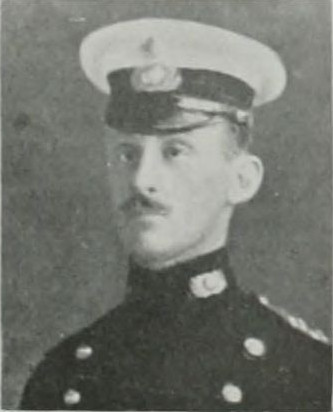
Charles B. Partridge.
PARTRIDGE, GEOFFREY DORMAN, Lieut., 2nd Battn. The Welsh Regt., yst. s. of Lieut.-Col. Sylvanus Roger Burnett Partridge, of Homecroft, Fleet, Hants, late King’s Own Scottish Borderers, and Governor of His Majesty’s Prison, Portland, by his wife, Mary Bishopp, dau. of Edward Bishopp Dorman, M.D.; b. Portsmouth, 24 Dec. 1890; educ. Bath College, United Services College, and the Royal Military College, Sandhurst; gazetted 2nd Lieut., 11 Oct. 1911, and was promoted Lieut., 1 Nov. 1914; went to France with the Expeditionary Force early in Aug., and was reported missing after the first Battle of Ypres, 3 Nov. 1914, and is now assumed to have been killed in action on or after that date. He had played Rugby for the Army. His elder brother, Capt. Charles Burnett Partridge, Royal Marine L.I., was killed in action in H.M.S. Good Hope two days previously (see his notice).
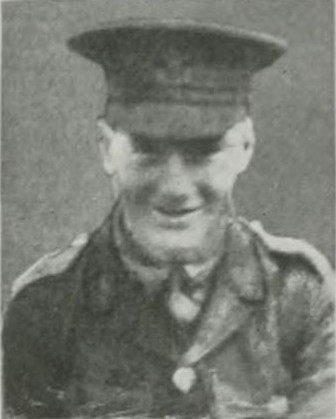
Geoffrey D. Partridge.
PARTRIDGE, THOMAS JOSIAH, Ship’s Corpl., 1st Class, 189739, H.M.S. Good Hope; lost in action off Coronel, on the coast of Chili, 1 Nov. 1914.
PATEMAN, WILLIAM, Sergt., No. 9157, 1st Battn. Coldstream Guards, s. of Emily, dau. of George Pateman; b. Little Houghton, near Northampton, 22 Aug. 1890; enlisted 29 June, 1911; went to France in Aug. 1914; was wounded 22 Oct. 1914, and invalided home; returned to the front 7 April, 1915; and was killed in action at Vermelles, 20 May, 1915; unm. The Officer Commanding No. 2 Coy. (the Hon. T. Agar-Robartes) wrote: “A large shell fell on the top of his dug-out where he was resting and he never regained consciousness. He was a most gallant soldier and will be greatly missed”; and Sergt. (now 2nd Lieut.) H. O. Tomkins wrote: “There were four of us in our dug-out in the trenches when a shell came right through the roof, seriously wounding Will in the head, killing a corpl. instantaneously and leaving myself and the other fellow untouched. He was knocked unconscious and died two hours afterwards. He did not even moan when he was hit, so he died painlessly, and was buried in a garden in front of an old Castle at Vermelles, near La Bassée. Vermelles is marked on the map, but the castle itself is one mile to the east of the village. It can easily be traced.”
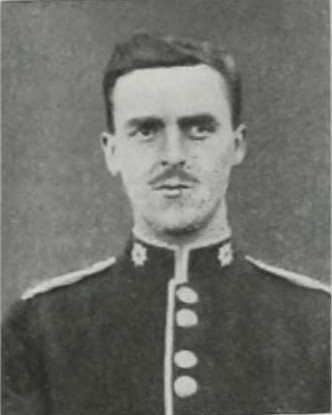
William Pateman.
PATERSON, ALASTAIR FINLAY, 2nd Lieut., 4th Battn. Queen’s Own Cameron Highlanders (T.F.), eldest s. of John Paterson, of Yewbank, Beauly, Ironmonger and Seed and Hay Merchant, by his wife, Mary, dau. of Tinlay Maclennan of Ardnagrask, Muir of Ord, Ross-shire; b. Beauly, co. Inverness, 4 Feb. 1888; educ. Beauly Public School and Inverness High School; joined the 4th Camerons as a Private in 1905, and previous to receiving his commission was considered one of the most efficient non-commissioned officers in D Coy. He went to the Front with his Battn. in Feb. 1915, and received his commission (24 Feb.) shortly after landing. He was wounded early in the charge against the German trenches at Festubert on the night of 17 May, and his brother, L.-Corpl. Paterson (see succeeding notice), was reported missing after the action. His wounds were not at first considered dangerous, but on 5 June he died at No. 2 British Red Cross Hospital, Rouen; unm. He was buried with full military honours in the St. Sevère Cemetery, Rouen. Lieut. Paterson was well known in the north, both as a noted shot and as a shinty player of high repute. He was captain of the Beauly Shinty Club for several years, and led it during the season when it won the Championship Cup. A player of skill, courage and resource, he was a notable figure on the shinty field, and the high place which his club attained was mainly due to his leadership.
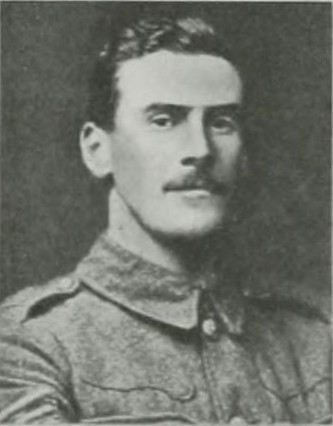
Alastair F. Paterson.
PATERSON, DONALD, L.-Corpl., No. 645, 4th Battn. Queen’s Own Cameron Highlanders (T.F.), 2nd s. of John Paterson, of Yewbank, Beauly, etc. (see preceding notice); b. Beauly, co. Inverness, 20 Dec. 1891; educ. Beauly Public School and Dingwall Academy; enlisted in the 4th Camerons in 1908. An architect by profession, he was at the time war broke out engaged in lands valuation work at Nethy-Bridge, but at once volunteered for foreign service. After the attack on the German trenches at Festubert on the night of 17 May, 1915 (at which his brother, 2nd Lieut. A. F. Paterson was mortally wounded), he was reported missing, but was later officially reported to have been instantaneously killed during the night of 17–18 May. From information received by his parents from L.-Corpl. Ferguson, of the same corps, it appears that Paterson was advancing towards the German trenches with the other members of D Coy., but remained behind to bind up the wounds of the said L.-Corp. Ferguson. Afterwards unable to get into touch with his companions, Paterson returned to Ferguson and remained with him over night. At daybreak he raised himself up to have a look round and endeavour to ascertain their whereabouts. Unfortunately, they were in close proximity to a German trench, and Paterson was shot by a German sniper, dying immediately. This was the second comrade whose wounds Paterson had bound up that night, and truly it may be said that he gave his life to save others. Paterson, who was unm., was piper to the Beauly Coy., a player of much merit and also a composer of Highland music. He was one of the champions of the Beauly Shinty Club, of which his brother, Lieut. Paterson, was captain.
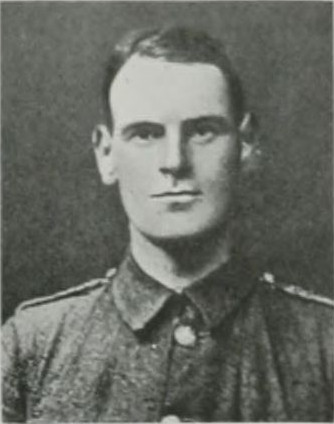
Donald Paterson.
PATERSON, JOHN AGAR, 2nd Lieut., 2nd Battn. Bedfordshire Regt., 2nd s. of William Morison Paterson, of 80, Great Portland Street, W., Manufacturers’ Agent, by his wife, Margaret S., dau. of John Agar; b. Glasgow, 19 Nov. 1893; educ. Dulwich College, and the Royal Military College, Sandhurst; gazetted 2nd Lieut. in the Bedfordshire Regt., 17 Sept. 1913; went to France, early Oct. 1914, and was killed in action near Klein Zillebeke, 31 Oct. following; unm. Buried there.
PATERSON, JOHN McLELLAN STEWART, M.A., Private, No. 2832, 4th Battn. Gordon Highlanders (T.F.), yr. s. of the Rev. Robert Paterson, M.A., Minister, Savoch U.F. Church, Auchnagatt, co. Aberdeen, by his wife, Agnes Y., dau. of John McLellan, of Burnhouse, Galston; b. Savoch aforesaid, 13 Dec. 1890; educ. there, Ellon H.G. School, Robert Gordon’s College, Aberdeen, and Edinburgh University (graduated with honours in English literature, July, 1913), and on leaving there spent several months in France and Germany with a view to qualifying as a journalist; joined the staff of the Aberdeen Free Press, as a Sub-Editor, on his return to England in May, 1914, to which paper he contributed articles, as well as to the Glasgow Herald, and The Student, etc., but, on the outbreak of war in Aug. of that year, he volunteered and joined the Gordon Highlanders in Oct.; went to France, 19 Feb. 1915, and was killed in action at Kemmel, 22–23 April, 1915, being shot by a sniper; unm. Buried there. While at Gordon’s College, Aberdeen, he was one of the originators and joint editor during its first year, of the school magazine, The Gordonian, and contributed articles to it on “An Aberdeenshire Wilderness,” “Bird Life on a Lake,” and “The Night Shore,” etc. At Edinburgh University he was one of the founders, a President, and an Honorary member, of the Edinburgh University English Literature Society; was an office bearer, and member of the Historical Society there, and of the Diagnostic Society, also of the O.T.C., and the Hockey Club. He was a great lover of nature, and was interested in every phase of country life. A writer in the Edinburgh University Magazine, The Student, said: “It was as a student of our University that I came to know him. His ability and attainments as a scholar were of the highest, and it very soon came to be recognised that his opinions were the outcome of a logical and well-informed mind. As such, no matter the topic under discussion, they were sought after and prized, for his outlook went far beyond the confines of his especial branch of literature. Nor was his wide range acquired at the expense of social popularity. I have confidence in saying that no student in my time had a wider circle of friends. I say friends advisedly—not acquaintances. His whole personality radiated friendship, and all who came within the sphere of his magnetic influence were irresistibly drawn to him; having made his acquaintance they immediately became his friends. He took a prominent part in many directions on the social side of our ’Varsity life. He was a member of at least three Societies, of the O.T.C., of the Hockey Club, and, I think, also of the Boat Club. A staunch and trusted member of the Liberal Association, he played his part right manfully in the victories which not infrequently attended that Party in the hotly contested debates in the Union. It is the man, however, as we knew him, that claims our affectionate remembrance and esteem. The multiplicity and yet the wonderful harmony of his moral and intellectual qualities compelled first respect, then admiration, then love. Unassuming in manner, he was loyal to a degree in his friendships. Intellectually the superior of most of us, he was a most delightful and lovable companion, upright in word and deed. He found his highest pleasure in helping others, when necessary, eliminating himself, and foregoing those honours to which his undoubted abilities and the high esteem in which he was held would necessarily have brought him—honours which were, in my time, and no doubt still are, considered the high-water mark of a successful University career. One might say of him without irreverence—he sought not his own. I find it difficult to give adequate expression of my esteem for Stewart Paterson, but in concluding this brief sketch I can at least say this: I have seldom found occasion to respect and esteem a man as I respected and esteemed Stewart Paterson, and however far I still fall short of the high ideal which stands, a beckoning figure, before the spiritual eye of each one of us, I am a better man to-day for having known him.”
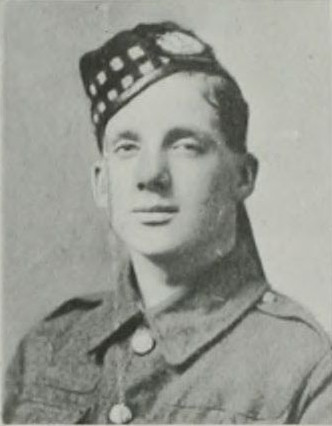
J. McL. S. Paterson.
PATIENCE, GEORGE, Sergt., No. 2334, 4th Battn. Seaforth Highlanders (T.F.), s. of George Patience, of 30, High Street, Avoch, Fisherman; b. Avoch, co. Ross, 7 Sept. 1895; educ. Mackenzie Foundation Institute there, and on leaving was apprenticed to a painter; it was his great desire to become a soldier and he more than once tried to enlist but was brought back by his father; but on the outbreak of war he volunteered and joined the 4th Seaforths in Sept. 1914. He was promoted Sergt. within three months, crossed to France, 11 March, 1915, and was killed in action in the trenches at Aubers Ridge, 7 May, 1915; unm.
PATON, JOHN EDWARD, 2nd Lieut., 2nd Battn. Monmouthshire Regt. (T.F.), eldest s. of John Paton, of Waun Wern, Pontypool, co. Monmouth, J.P., by his wife, Susan, dau. of the late Edward Jones, of Snatchwood Park, Pontypool; b. Pontypool, 6 Sept. 1895: educ. Copthorne School, Winchester College, and in the spring of 1914 passed the entrance examination for Pembroke College, Cambridge, where he was to have taken up residence in Oct., but after the outbreak of war in Aug., was given a commission as 2nd Lieut. in the 2nd Monmouthshire Regt., 14 Oct.; went to France, 5 Nov. 1914, and was killed in action at Le Bizet, 31 Dec. following; unm. He was buried in the Essex Regt. Cemetery, Calvaire, near Le Touquet. 2nd Lieut. Paton was mentioned in F.M. Sir John (now Lord) French’s Despatch of 14 Jan. 1915, for gallant and distinguished service in the field. While at Winchester he was in the O.T.C., in which he attained the rank of Sergt.; took Certificate “A” in 1912, and was one of the eight to represent the College at Bisley in 1913 and 1914.
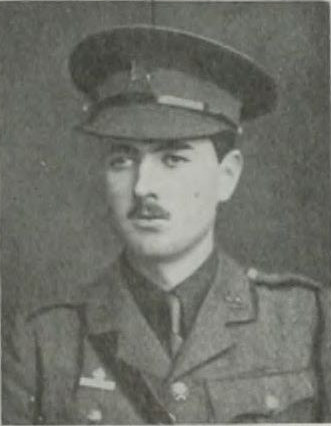
John Edward Paton.
PATRICK, FRANCIS ALEXANDER, Private, No. 2309, A Coy. 9th Battn. Royal Scots (T.F.), eldest s. of John Bonthron Patrick, of 1, Morningside Terrace, Edinburgh, Wholesale Merchant, by his wife, Wilemina Frances, dau. of the late William Goldie; b. Edinburgh, 6 Dec. 1892; educ. George Watson’s College there, Edinburgh University, and Besançon and Jena Universities; studied for the Indian Police, and passed the examination in 1912, but afterwards took up the study of Indian and Colonial agriculture, and in the prosecution of his researches studied at Besançon, Jena and Guelph (Canada). On the outbreak of war he was studying for his B.Sc. at the Edinburgh University, but gave this up and joined the 9th Royal Scots in Sept. 1914; went to France in Feb. 1915, and was killed in action during the second Battle of Ypres, 12 April following; unm. Buried at Sailly-sur-la-Lys, Ypres. An officer, writing home to a brother, said: “This sad event cast a gloom over the battn., with whom Patrick had been very popular, and I assure you I feel his loss very keenly. He was a lad I was proud to have in my platoon, a fellow-Watsonian, and the first Watsonian to fall in the Dandy 9th.” He was a keen golfer and fisher, and a good horseman, and one of the best shots in the regt.; but. above all, was a diligent student. “If you want to find Patrick,” wrote one of his comrades at the Front in the few days of rest that fell to them, “go to the roofless library or convent ruins and there you will find him rummaging amongst the old and shell-torn books, smoking his pipe.” His brother, Lieut. John Cairns Patrick, Royal Scots, and also ten of his cousins, are now (1916) on active service.
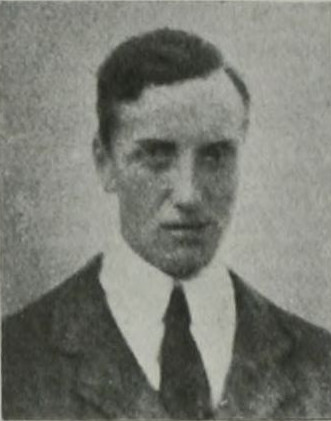
Francis A. Patrick.
PATRICK, FRED, A.B., 225222, H.M.S. Good Hope; lost in action off Coronel, on the coast of Chili, 1 Nov. 1914.
PATRICK, JAMES, Stoker, R.N.R., 13468, H.M.S. Aboukir; lost in action in the North Sea, 22 Sept. 1914.
PATTEN, EDWARD SAMUEL, A.B. (R.F.R., B. 10529), 217304, H.M.S Hogue; lost in action in the North Sea, 22 Sept. 1914.
PATTERSON, ALEXANDER, Trooper, No. 4238, 14th Hussars, attd. Royal Horse Guards, eldest s. of Alexander Patterson, Tin Plate Worker; b. Evesham, co. Worcester, 6 Sept. 1876; educ. Castleford Council School; enlisted in the 14th Hussars, Oct. 1900; served in the South African War, 1900–2, under Gen. (now Lord) French (Queen’s medal with three clasps); was 14 years with the Colours, then joined the Reserve, and was employed as a groom at Selby; mobilised 5 Aug. 1914; went to France in Sept., attd. to the Royal Horse Guards, and was killed in action there, 13 May, 1915. He m. at Castleford Parish Church, 1906, Sarah Ann (16, Douglas Street, off Brook Street, Selby, co. York), dau. of Joseph Clements, of Evesham, and had three children: Joseph, b. 12 Nov. 1906; George Alexander, b. 21 April, 1909; and John Stanley, b. 29 Sept. 1911.
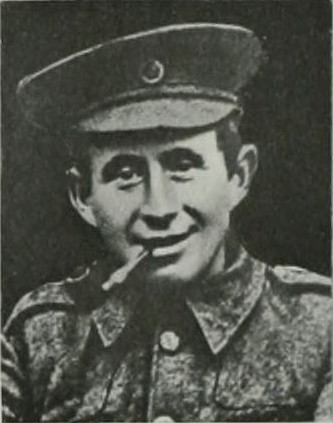
Alexander Patterson.
PATTERSON, ALEXANDER, Private, No. 12/826, Auckland Infantry Regt., New Zealand Expeditionary Force, yst. s. of the late James Patterson, of Henhill, Forteviot, Farmer; by his wife, Jessie, dau. of the late Robert Mitchell, of Golland[P2, P1 had changed this to Holland, the image is clearly Golland so probably printer error]; b. Forteviot, co. Perth, 24 July, 1884; educ. Crieff Academy; went to New Zealand about 1907, and was farming at Moeafoa Ye Kmiti; but on the outbreak of war, volunteered for Imperial service; left for Egypt with the Main Body, 16 Oct. 1914; took part in the landing at the Dardanelles, 25 April, 1915, and was killed in action there, 22 May following; unm.
PATTERSON, CYRIL JAMES, A.B., 208036, H.M.S. Good Hope; lost in action off Coronel, on the coast of Chili, 1 Nov. 1914.
PATTERSON, JOHN HEADLEY, L.-Corpl., No. 8976, 1st Battn. Northumberland Fusiliers, s. of James Patterson, Joiner; b. Newcastle-on-Tyne, 7 Feb. 1884; educ. Ouseburn Board Schools there; was employed in the moulding shop of Messrs. Henry Watson & Sons, High Bridge Works; was a Reservist, and was called up on mobilisation, 5 Aug. 1914; went to France at the end of Nov., and was killed in action, 4 March, 1915. Buried at Ypres. He m. at Newcastle-on-Tyne, 28 July, 1907, Mary Pringle, dau. of (—) Melville, and had with three other children a son, John Headley, b. 24 Sept. 1914.
PATTINSON, HUGH LEE, Capt. and Adjutant, 9th (Service) Battn. Royal Fusiliers, elder s. of Hugh Lee Pattinson, of Lowlynn, Beal, co. Northumberland, by his wife, Mary Constance, dau. of Lawrence W. Adamson; b. Newcastle-on-Tyne, 21 Aug. 1888; educ. Bengeo School, co. Herts; Rugby (Payne Smith’s, now Wilson’s House); Stubbington House, Fareham, and the Royal Military College, Sandhurst; gazetted 2nd Lieut., 3rd Battn. Royal Fusiliers, 6 Feb. 1909, and promoted Lieut. 14 Feb. 1912; temporary Capt. 28 Sept. 1914, and Capt. 9 March, 1915, being Adjutant of the 9th Battn. from 5 Sept. till the time of his death. He joined his regt. in Pietermaritzburg in 1909; went with it to Mauritius, then to Meerut and Chakrata, India, and finally to Lucknow; returned to England on leave in May, 1914, and on the outbreak of war the following Aug. was posted to the 9th Battn. Royal Fusiliers; went to France, 31 May, 1915, and was killed in action at Houplines, 4 Aug. 1915, while superintending a working party in the communication trenches. Brig.-Gen. Borradaile wrote: “His loss will be severely felt in the Battn., in forming which he took such a large and conspicuous share, and also in the Brigade, as his qualifications as a soldier were exceptional, and had he been spared he would have made his mark.” The Major commanding the Battn. wrote: “I should like you to know that this is an irreparable loss to the Regt., and particularly to this Battn. Taken all round he was the most efficient fellow I have ever worked with”; and a brother officer: “He was a splendid soldier, absolutely fearless, and loved by both officers and men.” He m., 22 July, 1914, Catherine Lina, dau. of John Patricius Chaworth-Musters, of Annesley Park, co. Notts, J.P., and had two daus.
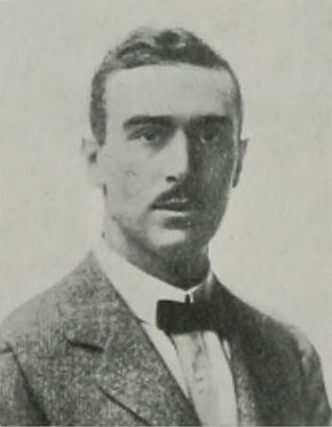
Hugh Lee Pattinson.
PATTLE, ERNEST, Private, No. 11086, 4th (Reserve) Battn. Coldstream Guards, s. of Arthur Pattle, of Denham, Bury St. Edmunds, by his wife; b. Denham, co. Suffolk, 8 Sept. 1881; educ. National School there; enlisted Oct. 1914, and was missing after the action at Givenchy, 22 Dec. 1914, and is now assumed to have been killed that day; unm.
PATTON, WILLIAM, Leading Seaman, 188359, H..M.S. Pathfinder; lost when that ship was sunk by a mine, about 20 miles off the East Coast, 5 Sept. 1914.
PAUL, GAVIN, Lieut., 2nd Dragoon Guards (Queen’s Bays), elder s. of the late Gavin Paul, of Edinburgh, Coalmaster; b. Edinburgh, 8 Aug. 1893; educ. Bramcote, Scarborough, and Radley College, near Oxford; gazetted 2nd Lieut., 2nd Dragoon Guards, 4 March, 1914; served with the Expeditionary Force in France, etc., and was killed in action at Messines, 31 Oct. following; unm.
PAUL, GEORGE THOMAS, Stoker, 1st Class, S.S. 110586, H.M.S. Pathfinder; lost when that ship was sunk by a mine, about 20 miles off the East Coast, 5 Sept. 1914.
PAUL, ROBERT, Private, No. 196, H Coy. 1st Battn. Argyll and Sutherland Highlanders, 2nd. s. of Robert Paul, of 22, Lutton Place, Edinburgh, Plumber, by his wife, Eliza; b. Edinburgh, 28 May, 1889; educ. Preston Street Public School there; enlisted in Sept. 1908; served at Chatham, Malta, in India and with the Expeditionary Force in France and Flanders; killed in action near Hooge, 10 May, 1915; unm. Writing to his father, his Chief Officer, Capt. J. R. Couper, said: “He was killed instantaneously by a shell which burst on the parapet in front of him and two others with him. The company was heavily engaged at the time and later had to evacuate the trench by order of our General. At night we went back and buried your son along with ten others. The company lost on this date 11 killed and 22 wounded. The place was close to Hooge, which is east of Ypres, and the exact spot of his grave is not marked by any special feature or by a cross as the burial had to be done very hurriedly.... Your son was a splendid ‘sticker,’ and though he suffered from very bad feet, always refused to ‘go sick,’ and on one occasion when ordered to go to the dressing station to have his feet treated, as he could not keep up with his company, he very reluctantly went, but rejoined us within three hours, having found his way to the trench at his own pace.”
PAUL, WILLIAM HENRY BOWEY, Ch. E.R.A., 2nd Class (Pensioner), 121261, H.M.S. Cressy; lost in action in the North Sea, 22 Sept. 1914.
PAULL, ALAN DRYSDALE, Private, No. 721, Honourable Artillery Company (T.F.), elder s. of Alan Paull, of Kylecote, Harrowdene Road, Wembley, J.P., F.S.I., by his wife, Catherine Swan, dau. of James Drysdale, of Devonside; b. Wembley, co. Middlesex, 10 June, 1894; educ. Colet Court, and St. Paul’s School, where he was a Corpl. in the O.T.C.; entered his father’s office on leaving school, having previously passed the examination and entered as a student of the Surveyors’ Institution, and in 1914 passed the Intermediate Professional Examination; joined the H.A.C. in 1912; volunteered for foreign service on the outbreak of war in Aug. 1914; went to France Sept. 1914, and was killed in action in the Ypres district 12 Dec. following, being shot by a sniper while proceeding with his section to reinforce the firing line; unm. He was buried at Kemmel, by a cottage now know as “Paull’s Cottage.” His officer wrote: “Through the great privations we have been through out here your son has always been one of the most willing, capable and cheerful members of my platoon, and I feel his loss as a friend, and his death is greatly felt throughout the regiment. He was a splendid soldier;” and a comrade: “All we in his section had learnt to understand and appreciate a kind heart and an indomitable spirit such as his. His cheerful voice and bright manner, how shall we get on without them, where cheerfulness and fortitude are so dearly needed?” He played Rugby football for the H.A.C., and represented them in boxing against the Cambridge University in 1913.
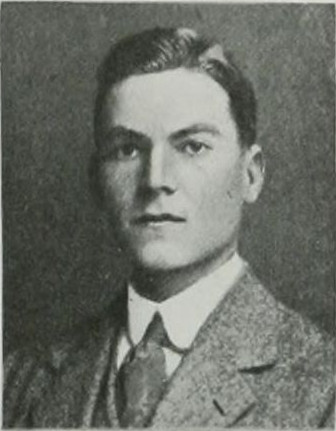
Alan Drysdale Paull.
PAVEY, CHARLES, Stoker, 1st Class (R.F.R., B. 9373), S.S. 106584, H.M.S. Hogue; lost in action in the North Sea, 22 Sept. 1914.
PAVITT, STEPHEN ARTHUR, Stoker, 1st Class, K. 1010, H.M.S. Hawke; lost when that ship was torpedoed in the North Sea, 15 Oct. 1914; m.
PAVLOSKY, FREDERICK, A.B. (R.F.R., B. 4387), 194223, H.M.S. Good Hope; lost in action off Coronel, on the coast of Chili, 1 Nov. 1914.
PAYNE, ALBERT JOHN, Boy, 1st Class, J. 27539 (Ports.), H.M.S. Hawke; lost when that ship was torpedoed in the North Sea, 15 Oct. 1914.
PAYNE, ARTHUR JAMES, A.B. (R.F.R., B. 9552), 207907, Chatham, H.M.S. Good Hope; lost in action off Coronel, on the coast of Chili, 1 Nov. 1914.
PAYNE, ERNEST ALFRED, Stoker, 1st Class (R.F.R., B. 1820), 290191, H.M.S. Hawke; lost when that ship was torpedoed in the North Sea, 15 Oct. 1914.
PAYNE, JOHN HENRY, A.B. 214259, H.M S. Hawke; lost when that ship was torpedoed in the North Sea, 15 Oct. 1914.
PAYNE, CHARLES GERAINT CHRISTOPHER, 2nd Lieut., 1st Battn. Highland L.I., only s. of Charles Henry Payne, of Brentor, Hereford, Manager of Lloyd’s Bank, Ltd., there, by his wife, Edith McKenna, dau. of William Evans Commins; b. Shifnal, co. Salop, 23 April, 1888; educ. Ludlow and Monmouth (1897–1905 Exhibitioner) Grammar Schools, and on leaving there was articled to his uncle, Mr. Alexander Payne, a London Architect, and had just started on his own account in the Metropolis when war was declared in Aug. 1914. He immediately joined the Artists’ Rifles; proceeded to France with them in the autumn of 1914; passed through the special training school for officers at the front, and was given a commission as 2nd Lieut., 27 Jan. 1915, being posted to the Highland L.I., subsequently joining the 1st Battn. about 18 Feb. He was killed in action at Neuve Chapelle, 12 March following, and was buried behind the trenches there; unm. He was a strong swimmer and keen boating man; was also an excellent ’cellist, and a member of the Hampstead Orchestral Society.
PAYNE, JOHN JAMES, Corpl., No. 2245, 2nd Battn. Royal Sussex Regt., eldest s. of Emily Payne (Gravel Pit Cottage, Rogate, near Petersfield, co. Hants), yst. dau. of John Payne; b. Liss, co. Hants, 11 Oct. 1882; enlisted Royal Army Medical Corps, 24 Nov. 1899, and served throughout the South African War, 1899–1902 (Queen’s medal with three clasps, and King’s medal with two clasps); re-enlisted in the 3rd (Reserve) Battn. Royal Sussex, as Corpl. Sept. 1908 then a Reservist, and served until 1909, when he purchased his discharge; joined the 2nd Battn. 15 Aug. 1914; left for France, Nov. 1914; and was killed in action at Richebourg l’Avoué, 9 May, 1915. The Quartermaster-Sergt. of his company wrote that he was struck in the head by a bullet, death being instantaneous, and added, “I can say that your son was a hard-working and zealous soldier and was esteemed by us all, who sadly miss him.” He m. at Rogate, Sussex, 9 Jan. 1905, Lydia Jane, dau. of Charles William Locke, late of Liss, and had two children: Albert, b. 13 June, 1907; and Emily, b. 14 June, 1905.
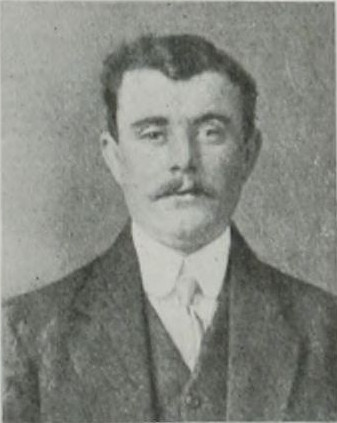
John James Payne.
PAYTON, CHARLES MERVYN, Lieut. 3rd, attd. 1st, Battn. Royal West Kent Regt., only s. of Sir Charles Payton, of Stepney Court, Scarborough, M.V.O., late British Consul-General at Calais, by his 1st wife, Eliza Mary, dau. of the late John Olive; b. Mogador, Morocco, 5 Dec. 1891; educ. Dover College, and on leaving there in 1909, became a Clerk under his father in the British Consulate at Calais; gazetted 2nd Lieut. in the Reserve Battn. of the Royal West Kent Regt., 1910, and promoted Lieut. 6 Sept. 1911; left the Army in 1912 to go to Singapore, where he held a post on a rubber plantation, but in the following year was appointed Chief Clerk in the Colonial Secretary’s Office, which appointment he gave up on the outbreak of war in Aug. 1914; returned home and rejoined his old Regt., was on special duty in England for some time; went to France in Jan. 1915, and was killed in action during the 2nd Battle of Ypres, 18 April following. He was leading his men in the attack on Hill 60 and had picked up the rifle of a fallen soldier, and was firing at the enemy when he was shot through the head. His Commanding Officer wrote that he had done very good work, and “shown himself to be a brave man and a good leader,” and a Sergt. of his Coy. wrote of him as “one of the best and truest, more like a brother to the men than an officer, cheering in the blackest times by his brave gaiety, and mourned by them as a brother.” Lieut. Payton was mentioned in Sir John (now Lord) French’s Despatch of 31 May [London Gazette, 22 June], 1915, for gallant and distinguished service in the field. He was a keen sportsman, a remarkably good shot and expert angler.
PEACOCK, EDWARD DANIEL, Leading Carpenter’s Crew, 345947, H.M.S. Cressy; lost in action in the North Sea, 22 Sept. 1914.
PEACE, HUBERT KIRKBY, Lieut., 3rd Battn. York and Lancaster Regt., attd. 1st Battn. Lincolnshire Regt., 3rd s. of the late Hugh Kirkby Peace, of Springfield House, Sheffield, Steel Manufacturer, by his wife, Emmeline (Sandygate, Sheffield), dau. of James Fawcett; b. Sheffield, 16 Oct. 1881; educ. Rugby; became Managing Director of his father’s firm, W. K. & C. Peace, File Manufacturers, Feb. 1906; joined the 1st Volunteer Battn. York and Lancaster Regt. (Doncaster Militia), afterwards the 4th (Hallamshire) Battn., and served 10 years retiring in May, 1913, but, after the outbreak of war, was given a commission in 3rd Battn. York and Lancaster Regt. as Lieut. 4 Sept. 1914, and went to France attd. to the 1st Lincolnshire Regt., on 3 Oct. 1914; and died in hospital at Aubers, on the morning of 17 Oct., of wounds received in action near Lille, the previous day. Buried there. He had gone to the rear to hurry up supports, and he succeeded in getting them, but as he was returning he was wounded in the neck by a shot fired from a farm which it was supposed had been cleared by the French. A wounded soldier in Leeds Base Hospital, belonging to the Coldstream Guards said: “He died fighting to the last in trying to save his platoon from being cut to pieces, and many will never be able to give full praise and admiration for so gallant a deed.” He m. at St. Leonards-on-Sea, 2 Aug. 1906, Grace Mary (Thurgoland, Sheffield), dau. of Charles Weller, and had a son, George Hugh Kirkby, b. 15 Dec. 1909.
PEACOCK, JOSEPH MOFFAT, Sapper, No. 46405, R.E., eldest s. of William Thomas Peacock, of Hartlepool, Driller, by his wife, Sarah Carry, dau. of Joseph Moffat, of Monkwearmouth; b. Southwick-on-Wear, co. Durham, 8 Feb. 1894; educ. Southwick and Goole Board Schools; was employed at Pickersgill’s and resided at 50, John Street, Southwick; enlisted, 9 Sept. 1914; trained at Brixton, Henley and Gillingham, and was killed in action “somewhere” in France, 10 Dec. 1915. His Chief Officer wrote “A shell came into their dug-out killing four of them instantly. They were buried the day following in Princess Pat’s Cemetery, Voormezeele, when all the section attended the funeral. He was a splendidly brave fellow.”
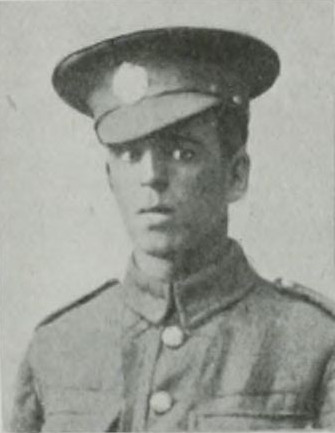
Joseph Moffat Peacock.
PEAKE, CECIL GERALD WYATT, Capt., 2nd Battn. Lincolnshire Regt., 2nd s. of Henry Arthur Peake, of Westholme, Sleaford, co. Lincoln, Solicitor, by his wife, Alice Anne, dau. of the Rev. John I. Penford Wyatt; b. Sleaford, 21 Nov. 1891; educ. Aysgarth School, Charterhouse, and Trinity Hall, Cambridge; gazetted 2nd Lieut. in the Lincolnshire Regt., 19 Jan. 1912; promoted Lieut. 28 May, 1913. and Capt. 21 Dec. 1914; served in Bermuda, Dec. 1913 to Sept. 1914, and with the Expeditionary Force in France and Flanders from 8 Nov. 1914 to March, 1915, on which date he was killed in action at the Battle of Neuve Chapelle, being among the first of the Lincolnshires to enter the enemy’s trenches; unm. Buried in an orchard at Masselot. Capt. Peake was mentioned in Sir John (now Lord) French’s Despatch of 31 May [London Gazette, 22 June], 1915. While at Oxford he gained his oar for rowing, and also took a 2nd in Law for his B.A. degree.
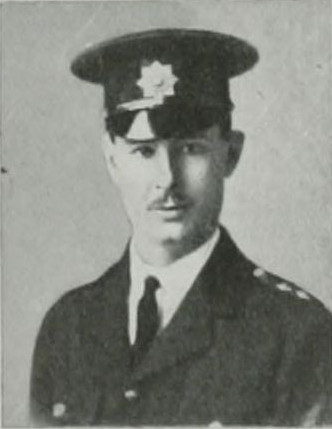
Cecil G. W. Peake
PEAKE, COLIN, Lieut., Leicestershire Yeomanry (T.F.), elder s. of Ronald Peake, of Howard House, Ashtead, co. Surrey, Solicitor, by his wife, Florence, dau. of the late Edward Adams; b. Ashtead, 28 Sept. 1889; educ. Fonthill, East Grinstead, and Charterhouse; admitted a Solicitor in 1913; joined the Leicestershire Yeomanry as 2nd Lieut., 23 April, 1909, being promoted Lieut. 1 April, 1911; volunteered for foreign service on the outbreak of war in Aug. 1914; went to France with his regt. in Nov.; took part in the fighting in France and Flanders, during the winter of 1914–15, and was killed in action in an advance trench near Ypres, 13 May, 1915; unm.
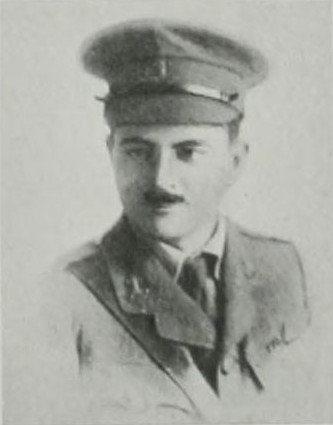
Colin Peake.
PEARCE, ALFRED, Driver, No. 35452, Royal Field Artillery, yst. s. of Nathan Pearce, of 21, Sunnyside, Diss, co. Norfolk, Farm Labourer; b. Thrandeston, Diss, 18 Aug. 1885; educ. there; enlisted in the R.F.A. in Oct. 1907; served six years with the colours, then passed into the Reserve, and was engaged as a Dairyman at Chigwell, Essex; mobilised 5 Aug. 1914; went to France in Aug., and died in the Lycée Pasteur, Neuilly, 28 Sept. following, of wounds received in action during the Battle of the Aisne. He m. at Chelmsford, Jan. 1914, Grace, dau. of (—) Bradley; s.p.
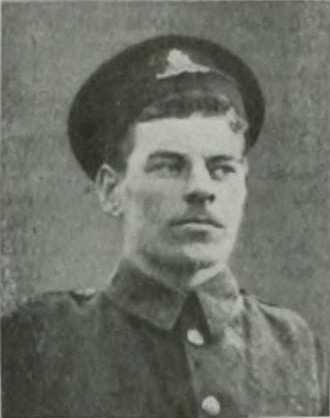
Alfred Pearce.
PEARCE, DUDLEY HOGARTH, L.-Corpl., No. 2162, Royal Gloucestershire Hussars (Yeomanry), s. of Henry Pearce, of Elberton, Tockington, co. Gloucester, by his wife, Eliza Jane Sarah, dau. of the late Charles Smith, of Max House, Winscombe, co. Somerset; b. Winford, co. Somerset, 13 Oct. 1884; educ. Thornbury Grammar School; joined the Royal Gloucestershire Hussars on the outbreak of war in Aug. 1914; trained at Newbury and Heacham; left for the Dardanelles, 15 April, 1915; was promoted Corpl. for his bravery and coolness during the charge of the Yeomanry on Chocolate Hill, 22 Aug. following, and was killed in action there at 5.30 a.m. on the 28th, while cooking his comrades’ breakfast; unm. Buried to the west of Chocolate Hill. His brother, Trooper Edward Charles Henry Pearce, was killed in action at Quinn’s Post, 7 Aug. 1915 (see following notice). L.-Corpl. Dudley Pearce was always called the father of the troop, for his great thought and kindness.
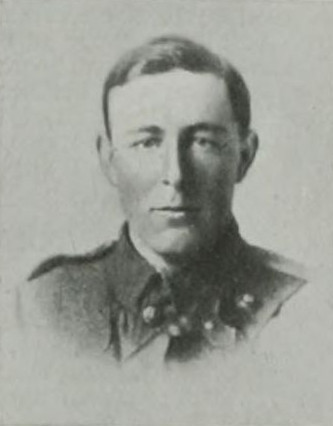
Dudley Hogarth Pearce.
PEARCE, EDWARD CHARLES HENRY, Trooper, No. 190, 2nd Australian Light Horse, Australian Imperial Force, s. of Henry Pearce, of Elberton, Tockington, co. Gloucester, by his wife, Eliza Jane Sarah, dau. of the late Charles Smith, of Max House, Winscombe, co. Somerset; b. Winford, co. Somerset, 26 Jan. 1883; educ. Thornbury Grammar School; served for three years in the Royal Gloucestershire Hussars; went to Australia in 1910 and was farming at Roma, Queensland, when war broke out; was one of the first men in that district to volunteer for Imperial service; joined the 2nd Light Horse, Australian Imperial Force; left for Egypt the end of Oct., where he completed his training; went to the Dardanelles; took part in the famous landing of the Australians there, 25–26 April, 1915, and was killed in action at Quinn’s Post, 7 Aug. following; unm. A comrade wrote: “He was one of the best chaps; he died as he had lived, an English gentleman to the last.” His brother, L.-Corpl. Dudley Hogarth Pearce, was killed in action at Chocolate Hill, 28 Aug. 1915 (see preceding notice).
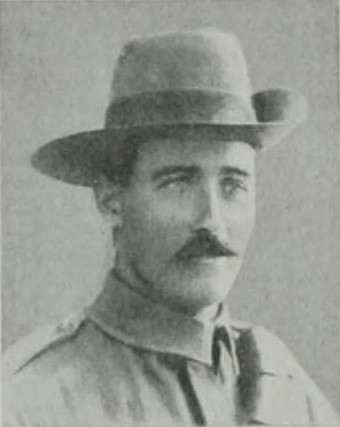
Edward C. H. Pearce.
PEARCE, HARRY CECIL, A.B., J. 896, H.M.S. Pathfinder; lost when that ship was sunk by a mine, about 20 miles off the East Coast, 5 Sept. 1914.
PEARCE, JOHN ALBERT, A.B. (R.F.R., B. 6098), 201703 (Chatham), H.M.S. Good Hope; lost in action off Coronel, on the coast of Chili, 1 Nov. 1914.
PEARCEY, ALFRED STEPHEN, Private, R.M.L.I., Po. 12774, H.M.S. Good Hope; lost in action off Coronel, on the coast of Chili, 1 Nov. 1914.
PEARCE, GEOFFREY VINCENT, 2nd Lieut., 2nd Battn. Royal Warwickshire Regt., only s. of Sir William Pearce, of Shepway Lodge, Walmer, co. Kent, M.P., J.P., by his wife, Ethel Alexandra, dau. of Edwin Neane, of Harefield, Sidling, co. Kent; b. Brentwood, co. Essex, 19 June, 1889; educ. Uppingham School, where he was a Sergt. in the School Corps; was a Chemical Manufacturer (Spencer, Chapman & Messel, Ltd.); joined the Artists’ Rifles in 1911; volunteered for foreign service on the outbreak of war in Aug. 1914; went to France with the Artists’ Rifles, Oct. 1914; was gazetted 2nd Lieut. Royal Warwicks, ... Nov. 1914, and was killed in action 18 Dec., during an attack on the German trenches at Rouges Bancs, south-east of Armentières, and buried by the enemy; unm.
PEARS, STUART, Sergt., No. 974, 14th Battn. (London Scottish) The London Regt. (T.F.); twin s. of Ernest Pears, of 69, Palace Road, Streatham Hill. S.W., Fellow of Chartered Institute of Secretaries, by his wife, Gertrude, dau. of John Campbell; b. Dulwich, 29 Oct. 1891; educ. Streatham Grammar School; was a Marine Insurance Clerk at Lloyds; joined the London Scottish in Nov. 1908; volunteered for foreign service on the outbreak of war in Aug. 1914; went to France, Sept. 1914, and was killed in action in the trenches at Givenchy, 22 Dec. 1914, being shot by a sniper; unm. Buried in the churchyard there.
PEARSON, FREDERICK PHILLIPS, Corpl., No 2881, 6th Battn. South Staffordshire Regt. (T.F.), yst. s. of Edward Pearson, of Whitchurch, co. Salop, formerly of Waterloo, Liverpool, retired Draper, by his wife, Maria, dau. of the late Thomas Phillips, of Chelmsford, Essex; b. Liverpool, 11 May, 1880; educ. Merchant Taylors’ School, Great Crosby, and on leaving entered the service of the National and Provincial Bank of England, and was stationed at Chester. He there joined the 2nd Volunteer Battn. of the Cheshire Regt., and on the outbreak of the South African War in 1899, volunteered and served with the 1st Volunteer Coy. of that Regt., in that campaign, and was awarded the Queen’s medal with three clasps. On the outbreak of the European War he was Cashier at the Wolverhampton branch of the National and Provincial Bank, and again volunteered for active service; joined the 6th (Territorial) Battn. South Staffordshire Regt. in Sept. 1914; went to the Front in March, 1915, and was killed in action near Zillebeke, 7 July, 1915; unm. Buried in Sanctuary Wood. His Lieut. wrote: “A shell came over which did not explode but crashed in a dug-out burying two men, one of whom was lying in the débris wounded. Pearson and another man at once got to work to dig them out, and had just succeeded when another shell came over, and a bit struck Pearson on the head. I took him up myself, but all to no purpose, he was hit badly. We all recognised his position, and others like him nobly served their country by joining in the ranks. He was actually killed in trying to save the life of other men, which I take it is the greatest thing a man can do. On all sides one hears the men talking about him, and there is no doubt he is a loss to the Regt.”
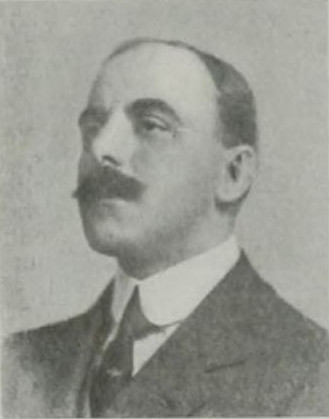
Frederick P. Pearson.
PEARSON, SYDNEY JOHN, Rifleman, No. 3584, 2/9th Battn. (Queen Victoria’s Rifles) The London Regt. (T.F.), only s. of the late John Pearson, of St. Neots, by his wife, Alice, dau. of George Cramley, of Sandy, Beds; b. St. Neots, co. Huntingdon, 21 June, 1887; educ. Sandy, co. Beds, and Downshall, co. Essex, and held a responsible position in an Ironmongery business at Ilford, which he gave up after the outbreak of war and joined Queen Victoria’s Rifles, 4 Nov. following; went to France, 12 Feb. 1915, and was killed in action at Hill 60, during the Second Battle of Ypres, 21 April, 1915; unm. Buried at Ypres behind the firing line.
PEARSON, WILLIAM RANSOME, L.-Sergt., No. 7366, 1st Battn. Coldstream Guards, only s. of William Pearson, of 24, Ashford Road, East Ham, Essex, formerly Colour-Sergt. 1st Battn. Coldstream Guards (served through the Nile Expedition for the relief of General Gordon, 1884–85; wounded at the Battle of Abu-Klea, 17 Jan. 1885; awarded Distinguished Conduct Medal for service in the field), by his wife, Sophia, dau. of Samuel Ransome, of Sherborne, King’s Lynn, co. Norfolk; b. St George’s Barracks, Trafalgar Square, London, 16 Oct. 1892; educ. Sandringham Road (Forest Gate) and Monega (E.) Council Schools; enlisted in the Coldstreams as a Drummer Boy, 27 July, 1907; joined the ranks, 6 June, 1912; appointed L.-Corpl. the same day; promoted Corpl., 24 May, 1914; appointed L.-Sergt., 7 Aug. 1914; went to France with the Expeditionary Force; served through the retreat from Mons; was wounded in action and taken prisoner during the Battle of the Aisne, 14 Sept., and died a prisoner of war in the Fortress Hospital, Wesel, Germany, 24 Dec. 1914; unm. His Company Officer, Capt. Saint A. Warde-Aldam, wrote: “On 14 Sept. we had a hard fight; the first brigade (in which we are) attacked between two villages called Vendresse and Cerny near the Aisne; we captured a good deal of ground but were not able to hold all we had taken, and consequently a large number of casualties were left on ground afterwards re-occupied by the Germans. I am afraid your son was one of them. I knew your son well, having trained with him at Aldershot, but I cannot remember definitely seeing him myself on the 14th. He was a very promising young sergt. and was a great loss to the company.... Whatever has happened to your son, I am quite confident he did his duty and upheld our old Coldstream traditions.” He himself wrote to his parents from the Festungshazarett, Wesel, about 30 Nov. 1914: “I was shot in the right thigh, and lay where I fell for a whole week. I don’t know how I lived it through, but I did. On the morning of the 21st some German stretcher-bearers picked me up and took me to hospital where they dressed the leg, which, of course, was broken. I have been shifted from one show to another till I’ve landed here, and here I shall be for two or three months.”
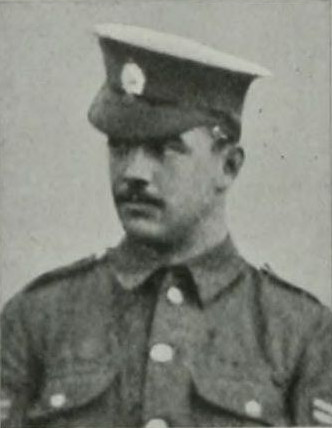
William Ransome Pearson.
PEART, GEORGE, Seaman, R.N.R., 5332A, H.M.S. Hogue; lost in action in the North Sea, 22 Sept. 1914.
PEART, STANLEY BRACE, A.C.I.S., Rifleman, No. 2436, B Coy., 21st Battn. (1st Surrey Rifles) The London Regt. (T.F.), 3rd and yst. s. of George Peart, by his wife, Marie (55, Silverdale, Sydenham, S.E.), dau. of Francis Henry Moller; b. Adelaide, South Australia, 10 Aug. 1891; educ. Bellenden Road L.C.C. School and Dulwich College; passed the Intermediate Examination in June, 1914, and was admitted an Associate of the Chartered Institute of Secretaries the following month, and prior to the outbreak of war was engaged on the staff of the Kamfersdam Mines, Ltd., of Gresham House, Old Broad street, E.C., with Mr. W. Howarth, F.C.I.S., who held a high opinion of his abilities. He joined the 1st Surrey Rifles for active service, 31 Aug. 1914, and after training at St. Albans, Luton and Harpenden, went to France, 14 March, 1915, and was killed in action at Givenchy, 25 May, 1915; unm. His Company Officer, 2nd Lieut. H. Persse, wrote; “On 25 May the battn. was ordered to attack at Givenchy. In the ordinary course of attack the bombers go first so as to prevent what are known as flank attacks. Your brother was with them, and I saw him myself go right into the German front line trench and on then to the second line trench. The last I saw of him was when his supply of bombs had run out—he was standing his ground very coolly on top of a German trench using his bayonet to great effect. I am afraid he was hit by a bomb, for when we found him next day he was greatly damaged but quite dead. I buried him myself with a lot of his comrades, and I am sure it will relieve your sorrow somewhat to know that the ‘fellow Tommies’ put up a beautiful cross to him with his name and regt. upon it. I always knew Stanley Peart as one of my best men. When the call came for bombers (a most dangerous job), Peart didn’t wait to be selected; he volunteered, and paid the price. No work was too hard for him, and he certainly fulfilled my greatest expectations when the time came for the battn. to show what it was made of.” And a comrade: “He was my fellow bomber in our platoon. There are four of us to a platoon. Although I did not actually see him fall, I know pretty well what his end was. It happened just before our platoon went over the parapet to support the other fellows who were holding the captured trench in front. There was an urgent call for bombs and bombers, and as Stan. happened to have a bandolier of bombs on him he was detailed to go with some more bombers. He was with me when he got the order, but he went to join the others a few yards further down the line. It was just in the act of getting over the parapet that he was shot; I think a machine gun caught him. At any rate it was a bullet that caused his death, not a shell.... He was one of the most popular fellows in our platoon.” Peart was well known in South London as a most versatile athlete. He captained Bellenden Road L.C.C. School in cricket, football and swimming. He won the Rutherford Harris Shield, the Championship South London breast stroke swimming in 1904, the championship of Dulwich, 1904 and 1905, and played in the cricket team for the boys for East v. West at the Oval in 1905 and 1906, captaining the team in 1906. He was in the Dulwich Hamlet Reserves in the season 1910–11, when they won the Southern Suburban League Championship. He played in the first team of Honor Oak Cricket Club for several years, until he gave up playing by his doctor’s orders.