The Roll of Honour. (continued 26)
Reading edition
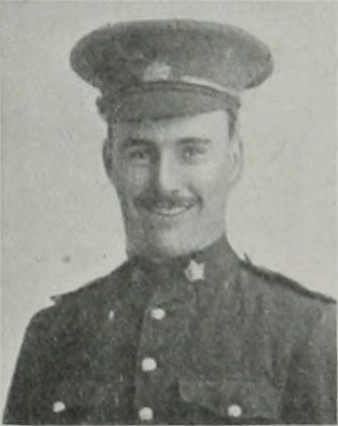
Harold John Hulbert.
HULME, SIDNEY, Gunner, R.M.A. (R.F.R., I.C. 42), H.M.S. Good Hope; lost in action off Coronel, on the coast of Chili, 1 Nov. 1914.
HUME, ARTHUR GRENVILLE, Major, Wellington Infantry, New Zealand Expeditionary Force, s. of Lieut.-Col. Arthur Hume, late 79th Cameron Highlanders and Inspector of Prisons, N.Z., by his wife, Raby, dau. of Dr. Macintire, Inspector-General of Hospitals; b. Parkhurst, Isle of Wight, 3 Oct. 1873; educ. Wellington College, and Wanganui College, New Zealand; was an Engineer; had been for many years in New Zealand Territorials and was Major, Garrison Artillery, when the European War broke out in Aug. 1914; volunteered for Imperial service and left for Egypt with the fourth reinforcements in April, 1915; served at the Dardanelles, and was killed in action at Suvla Bay, 8 Aug. 1915. He m. at Bath, 8 April, 1902, Amy Charlotte (8, Kensington, Bath), dau. of William Rogers, and had a son, Philip Waldron Grenville, b. 31 July, 1903.
HUME, ISAAC, Chief Stoker (R.F.R., A. 1267), 141118, H.M.S. Hawke; lost when that ship was torpedoed in the North Sea, 15 Oct. 1914; m.
HUMFREY, WILLIAM KNOX, of Cavanacor, 2nd Lieut., 2nd Battn. Lancashire Fusiliers, eldest surviving s. of the late Col. Benjamin Geale Humfrey, of Cavanacor, co. Donegal (who commanded the 3rd Leicestershire Regt. in the South African War), by his wife, Emily Anne (Cavanacor, Ballindrait, co. Donegal), 2nd dau. of William Knox, of Clonleigh, co. Donegal, N.E., I.C.S. [gdson. of the Right Rev. and Hon. William Knox, D.D., Lord Bishop of Derry, yr. brother of Thomas, 1st Earl of Ranfurly]; b. Narborough, co. Leicester, 14 May, 1891; educ. Bedford Grammar School; gazetted 2nd Lieut. to the Lancashire Fusiliers, 5 Oct. 1910; succeeded his elder brother in the family estates, 23 May, 1912; promoted Lieut. 3 Sept. 1914; went to France, 21 Aug. 1914, was appointed Machine-Gun Officer, and was killed in action at the Battle of Le Cateau, 26 Aug. 1914; unm. Buried at Esnes.
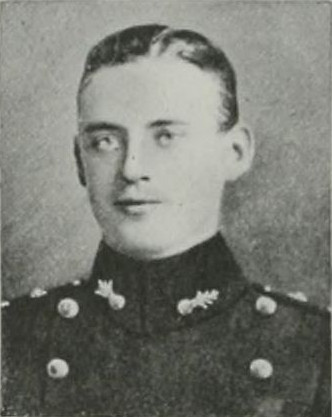
William Knox Humfrey.
HUMPHREY, ALBERT, Stoker, 1st Class (R.F.R., B. 1134), 276452, H.M.S. Hogue; lost in action in the North Sea, 22 Sept. 1914.
HUMPHREY, EDMUND WILLIAM ALFRED, Acting Lieut., Royal Naval Reserve, s. of Edmund Humphrey, of Boughton-under-Blean and Westgate-on-Sea, Schoolmaster, by his wife, Emma Lynch, dau. of William Andrews; b. Boughton-under-Blean, co. Kent, 11 July, 1880; educ. Wreight’s School, Faversham, and Margate School of Art; and joined the Merchant Service in 1895, being apprenticed to the Shaw, Saville and Albion Coy. and acquired his first knowledge of seacraft in the old-fashioned sailing ships, gradually working his way to a master’s ticket. He afterwards entered the service of the Royal Mail Steam Packet Coy. becoming 2nd officer, and in 1898 was nominated by the late Lord Goschen, then First Lord of the Admiralty, to a commission as Midshipman, R.N.R., and received his annual training in H.M.S. President, becoming Sub-Lieut. 10 April, 1904; just prior to the war was accepted for a year’s training in a battle ship, and appointed to H.M.S. Formidable, 1914, in which he was serving as acting Lieut. when she was torpedoed in the Channel, 1 Jan. 1915. A brother officer who survived, wrote: “Humphrey was popular with his shipmates and certain to have done his duty to the end.” He m. at the Presbyterian Church, Liverpool, 1 Nov. 1908, Annie McIlwrick Neilson (28, Hampstead Road, Elm Park, Liverpool), dau. of James Neilson Sproul, of Paisley and Liverpool, and had a dau., Joan, b. 7 July, 1915.
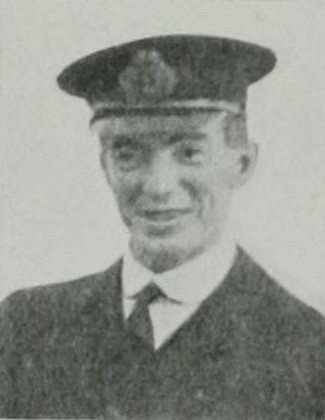
Edmund W. A. Humphrey.
HUMPHREYS, GEORGE GEOFFREY PENDERGAST, Major, 127th Regt. Queen Mary’s Own Baluchis L.I., yst. s. of the late Thomas William Drumond Humphreys, J.P., of Donoughmore House, Castlefin, co. Donegal, by his wife, Isabella, dau. of Dr. Thomas Thomson, of Leamington; b. Milltown house, Strabane, co. Tyrone, 17 Feb. 1873; educ. All Hallow’s School, Honiton, and the Royal Military College, Sandhurst (1891–2); gazetted 2nd Lieut. in the Welsh Regt. 13 July, 1892; transferred to the Indian Staff Corps as Lieut. 13 July, 1895, and promoted Capt. 13 July, 1901, and Major, 13 July, 1910; was Staff Officer to the Officer Commanding the troops in East Africa Protectorate and Uganda, 1897–8 (medal with clasp); and Double Coy. Officer, 130th Baluchis, with China Field Force in 1901; was Adjutant Sind Volunteer Rifles, 1 May, 1908, to 1 May, 1911; Double Coy. Commander, 17 April, 1910; and an extra A.D.C. to H.M. King George V, for the Delhi Durbar, 2 Dec. 1911 to 10 Jan. 1912. On the outbreak of war he went to France attd. to the 129th D.C.O. Baluchis, sailed from India 24 Aug., and died at Hollebeke, Belgium, 30 Oct. 1914, of wounds received in action. He was mentioned in F.M. Sir John (now Lord) French’s Despatch of 14 Jan. 1915. He m. at Holy Trinity Church, Karachi, India, 30 Nov. 1903, Olive Muriel (The Cottage, Rowledge, Farnham), only dau. of Major-Gen. Sir James Bell, K.C.V.O., and had two sons and two daus.: Patrick William, b. 14 May, 1905; George James Alexander, b. 16 Dec. 1906; Olive Phylis, b. 14 July, 1909; and Lorna Isobel, b. 9 May, 1913.
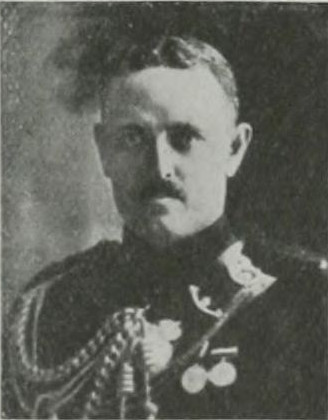
G. G. P. Humphreys.
HUMPHREYS, JOHN THOMAS, Sergt., R.M.A., 7273, H.M.S. Good Hope; lost in action off Coronel, on the coast of Chili, 1 Nov. 1914.
HUMPHRIES, GEORGE WILLIS, L.-Corpl., No. 1344, 12th Battn. (The Rangers) London Regt. (T.F.), s. of William Humphries; b. Newington, London, 2 Aug. 1877; joined The Rangers, 1911, and was killed by a shell which exploded in the trenches, 14 Feb. 1915, while serving with the British Expeditionary Force in France. Humphries was the winner of the Light Weight Amateur Boxing Championship in 1900 and was for 20 years connected with the Battersea Athletic Club. He m. at Balham, 4 Oct. 1902, Margaret (32, Strathville Road, Earlsfield, S.W.), dau. of Thomas Cooper, and left four children: George Stanley, b. 16 Feb. 1907; Margaret Dorothy, b. 12 Aug. 1904; Florence Ellen, b. 5 Nov. 1908; and Ivy Gertrude, b. 2 July, 1912.
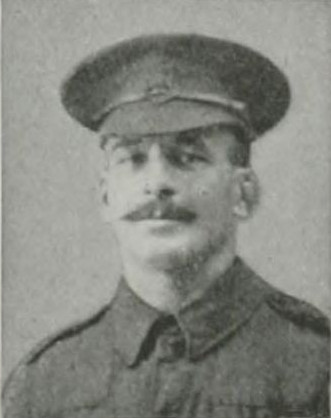
George Willis Humphries.
HUNT, ALBERT, Stoker, 1st Class (R.F.R., B. 9624), K. 536, H.M.S. Hawke; lost when that ship was torpedoed in the North Sea, 15 Oct. 1914; m.
HUNT, ALFRED EDWARD, Rifleman, No. 2894, 1/8th Battn. (Post Office Rifles) The London Regt. (T.F.), eldest s. of Alfred Hunt, of 35, Balfour Road, Lower Edmonton, by his wife, Elizabeth, dau. of Edward Eldridge; b. Old Kent Road, S.E., 10 Nov. 1895; educ. Croyland Road Board School, Lower Edmonton; was a Postman at Winchmore Hill and Finchley; joined the Post Office Rifles early in Sept. 1914; went to France, 17 March, 1915; and was killed in action at Festubert in the course of a bomb attack upon the German trenches. 2nd Lieut. W. N. Kirkland wrote: “I have known your son since he joined the Battn. in Sept. last, and since the beginning of this year, when the double-coy. organisation was adopted, he has been in my Platoon. Your son was one of the coy. bombers, and when we were ordered to attack a portion of the German trench, he went forward with the bombers in order to drive out the Huns. While doing this he unfortunately was killed. I am sure his death has caused a great loss to the Coy., as bombers are of the utmost importance when attacking the enemy’s trench and it is difficult to find brave and capable men for this.”
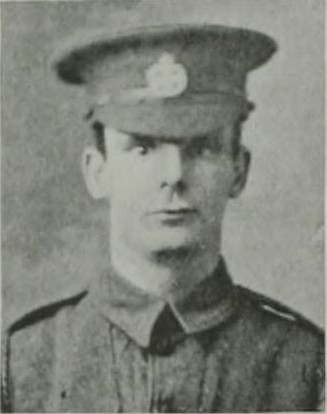
Alfred Edward Hunt.
HUNT, FRANK ERNEST, Private, No. 2057, 1st Sussex Yeomanry, 2nd s. of Simeon Hunt, of 5, Lancaster Road, Brighton, Architect and Surveyor, by his wife, Charlotte, 2nd dau. of Thomas Stanley Wakeley, of Rainham, Kent; b. Brighton, 7 Sept. 1892, and was educ. at Brighton Grammar School and Brighton Municipal Technical College. He passed the Cambridge Local Examination as a junior in 1st Class Honours with two distinctions in 1907, the Matriculation Exam., London University, 1910, and the Intermediate Exam, in Faculty of Engineering, London University, in 1912, but, owing to a severe nervous breakdown in 1913, he was unable to sit for the final B.Sc. (Eng.). Concerning this his master wrote: “Your son worked like a Trojan, and but for the collapse (which I feared) he would have passed. I should like you to be convinced of this.” After the outbreak of war, he volunteered and joined the Sussex Yeomanry in Sept. 1914, and after training at Brighton, Canterbury, and Maresfield, left England, 23 Sept. 1915 for the Dardanelles, and was killed in action there, 17 Dec. 1915, by a chance Turkish bullet fired at night from a considerable distance. The regt. was in reserve at the time some distance from the firing line, and Hunt was standing just outside his dug-out emptying sandbags when hit. Immediate medical attention was given, but the bullet had passed through the lung and death occurred within about half an hour. He was buried in East Anglia Gully Cemetery; unm. His troop officer wrote: “When he came to this regt. in Sept. he was placed in my troop, and although I had thus been his Troop Officer only for a few months they were more than ample to enable one to judge of his good qualities and to feel that, in addition to the thoroughness and loyalty which he always put into his work as a soldier in the form of warfare that we have been through, he would have given a good account of himself in open battle if the opportunity had been allowed him.”
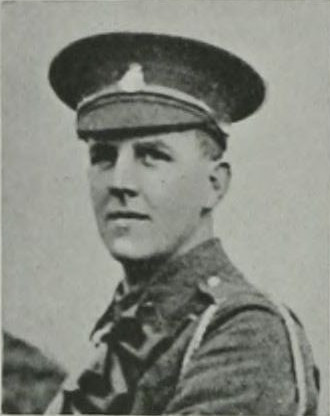
Frank Ernest Hunt.
HUNT, GEORGE HENRY, Bugler, R.M.L.I., Ch./11450, H.M.S. Cressy; lost in action in the North Sea, 22 Sept. 1914.
HUNT, HARRY, Private, No. 8921, R.E., eldest s. of the late Firth Hunt, of Market Place, Barton-on-Humber, by his wife, Alice, dau. of Thomas Cash; b. Barton-on-Humber, co. Lincoln, 22 Dec. 1883; educ. Wesleyan School there; enlisted 29 April, 1901; served through the South African War, 1899–1902 (medal with five clasps), and passed into the Reserve, 27 Feb. 1909; mobilised 5 Aug. 1914; went to France 28 Aug. and was killed in action at Armentières, 13 Dec. 1914. In addition to the South African medal he had two Good Conduct medals. He m. in Malta, 7 Aug. 1905, Concerta (30, White Cross Street, Barton-on-Humber, near Hull), dau. of Lorenzo Deprossimo, of Malta; s.p.
HUNT, PERCY HENRY HART, L.-Sergt., No. 1426, 21st Battn. (1st Surrey Rifles) The London Regt. (T.F.), only s. of the late Henry Hunt, Gas and Hot Water Engineer, by his wife, Agnes (39, Dekker Road, Dulwich Village, S.E.), dau. of the late George Hart; b. Chelsea, 24 May, 1892; educ. Dulwich Hamlet School, Dulwich; became a telegraph boy at the age of fourteen, and was subsequently promoted to sorting; joined the 1st Surrey Rifles, 11 April, 1913; appointed L.-Corpl. shortly before war broke out, and promoted Corpl. on mobilisation; volunteered for Imperial service and left for France, 15 March, 1915, where he was appointed L.-Sergt. and died at No. 1 Casualty Clearing Station, 28 May, 1915, from shrapnel wounds in the abdomen received in action at Givenchy on the 25th, while leading his men over a parapet. Buried in British New Cemetery, Chocques (grave No. 202); unm. From information furnished his relatives by a Sergt.-Major who assisted to carry him in, it appears that he was left on the field for twenty-four hours, and when they picked him up, although so badly wounded, was quite cheerful, and remarked “I’ve had it.” His Coy. Commander, Capt. A. Hutchinson, wrote that he was extremely popular with his men, and expressed his personal regret at the loss of such a promising and straightforward N.C.O.
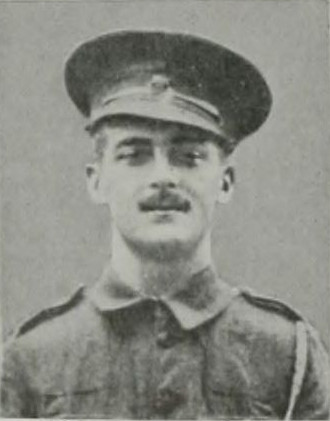
Percy Henry Hart Hunt.
HUNTER, GEORGE RUPERT, Gunner, No. 40190, 12th Battery, 3rd Brigade, Canadian Expeditionary Force, 3rd but only surviving s. of Richard Harrison Hunter, of 418, Gilmons Street, Ottawa, Canada, Civil Servant, by his wife, Sarah, dau. of George Cooper, of London, England; b. Aylmer, P. Quebec, 7 Nov. 1890; educ. Ottawa; volunteered for service overseas and joined the Canadian Expeditionary Force, at Winnipeg, 6 Aug. 1914, the day following the declaration of war; came over with the first contingent, and died at Netheravon, 10 Feb. 1915, of pneumonia, contracted while going through his course of training; unm.
HUNTER, HUGH, Private, No. 2000, 1/4th Battn. Seaforth Highlanders (T.F.), 3rd surviving s. of the late Robert Hunter, Engineer and Manager, Chester Gas Works, Member of the Society of Engineers, by his wife, Ann Martha (16, Durand Gardens, S.W.), yst. dau. of the late Henry Carne; b. Whitefriars, Chester, 21 June, 1892; educ. Christ’s Hospital, Horsham, Sussex, where he was a L.-Corpl. in the Cadet Corps, and on leaving entered the employ of a firm of Motor Engineers, afterwards Patent Agents in London; volunteered after the outbreak of war, joined the 4th Seaforths in Sept. 1914, and after two months’ training at Bedford, went to the Front with them in Nov. He was shot through the head while acting as observer to his Capt. in the advance on Neuve Chapelle, in the early morning of 11 March, 1915, and died before reaching the dressing station; unm. He was buried with several comrades in the garden of a house at Neuve Chapelle (Edgware Road), S.5.d.3.5. Letters from his Commanding Officer and the Chaplain testify of his being most popular with his comrades and a good soldier.
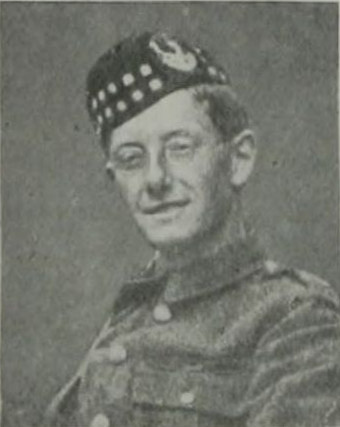
Hugh Hunter.
HUNTER, JAMES ANDREW, L.-Corpl., No. 982, 2nd Battn. Seaforth Highlanders, only s. of the late James Hunter, of Murdoch Terrace, Edinburgh, and 10, Bryson Road, Edinburgh, Hay and Straw Merchant, by his wife, Isabella, dau. of James Duncan, of Edinburgh, Coal Merchant; b. Edinburgh, 18 March, 1895; educ. Merchiston Public School; enlisted, 10 Jan. 1912; went to France, 22 Aug. 1914, and died in Hospital at Boulogne, 22 Oct. 1914, of wounds received at Steenwerk on the 20th; unm. His Commanding Officer wrote that he was wounded while taking part in a bayonet charge and bravely driving back the enemy, for which his coy. (B) was highly complimented.
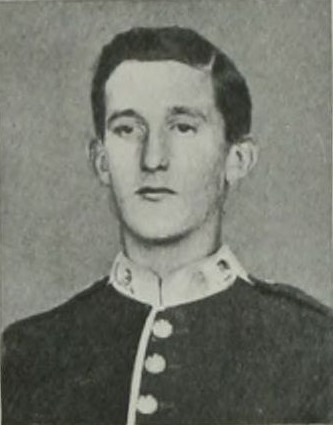
James Andrew Hunter.
HUNTER, JOHN GEORGE, Private, No. 2134, 6th Battn. Australian Imperial Force, s. of James Hunter, of 67, Charlotte Street, Fraserburgh, Aberdeen, Postman for 28 years in New Deer and Fraserburgh, by his wife, Elizabeth, dau. of George Forbes; b. Auchreddie, New Deer, 17 Sept. 1888; educ. New Deer and Fraserburgh Public Schools; served his time as a Draper with Mr. Anderson, Fraserburgh, and was afterwards for six years in the employ of Mr. Millar, cabinet-maker, as salesman and timekeeper; emigrated to Australia, June, 1911; enlisted, Sept. 1914, and trained at Broadmeadows, Victoria; sailed for Egypt, 24 Dec. 1914, and died on 26 April, 1915, of wounds received in action the previous day, during the landing of the Anzacs near Gaba Tepe, Gallipoli; unm.
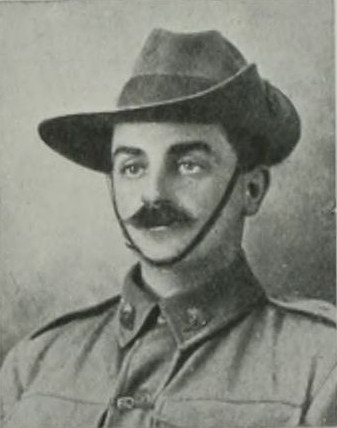
John George Hunter.
HUNTER, LESLIE, Sergt., 14th Platoon, D Coy., No. 75976, 29th (Vancouver) Battn. Canadian Expeditionary Force, 3rd s. of Edward Hunter, Manager of Lloyd’s Bank, Compton Street, Ashbourne; b. Ashbourne, co. Derby, 21 June, 1886; educ. Grammar School there; went to Canada in March, 1910; joined the 104th Regt. Jan. 1912; volunteered for service overseas after the outbreak of war, was transferred to the 29th Battn., and was killed in action in France, 11.35 a.m. on 30 Sept. 1915. Capt. P. H. Smith, his commanding officer, wrote that “there was no man in his company for whom he had a higher regard,” and one of his platoon (B. G. Wolfemerton): “He was killed in the discharge of his duty a few feet from myself; he and Corpl. Moorhouse had gone to a ruined house to attempt to locate a sniper who was a source of danger to our lines, and on his way back was shot by probably the sniper he was in search of, through the heart; he died instantly and suffered no pain.” Hunter m. at Derby, 14 Feb. 1910, Ethel (Compton Street, Ashbourne), dau. of Joseph Watson, and had a dau., Gladys Evelyn, b. 18 July, 1911.
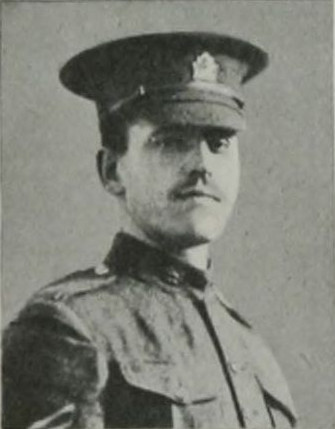
Leslie Hunter.
HUNTER, ROBERT, Stoker, 1st Class (R.F.R., B. 8375), S.S. 104449, H.M.S. Hawke; lost when that ship was torpedoed in the North Sea, 15 Oct. 1914; m.
HURLBERT, REXFORD, Private, No. 10773, 2nd Battn., 1st Brig. Canadian Expeditionary Force, yr. and only surviving s. of William Benjamin Hurlbert, by his wife, Bessie, dau. of (—) Race, and nephew of Almina, née Hurlbert, wife of George Alfred Whiting, of Smith’s Falls, Ontario (by whom he was brought up); b. Scranton, Pennsylvania, U.S.A., 29 May, 1895; educ. Smith’s Falls, Ontario; enlisted in the Canadian Expeditionary Force in Jan. 1915, and was killed in action in the trenches, 29 Nov. 1915, by a bullet through the head; unm. He was buried N.E. of R.E. Farm, Wulverghem.
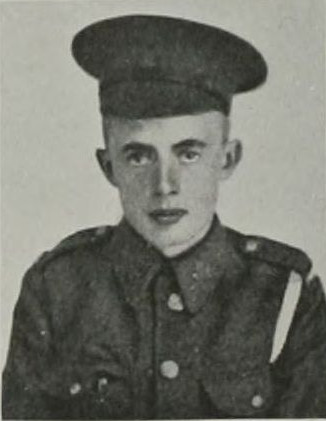
Rexford Hurlbert.
HURT, GEORGE WILLIAM, Leading Seaman (R.F.R., B. 8922), 196582, H.M.S. Hogue; lost in action in the North Sea, 22 Sept. 1914.
HURT, SEYMOUR FREDERICK AUCKLAND ALBERT, Capt., 1st Battn. Royal Scots Fusiliers, 2nd s. of Albert Frederick Hurt, of Alderwasley, co. Derby, J.P., D.L., by his wife, Alice, 3rd dau. of Frederic Peter Delmé Radcliffe, of Hitchin Priory, co. Herts; b. The Outwoods, near Duffield, co. Derby, 18 Oct. 1879; educ. Hazelwood, Limpsfield, Surrey (1890–93), Harrow (J. Stogden’s House, 1893–98); joined the Militia Oct. 1899, and was gazetted 2nd Lieut. to the Royal Scots Fusiliers, 18 April, 1900, and promoted Lieut. 4 Sept. 1901, and Capt. 24 Jan. 1911; went to the Front, 5 Sept. 1914, and was killed in action near La Bassée during the First Battle of Ypres, 18 Oct. following, while leading his coy. in a charge; unm. He was mentioned in F.M. Sir John (now Lord) French’s Despatch of 20 Nov. 1914–14 Jan. 1915 [London Gazette, 17 Feb. 1915]. Capt. Hurt was in the Harrow cricket XI and the football XI, 1897–98; and took great interest in the cricket and football teams in the R.S.F.; was a keen sportsman, devoting himself to polo, pig-sticking, and big game shooting while in India, where he served the greater part of his time. When at home he acted as field master to his brother’s (Mr. Hurt’s) pack of fox hounds in Derbyshire.
HUSBAND, HERBERT BARRY, L.-Corpl., No. 1377, 1/14th Battn. (London Scottish) The London Regt. (T.F.), eldest s. of John Irons Husband, of 4, Eastcheap, London, E.C., Merchant (a native of Fifeshire), by his wife, Constance Eugénie, dau. of Charles Barry, of San Francisco; b. San Francisco, U.S.A., 8 March, 1893; educ. St. George’s College, Weybridge, Surrey, and Maison de Melle, Belgium; was engaged with his father’s firm; joined the London Scottish in Nov. 1911; volunteered for foreign service on the outbreak of war; went to France, 16 Sept. 1914, and died at Wimereux, Boulogne-sur-Mer, 16 Nov. 1914, of wounds received in action at the First Battle of Ypres, and was buried there; unm. Lieut.-Col. G. A. Malcolm wrote: “No commanding officer could have had under his command a braver or more gallant soldier than your son, who so nobly gave his life for his country.” He is believed to have been the first native son of California to fall on a European battlefield. In 1913 he was champion shot of the London Scottish, and the youngest member of the Battn. to secure this distinction in the 49 years of its existence.
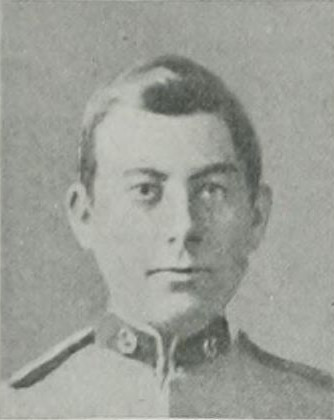
Herbert Barry Husband.
HUSKINSON, CHARLES ROBERT, Shipwright, 2nd Class, 344902, H.M.S. Cressy; lost in action in the North Sea, 22 Sept. 1914.
HUSSEY, JAMES WILLIAM, Private, R.M.L.I., Ply. 8213 (R.F.R., Ch. B. 131), H.M.S. Cressy; lost in action in the North Sea, 22 Sept. 1914.
HUSSEY, THOMAS JOSEPH, Private, R.M.L.I., 5775 (R.F.R., Ch. B. 398), H.M.S. Cressy; lost in action in the North Sea, 22 Sept. 1914.
HUTCHESON, JOHN, 2nd Lieut., 10th (Service) Battn. Sherwood Foresters (Notts and Derby Regt.), eldest s. of Robert Hutcheson, of Annandale, Berkhamsted, and Mincing Lane, E.C., Sugar Broker, by his wife, Janey Symington, dau. of the late John Henry Downes, of 18, Athole Gardens, Glasgow, and gdson. of the late John Mitchell Hutcheson, of Greenock; b. Highbury, London, 31 Jan. 1897; educ. Berkhamsted School, where he was from 1906 to 1914. The last three years he was a member of the O.T.C. On leaving school he entered the offices of the Clerical, Medical and General Life Assurance Society, but after the outbreak of war left in the beginning of Oct. to join the Inns of Court O.T.C. From this he was gazetted 2nd Lieut. to the 10th Battn. of the Sherwood Foresters, 3 Oct. 1914, and was killed in action near Zillebeke, Flanders, 8 Sept. 1915, by a sniper while surveying his fire trenches. He was buried in the Sanctuary Wood, near Ypres; unm. Many letters were received from his superior and his brother officers, all testifying to the regard and affection in which he was held. His Col. wrote: “He was a keen and energetic young officer of considerable promise and popular with all ranks.” His Capt.: “It is the first life lost among our officers and it is one of the best that has gone.... He was absolutely clean and honourable, frank, sincere and fearless.” His orderly wrote: “I write this short letter out of respect to my esteemed officer, your son. It was a very severe blow to me to lose him, for he was the very best friend that I ever had out here, and although I was only a ‘Tommy’ he showed every consideration for me as well as all the other men in the platoon, where he was very much esteemed. He was buried with full honours, and his grave is in a wood with others. There is a cross at the head, and I shall do all I can to keep his grave clean.” The doctor wrote: “A more unselfish boy one could not find; always thinking of the well-being of others.... I chose his resting place. A plain wood cross has been erected ‘In loving Memory of 2nd Lieut. J. Hutcheson. Killed in action,’ and the motto ‘To live in hearts we leave behind, is not to die.’”
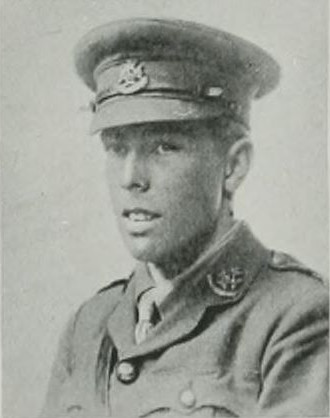
John Hutcheson.
HUTCHINGS, ROBERT SIDNEY, Private, R.M.L.I., Po. 15154, H.M.S. Good Hope; lost in action off Coronel, on the coast of Chili, 1 Nov. 1914.
HUTCHINS, THOMAS ARTHUR, Trooper, No. 303, 3rd Light Horse, 1st Light Horse Brigade, Australian Imperial Force, 5th and yst. s. of the late Samuel Newburgh Hutchins, of Ballylicky and Ardnagashel, Bantry, co. Cork, B.A. (T.C.D.), J.P., Barrister-at-Law, by his wife, Marianne Isabella eldest dau. of Henry Harrison, of Castle Harrison, co. Cork, J.P.; b. Ardnagashel, 20 July, 1888; educ. Fermoy College; went to Australia in Jan. 1912; enlisted in the 3rd Light Horse at Adelaide on 19 Aug. 1914, after the outbreak of war, and embarked for Egypt on 22 Oct. following, arriving at Alexandria on 9 Dec. He was in training for five months, and left for Gallipoli on 8 May, 1915. They landed on the evening of the 13th, and he was killed in action in the Monash Valley the following day, 14 Aug. 1915, the first man of his regt. to fall. He was unm.
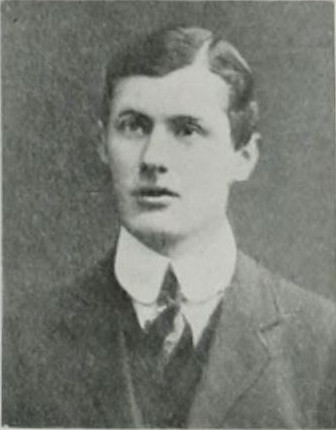
Thomas Arthur Hutchins.
HUTCHINSON, ALFRED RICHARD, Officer’s Steward, 2nd Class, L. 1645, H.M.S. Good Hope; lost in action off Coronel, on the coast of Chili, 1 Nov. 1914.
HUTCHINSON, HENRY ERNEST, Stoker, 1st Class, K. 10706, H.M.S. Good Hope; lost in action off Coronel, on the coast of Chili, 1 Nov. 1914.
HUTCHINSON, LIONEL CLYDE, A.C.A., Private, No. 3052, 13th (Princess Louise’s Kensington) Battn. London Regt. (T.F.), only surviving s. of Robert Hutchinson, Marine Engineer, of 6, Richmond Hill, Bournemouth, by his wife, Ellen King, dau. of Thomas Draper, of Albion Street, Spalding, co. Lincoln; b. Spalding, 12 Sept. 1884; educ. at Bournemouth and Bradford Grammar School, Yorks; was afterwards articled to Messrs. Hibberd, Bull & Co., Chartered Accountants, of London and Bournemouth; passed his final examination at the age of 21 and remained at the London office until he enlisted in the London Regt. 2 Sept. 1914. He was killed in the attack on the German lines, at Aubers Ridge, near Fromelles, on Sunday, 9 May, 1915, in which the Kensingtons took a leading part and captured three lines of trenches; meeting his death while returning for the third time for supplies of bombs under heavy rifle and machine-gun fire; unm. His commanding officer wrote: “He behaved with great gallantry, it was a brave soldier’s death.” A comrade said: “We were all very sorry to lose him, he was very popular with the fellows of his platoon”; and Gen. Rawlinson spoke of the attack as “a feat of arms surpassed by no other battn. in this great war,” asserting: “You and your fallen comrades have won imperishable glory for the 13th Battn.,” and Field-Marshal Sir John French, referring to their conduct in this action, spoke of the Kensingtons as the “glorious 13th.”
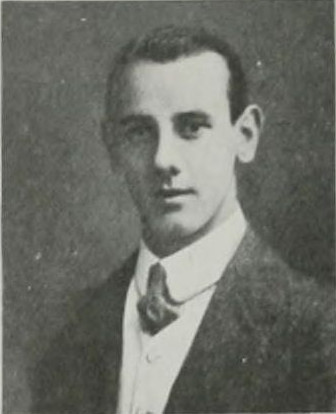
Lionel Clyde Hutchinson.
HUTCHINSON, ROBERT GREENWOOD, A.B., 222014, H.M.S. Good Hope; lost in action off Coronel, on the coast of Chili, 1 Nov. 1914.
HUTH, AUSTIN HENRY, Capt., 4th, att. 1st, Battn. East Surrey Regt., yr. s. of Edward Huth, of Wykehurst Park, Bolney, Sussex, D.L., J.P., by his wife, Edith Wilhelmina, 4th dau. of the late Rev. Frederick Anthony Stansfeld Marshall, Vicar of Great Easton, co. Leicester; b. Mayfair, London, W., 13 Oct. 1881; educ. Eton and Sandhurst; obtained a commission in the King’s Royal Rifles, Feb. 1900, and was promoted Lieut. 1902; served in the South African War, 1899–1902; took part in the operations in Natal, March-June; those in the Transvaal, east of Pretoria, July–29 Nov. 1900, including actions at Belfast (26–27 Aug.) and Lydenberg (5–8 Sept.), receiving the Queen’s medal with three clasps and the King’s medal with two clasps. On his return to England he left the Army with rank of Lieut., and went to Magdalen College, Oxford (B.A. 1907), afterwards becoming a partner in the family banking business of Messrs. Frederick Huth & Co. On the outbreak of the European War he enlisted in the Middlesex Regt. (Public School Battn.), and was given a Capt.’s commission with the 4th East Surrey Regt., 28 Oct. 1914; went to France, Jan. 1915, and was att. to the 1st East Surreys. He was killed in action at Hill 60, 20 April, 1915; unm. The Brig.-Gen. wrote: “I had a long talk with him in his trench that night. I was much impressed at the time with his zeal, keenness, and thoroughness, and the measures that he was taking to put his trench on a thoroughly sound footing. Sir Charles Fergusson (the Corps Commander) in a letter to me spoke of the East Surreys as ‘The heroes of the occasion,’ and later on he said ‘You may well be proud of your East Surreys.’ His life was given in the hour of victory for King and country in the performance of a magnificent exploit in capturing and consolidating our hold on Hill 60, a point of extreme importance to the well-being of the Allied front.”
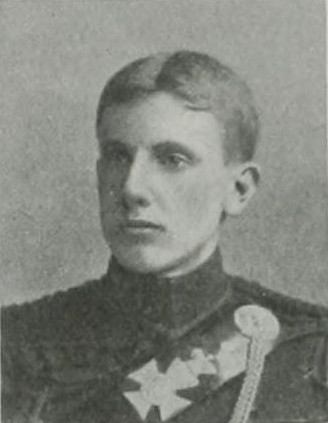
Austin Henry Huth.
HUTT, HAROLD VERNON, 2nd Lieut., 2nd Battn. Royal Sussex Regt., yr. s. of Arthur William Hutt, of The Moorings, Wallington, Surrey, Member of the London Stock Exchange, by his wife, Margaret Sarah, dau. of William Rees, J.P., Glamorganshire, and gdson. of the Rev. John Charles Hutt, Vicar of St. Silas, Pentonville; b. Enfield, co. Middlesex, 4 Oct. 1887; educ. Eastbourne College, and Finsbury Technical College; graduated B.Sc. (Eng.) with honours at University of London and passed the A.M. Inst.C.E. examination, taking first place, and obtaining the Bayliss Prize. For the four years preceding the war he was engaged on tube railway work: the Central London Railway extension to Liverpool Street, and the Queen’s Park extension of the Bakerloo Railway. He joined the Artists’ Rifles in Aug. 1914, went to France with them in Oct., and, after serving in the trenches for a time, joined the Artists’ O.T.C. and was gazetted 2nd Lieut. 2nd Royal Sussex. He was killed in action while defending the Keep at Cuinchy, 27 Jan. 1915, and was buried in Cuinchy Cemetery; unm. His Commanding Officer wrote: “During the short time your son was with us he endeared himself to all his comrades and showed very high promise; and we all feel that we have lost a comrade who would have been sure to distinguish himself. He died a soldier’s death in the forefront of the fight.” and the Commanding Officer of the Artists’ Rifles wrote: “Your son acted splendidly from the day of mobilisation in Aug. last, and had the goodwill and esteem of every man in the Regt. He had done much to uphold all the best traditions, and his name will always be remembered by all with pride.” 2nd Lieut. Hutt was a descendant of Capt. John Hutt, of H.M.S. Queen, who greatly distinguished himself in the victory obtained off Brest on 1 June, 1794, and to whom a monument was erected in Westminster Abbey by public subscription.
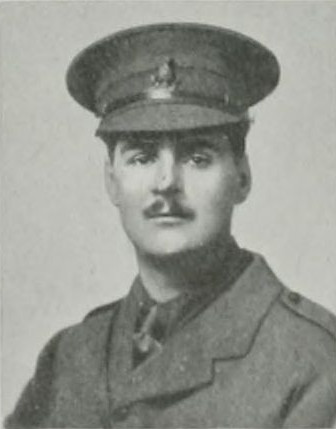
Harold Vernon Hutt.
HUTTON, GEORGE, A.B., 223256, H.M.S. Good Hope; lost in action off Coronel, on the coast of Chili, 1 Nov. 1914.
HUTTON, IAN CAMPBELL, Private, No. 2367, 9th Battn. The Royal Scots (T.F.), 1st s. of William Hutton, of 26, Nile Grove, Edinburgh, Superintending Engineer, Indian Public Works, by his wife, Annie Dickson, dau. of Edward Boyes; b. Tanjore, Southern India, 8 Aug. 1896; brought home to Scotland at the age of three, and was educ. Dollar Academy, where he distinguished himself in sports and was a member of the Cadet Corps. On leaving there he entered the Clydesdale Bank in Edinburgh, for training for Indian banking, but after the outbreak of war joined the 9th Battn. of The Royal Scots in Sept. 1914. After a period of training at Edinburgh, he went to the Front in Feb., and was killed instantaneously by a bullet, at the Second Battle of Ypres, 16 May, 1915. He was buried in Bellewaarde Wood, Hooge. He was a member of St. Matthew’s Parish Church, Edinburgh. His brother, 2nd Lieut. Gordon C. Hutton, 2nd Battn. King’s Own Scottish Borderers, was with him at Ypres, and is still (1916) on active service.
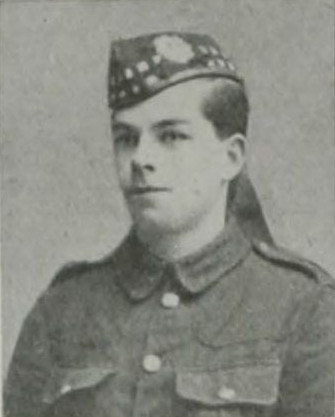
Ian Campbell Hutton.
HYLAND, JOHN EDWARD, Lieut., Royal Marine L.I., Portsmouth Battn. Royal Naval Division, eldest s. of the Rev. John Black Hyland, Rector of Combe Florey, Taunton, by his wife, Julia Harriet, dau. of the late Thomas Jourdain Hay, of Tower House, Millbrook, Hants; b. Arreton Vicarage, I.W., 24 Oct. 1895; educ. privately; gazetted 2nd Lieut., Royal Marines, 20 Aug. 1914, and promoted Lieut. March, 1915; left for the Dardanelles with the R.N.D., 27 Feb. 1915; took part in the landing there, 26 April, and was killed in action “leading and encouraging his men,” 10 May following; unm. Buried in Anzac Cove. Lieut.-Col. F. Luard (himself killed in action, 13 July, 1915), commanding Portsmouth Battn., wrote: “It may comfort you to know that ever since he joined the Battn. he had been conspicuous for good work, and that in consequence I had come to look upon him as one of the most promising and reliable of the younger officers. During the very severe fighting which took place on the four days before his death, and of which the brunt was borne by his company, he had shown extreme gallantry, and had come through scatheless, cheery, and full of spirit up to the last, enjoying every moment of his active responsibilities”; and Lieut. S. D. Wilmot-Sitwell (himself killed in action, 13 July, 1915): “On 10 May, early in the morning, the Battn. was turned out, and had to charge up a steep slope. The whole of the ridge at the top was swept by rifle and machine-gun fire. John led his platoon up the slope, and was, I believe, the first to reach the top, but I was further to the left myself. When he got to the top he turned to encourage his men to a last burst, when he was hit in the back by either a rifle or a machine-gun bullet. He was picked up by a stretcher-party, and died while being carried down to the dressing station. He was buried by the side of another officer who was hit while standing alongside him just before. A rough cross marks the place where they are buried.” Mrs. Stockley, wife of his Capt., also wrote: “I am writing for my husband, who was severely wounded on the same day as your son was so very unfortunately killed, and he wishes me to tell you how very well he did commanding his platoon, during a most trying three days in the trenches under practically incessant fire the whole time. My husband was always, from the time he joined his company, very pleased with the work your son did. He always showed great keenness in his work, and was a most promising young officer, always cheerful and bright and eager, and very popular with his men. The night before he was killed he and Mr. Fulton and my husband were sharing the same dug-out together, and they were both in such brave spirits in spite of all they had been through, that my husband says he could not help being proud of having such officers serving with him. One of your son’s last acts was to try and help my husband after he was wounded, but of course he had to go on and look after his men.”
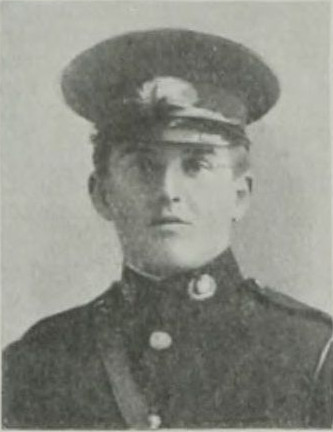
John Edward Hyland.
HYNES, JAMES, A.B. (Coastguard), 166525 (Devon.), H.M.S. Cressy; lost in action in the North Sea, 22 Sept. 1914.
HYNES, JAMES JOSEPH, Private, No. 1095, D Coy. 1st Newfoundland Regt., only s. of the late John Hynes [b. St. John’s, Newfoundland, died Halifax, N.S., 1900], by his wife, Margaret (now wife of John Paul Francis, of 285, South Side, St. John’s, Newfoundland), dau. of Stephen Fitzgerald; b. Halifax, Nova Scotia, 12 Dec. 1896; educ. Christian Brothers’ Schools there; was serving his time as a Cooper with Mr. E. G. Cousens, Mercantile Cooperage, St. John’s, when war broke out; volunteered for Imperial service, joined the Newfoundland Expeditionary Force, 8 Feb. 1915; left for England, 20 March, went to the Dardanelles, 12 Sept., and was killed in action there, 18 Nov. 1915; unm. Buried Borderers Ravine, 117 J. 3 Grave 41. A comrade wrote that they were having a rest in the support trench just behind the firing line, when at 9 a.m. they were sent up to the firing line to dig some dug-outs. They had been working for an hour when they were discovered by a Turkish sniper and Hynes was struck, being killed instantly, adding “Jimmie was one of the finest young men in our regt.; well liked by all.”
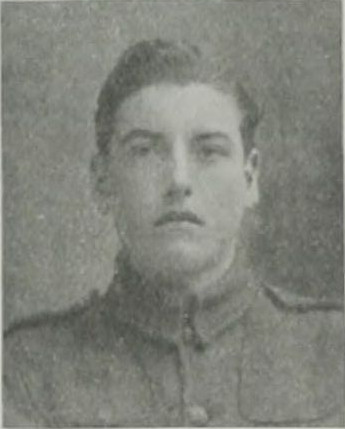
James Joseph Hynes.
IMRIE, JAMES WALTER, Private, No. 63470, 13th Battn. (Royal Highlanders of Canada) Canadian Expeditionary Force, yst. s. of James Harrison Imrie, retired Civil Engineer, Poona, India, by his wife, Letitia Ellen, dau. of the late Thomas Edward Kelly, Indian Police (who had the Mutiny medal of 1857); b. Khandwa, Central Provinces, India, 14 March, 1887; educ. Blairlodge School, Polmont, Stirlingshire, where he won several prizes for shooting and also the Spencer Cup at Bisley in 1903, and upon leaving there studied Civil Engineering in Scotland, and later went through a course of training at the Crystal Palace School of Engineering. He left for Canada in the autumn of 1910, being employed in Civil Engineering in various towns there, and on the outbreak of war volunteered for Imperial service and joined the 23rd Battn. Canadian Expeditionary Force. He came over with the second contingent in March, 1915, and was drafted to the 13th Battn. Royal Highlanders then at the Front. He went into action on 15 May, and was killed in action a week later during the active operations at the Orchard, 23 May, 1915; unm. He was buried by a shell in the communication trench leading to the Orchard at Festubert, and the official statement concluded “unfortunately there are no marks by which the place can be located.”
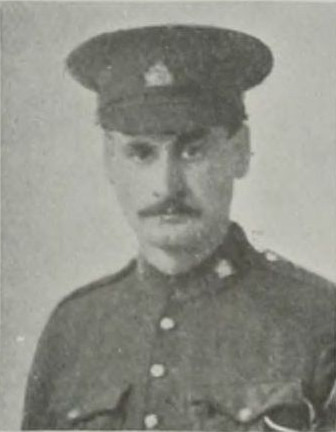
James Walter Imrie.
IMS, ROBERT THOMAS, Rifleman, No. 1577, 16th Battn. (Queen’s Westminster Rifles) The London Regt. (T.F.), 4th s. of the late Edwin George Ims, by his wife, Sarah Homred (34, Besborough Place, Pimlico), dau. of John Henley, of Broadway, Westminster; b. Westminster, 23 May, 1895; educ. Christ Church, Westminster, and Westminster City School; was a second grade Clerk in the Board of Education (Scottish Department); joined the Queen’s Westminster Rifles in 1912, having previously served in a Yeomanry Corps and the Civil Service Cadets; volunteered for foreign service on the outbreak of war in Aug. 1914; trained at St. Albans; went to France in Oct. 1914; took part in the First Battle of Ypres, Oct. and Nov.; the Battle of Festubert, Second Battle of Ypres, and the Battle of Hooge; went through his course of training as a bomber, and then through the Machine Gun School, where it was requested that he should be lent to the School as an Instructor, but his commanding officer could not spare him, and was killed in action at Ypres, 23 Aug. 1915, by shell fire; unm. Buried at Ypres. He had been recommended for a commission, and the papers were found in his pockets and sent to his mother.
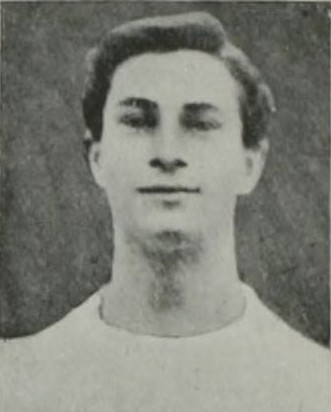
Robert Thomas Ims.
INGATE, WALTER WILLIAM, Seaman, R.N.R., 4050B, H.M.S. Hogue; lost in action in the North Sea, 22 Sept. 1914.
INGHAM, JOHN THOMAS, Private, No. 1559, 5th Battn. Supernumerary West Yorkshire Regt. (T.F.); b. co. Lancaster, 28 Feb. 1853; served in the 14th, 15th and 7th Hussars; took part in the Afghan War, 1878–80 (Afghan medal); the Boer War, 1881, and with the Royal Reserve Hussars; in the South African War, 1899; joined the National Reserve in Leeds, soon after its formation, and was accepted in April, 1915, at the age of 62, as medically fit for Reserve Service, and attached to the 5th Supernumerary West Yorkshire Regt. He died in North Ormesby Hospital, Middlesbrough, 25 June, 1915. He m. at Barwick-in-Elmet, Yorkshire, Eliza (6, Shepherd’s Place, Harehills Avenue, Leeds), dau. of Thomas Laford, of Garforth, Yorkshire, and had three surviving children. His second son, Sergt.-Major Ingham, is now (1916) on active service with the West Yorkshire Regt.
INGLES, ALEXANDER WIGHTON, Major, 1st Battn. West Yorkshire Regt., only s. of the Rev. Canon David Ingles, Vicar of Witham, co. Essex, M.A., by his wife, Anna, dau. of the Rev. Arthur Scrivener; b. at Apsley End, co. Herts, 20 May, 1869; educ. Haileybury; gazetted 2nd Lieut. to the West Yorkshire Regt., from the Militia, 12 March, 1892; and promoted Lieut. 1 Feb. 1894; Capt. 26 March, 1900, and Major 7 March, 1914, was Adjutant of volunteers from 10 Jan. 1902, to 9 Jan. 1907; served in the South African War, 1899–1901, including operations in the Transvaal, 30 Nov. 1900–Dec. 1901 (Queen’s medal with clasp); and with the Expeditionary Force in France, and was killed in action at the Battle of the Aisne, 24 Sept. 1914. The second in Command of the 1st West Yorkshires wrote: “You will be proud to know that he died a glorious death at the head of his Coy. The companies on the firing line were tricked by the Germans, who advanced under cover of the white flag, and then opened fire and enfiladed our men in the trenches. Your husband then shouted out, ‘All who will not surrender follow me,’ and retired fighting to the trenches on the left and was soon shot down and killed by a rifle bullet. He was buried where he fell with others of the Coy. I know no more details as no officers have returned in A, B, or D Coy.” Major Ingles m. at Hartley Wintney, Winchfield, Hants, Eugenia Ellen (93, Chelsea Gardens, Chelsea, S.W.), dau. of Major-Gen. Charles Henry Owen, late R.A., of Camberley, co. Surrey.
INGLIS, CHARLES NORTH DALRYMPLE, Lieut., Indian Army Reserve of Officers, attd. 2/8th Gurkha Rifles, 4th s. of Robert Inglis, Lovestone, Girvan, Ayrshire, J.P., by his wife, Isabella F., dau. of the Rev. Alexander Willison; b. Lovestone afsd., 17 June, 1880; educ. Ayr Academy, and afterwards went through an engineering course in Glasgow, on completing which he obtained a Government appointment in India in 1904, on the Eastern Bengal State Railway. He took a great interest in the Volunteer movement and was a Capt. in the Railway Volunteers. After the outbreak of war he was gazetted Lieut. to the Indian Reserve of Officers in Feb. 1915. He left India for France attached to the 2/8th Gurkha Rifles, in March, 1915, and was killed in action near Neuve Chapelle, 25 Sept. 1915; unm. Buried in a trench at the corner of Bois de Biez Wood. On this occasion the 2/8th Gurkhas lost their Col. and eleven of their officers killed and wounded and only 100 out of 600 of the regiment escaped. Inglis was a keen Rugby player; was a member of Turnberry Golf Club, and played in many matches. He was also an excellent tennis player. He and his brother (Capt. David Inglis, also killed, see following notice) did a good deal of shooting together in India, and both secured some fine big game trophies.
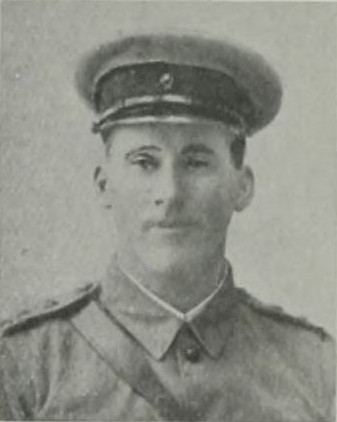
Charles N. D. Inglis.
INGLIS, DAVID, Capt. and Adjutant, 1st Battn. 4th Gurkha Rifles, yst. s. of Robert Inglis, Lovestone, Girvan, Ayrshire, J.P., by his wife, Isabella F., dau. of the Rev. Alexander Willison; b. Girvan afsd., 21 April, 1884; educ. Ayr Academy (1893–97); Glasgow Academy (1897–1900); and Bedford (1900–2), and the Royal Military College, Sandhurst (1902–3); gazetted 2nd Lieut., unattached, Indian Army, 19 Aug. 1903; served his first year with the Northamptonshire Regt., and was posted to the 4th Gurkhas at Bakloh, 18 Dec. 1904; promoted Lieut. 18 Nov. 1905, and Capt. 19 Aug. 1912; appointed Double Company Officer, 1 March, 1906, and Adjutant, 21 March, 1913; went to France with his regiment, leaving India 24 Aug. 1914, and was killed in action near Givenchy, 19 Dec. 1914; unm. He was mentioned in F.M. Sir John (now Lord) French’s Despatch of 31 May, 1915, for gallant and distinguished service in the field. His sports were Rugby, which he continued out in India, winning with the Gurkha team General Brown’s Cup in 1906; golf, member of Turnberry Golf Club, shooting and fishing.
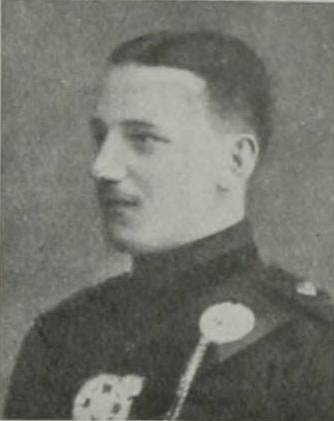
David Inglis.
INGRAM, FREDERICK JAMES, Acting E.R.A., 4th Class, M. 556, H.M.S. Good Hope; lost in action off Coronel, on the coast of Chili, 1 Nov. 1914.
INGRAM, GEORGE, A.B. (R.F.R., B. 3705), S.S. 1032, H.M.S. Good Hope; lost in action off Coronel, on the coast of Chili, 1 Nov. 1914.
INGRAM, JAMES, Private, No. 63467, 3rd Battn. (West Mounted Rifles) Canadian Expeditionary Force, eldest s. of John Jonas Ingram, of 15, Syphon Street, Porth, co. Glamorgan, Collier, by his wife, Mary Ann, dau. of late James Dyer; b. Porth, 25 July, 1894; educ. Winford and Dundry, near Bristol; emigrated to Montreal in 1912; joined the Canadian Grenadier Guards, for Home Defence, shortly after the declaration of war; was subsequently transferred to the West Mounted Rifles in order to go to the front; came over with the 2nd Contingent in Jan. 1915, went to France in May, and was killed in action at Givenchy, 16 June, 1915; unm. Buried at Ducks Bill there.
INGRAM, WALTER, Stoker, 1st Class, 293088, H.M.S. Laurel; killed in action in the Heligoland Bight, 28 Aug. 1914.
INGRAM, WILLIAM HENRY, Stoker, 1st Class, S.S. 111804, H.M.S. Hogue; lost in action in the North Sea, 22 Sept. 1914.
INNES, ALEXANDER BEROWALD, of Raemoir, Cowie, and Dunnottar, Lieut., 7th Battn. Gordon Highlander (T.F.), eldest s. of the late Alexander Innes, Younger of Raemoir, Cowie and Dunnottar, J.P., D.L., by his first wife, Helen Eytham, only child of the Rev. S. W. King, Rector of Saxlingham, Norfolk; b. Cowie House, Stonehaven, co. Kincardine, 10 Sept. 1872; educ. King’s College, Canterbury, and Trinity College, Glenalmond, and on leaving the latter, studied practical Engineering. He served in the South African War, 1901–2, with the Scottish Horse and received the Queen’s medal with three clasps. In 1900, he succeeded to the estates of Raemoir and Dunnottar, Kincardineshire, and was a J.P., and D.L. for that county, and a member of His Majesty’s Body Guard of Archers. On the outbreak of the European War he was gazetted Lieut. 7th Gordon Highlanders, 10 Oct. 1914; went to France, 1 May, 1915, and was killed in action at Festubert, 18 June, 1915. Buried, Le Touret. He m. at Dunfermline, 1 Dec. 1910, Mary, sister of 2nd Lieut. David Alexander Beveridge, R.F.A. (died on active service, 13 Sept. 1915), and only dau. of Erskine Beveridge, of St. Leonard’s Hill, Dunfermline, and Vallay, North Uist; LL.D.; s.p.
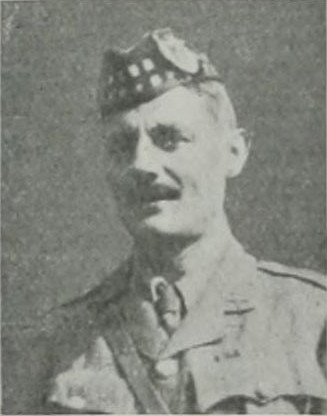
Alexander Berowald Innes.
INNES, DANIEL COTTIER, E.R.A., 1st Class (Pensioner), 269616, H.M.S. Hogue; lost in action in the North Sea, 22 Sept. 1914.
INNES, IAN CHARLES, Lieut., 2nd Battn., 2nd King Edward’s Own Gurkha Rifles (Sirmoor Rifles), Indian Army, only surviving s. of the late Charles Innes, of Inverness, by his wife, Constance (Bishops Thorpe, Inverness), dau. of John Andrew; b. 23 Oct. 1885; educ. The College, Inverness, and Fettes College, Edinburgh; gazetted 2nd Lieut., East Kent Regt., from the Militia, 16 Jan. 1907, and promoted Lieut., 16 April, 1909; served at Harrismith, South Africa, and Hong Kong; transferred to the Indian Army in 1909; came to Europe with the Indian Expeditionary Force in Oct. 1914; and was killed in action at Neuve Chapelle, 2 Nov. 1914; unm. His Commanding Officer wrote: “His death was a gallant one, in keeping with his character and life. The enemy had, by high explosive shell fire, obliterated and rendered untenable the trenches occupied by us. Innes with a few others gathered together and made a final charge against the advancing Germans, and so met his death.” While at Fettes College he was in the cricket XI and Fives X.
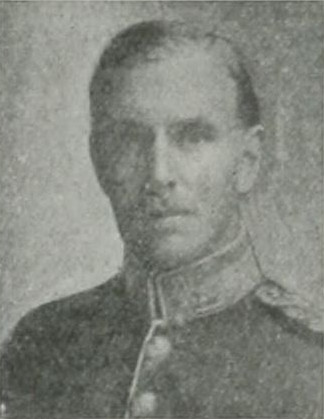
Ian Charles Innes.
INNES, JAMES IAN, Private, No. 2040, 1/14th Battn. (The London Scottish) The London Regt. (T.F.), 3rd s. of William Innes, of Clinterty, Kinnellar, co. Aberdeen, by his wife, Christina, dau. of James R. Grieve; b. Merriness, Tibbermore, co. Perth, 12 Aug. 1893; educ. Ashley Road School, and Gordon’s College, Aberdeen; served his apprenticeship in the Royal Bank there, and was appointed to the London Office of the Chartered Bank of India, Australia, and China, 1 Sept. 1913; joined the London Scottish, 2 March, 1914; mobilised on the outbreak of war in Aug., and volunteered for foreign service; went to France with the 2nd draft of the 1st Battn. 23 Nov.; went into the trenches 22 Dec. and was killed in action at Givenchy, 3 Jan. 1915; unm. He was buried there in the vicinity of a farm outside the trenches. His company commander, Capt. Claude Low, D.S.O., in returning a testament found on him, wrote: “I was very sorry to lose such a fine soldier and I will ever bear in mind the calm way in which he and his comrades kept their ground with no sign of fear, and earned for us the thanks of those in higher authority.” He was a keen lover of sport, a member of the Bank’s cricket and football teams, and the secretary of the cricket club, in a letter of sympathy, said how highly he was esteemed by all who knew him, adding “to use a cricketing phrase, ‘he always played the straight bat in everything that he did.’”
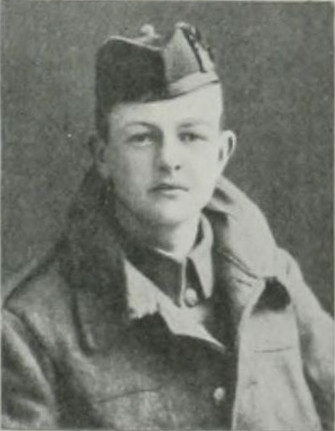
James Ian Innes.
INNES, JOHN, Private, No. 11068, 4th Battn. Canadian Expeditionary Force, s. of the late James Innes, Distillery Worker, and Mary Mason (758 Great Northern Road, Woodside, Aberdeen), dau. of the late James Thompson, of Botriphnie; b. Botriphnie, co. Banff, 17 Jan. 1894; educ. Keith Public School; went to Canada in June, 1911, and after working on the Railway at Winnipeg went to Oakville and entered the employ of the firm of James Langmuir; joined the Canadian Expeditionary Force on the outbreak of war in Aug. 1914; came over with the first contingent in Oct.; went to France in Feb., and died at the Casualty Clearing Station, 26 April, 1915, of wounds received in action in the Ypres; unm. Buried in Hazebrouck Cemetery. A Canadian Officer wrote: “Your son was one to be proud of. I knew him for years. He was a steady pushing young man, a keen soldier, and died a hero.”
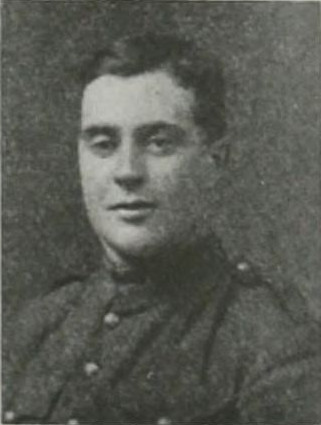
John Innes.
INNOCENT, JAMES ALFRED, 2nd Yeoman of Signals (R.F.R., B. 1743), 206250, H.M.S. Good Hope; lost in action off Coronel, on the coast of Chili, 1 Nov. 1914.
INSTONE, LEONARD FREDERICK, Private, No. 10128, 3rd Battn. Coldstream Guards, eldest s. of Louis Frederick Instone, now Coy. Sergt.-Major, 14th East Yorkshires, by his wife, Constance Evelyn (66, Seaton Street, Fountain Road, Hull), dau. of Allan Greenwood Cameron Templeton; b. Belgaum, India, 20 July, 1897; educ. Newland Avenue Council School, Hull; on 16 May, 1913, when barely 16, he enlisted in the 1st Battn. of the Coldstreams (giving his age as 18 years and 10 months) and on the outbreak of war in Aug. 1914, accompanied them to France, went through the retreat from Mons and came home slightly wounded in the foot; he was then attached to the 3rd Battn. and returned to the Front, 22 Oct. and was in the trenches off and on until 1 May, 1915, when he was shot through the head about 9 p.m. while trench digging at Givenchy. He was buried in the Military Cemetery, “Windy Corner,” Givenchy; unm. Instone was an exceptionally fine swimmer, winning the cup for the Junior Champion Swimmer of Hull, also a silver watch.
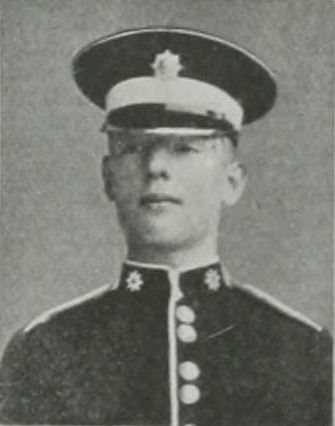
Leonard Frederick Instone.
IRELAND, WILLIAM, A.B., R.F.R., 162585, H.M.S. Cressy; lost in action in the North Sea, 22 Sept. 1914.
IRONS, ERNEST, Ordinary Signalman, J. 8011, H.M.S. Cressy; lost in action in the North Sea, 22 Sept. 1914.
IRONSIDE, ROBERT STEWART, D.C.M., Battery-Sergt.-Major, No. 33255, 120th Battery, Royal Field Artillery, eldest s. of Coy.-Sergt.-Major William Stewart Ironside, of the Tynemouth Artillery Volunteers, by his wife, Hannah, dau. of Robert Roberts; b. Sheffield Barracks, 8 Oct. 1883; educ. Elementary Schools, Leeds and Scarborough. He enlisted in the Northumberland Fusiliers, 28 July, 1903, and was transferred to the R.F.A. in Nov. of the same year, joining his battery at Newbridge, Ireland. Drafted to India in Oct. 1906, he served first in Kirkee and then in Karachi, returning with the 29th Battery to Ireland. He was promoted Sergt. and sent to the 120th Battery, then serving in Newbridge, where he was when war was declared. Leaving with that Battery for the Front, he served in France and Flanders, was seriously wounded in action on 8 Nov. 1914, and died the following day, without recovering consciousness, in No. 2 Clearing Station, Bailleul; unm. Major L. Wilson wrote to his sister: “You will, I am sure, be proud to know of the splendid record he has left behind in his Battery. He had been promoted Battery-Sergt.-Major ten days or so ago, and only yesterday morning we received information that he had been awarded the Distinguished Conduct Medal. He had just come back from seeing the General, who had sent for him to congratulate him on this distinction, when a shell fell in the trench where the Battery headquarters were, almost on the top of him, and he was dangerously wounded. You have the sympathy of the officers and men in the Battery. The Army can ill spare such a brave and capable soldier as your brother was.” He was awarded the D.C.M. [London Gazette, 11 Nov. 1914], the official record stating: “Although wounded at St. Ghislain on 23 Aug., 1914, he continued to act as No. 1 of his Sub-Section under heavy gun and rifle fire and for subsequent valuable work.” His younger brother, Sergt. William Stewart Ironside, was promoted Lieut. for service in the field, 1 Oct. 1914, and won the Military Cross at Hooge on 14 Aug. 1915.
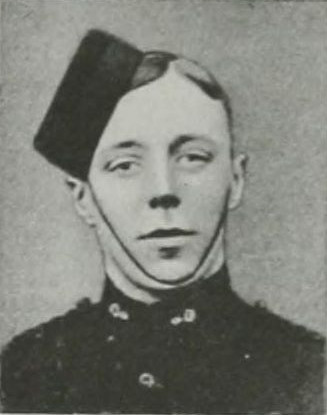
Robert Stewart Ironside.
IRVEN, WALTER JAMES, A.B. (R.F.R., Ch. B. 3648), 176302, H.M.S. Aboukir; lost in action in the North Sea, 22 Sept. 1914.
IRVINE, CHRISTOPHER THEODORE CORRIE, Lieut., 25th Punjabis, yst. s. of the late Inspector-Gen. Gerard James Irvine, R.N., by his wife, Henrietta (St. Andrew’s, Naini Tal, India), dau. of William Byrom Corrie, of Cheltenham, and nephew of Charles Edward Robert Alexander Irvine, of Drumgoon Manor, co. Fermanagh; b. 27 Jan. 1889; gazetted 2nd Lieut. to the Connaught Rangers, from the Special Reserve, 11 Dec. 1909, and promoted Lieut. 11 Feb. 1911; transferred to the Indian Army in Aug. 1912, serving temporarily with the 25th Punjabi Cavalry; went to the Dardanelles, and was killed in action there, 28 June, 1915; unm. His eldest brother Capt. Gerard Byrom Corrie Irvine, Bopal Infantry, was wounded in the early part of the war.
IRVINE, FRANCIS DUNCAN, Major, R.E., Brigade Major, 1st Infantry Brigade, Australian Expeditionary Force, elder s. of Duncan Irvine, of 45, Cathcart Road, S.W., I.C.S. (ret.), by his wife, Emily Gertrudes, dau. of Thomas Maguire; b. Waltain, Madras Presidency, India, 20 Jan. 1875; educ. Clifton College, and Royal Military Academy, Woolwich; gazetted 2nd Lieut. R.E., 15 March, 1895; promoted Lieut. 15 March, 1898, Capt. 1 April, 1904, and Major 30 Oct. 1914; took part in the Waziristan Expedition, N.W. Frontier of India, 1901–2 (medal with clasp); served with his regt. at Bangalore, and elsewhere in India, until July, 1913, when he was appointed for duty with the Australian Forces, serving as a General Staff Officer (3rd Grade), and, on the outbreak of war in Aug. 1914, was appointed Brigade Major, 1st Infantry Brigade, A.I.F., under the command of Col. McLaurin; trained his Brigade in Egypt; took part in the landing at the Dardanelles, 24–25 April, 1915, and was killed in action on the 27th at Gaba Tepe, being shot by a sniper in the firing line. He was buried near the spot where he fell. Col. ... wrote: “To my great regret your son was killed on Tuesday, 22 April, while doing his duty sorting troops into trenches.... We, too, have suffered a loss, as your son had from the time of the organisation of the force laboured unceasingly, and it was greatly due to his efforts that the 1st Rifle Brigade had reached the standard of efficiency to which the supreme test showed it had attained. In your son I have lost a comrade to whom I was greatly indebted. He was General Staff Officer of the 2nd Military District (N.S.W.) and I am glad to be able to tell you in all sincerity that on the outbreak of war a vast amount of the work was put in hand smoothly and methodically by reason of the efficient preparation which your son had made. I can never be sufficiently grateful for the thorough and whole hearted help which he gave.” Major Irvine m. at The Oratory, Brompton, London, 23 Oct. 1906, Emily Marion, dau. of Col. Terence McGann, I.M.S., and had a son, Ian Robert, b. Bangalore, 14 Feb. 1910.
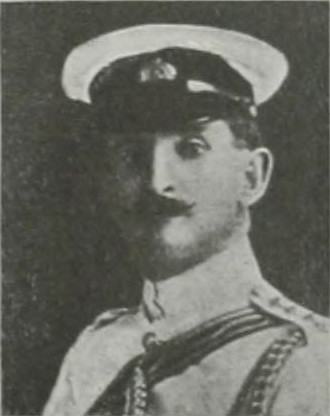
Francis Duncan Irvine.
IRVINE, STANNUS CHARLES EDWARD, Lieut., Northern Rhodesian Rifles, 4th s. of the late Col. John Gerard Irvine, of Killadeas, co. Fermanagh, J.P., D.L., by his wife, Elizabeth Daniell (Killadeas, co. Fermanagh), dau. of William Daniell, of Ballymackney, co. Monaghan; b. Kingstown, co. Dublin, 18 June, 1873; educ. Trinity College, Dublin; was a Civil Engineer; went to Rhodesia in March, 1897 and afterwards took up farming; joined the Northern Rhodesian Rifles on the outbreak of the European War in Aug. 1914, and died at Fife, N.R., 18 April, 1915, from wounds received in action on the North-East Frontier, Northern Rhodesia, while capturing a German stockade; unm. He was the first to enter the stockade, and was buried in the cemetery at Fife, Northern Rhodesia, with full military honours.
IRVINE, WILLIAM, Stoker, 1st Class, K. 14223 (Ports.), H.M.S. Hogue; lost in action in the North Sea, 22 Sept. 1914.
IRVING, JOHN VICTOR, Private, No. 2650, 4th Battn. The Royal Scots (T.F.), s. of John Irving, of 31, Scotland Street, Edinburgh, by his wife, Jemima, dau. of the late James McIntosh, lessee Craigleith Quarry; b. Mossgiel, Corstorphine, co. Midlothian, 5 June, 1887; educ. Daniel Stewart’s College, Edinburgh; was a Clerk in the North British and Mercantile Insurance Office; volunteered after the outbreak of war and enlisted in the 4th Royal Scots in Nov. 1914; trained at Edinburgh; left for the Dardanelles, 23 May, 1915, and was killed in action there, 12 July, 1915, during a counter-attack on the Turkish position; unm. He was Organist and Choirmaster in the John Ker Memorial Church, Edinburgh.
IRVING, WILLIAM CHARLES, Leading Stoker, 300112, H.M.S. Cressy; lost in action in the North Sea, 22 Sept. 1914.
IRWIN, GEORGE, Petty Officer (N.S.), 154211, H.M.S. Hawke; lost when that ship was torpedoed in the North Sea, 15 Oct. 1914.
ISAACS, ALFRED, A.B. (R.F.R., B. 5295), 178510, H.M.S. Hogue; lost in action in the North Sea, 22 Sept. 1914.
ISAAC, HOPKIN, Private, No. 8672, A Coy., 3rd Battn. Dorsetshire Regt., 5th s. of Howell Isaac, Collier, Navigation Colliery, Treharris, by his wife, Ann, dau. of Lewis Lewis; b. Treharris, co. Glamorgan, 30 Jan. 1888; educ. Board School there; was a Colliery Haulier; served for about eight months in the Monmouthshire R.E. in 1906; enlisted in the Dorsetshire Regt., after the outbreak of war, 31 Aug. 1914, trained at Weymouth; went to France, 13 April, 1915, and was killed in action at Hill 60, during the second Battle of Ypres, 2 May, 1915; unm. He was a good athlete, and won several prizes for racing, cycling, and boxing, also medals for football.
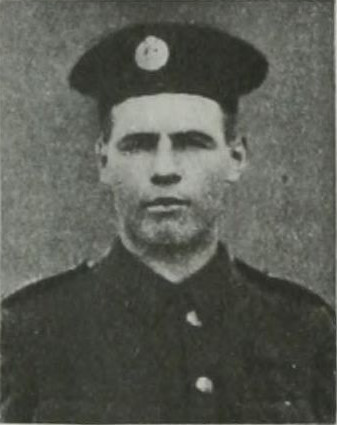
Hopkin Isaac.
ISTED, WILLIAM, Trooper, No. 125, 1st Australian Light Horse, Australian Imperial Force, 4th s. of the late John Isted, Farm Bailiff, by his wife, Fanny (Burwash Common, co. Sussex), dau. of the late Alfred Wells, of Burwash; b. Mayfield, co. Sussex, 2 July, 1892; educ. St. Philip’s School, Burwash Weald; went to Australia in 1912; settled at an up-country station, Cootamundra, where he was an employee on a large farm; subsequently returned to Sydney, and then took up a situation at Mr. Morgan’s, Torrilla, near Scone, N.S.W.; volunteered for Imperial Service on the outbreak of war in Aug. 1914, and joined the 1st Australian Light Horse; served in Egypt and at the Dardanelles, and died at No. 1 Australian General Hospital, Cairo, 16 Aug. 1915, of gunshot wounds received in action at Gallipoli; unm. Buried in Old Cairo Cemetery. His company officer wrote referring to the loss which the Regt. had sustained, and spoke in the highest terms of his popularity and fine soldierly qualities. His three brothers, Private Victor Isted, Private George Isted, and Private Frank Isted, are now (1916) on active service.
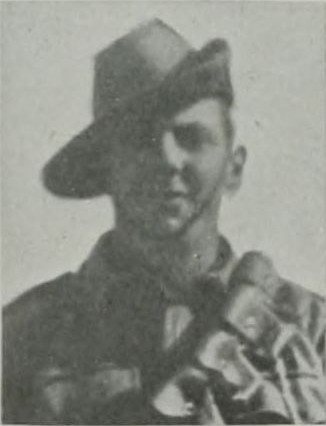
William Isted.
IVE, DAVID, 2nd Lieut., 2nd Battn. The Queen’s Royal West Surrey Regt., eldest s. of Ernest Ive, of The Hermitage, Meadvale, Redhill, Surrey, Assoc. M.Inst.C.E., by his wife, St. Claire, dau. of William George Taylor, of Carshalton, Surrey; b. Kensington, 27 May, 1894; educ. Reigate Grammar School, where he was a cadet in the O.T.C.; passed the Army Qualifying Examination in Nov. 1913; gazetted 2nd Lieut. Special Reserve of Officers, 1 Oct. 1913, receiving his preliminary training with the 1st Battn. Royal West Surreys; posted to the 2nd Battn. 1 Sept. 1914; went to France with his regt., which formed part of the 7th Division, on 5 Oct. 1914; took part in the severe fighting on the way to Ypres, and was killed in action there, 23 Oct. 1914; unm. Buried at Ypres.
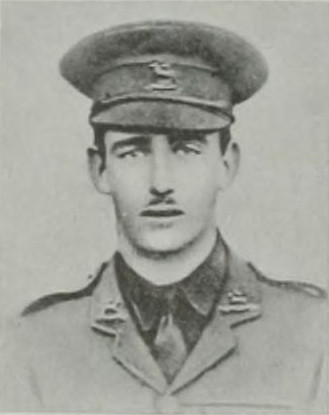
David Ive.
IVES, WILLIAM HENRY, Private, R.M.L.I., 5624 (R.F.R., B. 1189), H.M.S. Cressy; lost in action in the North Sea, 22 Sept. 1914.
IVINS, JOHN HERBERT, L.-Corpl., No. 7794, 2nd Battn. Coldstream Guards, only s. of John Arthur Ivins, of 1, Flaxley Road, Stechford, Birmingham, Carpet Planner with Chamberlain, King & Jones, Birmingham, by his wife, Jessie Maude, dau. of James Nicholds, of Woodville, Selly Park, Birmingham; b. Yardley, Birmingham, 12 March, 1892; educ. Yardley School and St. John’s Sparkhill, Birmingham; enlisted 13 April, 1908; went to France with the 1st Expeditionary Force in Aug. 1914, and was given his stripe at the Front; served through the retreat from Mons, the Battles of the Marne and the Aisne, and the advance to the Belgian frontier, etc., and was killed in action at Eppinette, 29 Dec. 1914; unm. Sergt. Leaman wrote: “We were being relieved when Jack, who was getting out of the trench, was hit in the head by a stray bullet, and before we got to him was dead.” He was buried in Le Touret Cemetery.
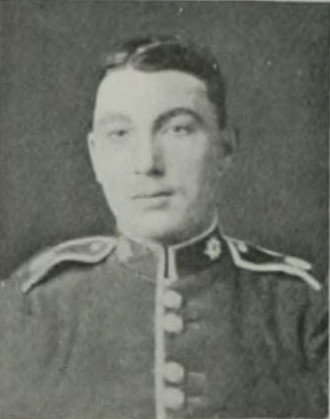
John Herbert Ivins.
IZZARD, WILLIAM, Stoker, 1st Class (R.F.R. Ch. B. 7556), S.S. 102795, H.M.S. Aboukir lost in action in the North Sea, 22 Sept. 1914.
JACKMAN, ALBERT EDWARD, Chief Armourer, 341931; served some time in H.M.S. Cressy (discharged 24 July, 1914); then joined H.M.S. Hogue; lost in action in the North Sea, 22 Sept. 1914.
JACKSON, EDWARD PHILLIPS, Lieut., 3rd (Reserve) Battn. Royal Warwickshire Regt., attd. 1st South Wales Borderers, 2nd s. of the Rev. William Edward Jackson, M.A., Rector of Loughton, co. Bucks, formerly scholar of Trinity College, Cambridge, by his wife, Mary Louisa, dau. of John Broadhurst, of Congleton; b. Monks Kirby Vicarage, co. Warwick, 11 Dec. 1893; educ. Newchurch Grammar School, King’s School, Warwick, and Trinity College, Cambridge; gazetted 2nd Lieut. 3rd Royal Warwicks, 15 Aug. 1914, and promoted Lieut. 2 Feb. 1915; left for France, 25 Dec. 1914, when he was attached to the 1st South Wales Borderers, and was killed in action at Richebourg l’Avoué, 9 May, 1915. Buried there; unm. His Major wrote: “He was absolutely fearless and was very popular with those over him and under him.”
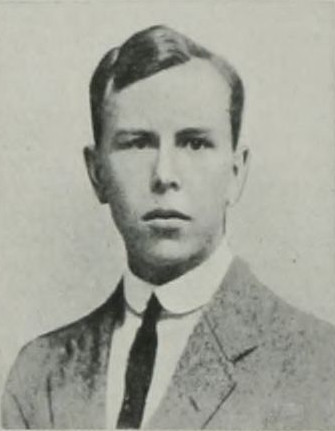
Edward Phillips Jackson.
JACKSON, FREDERICK JAMES, L.-Corpl., No. 58, 1st Battn. The Rifle Brigade, Machine Gun Section, 2nd s. of Harry Mayland Jackson, of The Ben Jonson, Goodman’s Yard, Minories, E.C., by his wife, Louisa Greenslade, dau. of the late James Young, of the Ferndale Hotel, Manor Way, Woolwich; b. Woolwich, 16 Sept. 1892; educ. St. Leonard Road Board School, Bromley-by-Bow, E.; enlisted in the 1st Rifle Brigade, May, 1913; left for France, 8th Aug. 1914; att. to 1st Battn. (Special Reserve), and was killed in action, near Pilken, 6 July, 1915; unm. Sergt. P. Blent, of the Machine Gun Section of his Battn., wrote: “Firstly, I must tell you that if any man earned the V.C. in the war, he did, for the part he took in the attack of ours on 6 July. He was trying to get his gun into action when he was wounded, first of all in the shoulder; this did not deter him, for he still endeavoured to do what he had set out to do, but unfortunately he was wounded again, this time in the face. He then had to give up the attempt, and took to his right and opened fire, and it was while doing this he met his death, for a piece of shrapnel entered the back of his head, and he died almost instantly. His conduct throughout was magnificent and he died a real hero.” The two brothers of L.-Corpl. Jackson are serving in the Army, one of whom, L.-Corpl. A. E. Jackson, of the 3rd Wiltshire Regt., was wounded at Neuve Chapelle, 12 March, 1915.
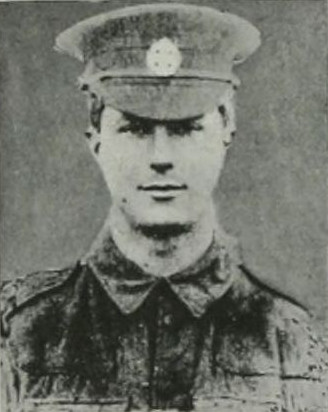
Frederick James Jackson.
JACKSON, JOHN, Stoker, R.N.R., S. 3123, H.M.S. Hawke; lost when that ship was torpedoed in the North Sea, 15 Oct. 1914; m.
JACKSON, JOHN GEORGE, Private, No. 8972, 1st Battn. Coldstream Guards, s. of Frank Leighton, of Howden, Yorks, Farm Labourer, by his wife, Alice, dau. of James Jackson; b. Howden, Yorks, 13 Jan. 1880; educ. Church of England School there; enlisted in 1911, went to France, 1914, and died a prisoner of war at Schneidemühl, in Germany, 8 Feb. 1915; unm.
JACKSON, JOSHUA GRAHAM, Corpl., No. 10/570, 3rd Auckland Battn. New Zealand Expeditionary Force, s. of the late Joshua Jackson, of Auckland, New Zealand, J.P., Sharebroker; b. Auckland, New Zealand, 3 Aug. 1881; educ. Northcote School there; and was in the employ of the Railway Service. On the outbreak of war he volunteered, left New Zealand with the main body in Oct. 1914; trained in Egypt during the winter; took part in the repulse of the Turkish attack on the Suez Canal in Feb. 1915, and in the landing at the Dardanelles on 25 April; was seriously wounded that day and invalided to England, where he spent several months; returned to duty in Nov. and had only been two days at Gallipoli when he was shot in the stomach by a sniper, while going to the beach to get water. He died on board the Hospital Ship Neuralia, 11 Nov. 1915, and was buried at sea between Rhodes and Alexandria; unm.
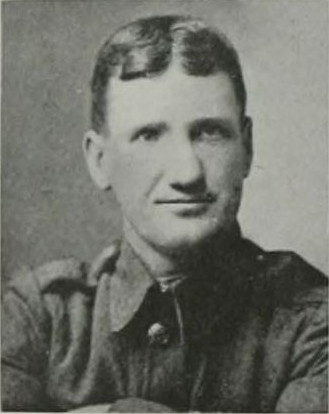
Joshua Graham Jackson.
JACKSON, SOLOMON, Private, R.M.L.I., 11701 (R.F.R., Ch. B. 1876), H.M.S. Cressy; lost in action in the North Sea, 22 Sept. 1914.
JACKSON, THOMAS, Private, No. 5451, 2nd Battn. East Lancashire Regt., s. of George Jackson, of 11, Smalley Street, Grimshaw Park, Blackburn; b. Primrose Hill, 28 Sept. 1891; enlisted in the East Lancashires, passed into the Reserve, 22 Oct. 1913; rejoined his Battn. on the outbreak of war, and was killed in action during the advance of the 8th Division against the German position at Fromelles, 9 May, 1915; unm.
JACKSON, THOMAS WILLIAM, Private, R.M.L.I. (R.F.R.), Ch. 6620, H.M.S. Hawke; lost when that ship was torpedoed in the North Sea, 15 Oct. 1914; m.
JACKSON, WILLIAM, Stoker, 1st Class, K. 17559, H.M.S. Hawke; lost when that ship was torpedoed in the North Sea, 15 Oct. 1914.
JACQUES, FRANCIS AUGUSTUS, Lieut.-Col., 14th (King George’s Own) Ferozepore Sikhs, 3rd s. of the Rev. Canon Kinton Jacques, Rector of Brindle, co. Lancs. (died 24 April, 1915), by his wife, Caroline Augusta, dau. of the Rev. Gardnor Baldwin; b. Leyland, co. Lancaster, 9 April, 1867; educ. Rossall School; gazetted 2nd Lieut. from the Militia to the Loyal North Lancashire Regt., 6 Nov. 1887, and promoted Lieut. 22 March, 1890; served for a few months with the 11th Rajputs and was then posted to the 14th Sikhs; joined the Indian S.C., 6 Sept. 1890, and transferred to the Indian Army, becoming Capt. 16 Nov. 1898, Major 16 Nov. 1905, and Lieut.-Col. 16 Nov. 1913. He served with the Hazara Expedition, 1891 (medal with clasp); with the Waziristan Expedition in 1894–5 (clasp); in the Tochi Campaign on the North-West Frontier, 1897–8 (medal with clasp), and in 1900 with the force that went to China (medal), and was temporarily Second in Command of the 45th Sikhs from Dec. 1909 to Dec. 1910, and of the 29th Punjabis, April to Oct. 1911. After the outbreak of the European War he went with his regt. to Egypt, took part in the repulse of the Turkish attack on the Suez Canal, afterwards proceeding to the Dardanelles, where he was killed in action, 4 June, 1915. A brother officer wrote: “I don’t think your husband knew what fear was, he was always so cheery when there was any show going on that it did one good to see him and be near him, and so it must have been to the last;” and his subaltern, who was two yards from him when he was killed, wrote: “I shall always appreciate your husband’s memory, not only as my double company Commander, but as a friend. Your husband was wonderfully cool and calm in action, much the same as when on parade. He knew that we had little chance of coming out of the advance alive, but he was cheerful to the last. His last words to me before breakfast were that he did not fear death at all, because you and his children were well provided for. That was about the only time I saw him in what one might call a serious mood.” He m. at Brindle, co. Lancaster, 27 July, 1904, Olivia Katherine, dau. of Burkill Jacques, of San Diego, California, and had two daughters: Barbara Caroline, b. 18 Jan. 1912; and Ruth Olivia, b. 6 Feb. 1914.
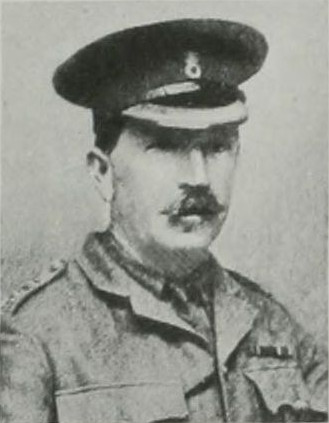
Francis Augustus Jacques.
JAGGER, OLIVER ROBIN OCTAVIUS, Cadet Royal Navy, H.M.S. Bulwark, yst. s. of Arthur Edward Jagger, of Coundon Lodge, near Coventry, Chairman of Singer & Co., Ltd., Coventry, by his wife, Sarah Lucy, dau. of William Burton, of Allesley, near Coventry; b. Coundon Lodge, near Coventry, 27 Sept. 1898; educ. Pretoria House, Folkestone, and the Osborne and Dartmouth Royal Naval Colleges; appointed Cadet to H.M.S. Bulwark, 2 Aug. 1914; and was lost when that ship was blown up in Sheerness Harbour, 26 Nov. following.
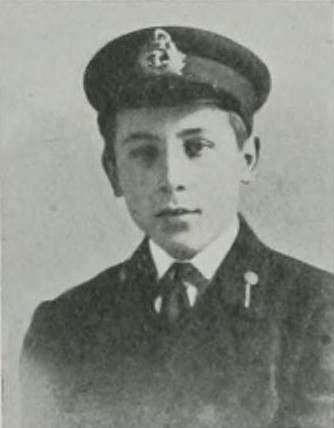
Oliver R. O. Jagger.
JAMES, ALFRED, Stoker, 1st Class (R.F.R., B. 6581), 354275, H.M.S. Hawke; lost when that ship was torpedoed in the North Sea, 15 Oct. 1914; m.
JAMES, DAVID, Petty Officer, 183045, R.N.; killed in action at Tsing-tau, 22 Aug. 1914, on board H.M. Destroyer Kennet, while engaged in chasing the German destroyer S. 90.
JAMES, ERIC SAMUEL PENNANT KINGSBURY, Capt. 6th (Reserve), attd. 4th, Battn. King’s Royal Rifle Corps, only s. of Edward Lewis James, of Holly Lodge, Larkhall Rise, S.W., F. Chemical S., F.R.H.S., by his wife, Sarah; b. Clapham, 4 Sept. 1887; educ. Manor House School, Clapham; St. Paul’s School (Foundation Scholar); Corpus Christi College, Cambridge (an Open Classical Exhibitioner, John Stock Exhibitioner and College Prizeman, B.A. (2nd Class Honours Classical Tripos) 1909; and M.A. 1914); and the University of Paris; was assistant-master and house-master at Oundle School, 1910; assistant-master at Merchant Taylors’ School, 1913; appointed 2nd Lieut. Territorial Force (unattd. list), 23 March, 1910; promoted Lieut. 18 Oct. 1912, and Capt. 15 Jan. 1914, and served in the O.T.C. at Oundle and Merchant Taylors’; gazetted Capt. to 6th (Reserve) Battn. K.R.R.C., 20 Sept. 1914; left for France, 6 Jan. 1915, and was attached to 4th Battn., and was killed in action about 21 miles from Dickebusch, at midnight on 17 March, 1915; unm. Capt. Hugo Watson, then temporarily in command of the 4th K.R.R.C. wrote: “He was shot in the head last night, about 11.45, while standing behind a breastwork, superintending his men at work filling sandbags. He was killed instantly. We buried him to-day in the Military Cemetery at Dickebusch, four miles from Ypres and 2½ miles from where he was killed.... I cannot tell you what a great loss he is. I was Adjutant of the 6th K.R.R.C., till recently when I came out here.... I know what splendid work he did at Sheerness, and how Colonel Brownlow depended on him. I was with him last Sunday, when we had a very nasty time; he was very cool and did admirably”; and Lieut.-Col. Brownlow, commanding the 6th Battalion, wrote: “He did excellent work for me down here, and I heard he was doing real well in France. He was most popular and looked up to by everybody, and was a very smart and efficient soldier.” The 4th Battn. K.R.R.C. was specially mentioned in Sir John (now Lord) French’s Despatch of 5 April, 1915, for “a very gallant attack on the enemy’s trenches on 2 March.” Capt. James was an excellent oarsman. He was Second Boat Captain at Corpus Christi, Cambridge, rowed in the College boat at Henley, 1909, and was a member of the Thames Rowing Club. He was also a good rifle shot and passed the School of Musketry at Hythe. He annually visited the Continent and was a good linguist, and at Merchant Taylors’ he attracted considerable attention by the success of his original methods of teaching history.
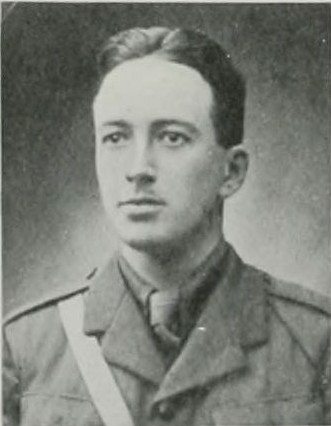
Eric S. P. K. James.
JAMES, GEORGE MILLAIS, Capt. 1st Battn. The Buffs (East Kent Regt.), and Brigade-Major, 22nd Infantry Brigade, 7th Division, elder s. of the late Major William Christopher James, Royal Scots Greys and 16th Lancers, by his wife, Effie Grey, dau. of the late Sir John Millais, 1st Bart., P.R.A., the eminent painter, and grandson of the late Lord Justice Sir William Milburn James; b. London, 15 Nov. 1880; educ. Cheltenham and Sandhurst; gazetted 2nd Lieut. 1st Northumberland Fusiliers, 6 Dec. 1899; promoted Lieut. 17 Feb. 1900; and Capt. 30 May, 1904. He served in the South African War, 1899–1902; taking part in operations in Orange Free State, April to May, 1900, in the Transvaal, West of Pretoria, July to 29 Nov. 1900, including action at Venterskroon, in which he was slightly wounded; in Orange River Colony, May to July, 1900, including action at Rhenoster River; in the Transvaal, 30 Nov. 1900 to Jan. 1902; and in Cape Colony, Jan. to 31 May, 1902. For his services he was mentioned twice in Despatches [London Gazette, 9 July and 10 Sept. 1901] and received the Queen’s medal with three clasps and the King’s with two clasps. After the war, he was stationed with his battn. at Wynberg, Cape Colony, in Mauritius, and in India, and was Adjutant from 1 Oct. 1903 to 30 Sept. 1906. He was transferred to the 1st Buffs, then at Aldershot, 20 May, 1908, and in 1910 entered the Staff College, and, having passed through it with distinction, was, on 7 Sept. 1912, appointed Brigade-Major, Pretoria District, South Africa. On the outbreak of war he returned to England and was appointed Brigade-Major, 22nd Infantry Brigade, 18 Sept. 1914. He left for France with the famous and ill-fated 7th Division, under Gen. Capper, on 4 Oct. his Brigadier being Gen. Lawford, and was killed in action near Ypres, during the first battle of that name, 3 Nov. following. Buried in a wood, about three miles S.W. of Ypres. Capt. James m. in London, 16 Oct. 1907, Hylda Madeleine, only dau. of Sir James Heath, of Oxendon Hall, Market Harborough, 1st Bart., and had two daus.: Eileen Alice, b. 19 June, 1909; and Daphne Millais, b. 13 Jan. 1911.
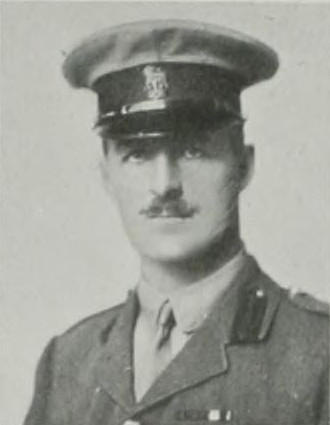
George Millais James.
JAMES, JOHN STEPHEN HARVEY, 2nd Lieut., 1st Battn. King’s Royal Rifle Corps, only child of Quintus Stephen Harvey James, of Croft Lodge, Mill Hill, N.W., by his wife, Josephine, dau. of John Rees, of Stafford House, South Hampstead; b. London, 22 Jan. 1894; educ. Colet Court and St. Paul’s School, and at the outbreak of war was a student at Guy’s Hospital. He had joined the Artists’ Rifles in May, 1914, and on the outbreak of war was among the first to volunteer for foreign service, and left for the Front on 25 Oct. 1914. He was gazetted 2nd Lieut. 1st Battn. King’s Royal Rifle Corps, 17 March following, and was killed in action at Richebourg l’Avoué during a successful endeavour to capture some of the enemy’s trenches, in the Battle of Festubert, 15–16 May, 1915. His Commanding Officer wrote: “He was under me all the time he was with us. He was always cheerful, imperturbable, and a thorough soldier. He died very bravely;” and Major Armstrong: “Your boy had actually reached the German trench when he was killed. We all deplore his loss.”
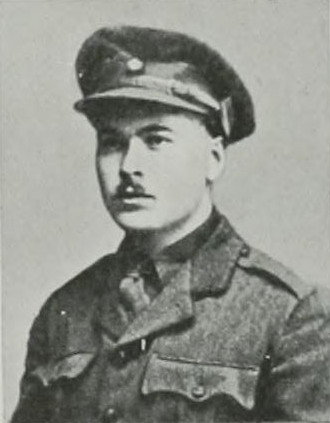
John S. H. James.
JAMES, PERCY, A.B. (R.F.R., B. 8187), S.S. 1720, H.M.S. Hawke; lost when that ship was torpedoed in the North Sea, 15 Oct. 1914; m.
JAMES, THOMAS, Stoker, 1st Class (R.F.R., Ch. B. 7911), S.S. 103598, H.M.S. Aboukir; lost in action in the North Sea, 22 Sept. 1914.
JAMES, THOMAS SPENCER, Rifleman, No. 2177, 12th Battn. (The Rangers) The London Regt. (T.F.), yst. s. of Major Arthur James, Suffolk Regt., by his wife, Hannah Caroline (Newbury Quadrant Road, Thornton Heath), dau. of William Ling, of Bury St. Edmunds; b. Ely, co. Cambridge, 30 Oct. 1891; educ. Whitgift School, Croydon; joined The Rangers, 14 Aug. 1914; landed in France with the battn. on Christmas Day following, and died in the 1st N.M. Field Ambulance, 8 May, 1915, of wounds received in action at Fortuin, near Ypres, on the 6th. Buried in Soldiers’ Cemetery, Hazebrouck; unm. His Platoon Officer wrote: “Your boy was so generally liked by all his comrades, whose spirits he greatly helped to keep alive, that his loss will be much felt, particularly when we do get together again. We went through so much together in my Platoon;” and a comrade: “24 April, we attacked in open order in support of 1st Suffolks, to back up the Canadians, who were gassed out. After this we were under continuous shell-fire both night and day, and our Platoon was reduced to four men, when in the early morning of May 6 a shell burst in our trench, and we were all put out of action. Your son was much liked in the Company, always ready to do a good turn to anybody; he was full of pluck and always the first to volunteer for any desperate task, in fact he was a soldier and a man worthy to be the son of a soldier.”
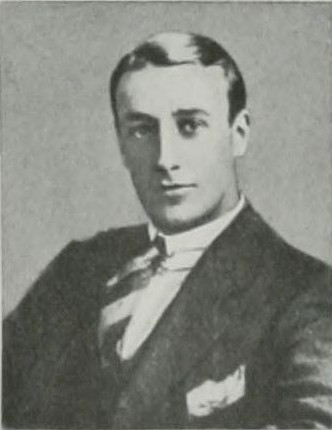
Thomas Spencer James.
JAMESON, ARTHUR GEORGE, Lieut.-Com., R.N., 3rd s. of Robert William Jameson, of Campfield House, Dundrum, co. Dublin, F.S.I., J.P., by his wife, Katherine Anne, dau. of Tooke Luscombe; b. Dublin, 30 Sept. 1883; educ. Monkton Combe School, near Bath, and H.M.S. Britannia, which he joined in Sept. 1898; appointed Naval Cadet, 15 May, 1900, and Midshipman, 30 May following, and served on board the Theseus and Repulse on the Mediterranean Station; promoted Sub-Lieut. 30 July, 1903, and went through the various courses and examinations to qualify for the rank of Lieut., taking four “firsts”; served at home in the destroyer Waveney and on North American Station in the Ariadne, flagship of Sir Day Bosanquet. He was promoted Lieut. 30 July, 1905, and in the same year joined H.M.S. Forth to qualify in submarines, and was shortly afterwards appointed to the command of A8, in which he served until May, 1908. He was then appointed to H.M.S. Thames for command of C2, and in Jan. 1911, was appointed to H.M.S. Neptune, the flagship of the Home Fleet, where he served under Sir Francis Bridgeman and Sir George Callaghan. In April, 1912, he was selected for the War Staff Course, being the junior officer of the class and, after completing the course was, in Feb. 1913, appointed to the Antrim for War Staff duties, where he served under Rear-Admiral Madden and Rear-Admiral Pakenham. He was promoted Lieut.-Com. 3 July following, and in March, 1914, he returned to the submarine service, being appointed to the command of D2 in 8th Flotilla. He took part in the Battle of the Bight of Heligoland; was mentioned in the despatch of Commander Keyes, C.M., M.V.O., 17 Oct. 1914, and was drowned off Yarmouth on 23 Nov. following, being washed overboard from submarine D2 while on active service. His body was not recovered. He m. at St. Mary’s Church, North Huish, Devon, 5 Aug. 1908, Isabel, yst. dau. of Augustus J. Pitman, of The Manor House, North Huish, and had a dau., Isabel Valerie, b. 10 Dec. 1913.
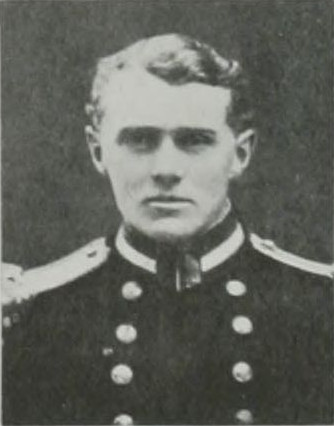
Arthur George Jameson.
JAMESON, HAROLD GORDON, 2nd Lieut., 65th Field Coy. Royal Engineers, 6th s. of Robert William Jameson, of Campfield House, Dundrum, co. Dublin, F.S.I., J.P., by his wife, Katherine Anne, dau. of the late Tooke Luscombe; b. Corgrig Lodge, Foynes, co. Limerick, 11 Oct. 1888; educ. Monkton Combe School, near Bath, and Trinity College, Dublin. Having completed his course at the University he was, in Oct. 1911, appointed Assistant Director of Works in the Sudan Irrigation Service (a branch of the P.W.D., Egyptian Government), and remained in this service until the summer of 1914, much of his time being spent in the Upper Nile Provinces, where he got some big game shooting, and secured several good specimens, including three elephants. He was in Ireland when war broke out, and, having applied for a commission, was gazetted 2nd Lieut. Royal Engineers (S.R.), 1 Oct. 1914, and subsequently attached to the 65th Field Coy. After training at Chatham and at the Curragh, he left for the Dardanelles with the 10th Division in July, 1915, and was killed in action at Suvla Bay, Gallipoli, on the night of 15–16 Aug. 1915, on a ridge on the Karakol Dagh which his company had been called out to help to hold; unm. His commanding officer (who was himself wounded on the 14 or 15 Aug.) wrote: “He was a general favourite amongst officers and men. We had a hard time at the Dardanelles, but your son’s never-failing courage and cheerfulness under these adverse circumstances were of the greatest help to us all. His death is a great loss to the 65th Coy., and to the R.E. of the 10th Division.”
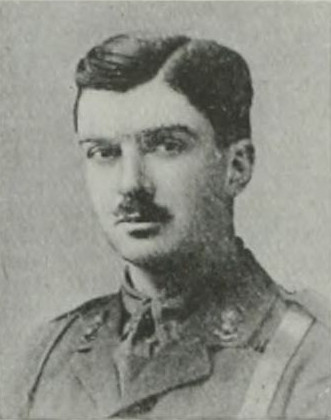
Harold Gordon Jameson.
JAMESON, HAROLD RISBOROUGH, Rifleman, No. 1931, 21st Battn. (1st Surrey Rifles) The London Regt. (T.F.), s. of William Alexander Jameson, of Lynton, Warren Road, Purley, by his wife, Emma Risborough, dau. of Henry Risborough Sharman, Barrister-at-Law; b. West Norwood, S.E., 16 June, 1892; educ. Whitgift Middle School, Croydon; was employed in the Anglo-South American Bank; joined the 1st Surrey Rifles in Aug. 1914; left for France 22 March, and died 4 April, 1915, of wounds received in action the previous day at Richebourg, where he was shot by a sniper. Buried in Bethune Cemetery; unm. Capt. C. W. B. Heslop wrote: “I reached your brother about five minutes after he received his wound. He showed splendid pluck, for though in some pain, he remained quite cheerful and smiling, and when carried away by stretcher-bearers, called out greetings to all he knew.”
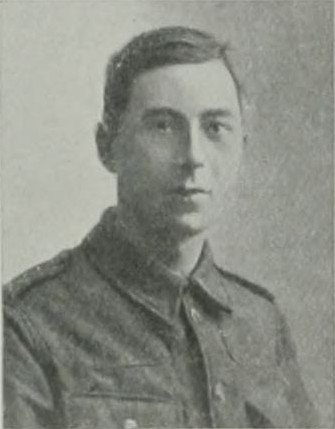
Harold R. Jameson.
JAMESON, MAURICE GURNEY, Private, No. 1116, 1st Battn. The Honourable Artillery Company, 3rd s. of the Rev. Hampden Gurney Jameson, M.A., Vicar of St. Peter’s, Eastbourne, by his wife, Amy Agnes, dau. of Robert Bayly, Barrister-at-Law, and a nephew of “Edna Lyall” (the late Miss Ada Ellen Bayly), the novelist; b. St. Peter’s Vicarage, Eastbourne, 3 Jan. 1887; educ. Eastbourne College, where he was a member of the O.T.C.; was engaged in farming in Oxfordshire when war broke out; joined the H.A.C. 6 Aug. 1914; left for France, 30 Dec. 1914, and was killed in action near Ypres, 6 March, 1915. Buried at Kemmel; unm.
JAMIESON, ALEXANDER, Stoker, 1st Class, 308993, H.M.S. Cressy; lost in action in the North Sea, 22 Sept. 1914.
JAMIESON, HENRY, Stoker, 1st Class (R.F.R., B. 7287), S.S. 102309, H.M.S. Hawke; lost when that ship was torpedoed in the North Sea, 15 Oct. 1914; m.
JAMIESON, MABEL ELIZABETH, Staff Nurse, New Zealand Army Nursing Service, yst. dau. of Thomas Jamieson, of Seddon Street, Kumara, Westland, South Island, New Zealand, Gold Miner, by his wife, Frances Jane, dau. of the late Capt. Thomas Payne; b. Kumara, 21 July, 1881; educ. Kumara District High School, and while there passed Senior Civil Service and Matriculation Examinations; entered Kumara Hospital as a probationer, 1904, and two years later joined Staff of Palmerston North Hospital, where she remained until her professional training was completed; was Sister in Grey River Hospital for four years, and then took up private nursing in Wellington; joined New Zealand Army Nursing Service, 12 April, 1915, at which time she was in charge of the Berhampope Military Hospital, Wellington; left for Egypt in the Hospital Ship Maheno, 10 July, 1915, and was stationed in No. 1 New Zealand Stationary Hospital, Port Said; left for Salonika in the transport Marquetta, 19 Oct. following, and was lost when that ship was sunk by torpedo fire in the Ægean Sea on the 23rd.
Mabel Elizabeth Jamieson.
JANASZ, JAMES GEORGE GEE, 2nd Lieut. 3rd (Reserve) Battn. Dorsetshire Regt., attd. 2nd Battn. Wiltshire Regt., only s. of Józef Janasz, of Boscombe, co. Hants; b. London, 4 Jan. 1893; educ. Sherborne (where he was for several years in the O.T.C.) and Corpus Christi College, Oxford; gazetted 2nd Lieut. to 3rd Dorsets, 4 Nov. 1914; left for France, 24 March, 1915, and was killed in action near Festubert, 15 June following, while leading his platoon in an attack on the German trenches; unm. His commanding officer, Lieut.-Col. W. S. Brown, wrote: “I must express to you our great admiration of your son. He died gallantly leading his men against the enemy, and was shot through the head about 200 yards in front of the German trenches. His Capt., who is the only officer not hit in the two leading companies, could not say enough in his praise to-day.”
JARDINE, JAMES MAXWELL MULLIN, Private, No. 16642, 13th (Service) Battn. The Royal Scots (Lothian Regt.), eldest s. of Robert Maxwell Jardine, of 101, Blackburn Street, Plantation, Glasgow, by his wife, Agnes, dau. of James Maxwell Mullin; b. Glasgow, 3 July, 1896; educ. St. Saviour’s School, Summerton Road, Glasgow; joined the 13th Royal Scots, 18 Dec. 1914; left for France early in Sept. 1915; and was killed in action on the 17th of that month; unm.
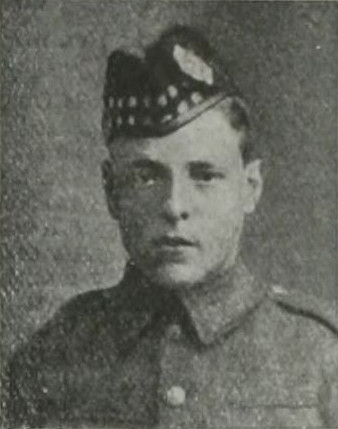
J. M. M. Jardine.
JARRAM, ERNEST, A.B., 206322, H.M.S. Good Hope; lost in action off Coronel, on the coast of Chili, 1 Nov. 1914.
JARRETT, AYLMER VIVIAN, D.S.O., Capt., 2nd Battn. York and Lancaster Regt., 4th s. of Col. Henry Sullivan Jarrett, South Lodge, East Grinstead, co. Sussex, C.I.E., by his wife, Agnes Delacour, dau. of the late Francis Beaufort, Bengal C.S.; b. Calcutta, 11 July, 1879; educ. Stonyhurst College; gazetted 2nd Lieut., 2nd York and Lancaster Regt. 12 Aug. 1899; promoted Lieut. 16 Dec. 1900; and Capt. 1 Jan. 1906; was Adjutant of his Battn. from 1 Dec. 1904, to 3 Nov. 1907, and from 29 Aug. 1908, to 19 Oct. 1911, was att. to the West African Regt.; served with the Expeditionary Force in France and Flanders; was mentioned in Despatches by F.M. Sir John (now Lord) French [London Gazette, 22 June, 1915] for gallant and distinguished service in the field and awarded the D.S.O. [London Gazette, 23 June, 1915], his name having been sent up four times for special recognition, and died on 22 June, 1915, at Vlamatinghe of wounds received in action the same day near Ypres. Buried near Vlamatinghe; unm. His elder brother, Major C. H. B. Jarrett, was killed at the Dardanelles (see following notice).
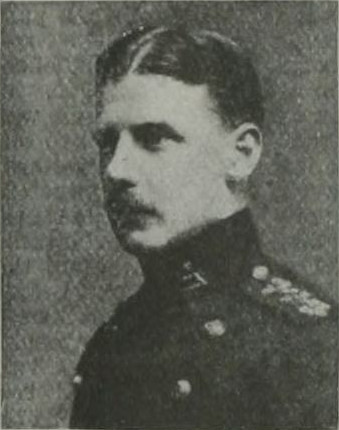
Aylmer Vivian Jarrett.
JARRETT, CHARLES HARRY BROWNLOW, Major, 1st Battn. Royal Munster Fusiliers, eldest s. of Col. Henry Sullivan Jarrett, of South Lodge, East Grinstead, co. Sussex, C.I.E., by his wife, Agnes Delacour, dau. of the late Francis Beaufort, Bengal C.S.; b. Calcutta, 26 Nov. 1874; educ. Stonyhurst College; gazetted 2nd Lieut. 1st Royal Munster Fusiliers, 10 Oct. 1894, and promoted Lieut. 2 Aug. 1897; Capt. 14 Jan. 1902, and Major, 19 Aug. 1914; served in the South African War, 1901–2, taking part in the operations in the Transvaal, April to 31 May, 1902, and in the Orange River Colony, Jan. to April, 1902, and May, 1902 (Queen’s medal with four clasps); and with the Mediterranean Expeditionary Force; and was killed at Beach V, Gallipoli, during the Battle of the Landing, 25 April, 1915; unm.
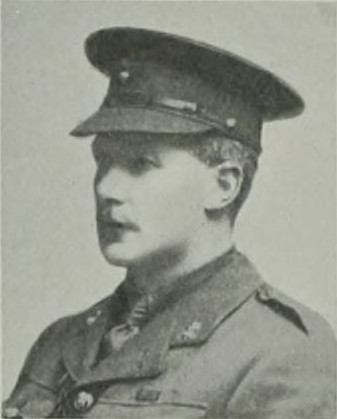
Charles Harry B. Jarrett.
JARROLD, FREDERICK ARTHUR, Ordinary Seaman, R.N.V.R. (Sussex), 1/296, H.M.S. Hawke; lost when that ship was torpedoed in the North Sea, 15 Oct. 1914.
JARVIS, EDWARD WILLIAM, Stoker, 1st Class, 311111, H.M.S. Pathfinder; lost when that ship was sunk by a mine, about 20 miles off the East Coast, 5 Sept. 1914.
JARVIS, FREDERICK ARTHUR, Stoker, 1st Class, K. 4636 (Ports.), H.M.S. Hogue; lost in action in the North Sea, 22 Sept. 1914.
JASPER, WILLIAM, A.B., 214626, H.M.S. Aboukir; lost in action in the North Sea, 22 Sept. 1914.
JAY, CHRISTOPHER, Leading Seaman (R.F.R., B. 9637), 202532, H.M.S. Hawke; lost when that ship was torpedoed in the North Sea, 15 Oct. 1914; m.
JAY, JOHN HENRY, Chief Electrician, 2nd Class, 345147, H.M.S. Good Hope; lost in action off Coronel, on the coast of Chili, 1 Nov. 1914.
JAYES, GEORGE WILLIAM, A.B. (R.F.R., B. 4071), 191019, H.M.S. Good Hope; lost in action off Coronel, on the coast of Chili, 1 Nov. 1914.
JEFFERSON, GEORGE WILLIAM, Stoker, 1st Class, K. 9649, H.M.S. Good Hope; lost in action off Coronel, on the coast of Chili, 1 Nov. 1914.
DUNNINGTON-JEFFERSON, WILFRED MERVYN, 2nd Lieut., 7th, attd. 3rd, Battn. The Royal Fusiliers (City of London Regt.), yst. s. of the late Capt. Mervyn Dunnington-Jefferson, 33rd Regt., by his wife, Louisa Dorothy (Ashcroft, Old Nunthorpe, York), dau. of the Rev. J. Barry, Rector of Great Smeaton, Yorkshire; b. at Middlethorpe Hall, York, 2 April, 1892; educ. Radley, and Christ Church, Oxford, where he graduated with honours; entered the Inner Temple, 1912; volunteered on the outbreak of war; gazetted 2nd Lieut. to the 7th Royal Fusiliers, 15 Aug. 1914; went to the Front in April, 1915, attd. to the 3rd Battn., and was killed in action at the Second Battle of Ypres, 25 April, 1915; unm. His elder brother, Major J. A. Dunnington-Jefferson, is (1916) serving on the Headquarters Staff with the Expeditionary Force in France.
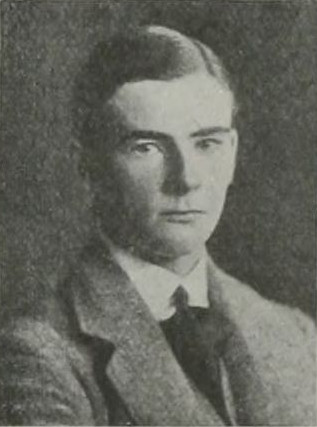
W. M. Dunnington-Jefferson.
JEFFERY, CLAUD GIFFARD, Capt., 2nd Battn. A.P.W.O. Yorkshire Regt. (Green Howards), eldest s. of Herbert James Jeffery, of Oak Mount, Manningham, Bradford, Solicitor, by his wife, Bertha Greenwood, dau. of John Greenwood Sugden, of Eastwood House, Keighley, Yorks, and grandson of Charles Jeffery, of Swaffham, Norfolk; b. Manningham, Bradford, 13 April, 1880; educ. Bradford Grammar School and Royal Agricultural College, Cirencester; joined the Service Coy. of the Vol. Battn. Yorkshire Regt., Dec. 1899, and went to South Africa in Feb. 1900. He took part in operations in the Orange Free State, May, 1900, including actions at Houtnek (Thoba Mountain), Vet River (5 and 6 May), and Zand River; in the Transvaal, May and June, 1900, including actions near Johannesburg, Pretoria and Diamond Hill; in operations East of Pretoria, July to Oct. 1900, including actions at Belfast (26 and 27 Aug.), and in those in Cape Colony. For his services in South Africa he received the Queen’s medal with six clasps, and was gazetted 2nd Lieut. to the Yorkshires (Green Howards) on Lord Kitchener’s nomination, 14 Sept. 1901. He served in India and again in South Africa, being promoted Lieut. 12 May, 1904, and Capt. 25 Aug. 1909, while from 1 March, 1910, to 12 April, 1912 (when he was seconded for service with the Egyptian Army), he was Adjutant to his battn. at York and Blackdown. He was restored to the Establishment, 12 April, 1914; left for France with his battn. 4 Oct. 1914, and died at Ypres on the 24th of the same month, of wounds received in action on the 22nd near Gheluvelt. Buried in the cemetery at Ypres. He was mentioned in F.M. Sir John (now Lord) French’s Despatch of 14 Jan. 1915. Capt. Jeffery was a keen all-round sportsman, his activities embracing pig-sticking, polo, big game shooting, hunting, athletics and regimental steeplechasing. He m. at Barbon, co. Westmoreland, 10 Feb. 1914, Nellie, widow of Spencer Anketell-Jones, and dau. of John George Wilding, of Preston, co. Lancashire; s.p.
JEFFERY, ROBERT BERRY, A.B., 195604 Chatham, H.M.S. Good Hope; lost in action off Coronel, on the coast of Chili, 1 Nov. 1914.
JEFFERY, WILLIAM ALLEN, Boy, 1st Class, J. 28350, H.M.S. Hawke, s. of Wilfred John Jeffery, of 2, Elm Leigh Villas, Ash, Aldershot, co. Surrey; lost when that ship was torpedoed in the North Sea, 15 Oct. 1914.
JEFFREY, JOHN, Trooper, No. 784, 1st Light Horse Regt., Australian Imperial Force, only s. of John Hogg Forrester Jeffrey, of 5, Albany Street, Blairhill, Coatbridge, co. Lanark, Analytical and Metallurgical Chemist, by his wife, Jeannie, dau. of John Brownlie; b. Coatbridge, 22 May, 1895; educ. Gartsherrie Academy, Coatbridge, and Allan Glens School, Glasgow; on leaving school was for three years in the Engineering Works of Messrs. Murray and Paterson of Coatbridge, and then went to Australia to take up sheep-farming; joined the 1st Australian Light Horse at Sydney, N.S.W. 27 Nov. 1914; left for Egypt, 6 Feb. 1915; proceeded to the Dardanelles, 10 July, 1915, and was killed in action at Lone Pine, Gallipoli, on the morning of 7 Aug. following, in the heroic charge of the 1st Light Horse, from which only 13 out of 300 returned; unm.
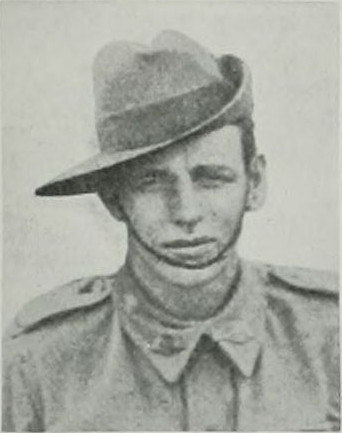
John Jeffrey.
JEFFRIES, HERBERT JOHN, A.B. (R.F.R., Ch. B. 3423), 188870, H.M.S. Aboukir; lost in action in the North Sea, 22 Sept. 1914.
JENINGS, GEORGE PIERSE CREAGH, Lieut., 1st Battn. King’s Shropshire L.I., 3rd s. of Lieut.-Col. Ulick Albert Jenings, of Ironpool, co. Galway and Mervue, Monkstown, co. Dublin, late Army Medical Service, J.P., by his wife, Isabel, dau. of Simon Macnamara Creagh; b. Dublin, 4 Jan. 1885; educ. Royal Military College, Sandhurst; gazetted 2nd Lieut. to 1st King’s Shropshire L.I., 16 Aug. 1905, and promoted Lieut., 20 Jan. 1907; left for France in Aug. 1914; was Assistant Adjutant to his battn., and was killed in action at the Rue de Bois, near Armentières, 6 Nov. 1914. Buried at the Rue de Bois; unm. His commanding officer wrote: “He was machine-gun officer and was using his glasses at the barrier to find a target for his gun, when suddenly a volley was fired by the enemy and he was shot dead. He was a very promising officer, and is a great loss not only to the regt., but to the Army. He was very popular with officers and men, and had done real good work throughout the war”; and an A.D.C., Headquarters, 6th Division, wrote: “He had been most dashing and gallant ... and is a terrible loss.”
JENKINS, JOHN REGINALD, Sergt., No. 1853, 13th Battn. (Princess Louise’s Kensington) The London Regt. (T.F.). eldest s. of James Jenkins, of 24, Wallingford Avenue, North Kensington, W., Ironmonger, by his wife, Catherine Letitia, dau. of Daniel Howell; b. Hammersmith, 12 Dec. 1885; educ. Lower Latimer School there; was an Ironmonger’s Assistant; joined the Kensingtons about 1908; volunteered for Imperial service on outbreak of war; left for France, 3 Nov. 1914; and was killed in action in the advance against the Aubers Ridge, 9 May, 1915, on which occasion the Kensingtons most brilliantly distinguished themselves, carrying three lines of German trenches with the bayonet, and holding them until the German fire made them untenable; unm. His Platoon Officer, 2nd Lieut. J. E. Lewin, wrote: “Sergt. Jenkins was my Sergt. in No. 6 Platoon, and when the two Platoons of ‘B’ Company, which were ahead of us, were left without officers, it became necessary for me to go to the front and lead. This I did, and my Platoon kept with me, with Sergt. Jenkins well to the front. We forced the German front trench, and proceeded to take up an arranged position. We had taken this, when I thought it necessary to find a better and safer one, and so I accordingly called for someone to follow, in order to go forward and scout for a proposed better line of defence. Sergt. Jenkins and another Sergt. (one on either side) came, and it was while thus doing one of the most important and vital acts upon which depended the safety of the whole of ‘B’ Company and probably the whole Battn. that I lost a comrade and friend. The two Sergts. were both shot by rifle fire and died instantaneously, and it is a sickening thought that I myself of the three was the only man to return. I cannot praise too highly the actions of Sergt. Jenkins on that day, which were but ordinary specimens of his everyday actions, and of a true and brave British soldier.”
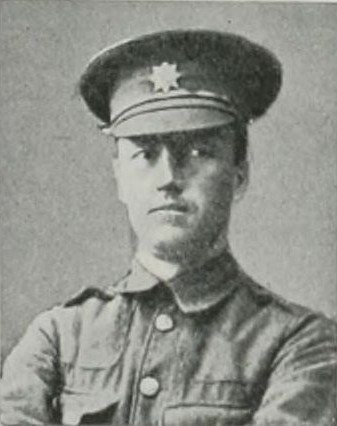
John Reginald Jenkins.
JENKINS, ROBERT, Private, No. 3845, 2nd Battn. The Royal Scots (Lothian Regt.), 3rd s. of Robert Jenkins, of Townhead, Glasgow, by his wife, Mary Jane, dau. of (——) Hamilton; b. Glasgow, 27 June, 1882; educ. Saint Rollox Board School, Glasgow; was in the employment of the Steel Company of Scotland at their Garthamloch Collieries; joined the 2nd Royal Scots, 7 Sept. 1914; left for France in Dec., and was killed in action near Hooge, 25 Sept. 1915. He m. at Glasgow, 31 Dec. 1908, Janet, dau. of Arthur Morrow, of Hogganfield, and had a son and a daughter: Arthur, b. 15 Jan. 1910; and Mary Jane, b. 8 Jan. 1911.
JENKINS, WALTER, A.B. (R.F.R., B. 7610), S.S. 1394 Chatham, H.M.S. Good Hope; lost in action off Coronel, on the coast of Chili, 1 Nov. 1914.
JENKINSON, JOHN BANKS, Capt., Rifle Brigade, eldest s. and heir of Sir George Banks Jenkinson, of Eastwood, co. Gloucester, 12th Baronet, by his wife, Madeline (Eastwood Park, Falfield; Hawkesbury, Chippenham), eldest dau. of Arthur Holme Sumner, of Hatchlands, Surrey; b. London, 9 June, 1881; educ. Harrow and Sandhurst; gazetted 2nd Lieut. Rifle Brigade, 10 March, 1900, and promoted Lieut. 18 March, 1901, and Captain, 6 May, 1908; served in the South African War 1901–2, being employed with the Mounted Infantry; took part in the operations in the Transvaal, April to Dec. 1901, and in the Orange River Colony, Jan. to 31 May, 1902 (Queen’s medal with five clasps); was Adjutant, School of Mounted Infantry, Egypt, 11 June, 1905, to 5 May, 1908; went through the Staff College, 1910–11; was G.S.O. (3rd Grade) to Sir James Grierson, Eastern Command, 1911–13, and Brigade Major, 3rd Infantry Brigade, at Bordon, and at the Front, 1913 to 14 Sept. 1914; went to France with the Expeditionary Force in Aug. 1914, and was killed in action at the Battle of the Aisne, 14 Sept. 1914. Buried at Vendresse. Capt. Jenkinson was a well-known big game hunter, and had secured rare trophies from countries, including South Africa, Egypt, Asia Minor, and the Rocky Mountains, the Canadian Prairies, and Southern Tunisia. He was also a keen polo player. He m. at St. George’s, Hanover Square, 9 Nov. 1907, Joan (The White House, Hook, Hants), only dau. of Colonel Joseph Hill, of Wollaston Hall, Northamptonshire, C.B., and had two children: Sir Anthony Banks Jenkinson, 13th Baronet, b. 3 July, 1912; succeeded his grandfather, 5 June, 1915; and Elizabeth Deborah, b. 27 Oct. 1908.