Volume 2 — Vol. II.—35.
Reading edition
Case containing the Heart of Lord Edward Bruce, AT CULROSS ABBEY.
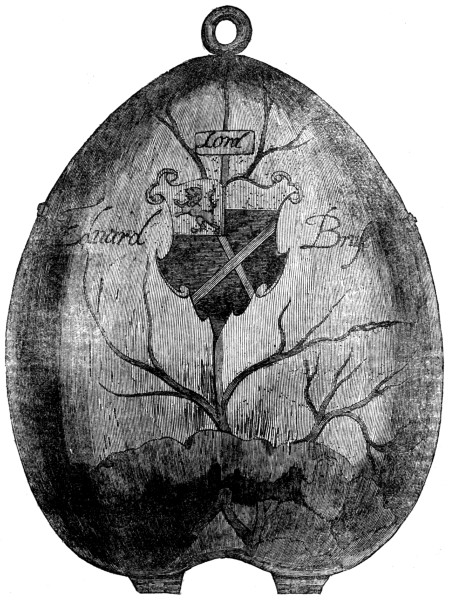
Case containing the Heart of Lord Edward Bruce, AT CULROSS ABBEY.
Lord Edward Bruce was eldest son of sir Edward, baron of Kinloss, so created by James I. in 1603, to whom the king gave the dissolved abbey of Kinloss, in Ayrshire, after he had been instrumental in his succession to the crown of England; whither accompanying the king, he was made master of the rolls in 1604, died in 1610, and was buried in the Rolls chapel. His son, the lord Edward, killed in duel by sir Edward Sackville in 1613, was succeeded by his brother, who was created earl of Elgin in 1633 and an English baron in 1641.
Sir Edward Sackville, by whose hand the lord Edward Bruce fell, was younger brother to Richard Sackville, earl of Dorset, on whose death he succeeded to the title. He was lord president of the council, a joint lord keeper, and filled several other distinguished offices under Charles I., to whom he adhered, by whose side he fought at the battle of Edge-hill, and whose death he took so much to heart, that he never afterwards stirred out of his house in Salisbury-court, but died there on the 17th of July, 1652.
Between these noblemen there arose a quarrel, which terminated in their duel; and all that is, or probably can be known respecting it, is contained in the following correspondence, preserved in a manuscript in Queen’s college library, Oxford.[319]
A Monsieur, Monsieur Sackvile.
“I that am in France, hear how much you attribute to yourself in this time, that I have given the world leave to ring your praises; and for me, the truest almanack, to tell you how much I suffer. If you call to memory, when as I gave you my hand last, I told you I reserved the heart for a truer reconciliation. Now be that noble gentleman, my love once spoke, and come and do him right that could recite the tryals you owe your birth and country, were I not confident your honour gives you the same courage to do me right, that it did to do me wrong. Be master of your own weapons and time; the place wheresoever, I will wait on you. By doing this, you shall shorten revenge, and clear the idle opinion the world hath of both our worths.
“Ed. Bruce.”
A Monsieur, Monsieur Baron de Kinloss.
“As it shall be always far from me to seek a quarrel, so will I always be ready to meet with any that is desirous to make tryal of my valour, by so fair a course as you require. A witness whereof yourself shall be, who, within a month, shall receive a strict account of time, place, and weapon, where you shall find me ready disposed to give honourable satisfaction, by him that shall conduct you thither. In the mean time, be as secret of the appointment, as it seems you are desirous of it.
“E. Sackvile.”
A Monsieur, Monsieur Baron de Kinloss.
“I am at Tergose, a town in Zeland, to give what satisfaction your sword can render you, accompanied with a worthy gentleman for my second, in degree a knight. And, for your coming, I will not limit you a peremptory day, but desire you to make a definite and speedy repair, for your own honour, and fear of prevention; at which time you shall find me there.
“E. Sackvile.”
Tergose, 10th of August, 1613.
A Monsieur, Monsieur Sackvile.
“I have received your letter by your man, and acknowledge you have dealt nobly with me; and now I come, with all possible haste, to meet you.
“E. Bruce.”
The combat was fierce, and fatal to lord Bruce. The survivor, sir Edward Sackville, describes it in a letter, which will be inserted at a future time. For the present purpose it is merely requisite to state, that lord Stowell, in a communication to the earl of Aberdeen, president of the Society of Antiquarians, dated February 15, 1822, seems to have determined the spot whereon the duel was fought, and the place of lord Bruce’s interment. From that communication, containing an account of the discovery of his heart, with representations of the case wherein it was enclosed, the following detail is derived, together with the engravings.
It has always been presumed that the duel was fought under the walls of Antwerp; but the combatants disembarked at Bergen-op-Zoom, and fought near that town, and not Antwerp. The circumstances are still well remembered at Bergen, while at Antwerp there is not a trace of them. A small piece of land, a mile and a half from the Antwerp gate of Bergen, goes by the name of Bruce-land; it is recorded as the spot where Bruce fell; and, according to tradition, was purchased by the parties to fight upon. The spot is unclaimed at the present day, and marked by a little earthen boundary, which separates it from the surrounding corn-fields. It was considered, until the French revolution, as free ground, where any person might take refuge without being liable to arrest. Lord Bruce was buried at Bergen, and a monument is stated to have been erected to his memory within the great Protestant church, which was nearly destroyed in the siege of 1747.
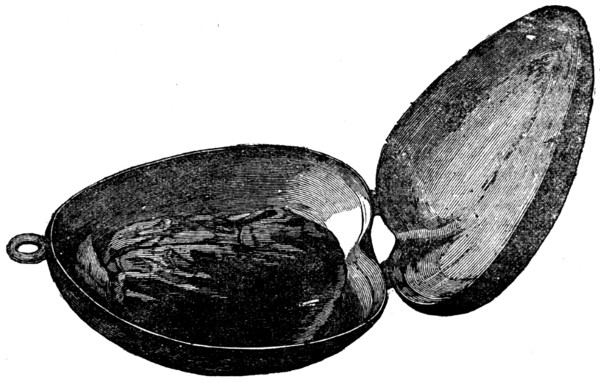
Appearance of the Heart of Lord Edward Bruce.
In consequence of a tradition, that the heart of lord Edward Bruce had been sent from Holland, and interred in the vault or burying-ground adjoining the old abbey church of Culross, in Perthshire, sir Robert Preston directed a search in that place in 1808, with the following result.—Two flat stones, without inscription, about four feet in length and two in breadth, were discovered about two feet below the level of the pavement, and partly under an old projection in the wall of the old building. These stones were strongly clasped together with iron; and when separated, a silver case, or box, of foreign workmanship, shaped like a heart, was found in a hollow or excavated place between them. Its lid was engraved with the arms and name “Lord Edward Bruse;” it had hinges and clasps; and when opened, was found to contain a heart, carefully embalmed, in a brownish coloured liquid. After drawings were taken of it, as represented in the present engravings, it was carefully replaced in its former situation. There was a small leaden box between the stones in another excavation; the contents of which, whatever they were originally, appeared reduced to dust.
Some time after this discovery, sir Robert Preston caused a delineation of the silver case, according to the exact dimensions, with an inscription recording its exhumation and re-deposit, to be engraved on a brass plate, and placed upon the projection of the wall where the heart was found.[320]
It is a remarkable fact, that the cause of the quarrel between lord Bruce and sir Edward Sackvile has remained wholly undetected, notwithstanding successive investigations at different periods. The last was conducted by the late lord Leicester, and several gentlemen, whose habits and love of investigation are equally well known, but they were unable to discover the slightest clue to the object of their anxious and diligent inquiry. Lord Clarendon, in his “History of the Rebellion,” records the combat as an occurrence of magnitude, from its sanguinary character and the eminence of the parties engaged in it. He does not say any thing respecting the occasion of the feud, although lord Bruce’s challenge seems to intimate that it was matter of public notoriety.
HEART BURIAL.
During the rebuilding of part of the church of Chatham, Kent, in 1788, there was found in one of the vaults a leaden pot, containing, according to an inscription, the heart of a woman, one Hester Harris. The pot appeared to have been nailed up to the side of the vault, there being a piece of lead soldered on for that purpose.[321]
POETICAL QUID PRO QUO.
A Greek poet frequently offered little compliments to Augustus, with hopes of some small reward. His poems were worthless and unnoticed, but as he persisted in his adulation, Augustus amused himself with writing an epigram in praise of the poet, and when he received the next customary panegyric, presented his lines to the bard with surprising gravity. The poor man took and read them, and with apparent delight deliberately drew forth two farthings, and gave them to the emperor, saying, “This is not equal to the demands of your situation, sire; but ’tis all I have: if I had more I would give it to you.” Augustus could not resist this; he burst into laughter, and made the poet a handsome present.
POCKETS.
Mr. Gifford relates the preceding anecdote, in a note on his Juvenal, from Macrobius. He makes the poet draw the farthings from his “pocket:” but the pocket was unknown to the Greeks and Romans. Mr. Fosbroke says the men used the girdle, and the women their bosom; and that Strutt thinks the scrip, and purse, or bag, were succedanea. The Anglo-Saxon and Norman women wore pocketting sleeves; and sleeves with pockets in them, mentioned by DuCange, Matthew Paris, Malmesbury, and Knighton, were searched, before the wearers could be admitted to the royal presence. Sleeve pockets are still worn by the monks in Portugal.
POCKET HANDKERCHIEFS.
These useful appendages to dress were certainly not in use with the Greeks. The most ancient text wherein handkerchiefs are expressly mentioned, describes them as long cloths, called oraria, used and worn by senators “ad emungendum et exspuendum;” that use is said to have grown out of the convenience of the orarium, which is supposed to have been merely used at first to wave for applause in the public shows. Mr. Fosbroke presumes it to have been the “swat-cloth” of the Anglo-Saxons; for one called mappula and manipulus was then worn on the left side to wipe the nose. In subsequent ages there was the manuariolum, one carried in the hand during summer, on account of perspiration. Queen Elizabeth wore handkerchiefs of party-coloured silk, or cambric, edged with gold lace.
PICKPOCKETS.
The old robbers, in the “good old times,” when purses were carried in the hand or borne at the side, cut them away, and carried them off with the contents, and hence they were called “cut-purses.” In the scarce “History of Highwaymen,” by Smith, there is a story of a ludicrous private robbery, from “the person” of a man, mistakenly committed by one of these cut-purses. One of Shakspeare’s rogues, Autolycus, says, that “to have an open ear, a quick eye, and a nimble hand, is necessary for a cut-purse.” Of course, “pickpockets” are of modern origin; they “came up” with the wearing of pockets.
Garrick Plays No. XXXI.
[From the “Triumphant Widow,” a Comedy, by the Duke of Newcastle, 1677.]
Humours of a Thief going to Execution.
Officers. Room for the prisoner there, room for the prisoner.
Footpad. Make room there; ’tis a strange thing a man cannot go to be hanged without crowding for it.
1st Fellow. Pray, Sir, were not you a kin to one Hinde?[322]
Footpad. No; I had run faster away then.
2d Fellow. Pray, prisoner, before your death clear your conscience, and tell me truly, &c.
(all ask him questions about robberies.)
Margery. I am sure you had my Lady’s gilt caudle cup.
Footpad. Yes, and would have kept it; but she has it again, has she not?
James. And the plate out of my buttery—
Footpad. Well, and had she not it again? what a plague would you have? you examine me, as if you would hang me, after I am hanged. Pray, officers, rid me of these impertinent people, and let me die in quiet.
1st Woman. O lord! how angry he is! that shews he is a right reprobate, I warrant you.
Footpad. I believe, if all of you were to be hanged, [II-233, II-234] which I hope may be in good time, you would not be very merry.
2d Woman. Lord, what a down look he has!
1st Woman. Aye, and what a cloud in his forehead, goody Twattle, mark that—
2d Woman. Aye, and such frowning wrinkles, I warrant you, not so much as a smile from him.
Footpad. Smile, quoth she! Tho’ tis sport for you, ’tis none for me, I assure you.
1st Woman. Aye, but ’tis so long before you are hanged.
Footpad. I wish it longer, good woman.
1st Fellow. Prithee, Mr. Thief, let this be a warning to you for ever doing the like again.
Footpad. I promise you it shall.
2d Woman. That’s well; thank you with all my heart, la! that was spoken like a precious godly man now.
1st Woman. By my truly, methinks now he is a very proper man, as one shall see in a summer’s day.
Footpad. Aye, so are all that are hanged; the gallows adds a great deal of grace to one’s person.
2d Woman. I vow he is a lovely man; ’tis pity he should be taken away, as they say, in the flower of his age.
1st Officer. Come, dispatch, dispatch; what a plague shall we stay all day, and neglect our business, to hang one thief?
2d Officer. Pray, be hanged quickly, Sir; for I am to go to a Fair hard by.
1st Officer. And I am to meet some friends to drink out a stand of ale by and by.
1st Woman. Nay, pray let him speak, and die like a Christian.
2d Woman. O, I have heard brave speeches at this place before.
Footpad. Well, good people—if I may be bold to call you so—this Pulpit was not of my chusing. I shall shortly preach mortality to you without speaking, therefore pray take example by me, and then I know what will become of ye. I will be, I say, your memento mori, hoping you will all follow me.
1st Fellow. O he speaks rarely.
2d Fellow. Aye, does Latin it.
Footpad. I have been too covetous, and at last taken for it, and am very sorry for it. I have been a great sinner, and condemned for it, which grieves me not a little, that I made not my escape, and so I heartily repent it, and so I die with this true confession.
1st Woman (weeping). Mercy on him, for a better man was never hanged.
2d Woman. So true and hearty repentance, and so pious.
2d Fellow. Help him up higher on the ladder. Now you are above us all.
Footpad. Truly I desire you were all equal with me; I have no pride in this world.
1st Fellow. Will you not sing, Sir, before you are hanged?
Footpad. No, I thank you; I am not so merrily disposed.
Hangman. Come, are you ready?
Footpad. Yes, I have been preparing for you these many years.
1st Woman. Mercy on him, and save his better part.
2d Woman. You see what we must all come to.
(horn blows a reprieve.)
Officer. A reprieve! how came that?
Post. My Lady Haughty procured it.
Footpad. I will always say, while I live, that her Ladyship is a civil person.
1st Fellow. Pish, what must he not be hanged now?
2d Fellow. What, did we come all this way for this?
1st Woman. Take all this pains to see nothing?
Footpad. Very pious good people, I shall shew you no sport this day.
[From “Mamamouchi,” a Comedy, by Edward Ravenscroft, 1675.]
Foolish Lender.
Debtor. As to my affairs, you know I stand indebted to you.
Creditor. A few dribbling sums, Sir.
Debt. You lent ’em me very frankly, and with a great deal of generosity, and much like a gentleman.
Cred. You are pleased to say so.
Debt. But I know how to receive kindnesses, and to make returns according to the merits of the person that obliges me.
Cred. No man better.
Debt. Therefore pray let’s see how our accounts stand.
Cred. They are down here in my table book.
Debt. I am a man that love to acquit myself of all obligations as soon——
Cred. See the memorandum.
Debt. You have set it all down.
Cred. All.
Debt. Pray read—
Cred. Lent, the second time I saw you, one hundred guineas.
Debt. Right.
Cred. Another time fifty.
Debt. Yes.
Cred. Lent for a certain occasion, which I did not tell you, one hundred and fifty.
Debt. Did I not? that I should conceal any thing from my friend!
Cred. No matter.
Debt. It looks like mistrust, which is a wrong to friendship—
Cred. O Lord!
Debt. I am so ashamed!—for I dare trust my soul with you. I borrowed it, to lend a person of quality, whom I employed to introduce me to the King, and recommend to his particular favour, that I might be able to do you service in your affairs.
Cred. O did you so? then that debt is as it were paid; I’ll cross it out.
Debt. By no means; you shall have it, or I vow—
Cred. Well, Sir, as you please.
[II-235, II-236]
Debt. I vow I would ne’er have borrowed of you again, as long as you lived—but proceed—
Cred. Another time one hundred—
Debt. O, that was to send into France to my wife to bring her over, but the Queen would not part with her then; and since, she is fallen sick—
Cred. Alas!
Debt. But pretty well recovered—
Cred. These four sums make up four hundred guineas—
Debt. Just as can be; a very good account. Put down two hundred more, which I will borrow of you now; and then it will be just six hundred: that is, if it will be no inconvenience to you—
Cred. Euh, not in the least—
Debt. It is to make up a sum of two thousand pounds, which I am about to lay up in houses I have bought; but if it incommode you, I can have it elsewhere—
Cred. O, by no means—
Debt. You need but tell me, if it will be any trouble—
Cred. Lord, Sir, that you will think so—
Debt. I know some will be glad of the occasion to serve me; but these are favours only to be asked of special friends. I thought you, being my most esteemed friend, would take it ill, if you should come to hear of it, that I did not ask you first—
Cred. It is a great honour.
C. L.
FURS.—TIPPETS AND SCARFS.
To the Editor.
Dear sir,—Dr. Whitaker, in his “History of Craven,” makes several extracts from the Compotus of Bolton in Craven, a folio of a thousand pages, kept by the monastery; which book begins in 1290 and ends in 1325. On one item, “In fururâ de Buget, vs.,” the doctor has the following note, which may be interesting to others besides the lovers of the delightful science of heraldry.
“In Fururâ de Buget. In the middle ages, fur of different species formed an elegant and comfortable appendage, not only to professional habits, but to the ordinary dress of both sexes, from the sovereign to the private gentleman. Beneath the latter rank, none but the coarsest kinds were ever in use, which they certainly wore; for Chaucer, who intended to clothe his personification of Avarice in the garb of Poverty, allows her, notwithstanding, ‘a burnette cote, furred with no meniveere, but with a furre rough of lambe skynnes, hevy and blacke.’ (Rom. Ros.) The different sorts enumerated in the Compotus are, the buget, or budge, gris, de ventre leporino, the white fur of the hare’s belly, and de pellibus agninis, or lambs’ skins. The last of these, which still forms the lining of the hoods of the bachelors of arts at Cambridge, was anciently worn both by bishops and noblemen. For the first, see Mr. Warton’s note on ‘Comus,’ edit. i. p. 146; and the inventory of the wardrope of the second earl of Cumberland in that volume. With respect to budge, or buget, it is understood by Mr. Warton (note on Comus, line 709) to be fur in general; but this interpretation is negatived by the terms of the present article, fururâ de buget. Whatever budge may have been, it is unknown to Du Cange, who has, with immense labour and erudition, collected every thing known on the subject in the middle ages. It was certainly scarce and expensive, being used for the lining of the prior’s (Bolton) hood alone. After all, I suspect it to have been the skin of the Lithuanian weasel.[323] Even as late as Dr. Caiius’s time, the hoods of the regent masters of arts of Cambridge were lined ‘pelle arminâ seu Lituana candidâ.’ Lituan is sometimes used by the old writers on heraldry as synonymous with ermine. If I am right in my conjecture, therefore, budge so nearly resembled ermine, that either skin might be used indifferently as a badge of the same academical rank. And this accounts for Milton’s epithet ‘budge,’ as applied to doctors, whose congregation robes at Cambridge are still faced with ermine. Gris, I think, was the skin of the grey, or badger.[324] The sleeves of Chaucer’s monk, ‘a fayre prelate,’ who was gayly and expensively habited, were ‘purfited with gris:’ and in the head of a bishop in painted glass, I have a fine specimen of this fur in the form of a tippet about the neck.
“It seems that, in the middle ages, ecclesiastics were apt to luxuriate in the use of beautiful and costly furs: ‘Ovium itaque et agnorum despiciuntur exuviæ; ermelini, gibelini (sables) martores exquiruntur et vulpes.’ This vanity was checked by an English sumptuary law—‘Statutum est ne quis escarleto, in Anglorum gente, sabelino, vario, vel grisèo uteretur,’ Brompton, Anno 1188. Again, in two MSS. quoted by Du Cange, to whom I am also indebted for the foregoing passage, the expensive furs are enumerated thus,
‘Vairs et gris, et ermines, et sables de rosie:’
and again,
‘Sables, ermines, et vair, et gris.’
Vair was the skin of the Mus Ponticus, a kind of weasel, the same animal with the ermine, but in a different state, i. e. killed in summer when the belly was white and the back brown, whence it obtained the name of ‘Varia.’ The ancient mineveere was ‘minuta varia,’ or fur composed of these diminutive skins; and Drayton was learned and accurate when he gave his well-dressed shepherd ‘mittons[325] of bauson’s skin;’ that is, of gris, and a hood of mineveere. With respect to sables, I have only to add, that from their grave and sober elegance, they were retained as tippets in the habits of bishops and other dignitaries in England to the time of queen Elizabeth, when they gave place to a similar ornament of silk, the origin of the present scarf, which continued to be called a tippet till the reign of Charles II. See Baxter’s life, where we find that puritan, when sworn in king’s chaplain, refusing to wear the tippet.”
I am, &c. T. Q. M.
BUDGE BACHELORS.—BUDGE-ROW.
In the old lord mayors’ processions of London, there were, in the first division, the “budge bachelors marching in measured order.”[326] These budge-bachelors go in the “Lord Mayor’s Show” to the present day, dressed in blue gowns trimmed with budge coloured fur, white. Bishop Corbet, in his “Iter Boreale,” speaks of
————— a most officious drudge, His face and gown drawn out with the same budge;
implying, that his beard and habit were of like colour. Budge-row, Cannon-street, according to Stow, was “so called of budge-fur, and of skinners dwelling there.”
*
DAIRY POETRY.
To the Editor.
Sir,—You may perhaps think the “Old Arm Chair” worthy a place in your amusing columns. It is the production of a self-taught, or natural genius, like Bloomfield, living in the fens of this place, and carrying on the business of a small dairyman.
Isle of Ely, Yours obediently,
Aug. 14, 1827. M. W.
THE OLD ARM CHAIR.
See Table Book, vol. i. p. 786.
What recollections of the past, Of scenes gone by, and days that were, Crowd through my mind whene’er I cast A look upon my father’s chair. How often have I climb’d his knees To pat his cheek, and stroke his hair; The kind paternal kiss to seize, When seated in this old arm chair. And much of monitory lore, Which bade me of the world beware; His tongue has utter’d o’er and o’er, When seated in this old arm chair. When ev’ning call’d us round the hearth. And storms disturb’d the wintry air; What merry tales of social mirth Have issued from this old arm chair. With summer’s toil and heat o’ercome, When weary nature sought repair; Oft has he thrown his languid frame, Exhausted, in this old arm chair. When adverse fortune cross’d his road, And bow’d him down with anxious care; How has he sigh’d beneath the load, When seated in this old arm chair. But death long since has clos’d his eyes; And peacefully he slumbers, where A grassy turf is seen to rise, And fills no more this old arm chair. Ev’n that which does those scenes recall, Which age and wasting worms impair Must shortly into pieces fall, And cease to be an old arm chair. Yet while its smallest parts remain, My fancy shall behold him there; And memory stir those thoughts again, Of him who fill’d the old arm chair.
For the Table Book.
SONNET
To T. Hood, Esq. written after reading his “Plea of the Midsummer Fairies.”
Delightful bard! what praises meet are thine, More than my verse can sound to thee belong; Well hast thou pleaded, with a tongue divine, In this thy sweet and newly breathed song, Where, like the stream, smooth numbers gliding throng; Gather’d, methinks I see the elfin race, With the Immortal standing them among, Smiling benign with more than courtly grace; Rescued I see them,—all their gambols trace, With their fair queen Titania in her bower, And all their avocations small embrace, Pictur’d by thee with a Shakspearean power— O when the time shall come thy soul must flee, Then may some hidden spirit plead for thee.
Edward Moxon.
For the Table Book.
THE QUINTAIN.
———— My better parts Are all thrown down; and that which here stands up, Is but a quintain, a mere lifeless block.
As You Like it.
Mr. Chalmers, in his edition of Shakspeare, gives the following annotation on the preceding passage:—“A quintain was a post, or butt, set up for several kinds of martial exercises, against which they threw their darts, and exercised their arms. But all the commentators are at variance about this word, and have illustrated their opinions with cuts, for which we must refer the reader to the new edition, 21 vols. 8vo.”
Ben, the satirical sorrel Ben Jonson, thus notices this same quintin, quintain, or gwyntyn, as the Welsh spell it:—
——— At quintin he In honour of his bridal-tee. Hath challenged either wide countee; Come cut and long taile, for there be Six batchelors as bold as he, Adjuting to his company, And each one hath his livery.
The word gwyntyn literally meant vane, and was corrupted by the English into quintin, or quintain. Thus, we may naturally suppose, that this ancient custom, and more particularly bridal game, was borrowed by the Britons from the Welsh, who had it from the Romans on their invasion of England. It is mentioned by Minshew, as being a sport held every fifth year among the Olympic games, or it was the last of the πενταθλοι, used on the fifth or last day of the Olympics: it is supposed to be a Roman game, and left in this island ever since their time.
Dr. Kennet, in his “Parochial Antiquities,” from Dr. Plot, says, that at the village of Blackthorn, through which the Roman road lay, they use it at their weddings to this day, on the common green, with much solemnity and mirth.[327]
Dr. Johnson says, I know not from whence it is derived; Minshew deduces it from quintus, and calls it a game celebrated every fifth year; palus quintanus, and from quintaine, French. It is, says he, an upright post, on the top of which a cross-post turned upon a pin; at one end of the cross-post was a broad board, and at the other a heavy sand-bag; the play was, to ride against the broad end with a lance, and pass by before the sand-bag, coming round, should strike the tilter to the ground. Sir Henry Spelman, who was a spectator of the game, coincides with this account, and says, “by which means, striking at the board, whirls round the bag and endangers the striker.” At weddings, in England and Wales, it was a constant amusement, and so generally practised in the latter country, that it may almost be said to class with their sports and manners.
In Roberts’s “Popular Antiquities of Wales,”[328] there is the following account of this ancient manly amusement. “On the day of the ceremony, the nuptial presents having previously been made, and the marriage privately celebrated at an early hour, the signal to the friends of the bridegroom was given by the piper, who was always present on these occasions, and mounted on a horse trained for the purpose; and the cavalcade being all mounted, set off at full speed, with the piper playing in the midst of them, for the house of the bride. The friends of the bride in the mean time having raised various obstructions to prevent their access to the house of the bride, such as ropes of straw across the road, blocking up the regular one, &c., and the quintain; the rider in passing struck the flat side, and if not dexterous was overtaken, and perhaps dismounted, by the sand-bag, and became a fair object for laughter. The gwyntyn was also guarded by champions of the opposite party; who, if it was passed successfully, challenged the adventurers to a trial of skill at one of the four and twenty games—a challenge which could not be declined; and hence to guard the gwyntyn was a service of high adventure.”
In Henry the Third’s time, or about the year 1253, it was much in fashion in almost every part of the kingdom: this game was sometimes played, by hanging a shield upon a staff fixed in the ground, and the skilful squire riding by struck the shield in such a manner as to detach it from its ligatures;[329] but this was of a less dangerous nature, and only used when the quintain could not be obtained.
There was another, but more hazardous manner, to those who were not skilled by habit in the use of the lance and javelin. It consisted of two large poles being drove into the ground, far enough apart to allow a man on horseback to ride full speed between them: at the top of these was an immense heavy sand-bag, fixed on a pivot, so as to swing freely round, and backward and forward, with amazing rapidity: this the young aspirant for chivalric honours delighted in, as a grand treat for the display of his personal bravery and contempt for danger. He commenced by reining in his steed opposite to the sand-bag, then dashing away at full speed, at the same time hurling the javelin at the bag with considerable force, and passing between the poles before it could resume its original position. Many of the squires and yeomen of Richard with the Lion-heart, held it in great esteem; and they would often pass through the supporters, regain their javelin, return back before the bag had sufficient time to fall, and ride bravely off without a single blow from this heavy instrument of pleasure. He who executed this feat in a handsome manner was declared victor, and the prize to which he became entitled was a peacock.
In the princely fête given by sir Rhys ap Thomas, in honour of his being admitted companion of the illustrious order of the Garter, it is mentioned thus:—“When they had dined they went to visit eache captaine in his quarters, wheare they found everie man in action, some wrestling, some hurling at the barr, some taking of the pike, some running at the quintaine, &c.” Dr. Watts thus explains it:—“A ludicrous and sportive way of tilting or running on horseback at some mark hung on high, moveable, and turning round; which, while the riders strike at with lances, unless they ride quickly off, the versatile beam strikes upon their shoulders.”
I earnestly recommend for the perusal of the reader, (if he delights in “merie deedes an’ greenewoodee sportes, inn thee brighte formes of ladees highh, immersed in uncouthe donjons, by treacherouse kings, greate lords, an’ mightee knights,”) the tale of “Castle Baynard,” in which he will find many very interesting customs, and more particularly, an excellent delineation of the above game. The author of this delightful little story is Hal Willis, who is possessed of considerable talent, and a knowledge of our ancestorial manners.
F. C. N.
A FARTHING LORD.
Lord Braco, an ancestor of the earl of Fife, was remarkable for practising that celebrated rule, “Get all you can, and keep all you get.” One day, walking down the avenue from his house, he saw a farthing lying at his feet, which he took up and carefully cleaned. A beggar passing at the same time, entreated his lordship would give him the farthing, saying, it was not worth a nobleman’s attention. “Fin’ a farthing to yoursel’, puir body,” replied his lordship, and carefully put the coin into his breeches pocket.
In addition to being his own farthing fin’er, his lordship was his own factor and rent-collector. A tenant who called upon him to pay his rent happened to be deficient a single farthing. This amount could not be excused; and the farmer had to seek the farthing. When the business was adjusted, the countryman said to his lordship, “Now Braco, I wou’d gie ye a shillin’ for a sight o’ a’ the goud an’ siller ye hae.”—“Weel, mon,” replied Braco, “it’s no cost ye ony mair;” and accordingly, for and in consideration of the aforesaid sum, in hand first well and truly paid, his lordship exhibited several iron boxes filled with gold and silver coin. “Now,” says the farmer, “I’m as rich as yoursel’, Braco.”—“Aye, mon!” said his lordship, “how can that be?”—“Because I’ve seen it—an’ you can do nae mair.”
SINGULAR TOLL. Skipton in Craven.
From a paper of Henry the Eighth’s time, among the MSS. at Skipton, I find that the following singular toll was anciently levied in Skirack and Crookrise:
“Note, that theise customes hayth ben used tyme out of mynd, by ye report of Rob. Garth, forster ther; the whych s-ay-eth, that he in all his tyme, and his father afore him in yt office, always hayth taken the sayd customes:
“First, that ev’ry bryde cumynge that waye shulde eyther gyve her lefte shoo or IIIs. IVd. to the forster of Crookryse, by way of custome or gaytcloys.”
The rest only relate to tolls taken for the passage of sheep, cattle, and wool.
The commutation was so high, that I suppose the penalty would generally be paid in kind; and by this ungallant custom, the poor brides of Craven would be reduced to tread the rugged ways of Crookrise in the situation of the light-footed sons of Thestius—
——— το λαιον ιχνος αναζβυλοι ωοδος, Τονδ εν ωεδιλοις.—
Eurip. in Fragm.[330]
A CURIOUS NARRATIVE.
For the Table Book.
Prince George of Denmark, and Sir John and Lady Duddlestone.
The following very remarkable anecdote is accompanied by a reference to the only work of any authority wherein I have met with it.
Prince George of Denmark, the nominal king-consort to queen Anne, in passing through Bristol, appeared on the Exchange, attended only by one gentleman, a military officer, and remained there till the merchants had pretty generally withdrawn, not one of them having sufficient resolution to speak to him, as perhaps they might not be prepared to ask such a guest to their houses. But this was not the case with all who saw him, for a person, whose name was John Duddlestone, a bodice-maker, in Corn-street, went up and asked the prince if he was not the husband of the queen, who informed him he was. John Duddlestone then told the prince, that he had observed, with a great deal of concern, that none of the merchants had invited him home to dinner, adding, it was not for want of love to the queen or to him, but because they did not consider themselves prepared to entertain so great a man; but John said, he was ashamed to think of his dining at an inn, and requested him to go and dine with him, and bring the gentleman along with him, informing him that he had a piece of good beef and a plum pudding, and ale of his dame’s own brewing. The prince admired the loyalty of the man, and though he had bespoke a dinner at the White Lion, went with him; and when they got to the house, Duddlestone called his wife, who was up stairs, desiring her to put on a clean apron and come down, for the queen’s husband and another gentleman were come to dine with them; she accordingly came down with her clean blue apron, and was immediately saluted by the prince. In the course of the dinner, the prince asked him if he ever went to London? He said, that since the ladies had worn stays instead of bodices, he sometimes went to buy whalebone; whereupon the prince desired him to take his wife when he went again, at the same time giving him a card, to facilitate his introduction to him at court.
In the course of a little time, John Duddlestone took his wife behind him to London, and, with the assistance of the card, found easy admittance to the prince, and by him they were introduced to the queen, who invited them to an approaching dinner, informing them that they must have new clothes for the occasion, allowing them to choose for themselves. Each therefore chose purple velvet, such as the prince had then on, which was accordingly provided for them, and in that dress they were introduced by the queen herself, as the most loyal persons in the city of Bristol, and the only ones in that city who had invited the prince her husband to their house; and after the entertainment, the queen, desiring him to kneel down, laid a sword on his head, and (to use lady Duddlestone’s own words) said to him, “Ston up, sir Jan.”
Sir “Jan” was offered money, or a place under government, but he did not choose to accept of either, informing the queen that he had “fifty pounds out at use,” and he apprehended that the number of people he saw about her must be very expensive. The queen, however, made lady Duddlestone a present of her gold watch from her side, which “my lady” considered as no small ornament, when she went to market, suspended over a blue apron.
I first found this interesting account in “Corry’s History of Bristol,” which was published a few years ago; but whence it was derived that author does not mention. As the editor of the Table Book is equally uninformed, perhaps some of his correspondents may be able to point out its origin; and, if it be authentic, communicate some particulars respecting the worthy knight and his dame.
Discoveries OF THE ANCIENTS AND MODERNS. No. VI.
The Corpuscular Philosophy.
The two illustrious moderns, Newton and Gassendi, attribute the continual change which happens in bodies to the different figure and magnitude of their minute corpuscles; and affirm, that their different junction or separation, and the variety of their arrangement, constitute the differences of bodies. This corpuscular philosophy can be traced from the times of Democritus, to its founder Moschus the Phœnician. It does not appear that the Phœnician school admitted the indivisibility of atoms; whereas, Leucippus, Democritus, and Epicurus did. And so the philosophers in all ages, down to the Cartesians and Newtonians, admit the same. Aristotle, as great in metaphysics as able in mathematics, treats of it in his works of both kinds. A modern proposition respecting it has been deemed new, although anciently it was expressed in almost the very same terms.
The Newtonians say, “that the smallest parcel of matter is able to cover the largest extent of space, by the number of parts into which it may be divided; and that without so much as leaving any one pore of the smallest dimension uncovered.” Anaxagoras had previously said, that each body, of whatever size, was infinitely divisible; insomuch, that a particle so small as the half of the foot of the minutest insect, might furnish out of itself parts sufficient for covering an hundred million of worlds, without ever becoming exhaustible as to the number of its parts. Democritus expressed the like proposition, when he affirmed that it was “possible to make a world out of an atom.” Chrysippus says the same, when he maintains that a drop of wine may be divided into a number of parts, each of itself sufficient to mingle with all the small particles of the ocean.
Motion—its Acceleration—the Fall of Bodies.
The ancients, as well as the moderns, define motion to be change of place, or the passing from one place to another; they knew the acceleration of bodies in falling, but not so exactly as to determine its law or cause. It was an axiom of Aristotle and the Peripatetics, that a body in falling acquired a celerity of motion, proportionable to its distance from the place whence the motion began; but they knew not that this increase of the celerity of falling bodies was uniform, and that the spaces passed over in equal times increased proportionably to the unequal numbers 1, 3, 5, 7, &c. Two mistakes of Aristotle hindered him from arriving at the truth. The first was, that there were two tendencies in body; one downwards, carrying it to the centre, in those that were heavy; the other upwards, removing it from it, in those that were light. His second error was, that he thought different bodies rolled through space with a celerity proportional to their masses. He did not consider that the resistance of the medium was the only cause of this difference; for supposing them to move through an irresisting medium, or in vacuo, the lightest bodies would then fall with the same velocity as the heaviest. This is demonstrated by means of the air-pump, wherein paper, lead, and gold, descend with equal swiftness.
Yet all the ancients were not thus ignorant. Lucretius, instructed in the principles of Democritus and Epicurus, arrived at this knowledge, and supports it by such arguments, as might do honour to the most experienced naturalist of our times.—“Admitting that there was nothing in the vacuum to resist the motion of bodies, it necessarily followed, that the lightest would descend with a celerity equal to the weightiest; that where there was no resistance in the medium, bodies must always move through equal spaces in equal times; but that the case would be different in such mediums, as opposed divers degrees of resistance to the bodies passing through them.” Hereupon, he alleges the very same reasonings which Galileo draws from experience to support his theory. He says, that “the difference of velocities ought to increase or abate, according to the difference of resistance in the medium; and that because air and water resist bodies differently, they fall through these mediums with different degrees of velocity.” We shall presently see, that the ancients were acquainted with the principle of gravitation.
GRASSINGTON THEATRICALS.
To the Editor.
Dear sir,—When I sent you the sketch of “Tom Airay” of this place, and his associates, I was not aware that the practice of acting plays was a very ancient one in the parish of Linton, (in which this place is.) The following extract from Whitaker’s history will prove this to have been the case, and that Airay was “the last of a bright band.” It will doubtless be perused with interest by many of the inhabitants of Craven, very few of whom I am inclined to think know of the circumstance. Whitaker’s history is an expensive work, and only in the hands of a few.
“Many of these amusements were long after in use at Linton. But the most popular of their amusements was the practice of acting old plays, continued, I have no doubt, from the old ‘Kirk Sights,’ and clerk plays, though I can trace it in Craven no farther than 1606, where I find the following article in the accounts of Francis, earl of Cumberland:—
“‘Item, paid to the yonge men of the town, (Skipton,) being his l’ps tenants and servants, to fit them for acting plays this Christmas, IIIIs.’
“In the interval of a century from this time, it does not seem that they had much improved their stock of dramas; for, within the recollection of old persons with whom I have conversed, one of their favourite performances was ‘The Iron Age,’ by Heywood, a poet of the reign of James I., whose work, long since become scarce, and almost forgotten, had probably been handed down from father to son, through all that period. But in every play, whether tragedy or comedy, the Vice constituted one of the dramatis personæ, and was armed, as of old, with a sword of lath, and habited in a loose party-coloured dress, with a fur-cap, and fox’s brush behind. In some parts of Craven these personages were called clowns, as in Shakspeare’s time, and too often and too successfully attempted to excite a laugh by ribaldry and nonsense of their own; a practice which is very properly reprehended in Hamlet.
“In the ‘Destruction of Troy’ this personage easily united with Thersites; but he was often found in situations where his appearance was very incongruous, as ex. gr. in ‘George Barnwell.’ These rustic actors had neither stage nor scenes, but performed in a large room, what is called the ‘house,’[331] of an ordinary dwelling.
“Sometimes they fabricated a kind of rude drama for themselves; in which case, as it is not likely that the plot would be very skilfully developed, the performers entered one by one, and each uttered a short metrical prologue, which they very properly chose to call a fore-speech. For why should these honest Englishmen be indebted to the Grecian stage for the word prologue, when they were certainly beholden to it for nothing else?
“In these fabrications, I believe, the subjects were frequently taken from printed plays; but the texture was of very inferior workmanship. For this I must beg my reader to give me credit; though, if all readers had the same relish for what, in the language of dulness, is called low, with Dr. Farmer and Mr. Warton, I could excite more than a smile by their travestie of the ‘Merchant of Venice.’ An old inhabitant of this place, (Linton,) whom I well knew, had the reputation of a dramatic manufacturer, though he had, in reality, no talents beyond those of an actor. But his fame drew upon him an awkward application; which, as the stated price of these services was three half crowns, he parried very dexterously by demanding half a guinea. Thus much for the chapter of amusements.”
In mentioning Airay’s stage companions I forgot to name Sim Coates, one of the principal. He was a club-footed man, and used to perform the “Fair Penitent!” He is lately dead.
I am, &c.
Grassington in Craven, T. Q. M.
Aug. 1, 1827.
THE GIN ACT—NAMES OF DRAMS.
On the 29th of September, 1736, when the bill against spirituous liquors took place, several people at Norwich, Bristol, and other places, as well as at London, made themselves very merry on the “Death of Madam Gin,” and some of both sexes got soundly drunk at her “funeral,” for which the mob made a formal procession, but committed no outrage.
A double guard for some days mounted at Kensington; the guard at St. James’s, and the horse-guards at Whitehall, were reinforced; a guard was placed at the Rolls Office, Chancery-lane; and a detachment of the life and horse grenadier guards paraded in Covent Garden, &c. in order to suppress any tumult that might happen at the going down of spirituous liquors.
Several of the distillers took out licenses to sell wine, others made preparations to take to the brewing-trade, and some went down to Oxford and Cambridge to open taverns there. The accounts of that period state, that the university of Oxford intended to try their right with them; the privilege of licensing vintners having been granted to it by a charter of Henry VIII., and afterwards confirmed by an act of parliament in 13 Elizabeth.
The distillers and others in different parts of the town sold a liquor, which seems to have been wine, with spices infused therein; and several continuing to sell spirituous liquors contrary to the act, informations were laid against them to the commissioners of excise.
Drams under the following names were sold at several brandy-shops in High Holborn, St. Giles’s, Tothill-street, Rosemary-lane, Shoreditch, the Mint, Kent-street, &c. viz. “Sangree,” “Tow Row,” “Cuckold’s Comfort,” “Parliament Gin,” “Bob,” “Make Shift,” “The Last Shift,” “The Ladies’ Delight,” “The Balk,” “King Theodore of Corsica,” “Cholick and Gripe Waters.” These denominations were with a view to evade the late act.
On the 14th of October, 1736, there came on before the commissioners of excise the trials of Mr. Robert Kirkpatrick, surgeon and apothecary in Turnmill-street, and Mr. John Thomas, chymist at Shoreditch, on informations for retailing spirituous liquors, contrary to the intent and meaning of the act; and they were both found guilty. The penalty was one hundred pounds each.
G. K.
A YOUNG POET’S OWN EPITAPH.
A few weeks before John Keats died of decline, at Rome, a gentleman, who was sitting by his bedside, spoke of an inscription to his memory. Keats desired that there should be no mention of his name or country. “If there be any thing,” he said, “let it be, Here lies the body of one whose name was writ in water.”
For the Table Book.
TIME.
Oh Time, that ever with resistless wing Cuts off our joys and shortens all our pain, Thou great destroyer that doth always bring Relief to man—all bow beneath thy reign; Nations before thee fall, and the grim king Of death and terror follows in thy train. Thou bring’st the cup of Lethe to the mind, Which else on earth no joy could ever find. Little in youth we think upon thy flight, Nor catch the lesson of each passing day, Till, when too late, it bursts upon our sight, And thou hast crowned us with thy cap of grey: Our friends for ever fled, and all the light That gilded this dim world hath passed away On to eternity—thro’ that sad portal Which parts us, and assures us man is mortal. Thou teachest us the vanity of earth. With which, in spite of thee, we are delighted, And lead’st us quickly onward from our birth Unto old age, then leav’st us there benighted; Where all our earthly pleasures, joys, and mirth Fade fast away, like young leaves seared and blighted. And hope, that lured us onward, then, we find, Was but an ignis fatuus of the mind.
S.
HACKERSTON’S COW.
This is a Scotch proverb, the application of which may be inferred from the following account of its origin. A tenant of lord Hackerston, who was one of the judges of the court of session, one day waited on his lordship with a woful countenance. “My lord,” said he, “I am come to inform your lordship of a sad misfortune, my cow has gored one of your lordship’s cows, so that I fear it cannot live.”—“Well, then, you must pay for it.”—“Indeed, my lord, it was not my fault, and you know I am a very poor man.”—“I can’t help that, I say you must pay for it; I am not to lose my cow.”—“Well, my lord, if it must be so I cannot say against your lordship,—but stop, my lord, I believe I have made a mistake, it was your lordship’s cow that gored mine.” “O! that is quite a different affair,—go along and don’t trouble me, I am busy—go along, I say.”
ROPE-RIDING ON HORSEBACK, ON ST. MARK’S DAY AT VENICE.
The gaiety and splendour exhibited in the place of St. Mark at Venice on this anniversary, is extremely attractive. Formerly, among the remarkable customs in honour of this the patron saint of the city, it was usual for a man to ascend and descend a rope stretched from the summit of St. Mark’s tower, and secured at a considerable distance from the base.
On the last day of February, 1680, the doge, the senate, and the imperial ambassador, with about fifty thousand spectators, beheld the annual solemnity. In the first place appeared certain butchers, in their roast-meat clothes; one of which, with a Persian scimitar, cut off the heads of three oxen, one after another, at one blow, to the admiration of the beholders, who had never seen the like either in Venice, or any other part of the world. But that which caused greater wonder was this:—A person, adorned in a tinsel riding habit, having a gilt helmet upon his head, and holding in his right hand a lance, in his left a helmet made of a thin piece of plate gilded, and sitting upon a white horse, with a swift pace ambled up a rope six hundred feet long, fastened from the quay to the top of St. Mark’s tower. When he had arrived half way, his tinsel coat fell off, and he made a stand, and stooping his lance submissively, saluted the doge sitting in the palace, and flourished the banner three times over his head. Then, resuming his former speed, he went on, and, with his horse, entered the tower where the bell hangs; and presently returning on foot, he climbed up to the highest pinnacle of the tower; where, sitting on the golden angel, he flourished his banner again several times. This performed, he descended to the bell-tower; and there taking horse, rode down again to the bottom in like manner as he had ascended.[332]
“Whoever,” says Mrs. Piozzi, “sees St. Mark’s Place lighted up of an evening, adorned with every excellence of human art, and pregnant with pleasure, expressed by intelligent countenances sparkling with every grace of nature—the sea washing its walls—the moon-beams dancing on its subjugated waves—sport and laughter resounding from the coffee-houses—girls with guitars skipping about the square—masks and merry-makers singing as they pass you—unless a barge with a band of music is heard at some distance upon the water, and calls attention to sounds made sweeter by the element over which they are brought;—whoever is led suddenly,” says Mrs. Piozzi, “to this scene of seemingly perennial gaiety, will be apt to exclaim in Venice, as Eve does to Adam in Milton,
With thee conversing, I forget all time, All seasons, and their change—all please alike!”
REV MR. WILSON, THE MAN IN THE MOON.
It will now give pain to no one, if I notice Mr. Wilson, formerly curate of Halton Gill, near Skipton in Craven, and father of the late Rev. Edward Wilson, canon of Windsor. He wrote a tract, entitled “The Man in the Moon,” which was seriously meant to convey the knowledge of common astronomy in the following strange vehicle:
A cobbler, Israel Jobson by name, is supposed to ascend first to the top of Pennigint; and thence, as a second stage equally practicable, to the moon! after which he makes a tour of the whole solar system. From this excursion, however, the traveller brings back little information which might not have been had upon earth, excepting that the inhabitants of one of the planets, I forget which, were made of “pot metal.” The work contains some other extravagancies; but the writer, after all, was a man of talent, and has abundantly shown that had he been blessed with a sound mind and a superior education, he would have been capable of much better things. If I had the book before me I could quote single sentences here and there, which in point of composition rise to no mean degree of excellence. It is rarely to be met with, having, as I am told, been industriously bought up by his family. I have only seen one copy, and my recollection of what I read in it is not very particular.[333]
Mr. Wilson had also good mechanical hands, and carved well in wood, a talent which he applied to several whimsical purposes. But his chef-d’œuvre was an oracular head, like that of friar Bacon and the disciple of the famous Escotillo, with which he diverted himself and amazed his neighbours, till a certain reverend wiseacre threatened to complain of the poor man to his metropolitan as an enchanter! After this the oracle was mute.[334]
SUMMER SHOWERS—SCORCHED LEAVES.
In the summer, after some days of fine weather, during the heat of the day, if a storm happens, accompanied with a few light showers of rain, and the sun appears immediately after with its usual splendour, it burns the foliage and the flowers on which the rain had fallen, and destroys the hopes of the orchard. The intense heat, which the ardour of the sun produces at that time on the leaves and flowers, is equal to that of burning iron. Naturalists have sought for the cause of this strange effect, but they have said nothing which satisfies a reasonable mind. This is, however, the fact: in the serene days of the summer it is visible that there gathers on the foliage and the flowers, as, indeed, on every other part, a little dust, sometimes more and sometimes less, scattered by the wind. When the rain falls on this dust, the drops mix together, and take an oval or round form, as we may frequently observe in our houses on the dusty floor, when servants scatter water before they sweep. These globes of water form convex lenses, which produce the same effect as burning mirrors. Should the rain be heavy and last long, the sun would not produce this burning heat, because the force and duration of the rain will have destroyed the dust that formed these drops of water; and the drops, losing their globular form, in which alone consisted their caustic power, will be dispersed.[335]
ROYAL SUMMER-HOUSE, IN SIAM.
The king of Siam has in one of his country palaces a most singular pavilion. The tables, the chairs, the closets, &c. are all composed of crystal. The walls, the ceiling, and the floors, are formed of pieces of plate glass, of about an inch thick, and six feet square, so nicely united by a cement, which is as transparent as glass itself, that the most subtile fluid cannot penetrate. There is but one door, which shuts so closely, that it is as impenetrable to the water as the rest of this singular building. A Chinese engineer constructed it thus as a certain remedy against the insupportable heat of the climate. This pavilion is twenty-eight feet in length, and seventeen in breadth; it is placed in the midst of a great basin, paved and ornamented with marble of various colours. They fill this basin with water in about a quarter of an hour, and it is emptied as quickly. When you enter the pavilion the door is immediately closed, and cemented with mastic, to hinder the water from entering; it is then that they open the sluices; and this great basin is soon filled with water, which is even suffered to overflow the land; so that the pavilion is entirely under water, except the top of the dome, which is left untouched for the benefit of respiration. Nothing is more charming than the agreeable coolness of this delicious place, while the extreme heat of the sun boils the surface of the freshest fountains.[336]
SPANISH PUNCTILIO.
On occasion of the decease of the queen mother of Spain in 1696, the Paris papers gravely relate the following particulars of a dispute respecting precedence.
The officers of the crown and the grandees of the kingdom assembled at the usual time to open her majesty’s will; but finding that the first lady of the queen’s chamber, who ought by virtue of her office to have been present, was absent, the august body sent a messenger, requesting her attendance. The first lady, deeming the message a gross attack upon her privileges and high importance, indignantly replied, that it was her indispensable duty not to leave her deceased royal mistress, and therefore the nobles must wait on her.
Thereupon ensued a negotiation by messages, which occupied eight hours. In the course of the discussion, the grandees insisted on their claims of precedence as an aggregate body, yet, individually, they considered themselves happy when complying with the commands of the ladies. Fixed in her resolution, the lady high-chamberlain acquainted her opponents with her final determination. The decision of the great officers and grandees was equally unalterable; but at the last they proposed, that “without rising from their seats, or moving themselves, they should be carried to a room at an equal distance between their own apartment and the lady high-chamberlain’s, who should be carried to the same place, seated upon a high cushion, in the same manner as she sat in the queen’s chamber, to the end it might be said, that neither side had made a step to meet each other.” It seems that the performance of the solemnity happily terminated the important difference.
BOSWELLIANA.
The following anecdotes are related by, or relate to, the well-known James Boswell, who conducted Dr. Johnson to the Highlands of Scotland.
It may be recollected that when Boswell took the doctor to his father’s house, the old laird of Auchinleck remarked, that “Jamie had brought an odd kind o’ a chiel’ wi’ him.” “Sir,” said Boswell, “he is the grand luminary of our hemisphere,—quite a constellation, sir.”—“Ursa Major, (the Great Bear,) I suppose,” said the laird.
Some snip-snap wit was wont to pass between sire and son. “Jamie” was bred an advocate, and sometimes pleaded at the bar. Pleading, on a particular occasion, before his father, who, at that time, was “Ordinary on the bills,” and saying something which his lordship did not like, he exclaimed to Jamie, “Ye’re an ass, mon.”—“No, my lord,” replied Jamie, “I am not an ass, but I am a colt, the foal of an ass!”
In 1785, Boswell addressed “a Letter to the People of Scotland” on a proposed alteration in the court of session. He says in this pamphlet, “When a man of probity and spirit, a lord Newhall, whose character is ably drawn in prose by the late lord president Arniston, and elegantly in verse by Mr. Hamilton of Bangour,—when such a man sits among our judges, should they be disposed to do wrong, he can make them hear and tremble. My honoured father told me, (the late lord Auchinleck,) that sir Walter Pringle ‘spoke as one having authority’—even when he was at the bar, ‘he would cram a decision down their throats.’”
Boswell tells, in the same “Letter,” that “Duncan Forbes of Culloden, when lord president of the court, gave every day as a toast at his table, ‘Here’s to every lord of session who does not deserve to be hanged!’ Lord Auchinleck and lord Monboddo, both judges, but since his time, are my authority,” says Boswell, “for this.—I do not say that the toast was very delicate, or even quite decent, but it may give some notion what sort of judges there may be.”
It is further related by Boswell, that a person was executed to please his laird. “Before the heritable jurisdictions were abolished, a man was tried for his life in the court of one of the chieftains. The jury were going to bring him in ‘not guilty,’ but somebody whispered them, that ‘the young laird had never seen an execution,’ upon which their verdict was—‘death;’ and the man was hanged accordingly.”
This is only to be paralleled by the story of the highland dame, whose sense of submission to the chief of her clan induced her to insinuate want of proper respect in her husband, who had been condemned, and showed some reluctance to the halter. “Git up, Donald,” said the “guid wife,” to her “ain guid man,” “Git up, Donald, and be hangit, an’ dinna anger the laird.”
BOWEL COMPLAINTS. A Recipe.
The writer of a letter to the editor of the “Times,” signed “W.” in August, 1827, communicates the following prescription, as particularly useful in diarrhœa, accompanied by inflammation of the bowels:—
Take of confection of catechu 2 drachms; simple cinnamon water 4 ounces; and syrup of white poppies 1 ounce. Mix them together, and give one or two table-spoonfuls twice or thrice a day as required. To children under ten years of age give a single dessert-spoon, and under two years a tea-spoonful, two or three times, as above stated.
This mixture is very agreeable, and far preferable to the spirituous and narcotic preparations usually administered. In the course of a few hours it abates the disorder, and in almost every instance infallibly cures the patient. During the fruit season it is especially valuable.
Epitaph ON A MARINE OFFICER
Here lies retired from busy scenes A First Lieutenant of Marines; Who lately lived in peace and plenty On board the ship the Atalanta: Now, stripp’d of all his warlike show, And laid in box of elm below, Confined to earth in narrow borders, He rises not till further orders.[337]