Volume 1 — Vol. I.—4.
Reading edition
The last Likeness of the Duke of York.
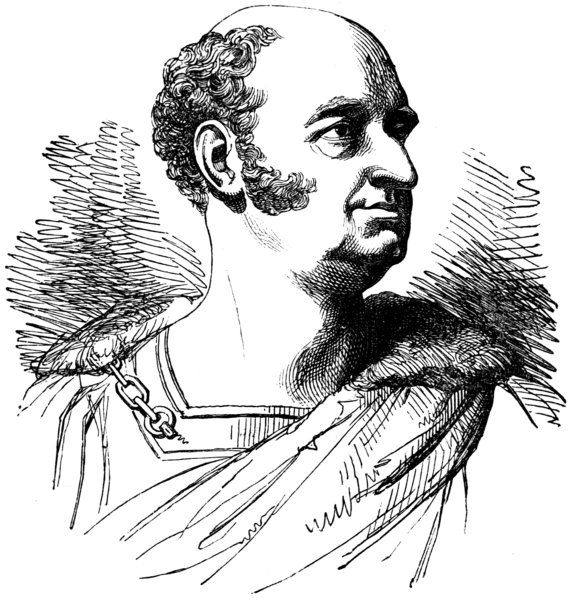
The last Likeness of the Duke of York. (NOW FIRST ENGRAVED) From the Bust by Behnes, executed for His Royal Highness in 1826.
In the rude block aspiring talent sees Its patron’s face, and hews it out with ease; Ere fail’d the royal breath, the marble breath’d, And lives to be by gratitude enwreath’d.
*
Towards the close of the year 1825, the duke of York commenced to sit for this bust at his late residence in the Stable-yard, St. James’s; and, in the summer of 1826, continued to give sittings, till its final completion, at the artist’s house, in Dean-street, Soho. The marble was then removed, for exhibition, to the Royal Academy, and from thence sent home to his royal highness, at Rutland-house. The duke and his royal sister, the princess Sophia, were equally delighted with the true and spirited likeness, and gratified by its possession, as a work of art.
The duke of York, on giving his orders to Mr. Behnes, left entirely to him the arrangement of the figure. With great judgment, and in reference to his royal highness’s distinguished station, the artist has placed armour on the body, and thrown a military cloak over the shoulders. This judicious combination of costume imparts simplicity and breadth to the bust, and assists the manly dignity of the head. The duke’s fine open features bear the frank and good-natured expression they constantly wore in life: the resemblance being minutely faithful, is as just to his royal highness’s exalted and benevolent character, as it is creditable to Mr. Behnes’s execution. The present engraving is a hasty sketch of its general appearance. His royal highness kindly permitted Mr. Behnes to take casts from the sculpture. Of the many, therefore, who experienced the duke of York’s friendship or favour, any one who desires to hold his royal highness’s person in remembrance, has an opportunity of obtaining a fac-simile of the original bust, which is as large as life.
Mr. Behnes was the last artist to whom the duke sat, and, consequently, this is his last likeness. The marble was in the possession of his royal highness during his long illness, and to the moment of his death, in Arlington-street. Its final destination will be appropriated by those to whom he was most attached, and on whom the disposition of such a memorial necessarily devolves.
To the ample accounts of the duke of York in the different journals, the Table Book brings together a few particulars omitted to be collected, preceded by a few notices respecting his royal highness’s title, a correct list of all the dukes of York from their origin, and, first, with an interesting paper by a gentleman who favoured the Every-Day Book with some valuable genealogical communications.
SHAKSPEARE’S DUKES of YORK, &c.
For the Table Book.
The elastic buoyancy of spirits, joined with the rare affability of disposition, which prominently marked the character of the prince whose recent loss we deplore, rendered him the enthusiastic admirer and steady supporter of the English stage. I hope I shall not be taken to task for alluding to a trifling coincidence, on recalling to recollection how largely the mighty master of this department, our immortal Shakspeare, has drawn upon his royal highness’s illustrious predecessors in title, in those unrivalled dramatic sketches which unite the force of genius with the simplicity of nature, whilst they impart to the strictly accurate annals of our national history some of the most vivid illuminations which blaze through the records of our national eloquence.
The touches of a master-hand giving vent to the emanations of a mighty mind are, perhaps, no where more palpably traced, than throughout those scenes of the historical play of Richard II., where Edmund of Langley, duke of York, (son of king Edward III.,) struggles mentally between sentiments of allegiance to his weak and misguided sovereign on the one hand, and, on the other hand, his sense of his other nephew Bolingbroke’s grievous wrongs, and the injuries inflicted on his country by a system of favouritism, profusion, and oppression.
Equal skill and feeling are displayed in the delineation of his son Rutland’s devoted attachment to his dethroned benefactor, and the adroit detection, at a critical moment, of the conspiracy, into which he had entered for Richard’s restoration.
In the subsequent play of Henry V., (perhaps the most heart-stirring of this interesting series,) we learn how nobly this very Rutland (who had succeeded his father, Edmund of Langley, as duke of York) repaid Henry IV.’s generous and unconditional pardon, by his heroic conduct in the glorious field of Agincourt, where he sealed his devotion to his king and country with his blood.
Shakspeare has rendered familiar to us the intricate plans of deep-laid policy, and the stormy scenes of domestic desolation, through which his nephew and successor, Richard, the next duke of York, obtained a glimpse of that throne, to which, according to strictness, he was legitimately entitled just before
“York overlook’d the town of York.”
The licentious indulgence, the hard-hearted selfishness, the reckless cruelty, which history indelibly stamps as the characteristics of his son and successor, Edward, who shortly afterwards seated himself firmly on the throne, are presented to us in colours equally vivid and authentic. The interestingly pathetic detail of the premature extinction in infancy of his second son, prince Richard, whom he had invested with the title of York, is brought before our eyes in the tragedy of Richard III., with a forcible skill and a plaintive energy, which set the proudest efforts of preceding or following dramatic writers at defiance.
To “bluff king Hal,” (who, during the lifetime of his elder brother, Arthur, prince of Wales, had next borne this exclusively royal title of duke of York,) ample justice is rendered, in every point of view, in that production, as eminent for its gorgeous pageantry as for its subdued interest, in which most of our elder readers must have been sufficiently fortunate to witness the transcendant merits of Mrs. Siddons, as Queen Catherine, surpassing even her own accustomed excellence.
Had, contrary to the wonted career of the triumph of human intellect, a Shakspeare enraptured and adorned the next generation, what studies would not the characters and fates of the martyred Charles I., and his misguided son, James II., have afforded to his contemplation. Both these sovereigns, during the lives of their respective elder brothers, bore the title of duke of York.
The counties of York and Lancaster are the only two in England from which the titles conferred have been exclusively enjoyed by princes of the blood royal. It may be safely asserted, that neither of these designations has ever illustrated an individual, who was not either son, brother, grandson, or nephew of the sovereign of this realm.
Richard, duke of York, killed at the battle of Wakefield, may, at first sight, strike the reader as an exception to this assertion, he being only cousin to Henry VI.; but we ought to bear in mind, that this Richard was himself entitled to that throne, of which his eldest son shortly afterwards obtained possession, under the title of Edward IV.
By the treaty of Westphalia, concluded at Munster, in 1648, which put an end to the memorable war that desolated the fairest portion of the civilized world during thirty years, it was stipulated that the bishopric of Osnaburgh, then secularized, should be alternately possessed by a prince of the catholic house of Bavaria, and the protestant house of Brunswick Lunenburgh. It is somewhat remarkable, on the score of dates, that the Bavarian family enjoyed but one presentation between the death of Ernest Augustus, duke of York, in 1728, and the presentation of his great, great, great nephew, the lamented prince whose loss, in 1827, is so deeply and justly deplored.
W. P.
OTHO, EARL OF YORK.
More than five centuries before a prince of the house of Brunswick sat on the British throne, there is a name in the genealogy of the Guelphs connected with the title of York.
Until the time of Gibbon, the learned were inclined to ascribe to Azo, the great patriarch of the house of Este, a direct male descent from Charlemagne: the brilliant result of this able investigator’s researches prove, in Azo’s behalf, four certain lineal ascents, and two others, highly probable,
“——— from the pure well of Italian undefiled.”
Azo, marquis or lord of Tuscany, married Cunegunda, a daughter of a Guelph, who was also sister of a Guelph, and heiress of the last Guelph. The issue of this alliance was Guelph I., who, at a time before titles were well settled, was either duke or count of Altdorff. He was succeeded by his son, Henry the Black, who married Wolfhildis, heiress of Lunenburgh, and other possessions on the Elbe, which descended to their son, Henry the Proud, who wedded Gertrude, the heiress of Saxony, Brunswick, and Hanover. These large domains centered in their eldest son, Henry the Lion, who married Maud, daughter of Henry II., king of England, and, in the conflicts of the times, lost all his possessions, except his allodial territories of Lunenburgh, Brunswick, and Hanover. The youngest son of this marriage was William of Winchester, or Longsword, from whom descended the dukes of Brunswick and Lunenburgh, in Germany, progenitors to the house of Hanover. His elder brother, Otho, is said to have borne the title of York.
This Otho, duke of Saxony, the eldest son of Henry the Lion, and Maud, was afterwards emperor of Germany; but previous to attaining the imperial dignity, he was created earl of York by Richard I., king of England, who, according to some authorities, subsequently exchanged with Otho, and gave him the earldom of Poictou for that of York. Otho’s relation to this kingdom, as earl of York, and grandson of Henry II., is as interesting as his fortunes were remarkable.
The emperor, Henry VI., having died, and left his son, Frederick, an infant three months old, to the care of his brother Philip, duke of Suabia; the minority of Frederick tempted pope Innocent to divest the house of Suabia of the imperial crown, and he prevailed on certain princes to elect Otho, of Saxony, emperor: other princes reelected the infant Frederick. The contention continued between the rival candidates, with repeated elections. Otho, by flattering the clergy, obtained himself to be crowned at Rome, and assumed the title of Otho IV.; but some of his followers having been killed by the Roman citizens he meditated revenge, and instead of returning to Germany, reconquered certain possessions usurped from the empire by the pope. For this violence Otho was excommunicated by the holy father, who turned his influence in behalf of the youthful Frederick, and procured him to be elected emperor instead. Otho had a quarrel with Philip Augustus, king of France, respecting an old wager between them. Philip, neither believing nor wishing that Otho could attain the imperial dignity, had wagered the best city in his kingdom against whichever he should select of Otho’s baggage horses, if he carried his point. After Otho had achieved it, he seriously demanded the city of Paris from Philip, who quite as seriously refused to deliver up his capital. War ensued, and in the decisive battle of Bovines, called the “battle of the spurs,” from the number of knights who perished, Philip defeated Otho at the head of two hundred thousand Germans. The imperial dragon, which the Germans, in their wars, were accustomed to plant on a great armed chariot with a guard chosen from the flower of the army, fell into the hands of the victors, and the emperor himself barely escaped at the hazard of his life. This battle was fought in August, 1215; and Otho, completely vanquished, retreated upon his devotions, and died in 1218, without issue.[31]
The wager, in its consequences so disastrous to the Germans, and so illustrious to the French arms, was made with Philip while Otho was passing through France on his way from the court of England. Collectors of “engraved British portraits,” and the portraits of persons who “come into England,” should look to this. How many illustrated “Grangers” are there with a portrait of Otho IV., earl of York?
THE DUKES OF YORK.
I.
Edmund Plantagenet, surnamed De Langley, from his birth-place, fifth son of king Edward III., was first created earl of Cambridge by his father, and afterwards created duke of York by his nephew, Richard II. He was much influenced by his brother, the duke of Gloucester; and an historian of the period calls him “a soft prince.” It is certain that he had few stirring qualities, and that passive virtues were not valued in an age when they were of little service to contending parties. In 1402, three years after the accession of Henry IV., he died at his manor of Langley, and was interred in the priory there.
II.
Edward Plantagenet, second duke of York, was son of the first duke, grandson to Edward III., and great uncle to Henry V., by whose side he valiantly fought and perished, in the field of Agincourt, October 25, 1415.
III.
Richard Plantagenet, third duke of York, nephew of the second duke, and son of Richard earl of Cambridge, who was executed for treason against Henry V., was restored to his paternal honours by Henry VI., and allowed to succeed to his uncle’s inheritance. As he was one of the most illustrious by descent, so he became one of the most powerful subjects through his dignities and alliances. After the death of the duke of Bedford, the celebrated regent of France, he was appointed to succeed him, and with the assistance of the valorous lord Talbot, afterwards earl of Shrewsbury, maintained a footing in the French territories upwards of five years. The incapacity of Henry VI. incited him to urge his claim to the crown of England in right of his mother, through whom he descended from Philippa, only daughter of the duke of Clarence, second son to Edward III.; whereas the king descended from the duke of Lancaster, third son of that monarch. The duke’s superiority of descent, his valour and mildness in various high employments, and his immense possessions, derived through numerous successions, gave him influence with the nobility, and procured him formidable connections. He levied war against the king, and without material loss slew about five thousand of the royal forces at St. Alban’s, on the 22d of May, 1452. This was the first blood spilt in the fierce and fatal quarrel between the rival houses of York and Lancaster, which lasted thirty years, was signalized by twelve pitched battles, cost the lives of eighty princes of the blood, and almost annihilated the ancient nobility of England. After this battle, the duke’s irresolution, and the heroism of Margaret, queen of Henry VI., caused a suspension of hostilities. The leaders on both sides assented to meet in London, and be solemnly reconciled. The duke of York led the queen in solemn procession to St. Paul’s, and the chiefs of one party marched hand in hand with the chiefs of the other. It was a public demonstration of peace, with secret mutual distrust; and an accident aroused the slumbering strife. One of the king’s retinue insulted one of the earl of Warwick’s; their companions fought, and both parties in every county flew to arms. The battle of Bloreheath, in Staffordshire, 23d September, 1459, was won by the Lancastrians. At the battle of Northampton, 10th July, 1560, the Yorkists had the victory, and the king was taken prisoner. A parliament, summoned in the king’s name, met at Westminster, which the duke of York attended; and, had he then seated himself on the throne in the House of Lords, the deadly feud might have been ended by his being proclaimed king; but his coolness and moderation intimidated his friends, and encouraged his enemies. His personal courage was undoubted, but he was deficient in political courage. The parliament deliberated, and though they declared the duke’s title indefeasible, yet they decided that Henry should retain the crown during life. They provided, however, that till the king’s decease the government should be administered by the duke, as the true and lawful heir of the monarchy; and in this arrangement Richard acquiesced. Meanwhile, queen Margaret, with her infant son, appealed to the barons of the north against the settlement in the south, and collected an army with astonishing celerity. The duke of York hastened with five thousand troops to quell what he imagined to be the beginning of an insurrection, and found, near Wakefield, a force of twenty thousand men. He threw himself into Sandal castle, but with characteristic bravery, imagining he should be disgraced by remaining between walls in fear of a female, he descended onto the plain of Wakefield on the 24th of December, and gave battle to the queen, who largely outnumbering his little army, defeated and slew him; and his son, the earl of Rutland, an innocent youth of seventeen, having been taken prisoner, was murdered in cold blood by the lord de Clifford. Margaret caused the duke’s head to be cut off, and fixed on the gates of the city of York, with a paper crown on it in derision of his claim. He perished in the fiftieth year of his age, worthy of a better fate.
IV.
Edward Plantagenet, fourth duke of York, eldest son of the last, prosecuted his father’s pretensions, and defeated the earl of Pembroke, half brother to Henry VI., at Mortimer’s Cross, in Herefordshire. Shortly afterwards, queen Margaret advanced upon London, and gained a victory over the Yorkists under the earl of Warwick, at the second battle of St. Alban’s, and, at the same time, regained possession of the person of her weak husband. Pressed by the Yorkists, she retreated to the north and the youthful duke, remarkable for beauty of person, bravery, affability, and every popular quality, entered the capital amidst the acclamations of the citizens. Elated by his success, he resolved to openly insist on his claim, and treat his adversaries as rebels and traitors. On the 3d of March, 1460, he caused his army to muster in St. John’s Fields, Clerkenwell; and after an harangue to the multitude surrounding his soldiery, the tumultuary crowd were asked whether they would have Henry of Lancaster, or Edward, eldest son of the late duke of York, for king. Their “sweet voices” were for the latter; and this show of popular election was ratified by a great number of bishops, lords, magistrates, and other persons of distinction, assembled for that purpose at Baynard’s Castle. On the morrow, the duke went to St. Paul’s and offered, and had Te Deum sung, and was with great royalty conveyed to Westminster, and there in the great hall sat in the king’s seat, with St. Edward’s sceptre in his hand. On the 29th of March, 1461, he fought the fierce and bloody battle of Touton, wherein he issued orders to give no quarter, and there were above thirty-six thousand slain. This slaughter confirmed him king of England, and he reigned upwards of twenty years under the title of Edward IV., defiling his fame and power by effeminacy and cruelty. The title of York merged in the royal dignity.
V.
Richard Plantagenet, of Shrewsbury, fifth duke of York, son of Edward IV., was murdered in the tower while young, with his elder brother, Edward V., by order of their uncle, the duke of Gloucester, afterwards Richard III.
VI.
Henry Tudor, sixth duke of York, was so created by his father Henry VII., whom he succeeded as king, under the title of Henry VIII., and stained our annals with heartless crimes.
VII.
Charles Stuart, seventh duke of York, was second son of James I., by whom he was created to that title in 1604, and whom he succeeded in the throne as Charles I.
VIII.
James Stuart, a younger son of Charles I., was the eighth duke of York. While bearing this title during the reign of his brother Charles II., he manifested great personal courage as a naval commander, in several actions with the Dutch. Under the title of James II., he incompetently filled the throne and weakly abdicated it.
IX.
Ernest Augustus Guelph, ninth duke of York, duke of Albany, earl of Ulster, and bishop of Osnaburgh, was brother to George Lewis Guelph, elector of Hanover, and king of England as George I., by letters from whom, in 1716, he was dignified as above, and died in 1728, unmarried.
X.
Edward Augustus, tenth duke of York, duke of Albany, and earl of Ulster, was second son of Frederick prince of Wales, and brother to king George III., by whom he was created to those titles. He died at Monaco, in Italy, September 17, 1767, unmarried.
XI. THE LATE DUKE OF YORK.
Frederick, eleventh Duke of York, was brother of His Majesty King George IV., and second son of his late Majesty King George III., by whom he was advanced to the dignities of Duke of the Kingdom of Great Britain, and of Earl of the Kingdom of Ireland, by the titles of Duke of York and of Albany in Great Britain, and of Earl of Ulster in Ireland, and presented to the Bishopric of Osnaburgh. His Royal Highness was Commander-in-Chief of all the Land Forces of the United Kingdom, Colonel of the First Regiment of Foot Guards, Colonel-in-chief of the 60th Regiment of Infantry, Officiating Grand Master of the Order of the Bath, High Steward of New Windsor, Warden and Keeper of the New Forest Hampshire, Knight of the Garter, Knight of the Order of the Holy Ghost in France, of the Black Eagle in Russia, the Red Eagle in Prussia, of St. Maria Theresa in Austria, of Charles III. in Spain, Doctor of Civil Law, and Fellow or the Royal Society.
The late duke of York was born on the 16th of August, 1763; he died on the 5th of January, 1827. A few miscellaneous memoranda are extracted from journals of the dates they refer to.
The duke of York was sent to Germany to finish his education. On the 1st of August, 1787, his royal highness, after having been only five days on the road from Hanover to Calais, embarked at that port, on board a common packet-boat, for England, and arrived at Dover the same afternoon. He was at St. James’s-palace the following day by half-past twelve o’clock; and, on the arrival of the prince of Wales at Carlton-house, he was visited by the duke, after an absence of four years, which, far from cooling, had increased the affection of the royal brothers.
On the 20th of December, in the same year, a grand masonic lodge was held at the Star and Garter in Pall-mall. The duke of Cumberland as grand-master, the prince of Wales, and the duke of York, were in the new uniform of the Britannic-lodge, and the duke of York received another degree in masonry; he had some time before been initiated in the first mysteries of the brotherhood.
On the 5th of February, 1788, the duke of York appeared in the Court of King’s Bench, and was sworn to give evidence before the grand jury of Middlesex, on an indictment for fraud, in sending a letter to his royal highness, purporting to be a letter from captain Morris, requesting the loan of forty pounds. The grand jury found the indictment, and the prisoner, whose name does not appear, was brought into court by the keeper of Tothill-fields Bridewell, and pleaded not guilty, whereupon he was remanded, and the indictment appointed to be tried in the sittings after the following term; but there is no account of the trial having been had.
In December of the same year, the duke ordered two hundred and sixty sacks of coals to be distributed among the families of the married men of his regiment, and the same to be continued during the severity of the weather.
In 1788, pending the great question of the regency, it was contended on that side of the House of Commons from whence extension of royal prerogative was least expected, that from the moment parliament was made acquainted with the king’s incapacity, a right attached to the prince of Wales to exercise the regal functions, in the name of his father. On the 15th of December, the duke of York rose in the House of Lords, and a profound silence ensued. His royal highness said, that though perfectly unused as he was to speak in a public assembly, yet he could not refrain from offering his sentiments to their lordships on a subject in which the dearest interests of the country were involved. He said, he entirely agreed with the noble lords who had expressed their wishes to avoid any question which tended to induce a discussion on the rights of the prince. The fact was plain, that no such claim of right had been made on the part of the prince; and he was confident that his royal highness understood too well the sacred principles which seated the house of Brunswick on the throne of Great Britain, ever to assume or exercise any power, be his claim what it might, not derived from the will of the people, expressed by their representatives and their lordships in parliament assembled. On this ground his royal highness said, that he must be permitted to hope that the wisdom and moderation of all considerate men, at a moment when temper and unanimity were so peculiarly necessary, on account of the dreadful calamity which every description of persons must in common lament, but which he more particularly felt, would make them wish to avoid pressing a decision, which certainly was not necessary to the great object expected from parliament, and which must be most painful in the discussion to a family already sufficiently agitated and afflicted. His royal highness concluded with saying, that these were the sentiments of an honest heart, equally influenced by duty and affection to his royal father, and attachment to the constitutional rights of his subjects; and that he was confident, if his royal brother were to address them in his place as a peer of the realm, that these were the sentiments which he would distinctly avow.
His majesty in council having declared his consent, under the great seal, to a contract of matrimony between his royal highness the duke of York and her royal highness the princess Frederique Charlotte Ulrique Catherine of Prussia, eldest daughter of the king of Prussia, on the 29th of September, 1791, the marriage ceremony was performed at Berlin. About six o’clock in the afternoon, all the persons of the blood royal assembled in gala, in the apartments of the dowager queen, where the diamond crown was put on the head of princess Frederica. The generals, ministers, ambassadors, and the high nobility, assembled in the white hall. At seven o’clock, the duke of York, preceded by the gentlemen of the chamber, and the court officers of state, led the princess his spouse, whose train was carried by four ladies of the court, through all the parade apartments; after them went the king, with the queen dowager, prince Lewis of Prussia, with the reigning queen, and others of the royal family to the white hall, where a canopy was erected of crimson velvet, and also a crimson velvet sofa for the marriage ceremony. The royal couple placed themselves under the canopy, before the sofa, the royal family stood round them, and the upper counsellor of the consistory, Mr. Sack, made a speech in German. This being over, rings were exchanged; and the illustrious couple, kneeling on the sofa, were married according to the rites of the reformed church. The whole ended with a prayer. Twelve guns, placed in the garden, fired three rounds, and the benediction was given. The new-married couple then received the congratulations of the royal family, and returned in the same manner to the apartments, where the royal family, and all persons present, sat down to card-tables; after which, the whole court, the high nobility, and the ambassadors, sat down to supper, at six tables. The first was placed under a canopy of crimson velvet, and the victuals served in gold dishes and plates. The other five tables, at which sat the generals, ministers, ambassadors, all the officers of the court, and the high nobility, were served in other apartments.
During supper, music continued playing in the galleries of the first hall, which immediately began when the company entered the hall. At the dessert, the royal table was served with a beautiful set of china, made in the Berlin manufactory. Supper being over, the whole assembly repaired to the white hall, where the trumpet, timbrel, and other music were playing; and the flambeau dance was begun, at which the ministers of state carried the torches. With this ended the festivity. The ceremony of the re-marriage of the duke and duchess of York took place at the Queen’s Palace, London, on the 23d of November.
The duchess of York died on the 6th of August, 1820.
The Dance of Torches.
As a note of illustration on this dance at the Prussian nuptials of the duke and duchess of York, reference may be had to a slight mention of the same observance on the marriage of the prince royal of Prussia with the princess of Bavaria, in the Every-Day Book, vol. i. p. 1551. Since that article, I find more descriptive particulars of it in a letter from baron Bielfeld, giving an account of the marriage of the prince of Prussia with the princess of Brunswick Wolfenbuttle, at Berlin, in 1742. The baron was present at the ceremonial.
“As soon as their majesties rose from table, the whole company returned into the white hall; from whence the altar was removed, and the room was illuminated with fresh wax lights. The musicians were placed on a stage of solid silver. Six lieutenant generals, and six ministers of state, stood, each with a white wax torch in his hand, ready to be lighted, in conformity to a ceremony used in the German courts on these occasions, which is called ‘the dance of torches,’ in allusion to the torch of Hymen. This dance was opened by the new married prince and princess, who made the tour of the hall, saluting the king and the company. Before them went the ministers and the generals, two and two, with their lighted torches. The princess then gave her hand to the king, and the prince to the queen; the king gave his hand to the queen mother, and the reigning queen to prince Henry; and in this manner all the princes and princesses that were present, one after the other, and according to their rank, led up the dance, making the tour of the hall, almost in the step of the Polognese. The novelty of this performance, and the sublime quality of the performers, made it in some degree agreeable. Otherwise the extreme gravity of the dance itself, with the continual round and formal pace of the dancers, the frequent going out of the torches, and the clangour of the trumpets that rent the ear, all these I say made it too much resemble the dance of the Sarmates, those ancient inhabitants of the prodigious woods of this country.”
On the 7th of June, 1794, about four o’clock in the morning, a fire broke out at the duke of York’s palace at Oatlands. It began in the kitchen, and was occasioned by a beam which projected into the chimney, and communicated to the roof. His royal highness’s armoury was in that wing of the building where the fire commenced, in which forty pounds of gunpowder being deposited, a number of most curious war-like instruments, which his royal highness had collected on the continent, were destroyed. Many of the guns and other weapons were presented from the king of Prussia, and German officers of distinction, and to each piece was attached its history. By the seasonable exertions of the neighbourhood, the flames were prevented from spreading to the main part of the building. The duchess was at Oatlands at the time, and beheld the conflagration from her sleeping apartment, in the centre of the mansion, from which the flames were prevented communicating by destroying a gateway, over the wing that adjoined to the house. Her royal highness gave her orders with perfect composure, directed abundant refreshment to the people who were extinguishing the flames, and then retired to the rooms of the servants at the stables, which are considerably detached from the palace. His majesty rode over from Windsor-castle to visit her royal highness, and staid with her a considerable time.
On the 8th of April, 1808, whilst the duke of York was riding for an airing along the King’s-road towards Fulham, a drover’s dog crossed, and barked in front of the horse. The animal, suddenly rearing, fell backwards, with the duke under him; and the horse rising, with the duke’s foot in the stirrup, dragged him along, and did him further injury. When extricated, the duke, with great cheerfulness, denied he was much hurt, yet two of his ribs were broken, the back of his head and face contused, and one of his legs and arms much bruised. A gentleman in a hack chaise immediately alighted, and the duke was conveyed in it to York-house, Piccadilly, where his royal highness was put to bed, and in due time recovered to the performance of his active duties.
On the 6th of August, 1815, the duke of York, on coming out of a shower-bath, at Oatlands, fell, from the slippery state of the oilcloth, and broke the large bone of his left arm, half way between the shoulder and the elbow-joint. His royal highness’s excellent constitution at that time assisted the surgeons, and in a fortnight he again attended to business.
On the 11th of October, in the same year, his royal highness’s library, at his office in the Horse-guards consisting of the best military authors, and a very extensive collection of maps, were removed to his new library (late her majesty’s) in the Green-park. The assemblage is the most perfect collection of works on military affairs in the kingdom.
It appears, from the report of the commissioners of woods, forests, and land revenues, in 1816, that the duke of York purchased of the commissioners the following estates: 1. The manor of Byfleet and Weybridge, with Byfleet or Weybridge-park, and a capital messuage and offices, and other messuages and buildings there. 2. The manor of Walton Leigh, and divers messuages and lands therein. 3. A capital messuage called Brooklands, with offices, gardens, and several parcels of land, situated at Weybridge. 4. A farm-house, and divers lands, called Brooklands-farm, at Weybridge. 5. A messuage and lands, called Childs, near Weybridge. 6. Two rabbit-warrens within the manor of Byfleet and Weybridge. To this property was to be added all lands and premises allotted to the preceding by virtue of any act of enclosure. The sale was made to his royal highness in May, 1809, at the price of £74,459. 3s.; but the money was permitted to remain at the interest of 31⁄2 per cent. till the 10th of June, 1815, when the principal and interest (amounting, after the deduction of property-tax, and of the rents, which, during the interval, had been paid to the crown, to £85,135. 5s. 9d.) were paid into the Bank of England, to the account of the commissioners for the new street. His royal highness also purchased about twenty acres of land in Walton, at the price of £1294. 2s. 3d.
While the duke was in his last illness, members on both sides of the House of Commons bore spontaneous testimony to his royal highness’s impartial administration of his high office as commander-in-chief; and united in one general expression, that no political distinction ever interfered to prevent the promotion of a deserving officer.
A statement in bishop Watson’s Memoirs, is a tribute to his royal highness’s reputation.
“On the marriage of my son in August, 1805, I wrote,” says the bishop, “to the duke of York, requesting his royal highness to give him his protection. I felt a consciousness of having, through life, cherished a warm attachment to the house of Brunswick, and to those principles which had placed it on the throne, and of having on all occasions acted an independent and honourable part towards the government of the country, and I therefore thought myself justified in concluding my letter in the following terms:—‘I know not in what estimation your royal highness may hold my repeated endeavours, in moments of danger, to support the religion and the constitution of the country; but if I am fortunate enough to have any merit with you on that score, I earnestly request your protection for my son. I am a bad courtier, and know little of the manner of soliciting favours through the intervention of others, but I feel that I shall never know how to forget them, when done to myself; and, under that consciousness, I beg leave to submit myself
‘Your Royal Highness’s ‘Most grateful servant, ‘R. Landaff.’
“I received a very obliging answer by the return of the post, and in about two months my son was promoted, without purchase, from a majority to a lieutenant-colonelcy in the Third Dragoon Guards. After having experienced, for above twenty-four years, the neglect of his majesty’s ministers, I received great satisfaction from this attention of his son, and shall carry with me to my grave a most grateful memory of his goodness. I could not at the time forbear expressing my acknowledgment in the following letter, nor can I now forbear inserting it in these anecdotes. The whole transaction will do his royal highness no discredit with posterity, and I shall ever consider it as an honourable testimony of his approbation of my public conduct.
‘Calgarth Park, Nov. 9, 1805.’
——— ‘Do, my lord of Canterbury, But one good turn, and he’s your friend for ever.’
‘Thus Shakspeare makes Henry VIII. speak of Cranmer; and from the bottom of my heart, I humbly entreat your royal highness to believe, that the sentiment is as applicable to the bishop of Landaff as it was to Cranmer.
‘The bis dat qui cito dat has been most kindly thought of in this promotion of my son; and I know not which is most dear to my feelings, the matter of the obligation, or the noble manner of its being conferred. I sincerely hope your royal highness will pardon this my intrusion, in thus expressing my most grateful acknowledgments for them both.
‘R. Landaff.’”
Mr. Charles Lamb. To the Editor.
Dear Sir,
It is not unknown to you, that about sixteen years since I published “Specimens of English Dramatic Poets, who lived about the Time of Shakspeare.” For the scarcer Plays I had recourse to the Collection bequeathed to the British Museum by Mr. Garrick. But my time was but short, and my subsequent leisure has discovered in it a treasure rich and exhaustless beyond what I then imagined. In it is to be found almost every production in the shape of a Play that has appeared in print, from the time of the old Mysteries and Moralities to the days of Crown and D’Urfey. Imagine the luxury to one like me, who, above every other form of Poetry, have ever preferred the Dramatic, of sitting in the princely apartments, for such they are, of poor condemned Montagu House, which I predict will not speedily be followed by a handsomer, and culling at will the flower of some thousand Dramas. It is like having the range of a Nobleman’s Library, with the Librarian to your friend. Nothing can exceed the courteousness and attentions of the Gentleman who has the chief direction of the Reading Rooms here; and you have scarce to ask for a volume, before it is laid before you. If the occasional Extracts, which I have been tempted to bring away, may find an appropriate place in your Table Book, some of them are weekly at your service. By those who remember the “Specimens,” these must be considered as mere after-gleanings, supplementary to that work, only comprising a longer period. You must be content with sometimes a scene, sometimes a song; a speech, or passage, or a poetical image, as they happen to strike me. I read without order of time; I am a poor hand at dates; and for any biography of the Dramatists, I must refer to writers who are more skilful in such matters. My business is with their poetry only.
Your well-wisher, C. Lamb.
January, 27, 1827.
Garrick Plays. No. I.
[From “King John and Matilda,” a Tragedy by Robert Davenport, acted in 1651.]
John, not being able to bring Matilda, the chaste daughter of the old Baron Fitzwater, to compliance with his wishes, causes her to be poisoned in a nunnery.
Scene. John. The Barons: they being as yet ignorant of the murder, and having just come to composition with the King after tedious wars. Matilda’s hearse is brought in by Hubert.
John. Hubert, interpret this apparition. Hubert. Behold, sir, A sad-writ Tragedy, so feelingly Languaged, and cast; with such a crafty cruelty Contrived, and acted; that wild savages Would weep to lay their ears to, and (admiring To see themselves outdone) they would conceive Their wildness mildness to this deed, and call Men more than savage, themselves rational. And thou, Fitzwater, reflect upon thy name,[32] And turn the Son of Tears. Oh, forget That Cupid ever spent a dart upon thee; That Hymen ever coupled thee; or that ever The hasty, happy, willing messenger Told thee thou had’st a daughter. Oh look here! Look here, King John, and with a trembling eye Read your sad act, Matilda’s tragedy. Barons. Matilda! Fitzwater. By the lab’ring soul of a much-injured man, It is my child Matilda! Bruce. Sweet niece! Leicester. Chaste soul! John. Do I stir, Chester? Good Oxford, do I move? stand I not still To watch when the griev’d friends of wrong’d Matilda Will with a thousand stabs turn me to dust, That in a thousand prayers they might be happy? Will no one do it? then give a mourner room, A man of tears. Oh immaculate Matilda, These shed but sailing heat-drops, misling showers The faint dews of a doubtful April morning; But from mine eyes ship-sinking cataracts, Whole clouds of waters, wealthy exhalations, Shall fall into the sea of my affliction, Till it amaze the mourners. Hubert. Unmatch’d Matilda; Celestial soldier, that kept a fort of chastity ’Gainst all temptations. Fitzwater. Not to be a Queen, Would she break her chaste vow. Truth crowns your reed; Unmatch’d Matilda was her name indeed. John. O take into your spirit-piercing praise My scene of sorrow. I have well-clad woes, Pathetic epithets to illustrate passion, And steal true tears so sweetly from all these, Shall touch the soul, and at once pierce and please. [Peruses the Motto and Emblems on the hearse. “To Piety and Purity”—and “Lillies mix’d with Roses”— How well you have apparell’d woe! this Pendant, To Piety and Purity directed, Insinuates a chaste soul in a clean body, Virtue’s white Virgin, Chastity’s red Martyr! Suffer me then with this well-suited wreath To make our griefs ingenious. Let all be dumb, Whilst the king speaks her Epicedium. Chester. His very soul speaks sorrow. Oxford. And it becomes him sweetly. John. Hail Maid and Martyr! lo on thy breast, Devotion’s altar, chaste Truth’s nest, I offer (as my guilt imposes) Thy merit’s laurel, Lillies and Roses; Lillies, intimating plain Thy immaculate life, stuck with no stain; Roses red and sweet, to tell How sweet red sacrifices smell. Hang round then, as you walk about this hearse, The songs of holy hearts, sweet virtuous verse. Fitzwater. Bring Persian silks, to deck her monument; John. Arabian spices, quick’ning by their scent; Fitzwater. Numidian marble, to preserve her praise, John. Corinthian ivory, her shape to praise: Fitzwater. And write in gold upon it, In this breast Virtue sate mistress, Passion but a guest. John. Virtue is sweet; and, since griefs bitter be, Strew her with roses, and give rue to me. Bruce. My noble brother, I’ve lost a wife and son;[33] You a sweet daughter. Look on the king’s penitence; His promise for the public peace. Prefer A public benefit.[34] When it shall please, Let Heaven question him. Let us secure And quit the land of Lewis.[35] Fitzwater. Do any thing; Do all things that are honorable; and the Great King Make you a good king, sir! and when your soul Shall at any time reflect upon your follies, Good King John, weep, weep very heartily; It will become you sweetly. At your eyes Your sin stole in; there pay your sacrifice. John. Back unto Dunmow Abbey. There we’ll pay To sweet Matilda’s memory, and her sufferings, A monthly obsequy, which (sweet’ned by The wealthy woes of a tear-troubled eye) Shall by those sharp afflictions of my face Court mercy, and make grief arrive at grace.
Song.
Matilda, now go take thy bed In the dark dwellings of the dead; And rise in the great waking day Sweet as incence, fresh as May. Rest there, chaste soul, fix’d in thy proper sphere, Amongst Heaven’s fair ones; all are fair ones there. Rest there, chaste soul, whilst we here troubled say: Time gives us griefs, Death takes our joys away.
This scene has much passion and poetry in it, if I mistake not. The last words of Fitzwater are an instance of noble temperament; but to understand him, the character throughout of this mad, merry, feeling, insensible-seeming lord, should be read. That the venomous John could have even counterfeited repentance so well, is out of nature; but supposing the possibility, nothing is truer than the way in which it is managed. These old playwrights invested their bad characters with notions of good, which could by no possibility have coexisted with their actions. Without a soul of goodness in himself, how could Shakspeare’s Richard the Third have lit upon those sweet phrases and inducements by which he attempts to win over the dowager queen to let him wed her daughter. It is not Nature’s nature, but Imagination’s substituted nature, which does almost as well in a fiction.
(To be continued.)
Literature.
Glances at New Books on my Table.
“Constable’s Miscellany of original and selected Publications” is proposed to consist of various works on important and popular subjects, with the view of supplying certain chasms in the existing stock of useful knowledge; and each author or subject is to be kept separate, so as to enable purchasers to acquire all the numbers, or volumes, of each book, distinct from the others. The undertaking commenced in the first week of the new year, 1827, with the first number of Captain Basil Hall’s voyage to Loo-Choo, and the complete volume of that work was published at the same time.
“Early Metrical Tales, including the History of Sir Egeir, Sir Gryme, and Sir Gray-Steill.” Edinb. 1826. sm. 8vo. 9s. (175 copies printed.) The most remarkable poem in this elegant volume is the rare Scottish romance, named in the title-page, which, according to its present editor, “would seem, along with the poems of sir David Lindsay, and the histories of Robert the Bruce, and of sir William Wallace, to have formed the standard productions of the vernacular literature of the country.” In proof of this he adduces several authorities; “and yet it is remarkable enough, that every ancient copy should have hitherto eluded the most active and unremitting research.” The earliest printed edition is presumed to have issued from the press of Thomas Bassandyne, “the first printer of the sacred Scriptures in Scotland.” An inventory of his goods, dated 18th October, 1577, contains an item of three hundred “Gray Steillis,” valued at the “pece VId. summa £VII. x. o.” Its editor would willingly give the sum-total of these three hundred copies for “one of the said Gray-Steillis, were he so fortunate as to meet with it.” He instances subsequent editions, but the only copy he could discover was printed at Aberdeen in 1711, by James Nicol, printer to the town and university; and respecting this, which, though of so recent date, is at present unique, “the editor’s best acknowledgments are due to his friend, Mr. Douce, for the kind manner in which he favoured him with the loan of the volume, for the purpose of republication.” On the 17th of April, 1497, when James IV. was at Stirling: there is an entry in the treasurer’s accounts, “Item, that samyn day to twa Sachelaris that sang Gray Steil to the King, IXs.” In MS. collections made at Aberdeen in 1627, called a “Booke for the Lute,” by Robert Gordon, is the air of “Gray-Steel;” and a satirical poem in Scottish rhyme on the marquis of Argyle, printed in 1686, is “appointed to be sung according to the tune of old Gray Steel.” These evidences that the poem was sung, manifest its popularity. There are conjectures as to who the person denominated Sir Gray Steel really was, but the point is undetermined.
In this volume there are thirteen poems. 1. Sir Gray-Steill above spoken of. 2. The Tales of the Priests of Peblis, wherein the three priests of Peebles, having met to regale on St. Bride’s day, agree, each in turn, to relate a story. 3. Ane Godlie Dreame, by lady Culross. 4. History of a Lord and his three Sons, much resembling the story of Fortunatus. 5. The Ring of the Roy Robert, the printed copies of which have been modernized and corrupted. 6. King Estmere, an old romantic tale. 7. The Battle of Harlaw, considered by its present editor “as the original of rather a numerous class of Scotish historical ballads.” 8. Lichtoun’s Dreme, printed for the first time from the Bannatyne MS. 1568. 9. The Murning Maiden, a poem “written in the Augustan age of Scotish poetry.” 10. The Epistill of the Hermeit of Alareit, a satire on the Grey Friers, by Alexander earl of Glencairn. 11. Roswall and Lillian, a “pleasant history,” (chanted even of late in Edinburgh,) from the earliest edition discovered, printed in 1663, of which the only copy known is in the Advocates’ Library, from the Roxburghe sale. 12. Poem by Glassinberry, a name for the first time introduced into the list of early Scotish poets, and the poem itself printed from “Gray’s MS.” 13. Sir John Barleycorn, from a stall-copy printed in 1781, with a few corrections, concerning which piece it is remarked, that Burns’s version “cannot be said to have greatly improved it.” There is a vignette to this ballad, “designed and etched by the ingenious young artist, W. Geikie,” of Edinburgh, from whence I take the liberty to cut a figure, not for the purpose of conveying an idea of this “Allan-a-Maut,” who is surrounded with like “good” company by Mr. Geikie’s meritorious pencil, but to extend the knowledge of Mr. Geikie’s name, who is perfectly unknown to me, except through the single print I refer to, which compels me to express warm admiration of his correct feeling, and assured talent.
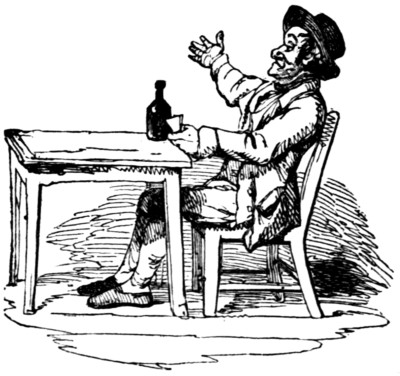
Besides Mr. Geikie’s beautiful etching, there is a frontispiece by W. H. Lizars from a design by Mr. C. Kirkpatrick Sharpe, and a portrait of Alexander earl of Eglintoune 1670, also by Mr. Lizars, from a curiously illuminated parchment in the possession of the present earl.
SAYING NOT MEANING. By William Basil Wake. For the Table Book.
Two gentlemen their appetite had fed, When, opening his toothpick-case, one said, “It was not until lately that I knew That anchovies on terrâ firmâ grew.” “Grew!” cried the other, “yes, they grow, indeed, Like other fish, but not upon the land; You might as well say grapes grow on a reed, Or in the Strand!” “Why, sir,” return’d the irritated other, “My brother, When at Calcutta, Beheld them bonâ fide growing; He wouldn’t utter A lie for love or money, sir; so in This matter you are thoroughly mistaken.” “Nonsense, sir! nonsense! I can give no credit To the assertion—none e’er saw or read it; Your brother, like his evidence, should be shaken.” “Be shaken, sir! let me observe, you are Perverse—in short—” “Sir,” said the other, sucking his cigar, And then his port— “If you will say impossibles are true, You may affirm just any thing you please— That swans are quadrupeds, and lions blue, And elephants inhabit Stilton cheese! Only you must not force me to believe What’s propagated merely to deceive.” “Then you force me to say, sir, you’re a fool,” Return’d the bragger. Language like this no man can suffer cool; It made the listener stagger; So, thunder-stricken, he at once replied, “The traveller lied Who had the impudence to tell it you.” “Zounds! then d’ye mean to swear before my face That anchovies don’t grow like cloves and mace?” “I do!” Disputants often after hot debates Leave the contention as they found it—bone, And take to duelling, or thumping têtes; Thinking, by strength of artery, to atone For strength of argument; and he who winces From force of words, with force of arms convinces! With pistols, powder, bullets, surgeons, lint, Seconds, and smelling-bottles, and foreboding, Our friends advanced; and now portentous loading (Their hearts already loaded) serv’d to show It might be better they shook hands—but no; When each opines himself, though frighten’d, right, Each is, in courtesy, oblig’d to fight! And they did fight: from six full measured paces The unbeliever pull’d his trigger first; And fearing, from the braggart’s ugly faces, The whizzing lead had whizz’d its very worst, Ran up, and with a duelistic tear, (His ire evanishing like morning vapours,) Found him possess’d of one remaining ear, Who, in a manner sudden and uncouth, Had given, not lent, the other ear to truth: For, while the surgeon was applying lint, He, wriggling, cried—“The deuce is in’t— Sir! I meant—capers!”
Characters.
THE OLD GENTLEMAN.
Our old gentleman, in order to be exclusively himself, must be either a widower or a bachelor. Suppose the former. We do not mention his precise age, which would be invidious;—nor whether he wears his own hair or a wig; which would be wanting in universality. If a wig, it is a compromise between the more modern scratch and the departed glory of the toupee. If his own hair, it is white, in spite of his favourite grandson, who used to get on the chair behind him, and pull the silver hairs out, ten years ago. If he is bald at top, the hair-dresser, hovering and breathing about him like a second youth, takes care to give the bald place as much powder as the covered; in order that he may convey, to the sensorium within, a pleasing indistinctness of idea respecting the exact limits of skin and hair. He is very clean and neat; and in warm weather is proud of opening his waistcoat half way down, and letting so much of his frill be seen; in order to show his hardiness as well as taste. His watch and shirt-buttons are of the best; and he does not care if he has two rings on a finger. If his watch ever failed him at the club or coffee-house, he would take a walk every day to the nearest clock of good character, purely to keep it right. He has a cane at home, but seldom uses it, on finding it out of fashion with his elderly juniors. He has a small cocked hat for gala days, which he lifts higher from his head than the round one, when made a bow to. In his pockets are two handkerchiefs, (one for the neck at night-time,) his spectacles, and his pocket-book. The pocket-book, among other things, contains a receipt for a cough, and some verses cut out of an odd sheet of an old magazine, on the lovely duchess of A., beginning—
When beauteous Mira walks the plain.
He intends this for a common-place book which he keeps, consisting of passages in verse and prose cut out of newspapers and magazines, and pasted in columns; some of them rather gay. His principal other books are Shakspeare’s Plays and Milton’s Paradise Lost; the Spectator, the History of England; the works of Lady M. W. Montague, Pope, and Churchill; Middleton’s Geography, the Gentleman’s Magazine; Sir John Sinclair on Longevity; several plays with portraits in character; Account of Elizabeth Canning, Memoirs of George Ann Bellamy, Poetical Amusements at Bath-Easton, Blair’s Works, Elegant Extracts; Junius as originally published; a few pamphlets on the American War and Lord George Gordon, &c. and one on the French Revolution. In his sitting rooms are some engravings from Hogarth and Sir Joshua; an engraved portrait of the Marquis of Granby; ditto of M. le Comte de Grasse surrendering to Admiral Rodney; a humorous piece after Penny; and a portrait of himself, painted by Sir Joshua. His wife’s portrait is in his chamber, looking upon his bed. She is a little girl, stepping forward with a smile and a pointed toe, as if going to dance. He lost her when she was sixty.
The Old Gentleman is an early riser, because he intends to live at least twenty years longer. He continues to take tea for breakfast, in spite of what is said against its nervous effects; having been satisfied on that point some years ago by Dr. Johnson’s criticism on Hanway, and a great liking for tea previously. His china cups and saucers have been broken since his wife’s death, all but one, which is religiously kept for his use. He passes his morning in walking or riding, looking in at auctions, looking after his India bonds or some such money securities, furthering some subscription set on foot by his excellent friend sir John, or cheapening a new old print for his portfolio. He also hears of the newspapers; not caring to see them till after dinner at the coffee-house. He may also cheapen a fish or so; the fishmonger soliciting his doubting eye as he passes, with a profound bow of recognition. He eats a pear before dinner.
His dinner at the coffee-house is served up to him at the accustomed hour, in the old accustomed way, and by the accustomed waiter. If William did not bring it, the fish would be sure to be stale, and the flesh new. He eats no tart; or if he ventures on a little, takes cheese with it. You might as soon attempt to persuade him out of his senses, as that cheese is not good for digestion. He takes port; and if he has drank more than usual, and in a more private place, may be induced by some respectful inquiries respecting the old style of music, to sing a song composed by Mr. Oswald or Mr. Lampe, such as—
Chloe, by that borrowed kiss,
or
Come, gentle god of soft repose;
or his wife’s favourite ballad, beginning—
At Upton on the Hill There lived a happy pair.
Of course, no such exploit can take place in the coffee-room; but he will canvass the theory of that matter there with you, or discuss the weather, or the markets, or the theatres, or the merits of “my lord North” or “my lord Rockingham;” for he rarely says simply, lord; it is generally “my lord,” trippingly and genteelly off the tongue. If alone after dinner, his great delight is the newspaper; which he prepares to read by wiping his spectacles, carefully adjusting them on his eyes, and drawing the candle close to him, so as to stand sideways betwixt his ocular aim and the small type. He then holds the paper at arm’s length, and dropping his eyelids half down and his mouth half open, takes cognizance of the day’s information. If he leaves off, it is only when the door is opened by a new comer, or when he suspects somebody is over-anxious to get the paper out of his hand. On these occasions, he gives an important hem! or so; and resumes.
In the evening, our Old Gentleman is fond of going to the theatre, or of having a game of cards. If he enjoy the latter at his own house or lodgings, he likes to play with some friends whom he has known for many years; but an elderly stranger may be introduced, if quiet and scientific; and the privilege is extended to younger men of letters; who, if ill players, are good losers. Not that he is a miser; but to win money at cards is like proving his victory by getting the baggage; and to win of a younger man is a substitute for his not being able to beat him at rackets. He breaks up early, whether at home or abroad.
At the theatre, he likes a front row in the pit. He comes early, if he can do so without getting into a squeeze, and sits patiently waiting for the drawing up of the curtain, with his hands placidly lying one over the other on the top of his stick. He generously admires some of the best performers, but thinks them far inferior to Garrick, Woodward, and Clive. During splendid scenes, he is anxious that the little boy should see.
He has been induced to look in at Vauxhall again, but likes it still less than he did years back, and cannot bear it in comparison with Ranelagh. He thinks every thing looks poor, flaring, and jaded. “Ah!” says he, with a sort of triumphant sigh, “Ranelagh was a noble place! Such taste, such elegance, such beauty! There was the duchess of A. the finest woman in England, sir; and Mrs. L., a mighty fine creature; and lady Susan what’s her name, that had that unfortunate affair with sir Charles. Sir, they came swimming by you like the swans.”
The Old Gentleman is very particular in having his slippers ready for him at the fire, when he comes home. He is also extremely choice in his snuff, and delights to get a fresh box-full at Gliddon’s, in King-street, in his way to the theatre. His box is a curiosity from India. He calls favourite young ladies by their Christian names, however slightly acquainted with them; and has a privilege also of saluting all brides, mothers, and indeed every species of lady on the least holiday occasion. If the husband for instance has met with a piece of luck, he instantly moves forward, and gravely kisses the wife on the cheek. The wife then says, “My niece, sir, from the country;” and he kisses the niece. The niece, seeing her cousin biting her lips at the joke, says, “My cousin Harriet, sir;” and he kisses the cousin. He never recollects such weather, except during the great frost, or when he rode down with Jack Skrimshire to Newmarket. He grows young again in his little grand-children, especially the one which he thinks most like himself; which is the handsomest. Yet he likes best perhaps the one most resembling his wife; and will sit with him on his lap, holding his hand in silence, for a quarter of an hour together. He plays most tricks with the former, and makes him sneeze. He asks little boys in general who was the father of Zebedee’s children. If his grandsons are at school, he often goes to see them; and makes them blush by telling the master or the upper-scholars, that they are fine boys, and of a precocious genius. He is much struck when an old acquaintance dies, but adds that he lived too fast; and that poor Bob was a sad dog in his youth; “a very sad dog, sir, mightily set upon a short life and a merry one.”
When he gets very old indeed, he will sit for whole evenings, and say little or nothing; but informs you, that there is Mrs. Jones (the housekeeper),—“She’ll talk.”—Indicator.
A HAPPY MEETING.
And doth not a meeting like this make amends For all the long years I’ve been wand’ring away? To see thus around me my youth’s early friends, As smiling and kind as in that happy day! Though haply o’er some of your brows, as o’er mine, The snow-fall of time may be stealing—what then Like Alps in the sunset, thus lighted by wine, We’ll wear the gay tinge of youth’s roses again. What soften’d remembrances come o’er the heart, In gazing on those we’ve been lost to so long! The sorrows, the joys, of which once they were part Still round them, like visions of yesterday, throng, As letters some hand hath invisibly traced, When held to the flame will steal out on the sight, So many a feeling, that long seem’d effaced, The warmth of a meeting like this brings to light. And thus, as in memory’s bark, we shall glide To visit the scenes of our boyhood anew, Tho’ oft we may see, looking down on the tide, The wreck of full many a hope shining through— Yet still, as in fancy we point to the flowers That once made a garden of all the gay shore, Deceiv’d for a moment, we’ll think them still ours, And breath the fresh air of life’s morning once more So brief our existence, a glimpse, at the most, Is all we can have of the few we hold dear; And oft even joy is unheeded and lost, For want of some heart that could echo it near. Ah! well may we hope, when this short life is gone, To meet in some world of more permanent bliss, For a smile, or a grasp of the hand, hast’ning on, Is all we enjoy of each other in this. But come—the more rare such delights to the heart, The more we should welcome, and bless them the more— They’re ours when we meet—they’re lost when we part, Like birds that bring summer, and fly when ’tis o’er, Thus circling the cup, hand in hand, ere we drink, Let Sympathy pledge us, thro’ pleasure thro’ pain, That fast as a feeling but touches one link, Her magic shall send it direct through the chain.
Lines to his Cousin ON THE NEW YEAR, By a Westminster Boy.
Time rolls away! another year Has rolled off with him; hence ’tis clear His lordship keeps his carriage A single man, no doubt;—and thus Enjoys himself without the fuss And great expense of marriage. His wheel still rolls (and like the river Which Horace mentions) still for ever Volvitur et volvetur. In vain you run against him; place your fleetest filly in the race,— Here’s ten to one he’ll beat her. Of all he sees, he takes a tithe, With that tremendous sweeping scythe, Which he keeps always going; While every step he takes, alas! Too plainly proves that flesh is grass, When he sets out a mowing. And though his hungry ravenous maw Is crammed with food, both dress’d and raw, I’ll wager any betting, His appetite has ever been Just like his scythe, sharp-set and keen, Which never wanted whetting. Could you but see the mighty treat Prepared, when he sits down to eat His breakfast or his dinner,—ah, Not vegetable—flesh,—alone, But timber, houses, iron, stone, He eats the very china. When maidens pray that he will spare Their teeth, complexion, or their hair, Alas! he’ll never hear ’em; Grey locks and wrinkles hourly show, What Ovid told us years ago, Ut Tempus edax rerum! In vain, my dearest girl, you choose (Your face to wash) Olympic dews; In vain you paint or rouge it; He’ll play such havoc with your youth, That ten years hence you’ll say with truth Ah Edward!—Tempus fugit! The glass he carries in his hand Has ruin in each grain of sand; But what I most deplore is, He breaks the links of friendship’s chain, And barters youthful love for gain: Oh, Tempora! oh, Mores! One sole exception you shall find, (Unius generis of its kind,) Wherever fate may steer us; Tho’ wide his universal range, Time has no power the heart to change Of your Amicus Verus.
Bath Herald.
GERMAN UNIVERSITIES.
Germany, which embraces a population of thirty-six millions of people, has twenty-two universities. The following table contains their names according to the order of their foundation, and the number of professors and students:
Universities. When founded. Number of Pro- fessors. Number of Students.
Prague 1348 55 1449
Vienna 1365 77 1688
Heidelberg 1368 55 626
Warsbourg 1403 31 660
Leipsig 1409 81 1384
Rostock 1419 34 201
Fribourg 1450 35 556
Griefswald 1456 30 227
Bâle 1460 24 214
Tubingen 1477 44 827
Marbourg 1527 38 304
Kœnisberg 1544 23 303
Jena 1558 51 432
Giessen 1607 39 371
Kiel 1665 26 238
Halle 1694 64 1119
Breslau 1702 49 710
Gœttengen 1734 89 1545
Erlangen 1743 34 498
Landshut 1803 48 623
Berlin 1810 86 1245
Bonn 1818 42 526
Of this number six belong to Prussia, three to Bavaria, two to the Austrian States, two to the Grand Duchy of Baden, two to the Electorate of Hesse-Cassel, and one to each of the following states—Saxony, Wurtemberg, Denmark, Hanover, the Grand Duchies of Mecklenbergh-Schweren and of Saxe-Weimar, and Switzerland. The total number of professors is 1055, embracing not only the ordinary and extraordinary professors, but also the private lecturers, whose courses of reading are announced in the half-yearly programmes. Catholic Germany, which reckons nineteen millions of inhabitants, has only six universities; while Protestant Germany, for seventeen millions of inhabitants, has seventeen. Of the students there are 149 for every 250,000 in the Protestant states, while there are only 68 for the same number in the Catholic states. It must, however, be mentioned, that this estimate does not take in those Catholic ecclesiastics who do not pursue their studies in the universities, but in private seminaries.—The universities of Paderborn and Munster, both belonging to Prussia, and which had only two faculties, those of theology and philosophy, were suppressed; the first in 1818, and the second in 1819; but that of Munster has been reestablished, with the three faculties of theology, philosophy, and medicine.