Volume 1 — Vol. I.—14.
Reading edition
Elvet Bridge, Durham.
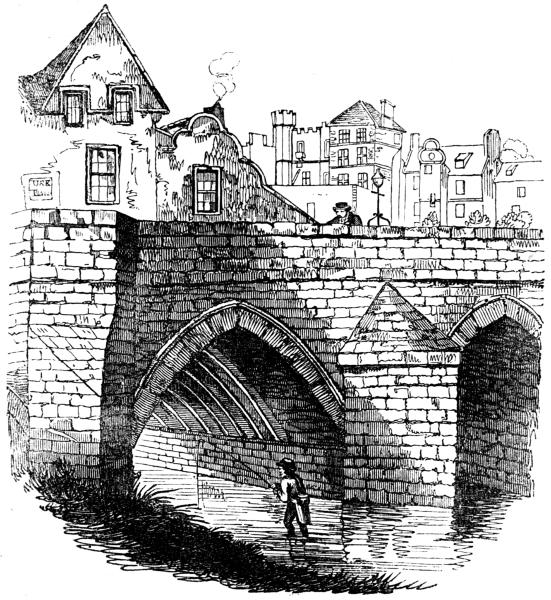
Elvet Bridge, Durham.
The above engraving is from a lithographic view, published in Durham in 1820: it was designed by Mr. Bouet, a very ingenious French gentleman, resident there, whose abilities as an artist are of a superior order.
Elvet bridge consists of nine or ten arches, and was built by the excellent bishop Pudsey, about the year 1170. It was repaired in the time of bishop Fox, who held the see of Durham from 1494 to 1502, and granted an “indulgence” to all who should contribute towards defraying the expense; an expedient frequently resorted to in Catholic times for the forwarding of great undertakings. It was again improved, by widening it to twice its breadth, in 1806.
Upon this bridge there were two chapels, dedicated respectively to St. James and St. Andrew, one of which stood on the site of the old house close to the bridge, at present inhabited by Mr. Adamson, a respectable veterinary surgeon; the other stood on the site of the new houses on the south side of the bridge, occupied by Mr. Fenwick and Mr. Hopper. About three years ago, while clearing away the rubbish, preparatory to the erection of the latter houses, some remains of the old chapel were discovered: an arch was in a very perfect state, but unfortunately no drawing was made.
It is believed by some, that another chapel stood on, or near Elvet bridge, dedicated to St. Magdalen; and the name of the flight of steps leading from Elvet bridge to Saddler-street, viz. the Maudlin, or Magdalen-steps, rather favours the supposition. On the north side of Elvet bridge is a building, erected in 1632, formerly used as the house of correction, but which, since the erection of the new gaol, was sold to the late Stephen Kemble, Esq., and is now the printing and publishing office of the Durham Chronicle. The ground cells are miserable places: some figures, still visible on many of the walls, as faces, ships, &c. show to what resources the poor fellows confined there were driven to amuse themselves. This building is said to be haunted by the restless sprite of an old piper, who, as the story is, was brought down the river by a flood, and, on being rescued from the water, became an inmate of the house of correction, where he died a few years afterwards. The credulous often hear his bagpipes at midnight. Every old bridge seems to have its legend, and this is the legend of Elvet bridge.
The buildings represented by the engraving in the distance are the old gaol, and a few of the adjoining houses. This gaol, which stood to the east of the castle, and contiguous to the keep, was originally the great north gateway to the castle, and was erected by bishop Langley, who held the see of Durham from 1406 to 1437. It divided Saddler-street from the North Bailey, and was a fine specimen of the architecture of the age, but, from its confined situation, in a public part of the city, it was adjudged to be a nuisance, and was accordingly destroyed in 1820. On the west side of it is erected an elegant subscription library and news-room, and on the opposite a spacious assembly-room; these form a striking contrast to the spot in the state here represented. The present county gaol is at the head of Old Elvet; it is a splendid edifice, and so it should be, considering that it cost the county 120,000l.
Of bishop Pudsey, the builder of Elvet bridge, the following account is given in Hegg’s Legend of St. Cuthbert. Speaking of St. Goodrick, of whom there are particulars in the Every-Day Book, Hegg says, “Thus after he had acted all the miracles of a legend, he ended his scene in the yeare 1170, not deserving that honour conferred on his cell by the forenamed bishop Pusar (Pudsey), who told him he should be seven yeares blind before his death, so that the bishop deferring his repentance till the tyme of his blindness, (which Goodrick meant of the eyes of his understanding) dyed unprovided for death. But if good works be satisfactorie, then died he not in debt for his sinnes, who repayred and built many of the episcopall manors, and founded the manor and church at Darlington, and two hospitals, one at Alverton, and the other at Sherburne, neare Durham. He built also Elvet bridge, with two chapels upon it, over the Weer; and, lastly, built that beautiful work the Galilee, now the bishop’s consistory, and hither translated saint Bede’s bones, which lye enterred under a tomb of black marble.”
From the above extract, as punctuated in all the printed copies I have seen, it would appear that Hegg intended to represent both the chapels as being over the Weer, whereas only one was so situated, the other being on one of the land arches. To render this passage correct, the words “with two chapels upon it” should have been inserted in a parenthesis, which would make the passage stand thus, “He built also Elvet bridge, (with two chapels upon it,) over the Weer.” Hegg, with all his humour, is frequently obscure; and his legend, which was for some time in manuscript, has suffered by the inattention of transcribers; there are three different copies in print, and all vary. The edition printed by the late Mr. Allan of Darlington, from a manuscript in the library of Corpus Christi College, Oxford, and since reprinted by Mr. Hogget of Durham, is the most correct one, and from that the above extract is taken.
Bishop Pudsey’s memory must always be dear to the inhabitants of the county of Durham, as probably no man ever conferred greater service on the county. It was he who, in order to supply the deficiency of Doomsday-book, caused a general survey to be made of all the demesne lands and possessions in his bishopric. This survey is recorded in a small folio of twenty-four pages, written in a bad hand, and called “Bolden Buke,” now in the archives at Durham. It contains inquisitions, or verdicts of all the several tenures of lands, services, and customs; all the tenants’ names of every degree; how much each of them held at that time, and what rents were reserved for the same. This book has been produced, and read in evidence on several trials at law, on the part of the succeeding bishops, in order to ascertain their property.
Garrick Plays. No. XI.
[From “Jack Drum’s Entertainment,” a Comedy, Author unknown, 1601.]
The free humour of a Noble Housekeeper.
Fortune (a Knight). I was not born to be my cradle’s drudge, To choke and stifle up my pleasure’s breath, To poison with the venom’d cares of thrift My private sweet of life: only to scrape A heap of muck, to fatten and manure The barren virtues of my progeny, And make them sprout ’spite of their want of worth; No, I do wish my girls should wish me live; Which few do wish that have a greedy sire, But still expect, and gape with hungry lip, When he’ll give up his gouty stewardship. Friend. Then I wonder, You not aspire unto the eminence And height of pleasing life. To Court, to Court— There burnish, there spread, there stick in pomp, Like a bright diamond in a Lady’s brow. There plant your fortunes in the flowring spring, And get the Sun before you of Respect. There trench yourself within the people’s love, And glitter in the eye of glorious grace. What’s wealth without respect and mounted place? Fortune. Worse and worse!—I am not yet distraught, I long not to be squeez’d with my own weight, Nor hoist up all my sails to catch the wind Of the drunk reeling Commons. I labour not To have an awful presence, nor be feared. Since who is fear’d still fears to be so feared. I care not to be like the Horeb calf, One day adored, and next pasht all in pieces. Nor do I envy Polyphemian puffs, Switzers’ slopt greatness. I adore the Sun, Yet love to live within a temperate zone. Let who will climb ambitious glibbery rounds, And lean upon the vulgar’s rotten love, I’ll not corrival him. The sun will give As great a shadow to my trunk as his; And after death, like Chessmen having stood In play, for Bishops some, for Knights, and Pawns, We all together shall be tumbled up Into one bag. Let hush’d-calm quiet rock my life asleep; And, being dead, my own ground press my bones; Whilst some old Beldame, hobbling o’er my grave, May mumble thus: ‘Here lies a Knight whose Money was his Slave.’
[From the “Changes,” a Comedy, by James Shirley, 1632.]
Excess of Epithets, enfeebling to Poetry.
Friend. Master Caperwit, before you read, pray tell me, Have your verses any Adjectives? Caperwit. Adjectives! would you have a poem without Adjectives? they’re the flower, the grace of all our language. A well-chosen Epithet doth give new soul To fainting Poesy, and makes every verse A Bride! With Adjectives we bait our lines, When we do fish for Gentlewomen’s loves, And with their sweetness catch the nibbling ear Of amorous ladies; with the music of These ravishing nouns we charm the silken tribe, And make the Gallant melt with apprehension Of the rare Word. I will maintain ’t against A bundle of Grammarians, in Poetry The Substantive itself cannot subsist Without its Adjective. Friend. But for all that, Those words would sound more full, methinks, that are not So larded; and if I might counsel you, You should compose a Sonnet clean without ’em. A row of stately Substantives would march Like Switzers, and bear all the fields before ’em; Carry their weight; shew fair, like Deeds Enroll’d; Not Writs, that are first made and after fill’d. Thence first came up the title of Blank Verse;— You know, Sir, what Blank signifies?—when the sense, First framed, is tied with Adjectives like points, And could not hold together without wedges: Hang ’t, ’tis pedantic, vulgar Poetry. Let children, when they versify, stick here And there these piddling words for want of matter Poets write Masculine Numbers.
[From the “Guardian,” a Comedy, by Abraham Cowley, 1650. This was the first Draught of that which he published afterwards under the title of the “Cutter of Coleman Street;” and contains the character of a Foolish Poet, omitted in the latter. I give a few scraps of this character, both because the Edition is scarce, and as furnishing no unsuitable corollary to the Critical Admonitions in the preceding Extract.—The “Cutter” has always appeared to me the link between the Comedy of Fletcher and of Congreve. In the elegant passion of the Love Scenes it approaches the former; and Puny (the character substituted for the omitted Poet) is the Prototype of the half-witted Wits, the Brisks and Dapper Wits, of the latter.]
Doggrell, the foolish Poet, described.
Cutter. —— the very Emblem of poverty and poor poetry. The feet are worse patched of his rhymes, than of his stockings. If one line forget itself, and run out beyond his elbow, while the next keeps at home (like him), and dares not show his head, he calls that an Ode. * * *
Tabitha. Nay, they mocked and fleered at us, as we sung the Psalm the last Sunday night.
Cutter. That was that mungrel Rhymer; by this light he envies his brother poet John Sternhold, because he cannot reach his heights. * * *
Doggrell (reciting his own verses.) Thus pride doth still with beauty dwell, And like the Baltic ocean swell. Blade. Why the Baltic, Doggrell? Doggrell. Why the Baltic!—this ’tis not to have read the Poets. * * * She looks like Niobe on the mountain’s top.
Cutter. That Niobe, Doggrell, you have used worse than Phœbus did. Not a dog looks melancholy but he’s compared to Niobe. He beat a villainous Tapster ’tother day, to make him look like Niobe.
C. L.
ANCIENT WAGGERY.
For the Table Book.
[From the “Pleasant Conceits of old Hobson, the merry Londoner; full of humourous Discourses and merry Merriments:—1607.”]
How Maister Hobson hung out a lanterne and candlelight.
In the beginning of queen Elizabeth’s reign, when the order of hanging out lanterne and candlelight first of all was brought up,[95] the bedell of the warde where Maister Hobson dwelt, in a dark evening, crieing up and down, “Hang out your lanternes! Hang out your lanternes!” using no other wordes, Maister Hobson tooke an emptie lanterne, and, according to the bedells call, hung it out. This flout, by the lord mayor, was taken in ill part, and for the same offence Hobson was sent to the Counter, but being released, the next night following, thinking to amend his call, the bedell cryed out, with a loud voice, “Hang out your lanternes and candle!” Maister Hobson, hereupon, hung out a lanterne and candle unlighted, as the bedell again commanded; whereupon he was sent again to the Counter; but the next night, the bedell being better advised, cryed “Hang out your lanterne and candle light! Hang out your lanterne and candle light!” which Maister Hobson at last did, to his great commendations, which cry of lanterne and candle light is in right manner used to this day.
How Maister Hobson found out the Pye-stealer.
In Christmas Holy-dayes when Maister Hobson’s wife had many pyes in the oven, one of his servants had stole one of them out, and at the tauerne had merrilie eat it. It fortuned, the same day, that some of his friends dined with him, and one of the best pyes were missing, the stealer thereof, after dinner, he found out in this manner. He called all his servants in friendly sort together into the hall, and caused each of them to drinke one to another, both wine, ale, and beare, till they were all drunke; then caused hee a table to be furnished with very goode cheare, whereat hee likewise pleased them. Being set altogether, he saide, “Why sit ye not downe fellows?”—“We bee set already,” quoth they.—“Nay,” quoth Maister Hobson, “he that stole the pye is not yet set.”—“Yes, that I doe!” quoth he that stole it, by which means Maister Hobson knewe what was become of the pye; for the poor fellowe being drunke could not keepe his owne secretts.
THE FIRST VIOLET.
The spring is come: the violet’s gone, The first-born child of the early sun; With us she is but a winter flower, The snow on the hills cannot blast her bower— And she lifts up her head of dewy blue To the youngest sky of the self-same hue. And when the spring comes with her host Of flowers—that flower beloved the most, Shrinks from the crowd that may confuse Her heavenly odour and virgin hues. Pluck the others, but still remember Their herald out of dim December— The morning star of all the flowers, The pledge of daylight’s lengthened hours. Nor, midst the roses, e’er forget The virgin—virgin violet.
YORKSHIRE SAYING.
For the Table Book.
“Let’s begin again like the Clerk of Beeston.”
The clerk of Beeston, a small village near Leeds, one Sunday, after having sung a psalm about half way through the first verse, discovered he had chosen a wrong tune, on which he exclaimed to the singers, “Stop lads, we’ve got into a wrong metre, let’s begin again!” Hence the origin of the saying, so common in Leeds and the neighbourhood, “Let’s begin again, like the clerk of Beeston.”
T. Q. M.
TO CONTENTMENT.
I.
Spark of pure celestial fire, Port of all the world’s desire, Paradise of earthly bliss, Heaven of the other world and this; Tell me, where thy court abides. Where thy glorious chariot rides?
II.
Eden knew thee for a day, But thou wouldst no longer stay; Outed for poor Adam’s sin, By a flaming cherubin; Yet thou lov’st that happy shade Where thy beauteous form was made, And thy kindness still remains To the woods, and flow’ry plains.
III.
Happy David found thee there, Sporting in the open air; As he led his flocks along, Feeding on his rural song: But when courts and honours had Snatch’d away the lovely lad, Thou that there no room cou’dst find, Let him go and staid behind.
IV.
His wise son, with care and pain, Search’d all nature’s frame in vain; For a while content to be, Search’d it round, but found not thee; Beauty own’d she knew thee not, Plenty had thy name forgot: Music only did aver, Once you came and danc’d with her.[96]
Biography.
PIETRE METASTASIO.
This celebrated Italian lyric and dramatic poet was born at Rome, in 1698, of parents in humble life, whose names were Trapassi. At ten years of age, he was distinguished by his talents as an improvvisatore. The eminent jurist, Gravina, who amused himself with writing bad tragedies, was walking near the Campus Martius one summer’s evening, in company with the abbé Lorenzini, when they heard a sweet and powerful voice, modulating verses with the greatest fluency to the measure of the canto improvviso. On approaching the shop of Trapassi, whence the melody proceeded, they were surprised to see a lovely boy pouring forth elegant verses on the persons and objects which surrounded him, and their admiration was increased by the graceful compliments which he took an opportunity of addressing to themselves. When the youthful poet had concluded, Gravina called him to him, and, with many encomiums and caresses, offered him a piece of money, which the boy politely declined. He then inquired into his situation and employment, and being struck with the intelligence of his replies, proposed to his parents to educate him as his own child. They consented, and Gravina changed his name from Trapassi to Metastasio, and gave him a careful and excellent education for his own profession.
At fourteen years of age, Metastasio produced his tragedy of “Giustino,” which so pleased Gravina, that he took him to Naples, where he contended with and excelled some of the most celebrated improvisatori of Italy. He still, however, continued his study of the law, and with a view to the only two channels of preferment which prevail at Rome, also assumed the minor order of priesthood, whence his title of abate. In 1718, death deprived him of his patron, who bequeathed to him the whole of his personal property, amounting to fifteen thousand crowns. Of too liberal and hospitable a disposition, he gradually made away with this provision and then resolved to apply more closely to the law. He repaired to Naples, to study for that purpose, but becoming acquainted with Brugnatelli, usually called “the Romanina,” the most celebrated actress and singer in Italy, he gave himself up entirely to harmony and poetry. The extraordinary success of his first opera, “Gli Orti Esperidi,” confirmed him in this resolution, and joining his establishment to that of “the Romanina” and her husband, in a short time he composed three new dramas, “Cato in Utica,” “Ezio,” and “Semiramide.” He followed these with several more of still greater celebrity, until, in 1730, he received and accepted an invitation from the court of Vienna, to take up his residence in that capital, as coadjutor to the imperial laureate, Apostolo Zeno, whom he ultimately succeeded. From that period, the life of Metastasio presented a calm uniformity for upwards of half a century. He retained the favour of the imperial family undiminished, for his extraordinary talents were admirably seconded by the even tenor of his private character, and avoidance of court intrigue. Indefatigable as a poet, he composed no less than twenty-six operas, and eight oratorios, or sacred dramas, besides cantatas, canzoni, sonnets, and minor pieces to a great amount. The poetical characteristics of Metastasio are sweetness, correctness, purity, simplicity, gentle pathos, and refined and elevated sentiment. There is less of nature than of elegance and beauty in his dramas, which consequently appear insipid to those who have been nourished with stronger poetic aliment.
Dr. Burney, who saw Metastasio at the age of seventy-two, describes him as looking like one of fifty, and as the gayest and handsomest man, of his time of life, he had ever beheld. He died after a short illness at Vienna, in April 1782, having completed his eighty-fourth year, leaving a considerable property in money, books, and valuables. Besides his numerous works, which have been translated into most of the European languages, a large collection of his letters, published since his death, supplied copious materials for his biography.[97]
Mrs. Piozzi gives an amusing account of Metastasio in his latter days. She says:—
“Here (at Vienna) are many ladies of fashion very eminent for their musical abilities, particularly mesdemoiselles de Martinas, one of whom is member of the academies of Berlin and Bologna: the celebrated Metastasio died in their house, after having lived with the family sixty-five years more or less. They set his poetry and sing it very finely, appearing to recollect his conversation and friendship with infinite tenderness and delight. He was to have been presented to the pope the very day he died, and in the delirium which immediately preceded dissolution, raved much of the supposed interview. Unwilling to hear of death, no one was ever permitted to mention it before him; and nothing put him so certainly out of humour, as finding that rule transgressed. Even the small-pox was not to be named in his presence, and whoever did name that disorder, though unconscious of the offence he had given, Metastasio would see no more.”
Mrs. Piozzi adds, “The other peculiarities I could gather from Miss Martinas were these: that he had contentedly lived half a century at Vienna, without ever even wishing to learn its language; that he had never given more than five guineas English money in all that time to the poor; that he always sat in the same seat at church, but never paid for it, and that nobody dared ask him for the trifling sum; that he was grateful and beneficent to the friends who began by being his protectors, but who, in the end, were his debtors, for solid benefits as well as for elegant presents, which it was his delight to be perpetually making. He left to them at last all he had ever gained, without the charge even of a single legacy; observing in his will, that it was to them he owed it, and that other conduct would in him have been injustice. He never changed the fashion of his wig, or the cut or colour of his coat, so that his portrait, taken not very long ago, looks like those of Boileau or Moliere at the head of their works. His life was arranged with such methodical exactness, that he rose, studied, chatted, slept, and dined, at the same hours, for fifty years together, enjoying uninterrupted health, which probably gave him that happy sweetness of temper, or habitual gentleness of manners, which was never ruffled, except when his sole injunction was forgotten, and the death of any person whatever was unwittingly mentioned before him. No solicitation had ever prevailed on him to dine from home, nor had his nearest intimates ever seen him eat more than a biscuit with his lemonade, every meal being performed with even mysterious privacy to the last. When his end approached by rapid steps, he did not in the least suspect that it was coming; and mademoiselle Martinas has scarcely yet done rejoicing in the thought that he escaped the preparations he so dreaded. Latterly, all his pleasures were confined to music and conversation; and the delight he took in hearing the lady he lived with sing his songs, was visible to every one. An Italian abate here said, comically enough, ‘Oh! he always looked like a man in the state of beatification when mademoiselle de Martinas accompanied his verses with her fine voice and brilliant finger.’ The father of Metastasio was a goldsmith at Rome, but his son had so devoted himself to the family he lived with, that he refused to hear, and took pains not to know, whether he had in his latter days any one relation left in the world.”
We have a life of Metastasio, chiefly derived from his correspondence, by Dr. Burney.
A DEATH-BED: In a Letter to R. H. Esq. of B——.
For the Table Book.
I called upon you this morning, and found that you were gone to visit a dying friend. I had been upon a like errand. Poor N. R. has lain dying now for almost a week; such is the penalty we pay for having enjoyed through life a strong constitution. Whether he knew me or not, I know not, or whether he saw me through his poor glazed eyes; but the group I saw about him I shall not forget. Upon the bed, or about it, were assembled his Wife, their two Daughters, and poor deaf Robert, looking doubly stupified. There they were, and seemed to have been sitting all the week. I could only reach out a hand to Mrs. R. Speaking was impossible in that mute chamber. By this time it must be all over with him. In him I have a loss the world cannot make up. He was my friend, and my father’s friend, for all the life that I can remember. I seem to have made foolish friendships since. Those are the friendships, which outlast a second generation. Old as I am getting, in his eyes I was still the child he knew me. To the last he called me Jemmy. I have none to call me Jemmy now. He was the last link that bound me to B——. You are but of yesterday. In him I seem to have lost the old plainness of manners and singleness of heart. Lettered he was not; his reading scarcely exceeding the Obituary of the old Gentleman’s Magazine, to which he has never failed of having recourse for these last fifty years. Yet there was the pride of literature about him from that slender perusal; and moreover from his office of archive keeper to your ancient city, in which he must needs pick up some equivocal Latin; which, among his less literary friends assumed the airs of a very pleasant pedantry. Can I forget the erudite look with which having tried to puzzle out the text of a Black lettered Chaucer in your Corporation Library, to which he was a sort of Librarian, he gave it up with this consolatory reflection—“Jemmy,” said he, “I do not know what you find in these very old books, but I observe, there is a deal of very indifferent spelling in them.” His jokes (for he had some) are ended; but they were old Perennials, staple, and always as good as new. He had one Song, that spake of the “flat bottoms of our foes coming over in darkness,” and alluded to a threatened Invasion, many years since blown over; this he reserved to be sung on Christmas Night, which we always passed with him, and he sang it with the freshness of an impending event. How his eyes would sparkle when he came to the passage:
We’ll still make ’em run, and we’ll still make ’em sweat, In spite of the devil and Brussels’ Gazette!
What is the Brussels’ Gazette now? I cry, while I endite these trifles. His poor girls who are, I believe, compact of solid goodness, will have to receive their afflicted mother at an unsuccessful home in a petty village in ——shire, where for years they have been struggling to raise a Girls’ School with no effect. Poor deaf Robert (and the less hopeful for being so) is thrown upon a deaf world, without the comfort to his father on his death-bed of knowing him provided for. They are left almost provisionless. Some life assurance there is; but, I fear, not exceeding ——. Their hopes must be from your Corporation, which their father has served for fifty years. Who or what are your Leading Members now, I know not. Is there any, to whom without impertinence you can represent the true circumstances of the family? You cannot say good enough of poor R., and his poor Wife. Oblige me, and the dead, if you can.
London, 10 Feb. 1827.L.
LINES FOR THE Table Book.
What seek’st thou on the heathy lea, So frequent and alone? What in the violet cans’t thou see? What in the mossy stone? Yon evening sky’s empurpled dye Seems dearer to thy gaze Than wealth or fame’s enrapt’ring name, Or beauty’s ’witching blaze. Go, mingle in the busy throng That tread th’ imperial mart; There listen to a sweeter song Than ever thrill’d thy heart. The treasures of a thousand lands Shall pour their wealth before thee; Friends proffer thee their eager hands And envious fools adore thee. Ay—I will seek that busy throng, And turn, with aching breast, From scenes of tort’ring care and wrong— To solitude and rest!
February 21, 1827.
Amicus.
WAVERLEY.
It is a curious, yet well authenticated fact, that the novel of “Waverley”—the first, and perhaps the best, of the prose writing of sir Walter Scott—remained for more than ten years unpublished. So far back as 1805, the late talented Mr. John Ballantyne announced “Waverley” as a work preparing for publication, but the announce excited so little attention, that the design was laid aside for reasons which every reader will guess. In those days of peace and innocence, the spirit of literary speculation had scarcely begun to dawn in Scotland; the public taste ran chiefly on poetry; and even if gifted men had arisen capable of treading in the footsteps of Fielding, but with a name and reputation unestablished, they must have gone to London to find a publisher. The “magician” himself, with all his powers, appears to have been by no means over sanguine as to the ultimate success of a tale, which has made millions laugh, and as many weep; and in autumn he had very nearly delivered a portion of the MSS. to a party of sportsmen who visited him in the country, and were complaining of a perfect famine of wadding.[98]
A Young Artist’s Letter FROM SWITZERLAND.
From the letter of an English artist, now abroad, accompanied by marginal sketches with the pen, addressed to a young relation, I am obligingly permitted to take the following—
EXTRACT,
Interlaken, Switzerland. Sunday, Sept. 10, 1826.
I arrived at Geneva, after a ride of a day and a night, from Lyons, through a delightful mountainous country. The steam-boat carried me from Geneva to Lausanne, a very pretty town, at the other end of the fine lake, from whence I went to Berne, one of the principal towns in Switzerland, and the most beautiful I have seen yet. It is extremely clean, and therefore it was quite a treat, after the French towns, which are filthy.
Berne is convenient residence, both in sunny and wet weather, for all the streets have arcades, under which the shops are in this way,
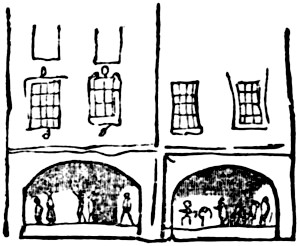
so that people are not obliged to walk in the middle of the street at all. The town is protected by strong fortifications, but the ramparts are changed into charming lawns and walks. There are also delightful terraces on the river side, commanding the surrounding country, which is enchanting—rich woods and fertile valleys, swelling mountains, and meadows like velvet; and, beyond all, the snowy Alps.
At Berne I equipped myself as most persons do who travel on foot through Switzerland; I have seen scores of young men all in the same pedestrian costume. I give you a sketch, that you may have a better idea of it.
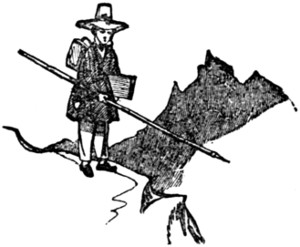
The dress is a light sort of smock-frock, with a leather belt round the waist, a straw hat, a knapsack on the back, and a small bottle, covered with leather, to carry spirits, fastened round the neck by a leather strap. The long pole is for climbing up the mountains, and jumping over the ice.
From Berne I arrived at Thun. The fine lake of Thun is surrounded by mountains of various forms, and I proceeded along it to this place. I have been on the lake of Brientys and to Lauterbrunnen, where there is the celebrated waterfall, called the “Stubach;” it falls about 800 feet; the rocks about it are exceedingly romantic, and close to it are the snowy mountains, among which I should particularize the celebrated “Yung frow,” which has never been ascended.
Interlaken is surrounded by mountains, and its scenery for sketches delicious. It is a village, built nearly all of wood; the houses are the prettiest things I ever saw: they are in this way,
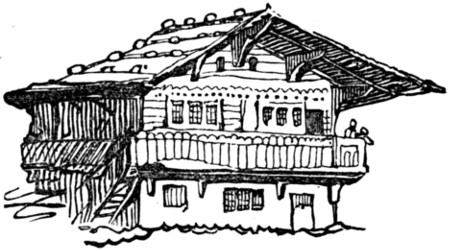
but much more beautiful than I can show in a small sketch. They are delicately clean, and mostly have fine vines and plenty of grapes about them. The stones on the roof are to keep the wood from being blown off. Then the people dress so well, and all look so happy, that it is a pleasure to be among them. I cannot understand a word they say, and yet they are all civil and obliging. If any children happen to see me drawing out of doors, they always run to fetch a chair for me. The women are dressed in this manner.
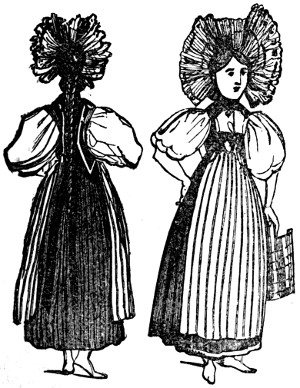
The poor people and ladies are in the same style exactly: the caps are made of horsehair, and the hair dressed quite plain in front, and plaited behind almost to the ground with black ribbons. They wear silver chains from each side of the bosom, to pass under the arms, and fasten on the back. They are not all pretty, but they are particularly clean and neat. There is nothing remarkable in the men’s dress, only that I observe on a Sunday they wear white nightcaps: every man that I can see now out of my window has one on; and they are all playing at ball and nine-pins, just as they do in France. There is another kind of cap worn here made of silk; this is limp, and does not look so well. They have also a flat straw hat.
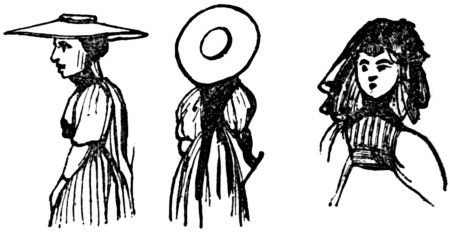
The women work much more than the men; they even row the boats on the lakes. All the Swiss, however, are very industrious; and I like Switzerland altogether exceedingly. I leave this place to-morrow, and am going on to the beautiful valley of Sornen, (there was a view of it in the Diorama,) and then to the lake of the four cantons, or lake of Lucerne, and round the canton of the Valais to Geneva, and from thence for the lakes of Italy. If you examine a map for these places, it will be an amusement for you.
Lady Byron has been here for two days; she is making a tour of Switzerland. There are several English passing through. I can scarcely give you a better notion of the situation of this beautiful little village, than by saying that it is in a valley between two lakes, and that there are the most charming walks you can imagine to the eminences on the river side, and along the borders of the lakes. There are more goats here than in Wales: they all wear a little bell round their neck; and the sheep and cows being similarly distinguished, the movement of the flocks and herds keep an incessant tinkling, and relieve the stillness of the beauteous scenery.
Gretna Green Marriages.
THE BLACKSMITH.
On Friday, March 23, at Lancaster Lent assizes 1827, before Mr. baron Hullock, came on the trial of an indictment against Edward Gibbon Wakefield and William Wakefield, (brothers,) Edward Thevenot, (their servant,) and Frances the wife of Edward Wakefield, (father of the brothers,) for conspiring by subtle stratagems and false representations to take and carry away Ellen Turner, a maid, unmarried, and within the age of sixteen years, the only child and heiress of William Turner, from the care of the Misses Daulby, who had the education and governance of Miss Turner, and causing her to contract matrimony with the said Edward Gibbon Wakefield, without the knowledge and consent of her father, to her great disparagement, to her father’s discomfort, and against the king’s peace. Thevenot was acquitted; the other defendants were found “guilty,” and the brothers stood committed to Lancaster-castle.
To a second indictment, under the statute of 4 and 5 Philip and Mary, against the brothers, for the abduction of Miss Turner, they withdrew their plea of “not guilty,” and pleaded “guilty” to the fifth count.
In the course of the defence to the first indictment, David Laing, the celebrated blacksmith of Gretna-green, was examined; and, indeed, the trial is only mentioned in these pages, for the purpose of sketching this anomalous character as he appeared in the witness-box, and represented his own proceedings, according to The Times’ report:—viz.
In appearance this old man was made to assume a superiority over his usual companions. Somebody had dressed him in a black coat, and velvet waistcoat and breeches of the same colour, with a shining pair of top boots—the shape of his hat, too, resembled the clerical fashion. He seemed a vulgar fellow, though not without shrewdness and that air of familiarity, which he might be supposed to have acquired by the freedom necessarily permitted by persons of a better rank of life, to one who was conscious he had the power of performing for them a guilty, but important ceremony.
On entering the witness-box, he leaned forward towards the counsel employed to examine him, with a ludicrous expression of gravity upon his features, and accompanied every answer with a knitting of his wrinkled brow, and significant nodding of his head, which gave peculiar force to his quaintness of phraseology, and occasionally convulsed the court with laughter.
He was interrogated both by Mr. Scarlett and Mr. Coltman in succession.
Who are you, Laing?
Why, I live in Springfield.
Well, what did you do in this affair?
Why, I was sent for to Linton’s, where I found two gentlemen, as it may be, and one lady.
Did you know them?
I did not.
Do you see them in court?
Why, no I cannot say.
What did you do?
Why I joined them, and then got the lady’s address, where she come from, and the party’s I believe.
What did they do then?
Why, the gentleman wrote down the names, and the lady gave way to it.
In fact, you married them after the usual way?
Yes, yes, I married them after the Scotch form, that is, by my putting on the ring on the lady’s finger, and that way.
Were they both agreeable?
O yes, I joined their hands as man and wife.
Was that the whole of the ceremony—was it the end of it?
I wished them well, shook hands with them, and, as I said, they then both embraced each other very agreeably.
What else did you do?
I think I told the lady that I generally had a present from ’em, as it may be, of such a thing as money to buy a pair of gloves, and she gave me, with her own hand, a twenty-shilling Bank of England note to buy them.
Where did she get the note?
How do I know.
What did the gentleman say to you?
Oh, you ask what did he treat me with.
No, I do not; what did he say to you?
He did nothing to me; but I did to him what I have done to many before, that is, you must know, to join them together; join hands, and so on. I bargained many in that way, and she was perfectly agreeable, and made no objections.
Did you give them a certificate?
Oh! yes, I gave it to the lady.
[Here a piece of paper was identified by this witness, and read in evidence, purporting to certify that Edward Gibbon Wakefield and Ellen Turner had been duly married according to the form required by the Scottish law. This paper, except the names and dates, was a printed register, at the top of which was a rudely executed woodcut, apparently of the royal arms.]
Did the gentleman and lady converse freely with you?
O, yes; he asked me what sort of wine they had in Linton’s house, and I said they had three kinds, with the best of Shumpine (Champagne.) He asked me which I would take, and I said Shumpine, and so and so; while they went into another room to dine, I finished the wine, and then off I came. I returned, and saw them still in the very best of comfortable spirits.
Mr. Scarlett.—We have done with you, Laing.
Mr. Brougham.—But my turn is to come with you, my gentleman. What did you get for this job besides the Shumpine? Did you get money as well as Shumpine?
Yes, sure I did, and so and so.
Well, how much?
Thirty or forty pounds or thereabouts, as may be.
Or fifty pounds, as it may be, Mr. Blacksmith?
May be, for I cannot say to a few pounds. I am dull of hearing.
Was this marriage ceremony, which you have been describing, exactly what the law and church of Scotland require on such occasions, as your certificate (as you call it) asserts?
O yes, it is in the old common form.
What! Do you mean in the old common form of the church of Scotland, fellow?
There is no prayer-book required to be produced, I tell you.
Will you answer me when I ask you, what do you mean by the old ordinary form of the church of Scotland, when this transaction has nothing whatever to do with that church? Were you never a clergyman of that country?
Never.
How long are you practising this delightful art?
Upwards of forty-eight years I am doing these marriages.
How old are you?
I am now beyond seventy-five.
What do you do to get your livelihood?
I do these.
Pretty doing it is; but how did you get your livelihood, say, before these last precious forty-eight years of your life?
I was a gentleman.
What do you call a gentleman?
Being sometimes poor, sometimes rich.
Come now, say what was your occupation before you took to this trade?
I followed many occupations.
Were you not an ostler?
No, I were not.
What else were you then?
Why, I was a merchant once.
That is a travelling vagrant pedlar, as I understand your term?
Yes, may be.
Were you ever any thing else in the way of calling?
Never.
Come back now to what you call the marriage. Do you pretend to say that it was done after the common old form of the church of Scotland? Is not the general way by a clergyman?
That is not the general way altogether.
Do you mean that the common ordinary way in Scotland is not to send for a clergyman, but to go a hunting after a fellow like you?
Scotland is not in the practice altogether of going after clergymen. Many does not go that way at all.
Do you mean to swear, then, that the regular common mode is not to go before a clergyman?
I do not say that, as it may be.
Answer me the question plainly, or else you shall not so easily get back to this good old work of yours in Scotland as you think?
I say as it may be, the marriages in Scotland an’t always done in the churches.
I know that as well as you do, for the clergyman sometimes attends in private houses, or it is done before a justice depute; but is this the regular mode?
I say it ent no wrong mode—it is law.
Re-examined by Mr. Scarlett.
Well, is it the irregular mode?
No, not irregular, but as it may be unregular, but its right still.
You mean your own good old unregular mode?
Yes; I have been both in the courts of Edinburgh and Dublin, and my marriages have always been held legal.
What form of words do you use?
Why, you come before me, and say—
Mr. Scarlett.—No, I will not, for I do not want to be married; but suppose a man did who called for your services, what is he to do?
Why, it is I that do it. Surely I ask them, before two witnesses, do you take one and other for man and wife, and they say they do, and I then declare them to be man and wife for ever more, and so and so, in the Scotch way you observe.
The Court.—Mr. Attorney, (addressing Mr. Scarlett, who is attorney-general for the county palatine,) is it by a fellow like this, that you mean to prove the custom of the law of Scotland as to valid marriage?
Here the blacksmith’s examination terminated.
SPRING.
Oh, how delightful to the soul of man, How like a renovating spirit comes, Fanning his cheek, the breath of infant Spring! Morning awakens in the orient sky With purpler light, beneath a canopy Of lovely clouds, their edges tipped with gold; And from his palace, like a deity, Darting his lustrous eye from pole to pole, The glorious sun comes forth, the vernal sky To walk rejoicing. To the bitter north Retire wild winter’s forces—cruel winds— And griping frosts—and magazines of snow— And deluging tempests. O’er the moisten’d fields A tender green is spread; the bladed grass Shoots forth exuberant; th’ awakening trees, Thawed by the delicate atmosphere, put forth Expanding buds; while, with mellifluous throat, The warm ebullience of internal joy, The birds hymn forth a song of gratitude To him who sheltered, when the storms were deep, And fed them through the winter’s cheerless gloom. Beside the garden path, the crocus now Puts forth its head to woo the genial breeze, And finds the snowdrop, hardier visitant, Already basking in the solar ray. Upon the brook the water-cresses float More greenly, and the bordering reeds exalt Higher their speary summits. Joyously, From stone to stone, the ouzel flits along, Startling the linnet from the hawthorn bough; While on the elm-tree, overshadowing deep The low-roofed cottage white, the blackbird sits Cheerily hymning the awakened year. Turn to the ocean—how the scene is changed. Behold the small waves melt upon the shore With chastened murmur! Buoyantly on high The sea-gulls ride, weaving a sportive dance, And turning to the sun their snowy plumes. With shrilly pipe, from headland or from cape, Emerge the line of plovers, o’er the sands Fast sweeping; while to inland marsh the hern, With undulating wing scarce visible, Far up the azure concave journies on! Upon the sapphire deep, its sails unfurl’d, Tardily glides along the fisher’s boat, Its shadow moving o’er the moveless tide; The bright wave flashes from the rower’s oar, Glittering in the sun, at measured intervals; And, casually borne, the fisher’s voice, Floats solemnly along the watery waste; The shepherd boy, enveloped in his plaid, On the green bank, with blooming furze o’ertopped, Listens, and answers with responsive note.
Eccentric Biography.
JAMES CHAMBERS.
This unfortunate being, well known by the designation of “the poor poet,” was born at Soham, in Cambridgeshire, in 1748, where his father was a leather-seller, but having been unfortunate in business, and marrying a second wife, disputes and family broils arose. It was probably from this discomfort in his paternal dwelling-place, that he left home never to return. At first, and for an uncertain period, he was a maker and seller of nets and some small wares. Afterwards, he composed verses on birthdays and weddings, acrostics on names, and such like matters. Naturally mild and unassuming in his manners, he attracted the attention and sympathy of many, and by this means lived, or, rather, suffered life! That his mind was diseased there can be no doubt, for no sane being would have preferred an existence such as his. What gave the first morbid turn to his feelings is perhaps unknown. His sharp, lively, sparkling eye might have conveyed an idea that he had suffered disappointment in the tender passion; while, from the serious tendency of many of his compositions, it may be apprehended that religion, or false notions of religion, in his very young days, operated to increase the unhappiness that distressed his faculties. Unaided by education of any kind, he yet had attained to write, although his MSS. were scarcely intelligible to any but himself; he could spell correctly, was a very decent grammarian, and had even acquired a smattering of Latin and Greek.
From the age of sixteen to seventy years, poor Chambers travelled about the county of Suffolk, a sort of wandering bard, gaining a precarious subsistence by selling his own effusions, of which he had a number printed in cheap forms. Among the poorer people of the country, he was mostly received with a hearty welcome; they held him in great estimation as a poet, and sometimes bestowed on him a small pecuniary recompense for the ready adaptation of his poetical qualities, in the construction of verses on certain occasions suitable to their taste or wishes. Compositions of this nature were mostly suggested to him by his muse during the stillness of night, while reposing in some friendly barn or hay-loft. When so inspired, he would immediately arise and commit the effusion to paper. His memory was retentive, and, to amuse his hearers, he would repeat most of his pieces by heart. He wandered for a considerable time in the west of Suffolk, particularly at Haverhill; and Mr. John Webb, of that place, in his poem entitled “Haverhill,” thus notices him:—
An hapless outcast, on whose natal day No star propitious beam’d a kindly ray. By some malignant influence doom’d to roam The world’s wide dreary waste, and know no home. Yet heav’n to cheer him as he pass’d along, Infus’d in life’s sour cup the sweets of song. Upon his couch of straw, or bed of hay, The poetaster tun’d the acrostic lay: On him an humble muse her favours shed, And nightly musings earn’d his daily bread. Meek, unassuming, modest shade! forgive This frail attempt to make thy memory live. Minstrel, adieu!—to me thy fate’s unknown; Since last I saw you, many a year has flown. Full oft has summer poured her fervid beams, And winter’s icy breath congeal’d the streams. Perhaps, lorn wretch! unfriended and alone In hovel vile, thou gav’st thy final groan! Clos’d the blear’d eye, ordain’d no more to weep, And sunk, unheeded sunk, in death’s long sleep!
Chambers left Haverhill, never to return to it, in the year 1790. In peregrinating the country, which he did in every change of sky, through storms, and through snow, or whatever might betide, he was often supported entirely by the spontaneous benevolence of those who witnessed his wanderings. In his verses on a snow-storm, he says:—
This vile raiment hangs in tatters; No warm garment to defend: O’er my flesh the chill snow scatters; No snug hut!—no social friend!
About four years before his death, while sojourning in Woodbridge, sleeping in a miserable hut on the barrack ground, and daily wandering about the town, with every visible mark of misery to distress the eye, his condition became a libel upon the feelings of the inhabitants of the place; a few gentlemen determined he should no longer wander in such a state of wretchedness, offered to clothe and cleanse him, and provide a comfortable room, bed, &c. and a person to shave him and wash for him; and they threatened, if he would not comply, to take him home to where he belonged.
His aversion to a poor-house amounted to horror: he expresses somewhat to that effect in one of his poems——
’Mongst Belial’s sons of contention and strife, To breathe out the transient remains of my life!
This dread operated in behalf of those who desired to assist him. His wretched hovel was emptied, its miserable accumulations were consigned to the flames, and he was put into a new habitation, clothed from head to foot, and so metamorphosed, that but few knew him at first sight. A bedstead and bedding, a chair, table, and necessary crockery were provided for his comfort, but the poor creature was often heard to exclaim, of the cleansing and burning, that “it was the worst day’s work he ever met with.” After a few short weeks he left this home, and a shilling a week allowed him by a gentleman, besides some weekly pence, donations from ladies in the town, for a life of wandering privation and, at times, of absolute want, until the closing scene of his weary pilgrimage. He breathed his last on the 4th of January, 1827, in an unoccupied farm-house belonging to Mr. Thurston of Stradbroke, where he had been permitted the use of two rooms. Within a few days before, he had been as well as usual, but he suddenly became ill, and had the attention of two women, neighbours, who provided him warm gruel, and a few things his situation required. Some one had given him a warm blanket, and when he died there was food in the house, with tenpence halfpenny in money, a few scraps of poetry, and a bushel of wheat which he had gleaned in the harvest. A decent coffin and shroud were provided, and he was buried in Stradbrook churchyard.[99]
Chambers was literally one of the poor at all times; and hence his annals are short and simple. Disregard of personal appearance was natural to his poverty-stricken circumstances and melancholy disposition; for the wheel of his fortune was fixed by habit, as by a nail in a sure place, to constant indigence. Neglected in his youth, and without fixed employment, he brooded throughout life on his hopeless condition, without a friend of his own rank who could participate in his sorrows. He was a lonely man, and a wanderer, who had neither act nor part in the common ways of the world.
Vauxhall. A Dramatic Sketch.
For the Table Book.
Characters—Mr. Greenfat, Mrs. Greenfat, Masters Peter and Humphrey Greenfat, Misses Theodosia and Arabella Greenfat, and Mr. John Eelskin.
Seen dispersedly in various parts of the gardens.
Master Peter. Oh my! what a sweet place! Why, the lamps are thicker than the pears in our garden, at Walworth: what a load of oil they must burn!
Miss Arabella. Mamma, is that the lady mayoress, with the ostridge feathers, and the pink satin gown?
Mrs. Greenfat. No, my love; that’s Miss Biddy Wilkins, of Gutter-lane! (To a waiter.) You rude fellow, you’ve trod on my dress, and your nasty foot has torn off one of my flounces.
Miss Theodosia. John, (to Mr. Eelskin,) how very pretty that hilluminated walk looks. Dear me! do you see the fountain? How vastly reviving this hot weather, isn’t it?
Mr. Eelskin. Ah, my beloved Theodosia! how should I notice the beauties of the scene in your company—when your eyes are brighter than the lamps, and your voice is sweeter than the music? In vain the fiddlers fiddle, and the singers sing, I can hear nothing—listen to nothing—but my adorable Theodosia!
Master Humphrey. La, papa, what’s that funny round place, with flags on the top, and ballad women and men with cocked hats inside?
Mr. Greenfat. That’s the Hawkestraw.
Mrs. Greenfat. Hush, my dear; it’s vulgar to talk loud. Dosee, my love, don’t hang so on Mr. John’s arm, you’ll quite fatigue him. That’s Miss Tunstall—Miss Tunstall’s going to sing. Now, my pretty Peter, don’t talk so fast.
Miss Arabella. Does that lady sing in French, mamma?
Mrs. Greenfat. No, child, it’s a senthemental air, and they never have no meaning?
Miss Theodosia. That’s the overthure to Friedshots; Eelskin, do you like it?
Mr. Eelskin. On your piano I should. But shall I take you out of this glare of light? Would you choose a ramble in the dark walk, and a peep at the puppet-show-cosmoramas?
Mr. Greenfat. I hates this squalling. (Bell rings.) What’s that for?
Mr. Eelskin. That’s for the fant-toe-sheeni, and the balancing man.
Mr. Greenfat. Well then, let’s go and look at Mr. Fant-toe-sheeni.
Mrs. Greenfat. Oh, goodness, how I’m squeedged. Pray don’t push so, sir—I’m astonished at your rudeness, mam! You’ve trod on my corn, and lamed me for the evening!
Mr. Greenfat. Sir, how dare you suffer your wife to tread on my wife’s toes?
Master Peter. My stars, sister, he’s got a bagginette on his nose!
Mrs. Greenfat. Mr. John, will you put little Humphy on your shoulder, and show him the fant-oh-see-ne?
Master Humphrey. I can see now, mamma; there’s Punch and Judy, mamma! Oh, my! how well they do dance!
Mr. Greenfat. I can see this in the streets for nothing.
Mrs. Greenfat. Yes, Mr. Greenfat, but not in such good company!
Mr. Eelskin. This, my beautiful Theodosia, is the musical temple; it’s very elegant—only it never plays. Them paintings on the walls were painted by Mungo Parke and Hingo Jones; the archatechture of this room is considered very fine!
Master Peter. Oh, I’m so hot. (Bell rings.)
Mr. Eelskin. That’s for the hyder-hawlics. We’d better go into the gallery, and then the ladies won’t be in the crowd.
Mr. Greenfat. Come along then; we want to go into the gallery. A shilling a-piece, indeed! I wonder at your impudence! Why, we paid three and sixpence a head at the door.
Mr. Eelskin. Admission to the gallery is hextra.
Mr. Greenfat. Downright robbery!—I won’t pay a farthing more.
Miss Arabella. See, mamma, water and fire at once!—how droll!
Mrs. Greenfat. Pray be kind enough to take off your hat, sir; my little boy can’t see a bit. Humphy, my dear, hold fast by the railing, and then you won’t lose your place. Oh, Mr. John, how very close and sultry it is!
Mr. Greenfat. What outlandish hussey’s that, eh, John?
Mr. Eelskin. That’s the female juggler, sir.
Miss Theodosia. Are those real knives, do you think, John?
Mr. Eelskin. Oh, no doubt of it; only the edges are blunt to prevent mischief. Who’s this wild-looking man? Oh, this is the male juggler: and now we shall have a duet of juggling!
Mrs. Greenfat. Can you see, Peter?—Bella, my love, can you see? Mr. John, do you take care of Dosee? Well, I purtest I never saw any thing half so wonderful: did you, Mr. Greenfat?
Mr. Greenfat. Never: I wonder when it will be over?
Mr. Eelskin. We’d better not go away; the ballet will begin presently, and I’m sure you’ll like the dancing, Miss, for, excepting the Westrisis, and your own sweet self, I never saw better dancing.
Miss Theodosia. Yes, I loves dancing; and at the last Cripplegate ball, the master of the ceremonies paid me several compliments.
Miss Arabella. Why do all the dancers wear plaids, mamma?
Mrs. Greenfat. Because it’s a cool dress, dear.
Mr. Greenfat. Well, if a girl of mine whisked her petticoats about in that manner, I’d have her horsewhipped.
Mr. Eelskin. Now we’ll take a stroll till the concert begins again. This is the marine cave—very natural to look at, Miss, but nothing but paint and canvass, I assure you. This is the rewolving evening war for the present; after the fire-works, it still change into his majesty, King George. Yonder’s the hermit and his cat.
Master Peter. Mamma, does that old man always sit there?
Mrs. Greenfat. I’m sure I don’t know, child; does he, Mr. Eelskin?
Mr. Greenfat. Nonsense—it’s all gammon!
Mr. Eelskin. This way, my angel; the concert has recommenced.
Miss Theodosia. Oh, that’s Charles Taylor; I likes his singing; he’s such a merry fellow: do hancore him, John.
Mrs. Greenfat. Dosee, my dear, you’re too bold; it was a very impurent song: I declare I’m quite ashamed of you!
Mr. Greenfat. Never mince matters; always speak your mind, girl.
Mr. Eelskin. The fire-works come next. Suppose we get nearer the Moorish tower, and look for good places, as Mr. G. dislikes paying for the gallery. Now you’ll not be afeard; there’ll not be the least danger, depend.
Mrs. Greenfat. Is there much smoke, Mr. John?—Do they fire many cannons?—I hates cannons—and smoke makes me cough. (Bell rings.) Run, run, my dears—Humphy, Peter, Bella, run! Mr. Greenfat, run, or we shall be too late! Eelskin and Dosee are a mile afore us! What’s that red light? Oh, we shall all be burnt! What noise is that?—Oh, it’s the bomb in the Park!—We shall all be burnt!
Mr. Greenfat. Nonsense, woman, don’t frighten the children!
Miss Theodosia. Now you’re sure the rockets won’t fall on my new pink bonnet, nor the smoke soil my French white dress, nor the smell of the powder frighten me into fits?—Now you’re quite sure of it, John?
Mr. Eelskin. Quite sure, my charmer: I have stood here repeatedly, and never had a hair of my head hurt. See, Blackmore is on the rope; there he goes up—up—up!—Isn’t it pretty, Miss?
Miss Theodosia. Oh, delightful!—Does he never break his neck?
Mr. Eelskin. Never—it’s insured! Now he descends. How they shoot the maroons at him! Don’t be afeard, lovee, they sha’n’t hurt you. See, Miss, how gracefully he bows to you.—Isn’t it terrific?
Miss Theodosia. Is this all?—I thought it would last for an hour, at least. John, I’m so hungry; I hope papa means to have supper?
Master Peter. Mamma, I’m so hungry.
Master Humphrey. Papa, I’m so dry.
Miss Arabella. Mamma, I want somewhat to eat.
Mrs. Greenfat. Greenfat, my dear, we must have some refreshments.
Mr. Greenfat. Refreshments! where will you get them? All the boxes are full.—Oh, here’s one. Waiter! what, the devil, call this a dish of beef?—It don’t weigh three ounces! Bring half a gallon of stout, and plenty of bread. Can’t we have some water for the children?
Mr. Eelskin. Shouldn’t we have a little wine, sir?—it’s more genteeler.
Mr. Greenfat. Wine, Eelskin, wine!—Bad sherry at six shillings a bottle!—Couldn’t reconcile it to my conscience.—We’ll stick to the stout.
Mrs. Greenfat. Eat, my loves.—Some more bread for Bella.—There’s a bit of fat for you, Peter.—Humphy, you shall have my crust.—Pass the stout to Dosee, Mr. John.—Don’t drink it all, my dear!
Mr. Greenfat. Past two o’clock!—Shameful!—Waiter, bring the bill. Twelve shillings and eightpence—abominable!—Charge a shilling a pot for stout—monstrous! Well, no matter; we’ll walk home. Come along.
Master Peter. Mamma, I’m so tired.
Miss Arabella. Mamma, my legs ache so.
Master Humphrey. Papa, I wish you’d carry me.
Mr. Greenfat. Come along—it will be five o’clock before we get home!
[Exeunt omnes.
H.
TO MY TEA-KETTLE.
For the Table Book.
1.
For many a verse inspired by tea, (A never-failing muse to me) My Kettle, let this tribute flow, Thy charms to blazon. And tell thy modest worth, although Thy face be brazen.
2.
Let others boast the madd’ning bowl, That raises but to sink the soul, Thou art the Bacchus that alone I wish to follow: From thee I tipple Helicon, My best Apollo!
3.
’Tis night—my children sleep—no noise Is heard, except thy cheerful voice; For when the wind would gain mine ear, Thou sing’st the faster— As if thou wert resolv’d to cheer Thy lonely master.
4.
And so thou dost: those brazen lungs Vent no deceit, like human tongues: That honest breath was never known To turn informer: And for thy feelings—all must own That none are warmer.
5.
But late, another eye and ear Would mark thy form, thy music hear: Alas! how soon our pleasures fly, Returning never! That ear is deaf—that friendly eye Is clos’d for ever!
6.
Be thou then, now, my friend, my guide, And humming wisdom by my side, Teach me so patiently to bear Hot-water troubles, That they may end, like thine, in air, And turn to bubbles.
7.
Let me support misfortune’s fire Unhurt; and, when I fume with ire. Whatever friend my passion sees, And near me lingers, Let him still handle me with ease. Nor burn his fingers.
8.
O! may my memory, like thy front. When I am cold, endure the brunt Of vitriol envy’s keen assaults, And shine the brighter, And ev’ry rub—that makes my faults Appear the lighter.
Sam Sam’s Son.
TO MY TEA-POT.
For the Table Book.
1.
My Tea-pot! while thy lips pour forth For me a stream of matchless worth, I’ll pour forth my rhymes for thee: Don Juan’s verse is gross, they say; But I will pen a grocer lay, Commencing—“Amo tea.”
2.
Yes—let Anacreon’s votary sip His flowing bowl with feverish lip, And breathe abominations; Some day he’ll be bowl’d out for it— He’s brewing mischief, while I sit And brew my Tea-pot-ations.
3.
After fatigue, how dear to me The maid who suits me to a T, And makes the water bubble. From her red hand when I receive The evergreen, I seem to give At T. L. no trouble.
4.
I scorn the hop, disdain the malt, I hate solutions sweet and salt, Injurious I vote ’em; For tea my faithful palate yearns; Thus—though my fancy never turns, It always is tea-totum!
5.
Yet some assure me whilst I sip, That thou hast stain’d thy silver lip With sad adulterations— Slow poison drawn from leaves of sloe, That quickly cause the quick to go, And join their dead relations.
6.
Aunt Malaprop now drinks noyeau Instead of Tea, and well I know That she prefers it greatly: She says, “Alas! I give up Tea, There’s been so much adultery Among the grocers lately!”
7.
She warns me of Tea-dealers’ tricks— Those double-dealing men, who mix Unwholesome drugs with some Tea ’Tis bad to sip—and yet to give Up sipping’s worse; we cannot live “Nec sine Tea, nec cum Tea.”
8.
Yet still, tenacious of my Tea, I think the grocers send it me Quite pure, (’tis what they call so.) Heedless of warnings, still I get “Tea veniente die, et Tea decedente,” also.
Sam Sam’s Son.