Volume 1 — Vol. I.—24.
Reading edition
The old Water Carrier.
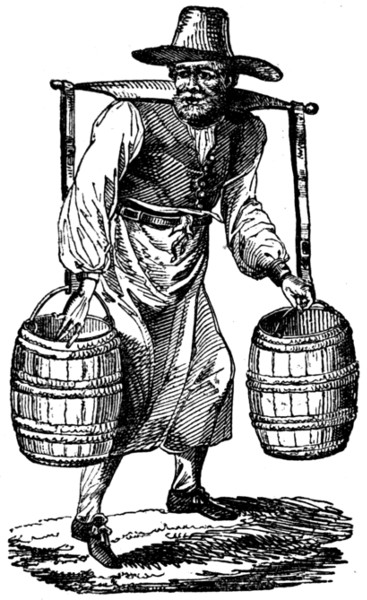
The old Water Carrier.
“Any New-River water here.”
This is another of the criers of a hundred years ago, and, it seems, he cried “New-River water.” The cry is scarce, though scarcely extinct, in the environs of London.
I well remember the old prejudices of old-fashioned people in favour of water brought to the door, and their sympathy with the complaints of the water-bearer. “Fresh and fair new River-water! none of your pipe sludge!” vociferated the water-bearer. “Ah dear!” cried his customers, “Ah dear! Well, what’ll the world come to!—they wo’n’t let poor people live at all by and by—here they’re breaking up the ground, and we shall be all under water some day or other with their goings on—I’ll stick to the carrier as long as he has a pail-full and I’ve a penny, and when we haven’t we must all go to the workhouse together.” This was the talk and the reasoning of many honest people within my recollection, who preferred taxing themselves to the daily payment of a penny and often twopence to the water-carrier, in preference to having “Company’s-water” at eighteen shillings per annum. Persons of this order of mind were neither political economists nor domestic economists: they were, for the most part, simple and kind-hearted souls, who illustrated the ancient saying, that “the destruction of the poor is their poverty”—they have perished for “lack of knowledge.”
The governing principle of Napoleon was, that “every thing must be done for the people, and nothing by them:” the ruling practice of the British people is to do every thing for themselves; and by the maintenance of this good old custom they have preserved individual freedom, and attained to national greatness. All our beneficial national works have originated with ourselves—our roads, our bridges, our canals, our water-companies, have all been constructed by our own enterprise, and in the order of our wants.
Garrick Plays. No. XXI.
[From Sir Richard Fanshaw’s Translation of “Querer Por Solo Querer”—“To love for love’s sake”—a Romantic Drama, written in Spanish by Mendoza: 1649.]
Felisbravo, Prince of Persia, from a Picture sent him of the brave Amazonian Queen of Tartary, Zelidaura, becoming enamoured, sets out for that realm; in his way thither disenchants a Queen of Araby; but first, overcome by fatigue, falls asleep in the Enchanted Grove, where Zelidaura herself coming by, steals the Picture from him. The passion of the Romance arises from his remorse at being taken so negligent; and her disdain that he should sleep, having the company of her Picture. She here plays upon him, who does not yet know her, in the disguise of a Rustic.
Fel. What a spanking Labradora! Zel. You, the unkent Knight, God ye gud mora![210] Fel. The time of day thou dost mistake. Zel.—and joy— Fel.—of what? Zel. That I discover. By a sure sign, you are awake. Fel. Awake? the sign— Zel. Your being a lover. Fel. In love am I? Zel.—and very deep. Fel. Deep in love! how is that seen? Zel. Perfectly. You do not sleep. Fel. Rustic Excellence, unscreen, And discover that sweet face, Which covers so much wit and grace. Zel. You but dream so: sleep again, And forget it. Fel. Why, now, Saint? Zel. Why, the Lady, that went in,[211] Looks as if that she did paint. Fel. What has that to do with sleeping? She is indeed angelical. Zel. That picture now’s well worth your keeping. For why? ’tis an original. Fel. Is this Shepherdess a Witch? Or saw the sleeping treason, which I committed against Love Erst, in the Enchanted Grove? Me hast thou ever seen before? Zel. Seen? aye, and know thee for a man That will turn him, and sleep more Than a dozen dunces can. Thou ken’st little what sighs mean. Fel. Unveil, by Jove, that face serene. Zel. What, to make thee sleep again? Fel. Still in riddles? Zel. Now he sees: This pinching wakes him by degrees. Fel. Art thou a Nymph? Zel. Of Parnass Green. Fel. Sleep I indeed, or am I mad? Zel. None serve thee but the Enchanted Queen? I think what dull conceits ye have had Of the bird Phœnix, which no eye E’er saw; an odoriferous Lye: How of her beauty’s spells she’s told; That by her spirit thou art haunted; And, having slept away the old, With this new Mistress worse enchanted. Fel. I affect not, Shepherdess, Myself in such fine terms to express; Sufficeth me an humble strain: Too little happy to be vain.— Unveil! Zel. Sir Gallant, not so fast. Fel. See thee I will. Zel. See me you shall: But touch not fruit you must not taste. (She takes off her veil.) What says it, now the leaf doth fall? Fel. It says, ’tis worthy to comprize The kernel of so rare a wit: Nor, that it grows in Paradise; But Paradise doth grow in it. The tall and slender trunk no less divine, Tho’ in a lowly Shepherdesses rine. (He begins to know her.) This should be that so famous Queen For unquell’d valour and disdain.— In these Enchanted Woods is seen Nothing but illusions vain. Zel. What stares the man at? Fel. I compare A Picture—I once mine did call— With the divine Original. Zel. Fall’n again asleep you are: We poor human Shepherd Lasses Nor are pictured, nor use glasses. Who skip their rank, themselves and betters wrong: To our Dames, god bless ’em, such quaint things belong. Here a tiny brook alone, Which fringed with borrow’d flowers (he has Gold and silver enough on his own) Is heaven’s proper looking-glass, Copies us: and its reflections, Shewing natural perfections, Free from soothing, free from error. Are our pencil, are our mirror. Fel. Art thou a Shepherdess? Zel.—and bore On a mountain, called There. Fel. Wear’st thou ever heretofore Lady’s clothes? Zel. I Lady’s gear?— Yes—what a treacherous poll have I!— In a Country Comedy I once enacted a main part; Still I have it half by heart: The famous History it was Of an Arabian—let me see— No, of a Queen of Tartary, Who all her sex did far surpass In beauty, wit, and chivalry: Who with invincible disdain Would fool, when she was in the vein, Princes with all their wits about ’em; But, an they slept, to death she’d flout ’em. And, by the mass, with such a mien My Majesty did play the Queen; Our Curate had my Picture made, In the same robes in which I play’d.
To my taste this is fine, elegant, Queen-like raillery; a second part of Love’s Labours Lost, to which title this extraordinary Play has still better pretensions than even Shakspeare’s: for after leading three pair of Royal Lovers thro’ endless mazes of doubts, difficulties; oppositions of dead fathers’ wills; a labyrinth of losings and findings; jealousies; enchantments; conflicts with giants, and single-handed against armies; to the exact state in which all the Lovers might with the greatest propriety indulge their reciprocal wishes—when, the deuce is in it, you think, but they must all be married now—suddenly the three Ladies turn upon their Lovers; and, as an exemplification of the moral of the Play, “Loving for loving’s sake,” and a hyper-platonic, truly Spanish proof of their affections—demand that the Lovers shall consent to their mistresses’ taking upon them the vow of a single life; to which the Gallants with becoming refinement can do less than consent.—The fact is that it was a Court Play, in which the Characters; males, giants, and all; were played by females, and those of the highest order of Grandeeship. No nobleman might be permitted amongst them; and it was against the forms, that a great Court Lady of Spain should consent to such an unrefined motion, as that of wedlock, though but in a play.
Appended to the Drama, the length of which may be judged from its having taken nine days in the representation, and me three hours in the reading of it—hours well wasted—is a poetical account of a fire, which broke out in the Theatre on one of the nights of its acting, when the whole Dramatis Personæ were nearly burnt, because the common people out of “base fear,” and the Nobles out of “pure respect,” could not think of laying hands upon such “great Donnas;” till the young King, breaking the etiquette, by snatching up his Queen, and bearing her through the flames upon his back, the Grandees, (dilatory Æneases), followed his example, and each saved one (Anchises-fashion), till the whole Courtly Company of Comedians were got off in tolerable safety.—Imagine three or four stout London Firemen on such an occasion, standing off in mere respect!
C. L.
THE STUART PAPERS, In Possession of the King.
In the year 1817 the public, or, more correctly speaking, the English public at Rome, were much excited by the report of a very singular discovery. The largest and the most interesting collection of papers relating to the Stuart family, probably existing, was suddenly recovered. The circumstances connected with the discovery are curious. Dr. W., whose residence on the continent for many years had been unceasingly devoted to every species of research which could tend to throw light on the antiquities of his country and the history of her kings, had in the Scotch college at Paris, after much patient investigation, arrived at the knowledge of some Gaelic MSS., and, what may be perhaps deemed of more consequence, of several papers relating to the dethroned family. The Gaelic MSS., it was imagined, would throw some light on the quarrel de lana caprina of the Ossian “remains,” a name which, as it has been given to the Iliad and Odyssey, cannot be considered as an insult to the claims of the Irish or Scottish phantom which has been conjured up under the name of Ossian: but the Journals, &c., though they added little to his actual information, and communicated few facts not hitherto before the public, had at least the merit of placing the end of the clue in his hand, and hinting first the probability of a more productive inquiry elsewhere. It occurred to him that after the demise of James II., as the majority of the family habitually resided at Rome, much the greater number of interesting documents ought still to be discoverable in that city, and, whatever facilities might originally have existed, they must have been increased considerably, and indeed enhanced by the late extinction of the direct line in the person of the cardinal de York.[212] His journey to Rome, and the results of his perseverance fully justified these conjectures. There was nothing in Dr. W.’s appearance or manner, nothing in the circumstances of his long absence from his country, which could offer motives of encouragement; no man carried less before him, as far as externals were in question, that letter of recommendation to which the most uncourteous are compelled to yield. He was in bad odour with his own government, and consequently with every thing legitimate and subservient on the continent, and one of the worst calculated individuals that Providence could have selected, if not for a discovery, at least for its preservation. Dr. W. was known to few of his countrymen at Rome; and as well as I recollect, they were exclusively Scotch, but his acquaintance amongst the natives was extensive and useful. He had been engaged in some cotton speculations in the Campagna, which had altogether failed; more, I believe, from want of funds and public spirit, than from any error in the project or its execution. The soil was favourable, the climate favourable, and the specimen I saw scarcely inferior to the Asiatic. But whatever may have been the causes, the results were salutary, and productive at least of this advantage, that it served to introduce him to the “mezzo ceto” circles of the capital. A mercante di Campagna is a personage in nowise inferior to a lawyer, and Dr. W. knew how to preserve his importance amongst his competitors. The information which he gained here was a new source of encouragement. After much sagacious and persevering inquiry, and occasional but partial disappointments, he at last chanced in a happy hour on the great object of all his labours. He was informed in rather a circuitous manner, that a considerable portion of the late cardinal de York’s effects lay still in the hands of the executors, but could not at first ascertain whether they comprehended any large masses of his papers. Enough, however, had been detected to lead him much farther: he seized the hint, profited by it, and in a few weeks satisfactorily assured himself that the papers were, as he suspected, included, and were at that very moment at Rome. He lost no time in addressing himself to the proper quarter, but monsignor —— was out of town, (the acting executor of the cardinal,) and it was very doubtful whether his agent, the abbate Lupi, was sufficiently authorized or empowered to dispose of them in his absence; the abbate Lupi, less scrupulous, or more ignorant than persons in situations of such high trust, smiled at the communication, and conducted the doctor without delay to the premises where these cartacci, or paper-rubbish, as he termed them, were still lying in confusion. It was a dark and dreary garret or gallery, at the top of the house. The abbate pushed back a crazy door, and showed them heaped up, in large lots, in various parts of the chamber. The garret was crumbling, the wind and rain entered ad libitum through the broken tiles, the rats prowled and plundered at full discretion, like the followers of Omar, and had now lived for many years at free quarters on the spoils; but neither decay, nor the seasons and their ravages, nor the rats and their incursions, nor the appearance of daily loss, were sufficient to rouse the habitual indolence of the administrators to the least effort for the preservation of the remainder. There was a sufficient quantity, however, left to surpass the most ardent anticipations of the doctor: he gazed in silence and astonishment; it was a moment of true and unalloyed delight—an instant which, in the estimate of the enthusiast, will outbalance the sufferings of months and years, like the “Land! land!” of Columbus, or the eureka of Pythagoras. He hesitated, he doubted—he took up the paper that was nearest to him; his warmest wishes were realized; it was an autograph of James II. A glance over the rest was sufficient; it was with difficulty he could suppress the feeling of exultation which shivered and fled over his whole frame. After an affected question or two, the abbate accepted his proposal, and very near five hundred thousand documents, of unquestionable authenticity and of the first historic importance and authority, were knocked down to him for not more than three hundred Roman crowns. Dr. W. still meditated, paused, appeared reluctant, inquired for the letter of attorney, examined it, and finding all in order, and powers as he imagined sufficiently full, the arrangement in a few moments was completed. Two carts were brought to the door, the papers were thrown into them confusedly, and so little did the abbate value their utility, that on two or three packets falling into the street, they undoubtedly would have lain there with other rubbish, had not the doctor immediately hastened to take them up and carried them himself to his lodgings.
The prize was now won, and a collection perhaps unrivalled in Europe, an El Dorado of imaginary wealth and glory, was safely lodged in the precincts of his own apartment. Joy is talkative, and for once the doctor altogether forgot his caution, and in the dangerous moment of a first triumph, rushed to his countrymen, and proclaimed his veni, vidi, vici to their envy and astonishment. They were invited to inspect them. Rome, the capital of a considerable state, is still a provincial town, and events of this kind hardly require newspapers. In a few days the news of all the poets and barbers was the singular good fortune of the doctor. What it was no one knew, except the duchess of D——. Her drawing-room was not only the rendezvous of every stranger, and particularly of every Englishman at Rome, but, what ought to have been considered as of infinitely more moment and indeed danger, was a sort of antechamber to the Vatican. Her acquaintance with the cardinal secretary intimately connected her with the Papal government; and, during her life and his administration, the English might almost be said to be, in the language of the modern city, the assistants of the pontifical throne. The duchess requested a cabinet peep. The doctor expostulated;—he ought to have done so, but on the contrary he was gratified by the compliment, and a little conversazione packet was made up with expedition for her next evening party. The doctor had time to judge of his acquisition, and made a judicious selection, but so unfortunately inviting, that his noble patroness could with difficulty confine to her own breast the sentiments she felt of surprise and admiration. Besides, it would be selfish to conceal the gratification from her friends; the papers were of course in a few days to start for England. Who could tell when they were likely to be out? Then there was an enjoyment, not likely to be resisted by a duchess and a protectress, of all that was literary at Rome, in tumbling over an original MS.—and such a MS.—and reading and judging the important work, before it was even dreamt of by the rest of the world. She had been favoured, and could not be blamed for extending, like the doctor, the favour to others. She had two or three very dear friends, and she could not reflect without pain on what they might say, and with so much justice, should they discover, some days afterwards, that she had been in possession of such a treasure, though for a few hours, without kindly participating her pleasures with her acquaintances.
These reasons, cogent at any time, were altogether invincible under the circumstances of the case. The duchess had many friends, but the most intimate of these many was the cardinal secretary. The practised eye of that statesman could not be so easily seduced. He was one of the chief invited of the evening, and as usual appeared amongst the earliest of the guests. The papers were on the table on his entry; they became the chief, the first, and soon the only topic of conversation. They were examined; the cardinal read, folded them up, and was silent; but ere daylight the next morning a guard of the pope’s carabiniers attacked Dr. W.’s apartment, which was not the castle of an Englishman, and very important papers were irrecoverably lost to him, and perhaps to the public for ever.
The next morning, all the valets de place in Rome knew, and took care to inform their masters, that during the night the abbate Lupi had been arrested, and lay actually in prison for a gross violation of his trust; but it was not understood till much later in the day, that the moment the cardinal had left the apartments of the duchess, orders had been also given to have the papers immediately put under the seal and wardship of the state. The doctor was consequently awakened, as we have seen, rather earlier than usual, in the most unceremonious manner imaginable, and requested, in rather a peremptory manner, to point out the treasury room. Tortures were not used, but threats were. The sanctuary was easily discovered; the inviolable seal was fixed on the door; and a guard put over the house, during the remainder of the day.
The arrest of the abbate was followed up by a measure of more rigour, and of far greater importance. The contract itself was annulled on the ground of incompetence in the seller—the three hundred crowns were ordered to be paid back, and Dr. W. permitted to appeal, and satisfy himself with civil answers as well as he could, and with what every jurisconsult of the Curia Innocenziana had decided, or would decide if called upon by the secretary, to be the ancient and existing law of Rome.
The doctor made, through himself and others, the ordinary applications, each of which were received and answered in the ordinary manner. This was encouraging; and he vented his indignation amongst his acquaintances; and, when the access and struggle was over, lay like Gulliver, fatigued on his back.
In the mean time, a vessel arrived from England at Cività Vecchia, and a boat’s crew a little after from Fiumicino at Rome. The papers were released and embarked. The doctor expostulated, and the cardinal secretary received him with his usual urbanity. His visit was quite as satisfactory as any of the preceding, and as conclusive as such visits generally are at Rome. The cardinal heard every thing with the most dignified composure, and simply replied, that any application to him personally was now unavailing, and that he could not do better than apply to the king of England, in whose hands the papers in question would probably be found in the course of another month.
The doctor bowed and took the advice,—but, in leaving the room, it occurred to him that he might not meet a more favourable reception at Downing-street than at the Vatican. A friend at that time resident at Rome proposed to act as his representative to the minister, and acquitted himself in the sequel with a fidelity as rare amongst ambassadors as attorneys.
I never heard any thing decisive of the result of this interview;—but I have no doubt the cardinal was in the right. No inquiries at all disquieting were made, or questions asked, of the keeper of the king’s conscience, on the adjudication of the court of Rome. The king of England, in right of his Stuart blood, keeps, and will leave to his descendants, probably, the care of publishing all the Stuart MSS.
But in the momentous interval between the discovery of the papers, and their voyage to England, more eyes than those of an English duchess and a cardinal secretary of state contrived to glance over the treasure. For a day or two they were exposed to the inspection of the privileged few, at the head of whom was the late professor Playfair, lord S——, lord of session, &c.: to one of these favoured individuals I am indebted for most of the particular which follow.
On entering the chamber where they were arranged, which was a small room, on the first floor, of a small apartment in a secondary quarter of Rome, he found the walls to a great height literally covered with piles of paper of every size and quality. They were packed so close, had been so long unopened, and had so much suffered from the humidity, that each packet was found to contain, on examination, a very much larger quantity than had at first been expected. They were arranged in the most perfect order, and classed according to the age, country, or writer. Several were autographs, and copies, where they existed, were in the best preservation, and generally under the eye, and by the order of the first authority. The series commenced about the period of the king’s arrival in France, and were continued down, with scarcely any interruption or hiatus, to the demise of the last direct heir, the cardinal de York. They embraced not only every document connected with political matters, but entered into the most minute details on the domestic and personal affairs of the illustrious individuals, to whom they related, and threw a very singular light on transactions which have been long concealed, or viewed under very partial bearings, by the British public. Not only the private and confidential correspondence between the different members of the royal family, but references to the most trivial circumstances connected with the interior of the royal household, and various other matters of similar interest, were everywhere observable. The revenues, the expenditure, were regularly noted; a large volume or ledger, almost completely filled with items of this kind, gave no bad scale of the gradation or diminution of expense, calculated on country, time, and situation, and therefore a very fair estimate of their means under the successive fortunes to which they had been exposed. But by far the most interesting documents of the collection referred to the important political transactions of that memorable epoch. James II. occupies a considerable, and, indeed, a principal portion of this interest. His letters to his son, written and corrected in his own hand, give a very flattering portrait, and perhaps a very authentic one, of his character in almost all his domestic relations, without much claim, but also without much pretension, to style—the sin of that age, and not less of the succeeding: they are not without a certain tinge of the elegance of manner, which, though by no means his apanage, had more or less been contracted in those dissolute circles which had inspired Hamilton. But there were other qualities with which they abounded, of much higher value and importance, greater depth of feeling than what usually exists in courts, paternal affection in all the bitterness of an unrequited fondness, and a settled and unavailing despair (he died, indeed, of a lethargy) of the future destinies of his house, grounded on the frail support he could anticipate from the depraved habits of his son. The reproaches addressed to him are frequent, and fraught with the overflowing waters of fatherly disappointment; the brouillon, or rough draft of the letter, which was sometimes preserved, was often blotted, and the wavering and agitation of his mind betrayed itself very visibly in his very hand. The general view which they give is favourable, and presents a kindlier aspect of his character than what we are habituated to meet with in the generality of the Whig writers.[213]
THE PLANETS.
Their Comparative Sizes and Positions.
To assist the mind in framing a conception of the magnitude and relative distances of the primary planets, let us have recourse to the following method. The dome of St. Paul’s is 145 feet in diameter. Suppose a globe of this size to represent the Sun; then a globe of 97⁄10 inches will represent Mercury; one of 179⁄10 inches, Venus; one of 18 inches, the Earth; one of 5 inches diameter, the Moon, (whose distance from the earth is 240,000 miles;) one of 10 inches, Mars; one of 15 feet, Jupiter; and one of 111⁄2 feet, Saturn, with his ring four feet broad, and at the same distance from his body all round.
In this proportion, suppose the Sun to be at St. Paul’s, then
☿ Mercury might be at the Tower of London,
♀ Venus at St. James’s Palace,
⊖ The Earth at Marylebone,
♂ Mars at Kensington,
♃ Jupiter at Hampton Court,
♄ Saturn at Clifden;
all moving round the cupola of St. Paul’s as ☉ their common centre.
ACCOUNT OF THE BEE-EATER Of Selborne, Hampshire.
By the Rev. Gilbert White, 1789.
We had in this village, more than twenty years ago, an idiot boy, whom I well remember, who, from a child, showed a strong propensity to bees: they were his food, his amusement, his sole object; and as people of this cast have seldom more than one point in view, so this lad exerted all his few faculties on this one pursuit. In the winter he dosed away his time, within his father’s house, by the fire-side, in a kind of torpid state, seldom departing from the chimney-corner; but in the summer he was all alert, and in quest of his game in the fields and on sunny banks. Honey-bees, humble-bees, and wasps, were his prey, wherever he found them: he had no apprehensions from their stings, but would seize them nudis manibus, and at once disarm them of their weapons, and suck their bodies for the sake of their honey-bags. Sometimes he would fill his bosom between his shirt and his skin with a number of these captives; and sometimes would confine them in bottles. He was a very merops apiaster, or bee-bird, and very injurious to men that kept bees; for he would slide into their bee-gardens, and, sitting down before the stools, would rap with his finger on the hives, and so take the bees as they came out. He has been known to overturn hives for the sake of honey, of which he was passionately fond. Where metheglin was making, he would linger round the tubs and vessels, begging a draught of what he called bee-wine. As he ran about, he used to make a humming noise with his lips, resembling the buzzing of bees. This lad was lean and sallow, and of a cadaverous complexion; and, except in his favourite pursuit, in which he was wonderfully adroit, discovered no manner of understanding. Had his capacity been better, and directed to the same object, he had perhaps abated much of our wonder at the feats of a more modern exhibiter of bees; and we may justly say of him now,
“Thou, Had thy presiding star propitious shone, Should’st Wildman be.”
When a tall youth, he was removed from hence to a distant village, where he died, as I understand, before he arrived at manhood.
Poor’s-Box in Cawston Church, Norfolk.
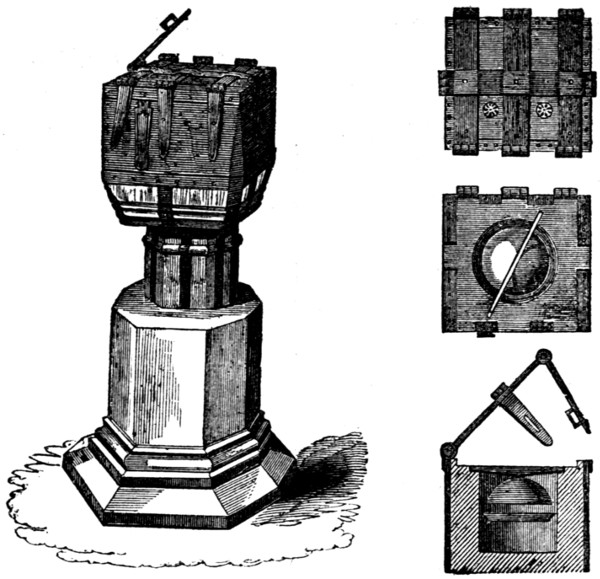
Poor’s-Box in Cawston Church, Norfolk.
Before the Reformation, says Anthony à Wood, “in every church was a poor man’s box, but I never remembered the use of it; nay, there was one at great inns, as I remember it was, before the wars.”
Poor-boxes are often mentioned in the twelfth century. At that period pope Innocent III. extended papal power to an inordinate height; absolved subjects from allegiance to their sovereigns; raised crusades throughout Europe for the recovery of the holy sepulchre; laid France under an interdict; promised paradise to all who would slaughter the Albigenses; excommunicated John, king of England; and ordered hollow trunks to be placed in all the churches, to receive alms for the remission of the sins of the donors.[214]
A communication to the Antiquarian Society, accompanied by drawings of the poor-boxes on this and the opposite page, briefly describes them.[215] The common poor-box in the churches appears to have been a shaft of oak, hollowed out at the top, covered by a hinged lid of iron, with a slit in it, for the money to fall through into the cavity, and secured by one or two iron locks.
Perhaps the most curiously constructed of the ancient poor-boxes now remaining, is that in the church of Cawston, near Aylsham. The church was built between 1385 and 1414. The poor-box was provided with three keys, two of which were for the churchwardens, and the third was most probably for the clergyman, as one of the key-holes is more ornamented than the others. The most singular part of this box is an inverted iron cup, for preventing the money from being taken out by means of any instrument through the holes on the top of the box.
The engravings above represent—1. this poor-box, as it stands on an octangular stone basement; 2. a perfect view of the lid; 3. another of the interior, with the manner wherein the cup is suspended for the security of the money; 4. a section of the box.
In places where the presumed richness of the boxes rendered them liable to be plundered, they were strongly bound or clamped with iron plates, as shown in the present engravings.
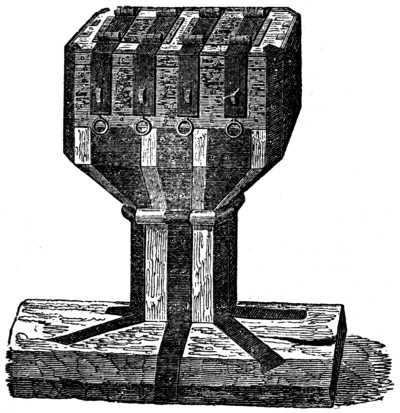
Poor’s-Box in Loddon Church, Norfolk.
The church of Loddon, in the south-eastern angle of the county of Norfolk, about five miles from Bungay, was built about 1495, and contains a depository of this description, with two separate boxes, each of them secured by two padlocks: over one of these is a hole in the lid for the offerings. When a sufficient sum was collected, it was taken out and placed in the adjoining box in the presence of the two churchwardens.
Ben Jonson, in his “Masque of the Metamorphosed Gipsies, as it was thrice presented before king James, 1621, &c.” makes a gipsy tell Tom Ticklefoot, a rustic musician,—
“On Sundays you rob the poor’s-box with your tabor; The collectors would do it, you save them a labour.”
Whereunto a countryman answers,
“Faith, but a little: they’ll do it non-upstant.”[216]
From this we gather that it was customary at that time to put money in the parish poor’s-box on Sundays, and that the trustees of the poor were sometimes suspected of misapplying it.
The neglect of this mode of public contribution is noted in Hogarth’s marriage scene of the “Rake’s Progress,” by a cobweb covering the poor’s-box in the church. There is an intimation to the same effect in one of Beaumont and Fletcher’s plays, which further intimates that poor’s-boxes had posies—
The poor man’s box is there too: if ye find any thing Besides the posy, and that half rubb’d out too, For fear it should awaken too much charity, Give it to pious uses: that is, spend it.
Spanish Curate, 1647.
The posies or mottoes on poor’s-boxes were short sentences to incite benevolence—such as, “He that giveth to the poor lendeth to the Lord,” &c.
Poetry.
ANGEL HELP.[217]
This rare Tablet doth include Poverty with Sanctitude. Past midnight this poor Maid hath spun, And yet the work not half is done, Which must supply from earnings scant A feeble bed-rid parent’s want. Her sleep-charged eyes exemption ask, And Holy hands take up the task; Unseen the rock and spindle ply, And do her earthly drudgery. Sleep, saintly Poor One, sleep, sleep on, And, waking, find thy labours done. Perchance she knows it by her dreams; Her eye hath caught the golden gleams (Angelic Presence testifying,) That round her everywhere are flying; Ostents from which she may presume That much of Heaven is in the room. Skirting her own bright hair they run, And to the Sunny add more Sun: Now on that aged face they fix, Streaming from the Crucifix; The flesh-clogg’d spirit disabusing. Death-disarming sleeps infusing, Prelibations, foretastes high, And equal thoughts to live or die. Gardener bright from Eden’s bower, Tend with care that Lily Flower; To its leaves and root infuse Heaven’s sunshine, Heaven’s dews; ’Tis a type and ’tis a pledge Of a Crowning Privilege: Careful as that Lily Flower, This Maid must keep her precious dower; Live a Sainted Maid, or die Martyr to Virginity. Virtuous Poor Ones, sleep, sleep on, And, waking, find your labours done.
C. Lamb.
New Monthly Magazine, June 1, 1827.
COWPER.
The poet of “The Sofa,” when “in merry pin,” trifled pleasantly. As an instance of his manner, there remains the following
Letter to the Rev. J. Newton.
July 12, 1781.
My very dear Friend,—I am going to send, what, when you have read, you may scratch your head, and say, I suppose there’s nobody knows, whether what I have got, be verse or not; by the tune or the time, it ought to be rhyme; but if it be, did you ever see, of late or of yore, such a ditty before?
I have writ Charity, not for popularity, but as well as I could, in hopes to do good; and if the reviewers should say “to be sure, the gentleman’s muse wears Methodist shoes; you may know by her pace, and talk about grace, that she and her bard, have little regard, for the taste and fashions, and ruling passions, and hoidening play, of the modern day: and though she assume a borrowed plume, and now and then wear a tittering air, ’tis only her plan, to catch if she can, the giddy and gay, as they go that way, by a production, on a new construction; she has baited her trap, in hopes to snap, all that may come, with a sugar plum.”—This opinion in this will not be amiss: ’tis what I intend, my principal end; and if I succeed, and folks should read, till a few are brought, to a serious thought, I should think I am paid for all I have said, and all I have done, though I have run, many a time, after a rhyme, as far from hence, to the end of my sense, and by hook or crook, write another book, if I live and am here, another year.
I have heard before, of a room with a floor, laid upon springs, and such like things, with so much art, in every part, that when you went in, you was forced to begin a minuet pace, with an air and a grace, swimming about, now in and now out, with a deal of state, in a figure of eight, without pipe or string, or any such thing. And now I have writ, in a rhyming fit, what will make you dance, and as you advance, will keep you still, though against your will, dancing away, alert and gay, till you come to an end of what I have penned; which that you may do, ere madam and you are quite worn out, with jigging about, I take my leave, and here you receive a bow profound, down to the ground, from your humble me—
W. C.
When prevented by rains and floods from visiting the lady who suggested “The Task,” Cowper beguiled the time by writing to her the following lines, and afterwards printing them with his own hand. He sent a copy of these verses, so printed, to his sister, accompanied by the subjoined note written upon his typographical labours.
To watch the storms, and hear the sky Give all the almanacks the lie; To shake with cold, and see the plains In autumn drown’d with wintry rains: ’Tis thus I spend my moments here, And wish myself a Dutch mynheer; I then should have no need of wit, For lumpish Hollander unfit; Nor should I then repine at mud, Or meadows delug’d with a flood; But in a bog live well content, And find it just my element; Should be a clod, and not a man, Nor wish in vain for sister Anne, With charitable aid to drag My mind out of its proper quag; Should have the genius of a boor, And no ambition to have more.
My dear Sister,—You see my beginning; I do not know but in time I may proceed to the printing of halfpenny ballads. Excuse the coarseness of my paper; I wasted so much before I could accomplish any thing legible, that I could not afford finer. I intend to employ an ingenious mechanic of this town to make me a longer case, for you may observe that my lines turn up their tails like Dutch mastiffs; so difficult do I find it to make the two halves exactly coincide with each other.
We wait with impatience for the departure of this unseasonable flood. We think of you, and talk of you; but we can do no more till the waters subside. I do not think our correspondence should drop because we are within a mile of each other; it is but an imaginary approximation, the flood having in reality as effectually parted us, as if the British Channel rolled between us.
Yours, my dear sister, with Mrs. U.’s best love,
William Cowper.
Monday, Aug. 12, 1782.
HIGHLAND DEER AND SHEEP.
“The last Deer of Beann Doran.”
A note to a poem, with this title, by John Hay Allan, Esq., relates, that in former times the barony of Glen Urcha was celebrated for the number and the superior race of its deer. When the chieftains relinquished their ancient character and their ancient sports, and sheep were introduced into the country, the want of protection, and the antipathy of the deer to the intruding animals, gradually expelled the former from the face of the country, and obliged them to retire to the most remote recesses of the mountains. Contracted in their haunts from corrai to corrai, the deer of Glen Urcha at length wholly confined themselves to Beann Doran, a mountain near the solitary wilds of Glen Lyon, and the vast and desolate mosses which stretch from the Black Mount to Loch Ranach. In this retreat they continued for several years; their dwelling was in a lonely corrai at the back of the hill, and they were never seen in the surrounding country, except in the deepest severity of winter, when, forced by hunger and the snow, a straggler ventured down into the straiths. But the hostility which had banished them from their ancient range, did not respect their last retreat. The sheep continually encroached upon their bounds, and contracted their resources of subsistence. Deprived of the protection of the laird, those which ventured from their haunt were cut off without mercy or fair chase; while want of range, and the inroads of poachers, continually diminished their numbers, till at length the race became extinct.
About the time of the disappearance of the deer from these wilds, an immense stag was one evening seen standing upon the side of Beann Donachan. He remained for some time quietly gazing towards the lake, and at length slowly descended the hill, and was crossing the road at Stronnmilchon, when he was discovered by some herdsmen of the hamlet. They immediately pursued him with their cooleys; and the alarm being given, the whole straith, men, women, and children, gathered out to the pursuit. The noble animal held them a severe chase till, as he passed through the copse on the north side of Blairachuran, his antlers were entangled in the boughs, he was overtaken by the pursuers, and barbarously slaughtered by the united onset, and assault of dogs, hay-forks, and “Sgian an Dubh.” When divided, he proved but a poor reward for the fatigue; for he was so old, that his flesh was scarcely eatable. From that time the deer were seen no more in Beann Doran; and none now appear in Glen Urcha, except when, in a hard winter, a solitary stag wanders out of the forest of Dalness, and passes down Glen Strae or Corrai Fhuar.
The same cause which had extirpated the deer from Glen Urcha has equally acted in most part of the Highlands. Wherever the sheep appear, their numbers begin to decrease, and at length they become totally extinct. The reasons of this apparently singular consequence is, the closeness with which the sheep feed, and which, where they abound, so consumes the pasturage, as not to leave sufficient for the deer: still more is it owing to the unconquerable antipathy which these animals have for the former. This dislike is so great, that they cannot endure the smell of their wool, and never mix with them in the most remote situations, or where there is the most ample pasturage for both. They have no abhorrence of this kind to cattle, but, where large herds of these are kept, will feed and lie among the stirks and steers with the greatest familiarity.
HIGHLAND MEALS.
Among the peculiarities of highland manners is an avowed contempt for the luxuries of the table. A highland hunter will eat with a keen appetite and sufficient discrimination: but, were he to stop in any pursuit, because it was meal time, to growl over a bad dinner, or visibly exult over a good one, the manly dignity of his character would be considered as fallen for ever.[218]
TREAD MILLS.
At Lewes, each prisoner walks at the rate of 6,600 feet in ascent per day; at Ipswich, 7,450; at St. Alban’s, 8,000; at Bury, 8,650; at Cambridge, 10,176; at Durham, 12,000; at Brixton, Guildford, and Reading, the summer rate exceeds 13,000; while at Warwick, the summer rate is about 17,000 feet in ten hours.[219]
Extraordinary ORAN-OUTANG, The Wild Man of the Woods.
The largest and most remarkable oran-outang ever seen by Europeans, was discovered by an officer of the ship Mary Anne Sophia, in the year 1824, at a place called Ramboon, near Touromon, on the west coast of Sumatra.
When the officer alluded to first saw the animal, he assembled his people, and followed him to a tree in a cultivated spot, on which he took refuge. His walk was erect and waddling, but not quick, and he was obliged occasionally to accelerate his motion with his hands; but with a bough which he carried, he impelled himself forward with great rapidity. When he reached the trees his strength was shown in a high degree, for with one spring he gained a very lofty branch, and bounded from it with the ease of the smaller animals of his kind. Had the circumjacent land been covered with wood, he would certainly have escaped from his pursuers, for his mode of travelling by bough or tree was as rapid as the progress of a very fleet horse: but at Ramboon there are but few trees left in the midst of cultivated fields, and amongst these alone he jumped about to avoid being taken. He was first shot on a tree, and after having received five balls, his exertion was relaxed, owing, no doubt, to loss of blood; and the ammunition having been by that time expended, his pursuers were obliged to have recourse to other measures for his destruction. One of the first balls probably penetrated his lungs, for immediately after the infliction of the wound, he slung himself by his feet from a branch with his head downwards, and allowed the blood to flow from his mouth. On receiving a wound, he always put his hand over the injured part, and the human-like agony of his expression had the natural effect of exciting painful feelings in his assailants. The peasantry seemed as amazed at the sight of him as the crew of the ship; for they had never seen one before, although living within two days’ journey from the vast and impenetrable forests on the island. They cut down the tree on which he was reclining exhausted; but the moment he found it falling, he exerted his remaining strength, and gained another, and then a third, until he was finally brought to the ground, and forced to combat his unrelenting foes, who now gathered very thickly round, and discharged spears and other missiles against him. The first spear, made of a very strong supple wood, which would have resisted the strength of the strongest man, was broken by him like a carrot; and had he not been in almost a dying state, it was feared that he would have severed the heads of some of the party with equal ease. He fell, at length, under innumerable stabs inflicted by the peasantry.
The animal is supposed to have travelled some distance from the place where he was killed, as his legs were covered with mud up to the knees. His hands and feet had great analogy to human hands and feet, only that the thumbs were smaller in proportion, and situated nearer the wrist-joint. His body was well proportioned; he had a fine broad expanded chest and a narrow waist; but his legs were rather short, and his arms very long, though both possessed such sinew and muscle as left no doubt of their strength. His head was well proportioned with his body, and the nose prominent; the eyes were large, and the mouth larger than the mouth in man. His chin was fringed, from the extremity of one ear to the other, with a shaggy beard, curling luxuriantly on each side, and forming altogether an ornamental, rather than a frightful appendage to his visage. When he was first killed, the hair of his coat was smooth and glossy, and his teeth and whole appearance indicated that he was young, and in the full possession of his physical powers. He was nearly eight feet high.
The skin and fragments of this surprising oran-outang were presented to the Asiatic Society at Calcutta; and on the 5th of January, 1825, Dr. Abel examined them, and read the observations he had made. The height already mentioned is according to the estimate of those who saw the animal alive, but the measurement of the skin went far to determine this question. The skin, dried and shrivelled as it was, in a straight line from the top of the shoulder to the point whence the ancle had been removed, measured five feet ten inches; the perpendicular length of the neck in the preparation, was three inches and a half; the length of the face, from the forehead to the chin, nine inches; and of the skin attached to the foot, from the line of its separation from the body to the heel, eight inches. The measurements were made by Dr. Abel himself. Thus we have one foot eight inches and a half to be added to the five feet ten inches, in order to approximate his real stature, which would make seven feet six inches and a half; and allowing the six inches and a half for the shortening that would result from the folding of the skin over the shoulders, the height would then be full seven feet. This is the greatest ascertained height of any tail-less monkey mentioned in the several notices which Dr. Abel collected from different writers on man-like apes.
The skin itself was of a dark leaden colour; the hair a brownish red, shaggy, and long over the shoulders and flanks.
Dr. Abel remarked, that of the small animals more particularly known in Europe, under the designation of oran-outang, one was an inhabitant of Africa, and the other of the east. Several living specimens of both have been seen in Europe, but all were of small stature, and very young, never exceeding three feet in height, or as many years of age. These animals were long considered as varieties of the same species, although in point of fact they are very distinctly separated by external character and anatomical distinctions. The African animal being always black with large ears, the eastern specimens as invariably having reddish brown hair, and very small ears; the former also are unprovided with the sacs communicating with the windpipe, which are always found in the latter.[220]
Different naturalists have deemed the oran-outang to be the connecting link between the brute and the human being.
A LITTLE LEARNING — “not a dangerous thing.”
Mr. Thomas Campbell having been chosen lord rector of the university of Glasgow, made his inaugural speech on the 12th of April, 1827, wherein are the following estimable remarks on desultory attainments:—
“In comparing small learned acquisitions with none at all, it appears to me to be equally absurd to consider a little learning valueless, or even dangerous, as some will have it, as to talk of a little virtue, a little wealth, or health, or cheerfulness, or a little of any other blessing under heaven, being worthless or dangerous.
“To abjure any degree of information, because we cannot grasp the whole circle of the sciences, or sound the depths of erudition, appears to be just about as sensible as if we were to shut up our windows because they are too narrow, or because the glass has not the magnifying power of a telescope.
“For the smallest quantity of knowledge that a man can acquire, he is bound to be contentedly thankful, provided his fate shuts him out from the power of acquiring a larger portion—but whilst the possibility of farther advancement remains, be as proudly discontented as ye will with a little learning. For the value of knowledge is like that of a diamond, it increases according to its magnitude, even in much more than a geometrical ratio.—One science and literary pursuit throws light upon another, and there is a connection, as Cicero remarks, among them all—
“‘Omnes Artes, quæ ad humanitatem pertinent, habent quoddam commune vinculum, et quasi cognatione quadam inter se continentur.’
“No doubt a man ought to devote himself, in the main, to one department of knowledge, but still he will be all the better for making himself acquainted with studies which are kindred to and with that pursuit.—The principle of the extreme division of labour, so useful in a pin manufactory, if introduced into learning, may produce, indeed, some minute and particular improvements, but, on the whole, it tends to cramp human intellect.
“That the mind may, and especially in early youth, be easily distracted by too many pursuits, must be readily admitted. But I now beg leave to consider myself addressing those among you, who are conscious of great ambition, and of many faculties; and what I say, may regard rather the studies of your future than of your present years.
“To embrace different pursuits, diametrically opposite, in the wide circle of human knowledge, must be pronounced to be almost universally impossible for a single mind.—But I cannot believe that any strong mind weakens its strength, in any one branch of learning, by diverging into cognate studies; on the contrary, I believe that it will return home to the main object, bringing back illustrative treasures from all its excursions into collateral pursuits.”
FIGURES, AND NUMBERS.
Respecting the origin of the numeral figures 1, 2, 3, 4, 5, 6, 7, 8, 9, there are various opinions, but the one most generally received is, that they were brought into Europe from Spain; that the Spaniards received them from the Moors, the Moors from the Arabians, and the Arabians from the Indians.
Bishop Huet, however, thinks it improbable that the Arabians received figures from the Indians, but, on the contrary, that the Indians obtained them from the Arabians, and the Arabians from the Grecians; from whom, in fact, they acquired a knowledge of every science they possessed. The shape of the figures they received underwent a great alteration; yet if we examine them, divested of prejudice, we shall find very manifest traces of the Grecian figures, which were nothing more than letters of their alphabet.
A small comma, or dot, was their mark for units.
The letter β (b) if its two extremities are erased, produces the figure 2.
If we form the letter γ (g) with more inclination to the left than usual, shorten the foot, and give some rotundity to the left horns near the left side, we shall make the figure 3.
The letter Δ (D) is the figure 4, as we should find on giving the left leg a perpendicular form, and lengthening it below the base, which also should be enlarged towards the left.
From the ε (e short) is formed the 5, by only bringing towards the right side the demicircle which is beneath inclining to the left.
From the figure 5 they made the 6, by leaving out the foot, and rounding the body.
Of the Ζ (Z) they make the 7, by leaving out the base.
If we turn the four corners of the Η (e long) towards the inside, we shall make the figure 8.
The ϑ (th) was the figure 9 without any alteration.
The nought was only a point which they added to their figures, to make them ten times more; it was necessary that this point should be made very distinctly, to which end they formed it like a circle, and filled it up; this method we have neglected.
Theophanus, the Eastern chronologist, says in express terms, that the Arabians had retained the Grecian numbers, not having sufficient characters in their own language to mark them.
Menage says, they were first employed in Europe in 1240, in the Alphonsian Tables, made under the direction of Alphonso, son to king Ferdinand of Castile, by Isaac Hazan, a Jew of Toledo, and Abel Ragel, an Arabian. Dr. Wallis conceives they were generally used in England about the year 1130.
In the indexes of some old French books these figures are called Arabic ciphers, to distinguish them from Roman numerals.
NUMBER X, 10.
It is observed by Huet as a remarkable circumstance, that for calculation and numerical increase the number 10 is always used, and that decimal progression is preferred to every other. The cause of this preference arises from the number of our fingers, upon which men accustom themselves to reckon from their infancy. First, they count the units on their fingers, and when the units exceed that number, they have recourse to another ten. If the number of tens increase, they still reckon on their fingers; and if they surpass that number, they then commence a different species of calculation by the same agents; as thus—reckoning each finger for tens, then for hundreds, thousands, &c.
From this mode of reckoning by the fingers then, we have been led to prefer the number ten, though it is not so convenient and useful a number as twelve. Ten can only be divided by two and five, but twelve can be divided by two, three, four, and six.
The Roman numbers are adduced in proof of the origin of reckoning by the number ten, viz.—
The units are marked by the letter I, which represent a finger.
The number five is marked by the letter V, which represents the first and last finger of a hand.
Ten, by an X, which is two V’s joined at their points, and which two V’s represent the two hands.
Five tens are marked by an L; that is half the letter E, which is the same as C, the mark for a hundred.
Five hundred is marked by a D, half of the letter Φ, which is the same as M, the mark for a thousand.
According to this, the calculation of the Roman numbers was from five to five, that is, from one hand to the other. Ovid makes mention of this mode, as also of the number ten:—
“Hic numeris magno tunc in honore fuit. Seu quia tot digiti per quos numerare solemnus, Seu quia bis quino femina mense parit. Seu quod ad usque decem numero crescente venitur: Principium spatiis sumitur inde novis.”
Vitruvius also makes the same remark; he says, “Ex manibus denarius digitorum numerus.”
We have refined, however, upon the convenience which nature has furnished us with to assist us in our calculations; for we not only use our fingers, but likewise various figures, which we place in different situations, and combine in certain ways, to express our ideas.
Many unlettered nations, as the inhabitants of Guinea, Madagascar, and of the interior parts of America, know not how to count farther than ten. The Brasilians, and several others, cannot reckon beyond five; they multiply that number to express a greater, and in their calculations they use their fingers and toes. The natives of Peru use decimal progression; they count from one to ten; by tens to a hundred; and by hundreds to a thousand. Plutarch says, that decimal progression was not only used among the Grecians, but also by every uncivilized nation.
Omniana.
FOX, THE QUAKER.
This individual, many years deceased, was a most remarkable man in his circle; a great natural genius, which employed itself upon trivial or not generally interesting matters. He deserved to have been known better than he was. The last years of his life he resided at Bristol. He was a great Persian scholar, and published some translations of the poets of that nation, which were well worthy perusal. He was self-taught, and had patience and perseverance for any thing. He was somewhat eccentric, but had the quickest reasoning power, and consequently the greatest coolness, of any man of his day, who was able to reason. His house took fire in the night; it was situated near the sea; it was uninsured, and the flames spread so rapidly nothing could be saved. He saw the consequences instantly, made up his mind to them as rapidly, and ascending a hill at some distance in the rear of his dwelling, watched the picture and the reflection of the flames on the sea, admiring its beauties, as if it were a holiday bonfire.
DIVING-BELLS.
The first diving-bell we read of was nothing but a very large kettle, suspended by ropes, with the mouth downwards, and planks to sit on fixed in the middle of its concavity. Two Greeks at Toledo, in 1588, made an experiment with it before the emperor Charles V. They descended in it, with a lighted candle, to a considerable depth. In 1683, William Phipps, the son of a blacksmith, formed a project for unloading a rich Spanish ship sunk on the coast of Hispaniola. Charles II. gave him a ship with every thing necessary for his undertaking; but being unsuccessful, he returned in great poverty. He then endeavoured to procure another vessel, but failing, he got a subscription, to which the duke of Albemarle contributed. In 1687, Phipps set sail in a ship of two hundred tons, having previously engaged to divide the profits according to the twenty shares of which the subscription consisted. At first all his labours proved fruitless; but at last, when he seemed almost to despair, he was fortunate enough to bring up so much treasure, that he returned to England with the value of 200,000l. sterling. Of this sum he got about 20,000l., and the duke 90,000l. Phipps was knighted by the king, and laid the foundation of the fortunes of the present noble house of Mulgrave. Since that time diving-bells have been often employed. On occasion of the breaking in of the water of the Thames during the progress of the tunnel under the Thames, Mr. Brunel frequently descended in one to the bed of the river.
GAMING.
—“The ruling passion strong in death.”
In “Arliquiniana” avarice, and love of gaming, are exemplified by the following anecdote:—
A French woman, who resided on her estate in the country, falling ill, sent to the village curate, and offered to play with him. The curate being used to gaming, gladly entertained the proposal, and they played together till he lost all his money. She then offered to play with him for the expenses of her funeral, in case she should die. They played, and the curate losing these also, she obliged him to give her his note of hand for so much money lent, as her funeral expenses would amount to. She delivered the note to her son, and died within eight or ten days afterwards, and the curate was paid his fees in his own note of hand.
THE TANNER. An Epigram.
A Bermondsey tanner would often engage, In a long tête-à-tête with his dame, While trotting to town in the Kennington stage, About giving their villa a name. A neighbour, thus hearing the skin-dresser talk, Stole out, half an hour after dark, Pick’d up in the roadway a fragment of chalk, And wrote on the palings—“Hide Park!”[221]
FRIENDSHIP ON THE NAIL.
When Marigny contracted a friendship with Menage, he told him he was “upon his nail.” It was a method he had of speaking of all his friends; he also used it in his letters; one which he wrote to Menage begins thus: “Oh! illustrious of my nail.”
When Marigny said, “you are upon my nail,” he meant two things—one, that the person was always present, nothing being more easy than to look at his nail; the other was, that good and real friends were so scarce, that even he who had the most, might write their names on his nail.
Notice TO THE CHANCE CUSTOMERS OF THE COMPANY OF FLYING STATIONERS.
Formerly there was a numerous class who believed every thing they saw in print. It is just possible that a few of these persuadable persons may survive; I therefore venture to remark, that my name printed on the squibs now crying about the streets is a forgery.
W. HONE.
June 8, 1827.