Volume 2 — Vol. II.—47.
Reading edition
The Giants IN THE LORD MAYOR’S SHOW, AND IN GUILDHALL.
In the Lord Mayor’s Show on the 9th of November, 1827, there was a remarkable variation from the customary route. Instead of the new chief magistrate and corporation embarking at Blackfriars, as of late years has been usual, the procession took a direction eastward, passed through the Poultry, Cornhill, Leadenhall-street, Billiter-lane, Mincing-lane, and from thence by Tower-street to the Tower Stairs, where they embarked. This deviation is presumed to have been in compliment to the Tower ward, in which the lord mayor presides as alderman. The ancient lord mayors of London were accustomed to “ride and go” on horseback, attended in like manner by the aldermen, and others of the corporation, to the bottom of Queen-street, and there embark on board the barges for Westminster. The present is the first instance of the lord mayor’s show by water having proceeded from a more distant spot down the river.
In addition to the “men in armour,” and the length of the route by land, in the lord mayor’s show of this year, there was “the far more attractive novelty of two colossal figures representing the well-known statues, Gog and Magog, (as they are called,) of Guildhall. They were extremely well contrived, and appeared to call forth more admiration and applause, than fell to the share of any of the other personages who formed part of the procession. Whatever some fastidious critics may say as to the taste of reviving in the present day some of the long-neglected civic pageants, we think the appearance of these figures augurs well for the future conduct of the new lord mayor: some of his brother magistrates would, we make no doubt, be well content if in the whole course, or at the close, of their official career, they could come in for a little of the plaudits which were yesterday bestowed on the two representatives of Gog and Magog.” (The Times, Nov. 10.) From the report of a spectator, it appears that the giants were constructed of wicker-work, gaily apparelled in the costume of their prototypes, and similarly armed: each walked along by means of a man withinside, who ever and anon turned the faces towards the thrones of company in the houses; and, as the figures were fourteen feet high, their features were on a level with the first-floor windows throughout the whole of their progress.
In a work, which contains much information respecting the “London Triumphs” of the lord mayors, and the “pageants” of those processions in the olden time, there is a chapter devoted to a History of the Carvings called the “Giants in Guildhall.” As the book is my own, and seems to be little known “within the walls,” I presume to render the account in a compressed form, as follows—
The Giants in Guildhall
From the time when I was astonished by the information, that “every day, when the giants hear the clock strike twelve they come down to dinner,” I have had something of curiosity towards them. How came they there, and what are they for? In vain were my examinations of Stow, Howell, Strype, Noorthouck, Maitland, Seymour, Pennant, and numberless other authors of books and tracts regarding London. They scarcely deign to mention them, and no one relates a syllable from whence we can possibly affirm that the giants of their day were the giants that now exist.
To this remark there is a solitary exception. Hatton, whose “New View of London” bears the date of 1708, says in that work, “This stately hall being much damnify’d by the unhappy conflagration of the city in 1666, was rebuilt anno 1669, and extremely well beautified and repaired both in and outside, which cost about two thousand five hundred pounds, and two new figures of gigantick magnitude will be as before.”[443] Presuming on the ephemeral information of his readers at the time he published, Hatton obscured his information by a brevity, which leaves us to suppose that the giants were destroyed when Guildhall was “much damnify’d” by the fire of London in 1666; and that from that period they had not been replaced. It is certain, however, that there were giants in the year 1699, when Ned Ward published his London Spy: for, describing a visit to Guildhall, he says, “We turned down King-street, and came to the place intended, which we entered with as great astonishment to see the giants, as the Morocco ambassador did London when he saw the snow fall. I asked my friend the meaning and design of setting up those two lubberly preposterous figures; for I suppose they had some peculiar end in it. Truly, says my friend, I am wholly ignorant of what they intended by them, unless they were set up to show the city what huge loobies their forefathers were, or else to fright stubborn apprentices into obedience; for the dread of appearing before two such monstrous loggerheads, will sooner reform their manners, or mould them into a compliance with their masters’ will, than carrying them before my lord mayor or the chamberlain of London; for some of them are as much frighted at the names of Gog and Magog, as little children are at the terrible sound of Raw-head and Bloody-bones.” There is no doubt that at that time the city giants were far more popular than now; for, in the same work, two passengers through Bartholomew fair, who had slyly alighted from a coach without discharging it, are addressed by the coachman with “Pay me my fare, or by Gog and Magog you shall feel the smart of my whipcord;” an oath which in our time is obsolete, though in all probability it was common then, or it would not have been used by Ward in preference to his usual indecency.
Again; as to giants being in Guildhall before Hatton wrote, and whether they were the present statues. On the 24th of April, 1685, there were “wonderful and stupendous fireworks in honour of their majesties’ coronation, (James II. and his queen,) and for the high entertainment of their majesties, the nobility, and City of London, made on the Thames.”[444] Among the devices of this exhibition, erected on a raft in the middle of the river, were two pyramids; between them was a figure of the sun in polished brass, below it a great cross, and beneath that a crown, all stored with fireworks; and a little before the pyramids “were placed the statues of the two giants of Guildhall, in lively colours and proportions facing Whitehall, the backs of which were all filled with fiery materials; and, from the first deluge of fire till the end of the sport, which lasted near an hour, the two giants, the cross, and the sun, grew all in a light flame in the figures described, and burned without abatement of matter.” From this mention of “statues of the two giants of Guildhall,” it is to be inferred, that giants were in Guildhall fourteen years before Ward’s book was published, and that, probably, the firework-maker took them for his models, because their forms being familiar to the “City of London,” their appearance would be an attraction as well as a compliment to his civic audience.
Just before 1708, the date of Hatton’s book, Guildhall had been repaired; and Hatton says, “In the middle of this front are depenciled in gold these words, Reparata et Ornata Thoma Rawlinson, Milit. Majore, An. Dom. M. DCC. VI.” From whence, and his observation, in the extract first quoted, that “two new figures of gigantick magnitude will be as before,” he intends his reader to understand that, as before that reparation there had been two giants, so, with the new adornment of the hall there would be two new giants. The proof of Hatton’s meaning is to be found in “The Gigantick History of the two famous Giants in Guildhall, London, third edition, corrected. London, printed for Tho. Boreman, bookseller, near the Giants in Guildhall, and at the Boot and Crown, on Ludgate-hill, 1741.”—2 vols. 64mo. This very rare book states, that “before the present giants inhabited Guildhall, there were two giants, made only of wicker-work and pasteboard, put together with great art and ingenuity: and those two terrible original giants had the honour yearly to grace my lord mayor’s show, being carried in great triumph in the time of the pageants; and when that eminent annual service was over, remounted their old stations in Guildhall—till, by reason of their very great age, old Time, with the help of a number of city rats and mice, had eaten up all their entrails. The dissolution of the two old, weak, and feeble giants, gave birth to the two present substantial and majestic giants; who, by order, and at the city charge, were formed and fashioned. Captain Richard Saunders,[445] an eminent carver in King-street, Cheapside, was their father; who, after he had completely finished, clothed, and armed these his two sons, they were immediately advanced to those lofty stations in Guildhall, which they have peaceably enjoyed ever since the year 1708.” The title-page of the “Gigantick History” shows that the work was published within the Guildhall itself, when shops were permitted there; so that Boreman, the publisher, had the best means that time and place could afford of obtaining true information, and for obvious reasons he was unlikely to state what was not correct. It is further related in this work, that “the first honour which the two ancient wicker-work giants were promoted to in the city, was at the restoration of king Charles II., when with great pomp and majesty they graced a triumphal arch, which was erected on that happy occasion at the end of King-street, in Cheapside.” This was before the fire of London, by which the hall was “much damnify’d,” but not burned down; for the conflagration was principally confined to the wooden roof; and, according to this account, the wicker-giants escaped, till their infirmities, and the labours of the “city rats,” rendered it necessary to supersede them.
That wicker was used in constructing figures for the London pageants is certain. Haywood, in his description of the pageants in the show of the lord mayor Raynton, in 1632, says, “The moddellor and composer of these seuerall pieces, Maister Gerard Christmas, found these pageants and showes of wicker and paper, and reduc’t them to sollidity and substance.”
To prove, however, the statement in the “Gigantick History,” that the present giants were put up upon the reparation of the hall in 1706, an examination of the city archives became necessary; and as the history fortunately mentions captain Richard Saunders as the carver, the name became a clue to successful inquiry. Accordingly, on examination of the city accounts at the chamberlain’s office, under the head of “Extraordinary Works,” for 1707, I discovered among the sums “paid for repairing of the Guildhall and chappell,” an entry in the following words:—
To Richard Saunders, carver, seaventy pounds, by order of the co’mittee for repairing Guildhall, dated ye xth. of April, 1707, for work by him done
70l.
This entry of the payment confirms the relation of the gigantic historian; but Saunders’s bill, which doubtless contained the charges for the two giants, and all the city vouchers before 1786, deposited in the chamberlain’s office, were destroyed by a fire there in that year.
Giants were part of the pageantry used in different cities of the kingdom. By an ordinance of the mayor, aldermen, and common-council of Chester,[446] for the setting of the watch on the eve of the festival of St. John the Baptist, in 1564, it was directed that there should be annually, according to ancient custom, a pageant, consisting of four giants, with animals, hobby-horses, and other figures, therein specified.[447] In 1599, Henry Hardman, Esq. the mayor of Chester in that year, from religious motives, caused the giants in the Midsummer show “to be broken, and not to goe the devil in his feathers,” and he provided a man in complete armour to go in their stead; but in 1601, John Ratclyffe, a beer-brewer, being mayor, set out the giants and the Midsummer show as usual. On the restoration of Charles II. new ones were ordered to be made, and the estimate for finding the materials and workmanship of the four great giants, as they were before, was at five pounds a giant; and four men to carry them at two shillings and sixpence each. The materials for making these Chester giants were deal-boards, nails, pasteboard, scaleboard, paper of various sorts, buckram, size cloth, and old sheets for their bodies, sleeves, and shirts, which were to be coloured; also tinsel, tinfoil, gold and silver leaf, and colours of different kinds. A pair of old sheets were to cover the father and mother giants, and three yards of buckram were provided for the mother’s and daughter’s hoods. There is an entry in the Chester charges of one shilling and fourpence “for arsenic to put into the paste to save the giants from being eaten by the rats;”[448] a precaution which, if adopted in the formation of the old wicker-giants of London, was not effectual, though how long they had ceased to exist before the reparation of the hall, and the carving of their successors, does not appear. One conjecture may perhaps be hazarded, that, as after the mayor of Chester had ordered the giants there to be destroyed, he provided a man in armour as a substitute; so perhaps the dissolution of the old London wicker-giants, and the lumbering incapacity of the new wooden ones for the duty of lord mayor’s show, occasioned the appearance of the men in armour in that procession.
Until the last reparation of Guildhall, in 1815, the present giants stood with the old clock and a balcony of iron-work between them, over the stairs leading from the hall to the courts of law and the council chamber. When they were taken down in that year, and placed on the floor of the hall, I thoroughly examined them as they lay in that situation. They are made of wood,[449] and hollow within, and from the method of joining and gluing the interior, are evidently of late construction, and every way too substantially built for the purpose of being either carried or drawn, or any way exhibited in a pageant. On inspecting them at that period, I made minute inquiry of an old and respectable officer of Guildhall, with whom they were favourites, as to what particulars existed in the city archives concerning them; he assured me that he had himself anxiously desired information on the same subject, and that after an investigation through the different offices, there was not a trace of the period when they commenced to be, nor the least record concerning them. This was subsequently confirmed to me by gentlemen belonging to other departments.
However stationary the present ponderous figures were destined to remain, there can scarcely be a question as to the frequent use of their wicker predecessors in the corporation shows. The giants were great favourites in the pageants.[450] Stow, in describing the ancient setting of the nightly watch in London on St John’s eve, relates that “the mayor was surrounded by his footmen and torch-bearers, and followed by two henchmen on large horses: the mayor had, besides his giant, three pageants; whereas the sheriffs had only two, besides their giants, each with their morris dance and one henchman.”[451] It is related, that, to make the people wonder, these giants were armed, and marched as if they were alive, to the great diversion of the boys, who, peering under, found them stuffed with brown paper.[452] A character in Marston’s “Dutch Courtezan,” a comedy acted in 1605, says, “Yet all will scarce make me so high as one of the gyant’s stilts that stalks before my lord mayor’s pageants.”[453]
During queen Elizabeth’s progress to her coronation, Gogmagog and Corinæus, two giants, were stationed at Temple-bar. It is not certain, yet it is probable, that these were the wicker-giants brought from Guildhall for the occasion. In the reign before, when queen Mary and Philip II. of Spain made their public entry, there was at London bridge a grand spectacle, with two images representing two giants, the one named Corinæus, and the other Gogmagog, holding between them certain Latin verses.[454] There is scarcely a likelihood that these were any other than the Guildhall giants, which on the occasion of a corporation rejoicing could be removed with the utmost ease.
Orator Henley, on the 21st of October, 1730, availed himself of the anticipated civic festival for that year to deliver a lecture upon it, mentioning the giants, which he announced by newspaper advertisement as follows:—
At the Oratory, the corner of Lincoln’s-Inn-Fields, near Clare-market, this Day, being Wednesday, at Six o’Clock in the Evening, will be a new Riding upon an old Cavalcade, entituled The City in its Glory; or, My Lord Mayor’s Shew: Explaining to all Capacities that wonderful Procession, so much envy’d in Foreign Parts, and nois’d at Paris: on my Lord Mayor’s Day; the fine Appearance and Splendor of the Companies of Trade; Bear and Chain; the Trumpets, Drums, and Cries, intermix’d; the qualifications of my L—’s Horse, the whole Art and History of the City Ladies and Beaux at Gape-stare in the Balconies; the Airs, Dress, and Motions; THE TWO GIANTS walking out to keep Holiday; like Snails o’er a Cabbage, says an old Author, they all crept along; admir’d by their Wives, and huzza’d by the Throng.
There is no stronger evidence of the indifference to playfulness and wit at city elections, than the almost total silence on those occasions respecting such ample subjects for allusion and parallel as the giants in the hall. Almost the only instance of their application in this way is to be found in a handbill on occasion of a mayoralty election, dated Oct. 4th, 1816, addressed “To the London Tavern Livery and their Spouses.” It states, that “the day after Mr. Alderman —— is elected lord mayor for the year ensuing, the following entertainments will be provided for your amusement gratis, viz. 1. The two giants, at the bottom of the hall, will dance a minuet by steam, attended by Mr. Alderman —— in a new wig upon an elastic principle, gentleman having bought half of his old one for the purpose of making a new peruke for the aforesaid giants.” This is the first humorous allusion to the giants after their removal to their present station.
It is imagined by the author of the “Gigantick History,” that the Guildhall giants represent Corinæus a Trojan, and Gogmagog a Cornish giant, whose story is related at large in that work; the author of which supposes, that as “Corinæus and Gogmagog were two brave giants, who nicely valued their honour, and exerted their whole strength and force in defence of their liberty and country; so the city of London, by placing these their representatives in their Guildhall, emblematically declare, that they will, like mighty giants, defend the honour of their country and liberties of this their city, which excels all others, as much as those huge giants exceed in stature the common bulk of mankind.” Each of these giants, as they now stand, measures upwards of fourteen feet in height: the young one is believed to be Corinæus, and the old one Gogmagog.
Such being the chief particulars respecting these enormous carvings, the terror of the children, the wonder of the ’prentices, and the talk of the multitude, in former days, I close the subject, satisfied with having authenticated their origin. Trifling as this affair may seem, I pursued the inquiry for upwards of sixteen years; and though much of the time I spent in the search might have been better employed, I can assure those who are unacquainted with the nature of such investigations, that I had much pleasure in the pursuit, and when I had achieved my purpose I felt more highly gratified, than I think I should had I attained to the dignity of being “proud London’s proud lord mayor.”
There are other memoranda respecting the giants and lord mayors’ shows in my volume on “Ancient Mysteries,” from whence the present particulars are extracted.
*
NORWICH GUILD. Mayor’s Feast, Temp. Elizabeth.
The earls of Northumberland and Huntingdon, the lords Thomas Howard and Willoughby, with many other noblemen and knights, paid a visit to the duke of Norfolk, and were entertained, with their retinue, at the duke’s palace, in Norwich, in 1561. The guild happening at this time, William Mingay, Esq., then mayor, invited them and their ladies to the feast, which they accepted, and expressed the greatest satisfaction at their generous and hospitable reception. At the entertainment the duke and duchess of Norfolk sat first; then the three earls of Northumberland, Huntingdon, and Surrey, lord Thomas Howard, lord Scroop and his lady, lord and lady Bartlet, lord Abergavenny, with so many other peers, knights, and ladies, that the hall could scarcely contain them and their retinue.[455] The mayor’s share of the expense was one pound, twelve shillings, and ninepence. The feast makers, four in number, paying the rest. The mayor’s bill of fare was as follows:—
£. s. d.
Eight stone of beef, at 8d. a stone, and a sirloin 0 5 8
Two collars of brawn 0 1 0
Four cheeses, at 4d. a cheese 0 1 4
Eight pints of batter 0 1 6
A hinder quarter of veal 0 0 10
A leg of mutton 0 0 5
A fore quarter of veal 0 0 5
Loin of mutton and shoulder of veal 0 0 9
Breast and coat of mutton 0 0 7
Six pullets 0 1 0
Four couple of rabbits 0 1 8
Four brace of partridges 0 2 0
Two Guinea cocks 0 1 6
Two couple of mallard 0 1 0
Thirty-four eggs 0 0 6
Bushel of flour 0 0 6
Peck of oatmeal 0 0 2
Sixteen white bread-loaves 0 0 4
Eighteen loaves of white wheat-bread 0 0 9
Three loaves of meslin bread 0 0 3
Nutmegs, mace, cinnamon, and cloves 0 0 3
Four pounds of Barbary sugar 0 1 0
Sixteen oranges 0 0 2
A barrel of double strong beer 0 2 6
A barrel of table beer 0 1 0
A quarter of wood 0 2 2
Two gallons of white wine and Canary 0 2 0
Fruit, almonds, sweet water, perfumes 0 0 4
The cook’s wages 0 1 2
Total £1 12 9
After dinner, Mr. John Martyn, a wealthy and honest man of Norwich, made the following speech:—“Maister Mayor of Norwich, and it please your worship, you have feasted us like a king. God bless the queen’s grace. We have fed plentifully and now, whilom I can speak plain English, I heartily thank you, maister Mayor, and so do we all. Answer, boys, answer. Your beer is pleasant and potent, and will soon catch us by the caput and stop our manners: and so huzza for the queen’s majesty’s grace, and all her bonny-brow’d dames of honour.[456] Huzza for maister Mayor, and our good dame Mayoress. His noble grace,[457] there he is, God bless him, and all this jolly company. To all our friends round county, who have a penny in their purse and an English heart in their bodies, to keep out Spanish dons, and papists with their faggots to burn our whiskers. Shove it about, twirl your cap-cases, handle your jugs, and huzza for maister Mayor, and his bretheren their worships.”
The honesty, freedom, loyalty, and good-humour of this speech would, at any time, entitle the orator to a patient hearing and an approving smile.
The above is from Beatniffe’s Norfolk Tour.
G. B.
Norwich, September, 1827.
Garrick Plays. No. XLI.
[Dedications to Fletcher’s “Faithful Shepherdess;” without date; presumed to be the First Edition.]
1st.
To that noble and true lover of learning, Sir Walton Aston.
Sir, I must ask your patience, and be true. This Play was never liked, except by few That brought their judgments with them; for of late First the infection,[458] then the common prate Of common people, have such customs got Either to silence Plays, or like them not: Under the last of which this Interlude Had fal’n, for ever press’d down by the rude That, like a torrent which the moist South feeds, Drowns both before him the ripe corn and weeds; Had not the saving sense of better men Redeem’d it from corruption. Dear Sir, then Among the better souls be you the best, In whom as in a center I take rest, And proper being; from whose equal eye And judgement nothing grows but purity. Nor do I flatter; for, by all those dead Great in the Muses, by Apollo’s head, He that adds any thing to you, ’tis done Like his that lights a candle to the sun. Then be as you were ever, yourself still Moved by your judgement, not by love or will. And when I sing again (as who can tell My next devotion to that holy Well?) Your goodness to the Muses shall be all Able to make a work Heroical.
2nd.
To the Inheritor of all Worthiness, Sir William Scipwith.
ODE.
1.
If from servile hope or love I may prove But so happy to be thought for Such a one, whose greatest ease Is to please, Worthy Sir, I have all I sought for.
2.
For no itch of greater name, Which some claim By their verses, do I show it To the world; nor to protest, ’Tis the best; These are lean faults in a poet.
3.
Nor to make it serve to feed At my need; Nor to gain acquaintance by it; Nor to ravish kind Atturneys In their journies; Nor to read it after diet.
4.
Far from me are all these aims; Frantic claims, To build weakness on and pity; Only to yourself, and such Whose true touch Makes all good, let me seem witty.
3rd.
To the perfect gentleman, Sir Robert Townesend.
If the greatest faults may crave Pardon, where contrition is, Noble Sir, I needs must have A long one for a long amiss. If you ask me how is this, Upon my faith I’ll tell you frankly; You love above my means to thank ye. Yet according to my talent, As sour fortune loves to use me, A poor Shepherd I have sent In home-spun gray, for to excuse me: And may all my hopes refuse me But, when better comes ashore, You shall have better, never more; ’Till when, like our desperate debtors, Or our three-piled sweet “protesters,” I must please you in bare letters; And so pay my debts, like jesters. Yet I oft have seen good feasters, Only for to please the pallet, Leave great meat, and chuse a sallet.
Apologetical Preface, following these:
To the Reader.
If you be not reasonably assured of your knowledge in this kind of Poem, lay down the Book; or read this, which I would wish had been the Prologue. It is a Pastoral Tragic-Comedy; which the people seeing when it was played, having ever had a singular gift in defining, concluded to be a play of Country hired Shepherds, in gray cloaks, with cur-tailed dogs in strings, sometimes laughing together, sometimes killing one another; and, missing Whitsun Ales, cream, wassail, and Morris dances, began to be angry. In their error I would not have you fall, lest you incur their censure.[459] Understand, therefore, a Pastoral to be—a Representation of Shepherds and Shepherdesses, with their Actions and Passions, which must be such as agree with their natures; at least, not exceeding former fictions and vulgar traditions. They are not to be adorn’d with any art, but such improper ones as nature is said to bestow, as Singing and Poetry; or such as experience may teach them, as the virtues of herbs and fountains; the ordinary course of the sun, moon, and stars; and such like. But you are ever to remember Shepherds to be such, as all the ancient poets (and modern of understanding) have received them; that is, the Owners of Flocks, and not Hirelings.—A Tragic-comedy is not so called in respect of mirth and killing, but in respect it wants deaths (which is enough to make it no Tragedy); yet brings some near to it (which is enough to make it no Comedy): which must be a Representation of Familiar People, with such kind of trouble as no life can be without; so that a God is as lawful in this, as in a Tragedy; and mean People, as in a Comedy.—Thus much I hope will serve to justify my Poem, and make you understand it; to teach you more for nothing, I do not know that I am in conscience bound.
John Fletcher.
[From the “Wars of Cyrus;” a Tragedy Author unknown, 1594.]
Dumb Show exploded.
Chorus (to the Audience). ———— Xenophon Warrants what we record of Panthea. It is writ in sad and tragic terms, May move you tears; then you content our Muse, That scorns to trouble you again with toys Or needless antics, imitations, Or shows, or new devises sprung o’ late; We have exiled them from our tragic stage, As trash of their tradition, that can bring Nor instance nor excuse: for what they do,[460] Instead of mournful plaints our Chorus sings; Although it be against the upstart guise, Yet, warranted by grave antiquity, We will revive the which hath long been done.
[From the “Married Beau,” a Comedy, by John Crowne, 1694.]
Wife tempted: she pleads religion.
Lover. Our happy love may have a secret Church Under the Church, as Faith’s was under Paul’s, Where we may carry on our sweet devotion; And the Cathedral marriage keep its state, And all its decency and ceremonies.
[From the “Challenge for Beauty,” Tragi-Comedy, by T. Heywood, 1636.]
Appeal for Innocence against a false accusation.
Helena. Both have sworn: And, Princes, as you hope to crown your heads With that perpetual wreath which shall last ever, Cast on a poor dejected innocent virgin Your eyes of grace and pity. What sin is it, Or who can be the patron to such evil?— That a poor innocent maid, spotless in deed, And pure in thought, both without spleen and gall, That never injured creature, never had heart To think of wrong, or ponder injury; That such a one in her white innocence, Striving to live peculiar in the compass Of her own virtues; notwithstanding these, Should be sought out by strangers, persecuted, Made infamous ev’n there where she was made For imitation; hiss’d at in her country; Abandon’d of her mother, kindred, friends; Depraved in foreign climes, scorn’d every where, And ev’n in princes’ courts reputed vile: O pity, pity this!
C. L.
Lodge and Avenue at Holwood, The Residence of John Ward, Esq. formerly of the late Right Hon. William Pitt.
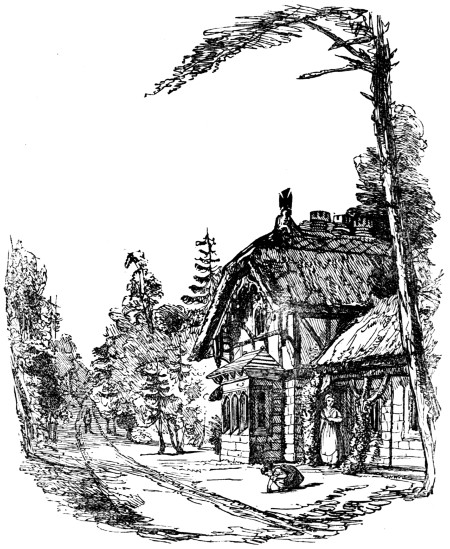
Lodge and Avenue at Holwood, The Residence of John Ward, Esq. formerly of the late Right Hon. William Pitt.
Mr. S. Young’s comfortable little inn, the Cross at Keston, or Keston Mark, is mentioned before as being at the north-east corner of the grounds belonging to Holwood. My friend W—— and I, on a second visit to Mr. Young’s house, went from thence, for the purpose of seeing the church and village of Keston, through which the main road runs to Westerham. We kept along to the entrance gate of Holwood, which we passed, having the park palings on our left, till we came to a well in the road, which derives its water from springs within Holwood, and stands on a swell of meadow land, called “the War Bank.” Further on, and out of the road to the right, lies the village of Keston, a few houses embowered in a dell of trees; with a stone church, which did not seem to have been built more than a couple of centuries. A peep through the windows satisfied us that there was nothing worth looking at within. We had heard of stone coffins having been found at the bottom of the War Bank, and we returned to that spot; where, though the ground had been ploughed and was in pasture, we met with much stone rubbish in the soil, and some large pieces loose on the surface and in the ditches of the hedge. These appearances indicated a former structure there; and an old labourer, whom we fell in with, told us that when he was a boy, his grandfather used to talk of “Keston old church” having stood in that spot, but becoming decayed, it was pulled down, and the church rebuilt in its present situation, with the materials of the ancient edifice. If this information was correct, the coffins which were discovered in that spot were more likely to have been deposited there in ordinary burial, than to have contained, as most of the country people suppose, the bodies of persons slain in battle on the War Bank. Besides, if that mound derives its name, as tradition reports, from a conflict there between the Romans and the ancient Britons, it must be remembered that our rude aboriginal ancestors were unaccustomed to that mode of sepulture, and that Cæsar had work of more consequence to employ his soldiers on than such laborious constructions for the interment of his officers. One of these coffins is at Mr. Smith’s, near the well-head on the War Bank, and another is at lady Farnaby’s, at Wickham Court.
The little village of Keston is, of itself, nothing; but, looking over it from the road towards the weald of Kent, and particularly Surrey, there is a sweeping view of hill and dale, arable and pasture, intersected with woodlands. Its name is said to have been derived from Cæsar’s (pronounced Kæsar’s) town; but it is quite as likely to have been a corruption of “castrum,” a fortress or citadel. There is little doubt that the Romans maintained a military position on the heights adjoining Keston for a considerable time. The site they held was afterwards occupied by the late right honourable William Pitt; and respecting it, there was published in the year 1792 the following
Account of Holwood.
Holwood-hill, at present the seat of the right hon. William Pitt, is a most beautiful eminence, commanding (without the view of water) one of the most agreeable prospects in this country, or perhaps in this kingdom.
The house is a very small, old, plastered brick building; but being on the edge of a celebrated fox-hunting country, it was formerly the residence of various gentlemen who hunted with the old duke of Grafton. It afterwards came into the hands of the late Mr. Calcraft, the agent; and, small as it is, was used as a house of rendezvous by the heads of the great party at that time, where they privately formed their schemes of parliamentary manœuvre, and partook of Mr. Calcraft and Mrs. Bellamy’s elegant entertainment.
From Mr. Calcraft it came into the hands of the Burrell family: by them it was sold to captain Ross, and was purchased of him by —— Burrow, Esq., (nephew of the late sir James Burrow,) who stuccoed the house, added greatly to the grounds by various purchases, grubbed and converted considerable woods into beautiful pasture and pieces of water, and planted those ornamental shrubberies, which have rendered it so delightful and so justly admired a spot.
—— Randall, Esq., an eminent shipbuilder, purchased it of Mr. Burrow, and he has since sold it to the right hon. William Pitt, a native of (Hayes) the adjoining parish.
Holwood is fourteen miles distant from London, in the parish of Keston, Kent; which parish evidently, either by Latin or Saxon derivation, takes its name from the camp, commonly called Julius Cæsar’s Camp; on the south entrenchment of which Mr. Pitt’s house stands, and some part of the pleasure-ground is within the same.
This celebrated camp, till within these twenty years, was tolerably perfect: it consisted of a circular double, and in some places treble entrenchment, enclosing about twenty-nine acres of land; into which there appeared to have been no original entrance but by the opening to the north-west, which descends to the spring called “Cæsar’s Spring.” This spring has long been converted into a most useful public cold bath; a dressing-house is built on the brink of it; it is ornamented with beautiful trees, and from its romantic situation, forms a most pleasing scene.
However antiquarians (from the variety of fragments, coins, &c. discovered ploughed up in the neighbourhood) may have been induced to differ in conjecture as to the person who framed it, they all agree that this camp was originally a strong and considerable Roman station, though not of the larger sort; but rather from its commanding situation, and short distance from the Thames, a camp of observation, or castra æstiva. At the same time, there is great reason to suppose it to have been since possessed by other invaders.
The beautiful common of Keston to the south-west of the camp, from its charming turf, shade, and views, has long been the promenade of the neighbouring company; and parties of gentry from even so far as Greenwich, have long been accustomed to retire with music and provision to spend in this delightful spot the sultry summer’s day, drinking at Cæsar’s Fountain, and making the stupendous Roman bulwarks resound with the strains of instruments and the voice of social glee.
The above is some account of the country-seat of Mr. Pitt; but as an inhabitant of the capital may be desirous of knowing what works of taste, or of neighbouring utility, may have engaged the retirement of our illustrious prime minister, the following are the few improvements Holwood has yet undergone.
Whether from a natural antipathy to the animal, or from too much of “Fox” in other places, certain it is, the first order that was issued, was for the utter destruction of the “fox earth,” being a lodgement in one side of the bulwarks, which the sagacious Reynards are supposed to have been in quiet possession of ever since the Roman abdication.
The house standing on a high hill, the gentlemen who have hitherto lived in it, judging “not much good was to be had from the North,” had defended it on that quarter by large plantations of evergreens; but the present possessor has cut down these plantations, and seems determined “to be open to every thing that comes from that delightful region.”
The house itself has undergone no other alteration than the addition of a small eating-room covered with pantiles, and a curious new-invented variegated stucco, with which the whole has been done over: this stucco has now stood several winters, and only requires to be a little more known to be universally adopted.[461]
While Holwood was in the occupation of Mr. Pitt he there seemed to enjoy the short cessations he could obtain from official duty. His chief delight in these spare hours was planting; which, as he pursued it only as opportunity enabled him, was without system of purchase or order of arrangement, and consequently very expensive. After his death Holwood successively devolved into different hands, and the residence and grounds were variously altered. At length the estate was purchased by John Ward, Esq. a merchant of London, who pulled down the house, and erected the present edifice from a design by Mr. Burton, under whose direction the work was completed in the spring of 1827. Its exterior is chaste, and the interior commodious and elegantly laid out. It stands on the summit of a noble ascent, well defended from adverse winds by full-grown trees and young plantations. From the back front, a fine sweep of lawn descends into a wide spreading valley; and the high and distant woodlands of Knole, Seven Oaks, Tunbridge, and the hills of Sussex, form an extensive amphitheatre of forest scenery and downs, as far as the eye can reach. The home grounds are so disposed, that the domain seems to include the whole of the rich and beautiful country around.
In the rear of Holwood Mr. Ward is forming a vineyard, which, if conducted with the judgment and circumspection that mark the commencement, may prove that the climate of England is suited to the open culture of the grape. Mr. Ward has imported ten sorts of vines, five black and five white, from different parts of the Rhine and Burgundy. They are planted on a slope towards the S.S.E. Difficulties and partial failures are to be expected in the outset of the experiment, and are to be overcome, in its progress, by enlarged experience and information respecting the treatment of the plants in foreign countries. That the vine flourished here several centuries ago can be proved historically. There is likewise evidence of it in the old names of places still existing. For instance, in London, there is “Vineyard-gardens,” Clerkenwell; and in Kent, there is a field near Rochester cathedral, which has been immemorially called “the Vines.” Many examples of this nature might be adduced. But far stronger than presumptive testimony is the fact, that, in some parts of the weald of Kent, the vine grows wild in the hedges; a friend assures me of this from his own knowledge, he having often assisted when a boy in rooting up the wild vine on his father’s land.
Mr. Ward’s alterations at Holwood are decisive and extensive. Besides the erection of a new and spacious residence, instead of the old one, which was small and inconvenient, and ill suited to the commanding character and extent of the grounds, he has greatly improved them; and perfected a stately approach to the mansion. Immediately within the great entrance gates, from Keston Common, is the elegant lodge represented by the engraving. For the purpose of making the drawing, we obtained seats just within the gates. While W. sketched it the silence was unbroken, save by the gentle rustle of the leaves in the warm afternoon air of summer, and the notes of the small birds preparing for their vesper song; the rabbits were scudding from their burrows across the avenue, and the sun poured glowing beams from between the branches of the magnificent trees, and dressed the varied foliage in a thousand beauteous liveries——
Circumstances prevent this article from concluding, as had been purposed, with notices of Holwood-hill as a Roman encampment, and of “Cæsar’s Spring,” in the declivity, beneath the gates of Holwood on Keston Common. An engraving of that ancient bourne, which Julius Cæsar is said to have himself discovered nearly two thousand years ago, and thither directed his legions to slake their thirst, will precede the remaining particulars in another sheet.
*
THE PLAGUE AT EYAM, AND THE REV. THOMAS STANLEY.
To the Editor.
Sir,—The publication of the paper, entitled “Catherine Mompesson’s Tomb,” on “The Desolation of Eyam, and other Poems, by William and Mary Howitt,” at p. 482 of the Table Book, gives me an opportunity, with your good offices, of rescuing from a degree of oblivion the name and merits of an individual, who has unaccountably been almost generally overlooked, but who ought, at least, to be equally identified in any notice of the “Plague at Eyam” with Mr. Mompesson himself.
The Rev. Thomas Stanley was instituted to the rectory of Eyam by the ruling powers in 1644, which he held till the “Act of Uniformity,” in 1662, threw him out.
It appears that he continued to reside at Eyam after his ejectment, and the tradition of the place at this day is, that he was supported by the voluntary contributions of two-thirds of the inhabitants; this may have been the cause of some jealousy in those who might have been satisfied with his removal from the living.
His comparative disinterestedness, with other circumstances worthy of notice, are recorded by his friend and fellow-sufferer Bagshaw, usually called “the Apostle of the Peak;” he concludes a most interesting account of Mr. Stanley in these words:—“When he could not serve his people publickly, some (yet alive) will testifie, how helpful he was to ’em in private; especially when the sickness (by way of eminency so called, I mean the Pestilence) prevailed in that town, he continuing with ’em, when, as it is written, 259 persons of ripe age, and 58 children were cut off thereby. When some, who might have been better employed, moved the then noble earl of Devonshire, lord lieutenant, to remove him out of the town; I am told by the credible, that he said, ‘It was more reasonable that the whole country should, in more than words, testify their thankfulness to him, who, together with his care of the town, had taken such care as no one else did, to prevent the infection of the towns adjacent.’”
Mr. Stanley died at Eyam 24th August, and was buried there on the 26th following, 1670.
I have thus extracted what, as an act of justice, ought to have been published long since, and which, indeed, ought to accompany every memorial of the plague at Eyam: though I scarcely regret that it has waited for the extensive circulation the Table Book must give to it—if it is so fortunate as to be considered a communication to your purpose. My authority is, “De Spiritualibus Pecci. Notes (or Notices) concerning the Work of God, and some of those who have been workers together with God in the High Peak of Derbyshire,” &c. 12mo. 1702. (Sheffield.)
Some farther account of Stanley may be seen in Calamy’s “Nonconformist’s Memorial,” and Hunter’s “History of Hallamshire,” but both follow Bagshaw.
I exceedingly regret that “William and Mary Howitt” were unacquainted with Mr. Stanley’s services at Eyam.
I am, sir, Your obedient and humble servant, M. N.
Nov. 9, 1827.
For the Table Book.
THE REIGN OF DEATH.
And I saw, and beheld a white horse: and he that sat on him had a bow; and a crown was given unto him: and he went forth conquering, and to conquer.
Revelations, vi. 2.
In nightly vision, on my bed, I saw A form unearthly, on a pale horse sat, Riding triumphant o’er a prostrate world. Around his brows he wore a crown of gold, And in his bony hand he grasp’d a bow, Which scatter’d arrows of destruction round. His form was meagre—shadowy—indistinct— Clothed with the faint lineaments of man. He pass’d me swifter than the winged wind— Or lightning from the cloud—or ghostly vision. From his eye he shot devouring lightnings, And his dilated nostril pour’d a stream Of noisome, pestilential vapour. Where’er he trod all vegetation ceas’d, And the spring flow’rs hung, with’ring, on their stalks. He passed by a city, whose huge walls, And towers, and battlements, and palaces, Cover’d the plain, aspiring to the skies: As he pass’d, he smil’d—and straight it fell— Wall, tower, and battlement, and glittering spire, Palace, and prison, crumbling into dust; And nought of this fair city did remain, But one large heap of wild, confused ruin. The rivers ceas’d to flow, and stood congeal’d. The sea did cease its roaring, and its waves Lay still upon the shore—— No tide did ebb or flow, but all was bound In a calm, leaden slumber. The proud ships, Which hitherto had travers’d o’er the deep, Were now becalmed with this dead’ning stillness:— The sails hung motionless—straight sunk the mast O’er the huge bulwarks, and the yielding planks Dropt silently into the noiseless deep:— No ripple on the wave was left to show Where, erst, the ship had stood, but all was blank And motionless. Birds in the air, upon the joyous wing, Fell, lifeless, as the shadowy monster pass’d And hostile armies, drawn in warlike lines, Ceas’d their tumultuous conflict in his sight— Conqueror and conquer’d yielding ’neath the power Of the unknown destroyer! Nations fell; And thrones, and principalities and powers.— Kings with their glitt’ring crowns, lay on the earth, And at their sides, their menials.—— Beauty and beggary together lay; Youth, innocence, and age, and crime, together. I saw a murderer, in a darksome wood, Wielding a dagger o’er a beauteous bosom, Threat’ning quick destruction to his victim:— The shadow pass’d—the leaves grew sere and dropp’d— The forest crumbled into ashes, and The steel dissolv’d within th’ assassin’s hand— His face grew wan and bloodless—his eyes stood Fix’d, and glazed—he stiffen’d, and he fell— And o’er his prostrate body sunk his victim! I still pursued the conqueror with my eye— The earth grew desart as he rode along— The sun turn’d bloody in the stagnant air— The universe itself was one vast ruin—— Then, stopp’d the Fiend. By him all mortal things Had been destroyed; yet was he unsated; And his vengeful eyes still flash’d destruction.— Thus, alone, he stood; and reign’d—sole monarch— All supreme—The King of Desolation!
Oct. 14, 1827. O. N. Y.
Discoveries OF THE ANCIENTS AND MODERNS. No. XIII.
Thunder—Lightning—Aurora Borealis—Earthquakes—Ebbing and Flowing of the Sea—the Loadstone and Amber—Electricity—Rivers.
Some of the moderns have assigned the cause of Thunder to inflamed exhalations, rending the clouds wherein they are confined; others, to the shock between two or more clouds, when those that are higher and more condensed fall upon those that are lower, with so much force as suddenly to expel the intermediate air, which vigorously expanding itself, in order to occupy its former space, puts all the exterior air in commotion, producing those reiterated claps which we call thunder. This is the explanation of Descartes, and had but few followers; the former had more, being that of the Newtonians. For a third theory, which makes the matter productive of thunder the same with that of electricity, its author, Dr. Franklin, is in no part indebted to the ancients.
The notion of Descartes entirely belongs to Aristotle, who says, that “thunder is caused by a dry exhalation, which, falling upon a humid cloud, and violently endeavouring to force a passage for itself, produces the peals which we hear.” Anaxagoras refers it to the same cause.
All the other passages, which occur in such abundance among the ancients, respecting thunder, contain in them the reasonings of the Newtonians, sometimes combining the notions of Descartes.
Leucippus, and the Eleatic sect, held that “thunder proceeded from a fiery exhalation, which, enclosed in a cloud, burst it asunder, and forced its way through.” Democritus asserts, that it is the effect of a mingled collection of various volatile particles, which impel downwards the cloud which contains them, till, by the rapidity of their motion, they set themselves and it on fire.
Seneca ascribes it to a dry sulphureous exhalation arising out of the earth, which he calls the aliment of lightning; and which, becoming more and more subtilized in its ascent, at last takes fire in the air, and produces a violent eruption.
According to the stoics, thunder was occasioned by the shock of clouds; and lightning was the combustion of the volatile parts of the cloud, set on fire by the shock. Chrysippus taught, that lightning was the result of clouds being set on fire by winds, which dashed them one against another; and that thunder was the noise produced by that rencontre: he added, that these effects were coincident; our perception of the lightning before the thunder-clap being entirely owing to our sight’s being quicker than our hearing.
In short, Aristophanes, in his comedy of the “Clouds,” introducing Socrates as satisfying the curiosity of one of his disciples as to the cause of thunder, makes him assign it to the action of the compressed air in a cloud, which dilating itself bursts it, and, violently agitating the exterior air, sets itself on fire, and by the rapidity of its progress occasions all that noise.
The Aurora Borealis was also observed by the ancients, as may be seen in Aristotle, Pliny, Seneca, and other writers, who conjectured differently its cause.
The Cartesians, Newtonians, and other able moderns, ascribe Earthquakes to the earth’s being filled with cavities of a vast extent, containing in them an immense quantity of thick exhalations, resembling the smoke of an extinguished candle, which being easily inflammable, and by their agitation catching fire, rarefy and heat the central and condensed air of the cavern to such a degree, that finding no vent, it bursts its enclosements; and, in doing this, shakes the surrounding earth all around with dreadful percussions, producing all the other effects which naturally follow.
Aristotle and Seneca assigned these dreadful events to the same cause. The former says, that they were occasioned by the efforts of the internal air in dislodging itself from the bowels of the earth; and he observes, that on the approach of an earthquake the weather is generally serene, because that sort of air which occasions commotions in the atmosphere, is at that time pent up in the entrails of the earth.
Seneca is so precise, we might take him for a naturalist of the present times. He supposes that the earth hides in its bosom many subterraneous fires, which uniting their flames, necessarily put into fervid motion the congregated vapours of its cells, which finding no immediate outlet, exert their utmost powers, till they force a way through whatever opposes them. He says also, that if the vapours be too weak to burst the barriers which retain them, all their efforts end in weak shocks, and hollow murmurs, without any fatal consequence.
Of all the solutions of the Ebbing and Flowing of the Sea, the most simple and ingenious, though afterwards found by observation to be inadequate, is that of Descartes, who supposes a vortex of subtile matter, of an elliptic form, to invest our globe, and compress it on all sides. The moon, according to this philosopher, is immerged in this elliptic vortex, and when at its greatest elongation from the earth, it makes less impression upon the circumambient ethereal matter; but when it comes to the narrowest part of the ellipse, gives such an impulse to the atmosphere, as puts the whole ocean in agitation. He supports his system by this remark, that the ebbing and flowing of the sea generally coincides with the irregularity of the moon’s course.
The opinion of Kepler and Newton is more conformable to observation, and is founded on this hypothesis—that the moon attracts the waters of the sea, diminishing the weight of those parts of it over whose zenith it comes, and increasing the weight of the collateral parts, so that the parts directly opposite to the moon, and under it in the same hemisphere, must become more elevated than the rest. According to this system, the action of the sun concurs with that of the moon, in occasioning the tides; which are higher or lower respectively, according to the situation of those two luminaries, which, when in conjunction, act in concert, raising the tides to the greatest height; and when in opposition, produce nearly the same effect, in swelling the waters of the opposite hemispheres; but when in quadrature, suspend each other’s force, so as to act only by the difference of their powers; and thus the tides vary, according to the different positions of the sun and moon.
The Cartesian method of solution has been indicated by Pytheas Massiliensis, who observes, that the tides, in their increase and decrease, follow the irregular course of the moon; and by Seleucus of Erythrea, the mathematician, who ascribing to the earth a rotation about its axis, imputes the cause of tides to the activity of the earth’s vortex, in conjunction with that of the moon.
Pliny’s account has more affinity to that of sir Isaac Newton. The great naturalist of the ancients maintained, that “the sun and moon had a reciprocal share in causing the tides:” and after a course of observations for many years, he remarked, that “the moon acted most forcibly upon the waters when it was nearest to the earth; but that the effect was not immediately perceived by us, but at such an interval as may well take place between the action of celestial causes, and the discernible result of them on earth.” He remarked also, that the waters, which are naturally inert, do not swell up immediately upon the conjunction of the sun and moon; but having gradually admitted the impulse, and begun to raise themselves, continue in that elevation, even after the conjunction is over.
There are few things which have more engaged the attention of naturalists, and with less success, than the wonderful properties of the Loadstone. Almost all have agreed in affirming that there are corpuscles of a peculiar form and energy that continually circulate around and through the loadstone, and that a vortex of the same matter circulates around and through the earth. Upon these suppositions Descartes and others have advanced, that the loadstone has two poles similar to those of the earth; and that the magnetic matter which issues at one of the poles, and circulates around to enter at the other, occasions that impulse which brings iron to the loadstone, whose small corpuscles have an analogy to the pores of iron, fitting them to lay hold of it, but not of other bodies.
All this the ancients had said before. The impulsive force which joins iron to the loadstone, and other things to Amber, was known to Plato; though he would not call it attraction, as allowing no such cause in nature. This philosopher called the magnet the stone of Hercules, because it subdued iron, which conquers every thing.
Descartes’s idea of his explanation was doubtless derived from Lucretius, who admitted, that there was a “vortex of corpuscles, or magnetic matter, which, continually circulating around the loadstone, repelled the intervening air betwixt itself and the iron. The air thus repelled, the intervening space became a vacuum; and the iron, finding no resistance, approached with an impulsive force, pushed on by the air behind it.”
Plutarch likewise is of the same opinion. He says, that “amber attracts none of those things that are brought to it, any more than the loadstone, but emits a matter, which reflects the circumambient air, and thereby forms a void. The expelled air puts in motion the air before it, which making a circle, returns to the void space, driving before it, towards the loadstone, the iron which it meets in its way.” He then proposes a difficulty, to wit, “why the vortex which circulates around the loadstone does not make its way to wood or stone, as well as iron?” He answers, like Descartes, that “the pores of iron have an analogy to the particles of the vortex circulating about the loadstone, which yields them such access as they can find in no other bodies, whose pores are differently formed.”
Certain authors report, that the properties of the loadstone, particularly its tendency towards the north pole, enabled the ancients to undertake long voyages; and they pretend, that the Egyptians, Phœnicians, and Carthaginians, employed the compass to guide them in their naval excursions; though afterwards they lost the use of it, just as they did of dying purple,[462] and of embroidering, and of composing bricks, and a cement able to resist the force of all weathers; arts, without all doubt, formerly well known to them. Pineda and Kircher affirm likewise, that Solomon knew the use of the compass, and that his subjects steered their course by it in sailing to the land of Ophir. There is also a passage of Plautus[463] produced, wherein it is alleged he speaks of the compass. There is not however a single passage in the ancients that directly supports these pretensions.[464]
It is scarcely credible, that the real cause of Electricity was known to the ancients, and yet there are indications of it in the work of Timæus Locrensis, concerning the soul of the world.
The moderns are also divided in their sentiments, as to how it happens that Rivers, continually flowing into the sea, do not swell the mass of waters, so as to make it overflow its banks. One of the solutions of this difficulty is, that rivers return again to their source by subterraneous passages or canals; and that there is, between the sea and the springs of rivers, a circulation analogous to that of blood in the human body. This solution, however, is the same as Seneca’s, who accounts for their not overflowing the bed of the ocean, by imagining secret passages, which reconduct them to their springs; and because, at their springs, they retain nothing of that brackishness which they carried with them from the sea, he supposes they are filtrated in their circuit through winding paths, and layers of every soil, so that they must needs return to their source as pure and sweet as they departed thence.
FILEY, YORKSHIRE. Haddock Legend, and Herring Fishery.
For the Table Book.
At Filey a singular range of rock, said to resemble the celebrated mole of Tangiers, extends from the cliff a considerable way into the sea, and is called Filey bridge. It is covered by the sea at high tide, but may be traversed for upwards of a quarter of a mile at low water. From the farther end a distant, but, in fine weather, a distinct view may be had of Scarborough and the Castle on the one hand, and of Flamborough-head and the Lighthouse, with an extensive stretch of lofty chalk-stone cliff, on the other. When the wind is from the north-east the waves break over it majestically, and may be seen rising up in foamy spray to a great distance, producing an imposing and awful appearance. From its singularity there is no wonder that the credulous, the superstitious, and the vulgar, who have always had a propensity to attach something of the marvellous to whatever is extraordinary, should have made this ridge an object from which to form a story.
Perhaps, Mr. Editor, you, as well as many of the readers of the Table Book, may have seen the haddock at different times, and observed the black marks on its sides. But do you know, sir, how the haddock came by these said marks? The legendary tale of Filey says, that the devil in one of his mischievous pranks determined to build Filey bridge for the destruction of ships and sailors, and the annoyance of fishermen, but that in the progress of his work he accidentally let fall his hammer into the sea, and being in haste to snatch it back caught a haddock, and thereby made the imprint, which the whole species retains to this day.
The village of Filey is seated in a small and beautiful bay. The settled inhabitants depend chiefly on the fishery, which is carried on with success to a considerable extent, although of late years a few good houses have been built, and several respectable families have resorted thither during the season, for the purpose of sea-bathing, for which the beach is well adapted. The church is in the form of a cross, with a steeple in the middle, and bears some resemblance to an ancient cathedral in miniature; it stands at a distance from the village, being divided by a deep ravine, which forms the boundary of partition between the North and East Ridings of Yorkshire; the church consequently stands in the former, and the village in the latter of the two Ridings.
T. C.
Bridlington, Sept. 27, 1827.
Since the foregoing was written I have been at Filey, and was there informed that in the month of September, yearly, about ninety men, sometimes accompanied by their wives and children, leave this village for the herring fishery at Yarmouth. Previously to their setting out for the fishing station they send a piece of sea-beef on shore from each boat to such of their friends at the public-houses as they wish “weel teea;” this occasions “a bit of a supper,” at which those who are going away and those who stay meet to enjoy good cheer, heightened with mutual good-will.
October 11, 1827. T. C.
PISCATORIA.
Lucan, the Roman poet, makes a beautiful digression to paint the happy life of a fisherman. In plain prose it will read in this manner:—
News (says he) was brought to Cæsar, at a late hour, that Pompey was up in arms in Calabria, ready to dispute with him the sovereignty of the world; perplexed in mind, he knew not for a while what steps best to pursue, when, stealing from the arms of his Calphornia, he cast his mantle about him, and through the gloom of midnight hastened alone to the mouth of the Tiber, and coming to the cabin of Amilcas the fisherman, struck thrice with his arm upon the door of the slumberer. “Arise, Amilcas,” said Cæsar, in a subdued tone. The fisherman and his family, without care, were reposing on their beds of sheepskins. Amilcas knew the voice of Cæsar, and threw open his wicket to receive his master. “Come away, Amilcas,” cried the emperor, “launch your boat with all speed, and bear me to Calabria; Pompey is there in arms against me while I am absent; hasten then, and ask what thou wilt of Cæsar.” The night was dark, and the elements were at war with each other; but by the strength, courage, and judgment of the boatman, Cæsar was soon landed on the shore of Calabria.—“And now, Amilcas,” rejoined the mighty chief, “make thy demand.” “Grant me then,” replied the fisherman, “that I may return the way I came to my peaceful family; for at daybreak should they not see me spreading my nets upon the beach, as they are wont, their faithful bosoms will be rent with sorrow.”—“Go,” replied the Roman chief, “thou humble, modest man, and never let it be forgotten that Cæsar is thy friend.”
INCREDIBLE LIARS
The French papers in the autumn of 1821 mention, that a man named Desjardins was tried, on his own confession, as an accomplice with Louvel, the assassin of the duke de Berri. But, on his defence, Desjardins contended that his confession ought not to be believed, because he was so notorious for falsehood, that nobody in the world would give credit to a word he said. In support of this, he produced a host of witnesses, his friends and relatives, who all swore that the excessive bad character he had given of himself was true, and he was declared “not guilty.”
This case parallels with a similar instance some years before in Ireland. A man was charged with highway robbery. In the course of the trial the prisoner roared out from the dock that he was guilty; but the jury pronounced him by their verdict “not guilty.” The astonished judge exclaimed, “Good God, gentlemen, did you not hear the man himself declare that he was guilty?” The foreman said, “We did, my lord, and that was the very reason we acquitted him, for we knew the fellow to be so notorious a liar that he never told a word of truth in his life.”
For the Table Book.
HEBREW MELODY, A Portuguese Hymn.
How blest is the mortal who never reposes In seat of the scorner, nor roams o’er the ground, Where Pleasure is strewing her thorn-covered roses. And waving her gay silken banners around. Who worships his Maker when evening is throwing Her somberest shadows o’er mountain and lea; And kneels in devotion when daylight is glowing, And gilding the waves of the dark rolling sea. He shall be like a tree on the calm river waving, That riseth all glorious all lovely to view, Whose deeply fix’d root the pure waters are laving, Whose boughs are enriched with the kindliest dew. Not so the ungodly! his fate shall resemble The chaff by autumnal winds wafted away; And when life’s fading lamp in its socket shall tremble Shall look to the judgment with fear and dismay!
T. Q. M.
Ivy Cottage, Grassington in Craven, October 21, 1827.
FACTITIA.
For the Table Book.
“Where is my Thermometer?”
In a certain town a certain military gentleman regulates his dress by a thermometer, which is constantly suspended at the back door of his house. Some wicked wag once stole the instrument, and left in its place the following lines:—
When ——n to Tartarus got, That huge and warm gasometer! “Good lord!” quoth he, “how wondrous hot! O, where is my thermometer!”
Degradation of a Degree.
“Why,” said our friend T. Q. M. to Sally Listen, an old inhabitant of Wensleydale, “why do you call Mr. ——, doctor, when he has no title to such an appellation? he is only a quack!”—“Why,” said Sally, “I’ll call him naught else. What mun a body mister sic chaps as him for? Doctor’s good enough for sic blacks!”