Volume 1 — Vol. I.—18.
Reading edition
May-Day at Lynn in Norfolk.
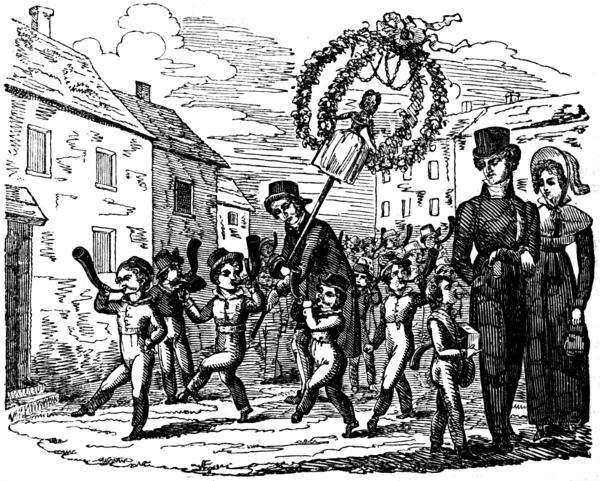
May-Day at Lynn in Norfolk.
For the Table Book.
Where May-day is still observed, many forms of commemoration remain, the rude and imperfect outlines of former splendour, blended with local peculiarities. The festival appears to have originated about A. M. 3760, and before Christ 242 years, in consequence of a celebrated courtezan, named Flora, having bequeathed her fortune to the people of Rome, that they should at this time, yearly, celebrate her memory, in singing, dancing, drinking, and other excesses; from whence these revels were called Floralia, or May-games.[143] After some years, the senate of Rome exalted Flora amongst their thirty thousand deities, as the goddess of flowers, and commanded her to be worshipped, that she might protect their flowers, fruits, and herbs.[144] During the Catholic age, a great portion of extraneous ceremony was infused into the celebration, but that the excesses and lawless misrule attributed to this Floralian festival, by the fanatic enthusiasts of the Cromwellian age, ever existed, is indeed greatly to be doubted. It was celebrated as a national festival, an universal expression of joy and adoration, at the commencement of a season, when nature developes her beauties, dispenses her bounties, and wafts her “spicy gales,” rich with voluptuous fragrance, to exhilarate man, and enliven the scenes around him.
In no place where the custom of celebrating May-day still continues does it present so close a resemblance to its Roman origin as at Lynn. This perhaps may be attributed to the circumstance of a colony of Romans having settled there, about the time of the introduction of Christianity into Britain, and projected the improvement and drainage of the marsh land and fens, to whom Lynn owes its origin, as the mother town of the district.[145] That they brought with them their domestic habits and customs we know; and hence the festival of May-day partakes of the character of the Roman celebrations.
Early on the auspicious morn, a spirit of emulation is generally excited among the juveniles of Lynn, in striving who shall be first to arise and welcome “sweet May-day,” by opening the door to admit the genial presence of the tutelary goddess,
———— borne on Auroral zephyrs And deck’d in spangled, pearly, dew-drop gems.
The task of gathering flowers from the fields and gardens for the intended garland succeeds, and the gatherers frequently fasten the doors of drowsy acquaintances, by driving a large nail through the handle of the snack into the door-post, though, with the disappearance of thumb-snacks, that peculiarity of usage is of course disappearing too.
The Lynn garland is made of two hoops of the same size, fixed transversely, and attached to a pole or staff, with the end through the centre, and parallel to the hoops. Bunches of flowers, interspersed with evergreens, are tied round the hoops, from the interior of which festoons of blown birds’ eggs are usually suspended, and long strips of various-coloured ribbons are also pendant from the top. A doll, full dressed, of proportionate size, is seated in the centre, thus exhibiting an humble, but not inappropriate representation of Flora, surrounded by the fragrant emblems of her consecrated offerings. Thus completed, the garlands are carried forth in all directions about the town, each with an attendant group of musicians, (i. e. horn-blowers,[146]) collecting eleemosynary tributes from their acquaintances. The horns, used only on this occasion, are those of bulls and cows, and the sounds produced by them when blown in concert, (if the noise from two to twenty, or perhaps more, may be so termed,) is not unlike the lowing of a herd of the living animals. Forgetful of their youthful days, numberless anathemas are ejaculated by the elder inhabitants, at the tremendous hurricane of monotonous sounds throughout the day. Though deafening in their tones, there appears something so classically antique in the use of these horns, that the imagination cannot forbear depicturing the horn-blowers as the votaries of Io and Serapis,[147] (the Egyptian Isis and Osiris,) in the character of the Lynn juveniles, sounding their Io Pæans to the honour of Flora.
Having been carried about the town, the garland, faded and drooping, is dismounted from the staff, and suspended across a court or lane, where the amusement of throwing balls over it, from one to another, generally terminates the day. The only public garland, amongst the few now exhibited, and also the largest, is one belonging to the young inmates of St. James’s workhouse, which is carried by one of the ancient inhabitants of the asylum, as appears in the sketch, attended by a numerous train of noisy horn-blowing pauper children, in the parish livery. Stopping at the door of every respectable house, they collect a considerable sum, which is dropped through the top of a locked tin canister, borne by one of the boys.
Previous to the Reformation, and while the festival of May-day continued under municipal patronage, it was doubtless splendidly celebrated at Lynn, with other ceremonies now forgotten; but having, by the order of council in 1644,[148] become illegal, it was severed from the corporation favour, and in a great measure annihilated. After the Restoration, however, it resumed a portion of public patronage, and in 1682 two new May-poles were erected; one in the Tuesday market-place, and the other at St. Anne’s Fort. The festival never entirely recovered the blow it received under the Commonwealth; the May-poles have long since disappeared, and probably the remnants, the garlands themselves, will soon fade away; for the celebration is entirely confined to the younger branches of the inhabitants. The refinement, or, more strictly speaking, the degeneracy of the age, has so entirely changed the national character, that while we ridicule and condemn the simple, and seemingly absurd, habits of our ancestors, we omit to venerate the qualities of their hearts; qualities which, unmixed with the alloy of innovating debasement, are so truly characteristic, that
——— “with all their faults, I reiterate them still, ———— and, while yet a nook is left, Where ancient English customs may be found, Shall be constrain’d to love them.”
That the celebration of May-day, as a national festival, should have been abolished, is not surprising, when we consider the formidable attacks directed against it by the spirit of fanaticism, both from the pulpit and the press; a curious specimen of which is here inserted from “Funebria Floræ, the Downfall of May-games,” a scarce tract, published in 1661 “by Thomas Hall, B. D., and pastor of King’s Norton.”[149] It is, as the author observes, “a kind of dialogue, and dialogues have ever been accounted the most lively and delightful, the most facile and fruitfullest way of teaching. Allusions and similes sink deep, and make a better impression upon the spirit; a pleasant allusion may do that which a solid argument sometimes cannot do; as, in some cases, iron may do that which gold cannot.”—From this curious tract is derived the following, with some slight omissions—
“Indictment of Flora.”
“Flora, hold up thy hand, thou art here indicted by the name of Flora, of the city of Rome, in the county of Babylon, for that thou, contrary to the peace of our sovereign lord, his crown and dignity, hast brought in a pack of practical fanatics, viz.—ignorants, atheists, papists, drunkards, swearers, swashbucklers, maid-marian’s, morrice-dancers, maskers, mummers, Maypole stealers, health-drinkers, together with a rascallion rout of fiddlers, fools, fighters, gamesters, lewd-women, light-women, contemners of magistracy, affronters of ministry, rebellious to masters, disobedient to parents, misspenders of time, and abusers of the creature, &c.
“Judge. What sayest thou, guilty or not guilty?
“Prisoner. Not guilty, my lord.
“Judge. By whom wilt thou be tried?
“Prisoner. By the pope’s holiness, my lord.
“Judge. He is thy patron and protector, and so unfit to be a judge in this case.
“Prisoner. Then I appeal to the prelates and lord bishops, my lord.
“Judge. This is but a tiffany put off, for though some of that rank did let loose the reins to such profaneness, in causing the book of sports, for the profanation of God’s holy day, to be read in churches, yet ’tis well known that the gravest and most pious of that order have abhorred such profaneness and misrule.
“Prisoner. Then I appeal to the rout and rabble of the world.
“Judge. These are thy followers and thy favourites, and unfit to be judges in their own case.
“Prisoner. My lord, if there be no remedy, I am content to be tried by a jury.
“Judge. Thou hast well said, thou shall have a full, a fair, and a free hearing.—Crier, call the jury.
“Crier. O yes, O yes; all manner of persons that can give evidence against the prisoner at the bar let them come into court, and they shall be freely heard.
“Judge. Call in the Holy Scriptures.
“Crier. Make room for the Holy Scriptures to come in.
“Judge. What can you say against the prisoner at the bar?
“Holy Scriptures. Very much, my lord. I have often told them, that the night of ignorance is now past, and the light of the gospel is come, and therefore they must walk as children of the light, denying all ungodliness and worldly lusts. I have often told them, that they must shun all the appearance of evil, and have no fellowship with the unfruitful works of darkness, nor conform themselves like to the wicked of this world. I have often told them, that our God is a jealous God, and one that will not endure to have his glory given to idols.
“Judge. This is full and to the purpose indeed; but is there no more evidence to come in?
“Crier. Yes, my lord, here is Pliny, an ancient writer, famous for his Natural History.
“Judge. What can you say against the prisoner at the bar?
“Pliny. My lord, I have long since told them, that these were not christian, but pagan feasts; they were heathens, (and as such knew not God,) who first instituted these Floralia and May-games. I have told them that they were instituted according to the advice of the Sibyl’s books, in the 516th year after the foundation of the city of Rome, to prevent the blasting and barrenness of the trees and the fruits of the earth. (Plin. Nat. Hist. lib. xviii. c. 29.)
“Judge. Sir, you have given us good light in this dark case; for we see that the rise of these feasts was from Pagans, and that they were ordained by the advice of Sibyl’s books, and not of God’s book; and for a superstitious and idolatrous end, that thereby Flora, not God, might be pleased, and so bless their fruits and flowers. This is clear, but have you no more evidence?
“Crier. Yes, my lord, here is Cœlius Lactantius Firmianus, who lived about three hundred years after Christ, who will plainly tell you the rise of these profane sports.
“Judge. I have heard of this celestial, sweet, and firm defender of the faith, and that he was a second Cicero for eloquence in his time. Sir, what can you say against the prisoner at the bar?
“Lactantius. My lord, I have long since declared my judgment against this Flora, in my first book of false religions, &c.
“Judge. This is plain and full, I now see that Lactantius is Firmianus, not only sweet, but firm and constant, &c. Have you no more evidence?
“Crier. Yes, my lord, here is the Synodus Francica, which was called, Anno Dom. 742.
“Judge. What can you say against the prisoner at the bar?
“Synodus. My lord, I have long since decreed, that the people of God shall have no pagan feasts or interludes, but that they reject and abominate all the uncleannesses of Gentilism, and that they forbear all sacrilegious fires, which they call bonfires, and all other observations of the Pagans whatsoever.
“Judge. This is clear against all heathenish feasts and customs, of which this is one. But have you no evidence nearer home?
“Crier. Yes, my lord, here is one that will conquer them all, and with the sword of justice suddenly suppress them.
“Judge. Who is that I pray you? Let me see such a man.
“Crier. My lord, it is Charles the Second, king of Great Britain, France, and Ireland, defender of the faith.
“Judge. Truly he deserves that title, if he shall now appear in defence of the truth, against that profane rout which lately threatened the extirpation both of sound doctrine and good life. I hear that the king is a sober and temperate person, and one that hates debauchery; I pray you let us hear what he saith.
“Crier. My lord, the king came into London May 29th, and on the 30th he published a Proclamation against Profaneness, to the great rejoicing of all good people of the land. When all was running into profaneness and confusion, we, poor ministers, had nothing left but our prayers and tears; then, even then, it pleased the Most High to put it into the heart of our sovereign lord the king, eminently to appear in the cause of that God who hath so eminently appeared for him, and hath brought him through so many dangers and difficulties to the throne, and made so many mountains a plain before him, to testify against the debauchery and gross profaneness, which, like a torrent, had suddenly overspread the land. (Proclamation against Profaneness, &c. &c.)
“Judge. Now blessed be the Lord, the King of kings, who hath put such a thing as this into the heart of the king, and blessed be his counsel, the good Lord recompense it sevenfold into his bosom, and let all the sons of Belial fly before him; as the dust before the wind, let the angel of the Lord scatter them.
“Prisoner. My lord, I and my retinue are very much deceived in this Charles the Second; we all conceited that he was for us. My drunkards cried, “A health to the king;” the swearers swore, “A health to the king;” the papist, the atheist, the roarer, and the ranter, all concluded that now their day was come; but alas! how are we deceived!
“Judge. I wish that you, and all such as you are, may for ever be deceived in this kind, and that your eyes may rot in your heads before you ever see idolatry, superstition, and profaneness countenanced in the land.—Have you no more evidence to produce against these profane practices?
“Crier. Yes, my lord, here is an Ordinance of Parliament against them.
“Prisoner. My lord, I except against this witness above all the rest; for it was not made by a full and free parliament of lords and commons, but by some rump and relic of a parliament, and so is invalid.
“Judge. You are quite deceived, for this ordinance was made by lords and commons when the house was full and free; and those the best that England ever had, for piety towards God and loyalty to their sovereign. Let us hear what they say.
“Ordinance of Parliament. My lord, I have plainly told them, that since the profanation of the Lord’s day hath been heretofore greatly occasioned by May-poles, the lords and commons do therefore ordain that they shall be taken down and removed, and that no May-pole shall be hereafter erected or suffered to remain within this kingdom, under the penalty of five shillings for every week, till such May-pole is taken down.[150]
“Judge. This is to the purpose. This may clearly convince any sober man of the sinfulness of such practices, and make them abhor them; for what is forbidden by the laws of men, especially when those laws are consonant to the laws of God, may not be practised by any person; but these profane sports being forbidden by the laws of men, are herein consonant to the laws of God, which condemn such sinful pastimes. Have you no more evidence besides this ordinance to batter these Babylonish towers?
“Crier. Yes, my lord, here is the Solemn League and Covenant, taken in a solemn manner by king, lords, and commons, the assembly of divines, the renowned city of London, the kingdom of Scotland, and by many thousands of ministers and people throughout this nation.
“Prisoner. My lord, these things are out of date, and do not bind now our troubles are over.
“Judge. The sixth branch of the covenant will tell you, that we are bound all the days of our lives to observe these things zealously and constantly against all opposition; and I suppose every good man thinks himself bound to preserve the purity of religion, to extirpate popery, heresy, superstition, and profaneness, not only in times of trouble, but as duties to be practised in our places and callings all our days. Now if May-games and misrules do savour of superstition and profaneness, (as ’tis apparent they do,)—if they be contrary to sound doctrine and the power of godliness, (as to all unprejudiced men they are,)—then, by this solemn league and sacred covenant, we are bound to root them up. This is sufficient, if there were no more; but because men are loath to leave what they dearly love, let us see whether you have any further evidence?
“Crier. Yes, my lord, here is an excellent Order from the Council of State, made this present May, (1661,) wherein they take notice of a spirit of profaneness and impiety that hath overspread the land; therefore they order, that the justices of the peace and commissioners for the militia do use their utmost endeavours to prevent all licentiousness and disorder, and all profanation of the sabbath; that they suppress all ale-houses, and all ungodly meetings; that they own and protect all good men in their pious and sober walking. The council doth likewise command them to have a special care to prevent profaneness and disorders of people about May-poles and meetings of that nature, and their rude and disorderly behaviours towards people, in molesting them, to get monies to spend vainly at such meetings.
“Judge. This is full and to the point indeed, blessed be God, and blessed be their counsel. But have you yet no more evidence?
“Crier. Yes, my lord, here is Mr. Elton, a man eminent for piety, and of known integrity in his time; he hath long since told us, that such filthy company, where there is such filthy speeches and lascivious behaviour, with mixed dancing at their merry meetings, &c.; and therefore to be abhorred by all sober Christians.[151]
“To him assents that great divine, Dr. Ames, who tells us, that those who will shun incontinency and live chastely, must shun such profane meetings; and take heed of mixed dancing, stage-plays, and such incentives.[152]
“Prisoner. My lord, these were old puritans and precisians, who were more nice than wise.
“Crier. I will produce men of another strain; here are bishops against you. Bishop Babington hath long since told us, that these sinful pastimes are the devil’s festival, &c. being forbidden by scripture, which commands us to shun all appearance of evil.[153]
“Here is also bishop Andrews, who tells us that we must not only refrain from evil, but also from the show of evil; and must do things honest not only before God, but also before men; to this end we must shun wanton dancing, stage-plays, &c. because our eyes thereby behold much wickedness, and a man cannot go on these hot coals and not be burnt, nor touch such pitch and not be defiled, nor see such wanton actions and not be moved.[154]
“Judge. This is pious, and to the purpose; here is evidence sufficient; I shall now proceed to sentence.
“Crier. My lord, I desire your patience to hear one witness more, and then I have done.
“Judge. Who is that which comes so late into court?
“Crier. My lord, ’tis the acute and accomplished Ovid.
“Prisoner. My lord, he is a heathen poet, who lived about twenty years before Christ.
“Judge. His testimony will be the stronger against your heathenish vanities. Publius Ovidius Naso, what can you say against mistress Flora?
“Ovid. My lord, I have long since told the world, that the senatorian fathers at Rome did order the celebration of these Floralian sports to be yearly observed about the beginning of May, in honour of Flora, that our fruits and flowers might the better prosper. At this feast there was drinking, dancing, and all manner, &c.[155]
“Prisoner. Sir, you wrong the poet, and may for ought I know wrong me, by wrapping up his ingenious narrative in so little room—
“Judge. I love those whose writings are like jewels, which contain much worth in a little compass.
“Crier. And it please you, my lord, we will now call over the jury, that the prisoner may see we have done her no wrong.
“Judge. Do so.
“Crier. Answer to your names—Holy Scriptures, ONE—Pliny, TWO—Lactantius, THREE—Synodus Francica, FOUR—Charles the Second, FIVE—Ordinance of Parliament, SIX—Solemn League and Covenant, SEVEN—Order of the Council of State, EIGHT—Messrs. Elton and Ames, NINE—Bishop Babington, TEN—Bishop Andrews, ELEVEN—Ovid, TWELVE.—These, with all the godly in the land, do call for justice against this turbulent malefactor.
“Judge. Flora, thou hast here been indicted for bringing in abundance of misrule and disorder into church and state; thou hast been found guilty, and art condemned both by God and man,—by scriptures, fathers, councils,—by learned and pious divines,—and therefore I adjudge thee to
Perpetual Banishment,
that thou no more disturb this church and state, lest justice do arrest thee.”—
K.
ACCOUNT OF A MAY-DAY COLLATION
Given by Whitelocke, in the English Manner, (during his Embassy from Oliver Cromwell,) to Christina, Queen of Sweden, and some of her favourite Ladies and Courtiers.
This being May-day, Whitelocke, according to the invitation he had made to the queen, put her in mind of it, that as she was his mistress, and this May-day, he was by the custom of England to wait upon her to take the air, and to treat her with some little collation, as her servant.
The queen said, the weather was very cold, yet she was very willing to bear him company after the English mode.
With the queen were Woolfeldt, Tott, and five of her ladies. Whitelocke brought them to his collation, which he had commanded his servants to prepare in the best manner they could, and altogether after the English fashion.
At the table with the queen sat La Belle Countesse, the Countesse Gabriel Oxenstierne, Woolfeldt, Tott, and Whitelocke; the other ladies sat in another room. Their meat was such fowl as could be gotten, dressed after the English fashion, and with English sauces, creams, puddings, custards, tarts, tanseys, English apples, bon chrétien pears, cheese, butter, neats’ tongues, potted venison, and sweetmeats, brought out of England, as his sack and claret also was; his beer was also brewed, and his bread made by his own servants, in his own house, after the English manner; and the queen and her company seemed highly pleased with this treatment: some of her company said, she did eat and drink more at it than she used to do in three or four days at her own table.
The entertainment was as full and noble as the place would afford, and as Whitelocke could make it, and so well ordered and contrived, that the queen said, she had never seen any like it: she was pleased so far to play the good housewife, as to inquire how the butter could be so fresh and sweet, and yet brought out of England? Whitelocke, from his cooks, satisfied her majesty’s inquiry; that they put the salt butter into milk, where it lay all night, and the next day it would eat fresh and sweet as this did, and any butter new made, and commended her majesty’s good housewifery; who, to express her contentment to this collation, was full of pleasantness and gayety of spirits, both in supper-time, and afterwards: among other frolics, she commanded Whitelocke to teach her ladies the English salutation; which, after some pretty defences, their lips obeyed, and Whitelocke most readily.
She highly commended Whitelocke’s music of the trumpets, which sounded all supper-time, and her discourse was all of mirth and drollery, wherein Whitelocke endeavoured to answer her, and the rest of the company did their parts.
It was late before she returned to the castle, whither Whitelocke waited on her; and she discoursed a little with him about his business, and the time of his audience, and gave him many thanks for his noble treatment of her and her company.
Two days after this entertainment, Mons. Woolfeldt, being invited by Whitelocke, told him that the queen was extremely pleased with his treatment of her. Whitelocke excused the meanness of it for her majesty. Woolfeldt replied, that both the queen and all the company esteemed it as the handsomest and noblest that they ever saw; and the queen, after that, would drink no other wine but Whitelocke’s, and kindly accepted the neats’ tongues, potted venison, and other cakes, which, upon her commendation of them, Whitelocke sent unto her majesty.[156]
MAY-DAY CHEESES.
To the Editor.
Dear Sir,—On the first of May, at the village of Randwick, near Stroud, there has been, from time immemorial, the following custom:—Three large cheeses, (Gloucester of course,) decked with the gayest flowers of this lovely season, are placed on litters, equally adorned with flowers, and boughs of trees waving at the corners. They are thus borne through the village, accompanied by a joyous throng, shouting and huzzaaing with all their might and main, and usually accompanied by a little band of music. They proceed in this manner to the church-yard, where the cheeses being taken from the litters, and divested of their floral ornaments, are rolled three times round the church. They are then carried back in the same state, and in the midst of the village are cut up and distributed piecemeal to the inhabitants.
I am, dear, sir, &c. C. Tomlinson.
April, 1827.
Easter.
EASTER-BOX.
A custom was instituted in the city of Thoulouse by Charlemagne, that at Easter any Christian might give a box on the ear to a Jew, wherever he chanced to meet him, as a mark of contempt for the nation, which had, at that season, crucified the Saviour of mankind. This usage, scandalous in itself, was sometimes, through zeal, practised with great violence. It is stated that the eye of a poor Jew was forced out, on that side of the head whereon the blow was given. In the course of centuries this cruel custom was commuted for a tax, and the money appropriated to the use of the church of St. Saturnin.[157] Accounts of the prevalence of this custom in our own country are related in the Every-Day Book, vol. i.
DOCTOR GIBBS, alias “HUCK’N!”
For the Table Book.
Dr. Gibbs, commonly called “Huck’n!” was an extraordinary individual, who followed the profession of an itinerary veterinary surgeon in the west of England. His ways were different from his neighbours, and his appearance was so singular, that a stranger might have taken him for a tramping tinker. Like Morland, he had an unfortunate predilection for “signs,” under whose influence he was generally to be found. He would “keep it up to the last,” with his last shilling; and, like the wit in doctor Kitchiner’s converzaziones, he would “come at seven and go it at eleven.” To love for his profession, he added a love for old pastimes, customs, and revelries. He was a man, in the fullest extent of the word, a lover of his country—zealous in his friendships, he exercised the virtues of humanity, by aiding and even feeding those who were in severe distress. He spent much, for his means were considerable—they were derived from his great practice. His knowledge of his art was profound; a horse’s life was as safe in his hands, as the writer’s would be in sir Astley Cooper’s.
In his person, “Huck’n!” was muscular, and he stood above the middle size; his habits gave him an unwieldy motion; his complexion was sandy; his aspect muddled; large eyebrows pent-housed his small glassy blue eyes; a wig of many curls, perking over his bald forehead, was closed by a bush of his own hair, of another colour behind; his whiskers were carroty, and he usually had an unshorn beard. It was when he entered a stable, or cow-pen, in his leather apron half-crossed, with his drug-pouch at his side, that he appeared in a skilful light. His thick holly walking-stick with a thong run through the top, was tried in the service, as its worn appearance testified, and many an animal’s mouth could witness. He rarely pulled the drenching horn, or fleam from his pocket to operate, but he rolled his tongue over his beloved “pigtail,” juicily deposited in the nook of a precarious tooth, and said,—“Huck’n!” Hence his nomme de guerre—and hence the proverb that outlives him—“he that can chew like Huck’n! may cure like Huck’n!” The meaning of this emphatic monosyllable remains a secret. Some of the superstitious conjectured, that he used it in stables and outhouses as a charm to scare the witches from riding the cattle. This liberty is verily believed by many to exist to this day; hence a horseshoe is nailed to the sill of the stable-door, that the midnight hags of “air and broom” may not cross the iron bar-rier.[158]
It is thirty years since “Huck’n” flourished. If he had a home, it was at Hullavington, near Malmsbury, where as a pharmacist, farrier, and phlebotomist of high character and respectability, to his patients—who are known to evince more patience than most of the human species—he was very attentive. He would cheerfully forego his cheerful glass, his boon companions, his amusing anecdotes, necessary food, and nocturnal rest, to administer to the comfort of a poor “dumb creature,” and remain day and night till life departed, or ease returned. Were he alive he would tell us, that in our intercourse with the brute creation, we should exercise humane feelings, and bestir ourselves to assuage the acute pain, betokened by agonizing looks and groans, in suffering animals.
“Huck’n!” was an improvident man: under more classical auspices, he might have stood first in his profession; but he preferred being “unadorned—adorned the most.” He lived to assist the helpless, and died in peace. Let persons of higher pretensions do more—“Huck’n?”[159]
March, 1827.J. R. P.

Armorial Bearing OF THE LORD OF THE MANOR OF Stoke Lyne, Oxfordshire.
The above print, obligingly presented, is submitted to the reader, with the following in explanation—
To the Editor.
Sir,—As I have taken in your Every-Day Book, and continue with the Table Book, I send you the subjoined account, which, perhaps, may be worth your consideration, and the engraved wood-block for your use.
I remain your well-wisher, X.
An Account of the Manor of Stoke Lyne in Oxfordshire, late the Property of the Earl and Countess of Shipbrook.
The lord of the manor has a right, by ancient custom, to bear a hawk about his arms agreeable to the print: it arose from the following circumstance. When Charles the First held his parliament at Oxford, the then lord of Stoke Lyne was particularly useful to the king in his unfortunate situation, and rendered him service. To reward him he offered him knighthood, which he declined, and merely requested the king’s permission to bear behind his coat of arms a hawk, which his majesty instantly granted. The present lord of the manor is Mr. Cole of Twickenham, inheriting the estate by descent from the late earl and countess, and whose family are registered in the parish church as early as March 22, 1584. There is also a monument of them in the church of Petersham, 1624; and another branch of the same family were created baronets, March 4, 1641, supposed to be the oldest family in the county of Middlesex.
May-Day Dance in 1698.
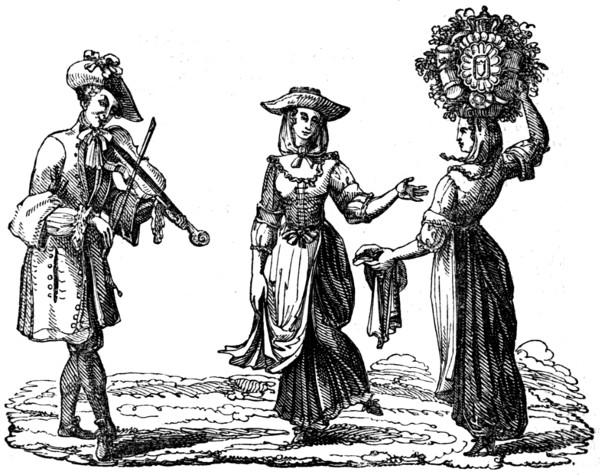
May-Day Dance in 1698.
This engraving of the milkmaids’ garland, and the costume of themselves and their fiddler, at the close of the century before last, is from a print in “Mémoires, &c. par un Voyageur en Angleterre,” an octavo volume, printed “à la Haye 1698,” wherein it is introduced by the author, Henry Misson, to illustrate a passage descriptive of the amusements of London at that time. His account of the usage is to the following effect:—
On the first of May, and the five or six days following, all the young and pretty peasant girls, who are accustomed to bear about milk for sale in the city, dress themselves very orderly, and carry about them a number of vases and silver vessels, of which they make a pyramid, adorned with ribbons and flowers. This pyramid they bear on their heads instead of the ordinary milk-pail, and accompanied by certain of their comrades and the music of a fiddle, they go dancing from door to door surrounded by young men and children, who follow them in crowds; and every where they are made some little present.
ISABELLA COLOUR.
The archduke Albert married the infanta Isabella, daughter of Philip II. king of Spain, with whom he had the Low Countries in dowry. In the year 1602, he laid siege to Ostend, then in the possession of the heretics, and his pious princess, who attended him in that expedition, made a vow that till the city was taken she would never change her clothes. Contrary to expectation, it was three years before the place was reduced; in which time her highness’s linen had acquired a hue, which from the superstition of the princess and the times was much admired, and adopted by the court fashionables under the name of the “Isabella-colour:” it is a whitish yellow, or soiled buff—better imagined than described.[160]
Garrick Plays. No. XV.
[From the “City Night-Cap,” a Tragi-Comedy, by Robert Davenport, 1651.]
Lorenzo Medico suborns three Slaves to swear falsely to an adultery between his virtuous Wife Abstemia, and his Friend Philippo. They give their testimony before the Duke of Verona, and the Senators.
Phil.—how soon Two souls, more precious than a pair of worlds, Are levell’d below death! Abst. Oh hark! did you not hear it? Sen. What, Lady? Abst. This hour a pair of glorious towers is fallen Two goodly buildings beaten with a breath Beneath the grave: you all have seen this day A pair of souls both cast and kiss’d away. Sen. What censure gives your Grace? Duke. In that I am kinsman To the accuser, that I might not appear Partial in judgment, let it seem no wonder, If unto your Gravities I leave The following sentence: but as Lorenzo stands A kinsman to Verona, so forget not, Abstemia still is sister unto Venice. Phil. Misery of goodness! Abst. Oh Lorenzo Medico, Abstemia’s Lover once, when he did vow, And when I did believe; then when Abstemia Denied so many princes for Lorenzo, Then when you swore:—Oh maids, how men can weep, Print protestations on their breasts, and sigh, And look so truly, and then weep again, And then protest again, and again dissemble!— When once enjoy’d, like strange sights, we grow stale; And find our comforts, like their wonder, fail. Phil. Oh Lorenzo! Look upon tears, each one of which well-valued Is worth the pity of a king; but thou Art harder far than rocks, and canst not prize The precious waters of truth’s injured eyes. Lor. Please your Grace, proceed to censure. Duke. Thus ’tis decreed, as these Lords have set down, Against all contradiction: Signor Philippo, In that you have thus grossly, Sir, dishonour’d Even our blood itself in this rude injury Lights on our kinsman, his prerogative Implies death on your trespass; but, (your merit Of more antiquity than is your trespass), That death is blotted out; perpetual banishment, On pain of death if you return, for ever From Verona and her signories. Phil. Verona is kind. Sen. Unto you, Madam, This censure is allotted: your high blood Takes off the danger of the law; nay from Even banishment itself: this Lord, your husband, Sues only for a legal fair divorce, Which we think good to grant, the church allowing: And in that the injury Chiefly reflects on him, he hath free licence To marry when and whom he pleases. Abst. I thank ye, That you are favorable unto my Love, Whom yet I love and weep for. Phil. Farewell, Lorenzo, This breast did never yet harbour a thought Of thee, but man was in it, honest man: There’s all the words that thou art worth. Of your Grace I humbly thus take leave. Farewell, my Lords;— And lastly farewell Thou, fairest of many, Yet by far more unfortunate!—look up, And see a crown held for thee; win it, and die Love’s martyr, the sad map of injury.— And so remember, Sir, your injured Lady Has a brother yet in Venice.
Philippo, at an after-trial, challenges Lorenzo.
Phil.—in the integrity, And glory of the cause, I throw the pawn Of my afflicted honour; and on that I openly affirm your absent Lady Chastity’s well knit abstract; snow in the fall, Purely refined by the bleak northern blast, Not freer from a soil; the thoughts of infants But little nearer heaven: and if these princes Please to permit, before their guilty thoughts Injure another hour upon the Lady, My right-drawn sword shall prove it.—
Abstemia, decoyed to a Brothel in Milan, is attempted by the Duke’s Son.
Prince. Do you know me? Abst. Yes, Sir, report hath given intelligence, You are the Prince, the Duke’s son. Prince. Both in one. Abst. Report, sure, Spoke but her native language. You are none Of either. Prince. How! Abst. Were you the Prince, you would not sure be slaved To your blood’s passion. I do crave your pardon For my rough language. Truth hath a forehead free And in the tower of her integrity Sits an unvanquish’d virgin. Can you imagine, ’Twill appear possible you are the Prince? Why, when you set your foot first in this house, You crush’d obedient duty unto death; And even then fell from you your respect. Honour is like a goodly old house, which If we repair not still with virtue’s hand, Like a citadel being madly raised on sand, It falls, is swallow’d, and not found. Prince. If thou rail upon the place, prithee how camest thou hither? Abst. By treacherous intelligence; honest men so, In the way ignorant, through thieves’ purlieus go.— Are you Son to such a Father? Send him to his grave then, Like a white almond tree, full of glad days With joy that he begot so good a Son. O Sir, methinks I see sweet Majesty Sit with a mourning sad face full of sorrows, To see you in this place. This is a cave Of scorpions and of dragons. Oh turn back; Toads here engender: ’tis the steam of death; The very air poisons a good man’s breath. Prince. Let me borrow goodness from thy lips. Farewell! Here’s a new wonder; I’ve met heav’n in hell.
Undue praise declined.
——— you are far too prodigal in praise, And crown me with the garlands of your merit; As we meet barks on rivers,—the strong gale Being best friends to us,—our own swift motion Makes us believe that t’other nimbler rows; Swift virtue thinks small goodness fastest goes.
[From the “Conspiracy,” a Tragedy by Henry Killigrew, 1638. Author’s age 17.]
The Rightful Heir to the Crown kept from his inheritance: an Angel sings to him sleeping.
Song.
While Morpheus thus does gently lay His powerful charge upon each part, Making thy spirits ev’n obey The silver charms of his dull art; I, thy Good Angel, from thy side,— As smoke doth from the altar rise, Making no noise as it doth glide,— Will leave thee in this soft surprise; And from the clouds will fetch thee down A holy vision, to express Thy right unto an earthly crown; No power can make this kingdom less. But gently, gently, lest I bring A start in sleep by sudden flight, Playing aloof, and hovering, Till I am lost unto the sight. This is a motion still and soft; So free from noise and cry, That Jove himself, who hears a thought, Knows not when we pass by.
C. L.
THE GOOD CLERK.
He writeth a fair and swift hand, and is completely versed in the four first rules of Arithmetic, in the Rule of Three, (which is sometimes called the Golden Rule,) and in Practice. We mention these things, that we may leave no room for cavillers to say, that any thing essential hath been omitted in our definition; else, to speak the truth, these are but ordinary accomplishments, and such as every understrapper at a desk is commonly furnished with. The character we treat of soareth higher.
He is clean and neat in his person; not from a vain-glorious desire of setting himself forth to advantage in the eyes of the other sex, (with which vanity too many of our young sparks now-a-days are infected,) but to do credit (as we say) to the office. For this reason he evermore taketh care that his desk or his books receive no soil; the which things he is commonly as solicitous to have fair and unblemished, as the owner of a fine horse is to have him appear in good keep.
He riseth early in the morning; not because early rising conduceth to health, (though he doth not altogether despise that consideration,) but chiefly to the intent that he may be first at the desk. There is his post—there he delighteth to be; unless when his meals, or necessity, calleth him away; which time he always esteemeth as lost, and maketh as short as possible.
He is temperate in eating and drinking, that he may preserve a clear head and steady hand for his master’s service. He is also partly induced to this observation of the rules of temperance by his respect for religion, and the laws of his country; which things (it may once for all be noted) do add special assistances to his actions, but do not and cannot furnish the main spring or motive thereto. His first ambition (as appeareth all along) is to be a good clerk, his next a good Christian, a good patriot, &c.
Correspondent to this, he keepeth himself honest, not for fear of the laws, but because he hath observed how unseemly an article it maketh in the day-book or ledger, when a sum is set down lost or missing; it being his pride to make these books to agree and to tally, the one side with the other, with a sort of architectural symmetry and correspondence.
He marrieth, or marrieth not, as best suiteth with his employer’s views. Some merchants do the rather desire to have married men in their counting-houses, because they think the married state a pledge for their servants’ integrity, and an incitement to them to be industrious; and it was an observation of a late lord mayor of London, that the sons of clerks do generally prove clerks themselves, and that merchants encouraging persons in their employ to marry, and to have families, was the best method of securing a breed of sober, industrious young men attached to the mercantile interest. Be this as it may, such a character as we have been describing, will wait till the pleasure of his employer is known on this point; and regulateth his desires by the custom of the house or firm to which he belongeth.
He avoideth profane oaths and jesting, as so much time lost from his employ; what spare time he hath for conversation, which in a counting-house such as we have been supposing can be but small, he spendeth in putting seasonable questions to such of his fellows, (and sometimes respectfully to the master himself,) who can give him information respecting the price and quality of goods, the state of exchange, or the latest improvements in book-keeping; thus making the motion of his lips, as well as of his fingers, subservient to his master’s interest. Not that he refuseth a brisk saying, or a cheerful sally of wit, when it comes enforced, is free of offence, and hath a convenient brevity. For this reason he hath commonly some such phrase as this in his mouth:—
It’s a slovenly look To blot your book.
Or,
Red ink for ornament, black for use, The best of things are open to abuse.
So upon the eve of any great holiday, of which he keepeth one or two at least every year, he will merrily say in the hearing of a confidential friend, but to none other:—
All work and no play Makes Jack a dull boy.
Or,
A bow always bent must crack at last.
But then this must always be understood to be spoken confidentially, and, as we say, under the rose.
Lastly, his dress is plain, without singularity; with no other ornament than the quill, which is the badge of his function, stuck under the dexter ear, and this rather for convenience of having it at hand, when he hath been called away from his desk, and expecteth to resume his seat there again shortly, than from any delight which he taketh in foppery or ostentation. The colour of his clothes is generally noted to be black rather than brown, brown rather than blue or green. His whole deportment is staid, modest, and civil. His motto is regularity.——
This character was sketched, in an interval of business, to divert some of the melancholy hours of a counting-house. It is so little a creature of fancy, that it is scarce any thing more than a recollection of some of those frugal and economical maxims which, about the beginning of the last century, (England’s meanest period,) were endeavoured to be inculcated and instilled into the breasts of the London apprentices,[161] by a class of instructors who might not inaptly be termed the masters of mean morals. The astonishing narrowness and illiberality of the lessons contained in some of those books is inconceivable by those whose studies have not led them that way, and would almost induce one to subscribe to the hard censure which Drayton has passed upon the mercantile spirit:—
The gripple merchant, born to be the curse Of this brave isle.[162]
Defoeana. No. I.
THE TRADESMAN.
I have now lying before me that curious book, by Daniel Defoe, “The complete English Tradesman.” The pompous detail, the studied analysis of every little mean art, every sneaking address, every trick and subterfuge (short of larceny) that is necessary to the tradesman’s occupation, with the hundreds of anecdotes, dialogues (in Defoe’s liveliest manner) interspersed, all tending to the same amiable purpose, namely, the sacrificing of every honest emotion of the soul to what he calls the main chance—if you read it in an ironical sense, and as a piece of covered satire, make it one of the most amusing books which Defoe ever wrote, as much so as any of his best novels. It is difficult to say what his intention was in writing it. It is almost impossible to suppose him in earnest. Yet such is the bent of the book to narrow and to degrade the heart, that if such maxims were as catching and infectious as those of a licentious cast, which happily is not the case, had I been living at that time, I certainly should have recommended to the grand jury of Middlesex, who presented the Fable of the Bees, to have presented this book of Defoe’s in preference, as of a far more vile and debasing tendency. I will give one specimen of his advice to the young tradesman, on the government of his temper. “The retail tradesman in especial, and even every tradesman in his station, must furnish himself with a competent stock of patience; I mean that sort of patience which is needful to bear with all sorts of impertinence, and the most provoking curiosity that it is impossible to imagine the buyers, even the worst of them, are or can be guilty of. A tradesman behind his counter must have no flesh and blood about him, no passions, no resentment; he must never be angry, no not so much as seem to be so, if a customer tumbles him five hundred pounds worth of goods, and scarce bids money for any thing; nay, though they really come to his shop with no intent to buy, as many do, only to see what is to be sold, and though he knows they cannot be better pleased than they are, at some other shop where they intend to buy, ’tis all one, the tradesman must take it, he must place it to the account of his calling, that ’tis his business to be ill used and resent nothing; and so must answer as obligingly to those that give him an hour or two’s trouble and buy nothing, as he does to those who in half the time lay out ten or twenty pounds. The case is plain, and if some do give him trouble and do not buy, others make amends and do buy; and as for the trouble, ’tis the business of the shop.” Here follows a most admirable story of a mercer, who, by his indefatigable meanness, and more than Socratic patience under affronts, overcame and reconciled a lady, who upon the report of another lady that he had behaved saucily to some third lady, had determined to shun his shop, but by the over-persuasions of a fourth lady was induced to go to it; which she does, declaring beforehand that she will buy nothing, but give him all the trouble she can. Her attack and his defence, her insolence and his persevering patience, are described in colours worthy of a Mandeville; but it is too long to recite. “The short inference from this long discourse,” says he, “is this, that here you see, and I could give you many examples like this, how and in what manner a shopkeeper is to behave himself in the way of his business; what impertinences, what taunts, flouts, and ridiculous things, he must bear in his trade, and must not show the least return, or the least signal of disgust: he must have no passions, no fire in his temper; he must be all soft and smooth: nay, if his real temper be naturally fiery and hot, he must show none of it in his shop: he must be a perfect, complete hypocrite if he will be a complete tradesman.[163] It is true, natural tempers are not to be always counterfeited; the man cannot easily be a lamb in his shop, and a lion in himself; but, let it be easy or hard, it must be done, and is done: there are men who have, by custom and usage, brought themselves to it, that nothing could be meeker and milder than they, when behind the counter, and yet nothing be more furious and raging in every other part of life; nay, the provocations they have met with in their shops have so irritated their rage, that they would go up stairs from their shop, and fall into frenzies, and a kind of madness, and beat their heads against the wall, and perhaps mischief themselves, if not prevented, till the violence of it had gotten vent, and the passions abate and cool. I heard once of a shopkeeper that behaved himself thus to such an extreme, that when he was provoked by the impertinence of the customers, beyond what his temper could bear, he would go up stairs and beat his wife, kick his children about like dogs, and be as furious for two or three minutes, as a man chained down in Bedlam; and again, when that heat was over, would sit down and cry faster than the children he had abused; and after the fit, he would go down into the shop again, and be as humble, courteous, and as calm as any man whatever; so absolute a government of his passions had he in the shop, and so little out of it: in the shop, a soulless animal that would resent nothing; and in the family a madman: in the shop, meek like a lamb; but in the family, outrageous like a Lybian lion. The sum of the matter is, it is necessary for a tradesman to subject himself by all the ways possible to his business; his customers are to be his idols: so far as he may worship idols by allowance, he is to bow down to them and worship them; at least, he is not in any way to displease them, or show any disgust or distaste, whatsoever they may say or do; the bottom of all is, that he is intending to get money by them, and it is not for him that gets money to offer the least inconvenience to them by whom he gets it; he is to consider that, as Solomon says, the borrower is servant to the lender, so the seller is servant to the buyer.” What he says on the head of pleasures and recreations is not less amusing:—“The tradesman’s pleasure should be in his business, his companions should be his books, (he means his ledger, waste-book, &c.;) and if he has a family, he makes his excursions up stairs and no further:—none of my cautions aim at restraining a tradesman from diverting himself, as we call it, with his fireside, or keeping company with his wife and children.”[164]
MANNERS OF A SPRUCE LONDON MERCER, AND HIS FEMALE CUSTOMER, A HUNDRED YEARS AGO.
Those who have never minded the conversation of a spruce Mercer, and a young Lady his Customer that comes to his shop, have neglected a scene of life that is very entertaining.—His business is to sell as much silk as he can, at a price by which he shall get what he proposes to be reasonable, according to the customary profits of the trade. As to the lady, what she would be at is to please her fancy, and buy cheaper by a groat or sixpence per yard than the things she wants are usually sold for. From the impression the gallantry of our sex has made upon her, she imagines (if she be not very deformed), that she has a fine mien and easy behaviour, and a peculiar sweetness of voice; that she is handsome, and if not beautiful, at least more agreeable than most young women she knows. As she has no pretensions to purchase the same things with less money than other people, but what are built on her good qualities, so she sets herself off to the best advantage her wit and discretion will let her. The thoughts of love are here out of the case; so on the one hand she has no room for playing the tyrant, and giving herself angry and peevish airs; and on the other, more liberty of speaking kindly, and being affable, than she can have almost on any other occasion. She knows that abundance of well-bred people come to his shop, and endeavours to render herself as amiable, as virtue and the rules of decency admit of. Coming with such a resolution of behaviour, she cannot meet with anything to ruffle her temper.—Before her coach is yet quite stopt, she is approached by a gentleman-like man, that has every thing clean and fashionable about him, who in low obeisance pays her homage, and as soon as her pleasure is known that she has a mind to come in, hands her into the shop, where immediately he slips from her, and through a by-way, that remains visible for only half a moment, with great address intrenches himself behind the counter: here facing her, with a profound reverence and modish phrase he begs the favour of knowing her commands. Let her say and dislike what she pleases, she can never be directly contradicted: she deals with a man, in whom consummate patience is one of the mysteries of his trade; and whatever trouble she creates, she is sure to hear nothing but the most obliging language, and has always before her a cheerful countenance, where joy and respect seem to be blended with good humour, and all together make up an artificial serenity, more engaging than untaught nature is able to produce.—When two persons are so well met, the conversation must be very agreeable, as well as extremely mannerly, though they talk about trifles. Whilst she remains irresolute what to take, he seems to be the same in advising her, and is very cautious how to direct her choice; but when once she has made it, and is fixed, he immediately becomes positive that it is the best of the sort, extols her fancy, and the more he looks upon it, the more he wonders he should not have discovered the preeminence of it over any thing he has in his shop. By precept, example, and great observation, he has learned unobserved to slide into the inmost recesses of the soul, sound the capacity of his customers, and find out their blind side unknown to them: by all which he is instructed in fifty other stratagems to make her overvalue her own judgment, as well as the commodity she would purchase. The greatest advantage he has over her, lies in the most material part of the commerce between them, the debate about the price, which he knows to a farthing, and she is wholly ignorant of: therefore he no where more egregiously imposes upon her understanding; and though here he has the liberty of telling what lies he pleases, as to the prime cost and the money he has refused, yet he trusts not to them only; but, attacking her vanity, makes her believe the most incredible things in the world, concerning his own weakness and her superior abilities. He had taken a resolution, he says, never to part with that piece under such a price, but she has the power of talking him out of his goods beyond anybody he ever sold to: he protests that he loses by his silk, but seeing that she has a fancy for it, and is resolved to give no more, rather than disoblige a lady he has such an uncommon value for, he will let her have it, and only begs that another time she will not stand so hard with him. In the mean time the buyer, who knows that she is no fool and has a voluble tongue, is easily persuaded that she has a very winning way of talking, and thinking it sufficient for the sake of good breeding to disown her merit, and in some witty repartee retort the compliment, he makes her swallow very contentedly the substance of every thing he tells her. The upshot is, that with the satisfaction of having saved ninepence per yard, she has bought her silk exactly at the same price as anybody else might have done, and often gives sixpence more than, rather than not have sold it, he would have taken.—
We have copied the above from Mandeville’s “Fable of the Bees,” Edition 1725. How far, and in what way, the practice between the same parties differs at this day, we respectfully leave to our fair shopping friends, of this present year 1827, to determine.
L.
CURING OF HERRINGS.
From the Works of Thomas Nash, 1599.
“It is to bee read, or to bee heard of, howe in the punie shipe or nonage of Cerdicke sandes, when the best houses and walles there were of mudde, or canvaze, or poldavies entiltments, a fisherman of Yarmouth, having drawne so many herrings hee wist not what to do with all, hung the residue, that hee could not sel nor spend, in the sooty roofe of his shad a drying; or say thus, his shad was a cabinet in decimo sexto, builded on foure crutches, and he had no roome in it, but that garret in excelsis, to lodge them, where if they were drie let them be drie, for in the sea they had drunk too much, and now hee would force them doo penance for it. The weather was colde, and good fires hee kept, (as fishermen, what hardnesse soever they endure at sea, will make all smoke, but they will make amends for it when they come to land;) and what with his fiering and smoking, or smokie fiering, in that his narrow lobby, his herrings, which were as white as whalebone when he hung them up, nowe lookt as red as a lobster. It was four or five dayes before either hee or his wife espied it; and when they espied it, they fell downe on their knees and blessed themselves, and cride, ‘A miracle, a miracle!’ and with the proclaiming it among their neighbours they could not be content, but to the court the fisherman would, and present it to the King, then lying at Burrough Castle two miles off.”
The same facetious author, in enumerating the excellences of herrings, says, “A red herring is wholesome in a frosty morning: it is most precious fish-merchandise, because it can be carried through all Europe. No where are they so well cured as at Yarmouth. The poorer sort make it three parts of their sustenance. It is every man’s money, from the king to the peasant. The round or cob, dried and beaten to powder, is a cure for the stone. Rub a quart-pot, or any measure, round about the mouth with a red herring, the beer shall never foam or froath in it. A red herring drawn on the ground will lead hounds a false scent. A broiled herring is good for the rheumatism. The fishery is a great nursery for seamen, and brings more ships to Yarmouth than assembled at Troy to fetch back Helen.”
At the end of what Nash calls “The Play in Praise of Red Herrings,” he boasts of being the first author who had written in praise of fish or fishermen: of the latter he wittily and sarcastically says, “For your seeing wonders in the deep, you may be the sons and heirs of the prophet Jonas; you are all cavaliers and gentlemen, since the king of fishes chose you for his subjects; for your selling smoke, you may be courtiers; for your keeping fasting days, friar-observants; and, lastly, look in what town there is the sign of the three mariners, the huff-capped drink in that house you shall be sure of always.”
Should any one desire to be informed to what farther medicinal and culinary purposes red herring may be applied with advantage, Dodd’s Natural History of the Herring may be consulted. If what is there collected were true, there would be little occasion for the faculty, and cookery would no longer be a science.
Norwich.G. B.
Poetry.
TO JOVE THE BENEFICENT.
For the Table Book.
Oh thou, that holdest in thy spacious hands The destinies of men! whose eye surveys Their various actions! thou, whose temple stands Above all temples! thou, whom all men praise! Of good the author! thou, whose wisdom sways The universe! all bounteous! grant to me Tranquillity, and health, and length of days; Good will t’wards all, and reverence unto thee; Allowance for man’s failings, of my own The knowledge; and the power to conquer all Those evil things to which we are too prone— Malice, hate, envy—all that ill we call. To me a blameless life, Great Spirit! grant, Nor burden’d with much care, nor narrow’d by much want.
S. R. J.
Varia.
WILSON AND SHUTER.
When Wilson the comedian made his début, it was in the character formerly supported by Shuter; but, upon his appearance on the stage, the audience called out for their former favourite, by crying, “Off, off—Shuter, Shuter!” Whereon Wilson, turning round, and with a face as stupid as art could make it, and suiting his action to his words, replied, “Shoot her, shoot her?” (pointing at the same time to the female performer on the stage with him,) “I’m sure she does her part very well.” This well-timed sally of seeming stupidity turned the scale in his favour, and called down repeated applause, which continued during the whole of the performance.[165]
KITTY WHITE’S PARENTHESIS.
Kitty White, a pupil to old Rich, the comedian, was instructed by O’Brien, of Drury-lane, how to perform Sylvia, in “The Recruiting Officer.” The lady reciting a passage improperly, he told her it was a parenthesis, and therefore required a different tone of voice, and greater volubility. “A parenthesis!” said Miss White, “What’s that?” Her mother, who was present, blushing for her daughter’s ignorance, immediately exclaimed, “Oh, what an infernal limb of an actress will you make! not to know the meaning of ’prentice, and that it is the plural number of ’prentices!”
LADY WALLIS AND Mr. HARRIS.
Mr. Harris, patentee of Covent-garden theatre, having received a very civil message from lady Wallis, offering him her comedy for nothing, Mr. H. observed, upon his perusal, that her ladyship knew the exact value of it.[166]
SMOKY CHIMNIES.
A large bladder filled with air, suspended about half way up the chimney by a piece of string attached to a stick, and placed across a hoop, which may be easily fastened by nails, will, it is said, prevent the disagreeable effects of a smoky chimney.
OLD ENGLISH PROVERB.
“An ounce of mother wit is worth a pound of learning,” seems well exemplified in the following dialogue, translated from the German:
Hans, the son of the clergyman, said to the farmer’s son Frederick, as they were walking together on a fine summer’s evening, “How large is the moon which we now see in the heavens?”
Frederick. As large as a baking-dish.
Hans. Ha! ha! ha! As large as a baking-dish? No, Frederick, it is full as large as a whole country.
Frederick. What do you tell me? as large as a whole country? How do you know it is so large?
Hans. My tutor told me so.
While they were talking, Augustus, another boy, came by; and Hans ran laughing up to him, and said, “Only hear, Augustus! Frederick says the moon is no bigger than a baking-dish.”
“No?” replied Augustus, “The moon must be at least as big as our barn. When my father has taken me with him into the city, I have observed, that the globe on the top of the dome of the cathedral seems like a very little ball; and yet it will contain three sacks of corn; and the moon must be a great deal higher than the dome.”
Now which of these three little philosophers was the most intelligent?—I must give it in favour of the last; though Hans was most in the right through the instruction of his master. But it is much more honourable to come even at all near the truth, by one’s own reasoning, than to give implicit faith to the hypothesis of another.