Volume 2 — Vol. II.—29.
Reading edition
Keston Cross.
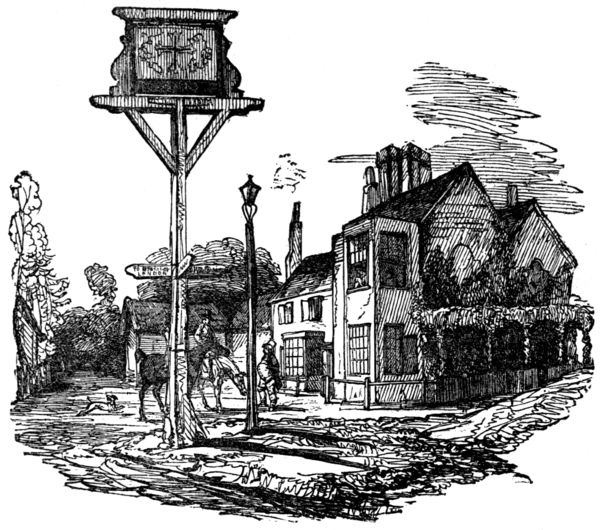
Keston Cross.
Com. Kent, 13 miles from London, 3 from Bromley.—Itinerary.
When I designed with my friend W. a visit to the Dulwich gallery, which we did not effect, we did not foresee the consequence of diversion from our intent; and having been put out of our way, we strolled without considering “the end thereof.” Hence, our peradventure at the “Crooked Billet,” on Penge Common;[252] our loitering to sketch the “Bridge on the Road to Beckenham;”[253] the same, for the same purpose, at “the Porch of Beckenham Church-yard;”[254] the survey of “Beckenham Church;”[255] the view of its old Font in the public-house garden;[256] and the look at the hall of “Wickham Court,” and West Wickham church.[257] New and beautiful prospects opened to us from the latter village; and to the just enumerated six articles, and their engravings, respecting that part of the country, in the former volume of the Table Book, it is intended to add like abstracts of our further proceedings. In short, to be respectful and orderly, as one moiety of a walking committee, self-constituted and appointed, I take permission to “report progress, and ask leave to go again.”
The “Crooked Billet” at Penge, and mine host of the “Swan” at West Wickham, have had visitors curious to trace the pleasant route, and remark the particulars previously described. While indulging the sight, there is another sense that craves to be satisfied; and premising that we are now penetrating further “into the bowels of the land,” it becomes a duty to acquaint followers with head-quarters. For the present, it is neither necessary nor expedient to nicely mark the road to “Keston Cross”—go which way you will it is an agreeable one. A Tunbridge or Seven-Oaks coach passes within a short half mile, and the Westerham coach within the same distance. If a delightful two hours’ lounging walk from Bromley be desired, take the turning from the Swan at Bromley to Beckenham church; go through the church-yard over a stile, keep the meadow foot-path, cross the Wickham road, and wander by hedge-row elms, as your will and the country-folk direct you, till you arrive at Hayes Common; then make for the lower or left-hand side of the common, and leaving the mill on the right, get into the cottaged lane. At a few hundred yards past the sheep-wash, formed in a little dell by the Ravensbourne, at the end of the open rise, stands “Keston Cross.”
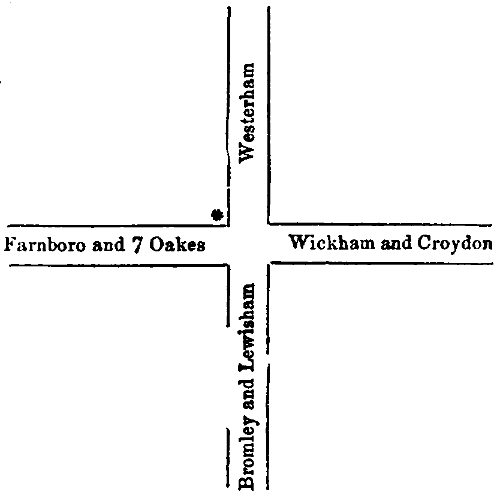
Before reaching this place on my first visit to it, the country people had indiscriminately called it “Keston Cross” and “Keston mark;” and lacking all intelligible information from them respecting the reason for its being so named, I puzzled myself with conjectures, as to whether it was the site of a cross of memorial, a market cross, a preaching cross, or what other kind of cross. It was somewhat of disappointment to me, when, in an angle of a cross-road, instead of some ancient vestige, there appeared a commodious, respectable, and comfortable-looking house of accommodation for man and horse; and, swinging high in air, its sign, the red-cross, heraldically, a cross gules; its form being, on reference to old Randle Holme, “a cross molyne, invertant;” to describe which, on the same authority, it may be said, that “this cross much resembles the molyne, or pomette; saving in this, the cut, or sawed ends, so turn themselves inward that they appear to be escrowles rolled up. Some term it molyne, the ends rolled up.”[258] So much for the sign, which I take to be a forgotten memorial of some old boundary stone, or land-mark, in the form of a cross, long since removed from the spot, and perhaps after it had become a “stump-cross;” which crosses were of so ancient date, that the Christians, ignorantly supposing them to have been dedicated to idolatrous purposes, religiously destroyed them, and their ancient names were soon forgotten: “this may be the reason why so many broken crosses were called stump-crosses.”[259] The observation is scarcely a digression; for the house and sign, commonly called “Keston Cross,” or “Keston mark,” stand on a site, which, for reasons that will appear by and by, the antiquary deems sacred. The annexed representation shows the direction of the roads, and the star * in the corner the angular situation of the house, cut out of Holwood, the estate of the late Mr. Pitt, which is bounded by the Farnborough and Westerham roads, and commands from the grounds of the enclosure the finest view towards the weald of Kent in this part of the county.
“Keston Cross” I call “head-quarters,” because in this house you will find yourself “at home.” You may sparkle forth to many remarkable spots in the vicinage, and then return and take your “corporal refection,” and go in and out at will; or you may sit at your ease, and do nothing but contemplate in quiet; or, in short, you may do just as you like. Of course this is said to “gentle” readers; and I presume the Table Book has no others: certain it is, that ungentle persons are unwelcome visitors, and not likely to visit again at “Keston Cross.” Its occupant, Mr. S. Young—his name is beneath his sign—will not be regarded by any one, who does himself the pleasure to call at his house, as a common landlord. If you see him seated beside the door, you estimate him at least of that order one of whom, on his travels, the chamberlain at the inn at Rochester describes to Gadshill as worthy his particular notice—“a franklin in the weald of Kent, that hath three hundred marks with him in gold—one that hath abundance of charge too.”[260] You take Mr. Young for a country gentleman; and, if you company with him, may perhaps hear him tell, as many a country gentleman would—bating obsolete phrase and versification—
I lerned never rhetorike certain; Thing that I speke it mote be bare and plain: I slept never on the mount of Pernaso, Ne lerned Marcus Tullius Cicero. Colours ne know I non, withouten drede, But swiche colours as growen in the mede, Or elles swiche as men die with, or peint; Colours of rhetorike ben to me queinte; My spirit feleth not of swiche matere: But if you lust my tale shul ye here.[261]
In brief, if you “put up” at the “Red Cross,” and invite Mr. Young’s society, you will find him
—————a franklin faire und free, That entertaines with comely courteous glee.[262]
The house itself is not one of your bold looking inns, that if you enter you assure yourself of paying toll at, in regard of its roystering appearance, in addition to every item in your bill; but one in which you have no objection to be “at charges,” in virtue of its cheerful, promising air. You will find these more reasonable perhaps than you expect, and you will not find any article presented to you of an inferior quality. In respect therefore of its self-commendations and locality, the “Cross” at Keston is suggested as a point d’appui to any who essay from town for a few hours of fresh air and comfort, and with a desire of leisurely observing scenery altogether new to most London residents.
The classical ancients had inns and public-houses. Nothing is a stronger proof of the size and populousness of the city of Herculaneum, which was destroyed by an eruption of Mount Vesuvius on the 24th of August, A. D. 79, than its nine hundred public-houses. A placard or inscription, discovered on the wall of a house in that ruined city, was a bill for letting one of its public-houses on lease; and hence, it appears that they had galleries at the top, and balconies, or green arbours, and baths. The dining-rooms were in the upper story. Although it was the custom of the Romans to recline at their meals, yet when they refreshed themselves at these places they sat. The landlord had a particular dress, and landladies wore a succinct, or tucked up dress, and brought the wine in vases for the visitors to taste. They had common drinking vessels as with us, and sometimes the flaggons were chained to posts. In the inns on the roads there were both hot and cold meats. Until the time of Nero, inns provided every kind of delicacy: that emperor restricted them to boiled vegetables. Tiberius prohibited their selling any baker’s goods.
The company frequenting the ancient public-houses were usually artificers, sailors, drunken galli, thieves, &c. Chess was played, and the abacus, or chess-board, was made oblong. Hence came the common painted post still at the doors of our own public-houses, the sign of the chequer or chequers.[263] Sir William Hamilton presented to the Antiquarian Society a view of a street in Pompeii, another Italian city destroyed by Vesuvius, which contains the sign of the chequers, from whence there can be no doubt that it was a common one among the Romans.
Our Saxon ancestors had public-houses where they drank very hard out of vessels of earthenware, as the country people do still.
The Anglo-Saxons had the eala-hus, ale-house, win-hus, wine-house, and cumen-hus, or inn. Inns, however, were by no means common houses for travellers. In the time of Edward I. lord Berkeley’s farm-houses were used for that purpose. Travellers were accustomed to inquire for hospitable persons, and even go to the king’s palaces for refreshment. John Rous, an old traveller, who mentions a celebrated inn on the Warwick road, was yet obliged to go another way for want of accommodation.[264]
Mr. Brand supposes, that the chequers, at this time a common sign of a public-house, was originally intended for a kind of draught-board, called “tables,” and that it showed that there that game might be played. From their colour, which was red, and the similarity to a lattice, it was corruptly called the red lettuce, a word frequently used by ancient writers to signify an alehouse. He observes, that this designation of an alehouse is not altogether lost, though the original meaning of the word is, the sign being converted into a green lettuce; of which an instance occurs in Brownlow-street, Holborn.
In “A Fine Companion,” one of Shackerly Marmion’s plays, we read of “A waterman’s widow at the sign of the Red Lattice in Southwark.” Again, in “Arden of Faversham,” 1592, we have
—“his sign pulled down, and his lattice born away.”
Again, in “The Miseries of Inforc’d Marriage,” 1607:
—“’tis treason to the Red Lattice, enemy to the signpost.”
It were needless to multiply examples of this sign beyond one in Shakspeare. Falstaff’s page, speaking of Bardolph, says, “He called me even now, my lord, through a red lattice, and I could see no part of his face from the window.”
A writer in the Gentleman’s Magazine for June 1793, says, “It has been related to me by a very noble personage, that in the reign of Philip and Mary the then earl of Arundel had a grant to license public-houses, and part of the armorial bearings of that noble family is a chequered board: wherefore the publican, to show that he had a license, put out that mark as part of his sign.” On this, Mr. Brand inquires why the publicans take but a part of the Arundel arms, and why this part rather than any other? Another writer in the Gentleman’s Magazine for September 1794, says, “I think it was the great earl Warrenne, if not, some descendant or heir near him, not beyond the time of Rufus, had an exclusive power of granting licenses to sell beer: that his agent might collect the tax more readily, the door-posts were painted in chequers; the arms of Warren then, and to this day.” We may, however, reasonably refer all these “modern instances” to ancient times; and derive the publican’s sign of the chequers from the great authors of many of our present usages, the old Romans.
Mons. Jorevin, a French traveller, who journeyed through England in the reign of Charles II., stopped at the Stag inn, at Worcester, in the High-street, and he describes the entertainment of himself and a friend with whom he supped, so as to acquaint us somewhat with the entertainments in inns at that time. “During supper he (his friend) sent for a band of music, consisting of all sorts of instruments: among these the harp is the most esteemed by the English. According to the custom of the country the landladies sup with the strangers and passengers, and if they have daughters they are also of the company, to entertain the guests at table with pleasant conceits, where they drink as much as the men. But what is to me the most disgusting in all this is, that when one drinks the health of any person in company, the custom of the country does not permit you to drink more than half the cup, which is filled up, and presented to him or her whose health you have drank. Moreover, the supper being finished, they set on the table half a dozen pipes and a packet of tobacco for smoking, which is a general custom, as well among women as men, who think that without tobacco one cannot live in England, because, say they, “it dissipates the evil humours of the brain.” It appears from a “Character of England,” printed in 1659, “that the ladies of greatest quality suffered themselves to be treated in these taverns, and that they drank their crowned cups roundly, danced after the fiddle, and exceeded the bounds of propriety in their carousals.”
If a description of Scottish manners, printed about fifty years ago, may be relied on, it was then a fashion with females at Edinburgh to frequent a sort of public-house in that city. The writer says: “January 15, 1775.—A few evenings ago I had the pleasure of being asked to one of these entertainments by a lady. At that time I was not acquainted with this scene of ‘high life below stairs;’ and therefore, when she mentioned the word ‘oyster-cellar,’ I imagined I must have mistaken the place of invitation: she repeated it, however, and I found it was not my business to make objections; so agreed immediately. I waited with great impatience till the hour arrived, and when the clock struck away I went, and inquired if the lady was there.—‘O yes,’ cried the woman, she has been here an hour, or more.’ The door opened, and I had the pleasure of being ushered in, not to one lady, as I expected, but to a large and brilliant company of both sexes, most of whom I had the honour of being acquainted with. The large table, round which they were seated, was covered with dishes full of oysters and pots of porter. For a long time I could not suppose that this was the only entertainment we were to have, and I sat waiting in expectation of a repast that was never to make its appearance. The table was cleared, and glasses introduced. The ladies were now asked whether they would choose brandy or rum punch? I thought this question an odd one, but I was soon informed by the gentleman who sat next me, that no wine was sold here, but that punch was quite ‘the thing;’ and a large bowl was immediately introduced. The conversation hitherto had been insipid, and at intervals: it now became general and lively. The women, who, to do them justice, are much more entertaining than their neighbours in England, discovered a great deal of vivacity and fondness for repartee. A thousand things were hazarded, and met with applause; to which the oddity of the scene gave propriety, and which could have been produced in no other place. The general ease with which they conducted themselves, the innocent freedom of their manners, and their unaffected good-nature, all conspired to make us forget that we were regaling in a cellar, and was a convincing proof that, let local customs operate as they may, a truly polite woman is every where the same. When the company were tired of conversation they began to dance reels, their favourite dance, which they performed with great agility and perseverance. One of the gentlemen, however, fell down in the most active part of it, and lamed himself; so the dance was at an end for that evening. On looking at their watches, the ladies now found it time to retire; the coaches were therefore called, and away they went, and with them all our mirth. The company were now reduced to a party of gentlemen; pipes and politics were introduced: I took my hat and wished them good night. The bill for entertaining half a dozen very fashionable women, amounted only to two shillings apiece. If you will not allow the entertainment an elegant one, you must at least confess that it was cheap.”[265]
It may be amusing to wander for a moment to another place of public entertainment, for the sake of a character of it two centuries ago, by bishop Earle.
The Tavern, 1628,
Is a degree, or (if you will) a pair of stairs above an ale-house, where men are drunk with more credit and apology. If the vintner’s nose be at the door, it is a sign sufficient, but the absence of this is supplied by the ivy-bush: the rooms are ill breathed like the drinkers that have been washed well over night, and are smelt-to fasting next morning. It is a broacher of more news than hogsheads, and more jests than news, which are sucked up here by some spungy brain, and from thence squeezed into a comedy. Men come here to make merry, but indeed make a noise; and this musick above is answered with the clinking below. The drawers are the civilest people in it, men of good bringing up; and howsoever we esteem of them, none can boast more justly of their high calling. ’Tis the best theater of natures, where they are truly acted, not played; and the business, as in the rest of the world, up and down, to wit, from the bottom of the cellar to the great chamber. A melancholy man would find here matter to work upon, to see heads as brittle as glasses, and often broken; men come hither to quarrel, and come hither to be made friends: and if, Plutarch will lend me his simile, it is even Telephus’s sword that makes wounds and cures them. It is the common consumption of the afternoon, and the murderer or maker-away of a rainy day. It is the torrid zone that scorches the face, and tobacco the gunpowder that blows it up. Much harm would be done, if the charitable vintner had not water ready for these flames. A house of sin you may call it, but not a house of darkness, for the candles are never out; and it is like those countries far in the north, where it is as clear at mid-night as at mid-day. To give you the total reckoning of it; it is the busy man’s recreation, the idle man’s business, the melancholy man’s sanctuary, the stranger’s welcome, the inns-of-court man’s entertainment, the scholar’s kindness, and the citizen’s courtesy. It is the study of sparkling wits, and a cup of canary their book, whence we leave them.
Bishop Earle, in his character of a “Poor Fiddler,” describes him as “in league with the tapsters for the worshipful of the inn, whom he torments next morning with his art, and has their names more perfect than their men.” Sir John Hawkins, who cites this in his History of Music, also abstracts a curious view of the customs at inns, from Fyne Moryson’s “Itinerary,” rather later in the same age:—
“As soone as a passenger comes to an inne, the seruants run to him, and one takes his horse and walkes him till he be cold, then rubs him, and giues him meate, yet I must say that they are not much to be trusted in this last point, without the eye of the master or his seruant to ouersee them. Another seruant giues the passenger his priuate chamber, and kindles his fier, the third puls of his bootes, and makes them cleane. Then the host or hostesse visits him, and if he will eate with the host, or at a common table with others, his meale will cost him sixepence, or in some places but foure pence, (yet this course is lesse honourable, and not vsed by gentlemen): but if he will eate in his chamber, he commands what meate he will according to his appetite, and as much as he thinkes fit for him and his company, yea, the kitchen is open to him, to command the meat to be dressed as he best likes; and when he sits at table, the host or hostesse will accompany him, or if they haue many guests, will at least visit him, taking it for curtesie to be bid sit downe: while he eates, if he haue company especially, he shall be offred musicke, which he may freely take or refuse, and if he be solitary, the musitians will giue him the good day with musicke in the morning. It is the custome, and no way disgracefull, to set vp part of supper for his breakefast: in the euening or in the morning after breakefast, (for the common sort vse not to dine, but ride from breakefast to supper time, yet comming early to the inne for better resting of their horses) he shall haue a reckoning in writing, and if it seeme vnreasonable, the host will satisfie him, either for the due price, or by abating part, especially if the seruant deceive him any way, which one of experience will soone find. I will now onely adde, that a gentleman and his man shall spend as much, as if he were accompanied with another gentleman and his man; and if gentlemen will in such sort ioyne together, to eate at one table, the expences will be much deminished. Lastly, a man cannot more freely command at home in his owne house, than hee may doe in his inne; and at parting, if he giue some few pence to the chamberlin and ostler, they wish him a happy iourney.”
Through a most diligent collector of archæological authorities, we find in the time of Elizabeth only eight-pence paid at an inn for a physician all night; and in the time of Charles II. only two-pence for a man and horse at Bristol.[266]
Bristol has now attained to so great wealth and prosperity, as to provide inns of importance equal perhaps to any in the kingdom. A friend, who sojourned there at the undermentioned date, hands me a printed document, which he received from his landlord, Mr. John Weeks; it is so great a curiosity, as bespeaking the opulence of that ancient city, and the spirit of its great innkeeper, that I cannot refrain from recording it.
BUSH TAVERN.
Bill of Fare for Christmas, 1800
1 Bustard
Red game
Black game
1 Turtle, 120lb.
1 Land tortoise
72 Pots turtle, different prices
Vermicelli soup
British turtle
Giblet soup
Pease soup
Gravy soup
Soup Santé
Soup and bouillé
Mutton broth
Barley broth
3 Turbots
4 Cods
2 Brills
2 Pipers
12 Dories
2 Haddocks
14 Rock fish
18 Carp
12 Perch
4 Salmon
12 Plaice
17 Herrings
Sprats
122 Eels
Salt fish
78 Roach
98 Gudgeons
1 Dried salmon
Venison,—1 Haunch hevior
Venison,—5 Haunches doe
Venison,—5 Necks
Venison,—10 Breasts
Venison,—10 Shoulders
42 Hares
17 Pheasants
41 Partridges
87 Wild ducks
17 Wild geese
37 Teal
31 Widgeon
16 Bald coots
2 Sea pheasants
3 Mews
11 Veal burrs
1 Roasting pig
Oysters, stew’d & collop’d
Eggs
Hogs’ puddings
Ragoo’d feet and ears
Scotch’d collops
Veal cutlets
Harricoed mutton
Maintenon chops
Pork chops
Mutton chops
Rump steaks
Joint steaks
Pinbone steaks
Sausages
Hambro’ sausages
Tripe, cow heels, and knotlings
5 House lambs
Veal—3 Legs & loins
Veal—2 Breasts & shoulders
Veal—2 Heads
Beef—5 Rumps
Beef—3 Sirloins
Beef—5 Rounds
Beef—2 Pieces of 5 ribs each
Beef—7 Pinbones
Dutch & Hambro’d beef
Mutton—8 Haunches
Mutton—8 Legs
Mutton—8 Necks
Mutton—11 Loins
Mutton—6 Saddles
Mutton—6 Chines
Mutton—5 Shoulders
Pork—4 Legs
Pork—4 Loins
Pork—4 Chines
Pork—Sparibs
Pork—Half a porker
[Cold]
1 Boar’s head
1 Baron beef
2 Hams
4 Tongues
6 Chicken
4 Moor hens[II-45, II-46]
2 Water drabs
7 Curlews
2 Bitterns
81 Woodcocks
149 Snipes
17 Wild Turkies
18 Golden plovers
1 Swan
5 Quists
2 Land rails
13 Galenas
4 Peahens
1 Peacock
1 Cuckoo
116 Pigeons
121 Larks
1 Sea magpye
127 Stares
208 Small birds
44 Turkies
8 Capons
19 Ducks
10 Geese
2 Owls
61 Chickens
4 Ducklings
11 Rabbits
3 Pork griskins
Hogs’ feet and ears
7 Collars brawn
2 Rounds beef
Collared veal
Collared beef
Collared mutton
Collared eels
Collared pig’s head
Dutch tongues
Bologna sausages
Paraguay pies
French pies
Mutton pies
Pigeon pies
Venison pasty
Sulks
430 Mince pies
13 Tarts
Jellies
Craw fish
Pickled salmon
Sturgeon
Pickled oysters
Potted partridges
Lobsters
52 Barrels Pyfleet & Colchester oysters
Milford & Tenby oysters
4 Pine apples
Could our ancestors take a peep from their graves at this bill of fare, we may conceive what would be their astonishment at so great a variety and abundance of provision for travellers at a single inn of our times; in earlier days, wayfarers were, in many places, compelled to seek accommodation from hospitable housekeepers, and knights were lodged in barns.
A history of inns would be curious. It is not out of the way to observe, that the old inns of the metropolis are daily undergoing alterations that will soon destroy their original character. “Courts with bedchambers, below and around the old inns, occur in the middle age, and are probably of Roman fashion; for they resemble the barracks at Tivoli.”[267] There are specimens of this inn-architecture still remaining to be observed at the Bell Savage, Ludgate-hill; the Saracen’s Head, Snow-hill; the George, and the Ram, in Smithfield; the Bull and Mouth; the Swan and two necks;[268] the Green Dragon, Bishopsgate-street, and a few others; not forgetting the Talbot inn, in the Borough, from whence Chaucer’s pilgrims set out to the shrine of St. Thomas à Becket, at Canterbury; of which there is a modern painting placed in front of one of its galleries facing the street entrance. Stow, in his time, calls it, under the name of the “Tabard,” “the most ancient” of the inns on the Surrey side of London. In Southwark, he says, “bee many faire innes for receit of travellers—amongst the which, the most ancient is the Tabard, so called of the signe, which as wee now terme it, is of a jacket, or sleevelesse coate, whole before, open on both sides, with a square collar, winged at the shoulders; a stately garment, of old time commonly worne of noblemen and others, both at home and abroad in the wars; but then (to wit, in the warres,) their armes embroidered, or otherwise depict upon them, that every man by his coat of armes might bee knowne from others: but now these tabards are onely worne by the heralds, and bee called their coats of armes in service.” Stowe then quotes Chaucer in commendation of the “Inne of the Tabard:”—
It befelle in that season, on a day In Southwerk, at the Tabard as I lay Ready to wend on my pilgrimage To Canterbury with devout courage; That night was come into that hostelrie Well nine and twenty in a compagnie Of sundry folke, by aventure yfalle In felawsship, and pilgrimes were they alle, That toward Canterbury wolden ride. The chambers and stables weren wide, &c.
Chaucer, whom it pleases to Stowe to call “the most famous poet of England,” relates
———— shortly in a clause Th’ estat, th’ araie, the nombre, and eke the cause, Why that assembled was this compagnie In Southwerk, at this gentil hostelrie, That hight the Tabard, faste by the Bell.
In course of time the original name of the sign seems to have been lost, and its meaning forgotten. The “Tabard” is corrupted or perverted into the “Talbot” inn; and as already, through Stowe, I have shown the meaning of the Tabard, some readers perhaps may excuse me for adding, that the Talbot, which is now only a term for an armorial bearing, is figured in heraldry as a dog, a blood-hound, or hunting hound.[269]
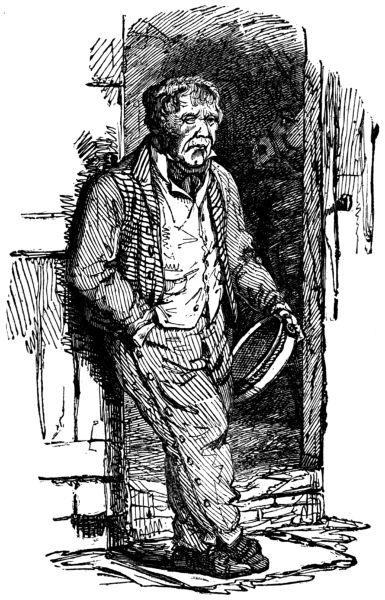
William Blake, Ostler at Keston Cross.
After thus beating up inns and public-houses generally, we will return for a moment to “Keston Cross.” To this pleasant house there is attached a delightful little flower and fruit-garden, with paddocks, poultry-yard, outhouses, and every requisite for private or public use; all well-stocked, and, by the order wherein all are kept, bespeaking the well-ordered economy of the occupant’s mind. The stabling for his own and visitors’ horses is under the management of an ostler of long service: and it must not be forgotten, that the rooms in the house are marked by its owner’s attachment to horses and field-sports. In the common parlour, opposite the door, is a coloured print of the burial of a huntsman—the attendants in “full cry” over the grave—with verses descriptive of the ceremony. A parlour for the accommodation of private parties has an oil painting of the old duke of Bolton, capitally mounted, in the yard of his own mansion, going out, attended by his huntsman and dogs. There are other pictures in the same taste, particularly a portrait of one of Mr. Young’s horses.
The ostler at “Keston Cross” is the most remarkable of its obliging, humble servants. The poor fellow has lost an eye, and is like the “high-mettled racer” in his decline—except that he is well used. While looking about me I missed W., and found he had deemed him a picturesque subject, and that he was in the act of sketching him from behind the door of the stable-yard, while he leaned against the stable-door with his corn-sieve in his hand. I know not why the portrait should not come into a new edition of Bromley’s Catalogue, or an appendix to Granger: sure I am that many far less estimable persons figure in the Biographical History of England. As an honest man, (and if he were not he would not be in Mr. Young’s service,) I craved my friend W. to engrave him on a wood-block; I have no other excuse to offer for presenting an impression of it, than the intrinsic worth of the industrious original, and the merit of the likeness; and that apology it is hoped very few will decline.
Dr. Johnson derives “ostler” from the French word “hostelier,” but “hostelier” in French, now spelt “hotelier,” signifies an innkeeper, or host, not an ostler; to express the meaning of which term the French word is wholly different in spelling and pronunciation. It seems to me that “ostler” is derived from the word “hostel,” which was formerly obtained from the French, and was in common use here to signify an inn; and the innkeeper was from thence called the “hosteller.” This was at a period when the innkeeper or “hosteller” would be required by his guests to take and tend their horses, which, before the use of carriages, and when most goods were conveyed over the country on the backs of horses, would be a chief part of his employment; and hence, the “hosteller” actually became the “hostler,” or “ostler,” that is, the horse-keeper.
We will just glean, for two or three minutes, from as many living writers who have gone pleasantly into inns, and so conclude.
Washington Irving, travelling under the name of “Geoffrey Crayon, gent.” and reposing himself within a comfortable hostel at Shakspeare’s birth-place, says:—“To a homeless man, who has no spot on this wide world which he can truly call his own, there is a momentary feeling of something like independence and territorial consequence, when, after a weary day’s travel, he kicks off his boots, thrusts his feet into slippers, and stretches himself before an inn fire. Let the world without go as it may; let kingdoms rise or fall, so long as he has the wherewithal to pay his bill, he is, for the time being, the very monarch of all he surveys. The arm chair is his throne, the poker his sceptre, and the little parlour, of some twelve feet square, his undisputed empire. It is a morsel of certainty, snatched from the midst of the uncertainties of life; it is a sunny moment gleaming out kindly on a cloudy day; and he who has advanced some way on the pilgrimage of existence, knows the importance of husbanding even morsels and moments of enjoyment. ‘Shall I not take mine ease in mine inn?’ thought I, as I gave the fire a stir, lolled back in my elbow chair, and cast a complacent look about the little parlour of the Red Horse, at Stratford-on-Avon.”——
Elia, to illustrate the “astonishing composure” of some of the society of “friends,” tells a pleasant anecdote, which regards a custom at certain inns, and is therefore almost as fairly relatable in this place, as it is delightfully related in his volume of “Essays:”—“I was travelling,” says Elia, “in a stage-coach with three male quakers, buttoned up in the straitest non-conformity of their sect. We stopped to bait at Andover, where a meal, partly tea apparatus, partly supper, was set before us. My friends confined themselves to the tea-table. I in my way took supper. When the landlady brought in the bill, the eldest of my companions discovered that she had charged for both meals. This was resisted. Mine hostess was very clamorous and positive. Some mild arguments were used on the part of the quakers, for which the heated mind of the good lady seemed by no means a fit recipient. The guard came in with his usual peremptory notice. The quakers pulled out their money, and formally tendered it—so much for tea—I, in humble imitation, tendering mine—for the supper which I had taken. She would not relax in her demand. So they all three quietly put up their silver, as did myself, and marched out of the room, the eldest and gravest going first, with myself closing up the rear, who thought I could not do better than follow the example of such grave and warrantable personages. We got in. The steps went up. The coach drove off. The murmurs of mine hostess, not very indistinctly or ambiguously pronounced, became after a time inaudible—and now my conscience, which the whimsical scene had for a while suspended, beginning to give some twitches, I waited, in the hope that some justification would be offered by these serious persons for the seeming injustice of their conduct. To my great surprise, not a syllable was dropped on the subject. They sate as mute as at a meeting. At length the eldest of them broke silence, by inquiring of his next neighbour, ‘Hast thee heard how indigos go at the India House?’ and the question operated as a soporific on my moral feeling as far as Exeter.”
Finally, from the “Indicator” we learn, that to Mr. Leigh Hunt “a tavern and coffee-house is a pleasant sight, from its sociality; not to mention the illustrious club memories of the times of Shakspeare and the Tatlers. The rural transparencies, however, which they have in their windows, with all our liking of the subject, would perhaps be better in any others; for tavern sociality is a town-thing, and should be content with town ideas. A landscape in the window makes us long to change it at once for a rural inn; to have a rosy-faced damsel attending us, instead of a sharp and serious waiter; and to catch, in the intervals of chat, the sound of a rookery instead of cookery. We confess that the commonest public-house in town is not such an eyesore to us as it is with some. It may not be very genteel, but neither is every thing that is rich. There may be a little too much drinking and roaring going on in the middle of the week; but what, in the mean time, are pride and avarice, and all the unsocial vices about? Before we object to public-houses, and above all to their Saturday evening recreations, we must alter the systems that make them a necessary comfort to the poor and laborious. Till then, in spite of the vulgar part of the polite, we shall have an esteem for the Devil and the Bag o’ Nails; and like to hear, as we go along on Saturday night, the applauding knocks on the table that follow the song of ‘Lovely Nan,’ or ‘Brave Captain Death,’ or ‘Tobacco is an Indian Weed,’ or ‘Why, Soldiers, why,’ or ‘Says Plato why should man be vain,’ or that judicious and unanswerable ditty, commencing
Now what can man more desire Nor sitting by a sea-coal fire; And on his knees, &c.”
Garrick Plays. No. XXV.
[From “Edward the Third,” an Historical Play, Author Unknown, 1597.]
The King, having relieved the Castle of the heroic Countess of Salisbury, besieged by the Scots, and being entertained by her, loves her.
Edward (solus.) She is grown more fairer far since I came hither: Her voice more silver every word than other, Her wit more fluent. What a strange discourse Unfolded she of David, and his Scots! Even thus, quoth she, he spake, and then spake broad With epithets and accents of the Scot; But somewhat better than the Scot could speak: And thus, quoth she, and answer’d then herself; For who could speak like her? but she herself Breathes from the wall an angel note from heaven Of sweet defiance to her barbarous foes.— When she would talk of peace, methinks her tongue Commanded war to prison: when of war, It waken’d Cæsar from his Roman grave, To hear war beautified by her discourse. Wisdom is foolishness, but in her tongue; Beauty a slander, but in her fair face; There is no summer, but in her chearful looks; Nor frosty winter, but in her disdain. I cannot blame the Scots that did besiege her, For she is all the treasure of our land: But call them cowards, that they ran away; Having so rich and fair a cause to stay.
The Countess repells the King’s unlawful suit.
Countess. Sorry I am to see my liege so sad: What may thy subject do to drive from thee This gloomy consort, sullome Melancholy? King. Ah Lady! I am blunt, and cannot strew The flowers of solace in a ground of shame. Since I came hither, Countess, I am wrong’d. Coun. Now God forbid that any in my house Should think my sovereign wrong! thrice-gentle king Acquaint me with your cause of discontent. King. How near then shall I be to remedy? Coun. As near, my liege, as all my woman’s power, Can pawn itself to buy thy remedy. King. If thou speak’st true, then have I my redress. Engage thy power to redeem my joys, And I am joyful, Countess; else I die. Coun. I will, my liege. King. Swear, Countess, that thou wilt. Coun. By heaven I will. King. Then take thyself a little way aside, And tell thyself, a king doth dote on thee. Say that within thy power it doth lie To make him happy, and that thou hast sworn To give him all the joy within thy power. Do this; and tell him, when I shall be happy. Coun. All this is done, my thrice-dread sovereign. That power of love, that I have power to give, Thou hast, with all devout obedience. Employ me how thou wilt in proof thereof. King. Thou hear’st me say that I do dote on thee. Coun. If on my beauty, take it if thou can’st; Though little, I do prize it ten times less: If on my virtue, take it if thou can’st; For virtue’s store by giving doth augment. Be it on what it will, that I can give, And thou can’st take away, inherit it. King. It is thy beauty that I would enjoy. Coun. O were it painted, I would wipe it off, And dispossess myself to give it thee; But, sovereign, it is soulder’d to my life: Take one, and both; for, like an humble shadow, It haunts the sunshine of my summer’s life. King. But thou may’st lend it me to sport withal. Coun. As easy may my intellectual soul Be lent away, and yet my body live, As lend my body (palace to my soul) Away from her, and yet retain my soul. My body is her bower, her court, her abbey. And she an angel pure, divine, unspotted; If I should lend her house, my Lord, to thee, I kill my poor soul, and my poor soul me. King. Didst thou not swear to give me what I would? Count. I did, my liege, so what you would, I could. King. I wish no more of thee, than thou may’st give: Nor beg I do not, but I rather buy; That is thy love; and for that love of thine In rich exchange, I tender to thee mine. Coun. But that your lips were sacred, my Lord, You would profane the holy name of love. That love, you offer me, you cannot give; For Cæsar owes that tribute to his Queen. That love, you beg of me, I cannot give; For Sara owes that duty to her Lord. He, that doth clip or counterfeit your stamp, Shall die, my Lord: and shall your sacred self Commit high treason ’gainst the King of Heaven, To stamp his image in forbidden metal, Forgetting your allegiance and your oath? In violating marriage’ sacred law, You break a greater Honour than yourself. To be a King, is of a younger house Than To be married; your progenitor, Sole-reigning Adam on the universe, By God was honour’d for a married Man But not by him anointed for a King. It is a penalty to break your statutes. Tho’ not enacted with your Highness’ hand; How much more to infringe the holy act, Made by the mouth of God, seal’d with his hand I know my Sovereign, in my Husband’s love, Doth but to try the Wife of Salisbury, Whether she will hear a wanton’s tale or no: Lest being guilty therein by my stay, From that, not from my liege, I turn away. ****** King. Whether is her beauty by her words divine Or are her words sweet chaplains to her beauty? Like as the wind doth beautify a sail, And as a sail becomes the unseen wind, So do her words her beauties, beauty words. ****** Coun. He hath sworn me by the name of God To break a vow made in the name of God. What if I swear by this right hand of mine To cut this right hand off? the better way Were to profane the idol, than confound it.
Flattery.
—— O thou World, great nurse of flattery, Why dost thou tip men’s tongues with golden words And poise their deeds with weight of heavy lead, That fair performance cannot follow promise? O that a man might hold the heart’s close book And choke the lavish tongue, when it doth utter The breath of falsehood, not character’d there!
Sin, worst in High Place.
An honourable grave is more esteemed, Than the polluted closet of a king; The greater man, the greater is the thing, Be it good or bad, that he shall undertake. An unreputed mote, flying in the sun, Presents a greater substance than it is; The freshest summer’s day doth soonest taint The loathed carrion, that it seems to kiss; Deep are the blows made with a mighty axe; That sin does ten times aggravate itself, That is committed in a holy place; An evil deed done by authority Is sin, and subornation; deck an ape In tissue, and the beauty of the robe Adds but the greater scorn unto the beast; The poison shews worst in a golden cup; Dark night seems darker by the light’ning flash; Lilies that fester, smell far worse than weeds. And every Glory, that inclines to Sin, The shame is treble by the opposite.
C. L.
Poetry.
For the Table Book.
SONNET TO MISS KELLY,
On her excellent performance of Blindness, in the revived Opera of Arthur and Emmeline.
Rare artist, who with half thy tools, or none, Canst execute with ease thy curious art, And press thy powerful’st meanings on the heart Unaided by the eye, expression’s throne! While each blind sense, intelligential grown Beyond its sphere, performs the effect of sight, Those orbs alone, wanting their proper might, All motionless and silent seem to moan The unseemly negligence of nature’s hand, That left them so forlorn. What praise is thine, O mistress of the passions!—artist fine!— Who dost our souls against our sense command; Plucking the horror from a sightless face, Lending to blank deformity a grace.
C. Lamb.
VOLUNTEER REMINISCENCES.
To the Editor.
Sham-Fights and Invasion.
Dear Sir,—Some agreeable recollections induce me to pen a few circumstances for the Table Book, which may kindle associations in the many who were formerly engaged in representing the “raw recruit,” and who are now playing the “old soldier” in the conflict of years. I do not travel out of the road to take the “Eleven city regiments” into my battalion, nor do I call for the aid of the “Gray’s-inn sharpshooters,” (as lawyers are,) and other gents of the “sword and sash,” who then emulated their brethren in “scarlet and blue.”—Erecting my canteen at Moorgate, I hint to other quilldrivers to extend their forces when and where their memories serve. Inkshed, not bloodshed, is my only danger—my greatest failing is a propensity (I fear) to digress and enlarge, till I may not bring the numbers of my muster-roll within proper discipline. Being on my guard, however, I take the succeeding specimens from a spot filled with chapels of several persuasions, the “London Institution,” and well-built houses, with a pleasant relief of verdure in the centre for nursery maids and romping children.
Moorfields, alas! has no fields! Where the “Beth’lem hospital” raised its magnificent but gloomy front, with old Cibber’s statues of “Raving and Melancholy Madness” siding the centre entrance, no vestiges remain, except the church and parts of London Wall, leading from Broker-row to the Albion chapel, commonly called the Plum-cake. Who that knew the crossing from Finsbury-square to Broad-street remembers not the open-barred window at which “Mad Molly” daily appeared, singing, and talking inconsistencies of love, confinement, and starvation? Who that stood before the massive building heard not the tones of agony, and felt not deep pity for the poor reasonless creatures?
——In Moorfields, when Buonaparte threatened this country with invasion, the beat of drum and the shrillings of the fife brought corps of gentlemen volunteers into rank and file, to show how much a “nation of shopkeepers” could do. Ladies in clusters assembled here to witness the feats of their soldier-like heroes—sanctioning with their presence, and applauding with their smiles, the defenders of their domiciles.
The “Bank gentlemen,” distinguished by their long gaiters, and therefore called black-legs, went farther off and exercised before bank-hours, in the Tenter-ground beyond the Vinegar-yard.
The East India Company’s three regiments (the best soldiers next to the foot-guards) drilled in a field which lay in the way on the one side to the Rosemary Branch, (noted for a water-party or fives’ match,) and the White Lead Mills, whose windsails are removed by the steam Quixotes of the day. On the other side, skirted the once pleasant path, leading from the Shepherd and Shepherdess across the meadow either to Queen’s Head-lane, the Britannia, or the Almshouses, near the Barley Mow, Islington. The East India field is now divided into gardens and snug arbours, let to the admirers of flowers and retreats.
Lackington’s “Temple of Fame” was a temple of knowledge. This splendid place and its winding shelves of books caught the passing eye with astonishment at the success and skill of the once humble owner of a bookstall in Chiswell-street. Here Finsbury’s “child of lore and catalogue-maker” wrote a “book,” abounding with quotations from authors, and refuted his own words in after-life by publishing his “Confessions.” Lackington was, however, a man of deep judgment in his business, and no every-day observer of the manners and variations of his contemporaries.
Then, the “Artillery Company” attracted well-dressed people on Wednesday evenings, and from Finsbury-side to Bunhill-row there was a promenade of fashionables from Duke’s-place and Bevis Marks, listening to a band of music and the roar of cannon till dusk.
Moorfields gathered more regiments than any other spot excepting the Park, in which reviews and sham-fights concentrated the corporate forces on field-days. Wimbledon Common became also an occasional scene of busy parade and preparation; baggage long drawn out, multitudes of friends, sweethearts and wives, and nondescripts. In the roads were collected the living beings of half of the metropolis. It seemed a stir in earnest of great achievements. Many a white handkerchief dried the parting tear. There were the adieu and the farewell; salutes given behind the counter, or snatched in the passage, affected the sensibilities like last meetings. Sir W. Curtis and other colonels reminded the “gentlemen” they had “the honour” to command, that they were in “good quarters.” Sermons were preached in and out of the establishment to “soldiers.” Representations were given at the theatres to “soldiers.” The shop-windows presented tokens of courage and love to “soldiers.” Not a concert was held, not a “free and easy” passed, without songs and melodies to “soldiers.” It was a fine time for publicans and poets. Abraham Newland’s promises kept army-clothiers, gun-makers, Hounslow powder-mills, and Mr. Pitt’s affairs in action. No man might creditably present himself if he were void of the tone of military distinction; and Charles Dibdin and Grimaldi—“wicked wags!”—satirized the fashion of “playing at soldiers.”
In process of time, Maidstone, Colchester, and Rochester were select places for trying the shopkeeping volunteers: they were on duty for weeks, and returned with the honours of the barracks. Things taking a more peaceful aspect, or rather the alarm of invasion having subsided, the regimentals were put by, and scarcely a relic is now seen to remind the rising generation of the deeds of their fathers.
I could travel further, and tell more of these and similar doings, but I refrain, lest I tire your patience and your readers’ courtesy.
Dear sir, Truly yours, A City Volunteer.
June, 1827.
Discoveries OF THE ANCIENTS AND MODERNS. No. I.
It has been ascertained by the researches of a curious investigator,[270] that many celebrated philosophers of recent times have, for the most part, taken what they advance from the works of the ancients. These modern acquisitions are numerous and important; and as it is presumed that many may be instructed, and more be surprised by their enumeration, a succinct account of them is proposed.
It appears as unjust to praise and admire nothing but what savours of antiquity, as to despise whatever comes from thence, and to approve of nothing but what is recent. The moderns certainly have much merit, and have laboured not a little in the advancement of science; but the ancients paved the way, wherein at present is made so rapid a progress: and we may in that respect join Quintilian, who declared, seventeen hundred years ago, “that antiquity had so instructed us by its example, and the doctrines of its great masters, that we could not have been born in a more happy age, than that which had been so illuminated by their care.” While it would be ingratitude to deny such masters the encomiums due to them, envy alone would refuse the moderns the praise they so amply deserve. Justice ought to be rendered to both. In comparing the merits of the moderns and ancients, a distinction ought to be made between the arts and sciences, which require long experience and practice to bring them to perfection, and those which depend solely on talent and genius. Without doubt the former, in so long a series of ages, have been extended more and more; and, with the assistance of printing and other discoveries, have been brought to a very high degree of perfection by the moderns. Our astronomers understand much better the nature of the stars, and the whole planetary system, than Hipparchus, Ptolemy, and others of the ancients; but it may be doubted, whether they had gone so far, unaided by telescopes. The moderns have nearly perfected the art of navigation, and discovered new worlds; yet without the compass, America had probably remained unknown. Likewise, by long observation, and experiments often repeated, we have brought botany, anatomy, and chirurgery, to their present excellence. Many secrets of nature, which one age was insufficient to penetrate, have been laid open in a succession of many. Philosophy has assumed a new air; and the trifling and vain cavils of the schools, have at length been put to flight by the reiterated efforts of Ramus, Bacon, Gassendi, Descartes, Newton, Gravesand, Leibnitz, and Wolf. While, therefore, willingly conceding to the moderns every advantage they are fairly entitled to, the share which the ancients had in beating out for us the pathways to knowledge is an interesting subject of inquiry.
For two thousand years the ancient philosophers were so fully in possession of the general esteem, that they often led men blindfold. They were listened to as oracles, and their very obscurities regarded as too sacred to be pried into by common eyes. An ipse dixit of Pythagoras, Aristotle, or any other ancient sage, was enough to decide the most difficult case: the learned bowed in a body, and expressed their satisfaction, while they surrendered their judgment. These habits of submission were ill adapted to advance knowledge. A few noble spirits, who, in recompense of their labours, have been honoured with the glorious title of restorers of learning, quickly felt the hardship of the bondage, and threw off the yoke of Aristotle. But instead of following the example of those great men, whose incessant studies, and profound researches, had so enriched the sciences, some of their successors were content to make them the basis of their own slight works; and a victory, which might have tended to the perfecting of the human mind, dwindled into a petty triumph. Bruno, Cardan, Bacon, Galileo, Descartes, Newton, and Leibnitz, the heroes of the literary commonwealth, had too much merit, not to own that of the ancients. They did them justice, and avowed themselves their disciples; but the half-learned and feeble, whose little stock and strength were insufficient to raise to themselves a name, rail at those from whom they stole the riches with which they are bedecked, and ungratefully conceal their obligations to their benefactors.
The method made use of by the moderns, in the new philosophy, recommends itself by its own excellence; for the spirit of analysis and geometry that pervades their manner of treating subjects, has contributed so much to the advancement of science, that it were to be wished they had never swerved from it. It is not, however, to be denied, that the noblest parts of that system of philosophy, received with so much applause in the three last centuries, were known and inculcated by Pythagoras, Plato, Aristotle, and Plutarch. Of these great men, it may be believed that they well knew how to demonstrate what they communicated; although the arguments, upon which some portions of their demonstrations were founded, have not come down to us. Yet, if in those works which have escaped destruction from the fanaticism of ignorance, and the injuries of time, we meet with numberless instances of penetration and exact reasoning in their manner of relating their discoveries, it is reasonable to presume that they exerted the same care and logical accuracy in support of these truths, which are but barely mentioned in the writings preserved to us. Among the titles of their lost books are many respecting subjects mentioned only in general in their other writings. We may conclude, therefore, that we should have met with the proofs we now want, had they not thought it unnecessary to repeat them, after having published them in so many other works, to which they often refer, and of which the titles are handed down to us by Diogenes Laertius, Suidas, and other ancients, with exactness sufficient to give us an idea of the greatness of our loss. From numerous examples of this kind, which might be quoted, one may be selected respecting Democritus. That great man was the author of two books, from the titles of which it evidently appears, that he was one of the principal inventors of the elementary doctrine which treats of those lines and solids that are termed irrational, and of the contact of circles and spheres.
It is remarkable, that the illustrious ancients, by the mere force of their own natural talents, attained to all those acquisitions of knowledge which our experiments, aided by instruments thrown in our way by chance, serve only to confirm. Without the assistance of a telescope Democritus knew and taught, that the milky way was an assemblage of innumerable stars that escape our sight, and whose united splendour produces in the heavens the whiteness, which we denominate by that name; and he ascribed the spots in the moon to the exceeding height of its mountains and depth of its vallies. True it is, that the moderns have gone farther, and found means to measure the height of those same mountains; yet Democritus’s researches were those of a great genius; whereas the operations of the moderns are merely organical and mechanic. Besides which, we have this advantage,—that we work upon their canvass.
Finally, it may be repeated, that there is scarcely any discovery ascribed to the moderns, but what was not only known to the ancients, but supported by them with the most solid arguments. The demonstration of this position will at least have this good effect; it will abate our prejudices against the ancients, occasioned by a blind admiration of some moderns, who had never shone at all but for the light they borrowed of their masters. Their opinions fairly stated from their own works, and often in their words, must render the decision easy; and the result may restore to the early philosophers some part at least of their disputed glory.
For the Table Book.
THE GOSSIP AND STARE.
—— A creature of so frightful mien, As to be hated needs but to be seen.
It is feminine; a lower animal of the tribe Inquisitoria; and with all others of its species indescribably restless. It is commonly found with the bosom slatternly arrayed, leaning with folded arms out of a “two-pair front,” looking cunningly and maliciously over the side of a garden-pot—like a starling through the water-hole of its cage over the water-pot—with its head always on the bob, like that of the Chinese figure in grocers’ shops. Its features are lean and sharp as the bows of a Folkstone cutter, or the face of a Port Royal pig; its nose, like a racoon’s, is continually on the twist; the ears are ever pricking up for vague rumours and calumnious reports, and the eyes roll from side to side, like those of the image in the wooden clock at Kaltenbach’s in the Borough; the tongue is snake-like, is perpetually in motion—pretty yet pert—and venomous. Its habit is bilious, its temper splenetic. It is a sure extractor of all secrets, a thorough heart-wormer, a living diving-bell, a walking corkscrew. It generally “appears as well as its neighbours,” but it is fastidious, and loves to be different. Upon its legs, which are of the sparrow order, it looks a merry, light-hearted, artless, and good-natured little thing; but it is the green-bag-bearer of the parish, and its food is scandal. Hear it talk on a first meeting with a regular listener! Its voice is at first soft as the low piping of the nightingale, but gradually becomes like the loud hissing of an adder, and ends hoarse, and ominous of evil as that of the raven. It is an untiring spreader of idle and false reports, to the injury of many a good character. It is only innoxious to reasonable beings, for they never listen to it, or when obliged to do so, are no more amused by its sayings than by the singing of a tea-kettle; but these being few in number, compared with the lovers of small talk, to whom its company is always acceptable, it is a dangerous animal,
—— mother of deceit and lies.
Look at it sitting in its habitation!—every sound from the street draws it to the light-hole[271]—every thing from a bonnet to a patten furnishes it with matter for gossip—every opening of a neighbour’s door brings its long neck into the street. Every misfortune that assails others is to it a pleasure—every death a new life to itself—and the failings of the departed are eternal themes for its envenomed slander. It is at the heels of every thing that stirs, and the sooner it is trodden upon the better. But people tolerate and like it, because it is “so amusing,” and “so clever;” and yet each of its listeners is traduced in turn. There is no dealing with it, but by giving it rope enough; it will then hang itself, which, by the by, will be such an end as the creature merits.
S. R. J.
NAVAL MANNERS.
When the old duke of York (brother to George III.) went on board lord Howe’s ship, as a midshipman, the different captains in the fleet attended, to pay him their respects, on the quarter-deck. He seemed not to know what it was to be subordinate, nor to feel the necessity of moderation in the display of superiority resulting from his high rank, and he received the officers with some hauteur. This a sailor on the forecastle observed; and after expressing astonishment at the duke’s keeping his hat on, he told one of his messmates, that “the thing was not in its sphere;” adding, “it is no wonder he does not know manners, as he was never at sea before.”
LEGAL RECREATION.
It is alleged in a memoir of the Life of Lord Eldon, that, when plain John Scott, his zeal for knowledge of the law was so great, that he abandoned the pursuit of almost every other species of information, and never sacrificed a moment from his legal studies, beyond what was absolutely necessary to his health. His brother William, (afterwards lord Stowell,) with a view of engaging him to meet Dr. Johnson and other men of distinguished literary talent, would sometimes say, “Where do you dine to-day?” To this question John’s uniform answer was, “I dine on Coke to-day.” William would then demur, with a “Nay, but come to my chambers—you’ll see the doctor;” whereupon John argued, concerning the doctor, “He can’t draw a bill;” and so the friendly suit concluded.
It is further affirmed, on the best authority, that it was an amusement in the early legal life of John Scott to turn pieces of poetry into the form of legal instruments; and that he actually converted the ballad of “Chevy Chace” into the shape and style of a bill in chancery.
A professional gentleman, who, during his pupilage, was recommended by a distinguished barrister to commit the following verses to memory, duly availed himself of that advantage, and obligingly communicates them.
For the Table Book.
CANONS OF DESCENT. By an Apprentice of the Law.
Canon I.
Estates go to the issue (item) Of him last seized in infinitum; like cow-tails, downward, straight they tend, But never, lineally, ascend:
Cannon II.
This gives that preference to males, At which a lady justly rails.
Canon III.
Of two males, in the same degree, The eldest, only, heir shall be: With females we this order break, And let them all together take.
Canon IV.
When one his worldly strife hath ended, Those who are lineally descended From him, as to his claims and riches, Shall stand, precisely, in his breeches.
Canon V.
When lineal descendants fail, Collaterals the land may nail: So that they be (and that a bore is) De sanguine progenitores.
Canon VI.
The heir collateral, d’ye see, Next kinsman of whole blood must be:
Canon VII.
And, of collaterals, the male Stocks are preferred to the female; Unless the land come from a woman, And then her heirs shall yield to no man.
FRENCH JUDICIAL AUTHORITY.
In the “Thuana” we read of a whimsical, passionate, old judge, who was sent into Gascony with power to examine into the abuses which had crept into the administration of justice in that part of France. Arriving late at Port St. Mary, he asked “how near he was to the city of Agen?” He was answered, “two leagues.” He then decided to proceed that evening, although he was informed that the leagues were long, and the roads very bad. In consequence of his obstinacy the judge was bemired, benighted, and almost shaken to pieces. He reached Agen, however, by midnight, with tired horses and harassed spirits, and went to bed in an ill humour. The next morn he summoned the court of justice to meet, and after having opened his commission in due form, his first decree was, “That for the future the distance from Agen to Port St. Mary should be reckoned six leagues.” This decree he ordered to be registered in the records of the province, before he would proceed to any other business.
A LONG MINUET.
Hogarth, in his “Analysis of Beauty,” mentions the circumstance of a dancing-master’s observing, that though the “minuet” had been the study of his whole life, he could only say with Socrates, that he “knew nothing.” Hogarth added of himself, that he was happy in being a painter, because some bounds might be set to the study of his art.