Volume 2 — Vol. II.—41.
Reading edition
Penn and the Indians.
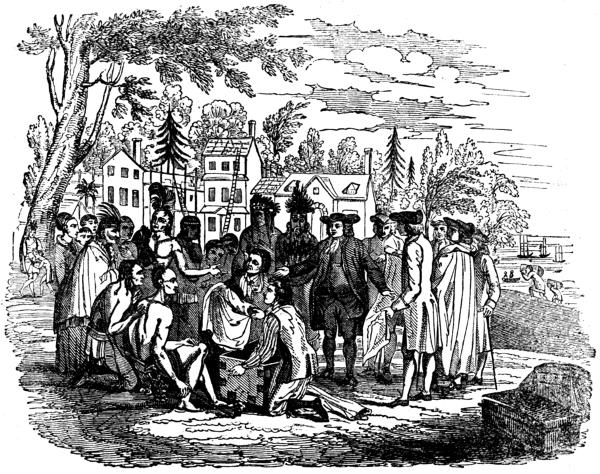
Penn and the Indians.
Yet thus could, in a savage-styled land, A few—reviled, scorn’d, hated of the whole— Stretch forth for Peace the unceremonious hand, And stamp Truth, even on a sealed scroll. They call’d not God, or men, in proof to stand: They pray’d no vengeance on the perjured soul: But Heaven look’d down, and, moved with wonder, saw A compact fram’d, where Time might bring no flaw.
This stanza is in a delightful little volume, entitled “The Desolation of Eyam; the Emigrant, a tale of the American Woods; and other poems: By William and Mary Howitt, authors of the Forest Minstrel, &c.” The feeling and beauty of one of the poems, “Penn and the Indians,” suggested the present engraving, after a celebrated print from a picture by the late Benjamin West. The following particulars are chiefly related by Mr. Clarkson, respecting the scene it represents.
King Charles II., in consideration of a considerable sum due from the crown for the services of admiral sir William Penn, granted to his son, the ever-memorable William Penn, and his heirs, in perpetuity, a great tract of land on the river Delaware, in America; with full power to erect a new colony there, to sell lands, to make laws, to create magistrates, and to pardon crimes. In August, 1682, Penn, after having written to his wife and children a letter eminently remarkable for its simplicity and patriarchal spirit, took an affectionate leave of them; and, accompanied by several friends, embarked at Deal, on board the Welcome, a ship of three hundred tons burthen. The passengers, including himself, were not more than a hundred. They were chiefly quakers, and most of them from Sussex, in which county his house at Warminghurst was seated. They sailed about the first of September, but had not proceeded far to sea, when the small-pox broke out so virulently, that thirty of their number died. In about six weeks from the time of their leaving the Downs they came in sight of the American coast, and shortly afterwards landed at Newcastle, in the Delaware river.
William Penn’s first business was to explain to the settlers of Dutch and Swedish extraction the object of his coming, and the nature of the government he designed to establish. His next great movement was to Upland, where he called the first general assembly, consisting of an equal number, for the province and for the territories, of all such freemen as chose to attend. In this assembly the frame of government, and many important regulations, were settled; and subsequently he endeavoured to settle the boundaries of his territory with Charles lord Baltimore, a catholic nobleman, who was governor and proprietor of the adjoining province of Maryland, which had been settled with persons of his own persuasion.
Penn’s religious principles, which led him to the practice of the most scrupulous morality, did not permit him to look upon the king’s patent, or legal possession according to the laws of England, as sufficient to establish his right to the country, without purchasing it by fair and open bargain of the natives, to whom, only, it properly belonged. He had therefore instructed commissioners, who had arrived in America before him, to buy it of the latter, and to make with them at the same time a treaty of eternal friendship. This the commissioners had done; and this was the time when, by mutual agreement between him and the Indian chiefs, it was to be publicly ratified. He proceeded, therefore, accompanied by his friends, consisting of men, women, and young persons of both sexes, to Coaquannoc, the Indian name for the place where Philadelphia now stands. On his arrival there he found the Sachems and their tribes assembling. They were seen in the woods as far as the eye could carry, and looked frightful both on account of their number and their arms. The quakers are reported to have been but a handful in comparison, and these without any weapon; so that dismay and terror had come upon them, had they not confided in the righteousness of their cause.
It is much to be regretted, when we have accounts of minor treaties between William Penn and the Indians, that there is not in any historian an account of this, though so many mention it, and though all concur in considering it as the most glorious of any in the annals of the world. There are, however, relations in Indian speeches, and traditions in quaker families, descended from those who were present on the occasion, from which we may learn something concerning it. It appears that, though the parties were to assemble at Coaquannoc, the treaty was made a little higher up, at Shackamaxon. Upon this Kensington now stands; the houses of which may be considered as the suburbs of Philadelphia. There was at Shackamaxon an elm tree of a prodigious size. To this the leaders on both sides repaired, approaching each other under its widely-spreading branches. William Penn appeared in his usual clothes. He had no crown, sceptre, mace, sword, halberd, or any insignia of eminence. He was distinguished only by wearing a sky-blue sash[365] round his waist, which was made of silk net-work, and which was of no larger apparent dimensions than an officer’s military sash, and much like it except in colour. On his right hand was colonel Markham, his relation and secretary, and on his left his friend Pearson; after whom followed a train of quakers. Before him were carried various articles of merchandise; which, when they came near the Sachems, were spread upon the ground. He held a roll of parchment, containing the confirmation of the treaty of purchase and amity, in his hand. One of the Sachems, who was the chief of them, then put upon his own head a kind of chaplet, in which appeared a small horn. This, as among the primitive eastern nations, and according to Scripture language, was an emblem of kingly power; and whenever the chief, who had a right to wear it, put it on, it was understood that the place was made sacred, and the persons of all present inviolable. Upon putting on this horn the Indians threw down their bows and arrows, and seated themselves round their chiefs in the form of a half-moon upon the ground. The chief Sachem then announced to William Penn, by means of an interpreter, that the nations were ready to hear him.
Having been thus called upon, he began. The Great Spirit, he said, who made him and them, who ruled the heaven and the earth, and who knew the innermost thoughts of man, knew that he and his friends had a hearty desire to live in peace and friendship with them, and to serve them to the utmost of their power. It was not their custom to use hostile weapons against their fellow-creatures, for which reason they had come unarmed. Their object was not to do injury, and thus provoke the Great Spirit, but to do good. They were then met on the broad pathway of good faith and good will, so that no advantage was to be taken on either side, but all was to be openness, brotherhood, and love. After these and other words, he unrolled the parchment, and by means of the same interpreter, conveyed to them, article by article, the conditions of the purchase, and the words of the compact then made for their eternal union. Among other things, they were not to be molested in their lawful pursuits even in the territory they had alienated, for it was to be common to them and the English. They were to have the same liberty to do all things therein relating to the improvement of their grounds, and providing sustenance for their families, which the English had. If any disputes should arise between the two, they should be settled by twelve persons, half of whom should be English and half Indians. He then paid them for the land, and made them many presents besides, from the merchandise which had been spread before them. Having done this, he laid the roll of parchment on the ground; observing again, that the ground should be common to both people. He then added, that he would not do as the Marylanders did; that is, call them children or brothers only; for often parents were apt to whip their children too severely, and brothers sometimes would differ: neither would he compare the friendship between him and them to a chain; for the rain might sometimes rust it, or a tree might fall and break it; but he should consider them as the same flesh and blood with the Christians, and the same as if one man’s body were to be divided into two parts. He then took up the parchment, and presented it to the Sachem who wore the horn in the chaplet, and desired him and the other Sachems to preserve it carefully for three generations; that their children might know what had passed between them, just as if he had remained himself with them to repeat it.
That William Penn must have done and said a great deal more on this interesting occasion than has now been represented, there can be no doubt. What has been related may be depended upon. It is to be regretted, that the speeches of the Indians on this memorable day have not come down to us. It is only known, that they solemnly pledged themselves, according to their country manner, to live in love with William Penn and his children as long as the sun and moon should endure.
Thus ended this famous treaty, of which more has been said in the way of praise than of any other ever transmitted to posterity. “This,” said Voltaire, “was the only treaty between those people and the Christians that was not ratified by an oath, and that was never broken.” “William Penn thought it right,” says the abbé Raynal, “to obtain an additional right by a fair and open purchase from the aborigines; and thus he signalized his arrival by an act of equity, which made his person and principles equally beloved. Here it is the mind rests with pleasure upon modern history, and feels some kind of compensation for the disgust, melancholy, and horror, which the whole of it, but particularly that of the European settlements in America, inspires.” Noble, in his Continuation of Granger, says, “He occupied his domains by actual bargain and sale with the Indians. This fact does him infinite honour, as no blood was shed, and the Christian and the barbarian met as brothers. Penn has thus taught us to respect the lives and properties of the most unenlightened nations.”—“Being now returned,” says Robert Proud, in his History of Pennsylvania, “from Maryland to Coaquannoc, he purchased lands of the Indians, whom he treated with great justice and sincere kindness. It was at this time when he first entered personally into that friendship with them, which ever afterwards continued between them, and which for the space of more than seventy years was never interrupted, or so long as the quakers retained power in the government. His conduct in general to these people was so engaging, his justice in particular so conspicuous, and the counsel and advice which he gave them were so evidently for their advantage, that he became thereby very much endeared to them; and the sense thereof made such deep impressions on their understandings, that his name and memory will scarcely ever be effaced while they continue a people.”
The great elm-tree, under which this treaty was made, became celebrated from that day. When in the American war the British general Simcoe was quartered at Kensington, he so respected it, that when his soldiers were cutting down every tree for fire-wood, he placed a sentinel under it, that not a branch of it might be touched. In 1812 it was blown down, when its trunk was split into wood, and cups and other articles were made of it, to be kept as memorials of it.
LINES
On receiving from Dr. Rush, of Philadelphia, a piece of the Tree under which William Penn made his Treaty with the Indians, and which was blown down in 1812, converted to the purpose of an Inkstand.
BY WILLIAM ROSCOE, ESQ.
From clime to clime, from shore to shore, The war-fiend raised his hateful yell, And midst the storm that realms deplore, Penn’s honour’d tree of concord fell. And of that tree, that ne’er again Shall Spring’s reviving influence know, A relic, o’er th’ Atlantic main, Was sent—the gift of foe to foe! But though no more its ample shade Wave green beneath Columbia’s sky, Though every branch be now decay’d, And all its scatter’d leaves be dry; Yet, midst this relic’s sainted space, A health-restoring flood shall spring, In which the angel-form of Peace May stoop to dip her dove-like wing. So once the staff the prophet bore, By wondering eyes again was seen To swell with life through every pore, And bud afresh with foliage green. The wither’d branch again shall grow, Till o’er the earth its shade extend— And this—the gift of foe to foe— Become the gift of friend to friend.
In the “Conditions” between William Penn, as Proprietary and Governor of Pennsylvania, and the Adventurers and Purchasers in the same province, “in behalf of the Indians it was stipulated, that, as it had been usual with planters to overreach them in various ways, whatever was sold to them in consideration of their furs should be sold in the public market-place, and there suffer the test, whether good or bad: if good, to pass; if not good, not to be sold for good; that the said native Indians might neither be abused nor provoked. That no man should by any ways or means, in word or deed, affront or wrong any Indian, but he should incur the same penalty of the law as if he had committed it against his fellow-planter; and if any Indian should abuse, in word or deed, any planter of the province, that the said planter should not be his own judge upon the said Indian, but that he should make his complaint to the governor of the province, or his deputy, or some inferior magistrate near him, who should to the utmost of his power take care with the king of the said Indian, that all reasonable satisfaction should be made to the said injured planter. And that all differences between planters and Indians should be ended by twelve men, that is, by six planters and six Indians, that so they might live friendly together, as much as in them lay, preventing all occasions of heart-burnings and mischief. These stipulations in favour of the poor natives will for ever immortalize the name of William Penn; for, soaring above the prejudices and customs of his time, by which navigators and adventurers thought it right to consider the inhabitants of the lands they discovered as their lawful prey, or as mere animals of the brute-creation, whom they might treat, use, and take advantage of at their pleasure, he regarded them as creatures endued with reason, as men of the like feelings and passions with himself, as brethren both by nature and grace, and as persons, therefore, to whom the great duties of humanity and justice were to be extended, and who, in proportion to their ignorance, were the more entitled to his fatherly protection and care.”[366]
The identical roll of parchment given by William Penn to the Indians was shown by their descendants to some English officers some years ago. This information, with the following passages, will be found in the “Notes” to “Penn and the Indians,” the poem, by “William and Mary Howitt,” from whence the motto is taken:—
“What shows the scrupulous adherence of the Indians to their engagements in the most surprising light is, that long after the descendants of Penn ceased to possess political influence in the state, in comparatively recent times, when the Indian character was confessedly lowered by their intercourse with the whites, and they were instigated both by their own injuries and the arts of the French to make incursions into Pennsylvania, the ‘Friends’ were still to them a sacred and inviolable people. While the tomahawk and the scalping-knife were nightly doing their dreadful work in every surrounding dwelling—theirs were untouched; while the rest of the inhabitants abandoned their houses and fled to forts for security,—they found more perfect security in that friendship which the wisdom and virtue of Penn had conciliated, and which their own disinterested principles made permanent.”
In endeavouring to conclude with a specimen of the elegant poem of “William and Mary Howitt,” an unexpected difficulty of selection occurs—it is a piece of continuous beauty that can scarcely be extracted from, without injury to the stanzas selected; and therefore, presuming on the kind indulgence of the amiable authors, it is here presented entire:—
PENN AND THE INDIANS.
“I will not compare our friendship to a chain; for the rain might sometimes rust it, or a tree might fall and break it; but I shall consider you as the same flesh and blood as the Christians; and the same as if one man’s body were to be divided into two parts.”
W. Penn’s Speech to the Indians.
There was a stir in Pennsylvanian woods: A gathering as the war-cry forth had gone; And, like the sudden gush of Autumn floods, Stream’d from all points the warrior-tribes to one. Ev’n in the farthest forest solitudes, The hunter stopped the battle-plume to don, And turn’d with knife, with hatchet, and with bow, Back, as to bear them on a sudden foe. Swiftly, but silently, each dusky chief Sped ’neath the shadow of continuous trees; And files whose feet scarce stirr’d the trodden leaf; And infant-laden mothers, scorning ease; And childhood, whose small footsteps, light and brief, Glanced through the forest, like a fluttering breeze, Followed—a numerous, yet a silent band,— As to some deed, high, fateful, and at hand. But where the foe? By the broad Delaware, Where flung a shadowy elm its branches wide,— In peaceful garments, and with hands that bare No sign of war,—a little band they spied. Could these be whom they sought? And did they fare Forth from their deserts, in their martial pride, Thus at their call? They did. No trumpet’s tongue Had pierced their wild-woods with a voice so strong. Who were they? Simple pilgrims:—it may be, Scarce less than outcasts from their native isles,— From Britain,—birth-place of the great and free, Where heavenly lore threw round its brightest smiles, Then why depart? Oh seeming mockery! Were they not here, on this far shore, exiles, Simply because, unawed by power or ban, They worshipped God but would not bow to man? Oh! Truth! Immortal Truth! on what wild ground Still hast thou trod through this unspiritual sphere! The strong, the brutish, and the vile surround Thy presence, lest thy streaming glory cheer The poor, the many, without price or bound. Drowning thy voice, they fill the popular ear, In thy high name, with canons, creeds, and laws, Feigning to serve, that they may mar thy cause. And the great multitude doth crouch, and bear The burden of the selfish. That emprize, That lofty spirit of virtue which can dare To rend the bands of Error from all eyes; And from the freed soul pluck each sensual care, To them is but a fable. Therefore lies Darkness upon the mental desert still; And wolves devour, and robbers walk at will. Yet, ever and anon, from thy bright quiver, The flaming arrows of thy might are strown; And, rushing forth, thy dauntless children shiver The strength of foes who press too near thy throne. Then, like the sun, or thy Almighty Giver, Thy light is through the startled nations shown: And generous indignation tramples down The sophist’s web, and the oppressor’s crown. Oh might it burn for ever! But in vain— For vengeance rallies the alarmed host, Who from men’s souls draw their dishonest gain. For thee they smite, audaciously they boast, Even while thy sons are in thy bosom slain. Yet this is thy sure solace,—that, not lost, Each drop of blood, each tear,—Cadmean seed, Shall send up armed champions in thy need. And these were of that origin. Thy stamp Was on their brows, calm, fearless, and sublime. And they had held aloft thy heavenly lamp; And borne its odium as a fearful crime, And therefore, through their quiet homes the tramp Of Rain passed,—laying waste all that Time Gives us of good; and, where Guilt fitly dwells, Had made them homes in execrable cells. We dwell in peace;—they purchased it with blood. We dwell at large;—’twas they who wore the chain, And broke it. Like the living rocks they stood, Till their invincible patience did restrain The billows of men’s fury. Then the rude Shock of the past diffused a mild disdain Through their pure hearts, and an intense desire For some calm land where freedom might respire. Some land where they might render God his due, Nor stir the gall of the blind zealot’s hate. Some land where came Thought’s soul-refreshing dew And Faith’s sublimer visions. Where elate, Their simple-hearted children they might view, Springing in joy,—heirs of a blest estate: And where each worn and weary mind might come From every realm, and find a tranquil home. And they sought this. Yet, as they now descried From the near forest, pouring, horde on horde, Armed, painted, plumed in all their martial pride, The dwellers of the woods—the men abhorred As fierce, perfidious, and with blood bedyed, Felt they no dread? No;—for their breasts were stored With confidence which pure designs impart, And faith in Him who framed the human heart. And they—the children of the wild—why came They at this summons? Swiftly it had flown Far through their woods, like wind, or wind-sent flame, Followed by rumours of a stirring tone, Which told that, all unlike, except in name, To those who yet had on their shores been known, These white men—wearers of the peaceful vest,— Craved, in their vales, a brother’s home and rest. On the red children of the desert, fell The tidings, like spring’s first delicious breath; For they had loved the strangers all too well; And still—though reaping ruin, scorn, and death For a frank welcome, and broad room to dwell, Given to the faithless boasters of pure faith,— Their wild, warm feelings kindled at the sight Of Virtue arm’d but with her native might. What term we savage? The untutored heart Of Nature’s child is but a slumbering fire; Prompt at each breath, or passing touch, to start Into quick flame, as quickly to retire: Ready alike, its pleasance to impart, Or scorch the hand which rudely wakes its ire: Demon or child, as impulse may impel; Warm in its love, but in its vengeance fell. And these Columbian warriors to their strand Had welcomed Europe’s sons,—and rued it sore, Men with smooth tongues, but rudely armed hand; Fabling of peace when meditating gore; Who, their foul deeds to veil, ceased not to brand The Indian name on every Christian shore. What wonder, on such heads, their fury’s flame Burst, till its terrors gloomed their fairer fame. For they were not a brutish race, unknowing Evil from good; their fervent souls embraced With virtue’s proudest homage to o’erflowing The mind’s inviolate majesty. The past To them was not a darkness; but was glowing With splendour which all time had not o’ercast; Streaming unbroken from creation’s birth, When God communed and walked with men on earth. Stupid idolatry had never dimmed The Almighty image in their lucid thought. To him alone their jealous praise was hymned; And hoar Tradition, from her treasury, brought Glimpses of far-off times, in which were limned His awful glory: and their prophets taught Precepts sublime,—a solemn ritual given, In clouds and thunder, to their sires from heaven. And, in the boundless solitude which fills, Even as a mighty heart, their wild domains; In caves and glens of the unpeopled hills; And the deep shadow that for ever reigns Spirit-like in their woods; where, roaring, spills The giant cataract to the astounded plains, Nature, in her sublimest moods, had given, Not man’s weak lore,—but a quick flash from heaven. Roaming, in their free lives, by lake and stream; Beneath the splendour of their gorgeous sky; Encamping, while shot down night’s starry gleam, In piny glades, where their forefathers lie; Voices would come, and breathing whispers seem To rouse within the life which may not die; Begetting valorous deeds, and thoughts intense, And a wild gush of burning eloquence. Such were the men who round the pilgrims came. Oh! righteous heaven! and thou, heaven-dwelling sun! How from my heart spring tears of grief and shame, To think how runs—and quickly shall have run O’er earth, for twice a thousand years, your flame, Since, for man’s weal, Christ’s victories were won; Since dying, to his sons, love’s gift divine He gave, the bond of brotherhood and the sign.— Where shines the symbol? Europe’s mighty states, The brethren of the cross—from age to age, Have striven to quench in blood their quenchless hates; Or—cease their armed hosts awhile their rage, ’Tis but that Peace may half unclose her gates In mockery; that each diplomatic sage May treat and sign, while War recruits his power And grinds the sword fresh millions to devour. Yet thus could, in a savage-styled land, A few,—reviled, scorn’d, hated of the whole, Stretch forth for peace the unceremonious hand, And stamp Truth, even upon a sealed scroll. They called not God, or men, in proof to stand: They prayed no vengeance on the perjured soul: But heaven look’d down, and moved with wonder saw A compact framed, where time might bring no flaw. Yet, through the land no clamorous triumph spread. Some bursts of natural eloquence were there: Somewhat of his past wrongs the Indian said; Of deeds design’d which now were given to air. Some tears the mother o’er her infant shed, As through her soul pass’d Hope’s depictions fair; And they were gone—the guileless scene was o’er; And the wild woods absorb’d their tribes once more. Ay, years have rolled on years, and long has Penn Pass’d, with his justice, from the soil he bought; And the world’s spirit, and the world’s true men Its native sons with different views have sought. Crushing them down till they have risen again With bloodiest retribution; yet have taught, Even while their hot revenge spread fire and scath, Their ancient, firm, inviolable faith. When burst the war-whoop at the dead of night, And the blood curdled at the dreadful sound; And morning brought not its accustomed light To thousands slumbering in their gore around; Then, like oases in the desert’s blight, The homes of Penn’s peculiar tribe were found: And still the scroll he gave, in love and pride, Their hands preserve,—earth has not such beside. Yes; prize it, waning race, for never more Shall your wild glades another Penn behold: Pure, dauntless legislator, who did soar Higher than dared sublimest thought of old. That antique lie which bent the great of yore, And ruleth still—Expedience stern and cold, He pluck’d with scorn from its usurped car And showed Truth strong, and glorious as a star. The vast, the ebbless, the engulphing tide Of the white population still rolls on! And quail’d has your romantic heart of pride,— The kingly spirit of the woods is gone. Farther, and farther do ye wend to hide Your wasting strength; to mourn your glory flown, And sigh to think how soon shall crowds pursue Down the lone stream where glides the still canoe. And ye, a beautiful nonentity, ere long, Shall live but with past marvels, to adorn Some fabling theme, some unavailing song. But ye have piled a monument of scorn For trite oppression’s sophistry of wrong. Proving, by all your tameless hearts have borne, What now ye might have been, had ye but met With love like yours, and faith unwavering yet.
The authors of “Penn and the Indians” justly observe in the last note upon their exalted poem, that “it is William Penn’s peculiar honour to stand alone as a statesman, in opposing principle to expedience, in public as well as in private life. Even Aristides, the very beau-ideal of virtuous integrity, failed in this point. The success of the experiment has been as splendid as the most philosophic worshipper of abstract morals could have hoped for or imagined.” These sentences exemplify an expression elsewhere—“Politics are Morals.”
*
QUAKERS. Origin of the Term.
On the 30th of October, 1650, the celebrated George Fox being at a lecture delivered in Derby by a colonel of the parliament’s army, after the service was over addressed the congregation, till there came an officer who took him by the hand, and said, that he, and the other two that were with him, must go before the magistrates. They were examined for a long time, and then George Fox, and one John Fretwell of Staniesby, a husbandman, were committed to the house of correction for six months upon pretence of blasphemous expressions. Gervas Bennet, one of the two justices who signed their mittimus, hearing that Fox bade him, and those about him, “tremble at the word of the Lord,” regarded this admonition so lightmindedly, that from that time, he called Fox and his friends Quakers. This new and unusual denomination was taken up so eagerly, that it soon ran over all England, and from thence to foreign countries.[367] It has since remained their distinctive name, insomuch, that to the present time they are so termed in acts of parliament; and in their own declarations on certain public occasions, and in addresses to the king, they designate themselves “the people called Quakers.” The community, in its rules and minutes, for government and discipline, denominates itself “The Society of Friends.”
*
The Will OF JOHN KEATS, THE POET.
To the Editor.
Sir,—Underneath I send you a copy of a document which “poor Keats” sent to Mr. ——, in August, 1820, just before his departure for Italy.
This paper was intended by him to operate as his last will and testament, but the sages of Doctors’ Commons refused to receive it as such, for reasons which to a lawyer would be perfectly satisfactory, however the rest of the world might deem them deficient in cogency:—
Copy.
“My share of books divide amongst my friends. In case of my death this scrap of paper may be serviceable in your possession.
“All my estate, real and personal, consists in the hopes of the sale of books, published or unpublished. Now I wish —— and you to be the first paid creditors—the rest is in nubibus—but, in case it should shower, pay —— the few pounds I owe him.”
Although too late to afford him any satisfaction or comfort, it did “shower” at last; and that, too, from a source which, in its general aspect, bears all the gloominess of a cloud, without any of its refreshing or fertilizing anticipations—I mean the Court of Chancery. This unexpected “shower” was sufficiently copious to enable the fulfilment of all the wishes expressed in the above note. His friends have therefore the gratification of knowing that no pecuniary loss has been (or need have been) sustained, by any one of those with whom he was connected, either by friendship or otherwise.
I am, Sir, &c. O. Z.
Old London Cries.
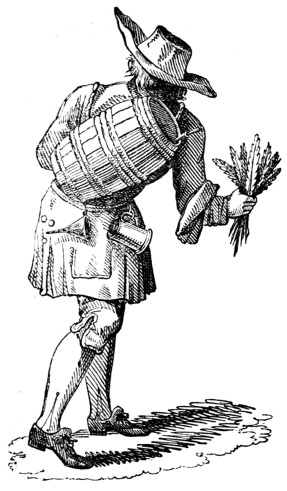
Fine Writing Ink!
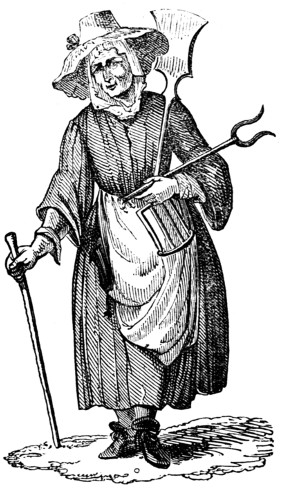
Buy an Iron Fork, or a Shovel?
Old London Cries.
These engravings pretty well describe the occupations of the figures they represent. The cry of “Fine writing-ink” has ceased long ago; and the demand for such a fork as the woman carries is discontinued. They are copied from a set of etchings formerly mentioned—the “Cries of London,” by Lauron. The following of that series are worth describing, because they convey some notion of cries which we hear no longer in the streets of the metropolis.
Buy a new Almanack?
A woman bears book-almanacks before her, displayed in a round basket.
London’s Gazette here.
A woman holds one in her hand, and seems to have others in her lapped-up apron.
Buy any Wax or Wafers?
A woman carries these requisites for correspondence in a small hand-basket, or frail, with papers open in the other hand.
My Name, and your Name, your Father’s Name, and Mother’s Name.
A man bears before him a square box, slung from his shoulders, containing type-founders’ letters, in small cases, each on a stick; he holds one in his hand. I well remember to have heard this very cry when a boy. The type-seller composed my own name for me, which I was thereby enabled to imprint on paper with common writing ink. I think it has become wholly extinct within the last ten years.
Old Shoes for some Brooms.
A man with birch-brooms suspended behind him on a stick. His cry intimates, that he is willing to exchange them for old shoes; for which a wallet at his back, depending from his waist, seems a receptacle.
Remember the poor Prisoners!
A man, with a capacious covered basket suspended at his back by leather handles, through which his arms pass; he holds in his right hand a small, round, deep box with a slit in the top, through which money may be put: in his left hand is a short walking-staff for his support. In former times the prisoners in different gaols, without allowance, deputed persons to walk the streets and solicit alms for their support, of passengers and at dwelling-houses. The basket was for broken-victuals.
Fritters, piping hot Fritters.
A woman seated, frying the fritters on an iron with four legs, over an open fire lighted on bricks; a pan of batter by her side: two urchins, with a small piece of money between them, evidently desire to fritter it.
Buy my Dutch Biskets?
A woman carries them open in a large, round, shallow arm-basket on her right arm; a smaller and deeper one, covered with a cloth, is on her left.
Who’s for a Mutton Pie, or a Christmas Pie?
A woman carries them in a basket hanging on her left arm, under her cloak; she rings a bell with her right hand.
Lilly white Vinegar, Threepence a Quart.
The vinegar is in two barrels, slung across the back of a donkey; pewter measures are on the saddle in the space between them. The proprietor walks behind—he is a jaunty youth, and wears flowers on the left side of his hat, and a lilly white apron; he cracks a whip with his left hand; and his right fingers play with his apron strings.
Old Satin, old Taffety, or Velvet.
A smart, pretty-looking lass, in a high-peaked crowned-hat, a black hood carelessly tied under her chin, handsomely stomachered and ruffled, trips along in high-heeled shoes, with bows of ribbons on the insteps; a light basket is on her right arm, and her hands are crossed with a quality air.
Scotch or Russia Cloth.
A comfortably clothed, stout, substantial-looking, middle-aged man, in a cocked hat, (the fashion of those days,) supporting with his left hand a pack as large as his body, slung at his back; his right hand holds his yard measure, and is tucked into the open bosom of his buttoned coat; a specimen of his cloth hangs across his arm. Irish and Holland linen have superseded Scotch and Russia.
Four pair for a Shilling, Holland Socks.
A woman cries them, with a shilling’s-worth in her hand; the bulk of her ware is in an open box before her. Our ancestors took great precautions against wet from without—they took much within. They were soakers and sockers.
Long Thread Laces, long and strong.
A miserably tattered-clothed girl and boy carry long sticks with laces depending from the ends, like cats-o’-nine tails. This cry was extinct in London for a few years, while the females dressed naturally—now, when some are resuming the old fashion of stiff stays and tight-lacing, and pinching their bowels to inversion, looking unmotherly and bodiless, the cry has been partially revived.
Pretty Maids, pretty Pins, pretty Women.
A man, with a square box sideways under his left arm, holds in his right hand a paper of pins opened. He retails ha’p’orths and penn’orths, which he cuts off from his paper. I remember when pins were disposed of in this manner in the streets by women—their cry was a musical distich—
Three-rows-a-penny, pins, Short whites, and mid-dl-ings!
Fine Tie, or a fine Bob, sir!
A wig-seller stands with one on his hand, combing it, and talks to a customer at his door, which is denoted by an inscription to be in “Middle-row, Holbourn.” Wigs on blocks stand on a bracketed board outside his window. This was when every body, old and young, wore wigs—when the price for a common one was a guinea, and a journeyman had a new one every year—when it was an article in every apprentice’s indenture that his master should find him in “one good and sufficient wig, yearly, and every year, for, and during, and unto the expiration, of the full end, and term, of his apprenticeship.”
Buy my fine Singing Glasses!
They were trumpet-formed glass tubes, of various lengths. The crier blows one of half his own height. He holds others in his left hand, and has a little box, and two or three baskets, slung about his waist.
Japan your Shoes, your honour!
A shoeblack. A boy, with a small basket beside him, brushes a shoe on a stone, and addresses himself to a wigged beau, who carries his cocked-hat under his left arm, with a crooked-headed walking-stick in his left hand, as was the fashion among the dandies of old times. I recollect shoeblacks formerly at the corner of almost every street, especially in great thoroughfares. There were several every morning on the steps of St. Andrew’s church Holborn, till late in the forenoon. But the greatest exhibition of these artists was on the site of Finsbury-square, when it was an open field, and a depository for the stones used in paving and street-masonry. There, a whole army of shoeblacks intercepted the citizens and their clerks, on their way from Islington and Hoxton to the counting houses and shops in the city, with “Shoeblack, your honour!” “Black your shoes, sir!”
Each of them had a large, old tin-kettle, containing his apparatus, viz. a capacious pipkin, or other large earthen-pot, containing the blacking, which was made of ivory black, the coarsest moist sugar, and pure water with a little vinegar—a knife—two or three brushes—and an old wig. The old wig was an indispensable requisite to a shoeblack; it whisked away the dust, or thoroughly wiped off the wet dirt, which his knife and brushes could not entirely detach; a rag tied to the end of a stick smeared his viscid blacking on the shoe, and if the blacking was “real japan,” it shone. The old experienced shoe-wearers preferred an oleaginous, lustreless blacking. A more liquid blacking, which took a polish from the brush, was of later use and invention. Nobody, at that time, wore boots, except on horseback; and every body wore breeches and stockings: pantaloons or trousers were unheard of. The old shoeblacks operated on the shoes while they were on the feet, and so dexterously as not to soil the fine white cotton stocking, which was at one time the extreme of fashion, or to smear the buckles, which were universally worn. Latterly, you were accommodated with an old pair of shoes to stand in, and the yesterday’s paper to read, while your shoes were cleaning and polishing, and your buckles were whitened and brushed. When shoestrings first came into vogue, the prince of Wales (now the king) appeared with them in his shoes, and a deputed body of the buckle-makers of Birmingham presented a petition to his royal highness to resume the wearing of buckles, which was good-naturedly complied with. Yet in a short time shoestrings entirely superseded buckles. The first incursion on the shoeblacks was by the makers of “patent cake-blacking,” on sticks formed with a handle, like a small battledoor; they suffered a more fearful invasion from the makers of liquid blacking in bottles. Soon afterwards, when “Day and Martin” manufactured the ne plus ultra of blacking, private shoeblacking became general, public shoeblacks rapidly disappeared, and now they are extinct. The last shoeblack that I remember in London, sat under the covered entrance of Red Lion-court, Fleet-street, within the last six years.
*
ANTIQUARIAN MEMORANDUM.
For the Table Book.
Chair at Page’s Lock.
At a little alehouse on the Lea, near Hoddesdon, called “Page’s Lock,” there is a curious antique chair of oak, richly carved. It has a high, narrow back inlaid with cane, and had a seat of the same, which last is replaced by the more durable substitute of oak. The framework is beautifully carved in foliage, and the top rail of the back, as also the front rail between the legs, have the imperial crown in the centre. The supports of the back are twisted pillars, surmounted with crowns, by way of knobs, and the fore-legs are shaped like beasts’ paws.
The date is generally supposed to be that of Elizabeth; and this is confirmed by the circumstance of the chairs in the long gallery of Hatfield-house, in Hertfordshire, being of similar construction, but without the crowns. The date of these latter chairs is unquestionably that of Elizabeth, who visited her treasurer, Burleigh, whose seat it was. The circumstance of the crowns being carved on the chair above-named, and their omission in those at Hatfield would seem to imply a regal distinction and we may fairly infer, that it once formed part of the furniture of queen Elizabeth’s hunting-lodge situate on Epping forest, not many miles from Hoddesdon.
Gaston.
MINISTER OF KIRKBY LONSDALE, KIRKBY KENDAL.—LUNE BRIDGE.
To the Editor.
Sir,—The Tenth Part of your interesting publication, the Table Book, has been lent to me by one of your constant readers; who, aware of the interest which I take in every thing connected with Westmoreland, pointed out the Notes of T. Q. M. on a Pedestrian Tour from Skipton to Keswick.[368]
It is not my intention to review those notes, or to point out the whole of his inaccuracies; but I shall select one, which, in my humble judgment, is quite inexcusable. After stating that the Rev. Mr. Hunt was once the curate of Kirkby (not Kirby, as your correspondent spells it) Lonsdale, he adds, “I believe the well-known Carus Wilson is the officiating minister at present.” What your narrator means by the appellation “well known,” he alone can determine—and to which of the family he would affix the term, I cannot possibly imagine. The eldest son is rector of Whittington, an adjoining parish; the second son of the same family is vicar of Preston, in Lancashire; the third is the curate of Tunstal, in the same county. These are all the gentlemen of that family who are, or ever were, “officiating ministers:” and I can safely assure your correspondent, that not one of them ever was the officiating minister of Kirkby Lonsdale. The vicar is the Rev. Mr. Sharp; who the curate is I forget, but an inquirer could have easily ascertained it; and an inquiry would have furnished him with some very curious details respecting the actual incumbent.
By the way, let me mention the curious fact of this town retaining its ancient name, while Kendal, a neighbouring town, has lost, in common parlance, a moiety of its name. In all legal documents Kendal is described as Kirkby Kendal, as the former is Kirkby Lons-dale; and the orthography is important, as it shows at once the derivation of these names. Kirk-by-Lon’s-dale, and Kirk-by-Ken or Kent-dale, evidently show, that the prominent object, the churches of those towns on the banks of their respective river, the Lune, Loyne, or Lon, as it is variously written, and the Kent or Ken, and their dales, or vallies, furnished the cognomen.
I should be much obliged to T. Q. M. if he would point out the house where my friend Barnabee
———————— viewed An hall, which like a taverne shewed Neate gates, white walls, nought was sparing, Pots brimful, no thought of caring.
If a very curious tradition respecting the very fine and remarkable bridge over the river Lune, together with a painting of it done for me by a cobbler at Lancaster, would be at all interesting to you, I shall be happy to send them to your publishers. The picture is very creditable to the artist; and after seeing it, I am sure you will say, that however (if ever) just, in former days, the moderns furnish exceptions to the well-known maxim—
Ne sutor ultra crepidam.
I am, sir, your obedient servant, Bob Short.
London, Sept. 25, 1827.
Discoveries OF THE ANCIENTS AND MODERNS. No. X.
The Copernican System that of the Ancients.
Copernicus places the sun in the centre of our system, the fixed stars at the circumference, and the earth and other planets in the intervening space; and he ascribes to the earth not only a diurnal motion around its axis, but an annual motion round the sun. This simple system, which explains all the appearances of the planets and their situations, whether processional, stationary, or retrograde, was so fully and distinctly inculcated by the ancients, that it is matter of surprise it should derive its name from a modern philosopher.
Pythagoras thought that the earth was a movable body, and, so far from being the centre of the world, performed its revolutions around the region of fire, that is the sun, and thereby formed day and night. He is said to have obtained this knowledge among the Egyptians, who represented the sun emblematically by a beetle, because that insect keeps itself six months under ground, and six above; or, rather, because having formed its dung into a ball, it afterwards lays itself on its back, and by means of its feet whirls that ball round in a circle.
Philolaüs, the disciple of Pythagoras, was the first publisher of that and several other opinions belonging to the Pythagorean school. He added, that the earth moved in an oblique circle, by which, no doubt, he meant the zodiac.
Plutarch intimates, that Timæus Locrensis, another disciple of Pythagoras, held the same opinion; and that when he said the planets were animated, and called them the different measures of time, he meant no other than that they served by their revolutions to render time commensurable; and that the earth was not fixed to a spot, but was carried about by a circular motion, as Aristarchus of Samos, and Seleucus afterwards taught.
This Aristarchus of Samos, who lived about three centuries before Jesus Christ, was one of the principal defenders of the doctrine of the earth’s motion. Archimedes informs us, “That Aristarchus, writing on this subject against some of the philosophers of his own age, placed the sun immovable in the centre of an orbit, described by the earth in its circuit.” Sextus Empiricus cites him, as one of the principal supporters of this opinion.
From a passage in Plutarch it appears, that Cleanthes accused Aristarchus of impiety and irreligion, by troubling the repose of Vesta and the Larian gods; when, in giving an account of the phenomena of the planets in their courses, he taught that heaven, or the firmament of the fixed stars, was immovable, and that the earth moved in an oblique circle, revolving at the same time around its own axis.
Theophrastus, as quoted by Plutarch, says in his History of Astronomy, which has not reached our times, that Plato, when advanced in years, gave up the error he had been in, of making the sun turn round the earth; and lamented that he had not placed it in the centre, as it deserved, instead of the earth, which he had put there contrary to the order of nature. Nor is it at all strange that Plato should reassume an opinion which he had early imbibed in the schools of the two celebrated Pythagoreans, Archytas of Tarentum, and Timæus the Locrian, as we see in St. Jerome’s Christian apology against Rufinus. In Cicero we find, that Heraclides of Pontus, who was a Pythagorean, taught the same doctrine. It may be added, that Tycho Brache’s system was known to Vitruvius, as well as were the motions of Venus and Mercury about the sun.
That the earth is round, and inhabited on all sides, and of course that there are Antipodes, or those whose feet are directly opposite to ours, is one of the most ancient doctrines inculcated by philosophy. Diogenes Laertius, in one part of his history, says, that Plato was the first who called the inhabitants of the earth opposite to us “Antipodes.” He does not mean that Plato was the first who taught this opinion, but only the first who made use of the term “Antipodes;” for, in another place, he mentions Pythagoras as the first who taught of When Plutarch wrote, it was a point in. controversy; and Lucretius and Pliny, were oppose this notion, as well as St. Augustine, serve as witnesses that it must have prevailed in their time.
The proofs which the ancients brought of the sphericalness of the earth, were the same that the moderns use. Pliny on this subject observes, that the land which retires out of sight to persons on the deck of a ship, appears still in view to those who are upon the mast. He thence concludes, that the earth is round. Aristotle drew this consequence not only from the circular shadow of the earth on the disk of the moon in eclipse, but also from this, that, in travelling south, we discover other stars, and that those which we saw before, whether in the zenith or elsewhere, change their situation with respect to us.
On whatever arguments the ancients founded their theory, it is certain they clearly apprehended that the planets revolved upon their own axis. Heraclides of Pontus, and Ecphantus, two celebrated Pythagoreans, said, that the earth turned from west to east, just as a wheel does upon its axis or centre. According to Atticus, the platonist, Plato extended this observation from the earth to the sun and other planets. “To that general motion which makes the planets describe a circular course, he added another, resulting from their spherical shape, which made each of them move about its own centre, whilst they performed the general revolution of their course.” Plotinus also ascribes this sentiment to Plato; for speaking of him he says, that besides the grand circular course observed by all the stars in general, Plato thought “they each performed another about their own centre.”
The same notion is ascribed to Nicetas of Syracuse by Cicero, who quotes Theophrastus to warrant what he advances. This Nicetas is he whom Diogenes Laertius names Hycetas, whose opinion, he says, was, that “the celerity of the earth’s motion about its own axis, and otherwise, was the only cause and reason of the apparent revolutions of the heavenly bodies.”
How useful the invention of telescopes has been to the astronomical observations of the moderns is particularly evident from their discovery, that the planets revolve on their axis, a discovery founded on the periodical revolution of the spots observed on their disks; so that every planet performs two revolutions, by one of which it is carried with others about a common centre; and, by the other, moves upon its axis round its own. Yet all that the moderns have advanced in this respect, serves only to confirm to the ancients the glory of being the first discoverers, by the aid of reason alone. The moderns in this are to the ancients, as the French philosophers to sir Isaac Newton; all whose labours and travail, in visiting the poles and equator to determine the figure of the earth, served only to confirm what sir Isaac had thought of it, without so much as stirring from his closet.
GRAVESEND.
A Mother and her Children.
To the Editor.
Rochester, Sept. 29, 1827.
Sir,—On the beach at Gravesend yesterday morning, I saw a gaily dressed young female walking and fondling an infant in her arms, whom she called Henry; with a fine, lively, bluff boy of about three years old running before, who suddenly venturing to interrupt the gravity of a goat, by tickling his beard with a switch, became in immediate danger of over-punishment from the provoked animal. I ran to “the rescue,” and received warm thanks for its achievement. After the manner of mothers she kissed and scolded her “dear Lobski,” as she called the little rogue; and I involuntarily and inquisitively repeated the appellation. “Sir,” said she,—and she smiled—“it is perfectly ridiculous; but his father and I so frequently give him that name in joke, that we sometimes let it fall when in earnest—his real Christian name is Robert.” I laughed at the whim, shook hands with young “Lobski,” wished his mother good morning, set off by the first conveyance to London, and wholly forgot my little adventure.
————It was brought to my recollection this afternoon through an incident on the roof of a stage-coach, by which I was travelling to Rochester with several passengers; all of whom, except myself, alighted at Gravesend. One of them, a Londoner, a young man of facetious remark, let an expression or two fall, from whence I strongly suspected he was the husband of Lobski’s mother. He had sat next to me at the back of the coach, and had been particularly anxious respecting the safety of a goose—whereon, as I learned, he anticipated to regale with his wife in honour of Michaelmas. Being left to pursue the short remainder of my journey alone, I was proceeding to change my place in the rear, for the box-seat, when I perceived a letter, with the direction so obliterated by friction, as to be undecipherable. There could not be a doubt that it had escaped from my late fellow-traveller’s pocket; and as it seemed to have been left to me as an airloom, I took the liberty to examine the contents. It was from his wife; and in connection with my surmise, and with my beach-story, it furnished the strongest presumptive evidence that I had rightly conjectured his identity. He was an entire stranger to the driver; and I am scarcely sorry that the absence of all clue to his address at Gravesend, or in London, allows me a fair opportunity of laying before the readers of the Table Book a sprightly epistle, from a mother who leaves her home in the metropolis to visit Gravesend, as a watering place, with a couple of young children whom she loves, and with the pleasure of expecting and receiving an occasional pop-visit from her good man.
Copy of the Letter.
Gravesend, Thursday aft.
Dear Henry,—We arrived here after a very pleasant voyage in one of the Calais steamers. Lobski, as usual, was, and is, quite at home. He really appears to be the flower of Gravesend. He spars with all the sailors who notice him, which are not a few—nods to the old women—halloes at the boys, and runs off with their hoops—knocks at the windows with his stick—hunts the fowls and pigs, because they run away from him—and admires the goats, because they are something new. As we walk on the beach he looks out for “anoner great ship”—kisses the little girls—thumps Mary—and torments me. The young ones in the road call him “Cock Robin.” He is, indeed, what E. D. calls “a tainted one.”
Upon first coming down I immediately commenced inquiries about the bathing, and found some who talked of mud-rubbing. No one gave it such a character as Mrs. E.—I met with a lady on the beach, who told me she had brought a little boy of hers down last year to be mud-rubbed; but after a month’s stay his legs were no way improved—she then bathed him for a month, and the boy is a fine little fellow. I considered, as Lobski’s legs really brought us here, it was best to bathe him at once; and accordingly paid 5s. 3d. for a month, otherwise it is 1s. each time. Since going in, which he took pretty well, considering the instantaneous plunge, he calls to me when he looks at the sea, “There is my tub, Ma.” He was rather frightened, and thought he fell into the water, but not near so much, the guide says, as most children are. Harry is getting fatter every day, and very jealous of Bob when with me—but, out of doors, the little fellow glories in seeing Lobski run on before. They grow very fond of each other.
Monday will be a grand day here in choosing the mayor, and at night a mock election takes place, with fireworks, &c.—and this day month Greenwich-fair is held in the fields. The people here are any thing but sociable, and “keep themselves to themselves.” The sailors are the most obliging, and very communicative—they usually carry Bob over any dirty place or so for me—and, to tell the truth, I have almost changed my mind from a parson to a sailor.
If you can, do come down on Sunday; but, by no means, empty-handed, or rather, empty-pocketed—my cash is now very low, though I have been as saving as possible. I find no alteration in the price of provisions except potatoes and milk—every thing else I think is as in London. I should like some pens, paper, and a book or two—for one, the Duchess D’Orleans’ Court of Louis the XIV., I think it is—and any thing, as poor Mrs. —— says, wery amusing; for the evenings are “cursedly” dull—stop—it’s your own word—and as I have said it, it may relieve a little of this evening’s ennui. Whatever you bring you can put into the little portmanteau, which I shall find very useful when we return. Bob and Harry send you a kiss apiece, and mine “I will twist up in a piece of paper, and bring with me when I come to town.”
This is a scribble—but Bob is asleep on my lap.
I am, my dear Harry, Yours, very affectionately, * * * * * * * * *
N.B. Please to send me word the day of the month, and what’s o’clock.
Can you, Mr. Editor, imagine any thing more expressive of loneliness, and desire for intelligence, than this young wife’s capital N.B., with the execratory citation from her husband’s vocabulary—or more sportively affectionate than the “twist up” of her kiss, with “Bob” Lobski asleep on her lap. I like a letter, and a letter writer of this sort mightily: one with a fearless and strong expression of feeling—as in the epithet about the dull evenings, which a female can scarcely extenuate, except by such a confession and assignment to its right owner, implying its impropriety, as this female makes. How oddly, and yet how well, her fondness for reading and her domestic management collocate—the Memoirs of the Court of Louis XIV. and the price of provisions. How natural is her momentary hesitation between mud-rubbing and bathing. Then the instant determination, so essential when there is no time to spare, marks such “decision of character!”—even the author of the excellent essay on that noble quality would admire it. I presume that “Lobski” may be rickety; and I take this opportunity of observing, on the authority of a medical friend, that town-bred children, who eat profusely of sugar, and are pampered with sweets, usually are. Sugar has the effect of softening the bones, and causes the rickets: it should form no part of the food of rickety children, or only in a small degree; and such children should be allowed and encouraged to eat common salt freely.
To return however to the letter.—I should really like to know the secret of the allusion respecting the “parson” and the “sailor,” so naturally called forth by the playful services of the tars; which, I have observed, are ever exerted on such occasions, and remind one of the labours of Hercules with the distaff. Her account of Lobski’s “animated nature” is so pretty and true a sketch of boyish infancy, that you may perceive the hand of the mother in every line. In the anticipation of the mayoralty show and the fair, and the unsociableness of Gravesend society, I think I can trace something of the woman. I hope she may live to see her boys “good men and true,” gladdening her heart by fearless well-doing. She must look well to Lobski:—he’s a “Pickle.” It is in the power of a mother to effect more in the formation of a child’s early disposition than the father.
Lastly, that you may be assured of the genuineness of the letter I found, and have copied, the original accompanies this communication to your publishers; with authority, if its ownership be claimed, to deliver it to the claimant, on the production of a line in the handwriting of the epistle itself.
I am, Sir, &c. Curio So.
“POOR BILLY W——.”
For the Table Book.
Some years ago my pen was employed to attempt the sketch of a Character, but apprehending that the identity might be too strong and catch his eye,—he was my friend, and a great reader of “periodicals”—I desisted. I meant to say nothing ill-natured, yet I feared to offend a harmless and inoffensive man, and I destroyed what had given me an hour’s amusement. The reason no longer exists—death has removed him. Disease and a broken spirit, occasioned by commercial misfortunes and imprudences, weighed him down, and the little sphere in which he used to shine has lost its chief attraction.
——What a man he was!—of the pure, real London cut. Saint Paul’s was stamped on his forehead. He was the great oracle of a certain coffee-house, not a hundred miles from Gray’s Inn; where he never dined but in one box, nor placed himself but in one situation. His tavern dignities were astounding—the waiters trembled at his approach—his orders were obeyed with the nicest precision. For some years he was the king of the room—he was never deposed, nor did he ever abdicate. His mode of calling for his pint of wine, and the bankrupt part of the Gazette, had a peculiar character past describing. I have now and then seen a “rural,” in the same coffee-room, attempt the thing—but my friend was “Hyperion to a satyr.”——
——I have him in my eye now—traversing to the city and back—regulating his watch by the Royal Exchange clock daily; and daily boasting he had the best “goer” in England. Like his watch, he was a curious piece of mechanism. He seldom quitted London, for he was persuaded every thing would “stand still” in his absence. It seemed, as though he imagined that St. Paul’s clock would not strike—that the letters by the general post would not be delivered.—Was he not right? To me, the city was a “void” without him.——
——What a referee he was! He would tell you the price of stocks on any past day; and dilate for hours on the interesting details in the charters of the twelve city companies. He had a peculiar mode of silencing an antagonist who ventured to obtrude an opinion—by adducing a scriptural maxim, “Study to be quiet,” and “mind your own business;” and now and then a few Latin mottos, obtained from the Tablet of Memory, would be used with great felicity. His observations were made in an elevated tone, they commanded attention—he used to declare that “money was money;” that “many people were great fools;” and that “bankrupts could not be expected to pay much.” After a remark of this kind he would take a pinch of snuff, with grave self-complacency, and throw his snuff-box on the table with inimitable importance—a species of dignified ingenuity that lived and died with him. His medical panacea was a certain “vegetable sirup,” whereon he would descant, by the hour together, as a specific for all human maladies, and affirm “your physicians and apothecaries—mere humbugs!”——
Then, he would astound the coffee-room by declaring he once bid the king of Spain £700,000 for the island of Porto Rico—this was his grandest effort, and if his ear ever caught the question “Who is he?” uttered by a country listener, his thrown-back shoulders and expansion of chest betrayed the delight he felt, that his bounce had been overheard.
Now and then, on a Saturday, he would break his city chains, and travel to “The Spaniard” at Hampstead for a dinner; but no argument or persuasion could get him to Richmond. His reply was always the same—“the hotels at Richmond employ too much capital.” He was an economist.
In his pleasantest humours, and he had few unpleasant ones, after dining with him I have sometimes importuned him to pay the whole bill; his answer was peculiar and conclusive; “My good friend,” said he, “if I had adopted the plan of paying for others, I might have kept company with all the princes and nobles in the land, instead of plebeians like you.”
His Sunday, till one o’clock, was passed in “spelling the newspapers;” after that he walked on the north side of Lincoln’s Inn Fields, with his hands behind him, till three—he then entered Lincoln’s Inn chapel, and returned to boiled beef and suet pudding at five, which were always brought to him first.—If an old friend or two dropped in, his happiness was complete.
He was a philosopher too, at least he indulged in a sort of philosophy, and I am not sure that it was not a good sort, although not a very elevated or poetical one. He evinced a disregard for life. The sooner “we are all dead the better” was one of his favourite phrases. And now he is dead.—Peace to his ashes!
This is the only tablet raised to his memory; the inscription is feeble, but it has the novelty of truth, and may occasion some of his many acquaintances to remember the quaintness and eccentricities of “Poor Billy W——.”
W. H.
ABORIGENES.
This word is explained in every dictionary, English, Latin, or French, as a general name for the indigenous inhabitants of a country; when in reality it is the proper name of a peculiar people of Italy, who were not indigenous, but supposed to have been a colony of Arcadians. The error has been founded chiefly on the supposed derivation of the word from ab origine. Never (except in Swift’s ludicrous work) was a more eccentric etymology—a preposition, with its governed case, made plural by the modern final s! The university of Oxford, some years ago, added to this solecism by a public prize poem on the Aboriginal Britons.
The most rational etymology of the word seems to be a compound of the Greek words απο, ορος, and γενος, a race of mountaineers. So Virgil calls them,
“—Genus indocile ac dispersum montibus altis.”
It seems more probable, that the name of the oldest settlers in Italy should have a Greek than a Latin derivation.
The preceding remarks are by a late poet-laureate, Mr. Pye, who concludes by inquiring, what should we say of the etymologist who were to deduce the name of an ancient British tribe from the modern English?
TASTING DAYS.
To the Editor.
Sir,—Few men enjoy, or deserve better living than the citizens of London. When they are far on the journey of life, and have acquired a useful fame in their respective companies, their elevation is delightful and complacent. Not a subject is proposed, nor a matter of reference considered, but, as a living author has observed, “it must begin or finish with a dinner.” Thus originated a most exquisite anticipation to the select few, the “Tasting Day,”—a day which precedes all good general eating and drinking days. Mr. Abernethy (who, by the by, is not afraid of dish or glass) may lecture profitably on abstinence, and the “Lancet” may breathe a satirical vein, yet, in compliance with social fellowship and humane gourmanderie, London citizens proudly patronise the preceding and succeeding engagements of “Tasting Days.”
I am, sir, Your brother cit, An Old Taster.
CURIOUS SIGN.
For the Table Book.
“A little learning is a dangerous thing.”
So said Pope, and so say I. At Halton East, near Skipton-in Craven, the following inscription arrests the attention of every passer-by:—
Watkinson’s Acadamy Whatever man has done man may do. Also Dealer in Groceries, &c.
Tim. T——.
ORDERS TO MARCH.
The following parody, on a stanza of the “Blue Bonnets over the Border,” is put forth, as an advertisement, by a hatter, at Brighton, named March.
March! March! has the best hats to sell, Try him, you’ll find him no wily deceiver; March!—march! go and he’ll use you well. His is the warehouse for buying a beaver. Come then, my masters, Doff your old castors, Ragged and torn, or howe’er in disorder: For a new topper, a Round hat or opera, March is the man, so give him an order. March! March! has the best hats to sell, &c.