Volume 1 — Vol. I.—5.
Reading edition
Colley Cibber’s youngest Daughter.
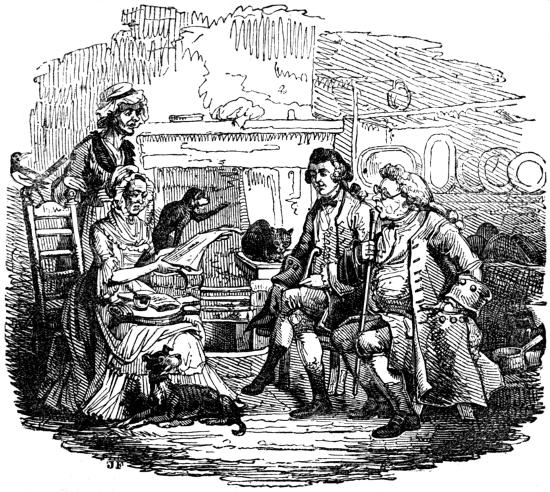
Colley Cibber’s youngest Daughter.
Last of her sire in dotage—she was used By him, as children use a fav’rite toy; Indulg’d, neglected, fondled, and abus’d, As quick affection of capricious joy, Or sudden humour of dislike dictated: Thoughtlessly rear’d, she led a thoughtless life; And she so well beloved became most hated: A helpless mother, and a wife unblest, She pass’d precocious womanhood in strife; Or, in strange hiding-places, without rest; Or, wand’ring in disquietude for bread: Her father’s curse—himself first cause of all That caused his ban—sunk her in deeper thrall, Stifling her heart, till sorrow and herself were dead.
*
“The Life of Mrs. Charlotte Charke, youngest daughter of Colley Cibber, Esq. written by herself,” is a curious narrative of remarkable vicissitudes. She dedicates it to herself, and aptly concludes her dedication by saying, “Permit me, madam, to subscribe myself, for the future, what I ought to have been some years ago, your real friend, and humble servant, Charlotte Charke.”
In the “Introduction” to the recent reprint of this singular work, it is well observed, that “her Life will serve to show what very strange creatures may exist, and the endless diversity of habits, tastes, and inclinations, which may spring up spontaneously, like weeds, in the hot-bed of corrupt civilization.” She was born when Mrs. Cibber was forty-five years old, and when both her father and mother had ceased to expect an addition to their family: the result was that Charlotte Cibber was a spoiled child. She married Mr. Richard Charke, an eminent violin player, of dissolute habits; and, after a course of levities, consequent upon the early recklessness of her parents, she was repudiated by her father. When she wrote her life, she was in great penury: it was published in eight numbers, at three-pence each. In the last, which appeared on the 19th of April, 1755, she feelingly deplores the failure of her attempts to obtain forgiveness of her father, and says, “I cannot recollect any crime I have been guilty of that is unpardonable.” After intimating a design to open an oratorical academy, for the instruction of persons going on the stage, she mentions her intention to publish “Mr. Dumont’s history, the first number of which will shortly make its appearance.” This was a novel she was then writing, which a bookseller treated with her for, in company with Mr. Samuel Whyte of Dublin, who thus describes her distressed situation:—
“Cibber the elder had a daughter named Charlotte, who also took to the stage; her subsequent life was one continued series of misfortune, afflictions, and distress, which she sometimes contrived a little to alleviate by the productions of her pen. About the year 1755, she had worked up a novel for the press, which the writer accompanied his friend the bookseller to hear read; she was at this time a widow, having been married to one Charke a musician, long since dead. Her habitation was a wretched thatched hovel, situated on the way to Islington in the purlieus of Clerkenwell Bridewell, not very distant from the New River Head, where at that time it was usual for the scavengers to leave the cleansings of the streets, &c. The night preceding a heavy rain had fallen, which rendered this extraordinary seat of the muses almost inaccessible, so that in our approach we got our white stockings enveloped with mud up to the very calves, which furnished an appearance much in the present fashionable style of half-boots. We knocked at the door, (not attempting to pull the latch string,) which was opened by a tall, meagre, ragged figure, with a blue apron, indicating, what else we might have doubted, the feminine gender,—a perfect model for the copper captain’s tattered landlady; that deplorable exhibition of the fair sex, in the comedy of Rule-a-Wife. She with a torpid voice and hungry smile desired us to walk in. The first object that presented itself was a dresser, clean, it must be confessed, and furnished with three or four coarse delf plates, two brown platters, and underneath an earthen pipkin and a black pitcher with a snip out of it. To the right we perceived and bowed to the mistress of the mansion sitting on a maimed chair under the mantle-piece, by a fire, merely sufficient to put us in mind of starving. On one hob sat a monkey, which by way of welcome chattered at our going in; on the other a tabby cat, of melancholy aspect! and at our author’s feet on the flounce of her dingy petticoat reclined a dog, almost a skeleton! he raised his shagged head, and, eagerly staring with his bleared eyes, saluted us with a snarl. ‘Have done, Fidele! these are friends.’ The tone of her voice was not harsh; it had something in it humbled and disconsolate; a mingled effort of authority and pleasure.—Poor soul! few were her visitors of that description—no wonder the creature barked!.—A magpie perched on the top ring of her chair, not an uncomely ornament! and on her lap was placed a mutilated pair of bellows, the pipe was gone, an advantage in their present office, they served as a succedaneum for a writing-desk, on which lay displayed her hopes and treasure, the manuscript of her novel. Her ink-stand was a broken tea-cup, the pen worn to a stump; she had but one! a rough deal board with three hobbling supporters was brought for our convenience, on which, without farther ceremony, we contrived to sit down and entered upon business:—the work was read, remarks made, alterations agreed to, and thirty guineas demanded for the copy. The squalid handmaiden, who had been an attentive listener, stretched forward her tawny length of neck with an eye of anxious expectation!—The bookseller offered five!—Our authoress did not appear hurt; disappointments had rendered her mind callous; however, some altercation ensued. This was the writer’s first initiation into the mysteries of bibliopolism and the state of authorcraft. He, seeing both sides pertinacious, at length interposed, and at his instance the wary haberdasher of literature doubled his first proposal, with this saving proviso, that his friend present would pay a moiety and run one half the risk; which was agreed to. Thus matters were accommodated, seemingly to the satisfaction of all parties; the lady’s original stipulation of fifty copies for herself being previously acceded to. Such is the story of the once-admired daughter of Colley Cibber, Poet Laureate and patentee of Drury-lane, who was born in affluence and educated with care and tenderness, her servants in livery, and a splendid equipage at her command, with swarms of time-serving sycophants officiously buzzing in her train; yet, unmindful of her advantages and improvident in her pursuits, she finished the career of her miserable existence on a dunghill.”[36]
Mr. Whyte’s account of the “reading the manuscript,” a subject worthy of Wilkie’s pencil, is designed to be illustrated by the engraving at the head of this article. Of Mrs. Charke, after that interview, nothing further is known, except that she kept a public-house, at Islington, and is said to have died on the 6th of April, 1760.[37] Her brother Theophilus was wrecked, and perished on his way to Dublin, in October, 1758; her father died on the 12th of December, in the year preceding. Her singular “Narrative” is printed verbatim in the seventh volume of “Autobiography,” with the life of the late “Mary Robinson,” who was also an actress, and also wrote her own “Memoirs.”
AN INEDITED BALLAD.
To the Editor.
Dear Sir,—A friend of mine, who resided for some years on the borders, used to amuse himself by collecting old ballads, printed on halfpenny sheets, and hawked up and down by itinerant minstrels. In his common-place book I found one, entitled “The Outlandish Knight,” evidently, from the style, of considerable antiquity, which appears to have escaped the notice of Percy, and other collectors. Since then I have met with a printed one, from the popular press of Mr. Pitts, the six-yards-for-a-penny song-publisher, who informs me that he has printed it “ever since he was a printer, and that Mr. Marshall, his predecessor, printed it before him.” The ballad has not improved by circulating amongst Mr. Pitts’s friends; for the heroine, who has no name given her in my friend’s copy, is in Mr. Pitts’s called “Polly;” and there are expressions contra bonos mores. These I have expunged; and, to render the ballad more complete, added a few stanzas, wherein I have endeavoured to preserve the simplicity of the original, of which I doubt if a correct copy could now be obtained. As it is, it is at the service of your Table Book.
The hero of the ballad appears to be of somewhat the same class as the hero of the German ballad, the “Water King,” and in some particulars resembles the ballad of the “Overcourteous Knight,” in Percy’s Reliques.
I am, dear sir, &c. — — —
Grange-road, Bermondsey, Jan. 8, 1827.
The Outlandish Knight.
——————“Six go true, The seventh askew.”
Der Freischutz Travestie.
An outlandish knight from the north lands came, And he came a wooing to me; He told me he’d take me unto the north lands, And I should his fair bride be. A broad, broad shield did this strange knight wield, Whereon did the red-cross shine, Yet never, I ween, had that strange knight been In the fields of Palestine. And out and spake this strange knight, This knight of the north countrie, O, maiden fair, with the raven hair, Thou shalt at my bidding be. Thy sire he is from home, ladye, For he hath a journey gone, And his shaggy blood-hound is sleeping sound, Beside the postern stone. Go, bring me some of thy father’s gold, And some of thy mother’s fee, And steeds twain of the best, in the stalls that rest Where they stand thirty and three. ***** She mounted her on her milk-white steed, And he on a dapple grey, And they forward did ride, till they reach’d the sea-side, Three hours before it was day. Then out and spake this strange knight, This knight of the north countrie, O, maiden fair, with the raven hair, Do thou at my bidding be. Alight thee, maid, from thy milk-white steed, And deliver it unto me; Six maids have I drown’d, where the billows sound, And the seventh one thou shalt be. But first pull off thy kirtle fine, And deliver it unto me; Thy kirtle of green is too rich, I ween, To rot in the salt, salt sea. Pull off, pull off thy silken shoon, And deliver them unto me; Methinks that they are too fine and gay To rot in the salt, salt sea. Pull off, pull off thy bonnie green plaid, That floats in the breeze so free; It is woven fine with the silver twine, And comely it is to see. If I must pull off my bonnie green plaid, O turn thy back to me; And gaze on the sun which has just begun To peer o’er the salt, salt sea. He turn’d his back on the dameselle And gaz’d on the bright sunbeam— She grasp’d him tight with her arms so white, And plung’d him into the stream. Lie there, sir knight, thou false-hearted wight, Lie there instead of me; Six damsels fair thou hast drown’d there, But the seventh has drowned thee. That ocean wave was the false one’s grave, For he sunk right hastily; Though with dying voice faint, he pray’d to his saint, And utter’d an Ave Marie. No mass was said for that false knight dead, No convent bell did toll; But he went to his rest, unshriv’d and unblest— Heaven’s mercy on his soul! ***** She mounted her on her dapple-grey steed, And led the steed milk-white; She rode till she reach’d her father’s hall, Three hours before the night. The parrot, hung in the lattice so high, To the lady then did say, Some ruffian, I fear, has led thee from home, For thou hast been long away. Do not prattle, my pretty bird, Do not tell tales of me; And thy cage shall be made of the glittering gold, Instead of the greenwood tree. The earl as he sat in his turret high, On hearing the parrot did say, What ails thee, what ails thee, my pretty bird? Thou hast prattled the live-long day. Well may I prattle, the parrot replied, And call, brave earl, on thee; For the cat has well nigh reach’d the lattice so high, And her eyes are fix’d on me. Well turn’d, well turn’d, my pretty bird, Well turn’d, well turn’d for me; Thy cage shall be made of the glittering gold, Instead of the greenwood tree.
PRIDE AND GOOD-WILL.
It is related of a certain class of French nobility, who, in their winter residence at Aix, were objects of dislike from their arrogance and self-importance, that they were beloved and esteemed for their kindness and benevolence by the dependants around their chateaus in the country. Many instances might be cited to show that the respect paid them was no more than they deserved; and one is particularly striking:—
A seigneur, when he resided in the country, used to distribute among the women and children, and the old men who were unable to work in the field, raw wool, and flax, which they spun and wove into cloth or stuff at their pleasure: every week they were paid wages according to the quantity of work done, and had a fresh supply of raw materials whenever it was wanted. At the end of the year, a general feast was given by the seigneur to the whole village, when all who had been occupied in spinning and weaving brought in their work, and a prize of a hundred livres was given to each person who had spun the best skein, and woven the best web. They had a dinner in a field adjoining to the chateau, at which the seigneur himself presided, and on each side of him sat those who had gained the prizes. The evening was concluded with a dance. The victors, besides the hundred livres, had their work given them: the rest were allowed to purchase theirs at a very moderate price, and the money resulting from it was laid by to distribute among any persons of the village who wanted relief on account of sickness, or who had suffered from unavoidable accident, either in their persons or property. At the death of this excellent man, who unfortunately left no immediate heirs to follow his good example, the village presented a scene of the bitterest lamentation and distress: the peasants assembled round the body, and it was almost forced away from them for interment. They brought their shuttles, their distaffs, their skeins of thread and worsted, their pieces of linen and stuff, and strewed them upon his grave, saying that now they had lost their patron and benefactor, they could no longer be of use to them. If this man felt the pride of conscious superiority, it was scarcely to be condemned when accompanied with such laudable exertions to render himself, through that superiority, a benefactor to society.[38]
Garrick Plays. No. II.
[From the “Parliament of Bees,” a Masque, by John Day, printed 1607. Whether this singular production, in which the Characters are all Bees, was ever acted, I have no information to determine. It is at least as capable of representation, as we can conceive the “Birds” of Aristophanes to have been.]
Ulania, a female Bee, confesses her passion for Meletus, who loves Arethusa.
—— not a village Fly, nor meadow Bee, That trafficks daily on the neighbour plain, But will report, how all the Winged Train Have sued to me for Love; when we have flown In swarms out to discover fields new blown. Happy was he could find the forward’st tree, And cull the choicest blossoms out for me; Of all their labours they allow’d me some And (like my champions) mann’d me out, and home: Yet loved I none of them. Philon, a Bee Well-skill’d in verse and amorous poetry, As we have sate at work, both of one Rose,[39] Has humm’d sweet Canzons, both in verse and prose, Which I ne’er minded. Astrophel, a Bee (Although not so poetical as he) Yet in his full invention quick and ripe, In summer evenings, on his well-tuned pipe, Upon a woodbine blossom in the sun, (Our hive being clean-swept, and our day’s work done), Would play me twenty several tunes; yet I Nor minded Astrophel, nor his melody. Then there’s Amniter, for whose love fair Leade (That pretty Bee) flies up and down the mead With rivers in her eyes; without deserving Sent me trim Acorn bowls of his own carving, To drink May dews and mead in. Yet none of these, My hive-born Playfellows and fellow Bees, Could I affect, until this strange Bee came; And him I love with such an ardent flame, Discretion cannot quench.— He labours and toils, Extracts more honey out of barren soils Than twenty lazy Drones. I have heard my Father, Steward of the Hive, profess that he had rather Lose half the Swarm than him. If a Bee, poor or weak, Grows faint on his way, or by misfortune break A wing or leg against a twig; alive, Or dead, he’ll bring into the Master’s Hive Him and his burthen. But the other day, On the next plain there grew a fatal fray Betwixt the Wasps and us; the wind grew high, And a rough storm raged so impetuously, Our Bees could scarce keep wing; then fell such rain, It made our Colony forsake the plain, And fly to garrison: yet still He stood, And ’gainst the whole swarm made his party good; And at each blow he gave, cried out His Vow, His Vow, and Arethusa!—On each bough And tender blossom he engraves her name With his sharp sting. To Arethusa’s fame He consecrates his actions; all his worth Is only spent to character her forth. On damask roses, and the leaves of pines, I have seen him write such amorous moving lines In Arethusa’s praise, as my poor heart Has, when I read them, envied her desert; And wept and sigh’d to think that he should be To her so constant, yet not pity me. ***
Porrex, Vice Roy of Bees under King Oberon, describes his large prerogative.
To Us (who, warranted by Oberon’s love. Write Ourself Master Bee), both field and grove, Garden and orchard, lawns and flowery meads, (Where the amorous wind plays with the golden heads Of wanton cowslips, daisies in their prime, Sun-loving marigolds; the blossom’d thyme, The blue-vein’d violets and the damask rose; The stately lily, Mistress of all those); Are allow’d and giv’n, by Oberon’s free areed, Pasture for me, and all my swarms to feed.
—————the doings, The births, the wars, the wooings,
of these pretty little winged creatures are with continued liveliness portrayed throughout the whole of this curious old Drama, in words which Bees would talk with, could they talk; the very air seems replete with humming and buzzing melodies, while we read them. Surely Bees were never so be-rhymed before.
C. L.
Biographical Memoranda.
John Scot, a Fasting Fanatic.
In the year 1539, there lived in Scotland one John Scot, no way commended for his learning, for he had none, nor for his good qualities, which were as few. This man, being overthrown in a suit of law, and knowing himself unable to pay that wherein he was adjudged, took sanctuary in the abbey of Holyrood-house; where, out of discontent, he abstained from all meat and drink, by the space of thirty or forty days together.
Fame having spread this abroad, the king would have it put to trial, and to that effect shut him up in a private room within the castle of Edinburgh, whereunto no man had access. He caused a little water and bread to be set by him, which he was found not to have diminished in the end of thirty days and two. Upon this he was dismissed, and, after a short time, he went to Rome, where he gave the like proof of his fasting to pope Clement VII.; from whence he went to Venice, carrying with him a testimony of his long fasting under the pope’s seal: and there also he gave the like proof thereof. After long time, returning into England, he went up into the pulpit in St. Paul’s Church-yard, where he gave forth many speeches against the divorce of king Henry VIII. from his queen Katherine, inveighing bitterly against him for his defection from the see of Rome; whereupon he was thrust into prison, where he continued fasting for the space of fifty days: what his end was I read not.—Spotswood, &c.
Hart the Astrologer.
There lived in Houndsditch, about the year 1632, one Alexander Hart, who had been a soldier formerly, a comely old man, of good aspect, he professed questionary astrology and a little of physic; his greatest skill was to elect young gentlemen fit times to play at dice, that they might win or get money. Lilly relates that “he went unto him for resolutions for three questions at several times, and he erred in every one.” He says, that to speak soberly of him he was but a cheat, as appeared suddenly after; for a rustical fellow of the city, desirous of knowledge, contracted with Hart, to assist for a conference with a spirit, and paid him twenty pounds of thirty pounds the contract. At last, after many delays, and no spirit appearing, nor money returned, the young man indicted him for a cheat at the Old Bailey in London. The jury found the bill, and at the hearing of the cause this jest happened: some of the bench inquired what Hart did? “He sat like an alderman in his gown,” quoth the fellow; at which the court fell into a laughter, most of the court being aldermen. He was to have been set upon the pillory for this cheat; but John Taylor the water poet being his great friend, got the lord chief justice Richardson to bail him, ere he stood upon the pillory, and so Hart fled presently into Holland, where he ended his days.[40]
REV. THOMAS COOKE.
The verses at the end of the following letter may excuse the insertion of a query, which would otherwise be out of place in a publication not designed to be a channel of inquiry.
To the Editor.
Sir,—I should feel much obliged, if the Table Book can supply some account of a clergyman of the name of Thomas Cooke, who, it is supposed, resided in Shropshire, and was the author of a very beautiful poem, in folio, (published by subscription, about ninety years since,) entitled “The Immortality of the Soul.” I have a very imperfect copy of this work, and am desirous of ascertaining, from any of your multifarious readers, whether or not the poem ever became public, and where it is probable I could obtain a glimpse of a perfect impression. Mine has no title-page, and about one moiety of the work has been destroyed by the sacrilegious hands of some worthless animal on two legs!
The list of subscribers plainly proves that Mr. Cooke must have been a man of good family, and exalted connections. On one of the blank leaves in my copy, the following lines appear, written by Mr. Cooke himself; and, considering the trammels by which he was confined, I think the verses are not without merit; at any rate, the subject of them appears to have been a beautiful creature.
By giving this article a place in the Table Book, you will much oblige
Your subscriber and admirer, G. J. D.
Islington-green.
An Acrostic On a most beautiful and accomplished young Lady. London, 1748.
M eekness—good-humour—each transcendent grace,
I s seen conspicuous on thy joyous face;
S weet’s the carnation to the rambling bee,
S o art thou, Charlotte! always sweet to me!
C an aught compare successfully with those
H igh beauties which thy countenance compose,
A ll doubly heighten’d by that gentle mind,
R enown’d on earth, and prais’d by ev’ry wind?
L ov’d object! no—then let it be thy care
O f fawning friends, at all times, to beware—
T o shun this world’s delusions and disguise,
T he knave’s soft speeches, and the flatt’rer’s lies,
E steeming virtue, and discarding vice!
[I-137, I-138]
G o where I may, howe’er remote the clime,
W here’er my feet may stray, thy charms sublime,
I llustrious maid! approv’d and prais’d by all,
L ike some enchantment shall my soul enthrall—
L ight ev’ry path—illuminate my mind—
I nspire my pen with sentiments refin’d—
A nd teach my tongue on this fond pray’r to dwell,
“M ay Heav’n preserve the maid it loves so well!”
Thomas Cooke.
Varieties.
CURIOUS PLAY BILL.
The following remarkable theatrical announcement is a mixed appeal of vanity and poverty to the taste and feelings of the inhabitants of a town in Sussex.
(Copy.)
At the old theatre in East Grinstead, on Saturday, May, 1758, will be represented (by particular desire, and for the benefit of Mrs. P.) the deep and affecting Tragedy of Theodosius, or the Force of Love, with magnificent scenes, dresses, &c.
Varanes, by Mr. P., who will strive, as far as possible, to support the character of this fiery Persian Prince, in which he was so much admired and applauded at Hastings, Arundel, Petworth, Midworth, Lewes, &c.
Theodosius, by a young gentleman from the University of Oxford, who never appeared on any stage.
Athenais, by Mrs. P. Though her present condition will not permit her to wait on gentlemen and ladies out of the town with tickets, she hopes, as on former occasions, for their liberality and support.
Nothing in Italy can exceed the altar, in the first scene of the play. Nevertheless, should any of the Nobility or Gentry wish to see it ornamented with flowers, the bearer will bring away as many as they choose to favour him with.
As the coronation of Athenais, to be introduced in the fifth act, contains a number of personages, more than sufficient to fill all the dressing-rooms, &c., it is hoped no gentlemen and ladies will be offended at being refused admission behind the scenes.
N. B. The great yard dog, that made so much noise on Thursday night, during the last act of King Richard the Third, will be sent to a neighbour’s over the way; and on account of the prodigious demand for places, part of the stable will be laid into the boxes on one side, and the granary be open for the same purpose on the other.
Vivat Rex.[41]
It’s never too late to mend.
At Chester, in the beginning of the year 1790, a reputable farmer, on the evening of a market-day, called at the shop of Mr. Poole, bookseller, and, desiring to speak with him at the door, put a shilling into his hand, telling him, “he had owed it to him many years.” The latter asked, for what? To which the farmer replied, that “When a boy, in buying a book-almanac at his shop, he had stolen another—the reflection of which had frequently given him much uneasiness.” If any one who sees this ever wronged his neighbour, let him be encouraged by the courage of the farmer of Chester, to make reparation in like manner, and so make clean his conscience.
Conscience.
—————There is no power in holy men, Nor charm in prayer—nor purifying form Of penitence—nor outward look—nor fast— Nor agony—nor, greater than all these, The innate tortures of that deep despair, Which is remorse without the fear of hell. But all in all sufficient to itself Would make a hell of heaven—can exorcise From out the unbounded spirit, the quick sense Of its own sins, wrongs, sufferance, and revenge Upon itself; there is no future pang Can deal that justice on the self-condemn’d He deals on his own soul.
Byron.
Epitaph by Dr. Lowth, late bishop of London, on a monument in the church of Cudesden, Oxfordshire, to the memory of his daughter, translated from the Latin:—
Dear as thou didst in modest worth excel, More dear than in a daughter’s name—farewell! Farewell, dear Mary—but the hour is nigh When, if I’m worthy, we shall meet on high: Then shall I say, triumphant from the tomb, “Come, to thy father’s arms, dear Mary, come!”
INSCRIPTION From the book at Rigi, in Switzerland.
Nine weary up-hill miles we sped The setting sun to see; Sulky and grim he went to bed. Sulky and grim went we. Seven sleepless hours we past, and then, The rising sun to see, Sulky and grim we rose again. Sulky and grim rose he.
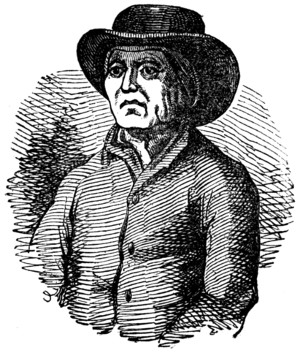
Antiquarian Hall, ALIAS Will. Will-be-so, of Lynn,
A goose-herd in the fen-lands; next, he Be-doctor’d Norfolk cows; much vext, he Turn’d bookseller, and poetaster, And was a tolerable master Of title-pages, but his rhymes Were shocking, at the best of times. However, he was very honest, And now, poor fellow, he is—“non est.”
*
For the Table Book.
William Hall, or as he used to style himself, “Antiquarian Hall,” “Will. Will-be-so,” and “Low-Fen-Bill-Hall,” or, as he was more generally termed by the public, “Old Hall,” died at Lynn, in Norfolk, on the 24th of January, 1825. From some curious autobiographical sketches in rhyme, published by himself, in the decline of life, it appears that he was born on June 1, O.S. 1748, at Willow Booth, a small island in the fens of Lincolnshire, near Heckington Ease, in the parish of South Kyme.
“Kyme, God knows. Where no corn grows, Nothing but a little hay; And the water comes, And takes it all away.”
His ancestors on the father’s side were all “fen slodgers,” having lived there for many generations; his mother was
————“a half Yorkshire The other half was Heckington, Vulgar a place as and one.”
When about four years old, he narrowly escaped drowning; for, in his own words, he
————“overstretching took a slip, And popp’d beneath a merchant’s ship;[42] No soul at hand but me and mother; Nor could I call for one or other.”
She, however, at the hazard of her own life, succeeded in saving her son’s. At eleven years old, he went to school, in Brothertoft chapel, for about six months, in which time he derived all the education he ever received. His love of reading was so great, that as soon as he could manage a gunning-boat, he used to employ his Sundays either in seeking for water-birds’ eggs, or to
————“shouve the boat A catching fish, to make a groat, And sometimes with a snare or hook; Well, what was’t for?—to buy a book, Propensity so in him lay.”
Before he arrived at man’s estate, he lost his mother, and soon afterwards his father married again. Will. himself, on arriving at man’s estate, married “Suke Holmes,” and became a “gozzard,” or gooseherd; that is, a keeper and breeder of geese, for which the fens were, at that time, famous throughout the kingdom, supplying the London markets with fowls, and the warehouses with feathers and quills. In these parts, the small feathers are plucked from the live geese five times a year, at Lady-tide, Midsummer, Lammas, Michaelmas, and Martinmas, and the larger feathers and quills are pulled twice. Goslings even are not spared, for it is thought that early plucking tends to increase the succeeding feathers. It is said that the mere plucking hurts the fowl very little, as the owners are careful not to pull until the feathers are ripe: those plucked after the geese are dead, are affirmed not to be so good. The number of geese kept by Will. must have been very great, for his “brood geese,” alone, required five coombs of corn for daily consumption.
The inundations to which the fens were then liable, from breaches, or overflowing of the banks, overwhelmed him with difficulties, and ruined his prospects.
“The poor old geese away were floated, Till some high lands got lit’rally coated; Nor did most peasants think it duty Them to preserve, but made their booty; And those who were ‘not worth a goose,’ On other people’s liv’d profuse.”
After many vicissitudes and changes of residence, he settled at Marshland, in Norfolk, where his wife practised phlebotomy and midwifery, while he officiated as an auctioneeer, cowleech, &c. &c. Indeed he appeared to have been almost bred to the doctoring profession, for his own mother was
————“a good cow-doctor, And always doctor’d all her own, Being cowleech both in flesh and bone.”
His mother-in-law was no less skilful, for in Will.’s words
“She in live stock had took her care, And of recipes had ample share, Which I retain unto this day.”
His father-in-law was an equally eminent practitioner; when, says Will.,
“I married Sukey Holmes, her father Did more than them put altogether; Imparted all his skill to me, Farrier, cowleech, and surgery, All which he practised with success.”
Will. tells of a remarkable and surprising accident, which closed his career as a cowleech.
“The rheumatism, (dreadful charm,) Had fix’d so close in my left arm, So violent throbb’d, that without stroke To touch—it absolutely broke! Went with a spring, made a report, And hence in cowleech spoil’d my sport; Remain’d so tender, weak, and sore, I never dare attempt it more.”
Thus disqualified, he removed to Lynn, and opening a shop in Ferry-street, commenced his operations as a purchaser and vender of old books, odds and ends, and old articles of various descriptions; from whence he obtained the popular appellation of “Old Hall.” On a board over the door, he designated this shop the
“Antiquarian Library,”
and thus quaintly announced his establishment to the public:
————“In Lynn, Ferry-street, Where, should a stranger set his feet, Just cast an eye, read ‘Antiquary!’ Turn in, and but one hour tarry, Depend upon’t, to his surprise, sir, He would turn out somewhat the wiser.”
He had great opportunity to indulge in “Bibliomania,” for he acquired an extensive collection of scarce, curious, and valuable books, and became, in fact, the only dealer in “old literature” at Lynn. He versified on almost every occasion that seemed opportune for giving himself and his verses publicity; and, in one of his rhyming advertisements, he alphabetised the names of ancient and modern authors, by way of catalogue. In addition to his bookselling business, he continued to practise as an auctioneer. He regularly kept a book-stall, &c. in Lynn Tuesday-market, from whence he occasionally knocked down his articles to the best bidder; and he announced his sales in his usual whimsical style. His hand-bill, on one of these occasions, runs thus:
“Lynn, 19th September, 1810.
“First Tuesday in the next October, Now do not doubt but we’ll be sober! If Providence permits us action, You may depend upon AN AUCTION, At the stall That’s occupied by WILLIAM HALL. To enumerate a task would be, So best way is to come and see; But not to come too vague an errant, We’ll give a sketch which we will warrant. “About one hundred books, in due lots, And pretty near the same in shoe-lasts; Coats, waistcoats, breeches, shining buttons, Perhaps ten thousand leather cuttings. Sold at per pound, your lot but ask it, Shall be weigh’d to you in a basket; Some lots of tools, to make a try on. About one hundred weight of iron; Scales, earthenware, arm-chairs, a tea-urn, Tea-chests, a herring-tub, and so on; With various more, that’s our intention, Which are too tedious here to mention. “N. B. To undeceive, ’fore you come nigher, The duty charg’d upon the buyer; And, should we find we’re not perplext, We’ll keep it up the Tuesday next.”
During repeated visits to his surviving relatives in his native fens, he observed the altered appearance of the scene from the improved method of drainage. It had become like “another world,” and he resolved
——————— “to try His talent for posterity;”
and “make a book,” under the title of “The Low Fen Journal,” to comprise “a chain of Incidents relating to the State of the Fens, from the earliest Account to the present Time.” As a specimen of the work he published, in the summer of 1812, an octavo pamphlet of twenty-four pages, called a “Sketch of Local History,” by “Will. Will-be-so,” announcing
“If two hundred subscribers will give in their aid, The whole of this journal is meant to be laid Under public view.”
This curious pamphlet of odds and ends in prose and rhyme, without order or arrangement, contained a “caution to the buyer.”
“Let any read that will not soil or rend it, But should they ask to borrow, pray don’t lend it! Advise them, ‘Go and buy;’ ’twill better suit My purpose; and with you prevent dispute. With me a maxim ’tis, he that won’t buy Does seldom well regard his neighbour’s property; And did you chew the bit, so much as I do From lending books, I think ’twould make you shy too.”
In the course of the tract, he presented to “the critics” the following admonitory address.
“Pray, sirs, consider, had you been Bred where whole winters nothing’s seen But naked flood for miles and miles, Except a boat the eye beguiles; Or coots, in clouds, by buzzards teaz’d, Your ear with seeming thunder seiz’d From rais’d decoy,—there ducks on flight, By tens of thousands darken light; None to assist in greatest need, Parents but very badly read, No conversation strike the mind, But of the lowest, vulgar kind; Five miles from either church or school, No coming there, but cross a pool; Kept twenty years upon that station, With only six months’ education; Traverse the scene, then weigh it well, Say, could you better write or spell?”
One extract, in prose, is an example of the disposition and powers of his almost untutored mind, viz.
“No animation without generation seems a standing axiom in philosophy: but upon tasting the berry of a plant greatly resembling brooklime, but with a narrower leaf, I found it attended with a loose fulsomeness, very different from any thing I had ever tasted; and on splitting one of them with my nail, out sprang a fluttering maggot, which put me upon minute examination. The result of which was, that every berry, according to its degree of maturity, contained a proportionate maggot, up to the full ripe shell, where a door was plainly discerned, and the insect had taken its flight. I have ever since carefully inspected the herb, and the result is always the same, viz. if you split ten thousand of the berries, you discover nothing but an animated germ. It grows in shallow water, and is frequently accompanied with the water plantain. Its berry is about the size of a red currant, and comes on progressively, after the manner of juniper in the berry: the germ is first discoverable about the middle of July, and continues till the frost subdues it. And my conjectures lead me to say, that one luxurious plant shall be the mother of many scores of flies. I call it the fly berry plant.”
Thus far the “Sketch.” He seems to have caught the notion of his “Low Fen Journal” from a former fen genius, whose works are become of great price, though it must be acknowledged, more for their quaintness and rarity, than their intrinsic merit. Will. refers to him in the following apologetical lines.
“Well, on the earth he knows of none, With a full turn just like his mind; Nor only one that’s dead and gone, Whose genius stood as his inclin’d: No doubt the public wish to know it, John Taylor, call’d the water poet, Who near two centuries ago Wrote much such nonsense as I do.”
The sale of the “Sketch” not answering his expectations, no further symptoms of the “Journal” made their appearance at that time.
In the summer of 1815, after forty-three years’ practice as an auctioneer, he announced his retirement by the following laconic farewell.
“Rap Senior’s given it up at last, With thanks for ev’ry favour past; Alias ‘Antiquarian Hall’ Will never more be heard to brawl; As auctioneer no more will lie, But’s thrown his wicked hammer by. Should you prefer him to appraise, He’s licensed for future days; Or still employ him on commission, He’ll always treat on fair condition, For goods brought to him at his stand. Or at your home, to sell by hand; Or should you want his pen’s assistance, He’ll wait on you at any distance, To lot, collect, in place of clerk, Or prevent moving goods i’ th’ dark; In short, for help or counsel’s aid, You need not of him be afraid.”
The harvest of 1816 proved wet and unfavourable, and he thought “it almost exceeded any thing in his memory;” wherefore the world was favoured with “Reflections upon Times, and Times and Times! or a more than Sixty Years’ Tour of the Mind,” by “Low-Fen-Bill-Hall.” This was an octavo pamphlet of sixteen pages, in prose, quite as confused as his other productions, “transmitting to posterity,” as the results of sixty years’ experience, that “the frequency of thunderstorms in the spring,”—“the repeated appearance of water-spouts,”—“an innumerable quantity of black snails,”—“an unusual number of field mice,”—and “the great many snakes to be seen about,” are certain “indications of a wet harvest.” To these observations, intermingled with digression upon digression, he prefixed as one of the mottoes, an extremely appropriate quotation from Deut. c. 32. v. 29, “O that they were wise, that they understood this!”
In the spring of 1818, when in his seventieth year, or, as he says, “David’s gage being near complete,” he determined on an attempt to publish his “Low Fen Journal,” in numbers; the first of which he thus announced:
“A Lincolnshire rais’d medley pie, An original miscellany, Not meant as canting, puzzling mystery, But for a general true Fen history, Such as design’d some time ago, By him ’yclept Will. Will-be-so; Here’s Number ONE for publication, If meet the public’s approbation, Low-Fen-Bill-Hall his word engages To send about two hundred pages, Collected by his gleaning pains, Mix’d with the fruit of his own brains.”
This specimen of the work was as unintelligible as the before-mentioned introductory “Sketch,” partaking of the same autobiographical, historical, and religious character, with acrostic, elegiac, obituarian, and other extraneous pieces in prose and rhyme. His life had been passed in vicissitude and hardship, “oft’ pining for a bit of bread;” and from experience, he was well adapted to
——————————— “tell, To whom most extra lots befell; Who liv’d for months on stage of planks, ’Midst captain Flood’s most swelling pranks, Five miles from any food to have, Yea often risk’d a wat’ry grave;”
yet his facts and style were so incongruous that speaking of the “Sketch,” he says, when he
————— “sent it out, Good lack! to know what ’twas about? He might as well have sent it muzzled, For half the folks seem’d really puzzled. Soliciting for patronage, He might have spent near half an age; From all endeavours undertook, He could not get it to a book.”
Though the only “historical” part of the first number of his “Fen Journal,” in twenty-four pages, consisted of prosaic fragments of his grandfather’s “poaching,” his mother’s “groaning,” his father’s “fishing,” and his own “conjectures;” yet he tells the public, that
“Protected by kind Providence, I mean in less than twelve months hence, Push’d by no very common sense, To give six times as much as here is, And hope there’s none will think it dear is, Consid’ring th’ matter rather queer is.”
In prosecution of his intentions, No. 2 shortly followed; and, as it was alike heterogeneous and unintelligible, he says he had “caught the Swiftiania, in running digression on digression,” with as many whimseys as “Peter, Martin, and John had in twisting their father’s will.” He expected that this “gallimaufry” and himself would be consecrated to posterity, for he says,
“’Tis not for lucre that I write, But something lasting,—to indite What may redound to purpose good, (If hap’ly can be understood;) And, as time passes o’er his stages Transmit my mind to future ages.”
On concluding his second number, he “gratefully acknowledges the liberality of his subscribers, and is apprehensive the Interlope will find a very partial acceptance; but it being so congenial an interlude to the improvement of Low Fen and Billinghay Dale manners, to be hereafter shown, he hopes it will not be considered detrimental, should his work continue.” Such, however, was not the case, for his literary project terminated: unforeseen events reduced his finances, and he had not
————————— “Pecune Enough, to keep his harp in tune.”
The care of a large family of orphan grandchildren, in indigent circumstances, having devolved upon him, he became perplexed with extreme difficulties, and again experienced the truth of his own observation, that
“If two steps forward, oft’ three back, Through life had been his constant track.”
Attracted by the “bodies of divinity,” and other theological works, which his “antiquarian library” contained, his attention was particularly directed to the fundamental truths of religion, and the doctrines of “the various denominations of the Christian world.” The result was, that without joining any, he imbibed such portions of the tenets of each sect, that his opinions on this subject were as singular as on every other. Above all sectaries, yet not entirely agreeing even with them, he “loved and venerated” the “Moravians or United Brethren,” for their meek, unassuming demeanour, their ceaseless perseverance in propagating the gospel, and their boundless love towards the whole human race. Of his own particular notions, he thus says,
“If I on doctrines have right view, Here’s this for me, and that for you; Another gives my neighbour comfort, A stranger comes with one of some sort. When after candid scrutinizing, We find them equally worth prizing; ’Cause all in gospel love imparted, Nor is there any one perverted; Only as they may seem unlike, Nor can on other’s fancy strike: Whereas from due conformity, O! what a spread of harmony, Each with each, bearing and forbearing. All wishing for a better hearing, Would in due time, then full improve Into one family of love: Instead of shyness on each other, My fellow-christian, sister, brother, And each in candour thus impart, You have my fellowship and heart; Let this but be the root o’ th’ sense, Jesus the Christ, my confidence, As given in the Father’s love, No other system I approve.”
After a short illness, towards the conclusion of his seventy-eighth year, death closed his mortal career. Notwithstanding his eccentricity, he was “devoid of guile,” plain and sincere in all transactions, and his memory is universally respected.—“Peace to his ashes”—(to use his own expressions,)
“Let all the world say worst they can, He was an upright, honest man.”
K.
Winter.
For the Table Book.
Winter! I love thee, for thou com’st to me Laden with joys congenial to my mind, Books that with bards and solitude agree, And all those virtues which adorn mankind. What though the meadows, and the neighb’ring hills, That rear their cloudy summits in the skies— What though the woodland brooks, and lowland rills, That charm’d our ears, and gratified our eyes. In thy forlorn habiliments appear? What though the zephyrs of the summer tide, And all the softer beauties of the year Are fled and gone, kind Heav’n has not denied Our books and studies, music, conversation, And ev’ning parties for our recreation; And these suffice, for seasons snatch’d away, Till Spring leads forth the slowly-length’ning day.
B. W. R.
A WINTER’S DAY.
For the Table Book.
The horizontal sun, like an orb of molten gold, casts “a dim religious light” upon the surpliced world: the beams, reflected from the dazzling snow, fall upon the purple mists, which extend round the earth like a zone, and in the midst the planet appears a fixed stud, surpassing the ruby in brilliancy.
Now trees and shrubs are borne down with sparkling congelations, and the coral clusters of the hawthorn and holly are more splendid, and offer a cold conserve to the wandering schoolboy. The huntsman is seen riding to covert in his scarlet livery, the gunner is heard at intervals in the uplands, and the courser comes galloping down the hill side, with his hounds in full chase before him. The farmer’s boy, who is forced from his warm bed, to milk cows in a cold meadow, complains it’s a “burning” shame that he should be obliged to go starving by himself, while “their wench” has nothing else to do but make a fire, and boil the tea-kettle. Now, Mrs. Jeremy Bellclack, properly so called, inasmuch as the unmentionables are amongst her peculiar attributes, waked by the mail-coach horn, sounding an Introit to the day, orders her husband, poor fellow, to “just get up and look what sort of a morning it is;” and he, shivering at the bare idea, affects to be fast asleep, till a second summons, accompanied by the contact of his wife’s heavy hand, obliges him to paddle across the ice-cold plaster floor; and the trees and church-steeples, stars, spears, and saws, which form an elegant tapestry over the windows, seem to authorize the excuse that he “can’t see,” while, shivering over the dressing-table, he pours a stream of visible breath on the frozen pane.
After breakfast, Dicky, “with shining morning face,” appears in the street, on his way to school, with his Latin grammar in one hand, and a slice of bread and butter in the other, to either of which he pays his devoirs, and “slides and looks, and slides and looks,” all the way till he arrives at “the house of bondage,” when his fingers are so benumbed, that he is obliged to warm his slate, and even then they refuse to cast up figures, “of their own accord.” In another part of the school, Joe Lazy finds it “so ’nation cold,” that he is quite unable to learn the two first lines of his lesson,—and he plays at “cocks and dollars” with Jem Slack in a corner. The master stands before the fire, like the Colossus of Rhodes, all the morning, to the utter discomfiture of the boys, who grumble at the monopoly, and secretly tell one another, that they pay for the fire, and ought to have the benefit of it. At length he says, “You may go, boys;” whereupon ensues such a pattering of feet, shutting of boxes, and scrambling for hats, as beats Milton’s “busy hum of men” all to nothing, till they reach their wonted slide in the yard, where they suddenly stop on discovering that “that skinny old creature, Bet Fifty, the cook,” has bestrewed it from end to end with sand and cinders. Frost-stricken as it were, they stare at one another, and look unutterable things at the aforesaid “skinny old creature;” till Jack Turbulent, ring-leader-general of all their riots and rebellions, execrates “old Betty, cook,” with the fluency of a parlour boarder, and hurls a well-wrought snowball at the Gorgon, who turns round in a passion to discover the delinquent, when her pattens, unused to such quick rotatory motion, slip from under her feet, and “down topples she,” to the delight of the urchins around her, who drown her cries and threats in reiterated bursts of laughter.
Now, the Comet stage-coach, bowling along the russet-coloured road, with a long train of vapour from the horses’ nostrils, looks really like a comet. At the same time, Lubin, who has been sent to town by his mistress with a letter for the post-office, and a strict injunction to return speedily, finds it impossible to pass the blacksmith’s shop, where the bright sparks fly from the forge; and he determines “just” to stop and look at the blaze “a bit,” which, as he says, “raly does one’s eyes good of a winter’s morning;” and then, he just blows the bellows a bit, and finds it so pleasant to listen to the strokes of Vulcan’s wit, and his sledge-hammer, alternately, that he continues blowing up the fire, till, at length, he recollects what a “blowing up” he shall have from his “Missis” when he gets home, and forswears the clang of horse-shoes and plough-irons, and leaves the temple of the Cyclops, but not without a “longing, ling’ring look behind” at Messrs. Blaze and Company.
From the frozen surface of the pond or lake, men with besoms busily clear away the drift, for which they are amply remunerated by voluntary contributions from every fresh-arriving skater; and black ice is discovered between banks of snow, and ramified into numerous transverse, oblique, semicircular, or elliptical branches. Here and there, the snow appears in large heaps, like rocks or islands, and round these the proficients in the art
“Come and trip it as they go On the light, fantastic toe,”
winding and sailing, one amongst another, like the smooth-winged swallows, which so lately occupied the same surface. While these are describing innumerable circles, the sliding fraternity in another part form parallel lines; each, of each class, vies with the other in feats of activity, all enjoy the exhilarating pastime, and every face is illumined with cheerfulness. The philosophic skater, big with theory, convinced, as he tells every one he meets, that the whole art consists “merely in transferring the centre of gravity from one foot to the other,” boldly essays a demonstration, and instantly transfers it from both, so as to honour the frozen element with a sudden salute from that part of the body which usually gravitates on a chair; and the wits compliment him on the superior knowledge by which he has “broken the ice,” and the little lads run to see “what a big star the gentleman has made!” and think it must have hurt him “above a bit!”
It is now that the different canals are frozen up, and goods are conveyed by the stage-waggon, and “it’s a capital time for the turnpikes;” and those who can get brandy, drink it; and those who can’t, drink ale; and those who are unable to procure either, do much better without them. And now, ladies have red noses, and the robin, with his little head turned knowingly on one side, presents his burning breast at the parlour window, and seems to crave a dinner from the noontide breakfast. In such a day, the “son and heir” of the “gentleman retired from business” bedizens the drawing-room with heavy loads of prickly evergreen; and bronze candlebearers, porcelain figures, and elegant chimney ornaments, look like prince Malcolm’s soldiers at “Birnam wood,” or chorister boys on a holy Thursday; and his “Ma” nearly falls into hysterics on discovering the mischief; and his “Pa” begins to scold him for being so naughty; and the budding wit asks, as he runs out of the room, “Why, don’t you know that these are the holly days?” and his father relates the astonishing instance of early genius at every club, card-party, or vestry-meeting for a month to come. Now, all the pumps are frozen, old men tumble down on the flags, and ladies “look blue” at their lovers. Now, the merry-growing bacchanal begins to thaw himself with frequent potations of wine; bottle after bottle is sacrificed to the health of his various friends, though his own health is sacrificed in the ceremony; and the glass that quaffs “the prosperity of the British constitution,” ruins his own.
And now, dandies, in rough great coats and fur collars, look like Esquimaux Indians; and the fashionables of the fair sex, in white veils and swans-down muffs and tippets, have (begging their pardons) very much the appearance of polar bears. Now, Miss Enigmaria Conundrina Riddle, poring over her new pocket-book, lisps out, “Why are ladies in winter like tea-kettles?” to which old Mr. Riddle, pouring forth a dense ringlet of tobacco-smoke, replies, “Because they dance and sing;” but master Augustus Adolphus Riddle, who has heard it before, corrects him by saying, “No, Pa, that’s not it—it’s because they are furred up.” Now, unless their horses are turned up, the riders are very likely to be turned down; and deep wells are dry, and poor old women, with a “well-a-day!” are obliged to boil down snow and icicles to make their tea with. Now, an old oak-tree, with only one branch, looks like a man with a rifle to his shoulder, and the night-lorn traveller trembles at the prospect of having his head and his pockets rifled together. Now, sedan-chairs, and servants with lanterns, are “flitting across the night,” to fetch home their masters and mistresses from oyster-eatings, and quadrille parties. And now, a young lady, who had retreated from the heat of the ballroom, to take the benefit of the north wind, and caught a severe cold, calls in the doctor, who is quite convinced of the correctness of the old adage, “It’s an ill wind that blows nobody good.”
Now, the sultana of the night reigns on her throne of stars, in the blue zenith, and young ladies and gentlemen, who had shivered all day by the parlour fire, and found themselves in danger of annihilation when the door by chance had been left a little way open, are quite warm enough to walk together by moonlight, though every thing around them is actually petrified by the frost.
Now, in my chamber, the last ember falls, and seems to warn us as it descends, that though we, like it, may shine among the brilliant, and be cherished by the great (grate,) we must mingle our ashes. The wasted candle, too, is going the way of all flesh, and the writer of these “night thoughts,” duly impressed with the importance of his own mortality, takes his farewell of his anti-critical readers in the language of the old song,—
“Gude night, an’ joy be wi’ you all!”
Lichfield. J. H.
TAKE NOTICE.
A correspondent who has seen the original of the following notice, written at Bath, says, it would have been placed on a board in a garden there, had not a friend advised its author to the contrary:
“Any person trespace here shall be prosticuted according to law.”
THE BAZAAR.
For the Table Book.
The Bazaar in Soho Is completely the go.—
(Song.)
Put it down in the bill Is the fountain of ill,— This has every shopkeeper undone— Bazaars never trust, so down with your dust, And help us to diddle all London.
(Song.)
Oh how I’ve wish’d for some time back To ride to the Bazaar, And I declare the day looks fair Now won’t you go, mamma? For there our friends we’re sure to meet, So let us haste away, My cousins, too, last night told you, They’d all be there to-day. With a “How do you do, Ma’am?” “How are you? How dear the things all are!” Throughout the day You hear them say, At fam’d Soho Bazaar. Some look at this thing, then at that, But vow they’re all too high; “How much is this?”—“Two guineas, miss!” “Oh, I don’t want to buy!” Look at these pretty books, my love, I think it soon will rain; There’s Mrs. Howe, I saw her bow, Why don’t you bow again? With a “How do you do. Ma’am?” “How are you? How dear the things all are!” Throughout the day You hear them say, At fam’d Soho Bazaar. Just see that picture on the box, How beautifully done! “It isn’t high, ma’am, won’t you buy? It’s only one pound one.” How pretty all these bonnets look With red and yellow strings; Some here, my dear, don’t go too near, You mustn’t touch the things. With a “How do you do, Ma’am?” “How are you? How dear the things all are!” Throughout the day You hear them say, At fam’d Soho Bazaar. Miss Muggins, have you seen enough? I’m sorry I can’t stay; There’s Mrs. Snooks, how fat she looks She’s coming on this way: Dear madam, give me leave to ask You,—how your husband is?— Why, Mr. Snooks has lost his looks, He’s got the rheumatiz! With a “How do you do. Ma’am?” “How are you? How dear the things all are!” Throughout the day You hear them say, At fam’d Soho Bazaar. “Tom! see that girl, how well she walks But faith, I must confess, I never saw a girl before In such a style of dress.” “Why, really, Jack, I think you’re right, Just let me look a while; (looking through his glass) I like her gait at any rate, But don’t quite like her style.” With a “How do you do, Ma’am?” “How are you? How dear the things all are!” Throughout the day You hear them say, At fam’d Soho Bazaar. “That vulgar lady’s standing there That every one may view her;”— “Sir, that’s my daughter;”—“No, not her; I mean the next one to her:” “Oh, that’s my niece,”—“Oh no, not her,”— “You seem, sir, quite amused;” “Dear ma’am,—heyday!—what shall I say? I’m really quite confused.” With a “How do you do, Ma’am?” “How are you? How dear the things all are!” Throughout the day You hear them say, At fam’d Soho Bazaar. Thus beaux and belles together meet, And thus they spend the day; And walk and talk, and talk and walk. And then they walk away. If you have half an hour to spare, The better way by far Is here to lounge it, with a friend, In the Soho Bazaar. With a “How do you do, Ma’am?” “How are you? How dear the things all are!” Throughout the day You hear them say, At fam’d Soho Bazaar.
Omniana.
THE SEASON OUT OF TOWN.
For the Table Book.
The banks are partly green; hedges and trees Are black and shrouded, and the keen wind roars, Like dismal music wand’ring over seas, And wailing to the agitated shores. The fields are dotted with manure—the sheep In unshorn wool, streak’d with the shepherd’s red, Their undivided peace and friendship keep, Shaking their bells, like children to their bed. The roads are white and miry—waters run With violence through their tracks—and sheds, that flowers In summer graced, are open to the sun, Which shines in noonday’s horizontal hours. Frost claims the night; and morning, like a bride, Forth from her chamber glides; mist spreads her vest; The sunbeams ride the clouds till eventide, And the wind rolls them to ethereal rest. Sleet, shine, cold, fog, in portions fill the time; Like hope, the prospect cheers; like breath it fades; Life grows in seasons to returning prime, And beauty rises from departing shades.
January, 1827. P.
THE SIEGE OF BELGRADE.
Addressed to the Admirers of Alliteration, and the Advocates of Noisy Numbers.
Ardentem aspicio atque arrectis auribis asto.—Virgil.
An Austrian army awfully arrayed, Boldly by battery besieged Belgrade: Cossack commanders cannonading come, Dealing destruction’s devastating doom; Every endeavour engineers essay, For fame, for fortune fighting—furious fray! Generals ’gainst generals grapple, gracious G—d! How honours heaven heroic hardihood! Infuriate—indiscriminate in ill— Kinsmen kill kindred—kindred kinsmen kill: Labour low levels loftiest, longest lines, Men march ’mid mounds, ’mid moles, ’mid murderous mines: Now noisy noxious numbers notice nought Of outward obstacles, opposing ought,— Poor patriots!—partly purchased—partly press’d, Quite quaking, quickly, “Quarter! quarter!” quest; Reason returns, religious right redounds, Suwarrow stops such sanguinary sounds. Truce to thee, Turkey, triumph to thy train Unwise, unjust, unmerciful Ukraine! Vanish, vain victory! vanish, victory vain! Why wish we warfare? Wherefore welcome were Xerxes, Ximenes, Xanthus, Xaviere Yield, yield, ye youths! ye yeomen, yield your yell! Zeno’s, Zampatee’s, Zoroaster’s zeal, Attracting all, arms against acts appeal!
NAMES OF PLACES.
For the Table Book.
The names of towns, cities, or villages, which terminate in ter, such as Chester, Caster, Cester, show that the Romans, in their stay among us, made fortifications about the places where they are now situated. In the Latin tongue Castra is the name of these fortifications—such are Castor, Chester, Doncaster, Leicester: Don signifies a mountain, and Ley, or Lei, ground widely overgrown.
In our ancient tongue wich, or wick, means a place of refuge, and is the termination of Warwick, Sandwich, Greenwich, Woolwich, &c.
Thorp, before the word village was borrowed from the French, was used in its stead, and is found at the end of many towns’ names.
Bury, Burgh, or Berry, signifies, metaphorically, a town having a wall about it, sometimes a high, or chief place.
Wold means a plain open country.
Combe, a valley between two hills.
Knock, a hill.
Hurst, a woody place.
Magh, a field.
Innes, an island.
Worth, a place situated between two rivers.
Ing, a tract of meadows.
Minster is a contraction of monastery.
Sam Sam’s Son.
SONNET
For the Table Book.
The snowdrop, rising to its infant height, Looks like a sickly child upon the spot Of young nativity, regarding not The air’s caress of melody and light Beam’d from the east, and soften’d by the bright Effusive flash of gold:—the willow stoops And muses, like a bride without her love, On her own shade, which lies on waves, and droops Beside the natal trunk, nor looks above:— The precipice, that torrents cannot move, Leans o’er the sea, and steadfast as a rock, Of dash and cloud unconscious, bears the rude Continuous surge, the sounds and echoes mock: Thus Mental Thought enduring, wears in solitude.
1827. *, *, P.