Volume 1 — Vol. I.—15.
Reading edition
Stratford upon Avon Church.
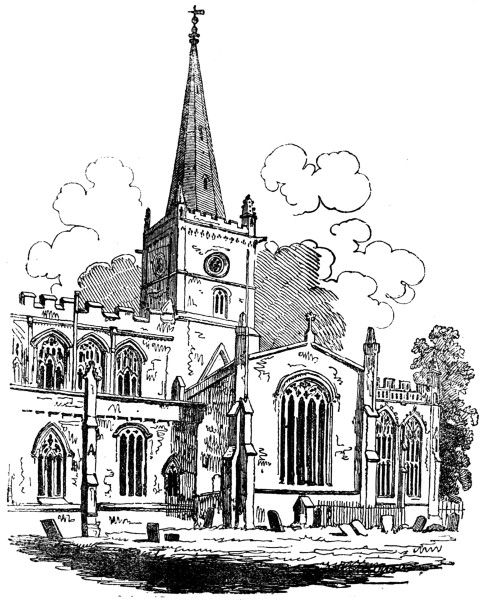
Stratford upon Avon Church.
From a sepia drawing, obligingly communicated by J. S. J., the reader is presented with this view of a church, “hallowed by being the sepulchral enclosure of the remains of the immortal Shakspeare.” It exemplifies the two distinct styles, the early pointed and that of the fourteenth century. The tower is of the first construction; the windows of the transepts possess a preeminent and profuse display of the mullions and tracery characteristic of the latter period.[100]
This structure is spacious and handsome, and was formerly collegiate, and dedicated to the Holy Trinity. A row of limes trained so as to form an arched avenue form an approach to the great door. A representation of a portion of this pleasant entrance is in an engraving of the church in the “Gentleman’s Magazine” for 1807.
Another opportunity will occur for relating particulars respecting the venerable edifice, and the illustrious bard, whose birth and burial at Stratford upon Avon confer on the town imperishable fame.
Garrick Plays. No. XII.
[From the “Brazen Age,” an Historical Play, by Thomas Heywood, 1613.]
Venus courts Adonis.
Venus. Why doth Adonis fly the Queen of Love, And shun this ivory girdle of my arms? To be thus scarf’d the dreadful God of War Would give me conquer’d kingdoms. For a kiss, But half like this, I could command the Sun Rise ’fore his hour, to bed before his time; And, being love-sick, change his golden beams, And make his face pale as his sister Moon. Look on me, Adon, with a stedfast eye, That in these chrystal glasses I may see My beauty that charms Gods, makes Men amazed And stown’d with wonder. Doth this roseat pillow Offend my Love? With my white fingers will I clap thy cheek; Whisper a thousand pleasures in thy ear. Adonis. Madam, you are not modest. I affect The unseen beauty that adorns the mind: This looseness makes you foul in Adon’s eye. If you will tempt me, let me in your face Read blusfulness and fear; a modest fear Would make your cheek seem much more beautiful. Venus. ———wert thou made of stone, I have heat to melt thee; I am Queen of Love. There is no practive art of dalliance Of which I am not mistress, and can use. I have kisses that can murder unkind words, And strangle hatred that the gall sends forth; Touches to raise thee, were thy spirits half dead; Words that can pour affection down thy ears. Love me! thou can’st not chuse; thou shalt not chuse. Adonis. Madam, you woo not well. Men covet not These proffer’d pleasures, but love sweets denied. These prostituted pleasures surfeit still; Where’s fear, or doubt, men sue with best good will. Venus. Thou canst instruct the Queen of Love in love. Thou shalt not, Adon, take me by the hand; Yet, if thou needs will force me, take my palm. I’ll frown on him: alas! my brow’s so smooth, It will not bear a wrinkle.—Hie thee hence Unto the chace, and leave me; but not yet: I’ll sleep this night upon Endymion’s bank, On which the Swain was courted by the Moon. Dare not to come; thou art in our disgrace: Yet, if thou come, I can afford thee place!
Phœbus jeers Vulcan.
Vul. Good morrow, Phœbus; what’s the news abroad?— For thou see’st all things in the world are done, Men act by day-light, or the sight of sun. Phœb. Sometime I cast my eye upon the sea, To see the tumbling seal or porpoise play. There see I merchants trading, and their sails Big-bellied with the wind; sea fights sometimes Rise with their smoke-thick clouds to dark my beams Sometimes I fix my face upon the earth, With my warm fervour to give metals, trees, Herbs, plants and flowers, life. Here in gardens walk Loose Ladies with their Lovers arm in arm. Yonder the laboring Plowman drives his team. Further I may behold main battles pitcht; And whom I favour most (by the wind’s help) I can assist with my transparent rays. Here spy I cattle feeding; forests there Stored with wild beasts; here shepherds with their lasses, Piping beneath the trees while their flocks graze. In cities I see trading, walking, bargaining, Buying and selling, goodness, badness, all things— And shine alike on all. Vul. Thrice happy Phœbus, That, whilst poor Vulcan is confin’d to Lemnos, Hast every day these pleasures. What news else? Phœb. No Emperor walks forth, but I see his state; Nor sports, but I his pastimes can behold. I see all coronations, funerals, Marts, fairs, assemblies, pageants, sights and shows. No hunting, but I better see the chace Than they that rouse the game. What see I not? There’s not a window, but my beams break in; No chink or cranny, but my rays pierce through; And there I see, O Vulcan, wondrous things: Things that thyself, nor any God besides, Would give belief to. And, shall I tell thee, Vulcan, ’tother day What I beheld?—I saw the great God Mars— Vul. God Mars— Phœb. As I was peeping through a cranny, a-bed— Vul. Abed! with whom?—some pretty Wench, I warrant. Phœb. She was a pretty Wench. Vul. Tell me, good Phœbus, That, when I meet him, I may flout God Mars; Tell me, but tell me truly, on thy life. Phœb. Not to dissemble, Vulcan, ’twas thy Wife!
The Peers of Greece go in quest of Hercules, and find him in woman’s weeds, spinning with Omphale.
Jason. Our business was to Theban Hercules. ’Twas told us, he remain’d with Omphale, The Theban Queen. Telamon. Speak, which is Omphale? or which Alcides? Pollux. Lady, our purpose was to Hercules; Shew us the man. Omphale. Behold him here. Atreus. Where? Omphale. There, at his task. Jason. Alas, this Hercules! This is some base effeminate Groom, not he That with his puissance frighted all the earth. Hercules. Hath Jason, Nestor, Castor, Telamon, Atreus, Pollux, all forgot their friend? We are the man. Jason. Woman, we know thee not: We came to seek the Jove-born Hercules, That in his cradle strangled Juno’s snakes, And triumph’d in the brave Olympic games. He that the Cleonean lion slew. Th’ Erimanthian boar, the bull of Marathon. The Lernean hydra, and the winged hart. Telamon. We would see the Theban That Cacus slew, Busiris sacrificed, And to his horses hurl’d stern Diomed To be devoured. Pollux. That freed Hesione From the sea whale, and after ransack’d Troy, And with his own hand slew Laomedon. Nestor. He by whom Dercilus and Albion fell; He that Œcalia and Betricia won. Atreus. That monstrous Geryon with his three heads vanquisht, With Linus, Lichas that usurpt in Thebes, And captived there his beauteous Megara. Pollux. That Hercules by whom the Centaurs fell, Great Achelous, the Stymphalides, And the Cremona giants: where is he? Telamon. That trait’rous Nessus with a shaft transfixt. Strangled Antheus, purged Augeus’ stalls, Won the bright apples of th’ Hesperides. Jason. He that the Amazonian baldrick won; That Achelous with his club subdued, And won from him the Pride of Caledon, Fair Deianeira, that now mourns in Thebes For absence of the noble Hercules! Atreus. To him we came; but, since he lives not here, Come, Lords; we will return these presents back Unto the constant Lady, whence they came. Hercules. Stay, Lords— Jason. ’Mongst women?— Hercules. For that Theban’s sake, Whom you profess to love, and came to seek, Abide awhile; and by my love to Greece, I’ll bring before you that lost Hercules, For whom you came to enquire. Telamon. It works, it works— Hercules. How have I lost myself! Did we all this? Where is that spirit become, That was in us? no marvel, Hercules, That thou be’st strange to them, that thus disguised Art to thyself unknown!—hence with this distaff, And base effeminate chares; hence, womanish tires; And let me once more be myself again. Your pardon, Omphale!
I cannot take leave of this Drama without noticing a touch of the truest pathos, which the writer has put into the mouth of Meleager, as he is wasting away by the operation of the fatal brand, administered to him by his wretched Mother.
My flame encreaseth still—Oh father Œneus; And you Althea, whom I would call Mother, But that my genius prompts me thou’rt unkind: And yet farewell!
What is the boasted “Forgive me, but forgive me!” of the dying wife of Shore in Rowe, compared with these three little words?
C. L.
Topography.
ST. MARGARET’S AT CLIFF.
For the Table Book.
————Stand still. How fearful And dizzy ’tis to cast one’s eyes so low! The crows and choughs, that wing the midway air Show scarce so gross as beetles: half way down Hangs one that gathers samphire; dreadful trade! Methinks he seems no bigger than his head: The fishermen that walk upon the beach Appear like mice; and yon tall anchoring bark, Diminish’d to her cock; her cock, a buoy, Almost too small for sight: the murmuring surge, That on the unnumber’d idle pebbles chafes, Cannot be heard so high.—
Shakspeare.
The village of St. Margaret’s at Cliff is situated at a small distance from the South Foreland, and about a mile from the high road half way between Dover and Deal. It was formerly of some consequence, on account of its fair for the encouragement of traders, held in the precincts of its priory, which, on the dissolution of the monastic establishments by Henry VIII., losing its privilege, or rather its utility, (for the fair is yet held,) the village degenerated into an irregular group of poor cottages, a decent farm-house, and an academy for boys, one of the best commercial school establishments in the county of Kent. The church, though time has written strange defeatures on its mouldering walls, still bears the show of former importance; but its best claim on the inquisitive stranger is the evening toll of its single bell, which is generally supposed to be the curfew, but is of a more useful and honourable character. It was established by the testament of one of its inhabitants in the latter part of the seventeenth century, for the guidance of the wanderer from the peril of the neighbouring precipices, over which the testator fell, and died from the injuries he received. He bequeathed the rent of a piece of land for ever, to be paid to the village sexton for tolling the bell every evening at eight o’clock, when it should be dark at that hour.
The cliffs in the range eastward of Dover to the Foreland are the most precipitous, but not so high as Shakspeare’s. They are the resort of a small fowl of the widgeon species, but something less than the widgeon, remarkable for the size of its egg, which is larger than the swan’s, and of a pale green, spotted with brown; it makes its appearance in May, and, choosing the most inaccessible part of the precipice, deposits its eggs, two in number, in holes, how made it is difficult to prove: when the young bird is covered with a thin down, and before any feathers appear, it is taken on the back of the parent, carried to the sea, and abandoned to its own resources, which nature amply supplies means to employ, in the myriads of mackerel fry that at that season colour the surface of the deep with a beautiful pale green and silver. This aquatic wanderer is said to confine its visit to the South Foreland and the seven cliffs at Beachy-head, and is known by the name of Willy. Like the gull, it is unfit for the table, but valuable for the downy softness of its feathers.
It was in this range of Dover cliffs that Joe Parsons, who for more than forty years had exclusively gathered samphire, broke his neck in 1823. Habit had rendered the highest and most difficult parts of these awful precipices as familiar to this man as the level below. Where the overhanging rock impeded his course, a rope, fastened to a peg driven into a cliff above, served him to swing himself from one projection to another: in one of these dangerous attempts this fastening gave way, and he fell to rise no more. Joe had heard of Shakspeare, and felt the importance of a hero. It was his boast that he was a king too powerful for his neighbours, who dared not venture to disturb him in his domain; that nature alone was his lord, to whom he paid no quittance. All were free to forage on his grounds, but none ventured. Joe was twice wedded; his first rib frequently attended and looked to the security of his ropes, and would sometimes terrify him with threats to cast him loose; a promise of future kindness always ended the parley, and a thrashing on the next quarrel placed Joe again in peril. Death suddenly took Judith from this vale of tears; Parsons awoke in the night and found her brought up in an everlasting roadstead: like a true philosopher and a quiet neighbour, Joe took his second nap, and when day called out the busy world to begin its matin labour, Joe called in the nearest gossip to see that all was done that decency required for so good a wife. His last helpmate survives her hapless partner. No one has yet taken possession of his estate. The inquisitive and firm-nerved stranger casts his eyes below in vain: he that gathered samphire is himself gathered. The anchored bark, the skiff, the choughs and crows, the fearful precipice, and the stringy root, growing in unchecked abundance, bring the bard and Joe Parsons to remembrance, but no one now attempts the “dreadful trade.”
K. B.
TO A SEA-WEED Picked up after a Storm.
Exotic!—from the soil no tiller ploughs, Save the rude surge;—fresh stripling from a grove Above whose tops the wild sea-monsters rove, —Have not the genii harbour’d in thy boughs, Thou filmy piece of wonder!—have not those Who still the tempest, for thy rescue strove, And stranded thee thus fair, the might to prove Of spirits, that the caves of ocean house? How else, from capture of the giant-spray, Hurt-free escapest thou, slight ocean-flower? —As if Arachne wove, thus faultless lay The full-develop’d forms of fairy-bower; —Who that beholds thee thus, nor with dismay Recalls thee struggling thro’ the storm’s dark hour![101]
MARRIAGE OF THE SEA.
The doge of Venice, accompanied by the senators, in the greatest pomp, marries the sea every year.
Those who judge of institutions by their appearance only, think this ceremony an indecent and extravagant vanity; they imagine that the Venetians annually solemnize this festival, because they believe themselves to be masters of the sea. But the wedding of the sea is performed with the most noble intentions.
The sea is the symbol of the republic: of which the doge is the first magistrate, but not the master; nor do the Venetians wish that he should become so. Among the barriers to his domination, they rank this custom, which reminds him that he has no more authority over the republic, which he governs with the senate, than he has over the sea, notwithstanding the marriage he is obliged to celebrate with her. The ceremony symbolizes the limits of his power, and the nature of his obligations.
OLD COIN INSCRIPTIONS.
To read an inscription on a silver coin which, by much wear, is become wholly obliterated, put the poker in the fire; when red hot, place the coin upon it, and the inscription will plainly appear of a greenish hue, but will disappear as the coin cools. This method was practised at the Mint to discover the genuine coin when the silver was last called in.
THE LADY AND THE TROUBADOUR.
For the Table Book.
[Emeugarde, daughter of Jacques de Tournay, Lord of Croiton, in Provence, becoming enamoured of a Troubadour, by name Enguilbert de Marnef, who was bound by a vow to repair to the Camp of the Crusaders in Palestine, besought him on the eve of his departure to suffer her to accompany him: de Marnef at first resolutely refused; but at length, overcome by her affectionate solicitations, assented, and was joined by her the same night, after her flight from her father’s chastel, in the garb of a guild brother of the joyeuse science.
Chronique de Poutailler]
Enguilbert! oh Enguilbert, the sword is in thine hand, Thou hast vowed before our Lady’s shrine to seek the Sainted land: —Thou goest to fight for glory—but what will glory be, If thou lov’st me, and return’st to find a tomb and dust for me? Look on me Enguilbert, for I have lost the shame That should have stayed these tears and prayers from one of Tournay’s name: —Look on me, my own bright-eyed Love—oh wilt thou leave me—say To droop as sunless flowers do, lacking thee—light of my day? Oh say that I may wend with thee—I’ll doff my woman’s ’tire, Sling my Father’s sword unto my side, and o’er my back my lyre: I’ll roam with thee a Troubadour, by day—by night, thy bride— —Speak Enguilbert—say yes,—or see my heart break if denied. Oh shouldst thou fall, my Enguilbert, whose lips thy wounds will close?— Who but thine own fond Emeugarde should watch o’er thy repose? And pierced, and cold her faithful breast must be e’er spear or sword Should ought of harm upon thee wreak, my Troubadour—my Lord. —Nay smile not at my words, sweet-heart—the Goss hath slender beak But brings its quarry nobly down—I love tho’ I am weak —My Blood hath coursed thro’ Charlemagne’s veins, and better it should flow Upon the field with Infidels’, than here congeal with woe. —Ah Enguilbert—my soul’s adored! the tear is in thine eye; Thou wilt not—can’st not leave me like the widowed dove to die: —No—no—thine arm is round me—that kiss on my hot brow Spoke thy assent, my bridegroom love,—we are ONE for ever now.
J. J. K.
THE GOLDEN TOOTH.
In 1593, it was reported that a Silesian child, seven years old, had lost all its teeth, and that a golden tooth had grown in the place of a natural double one.
In 1595, Horstius, professor of medicine in the university of Helmstadt, wrote the history of this golden tooth. He said it was partly a natural event, and partly miraculous, and that the Almighty had sent it to this child, to console the Christians for their persecution by the Turks.
In the same year, Rullandus drew up another account of the golden tooth.
Two years afterwards, Ingosteterus, another learned man, wrote against the opinion which Rullandus had given on this tooth of gold. Rullandus immediately replied in a most elegant and erudite dissertation.
Libavius, a very learned man, compiled all that had been said relative to this tooth, and subjoined his remarks upon it.
Nothing was wanting to recommend these erudite writings to posterity, but proof that the tooth was gold—a goldsmith examined it, and found it a natural tooth artificially gilt.
LE REVENANT.
“There are but two classes of persons in the world—those who are hanged, and those who are not hanged: and it has been my lot to belong to the former.”
There is a pathetic, narrative, under the preceding title and motto in “Blackwood’s Edinburgh Magazine,” of the present month, (April, 1827.) It is scarcely possible to abridge or extract from it, and be just to its writer. Perhaps the following specimen may induce curiosity to the perusal of the entire paper in the journal just named.
“I have been hanged, and am alive,” says the narrator. “I was a clerk in a Russia broker’s house, and fagged between Broad-street Buildings and Batson’s coffee-house, and the London-docks, from nine in the morning to six in the evening, for a salary of fifty pounds a-year. I did this—not contentedly—but I endured it; living sparingly in a little lodging at Islington for two years; till I fell in love with a poor, but very beautiful girl, who was honest where it was very hard to be honest; and worked twelve hours a-day at sewing and millinery, in a mercer’s shop in Cheapside, for half a guinea a-week. To make short of a long tale—this girl did not know how poor I was; and, in about six months, I committed seven or eight forgeries, to the amount of near two hundred pounds. I was seized one morning—I expected it for weeks—as regularly as I awoke—every morning—and carried, after a very few questions, for examination before the lord mayor. At the Mansion-house I had nothing to plead. Fortunately my motions had not been watched; and so no one but myself was implicated in the charge—as no one else was really guilty. A sort of instinct to try the last hope made me listen to the magistrate’s caution, and remain silent; or else, for any chance of escape I had, I might as well have confessed the whole truth at once. The examination lasted about half an hour; when I was fully committed for trial, and sent away to Newgate.
“The shock of my first arrest was very slight indeed; indeed I almost question if it was not a relief, rather than a shock, to me. For months, I had known perfectly that my eventual discovery was certain. I tried to shake the thought of this off; but it was of no use—I dreamed of it even in my sleep; and I never entered our counting-house of a morning, or saw my master take up the cash-book in the course of the day, that my heart was not up in my mouth, and my hand shook so that I could not hold the pen—for twenty minutes afterwards, I was sure to do nothing but blunder. Until, at last, when I saw our chief clerk walk into the room, on new year’s morning, with a police officer, I was as ready for what followed, as if I had had six hours’ conversation about it. I do not believe I showed—for I am sure I did not feel it—either surprise or alarm. My ‘fortune,’ however, as the officer called it, was soon told. I was apprehended on the 1st of January; and the sessions being then just begun, my time came rapidly round. On the 4th of the same month, the London grand jury found three bills against me for forgery; and, on the evening of the 5th, the judge exhorted me to ‘prepare for death;’ for ‘there was no hope that, in this world, mercy could be extended to me.’
“The whole business of my trial and sentence passed over as coolly and formally as I would have calculated a question of interest, or summed up an underwriting account. I had never, though I lived in London, witnessed the proceedings of a criminal court before; and I could hardly believe the composure and indifference—and yet civility—for there was no show of anger or ill-temper—with which I was treated; together with the apparent perfect insensibility of all the parties round me, while I was rolling on—with a speed which nothing could check, and which increased every moment—to my ruin! I was called suddenly up from the dock, when my turn for trial came, and placed at the bar; and the judge asked, in a tone which had neither severity about it, nor compassion—nor carelessness, nor anxiety—nor any character or expression whatever that could be distinguished—‘If there was any counsel appeared for the prosecution?’ A barrister then, who seemed to have some consideration—a middle aged, gentlemanly-looking man—stated the case against me—as he said he would do—very ‘fairly and forbearingly;’ but, as soon as he read the facts from his brief, ‘that only’—I heard an officer of the gaol, who stood behind me, say—‘put the rope about my neck.’ My master then was called to give his evidence; which he did very temperately—but it was conclusive. A young gentleman, who was my counsel, asked a few questions in cross-examination, after he had carefully looked over the indictment: but there was nothing to cross-examine upon—I knew that well enough—though I was thankful for the interest he seemed to take in my case. The judge then told me, I thought more gravely than he had spoken before—‘That it was time for me to speak in my defence, if I had any thing to say.’ I had nothing to say. I thought one moment to drop down upon my knees, and beg for mercy; but, again—I thought it would only make me look ridiculous; and I only answered—as well as I could—‘That I would not trouble the court with any defence.’ Upon this, the judge turned round, with a more serious air still, to the jury, who stood up all to listen to him as he spoke. And I listened too—or tried to listen attentively—as hard as I could; and yet—with all I could do—I could not keep my thoughts from wandering! For the sight of the court—all so orderly, and regular, and composed, and formal, and well satisfied—spectators and all—while I was running on with the speed of wheels upon smooth soil downhill, to destruction—seemed as if the whole trial were a dream, and not a thing in earnest! The barristers sat round the table, silent, but utterly unconcerned, and two were looking over their briefs, and another was reading a newspaper; and the spectators in the galleries looked on and listened as pleasantly, as though it were a matter not of death going on, but of pastime or amusement; and one very fat man, who seemed to be the clerk of the court, stopped his writing when the judge began, but leaned back in his chair, with his hands in his breeches’ pockets, except once or twice that he took a snuff; and not one living soul seemed to take notice—they did not seem to know the fact—that there was a poor, desperate, helpless creature—whose days were fast running out—whose hours of life were even with the last grains in the bottom of the sand-glass—among them! I lost the whole of the judge’s charge—thinking of I know not what—in a sort of dream—unable to steady my mind to any thing, and only biting the stalk of a piece of rosemary that lay by me. But I heard the low, distinct whisper of the foreman of the jury, as he brought in the verdict—‘Guilty,’—and the last words of the judge, saying—‘that I should be hanged by the neck until I was dead;’ and bidding me ‘prepare myself for the next life, for that my crime was one that admitted of no mercy in this.’ The gaoler then, who had stood close by me all the while, put his hand quickly upon my shoulder, in an under voice, telling me, to ‘Come along!’ Going down the hall steps, two other officers met me; and, placing me between them, without saying a word, hurried me across the yard in the direction back to the prison. As the door of the court closed behind us, I saw the judge fold up his papers, and the jury being sworn in the next case. Two other culprits were brought up out of the dock; and the crier called out for—‘The prosecutor and witnesses against James Hawkins, and Joseph Sanderson, for burglary!’
“I had no friends, if any in such a case could have been of use to me—no relatives but two; by whom—I could not complain of them—I was at once disowned.—There was but one person then in all the world that seemed to belong to me; and that one was Elizabeth Clare! And, when I thought of her, the idea of all that was to happen to myself was forgotten—I covered my face with my hands, and cast myself on the ground; and I wept, for I was in desperation.—She had gone wild as soon as she had heard the news of my apprehension—never thought of herself, but confessed her acquaintance with me. The result was, she was dismissed from her employment—and it was her only means of livelihood.
“She had been every where—to my master—to the judge that tried me—to the magistrates—to the sheriffs—to the aldermen—she had made her way even to the secretary of state! My heart did misgive me at the thought of death; but, in despite of myself, I forgot fear when I missed her usual time of coming, and gathered from the people about me how she was employed. I had no thought about the success or failure of her attempt. All my thoughts were—that she was a young girl, and beautiful—hardly in her senses, and quite unprotected—without money to help, or a friend to advise her—pleading to strangers—humbling herself perhaps to menials, who would think her very despair and helpless condition, a challenge to infamy and insult. Well, it mattered little! The thing was no worse, because I was alive to see and suffer from it. Two days more, and all would be over; the demons that fed on human wretchedness would have their prey. She would be homeless—pennyless—friendless—she would have been the companion of a forger and a felon; it needed no witchcraft to guess the termination.——
“We hear curiously, and read every day, of the visits of friends and relatives to wretched criminals condemned to die. Those who read and hear of these things the most curiously, have little impression of the sadness of the reality. It was six days after my first apprehension, when Elizabeth Clare came, for the last time, to visit me in prison! In only these short six days her beauty, health, strength—all were gone; years upon years of toil and sickness could not have left a more worn-out wreck. Death—as plainly as ever death spoke—sat in her countenance—she was broken-hearted. When she came, I had not seen her for two days. I could not speak, and there was an officer of the prison with us too: I was the property of the law now; and my mother, if she had lived, could not have blest, or wept for me, without a third person, and that a stranger, being present. I sat down by her on my bedstead, which was the only place to sit on in my cell, and wrapped her shawl close round her, for it was very cold weather, and I was allowed no fire; and we sat so for almost an hour without exchanging a word.——
*****
“She was got away, on the pretence that she might make one more effort to save me, with a promise that she should return again at night. The master was an elderly man, who had daughters of his own; and he promised—for he saw I knew how the matter was—to see Elizabeth safe through the crowd of wretches among whom she must pass to quit the prison. She went, and I knew that she was going for ever. As she turned back to speak as the door was closing, I knew that I had seen her for the last time. The door of my cell closed. We were to meet no more on earth. I fell upon my knees—I clasped my hands—my tears burst out afresh—and I called on God to bless her.”——
The mental and bodily sufferings of the condemned man in his cell, his waking dreams, and his dead sleep till the morning of execution, though of intense interest in the narrative, are omitted here that the reader may at once accompany the criminal to the place of execution.——
“I remember beginning to move forward through the long arched passages which led from the press-room to the scaffold. I saw the lamps that were still burning—for the daylight never entered here: I heard the quick tolling of the bell, and the deep voice of the chaplain reading as he walked before us—
‘I am the resurrection and the life, saith the Lord; he that believeth in me, though he were dead, shall live. And though after my skin worms destroy this body, yet in my flesh shall I see God!’
“It was the funeral service—the order for the grave—the office for those that were senseless and dead—over us, the quick and the living——
“I felt once more—and saw! I felt the transition from these dim, close, hot, lamp-lighted subterranean passages, to the open platform and steps at the foot of the scaffold, and to day. I saw the immense crowd blackening the whole area of the street below me. The windows of the shops and houses opposite, to the fourth story, choked with gazers. I saw St. Sepulchre’s church through the yellow fog in the distance, and heard the pealing of its bell. I recollect the cloudy, misty morning; the wet that lay upon the scaffold—the huge dark mass of building, the prison itself, that rose beside, and seemed to cast a shadow over us—the cold, fresh breeze, that, as I emerged from it, broke upon my face. I see it all now—the whole horrible landscape is before me. The scaffold—the rain—the faces of the multitude—the people clinging to the house-tops—the smoke that beat heavily downwards from the chimneys—the waggons filled with women, staring in the inn-yards opposite—the hoarse low roar that ran through the gathered crowd as we appeared. I never saw so many objects at once so plainly and distinctly in all my life as at that one glance; but it lasted only for an instant.
“From that look, and from that instant, all that followed is a blank——”
To what accident the narrator owes his existence is of little consequence, compared with the moral to be derived from the sad story.—“The words are soon spoken, and the act is soon done, which dooms a wretched creature to an untimely death; but bitter are the pangs—and the sufferings of the body are among the least of them—that he must go through before he arrives at it!”
In the narrative there is more than seems to be expressed. By all who advocate or oppose capital punishment—by every being with a human heart, and reasoning powers—it should be read complete in the pages of “Blackwood.”
*
Blind Willie, the Newcastle Minstrel.
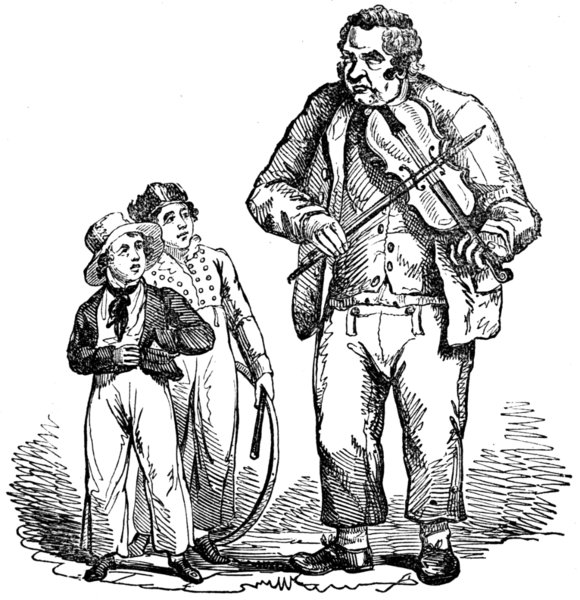
Blind Willie, the Newcastle Minstrel.
Lang may wor Tyneside lads sae true, In heart byeth blithe an’ mellow, Bestow the praise that’s fairly due To this bluff, honest fellow— And when he’s hamper’d i’ the dust, Still i’ wor memory springin’, The times we’ve run till like to brust To hear blind Willie singin’.
Newcastle Song.
William Purvis, or, as he is generally styled, blind Willie, is a well-known character, and native of Newcastle, where he has resided since his infancy. He was born blind, and is the son of Margaret Purvis, who died in All Saints’ workhouse, February 7, 1819, in her hundredth year.
Willie is, indeed, as the ingenious Mr. Sykes calls him in his “Local Records,” a “famous musician,” for he has long been celebrated for his minstrelsy throughout the northern counties, but more particularly so in Northumberland. In Newcastle, Willie is respected by all—from the rudest to the gentlest heart all love him—children seize his hand as he passes—and he is ever an equally welcome guest at the houses of the rich and the hovels of the pitmen. The hoppings of the latter are cheered by the soul-inspiring sound of his viol: nay, he is, I may truly say, a very particle of a pitman’s existence, who, after a hard day’s labour, considers it a pleasure of the most exquisite nature to repair to some neighbouring pot-house, there to enjoy Willie’s music, and listen to the rude ballads he is in the habit of composing and singing to the accompaniment of his own music. Poor Willie! may he live long and live happy. When he dies many a tear will fall from eyes that seldom weep, and hearts that know little of the more refined sensations of our nature will heave a sigh. Willie will die, but not his fame will die. In many of those humorous provincial songs, with which Newcastle abounds more than any other town I am acquainted with—the very airs as well as the words of which possess a kind of local nationality—“Blind Willie” is the theme. These songs are the admiration of all who know how to appreciate genuine humour; several of them have been sung for years, and I venture to prophecy, will be sung by future generations.
Among the characters who have noticed “Willie” may be mentioned the present duke of Northumberland, sir Matthew White Ridley, the late Stephen Kemble, Esq. and the admirable comedian Matthews. Sir Matthew White Ridley is a most particular favourite with “Willie,” and it is no uncommon occurrence to hear Willie, as he paces along the streets of Newcastle, muttering to himself “Sir Maffa! sir Maffa! canny sir Maffa! God bless sir Maffa!”
One of Willie’s greatest peculiarities is thus alluded to by Mr. Sykes:—“He has travelled the streets of Newcastle time out of mind without a covering upon his head. Several attempts have been made, by presenting him with a hat, to induce him to wear one, but after having suffered it for a day or two it is thrown aside, and the minstrel again becomes uncovered, preferring the exposure of his pate to the ‘pelting of the pitiless storm.’” The likeness that accompanies this notice is from a large quarto engraving, published at Newcastle, and will doubtless be acceptable to numerous readers of that populous district wherein blind Willie is so popular.
FARMERS.
IN
1722.
Man to the plough; Wife to the cow; Girl to the sow; Boy to the mow; And your rents will be netted.
1822.
Man tally-ho; Miss piano; Wife silk and satin; Boy Greek and Latin; And you’ll all be Gazetted.
1722.
Man to the plough; Wife to the cow; Girl to the sow; Boy to the mow; And your rents will be netted.
1822.
Man tally-ho; Miss piano; Wife silk and satin; Boy Greek and Latin; And you’ll all be Gazetted.
G.[102]
A REVERIE.
For the Table Book.
——On a cool delightful evening which succeeded one of the scorching days of last summer, I sallied forth for a walk in the neighbourhood of the city of ——. Chance led me along a path usually much frequented, which was then covered thick with the accumulated dust of a long drought; it bore the impression of a thousand busy feet, of every variety of form and size; from the first steps of the infant, whose nurse had allowed it to toddle his little journey to the outstretched arms of her who was almost seated to receive him, to the hobnailed slouch of the carter, whose dangling lash and dusty jacket annoyed the well-dressed throng. But three pair of footsteps, which were so perfect that they could not long have preceded my own, more than all, attracted my attention; those on the left certainly bore the impress of the delicately formed foot of a female; the middle ones were shaped by the ample square-toed, gouty shoe of a senior; and those on the right were as certainly placed there by the Wellington boot of some dandy; they were extravagantly right and left, the heel was small and high, for the middle of the foot did not tread on earth.—My imagination was instantly at work, to tenant these “leathern conveniences;” the last-mentioned I felt so certain were inhabited by an officer of the lancers, or an hussar who had witnessed Waterloo’s bloody fight, that I could almost hear the tinkle of his military spur. I pictured him young, tall, handsome, with black mustachios, dark eyes, and, as the poet says,
“His nose was large with curved line Which some men call the aquiline, And some do say the Romans bore Such noses ’fore them to the war.”
The strides were not so long as a tall man would make, but this I accounted for by supposing they were accommodated to the hobbling gait of the venerable gentleman in the centre, who I imagined “of the old school,” and to wear one of those few self-important wigs, which remain in this our day of sandy scratches. As these powdered coverings never look well without a three cocked hat, I had e’en placed one upon it, and almost edged it with gold lace, which, however, would not do—it had rather loo much of by-gone days:—to my “mind’s eye” he was clothed in a snuff-coloured suit, and one of his feet, which was not too gouty to admit of a leather shoe, had upon it a large silver buckle. My “high fancy” formed the lady a charming creature, sufficiently en bon point, with an exceedingly genteel figure; not such as two parallel lines would describe, but rather broad on the shoulders, gently tapering to the waist, then gradually increasing in a delicately flowing outline, such as the “statue that enchants the world” would exhibit, if animated and clothed in the present fashionable dress; her voice, of course, was delightful, and the mild expression of her face to be remembered through life—it could not be forgotten; in short, she was as Sterne says, “all that the heart wishes or the eye looks for in woman.” My reverie had now arrived at its height, my canvass was full, my picture complete, and I was enjoying the last delicate touches of creative fancy, when a sudden turn in the road placed before me three persons, who, on a moment’s reflection, I felt constrained to acknowledge as the authors of the footsteps which had led me into such a pleasing delusion; but—no more like the trio of my imagination, than “Hyperion to a satyr!” The dandy had red hair, the lady a red nose, and the middle man was a gouty sugar-baker; all very good sort of people, no doubt, except that they overthrew my aerial castle. I instantly retraced my steps, and was foolish enough to be sulky, nay, a very “anatomie of melancholy;” till a draught of “Burton’s” liquid amber at supper made me friends with the world again——
Eta.
HIGHLAND TRADITION.
Macgregor.
About the middle of the sixteenth century, the eldest son of Lamond, of Cowel, in Argyleshire, was hunting the red deer in Glenfine. At the same time the only son of Macgregor, of Glenstrae, the chief of that once powerful clan, was on a similar excursion in the same place, which was the boundary between the extensive territories of these two great families. Young Lamond had pierced a prime hart with an arrow; and the noble animal, galled by the shaft, which stuck in the wound, plunged into the river, and bent his course into Macgregor’s country. He was followed by Lamond, who outran all his companions. It unfortunately fell out, that a hart had been wounded by the young Macgregor at the same time, among his own hills. The two deer crossed each other in their flight, and the first that fell was claimed by both the hunters. The youths, flushed by the ardour of the chase, and totally unknown to each other, hotly disputed. They were armed, as was the fashion of those days, and fought, and the young Macgregor fell. Lamond cut his way through the attendants, but was keenly pursued. Having wonderful fleetness of foot, he made his way forward; and ignorant of the country and of the people, and almost exhausted with thirst, hunger, anguish, and fatigue, rushed into the house of Macgregor of Glenstrae, on whose mercy he threw himself, telling him that he had slain a man. Macgregor received him, and had given him refreshment, when the pursuers arrived, and told the unfortunate man the woful tale—that his son had fallen—his only child—the last of his ancient race—the hope of his life—the stay of his age. The old man was at this period left surrounded by enemies crafty and powerful—he, friendless and alone. The youth was possessed of every virtue that a father’s heart could wish; his destroyer was now in his hands; but he had pledged his promise for his safety, and that pledge must be redeemed. It required all the power and influence of the aged chief to restrain the fury of his people from slaying young Lamond at the moment; and even that influence, great as it was, could only protect him, on an assurance that on the next morning his life should be solemnly sacrificed for their beloved Gregor.
In the middle of the night, Macgregor led Lamond forth by the hand, and, aware of his danger, himself accompanied him to the shore of Lochfine, where he procured a boat, made Lamond enter it, and ordered the boatmen to convey him safely across the loch into his own country. “I have now performed my promise,” said the old man, “and henceforth I am your enemy—beware the revenge of a father for his only son!”
Before this fatal event occurred, the persecution against the unfortunate Macgregors had commenced, and this sad accident did not contribute to diminish it. The old laird of Glenstrae struggled hard to maintain his estate and his independence, but his enemies prevailed against him. The conduct of young Lamond was grateful and noble. When he succeeded to the ample possessions of his ancestors, he beseeched old Macgregor to take refuge under his roof. There the aged chief was treated as a father, and ended his days.
HY-JINKS. A Scotch Amusement.
This is a drunken sort of game.—The queff, or cup, is filled to the brim, then one of the company takes a pair of dice, and cries “Hy-jinks,” and throws. The number he casts points out the person that must drink; he who threw beginning at himself number one, and so round, till the number of the person agree with that of the dice, (which may fall upon himself, if the number be within twelve,) then he sets the dice to him, or bids him take them. He on whom they fall is obliged to drink, or pay a small sum of money as forfeit; then he throws and so on: but if he forgets to cry “Hy-jinks” he pays a forfeiture. Now, he, on whom it falls to drink, gets all the forfeited money in the bank, if he drinks, and orders the cup to be filled again, and then throws. If he errs in the articles, he loses the privilege of drawing the money. The articles are (1 drink;) 2 draw; 3 fill; 4 cry “Hy-jinks;” 5 count just; 6 choose your double man; viz. when two equal numbers of the dice is thrown, the person whom you choose must pay double forfeit, and so must you when the dice is in his hand.
A rare project this, and no bubble I can assure you, for a covetous fellow may save money, and get himself as drunk as he can desire in less than an hour’s time.[103]
S. S. S.
Clubs.
THE SILENT CLUB.
There was at Amadan a celebrated academy. Its first rule was framed in these words:—
“The members of this academy shall think much—write little—and be as mute as they can.”
A candidate offered himself—he was too late—the vacancy was filled up—they knew his merit, and lamented their disappointment in lamenting his own. The president was to announce the event; he desired the candidate should be introduced.
He appeared with a simple and modest air, the sure testimony of merit. The president rose, and presented a cup of pure water to him, so full, that a single drop more would have made it overflow; to this emblematic hint he added not a word but his countenance expressed deep affliction.
The candidate understood that he could not be received because the number was complete, and the assembly full; yet he maintained his courage, and began to think by what expedient, in the same kind of language, he could explain that a supernumerary academician would displace nothing, and make no essential difference in the rule they had prescribed.
Observing at his feet a rose, he picked it up, and laid it gently upon the surface of the water, so gently that not a drop of it escaped. Upon this ingenious reply, the applause was universal; the rule slept or winked in his favour. They presented immediately to him the register upon which the successful candidate was in the habit of writing his name. He wrote it accordingly; he had then only to thank them in a single phrase, but he chose to thank them without saying a word.
He figured upon the margin the number of his new associates, 100; then, having put a cipher before the figure 1, he wrote under it—“their value will be the same”—0100.
To this modesty the ingenious president replied with a politeness equal to his address: he put the figure 1 before the 100, and wrote, “they will have eleven times the value they had—1100.”
CHARLESTOWN UGLY CLUB.[104]
For the Table Book.
By a standing law of this “ugly club,” their club-room must always be the ugliest room in the ugliest house of the town. The only furniture allowed in this room is a number of chairs, contrived with the worst taste imaginable; a round table made by a back-woodsman; and a Dutch looking-glass, full of veins, which at one glance would make even a handsome man look a perfect “fright.” This glass is frequently sent to such gentlemen as doubt their qualifications, and neglect or decline to take up their freedom in the club.
When an ill-favoured gentleman first arrives in the city, he is waited upon, in a civil and familiar manner, by some of the members of the club, who inform him that they would be glad of his company on the next evening of their meeting; and the gentleman commonly thanks the deputation for the attention of the club, to one so unworthy as himself, and promises to consider the matter.
It sometimes happens, that several days elapse, and the “strange” gentleman thinks no more of the club. He has perhaps repeatedly looked into his own glass, and wondered what, in the name of sense, the club could have seen in his face, that should entitle him to the distinction they would confer on him.
He is, however, waited upon a second time by the most respectable members of the whole body, with a message from the president, requesting him not to be diffident of his qualifications, and earnestly desiring “that he will not fail to attend the club the very next evening—the members will feel themselves highly honoured by the presence of one whose appearance has already attracted the notice of the whole society.”
“Zounds!” he says to himself on perusing the billet, “what do they mean by teasing me in this manner? I am surely not so ugly,” (walking to his glass,) “as to attract the notice of the whole town on first setting my foot upon the wharf!”
“Your nose is very long,” cries the spokesman of the deputation. “Noses,” says the strange gentleman, “are no criterion of ugliness: it’s true, the tip-end of mine would form an acute angle with a base line drawn horizontally from my under lip; but I defy the whole club to prove, that acute angles were ever reckoned ugly, from the days of Euclid down to this moment, except by themselves.”
“Ah, sir,” answers the messenger, “how liberal has nature been in bestowing upon you so elegant a pair of lantern jaws! believe me, sir, you will be a lasting honour to the club.”
“My jaws,” says the ugly man in a pet, “are such as nature made them: and Aristotle has asserted, that all her works are beautiful.”
The conversation ends for the present. The deputation leaves the strange gentleman to his reflections, with wishes and hopes that he will consider further.
Another fortnight elapses, and the strange gentleman, presuming the club have forgotten him, employs the time in assuming petit-maître airs, and probably makes advances to young ladies of fortune and beauty. At the expiration of this period, he receives a letter from a pretended female, (contrived by the club,) to the following purport:—
“My dear sir,
“There is such a congeniality between your countenance and mine, that I cannot help thinking you and I were destined for each other. I am unmarried, and have a considerable fortune in pine-barren land, which, with myself, I wish to bestow upon some deserving man; and from seeing you pass several times by my window, I know of no one better entitled to both than yourself. I am now almost two years beyond my grand climacteric, and am four feet four inches in height, rather less in circumference, a little dropsical, have lovely red hair and a fair complexion, and, if the doctor do not deceive me, I may hold out twenty years longer. My nose is, like yours, rather longer than common; but then to compensate, I am universally allowed to have charming eyes. They somewhat incline to each other, but the sun himself looks obliquely in winter, and cheers the earth with his glances. Wait upon me, dear sir, to-morrow evening.
“Yours till death, &c. “M. M.”
“What does all this mean?” cries the ugly gentleman, “was ever man tormented in this manner! Ugly clubs, ugly women! imps and fiends, all in combination to persecute me, and make my life miserable! I am to be ugly, it seems, whether I will or not.”
At this critical juncture, the president of the club, who is the very pink of ugliness itself, waits upon the strange gentleman, and takes him by the hand. “My dear sir,” says he, “you may as well walk with me to the club as not. Nature has designed you for us, and us for you. We are a set of men who have resolution enough to dare to be ugly; and have long let the world know, that we can pass the evening, and eat and drink together with as much social glee and real good humour as the handsomest of them. Look into this Dutch glass, sir, and be convinced that we cannot do without you.”
“If it must be so, it must,” cries the ugly gentleman, “there seems to be no alternative; I will even do as you say!”
It appears from a paper in “The American Museum” of 1790, that by this mode the “ugly club” of Charleston has increased, is increasing, and cannot be diminished. According to the last accounts, “strange” gentlemen who do not comply with invitations to join the club in person are elected “honorary” members, and their names enrolled nolens volens.
P. N.
SUMMER DRINKS.
Imperial.
Take two gallons of water, two ounces of ginger bruised, and two lemons; boil them together; when lukewarm, pour the whole on a pound and a half of loaf sugar, and two ounces of cream of tartar; add four table spoonfuls of yeast, and let them work together for six hours; then strain the liquor, and bottle it off in small stone bottles: it will be ready for use in a few hours.
Sherbet.
Take nine Seville oranges and three lemons, grate off the yellow from the rinds, and put the raspings into a gallon of water, with three pounds of double refined sugar, and boil it to a candy height; then take it off the fire, and add the pulp of the oranges and lemons; keep stirring it till it be almost cold, then put it in a vessel for use.
Lemon Water.
Put two slices of lemon, thinly pared, into a tea-pot, with a little bit of the peel, and a bit of sugar, or a large spoonful of capillaire, pour in a pint of boiling water, and stop it close for two hours.
Ginger Beer.
To four gallons of water, put three pounds of brown sugar, two ounces of ginger, one ounce and a half of hops, and about half a pound of fern-root cut small; boil these together till there be about three gallons. To colour it, burn a little sugar and put it in the liquor. Pour it into a vessel when cold, add two table-spoonfuls of barm, and then proceed as with common beer.
CABBAGE, AND TAILORS.
The Roman name Brassica came, as is supposed, from “præséco,” because it was cut off from the stalk: it was also called Caulis in Latin, on account of the goodness of its stalks, and from which the English name Cole, Colwort, or Colewort, is derived. The word cabbage, by which all the varieties of this plant are now improperly called, means the firm head or ball that is formed by the leaves turning close over each other: from that circumstance we say the cole has cabbaged.—From thence arose the cant word applied to tailors, who formerly worked at the private houses of their customers, where they were often accused of cabbaging: which means the rolling up pieces of cloth instead of the list and shreds, which they claim as their due.[105]
APRIL. From the French of Remy Belleau.
April! sweet month, the daintiest of all. Fair thee befall: April! fond hope of fruits that lie In buds of swathing cotton wrapt, There closely lapt Nursing their tender infancy— April! that dost thy yellow, green, and blue, Around thee strew, When, as thou go’st, the grassy floor Is with a million flowers depaint, Whose colours quaint Have diaper’d the meadows o’er— April! at whose glad coming zephyrs rise With whisper’d sighs, Then on their light wings brush away, And hang amid the woodlands fresh Their aery mesh, To tangle Flora on her way— April! it is thy hand that doth unlock, From plain and rock, Odours and hues, a balmy store, That breathing lie on Nature’s breast, So richly blest, That earth or heaven can ask no more— April! thy blooms, amid the tresses laid Of my sweet maid, Adown her neck and bosom flow; And in a wild profusion there, Her shining hair With them hath blent a golden glow— April! the dimpled smiles, the playful grace, That in the face Of Cytherea haunt, are thine: And thine the breath, that, from the skies, The deities Inhale, an offering at thy shrine— ’Tis thou that dost with summons blythe and soft, High up aloft, From banishment these heralds bring. These swallows, that along the air Send swift, and bear Glad tidings of the merry spring. April! the hawthorn and the eglantine, Purple woodbine, Streak’d pink, and lily-cup and rose, And thyme, and marjoram, are spreading, Where thou art treading, And their sweet eyes for thee unclose. The little nightingale sits singing aye On leafy spray, And in her fitful strain doth run A thousand and a thousand changes. With voice that ranges Through every sweet division April! it is when thou dost come again, That love is fain With gentlest breath the fires to wake, That cover’d up and slumbering lay, Through many a day, When winter’s chill our veins did slake. Sweet month, thou seest at this jocund prime Of the spring time, The hives pour out their lusty young, And hear’st the yellow bees that ply, With laden thigh, Murmuring the flow’ry wilds among. May shall with pomp his wavy wealth unfold, His fruits of gold, His fertilizing dews, that swell In manna on each spike and stem And like a gem, Red honey in the waxen cell. Who will may praise him, but my voice shall be, Sweet month for thee; Thou that to her do’st owe thy name, Who saw the sea-wave’s foamy tide Swell and divide, Whence forth to life and light she came.
ETYMOLOGY.
The following are significations of a few common terms:—
Steward literally means the keeper of the place; it is compounded of the two old words, stede and ward: by the omission of the first d and e the word steward is formed.
Marshal means one who has the care of horses: in the old Teutonic, mare was synonymous with horse, being applied to the kind; scale signified a servant.
Mayor is derived from the Teutonic Meyer, a lover of might.
Sheriff is compounded of the old words shyre and reve—an officer of the county, one who hath the overlooking of the shire.
Yeoman is the Teutonic word gemen, corrupted in the spelling, and means a commoner.
Groom signifies one who serves in an inferior station. The name of bridegroom was formerly given to the new-married man, because it was customary for him to wait at table on his bride and friends on his wedding day.
All our words of necessity are derived from the German; our words of luxury and those used at table, from the French. The sky, the earth, the elements, the names of animals, household goods, and articles of food, are the same in German as in English; the fashions of dress, and every thing belonging to the kitchen, luxury, and ornament, are taken from the French; and to such a degree of exactness, that the names of animals which serve for the ordinary food of men, such as ox, calf, sheep, when alive, are called the same in English as in German; but when they are served up for the table they change their names, and are called beef, veal, mutton, after the French.[106]
ORGANS.
For the Table Book.
A few particulars relative to organs, in addition to those at col. 260, may be interesting to musical readers.
The instrument is of so great antiquity, that neither the time nor place of invention, nor the name of the inventor, is identified; but that they were used by the Greeks, and from them borrowed by the Latins, is generally allowed. St. Jerome describes one that could be heard a mile off; and says, that there was an organ at Jerusalem, which could be heard at the Mount of Olives.
Organs are affirmed to have been first introduced into France in the reign of Louis I., A. D. 815, and the construction and use of them taught by an Italian priest, who learned the art at Constantinople. By some, however, the introduction of them into that country is carried as far back as Charlemagne, and by others still further.
The earliest mention of an organ, in the northern histories, is in the annals of the year 757, when the emperor Constantine, surnamed Copronymus, sent to Pepin of France, among other rich presents, a “musical machine,” which the French writers describe to have been composed of “pipes and large tubes of tin,” and to have imitated sometimes the “roaring of thunder,” and, at others, the “warbling of a flute.”
Bellarmine alleges, that organs were first used in churches about 660. According to Bingham, they were not used till after the time of Thomas Aquinas, about A. D. 1250. Gervas, the monk of Canterbury, who flourished about 1200, says, they were in use about a hundred years before his time. If his authority be good, it would countenance a general opinion, that organs were common in the churches of Italy, Germany, and England, about the tenth century.
March, 1827.
PERPLEXING MARRIAGES.
At Gwennap, in Cornwall, in March 1823, Miss Sophia Bawden was married to Mr. R. Bawden, both of St. Day. By this marriage, the father became brother-in-law to his son; the mother, mother-in-law to her sister; the mother-in-law of the son, his sister-in-law; the sister of the mother-in-law, her daughter-in-law; the sister of the daughter-in-law, her mother-in-law; the son of the father, brother-in-law to his mother-in-law, and uncle to his brothers and sisters; the wife of the son, sister-in-law to her father-in-law, and aunt-in-law to her husband; and the offspring of the son and his wife would be grandchildren to their uncle and aunt, and cousins to their father.
In an account of Kent, it is related that one Hawood had two daughters by his first wife, of which the eldest was married to John Cashick the son, and the youngest to John Cashick the father. This Cashick the father had a daughter by his first wife, whom old Hawood married, and by her had a son: with the exception of the former wife of old Cashick, all these persons were living at Faversham in February, 1650, and his second wife could say as follows:—
My father is my son, and | My sister is my daughter, I’m mother’s mother; | I’m grandmother to my brother.
STEPS RE-TRACED.
Catherine de Medicis made a vow, that if some concerns which she had undertaken terminated successfully, she would send a pilgrim on foot to Jerusalem, and that at every three steps he advanced, he should go one step back.
It was doubtful whether there could be found a man sufficiently strong and patient to walk, and go back one step at every third. A citizen of Verberie, who was a merchant, offered to accomplish the queen’s vow most scrupulously, and her majesty promised him an adequate recompense. The queen was well assured by constant inquiries that he fulfilled his engagement with exactness, and on his return, he received a considerable sum of money, and was ennobled. His coat of arms were a cross and a branch of palm-tree. His descendants preserved the arms; but they degenerated from their nobility, by resuming the commerce which their ancestor quitted.[107]
Street Circulars. No. I.
For the Table Book.
WHISTLING JOE.
He whistles as he goes for want of bread.[108]
Old books declare,—in Plutus’ shade, Whistling was once a roaring trade,— Great was the call for nerve and gristle; That Charon, with his Styx in view, Pierced old Phlegethon through and through, And whist-led in the ferry-whistle— That Polyphemus whistled when He p-layed the pipe r in a pen, And sought Ulysses’ bark to launch; That Troy, King Priam had not lost, But for the whistlers that were horsed[109] Within the horse’s wooden paunch. Jupiter was a whist-ling wight, And Juno heard him with delight; And Boreas was a reedy swain, Awak’ning Venus from the sea: But of the Moderns?—Joe is he That whistles in the streets for gain. You wonder as you hear the tone Sound like a herald in a zone Distinctly clear, minutely sweet; You list and Joe is dancing, now You laugh, and Joe returns a bow Returning in the crooked street. He scrapes a stick across his arm And knocks his knees, in need, to charm;[110] Instead of tabor and a fiddle, Et omne solis,—on his sole! He, solus omnis, like a pole Supports his body in the middle. Thus, of the sprites that creep, or beg, With wither’d arm, or wooden leg, Uncatalogued in Bridewell’s missal; Joe is the fittest for relief, He whistles gladness in his grief,[111] And hardly earns it for his whistle.
J. R. P.