Volume 2 — Vol. II.—52.
Reading edition
Irish Pipes.
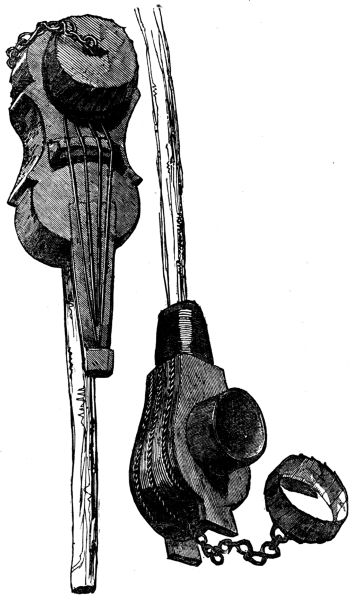
Irish Pipes.
A young friend brings me from Ireland a couple of pipes, in common use among the labouring people in Dublin and Clonmel. Their shape and materials being wholly different from any in England, they are represented in the above engraving, which shows their exact size. The bowl part, formed of iron, like the socket of a candlestick, is inserted in a piece of mahogany carved, as here shown, in the shape of a violin, or a pair of bellows, or other whimsical form; and the mahogany is securely bound and ornamented with brass wire: to a small brass chain is attached a tin cover to the bowl. The tube is of dogwood, such as butchers’ skewers are made of, or of a similar hard wood; and, being movable, may be taken out for accommodation to the pocket, or renewal at pleasure. These pipes cost sixpence each.
The dudeen, or short pipe, the “little tube of magic power,” wherewith the Irish labourer amuses himself in England, is thus mentioned in a note on the “Fairy Legends and Traditions of the South of Ireland,” by Mr. Crofton Croker:—“Dudeen signifies a little stump of a pipe. Small tobacco-pipes, of an ancient form, are frequently found in Ireland on digging or ploughing up the ground, particularly in the vicinity of those circular intrenchments, called Danish forts, which were more probably the villages or settlements of the native Irish. These pipes are believed by the peasantry to belong to the Cluricaunes, and when discovered are broken, or otherwise treated with indignity, as a kind of retort for the tricks which their supposed owners had played off.” Mr. Croker subjoins a sketch of one of these pipes, and adds, that “In the Anthologia Hibernica, vol i. p. 352, (Dublin, 1793,) there is a print of one, which was found at Brannockstown, county Kildare, sticking between the teeth of a human skull; and it is accompanied by a paper, which, on the authority of Herodotus, (lib. i. sec. 36,) Strabo, (lib. vii. 296,) Pomponius Mela, (2,) and Solinus, (c. 15,) goes to prove that the northern nations of Europe were acquainted with tobacco, or an herb of similar properties, and that they smoked it through small tubes—of course, long before the existence of America was known.”
Garrick Plays. No. XLV.
FACETIÆ.
1. Holding in Capite.
First Gent. ’Tis well known I am a Gentleman. My father was a man of £500 a year, and he held something in capite too.
Second Gent. So does my Lord something—
Foolish Lord. Nay, by my troth, what I hold in capite is worth little or nothing.
2. Fool’s Experience.
Page. He that’s first a scholar, and next in love, the year after is either an arrant fool or a madman.
Master. How came your knavery by such experience?
Page. As fools do by news: somebody told me so, and I believe it.
3. Modern Sybarite.
——softly, ye villains!—the rogues of chairmen have trundled me over some damn’d nutshell or other, that gave me such a jerk as has half murder’d me.
4. Spare diet of Spaniards.
Spaniard. The air being thin and rarified generally provides us good stomachs.
Englishman. Aye, and the earth little or nothing to satisfy ’em with; I think a cabbage is a jewel among you.
Span. Why, truly a good cabbage is respected. But our people are often very luxurious, they abound very often.
Eng. O no such matter, faith, Spaniard! ’death, if they get but a piece of beef, they shall hang all the bones out, and write underneath Here hath been beef eaten, as if ’twere a miracle. And if they get but a lean hen, the feathers shall be spread before the door with greater pride than we our carpets at some princely solemnity.
5. Foolish Form.
Servant (to my Lord Stately’s Gentleman Usher.) Sir, here’s your Lord’s footman come to tell you, your Lord’s hat is blown out of his hand.
Lord W. Why did not the footman take it up?
Usher. He durst not, my Lord; ’tis above him.
Lord W. Where? a’top of the chimney?
Usher. Above his office, my Lord.
Lord W. How does this fool, for want of solid greatness, swell with empty ceremony, and fortify himself with outworks! That a man must dig thro’ rubbish to come at an ass. English Friar.
6. Cast Books.
Waiting maid. I have a new Bible too; and when my Lady left her Practice of Piety, she gave it me. Newcastle.
7. Good at guessing
Nay, good Mr. Constable, you are e’en the luckiest at being wise that ever I knew. Newcastle.
8. Essays at Essays.
1. O eternal blockhead, did you never write Essays?
2. I did essay to write Essays, but I cannot say I writ Essays. Newcastle.
9. Hard words.
Indiscerptibility, and Essential Spissitude: words which, though I am no competent judge of, for want of languages, yet I fancy strongly ought to mean nothing. Mrs. Afra Behn.
10. Scandals to Atheism.
—— a late learned Doctor; who, though himself no great assertor of a Deity, yet was observed to be continually persuading this sort of men [the rakehelly blockheaded Infidels about town] of the necessity and truth of our religion; and being asked how he came to bestir himself so much this way, made answer, that it was because their ignorance and indiscreet debauch made them a Scandal to the Profession of Atheism. Behn.
11. Excuse for being afraid in a Storm.
Master. Courage! why what dost thou call courage? Hector himself would not have exchanged his ten years’ siege for our ten days’ storm at sea. A Storm! a hundred thousand fighting men are nothing to it; cities sack’d by fire, nothing. ’Tis a resistless coward, that attacks a man at disadvantage; an unaccountable magic, that first conjures down a man’s courage, and then plays the devil over him; and, in fine, it is a Storm!
Mate. Good lack, that it should be all these terrible things, and yet that we should outlive it!
Master. No god-a-mercy to our courages tho’, I tell you that now; but like an angry wench, when it had huffed and bluster’d itself weary, it lay still again. Behn.
12. Dutch Gallantry
Mate. What, beat a woman, Sir?
Master. ’Psha, all’s one for that; if I am provoked, anger will have its effects upon whomsoe’er it light: so said Van Tromp, when he took his Mistress a cuff on the ear for finding fault with an ill-fashioned leg he made her. I liked his humour well. Behn.
13. Dutchman.
—— sitting at home in the chimney corner, cursing the face of Duke de Alva upon the jugs, for laying an imposition on beer. Behn.
14. Rake at Church.
—— I shall know all, when I meet her in the chapel to-morrow. I am resolved to venture thither, tho’ I am afraid the dogs will bark me out again, and by that means let the congregation know how much I am a stranger to the place. Durfey.
15. Lying Traveller
You do not believe me then? the devil take me, if these home-bred fellows can be saved: they neither know nor believe half the creation. Lacy.
16. English Beau, contrasted with a French one.
—— a true-bred English Beau has indeed the powder, the essence, the toothpick, the snuff-box; and is as idle; but the fault is in the flesh—he has not the motion, and looks stiff under all this. Now a French Fop like a Poet, is born so, and would be known without clothes; it is in his eyes, his nose, his fingers, his elbows, his heels. They dance when they walk, and sing when they speak. We have nothing in that perfection as abroad; and our cuckolds, as well as our grapes, are but half ripened. Burnaby.
17. Fanciful Recipe, prescribed for sick Fancy.
The juice of a lemon that’s civil at seasons, Twelve dancing capers, ten lunatic reasons; Two dying notes of an ancient swan; Three sighs, a thousand years kept, if you can; Some scrapings of Gyges’s ring may pass, With the skin of a shadow caught in a glass; Six pennyworth of thoughts untold; The jelly of a star, before it be cold; One ounce of courtship from a country daughter; A grain of wit, and a quart of laughter.—
Boil these on the fire of Zeal (with some beech-coals, lest the vessel burst).—If you can get these ingredients, I will compound them for you. Then, when the patient is perfectly recovered, she shall be married in rich cloth of rainbow laced with sunbeams. Strode.
18. Beauties at Church.
Fair Women in Churches have as ill effect as fine Strangers in Grammar schools: for tho’ the boys keep on the humdrum still, yet none of ’em mind their lesson for looking about ’em. Fane.
19. Expedients.
I have observed the wisdom of these Moors: for some days since being invited by one of the chief Bashaws to dinner, after meat, sitting by a huge fire, and feeling his shins to burn, I requested him to pull back his chair, but he very understandingly sent for three or four masons, and removed the chimney. Brome.
20. Mayor of Queenborow, a Christian, giving orders for feasting Hengist, a Pagan King of Kent, who has invited himself to the Mayor’s table.
—— give charge the mutton come in all raw; the King of Kent is a Pagan, and must be served so. And let those officers, that seldom or never go to church, bring it in; it will be the better taken. Middleton.
21. Fat man’s device to get a dainty.
I have a privilege. I was at the tavern the other day; in the next room I smelt hot venison. I sent but a drawer to tell the company, “one in the house with a great belly longed for a corner,” and I had half a pasty sent me immediately. Shirley.
22. Miser’s Servant.
Friend. Camelion, how now, have you turned away your master?
Camelion. No; I sold my place. As I was thinking to run away, comes this fellow, and offers me a breakfast for my good will to speak to my master for him. I took him at his word, and resigned my office, and turned over my hunger to him immediately. Now I serve a man. Shirley.
23. Walking.
Fine Lady. I am glad I am come home, for I am even as weary with this walking; for God’s sake, whereabouts does the pleasure of walking lie? I swear I have often sought it till I was weary, and yet I could ne’er find it. T. Killegrew.
24. Foolish Suitor.
Alderman. Save you, Sir. Suitor. You do not think me damn’d, Sir, that you bestow That salutation on me? Ald. Good, Sir, no. Whom would you speak with here? Suit. Sir, my discourse Points at one Alderman Covel. Ald. I am the party. Suit. I understand you have a daughter, is Of most unknown perfections. Ald. She is as Heaven made her— Suit. She goes naked then; The tailor has no hand in her.
C. L.
Stories OF THE Craven Dales. No. III.
He had been in Yorkshire dale Among the winding scars, Where deep and low the hamlets lie, Beneath a little patch of sky, And little patch of stars.—Wordsworth.
Proem.
In the summer of 1823 I was residing for a few days at a solitary inn amongst the hills of Craven. One afternoon I had planned an excursion to a neighbouring cave, but was prevented from going there by a heavy rain which had fallen during the whole of the day. I had no friends in the neighbourhood, and could not have procured at my inn any work worth the perusal. The library of my landlord was small, and the collection not remarkable for being well chosen; it consisted of Pamela, Baron Munchausen, Fox’s Martyrs, the Pilgrim’s Progress, and a few other publications of an equally edifying description. I should have been at a loss how to have spent the tedious hours, had I not had a companion. He was a stout, elderly man, a perfect stranger to me; and by his conversation showed himself possessed of a very considerable share of erudition: his language was correct, his remarks strong and forcible, and delivered in a manner energetic and pointed. While engaged in conversation, our ears were stunned by a number of village lads shouting and hallooing at the door of the inn. On inquiring of the landlord into the cause of this disturbance, we were informed that a poor woman, who was reputed to be a witch, had taken shelter at his house from the inclemency of the storm, and that some idle boys, on seeing her enter, were behaving in the rude manner already mentioned.
The landlord having left the room, I said to my companion, “So you have witches in Craven, sir; or, at least, those who pretend to be such. I thought that race of ignorant impostors had been long extinct, but am sorry to find the case is otherwise.”
The stranger looked at me, and said, “Do you then disbelieve the existence of witchcraft?”
“Most assuredly,” I replied.
“But you must confess that witchcraft did exist?”
“I do; but think not its existing in the prophetical ages to be any evidence of its being permitted in the present.”
“But learned works have been written to prove the existence of it in late times—You are aware of the treatises of Glanvill and Sinclair?”
“True; and learned men have sometimes committed foolish actions; and certainly Glanvill and Sinclair, great as their talents undoubtedly were, showed no great wisdom in publishing their ridiculous effusions, which are nothing more than the overflowings of heated imaginations.”
My companion seeing I was not to be convinced by any arguments he could advance, but that, like the adder in holy writ, I was “deaf to the voice of the charmer, charm he never so wisely,” thus addressed me:—“I was like you, sceptical on the subject of our present discourse; but the doubts I once entertained have long since vanished; and if you can attend patiently to a history I will relate, I think you will be convinced that witchcraft does exist; or at least has existed in very modern times.”
The stranger then related the story of
The Wise Woman of Littondale.
“In the year 17—, in a lonely gill, not far distant from Arncliffe, stood a solitary cottage: a more wretched habitation the imagination cannot picture. It contained a single apartment, inhabited by an old woman, called Bertha, who was throughout the valley accounted a wise woman, and a practiser of the ‘art that none may name.’ I was at that time very young, and unmarried; and, far from having any dread of her, would frequently talk to her, and was always glad when she called at my father’s house. She was tall, thin, and haggard; her eyes were large, and sunk deep in their sockets; and the hoarse masculine intonations of her voice were anything but pleasing. The reason I took such delight in the company of Bertha was this—she was possessed of much historical knowledge, and related events which had occurred two or three centuries ago, in a manner so minute and particular, that many a time I have been induced to believe she had been a spectatress of what she was relating. Bertha was undoubtedly of great age; but what that age was no one ever knew. I have frequently interrogated her on the subject, but always received an evasive answer to my inquiries.
“In the autumn, or rather in the latter end of the summer of 17—, I set out one evening to visit the cottage of the wise woman. I had never beheld the interior; and, led on by curiosity and mischief, was determined to see it. Having arrived at the cottage, I knocked at the gate. ‘Come in,’ said a voice, which I knew was Bertha’s. I entered; the old woman was seated on a three-legged stool, by a turf fire, surrounded by three black cats and an old sheep-dog. ‘Well,’ she exclaimed, ‘what brings you here? what can have induced you to pay a visit to old Bertha?’ I answered, ‘Be not offended; I have never before this evening viewed the interior of your cottage; and wishing to do so, have made this visit; I also wished to see you perform some of your incantations.’ I pronounced the last word ironically. Bertha observed it, and said, ‘Then you doubt my power, think me an impostor, and consider my incantations mere jugglery; you may think otherwise; but sit down by my humble hearth, and in less than half an hour you shall observe such an instance of my power as I have never hitherto allowed mortal to witness.’ I obeyed, and approached the fire. I now gazed around me, and minutely viewed the apartment. Three stools, an old deal table, a few pans, three pictures of Merlin, Nostradamus, and Michael Scott, a caldron, and a sack, with the contents of which I was unacquainted, formed the whole stock of Bertha. The witch having sat by me a few minutes, rose, and said, ‘Now for our incantations; behold me, but interrupt me not.’ She then with chalk drew a circle on the floor, and in the midst of it placed a chafing-dish filled with burning embers; on this she fixed the caldron, which she had half filled with water.
“She then commanded me to take my station at the farther end of the circle, which I did accordingly. Bertha then opened the sack, and taking from it various ingredients, threw them into the ‘charmed pot.’ Amongst many other articles I noticed a skeleton head, bones of different sizes, and the dried carcasses of some small animals. My fancy involuntarily recurred to the witch in Ovid—
Semina, floresque, et succos in coquit acres; Addidit et exceptas lunâ pernocte pruinas, Et strigis infames ipsis cum carnibus alas, Vivacisque jecur cervi; quibus insuper addit, Ora caputque novem cornicis sæcula passæ.’
While thus employed, she continued muttering some words in an unknown language; all I remember hearing was the word konig. At length the water boiled, and the witch, presenting me with a glass, told me to look through it at the caldron. I did so, and observed a figure enveloped in the steam; at the first glance I knew not what to make of it, but I soon recognised the face of N——, a friend and intimate acquaintance: he was dressed in his usual mode, but seemed unwell, and pale. I was astonished, and trembled. The figure having disappeared, Bertha removed the caldron, and extinguished the fire. ‘Now,’ said she, ‘do you doubt my power? I have brought before you the form of a person who is some miles from this place; was there any deception in the appearance? I am no impostor, though you have hitherto regarded me as such.’ She ceased speaking: I hurried towards the door, and said, ‘Good night.’ ‘Stop,’ said Bertha, ‘I have not done with you; I will show you something more wonderful than the appearance of this evening: to-morrow, at midnight, go and stand upon Arncliffe bridge, and look at the water on the left side of it. Nothing will harm you; fear not.’
“‘And why should I go to Arncliffe bridge? What end can be answered by it? The place is lonely; I dread to be there at such an hour; may I have a companion?’
“‘No.’
“‘Why not?’
“‘Because the charm will be broken.’
“‘What charm?’
“‘I cannot tell.’
“‘You will not.’
“‘I will not give you any further information: obey me, nothing shall harm you.’
“‘Well, Bertha,’ I said, ‘you shall be obeyed. I believe you would do me no injury. I will repair to Arncliffe bridge to-morrow at midnight; good night.’”
I then left the cottage, and returned home. When I retired to rest I could not sleep; slumber fled my pillow, and with restless eyes I lay ruminating on the strange occurrences at the cottage, and on what I was to behold at Arncliffe bridge. Morning dawned, I arose unrefreshed and fatigued. During the day I was unable to attend to any business; my coming adventure entirely engrossed my mind. Night arrived, I repaired to Arncliffe bridge: never shall I forget the scene. It was a lovely night: the full orb’d moon was sailing peacefully through a clear blue cloudless sky, and its beams, like streaks of silvery lustre, were dancing on the waters of the Skirfare; the moonlight falling on the hills formed them into a variety of fantastic shapes; here one might behold the semblance of a ruined abbey, with towers and spires, and Anglo-Saxon and Gothic arches; at another place there seemed a castle frowning in feudal grandeur, with its buttresses, battlements, and parapets. The stillness which reigned around, broken only by the murmuring of the stream, the cottages scattered here and there along its banks, and the woods wearing an autumnal tinge, all united to compose a scene of calm and perfect beauty. I leaned against the left battlement of the bridge; I waited a quarter of an hour—half an hour—an hour—nothing appeared. I listened, all was silent; I looked around, I saw nothing. Surely, I inwardly ejaculated, I have mistaken the hour; no, it must be midnight; Bertha has deceived me, fool that I am, why have I obeyed the beldam? Thus I reasoned. The clock of the neighbouring church chimed—I counted the strokes, it was twelve o’clock; I had mistaken the hour, and I resolved to stay a little longer on the bridge. I resumed my station, which I had quitted, and gazed on the stream. The river in that part runs in a clear still channel, and ‘all its music dies away.’ As I looked on the stream I heard a low moaning sound, and perceived the water violently troubled, without any apparent cause. The disturbance having continued a few minutes ceased, and the river became calm, and again flowed along in peacefulness. What could this mean? Whence came that low moaning sound? What caused the disturbance of the river? I asked myself these questions again and again, unable to give them any rational answer. With a slight indescribable kind of fear I bent my steps homewards. On turning a corner of the lane that led to my father’s house, a huge dog, apparently of the Newfoundland breed, crossed my path, and looked wistfully on me. ‘Poor fellow!’ I exclaimed, ‘hast thou lost thy master? come home with me, and I will use thee well till we find him.’ The dog followed me; but when I arrived at my place of abode, I looked for it, but saw no traces of it, and I conjectured it had found its master.
“On the following morning I again repaired to the cottage of the witch, and found her, as on the former occasion, seated by the fire. ‘Well, Bertha,’ I said, ‘I have obeyed you; I was yesterday at midnight on Arncliffe bridge.’
“‘And of what sight were you a witness?’
“‘I saw nothing except a slight disturbance of the stream.’
“‘I know,’ she said, ‘you saw a disturbance of the water, but did you behold nothing more?’
“‘Nothing.’
“‘Nothing! your memory fails you.’
“‘I forgot, Bertha; as I was proceeding home, I met a Newfoundland dog, which I suppose belonged to some traveller.’
“‘That dog,’ answered Bertha, ‘never belonged to mortal; no human being is his master. The dog you saw was Bargest; you may, perhaps, have heard of him.’
“‘I have frequently heard tales of Bargest, but I never credited them. If the legends of my native hills be true, a death may be expected to follow his appearance.’
“‘You are right, and a death will follow his last night’s appearance.’
“‘Whose death?’
“‘Not yours.’
“As Bertha refused to make any further communication, I left her. In less than three hours after I quitted her I was informed that my friend N——, whose figure I had seen enveloped in the mist of the caldron, had that morning committed suicide, by drowning himself at Arncliffe bridge, in the very spot where I beheld the disturbance of the stream!”
Such was the story of my companion; the tale amused me, but by no means increased my belief in witchcraft. I told the narrator so, and we again entered into a serious discussion, which continued till the inn clock struck seven, when the stranger left me, saying, that he could not stay any longer, as he had a distance of ten miles to travel that evening along a very lonely road.
The belief of witchcraft is still very prevalent in Craven; and there are now residing in different parts wise men and wise women, whom the country people consult when any property is stolen or lost, as well as for the purpose of fortune-telling. These impostors pretend generally to practise divination by the crystal, as in the tale—a mode of deception which Moncrieff has very ingeniously ridiculed in his “Tom and Jerry.” Witches and wizards are not so common as they were a few years ago amongst us. The spread of education, by means of National and Sunday Schools, goes a great way to destroy superstition. Few witches were better known in Craven than Kilnsay Nan, who died a few years ago. This old hag travelled with a Guinea pig in her breast, which she pretended solved questions, and used at times to open a witchcraft shop in Bag’s-alley, Skipton: her stock of spells was not very large, for it only consisted of her Guinea pig, and about half a pack of dirty cards.
Littondale, the romantic valley which forms the scene of the above tale, is at the extremity of the parish of Burnsal, where Wharfdale forks off into two great branches, one whereof retains the name of Wharfdale to the source of the river; and the other, which is watered by the Skirfare, (sometimes called the Litton and Litton Bech,) is called Littondale. The ancient name was Amerdale; and by that designation Wordsworth alludes to it in his “White Doe,”
“The deep fork of Amerdale.”
The whole of the dale is in the parish of Arncliffe; so called, according to my great authority in Craven matters, Dr. Whitaker, from Єaꞃn, an eagle, and clyꝼꝼ, a rock; i. e. the eagle’s rock; “as it afforded many secure retreats for that bird in its ridges of perpendicular limestone.” The western side of the valley extends to Pennigent; on the skirts of which mountain are many ancient places of interment, called “Giants’ Graves,” thought to be Danish.
During the last summer I took a ride up Littondale, principally with a view of inspecting Arncliffe church, on the venerable tower of which I had frequently gazed at a distance. Alas! it is the only venerable thing about the church, all the rest of which has been rebuilt in a most paltry and insignificant style—not an ornament about it, inside or outside: as Dr. Whitaker truly says, “it has been rebuilt with all the attention to economy, and all the neglect, both of modern elegance and ancient form, which characterises the religious edifices of the present day.” It is indeed, as the same historian observes, “a perfect specimen” of a “plain, oblong, ill-constructed building, without aisles, choir, column, battlements, or buttresses; the roof and wainscotting of deal, the covering of slate; the walls running down with wet, and the whole resembling a modern conventicle, which this year may serve as a chapel, and the next as a cockpit.” The remarks that Arncliffe church leads the doctor to make ought to be thundered in the ears of every “beautifier” from Cornwall to Berwick upon Tweed:—
“Awakened by the remonstrances of their ecclesiastical superior, a parish discovers that, by long neglect, the roof of their church is half rotten, the lead full of cracks, the pews falling down, the windows broken, the mullions decayed, the walls damp and mouldy. Here it is well if the next discovery be not the value of the lead. No matter whether this covering have or have not given an air of dignity and venerable peculiarity to the church for centuries. It will save a parish assessment; and blue slate will harmonize very prettily with the adjoining cotton-mill! The work of renovation proceeds—the stone tracery of the windows, which had long shed their dim religious light, is displaced, and with it all the armorial achievements of antiquity, the written memorials of benefactors, the rich tints and glowing drapery of saints and angels—but to console our eyes for the losses, the smart luminous modern sash is introduced; and if this be only pointed at top, all is well; for all is—still Gothic![510] Next are condemned the massy oaken stalls, many of them capable of repairs, many of them wanting none: these are replaced by narrow slender deal pews, admirably contrived to cramp the tall, and break down under the bulky. Next the fluted wood work of the roof, with all its carved enrichments, is plastered over. It looked dull and nourished cobwebs! Lastly, the screens and lattices, which, from a period antecedent to the Reformation, had spread their light and perforated surfaces from arch to arch, are sawn away; and, in the true spirit of modern equality, one undistinguishing blank is substituted for separations which are yet canonical, and to distinctions which ought to be revered.”
In Littondale is the celebrated cave Doukerbottom Hole: the road leading to it is steep and difficult to travel for one unused to hilly countries; but the tourist will receive an ample recompense for the badness of the road, by the splendid views obtained from all parts of it of Whernside and the neighbouring hills. It is some years since I saw Doukerbottom Cave; and at this distance of time I fear to attempt a description of its wonders; but I remember that the entrance is steep and rather dangerous; the first chamber very spacious and lofty, and the roof starred with beautiful stalactites formed by the dripping of the limestone; that then the cavern becomes narrower and lower, so much so, that you have to stoop, and that at the end the ear is stunned by a waterfall, which discharges itself into some still lower cave. I remember, too, that I visited it in company with an amiable dissenting minister, and that we were highly amused at the jokes and tales of our one-eyed guide, Mr. Proctor, of Kilnsay. I have just been inquiring after that worthy and eccentric old fellow, and find that he is dead. I am sorry for it; and if my reverend friend should see this article, I doubt not but he will lament with me, that poor old Proctor is gone. For many years he had been guide to Doukerbottom Cave and Whernside.
In Littondale is a ridge of rock, called Tenant’s Ride, from one of the Tenant family having galloped along it while hunting. A dangerous feat truly, but not so daring as is generally supposed; for I am given to understand the ridge is seven yards wide, and perfectly level. There are fine waterfalls in the valley. I trust that a time will come when Littondale will be more frequented than at present.
T. Q. M.
December, 1827.
HAGBUSH-LANE
From desire to afford the destroyers of Corrall’s cottage time to reflect and make reparation for the injury they had inflicted on the old man and his wife; and wishing to abstain from all appearance of strife-making, the topic has remained till now untouched.
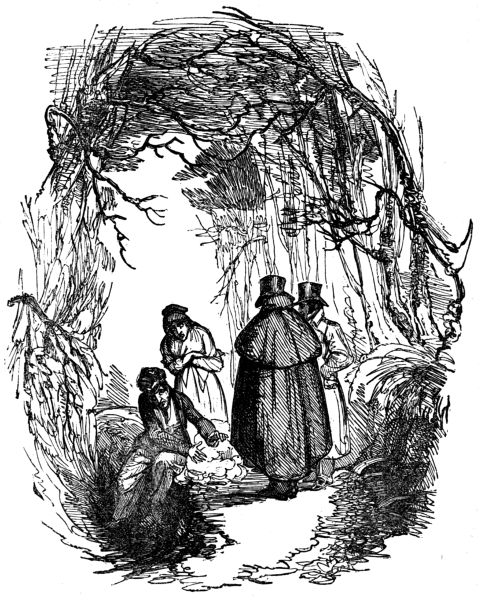
On the 28th of November Mr. S., as the agent of a respectable clergyman whose sympathy had been excited by the statements of the Table Book, called on me to make some inquiries into the case, and I invited him to accompany me to Corrall’s shed. We proceeded by a stage to the “Old Mother Red Cap,” Camden-town, and walked from thence along the New Road, leading to Holloway, till we came to the spot at the western corner of Hagbush-lane, on the left-hand side of the road. We had journeyed for nothing—the shed had disappeared from the clay swamp whereon it stood. Along the dreary line of road, and the adjacent meadows, rendered cheerless by alternate frosts and rains, there was not a human being within sight; and we were at least a mile from any place where inquiry could be made, with a chance of success, respecting the fugitives. As they might have retired into the lane for better shelter during the winter, we made our way across the quaggy entrance as well as we could, and I soon recognised the little winding grove, so delightful and lover-like a walk in days of vernal sunshine. Its aspect, now, was gloomy and forbidding. The disrobed trees looked black, like funeral mutes mourning the death of summer, and wept cold drops upon our faces. As we wound our slippery way we perceived moving figures in the distance of the dim vista, and soon came up to a comfortless man and woman, a poor couple, huddling over a small smouldering fire of twigs and leaves. They told us that Corrall and his wife had taken down their shed and moved three weeks before, and were gone to live in some of the new buildings in White-conduit fields. The destitute appearance of our informants in this lonely place induced inquiry respecting themselves. The man was a London labourer out of employment, and, for two days, they had been seeking it in the country without success. Because they were able to work, parish-officers would not relieve them; and they were without a home and without food. They had walked and sauntered during the two nights, for want of a place to sleep in, and occasionally lighted a fire for a little warmth—
“The world was not their friend, nor the world’s law.”
We felt this, and Mr. S. and myself contributed a trifle to help them to a supper and a bed for the night. It was more, by all its amount, than they could have got in that forlorn place. They cheerfully undertook to show us to Corrall’s present residence, and set forward with us. Before we got out of Hagbush-lane it was dark, but we could perceive that the site of Corrall’s cottage and ruined garden was occupied by heaps of gas-manure, belonging to the opulent landowner, whose labourers destroyed the poor man’s residence and his growing stock of winter vegetables.
A last Look at Hagbush-lane.
——“A man may see how this world goes with no eyes. Look with thine ears: see how yon’ justice rails upon yon’ simple thief. Hark in thine ear: change places; and handy dandy, which is the justice, which is the thief?——
“Through tatter’d cloaths small vices do appear; Robes and furr’d gowns hide all. Plate sin with gold, And the strong lance of justice hurtless breaks: Arm it in rags, a pigmy’s straw doth pierce it.”
We found Corrall and his wife and child at No. 3, Bishop’s-place, Copenhagen-street. The overseers would have taken them into the workhouse, but the old man and his wife refused, because, according to the workhouse rules, had they entered, they would have been separated. In “The Form of Solemnization of Matrimony,” it is enjoined, after the joining of hands, “Those whom God hath joined together, let no man put asunder;” and though this prescription is of the highest order of law, yet it is constantly violated by parochial authority. Corrall is sixty-nine years old, and his wife’s lungs appear diseased. Were they together in the poor-house they would be as well circumstanced as they can ever hope or wish; but, this not being allowed, they purpose endeavouring to pick up a living by selling ready dressed meat and small beer to labouring people. Their child, a girl about seven years of age, seems destined to a vagabond and lawless life, unless means can be devised to take her off the old people’s hands, and put her to school. On leaving them I gave the wife five shillings, which a correspondent sent for their use:[511] and Mr. S. left his address, that, when they get settled, they may apply to him as the almoner of the benevolent clergyman, on whose behalf he accompanied me to witness their situation.——
This notice will terminate all remark on Hagbush-lane: but I reiterate, that since it ceased to be used as the common highway from the north of England into London, it became a green lane, affording lovely walks to lovers of rural scenery, which lawless encroachments have despoiled, and only a few spots of its former beauty remain. It is not “waste” of the manors through which it passes, but belongs to the crown; and if the Commissioners of Woods and Forests survey and inquire, they will doubtless claim and possess themselves of the whole, and appropriate it by sale to the public service. True it is, that on one or two occasions manor homages have been called, and persons colourably admitted to certain parcels; but the land so disposed of, a homage could not legally admit claimants into possession of; nor could an entry on the court rolls confer a legal title. Indeed the court rolls themselves will, at least in one instance, show that the steward has doubted his lord’s right; and the futility of such a title has seemed so obvious, that some who retain portions of Hagbush-lane actually decline admission through the manor-court, and hold their possessions by open seizure, deeming such a holding as legal, to all intents and purposes, as any that the lord of the manor can give. Such possessors are lords in their own right—a right unknown to the law of England—founded on mere force; which, were it exercised on the personalties of passengers, would infallibly subject successful claimants to the inconvenience of taking either a long voyage to New South Wales, or, perhaps, a short walk without the walls of Newgate, there to receive the highest reward the sheriff’s substitute can bestow.
*
Discoveries OF THE ANCIENTS AND MODERNS. No. XXXV.
Ancient Chemistry, &c.
Distillation.—It has been questioned whether the ancients were acquainted with this art, but a passage of Dioscorides not only indicates the practice, but shows that the name of its principal instrument, the alembic, was derived from the Greek language. Pliny gives the same explanation, as Dioscorides does, of the manner of extracting quicksilver from cinnabar by distillation. And Seneca describes an instrument exactly resembling the alembic. Hippocrates even describes the process of distillation. He talks of vapours from the boiling fluid, which meeting with resistance stop and condense, till they fall in drops. Zosimus of Panopolis, an Egyptian city, desires his students to furnish themselves with alembics, gives them directions how to use them, describes them, and presents drawings of such as best deserve to be employed in practice.
Alcalis and Acids.—Of the substances promiscuously termed lixivial salt, sal alcali, rock-salt, &c., Aristotle speaks, when he says that in Umbria the burnt ashes of rushes and reeds, boiled in water, yield a great quantity of salt. Theophrastus observes the same. Varro relates of dwellers on the borders of the Rhine, who having neither sea nor pit salt, supply themselves by means of the saline cinders of burnt plants. Pliny speaks of ashes as impregnated with salts, and in particular of the nitrous ashes of burnt oak; adding, that these salts are used in medicine, and that a dose of lixivial ashes is an excellent remedy. Hippocrates, Celsus, Dioscorides, and especially Galen, often recommend the medical use of sal alcali. To the mixture of acids and alcali, Plato ascribed fermentation. Solomon seems to have known this effect of them, when he speaks of “vinegar upon nitre.”
Cleopatra’s Pearl.—A convincing proof of the ability of the ancients in chemistry is the experiment with which Cleopatra entertained Marc Antony, in dissolving before him, in a kind of vinegar, a pearl of very great value, (above 45,450l. sterling.) At present we know not of any “vinegar” that can produce this effect; but the fact is well attested. Probably the queen added something to the vinegar, omitted by the historian. The aid of Dioscorides, surnamed Phacas, who was her physician, might have enabled her thus to gain her wager with Marc Antony, that she would exceed him in the splendour and costliness of her entertainment. But Cleopatra herself was a chemical adept, as appears from some of her performances still in the libraries of Paris, Venice, and the Vatican. And Pliny informs us of the emperor Caius, that by means of fire he extracted some gold from orpiment.
Malleability of Glass.—The method of rendering glass ductile, which is to us a secret, was assuredly a process well known to the ancients. Some still doubt of it, as others have of the burning glasses of Archimedes. Because forsooth they do not know how it could be effected, they will not admit the fact, notwithstanding the exact accounts we have of it, till somebody again recovers this lost or neglected secret, as Kircher and Buffon did that of Archimedes’s mirrors. Pliny says, the flexibility of glass was discovered in the time of Tiberius; but that the emperor fearing lest gold and silver, those most precious metals, should thereby fall in their value, so as to become contemptible, ordered the residence, workhouse, and tools of the ingenious artisan to be destroyed, and thus strangled the art in its infancy. Petronius is more diffuse. He says, that in the time of Tiberius there was an artificer who made vessels of glass, which were in their composition and fabric as strong and durable as silver or gold; and that being introduced into the presence of the emperor, he presented him with a vase of this kind, such as he thought worthy of his acceptance. Meeting with the praise his invention deserved, and finding his present so favourably received, he threw the vase with such violence upon the floor, that had it been of brass it must have been injured by the blow; he took it up again whole, but dimpled a little, and immediately repaired it with a hammer. While in expectation of ample recompense for his ingenuity, the emperor asked him whether any body else was acquainted with this method of preparing glass, and being assured that no other was, the tyrant ordered his head to be immediately struck off; lest gold and silver, added he, should become as base as dirt. Dion Cassius, on this head, confirms the attestations of Pliny and Petronius. Ibn Abd Alhokim speaks of malleable glass as a thing known in the flourishing times of Egypt. Greaves, in his work on Pyramids, mentions him as a celebrated chronologist among the Arabians, and cites from him that “Saurid built in the western pyramid thirty treasuries, filled with store of riches and utensils, and with signatures made of precious stones, and with instruments of iron and vessels of earth, and with arms which rust not, and with glass which might be bended, and yet not broken, &c.” There is, however, a modern chemical composition, formed of silver dissolved in acid spirits, and which is called cornu lunæ, or horned moon, a transparent body, easily put into fusion, and very like horn or glass, and which will bear the hammer. Borrichius, a Danish physician of the seventeenth century, describes an experiment of his own, by which he obtained a pliant and malleable salt: he gives the receipt, and concludes from thence, that as glass for the most part is only a mixture of salt and sand, and as the salt may be rendered ductile, glass may be made malleable: he even imagines that the Roman artificer, spoken of by Pliny and Petronius, may have successfully used antimony as the principal ingredient in the composition of his vase. Descartes supposed it possible to impart malleability to glass, and Morhoff assures us that Boyle was of the same opinion.
Painting on Glass.—This art, so far as it depends upon chemistry, was carried formerly to high perfection. Of this we have striking instances in the windows of ancient churches, where paintings present themselves in the most vivid colours, without detracting from the transparency of the glass. Boerhave and others observe, that we have lost the secret to such a degree, that there are scarcely any hopes of recovering it. Late experiments go far towards a successful restoration of this art.
Democritus.—This eminent man, who was a native of Abdera in Thrace, flourished upwards of four centuries before the Christian æra. For the sake of acquiring wisdom he travelled into Egypt, and abode with the priests of the country. He may be deemed the father of experimental philosophy. It is affirmed that he extracted the juice of every simple, and that there was not a quality belonging to the mineral or vegetable kingdoms that escaped his notice. Seneca says, that he was the inventor of reverberating furnaces, the first who gave a softness to ivory, and imitated nature in her production of precious stones, particularly the emerald.
Gunpowder.—Virgil and his commentator Servius, Hyginus, Eustathius, La Cerda, Valerius Flaccus, and many other authors, speak in such a manner of Salmoneus’s attempts to imitate thunder, as suggest to us that he used a composition of the nature of gunpowder. He was so expert in mechanics, that he formed machines which imitated the noise of thunder, and the writers of fable, whose surprise in this respect may be compared to that of the Mexicans when they first beheld the fire-arms of the Spaniards, give out that Jupiter, incensed at the audacity of this prince, slew him with lightning. It is much more natural to suppose that this unfortunate prince, as the inventor of gunpowder, gave rise to these fables, by having accidentally fallen a victim to his own experiments. Dion and Joannes Antiochenus report of the emperor Caligula, that he imitated thunder and lightning by means of machines, which at the same time emitted stones. Themistius relates, that the Brachmans encountered one another with thunder and lightning, which they had the art of launching from on high at a considerable distance. Agathias reports of Anthemius Traliensis, that having fallen out with his neighbour, Zeno the rhetorician, he set fire to his house with thunder and lightning. Philostrates, speaking of the Indian sages, says, that when they were attacked by their enemies they did not leave their walls to fight them, but repelled and put them to flight by thunder and lightning. In another place he alleges that Hercules and Bacchus attempting to assail them in a fort where they were entrenched, were so roughly received by reiterated strokes of thunder and lightning, launched upon them from on high by the besieged, that they were obliged to retire. The effects ascribed to these engines could scarcely be brought about but by gunpowder. In Julius Africanus there is a receipt for an ingenious composition to be thrown upon an enemy, very nearly resembling that of gunpowder. But that the ancients were acquainted with it seems proved beyond doubt, by a clear and positive passage of an author called Marcus Græcus, whose work in manuscript is in the Royal Library at Paris, entitled “Liber Ignium.” The author, describing several ways of encountering an enemy, by launching fire upon him, among others gives the following receipt:—Mix together one pound of live sulphur, two of charcoal of willow, and six of saltpetre; reduce them to a very fine powder in a marble mortar. He directs a certain quantity of this to be put into a long, narrow, and well-compacted cover, and so discharged into the air. Here we have the description of a rocket. The cover with which thunder is imitated he represents as short, thick, but half-filled, and strongly bound with packthread, which is exactly the form of a cracker. He then treats of different methods of preparing the match, and how one squib may set fire to another in the air, by having it enclosed within it. In short, he speaks as clearly of the composition and effects of gunpowder as any body in our times could do. This author is spoken of by Mesue, an Arabian physician, who flourished in the beginning of the ninth century. There is reason to believe that he is the same of whom Galen speaks.
Generation.
There are two theories on this subject among the moderns. Harvey, Stenon, Graaf, Redi, and other celebrated physicians, maintain that all animals are oviparous, and spring from eggs, which in the animal kingdom are what seed is in the vegetable. Hartsoëker and Lewenhoek are of a different opinion, and maintain that all animals spring by metamorphosis from little animals of extreme minuteness.
The first of these systems is merely a revival of that taught by Empedocles, as cited by Plutarch and Galen, and next to him Hippocrates, Aristotle, and Macrobius. The other system, that of animalcula or spermatic vermiculi, is but a revival of the opinions of Democritus and other ancients.
Hippocrates, founding himself upon a principle universally received by antiquity that nothing arises from nothing, advanced that nothing in nature absolutely perished; that nothing, taking it altogether, was produced anew; nothing born, but what had a prior existence; that what we call birth, is only such an enlargement as brings from darkness to light, or renders visible, those small animalcula which were before imperceptible. He maintains that every thing increases as much as it can, from the lowest to the highest degree of magnitude. These principles he afterwards applies to generation, and declares that the larger sizes arise out of the lesser; that all the parts successively expand themselves, and grow and increase proportionally in the same series of time; that none of them in reality takes the start of another, so as to be quicker or slower in growth; but that those which are naturally larger sooner appear to the eye, than those which are smaller, though they by no means preceded them in birth or existence.
Polypi.—The multiplicity of animation of which the polypus is capable, supposed to have been discovered by the moderns, was known to the ancients. There are passages of Aristotle and St. Augustine, wherein they speak of it as a thing which they knew from their own experience. The latter, in his book entitled “De Quantitate Animæ,” relates, that one of his friends performed the experiment before him of cutting a polypus in two; and that immediately the separated parts betook themselves to flight, moving with precipitation, the one one way, and the other another. Aristotle, speaking of insects with many feet, says, that there are of these animals or insects, as well as of plants and trees, that propagate themselves by shoots: and as what were but the parts of a tree before, become thus distinct and separate trees; so in cutting one of these animals, says Aristotle, the pieces which before composed altogether but one animal, become all of a sudden so many different individuals. He adds, that the animating principle in these insects is in effect but one, though multiplied in its powers, as it is in plants.
The Sexual System of Plants.
Vivunt in Venerem frondes, omnesque vicissim Felix arbor amat, nutant ad mutua palmæ Fœdera, populeo suspirat populus ictu, Et platani platanis, alnoque assibilat alnus.
Claudian. de Nuptiis Honorii et Mariæ.
Claudian’s verses have been thus familiarly Englished:—“The tender boughs live together in love, and the happy trees pass their time entirely in mutual embraces. Palms by consent salute and nod to each other; the poplar, smitten with the poplar, sighs; whilst planes and alders express their affection in the melody of whispers.” This allusion to the “Loves of the Plants” was not a mere imagination of the old poet: their sexual difference was known to the old philosophers. “Naturalists,” says Pliny, “admit the distinction of sex not only in trees, but in herbs, and in all plants.”
Astronomy—Mathematics—Mechanics—Optics, &c.
The Vibration of the Pendulum was employed, for the purpose it is still applied to, by the ancient Arabians, long before the epoch usually assigned to its first discovery. A learned gentleman at Oxford, who carefully examined the Arabian manuscripts in the library of that university, says, “The advantages recommending the study of astronomy to the people of the East were many.” He speaks of “the serenity of their weather; the largeness and correctness of the instruments they made use of much exceeding what the moderns would be willing to believe; the multitude of their observations and writings being six times more than what has been composed by Greeks and Latins; and of the number of powerful princes who, in a manner becoming their own magnificence, aided them with protection.” He affirms, that it is easy “to show in how many respects the Arabian astronomers detected the deficiency of Ptolemy, and the pains they took to correct him; how carefully they measured time by water-clocks, sand-glasses, immense solar dials, and even by the vibrations of the pendulum; and with what assiduity and accuracy they conducted themselves in those nice attempts, which do so much honour to human genius—the taking the distances of the stars, and the measure of the earth.”
Refraction of Light.—According to Roger Bacon, Ptolemy, the great philosopher and geometrician, gave the same explanation of this phenomenon, which Descartes has done since; for he says, that “a ray, passing from a more rare into a more dense medium, becomes more perpendicular.” Ptolemy wrote a treatise on optics whence Alhazen seems to have drawn whatever is estimable in what he advances about the refraction of light, astronomical refraction, and the cause of the extraordinary size of planets when they appear on the horizon. Ptolemy, and after him Alhazen, said, that “when a ray of light passes from a more rare into a more dense medium, it changes its direction when it arrives upon the surface of the latter, describing a line which intersects the angle made by that of its first direction, and a perpendicular falling upon it from the more dense medium.” Bacon adds, after Ptolemy, that “the angle formed by the coincidence of those two lines is not always equally divided by the refracted ray; because in proportion to the greater or less density of the medium, the ray is more or less refracted, or obliged to decline from its first direction.” Sir Isaac Newton subsequently deducing the cause of refraction, from the attraction made upon the ray of light by the bodies surrounding it, says, “that mediums are more or less attractive in proportion to their density.”
Astronomic Refraction.—Ptolemy, acquainted with the principle of the refraction of light, could not fail to conclude that this was the cause of the appearance of planets upon the horizon before they came there. Hence he accounted for those appearances from the difference there was between the medium of air, and that of ether which lay beyond it; so that the rays of light coming from the planet, and entering into the denser medium of our atmosphere, must of course be so attracted as to change their direction, and by that means bring the star to our view, before it really come upon the horizon.
Why Stars appear largest upon the Horizon is attempted to be accounted for by Roger Bacon. He says it may proceed from this, that the rays coming from the star are made to diverge from each other, not only by passing from the rare medium of ether into the denser one of our surrounding air, but also by the interposition of clouds and vapours arising out of the earth, which repeat the refraction and augment the dispersion of the rays, whereby the object must needs be magnified to our eye. He afterwards adds, that there has been assigned by Ptolemy and Alhazen another more reasonable cause. These authors thought that the reason of a star’s appearing larger at its rising or setting than when viewed over head arose from this, that when the star is over head there are no immediate objects perceived between it and us, so that we judge it nearer to us, and are not surprised at its littleness; but when a star is viewed on the horizon, it lies then so low that all we can see upon earth interposes between it and us, which making it appear at a greater distance, we are surprised at observing it so large, or rather imagine it larger than it is. For the same reason the sun and moon, when appearing upon the horizon, seem to be at a greater distance, by reason of the interposition of those objects which are upon the surface of our earth, than when they are over head; and consequently there will arise in our minds an idea of their largeness, augmented by that of their distance, and this of course must make them appear larger to us, when viewed on the horizon, than when seen in the zenith.
Perspective of the Ancients.—Most of the learned deny the ancients the advantage of having known the rules of perspective, or of having put them in practice, although Vitruvius makes mention of the principles of Democritus and Anaxagoras respecting that science, in a manner that plainly shows they were not ignorant of them. “Anaxagoras and Democritus,” says he, “were instructed by Agatarchus, the disciple of Eschylus. They both of them taught the rules of drawing, so as to imitate from any point of view the prospect that lay in sight, by making the lines in their draught, issuing from the point of view there, exactly resemble the radiation of those in nature; insomuch, that however ignorant any one might be of the rules whereby this was performed, yet they could not but know at sight the edifices, and other prospects which offered themselves in the perspective scenes they drew for the decoration of the theatre, where, though all the objects were represented on a plain surface, yet they swelled out, or retired from the sight, just as objects do endowed with all dimensions.” Again he says, that the painter Apatarius drew a scene for the theatre at Tralles, “which was wonderfully pleasing to the eye, on account that the artist had so well managed the lights and shades, that the architecture appeared in reality to have all its projections.” Pliny says, that Pamphilus, who was an excellent painter, applied himself much to the study of geometry, and maintained that “without its aid it was impossible ever to arrive at perfection in that art.” Pliny elsewhere says, that Apelles fell short of Asclepiodorus in “the art of laying down distances in his paintings.” Lucian, in his Dialogue of Zeuxis, speaks of the effects of perspective in pictures, and Philostratus, in his preface to his Drawings, or History of Painting, makes it appear that he knew this science; and in his account of Menoetius’s picture of the siege of Thebes, describes the happy effects of perspective when studied with care.
Optical Problem.—Aristotle was the first who proposed the famous problem respecting the roundness of that image of the sun, which is formed by his rays passing through a small puncture, even though the hole itself be square or triangular. “Why is it,” inquires Aristotle, “that the sun, in passing through a square puncture, forms itself into an orbicular, and not into a rectilinear figure, as when it shines through a grate? Is it not because the efflux of its rays, through the puncture, converges it into a cone, whose base is the luminous circle?”
Squaring the Circle.—If there remain any hope of solving this problem it is founded on that discovery of Hippocrates of Chios, called the squaring of the Lunulæ, which is said to have first put him in heart, they say, to attempt the squaring of the circle. This Hippocrates must not be confounded with the father of medicine, who was of the isle of Cos. He who is spoken of here was a famous geometrician, and lived about five hundred years before Jesus Christ.
Anaxagoras appears to have been the first who dared this enterprise, and it was when he was in prison at Athens. Plutarch says positively that he achieved it; but this must be looked upon only as a general expression. Aristotle in many places mentions the efforts of the Pythagoreans Bryson and Antiphon, who likewise flattered themselves with having found out the square of the circle. Aristophanes jeers the learned of his time for attempting to resolve this problem. One of the nearest approximations to the solution of this problem is that of Archimedes. He found the proportion of the diameter to the circumference to be as 7 to 22, or somewhat between 21 and 22; and it is in making use of Archimedes’s method, that Wallis lays down rules for attaining nearly the square of the circle; yet they bring us not fully up to it, how far soever we advance. Archimedes contented himself with what he had in view, which was to find out a proportion that would serve all the purposes of ordinary practice. What he neglected to do, by extended approximations was afterwards performed by Apollonius, and by Philo of Gadare, who lived in the third century.
The Squaring of the Parabola is one of the geometrical discoveries which has done most honour to Archimedes. It is remarked to have been the first instance of the reducing a curve figure exactly into a square, unless we admit of Hippocrates’s squaring the lunulæ to have been of this sort.
The Burning Glasses, employed by Archimedes to set fire to the Roman fleet at the siege of Syracuse, Kepler, Naudéus, and Descartes have treated as fabulous, though attested by Diodorus Siculus, Lucian, Dion, Zonaras, Galen, Anthemius, Eustathius, Tzetzes, and other eminent authors. Some have pretended to demonstrate by the rules of catoptrics the impossibility of it; but Kircher, attentively observing the description which Tzetzes gives of the burning glasses of Archimedes, resolved upon an experiment; and having, by means of a number of plain mirrors, collected the sun’s rays into one focus, he by an increased number of mirrors produced the most intense degree of solar heat. Tzetzes says, that “Archimedes set fire to Marcellus’s navy, by means of a burning glass composed of small square mirrors, moving every way upon hinges; which, when placed in the sun’s rays, directed them upon the Roman fleet so as to reduce it to ashes at the distance of a bow-shot.” Buffon’s celebrated burning glass, composed of 168 little plain mirrors, produced so considerable a heat, as to set wood in flames at the distance of two hundred and nine feet; melt lead, at that of one hundred and twenty; and silver, at that of fifty.
Anthemius of Tralles in Lydia, celebrated as an able architect, sculptor, and mathematician, who in the emperor Justinian’s time built the church of St. Sophia at Constantinople, wrote a small treatise in Greek, which is extant only in manuscript, entitled “Mechanical Paradoxes,” wherein is a chapter respecting burning glasses, with a complete description of the requisites, which, according to this author, Archimedes must have possessed to enable him to set fire to the Roman fleet. His elaborate description demonstrates the possibility of a fact so well attested in history. Zonaras, speaking of Archimedes’s glasses, mentions those of Proclus, who, he says, burnt the fleet of Vitellius at the siege of Constantinople, in imitation of Archimedes, who set fire to the Roman fleet at the siege of Syracuse. He intimates that the manner wherein Proclus effected this, was by launching upon the vessels, from the surface of reflecting mirrors, such a quantity of flame as reduced them to ashes.
Refracting Burning Glasses were certainly known to the ancients. Pliny and Lactantius speak of glasses that burnt by refraction. The former tells of balls or globes of glass, or crystal, which exposed to the sun transmit a heat sufficient to set fire to cloth, or corrode away the dead flesh of those patients who stand in need of caustics; and the latter, after Clemens Alexandrinus, takes notice that fire may be kindled, by interposing glasses filled with water between the sun and the object, so as to transmit the rays to it. Aristophanes, in his comedy of the Clouds, introduces Socrates as examining Strepsiades about the method he had discovered for getting clear for ever of his debts. The latter replies, that he thought of making use of a burning glass, which he had hitherto used in kindling his fire; for, says he, should they bring a writ against me, I’ll immediately place my glass in the sun, at some little distance from the writ, and set it a fire.
Erratum.
Col. 455, line 10 from the bottom, for “Hartley Common,” read “Startley Common.”
For the Table Book.
FREE TRANSLATION OF A DRINKING SONG, BY GOETHE.
Sung by the Poet at a Meeting of Friends, to join which he and others had travelled a considerable distance.
1.
Celestial rapture seizes me, Your inspiration merely; It lifts me to the winking stars, I seem to touch them nearly: Yet would I rather stay below, I can declare sincerely, My song to sing, my glass to ring With those I love so dearly.
2.
Then wonder not to see me here To prop a cause so rightful: Of all lov’d things on this lov’d earth To me ’tis most delightful. I vow’d I would among ye be In scorn of fortune spiteful; So here I came, and here I am, To make the table quite full.
3.
When thus we should together meet, Not quickly to be sunder’d, I hoped at other Poets’ songs My joy, too, should be thunder’d. To join such brothers who would grudge To travel miles a hundred! So eager some this day to come, Through very haste they blunder’d.
4.
Long life to him who guards our lives! My doctrine’s not learnt newly: We’ll first do honour to our King, And drink to him most duly. May he his foes without o’ercome, Within quell all unruly; And grant support of every sort, As we shall serve him truly!
5.
Thee next I give—thou only one, Who all thy sex defeatest! Each lover deems right gallantly, His mistress the completest. I therefore drink to her I love; Thou, who some other greetest, Ne’er drink alone—still think thine own As I do mine—the sweetest!
6.
The third glass to old friends is due, Who aid us when we need it. How quickly flew each joyous day With such kind hearts to speed it! When fortune’s storm was gathering dark We had less cause to heed it: Then fill the glass—the bottle pass— A bumper!—we’ve agreed it!
7.
Since broader, fuller, swells the tide Of friends, as life advances, Let’s drink to every lesser stream, The greater that enhances. With strength united thus we meet, And brave the worst mischances; Since oft the tide, must darkly glide That in the sunlight dances.
8.
Once more we meet together here, Once more in love united: We trust that others’ toils like ours, Like ours will be requited. Upon the self-same stream we see Full many a mill is sited! May we the weal of all men feel, And with it be delighted.
J. P. C.