Volume 1 — Vol. I.—19.
Reading edition
OFFICE OF LORD HIGH ADMIRAL.
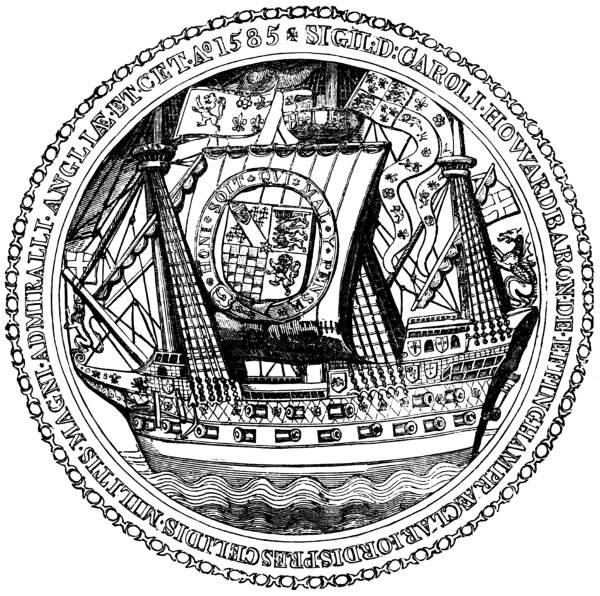
Seal and Autograph of the Lord High Admiral,
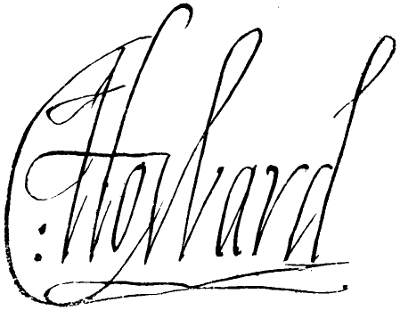
Charles Lord Howard of Effingham, 1585.
OFFICE OF LORD HIGH ADMIRAL.
An engraving of the great seal of Charles Lord Howard of Effingham, as high admiral of England, with another, his lordship’s autograph, are presented to the readers of the Table Book from the originals, before the Editor, affixed to a commission in the first year of that nobleman’s high office, granting to sir Edward Hoby, knight, the vice-admiralty of the hundred of Milton, in the county of Kent.[167]
It will be remembered, that the lord Howard of Effingham, afterwards created earl of Nottingham, was the distinguished admiral of the English fleet, which, in conjunction with the winds of heaven, dispersed and destroyed the formidable Spanish armada for the invasion of England in 1588, during the reign of queen Elizabeth. These engraved representations therefore are no mean illustrations to a short account of the office of lord high admiral, which, after having been in commission upwards of a century, is revived in the person of the heir apparent to the throne.
It is commonly said, that we have obtained the term admiral from the French. The first admiral of France, or that ever had been there by title of office, was Enguerrand de Bailleul, lord of Coucy, who was so created by Philip the Hardy in 1284, and under that title appointed to command a fleet for the conquest of Catalonia and other Spanish provinces from Peter of Arragon.
The French are presumed to have gained the term in the crusades a little before this period, under St. Lewis, who instituted the order of “the ship,” an honour of knighthood, to encourage and reward enterprise against the Turks. The collar of this order, at the lower end whereof hung a ship, was interlaced on double chains of gold, with double scallop-shells of gold, and double crescents of silver interwoven, “which figured the sandy shore and port of Aigues-Mortes, and, with the ship, made manifest declaration that this enterprise was to fight with infidel nations, which followed the false law of Mahomet who bare the crescent.”[168] The chief naval commander of the Saracens is said to have been called the admirante, and from him the French are conjectured to have gained their amiral: if they did, it was the only advantage secured to France by the expedition of St. Lewis.[169]
Still, however, whether the French amiral, comes from the Saracen admirante is doubtful; and though the title occurs in French history, before we discover admiral in our own, it is also doubtful whether we derive it from our neighbours. The Saxons had an officer, whom from his duties they called “Aen-Mere-all, that is All upon the sea:”[170] this title therefore of our ancient ancestors may reasonably be presumed to have been the etymon of our admiral.
William de Leybourne was the first Englishman that had the style of admiral. At the assembly at Bruges in 1297, (25 Edward I.) he was styled Admirallus Maris Regis, and soon after the office became tripartite. We subsequently meet with the titles of admiralty of the north and of the west, and in 1387 (10 Richard II.) we find Richard, son of Allan, earl of Arundel and Surry, denominated Admirallus Angliæ: this is the earliest mention of that style.[171]
Charles, lord Howard of Effingham, the illustrious high admiral of Elizabeth, held the office eighteen years under his heroic mistress, and was continued in it fourteen years longer by her successor James I. In 1619 he was succeeded in it by George, marquis (afterwards the first duke) of Buckingham, who held the dignity till 1636, (temp. Car. I.) when it was in commission for a week, and then conferred on Algernon, earl of Northumberland, and afterwards, by the parliament, on Robert, earl of Warwick. He surrendered his commission in 1645, under an ordinance that members should have no employment, and the office was executed by a committee of both houses, of whom the earl was one. In 1649, the commissioners of the admiralty under the Commonwealth were allowed three shillings each per diem.
At the restoration of Charles II. in 1660, his brother James, duke of York, was appointed lord high admiral; but on the passing of the test act in 1673, being a Roman Catholic, he resigned, and the office was put in commission, with prince Rupert as first lord, till 1679. It remained in commission till the end of that reign.
James II. (the duke of York just mentioned) on his accession declared himself, in council, lord high admiral, and lord general of the navy, and during his short reign managed the admiralty affairs by Mr. Secretary Pepys.
Throughout the reign of William III., the admiralty was continued in commission.
Queen Anne, in 1702, appointed her consort, prince George of Denmark, lord high admiral of England; he executed the office under that style, with a council, till 1707, when, on account of the union, he was styled lord high admiral of Great Britain, and so continued with a council as before. He died October 28, 1708, and the queen acted by Mr. Secretary Burchel, till the 29th of November, when her majesty appointed Thomas, earl of Pembroke, lord high admiral of Great Britain, with a fee of 300 marks per annum. In November, 1709, the admiralty was again put in commission, and has been so continued from that time till April 1827, when the duke of Clarence was appointed lord high admiral of Great Britain.
The lord high admiral has the management and controul of all maritime affairs, and the government of the royal navy. He commissions all naval officers, from an admiral to a lieutenant; he takes cognizance and decides on deaths, murders, maims, and all crimes and offences committed on or beyond sea, in all parts of the world, on the coasts, in all ports or havens, and on all rivers to the first bridge from the sea. He appoints deputies for the coasts, coroners for the view of dead bodies found at sea, or on the waters within his jurisdiction, and judges for his court of admiralty. To him belongs all fines and forfeitures arising from the exercise of his office, the goods of pirates, &c. maritime deodands, wrecks, salvage, sea-prize, waifs and strays, porpoises, and other great sea-fishes, called royal fishes, whale and sturgeon only excepted.[172] He is conservator of rivers and public streams, and of all ships and fisheries, with power to reform unlawful nets and engines; and he arrests and seizes ships, impresses mariners, pilots, masters, gunners, bombardiers, and any other persons wheresoever they may be met with, as often as the naval service may require.[173] Formerly, in common with other admirals, he wore a whistle suspended by a gold chain, with which he cheered his men to action, but which has now descended to the boatswain.[174]
The powers of the commission from the lord Howard of Effingham, high admiral of England, to sir Edward Hoby, may further illustrate the nature and extent of this high office. The deed itself is in Latin, fairly engrossed on parchment, with a large and fine illumination, entirely filling the side and bottom margins, representing a branch of white roses tinged with red, entwined with a branch of honeysuckle, the leaves and flowers in fair and proper colours.
This commission empowers “sir Edward Hobbie, knight,” to take cognizance of, and proceed in all civil and maritime causes, contracts, crimes, offences, and other matters, appertaining to the jurisdiction of the English admiralty of the queen in the hundred of Milton in the county of Kent, and the maritime parts thereof, and thereto adjacent, and to hear and determine the same: And to inquire by the oath of good and loyal men of the said hundred of all traitors, pirates, homicides, and felons, and of all suicides, and questionable deaths and casualties within such admiralty jurisdiction, and of their estates, and concerning whatever appertains to the office of the lord high admiral in the said hundred. And of and concerning the anchorage and shores and the royal fishes, viz. sturgeons, whales, shellfish, (cetis,) porpoises, dolphins, rigge and grampuses, and generally of all other fishes whatsoever, great and small, belonging to the queen in her office of chief admiralty of England: And to obtain and receive all pecuniary penalties in respect of crimes and offences belonging to such jurisdiction within the said hundred, and to decide on all such matters: And to proceed against all offenders according to the statutes of the queen and her kingdom, and according to the admiralty power of mulcting, correcting, punishing, castigating, reforming, and imprisoning within the said hundred or its jurisdiction: And to inquire concerning nets of too small mesh, and other contrivances, or illicit instruments, for the taking of fish: And concerning the bodies of persons wrecked and drowned in the waters of the hundred: And concerning the keeping and preservation of the statutes of the queen and her kingdom in the maritime parts of the said hundred: And concerning the wreck of the sea: And to exercise the office of coroner, according to the statutes in the third and fourth years of Edward the First: And to proceed according to the statutes concerning the damage of goods upon the sea in the 27th year of Edward III.: “And you the aforesaid sir Hobbie, our vice-admiral, commissary, and deputy in the office of vice-admiralty, in and over the aforesaid hundred of Milton, we appoint, recommending to you and your locum tenens firmness in the execution of your duty, and requiring you yearly in Easter and Michaelmas term to account to the Court of Admiralty your proceedings in the premises.”—— “Given at Greenwich under our great seal the twelfth day of the month of July in the year of our Lord from the incarnation one thousand five hundred and eighty-five, and in the twenty-seventh year of the reign of our most serene lady Elizabeth by the grace of God queen of England, France, and Ireland, defender of the faith, &c.”
The “great seal” above mentioned is the great seal of the admiralty, engraved on a preceding page, and as there represented, of the exact size of the seal appended to the commission.
Milton Hundred, Kent.
Through a different source than that, whence the commission just set forth came to hand, the Editor has now before him various original papers formerly belonging to sir Edward Hoby, concerning his private and public concerns. The two following relate to the hundred of Milton.
I.
Articles of the Queene’s Majestie Lands belonging to the Mannor of Milton with ther yearly values as they wilbe letten, and of the other benefitts belonging to the same mannor, which are now letten by her Majestie in farme.
Acres. Value.
Earable Lands 276 13s. 4d. 184li.
Meadowe Lands 39 20s. - 39li.
Mershe Lands 12 20s. - 12li.
Pasture Lands 80 15s. - 60li.
(Shent?) Lands 34 6s. 8d. 11li. 6s. 8d.
Towne meade 25 5s. - 6li. 5s.
466 331li. 0s. 8d.
Rents of Assise 115li. 1s. 10d.
The Myll 12li.
Faires and Marketts 10li.
Relieves and Alienac’ons 4li.
Fines and Amercements 6li. 13s. 4d.
Wastes Strayes Fellons - 13li. 6s. 8d.
Goods and Wrack of Sea
161li. 1s. 10d.
492li. 2s. 6d.
Articles of the Queene’s Majestie Lands and other benefitts belonging to the Hundred of Marden now less letten in farme.
Acres. Value.
Queene’s Lands 9 8s. 3li. 12s.
Rents of Assise 14li. 9s. 5d.
Wastes Straies and Fellons goods 3li. 6s. 8d.
21li. 8s. 1d.
S’m Tot. of the proffitte of bothe the mannors - 513li. 10s. 7d.
It is oversom’ed viij p. ann.
II.
Sir Edward Hoby for a Lease of the custodie of Milton and Marden.
The Queene’s Ma’tie by warrant of the late Lord Treasourer the sixt daye of July, in the xiijth Yeare of her Raigne, did graunt Custodia of the Mannor of Milton, and the Hundred of Milton, and Marden, &c. vnto Thomas Randolphe for Threescore years, yieldinge 120li. yearly rent and vjs. viijd increase of the rent. Prouiso semper q’d si aliquis alius plus dare voluerit de incr’o per Annum pro Custod. predict sine fraude vel malo ingenio Quod tunc idem Thomas Randolphe tantum pro eadem soluere teneatur si Custod. voluerit her’e sup’dict.
The Lease is by meane conveyance colorably sett over vnto one Thomas Bodley, but the interest is in one Richard Potman, Attorney towards the Lawe.
Sr Edward Hoby knight the xxvjth of Maye xlmo Regine nunc, before the nowe Lord Treasourer and the Barons of the Exchequer did personally cum, and in wrytinge under his hande, Offer, sine fraude vel malo ingenio, to increase the Queene’s rent 100li. yearly, which sayd Offer was accepted and attested, with Mr. Baron Clarke’s hande redy to be inrolled.
Whereupon the sayd Sr Edward Hoby doth humbly praye that Yor Lo’pp wilbe pleased to gyve warrant for the inrowlinge thereof accordingely, and that a scire facias maye presently be awarded agaynst the Leasee, to shewe cause whye the former Pattent shoulde not be repealed, and the custody aforesayd graunted to the sayd Sr Edward Hoby.
Note.
The lyke tender was heretofore made xxxijdo Regine Elizabeth by Richard Varney Esquyer, agaynst Gregory Wolmer Esquyer, for the Mannor of Torrington Magna: beinge in extent to her Ma’tie for the dett of Phillipp Basset, and leased with the like Prouiso, and thereby obteyned a newe Lease from her Ma’tie.
The preceding documents are so far interesting, as they connect sir Edward Hoby with the hundred of Milton and Maiden, beyond his public office of vice admiral of the former place, and show the underletting of the crown lands in the reign of Elizabeth, with something of the means employed at that time to obtain grants.
Garrick Plays. No. XVI.
[From “Tottenham Court,” a Comedy, by Thomas Nabbs, 1638.]
Lovers Pursued.
Worthgood, Bellamie, as travelling together before daylight.
Worth. Come, my Delight; let not such painted griefs Press down thy soul: the darkness but presents Shadows of fear; which should secure us best From danger of pursuit. Bell. Would it were day! My apprehension is so full of horror; I think each sound, the air’s light motion Makes in these thickets, is my Uncle’s voice, Threat’ning our ruins. Worth. Let his rage persist To enterprise a vengeance, we’ll prevent it. Wrapt in the arms of Night, that favours Lovers, We hitherto have ’scaped his eager search; And are arrived near London. Sure I hear The Bridge’s cataracts, and such-like murmurs As night and sleep yield from a populous number. Bell. But when will it be day? the light hath comfort: Our first of useful senses being lost, The rest are less delighted. Worth. Th’ early Cock Hath sung his summons to the day’s approach: Twill instantly appear. Why startled, Bellamie? Bell. Did no amazing sounds arrive thy ear; Pray, listen. Worth. Come, come; ’tis thy fear suggests Illusive fancies. Under Love’s protection We may presume of safety. (Within.) Follow, follow, follow. Bell. Aye me, ’tis sure my Uncle; dear Love Worthgood? Worth. Astonishment hath seiz’d my faculties. My Love, my Bellamie, ha! Bell. Dost thou forsake me, Worthgood? (Exit, as losing him.) Worth. Where’s my Love? Dart from thy silver crescent one fair beam Through this black air, thou Governess of Night, To shew me whither she is led by fear. Thou envious Darkness, to assist us here, And then prove fatal! (Within.) Follow, follow, follow. Worth. Silence your noise, ye clamorous ministers Of this injustice. Bellamie is lost; She’s lost to me. Not her fierce Uncle’s rage, Who whets your eager aptness to pursue me With threats or promises; nor his painted terrors Of laws’ severity; could ever work Upon the temper of my resolute soul To soften it to fear, till she was lost. Not all the illusive horrors, which the night Presents unto th’ imagination, T’ affright a guilty conscience, could possess me, While I possess’d my Love. The dismal shrieks Of fatal owls, and groans of dying mandrakes, Whilst her soft palm warm’d mine, were music to me.— Their light appears.—No safety does consist In passion or complaints. Night, let thine arms Again assist me; and, if no kind minister Of better fate guide me to Bellamie, Be thou eternal. (Within.) Follow, follow, follow.
Bellamie, alone, in Marybone Park.
Bell. The day begins to break; and trembling Light, As if affrighted with this night’s disaster, Steals thro the farthest air, and by degrees Salutes my weary longings.—O, my Worthgood, Thy presence would have checkt these passions; And shot delight thro’ all the mists of sadness, To guide my fear safe thro’ the paths of danger: Now fears assault me.—’Tis a woman’s voice. She sings; and in her music’s chearfulness Seems to express the freedom of a heart, Not chain’d to any passions.
Song, within.
What a dainty life the Milkmaid leads! When over the flowery meads She dabbles in the dew, And sings to her cow; And feels not the pain Of Love or Disdain. She sleeps in the night, tho’ she toils in the day And merrily passeth her time away. Bell. Oh, might I change my misery For such a shape of quiet!
[From the “Duchess of Suffolk,” an Historical Play, by T. Heywood, 1631.]
A Tragic Pursuit.
The Duchess, with her little child, preparing to escape by night from the relentless persecution of the Romanists.
Duch. (to the Nurse) Give me my child, and mantle;—now Heaven’s pleasure: Farewell;—come life or death, I’ll hug my treasure. Nay, chide not, pretty babe; our enemies come: Thy crying will pronounce thy mother’s doom. Be thou but still; This gate may shade us from their envious will. (Exit.)
(A noise of Pursuers. She re-enters.)
Duch. Oh fear, what art thou? lend me wings to fly; Direct me in this plunge of misery. Nature has taught the Child obedience; Thou hast been humble to thy mother’s wish. O let me kiss these duteous lips of thine, That would not kill thy mother with a cry. Now forward, whither heav’n directs; for I Can guide no better than thine infancy. Here are two Pilgrims bound for Lyon Quay,[175] And neither knows one footstep of the way. (Noise again heard.) Duch. Return you? then ’tis time to shift me hence. (Exit, and presently Re-enters.) Duch. Thus far, but heav’n knows where, we have escaped The eager pursuit of our enemies, Having for guidance my attentive fear. Still I look back, still start my tired feet, Which never till now measured London street: My Honours scorn’d that custom; they would ride; Now forced to walk, more weary pain to bide. Thou shalt not do so, child; I’ll carry thee In Sorrow’s arms to welcome misery. Custom must steel thy youth with pinching want, That thy great birth in age may bear with scant Sleep peaceably, sweet duck, and make no noise: Methinks each step is death’s arresting voice. We shall meet nurse anon; a dug will come, To please my quiet infant: when, nurse, when?
The Duchess, persecuted from place to place, with Berty, her Husband, takes comfort from her Baby’s smiles.
Duch. Yet we have scaped the danger of our foes; And I, that whilom was exceeding weak Through my hard travail in this infant’s birth, Am now grown strong upon necessity, How forwards are we towards Windham Castle? Berty. Just half our way: but we have lost our friends, Thro’ the hot pursuit of our enemies. Duch. We are not utterly devoid of friends; Behold, the young Lord Willoughby smiles on us: And ’tis great help to have a Lord our friend.
C. L.
Theatrical Customs.
PLAY-BILLS.
To the Editor.
Sir,—Conjecturing that some slight notices of the early use of play-bills by our comedians might be interesting to your readers, allow me respectfully to request the insertion of the following:—
So early as 1587, there is an entry in the Stationers’ books of a license granted to John Charlewood, in the month of October, “by the whole consent of the assistants, for the onlye ymprinting of all maner of bills for players. Provided that if any trouble arise herebye, then Charlewoode to bear the charges.” Ames, in his Typogr. Antiq., p. 342, referring to a somewhat later date, states, that James Roberts, who printed in quarto several of the dramas written by the immortal Shakspeare, also “printed bills for the players;” the license of the Stationers’ Company had then probably devolved to him. The announcements of the evening’s or rather afternoon’s entertainment was not circulated by the medium of a diurnal newspaper, as at present, but broadsides were pasted up at the corners of the streets to attract the passerby. The puritanical author of a “Treatise against Idleness, Vaine-playes, and Interludes,” printed in black letter, without date, but possibly anterior to 1587, proffers an admirable illustration of the practice.—“They use,” says he, in his tirade against the players, “to set up their bills upon postes some certain dayes before, to admonish the people to make resort to their theatres, that they may thereby be the better furnished, and the people prepared to fill their purses with their treasures.” The whimsical John Taylor, the water-poet, under the head of Wit and Mirth, also alludes to the custom.—“Master Nat. Field, the player, riding up Fleet-street at a great pace, a gentleman called him, and asked what play was played that day. He being angry to be stay’d on so frivolous a demand, answered, that he might see what play was plaied on every poste. I cry your mercy, said the gentleman, I took you for a poste, you rode so fast.”
It may naturally be inferred, that the emoluments of itinerant players could not afford the convenience of a printed bill, and hence from necessity arose the practice of announcing the play by beat of drum. Will. Slye, who attended Kempe in the provincial enactment of his “Nine Men of Gotham,” is figured with a drum. Parolles, in Shakspeare’s “All’s Well that ends Well,” alludes to this occupation of some of Will. Slye’s fellows, “Faith, sir, he has led the drum before the English comedians.”
The long detailed titles of some of the early quarto plays induce a supposition, that the play-bills which introduced them to public notice were similarly extended. The “pleasant conceited Comedy,” and “the Bloody Tragedy,” were equally calculated to attract idling gazers on the bookstalls, or the “walks at St. Paul’s,” and to draw gaping crowds about some vociferous Autolycus, who was probably an underling belonging to the company, or a servant to one of the players; for, as they ranked as gentlemen, each forsooth had his man. A carping satirical writer, who wrote anonymously “Notes from Blackfriers,” 1617, presents some traces of a play-bill crier of that period.
—————“Prithee, what’s the play? The first I visited this twelvemonth day. They say—‘A new invented boy of purle, That jeoparded his neck to steale a girl Of twelve, and lying fast impounded for’t, Has hither sent his bearde to act his part, Against all those in open malice bent, That would not freely to the theft consent: Faines all to ’s wish, and in the epilogue Goes out applauded for a famous—rogue.’ —Now hang me if I did not look at first, For some such stuff, by the fond-people’s thrust.”
In 1642, the players, who till the subversion of the kingly prerogative in the preceding year, basked in the sunshine of court favour, and publicly acknowledged the patronage of royalty, provoked, by their loyalty, the vengeance of the stern unyielding men in power. The lords and commons, assembled on the second day of September in the former year, suppressed stage plays, during these calamitous times, by the following
Ordinance.
“Whereas the distressed estate of Ireland, steeped in her own blood, and the distracted estate of England, threatened with a cloud of blood, by a Civill Warre; call for all possible meanes to appease and avert the wrath of God, appearing in these judgments; amongst which, fasting and prayer having been often tried to be very effectuall, have bin lately, and are still enjoyned: And whereas public sports doe not well agree with public calamities, nor publike Stage Playes with the seasons of humiliation, this being an exercise of sad and pious solemnity, and the other spectacles of pleasure, too commonly expressing lascivious mirth and levitie: It is therefore thought fit, and ordeined by the Lords and Commons in this Parliament assembled, that while these sad causes, and set times of humiliation doe continue, publike Stage Playes shall cease, and bee forborne. Instead of which, are recommended to the people of this land, the profitable and seasonable considerations of repentance, reconciliation, and peace with God, which probably may produce outward peace and prosperity, and bring againe times of joy and gladnesse to these nations.”
The tenour of this ordinance was strictly enforced; many young and vigorous actors joined the king’s army, in which for the most part they obtained commissions, and others retired on the scanty pittances they had earned, till on the restoration, the theatre burst forth with new effulgence. The play-bill that announced the opening of the new theatre, in Drury-lane, April 8, 1663, has been already printed in the Every-Day Book. The actors’ names were then, for the first time, affixed to the characters they represented; and, to evince their loyalty, “Vivat Rex et Regina,” was appended at the foot of the bills, as it continues to this day.
In the reign of the licentious Charles II., wherein monopolies of all kinds were granted to court favourites, licenses were obtained for the sole printing of play-bills. There is evidence in Bagford’s Collections, Harl. MSS. No. 5910, vol. ii., that in August, 1663, Roger L’Estrange, as surveyor of the imprimery and printing presses, had the “sole license and grant of printing and publishing all ballads, plays, &c. not previously printed, play-bills, &c.” These privileges he sold to operative printers. When that license ceased, I have yet to learn.
The play-bills at Bartholomew-fair were in form the same as those used at the regular theatres; but, as they were given among the populace, they were only half the size. One that Dogget published recently, in my possession, had W. R. in the upper corners, as those printed in the reign of Charles II., had C. R., the royal arms being in the centre.
The luxurious mode of printing in alternate black and red lines, was adopted in Cibber’s time; the bills of Covent-garden theatre were generally printed in that manner. The bills of Drury-lane theatre, within the last ten years, have issued from a private press, set up in a room below the stage of that theatre. The bills for the royal box, on his majesty’s visit to either theatre, are printed on white satin.
Connected with these notices of playbills, are the means by which they were dispersed. A century ago, they were sold in the theatres by young women, called “orange-girls,” some of whom, Sally Harris and others, obtained considerable celebrity; these were succeeded by others, who neither coveted nor obtained notoriety. The “orange-girls” have gone out, and staid married women, who pay a weekly stipend to the box-lobby fruit-woman, now vend play-bills in the theatre, but derive most of their emolument from the sale of the “book of the play,” or “the songs” of the evening. The old cry about the streets, “Choice fruit, and a bill of the play—Drury-lane or Covent-garden,” is almost extinct; the barrow-women are obliged to obtain special permission to remain opposite some friendly shopkeeper’s door; and the play-bills are chiefly hawked by little beggarly boys.
I am, sir, &c. Will o’ the Wisp.
March, 1827.
THE LINNET FANCY.
To the Editor of the Table Book.
It is my fantasie to have these things, For they amuse me in my moody hours: Their voices waft my soul into the woods: Where bends th’ enamour’d willow o’er the stream, They make sweet melody.
Of all the earthly things by which the brain of man is twisted and twirled, heated and cooled, fancy is the most powerful. Like a froward wife, she invariably leads him by the nose, and almost every man is in some degree ruled by her. One fancies a horse, another an ass—one a dog, another a rabbit—one’s delight is in dress, another’s in negligence—one is a lover of flowers, another of insects—one’s mind runs on a pigeon, another’s on a hawk—one fancies himself sick, the doctor fancies he can cure him: death—that stern reality—settles the matter, by fancying both. One, because he has a little of this life’s evil assail him, fancies himself miserable, another, as ragged as a colt, fancies himself happy. One, as ugly as sin, and as hideous as death, fancies himself handsome—another, a little higher than six-penn’orth of halfpence, fancies himself a second Saul. In short, it would take a monthly part of the Table Book to enumerate the different vagaries of fancy—so multifarious are her forms. Leaving this, proceed we to one of the fancies which amuse and divert the mind of man in his leisure and lonely hours—the “Linnet Fancy.”
“Linnet fancy!” I think I hear some taker-up of the Table Book say, “What’s in a linnet?—rubbish—
A bird that, when caught, May be had for a groat.”
Music! I answer—melody, unrivalled melody—equal to Philomel’s, that ever she-bird of the poets.—I wish they would call things by their proper names; for, after all, it is a cock—hens never make harmonious sounds. The fancy is possessed but by a few, and those, generally, of the “lower orders”—the weavers and cobblers of Whitechapel and Spitalfields, for instance. A good bird has been known to fetch ten sovereigns. I have frequently seen three and four given for one.
Whence the song of the linnet was obtained I cannot tell; but, from what I have heard the tit-lark and sky-lark do, I incline to believe that a good deal of theirs is in the song of the linnet. This song consists of a number of jerks, as they are called, some of which a bird will dwell on, and time with the most beautiful exactness: this is termed a “weighed bird.” Others rattle through it in a hurried manner, and take to what is termed battling; these are birds often “sung” against others. It is with them as in a party where many are inclined to sing, the loudest and quickest tires them out; or, as the phrase is, “knocks them down.” These jerks are as under. Old fanciers remember more, and regret the spoliation and loss of the good old strain. I have heard some of them say, that even larks are not so good as they were forty years ago. The reader must not suppose that the jerks are warbled in the apple-pie order in which he sees them here: the birds put them forth as they please: good birds always finish them.
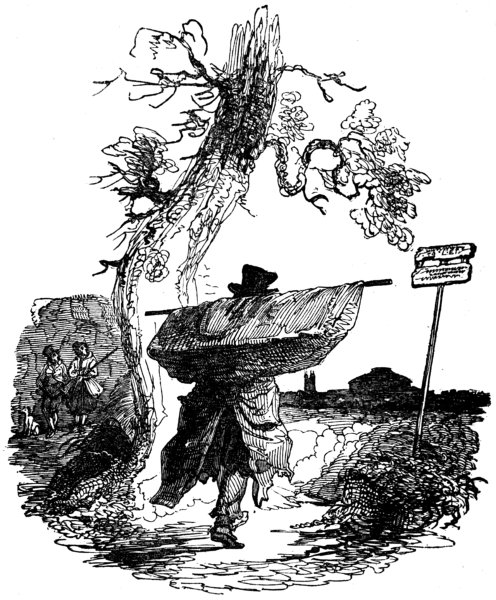
London Bird Catcher, 1827.
Jerks.
Tuck—Tuck—Fear.
Tuck, Tuck, Fear—Ic, Ic, Ic.
Tuck, Tuck, Fear—Ic quake-e-weet. This is a finished jerk.
Tuck, Tuck, Joey.
Tuck, Tuck, Tuck, Tuck, Joey—Tolloc cha, Ic quake-e-weet.
Tuck, Tuck, Wizzey.
Tuck, Tuck, Wizzey—Tyr, Tyr, Tyr, Cher—Wye wye Cher.
Tolloc, Ejup, R—Weet, weet, weet.
Tolloc, Ejup, R—Weet, cheer.
Tolloc, Ejup, R—Weet, weet, weet—cheer.
Tolloc, Tolloc, cha—Ic, Ic, Ic, Ic quake—Ic, Ic.
Tolloc, Tolloc, cha—Ic, Ic, Ic, Ic, quake—Ic, Ic, Tyr, Fear.
Tolloc, Tolloc, R—Weet, weet, weet, cheer—Tolloc, cha—Ejup.
Tolloc, Tolloc, R—Ejup.
Tolloc, Tolloc, R—Cha, cea—Pipe, Pipe, Pipe.
Tolloc, Tolloc, R—Ejup—Pipe, Pipe, Pipe.
Lug, Lug, G—Cher, Cher, Cher.
Lug, Lug—Orchee, weet.
Lug, Lug, G—Pipe, Pipe, Pipe.
Lug, Lug, G—Ic, Ic, Ic, Ic, quake, e Pipe Chow.
Lug, Lug, E chow—Lug, Ic, Ic, quake e weet.
Lug, Lug, or—cha cea.
Ic Ic R—Ejup—Pipe chow.
Lug, Lug, E chow, Lug, Ic, Ic, quake-e-weet.
Ic, Ic, R—Ejup, Pipe.
Ic, Ic, R—Ejup, Pipe, chow.
Ic Ic—R cher—Wye, wye, cher.
Ic, Ic R, cher—Weet, cheer.
Ic, Ic—quake-e-weet.
Ic, chow—E chow—Ejup, weet.
Tyr, Tyr, Cher—Wye, wye, cher.
Bell, Bell, Tyr.
Ejup, Ejup, Pipe, Chow.
Ejup, Ejup, Pipe.
Ejup, Ejup, Poy.
Peu Poy—Peu Poy. This is when calling to each other.
Cluck, Cluck, Cha.
Cluck, Cluck, Cha, Wisk—R, Wisk.
Ic, quake-e-weet—R Cher.
Ic, Quake-e-Pipe—Tolloc Ic—Tolloc Ic Tolloc Ic—R Cher.
Fear, Fear, weet—Ejup, Pipe, Chow.
Pipe, Pipe, Pipe, Pipe—Ejup, Ejup, Ejup.
Ejup R—Lug, Ic, Ic, quake-e-weet.
Ic, Ic, R, Chow, Ic, Ic, R—Ic, Ic, quake, tyr, fear.
Most of these my own birds do. Several strains have been known of the linnet, the best of which I believe was Wilder’s.
The method of raising is this. Get a good bird—as soon as nestlings can be had, purchase four, or even six; put them in a large cage, and feed them with boiled or scalded rape-seed, mixed with bread. This will do till about three weeks old; then throw in dry seed, rape, flax, and canary, bruised; they will pick it up, and so be weaned from the moist food. You may then cage them off in back-cages, and hang them under the old ones.
If you do not want the trouble of feeding them, buy them at a shop about a month old, when they are able to crack the seed. Some persons prefer branchers to nestlings; these are birds caught about July. When they are just able to fly among the trees, they are in some cases better than the others; and invariably so, if they take your old bird’s song, being stronger and steadier. Nestlings lose half their time in playing about the cage.
As two heads are said to be better than one, so are two birds, therefore he who wants to raise a strain, should get two good ones, about the end of May—stop one of them. This is done by putting your cage in a box, just big enough to hold it, having a door in front to pull up. Some have a glass in the door to enable them to see the birds; others keep them in total darkness, only opening their prison to give them food and water. The common way is to put the cage in the box, and close the door, by a little at a time, daily, keeping it in a warm place. This is a brutal practice, which I have never subscribed to, nor ever shall; yet it does improve the bird, both in feather and song. By the time he has “moulted off,” the other bird will “come in” stout, and your young ones will take from him; thus you will obtain good birds.
To render your birds tame, and free in song, move them about; tie them in handkerchiefs, and put them on the table, or any where that you safely can; only let their usual place of hanging be out of sight of each other. Their seeing one another makes them fretful. To prevent this, have tin covers over their water-pots.
The man who keeps birds should pay attention to them: they cannot speak, but their motions will often tell him that something is wrong; and it will then be his business to discover what. He who confines birds and neglects them, deserves to be confined himself; they merit all we can do for them, and are grateful. What a fluttering of wings—what a stretching of necks and legs—what tappings with the bill against the wires of their cages have I heard, when coming down to breakfast; what a burst of song—as much as to say, “Here’s master!”
Should any one be induced, from this perusal, to become a fancier, let him be careful with whom, and how he deals, or he will assuredly be taken in. In choosing a bird, let him see that it stands up on its perch boldly; let it be snake-headed, its feathers smooth and sleek, its temper good; this you may know by the state of its tail: a bad-tempered bird generally rubs his tail down to a mere bunch of rags. Hear the bird sing; and be sure to keep the seller at a distance from him; a motion of his master’s hand, a turn of his head, may stop a bird when about to do something bad. Let him “go through” with his song uninterrupted; you will then discover his faults.
In this dissertation (if it may be so called) I have merely given what has come under my own observation; others, who are partial to linnets, are invited to convey, through the same medium, their knowledge, theoretical and practical, on the subject.
I am, sir, &c. S. R. J.
Foundation of the LONDON UNIVERSITY.
On Monday, the 30th of April, 1827, his royal highness the duke of Sussex laid the foundation-stone of the London University. The spot selected for the building is situated at the end of Gower-street, and comprehends a very extensive piece of ground. The adjacent streets were crowded with passengers and carriages moving towards the place. The day was one of the finest of this fine season. The visiters, who were admitted by cards, were conducted to an elevated platform, which was so much inclined, that the most distant spectator could readily see every particular of the ceremony. Immediately before this platform, and at about three yards distant from it, was another, upon which the foundation-stone was placed. The persons admitted were upwards of two thousand, the greatest proportion composed of well-dressed ladies. Every house in the neighbourhood, which afforded the smallest opportunity of witnessing the operations, was crowded from the windows to the roof; and even many windows in Gower-street, from which no view of the scene could be any way obtained, were filled with company. At a quarter past three o’clock, the duke of Sussex arrived upon the ground, and was greeted by the acclamations of the people both inside and outside the paling. When he descended from his carriage, the band of the third regiment of foot-guards, which had been upon the ground some time before, playing occasional airs, struck up “God save the king.” The royal duke, attended by the committee and stewards, went in procession to the platform, upon which the foundation-stone was deposited. The stone had been cut exactly in two, and in the lower half was a rectangular hollow, to receive the medals and coins, and an inscription engraved upon a copper-plate:—
DEO OPT. MAX. SEMPITERNO ORBIS ARCHITECTO FAVENTE QVOD FELIX FAVSTVM QVE SIT OCTAVVM REGNI ANNVM INEVNTE GEORGIO QVARTO BRITANNIARVM REGE CELSISSIMVS PRINCEPS AVGVSTVS FREDERICVS SUSSEXIAE DVX OMNIVM BONARVM ARTIVM PATRONVS ANTIQVISSIMI ORDINIS ARCHITECTONICI PRAESES APVD ANGLOS SVMMVS PRIMVM LONDINENSIS ACADEMIAE LAPIDEM INTER CIVIVM ET FRATRVM CIRCVMSTANTIVM PLAVSVS MANV SVA LOCAVIT PRID. KAL. MAII. OPVS DIV MVLTVM QVE DESIDERATVM VRBI PATRIAE COMMODISSIMVM TANDEM ALIQVANDO INCHOATVM EST ANNO SALVTIS HVMANAE MDCCCXXVII ANNO LVCIS NOSTRAE MMMMMDCCCXXVII. NOMINA CLARISSIMORVM VIRORVM QVI SVNT E CONCILIO HENRICVS DVX NORFOLCIAE HENRICVS MARCHIO DE LANSDOWN DOMINVS IOANNES RVSSELL IOANNES VICECOMES DVDLEY ET WARD GEORGIVS BARO DE AVCKLAND HONORABILIS IAC. ABERCROMBIE IACOBVS MACINTOSH EQVES
ALEX. BARING HEN. BROUGHAM I. L. GOLDSMID GEORGIVS GROTE ZAC. MACAULAY BENIAMINVS SHAW GVLIELMVS TOOKE HEN. WAYMOVTH
GEORGIVS BIRKBECK THOMAS CAMPBELL OLINTHVS GREGORY IOSEPHVS HVME IACOBVS MILL IOHANNES SMITH HEN. WARBVRTON IOANNES WISHAW
THOMAS WILSON GVLIELMVS WILKINS, ARCHITECTVS.
After this inscription had been read, the upper part of the stone was raised by the help of pullies, and his royal highness having received the coins, medals, and inscription, deposited them in the hollow formed for their reception. The two parts of the stone were then fastened together, and the whole was lifted from the ground. A bed of mortar was next laid upon the ground by the workmen, and his royal highness added more, which he took from a silver plate, and afterwards smoothed the whole with a golden trowel, upon which were inscribed the following words:—“With this trowel was laid the first stone of the London University, by his royal highness Augustus duke of Sussex, on the 30th of April, 1827. William Wilkins, architect; Messrs. Lee and Co., builders.” The stone was then gradually lowered amidst the cheers of the assembly, the band playing “God save the king.” His royal highness, after having proved the stone with a perpendicular, struck it three times with a mallet, at the same time saying, “May God bless this undertaking which we have so happily commenced, and make it prosper for the honour, happiness, and glory, not only of the metropolis, but of the whole country.”
An oration was then delivered by the Rev. Dr. Maltby, in which he offered up a prayer to the Almighty in behalf of the proposed University.
Dr. Lushington stated, that he had been chosen by the committee as the organ of their opinions. He remarked that the London University must effect good. The clouds of ignorance had passed away, and the sun had broken forth and dispelled the darkness which had hitherto prevailed. No man dared now to assert that the blessings of education should not be extended to every, even the lowest, of his majesty’s subjects. He then expatiated on the advantages which were likely to arise from the establishment of a London University, and especially on its admission of Dissenters, who were excluded from the two great Universities. He concluded by passing an eloquent compliment upon the public conduct of the duke of Sussex, who, attached to no party, was a friend to liberality, and promoted by his encouragement any efforts of the subjects of this realm, whatever their political opinions, if their motives were proper and praiseworthy.
The duke of Sussex acknowledged the compliments paid to him, and stated, that the proudest day of his life was that upon which he had laid the first stone of the London University, surrounded as he was by gentlemen of as high rank, fortune, and character, as any in the kingdom. He was quite convinced that the undertaking must be productive of good. It would excite the old Universities to fresh exertions, and force them to reform abuses. His royal highness concluded, amidst the cheers of the assembly, by repeating that the present was the happiest day of his life.
His royal highness and the committee then left the platform, and the spectators dispersed, highly gratified with the exhibition of the day.
In the evening, the friends and subscribers to the new University dined together, in the Freemasons’ Hall. On no previous occasion of a similar nature was that room so crowded; upwards of 420 persons sat down to table, with his royal highness the duke of Sussex in the chair.
The cloth having been removed, “The King” was drank with three times three.
The next toast was “The Duke of Clarence, the Lord High Admiral of England,” and the rest of the royal family. As soon as the royal chairman, in proposing the above toast, stated the title of the new office held by his royal brother, the room rang with acclamations.
The duke of Norfolk then proposed the health of his royal highness the duke of Sussex, who, he said, had added to the illustrious title which he inherited by birth, that of the friend of the arts, and the patron of every liberal institution in the metropolis. (Cheers.)
The toast was drunk with three times three.
His Royal Highness said, that he received what his noble friend had been pleased to say of him, more as an admonition than as a compliment, because it brought to his recollection the principles on which his family was seated on the throne of this country. He was rejoiced at every circumstance which occurred to refresh his memory on that subject, and never felt so happy as when he had an opportunity of proving by acts, rather than professions, how great was his attachment to the cause of liberty and the diffusion of knowledge. (Cheers.) He repeated what he had stated in the morning, that the University of London had been undertaken with no feelings of jealousy or ill-will towards the two great English Universities already existing, but only to supply a deficiency, which was notoriously felt, and had been created by changes in circumstances and time since the foundation of those two great seminaries of learning. He concluded by once more repeating, that he had never felt more proud in his life than when he was laying the foundation-stone of the new University in the presence of some of the most honest and enlightened men of whom this country could boast. (Applause.) He then proposed “Prosperity to the University of London,” which was drunk with three times three, and loud applause.
Mr. Brougham rose amidst the most vehement expressions of approbation. He rose, he said, in acquiescence to the command imposed upon him by the council, to return thanks to the royal chairman for the kind and cordial manner in which he had been pleased to express himself towards the new University, and also to the company present for the very gratifying manner in which they had received the mention of the toast. The task had been imposed upon him, God knew, not from any supposed peculiar fitness on his part to execute it, but from a well-grounded recollection that he was amongst the earliest and most zealous promoters of the good work they were met to celebrate. Two years had not elapsed since he had the happiness of attending a meeting, at which, peradventure, a great proportion of those whom he was now addressing were present, for the purpose of promoting the foundation of the new University, held in the middle of the city of London, the cradle of all our great establishments, and of the civil and religious liberties of this land; the place where those liberties had first been nurtured; near the spot where they had been watered by the most precious blood of the noblest citizens; and he much deceived himself if the institution, the foundation of which they had met to celebrate, was not destined, with the blessing of Divine Providence, to have an extensive influence in rendering the liberties to which he had before alluded, eternal in England, and to spread the light of knowledge over the world. (Cheers.) On the day which he had referred to, the circumstances under which he spoke were very different from those which now surrounded him. The advocates of the University had then to endure the sneers of some, the more open taunts and jibes of others, accompanied with the timidly expressed hopes of many friends, and the ardent good wishes and fond expectations of a large body of enlightened men, balanced however by the loudly expressed and deep execrations of the enemies of human improvement, light, and liberty, throughout the world. (Applause.) Now, however, the early clouds and mists which had hung over the undertaking had disappeared, and the friends of the new University had succeeded in raising the standard of the establishment in triumph over its defeated enemies—they had succeeded in laying the foundation of the University, amidst the plaudits of surrounding thousands, accompanied by the good wishes of their kind in every corner of the globe. (Cheers.) The council had come to a fixed resolution that in the selection of teachers for the University, no such phrase as “candidate” for votes should ever be used in their presence. The appointments would be given to those who were found most worthy; and if the merits, however little known, should be found to surpass those of others the most celebrated, only in the same proportion as the dust which turned the balance, the former would certainly be preferred. Instead of teaching only four or five, or at the utmost six months in the year, it was intended that the lectures at the new University should continue nine months in the year. After each lecture, the lecturer would devote an hour to examining, in turn, each of the pupils, to ascertain whether he had understood the subject of his discourse. The lecturer would then apply another hour, three times in the week, if not six, (the subject was under consideration,) to the further instruction of such of his pupils as displayed particular zeal in the search of knowledge. By such means, it was hoped that the pupils might not only be encouraged to learn what was already known, but to dash into untried paths, and become discoverers themselves. (Applause.) The honourable and learned gentleman then proceeded, in a strain of peculiar eloquence, to defend himself from a charge which had been made against him, of being inimical to the two great English Universities, which he designated the two lights and glories of literature and science. Was it to be supposed that because he had had the misfortune not to be educated in the sacred haunts of the muses on the Cam or the Isis, that he would, like the animal, declare the fruit which was beyond his reach to be sour? He hoped that those two celebrated seats of learning would continue to flourish as heretofore, and he would be the last person in the world to do any thing which could tend to impair their glory. The honourable and learned gentleman said, he would conclude by repeating the lines from one of our sweetest minstrels, which he had before quoted in reference to the undertaking which they had assembled to support. He then quoted the passage prophetically—now it was applicable as a description of past events:—
“As some tall cliff that lifts its awful form, Swells from the vale, and midway leaves the storm; Though round its breast the rolling clouds are spread, Eternal sunshine settles on its head.”
The Royal Chairman then proposed “The Marquis of Lansdown, and the University of Cambridge,” which was drank with great applause.
The Marquis of Lansdown, on rising, was received with loud cheers. He felt himself highly honoured, he said, in having his name coupled with the University in which he had received his education. He felt the greatest veneration for that institution, and he considered it by no means inconsistent with that feeling to express the most ardent wishes for the prosperity of the new University. (Applause.) He was persuaded that the extension of science in one quarter could not be prejudicial to its cultivation in another. (Applause.)
“The Royal Society” was next drank, then “Prosperity to the City of London,” and Mr. Alderman Venables returned thanks.
“Prosperity to the City of Westminster” being drank, Mr. Hobhouse returned thanks.
“The health of Lord Dudley” was drank with much applause.
Amongst the other toasts were “Prosperity to the Universities of Scotland and Ireland;” “Henry Brougham, Esq., and the Society for the Promotion of Useful Knowledge;” “The Duke of Norfolk;” “The Mechanics’ Institution,” &c.
The company did not separate till a late hour.[176]
Syr Delaballe ande the Moncke. A LEGENDE OFFE TINMOUTHE PRIORIE.
(For the Table Book.)
“O horrydde dede toe kylle a manne forre a pygges hede.”—Inscription.
Quahat want ye, quahat want ye thoue jollie fryare, Sayde Syr Delavalles Wardoure brave; Quahat lack ye, quahat lack ye, thoue jollie fryare;— ———Saythe—Openne ye portalle, knave, Three wearye legues fro ye Pryorye Ive com synne ye sonne hathe smylde onne ye sea. Nowe naye, nowe naye, thoue halie fryare, I maie notte lett ye ynne; Syr Delavalles moode ys notte forre ye Roode, Ande hee cares nott toe shryve hys synne; And schoulde hee retorne quithe hys hoonde and horne, Hee will gare thye haliness rynne. Forre Chryste hys sak nowe saie nott naie, Botte openne ye portalle toe mee; Ande I wylle donne a ryche benyzonne Forre thye gentlesse ande cortesye:— Bye Masse ande bye Roode gyffe thys boone ys quithstoode, Thoue shalte perryshe bye sorcerie. Y’enne quycklie ye portalle wals opennd wyde, Syr Delavalles hal wals made free, Ande ye table wals spredde forre ye fryare quithe spede, Ande he fesstedde ryghte plentyfullie: Dydde a fryare wyghte everre lack off myghte Quhenne hee token chepe hostelrye? Ande ye fryare hee ate, ande ye fryare hee dronke, Tylle ye cellarmonne wonderred fulle sore; And hee wysh’d hymm atte home att Saynte Oswynnes tombe,[177] Quithe hys relyckes ande myssall lore: Botte ye fryare hee ate offe ye vensonne mete, Ande ye fryare hee dronke ye more. Nowe thys daie wals a daie off wassell keppt, Syr Delavalles byrthe daie I weene, And monnie a knycghte ande ladye bryghte, Ynne Syr Delavalles castell wals seene; Botte synne ye sunne onne ye blue sea schonne. They’d huntedd ye woodes sae greene. And ryche and rare wals ye feste prepardde Forre ye knycghtes ande ladyes gaie; Ande ye fyelde ande ye floode baythe yyeldedd yere broode Toe grace ye festalle daie; And ye wynnes fro Espagne wyche longe hadde layne, And spyces fro farre Cathaye. Botte fyrst ande fayrest offe al ye feste, Bye Syr Delavalle pryzd moste dere, A fatte boare rostedde ynn seemlye gyze, Toe grace hys lordlye chere: Ye reke fro ye fyre sore hongerdde ye fryare, Ynne spyte of refectynge gere. Ande thuss thoughte ye fryare als he sate, Y’sse Boare ys ryghte savourie; I wot tys noe synn ytts hede toe wynne, Gyffe I mote ryghte cunnynglie; Ysse goddelesse knycghte ys ane churche hatynge wyghte, Toe fylche hymme ne knaverie. Quithe yatt hee toke hys lethernne poke, Ande whettedde hys knyfe soe shene, Ande hee patyentlye sate atte ye kytchenne yate Tyll ne villeins quehere thyther seene; Yenne quithe meikle drede cutte offe ye boares hede. Als thoe ytte nevere hadde beene. Yenne ye fryare hee nymblie footedde ye swerde, Ande bente hym toe halie pyle; Forre ance quithynne yttes sacredde shrynne, Hee’d loucgche and joke atte hys guyle; Botte hie thee faste quithe thye outmoste haste, Forre thye gate ys monnie a myle. Nowe Chryste ye save, quehene ye vylleins sawe. Ye boare quithouten ye hede, They wyst ande grie yatte wytcherie Hadde donne ye featouse dede Ynne sore dystraughte ye fryare they soucghte, Toe helpe y’em ynne yere nede. Theye soucghte and soucghte ande lang theye soucghte, Ne fryare ne hede cold fynde, Forre fryare ande hede farre oer ye mede, Were scuddynge ytte lyk ye wynde: Botte haste, botte haste, thoue jollie fryare, Quehere boltt and barre wylle bynde. Ye sunne wals hyghe yane hys journeye flyghte, Ande homewarde ye fysher bote rowedde,[178] Quehenne ye deepe soundynge horne shoudde Syr Delavalles retorne, Quithe hys knychtes ande ladyes proude: Ye bagpypes y’sonde ande ye jeste went ronde, Ande revelrye merrye ande loude. Botte meikle, botte meikle wals ye rage, Offe ye hoste and compagnie, Quehenne ye tale wals tolde offe ye dede soe bolde, Quilke wals layde toe wytcherie: Ande howe ynne destraucghte ye moncke they soucghte, Ye moneke offe ye Pryorie. Now rycghtlie y wyss Syr Delavalle knewe, Quehenne tould of ye fryare knave; Bye mye knycghthoode I vowe hee schalle derelye rue, Thys trycke hee thoucghte soe brave; Ande awaie flewe ye knycghte, lyk are egle’s flychte, Oere ye sandes of ye northerne wave. Ande faste and faste Syr Delavalle rodde, Tylle ye Pryorie yate wals ynne vyewe, Ande ye knycghte wals awar offe a fryare talle, Quithe ane loke baythe tiredde ande grewe, Who quithe rapydde spanne oerre ye grene swerde ranne, Ye wrathe offe ye knycghte toe eschewe. Botte staie, botte staie, thou fryare knave, Botte staie ande shewe toe mee, Quatte thoue haste ynne yatte leatherne poke, Quilke thoue mayest carrie soe hie, Now Chryste ye save, sayde ye fryare knave, Fire-botte forre ye Pryorie. Thoue lyest! thoue lyest! thoue knavyshe preste, Thoue lyest untoe mee, Ye knycghte hee toke ye leatherne poke, Ande hys boare’s hede dydde espie, And stylle ye reke fro ye scotchedde cheke, Dydde seeme rychte savourie. Goddeswotte! botte hadde ye seene ye fryare, Quithe his skynne of lividde hue, Quehenne ye knycghte drewe outte ye rekynge snoutte, Ande floryshodde hys huntynge thewe; Gramercye, gramercye, nowe godde Syr Knycghte, Als ye Vyrgynne wylle mercye schewe. Botte ye knycghte hee bangedde ye fryare aboutte, Ande bette hys backe fulle sore; And hee bette hym als hee rolledde onne ye swerde, Tylle ye fryare dydde loudlie roare: Ne mote hee spare ye fryare maire, Y’anne Mahounde onne easterene shore.[179] Nowe tak ye yatte ye dogge offe ane moncke, Nowe tak ye yatte fro mee; Ande awaie rodde ye knycghte, ynne grete delycghte, Atte hys fete offe flagellrie; Ande ye sands dydde resounde toe hys chevalx boundde,[180] Als hee rodde nere ye mergynnedde sea. Botte whaes yatte hyghes fro ye Pryorie yatte, Quithe a crosse soe halie ande talle, Ande offe monckes a crowde al yelpynge lowde, Atte quahatte mote ye fryare befalle; Forre theye seene ye dede fra ye Pryorie hede, Ande herde hym piteousse calle. Ye fryare hee laye ynne sare distraucghte, Al wrythynge ynne grymme dismaie, Eche leeshedde wonnde spredde blode onne ye gronde, And tyngedde ye daisie gaie: Wae fa’ ye dede, ande yere laye ye hede, Bothe reekynge als welle mote theye. Ne worde hee spak, ne cryne colde mak, Quehenne ye pryore cam breathlesse nyghe; Botte ye teares y’ranne fro ye halie manne, Als hee heavedde monie a syghe: Y’nne ye pryore wals redde offe ye savourie hede, Y’atte nere ye moncke dydde ly. Y’enne theye bore ye moncke toe ye Pryorie yatte, Ynne dolorousse steppe ande slowe, They vengeannce vowdde, ynne curses loude, Onne ye horsmanne wyghte I trowe; Ye welkynne range wi yere yammerynges lange, Als ye cam ye Pryorie toe. A leache offe skylle, quithe meikle care. Ande herbes ande conjurie, Soone gav ye moncke hys wontedde sponke, Forre hys quyppes ande knaverie; Quehenne hee tould how ye knycghte, Syr Delavalle hyghte, Hadde donne ye batterie. Botte woe forre thys knycghte offe hyghe degre, And greete als welle hee maie, Forre ye fryare y’wot hee batteredde and bruysdde, Toke ylle, als ye churchmenne saye, Ande ys surelie dede quythouten remede, Quithynne yere ande eke a daie. Farewelle toe y’re landes, Syr Delavalle bolde, Farewelle toe y’re castelles three, Y’ere gonne fro thye heyre, tho greiveste thoue saire Y’ere gonne toe ye Pryorie; Ande thoue moste thole a wollennne stole, Ande lacke thye libertie— Three lange lange yeres ynne dolefulle gyze, Ynne Tynemouthe Abbie praie, And monie a masse toe hevenwerde passe, Forre ye fryare yatte thou dyddst slaye: Thoue mayest loke oere ye sea ande wyshe toe bee free, Botte ye pryore offe Tynemouthe saythe naye. Quehenne thoue haste spente three lange lange yeres Toe ye halie londe thoue moste hie, Thye falchyonne wyelde onne ye battelled fyelde, Gaynste ye paynimme chevalrie; Three crescentes bryghte moste thoue wynne ynne fyghte, Ere thoue wynnste thye dere countrie. Ande onne ye spotte quehere ye ruthless dede Ystayndde ye medowe grene, Al fayre toe see ynne masonrie, Als talle als ane oakenne treene, Thoue moste sette a stonne quithe a legende thereonne, Yatte ye murtherre yere hadde beene. Ye masses maiste gryevedde Syr Delavalle sore, Botte praye he moste ande maye, Hee thrummelldde hys bede, ande bente hys hede, Thoroughe ye nyhte ande thoroughe ye daye, Tylle ye three yeres oerre, hee lepte toe ye shore, Ande cryedde toe ye battelle awaye! Hee doffedde hys stole offe woolenne coorse, Ande donnde ynne knycghtlye pryde, Hys blade ande cuirasse, ande sayde ne mo masse, Quehyle hee crossedde ye byllowye tyd: Ne candle, ne roode, botte ye fyghtynge moode, Wals ye moode offe ye borderre syde. Soone soone myddst ye foes offe ye halie londe, Quehere ye launces thyckestte grewe, Wals Syr Delavalle seene, quithe hys brande soe kene, Onne hys stede soe stronge ande trewe; Ye Pagannes they felle, ande passdde toe helle, Ande hee monie a Saracenne slewe. Ande hee soone fra ye rankes offe Saladynne bore Three crescentes off sylverre sheene, Ne paganne knycghte mote quithestonde hys myghte, Who foughtenne forre wyffe and wene; Saincte George, cryedde ye knycghte, ande Englande’s myghte, Orre a bedde nethe ye hyllocke grene. Gallantlye rodde Syr Delavalle onne Quehere lethal woundes were gyvenne, Ande ye onnesettes brave, lyk a swepynge wave, Rolldde ye warriors off Chryste toe hevene: Botte forre eche halie knycghte y’ slayne ynne fyghte, A hondredde fals hertes were ryvenne. Nowe brave Syr Delavalles penaunce wals donne, Hee hamewerde soughtenne hys waie; Fro ye battel playne acrosse ye mayne, Toe fayre Englonndes wellcom baie; Toe see hys lone bryde, toe ye northe hee hyedde, Quithoutenne stoppe orr staye. ***** Ance maire ys merrye ye borderre londe, Harke thoroughe ye myddnyghte gale, Ye bagpypes agayne playe a wasselle strayne, Ronde ronde flees ye joyaunce tale: Monie a joke offe ye fryares poke Ys passedde oerre hylle ande dale. Ye Ladye Delavalle ance matre smylde, Ande sange tylle herre wene onne herre knee, Ande pryedde herre knycghte ynne fonde delyghte, Quihile hee helde herre lovynglye: Ne gryevedde hee maire offe hys dolorres sayre, Tho’ stryppedde offe londe ande ffee. Atte Werkeworthe castelle, quilke proudlie lookes Oerre ye stormie northernne mayne, Ye Percye gretedde ye borderre knycghte, Quithe hys merryeste mynstrelle strayne: Throngedde wals ye hal, quithe nobles alle, Toe wellcom ye knycghte agayne. Nowe at thys daye quihile yeres rolle onne Ande ye knycghte dothe cauldlie ly, Ye stonne doth stande onne ye sylente londe Toe tellen toe strangeres nyghe. Yatte ane horrydde dede forre a pygge hys hede Dydde y’ere toe hevenwerdde crye.
ON THE ABOVE LEGEND.
To the Editor.
The legend of “Syr Delavalle and the Moncke” is “owre true a tale.” The stone syr Delavalle was compelled to erect in commemoration of this “horryd dede” is (or rather the shattered remains of its shaft are) still lying close to a neat farmhouse, called Monkhouse, supposed to be built on the identical spot on which the “flagellrie” was effected, and is often bent over by the devout lovers of monkish antiquity.
The poem was found amongst the papers of an ingenious friend, who took pleasure in collecting such rhymes; but as he has been dead many years, I have no means of ascertaining at what period it was written, or whether it was the original channel through which the story has come down to posterity. I have some confused recollection, that I heard it stated my friend got this, and several similar ballads, from a very old man who resided at a romantic village, at a short distance from Tynemouth Priory, called “Holywell.” It is possible that there may be some account of its source among my lamented friend’s papers, but as they are very multitudinous and in a confused mass, I have never had courage to look regularly through them. There are several other poems of the like description the labour of copying which I may be induced to undergo should I find that this is within the range of the Table Book.
Alpha
London, April 14, 1827.