Volume 1 — Vol. I.—20.
Reading edition
On Chatham Hill.
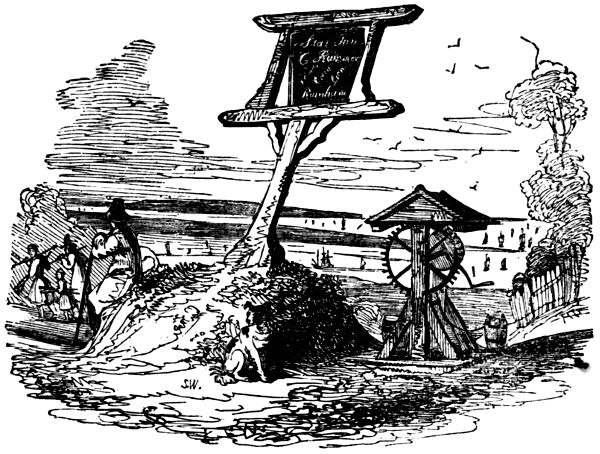
On Chatham Hill.
This sketch, in the pocket-book of an artist, suddenly startled recollection to the April of my life—the season of sunshine hopes, and stormy fears—when each hour was a birth-time of thought, and every new scene was the birth-place of a new feeling. The drawing carried me back to an October morning in 1797, when I eagerly set off on an errand to Boughton-hill, near Canterbury, for the sake of seeing the country on that side of Chatham for the first time. The day was cloudy, with gales of wind. I reached Chatham-hill, and stood close to this sign, looking over the flood of the Medway to the Nore, intently peering for a further sea-view. Flashes of fire suddenly gleamed in the dim distance, and I heard the report of cannon. Until then, such sounds from the bosom of the watery element were unknown to me, and they came upon my ear with indescribable solemnity. We were at war with France; and supposing there was a battle between two fleets off the coast, my heart beat high; my thoughts were anxious, and my eyes strained with the hope of catching something of the scene I imagined. The firing was from the fleet at the Nore, in expectation of a royal review. The king was then proceeding from Greenwich to Sheerness, in the royal yacht, attended by the lords of the admiralty, to go on board the Dutch ships captured by lord Duncan, at the battle of Camperdown.[181] On my return to Chatham, the sign of “the Star” was surrounded by sailors, who, with their shipmates inside the house, were drinking grog out of pewter-pots and earthen basins, and vociferating “Rule Britannia.”
The following year, on the evening of a glorious summer’s day, I found refuge in this house from the greatest storm I had then seen. It came with gusts of wind and peals of thunder from the sea. Standing at the bow-window, I watched the lightning sheeting the horizon, making visible the buried objects in the black gloom, and forking fearfully down, while the rain fell in torrents, and the trees bent before the furious tempest like rushes. The elements quickly ceased their strife, the moon broke out, and in a few minutes there was
The spacious firmament on high, And all the blue ethereal sky And spangled heavens, a shining frame.
The “Star” in war time was the constant scene of naval and military orgies, and therefore rather repelled than courted other visitants. It is now a respectable inn and a stage for the refreshment of coach travellers. During a hasty trip to Canterbury a short time ago, Mr. Samuel Williams stopped there long enough to select its sign, and the character of the view beyond it, as “a bit” for his pencil, which I, in turn, seized on, and he has engraved it as a decoration for the Table Book.
My readers were instructed at the outset of the work that, if they allowed me to please myself, we might all be pleased in turn. If I am sometimes not their most faithful, I am never otherwise than their most sincere servant; and therefore I add that I am not always gratified by what gratifies generally, and I have, in this instance, presented a small matter of my particular liking. I would have done better if I could. There are times when my mind foils and breaks down suddenly—when I can no more think or write than a cripple can run: at other times it carries me off from what I ought to do, and sets me to something the very negative to what I wish. I then become, as it were, possessed; an untamable spirit has its will of me in spite of myself:—what I have omitted, or done, in the present instance, illustrates the fact.
*
GREENGROCERS’ DEVICES.
For the Table Book.
Dear Sir,—In my wanderings through the metropolis at this season, I observe an agreeable and refreshing novelty, an ingenious contrivance to make mustard and cress seeds grow in pleasant forms over vessels and basketwork, covered on their exterior with wet flannel, wherein the seeds are deposited, and take root and grow, to adorn the table or recess. The most curious which struck me, consisted of a “hedgehog”—a doll’s head looking out of its vernally-growing clothes—a “Jack in the green”—a Dutch cheese in “a bower”—“Paul Pry”—and “Pompey’s pillar.”
If greengrocers proceed in these devices, their ingenuity may suggest a rivalry of signs of a more lasting nature, suitable to the shop windows of other tradesmen.
Yours, truly, J. R.
April 30, 1827.
Garrick Plays. No. XVII.
[From the “Parliament of Bees;” further Extracts.]
Oberon. Flora, a Bee.
Ober. A female Bee! thy character? Flo. Flora, Oberon’s Gardener, Huswive both of herbs and flowers, To strew thy shrine, and trim thy bowers, With violets, roses, eglantine, Daffadown, and blue columbine, Hath forth the bosom of the Spring Pluckt this nosegay, which I bring From Eleusis (mine own shrine) To thee, a Monarch all divine; And, as true impost of my grove, Present it to great Oberon’s love. Ober. Honey dews refresh thy meads. Cowslips spring with golden heads; July-flowers and carnations wear Leaves double-streakt, with maiden-hair; May thy lilies taller grow, Thy violets fuller sweetness owe; And last of all, may Phœbus love To kiss thee: and frequent thy grove. As thou in service true shalt be Unto our crown and royalty.
Oberon holds a Court, in which he sentences the Wasp, the Drone, and the Humble-bee, for divers offences against the Commonwealth of Bees.
Oberon. Prorex, his Viceroy; and other Bees.
Pro. And whither must these flies be sent? Ober. To Everlasting Banishment. Underneath two hanging rocks (Where babbling Echo sits and mocks Poor travellers) there lies a grove, With whom the Sun’s so out of love, He never smiles on’t: pale Despair Calls it his Monarchal Chair. Fruit half-ripe hang rivell’d and shrunk On broken arms, torn from the trunk: The moorish pools stand empty, left By water, stol’n by cunning theft To hollow banks, driven out by snakes, Adders, and newts, that man these lakes: The mossy leaves, half-swelter’d, serv’d As beds for vermin hunger sterv’d: The woods are yew-trees, bent and broke By whirlwinds; here and there an oak, Half-cleft with thunder. To this grove We banish them. Culprits. Some mercy, Jove! Ober. You should have cried so in your youth, When Chronos and his daughter Truth Sojourn’d among you; when you spent Whole years in riotous merriment, Thrusting poor Bees out of their hives, Seizing both honey, wax, and lives. You should have call’d for mercy when You impaled common blossoms; when, Instead of giving poor Bees food, You ate their flesh, and drank their blood. Fairies, thrust ’em to their fate.
Oberon then confirms Prorex in his Government; and breaks up Session.
Ober.——now adieu! Prorex shall again renew His potent reign: the massy world, Which in glittering orbs is hurl’d About the poles, be Lord of: we Only reserve our Royalty— Field Music.[182] Oberon must away; For us our gentle Fairies stay: In the mountains and the rocks We’ll hunt the Grey, and little Fox, Who destroy our lambs at feed, And spoil the nests where turtles feed.
[From “David and Bethsabe,” a Sacred Drama, by George Peel, 1599.]
Nathan. David.
Nath. Thus Nathan saith unto his Lord the King: There were two men both dwellers in one town; The one was mighty, and exceeding rich In oxen, sheep, and cattle of the field; The other poor, having nor ox, nor calf, Nor other cattle, save one little lamb, Which he had bought, and nourish’d by his hand. And it grew up, and fed with him and his, And ate and drank as he and his were wont, And in his bosom slept, and was to live As was his daughter or his dearest child.— There came a stranger to this wealthy man, And he refused and spared to take his own, Or of his store to dress or make his meat, But took the poor man’s sheep, partly poor man’s store; And drest it for this stranger in his house. What, tell me, shall be done to him for this? Dav. Now, as the Lord doth live, this wicked man Is judged, and shall became the child of death; Fourfold to the poor man he shall restore, That without mercy took his lamb away. Nath. Thou art the man, and thou hast judged thyself.— David, thus saith the Lord thy God by me: I thee anointed King in Israel, And saved thee from the tyranny of Saul; Thy master’s house I gave thee to possess, His wives unto thy bosom I did give, And Juda and Jerusalem withal; And might, thou know’st, if this had been too small, Have given thee more. Wherefore then hast thou gone so far astray, And hast done evil, and sinned in my sight? Urias thou hast killed with the sword, Yea with the sword of the uncircumcised Thou hast him slain; wherefore from this day forth The sword shall never go from thee and thine: For thou hast ta’en this Hithite’s wife to thee, Wherefore behold I will, saith Jacob’s God, In thine own house stir evil up to thee, Yea I before thy face will take thy wives, And give them to thy neighbour to possess. This shall be done to David in the day, That Israel openly may see thy shame. Dav. Nathan, I have against the Lord, I have Sinned, oh sinned grievously, and lo! From heaven’s throne doth David throw himself, And groan and grovel to the gates of hell. Nath. David, stand up; thus saith the Lord by me, David the King shall live, for he hath seen The true repentant sorrow of thy heart; But for thou hast in this misdeed of thine Stirr’d up the enemies of Israel To triumph and blaspheme the Lord of Hosts, And say, “He set a wicked man to reign Over his loved people and his tribes;” The Child shall surely die, that erst was born, His Mother’s sin, his Kingly Father’s scorn. Dav. How just is Jacob’s God in all his works! But must it die, that David loveth so? O that the mighty one of Israel Nill change his doom, and says the Babe must die Mourn, Israel, and weep in Sion gates; Wither, ye cedar trees of Lebanon; Ye sprouting almonds with your flowing tops, Droop, drown, and drench in Hebron’s fearful streams: The Babe must die, that was to David born, His Mother’s sin, his Kingly Father’s scorn.
C. L.
Dissertations on Doomsday.
For the Table Book.
§ I. Name.
Doomsday Book, one of the most ancient records of England, is the register from which judgment was to be given upon the value, tenure, and services of lands therein described.
Other names by which it appears to have been known were Rotulus Wintoniæ, Scriptura Thesauri Regis, Liber de Wintonia, and Liber Regis. Sir Henry Spelman adds, Liber Judiciarius, Censualis Angliæ, Angliæ Notitia et Lustratio, and Rotulus Regis.
§ II. Date.
The exact time of the Conqueror’s undertaking the Survey, is differently stated by historians. The Red Book of the Exchequer seems to have been erroneously quoted, as fixing the time of entrance upon it in 1080; it being merely stated in that record, that the work was undertaken at a time subsequent to the total reduction of the island to William’s authority. It is evident that it was finished in 1086. Matthew Paris, Robert of Gloucester, the Annals of Waverley, and the Chronicle of Bermondsey, give the year 1083, as the date of the record; Henry of Huntingdon, in 1084; the Saxon Chronicle in 1085; Bromton, Simeon of Durham, Florence of Worcester, the Chronicle of Mailros, Roger Hovedon, Wilkes, and Hanningford, in 1086; and the Ypodigma Neustriæ and Diceto in 1087.
The person and property of Odo, bishop of Bayeux, are said to have been seized by the Conqueror in 1082.
§ III. Origin and Object.
Ingulphus affirms, that the Survey was made in imitation of the policy of Alfred, who, at the time he divided the kingdom into counties, hundreds, and tithings, had an Inquisition taken and digested into a Register, which was called, from the place in which it was reposited, the Roll of Winchester. The formation of such a Survey, however, in the time of Alfred, may be fairly doubted, as we have only a solitary authority for its existence. The separation of counties also is known to have been a division long anterior to the time of Alfred. Bishop Kennet tells us, that Alfred’s Register had the name of Domeboc, from which the name of Doomsday Book was only a corruption.
Dom-boc is noticed in the laws of Edward the elder, and more particularly in those of Æthelstan, as the code of Saxon laws.
§ IV. Mode of Execution.
For the adjusting of this Survey, certain commissioners, called the king’s justiciaries, were appointed inquisitors: it appears, upon the oaths of the sheriffs, the lords of each manor, the presbyters of every church, the reeves of every hundred, the bailiffs, and six villans of every village, were to inquire into the name of the place, who held it in the time of Edward (the Confessor,) who was the present possessor, how many hides in the manor, how many carrucates in demesne, how many homagers, how many villans, how many cotarii, how many servi, what freemen, how many tenants in socage, what quantity of wood, how many meadows and pasture, what mills and fish-ponds, how much added or taken away, what the gross value in king Edward’s time, what the present value, and how much each free-man or soch-man had or has. All this was to be triply estimated; first, as the estate was in the time of the Confessor; then, as it was bestowed by king William; and, thirdly, as its value stood at the formation of the Survey. The jurors were, moreover, to state whether any advance could be made in the value. The writer of the Saxon Chronicle, with some degree of asperity, informs us, that not a hyde or yardland, not an ox, cow, or hog, were omitted in the census.
PRINCIPAL MATTERS NOTICED IN THIS RECORD.
§ I. Persons.
(1.) After the bishops and abbats, the highest persons in rank were the Norman barons.
(2.) Taini, tegni, teigni, teini, or teinni, are next to be mentioned, because those of the highest class were in fact nobility, or barons of the Saxon times. Archbishops, bishops, and abbats, as well as the great barons, are also called thanes.
(3.) Vavassores, in dignity, were next to the barons, and higher thanes. Selden says, they either held of a mesne lord, and not immediately of the king, or at least of the king as of an honour or manor and not in chief. The grantees, says sir Henry Spelman, that received their estates from the barons or capitanei, and not from the king, were called valvasores, (a degree above knights.)
(4.) The aloarii, alodarii, or alodiarii, tenants in allodium, (a free estate “possessio libera.”) The dinges mentioned, tom i. fol. 298, are supposed to have been persons of the same description.
(5.) Milites. The term miles appears not to have acquired a precise meaning at the time of the Survey, sometimes implying a soldier, or mere military servant, and sometimes a person of higher distinction.
(6.) Liberi Homines appears to have been a term of considerable latitude; signifying not merely the freeman, or freeholders of a manor, but occasionally including all the ranks of society already mentioned, and indeed all persons holding in military tenure. “The ordinary freemen, before the conquest,” says Kelham, “and at the time of compiling Doomsday, were under the protection of great men; but what their quality was, further than that their persons and blood were free, that is, that they were not nativi, or bondmen, it will give a knowing man trouble to discover to us.” These freemen are called in the Survey liberi homines comendati. They appear to have placed themselves, by voluntary homage, under this protection: their lord or patron undertook to secure their estates and persons, and for this protection and security they paid to him an annual stipend, or performed some annual service. Some appear to have sought a patron or protector, for the sake of obtaining their freedom only; such the liberi homines comendatione tantum may be interpreted. According to the laws of the Conqueror, a quiet residence of a year and a day, upon the king’s demesne lands, would enfranchise a villan who had fled from his lord. “Item si servi permanserint sine calumnia per annum et diem in civitatibus nostris vel burgis in muro vallatis, vel in castris nostris, a die illa liberi afficiuntur et liberi a jugo servitutis suæ sunt in perpetuum.” The commendati dimidii were persons who depended upon two protectors, and paid half to one and half to the other. Sub commendati were under the command of those who were themselves depending upon some superior lord. Sub commendati dimidii were those who were under the commendati dimidii, and had two patrons or protectors, and the same as they had. Liberi homines integri were those who were under the full protection of one lord, in contradistinction to the liberi homines dimidii. Commendatio sometimes signified the annual rent paid for the protection. Liberi homines ad nullam firmam pertinentes were those who held their lands independent of any lord. Of others it is said, “qui remanent in manu regis.” In a few entries of the Survey, we have liberæ feminæ, and one or two of liberæ feminæ commendatæ.
(7.) Sochmanni, or socmens, were those inferior landowners who had lands in the soc or franchise of a great baron; privileged villans, who, though their tenures were absolutely copyhold, yet had an interest equal to a freehold.
(8.) Of this description of tenantry also were the rachenistres, or radchenistres, who appear likewise to have been called radmanni, or radmans. It appears that some of the radchenistres, like the sochmen, were less free than others. Dr. Nash conjectured that the radmanni and radchenistres were probably a kind of freemen who served on horseback. Rad-cnihꞇ is usually interpreted by our glossarists equestris homo sive miles, and Raðheꞃe equestris exercitus.
(9.) Villani. The clearest notion of the tenure of villani is probably to be obtained from sir W. Blackstone’s Commentaries. “With regard to folk-land,” says he, “or estates held in villenage, this was a species of tenure neither strictly Feodal, Norman, nor Saxon, but mixed or compounded of them all; and which also, on account of the heriots that usually attend it, may seem to have somewhat Danish in its composition. Under the Saxon government, there were, as sir William Temple speaks, a sort of people in a condition of downright servitude, used and employed in the most servile works, and belonging, both they and their children, and their effects, to the lord of the soil, like the rest of the cattle or stock upon it. These seem to have been those who held what was called the folk-land, from which they were removable at the lord’s pleasure. On the arrival of the Normans here, it seems not improbable that they, who were strangers to any other than a feodal state, might give some sparks of enfranchisement to such wretched persons as fell to their share, by admitting them, as well as others, to the oath of fealty, which conferred a right of protection, and raised the tenant to a kind of estate superior to downright slavery, but inferior to every other condition. This they called villenage, and the tenants villeins; either from the word vilis, or else, as sir Edward Coke tells us, a villa; because they lived chiefly in villages, and were employed in rustic works of the most sordid kind. They could not leave their lord without his permission; but if they ran away, or were purloined from him, might be claimed and recovered by action, like beasts or other chatels. The villeins could acquire no property either in lands or goods; but if he purchased either, the lord might enter upon them, oust the villein, and seize them to his own use, unless he contrived to dispose of them before the lord had seized them; for the lord had then lost his opportunity. The law however protected the persons of villeins, as king’s subjects, against atrocious injuries of the lord.”
(10.) Bordarii of the Survey appear at various times to have received a great variety of interpretations. Lord Coke calls them “boors, holding a little house, with some land of husbandry, bigger than a cottage.” Some have considered them as cottagers, taking their name from living on the borders of a village or manor; but this is sufficiently refuted by Doomsday itself, where we find them not only mentioned generally among the agricultural occupiers of land, but in one instance as “circa aulam manentes,” dwelling near the manor-house; and even residing in some of the larger towns. Boꞃð, bishop Kennett notices, was a cottage. The cos-cets, corcez, cozets, or cozez, were apparently the same as the cottarii and cotmanni; cottagers who paid a certain rent for very small parcels of land.
(11.) Bures, buri, or burs, are noticed in the first volume of Doomsday itself, as synonymous with coliberti. The name of coliberti was unquestionably derived from the Roman civil law. They are described by lord Coke as tenants in free socage by free rent. Cowel says, they were certainly a middle sort of tenants, between servile and free, or such as held their freedom of tenure under condition of such works and services, and were therefore the same landholders whom we meet with (in aftertimes) under the name of conditionales.
Such are the different descriptions of tenantry, and their rights more particularly noticed in Doomesday.
(12.) Servi. It is observed by bishop Kennett, and by Morant after him, in his History of Essex, that the servi and villani are, all along in Doomsday, divided from each other; but that no author has fixed the exact distinction between them. The servi, bishop Kennett adds, might be the pure villanes, and villanes in gross, who, without any determined tenure of land, were, at the arbitrary pleasure of the lord, appointed to servile works, and received their wages and maintenance at the discretion of the lord. The other were of a superior degree, and were called villani, because they were villæ or glebæ adscripti, i. e. held some cottage and lands, for which they were burthened with such stated servile works as their lords had annexed to them. The Saxon name for servus was Eꞅne. The ancillæ of the Survey were females, under circumstances nearly similar to the servi. These were disposed of in the same way, at the pleasure of the lord. The laws, however, protected their chastity; they could not be violated with impunity, even by their owners.
(13.) Censarii, censores, or censorii, were also among the occupiers of land. They appear to have been free persons, censum reddentes.
(14.) Porcarii. Although in one or two instances in Doomsday Survey mere swine-herds seem to have been intended by Porcarii, yet in the generality of entries in which they are mentioned, they appear in the rank of free occupiers, who rented the privilege of feeding pigs in the woodlands, some for money, and some for payments in kind.
(15.) The homines, who are so frequently mentioned, included all sorts of feudatory tenants. They claimed a privilege of having their causes and persons tried only in the court of their lord, to whom they owed the duty of submission, and professed dependance.
(16.) Angli and Anglici occur frequently in the Survey among the under tenants, holding in different capacities.
(17.) Among the offices attached to names, we find accipitrarii or ancipitrarii, arbalistarii or balistarii arcarii biga, camerarii campo, constabularius, cubicularius, dapifer, dispensator, equarius, forestarii huscarli ingeniator, interpres, lagemanni, Latinarius, legatus liberatores marescal, or marescalcus medici, monitor, pincerna recter navis regis, scutularius, stalre, stirman or stiremannus regis, thesaurarius and venatores of a higher description.
(18.) Offices of an inferior description, and trades, are aurifabri, carpentarii, cemetarii, cervisiarii, coci, coqui, or koci, fabri, ferrarii, figuli fossarii, fossator, granetarius, hostarius, inguardi, joculator regis, joculatrix, lanatores, loricati, lorimarius, loripes, mercatores, missatici, monetarii, parcher, parm’t piscatores, pistores, portarius potarii, or poters, prebendarii prefecti, prepositi salinarii servientes, sutores, tonsor, and vigilantes homines. Among ecclesiastical offices, we have Capicerius, Æcel. Winton the sacrist, and Matricularias, Æcel. S. Johannis Cestriæ. Buzecarts were mariners. Hospites, occupiers of houses.
Among the assistants in husbandry, we find apium custos, avantes homines, berquarii bovarii caprarum mediator daia granatarius mellitarii, mercennarius, porcarii, and vacarius.
S. R. F.
I. ANCIENT TENURE. II. MODERN ANECDOTE.
For the Table Book.
Tenure of the ancient Manor of Bilsington Priory, the Seat of Thomas Carr Rider, Esq.
The manor of Bilsington inferior was held in grand sergeantry in the reign of Edward III. by the service of presenting three maple cups at the king’s coronation and, at the time of the coronation of Charles II., by the additional service of carrying the last dish of the second course to the king’s table. The former service was performed by Thomas Rider, who was knighted (Mos pro Lege) by his late majesty George III., when the king, on receiving the maple cups from the lord of the manor, turned to the mayor of Oxford, who stood at his right hand, and, having received from him for his tenure of that city a gold cup and cover, gave him these three cups in return.
Anecdote of the illustrious Washington and the celebrated Admiral Vernon, Uncle to the late Earl of Shipbrook.
When the admiral was attacking Porto Bello, with his six ships only, as is described on the medal struck on the occasion, he observed a fine young man in appearance, who, with the most intrepid courage, attended with the most perfect calmness, was always in that part of the ship which was most engaged. After the firing had ceased, he sent his captain to request he would attend upon him, which he immediately obeyed; and the admiral entering into conversation, discovered by his answers and observations that he possessed more abilities than usually fall to the lot of mankind in general. Upon his asking his name, the young man told him it was George Washington; and the admiral, on his return home, strongly recommended him to the attention of the admiralty. This great man, when he built his house in America, out of gratitude to his first benefactor, named it “Mount Vernon,” and at this moment it is called so.
Zoology.
I. THE KING’S OSTRICH.
II. THE HORSE ECLIPSE.
Mr. Joshua Brookes, the eminent anatomist, gave a lecture on Wednesday evening, the 25th of April, 1827, at the house of the Zoological Society, in Bruton-street, on the body of an ostrich which his majesty had presented to the society. The lecture was attended by lord Auckland, lord Stanley, Dr. Birkbeck, and several other noblemen and gentlemen distinguished for their devotion to the interests of science. The ostrich, which was a female, and had been presented to his majesty about two years before by colonel Denham, had been kept at Windsor, and had died about three weeks previous to the lecture, of obesity, a disease which frequently shortens the lives of wild animals of every species, when attempts are made to domesticate them.
Mr. Brookes commenced by observing, that when he retired from the practice of anatomy, he did not expect to appear again before the public; but, as the noble directors of the society had honoured him by considering that his services might be of some use in forwarding that most interesting science zoology, he had only to remark that he felt great pride in adding his mite of information to the mass with which the society was furnished from other sources. The period had arrived, when the science of natural history bad fair to reach a height in this country, which would enable us to rival the establishments founded for its promotion abroad. The founder of the study of zoology in England was the great John Hunter; and he was followed by individuals well known to the scientific world, in Edinburgh, Gottingen, and Amsterdam. In the latter city, the science of zoology was pursued with great success by professor Camper, who, when he was in London, invited him (Mr. Brookes) and a professional friend to breakfast, and treated them with bones, consisting of the teeth of rats, mice, and deer, served up in dishes made out of the rock of Gibraltar. The fact was, that the professor had, shortly before, explored this celebrated rock, in search of bones, for the purposes of comparative anatomy. The learned lecturer then entered into a very minute account of the various peculiarities of the ostrich, and described with great clearness the organs by which this extraordinary bird was enabled to travel with its excessive speed. This peculiarity he ascribed to the power of the muscles, which pass from the pelvis to the foot, and cause the ostrich to stand in a vertical position, and not like other birds resembling it, on the toes.
For proof of the intimate relation between muscular power and extraordinary swiftness, Mr. Brookes mentioned that the chief professor of the Veterinary College had informed him, that upon dissecting the body of the celebrated racer Eclipse, one of the fleetest horses ever seen in this kingdom, it was found that he possessed muscles of unparalleled size. The lecturer here produced an anatomical plate of Eclipse; for the purpose of displaying his extraordinary muscular power, and observed, that if he had not told his hearers that it represented a race-horse, from the size of the muscles they might conclude, that he was showing them the plate of a cart-horse.[183]
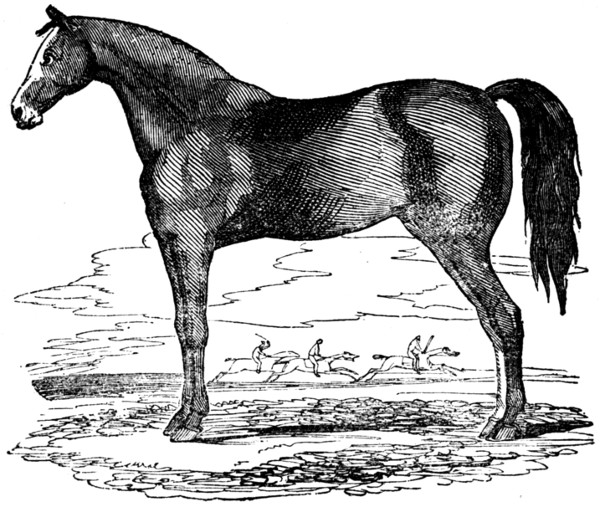
Eclipse.
This engraving is from a drawing, in a treatise “on the proportions of Eclipse: by Mr. Charles Vial de Saint Bel, professor of the Veterinary College of London, &c.” 4to. 1791. Mr. Saint Bel’s work was written with a view to ascertain the mechanical causes which conspire to augment the velocity of the gallop; and no single race-horse could have been selected as a specimen of speed and strength equal to Eclipse. According to a calculation by the writer just mentioned, Eclipse, free of all weight, and galloping at liberty in his greatest speed, could cover an extent of twenty-five feet at each complete action on the gallop; and could repeat this action twice and one third in each second of time: consequently, by employing without reserve all his natural and mechanical faculties on a straight line, he could run nearly four miles in the space of six minutes and two seconds.
Eclipse was preeminent above all other horses, from having ran repeated races, without ever having been beat. The mechanism of his frame was almost perfect; and yet he was neither handsome, nor well proportioned. Compared with a table of the geometrical portions of the horse, in use at the veterinary schools of France, Eclipse measured in height one seventh more than he ought—his neck was one third too long—a perpendicular line falling from the stifle of a horse should touch the toe; this line in Eclipse touched the ground, at the distance of half a head before the toe—the distance from the elbow to the bend of the knee should be the same as from the bend of the knee to the ground; the former, in Eclipse, was two parts of a head longer than the latter. These were some of the remarkable differences between the presumed standard of proportions in a well-formed horse, and the horse of the greatest celebrity ever bred in England.
The excellence of Eclipse in speed, blood, pedigree, and progeny, will be transmitted, perhaps, to the end of time. He was bred by the former duke of Cumberland, and, being foaled during the “great eclipse,” was named “Eclipse” by the duke in consequence. His royal highness, however, did not survive to witness the very great performances he himself had predicted; for, when a yearling, Eclipse was disposed of by auction, with the rest of the stud, and a remarkable circumstance attended his sale. Mr. Wildman, a sporting gentleman, arrived after the sale had commenced, and a few lots had been knocked down. Producing his watch, he insisted that the sale had begun before the time advertised. The auctioneer remonstrated; Mr. Wildman was not to be appeased, and demanded that the lots already sold should be put up again. The dispute causing a loss of time, as well as a scene of confusion, the purchasers said, if there was any lot already sold, which he had an inclination to, rather than retard progress, it was at his service. Eclipse was the only lot he had fixed upon, and the horse was transferred to him at the price of forty-six guineas. At four, or five years old, Captain O’Kelly purchased him of Mr. Wildman for seventeen hundred guineas. He remained in Col. O’Kelly’s possession, winning king’s plates and every thing he ran for, until the death of his owner, who deemed him so valuable, as to insure the horse’s life for several thousand guineas. He bequeathed him to his brother, Philip O’Kelly, Esq. The colonel’s decease was in November, 1787. Eclipse survived his old master little more than a year, and died on the 27th of February, 1789, in the twenty-sixth year of his age. His heart weighed 13 lbs. The size of this organ was presumed to have greatly enabled him to do what he did in speed and strength. He won more matches than any horse of the race-breed was ever known to have done. He was at last so worn out, as to have been unable to stand, and about six months before his death was conveyed, in a machine constructed on purpose, from Epsom to Canons, where he breathed his last.
Colonel Dennis O’Kelly, the celebrated owner of Eclipse, amassed an immense fortune by gambling and the turf, and purchased the estate of Canons, near Edgware, which was formerly possessed by the duke of Chandos, and is still remembered as the site of the most magnificent mansion and establishment of modern times. The colonel’s training stables and paddocks, at another estate near Epsom, were supposed to be the best appointed in England.
Besides O’Kelly’s attachment to Eclipse, he had an affection to a parrot, which is famed for having been the best bred bird that ever came to this country. He gave fifty guineas for it at Bristol, and paid the expenses of the woman who brought it up to town. It not only talked what is usually termed “every thing,” but sang with great correctness a variety of tunes, and beat time as he sang; and if perchance he mistook a note in the tune, he returned to the bar wherein the mistake arose, and corrected himself, still beating the time with the utmost exactness. He sang any tune desired, fully understanding the request made. The accounts of this bird are so extraordinary, that, to those who had not seen and heard the bird, they appeared fabulous.
THE EVENING LARK.
For the Table Book.
I love thee better at this hour, when rest Is shadowing earth, than e’en the nightingale: The loudness of thy song that in the morn Rang over heaven, the day has softened down To pensive music.
In the evening, the body relaxed by the toil of the day, disposes the mind to quietness and contemplation. The eye, dimmed by close application to books or business, languishes for the greenness of the fields; the brain, clouded by the smoke and vapour of close rooms and crowded streets, droops for the fragrance of fresh breezes, and sweet smelling flowers.
Summer cometh, The bee hummeth, The grass springeth, The bird singeth, The flower groweth, And man knoweth The time is come When he may rove Thro’ vale and grove. No longer dumb. There he may hear sweet voices, Borne softly on the gale; There he may have rich choices Of songs that never fail; The lark, if he be cheerful, Above his head shall tower; And the nightingale, if fearful, Shall soothe him from the bower. *** If red his eye with study, If pale with care his cheek, To make them bright and ruddy, The green hills let him seek. The quiet that it needeth His mind shall there obtain; And relief from care, that feedeth Alike on heart and brain.
Urged by this feeling, I rambled along the Old Kent Road, making my way through the Saturnalian groups, collected by that mob-emancipating-time Easter Monday; wearied with the dust, and the exclamations of the multitude, I turned down the lane leading to the fields, near the place wherein the fair of Peckham is held, and sought for quietness in their greenness—and found it not. Instead of verdure, there were rows of dwellings of “plain brown brick,” and a half-formed road, from whence the feet of man and horse impregnated the air with stifling atoms of vitrified dust. Proceeding over the Rye, up the lane at the side of Forest-hill, I found the solitude I needed. The sun was just setting; his parting glance came from between the branches of the trees, like the mild light of a lover’s eye, from her long dark lashes, when she receives the adieu of her beloved, and the promise of meeting on the morrow. The air was cool and fitful, playing with the leaves, as not caring to stir them; and as I strayed, the silence was broken by the voice of a bird—it was the tit-lark. I recognised his beautiful “weet” and “fe-er,” as he dropped from the poplar among the soft grass; and I lingered near the wood, in the hope of hearing the nightingale—but he had not arrived, or was disposed to quiet. Evening closed over me: the hour came
When darker shades around us thrown Give to thought a deeper tone.
Retracing my steps, I reached that field which stretches from the back of the Rosemary-branch to the canal; darkness was veiling the earth, the hum of the multitude was faintly audible; above it, high in the cool and shadowy air, rose the voice of a sky-lark, who had soared to take a last look at the fading day, singing his vespers. It was a sweeter lay than his morning, or mid-day carol—more regular and less ardent—divested of the fervour and fire of his noontide song—its hurried loudness and shrill tones. The softness of the present melody suited the calm and gentle hour. I listened on, and imagined it was a bird I had heard in the autumn of last year: I recollected the lengthy and well-timed music—the “cheer che-er,” “weet, weet, che-er”—“we-et, weet, cheer”—“che-er”—“weet, weet”—“cheer, weet, weet.” I still think it to have been the very bird of the former season. Since then he had seen
The greenness of the spring, and all its flowers; The ruddiness of summer and its fruits; And cool and sleeping streams, and shading bowers The sombre brown of autumn, that best suits His leisure hours, whose melancholy mind Is calm’d with list’ning to the moaning wind, And watching sick leaves take their silent way, On viewless wings, to death and to decay.
He had survived them, and had evaded the hawk in the cloud, and the snake in the grass. I felt an interest in this bird, for his lot had been like mine. The ills of life—as baleful to man, as the bird of prey and the invidious reptile to the weakest of the feathered race—had assailed me, and yet I had escaped. The notes in the air grew softer and fainter—I dimly perceived the flutter of descending wings—one short, shrill cry finished the song—darkness covered the earth—and I again sought human habitations, the abodes of carking cares, and heart-rending jealousies.
S. R. J.
April 16, 1827.
THE VOICE OF SPRING.
I come, I come! ye have call’d me long; I come o’er the mountains with light and song! Ye may trace my steps o’er the wakening earth, By the winds which tell of the violet’s birth, By the primrose-stars in the shadowy grass, By the green leaves opening as I pass. I have breath’d on the south, and the chestnut flowers By thousands have burst from the forest bowers, And the ancient graves, and the fallen fanes, Are veil’d with wreaths on Italian plains. —But it is not for me, in my hour of bloom, To speak of the ruin of the tomb! I have pass’d o’er the hills of the stormy north, And the larch has hung all his tassels forth; The fisher is out on the sunny sea, And the rein-deer bounds thro’ the pasture free, And the pine has a fringe of softer green, And the moss looks bright where my step has been. I have sent thro’ the wood-paths a gentle sigh, And call’d out each voice of the deep blue sky, From the nightbird’s lay thro’ the starry time, In the groves of the soft Hesperian clime, To the swan’s wild note by the Iceland lakes, When the dark fir-bough into verdure breaks. From the streams and founts I have loos’d the chain, They are sweeping on to the silvery main, They are flashing down from the mountain-brows, They are flinging spray on the forest-boughs, They are bursting fresh from their starry caves, And the earth resounds with the joy of waves. Come forth, O ye children of gladness, come! Where the violets lie, may be now your home; Ye of the rose-cheek and dew-bright eye, And the bounding footstep, to meet me fly. With the lyre, and the wreath, and the joyous lay, Come forth to the sunshine, I may not stay! Away from the dwellings of care-worn men, The waters are sparkling in wood and glen, Away from the chamber and dusky hearth, The young leaves are dancing in breezy mirth, Their light stems thrill to the wild-wood strains, And youth is abroad in my green domains.
Mrs. Hemans.
MOTHERING SUNDAY.
For the Table Book.
To the accounts in the Every-Day Book of the observance of Mid Lent, or “Mothering Sunday,” I would add, that the day is scrupulously observed in this city and neighbourhood; and, indeed, I believe generally in the western parts of England. The festival is kept here much in the same way as the 6th of January is with you: that day is passed over in silence with us.
All who consider themselves dutiful children, or who wish to be so considered by others, on this day make presents to their mother, and hence derived the name of “Mothering Sunday.” The family all assemble; and, if the day prove fine, proceed, after church, to the neighbouring village to eat frumerty. The higher classes partake of it at their own houses, and in the evening come the cake and wine. The “Mothering cakes” are very highly ornamented, artists being employed to paint them. This social meeting does not seem confined to the middling or lower orders; none, happily, deem themselves too high to be good and amiable.
The custom is of great antiquity; and long, long may it be prevalent amongst us.
Your constant reader, Juvenis (N.)
Bristol, March 28, 1827.
Defoeana. No. II.
MIXED BREEDS; OR, EDUCATION THROWN AWAY.
I came into a public-house once in London, where there was a black Mulatto-looking man sitting, talking very warmly among some gentlemen, who I observed were listening very attentively to what he said; and I sat myself down, and did the like; ’twas with great pleasure I heard him discourse very handsomely on several weighty subjects; I found he was a very good scholar, had been very handsomely bred, and that learning and study was his delight; and more than that, some of the best of science was at that time his employment: at length I took the freedom to ask him, if he was born in England? He replied with a great deal of good humour, but with an excess of resentment at his father, and with tears in his eyes, “Yes, yes, sir, I am a true born Englishman, to my father’s shame be it spoken; who, being an Englishman himself, could find in his heart to join himself to a negro woman, though he must needs know, the children he should beget, would curse the memory of such an action, and abhor his very name for the sake of it. Yes, yes, (said he repeating it again,) I am an Englishman, and born in lawful wedlock; happy it had been for me, though my father had gone to the devil for wh——m, had he lain with a cook-maid, or produced me from the meanest beggar in the street. My father might do the duty of nature to his black wife; but, God knows, he did no justice to his children. If it had not been for this black face of mine, (says he, then smiling,) I had been bred to the law, or brought up in the study of divinity: but my father gave me learning to no manner of purpose; for he knew I should never be able to rise by it to any thing but a learned valet de chambre. What he put me to school for I cannot imagine; he spoiled a good tarpawling, when he strove to make me a gentleman. When he had resolved to marry a slave, and lie with a slave, he should have begot slaves, and let us have been bred as we were born: but he has twice ruined me; first with getting me a frightful face, and then going to paint a gentleman upon me.”—It was a most affecting discourse indeed, and as such I record it; and I found it ended in tears from the person, who was in himself the most deserving, modest, and judicious man, that I ever met with, under a negro countenance, in my life.
CHINESE IDOL.
It had a thing instead of a head, but no head; it had a mouth distorted out of all manner of shape, and not to be described for a mouth, being only an unshapen chasm, neither representing the mouth of a man, beast, fowl, or fish: the thing was neither any of the four, but an incongruous monster: it had feet, hands, fingers, claws, legs, arms, wings, ears, horns, every thing mixed one among another, neither in the shape or place that nature appointed, but blended together, and fixed to a bulk, not a body; formed of no just parts, but a shapeless trunk or log; whether of wood, or stone, I know not; a thing that might have stood with any side forward, or any side backward, any end upward, or any end downward; that had as much veneration due to it on one side, as on the other; a kind of celestial hedgehog, that was rolled up within itself, and was every thing every way; formed neither to walk, stand, go, nor fly; neither to see, hear, nor speak; but merely to instil ideas of something nauseous and abominable into the minds of men that adored it.
MANNERS OF A LONDON WATERMAN, AND HIS FARE, A HUNDRED YEARS AGO.
What I have said last [of the Manners of a spruce London Mercer,[184]] makes me think on another way of inviting customers, the most distant in the world from what I have been speaking of, I mean that which is practised by the watermen, especially on those whom by their mien and garb they know to be peasants. It is not unpleasant to see half a dozen people surround a man they never saw in their lives before, and two of them that can get the nearest, clapping each an arm over his neck, hug him in as loving and familiar a manner as if he were their brother newly come home from an East India voyage; a third lays hold of his hand, another of his sleeve, his coat, the buttons of it, or any thing he can come at, whilst a fifth or a sixth, who has scampered twice round him already without being able to get at him, plants himself directly before the man in hold, and within three inches of his nose, contradicting his rivals with an open-mouthed cry, shows him a dreadful set of large teeth, and a small remainder of chewed bread and cheese, which the countryman’s arrival had hindered from being swallowed. At all this no offence is taken, and the peasant justly thinks they are making much of him; therefore far from opposing them he patiently suffers himself to be pushed or pulled which way the strength that surrounds him shall direct. He has not the delicacy to find fault with a man’s breath, who has just blown out his pipe, or a greasy head of hair that is rubbing against his chaps: dirt and sweat he has been used to from his cradle, and it is no disturbance to him to hear half a score people, some of them at his ear, and the furthest not five feet from him, bawl out as if he was a hundred yards off: he is conscious that he makes no less noise when he is merry himself, and is secretly pleased with their boisterous usages. The hawling and pulling him about he construes in the way it is intended; it is a courtship he can feel and understand: he can’t help wishing them well for the esteem they seem to have for him: he loves to be taken notice of, and admires the Londoners for being so pressing in their offers of service to him, for the value of threepence or less; whereas in the country, at the shop he uses, he can have nothing but he must first tell them what he wants, and, though he lays out three or four shillings at a time, has hardly a word spoke to him unless it be in answer to a question himself is forced to ask first. This alacrity in his behalf moves his gratitude, and unwilling to disoblige any, from his heart he knows not whom to choose. I have seen a man think all this, or something like it, as plainly as I could see the nose on his face; and at the same time move along very contentedly under a load of watermen, and with a smiling countenance carry seven or eight stone more than his own weight, to the water side.
Fable of the Bees: 1725.
May.
MAY GOSLINGS.—MAY BATHERS.
For the Table Book.
On the first of May, the juvenile inhabitants of Skipton, in Craven, Yorkshire, have a similar custom to the one in general use on the first of April. Not content with making their companions fools on one day, they set apart another, to make them “May goslings,” or geese. If a boy made any one a May gosling on the second of May, the following rhyme was said in reply:—
“May-day’s past and gone, Thou’s a gosling, and I’m none.”
This distich was also said, mutatis mutandis, on the second of April. The practice of making May goslings was very common about twelve years ago, but is now dying away.
As the present month is one when very severe colds are often caught by bathers, it may not be amiss to submit to the readers of the Table Book the following old saying, which is very prevalent in Skipton:—
“They who bathe in May Will be soon laid in clay; They who bathe in June Will sing a merry tune.”
T. Q. M.
SAILORS ON THE FIRST OF MAY.
For the Table Book.
Sir,—You have described the ceremony adopted by our sailors, of shaving all nautical tyros on crossing the line,[185] but perhaps you are not aware of a custom which prevails annually on the first of May, in the whale-fishery at Greenland and Davis’s Straits. I therefore send you an account of the celebration which took place on board the Neptune of London, in Greenland, 1824, of which ship I was surgeon at that period.
Previous to the ship’s leaving her port, the sailors collected from their wives, and other female friends, ribands “for the garland,” of which great care was taken until a few days previous to the first of May, when all hands were engaged in preparing the said garland, with a model of the ship.
The garland was made of a hoop, taken from one of the beef casks; this hoop, decorated with ribands, was fastened to a stock of wood, of about four feet in length, and a model of the ship, prepared by the carpenter, was fastened above the hoop to the top of the stock, in such a manner as to answer the purpose of a vane. The first of May arrives; the tyros were kept from between decks, and all intruders excluded while the principal performers got ready the necessary apparatus and dresses. The barber was the boatswain, the barber’s mate was the cooper, and on a piece of tarpawling, fastened to the entrance of the fore-hatchway, was the following inscription:—
“Neptune’s Easy Shaving Shop, Kept by John Johnson.”
The performers then came forward, as follows:—First, the fiddler, playing as well as he could on an old fiddle, “See the conquering hero comes;” next, four men, two abreast, disguised with matting, rags, &c. so as to completely prevent them from being recognised, each armed with a boat-hook; then came Neptune himself, also disguised, mounted on the carriage of the largest gun in the ship, and followed by the barber, barber’s mate, swab-bearer, shaving-box carrier, and as many of the ship’s company as chose to join them, dressed in such a grotesque manner as to beggar all description. Arrived on the quarter-deck they were met by the captain, when his briny majesty immediately dismounted, and the following dialogue ensued:—
Nept. Are you the captain of this ship, sir?
Capt. I am.
Nept. What’s the name of your ship?
Capt. The Neptune of London.
Nept. Where is she bound to?
Capt. Greenland.
Nept. What is your name?
Capt. Matthew Ainsley.
Nept. You are engaged in the whale fishery?
Capt. I am.
Nept. Well, I hope I shall drink your honour’s health, and I wish you a prosperous fishery.
[Here the captain presented him with three quarts of rum.]
Nept. (filling a glass.) Here’s health to you, captain, and success to our cause. Have you got any fresh-water sailors on board? for if you have, I must christen them, so as to make them useful to our king and country.
Capt. We have eight of them on board at your service; I therefore wish you good morning.
The procession then returned in the same manner as it came, the candidates for nautical fame following in the rear; after descending the fore-hatchway they congregated between decks, when all the offerings to Neptune were given to the deputy, (the cook,) consisting of whiskey, tobacco, &c. The barber then stood ready with his box of lather, and the landsmen were ordered before Neptune, when the following dialogue took place with each, only with the alteration of the man’s name, as follows:—
Nept. (to another.) What is your name?
Ans. Gilbert Nicholson.
Nept. Where do you come from?
Ans. Shetland.
Nept. Have you ever been to sea before?
Ans. No.
Nept. Where are you going to?
Ans. Greenland.
At each of these answers, the brush dipped in the lather (consisting of soap-suds, oil, tar, paint, &c.) was thrust into the respondent’s mouth and over his face; then the barber’s-mate scraped his face with a razor, made of a piece of iron hoop well notched; his sore face was wiped with a damask towel, (a boat-swab dipped in filthy water) and this ended the ceremony. When it was over they undressed themselves, the fiddle struck up, and they danced and regaled with their grog until they were “full three sheets in the wind.”
I remain, sir, &c. H. W. Dewhurst.
Crescent-street, Euston-square.
NAVAL ANECDOTE.
During the siege of Acre, Daniel Bryan, an old seaman and captain of the fore-top, who had been turned over from the Blanche into sir Sidney Smith’s ship Le Tigré, repeatedly applied to be employed on shore; but, being an elderly man and rather deaf, his request was not acceded to. At the first storming of the breach by the French, one of their generals fell among the multitude of the slain, and the Turks, in triumph, struck off his head, and, after mangling the body with their sabres, left it a prey to the dogs, which in that country are of great ferocity, and rove in herds. In a few days it became a shocking spectacle, and when any of the sailors who had been on shore returned to their ship, inquiries were constantly made respecting the state of the French general. To Dan’s frequent demands of his messmates why they had not buried him, the only answer he received was, “Go and do it yourself.” One morning having obtained leave to go and see the town, he dressed himself as though for an excursion of pleasure, and went ashore with the surgeon in the jolly-boat. About an hour or two after, while the surgeon was dressing the wounded Turks in the hospital, in came honest Dan, who, in his rough, good-natured manner, exclaimed, “I’ve been burying the general, sir, and now I’m come to see the sick!” Not particularly attending to the tar’s salute, but fearing that he might catch the plague, which was making great ravages among the wounded Turks, the surgeon immediately ordered him out. Returning on board, the cockswain asked of the surgeon if he had seen old Dan? It was then that Dan’s words in the hospital first occurred, and on further inquiry of the boat’s crew they related the following circumstances:—
The old man procured a pick-axe, a shovel, and a rope, and insisted on being let down, out of a port-hole, close to the breach. Some of his more juvenile companions offered to attend him. “No!” he replied, “you are too young to be shot yet; as for me, I am old and deaf, and my loss would be no great matter.” Persisting in his adventure, in the midst of the firing, Dan was slung and lowered down, with his implements of action on his shoulder. His first difficulty was to beat away the dogs. The French levelled their pieces—they were on the instant of firing at the hero!—but an officer, perceiving the friendly intentions of the sailor, was seen to throw himself across the file: instantaneously the din of military thunder ceased, a dead, solemn silence prevailed, and the worthy fellow consigned the corpse to its parent earth. He covered it with mould and stones, placing a large stone at its head, and another at its feet. The unostentatious grave was formed, but no inscription recorded the fate or character of its possessor. Dan, with the peculiar air of a British sailor, took a piece of chalk from his pocket, and attempted to write
“Here you lie, old Crop!”
He was then, with his pick-axe and shovel, hoisted into the town, and the hostile firing immediately recommenced.
A few days afterwards, sir Sidney, having been informed of the circumstance, ordered old Dan to be called into the cabin.—“Well, Dan, I hear you have buried the French general.”—“Yes, your honour.”—“Had you any body with you?”—“Yes, your honour.”—“Why, Mr. —— says you had not.”—“But I had, your honour.”—“Ah! who had you?”—“God Almighty, sir.”—“A very good assistant, indeed. Give old Dan a glass of grog.”—“Thank your honour.” Dan drank the grog, and left the cabin highly gratified. He was for several years a pensioner in the royal hospital at Greenwich.
THE “RIGHT” LORD LOVAT.
The following remarkable anecdote, communicated by a respectable correspondent, with his name and address, may be relied on as genuine.
For the Table Book.
An old man, claiming to be “the right lord Lovat,” i. e. heir to him who was beheaded in 1745, came to the Mansion-house in 1818 for advice and assistance. He was in person and face as much like the rebel lord, if one may judge from his pictures, as a person could be, and the more especially as he was of an advanced age. He said he had been to the present lord Lovat, who had given him food and a little money, and turned him away. He stated his pedigree and claim thus:—The rebel lord had an only brother, known by the family name of Simon Fraser. Before lord Lovat engaged in the rebellion, Simon Fraser went to a wedding in his highland costume; when he entered the room where the party was assembled, an unfortunate wight of a bagpiper struck up the favourite march of a clan in mortal enmity with that of Fraser, which so enraged him, that he drew his dirk and killed the piper upon the spot. Fraser immediately fled, and found refuge in a mine in Wales. No law proceedings took place against him as he was absent, and supposed to have perished at sea. He married in Wales, and had one son, the old man abovenamed, who said he was about sixty. When lord Lovat was executed his lands became forfeited; but in course of time, lord L. not having left a son, the estates were granted by the crown to a collateral branch, (one remove beyond Simon Fraser,) the present lord, it not being known that Simon Fraser was alive or had left issue. It is further remarkable that the applicant further stated, that both he and his father, Simon Fraser, were called lord Lovat by the miners and other inhabitants of that spot where he was known.
The old man was very ignorant, not knowing how to read or write, having been born in the mine and brought up a miner; but he said he had preserved Simon Fraser’s highland dress, and that he had it in Wales.
FAST-PUDDING. Extract from the Famous Historie of Friar Bacon. How Friar Bacon deceived his Man, that would fast for conscience sake.
Friar Bacon had only one man to attend him; and he, too, was none of the wisest, for he kept him in charity more than for any service he had of him. This man of his, named Miles, never could endure to fast like other religious persons did; for he always had, in one corner or other, flesh, which he would eat, when his master eat bread only, or else did fast and abstain from all things.
Friar Bacon seeing this, thought at one time or other to be even with him, which he did, one Friday, in this manner: Miles, on the Thursday night, had provided a great black-pudding for his Friday’s fast; that pudding he put in his pocket, (thinking to warm it so, for his master had no fire on those days.) On the next day, who was so demure as Miles! he looked as though he could not have eat any thing. When his master offered him some bread, he refused it, saying, his sins deserved a greater penance than one day’s fast in a whole week. His master commended him for it, and bid him take heed he did not dissemble, for if he did, it would at last be known. “Then were I worse than a Turk,” said Miles. So went he forth, as if he would have gone to pray privately, but it was for nothing but to prey privily on his black-pudding. Then he pulled out, and fell to it lustily: but he was deceived, for, having put one end in his mouth, he could neither get it out again, nor bite it off; so that he stamped for help. His master hearing him, came; and finding him in that manner, took hold of the other end of the pudding, and led him to the hall, and showed him to all the scholars, saying, “See here, my good friends and fellow-students, what a devout man my servant Miles is! He loved not to break a fast-day—witness this pudding, that his conscience will not let him swallow!” His master did not release him till night, when Miles did vow never to break any fast-day while he lived.
CLERICAL ERRORS.
For the Table Book.
The Rev. Mr. Alcock, of Burnsal, near Skipton, Yorkshire.
Every inhabitant of Craven has heard tales of this eccentric person, and numberless are the anecdotes told of him. I have not the history of Craven, and cannot name the period of his death exactly, but I believe it happened between fifty and sixty years ago. He was a learned man and a wit—so much addicted to waggery, that he sometimes forgot his office, and indulged in sallies rather unbecoming a minister, but nevertheless he was a sincere Christian. The following anecdotes are well known in Craven, and may amuse elsewhere. One of Mr. Alcock’s friends, at whose house he was in the habit of calling previously to his entering the church on Sundays, once took occasion to unstitch his sermon and misplace the leaves. At the church, Mr. Alcock, when he had read a page, discovered the joke. “Peter,” said he, “thou rascal! what’s thou been doing with my sermon?” then turning to his congregation he said, “Brethren, Peter’s been misplacing the leaves of my sermon, I have not time to put them right, I shall read on as I find it, and you must make the best of it that you can;” and he accordingly read through the confused mass, to the astonishment of his flock. On another occasion, when in the pulpit, he found that he had forgotten his sermon; nowise disappointed at the loss, he called out to his clerk, “Jonas, I have left my sermon at home, so hand us up that Bible, and I’ll read ’em a chapter in Job worth ten of it!” Jonas, like his master, was an oddity, and used to make a practice of falling asleep at the commencement of the sermon, and waking in the middle of it, and bawling out “amen,” thereby destroyed the gravity of the congregation. Mr. Alcock once lectured him for this, and particularly requested he would not say amen till he had finished his discourse. Jonas promised compliance, but on the following Sunday made bad worse, for he fell asleep as usual, and in the middle of the sermon awoke and bawled out “Amen at a venture!” The Rev. Mr. Alcock is, I think, buried before the communion-table of Skipton church, under a slab of blue marble, with a Latin inscription to his memory.
T. Q. M.
REMARKABLE EPITAPH.
For the Table Book.
Frank Fry, of Christian Malford, Wilts, whose bones lie undisturbed in the church-yard of his native village, wrote for himself the following
“Epitaph.
“Here lies I Who did die; I lie did As I die did, Old Frank Fry! “When the worms comes To pick up their crumbs, They’ll have in I— A rare Frank Fry!”
The worms have had, in Frank, a lusty subject—his epitaph is recorded only in the Table Book.
*, *, P.
A MODERN MYSTERY.
To the Editor.
Blackwall, April 13, 1827.
Sir,—As I perceive you sometimes insert in your Table Book articles similar to the enclosed original printed Notice, you may perhaps think it worthy of a place in your amusing miscellany; if so, it is much at your service.
I am, &c. F. W.
(Literal Copy.)
NOTICE.
Saturday 30 and on Sunday 31 of the corrent, in the Royal Theatre of St. Charles will be represented by the Italian Company the famous Holy Drama intitled
IL TRIONFO DI GIUDITTA, O SIA LA MORTE D’OLOFERNE.
In the interval of the frist to the second act it shall have a new and pompous Ball of the composition of John Baptista Gianini, who has by title:
IL SACRIFICIO D’ABRAMO,
in which will enter all the excellent corp of Ball, who dance at present in the said Royal Theatre; the spetacle will be finished with the second act and Ball analog to the same Drama, all with the nessessary decoration.
This is who is offered to the Respectable Publick of whom is waited all the protection and concurrence:
It will begin at 8 o’clok.
Na Officina de Simāo Thaddeo Ferreira. 1811. Com licenca.
ODD SIGN.
For the Table Book.
At West-end, near Skipton in Craven, Yorkshire, a gate hangs, as a sign to a public-house, with this inscription on it—
This gate hangs well, And hinders none; Refresh and pay, And travel on.
J. W.