Volume 1 — Vol. I.—23.
Reading edition
Bridge on the Road to Beckenham.
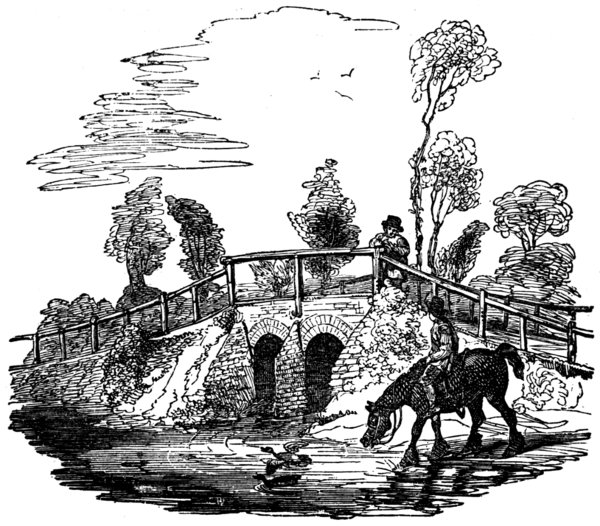
Bridge on the Road to Beckenham.
—Ancient Charity let flow this brook Across the road, for sheep and beggar-men To cool their weary feet, and slake their thirst.
*
On our way from Penge,[204] W. thought this object worth sketching. He occupied himself with his pencil, and I amused myself with dropping grains of dust among a fleet of tadpoles on the yellow sands, and watching their motions; a few inches from them, in a clearer shallow, lay a shoal of stickle-backs as on their Dogger-bank: a thread and a blood-worm, and the absence of my friend, and of certain feelings in behalf of the worms, would have afforded me excellent sport. The rivulet crosses the road from a meadow, where I heard it in its narrow channel, and muttering inwardly “the rapids are near,” from the “Canadian Boat-song,” I fell into a reverie on Wilson’s magnificent painting of the falls of Niagara, in Mr. Landseer’s painting-room. While I seated myself by the wayside, and, among ground-ivy and periwinkle, discriminating the diminutive forms of trees in the varied mosses of an old bank, I recollected descriptions I had read of transatlantic scenery, and the gigantic vegetation on the Ohio and Mississipi.
A labourer told us, that this little brook is called “Chaffinch’s River,” and that it springs from “the Alders,” near Croydon, and runs into the Ravensbourne.
Garrick Plays. No. XX.
[From “Bussy D’Ambois his Revenge,” a Tragedy, by George Chapman, 1613.]
Plays and Players.
Guise.—I would have these things Brought upon Stages, to let mighty Misers See all their grave and serious mischiefs play’d, As once they were in Athens and old Rome. Clermont. Nay, we must now have nothing brought on Stages But puppetry, and pied ridiculous antics. Men thither come to laugh, and feed fool-fat: Check at all goodness there, as being profaned: When, wheresoever Goodness comes, she makes The place still sacred, though with other feet Never so much ’tis scandal’d and polluted. Let me learn any thing, that fits a man, In any Stables shewn, as well as Stages.— Baligny. Why, is not all the World esteem’d a Stage? Clermont. Yes, and right worthily; and Stages too Have a respect due to them, if but only For what the good Greek Moralist says of them: “Is a man proud of greatness, or of riches? Give me an expert Actor; I’ll shew all That can within his greatest glory fall: Is a man ’fraid with poverty and lowness? Give me an Actor; I’ll shew every eye What he laments so, and so much does fly: The best and worst of both.”—If but for this then, To make the proudest outside, that most swells With things without him, and above his worth, See how small cause he has to be so blown up; And the most poor man, to be griev’d with poorness; Both being so easily borne by expert Actors: The Stage and Actors are not so contemptful, As every innovating Puritan, And ignorant Swearer out of jealous envy, Would have the world imagine. And besides That all things have been liken’d to the mirth Used upon Stages, and to Stages fitted; The Splenetive Philosopher, that ever Laugh’d at them all, were worthy the enstaging: All objects, were they ne’er so full of tears, He so conceited, that he could distill thence Matter, that still fed his ridiculous humour. Heard he a Lawyer, never so vehement pleading, He stood and laugh’d. Heard he a Tradesman, swearing Never so thriftily, selling of his wares, He stood and laugh’d. Heard he a Holy Brother, For hollow ostentation, at his prayers Ne’er so impetuously, he stood and laugh’d. Saw he a Great Man, never so insulting, Severely inflicting, gravely giving laws, Not for their good but his—he stood and laugh’d. Saw he a Youthful Widow, Never so weeping, wringing of her hands For her dead Lord, still the Philosopher laugh’d.— Now, whether he supposed all these Presentments Were only maskeries, and wore false faces, Or else were simply vain, I take no care; But still he laugh’d, how grave soe’er they were.
Stoicism.
—— in this one thing all the discipline Of manners and of manhood is contain’d; A Man to join himself with the Universe In his main sway; and make (in all things fit) One with that All; and go on, round as it: Not plucking from the whole his wretched part, And into straits, or into nought revert; Wishing the complete Universe might be Subject to such a rag of it as He.
Apparitions before the Body’s Death Scotice, Second Sight.
—— these true Shadows of the Guise and Cardinal, Fore-running thus their Bodies, may approve, That all things to be done, as here we live, Are done before all times in th’ other life.
[From “Satiromastix,” a Comedy, by Thomas Decker, 1602: in which Ben Jonson, under the name of Horace, is reprehended, in retaliation of his “Poetaster;” in which he had attacked two of his Brother Dramatists, probably Marston and Decker, under the names of Crispinus and Demetrius.]
Horace. What could I do, out of a just revenge, But bring them to the Stage? they envy me, Because I hold more worthy company. Demetrius. Good Horace, no; my cheeks do blush for thine, As often as thou speaks’t so. Where one true And nobly-virtuous spirit for thy best part Loves thee, I wish one ten even from my heart. I make account I put up as deep share In any good man’s love, which thy worth owns, As thou thyself; we envy not to see Thy friends with bays to crown thy Poesy. No, here the gall lies; we that know what stuff Thy very heart is made of, know the stalk On which thy learning grows, and can give life To thy (once dying) baseness, yet must we Dance antics on thy paper. Crispinus. This makes us angry, but not envious. No; were thy warpt soul put in a new mould, I’d wear thee as a jewel set in gold.
[From the “Antipodes,” a Comedy, by Richard Brome, 1633.]
Directions to Players.
Nobleman. ———My actors Are all in readiness, and I think all perfect, But one, that never will be perfect in a thing He studies; yet he makes such shifts extempore, (Knowing the purpose what he is to speak to), That he moves mirth in me ’bove all the rest. For I am none of those Poetic Furies, That threats the actor’s life, in a whole Play That adds a syllable, or takes away. If he can fribble through, and move delight In others, I am pleased.—**** Let me not see you now, In the scholastic way you brought to town with you, With see-saw sack-a-down, like a sawyer; Nor in a comic scene play Hercules Furens, Tearing your throat to split the audients’ ears;— And you, Sir, you had got a trick of late Of holding out your breech in a set speech; Your fingers fibulating on your breast, As if your buttons or your bandstrings were Helps to your memory; let me see you in’t No more, I charge you. No, nor you, Sir, In that o’er-action of your legs I told you of, Your singles and your doubles—look you—thus— Like one of the dancing-masters of the bear-garden; And when you’ve spoke, at end of every speech, Not minding the reply, you turn you round As tumblers do, when betwixt every feat They gather wind by firking up their breeches. I’ll none of these absurdities in my house; But words and actions married so together, That shall strike harmony in the ears and eyes Of the severest, if judicious, critics. Players. My Lord, we are corrected. Nobleman. Go, be ready.— But you, Sir, are incorrigible, and Take licence to yourself to add unto Your parts your own free fancy; and sometimes To alter or diminish what the writer With care and skill composed; and when you are To speak to your Co-actors in the scene, You hold interloqutions with the audients. Player. That is a way, my Lord, has been allowed On elder stages, to move mirth and laughter. Nobleman. Yes, in the days of Tarleton and Kemp, Before the Stage was purged from barbarism, And brought to the perfection it now shines with. Then Fools and Jesters spent their wits, because The Poets were wise enough to save their own For profitabler uses.—
C. L.
THE DIVER OF CHARYBDIS.
To the Editor.
Sir,—Mr. Brydone, in the quotations you have made,[205] appears to doubt the accuracy of the stories relating to Charybdis. I never recollect to have heard mention of the name of Colus, but apprehend he was the same as the famous Sicilian diver, Nicolo Pesce. Associated with Charybdis, some notice of this extraordinary man may not be uninteresting.
The authenticity of this account depends entirely on the authority of Kircher. He assures us, he had it from the archives of the kings of Sicily; but its having so much of the marvellous in it, many have been disposed to doubt its accuracy. Historians are too fond of fiction, but we should by no means doubt their sincerity, when we find them on other subjects not contemptible authorities.
“In the time of Frederic, king of Sicily, (says Kircher,) there lived a celebrated diver, whose name was Nicholas, and who, from his amazing skill in swimming, and his perseverance under the water, was surnamed the fish. This man had from his infancy been used to the sea; and earned his scanty subsistence by diving for corals and oysters, which he sold to the villagers on shore. His long acquaintance with the sea at last brought it to be almost his natural element. He was frequently known to spend five days in the midst of the waves, without any other provisions than the fish which he caught there, and ate raw. He often swam over from Sicily into Calabria, a tempestuous and dangerous passage, carrying letters from the king. He was frequently known to swim among the gulfs of Lipari, no way apprehensive of danger.
“Some mariners out at sea one day observing something at a distance from them, regarded it as a sea-monster; but upon its approach it was known to be Nicholas, whom they took into their ship. When they asked him whither he was going in so stormy and rough a sea, and at such a distance from land, he showed them a packet of letters, which he was carrying to one of the towns of Italy, exactly done up in a leather bag, in such a manner that they could not be wetted by the sea. He kept them company for some time in their voyage, conversing and asking questions; and, after eating with them, took his leave, and jumping into the sea, pursued his voyage alone.
“In order to aid these powers of enduring in the deep, nature seemed to have assisted him in a very extraordinary manner; for the spaces between his fingers and toes were webbed as in a goose: and his chest became so very capacious, that he was able, at one inspiration, to take in as much breath as would serve him a whole day.
“The account of so extraordinary a person did not fail to reach the king himself; who commanded Nicholas to be brought before him. It was no easy matter to find Nicholas, who generally spent his time in the solitudes of the deep; but, at last, after much searching, he was discovered, and brought before his majesty. The curiosity of this monarch had long been excited by the accounts he had heard of the bottom of the gulf of Charybdis; he now therefore conceived that it would be a proper opportunity to obtain more certain information. He therefore commanded the poor diver to examine the bottom of this dreadful whirlpool; and, as an incitement to his obedience, he ordered a golden cup to be thrown into it. Nicholas was not insensible of the danger to which he was exposed; dangers best known only to himself, and therefore he presumed to remonstrate; but the hopes of the reward, the desire of pleasing the king, and the pleasure of showing his skill, at last prevailed. He instantly jumped into the gulf, and was as instantly swallowed up in its bosom. He continued for three quarters of an hour below, during which time the king and his attendants remained on shore anxious for his fate: but he at last appeared, holding the cup in triumph in one hand, and making his way good among the waves with the other. It may be supposed he was received with applause when he came on shore; the cup was made the reward of his adventure; the king ordered him to be taken proper care of; and, as he was somewhat fatigued and debilitated with his labour, after a hearty meal he was put to bed, and permitted to refresh himself with sleeping.
“When his spirits were thus restored, he was again brought before the king, to satisfy his curiosity with a narrative of the wonders he had seen; and his account was to the following effect:—He would never, he said, have obeyed the king’s commands, had he been apprized of half the dangers that were before him. There were four things, he said, which rendered the gulf dreadful, not only to men but to the fishes themselves. 1. The force of the water bursting up from the bottom, which required great strength to resist. 2. The abruptness of the rocks, which on every side threatened destruction. 3. The force of the whirlpool dashing against these rocks. And, 4. The number and magnitude of the polypous fish, some of which appeared as large as a man; and which, every where sticking against the rocks projected their fibrous arms to entangle him. Being asked, how he was able so readily to find the cup that had been thrown in, he replied, that it happened to be flung by the waves into the cavity of a rock against which he himself was urged in his descent. This account, however, did not satisfy the king’s curiosity. Being requested once more to venture into the gulf for further discoveries, he at first refused: but the king, desirous of having the most accurate information possible of all things to be found in the gulf, repeated his solicitations; and to give them greater weight, produced a larger cup than the former, and added also a purse of gold. Upon these considerations the unfortunate diver once again plunged into the whirlpool, and was never heard of more.”
This is Kircher’s account, some assertions of whom will undoubtedly excite incredibility in the minds of all. I do not wish to offer any remarks, but leave your readers to form their own opinions.
People, by being accustomed to the water from their infancy, may often, at length, not only be enabled to stay much longer under water, but putting on a kind of amphibious nature, have the use of all their faculties as well under the water as on the dry land. Most savage nations are remarkable for this; and, even among civilized nations, many persons are found capable of continuing submerged for an incredible time.
I am, &c., A. B.
Hackney, May, 1827.
COUNTRY LITTLE KNOWN.
We have to inform the public of a remarkable discovery, which, though partially disclosed by former travellers, has still remained, for the most part, a strange secret. It is this;—that there is actually, at this present moment, and in this our own beautiful country of Great Britain, a large tract of territory, which to nine hundred and ninety-nine thousandths of our beloved countrymen is as much an undiscovered land as the other end of New South Wales, or the Pole which they have gone to find out. We have read of places in romance, which were more shut out by magic from people’s eyes, though close to them, than if a fifty-foot wall encircled them. It would seem as if some such supernatural prohibition existed with regard to the land in question; for the extremities of it reach to within a short distance from the metropolis, which it surrounds on all sides; nay, we have heard of persons riding through it, without seeing any thing but a sign-post or some corn; and yet it is so beautiful, that it is called emphatically “the country.”
It abounds in the finest natural productions. The more majestic parts of it are at a distance, but the zealous explorer may come upon its gentler beauties in an incredibly short time. Its pastures and cattle are admirable. Deer are to be met with in the course of half a day’s journey; and the traveller is accompanied, wherever he goes, with the music of singing birds. Immediately towards the south is a noble river, which brings you to an upland of the most luxuriant description, looking in the water like a rich-haired beauty in her glass: yet the place is in general solitary. Towards the north, at a less distance, are some other hilly spots of ground, which partake more of the rudely romantic, running however into scenes of the like sylvan elegance; and yet these are still more solitary. The inhabitants of these lands, called the country-people, seem, in truth, pretty nearly as blind to their merits as those who never see them; but their perceptions will doubtless increase, in proportion as their polished neighbours set the example. It should be said for them, that some causes, with which we have nothing to do in this place, have rendered them duller to such impressions than they appear to have been a century or two ago; but we repeat, that they will not live in such scenes to no purpose, if those who know better take an interest in their improvement. Their children have an instinct that is wiser, till domestic cares do it away. They may be seen in the fields and green lanes, with their curly locks and brown faces, gathering the flowers which abound there, and the names of which are as pretty as the shapes and colours. They are called wild roses, primroses, violets, the rose campion, germander, stellaria, wild anemone, bird’s-eye, daisies and buttercups, lady-smocks, ground-ivy, hare-bells or blue-bells, wake-robin, lillies of the valley, &c. &c. The trees are oaks, elms, birches, ash, poplar, willow, wild cherry, the flowering may-bush, &c. &c. all, in short, that we dote upon in pictures, and wish that we had about us when it is hot in Cheapside and Bond-street. It is perfectly transporting, in fine weather, like the present for instance, to lounge under the hedge-row elms in one of these sylvan places, and see the light smoke of the cottages fuming up among the green trees, the cattle grazing or lying about with a heavy placidity accordant to the time and scene, “painted jays” glancing about the glens, the gentle hills sloping down into water, the winding embowered lanes, the leafy and flowery banks, the green oaks against the blue sky, their ivied trunks, the silver-bodied and young-haired birches, and the mossy grass treble-carpeted after the vernal rains. Transporting is it to see all this; and transporting to hear the linnets, thrushes, and blackbirds, the grave gladness of the bee, and the stock-dove “brooding over her own sweet voice.” And more transporting than all is it to be in such places with a friend, that feels like ourselves, in whose heart and eyes (especially if they have fair lids) we may see all our own happiness doubled, as the landscape itself is reflected in the waters.[206]
SPECTROLOGY. A Remarkable Narrative.
Nicolai, the celebrated German bookseller, a member of the royal society of Berlin, presented to that institution a memoir on the subject of a complaint with which he was affected, and one of the singular consequences of which was, the representation of various spectres. M. Nicolai for some years had been subject to a congestion in the head, and was blooded frequently for it by leeches. After a detailed account of the state of his health, on which he grounds much medical as well as psychological reasoning, he gives the following interesting narrative:—
In the first two months of the year 1791, I was much affected in my mind by several incidents of a very disagreeable nature; and on the 24th of February a circumstance occurred which irritated me extremely. At ten o’clock in the forenoon my wife and another person came to console me; I was in a violent perturbation of mind, owing to a series of incidents which had altogether wounded my moral feelings, and from which I saw no possibility of relief: when suddenly I observed at the distance of ten paces from me a figure—the figure of a deceased person. I pointed at it, and asked my wife whether she did not see it. She saw nothing, but being much alarmed endeavoured to compose me, and sent for the physician. The figure remained some seven or eight minutes, and at length I became a little more calm; and as I was extremely exhausted, I soon afterwards fell into a troubled kind of slumber, which lasted for half an hour. The vision was ascribed to the great agitation of mind in which I had been, and it was supposed I should have nothing more to apprehend from that cause; but the violent affection having put my nerves into some unnatural state, from this arose further consequences, which require a more detailed description.
In the afternoon, a little after four o’clock, the figure which I had seen in the morning again appeared. I was alone when this happened; a circumstance which, as may be easily conceived, could not be very agreeable. I went therefore to the apartment of my wife, to whom I related it. But thither also the figure pursued me. Sometimes it was present, sometimes it vanished; but it was always the same standing figure. A little after six o’clock several stalking figures also appeared; but they had no connection with the standing figure. I can assign no other reason for this apparition than that, though much more composed in my mind, I had not been able so soon entirely to forget the cause of such deep and distressing vexation, and had reflected on the consequences of it, in order, if possible, to avoid them; and that this happened three hours after dinner, at the time when the digestion just begins.
At length I became more composed with respect to the disagreeable incident which had given rise to the first apparition; but though I had used very excellent medicines, and found myself in other respects perfectly well, yet the apparitions did not diminish, but, on the contrary, rather increased in number, and were transformed in the most extraordinary manner.
After I had recovered from the first impression of terror, I never felt myself particularly agitated by these apparitions, as I considered them to be what they really were, the extraordinary consequences of indisposition; on the contrary, I endeavoured as much as possible to preserve my composure of mind, that I might remain distinctly conscious of what passed within me. I observed these phantoms with great accuracy, and very often reflected on my previous thoughts, with a view to discover some law in the association of ideas, by which exactly these or other figures might present themselves to the imagination.—Sometimes I thought I had made a discovery, especially in the latter period of my visions; but, on the whole, I could trace no connection which the various figures that thus appeared and disappeared to my sight had, either with my state of mind or with my employment, and the other thoughts which engaged my attention. After frequent accurate observations on the subject, having fairly proved and maturely considered it, I could form no other conclusion on the cause and consequence of such apparitions than that, when the nervous system is weak, and at the same time too much excited, or rather deranged, similar figures may appear in such a manner as if they were actually seen and heard; for these visions in my case were not the consequence of any known law of reason, of the imagination, or of the otherwise usual association of ideas; and such also is the case with other men, as far as we can reason from the few examples we know.
The origin of the individual pictures which present themselves to us, must undoubtedly be sought for in the structure of that organization by which we think; but this will always remain no less inexplicable to us than the origin of these powers by which consciousness and fancy are made to exist.
The figure of the deceased person never appeared to me after the first dreadful day; but several other figures showed themselves afterwards very distinctly; sometimes such as I knew, mostly, however, of persons I did not know, and amongst those known to me, were the semblances of both living and deceased persons, but mostly the former; and I made the observation, that acquaintances with whom I daily conversed never appeared to me as phantasms; it was always such as were at a distance. When these apparitions had continued some weeks, and I could regard them with the greatest composure, I afterwards endeavoured, at my own pleasure, to call forth phantoms of several acquaintance, whom I for that reason represented to my imagination in the most lively manner, but in vain.—For however accurately I pictured to my mind the figures of such persons, I never once could succeed in my desire of seeing them externally; though I had some short time before seen them as phantoms, and they had perhaps afterwards unexpectedly presented themselves to me in the same manner. The phantasms appeared to me in every case involuntarily, as if they had been presented externally, like the phenomena in nature, though they certainly had their origin internally; and at the same time I was always able to distinguish with the greatest precision phantasms from phenomena. Indeed, I never once erred in this, as I was in general perfectly calm and self-collected on the occasion. I knew extremely well, when it only appeared to me that the door was opened, and a phantom entered, and when the door really was opened and any person came in.
It is also to be noted, that these figures appeared to me at all times, and under the most different circumstances, equally distinct and clear. Whether I was alone, or in company, by broad daylight equally as in the nighttime, in my own as well as in my neighbour’s house; yet when I was at another person’s house, they were less frequent; and when I walked the public street they very seldom appeared. When I shut my eyes, sometimes the figures disappeared, sometimes they remained even after I had closed them. If they vanished in the former case, on opening my eyes again nearly the same figures appeared which I had seen before.
I sometimes conversed with my physician and my wife, concerning the phantasms which at the time hovered around me; for in general the forms appeared oftener in motion than at rest. They did not always continue present—they frequently left me altogether, and again appeared for a short or longer space of time, singly or more at once; but, in general, several appeared together. For the most part I saw human figures of both sexes; they commonly passed to and fro as if they had no connection with each other, like people at a fair where all is bustle; sometimes they appeared to have business with one another. Once or twice I saw amongst them persons on horseback, and dogs and birds; these figures all appeared to me in their natural size, as distinctly as if they had existed in real life, with the several tints on the uncovered parts of the body, and with all the different kinds of colours of clothes. But I think, however, that the colours were somewhat paler than they are in nature.
None of the figures had any distinguishing characteristic; they were neither terrible, ludicrous, nor repulsive; most of them were ordinary in their appearance—some were even agreeable.
On the whole, the longer I continued in this state, the more did the number of phantasms increase, and the apparitions became more frequent. About four weeks afterwards I began to hear them speak: sometimes the phantasms spoke with one another; but for the most part they addressed themselves to me: those speeches were in general short, and never contained any thing disagreeable. Intelligent and respected friends often appeared to me, who endeavoured to console me in my grief, which still left deep traces in my mind. This speaking I heard most frequently when I was alone; though I sometimes heard it in company, intermixed with the conversation of real persons; frequently in single phrases only, but sometimes even in connected discourse.
Though at this time I enjoyed rather a good state of health, both in body and mind, and had become so very familiar with these phantasms, that at last they did not excite the least disagreeable emotion, but on the contrary afforded me frequent subjects for amusement and mirth; yet as the disorder sensibly increased, and the figures appeared to me for whole days together, and even during the night, if I happened to awake, I had recourse to several medicines, and was at last again obliged to have recourse to the application of leeches.
This was performed on the 20th of April, at eleven o’clock in the forenoon. I was alone with the surgeon, but during the operation the room swarmed with human forms of every description, which crowded fast one on another; this continued till half-past four o’clock, exactly the time when the digestion commences. I then observed that the figures began to move more slowly; soon afterwards the colours became gradually paler; and every seven minutes they lost more and more of their intensity, without any alteration in the distinct figure of the apparitions. At about half-past six o’clock all the figures were entirely white, and moved very little; yet the forms appeared perfectly distinct; by degrees they became visibly less plain, without decreasing in number, as had often formerly been the case. The figures did not move off, neither did they vanish, which also had usually happened on other occasions. In this instance they dissolved immediately into air; of some even whole pieces remained for a length of time, which also by degrees were lost to the eye. At about eight o’clock there did not remain a vestige of any of them, and I have never since experienced any appearance of the same kind. Twice or thrice since that time I have felt a propensity, if I may be so allowed to express myself, or a sensation, as if I saw something which in a moment again was gone. I was even surprised by this sensation whilst writing the present account, having, in order to render it more accurate, perused the papers of 1791, and recalled to my memory all the circumstances of that time. So little are we sometimes, even in the greatest composure of mind, masters of our imagination.
The Porch of Beckenham Church-yard.
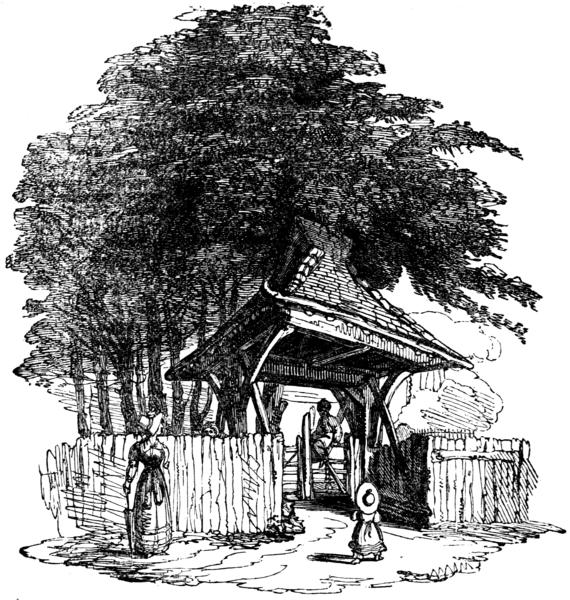
The Porch of Beckenham Church-yard.
Beyond the Lich-gate stand ten ancient yews— Branching so high they seem like giant mutes, With plumes, awaiting rich men’s funerals And poor men’s bury’ngs:—stretching, over all, An arch of triumph for Death’s victories.
*
Over the wickets to many of the church-yards in Kent is a shed, or covered way, of ancient structure, used as a resting-place for funerals, and for the shelter of the corpse until the minister arrives to commence the service for the dead. This at Beckenham is one of the most perfect in the county: the footway beyond, to the great entrance-door of the church, is canopied by a grove of trees, “sad sociate to graves.” These old church-yard buildings, now only seen in villages, were formerly called lich-gates, and the paths to them were called lich-lanes, or lich-ways.
The word lich signified a corpse. Hence the death-owl was anciently called the lich-owl.
The shrieking Litch-owl, that doth never cry But boding death, and quick herself inters In darksome graves, and hollow sepulchres.
Drayton.
Also, from lich is derived the name of the city of Lichfield, so called because of a massacre on that spot.
A thousand other saints whom Amphibal had taught, Flying the pagan foe, their lives that strictly sought, Were slain where Litchfield is, whose name doth rightly sound There, of those Christians slain, dead field, or burying ground.
Drayton.
For the Table Book.
THE TWO GRAVES.
In yonder cowslip’s sprinkled mead A church’s tapering spire doth rise, As if it were directing us Unto a fairer paradise; Within the yard, so fair and green, Full many a grave is to be seen. Often upon a summer’s eve The church-yard’s smooth, green sward I’ve trod! Reading the rugged epitaphs Of those who lie beneath the sod; But in one spot two graves were seen, Which always stopp’d my wandering. Upon one stone’s expansive front Was writ, in language stiff and cold, That he, who lay beneath that slab, Had died when he was very old; And at its close a simple line Said, that his age was ninety-nine. Another small and polish’d stone Beside the former did appear; It said, that that grave’s occupant Had died when in his third year: How eloquent the polish’d praise Lavish’d on that child’s winning ways! The old man lay beneath the stone, Where nought in praise of him was told; It only said, that there he lay, And that he died when he was old: It did not chronicle his years, His joys and sorrows—hopes and fears. Ninety-nine years of varying life On gliding pinions by had fled; (Oh what long years of toil and strife!) Ere he was number’d with the dead; But yet no line was left to tell How he had liv’d, or how he fell! Had he no wife,—no child,—no friend? To cheer him as he pass’d away; No one who would his name commend, And wail as he was laid in clay? Of this the record nought supplied,— It only said he liv’d and died! How must his soul have been oppress’d, As intimates dropp’d from his side! And he, almost unknown, was left Alone,—upon this desert wide! Wife—children—friends—all, all were gone, And he left in the world alone! His youthful friends had long grown old, And then were number’d with the dead; His step had totter’d, sight grown dim, And ev’ry source of pleasure fled; By nature’s law such must have been, Th’ effect of the long years he’d seen! But then the record nought supplied, How he had spent this length’ned life; Whether in peace and quietness, Or had he worried been with strife: Perhaps the muse to him had given Visions of glory, fire from Heaven! All is conjecture! He was laid Beneath the cold, unfeeling clay, His fame—if he had sigh’d for fame— Had from remembrance pass’d away. Hope, joy, fear, sorrow, all were fled, And he lay number’d with the dead! Oh! cold and cheerless is the thought, That I shall be as he is now; My very name remember’d not, And fame’s wreath wither’d on my brow: Of me no record be supplied, But that I liv’d, and that I died! Such is the tone of sorrowing thought That through my heart has often past, As, on a summer’s brightning eve, A look upon those graves I’ve cast, Where youth and age together lie, Emblems of frail mortality!
O. N. Y.
THE WHITE LADY. A romantic and true Anecdote.
At Nottingham, a year or two ago, Sophia Hyatt, in consequence of extreme deafness, was accidentally run over by a carrier’s cart, at the entrance of the Maypole inn-yard, and unfortunately killed. She had arrived that morning in a gig from Newstead Papplewick, or somewhere in that neighbourhood, and had been, for the three or four preceding years, a lodger in one of the farm-houses belonging to colonel Wildman, at Newstead Abbey. No one knew exactly from whence she came, nor what were her connections. Her days were passed in rambling about the gardens and grounds of the abbey, to which, from the kindness of colonel Wildman, she had free access. Her dress was invariably the same; and she was distinguished by the servants at Newstead, as the “white lady.” She had ingratiated herself with the Newfoundland dog which came from Greece with the body of lord Byron, by regularly feeding him; and on the evening before the fatal accident, she was seen, on quitting the gardens, to cut off a small lock of the dog’s hair, which she carefully placed in her handkerchief. On that evening also, she delivered to Mrs. Wildman a sealed packet, with a request that it might not be opened till the following morning. The contents of the packet were no less interesting than surprising; they consisted of various poems in manuscript, written during her solitary walks, and all of them referring to the bard to whom Newstead once belonged. A letter, addressed to Mrs. Wildman, was enclosed with the poetry, written with much elegance of language and native feeling; it described her friendless situation, alluded to her pecuniary difficulties, thanked the family for their kind attention towards her, and stated the necessity she was under of removing for a short period from Newstead. It appeared from her statement, that she had connections in America, that her brother had died there, leaving a widow and family, and she requested colonel Wildman’s assistance to arrange certain matters, in which she was materially concerned. She concluded with declaring, that her only happiness in this world consisted in the privilege of being allowed to wander through the domain of Newstead, and to trace the various spots which had been consecrated by the genius of lord Byron. A most kind and compassionate note was conveyed to her immediately after the perusal of this letter, urging her, either to give up her journey, or to return to Newstead as quickly as possible. With the melancholy sequel the reader is acquainted. Colonel Wildman took upon himself the care of her interment, and she was buried in the church-yard of Hucknall, as near as possible to the vault which contains the body of lord Byron. The last poem she composed was the following: it seems to have been dictated by a melancholy foreboding of her fate.
My last Walk in the Gardens of Newstead Abbey.
Here no longer shall I wander Lone, but in communion high, Kindred spirits greet me—yonder Glows the form that’s ever nigh. Wrapt in blissful contemplation, From that hill no more I gaze On scenes as fair as when creation Rose—the theme of seraphs’ lays. And thou, fair sylph, that round its basis Driv’st thy car, with milk-white steed; Oft I watch’d its gentle paces— Mark’d its track with curious heed. Why? oh! why thus interesting, Are forms and scenes to me unknown? Oh you, the Muses’ power confessing, Define the charm your bosoms own. Why love to gaze or playful fountain, Or lake, that bore him on its breast? Lonely to wander o’er each mountain, Grove, or plain, his feet have press’d? It is because the Muses hover, And all around, a halo shed; And still must every fond adorer Worship the shrine, the idol fled. But ’tis past; and now for ever Fancy’s vision’s bliss is o’er; But to forget thee, Newstead—never, Though I shall haunt thy shades no more.[207]
DUELS.
Duelling in England was carried to its greatest possible excess in the reigns of James I. and of the two Charles’s. In the reign of the latter Charles, the seconds always fought as well as their principals; and as they were chosen for their courage and adroitness, their combats were generally the most fatal. Lord Howard, of Carlisle, in the reign of Charles II., gave a grand fête champêtre at Spring Gardens, near the village of Charing, the Vauxhall of that day. This fête was to facilitate an intrigue between lord Howard and the profligate duchess of Shrewsbury: but the gay and insinuating Sidney flirted with the duchess, abstracted her attention from Howard, and ridiculed the fête. The next day his lordship sent a challenge to Sidney, who chose as his second a tall, furious, adroit swordsman, named Dillon; Howard selected a young gentleman, named Rawlings, just come into possession of an estate of 10,000l. a year. Sidney was wounded in two or three places, whilst his second was run through the heart, and left dead on the field. The duke of Shrewsbury became afterwards so irritated as to challenge the infamous Buckingham for intriguing with his wife. The duchess of Shrewsbury, in the disguise of a page, attended Buckingham to the field, and held his horse whilst he fought and killed her husband. The profligate king, in spite of every remonstrance from the queen, received the duke of Buckingham with open arms, after this brutal murder.
In 172 duels fought during the last sixty years, 69 persons were killed; (in three of these duels, neither of the combatants survived;) 96 persons were wounded, 48 desperately and 48 slightly; and 188 escaped unhurt. Thus, rather more than one-fifth lost their lives, and nearly one-half received the bullets of their antagonists. It appears also, that out of this number of duels, eighteen trials took place; six of the arraigned were acquitted, seven found guilty of manslaughter, and three of murder; two were executed, and eight imprisoned for different periods.
About thirty years ago, there was a duelling society held in Charleston, South Carolina, where each “gentleman” took precedence according to the numbers he had killed or wounded in duels. The president and deputy had killed many. It happened that an old weather-beaten lieutenant of the English navy arrived at Charleston, to see after some property which had devolved upon him, in right of a Charleston lady, whom he had married; and on going into a coffee-house, engaged in conversation with a native, whose insults against England were resented, and the English lieutenant received a challenge. As soon as the affair was known, some gentlemen waited upon the stranger to inform him, that the man who had called him out was a duellist, a “dead shot,” the president of the duellist club; they added, that the society and all its members, though the wealthiest people of the place, were considered so infamous by really respectable persons, that he would not be held in disesteem by not meeting the challenger. The lieutenant replied, that he was not afraid of any duellist; he had accepted the challenge, and would meet his man. They accordingly did meet, and at the first fire the lieutenant mortally wounded his antagonist. In great agony, and conscience-stricken, he invoked the aid of several divines, and calling the “duellist society” to his bedside, lectured them upon the atrocity of their conduct, and begged, as his dying request, that the club might be broken up. The death of this ruffian suppressed a society which the country did not possess sufficient morals or gentlemanly spirit to subdue.
In Virginia, a Mr. Powell, a notorious duellist, purposely met and insulted an English traveller, for having said, that “the Virginians were of no use to the American Union, it requiring one half of the Virginians to keep the other half in order;” the newspapers took it up as a national quarrel, and anticipated the meeting, without the magistracy having decency, morals, or public spirit sufficient to interfere. The Englishman, therefore, got an American duellist as his second, went into training and practice, and met his adversary amidst a mob of many thousands to witness the fight. Mr. Powell was killed on the first shot, and the Englishman remained unhurt.
The brother of general Delancey, the late barrack-master general, having high words with a “gentleman” in a coffee-house at New York, the American immediately called for pistols, and insisted upon fighting in the public coffee-room, across one of the tables. None of the “gentlemen” present interfered; they fought across the table, and the American dishonestly firing before his time, the Englishman was shot dead upon the spot. Lately, at Nashville, a gentleman was shot dead before his own door, in a duel, in the principal square of the city.
In 1763, the secretary of the English treasury, Mr. Martin, notoriously trained himself as a duellist, for the avowed purpose of shooting Mr. Wilkes, whom he first insulted in the House of Commons, and afterwards wounded in the park. This gave rise to Churchill’s poem of “The Duellist;” the House of Commons ordered his majesty’s sergeant surgeon to attend Mr. Wilkes, and Mr. Martin was considered to “have done the state some service.”
At that period duels were frequent among clergymen. In 1764, the Rev. Mr. Hill was killed in a duel by cornet Gardener, of the carabineer. The Reverend Mr. Bate fought two duels, and was subsequently created a baronet, and preferred to a deanery after he had fought another duel. The Reverend Mr. Allen killed a Mr. Delany in a duel, in Hyde Park, without incurring any ecclesiastical censure, though judge Buller, on account of his extremely bad conduct, strongly charged his guilt upon the jury.
In 1765, occurred a celebrated duel between the father of the late lord Byron and Mr. Chaworth, a famous duellist. They quarrelled at a club-dinner at the Star and Garter, Pall Mall, about game; Chaworth was a great game preserver, and lord Byron had argued upon the cruelty and impolicy of the game laws. They agreed to fight in an adjoining room, by the light of only one candle. Lord Byron entered first; and, as Chaworth was shutting the door, turning his head round, he beheld lord Byron’s sword half undrawn; he immediately whipped his own weapon out, and making a lunge at his lordship, ran it through his waistcoat, conceiving that his sword had gone through his body: lord Byron closed, and, shortening his sword, stabbed Mr. Chaworth in the belly. The challenge had proceeded from Chaworth. Lord Byron read his defence to the House of Lords, and was found guilty of manslaughter; and, upon the privilege of his peerage, was discharged on paying his fees.
In 1772, a Mr. M‘Lean was challenged and killed by a Mr. Cameron; and the mother of Mr. M‘Lean, on hearing of the shocking event, instantly lost her senses, whilst a Miss M‘Leod, who was to have been married to the deceased, was seized with fits, and died in three days.
In Mr. Sheridan’s duel with Mr. Mathews, the parties cut and slashed at each other, à la mode de théâtre, until Mr. Mathews left a part of his sword sticking in Mr. Sheridan’s ear.
In a famous duel in which Mr. Riddell was killed, and Mr. Cunningham very severely wounded, the challenge, by mistake, had fallen in the first instance into the hands of sir James Riddell, father to Mr. Riddell, who, on having it delivered to him, did no more than provide surgeons for the event.
In 1789, colonel Lennox conceived himself to have been insulted by the late duke of York having told him, before all the officers on the parade of St. James’s, “that he desired to derive no protection from his rank of prince.” The colonel accordingly fought his royal highness, it was said, with cork bullets; but be that as it may, he contrived to disturb one of the huge rows of curls which it was then the fashion to wear on the side of the head.
In 1790, a captain Macrae fought and killed sir George Ramsay, for refusing to dismiss a faithful old servant who had insulted captain Macrae. Sir George urged, that even if the servant were guilty, he had been sufficiently punished by the cruel beating that captain Macrae had given him. As soon as the servant heard that his master had been killed on his account, he fell into strong convulsions, and died in a few hours. Captain Macrae fled, and was outlawed.
In 1797, colonel Fitzgerald, a married man, eloped from Windsor with his cousin, the daughter of lord Kingston. Colonel King, the brother, fought colonel Fitzgerald in Hyde Park. They fired six shots each without effect; and the powder being exhausted, colonel King called his opponent “a villain,” and they resolved to fight again next day. They were, however, put under an arrest, when colonel Fitzgerald had the audacity to follow lord Kingston’s family to Ireland, to obtain the object of his seduction from her parents. Colonel King hearing of this, repaired to the inn where colonel Fitzgerald put up. Colonel Fitzgerald had locked himself in his room, and refused admission to colonel King, who broke open the door, and running to a case of pistols, seized one, and desired colonel Fitzgerald to take the other. The parties grappled, and were fighting, when lord Kingston entered the room; and perceiving, from the position of the parties, that his son must lose his life, instantly shot Fitzgerald dead on the spot.
In 1803, a very singular duel took place in Hyde Park, between a lieutenant W., of the navy, and a captain I., of the army. Captain I. had seduced the lieutenant’s sister. Lieutenant W. seemed impressed with a deep sense of melancholy: he insisted that the distance should be only six paces. At this distance they fired, and the shot of captain I. struck the guard of lieutenant W.’s pistol, and tore off two fingers of his right hand. The lieutenant deliberately wrapped his handkerchief round the wound, and looking solemnly to heaven, exclaimed, “I have a left hand, which never failed me.” They again took their ground. Lieutenant W. looked steadfastly at captain I., and casting his eyes up to heaven, was heard to utter “forgive me.” They fired, and both fell. Captain I. received the ball in his head, and died instantly: the lieutenant was shot through the breast. He inquired if captain I.’s wound was mortal. Being answered in the affirmative, he thanked heaven that he had lived so long. He then took his mourning ring off his finger, and said to his second, “Give this to my sister, and tell her it is the happiest moment I ever knew.” He had scarcely uttered the last word, when a quantity of blood gushed from his wound, and he instantly expired.
These are practices in a Christian country.
ANSWER TO A CHALLENGE.
At a late meeting under a commission of bankruptcy, at Andover, between Mr. Fleet and Mr. Mann, both respectable solicitors of that town, some disagreement arose, which ended in the former sending the latter a challenge, to which the following answer was returned.
To Kingston Fleet, Esq.
I am honour’d this day, sir, with challenges two, The first from friend Langdon, the second from you; As the one is to fight, and the other to dine, I accept his “engagement,” and yours must decline. Now, in giving this preference, I trust you’ll admit I have acted with prudence, and done what was fit, Since encountering him, and my weapon a knife, There is some little chance of preserving my life; Whilst a bullet from you, sir, might take it away, And the maxim, you know, is to live while you may. If, however, you still should suppose I ill-treat you, By sternly rejecting this challenge to meet you, Bear with me a moment, and I will adduce Three powerful reasons by way of excuse: In the first place, unless I am grossly deceiv’d, I myself am in conscience the party aggriev’d; And therefore, good sir, if a challenge must be, Pray wait till that challenge be tender’d by me. Again, sir, I think it by far the more sinful, To stand and be shot, than to sit for a skinful; From whence you’ll conclude (as I’d have you, indeed) That fighting composes not part of my creed— And my courage (which, though it was never disputed, Is not, I imagine, too, too deeply rooted) Would prefer that its fruit, sir, whate’er it may yield, Should appear at “the table,” and not in “the field.” And, lastly, my life, be it never forgot, Possesses a value which yours, sir, does not;[208] So I mean to preserve it as long as I can, Being justly entitled “a family Man,” With three or four children, (I scarce know how many,) Whilst you, sir, have not, or ought not, to have any. Besides, that the contest would be too unequal, I doubt not will plainly appear by the sequel: For e’en you must acknowledge it would not be meet That one small “Mann of war” should engage “a whole Fleet.”
Andover, July 24, 1826.
SIGNS OF LOVE, AT OXFORD. By an Inn-consolable Lover.
She’s as light as the Greyhound, and fair as the Angel; Her looks than the Mitre more sanctified are; But she flies like the Roebuck, and leaves me to range ill, Still looking to her as my true polar Star. New Inn-ventions I try, with new art to adore, But my fate is, alas! to be voted a Boar; My Goats I forsook to contemplate her charms, And must own she is fit for our noble King’s Arms. Now Cross’d, and now Jockey’d, now sad, now elate, The Chequers appear but a map of my fate; I blush’d like a Blue-cur to send her a Pheasant, But she call’d me a Turk, and rejected my present; So I moped to the Barley-mow, griev’d in my mind, That the Ark from the flood ever rescu’d mankind! In my dreams Lions roar, and the Green Dragon grins And fiends rise in shape of the Seven deadly sins. When I ogle the Bells, should I see her approach, I skip like a Nag and jump into the Coach. She is crimson and white, like a Shoulder of Mutton, Not the red of the Ox was so bright, when first put on: Like the Hollybush prickles, she scratches my liver, While I moan, and I die like the Swan by the river!
Prolific Writers.
The copiousness and the multiplicity of the writings of many authors, have shown that too many find a pleasure in the act of composition, which they do not communicate to others. Great erudition and every-day application is the calamity of that voluminous author, who, without good sense, and what is more rare, without that exquisite judgment which we call good taste is always prepared to write on any subject, but at the same time on no one reasonably. We are astonished at the fertility and the size of our own writers of the seventeenth century, when the theological war of words raged, spoiling so many pages and brains. They produced folio after folio, like almanacks. The truth is, that it was then easier to write up to a folio, than in our days to write down to an octavo; for correction, selection, and rejection, were arts as yet unpractised. They went on with their work, sharply or bluntly, like witless mowers, without stopping to whet their scythes. They were inspired by the scribbling demon of that rabbin, who, in his oriental style and mania of volume, exclaimed, that were “the heavens formed of paper, and were the trees of the earth pens, and if the entire sea run ink, these only could suffice” for the monstrous genius he was about to discharge on the world.
WILLIAM PRYNNE.
Prynne seldom dined: every three or four hours he munched a manchet, and refreshed his exhausted spirits with ale brought to him by his servant; and when “he was put into this road of writing,” as Anthony à Wood telleth, he fixed on “a long quilted cap, which came an inch over his eyes, serving as an umbrella to defend them from too much light;” and then, hunger nor thirst did he experience, save that of his voluminous pages. Prynne has written a library, amounting, perhaps, to nearly two hundred books. Our unlucky author, whose life was involved in authorship, and his happiness, no doubt, in the habitual exuberance of his pen, seems to have considered the being debarred from pen, ink, and books, during his imprisonment, as an act more barbarous than the loss of his ears. The extraordinary perseverance of Prynne in this fever of the pen appears in the following title of one of his extraordinary volumes, “Comfortable Cordials against discomfortable Fears of Imprisonment; containing some Latin Verses Sentences, and Texts of Scripture, written by Mr. Wm. Prynne on his Chamber Walls, in the Tower of London, during his Imprisonment there; translated by him into English Verse, 1641.” Prynne literally verified Pope’s description:—
“Is there, who, locked from ink and paper, scrawls, With desperate charcoal round his darkened walls.”
We have also a catalogue of printed books, written by Wm. Prynne, Esq., of Lincoln’s Inn, in these classes,
Before, During, and Since
- his imprisonment,
Before, During, and Since his imprisonment,
with this motto, “Jucundi acti labores,” 1643. The secret history of this voluminous author concludes with a characteristic event: a contemporary who saw Prynne in the pillory at Cheapside, informs us, that while he stood there they “burnt his huge volumes under his nose, which had almost suffocated him.”
FRENCH PAMPHLETEER.
One Catherinot all his life was printing a countless number of feuilles volantes in history and on antiquities; each consisting of about three or four leaves in quarto: Lenglet du Fresnoy calls him “Grand auteur des petits livres.” This gentleman liked to live among antiquaries and historians; but with a crooked head-piece, stuck with whims, and hard with knotty combinations, all overloaded with prodigious erudition, he could not ease it at a less rate than by an occasional dissertation of three or four quarto pages. He appears to have published about two hundred pieces of this sort, much sought after by the curious for their rarity: Brunet complains he could never discover a complete collection. But Catherinot may escape “the pains and penalties” of our voluminous writers, for De Bure thinks he generously printed them to distribute among his friends. Such endless writers, provided they do not print themselves into an alms-house, may be allowed to print themselves out; and we would accept the apology which Monsieur Catherinot has framed for himself, which is preserved in Beyeri Memoriæ Librorum Rariorum. “I must be allowed my freedom in my studies, for I substitute my writings for a game at the tennis-court, or a club at the tavern; I never counted among my honours these opuscula of mine, but merely as harmless amusements. It is my partridge, as with St. John the Evangelist; my cat, as with Pope St. Gregory; my little dog, as with St. Dominick; my lamb, as with St. Francis; my great black mastiff, as with Cornelius Agrippa; and my tame hare, as with Justus Lipsius.” Catherinot could never get a printer, and was rather compelled to study economy in his two hundred quartos of four or eight pages; his paper was of inferior quality, and when he could not get his dissertations into his prescribed number of pages, he used to promise the end at another time, which did not always happen. But his greatest anxiety was to publish and spread his works; in despair he adopted an odd expedient. Whenever Monsieur Catherinot came to Paris, he used to haunt the quaies where books are sold, and while he appeared to be looking over them, he adroitly slided one of his own dissertations among these old books. He began this mode of publication early, and continued it to his last days. He died with a perfect conviction that he had secured his immortality; and in this manner he disposed of more than one edition of his unsaleable works.[209]
LOVE’S PROGRESS OF A TOBACCONIST.
For the Table Book.
1.
When bless’d with Fanny’s rosy smiles, I thought myself in heaven; Fanny is blooming twenty-two, And I am—thirty-seven.
2.
I thought her deck’d with every grace, Without one vice to jar, Fresh as new carrot was her face And sweet as Macabar.
3.
Besides a person fair to view She had a thousand pounds; Not to be sneezed at—I had two, And credit without bounds.
4.
Our courtship oft consisted in Slight taps and gentle knocks; And when I gave her a small pinch, She quick return’d a box.
5.
Howe’er, one morning, in a rage, With me herself she put, She call’d me blackguard, and declar’d I was from thence short cut.
6.
In vain I tried the cause to smoke, When she had ta’en offence; In vain recall’d the words I spoke, That she had deem’d bad scents.
7.
But soon a mutual friend contriv’d Our quarrel up to botch; Fanny confess’d her temper warm— ’Twas natural—she was Scotch.
8.
We married—snugly in my shop Fanny’s become a fixture, And all the neighbourhood declare, We’re quite a pleasant mixture.
Sam Sam’s Son.
THE LORD CHANCELLOR.
The title of chancellor originated with the Romans. It was adopted by the church, and became a half ecclesiastic, and half lay office. The chancellor was intrusted with all public instruments which were authenticated; and when seals came into use, the custody of them was confided to that officer. The mere delivery of the king’s great seal, or the taking it away, is all the ceremony that is used in creating or unmaking a chancellor, the officer of the greatest weight and power subsisting in the kingdom. The first chancellor in England was appointed in the reign of William the Conqueror, and with only one exception, it was enjoyed by ecclesiastics until the time of Elizabeth, when such officers were called keepers of the great seal. From the time of sir Thomas More’s appointment, which took place in the reign of Henry VIII., there is only one instance of a clergyman having been elevated to the office—namely, Dr. Williams, dean of Westminster, in the time of James I.—The chancellor is a privy counsellor by office, and speaker of the house of lords by prescription. To him belongs the appointment of all justices of the peace throughout the kingdom. When the chancellor was an ecclesiastic, he became keeper of the king’s conscience, and remained so. He is also visitor of all hospitals and colleges of the king’s foundation. He is patron of all livings under twenty pounds per annum in the king’s book. He is the general guardian of all infants, idiots, and lunatics, and has the superintendence of all charitable institutions in the kingdom. He takes precedent of every temporal lord, except the royal family, and of all others, except the archbishop of Canterbury. It is declared treason by statute of Edward III. to slay the chancellor in his place, and doing his office.—In the year 1689, there were commissioners appointed for executing the office of lord chancellor.
Anonymiana.
The great Lord Chancellor.
Sir Thomas More, when at the bar, is said to have undertaken only such causes as appeared just to his conscience, and never to have accepted a fee from a widow, orphan, or poor person; yet he acquired by his practice the considerable sum, in those days, of four hundred pounds per annum. When he rose to the height of his profession, his diligence was so great, that one day being in court he called for the next cause, on which it was answered, that there were no more suits in chancery. This made a punning bard of that time thus express himself:—
When More some years had chancellor been, No more suits did remain; The same shall never more be seen. Till More be there again.
Chancery.
Cancellæ are lattice-work, by which the chancels being formerly parted from the body of the church, they took their names from thence. Hence, too, the court of chancery and the lord chancellor borrowed their names, that court being enclosed with open work of that kind. And, so, to cancel a writing is to cross it out with the pen, which naturally makes something like the figure of a lattice.
Diligence and Delight.
It is a common observation, that unless a man takes a delight in a thing, he will never pursue it with pleasure or assiduity. Diligentia, diligence, is from diligo, to love.
Pamphlet, Palm, Palmistry.
Pamphlet.—This word is ancient, see Lilye’s Euphnes, p. 5; Lambarde’s Perambulation of Kent, p. 188; Hearne’s Cur. Disc. p. 130; Hall’s Chronicle, in Edward V. f. 2; Richard III. f. 32; Skelton, p. 47; Caxton’s Preface to his Virgil, where it is written paunflethis; Oldys’s British Librarian, p. 128; Nash, p. 3, 64; and also his preface, wherein he has the phrase, “to pamphlet on a person” and pampheleter, p. 30.
The French have not the word pamphlet, and yet it seems to be of French extraction, and no other than palm-feuillet, a leaf to be held in the hand, a book being a thing of a greater weight. So the French call it now feuille volante, retaining one part of the compound.
Palm is the old French word for hand, from whence we have palmistry, the palm of the hand, a palm or span, and to palm a card, and from thence the metaphor of palming any thing upon a person.
Cambridge Wit.
A gentleman of St. John’s College, Cambridge, having a clubbed foot, which occasioned him to wear a shoe upon it of a particular make, and with a high heel, one of the college wits called him Bildad the shuhite.
Gradual Reform.
When lord Muskerry sailed to Newfoundland, George Rooke went with him a volunteer: George was greatly addicted to lying; and my lord, being very sensible of it, and very familiar with George, said to him one day, “I wonder you will not leave off this abominable custom of lying, George.” “I can’t help it,” said the other. “Puh!” says my lord, “it may be done by degrees; suppose you were to begin with uttering one truth a day.”
Private and Public.
Charles II. spending a cheerful evening with a few friends, one of the company, seeing his majesty in good humour, thought it a fit time to ask him a favour, and was so absurd as to do so: after he had mentioned his suit, Charles instantly and very acutely replied, “Sir, you must ask your king for that.”
A Hundred to One.
“There were a hundred justices,” says one, “at the monthly meeting.” “A hundred,” says another. “Yes,” says he, “do you count, and I will name them. There was justice Balance, put down one; justice Hall, put down a cipher, he is nobody; justice House, you may put down another cipher for him—one and two ciphers are a hundred.”
THE CHILD OF MIGHT.
For the Table Book.
War was abroad, and the fleeting gale Loud, o’er the wife’s and the daughter’s wail, Brought the summoning sound of the clarion’s blast— Age and affection looked their last On the valour and youth that went forth to the tomb— Young eyes were bright at the nodding plume— Banner and spear gleam’d in the sun— And the laugh was loud as the day were won: But the sun shall set, and—ere ’tis night,— Woe to thee, Child of Pride and Might. ’Tis the hour of battle, the hosts are met, Pierc’d is the hauberk, cleft the bass’net: Like a torrent the legions thunder’d on— Lo! like its foam, they are vanish’d and gone Thou whom this day beauty’s arms carest, The hoof of the fleeing spurns thy crest— Thy pride yet lives on thy dark brow’s height, But, where is thy power, Child of Might?
J. J. K.