Volume 1 — Vol. I.—11.
Reading edition
March Fair, at Brough, Westmoreland.
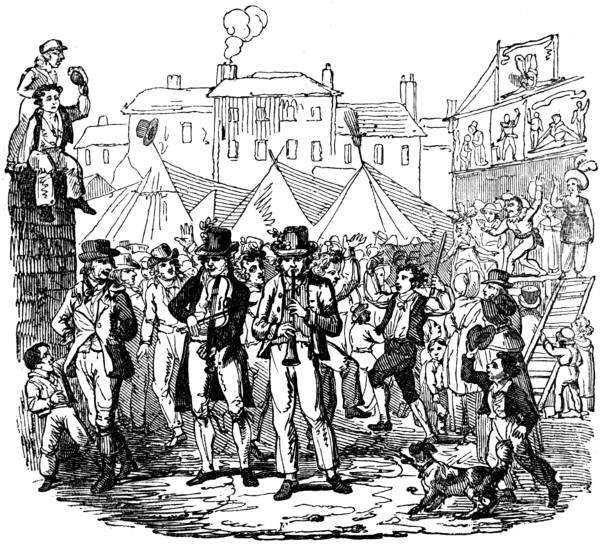
March Fair, at Brough, Westmoreland
For the Table Book
This fair is held always on the second Thursday in March: it is a good one for cattle; and, in consequence of the great show, the inhabitants are obliged to shut up their windows; for the cattle and the drivers are stationed in all parts of the town, and few except the jobbers venture out during the time of selling.
From five to six o’clock the preceding evening, carts, chiefly belonging to Yorkshire clothiers, begin to arrive, and continue coming in until the morning, when, at about eight or nine, the cattle fair begins, and lasts till three in the afternoon. Previously to any article being sold, the fair is proclaimed in a manner depicted tolerably well in the preceding sketch. At ten, two individuals, named Matthew Horn and John Deighton, having furnished themselves with a fiddle and clarinet, walk through the different avenues of the town three times, playing, as they walk, chiefly “God save the King;” at the end of this, some verses are repeated, which I have not the pleasure of recollecting; but I well remember, that thereby the venders are authorized to commence selling. After it is reported through the different stalls that “they’ve walked the fair,” business usually commences in a very brisk manner.
Mat. Horn has the best cake booth in the fair, and takes a considerable deal more money than any “spice wife,” (as women are called who attend to these dainties.) Jack Deighton is a shoemaker, and a tolerably good musician. Coals are also brought for sale, which, with cattle, mainly constitute the morning fair.
At the close of the cattle fair, the town is swept clean, and lasses walk about with their “sweethearts,” and the fair puts on another appearance. “Cheap John’s here the day,” with his knives, combs, bracelets, &c. &c. The “great Tom Mathews,” with his gallanty show, generally contrives to pick up a pretty bit of money by his droll ways. Then “Here’s spice Harry, gingerbread, Harry—Harry—Harry!” from Richmond, with his five-and-twenty lumps of gingerbread for sixpence. Harry stands in a cart, with his boxes of “spice” beside him, attracting the general attention of the whole fair, (though he is seldomer here than at Brough-hill fair.) There are a few shows, viz. Scott’s sleight of hand, horse performances, &c. &c.; and, considering the size of the town, it has really a very merry-spent fair. At six o’clock dancing begins in nearly all the public-houses, and lasts the whole of “a merry neet.”
Jack Deighton mostly plays at the greatest dance, namely, at the Swan inn; and his companion, Horn, at one of the others; the dances are merely jigs, three reels, and four reels, and country dances, and no more than three sets can dance at a time. It is a matter of course to give the fiddler a penny or two-pence each dance; sometimes however another set slips in after the tune’s begun, and thus trick the player. By this time nearly all the stalls are cleared away, and the “merry neet” is the only place to resort to for amusement. The fiddle and clarinet are to be heard every where; and it is astonishing what money is taken by the fiddlers. Some of the “spice wives,” too, stop till the next morning, and go round with their cakes at intervals, which they often sell more of than before.
At this festival at Brough, the husbandmen have holiday, and many get so tipsy that they are frequently turned off from their masters. Several of the “spice wives” move away in the afternoon to Kirby Stephen, where there is a very large fair, better suited to their trade, for it commences on the day ensuing. Unfortunately, I was never present at the proclamation. From what I saw, I presume it is in consequence of a charter, and that these people offer their services that the fair-keepers may commence selling their articles sooner. I never heard of their being paid for their trouble. They are constantly attended by a crowd of people, who get on the carts and booths, and, at the end, set up a load “huzza!”
W. H. H.
THE TWELVE GEMS Of the Twelve Months.
For the Table Book.
It is a Polish superstition, that each month has a particular gem attached to it, which governs it, and is supposed to influence the destiny of persons born in that month; it is therefore customary among friends, and lovers particularly, to present each other, on their natal day, with some trinket containing their tutelary gem, accompanied with its appropriate wish; this kind fate, or perhaps kinder fancy, generally contrives to realize according to their expectations.
January.
Jacinth, or Garnet denotes constancy and fidelity in every engagement.
February.
Amethyst preserves mortals from strong passions, and ensures peace of mind.
March.
Bloodstone denotes courage and secrecy in dangerous enterprises.
April.
Sapphire, or Diamond denotes repentance and innocence.
May.
Emerald, successive love.
June.
Agate ensures long life and health.
July.
Ruby, or Cornelian ensures the forgetfulness or cure of evils springing from friendship or love.
August.
Sardonix ensures conjugal felicity.
September.
Chrysolite preserves from, or cures folly.
October.
Aquamarine, or Opal denotes misfortune and hope.
November.
Topaz ensures fidelity and friendship.
December.
Turquoise, or Malakite denotes the most brilliant success and happiness in every circumstance of life.
E. M. S.
Garrick Plays. No. VIII.
[From the “Game at Chess,” a Comedy, by Thomas Middleton, 1624.]
Popish Priest to a great Court Lady, whom he hopes to make a Convert of.
Let me contemplate; With holy wonder season my access, And by degrees approach the sanctuary Of unmatch’d beauty, set in grace and goodness. Amongst the daughters of men I have not found A more Catholical aspect. That eye Doth promise single life, and meek obedience. Upon those lips (the sweet fresh buds of youth) The holy dew of prayer lies, like pearl Dropt from the opening eyelids of the morn Upon the bashful rose. How beauteously A gentle fast (not rigorously imposed) Would look upon that cheek; and how delightful The courteous physic of a tender penance, (Whose utmost cruelty should not exceed The first fear of a bride), to beat down frailty!
[From the “Virgin Widow,” a Comedy, 1649; the only production, in that kind, of Francis Quarles, Author of the Emblems.]
Song.
How blest are they that waste their weary hours In solemn groves and solitary bowers, Where neither eye nor ear Can see or hear The frantic mirth And false delights of frolic earth; Where they may sit, and pant, And breathe their pursy souls; Where neither grief consumes, nor griping want Afflicts, nor sullen care controuls. Away, false joys; ye murther where ye kiss! There is no heaven to that, no life to this.
[From “Adrasta,” a Tragi-comedy, by John Jones, 1635.]
Dirge.
Die, die, ah die! We all must die: ’Tis Fate’s decree; Then ask not why. When we were framed, the Fates consultedly Did make this law, that all things born should die. Yet Nature strove, And did deny We should be slaves To Destiny. At which, they heapt Such misery; That Nature’s self Did wish to die: And thank their goodness, that they would foresee To end our cares with such a mild decree.
Another.
Come, Lovers, bring your cares, Bring sigh-perfumed sweets; Bedew the grave with tears, Where Death with Virtue meets. Sigh for the hapless hour, That knit two hearts in one; And only gave Love power To die, when ’twas begun.
[From “Tancred and Gismund,” acted before the Court by the Gentlemen of the Inner Temple, 1591.]
A Messenger brings to Gismund a cup from the King her Father, enclosing the heart of her Lord, whom she had espoused without his sanction.
Mess. Thy father, O Queen, here in this cup hath sent The thing to joy and comfort thee withal, Which thou lovedst best: ev’n as thou wast content To comfort him with his best joy of all. Gis. I thank my father, and thee, gentle Squire; For this thy travail; take thou for thy pains This bracelet, and commend me to the King. **** So, now is come the long-expected hour, The fatal hour I have so looked for. Now hath my father satisfied his thirst With guiltless blood, which he so coveted. What brings this cup? aye me, I thought no less; It is my Earl’s, my County’s pierced heart. Dear heart, too dearly hast thou bought my love. Extremely rated at too high a price. Ah my dear heart, sweet wast thou in thy life, But in thy death thou provest passing sweet. A fitter hearse than this of beaten gold Could not be lotted to so good a heart. My father therefore well provided thus To close and wrap thee up in massy gold And therewithal to send thee unto me, To whom of duty thou dost best belong. My father hath in all his life bewrayed A princely care and tender love to me, But this surpasseth, in his latter days To send me this mine own dear heart to me. Wert not thou mine, dear heart, whilst that my love Danced and play’d upon thy golden strings? Art thou not mine, dear heart, now that my love Is fled to heaven, and got him golden wings? Thou art mine own, and still mine own shall be, Therefore my father sendeth thee to me. Ah pleasant harbourer of my heart’s thought! Ah sweet delight, the quickener of my soul! Seven times accursed be the hand that wrought Thee this despite, to mangle thee so foul Yet in this wound I see my own true love, And in this wound thy magnanimity, And in this wound I see thy constancy. Go, gentle heart, go rest thee in thy tomb; Receive this token as thy last farewell. She kisseth it. Thy own true heart anon will follow thee, Which panting hasteth for thy company. Thus hast thou run, poor heart, thy mortal race, And rid thy life from fickle fortune’s snares, Thus hast thou lost this world and worldly cares, And of thy foe, to honour thee withal, Receiv’d a golden grave to thy desert. Nothing doth want to thy just funeral, But my salt tears to wash thy bloody wound; Which to the end thou mightst receive, behold, My father sends thee in this cup of gold: And thou shalt have them; though I was resolved To shed no tears; but with a cheerful face Once did I think to wet thy funeral Only with blood, and with no weeping eye. This done, my soul forthwith shall fly to thee; For therefore did my father send thee me.
Nearly a century after the date of this Drama, Dryden produced his admirable version of the same story from Boccacio. The speech here extracted may be compared with the corresponding passage in the Sigismonda and Guiscardo, with no disadvantage to the elder performance. It is quite as weighty, as pointed, and as passionate.
C. L.
Necromancy.
THE DEAN OF BADAJOS. By the Abbe Blanchet.
The dean of the cathedral of Badajos was more learned than all the doctors of Salamanca, Coimbra, and Alcala, united; he understood all languages, living and dead, and was perfect master of every science divine and human, except that, unfortunately, he had no knowledge of magic. He was inconsolable when he reflected on his ignorance in that sublime art, till he was told that a very able magician resided in the suburbs of Toledo, named don Torribio. He immediately saddled his mule, departed for Toledo, and alighted at the door of no very superb dwelling, the habitation of that great man.
“Most reverend magician,” said he, addressing himself to the sage, “I am the dean of Badajos. The learned men of Spain all allow me to be their superior; but I am come to request from you a much greater honour, that of becoming your pupil. Deign to initiate me in the mysteries of your art, and doubt not but you shall receive a grateful acknowledgment, suitable to the benefit conferred, and your own extraordinary merit.”
Don Torribio was not very polite, though he valued himself on being intimately acquainted with the highest company below. He told the dean he was welcome to seek elsewhere for a master; for that, for his part, he was weary of an occupation which produced nothing but compliments and promises, and that he should but dishonour the occult sciences by prostituting them to the ungrateful.
“To the ungrateful!” exclaimed the dean: “has then the great don Torribio met with persons who have proved ungrateful? And can he so far mistake me as to rank me with such monsters?” He then repeated all the maxims and apophthegms which he had read on the subject of gratitude, and every refined sentiment his memory could furnish. In short, he talked so well, that the conjuror, after having considered a moment, confessed he could refuse nothing to a man of such abilities, and so ready at pertinent quotations.
“Jacintha,” said don Torribio to his old woman, “lay down two partridges to the fire. I hope my friend the dean will do me the honour to sup with me to night.” At the same time he took him by the hand and led him into the cabinet; when here, he touched his forehead, uttering three mysterious words, which the reader will please to remember, “Ortobolan, Pistafrier, Onagriouf.” Then, without further preparation, he began to explain, with all possible perspicuity, the introductory elements of his profound science. The new disciple listened with an attention which scarcely permitted him to breathe; when, on a sudden, Jacintha entered, followed by a little old man in monstrous boots, and covered with mud up to the neck, who desired to speak with the dean on very important business. This was the postilion of his uncle, the bishop of Badajos, who had been sent express after him, and who had galloped without ceasing quite to Toledo, before he could overtake him. He came to bring him information that, some hours after his departure, his grace had been attacked by so violent an apoplexy that the most terrible consequences were to be apprehended. The dean heartily, that is inwardly, (so as to occasion no scandal,) execrated the disorder, the patient, and the courier, who had certainly all three chosen the most impertinent time possible. He dismissed the postilion, bidding him make haste back to Badajos, whither he would presently follow him; and instantly returned to his lesson, as if there were no such things as either uncles or apoplexies.
A few days afterwards the dean again received news from Badajos: but this was worth hearing. The principal chanter, and two old canons, came to inform him that his uncle, the right reverend bishop, had been taken to heaven to receive the reward of his piety; and the chapter, canonically assembled, had chosen him to fill the vacant bishopric, and humbly requested he would console, by his presence, the afflicted church of Badajos, now become his spiritual bride.
Don Torribio, who was present at this harangue, endeavoured to derive advantage from what he had learned; and taking aside the new bishop, after having paid him a well-turned compliment on his promotion, proceeded to inform him that he had a son, named Benjamin, possessed of much ingenuity, and good inclination, but in whom he had never perceived either taste or talent for the occult sciences. He had, therefore, he said, advised him to turn his thoughts towards the church, and he had now, he thanked heaven, the satisfaction to hear him commended as one of the most deserving divines among all the clergy of Toledo. He therefore took the liberty, most humbly, to request his grace to bestow on don Benjamin the deanery of Badajos, which he could not retain together with his bishopric.
“I am very unfortunate,” replied the prelate, apparently somewhat embarrassed; “you will, I hope, do me the justice to believe that nothing could give me so great a pleasure as to oblige you in every request; but the truth is, I have a cousin to whom I am heir, an old ecclesiastic, who is good for nothing but to be a dean, and if I do not bestow on him this benefice, I must embroil myself with my family, which would be far from agreeable. But,” continued he, in an affectionate manner, “will you not accompany me to Badajos? Can you be so cruel as to forsake me at a moment when it is in my power to be of service to you? Be persuaded, my honoured master, we will go together. Think of nothing but the improvement of your pupil, and leave me to provide for don Benjamin; nor doubt, but sooner or later, I will do more for him than you expect. A paltry deanery in the remotest part of Estremadura is not a benefice suitable to the son of such a man as yourself.”
The canon law would, no doubt, have construed the prelate’s offer into simony. The proposal however was accepted, nor was any scruple made by either of these two very intelligent persons. Don Torribio followed his illustrious pupil to Badajos, where he had an elegant apartment assigned him in the episcopal palace; and was treated with the utmost respect by the diocese as the favourite of his grace, and a kind of grand vicar. Under the tuition of so able a master the bishop of Badajos made a rapid progress in the occult sciences. At first he gave himself up to them, with an ardour which might appear excessive; but this intemperance grew by degrees more moderate, and he pursued them with so much prudence that his magical studies never interfered with the duties of his diocese. He was well convinced of the truth of a maxim, very important to be remembered by ecclesiastics, whether addicted to sorcery, or only philosophers and admirers of literature—that it is not sufficient to assist at learned nocturnal meetings, or adorn the mind with embellishments of human science, but that it is also the duty of divines to point out to others the way to heaven, and plant in the minds of their hearers, wholesome doctrine and Christian morality. Regulating his conduct by these commendable principles, this learned prelate was celebrated throughout Christendom for his merit and piety: and, “when he least expected such an honour,” was promoted to the archbishopric of Compostella. The people and clergy of Badajos lamented, as may be supposed, an event by which they were deprived of so worthy a pastor; and the canons of the cathedral, to testify their respect, unanimously conferred on him the honour of nominating his successor.
Don Torribio did not neglect so alluring an opportunity to provide for his son. He requested the bishopric of the new archbishop, and was refused with all imaginable politeness. He had, he said, the greatest veneration for his old master, and was both sorry and ashamed it was “not in his power” to grant a thing which appeared so very a trifle, but, in fact, don Ferdinand de Lara, constable of Castile, had asked the bishopric for his natural son; and though he had never seen that nobleman, he had, he said, some secret, important, and what was more, very ancient obligations to him. It was therefore an indispensable duty to prefer an old benefactor to a new one But don Torribio ought not to be discouraged at this proof of his justice; as he might learn by that, what he had to expect when his turn arrived, which should certainly be the first opportunity. This anecdote concerning the ancient obligations of the archbishop, the magician had the goodness to believe, and rejoiced, as much as he was able, that his interests were sacrificed to those of don Ferdinand.
Nothing was now thought of but preparations for their departure to Compostella, where they were to reside. These, however, were scarcely worth the trouble, considering the short time they were destined to remain there; for at the end of a few months one of the pope’s chamberlains arrived, who brought the archbishop a cardinal’s cap, with an epistle conceived in the most respectful terms, in which his holiness invited him to assist, by his counsel, in the government of the Christian world; permitting him at the same time to dispose of his mitre in favour of whom he pleased. Don Torribio was not at Compostella when the courier of the holy father arrived. He had been to see his son, who still continued a priest in a small parish at Toledo. But he presently returned, and was not put to the trouble of asking for the vacant archbishopric. The prelate ran to meet him with open arms, “My dear master,” said he, “I have two pieces of good news to relate at once. Your disciple is created a cardinal, and your son shall—shortly—be advanced to the same dignity. I had intended in the mean time to bestow upon him the archbishopric of Compostella, but, unfortunately for him, and for me, my mother, whom we left at Badajos, has, during your absence, written me a cruel letter, by which all my measures have been disconcerted. She will not be pacified unless I appoint for my successor the archdeacon of my former church, don Pablas de Salazar, her intimate friend and confessor. She tells me it will “occasion her death” if she should not be able to obtain preferment for her dear father in God. Shall I be the death of my mother?”
Don Torribio was not a person who could incite or urge his friend to be guilty of parricide, nor did he indulge himself in the least resentment against the mother of the prelate. To say the truth, however, this mother was a good kind of woman, nearly superannuated. She lived quietly with her cat and her maid servant, and scarcely knew the name of her confessor. Was it likely, then, that she had procured don Pablas his archbishopric? Was it not more than probable that he was indebted for it to a Gallician lady, his cousin, at once devout and handsome, in whose company his grace the archbishop had frequently been edified during his residence at Compostella? Be this as it may, don Torribio followed his eminence to Rome. Scarcely had he arrived at that city ere the pope died. The conclave met—all the voices of the sacred college were in favour of the Spanish cardinal. Behold him therefore pope.
Immediately after the ceremony of his exaltation, don Torribio, admitted to a secret audience, wept with joy while he kissed the feet of his dear pupil. He modestly represented his long and faithful services, reminded his holiness of those inviolable promises which he had renewed before he entered the conclave, and instead of demanding the vacant hat for don Benjamin, finished with most exemplary moderation by renouncing every ambitious hope. He and his son, he said, would both esteem themselves too happy if his holiness would bestow on them, together with his benediction, the smallest temporal benefice; such as an annuity for life, sufficient for the few wants of an ecclesiastic and a philosopher.
During this harangue the sovereign pontiff considered within himself how to dispose of his preceptor. He reflected he was no longer necessary; that he already knew as much of magic as was sufficient for a pope. After weighing every circumstance, his holiness concluded that don Torribio was not only an useless, but a troublesome pedant; and this point determined, he replied in the following words:
“We have learned, with concern, that under the pretext of cultivating the occult sciences, you maintain a horrible intercourse with the spirit of darkness and deceit; we therefore exhort you, as a father, to expiate your crime by a repentance proportionable to its enormity. Moreover, we enjoin you to depart from the territories of the church within three days, under penalty of being delivered over to the secular arm, and its merciless flames.”
Don Torribio, without being alarmed, immediately repeated the three mysterious words which the reader was desired to remember; and going to a window, cried out with all his force, “Jacintha, you need spit but one partridge; for my friend, the dean, will not sup here to-night.”
This was a thunderbolt to the imaginary pope. He immediately recovered from the trance, into which he had been thrown by the three mysterious words. He perceived that, instead of being in the vatican, he was still at Toledo, in the closet of don Torribio; and he saw, by the clock, it was not a complete hour since he entered that fatal cabinet, where he had been entertained by such pleasant dreams.
In that short time the dean of Badajos had imagined himself a magician, a bishop, a cardinal, and a pope; and he found at last that he was only a dupe and a knave. All was illusion, except the proofs he had given of his deceitful and evil heart. He instantly departed, without speaking a single word, and finding his mule where he had left her, returned to Badajos.
Phrenology.
For the Table Book.
“You look but on the outside of affairs.”
King John.
Oh! why do we wake from the alchymist’s dream To relapse to the visions of Doctor Spurzheim? And why from the heights of philosophy fall, For the profitless plans of Phrenology Gall? To what do they tend? What interest befriend? By disclosing all vices, we burn away shame, And virtuous endeavour Is fruitless for ever, If it lose the reward that self-teaching may claim. On their skulls let the cold-blooded theorists seek Indications of soul, which we read on the cheek; In the glance—in the smile—in the bend of the brow We dare not tell when, and we cannot tell how. More pleasing our task, No precepts we ask; ’Tis the tact, ’tis the instinct, kind Nature has lent, For the guide and direction of sympathy meant. And altho’ in our cause no learn’d lecturer proses, We reach the same end, thro’ a path strew’d with roses. ’Twixt the head and the hand, be the contact allow’d, Of the road thro’ the eye to the heart we are proud. When we feel like the brutes, like the brutes we may show it, But no lumps on the head mark the artist or poet. The gradations of genius you never can find, Since no matter can mark the refinements of mind. ’Tis the coarser perceptions alone that you trace, But what swells in the heart must be read in the face. That index of feeling, that key to the soul, No art can disguise, no reserve can control. ’Tis the Pharos of love, tost on oceans of doubt, ’Tis the Beal-fire of rage—when good sense puts about. As the passions may paint it—a heaven or a hell. And ’tis always a study—not model as well.
TO THE RHONE
For the Table Book.
Thou art like our existence, and thy waves, Illustrious river! seem the very type Of those events which drive us to our graves, Or rudely place us in misfortune’s gripe! Thou art an emblem of our changeful state, Smooth when the summer magnifies thy charms. But rough and cheerless when the winds create Rebellion, and remorseless winter arms The elements with ruin! In thy course The ups and downs of fortune we may trace— One wave submitting to another’s force, The boldest always foremost in the race: And thus it is with life—sometimes its calm Is pregnant with enjoyment’s sweetest balm; At other times, its tempests drive us down The steep of desolation, while the frown Of malice haunts us, till the friendlier tomb Protects the victim she would fain consume!
B. W. R.
Upper Park Terrace.
ADVICE.
Would a man wish to offend his friends?—let him give them advice.
Would a lover know the surest method by which to lose his mistress?—let him give her advice.
Would a courtier terminate his sovereign’s partiality?—let him offer advice.
In short, are we desirous to be universally hated, avoided, and despised, the means are always in our power.—We have but to advise, and the consequences are infallible.
The friendship of two young ladies though apparently founded on the rock of eternal attachment, terminated in the following manner: “My dearest girl, I do not think your figure well suited for dancing; and, as a sincere friend of yours, I advise you to refrain from it in future.” The other naturally affected by such a mark of sincerity, replied, “I feel very much obliged to you, my dear, for your advice; this proof of your friendship demands some return: I would sincerely recommend you to relinquish your singing, as some of your upper notes resemble the melodious squeaking of the feline race.”
The advice of neither was followed—the one continued to sing, and the other to dance—and they never met but as enemies.
Tommy Sly, of Durham.
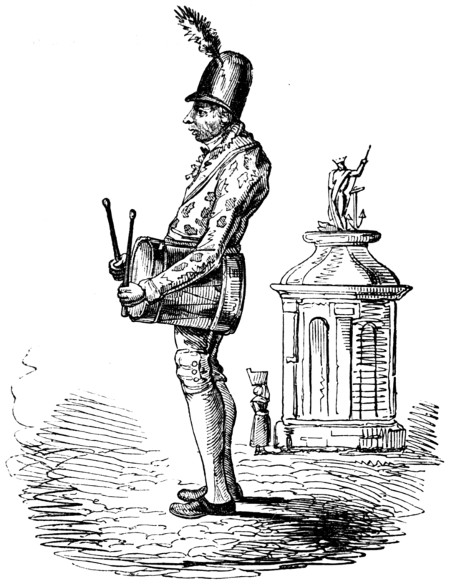
Tommy Sly, of Durham.
For the Table Book.
Tommy Sly, whose portrait is above, is a well-known eccentric character in the city of Durham, where he has been a resident in the poor-house for a number of years. We know not whether his parents were rich or poor, where he was born, or how he spent his early years—all is alike “a mystery;” and all that can be said of him is, that he is “daft.” Exactly in appearance as he is represented in the engraving,—he dresses in a coat of many colours, attends the neighbouring villages with spice, sometimes parades the streets of Durham with “pipe-clay for the lasses,” and on “gala days” wanders up and down with a cockade in his hat, beating the city drum, which is good-naturedly lent him by the corporation. Tommy, as worthless and insignificant as he seems, is nevertheless “put out to use:” his name has often served as a signature to satirical effusions; and at election times he has been occasionally employed by the Whigs to take the distinguished lead of some grand Tory procession, and thereby render it ridiculous; and by way of retaliation, he has been hired by the Tories to do the same kind office for the Whigs. He is easily bought or sold, for he will do any thing for a few halfpence. To sum up Tommy’s character, we may say with truth, that he is a harmless and inoffensive man; and if the reader of this brief sketch should ever happen to be in Durham, and have a few halfpence to spare, he cannot bestow his charity better than by giving it to the “Custos Rotulorum” of the place—as Mr. Humble once ludicrously called him—poor Tommy Sly.
Ex Dunelmensis.
Topography.
WESTMINSTER ABBEY.
Burial Fees.
The following particulars from a paper before me, in the hand-writing of Mr. Gell, were addressed to his “personal representative” for instruction, in his absence, during a temporary retirement from official duty in August, 1810.
Fees
In the Cloisters £19 6 0
If a grave-stone more £4 4 0
In the Abbey 54 18 0
If a grave-stone more 7 7 0
Peers, both in the Cloisters and Abbey, the degree of rank making a difference, Mr. Catling had perhaps write to Mr. Gell, at post-office, Brighton, telling the party that it will be under £150. They might, therefore, leave that sum, or engage to pay Mr. Gell.
Mr. Glanvill can tell about the decorations.
Penalty for burying in linen 2 10 0
Always take full particulars of age and death.
The abbey-church of Westminster may be safely pronounced the most interesting ecclesiastical structure in this kingdom. Considered as a building, its architecture, rich in the varieties of successive ages, and marked by some of the most prominent beauties and peculiarities of the pointed style, affords an extensive field of gratification to the artist and the antiquary. Rising in solemn magnificence amidst the palaces and dignified structures connected with the seat of imperial government, it forms a distinguishing feature in the metropolis of England. Its history, as connected with a great monastic establishment, immediately under the notice of our ancient monarchs, and much favoured by their patronage, abounds in important and curious particulars.
But this edifice has still a stronger claim to notice—it has been adopted as a national structure, and held forward as an object of national pride. Whilst contemplating these venerable walls, or exploring the long aisles and enriched chapels, the interest is not confined to the customary recollections of sacerdotal pomp: ceremonies of more impressive interest, and of the greatest public importance, claim a priority of attention. The grandeur of architectural display in this building is viewed with additional reverence, when we remember that the same magnificence of effect has imparted increased solemnity to the coronation of our kings, from the era of the Norman conquest.
At a very early period, this abbey-church was selected as a place of burial for the English monarchs; and the antiquary and the student of history view their monuments as melancholy, but most estimable sources of intelligence and delight. In the vicinity of the ashes of royalty, a grateful and judicious nation has placed the remains of such of her sons as have been most eminent for patriotic worth, for valour, or for talent; and sculptors, almost from the earliest period in which their art was exercised by natives of England, down to the present time, have here exerted their best efforts, in commemoration of those thus celebrated for virtue, for energy, or for intellectual power.[82]
St. David’s Day.
THE LEEK.
Written by William Leathart, Llywydd.
Sung at the Second Anniversary of the Society of Undeb Cymry, St. David’s Day, 1825.
Air—Pen Rhaw.
I.
If bards tell true, and hist’ry’s page Is right,—why, then, I would engage To tell you all about the age, When Cæsar used to speak; When dandy Britons painted,—were Dress’d in the skin of wolf or bear, Or in their own, if none were there, Before they wore THE LEEK. Ere Alfred hung in the highway, His chains of gold by night or day; And never had them stol’n away, His subjects were so meek. When wolves they danc’d o’er field and fen; When austere Druids roasted men;— But that was only now and then, Ere Welshmen wore THE LEEK.
II.
Like all good things—this could not last, And Saxon gents, as friends, were ask’d, Our Pictish foes to drive them past The wall:—then home to seek, Instead of home, the cunning chaps Resolv’d to stop and dish the APs, Now here they are, and in their caps To day they wear THE LEEK. Yet tho’ our dads, they tumbled out, And put each other to the rout, We sons will push the bowl about;— We’re here for fun or freak. Let nought but joy within us dwell; Let mirth and glee each bosom swell; And bards, in days to come, shall tell, How Welshmen love THE LEEK.
THE WELSH HARP.
Mr. Leathart is the author of “Welsh Pennillion, with Translations into English, adapted for singing to the Harp,” an eighteenpenny pocket-book of words of ancient and modern melodies in Welsh and English, with a spirited motto from Mr. Leigh Hunt.—“The Ancient Britons had in them the seeds of a great nation even in our modern sense of the word. They had courage, they had reflection, they had imagination. Power at last made a vassal of their prince. There were writers in those times, harpers, and bards, who made the instinct of that brute faculty turn cruel out of fear. They bequeathed to their countrymen the glory of their memories; they and time together have consecrated their native hills, so as they never before were consecrated.”
According to the prefatory dissertation of Mr. Leathart’s pleasant little manual, “Pennillion singing” is the most social relic of ancient minstrelsy in existence. It originated when bardism nourished in this island; when the object of its members was to instil moral maxims through the medium of poetry, and the harp was then, as it still is, the instrument to which they chanted. There is evidence of this use of the harp in Cæsar and other Latin writers. The bards were priest and poet; the harp was their inseparable attribute, and skill in playing on it an indispensable qualification. A knowledge of this instrument was necessary, in order to establish a claim to the title of gentleman; it occupied a place in every mansion; and every harper was entitled to valuable privileges. A “Pencerdd,” or chief of song, and a “Bardd Teulu,” or domestic bard, were among the necessary appendages to the king’s court. The former held his lands free, was stationed by the side of the “judge of the palace,” and lodged with the heir presumptive. He was entitled to a fee on the tuition of all minstrels, and to a maiden fee on the marriage of a minstrel’s daughter. The fine for insulting him was six cows and eighty pence. The domestic bard also held his land free; he had a harp from the king, which he was enjoined never to part with; a gold ring from the queen, and a beast out of every spoil. In the palace he sang immediately after the chief of song, and in fight at the front of the battle. It is still customary for our kings to maintain a Welsh minstrel.
One of the greatest encouragers of music was Gruffydd ap Cynan, a sovereign of Wales, who, in the year 1100, summoned a grand congress to revise the laws of minstrelsy, and remedy any abuse that might have crept in. In order that it should be complete, the most celebrated harpers in Ireland were invited to assist, and the result was the establishing the twenty-four canons of music; the MS. of which is in the library of the Welsh school, in Gray’s Inn-lane. It comprises several tunes not now extant, or rather that cannot be properly deciphered, and a few that are well known at the present day. A tune is likewise there to be found, which a note informs us was usually played before king Arthur, when the salt was laid upon the table; it is called “Gosteg yr Halen,” or the Prelude of the Salt.
The regulations laid down in the above MS. are curious. A minstrel having entered a place of festivity was not allowed to depart without leave, or to rove about at any time, under the penalty of losing his fees. If he became intoxicated and committed any mischievous trick, he was fined, imprisoned, and divested of his fees for seven years. Only one could attend a person worth ten pounds per annum, or two a person worth twenty pounds per annum, and so forth. It likewise ordains the quantum of musical knowledge necessary for the taking up of the different degrees, for the obtaining of which three years seems to have been allowed.
The Welsh harp, or “Telyn,” consists of three distinct rows of strings, without pedals, and was, till the fifteenth century, strung with hair. The modern Welsh harp has two rows of strings and pedals.
Giraldus Cambrensis, in his Itinerary, speaking of the musical instruments of the Welsh, Irish, and Scotch, says, Wales uses the harp, “crwth,” and bag-pipes; Scotland the harp, “crwth,” and drum; Ireland the harp and drum only; and, of all, Wales only retains her own.
The “crwth” is upon the same principle as the violin; it has however six strings, four of which are played upon with a bow, the two outer being struck by the thumb as an accompaniment, or bass; its tone is a mellow tenor, but it is now seldom heard, the last celebrated player having died about forty years since, and with him, says the editor of the Cambrian Register, “most probably the true knowledge of producing its melodious powers.” From the player of this instrument is derived a name now common, viz. “Crowther” and “Crowder” (Crwthyr); it may be translated “fiddler,” and in this sense it is used by Butler in his Hudibras.
Within the last few years, the harp has undergone a variety of improvements, and it is now the most fashionable instrument; yet in Wales it retains its ancient form and triple strings; “it has its imperfections,” observes Mr. Parry, “yet it possesses one advantage, and that is its unisons,” which of course are lost when reduced to a single row.
There would be much persuasion necessary to induce “Cymru” to relinquish her old fashioned “Telyn,” so reluctant are a national people to admit of changes. When the violin superseded the “crwth,” they could not enjoy the improvement.
Pennillion chanting consists in singing stanzas, either attached or detached, of various lengths and metre, to any tune which the harper may play; for it is irregular, and in fact not allowable, for any particular one to be chosen. Two, three, or four bars having been played, the singer takes it up, and this is done according as the Pennill, or stanza, may suit; he must end precisely with the strain, he therefore commences in any part he may please. To the stranger it has the appearance of beginning in the middle of a line or verse, but this is not the case. Different tunes require a different number of verses to complete it; sometimes only one, sometimes four or six. It is then taken up by the next, and thus it proceeds through as many as choose to join in the pastime, twice round, and ending with the person that began.
These convivial harp meetings are generally conducted with great regularity, and are really social; all sing if they please, or all are silent. To some tunes there are a great number of singers, according to the ingenuity required in adapting Pennillion. Yet even this custom is on the decline.
In South Wales, the custom has been long lost; on its demise they encouraged song writing and singing, and they are still accounted the best (without the harp) in the principality. In North Wales song-singing was hardly known before the time of Huw Morus, in the reign of Charles I., nor is it now so prevalent as in the south.
In the year 1176, Rhys ap Gruffydd held a congress of bards and minstrels at Aberteifi, in which the North Welsh bards came off as victors in the poetical contest, and the South Welsh were adjudged to excel in the powers of harmony.
For the encouragement of the harp and Pennillion chanting, a number of institutions have lately been formed, and the liberal spirit with which they are conducted will do much towards the object; among the principal are the “Cymmrodorion,” or Cambrian Societies of Gwynedd, Powys, Dyfed, Gwent, and London; the “Gwyneddigion,” and “Canorion,” also in London. The former established so long since as 1771, and the “Undeb Cymry,” or United Welshmen, established in 1823, for the same purpose. In all the principal towns of Wales, societies having the same object in view have been formed, among which the “Brecon Minstrelsy Society” is particularly deserving of notice. The harp and Pennillion singing have at all times come in for their share of encomium by the poets, and are still the theme of many a sonnet in both languages.
From more than a hundred pieces in Mr. Leathart’s “Pennillion,” translations of a few pennills, or stanzas, are taken at random, as specimens of the prevailing sentiments.
The man who loves the sound of harp, Of song, and ode, and all that’s dear, Where angels hold their blest abode, Will cherish all that’s cherish’d there. But he who loves not tune nor strain, Nature to him no love has given, You’ll see him while his days remain, Hateful both to earth and heaven.
Fair is yon harp, and sweet the song, That strays its tuneful strings along, And would not such a minstrel too, This heart to sweetest music woo? Sweet is the bird’s melodious lay In summer morn upon the spray. But from my Gweno sweeter far, The notes of friendship after war. Woe to him, whose every bliss Centers in the burthen’d bowl; Of all burthens none like this, Sin’s sad burthen on the soul; Tis of craft and lies the seeker, Murder, theft, and wantonness, Weakens strong men, makes weak weaker, Shrewd men foolish, foolish—less. Ah! what avails this golden coat, Or all the warblings of my throat, While I in durance pine? Give me again what nature gave, ’Tis all I ask, ’tis all I crave, Thee, Liberty divine! To love his language in its pride, To love his land—tho’ all deride, Is a Welshman’s ev’ry care, And love those customs, good and old, Practised by our fathers bold. We travel, and each town we pass Gives manners new, which we admire, We leave them, then o’er ocean toss’d Thro’ rough or smooth, to pleasure nigher, Still one thought remains behind, ’Tis home, sweet home, our hearts desire. Wild in the woodlands, blithe and free, Dear to the bird is liberty; Dear to the babe to be caress’d, And fondled on his nurse’s breast, Oh! could I but explain to thee How dear is Merion’s land to me. Low, ye hills, in ocean lie. That hide fair Merion from mine eye, One distant view, oh! let me take, Ere my longing heart shall break. Another dress will nature wear Before again I see my fair; The smiling fields will flowers bring, And on the trees the birds will sing; But still one thing unchang’d shall be, That is, dear love, my heart for thee.
The original Welsh of these and other translations, with several interesting particulars, especially the places of weekly harp-meetings and Pennillion-singing in London, may be found in Mr. Leathart’s agreeable compendium.
THE WINTER’S MORN.
Artist unseen! that dipt in frozen dew Hast on the glittering glass thy pencil laid, Ere from yon sun the transient visions fade, Swift let me trace the forms thy fancy drew! Thy towers and palaces of diamond hue, Rivers and lakes of lucid crystal made, And hung in air hoar trees of branching shade, That liquid pearl distil:—thy scenes renew, Whate’er old bards, or later fictions feign, Of secret grottos underneath the wave, Where nereids roof with spar the amber cave, Or bowers of bliss, where sport the fairy train, Who frequent by the moonlight wanderer seen Circle with radiant gems the dewy green.
Sotheby.
Characters.
MRS. AURELIA SPARR.
For the Table Book.
Mrs. Aurelia Sparr is a maiden lady, rather past fifty, but fresh and handsome for her age: she has a strong understanding, a retentive memory, a vast deal of acquired knowledge, and with all she is the most disagreeable woman breathing. At first she is amusing enough to spend an evening with, for she will tell you anecdotes of all your acquaintance, and season them with a degree of pleasantry, which is not wit, though something like it. But as a jest-book is the most tiresome reading in the world, so is a narrative companion the most wearisome society. What, in short, is conversation worth, if it be not an emanation from the heart as well as head; the result of sympathy and the aliment of esteem?
Mrs. Aurelia Sparr never sympathized with any body in her life: inexorable to weaknesses of every kind, more especially to those of a tender nature, she is for ever taxing enthusiasm with absurdity, and resolving the ebullition of vivacity into vanity, and the desire to show off. She is equally severe to timidity, which she for ever confounds with imbecility. We are told, that “Gentle dulness ever loved a joke.” Now Mrs. Aurelia Sparr is neither gentle nor dull; it would be a mercy to her hearers if she were either, or both: nevertheless, she chuckles with abundant glee over a good story, is by no means particular as to the admission of unpleasant images and likes it none the worse for being a little gross. But woe to the unlucky wight who ventures any glowing allusion to love and passionate affection in her hearing! Down come the fulminations of her wrath, and indecency—immorality—sensuality—&c. &c. &c.—are among the mildest of the epithets, or, to keep up the metaphor, (a metaphor, like an actor, should always come in more than once,) the bolts which the tempest of her displeasure hurls down upon its victim. The story of Paul and Virginia she looks upon as very improper, while the remembrance of some of the letters in Humphrey Clinker dimples her broad face with retrospective enjoyment.
If pronouns had been tangible things, Mrs. Aurelia Sparr would long ago have worn out the first person singular. Her sentences begin as regularly with “I,” as the town-crier’s address does with “O yes,” or as a French letter ends with “l’assurance des sentimens distingués.” While living with another lady in daily and inevitable intercourse, never was she known to say, “We shall see—we shall hear—we can go—we must read.” It was always “I, I, I.” In the illusion of her egotism, she once went so far as to make a verbal monopoly of the weather, and exclaimed, on seeing the rosy streaks in the evening sky, “I think I shall have a fine day to-morrow.” If you forget yourself so far, in the querulous loquacity of sickness, as to tell her of any ailment, as “My sore-throat is worse than ever to-night”—she does not rejoin, “What will you take?” or “Colds are always worse of an evening, it may be better to-morrow;” or propose flannel or gargle, or any other mode of alleviation, like an ordinary person; no! she flies back from you to herself with the velocity of a coiled-up spring suddenly let go; and says, “I had just such another sore-throat at Leicester ten years ago, I remember it was when I had taken down my chintz bed-curtains to have them washed and glazed.” Then comes a mammoth of an episode, huge, shapeless, and bare of all useful matter: telling all she said to the laundress, with the responses of the latter. You are not spared an item of the complete process: first, you are blinded with dust, then soaked in lye, then comes the wringing of your imagination and the calico, then the bitterness of the gall to refresh the colours; then you are extended on the mangle, and may fancy yourself at the court of king Procrustes, or in a rolling-press. All the while you are wondering how she means to get round to the matter in question, your sore-throat.—Not she! she cares no more for your sore-throat than the reviewers do for a book with the title of which they head an article; your complaint was the peg, and her discourse the voluminous mantle to be hung on it. Some people talk with others, and they are companions; others at their company, and they are declaimers or satirists; others to their friends, and they are conversationists or gossips, according as they talk of things or persons. Mrs. Aurelia Sparr talks neither to you, nor with you, nor at you. Listen attentively, or show your weariness by twenty devices of fidgetiness and preoccupation, it is all the same to Mrs. Aurelia Sparr. She talks spontaneously, from an abstract love of hearing her own voice; she can no more help talking, than a ball can help rolling down an inclined plane. She will quarrel with you at dinner, for she is extremely peevish and addicted to growling over her meals; and by no means so nice as to what comes out of her mouth as to what goes into it; and then, before you can fold your napkin, push back your chair and try to make good your escape, she begins to lay open the errors, failures, and weaknesses of her oldest and best friends to your cold-blooded inspection, with as little reserve as an old practitioner lecturing over a “subject.” Things that no degree of intimacy could justify her in imparting, she pours forth to a person whom she does not even treat as a friend; but talk she must, and she had no other topic at hand. Thus, at the end of a siege, guns are charged with all sorts of rubbish for lack of ammunition.
Mrs. Aurelia Sparr not only knows all the modern languages, but enough of the ancient to set up a parson, and every dialect of every county she has ever been in. If you ask her the name of any thing, she will give you a polyglot answer; you may have the satisfaction to know how the citizens of every town and the peasants of every province express themselves, on a matter you may never have occasion to name again. But I earnestly recommend you never to ask anything; it is better to go without hearing one thing you do want to hear, than to be constrained to hear fifty things that are no more to you than I to Hecuba—not half so much as Hecuba is to me. Mrs. Aurelia Sparr is not easy to deal with; she looks upon all politeness as affectation, and all affectation as perfidy: she palsies all the courtesies of life by a glum air of disbelief and dissatisfaction. When one sees nobody else, one forgets that such qualities as urbanity, grace, and benignity exist, and is really obliged to say civil things to one’s self, to keep one’s hand in. Mrs. Aurelia Sparr is more eminent as a chronicler than as a logician; some of her conclusions and deductions are not self-evident. For instance—she interprets a reasonable conformity to the dress and manners of persons of other countries, while sojourning among them, into “hating one’s own country.” Command of temper is “an odious, cold disposition.” Address, and dexterity in female works, what good ladies in England term notability, are deemed by her “frivolous vanity,” &c. &c. &c. She has learnt chemistry, and she distils vexation and bitterness from every person and every event—geometry, and she can never measure her deportment to circumstances—algebra, merely to multiply the crosses of all whose fate makes them parallel with her—navigation, and she does but tack from one absurdity to another, without making any way—mathematics, and she never calculates how much more agreeable a little good-nature would make her than all her learning—history, and that of her own heart is a blank—perspective, without ever learning to place self at the “vanishing point”—and all languages, without ever uttering in any one of them a single phrase that could make the eyes of the hearer glisten, or call a glow on the cheek of sympathy. Every body allows that Mrs. Aurelia Sparr is very clever—poor, arid praise, what is it worth?
N.
Wine.
EWART’S OLD PORT.
To J. C——y, Esq.
On receiving from him a Present of a Wine-strainer.—1825.
This life, dear C——y,—who can doubt?— Resembles much friend Ewart’s[83] wine; When first the ruby drops flow out, How beautiful, how clear they shine! And thus awhile they keep their tint, So free from ev’n a shade,—that some Would smile, did you but dare to hint, That darker drops would ever come. But soon, alas, the tide runs short;— Each minute makes the sad truth plainer; Till Life, like Ewart’s crusty Port, When near its close, requires a strainer. This, Friendship, can, alone, supply,— Alone can teach the drops to pass, If not with all their rosiest dye, At least, unclouded, through the glass. Nor, C——y, could a boon be mine, Of which this heart were fonder, vainer, Than thus, if Life be like old wine, To have thy friendship for its strainer!
E.
For many years the goodness of Mr. Ewart’s old Port has been duly appreciated by his private friends. The preceding verses, in The Times of Monday, (March 5, 1827,) have disclosed “the secret,” and now, probably, he will “blush to find it fame.” The knowledge of his “ruby drops” should be communicated to all who find it necessary to “use a little wine for their stomach’s sake, and their often infirmities.” Can the information be conveyed in more agreeable lines?
Beauty.
A NATURAL COMPLIMENT.
As the late beautiful duchess of Devonshire was one day stepping out of her carriage, a dustman, who was accidentally standing by, and was about to regale himself with his accustomed whiff of tobacco, caught a glance of her countenance, and instantly exclaimed, “Love and bless you, my lady, let me light my pipe in your eyes!” It is said that the duchess was so delighted with this compliment, that she frequently afterwards checked the strain of adulation, which was constantly offered to her charms, by saying, “Oh! after the dustman’s compliment, all others are insipid.”
PERSIAN SONG OF HAFIZ.
By Sir William Jones.
Sweet maid, if thou wouldst charm my sight, And bid these arms thy neck infold; That rosy cheek, that lily hand, Would give thy poet more delight Than all Bocara’s vaunted gold, Than all the gems of Samarcand. Boy! let yon liquid ruby flow, And bid thy pensive heart be glad, Whate’er the frowning zealots say:— Tell them their Eden cannot show A stream so clear as Rocnabad, A bower so sweet as Mosellay. O! when these fair, perfidious maids, Whose eyes our secret haunts infest, Their dear destructive charms display;— Each glance my tender breast invades, And robs my wounded soul of rest; As Tartars seize their destin’d prey. In vain with love our bosoms glow, Can all our tears, can all our sighs, New lustre to those charms impart? Can cheeks, where living roses blow, Where nature spreads her richest dyes, Require the borrow’d gloss of art? Speak not of fate:—ah! change the theme, And talk of odours, talk of wine, Talk of the flowers that round us bloom:— ’Tis all a cloud, ’tis all a dream: To love and joy thy thoughts confine, Nor hope to pierce the sacred gloom. Beauty has such resistless power, That ev’n the chaste Egyptian dame Sigh’d for the blooming Hebrew boy; For her how fatal was the hour, When to the banks of Nilus came A youth so lovely and so coy! But ah, sweet maid! my counsel hear,— (Youth shall attend when those advise Whom long experience renders sage) While music charms the ravish’d ear; While sparkling cups delight our eyes, Be gay; and scorn the frowns of age. What cruel answer have I heard! And yet, by heaven, I love thee still: Can aught be cruel from thy lip? Yet say, how fell that bitter word From lips which streams of sweetness fill, Which nought but drops of honey sip? Go boldly forth, my simple lay, Whose accents flow with artless ease, Like orient pearls at random strung: Thy notes are sweet, the damsels say; But O! far sweeter, if they please, The nymph for whom these notes are sung.
“OUR LIVES AND PROPERTIES.”
By Mr. William Hutton, F. A. S. S.
If we survey this little world, vast in our idea, but small compared to immensity, we shall find it crusted over with property, fixed and movable. Upon this crusty world subsist animals of various kinds; one of which, something short of six feet, moves erect, seems the only one without a tail, and takes the lead in the command of this property. Fond of power, and conscious that possessions give it, he is ever attempting, by force, fraud, or laudable means, to arrive at both.
Fixed property bears a value according to its situation; 10,000 acres in a place like London, and its environs, would be an immense fortune, such as no man ever possessed; while 10,000, in some parts of the globe, though well covered with timber, would not be worth a shilling—no king to govern, no subject to submit, no market to exhibit property, no property to exhibit; instead of striving to get possession, he would, if cast on the spot, strive to get away. Thus assemblages of people mark a place with value.
Movable property is of two sorts; that which arises from the earth, with the assistance of man; and the productions of art, which wholly arise from his labour. A small degree of industry supplies the wants of nature, a little more furnishes the comforts of life, and a farther proportion affords the luxuries. A man, by labour first removes his own wants, and then, with the overplus of that labour, purchases the labour of another. Thus, by furnishing a hat for the barber, the hatter procures a wig for himself: the tailor, by making a coat for another, is enabled to buy cloth for his own. It follows, that the larger the number of people, the more likely to cultivate a spirit of industry; the greater that industry, the greater its produce; consequently, the more they supply the calls of others, the more lucrative will be the returns to themselves.
It may be asked, what is the meaning of the word rich? Some have termed it, a little more than a man has; others, as much as will content him; others again, the possession of a certain sum, not very small. Perhaps all are wrong. A man may be rich, possessed only of one hundred pounds; he may be poor, possessed of one hundred thousand. He alone is rich, whose income is more than he uses.
Industry, though excellent, will perform but half the work; she must be assisted by economy; without this, a ministerial fortune will be defective. These two qualities, separated from each other, like a knife from the handle, are of little use; but, like these, they become valuable when united. Economy without industry will barely appear in a whole coat; industry without economy will appear in rags. The first is detrimental to the community, by preventing the circulation of property; the last is detrimental to itself. It is a singular remark, that even industry is sometimes the way to poverty. Industry, like a new cast guinea, retains its sterling value; but, like that, it will not pass currently till it receives a sovereign stamp: economy is the stamp which gives it currency. I well knew a man who began business with 1500l. Industry seemed the end for which he was made, and in which he wore himself out. While he laboured from four in the morning till eight at night, in the making of gimlets, his family consumed twice his produce. Had he spent less time at the anvil, and more in teaching the lessons of frugality, he might have lived in credit. Thus the father was ruined by industry, and his children have, for many years, appeared on the parish books. Some people are more apt to get than to keep.
Though a man, by his labour, may treat himself with many things, yet he seldom grows rich. Riches are generally acquired by purchasing the labour of others. He who buys the labour of one hundred people, may acquire ten times as much as by his own.
What then has that capricious damsel, Fortune, to do in this chain of argument? Nothing. He who has capacity, attention, and economy, has a fortune within himself. She does not command him, he commands her.
Having explained the word riches, and pointed out the road to them, let us examine their use. They enable a man with great facility to shake off an old friend, once an equal; and forbid access to an inferior, except a toad-eater. Sometimes they add to his name, the pretty appendage of Right Honourable, Bart. or Esq. additions much coveted, which, should he happen to become an author, are an easy passport through the gates of fame. His very features seem to take a turn from his fortune, and a curious eye may easily read in his face, the word consequence. They change the tone of his voice from the submissive to the commanding, in which he well knows how to throw in a few graces. His style is convincing. Money is of singular efficacy; it clears his head, refines his sense, points his joke. The weight of his fortune adds weight to his argument. If, my dear reader, you have been a silent spectator at meetings for public business, or public dinners, you may have observed many a smart thing said unheeded, by the man without money; and many a paltry one echoed with applause, from the man with it. The room in silent attention hears one, while the other can scarcely hear himself. They direct a man to various ways of being carried who is too idle to carry himself; nay, they invert the order of things, for we often behold two men, who seem hungry, carry one who is full fed. They add refinement to his palate, prominence to his front, scarlet to his nose. They frequently ward off old age. The ancient rules of moderation being broken, luxury enters in all her pomp, followed by a group of diseases, with a physician in their train, and the rector in his. Phials, prayers, tears, and galley-pots, close the sad scene, and the individual has the honour to rot in state, before old age can advance. His place may be readily supplied with a joyful mourner.[84]
A MUSICAL CRASH.
The Rev. Mr. B——, when residing at Canterbury, was reckoned a good violoncello player; but he was not more distinguished for his expression on the instrument, than for the peculiar appearance of feature whilst playing it. In the midst of the adagios of Corelli or Avison, the muscles of his face sympathised with his fiddlestick, and kept reciprocal movement. His sight, being dim, obliged him often to snuff the candles; and, when he came to a bar’s rest, in lieu of snuffers, he generally employed his fingers in that office; and, lest he should offend the good housewife by this dirty trick, he used to thrust the spoils into the sound-holes of his violoncello. A waggish friend resolved to enjoy himself “at the parson’s expense,” as he termed it; and, for that purpose, popped a quantity of gunpowder into B.’s instrument. Others were informed of the trick, and of course kept a respectable distance. The tea equipage being removed, music became the order of the evening; and, after B—— had tuned his instrument, and drawn his stand near enough to snuff his candles with ease, feeling himself in the meridian of his glory, he dashed away at Vanhall’s 47th. B—— came to a bar’s rest, the candles were snuffed, and he thrust the ignited wick into the usual place; fit fragor, bang went the fiddle to pieces, and there was an end of harmony that evening.
FASHIONABLE RELIGION.
A French gentleman, equally tenacious of his character for gallantry and devotion, went to hear mass at the chapel of a favourite saint at Paris; when he came there, he found repairs were doing in the building which prevented the celebration. To show that he had not been defective in his duty and attentions, he pulled out a richly decorated pocket-book, and walking with great gravity and many genuflexions up the aisle, very carefully placed a card of his name upon the principal altar.
A POLITE TOWN.
Charles II. on passing through Bodmin, is said to have observed, that “this was the politest town he had ever seen, as one half of the houses appeared to be bowing, and the other half uncovered.” Since the days of Charles, the houses are altered, but the inhabitants still retain their politeness, especially at elections.