Volume 2 — Vol. II.—49.
Reading edition
Mr. Gliddon’s Cigar Divan. King Street, Covent Garden.
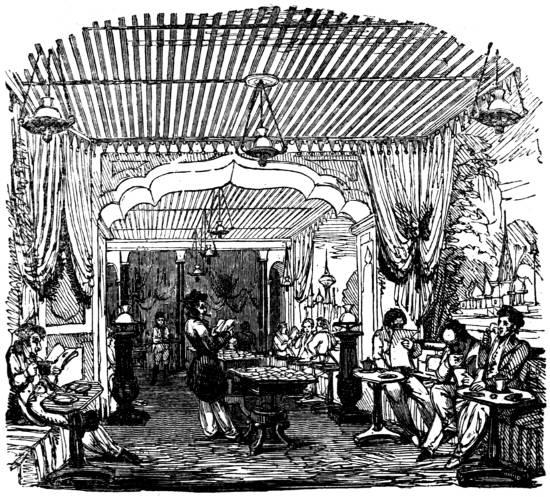
Mr. Gliddon’s Cigar Divan. King Street, Covent Garden.
Our readers, whom, between ourselves, and without flattery, we take to be as social a set of persons as can be, people of an impartial humanity, and able to relish whatever concerneth a common good, whether a child’s story or a man’s pinch of snuff, (for snuff comes after knowledge,) doubtless recollect the famous tale of the Barmecide and his imaginary dinner in the Arabian Nights’ Entertainments. We hereby invite them to an imaginary cigar and cup of coffee with us in a spot scarcely less oriental—to wit, our friend Gliddon’s Divan in King-street. Not that our fictitious enjoyment is to serve them instead of the real one. Quite the contrary; our object being to advance the good of all parties,—of our readers, inasmuch as they are good fellows in their snuffs,—of our friend, who can supply them in a manner different from any body else,—and of ourselves, because the subject is a pleasant one, and brings us all together agreeably. Those who have the greatest relish for things real, have also the best taste of them in imagination. We confess, that for our private eating (for a cigar, with coffee, may truly be said to be meat and drink to us) we prefer a bower with a single friend; but for public smoking, that is to say, for smoking with a greater number of persons, or in a coffee-room, especially now that the winter is coming on, and people cannot sit in bowers without boots, commend us to the warmth, and luxury, and conspiracy of comforts, in the Cigar Divan.
In general, the room is occupied by individuals, or groups of individuals, sitting apart at their respective little mahogany tables, and smoking, reading, or talking with one another in a considerate undertone, in order that nobody may be disturbed. But on the present occasion we will have the room to ourselves, and talk as we please. In the East it is common to see dirty streets and poor looking houses, and on being admitted into the interior of one of them, to find yourself in a beautiful room, noble with drapery, and splendid with fountains and gilded trellices. We do not mean to compare King-street with a street in Bagdad or Constantinople. We have too much respect for that eminent thoroughfare, clean in general, and classical always; where you cannot turn, but you meet recollections of the Drydens and Hogarths. The hotel next door to the Divan is still the same as in Hogarth’s picture of the Frosty Morning; and looking the other way, you see Dryden coming out of Rose Alley to spend his evening at the club in Russell-street. But there is mud and fog enough this weather to render the contrast between any thoroughfare and a carpeted interior considerable; and making due allowance for the palace of an effendi and the premises of a tradesman, a person’s surprise would hardly be greater, certainly his comfort not so great, in passing from the squalidness of a Turkish street into the gorgeous but suspicious wealth of the apartment of a pasha, as in slipping out of the mud, and dirt, and mist, and cold, and shudder, and blinking misery of an out-of-door November evening in London, into the oriental and carpeted warmth of Mr. Gliddon’s Divan. It is pleasant to think, what a number of elegant and cheerful places lurk behind shops, and in places where nobody would expect them. Mr. Gliddon’s shop is a very respectable one; but nobody would look for the saloon beyond it; and it seems in good oriental keeping, and a proper sesame, when on touching a door in the wall, you find yourself in a room like an eastern tent, the drapery festooned up around you, and views exhibited on all sides of mosques, and minarets, and palaces rising out of the water.
But here we are inside ourselves. What do you think of it?
B. This is a tent indeed, exactly as you have described it. It seems pitched in the middle of the Ganges or Tigris; for most of the views are in the midst of water.
J. Yes; we might fancy ourselves a party of British merchants, who had purchased a little island in an Eastern gulf, and built themselves a tent on it to smoke in. The scenes, though they have a panoramic effect, are really not panoramic daubs. This noble edifice on the left, touched in that delicate manner with silver, (or is it rather not gold?) unites the reality of architecture built by mortal hands, with the fairy lustre of a palace raised by enchantment. One has a mind to sail to it, and get an adventure.
E. And this on the left. What a fine sombre effect that mountain with a building on it has in the background;—how dark yet aerial! You would have a very solemn adventure there,—nothing under a speaking stone-gentleman, or the loss of your right eye.
O. Well, this snug little corner for me, under the bamboos; two gigantic walking-sticks in leaf! A cup of coffee served by a pretty Hindoo would do very well here; and there is a temple to be religious in, when convenient. ’Tis pleasant to have all one’s luxuries together.
T. If there is any fault, it is in the scene at the bottom of the room, which is perhaps too full of scattered objects. But all is remarkably well done; and as the newspapers have observed, as oriental as any thing in the paintings of Daniel or Hodges.
C. Are you sure we are not all Mussulmen? I begin to think I am a Turk under the influence of opium, who take my turban for a hat, and fancy I’m speaking English. We shall have the sultan upon us presently.
L. With old Ibrahim to give us the bastinado. I have no fair Persian at hand to offer him; and, if I had, wouldn’t do it. But here’s ——; he shall have him.
O. (grinding with laughter.) What, in woman’s clothes, to beguile him, and play the lute?
L. No; as a fair dealer; no less a prodigy, especially for a bookseller. You should save your head every day by a new joke; and we would have another new Arabian Nights, or the Adventures of Sultan Mahmoud and the Fair Dealer. You should be Scheherezade turned into a man. Every morning, the prince’s jester should say to you, “Brother Scratch-his-head, if you are awake, favour his Majesty with a handsome come-off.”
E. I cannot help thinking we are the Calenders, got into the house full of ladies; and that we shall have to repent, and rub our faces with ashes, crying out, “This is the reward of our debauchery: This is the reward of taking too many cups of coffee: This is the reward of excessive girl and tobacco.”
L. But, alas! in that case we should have the repentance without the lady, which is unfair. No ladies, I believe, are admitted here, Mr. Gliddon?
Mr. G. No, sir; it has been often observed to me, by way of hint, that it was a pity ladies were not admitted into English coffee-houses, as they are on the continent; but this is a smoking as well as a coffee-room. Ladies do not smoke in England, as they do in the East; and then, as extremes meet, and the most respectable creatures in the world render a place, it seems, not respectable, I was to take care how I risked my character, and made my Divan too comfortable.
O. And we call ourselves a gallant nation! We also go to the theatres to sit and hear ourselves complimented on our liberal treatment of women, and suffer them all the while to enjoy the standing-room!
C. Women are best away, after all. We should be making love, while they ought to be making the coffee.
L. Women and smoking would not do together, unless we smoked perfumes, and saw their eyes through a cloud of fragrance, like Venus in her ambrosial mist. This room, I confess, being full of oriental scenes, reminds one of other things oriental—of love and a lute. I could very well fancy myself Noureddin, sitting here with my fair Persian, eating peaches, and sending forth one of the songs of Hafiz over those listening waters.
J. The next time Mr. Gliddon indulges us with a new specimen of his magnificence, he must give us animate instead of inanimate scenes, and treat us with a series of subjects out of the Arabian Nights—lovers, genii, and elegant festivities.
Mr. G. Gentlemen, here is a little festivity at hand, not, I hope, altogether inelegant. Your coffee and cigars are ready.
C. Ah, this is the substantial picturesque. I was beginning to long for something oriental to eat, elegant or not; an East-dumpling for instance.
H. I wonder whether they have any puns in the East.
J. To be sure they have. The elegancies of some of their writers consist of a sort of serious punning, like the conceits of our old prosers; such as, a man was “deserted for his deserts;” or “graceless, though full of gracefulness, was his grace, and in great disgrace.”
C. But I mean proper puns; puns worthy of a Pundit.
L. You have it. It is part of their daily expunditure. How can there be men and not puns?
To pun is human; to forgive it, fine.
H. There’s an instance in Blue Beard; in a pun set to music by Kelly;
Fatima, Fatima, See-limbs here!
C. Good. I think I see Kelly, who used to stick his arms out, as if he were requesting you to see his limbs; and Mrs. Bland, whom he used to sing it to—a proper little Fatima. Come; I feel all the beauty of the room, now that one is “having something.” This is really very Grand, Signior; though to complete us, I think we ought to have some Sublime Port.
Mr. G. Excuse me: whining is not allowed to a true Mussulman.
C. Some snuff, however.
Mr. G. The best to be had.
W. Take some of mine; I have cropped the flower of the shop.
J. You sneeze, C. I thought you too old a snuff-taker for that.
C. The air of the water always makes me sneeze. It’s the Persian gulf here.
W. This is a right pinch, friend C. I’ll help you at another, as you’ve helped me.
C. Snuff’s a capital thing. I cannot help thinking there is something providential in snuff. If you observe, different refreshments come up among nations at different eras of the world. In the Elizabethan age, it was beef-steaks. Then tea and coffee came up; and people being irritable sometimes, perhaps with the new light let in upon them by the growth of the press, snuff was sent us to “support uneasy thoughts.” During the Assyrian monarchy, cherry-brandy may have been the thing. I have no doubt Semiramis took it; unless we suppose it too matronly a drink for So-Mere-a-Miss.
(Here the whole Assyrian monarchy is run down in a series of puns.)
H. Gentlemen, we shall make the Tour of Babel before we have done.
L. Talking of the refreshments of different ages, it is curious to see how we identify smoking with the Eastern nations; whereas it is a very modern thing among them, and was taught them from the west. One wonders what the Turks and Persians did before they took to smoking; just as the ladies and gentlemen of these nervous times wonder how their ancestors existed without tea for breakfast.
J. Coffee is a modern thing too in the East, though the usual accompaniment of their tobacco. “Coffee without Tobacco,” quoth the Persian, as our friend’s learned placard informs us, “is like meat without salt.”[479] But coffee is of Eastern growth. It is a species of jasmin. I remember, in a novel I read once, the heroine was described in grand terms, as “presiding at the hysonian altar;” that is to say, making tea. This lady might have asked her lover, whether before his hysonian recreation, he would not “orientalize in a cup of jessamine.”
W. I met with a little story in a book yesterday, which I must tell you, not because it is quite new or very applicable, but because it is Eastern, and made me laugh. I don’t know whether it is in the jest-books; but I never saw it before. A fellow was going home through one of the streets of Bagdad with a forbidden bottle of wine under his cloak, when the cadi stopped him. “What have you got there, fellow?” The fellow, who had contrived to plant himself against a wall, said, “Nothing, sir.” “Put out your hand, sir.” The right hand was put out; there was nothing in it. “Your left, sir.” The left was put out, equally innocent. “You see, sir,” said the fellow, “I have nothing.” “Come away from the wall,” said the cadi. “No, sir,” returned he, “it will break.”
H. Good. That is really dramatic. It reminds me that I must be off to the play.
J. And I.
C. And I.
O. And I. We’ll make a party of it, and finish our evening worthily with Shakspeare; one of the greatest of men, and most good-natured of punsters.
L. By the by, Mr. Gliddon, your room is not so large as in the lithographic print they have made of it; but it is more Eastern and picturesque.
W. We’ll have a more faithful print to accompany this conversation, for I am resolved to be treacherous for this night only, and publish it. It is not a proper specimen of what my friends could say; but it is not unlike something of what they do; and sociality, on all sides, will make the best of it. ☞
LAURENCE-KIRK SNUFF-BOXES.
James Sandy, the inventor of these pocket-utensils, lived a few years ago at Alyth, a town on the river Isla, in Perthshire, North Britain. The genius and eccentricity of character which distinguished him have been rarely surpassed. Deprived at an early age of the use of his legs, he contrived, by dint of ingenuity, not only to pass his time agreeably, but to render himself an useful member of society.
Sandy soon displayed a taste for mechanical pursuits; and contrived, as a workshop for his operations, a sort of circular bed, the sides of which being raised about eighteen inches above the clothes, were employed as a platform for turning-lathes, table-vices, and cases for tools of all kinds. His talent for practical mechanics was universal. He was skilled in all sorts of turning, and constructed several very curious lathes, as well as clocks and musical instruments of every description, which were no less admired for the sweetness of their tone than the elegance of their workmanship. He excelled, too, in the construction of optical instruments, and made some reflecting telescopes, the specula of which were not inferior to those finished by the most eminent London artists. He likewise suggested some important improvements in the machinery for spinning flax; and, as before stated, he was the first who made the wooden-jointed snuff-boxes, generally called Laurence-Kirk boxes, some of which, fabricated by this self-taught artist, were purchased and sent as presents to the royal family.
To his other endowments he added an accurate knowledge of drawing and engraving, and in both these arts produced specimens of great merit.
For upwards of fifty years Sandy quitted his bed only three times, and on these occasions his house was either inundated with water, or threatened with danger from fire. His unbounded curiosity prompted him to hatch different kinds of birds’ eggs by the natural warmth of his body, and he reared his various broods with all the tenderness of a parent. On visiting him it was no unusual thing to see singing birds of different species, to which he may be said to have given birth, perched on his head, and warbling the artificial notes he had taught them.
Naturally possessed of a good constitution, and an active, cheerful turn of mind, his house was the general coffee-room of the village, where the affairs of church and state were freely discussed. In consequence of long confinement his countenance had rather a sickly cast, but it was remarkably expressive, particularly when he was surrounded by his country friends. This singular man had acquired by his ingenuity and industry an honourable independence, and died possessed of considerable property. About three weeks before his death he married.
INN-YARDS.
For the Table Book.
It was a November morning—sullen and lowering. A dense fog left the houses but half distinguishable on either side the way, as I passed through Holborn to the Saracen’s Head, Snow-hill, where I had taken my place the preceding evening in the —— coach, in order to pay a long-promised visit to my friend and schoolfellow T——. My feelings were any thing but enviable. They were in a state of seasonable and almost intolerable irritation, resulting from all successive evils of a shivering and early resignation of enveloping bed-clothes, a hurried dressing, (productive of an utter failure in the arrangement of the bow of my neckcloth,) a trembling hand that caused a gash in my chin with a blunt razor, (all my others had been officiously packed up by Mrs. Sally,) a breakfast swallowed standing, (which I abominate, as it stands to reason it must be unwholesome,) tea that seemed “as if it never would grow cool,” though poured out in the saucer, and sundry admonitory twitchings of the bit of court-plaster on my sliced chin, threatening the total discomfiture of my habilimentary economy. All these things tended but little towards rendering my frame of mind peculiarly equable, while hurrying forward towards the point of destination, gulping down fresh (no not fresh) mouthfuls of the thick yellow atmosphere, at each extorted exclamation of disgust and impatience.
At last I arrived in the inn-yard, fully prepared for an expected look of surprise, and accompanying exclamation of—“The —— coach, sir! why, Lord bless you, sir, it’s off long ago; it leaves here at seven precisely, and it’s now nearly half past.” Conceive then what was my agreeable astonishment when I learned that the real time was only half past six! I found that, owing to my anxious fears lest I should be too late, I had neglected to perceive that my watch had gained half an hour in the course of the night; and the shame I now felt at having thus suffered my irritability to get the better of me, led me to reflect upon the patient gentleness of the mild and amiable Fanny, (my friend’s wife,) who is indeed a perfect specimen of a delightful woman. In her are joined those two qualities so rarely united (yet, which, when they are so, form a gem)—a truly feminine and gentle heart, and a strong and well-informed mind. It is truly delightful to see her blend the domestic duties of a housewife, (the fulfilment of which is ever graceful in a female,) and the affectionate attentions of a mother and wife, with literary information and attainments.
I was called off from this pleasing subject of reflection by a view of the scene before me. The coach, a handsome, well-built vehicle, stood on one side of the yard in all the brilliancy of a highly-varnished claret ground, and burnishe The four beautiful, spirited animals belonging to it, with their glossy bright skins covered with cloths till the moment of “putting to,” were then led forth by a fellow in corduroy breeches, laying in massive rolls on his large muscular limbs, and terminating in a pair of dull and never-shining top-boots—a waistcoat which had been of red plush, spotted with black; but the glories of its gules and sable were well nigh effaced by the long line of successive cross-quarterings of grease and mud—a face hard and liny, that looked impenetrable, and certainly conveyed no idea to my mind of a “Robin Ostler,” who “never joy’d since the price of oats rose,” much less could it have ever been “the death of him.” He came forward with that slouching gait and hoarse rasping voice, so well personified by the admirable and all-observing Matthews.
Then the coachman appeared—well buttoned up to the throat in an enormous box-coat of a whitish drab colour, fastened with immense mother-o’-pearl buttons—a yellow silk handkerchief round his neck, reaching just under the nether lip, and covering the tips of his ears—a hat with brims, like the walls of Babylon—and an air of affected nonchalance, which tells you, that you are expected to look upon him in a very different light from the attentive “coachee” of some few years back. He is now a complete fine gentleman; for as the gentleman affects the coachman, why should not the coachman affect the gentleman? They are now not to be known apart.
The “luggage” is then brought forth and “loaded”—and all the passengers installed in their different places. The last directions are given. “More last words,” and a paper of biscuits is handed in at the coach-window to the little boy who is going to ——, under the special care of the coachman, and, as his mamma delightedly observes, is already become a favourite with the “kind-looking lady” opposite to him. The small parcel “to be left at Mr. K——’s at the small white cottage” is snugly slipt into the coach-pocket—and the final “all right” is given from the impatient passengers “behind.” How different is the quiet and orderly manner in which a vehicle is thus despatched to go hundreds of miles, from the dire bustle and utter “confusion of tongues” attendant upon the departure of a French diligence.——
Imagine a spacious yard, paved with stones shaped like enormous “sugared almonds,” jutting out in all directions to the utter annoyance of the five poor animals, or rather skeletons, in rope harness, which are about to be yoked to an uncouth machine, looking the complete antipodes of rapidity of motion—of a colour perfectly indescribable, but something approaching to a dingy red, intermixed with a rusty, dusty black—straw peeping out in every direction; whether from roof, or sides, or entangled among the broken, rickety steps, which project in awful forewarning of grazed shins and sprained ancles. The Conducteur in his dark blue jacket turned up with scarlet—leather breeches shining with the perpetual friction of the saddle—boots, like brewing vats—a hat, very nearly a “perfect cone,” with a rim, set in the middle of a regular copse-wood of coal black hair, surmounting a face whose dark complexion, fiercely sparkling eyes, and stiff mustachios, help to give force to the excessive tension of muscle in his countenance, which is actually convulsed with ire, as he sends forth volleys of sacrés and morbleus at the maudit entêté on the roof, who persists in loading the different articles in exact opposition to all the passionate remonstrances and directions of poor Monsieur le Conducteur. Femmes de chambres shrieking at the very top of their voices—“Garçons of fifty” equally vociferous in bawling “On vient! on vient!” though no one calls—Commissionaires insisting upon the necessity of passports to incredulous Englishmen, with an incessant “Mais que diable donc, Monsieur!”—Hordes of beggars shouting forth their humble petitions of “Pour l’amour du bon Dieu un petit liard, Monsieur.” “Ah! Seigneur, qu’est-ce que j’ai fait de mes clefs!” screams the landlady. “Sacré nom de tonnerre! tais-toi, donc,” growls the landlord, in a voice like the thunder he invokes.
At last the ponderous vehicle is set in motion amid the deafening clamour of the surrounding group, and the hideous, unrelentingly, eternal cracking of the Conducteur’s detested fouet!
M. H.
For the Table Book.
THE TURNPIKE MAN.
“Good and bad of all sorts.”
As the “Commissioners” rely on the trust reposed in the “Pikeman,” I imagine him to be worthy of being shown in the most favourable colours. Like a good sexton, he must attend to his toll—like a salesman, know his head of cattle—like a lottery prize-seeker, be acquainted with his number—like Fielding’s Minos, in his “Journey from this world to the next,” shut his gate against those who are brought up improperly to the bar. A modern Gilpin should scarcely risk a ride unwittingly through his demesne.
In the “dead waste and middle of the night,” when sleep steals over him wearily, how many calls of the coachman, the chaise driver, the stanhope gentleman, the important bagman, and the drover, is he obliged to obey! The imperative “Pike!”—“Gate!”—“Hallo!”—are like so many knells rung in his ear. The clock is a friend to most men in the various occupations of life; the shadow on the grass warns the shepherd and hind to retire to rest; the dial gives the gardener leave to quit his vegetable and floral world in safety till the succeeding morning; but the pikeman finds no solace in the instructive progress of his Dutch-clock, or in the more highly favoured one with a window before its pulselike-pendulum, (as the person with a window in his breast,) or in the weather betokening “man and woman,” who, like an unhappy couple, never go out together.
Who that has looked upon the pikeman’s contracted span—his little white-painted hut, like a showman’s figured canvass—but shrewdly guesses that the best portions of his sunside of comforts are on the outside? What a Jack in the Box![480] He seems in his room like a singing-bird in a cage. His cat and dog are his companions, save when the newsman, postman, or any man, in short, arrives. Munden’s “Crack” is not to be seen at every turnpike gate. A magpie, or blackbird, often hangs and whistles, like himself, in stationary captivity. Yet he is a man of some information. The waggoner, the duellist, the huckster, and the Gretna folks, in pursuit of romantic happiness, sometimes make him useful. The horse patrol consults him in the way of business; few fights occur without his knowledge; and even the political express gives him broad hints as to the secret operations of his majesty’s ministers. He is completely au fait in all common concerns in his vicinity—a local “finger-post.”
Occasionally, I have seen a chubfaced, curly-headed child playing near his “box” on the roadside, like idleness in ease, with rushes and flags round its brow, enjoying the luxuries of fancied greatness, and twisting leaves and weeds together—emblems of our varied and united virtues. And I have beheld a pikeman’s housewife (if her dwelling may be called a house) busily employed within her narrow sphere to “keep things straight,” and “make both ends meet,” with an understanding, that “all’s well that ends well.”[481] And I have observed her lovely child, kneeling before its mother on a stool, with its palms pressed together, in the grateful attitude of an acknowledged beneficent Providence.
I once knew an upright and a civil pikeman. He had seen better days.—One of the beauties of education is, that it distinguishes a man, however he is placed.—He was planed down, as a carpenter might say, from the knots of pride, to smooth humanity. To use a beautiful, though much quoted, apostrophe by Avon’s bard, “I shall not look upon his like again!” All good characters give useful example:—they teach as they live, and win inferiors in virtue by the brightness and placidity of their decline and fall.
There is a difference between a Tyburn-gate official, and a promiscuous sojourner, who guards the pass of a new, lone road, through which scarcely a roadster trots. The cockney keeper of cockney riders, is rarely without “short cut” and the “ready” in word and deed. In his short-pocketed white apron he stands defiance, and seems to say, “Who cares?” His knowing wink to the elastic arm of the coachee, which indicates the “all right!” has much meaning in it. His twirl of the sixpence on his thumb nail, and rattle of “coppers” for “small change,” prove his knowledge of exchange and the world.
The pikeman out of town is allowed a scrap of garden-ground, which he sedulously cultivates. In town, he has not the liberty of a back door—to be acquainted with his boundaries, you need only look at the “Farthing pie gate” for an example. He may be sometimes seen in a chair, in front of his domicile, making remarks on “men and manners.” His name hangs on a thread over his door: if he is an honest man, equestrians will appreciate his merits, and do well if they imitate his philosophy.
J. R. P.
Robert North, Esq. of Scarborough.
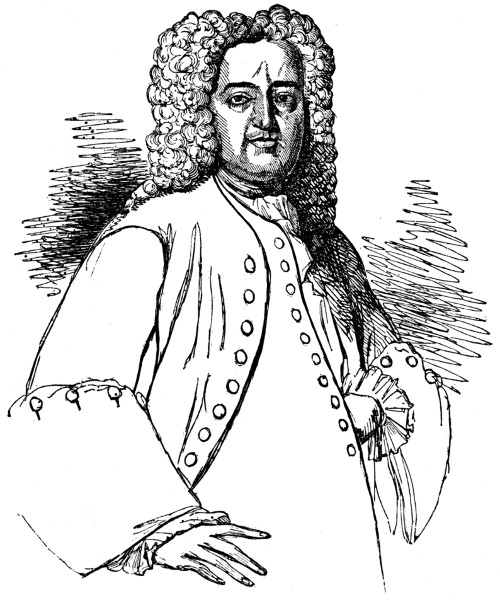
Robert North, Esq. of Scarborough.
This portrait, copied from a picture at Scarborough by Mr. Baynes, jun. and not before engraven, is of a very worthy person, whose eccentricities in well doing rendered him in some degree remarkable. Mr. Robert North, whom it represents, was born at that place, of which his father was vicar, on the second of November, 1702. His education was liberal. After completing his studies at one of the universities he visited the continent, and was distinguished for refinement of manners and exemplary benevolence and piety. In the latter part of his life he sought retirement, and seldom went abroad except to the church, which he regularly attended on every occasion when service was performed. He generally appeared absorbed in meditation, and was accustomed to make ejaculatory prayers, or fervent aspirations, as he walked. Once in every year he had a sort of gala-day for the entertainment of his female friends, whom he charmed by his polite attention and pleasing conversation. With the next morning he resumed his usual seclusion for the ensuing twelvemonth. He lived many years in full expectation of the commencement of the millennium.
But that which has given celebrity to the name of the late “Robert North, Esq.” at Scarborough is the founding, in the year 1728, of a very useful institution, called “The Amicable Society,” for clothing and educating the children of the poor; which under the government of a president, four trustees, and four wardens, annually elected, with a fund for its support, arising from the weekly subscriptions of the members, collections made in the church, and other voluntary donations, continues to flourish. The number of children thus clothed and educated, now in the school, is sixty, and the number of members two hundred and sixty-five.
This institution has preserved many children from the contagion of evil example, and enabled them to follow useful occupations in life with credit and advantage. Several, who, by their early education at this seminary, attained a competent knowledge of navigation, became mates and commanders of vessels, and eventually benefactors and patrons of the institution.
The exact day of Mr. North’s death does not appear; but his interment is dated in the parish-register of Scarborough, 14th October, 1760.
Mr. North, by a singular codicil to his will, gives one pair of his silver candlesticks to the celebrated Dr. Young, author of the poem on the Last Day, &c.; and the other pair to the Rev. James Hervey, author of the Meditations among the Tombs, &c. “I call these,” he says, “in some measure legacies to the public, having given them to persons so well able to employ them for the benefit of mankind.”
The other legacies by this codicil are usually in themselves remarkable, and all the bequests are accompanied by remarks, which denote the peculiar character of the donor’s disposition: for example—“To the lady Lowther, of Swillington, a curious basket made of beads, the product of the virgin amusements of my grandmother—and her two sisters—it seeming highly proper to present a thing, which has gained the applause of most people, to a person who I hope has gained the applause of all. To Mrs. Philadelphia Boycott, my Kerry seal set in gold, with Mr. Addison’s head engraven on it—which will be very fitly deposited in the hands of a lady, whose letters are much celebrated for their wit and humour. In pursuance of an old promise, to Mrs. Barbara Tatton a picture in needlework, which was likewise made at the leisure hours of my aforesaid grandmother and her sisters, and which I suppose to have been designed for king Charles II.—the subject of which may perhaps sometimes engage her to reflect on this great truth, that the finest wit, if it deviate from the paths of virtue, is but a more elegant sort of folly. To Mrs. Christiana Hargrave, spinster, my silver coffee-pot, silver tea-pot, the silver stands for them, and my silver tea-canisters, milk-pot, and tea-spoons—being all of them baubles of some dignity and importance, even to women of sense, when in complaisance to the customs of an inconsiderate age they condescend to trifle. To the Rev. Thomas Adam,[482] rector of Wintringham in Lincolnshire, my mahogany bureau and bookcase—which may serve as a cabinet in which to reposit his manuscripts, till he may think it proper to make a cabinet of the world. In pursuance of an old promise to Mrs. Susannah Adam, his wife, my gold snuff-box—but if the contents of it prejudice her constitution, I hope she will upon this occasion follow the example of many fine ladies, who have many fine things which they never use. My silver cup and best silver tankard to Barnabas Legard, of Brompton, county of York, Esq., a person qualified by experience to teach our fine gentlemen a truth, which perhaps many of them will be surprised to hear—that temperance is the most delicious and refined luxury. To ensign William Massey, (my godson,) son of the late Capt. John Massey, of Hull, my sword; and hope he will, if ever occasion require it, convince a rash world that he has learned to obey his God as well as his general, and that he entertains too true a sense of honour ever to admit any thing into the character of a good soldier, which is inconsistent with the duty of a good Christian.[483] I give the sum of forty pounds, to be paid into the king’s exchequer.—I give thirty pounds to be added to the common stock of our East India company—which two last legacies I leave, as the best method I know, though not an exact one, of making restitution for the injustice I may have done, in buying (inadvertently) any uncustomed goods; and which I hope will be accepted by the great Judge of all men, in case I do not meet with a better before I die.—I give the sum of one hundred pounds to the person who shall within four years after my decease make and publish the best tragedy, entitled Virtue Triumphant—wherein among such others, as the poet shall think proper to introduce, shall be drawn the character of a virtuous man unconquered by misfortunes, &c. I give the sum of one hundred pounds to the person who shall, within four years after my decease, make and publish the best comedy; wherein—among such others as the poet shall think proper to introduce—shall be drawn the four following characters, viz. of a fine gentleman, a fine lady, a beau, and a coquet; the two first to be drawn with a thorough taste for religion and virtue, accompanied with fine sense and humour, and to be crowned with success; the two last with the fopperies and follies common to persons of these denominations, and to be made objects of contempt and ridicule,” &c.[484]
Mr. North’s Prizes for the Poets.
Nothing further appears to be known respecting Mr. North, except that, through the “Gentleman’s Magazine” for July, 1734, he proposed, and was the anonymous donor of fifty pounds, “as a prize for the poets,” to encourage them “to make the best poem, Latin or English, on Life, Death, Judgment, Heaven, and Hell, viz. all the said subjects jointly, and not any single one independent of the rest:” and, that the poets might not be discouraged “upon suspicion of incapacity in their judges,” he entirely resigned the decision of the best poem to “universal suffrage” and election by “vote;” or, as he is pleased to call it, in the Magazine for August, “the public vote of kingdoms.” He presumes that this scheme “will probably be most agreeable to the poets themselves, because they will be tried by such a number as is not capable of being bribed, and because this method of determination will, as he conceives, tend most to the honour of that poet who shall succeed.” In October he prescribes that the voters shall sign a declaration, disclaiming undue influence; and he suggests, that if the majority of candidates prefer a determinate number of judges to the public at large, he will accord to that arrangement, provided they express their desires with their poems. Accordingly, the Gentleman’s Magazine of May, 1735, “informs the candidates, that as the majority of them are for a decision by a select number of judges, the donor is desirous that Mr. Urban should apply to three particular gentlemen of unexceptionable merit, to undertake this office;” and it is announced, that the poems will be published in “an entire Magazine Extraordinary,” to render which “acceptable, to those who have no great taste for poetry,” there will be added “something of general use.” In the following July the poems appeared in the promised “Gentleman’s Magazine Extraordinary, printed by E. Cave, at St. John’s Gate, for the benefit of the poets;” whereto was added, as of “general use,” agreeably to the above promise, and for those “who have no great taste in poetry,” the Debates in the first session of parliament for 1735.
What gratification Mr. North derived from his encouragement of “the poets,” is to be inferred from this—that, in the supplement to the Gentleman’s Magazine of the same year, 1735, he announced, that other prizes thereafter mentioned would be given to persons who should “make and send” to Mr. Urban, before the 11th of June, 1736, the four best poems, entitled “The Christian Hero”—viz.
“1. To the person who shall make the best will be given a gold medal, (intrinsic value about ten pounds,) which shall have the head of the right hon. the lady Elizabeth Hastings on one side, and that of James Oglethorpe, Esq. on the other, with this motto—‘England may challenge the world, 1736.’
“2. To the author of the second, a complete set of Archbishop Tillotson’s Sermons.
“3. To the author of the third, a complete set of Archbishop Sharpe’s Sermons. And,
“4. To the author of the fourth, a set of Cooke’s Sermons.”
In the Magazine of February, 1736, Mr. North begs pardon of the lady Elizabeth Hastings, (a female of distinguished piety,) for the uneasiness he had occasioned her by proposing to engrave her portrait on his prize medal: being, “however, desirous that the poets should exercise their pens,” he proposes to substitute the head of archbishop Tillotson, and “hopes that Mr. Oglethorpe will be prevailed upon to consent that the medal shall bear his effigies.” Several of the poems made by “the poets” for this second prize appear in the Magazine of the same year, to which readers, desirous of perusing the effusions elicited by Mr. North’s liberality, are referred.
The “James Oglethorpe, Esq.” whose head Mr. North coveted for his prize medal, was the late general Oglethorpe, who died in 1785, at the advanced age of ninety-seven, the oldest general in the service. Besides his military employments, first as secretary and aide-de-camp to prince Eugene, and afterwards in America, and at home during the rebellion in 1745, he was distinguished as a useful member of the House of Commons, by proposing several regulations for the benefit of trade and the reform of prisons. In 1732 he settled the colony of Georgia, and erected the town of Savannah, and arrived in England in June, 1734, with several Indian chiefs. This gentleman’s public services at that time, and his eminent philanthropy, were inducements to Mr. North to do him honour. The following is an interesting account of the presentation of the Indians at court.
On the 1st of August, 1734, Tomo Chachi, the king, Senauki his wife, with Tooanakowki, their son, Hillispilli, the war captain, and the other Cherokee Indians, brought over by Mr. Oglethorpe from Georgia, were introduced to his majesty at Kensington, who received them seated on his throne; when Tomo Chachi, micho, or king, made the following speech, at the same time presenting several eagles’ feathers, trophies of their country.
“This day I see the majesty of your face, the greatness of your house, and the number of your people. I am come for the good of the whole nation, called the Creeks, to renew the peace which was long ago had with the English. I am come over in my old days, though I cannot live to see any advantage to myself; I am come for the good of the children of all the nations of the Upper and of the Lower Creeks, that they may be instructed in the knowledge of the English.
“These are the feathers of the eagle, which is the swiftest of birds, and who flieth all round our nations. These feathers are a sign of peace in our land, and have been carried from town to town there; and we have brought them over to leave with you, O great king, as a sign of everlasting peace.
“O great king, whatsoever words you shall say unto me, I will tell them faithfully to all the kings of the Creek nations.”
To which his majesty graciously answered,
“I am glad of this opportunity of assuring you of my regard for the people from whom you come, and am extremely well pleased with the assurances you have brought me from them, and accept very gratefully this present, as an indication of their good disposition to me and my people. I shall always be ready to cultivate a good correspondence between them and my own subjects, and shall be glad of any occasion to show you a mark of my particular friendship and esteem.”
Tomo Chachi afterwards made the following speech to the queen.
“I am glad to see this day, and to have the opportunity of seeing, the mother of this great people.
“As our people are joined with your majesty’s, we do humbly hope to find you the common mother and protectress of us and all our children.”
Her majesty returned a suitably gracious answer.
The war captain, and other attendants of Tomo Chachi, were very importunate to appear at court in the costume of their own country, merely a covering round the waist, the rest of the body being naked, but were dissuaded from it by Mr. Oglethorpe. But their faces were variously painted after their country manner, some half black, others triangular, and others with bearded arrows instead of whiskers, Tomo Chachi, and Senauki, his wife, were dressed in scarlet, trimmed with gold.
On the 17th of the same month Tomo Chachi, and the rest of the Indians, dined with the lady Dutry at Putney; and then waited on the archbishop of Canterbury, (Potter,) who received them with the utmost kindness and tenderness, and expressed his fatherly concern for their ignorance with respect to Christianity, and his strong desire for their instruction. His grace, though very weak, would not sit down, the micho therefore omitted speaking to him what he intended, and only desired his blessing; adding, that what he had further to say he would speak to Dr. Lynch, his grace’s son-in-law, and then withdrew. He was afterwards entertained at a noble collation, and had a conference with Dr. Lynch, expressing his joy, as believing some good persons would be sent amongst them to instruct their youth.
On the 30th of October the Indian king, queen, prince, &c. set out from the Georgia office, in the king’s coaches, for Gravesend, to embark on their return home. During their stay in England, which had been about four months, his majesty allowed them 20l. a week for their subsistence. Whatever was curious and worthy observation in and about London and Westminster had been carefully shown them; and nothing had been wanting to contribute to their diversion and amusement, and to give them a just idea of English politeness and respect. In return, they expressed themselves heartily attached to the British nation. They had about the value of 400l. in presents. Prince William presented the young micho, John Towanohowi, with a gold watch, with an admonition to call upon Jesus Christ every morning when he looked on it, which he promised. They appeared particularly delighted with seeing his highness perform his exercise of riding the managed horse, the Horse Guards pass in review, and the agreeable appearance of the barges, &c. on the Thames on lord mayor’s day. In the same ship embarked several relations of the English settled in Georgia, with sir Francis Bathurst, his son, three daughters, and servants; together with fifty-six Saltzburghers, newly arrived from Rotterdam. These people had been at the German church in Trinity-lane, where 47l. was collected for them.[485]
MENDIP MINES.
To the Editor.
Sir,—The very great entertainment I have derived from your Every-Day Book induces me to contribute to your present publication, if you consider the accompanying copy from an old record merits a place in the Table Book. It formed part of a brief held by counsel in a cause, “Hembury and Day,” tried at Taunton assizes in 1820. On referring to the papers I find that the present Mr. justice Gaselee was the counsel employed. Some of these old Mendip laws are recognised in “Collinson’s History of Somersetshire.”
I am, Your very obedient servant, John Pinchard.
Taunton, August 24, 1827.
Laws and Orders of the Mendip Miners.
Be it known that this is a true Copy of the Enrollment in the King’s Exchequer in the time of King Edward the Fourth, of a dispute that was in the County of Somerset, Between the Lord Bonfield and the tenants of Chewton and the prior of Green Oare; the said prior complaining unto the King of great injuries and wrongs that he had upon Mendip, being the King’s Forrest. The said King Edward, commanded the lord Chock the lord Chief Justice of England to go down into the County of Somerset, to Mendipp, and sit in concord and Peace in the said County concerning Mendipp upon pain of high displeasure. The said Lord Chock sate upon Mendipp on a place of my Lord’s of Bath, called the Forge, Whereas he commanded all the Commoners to appear, and especially the four Lords Royal of Mendipp (that is to say) the Bishop of Bath, my Lord of Glaston, my Lord of Bonfield, the Lord of Chewton, and my Lord of Richmond, with all the appearance to the Number of ten Thousand people. A Proclamation was made to enquire of all the company how they would be ordered. Then they with one consent made answer, That they would be Ordered and tryed by the four Lords of the Royalties. And then the four Lords Royal were agreed, that the Commoners of Mendipp should hem out their outlets as much the Summer as they be able to Winter, without hounding or pounding upon whose ground soever they went to take their course and recourse, to which the four Lords Royal did put their Seals, and were also agreed that whosoever should break the said Bonds should forfeit to the King 1000 Marks, and all the Commoners their Bodies and goods to be at the King’s pleasure or command that doeth either hound or pound.———
The old Ancient Occupation of Miners upon Mendipp, being the King’s Forrest within the County of Somerset one of the four Staples of England which have been Exercised, used and continued through the said Forrest of Mendipp from the time whereof no Man living hath no memory; as hereafter doth particularly ensue the Order;
First. That, if any man whatsoever he be that doeth intend to venture his Life to be a Workman in the said Occupation, he must first of all crave licence of the Lords of the Soyle where he doth purpose to work, and in his absence of his said Officers, as the lead-reave or Bailiff, and the lord, neither his Bailiffs can deny him.
2d Item. That, after the first Licence had, the Workman shall never need to ask leave again, but to be at his free will to pitch within the Forrest, and to break the ground where and in what place it shall please him, to his behalf and profit, using himself justly and truly.
3d Item. If any doth begin to pitch or groof he shall heave his hacks through two ways after the Rate.—Note, that he that throw the hack must stand to the Girdle or Waste in the same Groof, and then no Man shall or may work within his hack’s throwe: provided always, that no man shall or can keep but his wet, and dry Groof, and his Mark—
4th Item. That, when a Workman have landed his Oare, he may carry the same, to cleansing or blowing, to what Minery it shall please him, for the speedy making out of the same, so that he doth truly pay the lord of the Soyle, where it was landed, his due, which is the Tenth part thereof—
5th Item. That if any Lord or Officer hath once given licence to any Man to build, or set up an hearth, or Washing-house, to wash, cleanse or blow the Oare, He that once hath leave shall keep it for ever, or give it to whom he will, so that he doth justly pay his Lot-lead, which is the Tenth pound which shall be blown at the Hearth or hearths, and also that he doth keep it Tenantable, as the Custom doth require—
6th Item. That, if any of that Occupation doth pick or steal any lead or Oare to the value of thirteen-pence halfpenny[486] the lord or his Officer may Arrest all his Lead-works, house and hearth, with all his Groofs and Works, and keep them as safely for his own Use; and shall take the person that hath so offended, and bring him where his house is, or his work, and all his Tools or Instruments which to the Occupation belongs, as he useth, and put him into the said house, and set Fire on all together about him, and banish him from that Occupation before the Miners for ever—
7th Item. That, if ever that person do pick or Steal there any more, he shall be tryed by the Common Law, for this Custom and Law hath noe more to do with him—
8th Item. That every Lord of Soyle or Soyles ought to keep two Mynedrie Courts by the year, and to swear twelve Men or more of the same occupation, for the orders of all Misdemeanours and wrongs touching the Mynedries.
9th Item. The Lord, or Lords, may make three manner of Arrests, (that is to say) ye first is for strife between man and man, for their workes under the Earth, &c.; the second is for his own duty, for Lead or Oare, wheresoever he find it within the said Forrest; the third is upon felon’s goods of the same occupation, wheresoever he find it within the same Hill, &c.—
10th Item. That, if any Man, by means of Misfortune take his Death, as by falling of the Earth upon him, by drawing or Stifling, or otherwise, as in time past many have been, the Workmen of the same Occupation are bound to fetch him out of the Earth, and to bring him to Christian burial, at their own Costs and Charges, although he be Forty Fathoms under the Earth, as heretofore hath been done; and the Coroner, or any Officer at large, shall not have to do with him in any respect.
THIRTEEN-PENCE HALFPENNY.
Hangman’s Wages.
Jack Ketch a Gentleman.
Dr. Samuel Pegge, who is likely to be remembered by readers of the article on the Revolution-house at Whittington, he having, on the day he entered his eighty-fifth year, preached the centenary sermon to commemorate the Revolution, was an eminent antiquary. He addressed a paper to the Society of Antiquaries, on “the vulgar notion, though it will not appear to be a vulgar error, that thirteen-pence halfpenny is the fee of the executioner in the common line of business at Tyburn,[487] and that, therefore, it is called hangman’s wages.” It is proposed from this paper to give an account of the origin of the saying.
According to Dr. Pegge, the office of hangman was, in some parts of the kingdom, annexed to other posts; for the porter of the city of Canterbury was the executioner for the county of Kent, temporibus Hen. II. and Hen. III.; for which he had an allowance from the sheriff, who was reimbursed from the exchequer, of twenty shillings per annum.[488] From the great and general disesteem wherein the office is held, the sheriffs are much obliged to those who will undertake it, as otherwise its unpleasant and painful duty must fall upon themselves. For, to them the law looks for its completion, as they give a receipt to the gaoler for the bodies of condemned criminals whom they are to punish, or cause to be punished, according to their respective sentences. Sometimes in the country, sheriffs have had much difficulty to procure an executioner. In short, although, in the eyes of the people generally, a stigma attaches to the hangman, yet, in fact, the hangman is the sheriff’s immediate deputy in criminal matters, as his under-sheriff is for civil purposes. The nature and dignity of the office in some particulars, and the rank of the officer, called Squire Ketch, will be found to be supportable, as well as the fee of office.
And first, as regards the sheriff himself. The sheriff is, by being so styled in the king’s patent under the great seal, an esquire, which raises him to that rank, unless he has previously had the title adventitiously. None were anciently chosen sheriffs, but such gentlemen whose fortunes and stations would warrant it; so, on the other hand, merchants, and other liberal branches of the lower order, were admitted first into the rank of gentlemen, by a grant of arms, on proper qualifications, from the earl marshal, and the kings of arms, respectively, according to their provinces. After a negotiant has become a gentleman, courtesy will very soon advance that rank, and give the party the title of esquire; and so it happened with a worthy gentleman, for so a hangman will be proved to have been. This remarkable case happened in the year 1616, in the manner following.
Ralph Brooke, whose real name was Brokesmouth, at that time “York herald,” put a trick upon sir William Segar, “garter king of arms,” which had very nearly cost both of them their places. Brooke employed a person to carry a coat of arms ready drawn to garter, and to pretend it belonged to one Gregory Brandon, a gentleman who had formerly lived in London, but was then residing in Spain. The messenger was instructed to desire garter to set his hand to this coat of arms: and to prevent deliberation, he was further to pretend that the vessel, which was to carry this confirmation into Spain, when it had received the seal of the office and garter’s hand, was just ready to sail.[489] This being done, and the fees paid, Brooke carried it to Thomas earl of Arundel, then one of the commissioners for executing the office of earl marshal; and, in order to vilify garter, and to represent him as a rapacious, negligent officer, assured his lordship that those were the arms of Arragon, with a canton for Brabant, and that Gregory Brandon was a mean and inconsiderable person. This was true enough; for he was the common hangman for London and Middlesex. Ralph Brooke afterwards confessed all these circumstances to the commissioners who represented the earl marshal; the consequence of which was, that, by order of the king, when he heard the case, garter was committed to prison for negligence, and the herald for treachery. There was this previous result, however, that Gregory Brandon, the hangman, had become a gentleman; and, as the Bastard says in King John, “could make any Joan a gentlewoman.”
Thus was this Gregory Brandon advanced, perhaps from the state of a convict, to the rank of a gentleman; and though it was a personal honour to himself, notwithstanding it was surreptitiously obtained by the herald, of which Gregory Brandon, gentleman, was perhaps ignorant, yet did it operate so much on his successors in office, that afterwards it became transferred from the family to the officer for the time being; and from Mr. Brandon’s popularity, though not of the most desirable kind, the mobility soon improved his rank, and, with a jocular complaisance, gave him the title of esquire, which remains to this day.
It seems too as if this office had once, like many other important offices of state, been hereditary. Shakspeare has this passage in Coriolanus, act ii. sc. 1.—
“Menenius.—Marcius, in a cheap estimation, is worth all your predecessors, since Deucalion; though, peradventure, some of the best of them were hereditary hangmen.”
This looks as if the office of executioner had run in some family for a generation or two, at the time when Shakspeare wrote; and that it was a circumstance well understood, and would be well relished, at least by the galleries. This might, indeed, with regard to time, point at the ancestors of Mr. Brandon himself; for it was in the reign of king James I. that this person was brought within the pale of gentility. Nay, more, we are told by Dr. Grey, in his Notes on Shakspeare,[490] that from this gentleman, the hangmen, his successors, bore for a considerable time his Christian name of Gregory, though not his arms, they being a personal honour, till a greater man arose, viz. Jack Ketch, who entailed the present official name on all who have hitherto followed him.[491]
Whether the name of Ketch be not the provincial pronunciation of Catch among the cockneys, may be doubted, notwithstanding that learned and laborious compiler, B. E., gent., the editor of the “Canting Dictionary,” says that Jack Kitch, for so he spells it, was the real name of a hangman, which has become that of all his successors.
So much for the office. It now remains to consider the emoluments which appertain to it, and assign a reason why thirteen-pence halfpenny should be esteemed its standard fee for inflicting the last stroke of the law.
Before proceeding to matters of a pecuniary nature, it may be allowed, perhaps, to illustrate a Yorkshire saying. It was occasioned by a truly unfortunate man, whose guilt was doubtful, and yet suffered the sentence of the law at York. This person was a saddler at Bawtry, and hence the saying among the lower people to a man who quits his friends too early, and will not stay to finish his bottle:—“He will be hanged for leaving his liquor, like the saddler of Bawtry.” The case was this:—There was formerly an ale-house, which house to this day is called “The Gallows House,” situate between the city of York and their Tyburn; at this house the cart used always to stop, and there the convict and the other parties were refreshed with liquors; but the rash and precipitate saddler of Bawtry, on his road to the fatal tree, refused this little regale, and hastened on to the place of execution; where, but not until after he had been turned off, and it was too late, a reprieve arrived. Had he stopped, as was usual, at the gallows house, the time consumed there would have been the means of saving his life. He was hanged, as truly as unhappily, for leaving his liquor.
Similar means of refreshment were anciently allowed to convicts, on their passage to Tyburn, at St. Giles’s hospital; for we are told by Stowe, that they were there presented with a bowl of ale, called “St. Giles’s bowl; thereof to drink at their pleasure, as their last refreshing in this life.” Tyburn was the established scene of executions in common cases so long ago as the first year of king Henry IV.; Smithfield and St. Giles’s Field being reserved for persons of higher rank, and for crimes of uncommon magnitude, such as treason and heresy. In the last of these, sir John Oldcastle, lord Cobham, was burnt, or rather roasted, alive; having been hanged up over the fire by a chain which went round his waist.[492]
The executioner of the duke of Monmouth (in July, 1685) was peculiarly unsuccessful in the operation. The duke said to him, “Here are six guineas for you: pray do your business well; do not serve me as you did my lord Russell: I have heard you struck him three or four times. Here, (to his servant,) take these remaining guineas, and give them to him if he does his work well.”
Executioner.—“I hope I shall.”
Monmouth.—“If you strike me twice, I cannot promise you not to stir. Pr’ythee let me feel the axe.” He felt the edge, and said, “I fear it is not sharp enough.”
Executioner.—“It is sharp enough, and heavy enough.”
The executioner proceeded to do his office; but the note says, “it was under such distraction of mind, that he fell into the very error which the duke had so earnestly cautioned him to avoid; wounding him so slightly, that he lifted up his head, and looked him in the face, as if to upbraid him for making his death painful; but said nothing. He then prostrated himself again, and received two other ineffectual blows; upon which the executioner threw down his axe in a fit of horror; crying out, ‘he could not finish his work:’ but, on being brought to himself by the threats of the sheriffs, took up the fatal weapon again, and at two other strokes made a shift to separate the head from the body.”[493]
As to the fee itself, “thirteen-pence half-penny—hangman’s wages,” it appears to have been of Scottish extraction. The Scottish mark (not ideal or nominal money, like our mark) was a silver coin, in value thirteen-pence halfpenny and two placks, or two-thirds of a penny; which plack is likewise a coin. This, their mark, bears the same proportion to their pound, which is twenty-pence, as our mark does to our pound, or twenty shillings, being two-thirds of it. By these divisions and sub-divisions of their penny (for they have a still smaller piece, called a bodel or half a plack) they can reckon with the greatest minuteness, and buy much less quantities of any article than we can.[494] This Scottish mark was, upon the union of the two crowns in the person of king James I., made current in England at the value of thirteen-pence halfpenny, (without regarding the fraction,) by proclamation, in the first year of that king; where it is said, that “the coin of silver, called the mark piece, shall be from henceforth current within the said kingdom of England, at the value of thirteen-pence halfpenny.”[495] This, probably, was a revolution in the current money in favour of the hangman, whose fee before was perhaps no more than a shilling. There is, however, very good reason to conclude, from the singularity of the sum, that the odious title of “hangman’s wages” became at this time, or soon after, applicable to the sum of thirteen-pence halfpenny. Though it was contingent, yet it was then very considerable pay; when one shilling per day was a standing annual stipend to many respectable officers of various kinds.
Nothing can well vary more than the perquisites of this office; for it is well known that Jack Ketch has a post-obit interest in the convict, being entitled to his clothes, or to a composition for them; though, on the other hand, they must very frequently be such garments that, as Shakspeare says, “a hangman would bury with those who wore them.”[496]
This emolument is of no modern date, and has an affinity to other droits on very dissimilar occasions, which will be mentioned presently. The executioner’s perquisite is at least as old as Henry VIII.; for sir Thomas More, on the morning of his execution, put on his best gown, which was of silk camlet, sent him as a present while he was in the Tower by a citizen of Lucca, with whom he had been in correspondence; but the lieutenant of the Tower was of opinion that a worse gown would be good enough for the person who was to have it, meaning the executioner, and prevailed upon sir Thomas to change it, which he did for one made of frize.[497] Thus the antiquity of this obitual emolument, so well known in Shakspeare’s time, seems well established; and, as to its nature, has a strong resemblance to a fee of a much longer standing, and formerly received by officers of very great respectability. For anciently “garter king of arms” had specifically the gown of the party on the creation of a peer; and again, when archbishops, bishops, abbots, and priors, did homage to the king, their upper garment was the perquisite even of the lord chamberlain of the household. The fee in the latter case was always compounded for, though garter’s was often formerly received in kind, inasmuch as the statute which gives this fee to the lord chamberlain directs the composition, because, as the words are, “it is more convenient that religious men should fine for their upper garment, than to be stripped.”[498] The same delicate necessity does not operate in the hangman’s case, and his fee extends much farther than either of them, he being entitled to all the sufferer’s garments, having first rendered them useless to the party. Besides this perquisite, there has always been a pecuniary compliment, where it could possibly be afforded, given by the sufferer to the executioner, to induce him to be speedy and dexterous in the operation. These outward gifts may likewise be understood as tokens of inward forgiveness.
“Upon the whole,” says Dr. Pegge, “I conceive that what I have offered above, though with much enlargement, is the meaning of the ignominious term affixed to the sum of thirteen-pence halfpenny, and I cannot but commiserate those for whom it is to be paid.”[499]