Volume 1 — Vol. I.—13.
Reading edition
Shepherd’s Well, Hampstead.
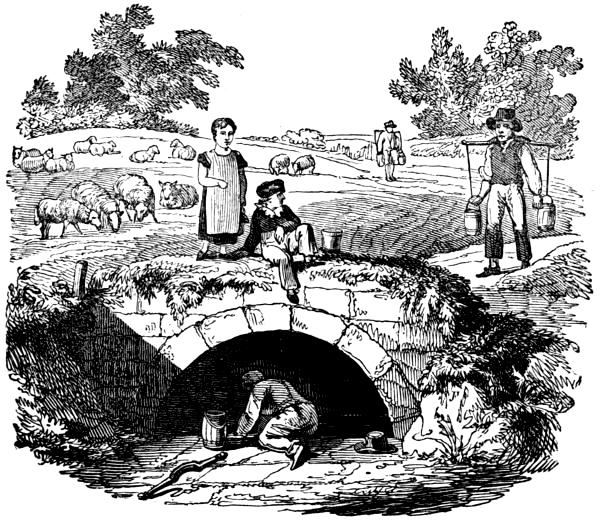
Shepherd’s Well, Hampstead.
The verdant lawns which rise above the rill Are not unworthy Virgil’s past’ral song.
On the west side of Hampstead, in the middle of one of the pleasant meadows called Shepherd’s fields, at the left-hand of the footpath going from Belsize-house towards the church, this arch, embedded above and around by the green turf, forms a conduit-head to a beautiful spring: the specific gravity of the fluid, which yields several tuns a day, is little more than that of distilled water. Hampstead abounds in other springs, but they are mostly impregnated with mineral substances. The water of “Shepherd’s well,” therefore, is in continual request, and those who cannot otherwise conveniently obtain it, are supplied through a few of the villagers, who make a scanty living by carrying it to houses for a penny a pail-full. There is no carriage-way to the spot, and these poor things have much hard work for a very little money.
I first knew this spring in my childhood, when domiciled with a relation, who then occupied Belsize-house, by being allowed to go with Jeff the under-gardener, whose duty it was to fetch water from the spring. As I accompanied him, so a tame magpie accompanied me: Jeff slouched on with his pails and yoke, and my ardour to precede was restrained by fear of some ill happening to Mag if I did not look after the rogue. He was a wayward bird, the first to follow wherever I went, but always according to his own fashion; he never put forth his speed till he found himself a long way behind, so that Jeff always led the van, and Mag always brought up the rear, making up for long lagging by long hopping. On one occasion, however, as soon as we got out of the side-door from the out-house yard into Belsize-lane, Mag bounded across the road, and over the wicket along the meadows, with quick and long hops, throwing “side-long looks behind,” as if deriding my inability to keep up with him, till he reached the well: there we both waited for Jeff, who for once was last, and, on whose arrival, the bird took his station on the crown of the arch, looking alternately down to the well and up at Jeff. It was a sultry day in a season of drought, and, to Jeff’s surprise, the water was not easily within reach; while he was making efforts with the bucket, Mag seemed deeply interested in the experiment, and flitted about with tiresome assiduity. In a moment Jeff rose in a rage, execrated poor Mag, and vowed cruel vengeance on him. On our way home the bird preceded, and Jeff, to my continual alarm in behalf of Mag, several times stopped, and threw stones at him with great violence. It was not till we were housed, that the man’s anger was sufficiently appeased to let him acquaint me with its cause: and then I learned that Mag was a “wicked bird,” who knew of the low water before he set out, and was delighted with the mischief. From that day, Jeff hated him, and tried to maim him: the creature’s sagacity in eluding his brutal intent, he imputed to diabolical knowledge; and, while my estimation of Jeff as a good-natured fellow was considerably shaken, I acquired a secret fear of poor Mag. This was my first acquaintance with the superstitious and dangerous feelings of ignorance.
The water of Shepherd’s well is remarkable for not being subject to freeze. There is another spring sometimes resorted to near Kilburn, but this and the ponds in the Vale of Health are the ordinary sources of public supply to Hampstead. The chief inconvenience of habitations in this delightful village is the inadequate distribution of good water. Occasional visitants, for the sake of health, frequently sustain considerable injury by the insalubrity of private springs, and charge upon the fluid they breathe the mischiefs they derive from the fluid they drink. The localities of the place afford almost every variety of aspect and temperature that invalids require: and a constant sufficiency of wholesome water might be easily obtained by a few simple arrangements.
*
March 19, 1827.
Garrick Plays. No. X.
[From the “Fair Maid of the Exchange,” a Comedy, by Thomas Heywood, 1637.]
Cripple offers to fit Frank Golding with ready made Love Epistles.
Frank. Of thy own writing? Crip. My own, I assure you, Sir. Frank. Faith, thou hast robb’d some sonnet-book or other. And now would’st make me think they are thy own. Crip. Why, think’st thou that I cannot write a Letter, Ditty, or Sonnet, with judicial phrase, As pretty, pleasing, and pathetical, As the best Ovid-imitating dunce In the whole town? Frank. I think thou can’st not. Crip. Yea, I’ll swear I cannot. Yet, Sirrah, I could coney-catch the world, Make myself famous for a sudden wit, And be admired for my dexterity, Were I disposed. Frank. I prithee, how? Crip. Why, thus. There lived a Poet in this town, (If we may term our modern writers Poets), Sharp-witted, bitter-tongued; his pen, of steel; His ink was temper’d with the biting juice And extracts of the bitterest weeds that grew; He never wrote but when the elements Of fire and water tilted in his brain. This fellow, ready to give up his ghost To Lucia’s bosom, did bequeath to me His Library, which was just nothing But rolls, and scrolls, and bundles of cast wit, Such as durst never visit Paul’s Church Yard. Amongst ’em all I lighted on a quire Or two of paper, fill’d with Songs and Ditties, And here and there a hungry Epigram; These I reserve to my own proper use, And Pater-noster-like have conn’d them all. I could now, when I am in company, At ale-house, tavern, or an ordinary, Upon a theme make an extemporal ditty (Or one at least should seem extemporal), Out of the abundance of this Legacy, That all would judge it, and report it too, To be the infant of a sudden wit, And then were I an admirable fellow. Frank. This were a piece of cunning. Crip. I could do more; for I could make enquiry, Where the best-witted gallants use to dine, Follow them to the tavern, and there sit In the next room with a calve’s head and brimstone, And over-hear their talk, observe their humours, Collect their jests, put them into a play, And tire them too with payment to behold What I have filch’d from them. This I could do But O for shame that man should so arraign Their own fee-simple wits for verbal theft! Yet men there be that have done this and that, And more by much more than the most of them.[92]
After this Specimen of the pleasanter vein of Heywood, I am tempted to extract some lines from his “Hierarchie of Angels, 1634;” not strictly as a Dramatic Poem, but because the passage contains a string of names, all but that of Watson, his contemporary Dramatists. He is complaining in a mood half serious, half comic, of the disrespect which Poets in his own times meet with from the world, compared with the honors paid them by Antiquity. Then they could afford them three or four sonorous names, and at full length; as to Ovid, the addition of Publius Naso Sulmensis; to Seneca, that of Lucius Annæas Cordubensis; and the like. Now, says he,
Our modern Poets to that pass are driven, Those names are curtail’d which they first had given; And, as we wish’d to have their memories drown’d, We scarcely can afford them half their sound. Greene, who had in both Academies ta’en Degree of Master, yet could never gain To be call’d more than Robin: who, had he Profest ought save the Muse, served, and been free After a sev’n years prenticeship, might have (With credit too) gone Robert to his grave. Marlowe, renown’d for his rare art and wit, Could ne’er attain beyond the name of Kit; Although his Hero and Leander did Merit addition rather. Famous Kid Was call’d but Tom. Tom Watson; though he wrote Able to make Apollo’s self to dote Upon his Muse; for all that he could strive, Yet never could to his full name arrive. Tom Nash (in his time of no small esteem) Could not a second syllable redeem. Excellent Beaumont, in the foremost rank Of the rarest wits, was never more than Frank. Mellifluous Shakspeare, whose inchanting quill Commanded mirth or passion, was but Will; And famous Jonson, though his learned pen Be dipt in Castaly, is still but Ben. Fletcher, and Webster, of that learned pack None of the meanest, neither was but Jack; Decker but Tom; nor May, nor Middleton; And he’s now but Jack Ford, that once were John.
Possibly our Poet was a little sore, that this contemptuous curtailment of their Baptismal Names was chiefly exercised upon his Poetical Brethren of the Drama. We hear nothing about Sam Daniel, or Ned Spenser, in his catalogue. The familiarity of common discourse might probably take the greater liberties with the Dramatic Poets, as conceiving of them as more upon a level with the Stage Actors. Or did their greater publicity, and popularity in consequence, fasten these diminutives upon them out of a feeling of love and kindness; as we say Harry the Fifth, rather than Henry, when we would express good will?—as himself says, in those reviving words put into his mouth by Shakspeare, where he would comfort and confirm his doubting brothers:
Not Amurath an Amurath succeeds, But Harry Harry!
And doubtless Heywood had an indistinct conception of this truth, when (coming to his own name), with that beautiful retracting which is natural to one that, not Satirically given, has wandered a little out of his way into something recriminative, he goes on to say:
Nor speak I this, that any here exprest Should think themselves less worthy than the rest, Whose names have their full syllables and sound; Or that Frank, Kit, or Jack, are the least wound Unto their fame and merit. I for my part (Think others what they please) accept that heart, Which courts my love in most familiar phrase; And that it takes not from my pains or praise, If any one to me so bluntly come: I hold he loves me best that calls me Tom.
C. L.
ERRATA.
Garrick Plays, No. IX.
Col. 357. Last line but two of the last extract—
“Blushing forth golden hair and glorious red”—
a sun-bright line spoiled:—
Blush for Blushing.
Last line but two of the extract preceding the former, (the end of the old man’s speech)—
“Restrained liberty attain’d is sweet,”
should have a full stop.
These little blemishes kill such delicate things: prose feeds on grosser punctualities.
Will the reader be pleased to make the above corrections with a pen, and allow the fact of illness in excuse for editorial mischance?
*
SNUFF AND TOBACCO.
For the Table Book.
In the year 1797 was circulated the following:—
Proposals for Publishing by Subscription, a History of Snuff and Tobacco, in two Volumes.
Vol. I. to contain a Description of the Nose—Size of Noses—A Digression on Roman Noses—Whether long Noses are symptomatic—Origin of Tobacco—Tobacco first manufactured into Snuff—Enquiry who took the first Pinch—Essay on Sneezing—Whether the ancients sneezed, and at what—Origin of Pocket-handkerchiefs—Discrimination between Snuffing and taking Snuff; the former applied only to Candles—Parliamentary Snufftakers—Troubles in the time of Charles the First, as connected with Smoking.
Vol. II. Snufftakers in the Parliamentary army—Wit at a Pinch—Oval Snuff-boxes first used by the Round-heads—Manufacture of Tobacco Pipes—Dissertation on Pipe Clay—State of Snuff during the Commonwealth—The Union—Scotch Snuff first introduced—found very pungent and penetrating—Accession of George the Second—Snuff-boxes then made of Gold and Silver—George the Third—Scotch Snuff first introduced at Court—The Queen—German Snuffs in fashion—Female Snufftakers—Clean Tuckers, &c. &c.—Index and List of Subscribers.
In connection with this subject I beg to mention an anecdote, related to me by an old Gentleman who well remembered the circumstance:—
“When every Shopkeeper had a Sign hanging out before his door, a Dealer in Snuff and Tobacco on Fish Street Hill, carried on a large trade, especially in Tobacco, for his Shop was greatly frequented by Sailors from the Ships in the River. In the course of time, a Person of the name of Farr opened a Shop nearly opposite, and hung out his Sign inscribed ‘The best Tobacco by Farr.’ This (like the Shoemaker’s inscription, ‘Adam Strong Shoemaker,’ so well known) attracted the attention of the Sailors, who left the old Shop to buy ‘the best Tobacco by far.’ The old Shopkeeper observing that his opponent obtained much custom by his Sign, had a new one put up at his Door inscribed ‘Far better Tobacco than the best Tobacco by Farr.’ This had its effect; his trade returned, and finally his opponent was obliged to give up business.”
W. P.
THE SMOKER’S SONG.
For the Table Book.
For thy sake, Tobacco, I Would do any thing but die!
Charles Lamb.
1.
There is a tiny weed, man, That grows far o’er the sea man; The juice of which does more bewitch Than does the gossip’s tea, man.
2.
Its name is call’d tobacco, ’Tis used near and far man; The car-man chews—but I will choose The daintier cigar, man.
3.
’Tis dainty ev’n in shape, man— So round, so smooth, so long, man! If you’re a churl, ’twill from you hurl Your spleen—you’ll sing a song, man!
4.
If you will once permit it To touch your swelling lip, man, You soon shall see ’twill sweeter be Than what the bee doth sip, man!
5.
If e’er you are in trouble, This will your trouble still, man, On sea and land ’tis at command, An idle hour to kill, man!
6.
And if the blind god, Cupid, Should strike you to the heart, man, Take up a glass, and toast your lass— And—ne’er from smoking part, man!
7.
And also if you’re married, In Hymen’s chains fast bound, man; To plague your wife out of her life, Smoke still the whole year round, man!
8.
How sweet ’tis of an evening When wint’ry winds do blow, man, As ’twere in spite, to take a pipe, And smoke by th’ fire’s glow, man!
9.
The sailor in his ship, man, When wildly rolls the wave, man, His pipe will smoke, and crack his joke Above his yawning grave, man!
10.
The soldier, in the tavern, Talks of the battle’s roar, man; With pipe in hand, he gives command, And thus he lives twice o’er man!
11.
All classes in this world, man, Have each their own enjoyment, But with a pipe, they’re all alike— ’Tis every one’s employment!
12.
Of all the various pleasures That on this earth there are, man, There’s nought to me affords such glee As a pipe or sweet cigar, man!
O. N. Y.
Old Customs and Manners By JOHN AUBREY, 1678 Ex MS. Coll. Ashmol. Mus. Oxford.
Education.
There were very few free-schools in England before the Reformation. Youth were generally taught Latin in the monasteries, and young women had their education not at Hackney, as now, scilicit, anno 1678, but at nunneries, where they learnt needle-work, confectionary, surgery, physic, (apothecaries and surgeons being at that time very rare,) writing, drawing, &c. Old Jackquar, now living, has often seen from his house the nuns of St. Mary Kingston, in Wilts, coming forth into the Nymph Hay with their rocks and wheels to spin, sometimes to the number of threescore and ten, all whom were not nuns, but young girls sent there for their education.
Chimneys.
Anciently, before the Reformation, ordinary men’s houses, as copyholders, and the like, had no chimneys, but flues like louver-holes; some of them were in being when I was a boy.
Painted Cloths.
In the halls and parlours of great houses were wrote texts of Scripture on the painted cloths.
Libels.
The lawyers say, that, before the time of king Henry VIII., one shall hardly find an action on the case as for slander, &c. once in a year, quod nota.
Christmas.
Before the last civil wars, in gentlemen’s houses at Christmas, the first dish that was brought to the table was a boar’s head with a lemon in his mouth. At Queen’s College in Oxford they still retain this custom; the bearer of it brings it into the hall, singing to an old tune an old Latin rhyme, “Caput apri defero,” &c. The first dish that was brought up to the table on Easter-day was a red herring riding away on horseback, i. e. a herring ordered by the cook something after the likeness of a man on horseback, set in a corn salad.
Easter.
The custom of eating a gammon of bacon at Easter, which is still kept up in many parts of England, was founded on this, viz. to show their abhorrence to Judaism at that solemn commemoration of our Lord’s resurrection. In the Easter holydays was the clerk’s ale for his private benefit, and the solace of the neighbourhood.
Salutations.
The use of “Your humble servant” came first into England on the marriage of queen Mary, daughter of Henry IV. of France, which is derived from Votre très humble serviteur. The usual salutation before that time was, “God keep you!” “God be with you!” and among the vulgar, “How dost do?” with a thump on the shoulder.
Court Rudeness.
Till this time the court itself was unpolished and unmannered. King James’s court was so far from being civil to women, that the ladies, nay the queen herself, could hardly pass by the king’s apartment without receiving some affront.
Travellers in France.
At the parish priests’ houses in France, especially in Languedoc, the table-cloth is on the board all day long, and ready for what is in the house to be put thereon for strangers, travellers, friars, and pilgrims; so ’twas, I have heard my grandfather say, in his grandfather’s time.
Private Heralds.
Heretofore noblemen and gentlemen of fair estates had their heralds, who wore their coat of arms at Christmas, and at other solemn times, and cried “Largesse” thrice.
At Tomarton, in Gloucestershire, anciently the seat of the Rivers, is a dungeon thirteen or fourteen feet deep; about four feet high are iron rings fastened to the wall, which was probably to tie offending villains to, as all lords of manors had this power over their villains, (or soccage tenants,) and had all of them no doubt such places for their punishment. It is well known, all castles had dungeons, and so I believe had monasteries, for they had often within themselves power of life and death.
In days of yore, lords and gentlemen lived in the country like petty kings; had jura regalia belonging to their seigniories, had their castles and boroughs, had gallows within their liberties, where they could try, condemn, and execute. Never went to London but in parliament-time, or once a year to do their homage to the king. They always ate in gothic halls, at the high table or oreille, (which is a little room at the upper end of the hall, where stands a table,) with the folks at the side-tables. The meat was served up by watchwords. Jacks are but of late invention. The poor boys did turn the spits, and licked the dripping for their pains. The beds of the men-servants and retainers were in the hall, as now in the grand or privy chamber.
Here in the hall, the mumming and the loaf-stealing, and other Christmas sports, were performed.
The hearth was commonly in the middle, whence the saying, “Round about our coal-fire.”
A neat-built chapel, and a spacious hall, were all the rooms of note, the rest more small.
Private Armories.
Every baron and gentleman of estate kept great horses for men at arms. Some had their armories sufficient to furnish out some hundreds of men.
Justices’ Halls.
The halls of the justices of peace were dreadful to behold; the screen was garnished with corselets and helmets gaping with open mouths, with coats of mail, lances, pikes, halberds, brown bills, batterdastors, and buckles.
Inns.
Public inns were rare. Travellers were entertained at religious houses for three days together, if occasion served.
Gentry Meetings.
The meeting of the gentry were not at taverns, but in the fields or forests, with hawks and hounds, and their bugle-horns, in silken bawderies.
Hawking.
In the last age every gentleman-like man kept a sparrow-hawk, and the priest a hobby, as dame Julian Berners teaches us, (who wrote a treatise on field-sports, temp. Henry VI.:) it was a divertisement for young gentlewomen to manne sparrow-hawks and merlines.
Church-houses—Poor-rates.
Before the Reformation there were no poor’s rates; the charitable doles given at religious houses, and church-ale in every parish, did the business. In every parish there was a church-house, to which belonged spits, pots, crocks, &c. for dressing provision. Here the housekeepers met and were merry, and gave their charity. The young people came there too, and had dancing, bowling, shooting at butts, &c. Mr. A. Wood assures me, there were few or no alms-houses before the time of king Henry VIII.; that at Oxford, opposite to Christ church, is one of the most ancient in England. In every church was a poor man’s box, and the like at great inns.
In these times, besides the jollities above-mentioned, they had their pilgrimages to several shrines, as to Walsingham, Canterbury, Glastonbury, Bromholm, &c. Then the crusades to the holy wars were magnificent and splendid, and gave rise to the adventures of the knight-errant and romances; the solemnity attending processions in and about churches, and the perambulations in the fields, were great diversions also of those times.
Glass Windows.
Glass windows, except in churches and gentlemen’s houses, were rare before the time of Henry VIII. In my own remembrance, before the civil wars, copyholders and poor people had none.
Men’s Coats.
About ninety years ago, noblemen’s and gentlemen’s coats were of the bedels and yeomen of the guards, i. e. gathered at the middle. The benchers in the inns of court yet retain that fashion in the make of their gowns.
Church-building.
Captain Silas Taylor says, that in days of yore, when a church was to be built, they watched and prayed on the vigil of the dedication, and took that point of the horizon where the sun arose for the east, which makes that variation, so that few stand true, except those built between the two equinoxes. I have experimented some churches, and have found the line to point to that part of the horizon where the sun rises on the day of that saint to whom the church was dedicated.
Before the wake, or feast of the dedication of the church, they sat up all night fasting and praying, (viz.) on the eve of the wake.
New Moon.
In Scotland, especially among the Highlanders, the women make a courtesy to the new moon; and our English women in this country have a touch of this, some of them sitting astride on a gate or style the first evening the new moon appears, and say, “A fine moon, God bless her!” The like I observed in Herefordshire.
Husbandry—Shepherds.
The Britons received the knowledge of husbandry from the Romans; the foot and the acre, which we yet use, is the nearest to them. In our west country, (and I believe so in the north,) they give no wages to the shepherd, but he has the keeping so many sheep with his master’s flock. Plautus hints at this in his Asinaria, act 3, scene 1, “etiam Opilio,” &c.
Architecture.
The Normans brought with them into England civility and building, which, though it was gothic, was yet magnificent.
Mr. Dugdale told me, that, about the time of king Henry III., the pope gave a bull, or patent, to a company of Italian architects, to travel up and down Europe to build churches.
Trumpets—Sheriffs’ Trumpets.
Upon occasion of bustling in those days, great lords sounded their trumpets, and summoned those that held under them. Old sir Walter Long, of Draycot, kept a trumpeter, rode with thirty servants and retainers. Hence the sheriffs’ trumpets at this day.
Younger Brothers.
No younger brothers were to betake themselves to trades, but were churchmen or retainers to great men.
Learning, and learned Men.
From the time of Erasmus till about twenty years last past, the learning was downright pedantry. The conversation and habits of those times were as starched as their bands and square beards, and gravity was then taken for wisdom. The doctors in those days were but old boys, when quibbles passed for wit, even in their sermons.
Gentry and their Children.
The gentry and citizens had little learning of any kind, and their way of breeding up their children was suitable to the rest. They were as severe to their children as their schoolmasters, and their schoolmasters as masters of the house of correction: the child perfectly loathed the sight of his parents as the slave his torture.
Gentlemen of thirty and forty years old were to stand like mutes and fools bare-headed before their parents; and the daughters (grown women) were to stand at the cupboard-side during the whole time of her proud mother’s visit, unless (as the fashion was) leave was desired forsooth that a cushion should be given them to kneel upon, brought them by the servingman, after they had done sufficient penance in standing.
The boys (I mean the young fellow) had their foreheads turned up and stiffened with spittle: they were to stand mannerly forsooth thus, the foretop ordered as before, with one hand at the bandstring, and the other behind.
Fans.
The gentlewomen had prodigious fans, as is to be seen in old pictures, like that instrument which is used to drive feathers, and it had a handle at least half a yard long; with these the daughters were oftentimes corrected, (sir Edward Coke, lord chief justice, rode the circuit with such a fan; sir William Dugdale told me he was an eye-witness of it. The earl of Manchester also used such a fan,) but fathers and mothers slashed their daughters in the time of their besom discipline, when they were perfect women.
University Flogging.
At Oxford (and I believe at Cambridge) the rod was frequently used by the tutors and deans; and Dr. Potter, of Trinity college, I knew right well, whipped his pupil with his sword by his side, when he came to take his leave of him to go to the inns of court.
Young Lambs to sell.
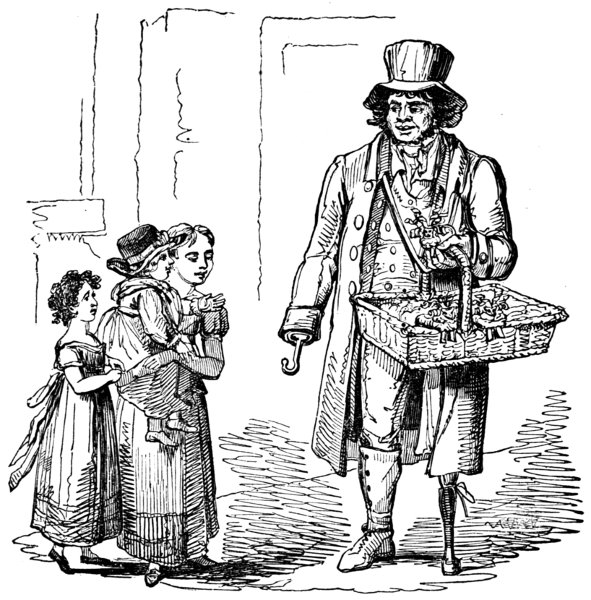
Young Lambs to sell.
Young lambs to sell! young lambs to sell If I’d as much money as I could tell, I’d not come here with lambs to sell! Dolly and Molly, Richard and Nell, Buy my young lambs, and I’ll use you well!
This is a “London cry” at the present time: the engraving represents the crier, William Liston, from a drawing for which he purposely stood.
This “public character” was born in the Gallowgate in the city of Glasgow. He became a soldier in the waggon-train, commanded by colonel Hamilton, and served under the duke of York in Holland, where, on the 6th of October, 1799, he lost his right arm and left leg, and his place in the army. His misfortunes thrust distinction upon him. From having been a private in the ranks, where he would have remained a single undistinguishable cipher 0, amongst a row of ciphers 0 0 0 0 0 0 0 0 0 he now makes a figure in the world; and is perhaps better known throughout England than any other individual of his order in society, for he has visited almost every town with “young lambs to sell.” He has a wife and four children; the latter are constantly employed in making the “young lambs,” with white cotton wool for fleeces, spangled with Dutch gilt, the head of flour paste, red paint on the cheeks, two jet black spots for eyes, horns of twisted shining tin, legs to correspond, and pink tape tied round the neck for a graceful collar. A full basket of these, and his song-like cry, attract the attention of the juvenile population, and he contrives to pick up a living, notwithstanding the “badness of the times.” The day after last Christmas-day, his cry in Covent-garden allured the stage-manager to purchase four dozen of “young lambs,” and at night they were “brought out” at that theatre, in the basket of a performer who personated their old proprietor, and cried so as to deceive the younger part of the audience into a belief that he was their real favourite of the streets.
I remember the first crier of “young lambs to sell!” He was a maimed sailor; and with him originated the manufacture. If I am not mistaken, this man, many years after I had ceased to be a purchaser of his ware, was guilty of some delinquency, for which he forfeited his life: his cry was
Young lambs to sell! young lambs to sell! Two for a penny young lambs to sell! Two for a penny young lambs to sell— Two for a penny young lambs to sell! If I’d as much money as I could tell, I wouldn’t cry young lambs to sell! Young lambs to sell—young lambs to sell— Two for a penny young lambs to sell! Young lambs to se—e—ll, Young la—a—mbs to sell!
Though it is five and thirty years ago since I heard the sailor’s musical “cry,” it still sings in my memory; it was a tenor of modulated harmonious tune, till, in the last line but one, it became a thorough bass, and rolled off at the close with a loud swell that filled urchin listeners with awe and admiration. During this chant his head was elevated, and he gave his full voice, and apparently his looks, to the winds; but the moment he concluded, and when attention was yet rivetted, his address became particular: his persuasive eye and jocular address flashed round the circle of “my little masters and mistresses,” and his hand presented a couple of his snow white “fleecy charge,” dabbled in gold, “two for a penny!” nor did he resume his song till ones and twos were in the possession of probably every child who had a halfpenny or penny at command.
The old sailor’s “young lambs” were only half the cost of the poor soldier’s. It may be doubted whether the materials of their composition have doubled in price, but the demand for “young lambs” has certainly lessened, while the present manufacturer has quite as many wants as the old one, and luckily possessing a monopoly of the manufacture, he therefore raises the price of his articles to the necessity of his circumstances. It is not convenient to refer to the precise chapter in the “Wealth of Nations,” or to verified tables of the increased value of money, in order to show that the new lamb-seller has not exceeded “an equitable adjustment” in the arrangement of his present prices; but it is fair to state in his behalf, that he declares, notwithstanding all the noise he makes, the carrying on of the lamb business is scarcely better than pig-shaving; “Sir,” says he, “it’s great cry, and little wool.” From a poor fellow, at his time of life, with only half his limbs to support a large family this is no joke. Not having been at his native place for two and twenty years, the desire to see it once more is strong within him, and he purposes next Easter to turn his face northwards, with his family, and “cry” all the way from London to Glasgow. Let the little ones, therefore, in the towns of his route, keep a penny or two by them to lay out in “young lambs,” and so help the poor fellow along the road, in this stage of his struggle through life.
*
March 19, 1827.
LINES ON HAPPINESS.
For the Table Book.
Like a frail shadow seen in maze, Or some bright star shot o’er the ocean, Is happiness, that meteor’s blaze, For ever fleeting in its motion. It plays within our fancied grasp, Like a phantasmagorian shade, Pursued, e’en to the latest gasp, It still seems hovering in the glade. Tis but like hope, and hope’s, at best, A star that leads the weary on, Still pointing to the unpossess’d And palling that it beams upon.
J. B. O.
HUMAN LIFE.
By Goethe.
That life is but a dream is the opinion of many; it is mine. When I see the narrow limits which confine the penetrating, active genius of man; when I see that all his powers are directed to satisfy mere necessities, the only end of which is to prolong a precarious or painful existence; that his greatest care, with regard to certain inquiries, is but a blind resignation; and that we only amuse ourselves with painting brilliant figures and smiling landscapes on the walls of our prison, whilst we see on all sides the boundary which confines us; when I consider these things I am silent: I examine myself; and what do I find? Alas! more vague desires, presages, and visions, than conviction, truth, and reality.
The happiest are those, who, like children, think not of the morrow, amuse themselves with playthings, dress and undress their dolls, watch with great respect before the cupboard where mamma keeps the sweetmeats, and when they get any, eat them directly, and cry for more; these are certainly happy beings. Many also are to be envied, who dignify their paltry employments, sometimes even their passions, with pompous titles; and who represent themselves to mankind as beings of a superior order, whose occupation it is to promote their welfare and glory. But the man who in all humility acknowledges the vanity of these things; observes with what pleasure the wealthy citizen transforms his little garden into a paradise; with what patience the poor man bears his burden; and that all wish equally to behold the sun yet a little longer; he too may be at peace. He creates a world of his own, is happy also because he is a man; and, however limited his sphere, he preserves in his bosom the idea of liberty.
VALEDICTORY STANZAS.
For the Table Book.
The flower is faded, The sun-beam is fled, The bright eye is shaded, The loved one is dead: Like a star in the morning— When, mantled in gray, Aurora is dawning— She vanish’d away. Like the primrose that bloometh Neglected to die, Though its sweetness perfumeth The ev’ning’s soft sigh— Like lightning in summer, Like rainbows that shine With a mild dreamy glimmer In colours divine— The kind and pure hearted, The tender, the true, From our love has departed With scarce an adieu: So briefly, so brightly In virtue she shone, As shooting stars nightly That blaze and are gone. The place of her slumber Is holy to me, And oft as I number The leaves of the tree, Whose branches in sorrow Bend over her urn, I think of to-morrow And silently mourn. The farewell is spoken, The spirit sublime The last tie has broken, That bound it to time; And bright is its dwelling Its mansion of bliss— How far, far excelling The darkness of this! Yet hearts still are beating, And eyes still are wet— True, our joys are all fleeting, But who can forget? I know they must vanish As visions depart, But oh, can this banish The thorn from my heart? The eye of affection, Its tribute of tears Sheds, with fond recollection Of life’s happy years; And tho’ vain be the anguish Indulg’d o’er the tomb, Yet nature will languish And shrink from its gloom. Those lips—their least motion Was music to me, And, like light on the ocean, Those eyes seem’d to be: Are they mute—and for ever? The spell will not break; Are they closed—must I never Behold them awake? When distress was around me Thy smiles were as balm, That in misery found me, And left me in calm: Success became dearer When thou wert with me, And the clear sky grew clearer When gaz’d on with thee. Thou art gone—and tho’ reason My grief would disarm, I feel there’s a season When grief has a charm; And ’tis sweeter, far sweeter To sit by thy grave, Than to follow Hope’s meteor Down time’s hasty wave. In darkness we laid thee— The earth for thy bed— The couch that we made thee Is press’d by thee dead: In sorrow’s film shrouded, Our eyes could not see The glory unclouded That opened on thee. Thou canst not, pure spirit, Return to the dust, But we may inherit— So humbly we trust— The joys without measure To which thou art gone, The regions of pleasure Where tears are unknown.
H.
EFFECT OF CONSCIENCE.
On the 30th of March, 1789, 360l. was carried to the account of the public, in consequence of the following note received by the chancellor of the exchequer.
“Sir—You will herewith receive bank notes to the amount of 360l. which is the property of the nation, and which, as an honest man, you will be so just as to apply to the use of the state in such manner that the nation may not suffer by its having been detained from the public treasury. You are implored to do this for the ease of conscience to an honest man.”
Anecdotes OF HENRY THE GREAT.
Public Libel.
About 1605, Henry IV. of France attempting to enforce some regulations respecting the annuities upon the Hotel de Ville, of Paris, several assemblies of the citizens were held, in which Francis Miron, the prévôt des marchands, addressed the king’s commissioners against the measures with fervour and firmness. It was rumoured amongst the people of Paris, that their magistrate was threatened, for having exerted himself too warmly in their behalf; they crowded about his house, in order to defend him, but Miron requested them to retire, and not to render him really criminal. He represented that nothing injurious was to be apprehended, for they had a king as great and wise, as he was beneficent and just, who would not suffer himself to be hurried away by the instigations of evil counsellors. Yet those whose conduct Miron had arraigned, endeavoured to persuade Henry to punish him, and deprive him of his office, for disobedient actions, and seditious discourse. The king’s answer contained memorable expressions:—“Authority does not always consist in carrying things with a high hand: regard must be paid to times, persons, and the subject-matter. I have been ten years in extinguishing civil discord, I dread its revival, and Paris has cost me too much for me to risk its loss; in my opinion, it would unquestionably be the case, were I to follow your advice; for I should be obliged to make terrible examples, which, in a few days, would deprive me of the glory of clemency, and the affection of my people; and these I prize as much, and even more than my crown. I have experienced, on many occasions, the fidelity and probity of Miron, who harbours no ill intentions, but undoubtedly deemed himself bound, by the duties of his office, to act as he has acted. If unguarded expressions have escaped him, I pardon them, on account of his past services; and, should he even desire a martyrdom in the public cause, I will disappoint him of the glory, by avoiding to become a persecutor and a tyrant.”
Henry ended the affair by receiving the apology and submission of Miron, and revoking the orders concerning the annuities, which had occasioned the popular alarm.[93]
Libellous Drama.
On the 26th of January, 1607, a pleasant farce was acted at the Hotel de Bourgogne, at Paris, before Henry IV., his queen, and the greater part of the princes, lords, and ladies of the court. The subject of the piece was a quarrel between a married man and his wife. The wife told her husband, that he staid tippling at the tavern while executions were daily laid upon their goods, for the tax which must be paid to the king, and that all their substance was carried away. “It is for that very reason,” said the husband in his defence, “that we should make merry with good cheer; for of what service would all the fortune we could amass be to us, since it would not belong to ourselves, but to this same noble king. I will drink the more, and of the very best: monsieur the king shall not meddle with that; go fetch me some this minute; march.” “Ah, wretch!” replied the wife, “would you bring me and your children to ruin?” During this dialogue, three officers of justice came in, and demanded the tax, and, in default of payment, prepared to carry away the furniture. The wife began a loud lamentation; at length the husband asked them who they were? “We belong to Justice,” said the officers: “How, to Justice!” replied the husband; “they who belong to Justice act in another manner; I do not believe that you are what you say.” During this altercation the wife seized a trunk, upon which she seated herself. The officers commanded her, “in the king’s name,” to open it; and after much dispute the trunk was opened, and out jumped three devils, who carry away the three officers of justice.
The magistrates, conceiving themselves to have been insulted by this performance, caused the actors to be arrested, and committed them to prison. On the same day they were discharged, by express command of the king, who magnanimously told those that complained of the affront, “You are fools! If any one has a right to take offence, it is I, who have received more abuse than any of you. I pardon the comedians from my heart; for the rogues made me laugh till I cried again.”[94]
CUSTOM AT SCARBOROUGH.
The fish-market is held on the sands, by the sides of the boats, which, at low water, are run upon wheels with a sail set, and are conducted by the fishermen, who dispose of their cargoes in the following manner.
One of the female fishmongers inquires the price, and bids a groat; the fishermen ask a sum in the opposite extreme: the one bids up, and the other reduces the demand, till they meet at a reasonable point, when the bidder suddenly exclaims, “Het!” This practice seems to be borrowed from the Dutch. The purchase is afterwards retailed among the regular, or occasional surrounding customers.
LINES TO A BARREL ORGAN.
For the Table Book.
How many thoughts from thee I cull, Music’s humblest vehicle! From thy caravan of sounds, Constant in its daily rounds, Some such pleasure do I find As when, borne upon the wind, The well-known “bewilder’d chimes” Plaintively recall those times, (Long since lost in sorrow’s shade,) When, in some sequester’d glade, Their simple, stammering tongues would try Some heart-moving melody.— Oldest musical delight Of my boyish days! the sight Or sound of thee would charm my feet, And make my joy of heart complete— How thou luredst listeners To thy crazy, yearning airs!— Harmonious, grumbling volcano! Murm’ring sounds in small piano, Or screaming forth a shrill soprano, Mingled with the growling bass. Fragments of some air I trace, Stifled by the notes which cram it— Scatter’d ruins of the gamut!— Sarcophagus of harmony! Orpheus’ casket! guarded by A swain who lives by what he earns From the music which he churns: Every note thou giv’st by turns.— Not Pindar’s lyre more variety Possess’d than thou! no cloy’d satiety Feel’st thou at thy perpetual feast Of sound; nor weariness the least: Thy task’s perform’d with right goodwill.— Thou art a melodious mill! Notes, like grain, are dribbled in, Thou grindest them, and fill’st the bin Of melody with plenteous store. Thy tunes are like the parrot’s lore, Nothing of them dost thou wot, But repeatest them by rote.— Curious, docile instrument! To skilless touch obedient: Like a mine of richest ore, Inexhaustible in store, Yielding at a child’s command All thy wealth unto its hand. Harmonicon peripatetic! What clue to notes so oft erratic Hast thou, by which the ear may follow Through thy labyrinthine hollow, Which its own echo dost consume, As stoves devour their own fume.— Mysterious fabric! cage-like chest! Behind whose gilded bars the nest Of unfledg’d melodies is hid ’Neath that brazen coverlid.— In thy bondage-house of song, Bound in brazen fetters strong, Immortal harmonies do groan! Doleful sounds their stifled moan. A vulture preys upon their pangs, Round whose neck their prison hangs, Like that tenanted strong box By eagle found upon the rocks Of Brobdingnag’s gigantic isle. Like Sysiphus, their endless toil Is hopeless: their tormentor’s claw Turns the wheel (his will’s their law) Which all their joints and members racks, Ne’er will his cruelty relax.— Miniature in shape and sound Of that grand instrument, which round Old cathedral walls doth send Its pealing voice; whose tones do blend The clangor of the trumpet’s throat, And the silver-stringed lute.— To what else shall I compare thee?— Further epithets I’ll spare thee. Honest and despised thing, To thy memory I cling. Spite of all thy faults, I own I love thy “old, familiar” tone.
Gaston.
MINISTERIAL FAVOUR.
A gentleman who had been long attached to cardinal Mazarine, reminded the cardinal of his many promises, and his dilatory performance. Mazarine, who had a great regard for him, and was unwilling to lose his friendship, took his hand, and explained the many demands made upon a person in his situation as minister, which it would be politic to satisfy previously to other requests, as they were founded on services done to the state. The cardinal’s adherent, not very confident in his veracity, replied, “My lord, all the favour I now ask at your hand is, that whenever we meet in public, you will do me the honour to tap me on the shoulder in an unreserved manner.” The cardinal smiled, and in the course of two or three years tapping, his friend became a wealthy man, on the credit of these attentions to him; and Mazarine and his confidant laughed at the public security which enriched the courtier at so little expense to the state.
DUDLEY OF PORTSMOUTH.
“I’m a going!” For the Table Book.
Barbers are not more celebrated by a desire to become the most busy citizens of the state, than by the expert habit in which they convey news. Many a tale is invented out of a mere surmise, or whisper, for the gratification of those who attend barbers’ shops. An old son of the scissors and razor, well known at Portsmouth, was not, however, quite so perfect a phiziologist, as his more erudite and bristling fraternity. One evening, as he was preparing his fronts, and fitting his comb “to a hair,” two supposed gentlemen entered his shop to be dressed; this being executed with much civility and despatch, a wager was laid with old Dudley, (for that was his name,) that he could not walk in a ring three feet in diameter, for one hour, and utter no other words than “I’m a going!” Two pounds on each side was on the counter; the ring was drawn in chalk; the money chinked in the ear, and old Dudley moved in the circle of his orbit. “I’m a going!—I’m a going!—I’m a going!” were the only words which kept time with his feet during the space of fifty-five minutes, when, on a sudden, one of the gentlemen sprang forward, and taking up the money, put it into his pocket. This device threw old Dudley off his guard, and he exclaimed, “That’s not fair!”—“Enough!” rejoined the sharpers, “you’ve lost the wager.” They departed, leaving him two pounds minus, and to this day old Dudley is saluted by the appellation of “I’m a going!”
Jehoiada.
ROYAL DECISION.
In the reign of George I. the sister of judge Dormer being married to a gentleman who afterwards killed a man very basely, the judge went to move the king for a pardon. It was impossible that he could offer any thing to the royal ear in extenuation of the crime, and therefore he was the more earnest in expressing his hope that his majesty would save him and his family from the infamy the execution of the sentence would bring upon them. “So, Mr. Justice,” said the king, “what you propose to me is, that I should transfer the infamy from you and your family, to me and my family; but I shall do no such thing.” Motion refused.
Biographiana.
REV. THOMAS COOKE.
To the Editor.
Sir—In reply to the inquiries of your correspondent G. J. D. at p. 136, I beg to state, that the person he alludes to was the translator of Hesiod, immortalized by Pope in his Dunciad.
The Rev. Thomas Cooke was a profound Greek and Latin scholar, and consequently much better versed in the beauties of Homer, &c. than the irritable translator of the Iliad and Odyssey: his remarks on, and expositions of Pope’s glaring misconceptions of many important passages of the ancient bard drew down the satirical vengeance of his illustrious translator.
It would, however, appear that Pope was not the assailant in the first instance, for in the Appendix to the Dunciad we find “A list of Books, Papers, and Verses, in which our author (Pope) was abused, before the publication of that Poem;” and among the said works “The Battle of the Poets, an heroic Poem, by Thomas Cooke, printed for J. Roberts, folio, 1725,” is particularly mentioned. In book ii. of the Dunciad, we have the following line,—
“Cooke shall be Prior, and Concanen Swift;”
to which the following note is appended:—
“The man here specified writ a thing called The Battle of the Poets, in which Philips and Welsted were the heroes, and Swift and Pope utterly routed.”
Cooke also published some “malevolent things in the British, London, and daily journals, and at the same time wrote letters to Mr. Pope, protesting his innocence.”
His chief work was a translation of “Hesiod, to which Theobald writ notes, and half notes, which he carefully owned.”
Again, in the testimonies of authors, which precede the Dunciad, we find the following remark:—
“Mr. Thomas Cooke,
“After much blemishing our author’s Homer, crieth out
“But in his other works what beauties shine, While sweetest music dwells in ev’ry line! These he admir’d, on these he stamp’d his praise, And bade them live t’ enlighten future days!”
I have somewhere read that Cooke was a native of Sussex; that he became famous for his knowledge of the Greek and Latin languages while at Cambridge; and was ultimately settled in some part of Shropshire, where he soon became acquainted with the family of the young lady celebrated by his muse, in the fifth number of the Table Book, and where he also greatly distinguished himself as a clergyman, and preceptor of the younger branches of the neighbouring gentry and nobility. This may in some measure account for the respectable list of subscribers alluded to by G. J. D.
It is presumed, however, that misfortune at length overtook him; for we find, in the “Ambulator, or London and its Environs,” under the head “Lambeth,” that he lies interred in the church-yard of that parish, and that he died extremely poor: he is, moreover, designated “the celebrated translator of Hesiod, Terence, &c.”
I have seen the poem entitled “The Immortality of the Soul,” mentioned by G. J. D., though I have no recollection of its general features or merit; but of “The Battle of the Poets” I have a copy; and what renders it more rare and valuable is, that it was Mr. Cooke’s own impression of the work, and has several small productions upon various occasions, written, I presume, with his own hand, each having the signature “Thomas Cooke,” on the blank leaves at the commencement of the book.
On my return from the continent, I shall have no objection to intrust this literary curiosity to your care for a short time, giving you the liberty of extracting any (and all if you think proper) of the pieces written on the interleaves: and, in the mean time, I will do myself the pleasure of selecting one from the number, for insertion in the Table Book, which will, at least, prove that Mr. Cooke’s animosity was of transient duration, and less virulent than that of Pope.
It is possible that at some future time I may be able to enlarge upon this subject, for the better information of your correspondent; and I beg, in the interim, to remark that there is no doubt the Annual Register, from about the year 1750 to 1765, or works of that description, will fully satisfy his curiosity, and afford him much more explanation relative to Mr. Cooke than any communications from existing descendants.
In Mr. Cooke’s copy of “The Battle of the Poets,” the lines before quoted run thus:—
“But in his other works what beauties shine— What sweetness also dwells in ev’ry line! These all admire—these bring him endless praise, And crown his temples with unfading bays!”
I remain, sir, Your obedient servant and subscriber, * * * * * * * * * * * *
Oxford, Jan. 29, 1827.
VERSES, Occasioned by the lamented Death of Mr. Alexander Pope.
Pope! though thy pen has strove with heedless rage To make my name obnoxious to the age, While, dipp’d in gall, and tarnish’d with the spleen, It dealt in taunts ridiculous and mean, Aiming to lessen what it could not reach, And giving license to ungrateful speech, Still I forgive its enmity, and feel Regrets I would not stifle, nor conceal; For though thy temper, and imperious soul, Needed, at times, subjection and controul, There was a majesty—a march of sense— A proud display of rare intelligence, In many a line of that transcendent pen, We never, perhaps, may contemplate again— An energy peculiarly its own, And sweetness perfectly before unknown! Then deign, thou mighty master of the lyre! T’ accept what justice and remorse inspire; Justice that prompts the willing muse to tell, None ever wrote so largely and so well— Remorse that feels no future bard can fill The vacant chair with half such Attic skill, Or leave behind so many proofs of taste, As those rich poems dulness ne’er disgrac’d! Farewell, dear shade! all enmity is o’er, Since Pope has left us for a brighter shore, Where neither rage, nor jealousy, nor hate, Can rouse the little, nor offend the great; Where worldly contests are at once forgot, In the bright glories of a happier lot; And where the dunces of the Dunciad see Thy genius crown’d with immortality!
Thomas Cooke.
DUKE OF YORK Albany and Clarence.
For the Table Book.
In the History of Scotland, there is a remark which may be added to the account of the dukes of York, at col. 103; viz.
Shire of Perth.—That part of the county called Braidalbin, or Breadalbane, lies amongst the Grampian-hills, and gives title to a branch of the family of Campbell; where note that Braid-Albin, in old Scotch, signifies the highest part of Scotland, and Drum-Albin, which is the name of a part thereof, signifies the ridge or back of Scotland. Hence it is collected that this is the country which the ancients called Albany, and part of the residence of the ancient Scots, who still retain the name, and call themselves “Albinkich,” together with the ancient language and habit, continuing to be a hardy, brave, and warlike people, and very parsimonious in their way of living; and from this country the sons of the royal family of Scotland took the title of “duke of Albany;” and since the union of the two crowns, it has been found amongst the royal titles of the dukes of York.
Respecting the dukedom of Clarence, which is originally derived from Clare, in Suffolk, king Edward III. in the thirty-sixth year of his reign, for default of issue male in the former family, created his third son, Lionel, by reason of his marriage with the grandaughter of the late earl of Clare, duke of Clarence, being a word of a fuller sound than the monosyllable “Clare.”
M.
DOMESTIC ARRANGEMENTS.
Lord George Germain was of a remarkably amiable disposition; and his domestics lived with him rather as humble friends than menial servants. One day entering his house in Pall-mall, he observed a large basket of vegetables standing in the hall, and inquired of the porter to whom they belonged, and from whence they came? Old John immediately replied, “They are ours, my lord, from our country-house.”—“Very well,” rejoined his lordship. At that instant a carriage stopped at the door, and lord George, turning round, asked what coach it was? “Ours,” said honest John. “And are the children in it ours too?” said his lordship, smiling. “Most certainly, my lord,” replied John, with the utmost gravity, and immediately ran to lift them out.
Riddle.
A LITERARY CHARACTER.
I have long maintained a distinguished station in our modern days, but I cannot trace my origin to ancient times, though the learned have attempted it. After the revolution in 1688, I was chief physician to the king; at least in my absence he ever complained of sickness. Had I lived in ancient days, so friendly was I to crowned heads, that Cleopatra would have got off with a sting; and her cold arm would have felt a reviving heat. I am rather a friend to sprightliness than to industry; I have often converted a neutral pronoun into a man of talent: I have often amused myself with reducing the provident ant to indigence; I never meet a post horse without giving him a blow; to some animals I am a friend, and many a puppy has yelped for aid when I have deserted him. I am a patron of architecture, and can turn every thing into brick and mortar; and so honest withal, that whenever I can find a pair of stockings, I ask for their owner. Not even Lancaster has carried education so far as I have: I adopt always the system of interrogatories. I have already taught my hat to ask questions of fact; and my poultry questions of chronology. With my trees I share the labours of my laundry; they scour my linen; and when I find a rent, ’tis I who make it entire.
In short, such are my merits, that whatever yours may be, you can never be more than half as good as I am.
ANSWER TO THE PRECEDING.
A literary character you view, Known to the moderns only—W: I was physician to king William; When absent, he would say, “how—ill I am!” In ancient days if I had liv’d, the asp Which poison’d Egypt’s queen, had been a—Wasp; And the death-coldness of th’ imperial arm With life reviving had again been—Warm. A friend to sprightliness, that neuter it By sudden pow’r I’ve chang’d into a—Wit. The vainly-provident industrious ant With cruel sport I oft reduce to—Want; Whene’er I meet with an unlucky hack, I give the creature a tremendous—Whack: And many a time a puppy cries for help, If I desert capriciously the—Whelp. A friend to architecture, I turn all (As quick as Chelt’nham builders) into—Wall. I’m honest, for whene’er I find some hose, I seek the owner, loud exclaiming—Whose? Farther than Lancaster I educate, My system’s always to interrogate; Already have I taught my very hat Questions of fact to ask, and cry out—What? Questions of time my poultry, for the hen Cackles chronology, enquiring—When? My laundry’s labour I divide with ashes; It is with them the laundress scours and—Washes: And if an ugly rent I find, the hole Instantly vanishes, becoming—Whole. In short, my merits are so bright to view How good soe’er you may be, just or true, You can but halve my worth, for I am—double you.
Cheltenham.
THE MERRY MONARCH, AND “BLYTHE COCKPEN.”
While Charles II. was sojourning in Scotland, before the battle of Worcester, his chief confidant and associate was the laird of Cockpen, called by the nick-naming fashion of the times, “Blythe Cockpen.” He followed Charles to the Hague, and by his skill in playing Scottish tunes, and his sagacity and wit, much delighted the merry monarch. Charles’s favourite air was “Brose and Butter;” it was played to him when he went to bed, and he was awakened by it. At the restoration, however, Blythe Cockpen shared the fate of many other of the royal adherents; he was forgotten, and wandered upon the lands he once owned in Scotland, poor and unfriended. His letters to the court were unpresented, or disregarded, till, wearied and incensed, he travelled to London; but his mean garb not suiting the rich doublets of court, he was not allowed to approach the royal presence. At length, he ingratiated himself with the king’s organist, who was so enraptured with Cockpen’s wit and powers of music, that he requested him to play on the organ before the king at divine service. His exquisite skill did not attract his majesty’s notice, till, at the close of the service, instead of the usual tune, he struck up “Brose and Butter,” with all its energetic merriment. In a moment the royal organist was ordered into the king’s presence. “My liege, it was not me! it was not me!” he cried, and dropped upon his knees. “You!” cried his majesty, in a rapture, “you could never play it in your life—where’s the man? let me see him.” Cockpen presented himself on his knee. “Ah, Cockpen, is that you?—Lord, man, I was like to dance coming out of the church!”—“I once danced too,” said Cockpen, “but that was when I had land of my own to dance on.”—“Come with me,” said Charles taking him by the hand, “you shall dance to Brose and Butter on your own lands again to the nineteenth generation;” and as far as he could, the king kept his promise.
Topography.
SINGULAR INTERMENT.
The following curious entry is in the register of Lymington church, under the year 1736:—
“Samuel Baldwin, esq. sojourner in this parish, was immersed, without the Needles, sans cérémonie, May 20.”
This was performed in consequence of an earnest wish the deceased had expressed, a little before his dissolution, in order to disappoint the intention of his wife, who had repeatedly assured him, in their domestic squabbles, (which were very frequent,) that if she survived him, she would revenge her conjugal sufferings, by dancing on his grave.
ODD SIGNS.
A gentleman lately travelling through Grantham, in Lincolnshire, observed the following lines under a sign-post, on which was placed an inhabited bee-hive.
Two wonders, Grantham, now are thine, The highest spire, and a living sign.
The same person, at another public-house in the country, where London porter was sold, observed the figure of Britannia engraved upon a tankard, in a reclining posture; underneath was the following motto:—
Pray Sup-Porter.