Volume 1 — Vol. I.—22.
Reading edition
The Crooked Billet, on Penge Common.
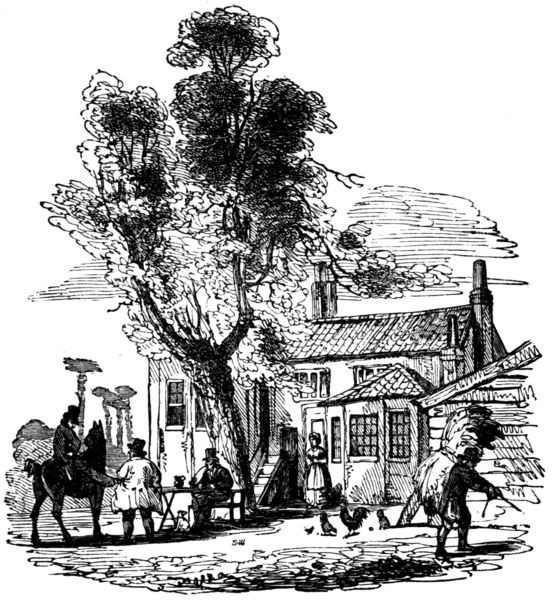
The Crooked Billet, on Penge Common.
Friday, May, — 1827.
I had appointed this morning with my friend W. for a visit to the gallery of paintings at Dulwich College; and he was to obtain from a printseller an admission ticket, and bring it with him. He came furnished with the ticket, but as the ticket provided that the public were not to be admitted on a Friday, our seeing the pictures was out of the question. Neither of us, however, was in a humour to be disappointed of a holiday; we therefore set out in the direction we had intended. A coachman hailed us from the box of a Dulwich stage; we gave him an assenting nod, and mounted the roof: and after a brisk drive through Walworth and Camberwell, which are now no other way distinguishable from the metropolis, than by the irregular forms and sizes of the houses, and the bits of sickly grass and bottle-green poplars that further diversify them, we attained to the sight of the first out-of-town looking trees and verdure on the ascent towards Herne-hill. Here we began to feel “another air;” and during the calm drive down the hill into Dulwich—the prettiest of all the village entrances in the environs of London—we had glimpses, between the elms and sycamores, of pleasant lawns And blooming gardens, with bursts of the fine distances. The calm of the scene was heightened by the note of the cuckoo: it was no “note of fear” to us—we remembered our good wives surrounded by their families; they had greeted our departure with smiles, and hopes that the day would be pleasant, and that we should enjoy ourselves;—the mother and the children rejoiced in “father’s holiday” as a day of happiness to them, because it would make him happier.
Leaving Dulwich College on our right, with an useless regret, that, by our mistake as to the day, the picture-gallery was closed to us, we indulged in a passing remark on the discrepancies of the building—the hall and west wing of the Elizabethan age; the east wing in the Vanbrugh style; and the gallery differing from each. Alighting, just beyond, at the end of the old road, and crossing to the new one in the same line, we diligently perused an awful notice from the parochial authorities against offenders, and acquainted ourselves with the rewards for apprehending them. The board seemed to be a standing argument in behalf of reading and writing, in opposition to some of the respectable inhabitants of Dulwich, who consider ignorance the exclusive property of labourers and servants, which they cannot be deprived of without injury to their morals.
Ascending the hill, and leaving on the left hand a large house, newly built by a rich timber-merchant, with young plantations that require years of growth before they can attain sufficient strength to defend the mansion from the winds, we reached the summit of the hill, and found a direction-post that pointed us to a choice of several roads. We strolled into one leading to Penge Common through enclosed woodlands. Our ears were charmed by throngs of sweet singing birds; we were in a cathedral of the feathered tribes, where “every denomination” chanted rapturous praises and thanksgivings; the verger-robins twittered as they accompanied us with their full sparkling eyes and bright liveried breasts.—
Chiefs of the choir, and highest in the heavens, As emulous to join the angels’ songs, Were soaring larks; and some had dared so far They seem’d like atoms sailing in the light; Their voices and themselves were scarce discern’d Above their comrades, who, in lower air Hung buoyant, brooding melody, that fell Streaming, and gushing, on our thirsty ears. In this celestial chancel we remain’d To reverence these creatures’ loud Te Deum— A holy office of their simple natures To Him—the great Creator and Preserver— Whom they instinctively adored.
A gate in the road was opened to us by a poor woman, who had seen our approach from her road-side dwelling; she had the care of collecting the toll from horsemen and carriage-drivers—we were foot-passengers, and credited our tailors for the civility. At a few yards beyond this turnpike we stopped to read a dictatorial intimation:—“All trespassers on these woods will be prosecuted, and the constables have orders to take them into custody.” I am not sure that there is a “physiognomy of hand-writing,” but I am a believer in the physiognomy of style, and the features of this bespoke a Buonaparte of the hundred who had partaken of the carvings under an enclosure-act. No part was fenced off from the common road, and the land had been open to all till spoliation deprived the commoners of their ancient right, and annexed the common soil to a neighbouring domain. Whose it now is, by law, I know not, nor inquired. I look around, and cottages have disappeared, and there are villas instead; and the workhouses are enlarged, and, instead of labour, tread-mills are provided. According to a political economist of ancient times, “There is much food in the tillage of the poor;” and “He that maketh haste to be rich shall not be innocent.” To whom of old was it said, “The spoil of the poor is in your houses?”
We lingered on our way, and passed a bridge over the canal, towards a well-looking public-house, called “the Old Crooked Billet.” Before the door is, what is called, a “sign,” which, according to modern usage, is a sign-post, with a sign-board without a sign, inscribed with the name of what the sign had been. Formerly this was a little ale-house, and to denote its use to the traveller, the landlord availed himself of one of the large old trees then before the door, and hung upon the lowest of its fine spreading branches not the “sign” of the billet, but a real “crooked billet:” this was the origin of “the Old Crooked Billet” on (what was) Penge Common. We had set out late and loitered, and after a brief reconnoitre entered the house in search of refreshment. The landlord and his family were at dinner in a commodious, respectable bar. He rose to us like “a giant refreshed,” and stood before us a good-humoured “Boniface”—every inch a man—who had attained to strength and fair proportion, by virtue of the ease and content wherein he lived. We found from his notable dame that we could have eggs and bacon, and spinach put into the pot from the garden, in a few minutes; nothing could have been suggested more suitable to our inclination, and we had the pleasure of being smiled into a comfortable parlour, with a bow-window view of the common. The time necessary for the preparation of our meal afforded leisure to observe the hostel. W. went out to pencil the exterior in his sketch-book. Except for the situation, and the broad, good-humoured, country face of our landlord, we might have imagined ourselves in town; and this was the only uncomfortable feeling we had. The sign-board on the other side of the road revealed the name of our entertainer—“R. Harding,” and the parlour mantlepiece told that he was a “Dealer in Foreign Wines, Segars, &c.” This inscription, written in clerk-like German text, framed and glazed, was transportation against my will, to the place from whence I came. Our attention was diverted by the rolling up of a gig, espied afar off by “mine host,” who waited at the door with an eye to business, and his hands in the pockets of his jean jacket. The driver, a thin, sharp-featured, pock-faced man, about forty, alighted with as much appearance of kindly disposition as he could bring his features to assume, and begged the favour of an order for “a capital article.” His presented card was received with a drop of the landlord’s countenance, and a shake of the head. The solicitor—and he looked as keenly as a Chancery-lane one—was a London Capillaire-maker; he urged “a single bottle;” the landlord pleaded his usage of sugar and demurred, nor could he be urged on to trial. Our repast brought in, and finished with a glass of country brewed and a segar, W. completed his sketch, and we paid a moderate charge, and departed with “the Old Crooked Billet” as exhibited in the engraving. The house affords as “good accommodation for man and horse” as can be found in any retired spot so near London. Our stroll to it was delightful. We withdrew along the pleasant road to the village of Beckenham. Its white pointed spire, embowered in trees, had frequently caught our sight in the course of the day, and we desired to obtain a near view of a church that heightened the cheerful character of the landscape. It will form another article—perhaps two.
*
Witchcraft.
THE MOUNTAIN ASH.
To the Editor.
Witherslack, near Milnthorpe, Westmoreland.
Sir,—I think you have not celebrated in the Every-Day Book the virtues of the mountain ash, or as it is called in the northern counties, the Wiggen Tree.—Its anti-witching properties are there held in very high esteem. No witch will come near it; and it is believed that the smallest twig, which might cross the path of one of these communers with the powers of darkness, would as effectually stop her career, however wild it might be, or however intent she might be on the business of evil, as did the “key-stane” of the bridge of Doon stop the fiendish crew, that pursued poor Tam O’Shanter and his luckless mare Maggie.
You are well aware that there are few places, especially in the country, in which one of these agents of the devil, ycleped “witches,” does not reside. She may always be known by her extreme penury and ugliness. There is generally also a protuberance of flesh on some part of the neck or jaw, by which it is known that she has sold herself to the father of lies. She has usually a large black cat, of which she is prodigiously fond, and takes special care. Some shrewdly suspect this to be the “old gentleman” himself. She is very envious, and frequently makes malicious prognostications of evil, which subsequent events but too faithfully verify. She must therefore, with all these qualifications, be the authoress of every mishap, which cannot more reasonably be accounted for. For example, should the “auld witch” call at any farmhouse during the operation of churning, and be suffered to depart without a sop being thrown to her, in the shape of a small print of butter, you will be sure to have many a weary hour of labour the next time you churn, before butter can be obtained. And, therefore, to prevent the old beldam introducing herself into the churn, the churn-staff must be made of the “Wiggen Tree,” and you will be effectually freed from her further interference in that case. The cattle in the stables and cow-houses, if she takes a spite against you, are frequently found, or dreaded to be found, (for many an instance of such things is recorded on undoubted testimony,) in a morning, tied together, standing on their heads, the cows milked, and every other mischievous prank played, which a malicious fiend could invent: and therefore to prevent all these dire ills, the shafts of the forks, and all other utensils used in those places, must be made of the all-powerful “Wiggen.” She frequently does the same mischief in places far remote on the same night; and although old and crippled, and showing “all the variety of wretchedness” by day, at night she mounts her broomstick, and wings her airy course to the moon, if need be. All honest people, who have a due regard to undisturbed slumbers during the night, when all the world knows that
Church-yards yawn, And hell itself breathes forth contagion to the world,
take special care to have a branch of this never-failing antidote to witchery at their bed heads. This has been the practice of my mother ever since I can remember; she also carries a hare’s foot in her pocket, to guard against all attacks in that quarter by day. You will think that these precautions are very uncalled for, perhaps, at this time of day, but such we have been in our generations, and such to a considerable extent we now are, and therefore pray do record us.
I remain, Sir, &c. CARLE.
A PARTICULAR DIRECTION.
A few months ago a letter, bearing the following curious superscription, was put into the post-office in Manchester:—“For Mr. Colwell that Keeps the Shop in Back Anderson-st. to Bee Gave to Jack Timlen that Keeps the pigs in his own Sellar in Back Anderson-st. the irish man that has the Large family that bgs the mail from Mr. Colwell and milk to Bolton.”[195]
Garrick Plays. No. XIX.
[From the “Silver Age,” an Historical Play, by Thomas Heywood, 1613.]
Proserpine seeking Flowers.
Pros. O may these meadows ever barren be, That yield of flowers no more variety! Here neither is the White nor Sanguine Rose, The Strawberry Flower, the Paunce, nor Violet; Methinks I have too poor a meadow chose: Going to beg, I am with a Beggar met, That wants as much as I. I should do ill To take from them that need.—
Ceres, after the Rape of her Daughter.
Cer. Where is my fair and lovely Proserpine? Speak, Jove’s fair Daughter, whither art thou stray’d I’ve sought the meadows, glebes, and new-reap’d fields Yet cannot find my Child. Her scatter’d flowers, And garland half-made-up, I have lit upon; But her I cannot spy. Behold the trace Of some strange wagon,[196] that hath scorcht the trees, And singed the grass: these ruts the sun ne’er sear’d. Where art thou, Love, where art thou, Proserpine?—
She questions Triton for her Daughter.
Cer.——thou that on thy shelly trumpet Summons the sea-god, answer from the depth. Trit. On Neptune’s sea-horse with my concave trump Thro’ all the abyss I’ve shrill’d thy daughter’s loss. The channels clothed in waters, the low cities In which the water-gods and sea-nymphs dwell, I have perused; sought thro’ whole woods and forests Of leafless coral, planted in the deeps; Toss’d up the beds of pearl; rouzed up huge whales, And stern sea-monsters, from their rocky dens; Those bottoms, bottomless; shallows and shelves, And all those currents where th’ earth’s springs break in; Those plains where Neptune feeds his porpoises, Sea-morses, seals, and all his cattle else: Thro’ all our ebbs and tides my trump hath blazed her, Yet can no cavern shew me Proserpine.
She questions the Earth.
Cer. Fair sister Earth, for all these beauteous fields, Spread o’er thy breast; for all these fertile crops, With which my plenty hath enrich’d thy bosom; For all those rich and pleasant wreaths of grain, With which so oft thy temples I have crowned; For all the yearly liveries, and fresh robes, Upon thy summer beauty I bestow— Shew me my Child! Earth. Not in revenge, fair Ceres, That your remorseless ploughs have rak’t my breast, Nor that your iron-tooth’d harrows print my face So full of wrinkles; that you dig my sides For marle and soil, and make me bleed my springs Thro’ all my open’d veins to weaken me— Do I conceal your Daughter. I have spread My arms from sea to sea, look’d o’er my mountains, Examin’d all my pastures, groves, and plains, Marshes and wolds, my woods and champain fields, My dens and caves—and yet, from foot to head, I have no place on which the Moon[197] doth tread. Cer. Then, Earth, thou’st lost her; and, for Proserpine, I’ll strike thee with a lasting barrenness. No more shall plenty crown thy fertile brows; I’ll break thy ploughs, thy oxen murrain-strike: With idle agues I’ll consume thy swains; Sow tares and cockles in thy lands of wheat, Whose spikes the weed and cooch-grass shall outgrow, And choke it in the blade. The rotten showers Shall drown thy seed, which the hot sun shall parch, Or mildews rot; and what remains, shall be A prey to ravenous birds.—Oh Proserpine!— You Gods that dwell above, and you below, Both of the woods and gardens, rivers, brooks, Fountains and wells, some one among you all Shew me her self or grave: to you I call.
Arethusa riseth.
Are. That can the river Arethusa do. My streams you know, fair Goddess, issue forth From Tartary by the Tenarian isles: My head’s in Hell where Stygian Pluto reigns. There did I see the lovely Proserpine, Whom Pluto hath rapt hence; behold her girdle, Which on her way dropt from her lovely waist, And scatter’d in my streams.—Fair Queen, adieu! Crown you my banks with flowers, as I tell true.
[From the “Golden Age,” an Historical Play, by the same Author, 1611.]
Sibilla, the Wife of Saturn, is by him enjoined to slay the new-born Jupiter. None can do it for his smiles.
Sibilla. Vesta. Nurse.
Sib. Mother, of all that ever mothers were Most wretched! Kiss thy sweet babe ere he die, That hath life only lent to suffer death. Sweet Lad, I would thy father saw thee smile. Thy beauty, and thy pretty infancy, Would mollify his heart, were’t hew’d from flint, Or carved with iron tools from Corsic rock. Thou laugh’st to think thou must be kill’d in jest. Oh! if thou needs must die, I’ll be thy murtheress, And kill thee with my kisses, pretty knave.— And can’st thou laugh to see thy mother weep? Or art thou in thy chearful smiles so free, In scorn of thy rude father’s tyranny? I’ll kiss thee ere I kill thee: for my life The Lad so smiles, I cannot hold the knife. Vest. Then give him me; I am his Grandmother, And I will kill him gently: this sad office Belongs to me, as to the next of kin. Sib. For heaven’s sake, when you kill him, hurt him not. Vest. Come, little knave, prepare your naked throat I have not heart to give thee many wounds, My kindness is to take thy life at once. Now— Alack, my pretty Grandchild, smilest thou still? I have lust to kiss, but have no heart to kill. Nurse. You may be careless of the King’s command But it concerns me; and I love my life More than I do a Stripling’s. Give him me, I’ll make him sure; a sharp weapon lend, I’ll quickly bring the Youngster to his end.— Alack, my pretty knave, ’twere more than sin With a sharp knife to touch thy tender skin. O Madam, he’s so full of angel grace, I cannot strike, he smiles so in my face. Sib. I’ll wink, and strike; come, once more reach him hither; For die he must, so Saturn hath decreed: ’Las, for a world I would not see him bleed. Vest. Ne shall he do. But swear me secrecy; The Babe shall live, and we be dangerless.
C. L.
THE FIRST BUTTERFLY.
One of the superstitions prevailing in Devonshire is, that any individual neglecting to kill the first butterfly he may see for the season will have ill-luck throughout the year. The following recent example is given by a young lady:—“The other Sunday, as we were walking to church, we met a man running at full speed, with his hat in one hand, and a stick in the other. As he passed us, he exclaimed, ‘I sha’n’t hat’en now, I b’lieve.’ He did not give us time to inquire what he was so eagerly pursuing; but we presently overtook an old man, whom we knew to be his father, and who being very infirm, at upwards of seventy, generally hobbled about by the aid of two sticks. Addressing me, he observed, ‘My zin a took away wan a’ my sticks, miss, wan’t be ebble to kill’n now, though, I b’lieve.’ ‘Kill what?’ said I. ‘Why, ’tis a butterfly, miss, the furst hee’th a zeed for the year; and they zay that a body will have cruel bad luck if a ditn’en kill a furst a zeeth.’”[198]
KING JAMES I. AT DURHAM.
To the Editor.
Sir,—If you think the subjoined worthy of a place in your Table Book, I shall feel glad to see it. I believe it has never been in print; it is copied from an entry in one of the old corporation books.
Yours, very truly, M. J.
Durham, May, 1827.
The Manner of the Kinges Majesty coming to the Cittie of Durham, Anno Dom. 1617, as followeth.
Upon Good Friday, being the 18th of April, 1617, Mr. Heaborne, one of his majesties gentlemen ushers spoke to George Walton, Maior, that it was his majesties pleasure to come in state unto the cittie, and that it were fitting that the maior and aldermen should be ready upon the next daie following, being Satturdaie, to give their attendance upon his majestie in some convenient place within the cittie; and the said maior to have his foot-cloth horse their ready to attend, which likewise was done upon Elvet Bridge, near the tower thereof, being new rayled, within the rayles of wood then made for that purpose: at which time his said majesties said gentleman usher standing by the said maior and aldermen till his majesties coming, when there was a speech delivered by the said maior to his majestie, together with the maces and staffe; and at time fitting in the same speech so made, a silver bowle gilt, with a cover, was presented by the said maior to his majestie, which appeares as followeth:—
“Most gracious soveraigne. What unspeakable joy is this your highness presents unto us, your loving subjects; our tongues are not able to utter, nor our meanes to shew you welcome. Your gracious majestie, at your happie cominge hither with much peace and plentie found this cittie inabled, with divers liberties and priveledges, all sovering pittie and power spiritual and temporal being in yourself, gave unto us the same againe; and afterwards, of your gracious bountie, confirmed them under your great seal of England. We humbly beseech your majestie continue your favours towards this cittie; and in token of our love and loyaltie, crave the acceptance of this myte, and we shall be readie to the uttermost expence of our dearest bloud, to defend you and your royal progeny here on earth, as with our prayers to God to blesse you and all yours in all eternitie.”
After which speech the maior was called by his majesties gentleman usher to take his horse, and to ride before his majestie; immediate upon which commandment made by his majesties gentleman usher, there was at the same place, about forty yards distance, certayne verses spoken by an apprentice of this cittie to his majestie, as followeth: after which, the maior was placed in rank next the sword, and so rode forward, carring the citties mace, to the church.
To the Kinges most Excellent Majestie.
“Durham’s old cittie thus salutss our king With entertainment, she doth homlie bring: And cannot smyle upon his majestie With shew of greatness; but humilitie Makes her express herself in modern guise Dejected to this north, bare to your eyes. For the great prelate, which of late adorde His dignities, and for which we implore Your highnesse aide to have a continuance— And so confirmed by your dread —— arm. Yet what our royal James did grant herein, William, our bishoppe, hath oppugnant been; Small task to sway down smallnesse, where man’s might Hath greater force than equity or right. But these are only in your brest included From your most gracious grant. Therefore we pray, That the faire sunshine of your brightest daie, Would smyle upon this cittie with clere beams, To exhale the tempest off insuing streames. Suffer not, great prince, our ancient state, By one fore’d will to be depopulate, Tis one seeks our undoeing: but to you, Ten thousand hearts shall pray, and knees shall bowe And this dull cell of earth wherein we live, Unto your name immortal prayse shall give. Confirm our grant, good kinge. Durham’s old cittie Would be more powerful so it has Jame’s pittie.”
Remark.
The complaint against the bishop arose from a suit which he had instituted against the corporation in the Exchequer, for taking all the bishop’s privileges and profits of the markets and courts into their own hands, and for driving his officers by violence out of the tollbooth on the 3d of October, (7th of James I.,) and preventing their holding the courts there as usual, as well as for several other similar matters, when judgment was given against the corporation on the 24th of June, (8th of James I.,) 1611.
MARCH OF INTELLECT.
Every intelligent mind of right reflection accords its wishes for general enlightenment. It appears, from a fashionable miscellany, that a late distinguished writer expressed himself to that effect; the following are extracts from the article referred to. They contain, in the sequel, a forcible opinion on the tendency of the present general diffusion of literature.—
Conversations of Maturin.
Maturin’s opinions of poetry, as of every thing else, were to be inferred rather than gathered. It was very difficult to draw him into literary conversation: like Congreve, he wished to be an author only in his study. Yet he courted the society of men of letters when it was to be had; but would at any time have sacrificed it to dally an hour in the drawing-room, or at the quadrille. Sometimes, however, amongst friends (particularly if he was in a splenetic mood) he freely entered into a discussion upon the living authors of England, and delivered his opinions rapidly, brilliantly, and with effect. On one occasion a conversation of this description took place, in which I had the pleasure of participating. I will recall the substance of it as well as I can. Do not expect from Maturin the turgidity of Boswell’s great man, or the amiable philosophy of Franklin: you will be disappointed if you anticipate any thing profound or speculative from him; for at the best of times he was exceedingly fond of mixing up the frivolity of a fashionable conversazione with the most solid subjects.
I met him in the county of Wicklow on a pedestrian excursion in the autumn; a relaxation he constantly indulged in, particularly at that season of the year. It was in that part of the vale of Avoca, where Moore is said to have composed his celebrated song: a green knoll forms a gradual declivity to the river, which flows through the vale, and in the centre of the knoll there is the trunk of an old oak, cut down to a seat. Upon that venerable trunk, say the peasants, Moore sat when he composed a song that, like the Rans de Vache of the Swiss, will be sung amidst those mountains and valleys as long as they are inhabited. Opposite to that spot I met Maturin, accompanied by a young gentleman carrying a fishing-rod. We were at the distance of thirty miles from Dublin; in the heart of the most beautiful valley in the island; surrounded by associations of history and poetry, with spirits subdued into tranquillity by the Italian skies above, and the peaceful gurgling of the waters below us. Never shall I forget Maturin’s strange appearance amongst those romantic dells. He was dressed in a crazy and affectedly shabby suit of black, that had waxed into a “brilliant polish” by over zeal in the service of its master; he wore no cravat, for the heat obliged him to throw it off, and his delicate neck rising gracefully from his thrice-crested collar, gave him an appearance of great singularity. His raven hair, which he generally wore long, fell down luxuriantly without a breath to agitate it; and his head was crowned with a hat which I could sketch with a pencil, but not with a pen. His gait and manner were in perfect keeping; but his peculiarities excited no surprise in me, for I was accustomed to them. In a short time we were seated on the banks of the Avoca, the stream cooling our feet with its refreshing spray, and the green foliage protecting us from the sun.
“Moore is said to have written his song in this place.”
“I don’t believe a word of it,” replied Maturin. “No man ever wrote poetry under a burning sun, or in the moonlight. I have often attempted a retired walk in the country at moonlight, when I had a madrigal in my head, and every gust of wind rang in my ears like the footsteps of a robber. One robber would put to flight a hundred tropes. You feel uneasy in a perfectly secluded place, and cannot collect your mind.”
“But Moore, who is a poet by inspiration, could write in any circumstances?”
“There is no man of the age labours harder than Moore. He is often a month working out the fag-end of an epigram. ’Pon my honour, I would not be such a victim to literature for the reputation of Pope, the greatest man of them all.”
“Don’t you think that every man has his own peculiarity in writing, and can only write under particular excitements, and in a particular way?”
“Certainly. Pope, who ridiculed such a caprice, practised it himself; for he never wrote well but at midnight. Gibbon dictated to his amanuensis, while he walked up and down the room in a terrible passion; Stephens wrote on horseback in a full gallop; Montaigne and Chateaubriand in the fields; Sheridan over a bottle of wine; Molière with his knees in the fire; and lord Bacon in a small room, which he said helped him to condense his thoughts. But Moore, whose peculiarity is retirement, would never come here to write a song he could write better elsewhere, merely because it related to the place.”
“Why omit yourself in the list? you have your own peculiarity.”
“I compose on a long walk; but then the day must neither be too hot, nor cold; it must be reduced to that medium from which you feel no inconvenience one way or the other; and then when I am perfectly free from the city, and experience no annoyance from the weather, my mind becomes lighted by sunshine, and I arrange my plan perfectly to my own satisfaction.”
“From the quantity of works our living poets have given to the public, I would be disposed to say that they write with great facility, and without any nervous whim.”
******
“But lord Byron—he must write with great ease and rapidity?”
“That I don’t know; I never could finish the perusal of any of his long poems. There is something in them excessively at variance with my notions of poetry. He is too fond of the obsolete; but that I do not quarrel with so much as his system of converting it into a kind of modern antique, by superadding tinsel to gold. It is a sort of mixed mode, neither old nor new, but incessantly hovering between both.”
“What do you think of Childe Harold?”
“I do not know what to think of it, nor can I give you definitively my reasons for disliking his poems generally.”
“You have taken up a prejudice, perhaps, from a passage you have forgotten, and never allowed yourself patience to examine it.”
“Perhaps so; but I am not conscious of a prejudice.”
“No man is.”
*****
“And which of the living poets fulfils your ideal standard of excellence?”
“Crabbe. He is all nature without pomp or parade, and exhibits at times deep pathos and feeling. His characters are certainly homely, and his scenes rather unpoetical; but then he invests his subject with so much genuine tenderness and sweetness, that you care not who are the actors, or in what situations they are placed, but pause to recollect where it was you met something similar in real life. Do you remember the little story ‘Delay is Danger?’ I’ll recite you a few lines describing my favourite scene, an autumn-evening landscape:—
“On the right side the youth a wood survey’d, With all its dark intensity of shade; Where the rough wind alone was heard to move, In this, the pause of nature and of love, When now the young are rear’d, and when the old, Lost to the tie, grow negligent and cold— Far to the left he saw the huts of men Half hid in mist that hung upon the fen; Before him swallows, gathering for the sea, Took their short flights, and twitter’d on the lea And near the bean-sheaf stood, the harvest done, And slowly blacken’d in the sickly sun; All these were sad in nature, or they took Sadness from him, the likeness of his look, And of his mind—he ponder’d for a while, Then met his Fanny with a borrow’d smile.”
“Except Gray’s Elegy, there is scarcely so melancholy and touching a picture in English poetry.”
“And whom do you estimate after Crabbe?”
“I am disposed to say Hogg. His Queen’s Wake is a splendid and impassioned work. I like it for its varieties, and its utter simplicity. What a fine image is this of a devoted vessel suddenly engulfed at sea:
“Some ran to the cords, some kneel’d at the shrine. But all the wild elements seem’d to combine; ’Twas just but one moment of stir and commotion, And down went the ship like a bird of the ocean!”
“But do not altogether take me at my word in what I say of Crabbe and Hogg. They have struck the chord of my taste; but they are not, perhaps, the first men of the day. Moore is a writer for whom I feel a strong affection, because he has done that which I would have done if I could: but after him it would be vain to try any thing.”
*****
“Is it your opinion that the swarm of minor poets and writers advance the cause of literature, or that the public taste would be more refined and informed, if those who administered to it were fewer and better?”
“I object to prescribing laws to the republic of letters. It is a free republic, in which every man is entitled to publicity if he chooses it. The effect unquestionably of a swarm of minor poets is the creation of a false taste amongst a certain class; but then that is a class that otherwise would have no taste at all, and it is well to draw their attention to literature by any agency. In the next age their moral culture will improve, and we shall go on gradually diminishing the contagion.”[199]
Old London Cries, No. II.
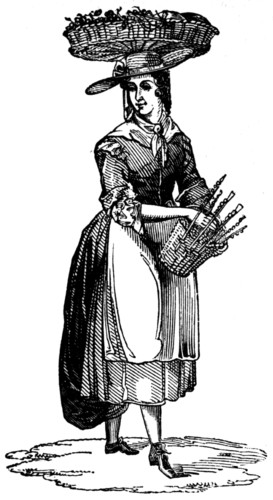
“Sixpence a pound, fair cherries!”
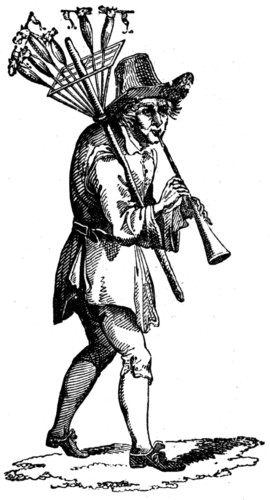
“Troop, every one!”
Old London Cries, No. II.
We have here a print of the cherry-woman of a hundred years ago, when cherries were so little grown, that the popular street cry was double the price of the present day. Readers of the Every-Day Book may remember the engraving of the “London barrow-woman,” with her cherry-cry—“round and sound”—the cherry-woman (that was) of our own times—the recollection of whose fine person, and melodious voice, must recur to every one who saw and heard her—a real picture to the mind’s eye, discoursing “most excellent music.”
The man blowing a trumpet, “Troop, every one!” was a street seller of hobby-horses—toys for the children of a hundred years ago. He carried them, as represented in the engraving, arranged in a partitioned frame on his shoulder, and to each horse’s head was a small flag with two bills attached. The crier and his ware are wholly extinct. Now-a-days we give a boy the first stick at hand to thrust between his legs as a Bucephalus—the shadow of a shade:—our forefathers were better natured, for they presented him with something of the semblance of the generous animal. Is a horse now less popular with boys than then? or did they, at that time, rather imitate the galloping of the real hobby-horse in the pageants and mummeries that passed along the streets, or pranced in the shows at fairs and on the stage? Be that as it may, this is a pretty plaything for “little master;” and toymakers would find account in reviving the manufacture for the rising generation. They have improved the little girl’s doll, and baby-house: are they ignorant that boys, as soon as they can walk, demand a whip and a horse?
MR. HOBDAY’S GALLERY. No. 54, Pall-mall.
In addition to the associations for the exhibition and sale of pictures by living artists, Mr. Hobday opened an establishment on the 21st of May for the same purpose, adjoining the British Institution, This gentleman is known to the public as a respectable portrait painter, with a taste for art entitled to consideration for his present spirited endeavour in its behalf.
In this exhibition there are performances of distinguished merit by several eminent artists. The Upas, or poison-tree of Java, by Mr. Danby, in illustration of the legend in Darwin’s Loves of the Plants, is a fine picture, already known. Another by Mr. Danby—is a wood on the sea-shore, with figures, Ulysses and Nausicaa, from Homer. A Fête Champêtre, by Mr. Stothard, is one of a class of subjects, which its venerable painter has distinguished by his magic pencil; Mr. Edwin Landseer’s Lion disturbed at his repast, a forcible and well-remembered effort of his genius, stands near it. Mr. Charles Landseer’s Merchant, with Slaves and Merchandise, reposing in a Brazilian Rancho; the Entombing of Christ, by Mr. Westall; landscapes, by Messrs. Daniel, Glover, Hoffland, Laporte, Linnell, W. Westall, &c.; pictures by sir W. Beechey, Messrs. Chalon, Kidd, Heaphy, Rigaud, Singleton, Stephanoff, J. Ward, &c., grace the walls of the establishment. Every picture in this gallery is for sale; and, under Mr. Hobday’s management, it promises to be a means of introducing the public to an acquaintance with distinguished works of art still remaining open to the selection of its patrons.
Topography.
ORIGINAL NOTICE.
For the Table Book.
Denton-castle, in the West Riding of Yorkshire, and on the north-west side of Otley, was once the seat of the parliament’s general, Fairfax, and came to the present family of Ibbetson by relationship. Prince Rupert in passing by it on his march into Lancashire, in order to assist the king’s troops in that quarter, was about to raze it, but going into the house, he observed the pictures of the Manners and the Villiers, Fairfax’s ancestors, and out of good will towards them he desisted. It, however, was afterwards unfortunately destroyed by the carelessness of a maid servant, who dropping asleep at the time she was picking feathers, the candle fell into the feathers and burnt the house to the ground. In a few years afterwards, it was rebuilt by the father of sir Henry Ibbetson, bart. in the year 1721, and has this remarkable motto in the pediment:—
“Quod nec Jovis ira nec ignis nec poterit ferrum.”
Verses
To the memory of Denzil Ibbetson, fourth son of sir Henry Ibbetson, bart., who unfortunately lost his life by an accidental discharge of his gun when shooting at Cocken, near Durham, the seat of his aunt, lady Mary Carr, sister of Henry earl of Darlington—1774.
1.
Thy fate, lamented Ibbetson, we were. With an unfeign’d and sympathetic tear; Thy virtues, on our mem’ries graven deep, Recall the painful thought of what was dear.
2.
Yet ’tis not for thy sufferings, but our own, That heaves the heartfelt melancholy sigh, That death, which haply cost thee not a groan, Leaves us to mourn with what we ne’er can vie.
3.
That life, good humour, and that manly sense, Those ever-pleasing ties, that friendly heart, Which but unwittingly could give offence, Disarm’d ev’n Death’s grim tyrant of his dart.
4.
Without one pang or agonizing groan, Thy soul reliev’d forsook its vile abode, For joys more worthy of the good alone— “The bosom of thy Father and thy God.”
PRONUNCIATION.
The difficulty of applying rules to the pronunciation of our language may be illustrated in two lines, where the combination of the letters ough, is pronounced in no less than seven different ways, viz. as o, uf, of, up, ow, oo, and ock.
Though the tough cough and hiccough plough me through; O’er life’s dark lough my course I still pursue.
For the Table Book.
EMIGRATION OF THE ROOKS FROM CARLTON GARDENS, 1827.
“I shall not ask Jean Jacques Rousseau, If birds confabulate or no:— ’Tis certain they were always able, To hold discourse, at least in fable.”
Cowper.
The mandate pass’d, the axe applied, The woodman’s efforts echoed wide; The toppling elm trees fell around, And cumbrous ruin strew’d the ground. The tuneful thrush, whose vernal song Was earliest heard the boughs among, Exil’d from grounds, where he was bred, To some far habitation fled; Remote from court and courtly strife, To pass a sober, quiet life. O’er head the Rooks, in circles flew, And closer still, and closer drew; Then perch’d amid the desolation, In senatorial consultation: The chairman, far advanc’d in age, A sapient-looking personage, Who long the councils of the land Had sway’d with a tenacious hand; —For e’en among the feather’d race, There are, who cling to pow’r and place:— There wanted not, among the throng, Those who averr’d, that much too long He had, within the sable state, Continued to adjudicate;— So tardily his judgments came, They injur’d his judicial fame; What, though they were unting’d by bribe, Or fear;—the sad impatient tribe, Who fed on Hope’s expectancies, Were ruin’d—by his just decrees! But to our tale:—the speaker now, Perch’d on an elm tree’s topmost bough, Had hush’d the multitude in awe, You might not hear a single “caw;” He then in pride of conscious pow’r, Commenc’d the bus’ness of the hour. “Ye rooks and daws in senate met;” He said, and smooth’d his breast of jet: “What crimes, among our sable band, Have brought this ruin on our land? Has murder mark’d our noonday flight? Or depredation in the night? Has rook or daw, in thought or word, Rebell’d against our Sovereign Lord? No! rather say, our loyalty Has echo’d oft, from tree to tree! Have we not, when the cannon’s sound Gave joyous intimation round, Of triumph won by land or sea, Join’d in the general jubilee? Why, then, ye advocates of taste, Lay ye our habitations waste? Why level low our rookery, And blot it out from memory? Man lacketh not a host of pleas, To vindicate his cruelties. ‘Improvement’s come!’ ’tis thus they rhyme ‘Upon the rolling car of Time.’[200]— Yes! come, if blessings they dispense, With due regard to feeling—sense; But when they emanate from pride, And scheme on scheme is multiplied, To beautify by acts like this, Their overgrown metropolis, To please the vitiate taste of men, They cease to be improvements then. ’Tis not enough, to please the eye, With terrace walks, and turrets high; With sloping lawns, and dark arcades; With cock-boat lakes, and forest glades, With schoolboy cataracts and jets; With Turkish mosques and minarets! Or Lilliputian arches, rich, Spanning a vegetating ditch! Improvement opes a nobler field, Than Grecian plinth and column yield! ’Tis when the streams of treasure flow, To lighten sorrow,—soften woe;— Rebuild the structure, ruin raz’d, Relume the eye, that want hath glaz’d: And flowing far from revelry, They cheer the sons of penury, Who sicken in the breeze of health! And starve, amid a nation’s wealth! To chase despair—and bring relief, For human crime, and human grief! These are thy triumphs, Virtue! these Are sparks of heav’n-born sympathies, That through man’s denser nature shine, And prove his origin divine! Oh! may we hope, in Britain’s school, There are, who, free from sophist rule, Have learnt not, ’neath Italian skies, Their native genius to despise; In whom, amid the bosom’s throes, The innate love of country glows! Assembled birds! it is for you To point the course we must pursue: Our monarch ne’er could contemplate Amid the recent change in state, That we, like other rooks, should be Exil’d from seats of royalty! Then let us humbly seek the throne, And make our common grievance known His Majesty will ne’er consent, That this, our sable parliament, Should thus be driv’n abroad to roam, And banish’d from our native home.” He ceas’d;—a shout of wild applause, Tumultuous burst, from rooks and daws! Ne’er yet, had yonder central sun, Since worlds had in their orbits run, Beheld upon a spot of earth So much of simultaneous mirth. Scarce had the turbulence subsided. When, as if Fate their joy derided, The hatchet reach’d with thund’ring stroke The tree from whence the Chairman spoke. Alas! the triumph was but brief; The sound struck awe—like midnight thief— The senate fled from falling trees, And stretch’d their pinions to the breeze: The shrubs behind Spring Garden-place Receiv’d the emigrated race. Now far from woodman’s axe, with care They build, and breed, and nestle there.
T. T.
MUSIC AND ANIMALS.
Bonaventure d’Argonne says, “Doubting the truth of those who say it is natural for us to love music, especially the sounds of instruments, and that beasts are touched with it, I one day, being in the country, endeavoured to determine the point; and, while a man was playing on the trump marine, made my observations on a cat, a dog, a horse, an ass, a hind, cows, small birds, and a cock and hens, who were in a yard, under a window on which I was leaning. I did not perceive that the cat was the least affected; and I even judged, by her air, that she would have given all the instruments in the world for a mouse, sleeping in the sun all the time; the horse stopped short from time to time before the window, lifting his head up now and then, as he was feeding on the grass; the dog continued for above an hour seated on his hind legs, looking steadfastly at the player; the ass did not discover the least indication of his being touched, eating his thistles peaceably; the hind lifted up her large wide ears, and seemed very attentive; the cows slept a little, and after gazing as though they had been acquainted with us, went forward: some birds who were in an aviary, and others on the trees and bushes, almost tore their throats with singing; but the cock, who minded only his hens, and the hens, who were solely employed in scraping on a neighbouring dunghill, did not show in any manner that they took the least pleasure in hearing the trump marine.”
IRISHMEN ON A HOLIDAY.
When they met at a “pattern,” (patron, perhaps,) or merry-making, the lively dance of the girls, and the galloping jig-note of the bagpipes, usually gave place to the clattering of alpeens, and the whoops of onslaught; when one of them sold his pig, or, under Providence, his cow, at the fair, the kicking up of a “scrimmage,” or at least the plunging head foremost into one, was as much matter of course as the long draughts of ale or whiskey that closed his mercantile transaction. At the village hurling-match, the “hurlet,” or crooked stick, with which they struck the ball, often changed its playful utility; nay, at a funeral, the body was scarce laid in the grave, when the voice of petty discord might be heard above the grave’s silence.
These contentions, like all great events, generally arose from very trivial causes. A drunken fellow, for instance, was in a strange public-house; he could not content himself with the new faces near him, so struck at some three, six, or ten, as it might be; and, in course, got soundly drubbed. On his return home he related his case of injury, exhibiting his closed eye, battered mouth, or remnant of nose; enlisting all his relatives, “kith-and-kin;” in fact, all his neighbours who liked “a bit of diversion,” and they generally included the whole male population able to bear arms. At the head of his faction he attended the next fair, or other place of popular resort, where he might expect to meet his foes; the noise of his muster went abroad, or he sent a previous challenge: the opposite party assembled in as much force as possible, never declining the encounter; one or other side was beaten, and tried to avenge its disgrace on the first opportunity; defeat again followed, and again produced like efforts and results; and thus the solemn feud ran through a number of years and several generations.
A wicked, “devil-may-care” fellow, feverish for sport, would, at fair, pattern, or funeral, sometimes smite another without any provocation, merely to create a riot; the standers-by would take different sides, as their taste or connections inclined them; and the fray, thus commencing between two individuals who owed each other no ill-will, embroiled half the assembled concourse. Nay, a youth, in despair that so fine a multitude was likely to separate peaceably, stripped off his heavy outside coat, and trailed it through the puddle, daring any of the lookers on to tread upon it; his defiance was rarely ineffectual; he knocked down, if possible, the invited offender; a general battle ensued, that soon spread like wild-fire, and every “alpeen” was at work in senseless clatter and unimaginable hostility.
The occurrence of the word “alpeen” seems to suggest a description of the weapon of which it is the name, and this can best be given in a piece of biographical anecdote.
Jack Mullally still lives in fame, though his valiant bones are dust. He was the landlord of a public-house in a mountain district; a chivalrous fellow, a righter of wrongs, the leader of a faction of desperate fighting men, and, like Arthur, with his doughty knights, a match for any four among them, though each a hero; and, above all, the armourer of his department. In Jack’s chimney-corner hung bundles of sticks, suspended there for the purpose of being dried and seasoned; and these were of two descriptions of warlike weapons; shortish oaken cudgels, to be used as quarter-staves, or, par excellence, genuine shillelaghs; and the alpeens themselves,—long wattles with heavy knobs at the ends, to be wielded with both hands, and competent, under good guidance, to the felling of a reasonable ox.
Jack and his subjects, Jack and his alpeens, were rarely absent from any fair within twenty miles, having always business on hands in the way of their association. When a skirmish took place, the side that could enlist in its interests Jack, his alpeens, and his merry men, was sure of victory. The patriarch was generally to be found seated by his kitchen fire; business was beneath him; he left all that to the “vanithee;” and his hours lapsed, when matters of moment did not warn him to the field, either in wetting his sticks with a damp cloth, and then heating them over the turf blaze, to give them the proper curve; or, in teaching a pet starling to speak Irish, and whistle “Shaun Buoy;” or, haply, in imbibing his own ale or whiskey, and smoking his short black pipe, or doohdeen, as himself termed it. And here he gave audience to the numerous suitors and ambassadors who, day by day, came to seek his aid, preparatory to a concerted engagement. His answer was never hastily rendered. He promised, at all events, to be with his corps at the appointed ground; and then and there he would proclaim of which side he was the ally. This precautionary course became the more advisable, as he was always sure of a request from both factions; and time, forethought, and inquiry, were necessary to ascertain which side might prove the weakest; for to the weakest (the most aggrieved formed no part of his calculations) Jack invariably extended his patronage.
The vanithee, good woman, when she heard of an approaching fair, or other popular meeting, immediately set about preparing plasters and ointments; and this resulted from a thrifty forecast; for were she to call in a doctor every time her husband’s head wanted piecing, it would run away with the profits of her business. Jack, indeed, never forgot his dignity so far as to inform his wife that he intended being engaged on such occasions; but she always took it for granted, and with the bustle of a good housewife, set about her preparations accordingly: till, at length, a breach happened in his skull which set her art at defiance; and ever since she lives the sole proprietor of the public-house where Jack once reigned in glory. The poor widow has thriven since her husband’s death; and is now rich, not having lately had Jack’s assistance in spending, (she never had it in earning.) She recounts his exploits with modest spirit; and one blessing at least has resulted from her former matronly care of the good man—she is the Lady Bountiful of her district; a quack it may be, yet sufficiently skilful for the uncomplicated ailments of her country customers.[201]
LONDON HOLIDAYS.
Holidays, like all other natural and lively things, are good things; and the abuse does not argue against the use. They serve to keep people in mind that there is a green and glad world, as well as a world of brick and mortar and money-getting. They remind them disinterestedly of one another, or that they have other things to interchange besides bills and commodities. If it were not for holidays and poetry, and such like stumbling blocks to square-toes, there would be no getting out of the way of care and common-places.—They keep the world fresh for improvement. The great abuse of holidays is when they are too few. There are offices, we understand, in the city, in which, with the exception of Sundays, people have but one holiday or so throughout the year, which appears to us a very melancholy hilarity. It is like a single living thing in a solitude, which only adds to the solitariness. A clerk issuing forth on his exclusive Good Friday must in vain attempt to be merry, unless he is a very merry person at other times. He must be oppressed with a sense of all the rest of the year. He cannot have time to smile before he has to be grave again. It is a difference, a dream, a wrench, a lay-sabbath, any thing but a holiday. There was a Greek philosopher, who, when he was asked on his death-bed what return could be made him for the good he had done his country, requested that all the little boys might have a holiday on the anniversary of his birth-day. Doubtless they had many besides, and yet he would give them another. When we were at school, we had a holiday on every saint’s day, and this was pretty nearly all that we, or, indeed, any one else, knew of some of those blessed names in the calendar. When we came to know that they had earned this pleasure for us by martyrdom and torment, we congratulated ourselves that we had not known it sooner; and yet, upon the principle of the Greek philosopher, perhaps a true lover of mannikin-kind would hardly object to have his old age burnt out at the stake, if he could secure to thousands hereafter the beatitude of a summer’s holiday.[202]
THE HUSBANDMEN OF HINDU.
They are generally termed Koonbees, and on the whole they are better informed than the lower classes of our own countrymen; they certainly far surpass them in propriety and orderliness of demeanour. They are mild and unobtrusive in their manners, and quickly shrink from any thing like an opposite behaviour in others. Litigation is not a marked part of their character. They are forgetful of injury; or if they harbour animosity, they are seldom hurried by it into acts of violence or cruelty. Custom has taught them not to have much respect for their women, or rather, indeed, to look on them with contempt; but they are always indulgent to them, and never put any restraint on their liberty. The great attachment they have to their children forms an amiable part of their character. They are usually frugal, inclining to parsimony, and not improvident; but at their marriage feasts they are lavish and profuse, and on these and other occasions often contract debts that are a burden to them for life. Their religion strongly enjoins charity, and they are disposed to be hospitable, but their extreme poverty is a bar to their being extensively so. No person, however, would ever be in want of a meal amongst them, and they are always kind and attentive to strangers when there is nothing offensive in their manners. They are just in their dealings amongst themselves, but would not be scrupulous in overreaching government or those without. Theft is scarcely known amongst them, and the voice of the community is loud against all breaches of decorum, and attaches weight and respectability to virtuous conduct in its members. The vices of this people, which they owe chiefly to their government, are dissimulation, cunning, and a disregard to truth. They are naturally timid, and will endeavour to redress their wrongs rather by stratagem than more generous means; when roused, however, they will be found not without courage, nor by any means contemptible enemies. Although not remarkable for sharpness, they are not wanting in intelligence. They are all minutely informed in every thing that relates to their own calling. They are fond of conversation, discuss the merits of different modes of agriculture, the characters of their neighbours, and every thing that relates to the concerns of the community, and many of them are not without a tolerable knowledge of the leading events of the history of their country.
The Hindu husbandman rises at cock crow, washes his hands, feet, and face, repeats the names of some of his gods, and perhaps takes a whiff of his pipe or a quid of tobacco, and is now ready to begin his labour. He lets loose his oxen, and drives them leisurely to his fields, allowing them to graze, if there is any grass on the ground, as they go along, and takes his breakfast with him tied up in a dirty cloth, or it is sent after him by one of his children, and consists of a cake (made unleavened of the flour of Badjeree or Juwaree,) and some of the cookery of the preceding day, or an onion or two. On reaching his field it is perhaps seven or eight o’clock; he yokes his oxen, if any of the operations of husbandry require it, and works for an hour or two, then squats down and takes his breakfast, but without loosing his cattle. He resumes his work in a quarter of an hour, and goes on till near twelve o’clock, when his wife arrives with his dinner. He then unyokes his oxen, drives them to drink, and allows them to graze or gives them straw; and takes his dinner by the side of a well or a stream, or under the shade of a tree if there happens to be one, and is waited on during his meal by his wife. After his dinner he is joined by any of his fellow labourers who may be near, and after a chat takes a nap on his spread cumley or jota for half an hour, while his wife eats what he has left. He yokes his cattle again about two or half-past two o’clock, and works till sunset, when he proceeds leisurely home, ties up and feeds his oxen, then goes himself to a brook, bathes and washes, or has hot water thrown over him by his wife at home. After his ablutions, and perhaps on holidays anointing himself with sandal wood oil, he prays before his household gods, and often visits one or more of the village temples. His wife by this time has prepared his supper, which he takes in company with the males of the family. His principal enjoyment seems to be between this meal and bed-time, which is nine or ten o’clock. He now fondles and plays with his children, visits or is visited by his neighbours, and converses about the labour of the day and concerns of the village, either in the open air or by the glimmering light of a lamp, learns from the shopkeeper or beadle what strangers have passed or stopped at the village, and their history, and from any of the community that may have been at the city (Poohnah) what news he has brought. In the less busy times, which are two or three months in the year, the cultivators take their meals at home, and have sufficient leisure for amusement. They then sit in groups in the shade and converse, visit their friends in the neighbouring villages, go on pilgrimages, &c. &c.
The women of the cultivators, like those of other Asiatics, are seldom the subject of gallantry, and are looked on rather as a part of their live stock than as companions, and yet, contrary to what might be expected, their condition seems far from being unhappy. The law allows a husband to beat his wife, and for infidelity to maim her or else put her to death; but these severities are seldom resorted to, and rarely any sort of harsh behaviour. A man is despised who is seen much in company with women. A wife, therefore, never looks for any fondling from her husband; it is thought unbecoming in him even to mention her name, and she is never allowed to eat in company with him, from the time of their wedding dinner; but patiently waits on him during his meals, and makes her repast on what he leaves. But setting aside these marks of contempt, she is always treated with kindness and forbearance, unless her conduct is very perverse and bad, and she has her entire liberty. The women have generally the sole direction of household affairs, and if clever, notwithstanding all their disadvantages, not unfrequently gain as great an ascendancy over their lords as in other parts of the world.[203]
ROUND ROBIN.
It was customary among the ancients to write names, whether of the gods, or of their friends, in a circle, that none might take offence at seeing another’s name preferred to his own. The Cordeliers have formerly been known to have paid the same attention to delicacy, and when a pope has demanded the names of some priests of their order, that one might be raised to the purple, they have sent those names written circularly, that they might not seem to recommend one more than another. The race of sailors are the only people who preserve this very ancient custom in its purity, for when any remonstrance is on foot among them, they sign it in a circle, and call it a round robin.
NAMES.
Toward the middle of the fifteenth century, it was the fancy of the wits and learned men of the age, particularly in Italy, to change their baptismal names for classical ones. As Sannazarius, for instance, who altered his own plain name “Jacopo” to “Actius Syncerus.” Numbers did the same, and among the rest, Platina the historian, at Rome, who, not without a solemn ceremonial, took the name of “Callimachus,” instead of “Philip.” Pope Paul II., who reigned about that time, unluckily chanced to be suspicious, illiterate, and heavy of comprehension. He had no idea that persons could wish to alter their names, unless they had some bad design, and actually scrupled not to employ imprisonment, and other violent methods, to discover the fancied mystery. Platina was most cruelly tortured on this frivolous account; he had nothing to confess, so the pope, after endeavouring in vain to convict him of heresy, sedition, &c. released him, after a long imprisonment.
Formerly there were many persons surnamed Devil. In an old book, the title of which does not recur, mention is made of one Rogerius Diabolus, lord of Montresor.
An English monk, “Willelmus, cognomento Diabolus,” and another person, “Hughes le Diable, lord of Lusignan.”
Robert, duke of Normandy, son to William the Conqueror, was surnamed “the Devil.”
In Norway and Sweden there were two families of the name of “Trolle,” in English “Devil,” and every branch of these families had an emblem of the “Devil” for their coat of arms.
In Utrecht there was a family of “Teufels,” or “Devils,” and another in Brittany named “Diable.”
A SEA BULL.
An Irishman, who served on board a man of war in the capacity of a waister, was selected by one of the officers to haul in a tow-line of considerable length, which was towing over the tafrail. After rowsing in forty or fifty fathoms, which had put his patience severely to proof, as well as every muscle of his arms, he muttered to himself, “Sure, it’s as long as to day and to-morrow! It’s a good week’s work for any five in the ship!—Bad luck to the arm or leg it’ll leave me at last!—What! more of it yet!—Och, murder; the sa’s mighty deep to be sure!”—After continuing in a similar strain, and conceiving there was little probability of the completion of his labour, he suddenly stopped short, and addressing the officer of the watch, exclaimed, “Bad manners to me, sir, if I don’t think somebody’s cut off the other end of it!”
CHEERFUL FUNERAL.
Lodovick Cortusius, an eminent lawyer, who died at Padua on the 15th of July, 1518, when upon his death-bed forbad his relations to shed tears at his funeral, and even put his heir under a heavy penalty if he neglected to perform his orders. On the other hand, he ordered musicians, singers, pipers, and fiddlers, of all kinds, to supply the place of mourners, and directed that fifty of them should walk before his corpse with the clergymen, playing upon their several instruments; for this service he ordered each of them half a ducat. He likewise appointed twelve maids in green habits to carry his corpse to the church of St. Sophia, where he was buried, and that they too as they went along should sing aloud, having each of them, as a recompense, a handsome sum of money allotted for a portion. All the clergy of Padua marched before in long procession, together with all the monks of the convent, except those wearing black habits, whom he expressly excluded by his will, lest the blackness of their hoods should throw a gloom upon the cheerfulness of the procession.
ANECDOTE. Charles I. and Parliaments.
Mr. Pye, the late poet laureate, in his “Sketches,” says, “When I was at Oxford, my tutor having the revisal of some papers relative to the civil war, (I know not if they have been published,) showed me a letter from one of the king’s secretaries, with remarks on the margin in the king’s own handwriting. One expression particularly struck me, as seeming to show his determination to lay aside the use of parliaments. The paper was a circular request to some of the counties for their pecuniary assistance, I believe on the Scots’ invasion. The words were, as nearly as I can recollect, (sixteen years having elapsed since I saw the letter,) ‘Your obliging me in this instance will induce me to ask your aid in a manner more agreeable to yourselves.’ These words had a line drawn through them; and there was written on the margin, in the king’s hand: ‘I have SCORED out these words, as they seem to imply a promise of calling a parliament, of which I have no intention.’”
THE YANKEE CAUGHT IN HIS OWN TRAP.
For the Table Book.
A Pat—an odd joker—and Yankee more sly, Once riding together, a gallows pass’d by: Said the Yankee to Pat, “If I don’t make too free, Give that gallows its due, pray where then would you be?” “Why honey,” said Pat, “faith that’s easily known I’d be riding to town—by myself—all alone.”
Sam Sam’s Son