Volume 1 — Vol. I.—17.
Reading edition
London Cries.
London Cries.
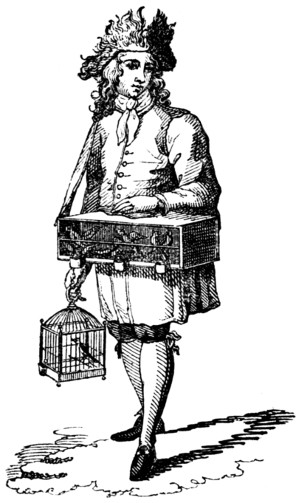
“Buy a fine singing-bird!”
The criers of singing birds are extinct: we have only the bird-sellers. This engraving, therefore, represents a by-gone character: it is from a series of etchings called the “Cries of London,” by Marcellus Lauron, a native of the Hague, where he was born in 1653. He came to England with his father, by whom he was instructed in painting. He drew correctly, studied nature diligently, copied it closely, and so surpassed his contemporaries in drapery, that sir Godfrey Kneller employed him to clothe his portraits. He likewise excelled in imitating the different styles of eminent masters, executed conversation pieces of considerable merit, and died at London in 1705. His “London Cries” render his name familiar, on account of the popularity which these performances still possess, and there being among them likenesses of several “remarkable people” of the times. “Lauron’s Cries” are well known to collectors, with whom the portrait of a pedlar, if a “mentioned print,” is quite as covetable as a peer’s.
Mr. Fenn of East Dereham, Norfolk, writing to the Rev. Mr. Granger, who was the Linnæus of “engraved British portraits,” sends him a private etching or two of a “Mr. Orde’s doing,” and says, “He is a fellow of King’s College, Cambridge, and is exceedingly lucky in taking off any peculiarity of person. Mr. Orde is a gentleman of family and fortune, and in these etchings makes his genius a conveyance of his charity, as he gives the profits arising from the local sale of the impressions in the University, to the originals from whom he draws his likenesses.—Randal, the orangeman, got enough by the sale of himself to equip himself from head to food: he always calls his oranges, &c. by some name corresponding to the time he sells them; as, at the commencement, Commencement oranges; at a musical entertainment, Oratorio oranges. By this humour he is known throughout the University, where he is generally called Dr. Randal. His likeness, manner, and gait, are exactly taken off.—The Clare-hall fruit-woman too is very striking, as indeed are all the etchings.”[131]
Mr. Malcolm tells of a negro-man abroad, who cried “balloon lemons, quality oranges, quality lemons, holiday limes, with a certain peculiarity, and whimsicality, that recommended him to a great deal of custom. He adventured in a lottery, obtained a prize of five thousand dollars, became raving mad, through excess of joy, and died in a few days.”
Lauron’s “London Cries” will be further noticed: in the mean time it may suffice to say, that this is the season wherein a few kidnappers of the feathered tribe walk about with their little prisoners, and tempt young fanciers to “buy a fine singing bird.”
April 9, 1827.*
Garrick Plays. No. XIV.
[From the “Arraignment of Paris,” a Dramatic Pastoral, by George Peel, 1584.]
Flora dresses Ida Hill, to honour the coming of the Three Goddesses.
Flora. Not Iris in her pride and bravery Adorns her Arch with such variety; Nor doth the Milk-white Way in frosty night Appear so fair and beautiful in sight, As done these fields, and groves, and sweetest bowers, Bestrew’d and deck’d with parti-colour’d flowers. Along the bubbling brooks, and silver glide, That at the bottom doth in silence slide, The watery flowers and lilies on the banks Like blazing comets burgeon all in ranks; Under the hawthorn and the poplar tree, Where sacred Phœbe may delight to be: The primrose, and the purple hyacinth, The dainty violet, and the wholesome minth; The double daisy, and the cowslip (Queen Of summer flowers), do over-peer the green; And round about the valley as ye pass, Ye may ne see (for peeping flowers) the grass.— They are at hand by this. Juno hath left her chariot long ago, And hath return’d her peacocks by her Rainbow; And bravely, as becomes the Wife of Jove, Doth honour by her presence to our grove: Fair Venus she hath let her sparrows fly, To tend on her, and make her melody; Her turtles and her swans unyoked be, And flicker near her side for company: Pallas hath set her tigers loose to feed, Commanding them to wait when she hath need: And hitherward with proud and stately pace, To do us honour in the sylvan chace, They march, like to the pomp of heav’n above, Juno, the Wife and Sister of King Jove, The warlike Pallas, and the Queen of Love.
The Muses, and Country Gods, assemble to welcome the Goddesses.
Pomona. ——— with country store like friends we venture forth. Think’st, Faunus, that these Goddesses will take our gifts in worth? Faunus. Nay, doubtless; for, ’shall tell thee, Dame, ’twere better give a thing, A sign of love, unto a mighty person, or a King, Than to a rude and barbarous swain both bad and basely born: For gently takes the gentleman that oft the clown will scorn.
The Welcoming Song.
Country Gods. O Ida, O Ida, O Ida, happy hill! This honour done to Ida may it continue still! Muses. Ye Country Gods, that in this Ida wonne, Bring down your gifts of welcome, For honour done to Ida. Gods. Behold in sign of joy we sing, And signs of joyful welcome bring. For honour done to Ida. Pan. The God of Shepherds, and his mates With country cheer salutes your States: Fair, wise, and worthy, as you be! And thank the gracious Ladies Three, For honour done to Ida.
Paris. Œnone.
Paris. Œnone, while we bin disposed to walk, Tell me, what shall be subject of our talk. Thou hast a sort of pretty tales in store; ’Dare say no nymph in Ida’s woods hath more. Again, beside thy sweet alluring face, In telling them thou hast a special grace. Then prithee, sweet, afford some pretty thing, Some toy that from thy pleasant wit doth spring. Œn. Paris, my heart’s contentment, and my choice Use thou thy pipe, and I will use my voice; So shall thy just request not be denied, And time well spent, and both be satisfied. Paris. Well, gentle nymph, although thou do me wrong, That can ne tune my pipe unto a song, Me list this once, Œnone, for thy sake, This idle task on me to undertake.
(They sit under a tree together.)
Œn. And whereon then shall be my roundelay? For thou hast heard my store long since, ’dare say— How Saturn did divide his kingdom tho’ To Jove, to Neptune, and to Dis below: How mighty men made foul successless war Against the Gods, and State of Jupiter: How Phorcyas’ ’ympe, that was so trick and fair, That tangled Neptune in her golden hair, Became a Gorgon for her lewd misdeed;— A pretty fable, Paris, for to read; A piece of cunning, trust me for the nonce, That wealth and beauty alter men to stones: How Salmacis, resembling Idleness, Turns men to women all thro’ wantonness: How Pluto raught Queen Pluto’s daughter thence, And what did follow of that love-offence: Of Daphne turn’d into the Laurel Tree, That shews a myrror of virginity: How fair Narcissus, tooting on his shade, Reproves disdain, and tells how form doth vade: How cunning Philomela’s needle tells, What force in love, what wit in sorrow, dwells: What pains unhappy Souls abide in Hell, They say, because on Earth they lived not well,— Ixion’s wheel, proud Tantal’s pining woe, Prometheus’ torment, and a many moe; How Danaus’ daughters ply their endless task; What toil the toil of Sysiphus doth ask. All these are old, and known, I know; yet, if thou wilt have any, Chuse some of these; for, trust me else, Œnone hath not many. Paris. Nay, what thou wilt; but since my cunning not compares with thine, Begin some toy that I can play upon this pipe of mine. Œn. There is a pretty Sonnet then, we call it Cupid’s Curse: “They that do change old love for new, pray Gods they change for worse.”
(They sing.)
Œn. Fair, and fair, and twice so fair, As fair as any may be, The fairest shepherd on our green, A Love for any Lady. Paris. Fair, and fair, and twice so fair, As fair as any may be, Thy Love is fair for thee alone, And for no other Lady. Œn. My Love is fair, my Love is gay. And fresh as bin the flowers in May, And of my Love my roundelay, My merry, merry, merry roundelay, Concludes with Cupid’s Curse: They that do change old love for new. Pray Gods they change for worse. Both. { Fair, and fair, &c. Fair, and fair, &c. } (repeated.) Both: Fair, and fair, &c. Fair, and fair, &c. Repeated. Œn. My Love can pipe, my Love can sing, My Love can many a pretty thing, And of his lovely praises ring My merry, merry, merry roundelays Amen to Cupid’s Curse: They that do change old love for new, Pray Gods they change for worse. Both. { Fair, and fair, &c. Fair, and fair, &c. } (repeated.) Both: Fair, and fair, &c. Fair, and fair, &c. Repeated.
To my esteemed Friend, and excellent Musician, V. N., Esq.
Dear Sir,
I conjure you in the name of all the Sylvan Deities, and of the Muses, whom you honour, and they reciprocally love and honour you,—rescue this old and passionate Ditty—the very flower of an old forgotten Pastoral, which had it been in all parts equal, the Faithful Shepherdess of Fletcher had been but a second name in this sort of Writing——rescue it from the profane hands of every common Composer: and in one of your tranquillest moods, when you have most leisure from those sad thoughts, which sometimes unworthily beset you; yet a mood, in itself not unallied to the better sort of melancholy; laying by for once the lofty Organ, with which you shake the Temples; attune, as to the Pipe of Paris himself, to some milder and more love-according instrument, this pretty Courtship between Paris and his (then-not as yet-forsaken) Œnone. Oblige me; and all more knowing Judges of Music and of Poesy; by the adaptation of fit musical numbers, which it only wants to be the rarest Love Dialogue in our language.
Your Implorer, C. L.
Etymology.
“For the NONCE.”
The original of nonce, an old word used by George Peel, is uncertain: it signifies purpose, intent, design.
I saw a wolf Nursing two whelps; I saw her little ones In wanton dalliance the teat to crave, While she her neck wreath’d from them for the NONCE.
Spenser.
They used at first to fume the fish in a house built for the NONCE.
Carew.
When in your motion you are hot. And that he calls for drink, I’ll have prepared him A chalice for the NONCE. Such a light and metall’d dance; Saw you never; And they lead men for the NONCE, That turn round like grindle stones.
Ben Jonson.
A voider for the NONCE, I wrong the devil should I pick their bones.
Cleaveland.
Coming ten times for the NONCE, I never yet could see it flow but once.
Cotton.
These authorities, adduced by Dr. Johnson, Mr. Archdeacon Nares conceives to have sufficiently explained the meaning of the word, which, though obsolete, is still “provincially current.” He adds, that it is sometimes written nones, and exemplifies the remark by these quotations:—
The mask of Monkes, devised for the nones.
Mirror for Magistrates.
And cunningly contrived them for the nones In likely rings of excellent device.
Drayton.
We also find “for the nones” in Chaucer.
THE BANQUET OF THE DEAD, OR GENERAL BIBO’S TALE. A Legend of Kirby Malhamdale Church-yard, Craven, Yorkshire.
For the Table Book.
Come all ye jovial farmers bold, and damsels sweet and fair, And listen unto me awhile a doleful tale you’ll hear.
Bloody Squire, or Derbyshire Tragedy.
Proem.
On Sheep-street-hill, in the town of Skipton, in Craven, is a blacksmith’s-shop, commonly called “the parliament-house.” During the late war it was the resort of all the eccentric characters in the place, who were in the habit of assembling there for the purpose of talking over the political events of the day, the knowledge whereof was gleaned from a daily paper, taken in by Mr. Kitty Cook, the occupier of the premises, and to the support of which the various members contributed. One winter’s morning in the year 1814, owing to a very heavy snow, the mail was detained on its road to the great discomfiture and vexation of the respectable parliamentary members, who were all as usual at their posts at the hour of nine. There happened on that morning to be a full house, and I very well recollect that Tom Holderd, General Bibo, Roger Bags, Duke Walker, Town Gate Jack, and Bill Cliff of Botany,[132] all of whom are since dead, were present. After the members had waited a long time, without the accustomed “folio of four pages” making its appearance, general Bibo arose and turning to the speaker, who in pensive melancholy was reclining on the anvil, he thus addressed him:—
“Mr. Speaker, I am convinced that the mail will not arrive to day, (hear! hear!) and therefore, that the members of this honourable house may not, at the hour of twelve, which is fast approaching, go home to their dinners without having something to communicate to their wives and families, I will, with your permission, relate one of those numerous legendary tales, with which our romantic district so much abounds—May I do so?”
Kitty upon this gave the anvil a thundering knock, which was his usual signal of assent, and the general proceeded to relate the full particulars, from which is extracted the following
Legend.
It was the 14th day of July, in the year 17—, when the corpse of a villager was interred in the romantic church-yard of Kirby Malhamdale. The last prayer of the sublime burial service of the English church was said, and the mourners had taken a last lingering look at the narrow tenement which enshrined mortality. All had departed, with the exception of the sexton, a village lad of the name of Kitchen, and a soldier, whose long, flowing, silvery hair and time-worn frame bespoke a very advanced age; he was seated on a neighbouring stone. The grave was not entirely filled up, and a scull, the melancholy remnant of some former occupier of the same narrow cell, was lying beside it. Kitchen took up the scull, and gazed on the sockets, eyeless then, but which had contained orbs, that perhaps had reflected the beam sent from beauty’s eye, glowed with fury on the battle-field, or melted at the tale of compassion. The old soldier observed the boy, and approaching him said, “Youth! that belonged to one who died soon after the reign of queen Mary. His name was Thompson, he was a military man, and as mischievous a fellow as ever existed—ay, for many a long year he was a plague to Kirby Malhamdale.”
“Then,” replied the boy, “doubtless his death was a benefit, as by it the inhabitants of the valley would be rid from a pest.”
“Why, as to that point,” answered the veteran, “I fear you are in the wrong. Thompson’s reign is not yet finished; ’tis whispered he often returns and visits the scenes of his childhood, nay, even plays his old tricks over again. It is by no means improbable, that at this very instant he is at no great distance, and listening to our conversation.”
“What,” ejaculated the boy, “he will neither rest himself nor allow other people to do so, the old brute!” and he kicked the scull from him.
“Boy,” said the soldier, “you dare not do that again.”
“Why not?” asked Kitchen, giving it at the same time another kick.
“Kick it again,” said the soldier.
The boy did so.
The veteran smiled grimly, as if pleased with the spirit which the boy manifested, and said, in a joking way, “Now take up that scull, and say to it—Let the owner of this meet me at the midnight hour, and invite me to a banquet spread on yon green stone by his bony fingers—
Come ghost, come devil, Come good, come evil, Or let old Thompson himself appear, For I will partake of his midnight cheer.”[133]
Kitchen, laughing with the glee of a schoolboy, and with the thoughtlessness incident to youth, repeated the ridiculous lines after his director, and then leaving the church-yard vaulted over the stile leading to the school-house, where, rejoining his companions, he quickly forgot the scene wherein he had been engaged; indeed it impressed him so little, that he never mentioned the circumstance to a single individual.
The boy at his usual hour of ten retired to rest, and soon fell into a deep slumber, from which he was roused by some one rattling the latch of his door, and singing beneath his window. He arose and opened the casement. It was a calm moonlight night, and he distinctly discerned the old soldier, who was rapping loudly at the door, and chanting the elegant stanzas he had repeated at the grave of the villager.
“And what pray now may you be wanting at this time of night?” asked the boy, wholly undaunted by the strangeness of the visitation. “If you cannot lie in bed yourself, you ought to allow others to rest.”
“What,” replied the old man, “hast thou so soon forgotten thy promise?” and he repeated the lines “Come good, come evil, &c.”
Kitchen laughed at again hearing the jingle of these ridiculous rhymes, which to him seemed to be “such as nurses use to frighten babes withal.” At this the soldier’s countenance assumed a peculiar expression, and the full gaze of his dark eye, which appeared to glow with something inexpressibly wild and unearthly, was bent upon the boy, who, as he encountered it, felt an indescribable sensation steal over him, and began to repent of his incautious levity. After a short silence the stranger again addressed him, but in tones so hollow and sepulchral, that his youthful blood was chilled, and his heart beat strongly and quickly in his bosom.
“Boy, thy word must be kept! Promises made with the grave are not to be lightly broken—
“Amidst the cold graves of the coffin’d dead Is the table deck’d and the banquet spread; Then haste thee thither without delay, For nigh is the time, away! away!”
“Then be it as you wish,” said the boy, in some slight degree resuming his courage; “go; I will follow.” On hearing this the soldier departed, and Kitchen watched his figure till it was wholly lost in the mists of the night.
*****
At a short distance from Kirby Malhamdale church, on the banks of the Aire, was a small cottage, the residence of the Rev. Mr. ——, the rector of the parish, [General Bibo mentioned his name, but I shall not, for if I did some of his descendants might address themselves to the Table Book, and contradict the story of their ancestor having been engaged in so strange an adventure as that contained in the sequel of this legend.] Mr. —— had from his earliest years been addicted to scientific and literary pursuits, and was generally in his study till a late hour. On this eventful night he was sitting at a table strewed with divers ancient tomes, intently perusing an old Genevan edition of the Institutes of John Calvin. While thus employed, and buried in profound meditation, the awful and death-like stillness was broken, and he was roused from his reverie by a hurried and violent knocking at the door. He started from his chair, and rushing out to ascertain the cause of this strange interruption, beheld Kitchen with a face as pale as a winding-sheet. “Kitchen, what brings you here at this untimely hour?” asked the clergyman. The boy was silent, and appeared under the influence of extreme terror. Mr. ——, on repeating the question, had a confused and indistinct account given him of all the circumstances. The relation finished, Mr. —— looked at the boy, and thus addressed him: “Yes, I thought some evil would come of your misdeeds; for some time past your conduct has been very disorderly, you having long set a bad example to the lads of Malhamdale. But this is no time for upbraiding. I will accompany you, and together we will abide the result of your rash engagement.”
Mr. —— and the boy left the rectory, and proceeded along the road leading to the church-yard; as they entered the sacred precinct, the clock of the venerable pile told the hour of midnight. It was a beautiful night—scarcely a cloud broke the cerulean appearance of the heavens—countless stars studded heaven’s deep blue vault—the moon was glowing in her highest lustre, and shed a clear light on the old grey church tower and the distant hills—scarcely a breeze stirred the trees, then in their fullest foliage—every inmate of the village-inn[134] was at rest—there was not a sound, save the murmuring of the lone mountain river, and the deep-toned baying of the watchful sheep-dog.
Mr. —— looked around, but, seeing no one, said to the boy, “Surely you have been dreaming—your tale is some illusion, some chimera of the brain. The occurrences of the day have been embodied in your visions, and the over excitement created by the scene at the tomb has worked upon your imagination.”
“Oh no, sir!” said Kitchen, “but his eyes which glared so fearfully upon me could not have been a deception. I saw his tall figure, and heard his hollow sepulchral voice sing those too well-remembered lines, but—Heavens! did you not see it?” He started, and drawing nearer to the priest, pointed to the eastern window of the edifice. Mr. —— looked in the direction, and saw a dark shadowy form gliding amid the tombstones. It approached, and as its outline became more distinctly marked, he recognised the mysterious being described to him in his study by the terrified boy.—The figure stopped, and looking long and earnestly at them said, “One! two! How is this? I have one more guest than I invited; but it matters not, all is ready, follow me—
“Amidst the cold graves of the coffin’d dead, Is the table deck’d and the banquet spread.”
The figure waved its arm impatiently, and beckoning them to follow moved on in the precise and measured step of an old soldier. Having reached the eastern window, it turned the corner of the building, and proceeded directly to the old green stone, near Thompson’s grave. The thick branches of an aged yew-tree partially shaded the spot from the silver moonlight, which was peacefully falling on the neighbouring graves, and gave to this particular one a more sombre and melancholy character than the rest. Here was, indeed, a table spread, and its festive preparations formed a striking contrast with the awful mementos strewed around. Never in the splendid and baronial halls of De Clifford,[135] never in the feudal mansion of the Nortons,[136] nor in the refectory of the monks of Sawley, had a more substantial banquet been spread. Nothing was wanting there of roast or boiled—the stone was plentifully decked; yet it was a fearful sight to see, where till now but the earthworm had ever revelled, a banquet prepared as for revelry. The boy looked on the stone, and as he gazed on the smoking viands a strange thought crossed his brow—at what fire were those provisions cooked. The seats placed around were coffins, and Kitchen every instant seemed to dread lest their owners should appear, and join the sepulchral banquet. Their ghostly host having placed himself at the head of the table, motioned his guests to do the same, and they did so accordingly. Mr. —— then in his clerical character rose to ask the accustomed blessing, when he was interrupted. “It cannot be,” said the stranger as he rose; “I cannot hear at my board a protestant grace. When I trod the earth as a mortal, the catholic religion was the religion of the land! It was the blessed faith of my forefathers, and it was mine. Within those walls I have often listened to the solemnization of the mass, but now how different! listen!” He ceased. The moon was overcast by a passing cloud, the great bell tolled, a screech-owl flew from the tower, lights were seen in the building, and through one of the windows Mr. —— beheld distinctly the bearings of the various hatchments, and a lambent flame playing over the monument of the Lamberts—music swelled through the aisles, and unseen beings with voices wilder than the unmeasured notes
Of that strange lyre, whose strings The genii of the breezes sweep,
chanted not a Gratias agimus, but a De Profundis. All was again still, and the stranger spoke, “What you have heard is my grace. Is not a De Profundis the most proper one to be chanted at the banquet of the dead?”
Mr. ——, who was rather an epicure, now glanced his eye over the board, and finding that that necessary appendage to a good supper, salt, was wanting, said, in an astonished tone, “Why, where’s the salt?” when immediately the stranger and his feast vanished, and of all that splendid banquet nothing remained, save the mossy stone whereon it was spread.
Such was the purport of general Bibo’s tale; and why those simple words had so wondrous an effect has long been a subject of dispute with the illuminati of Skipton and Malhamdale. Many are the conjectures, but the most probable one is this,—the spectre on hearing the word salt was perhaps reminded of the Red Sea, and having, like all sensible ghosts, a dislike to that awful and tremendous gulf, thought the best way to avoid being laid there was to make as precipitate a retreat as possible.
Kirby, or as it is frequently called, Kirby Malhamdale, from the name of the beautiful valley in which it is situate, is one of the most sequestered villages in Craven, and well worthy of the attention of the tourist, from the loveliness of its surrounding scenery and its elegant church, which hitherto modern barbarity has left unprofaned by decorations and ornaments, as churchwardens and parish officers style those acts of Vandalism, by which too many of the Craven churches have been spoiled, and on which Dr. Whitaker has animadverted in pretty severe language. That excellent historian and most amiable man, whose memory will ever be dear to the inhabitants of Craven, speaking of Kirby church, says, “It is a large, handsome, and uniform building of red stone, probably of the age of Henry VII. It has one ornament peculiar, as far as I recollect, to the churches in Craven, to which the Tempests were benefactors. Most of the columns have in the west side, facing the congregation as they turned to the altar, an elegant niche and tabernacle, once containing the statue of a saint. In the nave lies a grave-stone, with a cross fleury in high relief, of much greater antiquity than the present church, and probably covering one of the canons of Dereham.”[137]
At the west end of the church, on each side of the singer’s gallery, are two emblematical figures, of modern erection, painted on wood; one of them, Time with his scythe, and this inscription, “Make use of time;” the other is a skeleton, with the inscription “Remember death.” With all due deference to the taste of the parishioners, it is my opinion that these paintings are both unsuited to a Christian temple, and the sooner they are removed the better. The gloomy mythology of the Heathens ill accords with the enlightened theology of Christianity.
At the east end of the church are monumental inscriptions to the memory of John Lambert, the son, and John Lambert, the grandson of the well-known general Lambert, of roundhead notoriety. The residence of the Lamberts was Calton-hall, in the neighbourhood; and at Winterburn, a village about two miles from Calton, is one of the oldest Independent chapels in the kingdom, having been erected and endowed by the Lamberts during the usurpation of Cromwell; it is still in possession of this once powerful sect, and was a picturesque object: it had something of sturdy non-conformity in its appearance, but alas! modern barbarism has been at work on it, and given it the appearance of a respectable barn. The deacons, who “repaired and beautified” it, ought to place their names over the door of the chapel, in characters readable at a mile’s distance, that the traveller may be informed by whom the chapel erected by the Lamberts was deformed.
I often have lamented, that ministers of religion have so little to do with the repairs of places of worship. The clergy of all denominations are, in general, men of cultivated minds and refined tastes, and certainly better qualified to superintend alterations than country churchwardens and parish officers, who, though great pretenders to knowledge, are usually ignorant destroyers of the beauty of the edifices confided to their care.
T. Q. M.
April, 1827.
SALT.
The conjecture of T. Q. M. concerning the disappearance of the spectre-host, and the breaking up of the nocturnal banquet, in the church-yard of Kirby Malhamdale, is ingenious, and entitled to the notice of the curious in spectral learning: but it may be as well to consider whether the point of the legend may not be further illustrated.
According to Moresin, salt not being liable to putrefaction, and preserving things seasoned with it from decay, was the emblem of eternity and immortality, and mightily abhorred by infernal spirits. “In reference to this symbolical explication, how beautiful,” says Mr. Brand, “is that expression applied to the righteous, ‘Ye are the salt of the earth!’”
On the custom in Ireland of placing a plate of salt over the heart of a dead person, Dr. Campbell supposes, in agreement with Moresin’s remark, that the salt was considered the emblem of the incorruptible part; “the body itself,” says he, “being the type of corruption.”
It likewise appears from Mr. Pennant, that, on the death of a highlander, the friends laid on the breast of the deceased a wooden platter, containing a small quantity of salt and earth, separate and unmixed; the earth an emblem of the corruptible body—the salt an emblem of the immortal spirit.
The body’s salt the soul is, which when gone The flesh soone sucks in putrefaction.
Herrick.
The custom of placing a plate of salt upon the dead, Mr. Douce says, is still retained in many parts of England, and particularly in Leicestershire; but the pewter plate and salt are laid with an intent to hinder air from getting into the body and distending it, so as to occasion bursting or inconvenience in closing the coffin. Though this be the reason for the usage at present, yet it is doubtful whether the practice is not a vulgar continuation of the ancient symbolical usage; otherwise, why is salt selected?
To these instances of the relation that salt bore to the dead, should be annexed Bodin’s affirmation, cited by Reginald Scot; namely, that as salt “is a sign of eternity, and used by divine commandment in all sacrifices,” so “the devil loveth no SALT in his meat.”—This saying is of itself, perhaps, sufficient to account for the sudden flight of the spectre, and the vanishing of the feast in the church-yard of Kirby Malhamdale on the call for the salt.
Finally may be added, salt from the “Hesperides” of Herrick:—
TO PERILLA.
Ah, my Perilla! dost thou grieve to see Me, day by day, to steale away from thee? Age cals me hence, and my gray haires bid come And haste away to mine eternal home; ’Twill not be long, Perilla, after this, That I must give thee the supremest kisse: Dead when I am, first cast in salt, and bring Part of the creame from that religious spring, With which, Perilla, wash my hands and feet; That done, then wind me in that very sheet Which wrapt thy smooth limbs, when thou didst plore The gods protection but the night before; Follow me weeping to my turfe, and there Let fall a primrose, and with it a teare: Then, lastly, let some weekly strewings be Devoted to the memory of me; Then shall my ghost not walk about, but keep Still in the cold and silent shades of sleep.
*
A CORPORATION.
Mr. Howel Walsh, in a corporation case tried at the Tralee assizes, observed, that “a corporation cannot blush. It was a body it was true; had certainly a head—a new one every year—an annual acquisition of intelligence in every new lord mayor. Arms he supposed it had, and long ones too, for it could reach at any thing. Legs, of course, when it made such long strides. A throat to swallow the rights of the community, and a stomach to digest them! But whoever yet discovered, in the anatomy of any corporation, either bowels, or a heart?”
House at Kirkby-Moorside, Yorkshire
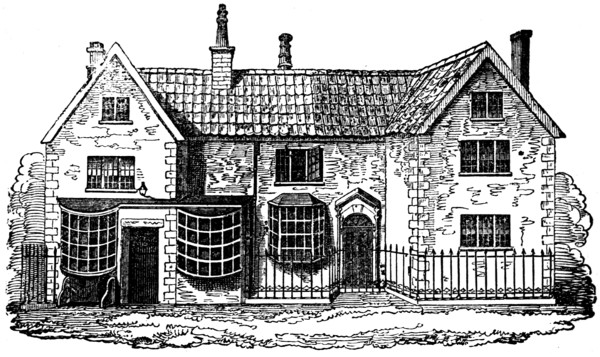
House at Kirkby-Moorside, Yorkshire, WHEREIN THE SECOND DUKE OF BUCKINGHAM DIED.
In the worst inn’s worst room, with mat half-hung, The floors of plaster, and the walls of dung, On once a flock-bed, but repair’d with straw, With tape-ty’d curtains, never meant to draw, The George and Garter dangling from that bed Where tawdry yellow strove with dirty red, Great Villiers lies—alas! how chang’d from him, That life of pleasure, and that soul of whim! Gallant and gay, in Cliveden’s proud alcove. The bow’r of wanton Shrewsbury and Love: Or just as gay at council, in a ring Of mimick’d Statesmen, and their merry King. No wit to flatter, ’reft of all his store! No fool to laugh at, which he valued more! There victor of his health, of fortune, friends, And fame; this lord of useless thousands ends.
Pope.
In an amusing and informing topographical tract, written and published by Mr. John Cole of Scarborough, there is the preceding representation of the deathbed-house of the witty and dissipated nobleman, whose name is recorded beneath the engraving. From this, and a brief notice of the duke in a work possessed by most of the readers of the Table Book,[138] with some extracts from documents, accompanying Mr. Cole’s print, an interesting idea may be formed of this nobleman’s last thoughts, and the scene wherein he closed his eyes.
The room wherein he died is marked above by a star * near the window.
Kirkby-Moorside is a market town, about twenty-six miles distant from Scarborough, seated on the river Rye. It was formerly part of the extensive possessions of Villiers, the first duke of Buckingham, who was killed by Felton, from whom it descended with his title to his son, who, after a profligate career, wherein he had wasted his brilliant talents and immense property, repaired to Kirkby-Moorside, and died there in disease and distress.
In a letter to bishop Spratt, dated “Kerby-moor Syde, April 17, 1687,” the earl of Arran relates that, being accidentally at York on a journey towards Scotland, and hearing of the duke of Buckingham’s illness, he visited him. “He had been long ill of an ague, which had made him weak; but his understanding was as good as ever, and his noble parts were so entire, that though I saw death in his looks at first sight, he would by no means think of it.—I confess it made my heart bleed to see the duke of Buckingham in so pitiful a place, and in so bad a condition.—The doctors told me his case was desperate, and though he enjoyed the free exercise of his senses, that in a day or two at most it would kill him, but they durst not tell him of it; so they put a hard part on me to pronounce death to him, which I saw approaching so fast, that I thought it was high time for him to think of another world.—After having plainly told him his condition, I asked him whom I should send for to be assistant to him during the small time he had to live: he would make me no answer, which made me conjecture, and having formerly heard that he had been inclining to be a Roman Catholic, I asked him if I should send for a priest; for I thought any act that could be like a Christian, was what his condition now wanted most; but he positively told me that he was not of that persuasion, and so would not hear any more of that subject, for he was of the church of England.—After some time, beginning to feel his distemper mount, he desired me to send for the parson of this parish, who said prayers for him, which he joined in very freely, but still did not think he should die; though this was yesterday, at seven in the morning, and he died about eleven at night.
“I have ordered the corpse to be embalmed and carried to Helmsley castle, and there to remain till my lady duchess her pleasure shall be known. There must be speedy care taken: for there is nothing here but confusion, not to be expressed. Though his stewards have received vast sums, there is not so much as one farthing, as they tell me, for defraying the least expense. But I have ordered his intestines to be buried at Helmsley, where his body is to remain till farther orders. Being the nearest kinsman upon the place, I have taken the liberty to give his majesty an account of his death, and sent his George and blue ribbon to be disposed as his majesty shall think fit. I have addressed it under cover to my lord president, to whom I beg you would carry the bearer the minute he arrives.”
A letter, in Mr. Cole’s publication, written by the dying duke, confesses his ill-spent life, and expresses sincere remorse for the prostitution of his brilliant talents.
“From the younger Villiers, Duke of Buckingham, on his Deathbed to Dr. W——
“Dear doctor,
“I always looked upon you to be a person of true virtue, and know you to have a sound understanding; for, however I have acted in opposition to the principles of religion, or the dictates of reason, I can honestly assure you I have always had the highest veneration for both. The world and I shake hands; for I dare affirm, we are heartily weary of each other. O, what a prodigal have I been of that most valuable of all possessions, Time! I have squandered it away with a profusion unparalleled; and now, when the enjoyment of a few days would be worth the world, I cannot flatter myself with the prospect of half a dozen hours. How despicable, my dear friend, is that man who never prays to his God, but in the time of distress. In what manner can he supplicate that Omnipotent Being, in his afflictions, whom, in the time of his prosperity, he never remembered with reverence.
“Do not brand me with infidelity, when I tell you, that I am almost ashamed to offer up my petitions at the throne of Grace, or to implore that divine mercy in the next world which I have so scandalously abused in this.
“Shall ingratitude to man be looked upon as the blackest of crimes, and not ingratitude to God? Shall an insult offered to a king be looked upon in the most offensive light, and yet no notice (be) taken when the King of kings is treated with indignity and disrespect?
“The companions of my former libertinism would scarcely believe their eyes, were you to show this epistle. They would laugh at me as a dreaming enthusiast, or pity me as a timorous wretch, who was shocked at the appearance of futurity; but whoever laughs at me for being right, or pities me for being sensible of my errors, is more entitled to my compassion than resentment. A future state may well enough strike terror into any man who has not acted well in this life; and he must have an uncommon share of courage indeed who does not shrink at the presence of God. The apprehensions of death will soon bring the most profligate to a proper use of his understanding. To what a situation am I now reduced! Is this odious little hut a suitable lodging for a prince? Is this anxiety of mind becoming the character of a Christian? From my rank I might have expected affluence to wait upon my life; from religion and understanding, peace to smile upon my end: instead of which I am afflicted with poverty, and haunted with remorse, despised by my country, and, I fear, forsaken by my God.
“There is nothing so dangerous as extraordinary abilities. I cannot be accused of vanity now, by being sensible that I was once possessed of uncommon qualifications, especially as I sincerely regret that I ever had them. My rank in life made these accomplishments still more conspicuous, and fascinated by the general applause which they procured, I never considered the proper means by which they should be displayed. Hence, to procure a smile from a blockhead whom I despised, I have frequently treated the virtues with disrespect; and sported with the holy name of Heaven, to obtain a laugh from a parcel of fools, who were entitled to nothing but contempt.
“Your men of wit generally look upon themselves as discharged from the duties of religion, and confine the doctrines of the gospel to meaner understandings. It is a sort of derogation, in their opinion, to comply with the rules of Christianity; and they reckon that man possessed of a narrow genius, who studies to be good.
“What a pity that the holy writings are not made the criterion of true judgment; or that any person should pass for a fine gentleman in this world, but he that appears solicitous about his happiness in the next.
“I am forsaken by all my acquaintance, utterly neglected by the friend of my bosom, and the dependants on my bounty; but no matter! I am not fit to converse with the former, and have no ability to serve the latter. Let me not, however, be wholly cast off by the good. Favour me with a visit as soon as possible. Writing to you gives me some ease, especially on a subject I could talk of for ever.
“I am of opinion this is the last visit I shall ever solicit from you; my distemper is powerful; come and pray for the departing spirit of the poor unhappy
“Buckingham.”
The following is from the parish register of Kirkby Moorside.
Copy.
buried in the yeare of our Lord [1687.] April ye 17. Gorges uiluas Lord dooke of bookingam, etc.
This vulgar entry is the only public memorial of the death of a nobleman, whose abuse of faculties of the highest order, subjected him to public contempt, and the neglect of his associates in his deepest distress. If any lesson can reach the sensualist he may read it in the duke’s fate and repentant letter.
The publication of such a tract as Mr. Cole’s, from a provincial press, is an agreeable surprise. It is in octavo, and bears the quaint title of the “Antiquarian Trio,” because it describes, 1. The house wherein the duke of Buckingham died. 2. Rudston church and obelisk. 3. A monumental effigy in the old town-hall, Scarborough, with a communication to Mr. Cole from the Rev. J. L. Lisson, expressing his opinion, that it represents John de Mowbray, who was constable of Scarborough castle in the reign of Edward II. Engravings illustrate these descriptions, and there is another on wood of the church of Hunmanby, with a poem, for which Mr. Cole is indebted to the pen of “the present incumbent, the Rev. Archdeacon Wrangham, M. A. F. R. S.”
Literature.
“Servian popular Poetry, translated by John Bowring,” 1827.
It is an item of “Foreign Occurrences,” in the “Gentleman’s Magazine,” July, 1807, that a firman of the grand signior sentenced the whole Servian nation to extermination, without distinction of age or sex; if any escaped the sword, they were to be reduced to slavery. Every plain matter-of-fact man knew from his Gazetteer that Servia was a province of Turkey in Europe, bounded on the north by the Danube and Save, which separate it from Hungary, on the east by Bulgaria, on the west by Bosnia, and on the south by Albania and Macedonia; of course, he presumed that fire and sword had passed upon the country within these boundaries, and that the remaining natives had been deported; and consequently, to render the map of Turkey in Europe perfectly correct, he took his pen, and blotted out “Servia.” It appears, however, that by one of those accidents, which defeat certain purposes of state policy, and which are quite as common to inhuman affairs, in “sublime” as in Christian cabinets, there was a change of heads in the Turkish administration. The Janizaries becoming displeased with their new uniforms, and with the ministers of Selim, the best of grand signiors, his sublime majesty was graciously pleased to mistake the objects of their displeasure, and send them the heads of Mahmud Effendi, and a few ex-ministers, who were obnoxious to himself, instead of the heads of Achmet Effendi, and others of his household; the discontented therefore immediately decapitated the latter themselves; and, further, presumed to depose Selim, and elevate Mustapha to the Turkish throne. According to an ancient custom, the deposed despot threw himself at the feet of his successor, kissed the border of his garment, retired to that department of the seraglio occupied by the princes of the blood who cease to reign, and Mustapha, girded with the sword of the prophet, was the best of grand signiors in his stead. This state of affairs at the court of Constantinople rendered it inconvenient to divert the energies of the faithful to so inconsiderable an object as the extinction of the Servian nation; and thus Servia owes its existence to the Janizaries’ dislike of innovation on their dress; and we are consequently indebted to that respectable prejudice for the volume of “Servian popular Poetry,” published by Mr. Bowring. We might otherwise have read, as a dry matter of history, that the Servian people were exterminated A. D. 1807, and have passed to our graves without suspecting that they had songs and bards, and were quite as respectable as their ferocious and powerful destroyers.
Mr. Bowring’s “Introduction” to his specimens of “Servian popular Poetry,” is a rapid sketch of the political and literary history of Servia.
“The Servians must be reckoned among those races who vibrated between the north and the east; possessing to-day, dispossessed to-morrow; now fixed, and now wandering: having their head-quarters in Sarmatia for many generations, in Macedonia for following ones, and settling in Servia at last. But to trace their history, as to trace their course, is impossible. At last the eye fixes them between the Sava and the Danube, and Belgrade grows up as the central point round which the power of Servia gathers itself together, and stretches itself along the right bank of the former river, southwards to the range of mountains which spread to the Adriatic and to the verge of Montengro. Looking yet closer, we observe the influence of the Venetians and the Hungarians on the character and the literature of the Servians. We track their connection now as allies, and now as masters; once the receivers of tribute from, and anon as tributaries to, the Grecian empire; and in more modern times the slaves of the Turkish yoke. Every species of vicissitude marks the Servian annals—annals represented only by those poetical productions of which these are specimens. The question of their veracity is a far more interesting one than that of their antiquity. Few of them narrate events previous to the invasion of Europe by the Turks in 1355, but some refer to facts coeval with the Mussulman empire in Adrianople. More numerous are the records of the struggle between the Moslem and the Christian parties at a later period; and last of all, they represent the quiet and friendly intercourse between the two religions, if not blended in social affections, at least associated in constant communion.”
Respecting the subject more immediately interesting, Mr. Bowring says—
“The earliest poetry of the Servians has a heathenish character; that which follows is leagued with Christian legends. But holy deeds are always made the condition of salvation. The whole nation, to use the idea of Göthe, is imaged in poetical superstition. Events are brought about by the agency of angels, but the footsteps of Satan can be nowhere traced; the dead are often summoned from their tombs; awful warnings, prophecies, and birds of evil omen, bear terror to the minds of the most courageous.
“Over all is spread the influence of a remarkable, and, no doubt, antique mythology. An omnipresent spirit—airy and fanciful—making its dwelling in solitudes—and ruling over mountains and forests—a being called the Vila, is heard to issue its irresistible mandates, and pour forth its prophetic inspiration: sometimes in a form of female beauty—sometimes a wilder Diana—now a goddess, gathering or dispersing the clouds—and now an owl, among ruins and ivy. The Vila, always capricious, and frequently malevolent, is a most important actor in all the popular poetry of Servia. The Trica Polonica is sacred to her. She is equally renowned for the beauty of her person and the swiftness of her step:—‘Fair as the mountain Vila,’ is the highest compliment to a Servian lady—‘Swift as the Vila,’ is the most eloquent eulogium on a Servian steed.
“Of the amatory poems of the Servians, Göthe justly remarks, that, when viewed all together, they cannot but be deemed of singular beauty; they exhibit the expressions of passionate, overflowing, and contented affection; they are full of shrewdness and spirit; delight and surprise are admirably portrayed; and there is, in all, a marvellous sagacity in subduing difficulties, and in obtaining an end; a natural, but at the same time vigorous and energetic tone; sympathies and sensibilities, without wordy exaggeration, but which, notwithstanding, are decorated with poetical imagery and imaginative beauty; a correct picture of Servian life and manners—every thing, in short, which gives to passion the force of truth, and to external scenery the character of reality.
“The poetry of Servia was wholly traditional, until within a very few years. It had never found a pen to record it, but has been preserved by the people, and principally by those of the lower classes, who had been accustomed to listen and to sing these interesting compositions to the sound of a simple three-stringed instrument, called a Gusle; and it is mentioned by Göthe, that when some Servians who had visited Vienna were requested to write down the songs they had sung, they expressed the greatest surprise that such simple poetry and music as theirs should possess any interest for intelligent and cultivated minds. They apprehended, they said, that the artless compositions of their country would be the subject of scorn or ridicule to those whose poetry was so polished and so sublime. And this feeling must have been ministered to by the employment, even in Servia, of a language no longer spoken; for the productions of literature, though it is certain the natural affections, the every-day thoughts and associations could not find fit expression in the old church dialect:—
“The talk Man holds with week-day man in the hourly walk Of the mind’s business, is the undoubted stalk ‘True song’ doth grow on.”
“The collection of popular songs, Narodne srpske pjesme, from which most of those which occupy this volume are taken, was made by Vuk, and committed to paper either from early recollections, or from the repetition of Servian minstrels. These, he informs us, and his statement is corroborated by every intelligent traveller, form a very small portion of the treasure of song which exists unrecorded among the peasantry. How so much of beautiful anonymous poetry should have been created in so perfect a form, is a subject well worthy of inquiry. Among a people who look to music and song as a source of enjoyment, the habit of improvisation grows up imperceptibly, and engages all the fertilities of imagination in its exercise. The thought which first finds vent in a poetical form, if worth preservation, is polished and perfected as it passes from lip to lip, till it receives the stamp of popular approval, and becomes as it were a national possession. There is no text-book, no authentic record, to which it can be referred, whose authority should interfere with its improvement. The poetry of a people is a common inheritance, which one generation transfers sanctioned and amended to another. Political adversity, too, strengthens the attachment of a nation to the records of its ancient prosperous days. The harps may be hung on the willows for a while, during the storm and the struggle, but when the tumult is over, they will be strung again to repeat the old songs, and recall the time gone by.
“The historical ballads, which are in lines composed of five trochaics, are always sung with the accompaniment of the Gusle. At the end of every verse, the singer drops his voice, and mutters a short cadence. The emphatic passages are chanted in a louder tone. ‘I cannot describe,’ says Wessely, ‘the pathos with which these songs are sometimes sung. I have witnessed crowds surrounding a blind old singer, and every cheek was wet with tears—it was not the music, it was the words which affected them.’ As this simple instrument, the Gusle, is never used but to accompany the poetry of the Servians, and as it is difficult to find a Servian who does not play upon it, the universality of their popular ballads may be well imagined.”
While Mr. Bowring pays cheerful homage to a rhyme translation of a Servian ballad, in the Quarterly Review, No. LXIX. p. 71, he adds, that it is greatly embellished, and offers a version, in blank verse, more faithful to the original, and therefore more interesting to the critical inquirer. The following specimen of Mr. Bowring’s translation may be compared with the corresponding passage in the Review.
She was lovely—nothing e’er was lovelier; She was tall and slender as the pine tree; White her cheeks, but tinged with rosy blushes, As if morning’s beam had shone Till that beam had reach’d its high meridian; And her eyes, they were two precious jewels; And her eyebrows, leeches from the ocean; And her eyelids, they were wings of swallows; Silken tufts the maiden’s flaxen ringlets; And her sweet mouth was a sugar casket; And her teeth were pearls array’d in order; White her bosom, like two snowy dovelets; And her voice was like the dovelet’s cooing; And her smiles were like the glowing sunshine.
On the eyebrows of the bride, described as “leeches from the ocean,” it is observable that, with the word leech in Servian poetry, there is no disagreeable association. “It is the name usually employed to describe the beauty of the eyebrows, as swallows’ wings are the simile used for eyelashes.” A lover inquires
“Hast thou wandered near the ocean? Has thou seen the pijavitza?[139] Like it are the maiden’s eyebrows.”
There is a stronger illustration of the simile in
The Brotherless Sisters.
Two solitary sisters, who A brother’s fondness never knew. Agreed, poor girls, with one another. That they would make themselves a brother. They cut them silk, as snow-drops white; And silk, as richest rubies bright; They carved his body from a bough Of box-tree from the mountain’s brow; Two jewels dark for eyes they gave; For eyebrows, from the ocean’s wave They took two leeches; and for teeth Fix’d pearls above, and pearls beneath; For food they gave him honey sweet. And said, “Now live, and speak, and eat.”
The tenderness of Servian poetry is prettily exemplified in another of Mr. Bowring’s translations.
Farewell.
Against white Buda’s walls, a vine Doth its white branches fondly twine: O no! it was no vine-tree there It was a fond, a faithful pair, Bound each to each in earliest vow— And, O! they must be severed now! And these their farewell words:—“We part— Break from my bosom—break—my heart! Go to a garden—go, and see, Some rose-branch blushing on the tree; And from that branch a rose-flower tear, Then place it on thy bosom bare; And as its leavelets fade and pine, So fades my sinking heart in thine.” And thus the other spoke: “My love! A few short paces backward move, And to the verdant forest go; There’s a fresh water-fount below; And in the fount a marble stone, Which a gold cup reposes on; And in the cup a ball of snow— Love! take that ball of snow to rest Upon thine heart within thy breast, And as it melts unnoticed there, So melts my heart in thine, my dear!”
One other poem may suffice for a specimen of the delicacy of feeling in a Servian bosom, influenced by the master-passion.
The Young Shepherds.
The sheep, beneath old Buda’s wall, Their wonted quiet rest enjoy; But ah! rude stony fragments fall. And many a silk-wool’d sheep destroy; Two youthful shepherds perish there, The golden George, and Mark the fair. For Mark, O many a friend grew sad, And father, mother wept for him: George—father, friend, nor mother had, For him no tender eye grew dim: Save one—a maiden far away, She wept—and thus I heard her say: “My golden George—and shall a song, A song of grief be sung for thee— ’Twould go from lip to lip—ere long By careless lips profaned to be; Unhallow’d thoughts might soon defame The purity of woman’s name. “Or shall I take thy picture fair, And fix that picture in my sleeve? Ah! time will soon the vestment tear. And not a shade, nor fragment leave: I’ll not give him I love so well To what is so corruptible. “I’ll write thy name within a book; That book will pass from hand to hand. And many an eager eye will look, But ah! how few will understand!— And who their holiest thoughts can shroud From the cold insults of the crowd?”
GRETNA GREEN.
For the Table Book.
This celebrated scene of matrimonial mockery is situated in Dumfrieshire, near the mouth of the river Esk, nine miles north-west from Carlisle.
Mr. Pennant, in his journey to Scotland, speaks in the following terms of Gretna, or, as he calls it, Gretna Green. By some persons it is written Graitney Green, according to the pronunciation of the person from whom they hear it:—
“At a short distance from the bridge, stop at the little village of Gretna—the resort of all amorous couples, whose union the prudence of parents or guardians prohibits. Here the young pair may be instantly united by a fisherman, a joiner, or a blacksmith, who marry from two guineas a job, to a dram of whiskey. But the price is generally adjusted by the information of the postilions from Carlisle, who are in pay of one or other of the above worthies; but even the drivers, in case of necessity, have been known to undertake the sacerdotal office. This place is distinguished from afar by a small plantation of firs, the Cyprian grove of the place—a sort of landmark for fugitive lovers. As I had a great desire to see the high-priest, by stratagem I succeeded. He appeared in the form of a fisherman, a stout fellow in a blue coat, rolling round his solemn chaps a quid of tobacco of no common size. One of our party was supposed to come to explore the coast; we questioned him about the price, which, after eying us attentively, he left to our honour. The church of Scotland does what it can to prevent these clandestine matches, but in vain; for these infamous couplers despise the fulmination of the kirk, and excommunication is the only penalty it can inflict.”
The “Statistical Account of Scotland” gives the subsequent particulars:—“The persons who follow this illicit practice are mere impostors—priests of their own creation, who have no right whatever either to marry, or exercise any part of the clerical function. There are at present more than one of this description in this place; but the greatest part of the trade is monopolized by a man who was originally a tobacconist, and not a blacksmith, as is generally believed. He is a fellow without education, without principle, without morals, and without manners. His life is a continued scene of drunkenness: his irregular conduct has rendered him an object of detestation to all the sober and virtuous part of the neighbourhood. Such is the man (and the description is not exaggerated) who has had the honour to join in the sacred bonds of wedlock many people of great rank and fortune from all parts of England. It is forty years and upwards since marriages of this kind began to be celebrated here. At the lowest computation, about sixty are supposed to be solemnized annually in this place.”
Copy Certificate of a Gretna Green Marriage.
“Gretnay Green Febry 17 1784
“This is to Sertfay to all persons that may be Cunserned that William Geades from the Cuntey of Bamph in thee parish of Crumdell and Nelley Patterson from the Sitey of Ednbrough Both Comes before me and Declares them Selvese to be Both Single persons and New Mareid by thee way of thee Church of Englond And Now maried by thee way of thee Church of Scotland as Day and Deat abuv menchned by me
David M‘Farson his William Geades Mark Nelly Patorson

Witness Danell Morad”
By the canons and statutes of the church of Scotland, all marriages performed under the circumstances usually attending them at Gretna Green, are clearly illegal; for although it may be performed by a layman, or a person out of orders, yet, as in England, bans or license are necessary, and those who marry parties clandestinely are subject to heavy fine and severe imprisonment. Therefore, though Gretna Green be just out of the limits of the English Marriage Act, that is not sufficient, unless the forms of the Scottish church are complied with.
H. M. Lander.
SCOTCH ADAM AND EVE.
The first record for marriage entered into the session-book of the West Parish of Greenock, commences with Adam and Eve, being the Christian names of the first couple who were married after the book was prepared. The worthy Greenockians can boast therefore of an ancient origin, but traces of Paradise or the Garden of Eden in their bleak regions defy research.
BOA CONSTRICTOR.
Jerome speaks of “a dragon of wonderful magnitude, which the Dalmatians in their native language call boas, because they are so large that they can swallow oxen.” Hence it should seem, that the boa-snake may have given birth to the fiction of dragons.[140]
Varia.
PIOUS DIRECTION POST.
Under this title, in a west-country paper of the present year, (1827) there is the following statement:—
On the highway near Bicton, in Devonshire, the seat of the right hon. lord Rolle, in the centre of four cross roads, is a directing post with the following inscriptions, by an attention to which the traveller learns the condition of the roads over which he has to pass, and at the same time is furnished with food for meditation:—
To Woodbury, Topsham, Exeter.—Her ways are ways of pleasantness, and all her paths are peace.
To Brixton, Ottery, Honiton.—O hold up our goings in thy paths that our footsteps slip not.
To Otterton, Sidmouth, Culliton, A. D. 1743.—O that our ways were made to direct that we might keep thy statutes.
To Budleigh.—Make us to go in the paths of thy commandments, for therein is our desire.
MARSEILLES.
The history of Marseilles is full of interest. Its origin borders on romance. Six hundred years before the Christian era, a band of piratical adventurers from Ionia, in Asia Minor, by dint of superior skill in navigation, pushed their discoveries to the mouth of the Rhone. Charmed with the white cliffs, green vales, blue waters, and bright skies, which they here found, they returned to their native country, and persuaded a colony to follow them to the barbarous shores of Gaul, bearing with them their religion, language, manners, and customs. On the very day of their arrival, so says tradition, the daughter of the native chief was to choose a husband, and her affections were placed upon one of the leaders of the polished emigrants. The friendship of the aborigines was conciliated by marriage, and their rude manners were softened by the refinement of their new allies in war, their new associates in peace. In arts and arms the emigrants soon acquired the ascendancy, and the most musical of all the Greek dialects became the prevailing language of the colony.[141]
Law.
CHANCERY.
Unhappy Chremes, neighbour to a peer. Kept half his lordship’s sheep, and half his deer; Each day his gates thrown down, his fences broke. And injur’d still the more, the more he spoke; At last resolved his potent foe to awe, And guard his right by statute and by law— A suit in Chancery the wretch begun; Nine happy terms through bill and answer run, Obtain’d his cause and costs, and was undone.
A DECLARATION IN LAW.
Fee simple and a simple fee. And all the fees in tail. Are nothing when compared to thee, Thou best of fees—fe-male.
LAW AND PHYSIC.
It has been ascertained from the almanacs of the different departments and of Paris, that there are in France no less than seventeen hundred thousand eight hundred and forty-three medical men. There are, according to another calculation, fourteen hundred thousand six hundred and fifty-one patients. Turning to another class of public men, we find that there are nineteen hundred thousand four hundred and three pleaders, and upon the rolls there are only nine hundred and ninety-eight thousand causes; so that unless the nine hundred and two thousand four hundred and three superfluous lawyers see fit to fall sick of a lack of fees and employment, there must remain three hundred thousand one hundred and ninety-two doctors, with nothing to do but sit with their arms across.[142]
“THE NAUGHTY PLACE.”
A Scotch pastor recognised one of his female parishioners sitting by the side of the road, a little fuddled. “Will you just help me up with my bundle, gude mon?” said she, as he stopped.—“Fie, fie, Janet,” cried the pastor, “to see the like o’ you in sic a plight: do you know where all drunkards go?”—“Ay, sure,” said Janet, “they just go whar a drap o’ gude drink is to be got.”