Volume 1 — Vol. I.—25.
Reading edition
Beckenham Church, Kent.
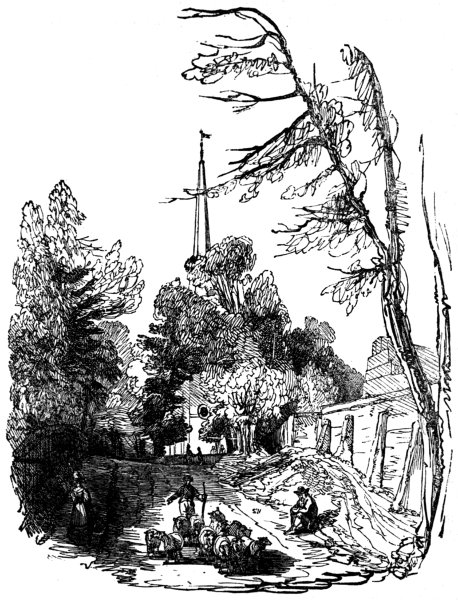
Beckenham Church, Kent.
The parish of Beckenham lends its name to the hundred, which is in the lath of Sutton-at-Hone. It is ten miles from London, two miles north from Bromley, and, according to the last census, contains 196 houses and 1180 inhabitants. The living is a rectory valued in the king’s books at 6l. 18s. 9d. The church is dedicated to St. George.
—Beyond “Chaffinch’s River” there is an enticing field-path to Beckenham, but occasional sights of noble trees kept us along the high road, till the ring of the blacksmith’s hammer signalled that we were close upon the village. We wound through it at a slow pace, vainly longing for something to realize the expectations raised by the prospect of it on our way.
Beckenham consists of two or three old farm-like looking houses, rudely encroached upon by a number of irregularly built dwellings, and a couple of inns; one of them of so much apparent consequence, as to dignify the place. We soon came to an edifice which, by its publicity, startles the feelings of the passenger in this, as in almost every other parish, and has perhaps greater tendency to harden than reform the rustic offender—the “cage,” with its accessory, the “pound.” An angular turn in the road, from these lodgings for men and cattle when they go astray, afforded us a sudden and delightful view of
“The decent church that tops the neighb’ring hill.”
On the right, an old, broad, high wall, flanked with thick buttresses, and belted with magnificent trees, climbs the steep, to enclose the domain of I know not whom; on the opposite side, the branches, from a plantation, arch beyond the footpath. At the summit of the ascent is the village church with its whitened spire, crowning and pinnacl’ing this pleasant grove, pointing from amidst the graves—like man’s last only hope—towards heaven.
This village spire is degradingly noticed in “An accurate Description of Bromley and Five Miles round, by Thomas Wilson, 1797.” He says, “An extraordinary circumstance happened here near Christmas, 1791; the steeple of this church was destroyed by lightning, but a new one was put up in 1796, made of copper, in the form of an extinguisher.” The old spire, built of shingles, was fired on the morning of the 23d of December, in the year seventeen hundred and ninety, in a dreadful storm. One of the effects of it in London I perfectly remember:—the copper roofing of the new “Stone Buildings” in Lincoln’s Inn was stripped off by the wind, and violently carried over the opposite range of high buildings, the Six Clerks’ offices, into Chancery Lane, where I saw the immense sheet of metal lying in the carriage way, exactly as it fell, rolled up, with as much neatness as if it had been executed by machinery. As regards the present spire of Beckenham church, its “form,” in relation to its place, is the most appropriate that could have been devised—a picturesque object, that marks the situation of the village in the forest landscape many miles round, and indescribably graces the nearer view.
We soon came up to the corpse-gate of the church-yard, and I left W. sketching it,[222] whilst I retraced my steps into the village in search of the church-keys at the parish clerk’s, from whence I was directed back again, to “the woman who has the care of the church,” and lives in the furthest of three neat almshouses, built at the church-yard side, by the private benefaction of Anthony Rawlings, in 1694. She gladly accompanied us, with the keys clinking, through the mournful yew-tree grove, and threw open the great south doors of the church. It is an old edifice—despoiled of its ancient font—deprived, by former beautifyings, of carvings and tombs that in these times would have been remarkable. It has remnants of brasses over the burial places of deceased rectors and gentry, from whence dates have been wantonly erased, and monuments of more modern personages, which a few years may equally deprave.
There are numerous memorials of the late possessors of Langley, a predominant estate in Beckenham. One in particular to sir Humphry Style, records that he was of great fame, in his day and generation, in Beckenham: he was “Owner of Langley in this parish, Knight and Baronet of England and Ireland, a gentleman of the privy chamber in ordinary to James I., one of the cupbearers in ordinary to King Charles, and by them boath intrusted with the weighty affairs of this countye: Hee was justice of peace and quorum, Deputy lieftenant, and alsoe (an hono’r not formerly conferred upon any) made Coronell of all the trayned band horse thereof.”
The possession of Langley may be traced, through the monuments, to its last heritable occupant, commemorated by an inscription; “Sacred to the Memory of Peter Burrell, Baron Gwydir, of Gwydir, Deputy Great Chamberlain of England, Born July 16, 1754; Died at Brighton, June 29th, 1820, aged 66 years.” After the death of this nobleman Langley was sold. The poor of Beckenham speak his praise, and lament that his charities died with him. The alienation of the estate deprived them of a benevolent protector, and no one has arisen to succeed him in the character of a kind-hearted benefactor.
A tablet in this church, to “Harriet, wife of (the present) J. G. Lambton, Esq. of Lambton Hall, Durham,” relates that she died “in her twenty-fifth year.”
Within the church, fixed against the northern corner of the west end, is a plate of copper, bearing an inscription to this import:—Mary Wragg, of St. John’s, Westminster, bequeathed 15l. per annum for ever to the curate of Beckenham, in trust for the following uses; viz. a guinea to himself for his trouble in taking care that her family vault should be kept in good repair; a guinea to be expended in a dinner for himself, and the clerk, and parish officers; 12l. 10s. to defray the expenses of such repairs; if in any year the vault should not require repair, the money to be laid out in eighteen pennyworth of good beef, eighteen pennyworth of good bread, five shillings worth of coals, and 4s. 6d. in money, to be given to each of twenty of the poorest inhabitants of the parish; if repairs should be required, the money left to be laid out in like manner and quantity, with 4s. 6d. to as many as it will extend to; and the remaining 8s. to be given to the clerk. In consequence of Mary Wragg’s bequest, her vault in the church-yard is properly maintained, and distribution made of beef, bread, and money, every 28th of January. On this occasion there is usually a large attendance of spectators; as many as please go down into the vault, and the parochial authorities of Beckenham have a holiday, and “keep wassel.”
There is carefully kept in this church a small wooden hand-box, of remarkable shape, made in king William’s time, for the receipt of contributions from the congregation when there are collections. As an ecclesiastical utensil with which I was unacquainted, W. took a drawing, and has made an engraving of it.
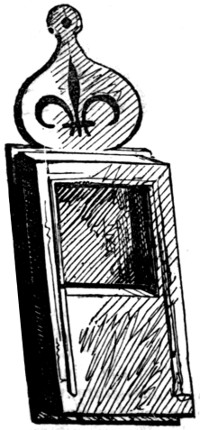
This collecting-box is still used. It is carried into the pews, and handed to the occupants, who drop any thing or nothing, as they please, into the upper part. When money is received, it passes through an open slit left between the back and the top enclosure of the lower half; which part, thus shut up, forms a box, that conceals from both eye and hand the money deposited. The contrivance might be advantageously adopted in making collections at the doors of churches generally. It is a complete security against the possibility of money being withdrawn instead of given; which, from the practice of holding open plates, and the ingenuity of sharpers, has sometimes happened.
In the middle of two family pews of this church, which are as commodious as sitting parlours, there are two ancient reading desks like large music stands, with flaps and locks for holding and securing the service books when they are not in use. These pieces of furniture are either obsolete in churches, or peculiar to that of Beckenham; at least I never saw desks of the like in any other church.
Not discovering any thing further to remark within the edifice, except its peal of five bells, we strolled among the tombs in the church-yard, which offers no inscriptions worth notice. From its solemn yew-tree grove we passed through the “Lich-gate,” already described. On our return to the road by which we had approached the church, and at a convenient spot, W. sketched the view he so freely represents in the engraving. The melodists of the groves were in full song. As the note of the parish-clerk rises in the psalm above the common voice of the congregation, so the loud, confident note of the blackbird exceeds the united sound of the woodland choir: one of these birds, on a near tree, whistled with all his might, as if conscious of our listening, and desirous of particular distinction.
Wishing to reach home by a different route than that we had come, we desired to be acquainted with the way we should go, and went again to the almshouses which are occupied by three poor widows, of whom our attendant to the church was one. She was alone in her humble habitation making tea, with the tokens of her office-bearing, the church keys, on the table before her. In addition to the required information, we elicited that she was the widow of Benjamin Wood, the late parish-clerk. His brother, a respectable tradesman in London, had raised an excellent business, “Wood’s eating-house,” at the corner of Seething-lane, Tower-street, and at his decease was enabled to provide comfortably for his family. Wood, the parish-clerk, had served Beckenham in that capacity many years till his death, which left his widow indigent, and threw her on the cold charity of a careless world. She seems to have outlived the recollection of her husband’s relatives. After his death she struggled her way into this almshouse, and gained an allowance of two shillings a week; and on this, with the trifle allowed for her services in keeping clean the church, at past threescore years and ten, she somehow or other contrives to exist.
We led dame Wood to talk of her “domestic management,” and finding she brewed her own beer with the common utensils and fire-place of her little room, we asked her to describe her method: a tin kettle is her boiler, she mashes in a common butter-firkin, runs off the liquor in a “crock,” and tuns it in a small-beer-barrel. She is of opinion that “poor people might do a great deal for themselves if they knew how: but,” says she, “where there’s a will, there’s a way.” *
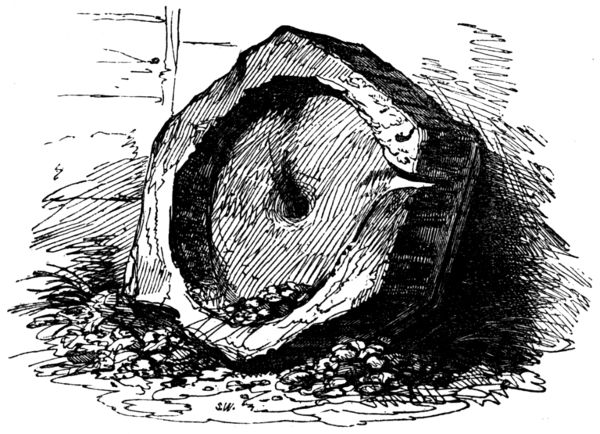
The old Font of Beckenham Church.
A font often denotes the antiquity, and frequently determines the former importance of the church, and is so essential a part of the edifice, that it is incomplete without one. According to the rubrick, a church may be without a pulpit, but not without a font; hence, almost the first thing I look for in an old church is its old stone font. Instead thereof, at Beckenham, is a thick wooden baluster, with an unseemly circular flat lid, covering a sort of wash-hand-basin, and this the “gentlemen of the parish” call a “font!” The odd-looking thing was “a present” from a parishioner, in lieu of the ancient stone font which, when the church was repaired after the lightning-storm, was carried away by Mr. churchwarden Bassett, and placed in his yard. It was afterwards sold to Mr. Henry Holland, the former landlord of the “Old Crooked Billet,” on Penge Common, who used it for several years as a cistern, and the present landlord has it now in his garden, where it appears as represented in the engraving. Mr. Harding expresses an intention of making a table of it, and placing it at the front of his house: in the interim it is depicted here, as a hint, to induce some regard in Beckenham people, and save the venerable font from an exposure, which, however intended as a private respect to it by the host of the “Crooked Billet,” would be a public shame to Beckenham parish.
For the Table Book.
GONE or GOING.
1.
Fine merry franions, Wanton companions, My days are ev’n banyans With thinking upon ye; How Death, that last stringer, Finis-writer, end-bringer, Has laid his chill finger, Or is laying, on ye. 2. There’s rich Kitty Wheatley, With footing it featly That took me completely, She sleeps in the Kirk-house; And poor Polly Perkin, Whose Dad was still ferking The jolly ale firkin— She’s gone to the Work-house: 3. Fine gard’ner, Ben Carter (In ten counties no smarter) Has ta’en his departure For Proserpine’s orchards; And Lily, postillion, With cheeks of vermilion, Is one of a million That fill up the church-yards. 4. And, lusty as Dido, Fat Clemitson’s widow Flits now a small shadow By Stygian hid ford; And good Master Clapton Has thirty years nap’t on The ground he last hap’t on; Intomb’d by fair Widford; 5. And gallant Tom Docwra, Of Nature’s finest crockery, Now but thin air and mockery, Lurks by Avernus; Whose honest grasp of hand, Still, while his life did stand, At friend’s or foe’s command, Almost did burn us. 6. (Roger de Coverly Not more good man than he), Yet is he equally Push’d for Cocytus, With cuckoldy Worral, And wicked old Dorrel, Gainst whom I’ve a quarrel— His death might affright us! 7. Had he mended in right time, He need not in night time, (That black hour, and fright-time,) Till sexton interr’d him, Have groan’d in his coffin, While demons stood scoffing— You’d ha’ thought him a coughing— My own father[223] heard him! 8. Could gain so importune, With occasion opportune, That for a poor Fortune, That should have been ours,[224] In soul he should venture To pierce the dim center, Where will-forgers enter, Amid the dark Powers?— 9. Kindly hearts I have known; Kindly hearts, they are flown; Here and there if but one Linger, yet uneffaced,— Imbecile, tottering elves, Soon to be wreck’d on shelves, These scarce are half themselves, With age and care crazed. 10. But this day, Fanny Hutton Her last dress has put on; Her fine lessons forgotten, She died, as the dunce died; And prim Betsey Chambers, Decay’d in her members, No longer remembers Things, as she once did: 11. And prudent Miss Wither Not in jest now doth wither, And soon must go—whither Nor I, well, nor you know; And flaunting Miss Waller— That soon must befal her, Which makes folks seem taller,[225]— Though proud, once, as Juno!
Elia.
Scottish Legends.
HIGHLAND SCENERY.
The scenery and legend of Mr. James Hay Allan’s poem, “The Bridal of Caölchairn,” are derived from the vicinity of Cruachan, (or Cruachan-Beinn,) a mountain 3390 feet above the level of the sea, situated at the head of Loch Awe, a lake in Argyleshire. The poem commences with the following lines: the prose illustrations are from Mr. Allan’s descriptive notes.
Grey Spirit of the Lake, who sit’st at eve At mighty Cruächan’s gigantic feet; And lov’st to watch thy gentle waters heave The silvery ripple down their glassy sheet; How oft I’ve wandered by thy margin sweet, And stood beside the wide and silent bay, Where the broad Urcha’s stream thy breast doth meet, And Caölchairn’s forsaken Donjon grey Looks from its narrow rock upon thy watery way. Maid of the waters! in the days of yore What sight yon setting sun has seen to smile Along thy spreading bound, on tide, and shore, When in its pride the fortress reared its pile, And stood the abbey on “the lovely isle;” And Fraòch Elan’s refuge tower grey Looked down the mighty gulf’s profound defile. Alas! that Scottish eye should see the day, When bower, and bield, and hall, in shattered ruin lay. What deeds have past upon thy mountain shore; What sights have been reflected in thy tide; But dark and dim their tales have sunk from lore: Scarce is it now remembered on thy side Where fought Mac Colda, or Mac Phadian died. But lend me, for a while, thy silver shell, ’Tis long since breath has waked its echo wide; Then list, while once again I raise its swell, And of thy olden day a fearful legend tell—
INISHAIL.
“——the convent on the lovely isle.”
Inishail, the name of one of the islands in Loch Awe, signifies in Gaëlic “the lovely isle.” It is not at present so worthy of this appellation as the neighbouring “Fràoch Elan,” isle of heather, not having a tree or shrub upon its whole extent. At the period when it received its name, it might, however, have been better clothed; and still it has a fair and pleasant aspect: its extent is larger than that of any other island in the lake, and it is covered with a green turf, which, in spring, sends forth an abundant growth of brackens.
There formerly existed here a convent of Cistercian nuns; of whom it is said, that they were “memorable for the sanctity of their lives and the purity of their manners: at the Reformation, when the innocent were involved with the guilty in the sufferings of the times, their house was supprest, and the temporalities granted to Hay, the abbot of Inchaffrey, who, abjuring his former tenets of religion, embraced the cause of the reformers.”[226] Public worship was performed in the chapel of the convent till the year 1736: but a more commodious building having been erected on the south side of the lake, it has since been entirely forsaken; nothing now remains of its ruin but a small part of the shell, of which only a few feet are standing above the foundation. Of the remaining buildings of the order there exists no trace, except in some loose heaps of stones, and an almost obliterated mound, which marks the foundation of the outer wall. But the veneration that renders sacred to a Highlander the tombs of his ancestors, has yet preserved to the burying-ground its ancient sanctity. It is still used as a place of interment, and the dead are often brought from a distance to rest there among their kindred.
In older times the isle was the principal burying-place of many of the most considerable neighbouring families: among the tombstones are many shaped in the ancient form, like the lid of a coffin, and ornamented with carvings of fret-work, running figures, flowers, and the forms of warriors and two-handed swords. They are universally destitute of the trace of an inscription.
Among the chief families buried in Inishail were the Mac Nauchtans of Fràoch Elan, and the Campbells of Inbherau. Mr. Allan could not discover the spot appropriated to the former, nor any evidence of the gravestones which must have covered their tombs. The place of the Campbells, however, is yet pointed out. It lies on the south side of the chapel, and its site is marked by a large flat stone, ornamented with the arms of the family in high relief. The shield is supported by two warriors, and surmounted by a diadem, the signification and exact form of which it is difficult to decide; but the style of the carving and the costume of the figures do not appear to be later than the middle of the fifteenth century.
On the top of the distant hill over which the road from Inverara descends to Cladich there formerly stood a stone cross, erected on the spot where Inishail first became visible to the traveller. These crosses were general at such stations in monastic times, and upon arriving at their foot the pilgrims knelt and performed their reverence to the saint, whose order they were approaching. From this ceremony, the spot on the hill above-mentioned was and is yet called “the cross of bending.”
FRAOCH ELAN.
“The refuge tower grey Looked down the mighty gulf’s profound defile.”
The little castellated isle of “Fràoch Elan” lies at a short distance from Inishail, and was the refuge hold of the Mac Nauchtans. It was given to the chief, Gilbert Mac Nauchtan, by Alexander III. in the year 1276, and was held by the tenure of entertaining the king whenever he should pass Loch Awe. The original charter of the grant was lately in possession of Mr. Campbell of Auchlian, and a copy is to be found in “Sir James Balfour’s Collection of Scottish Charters.” The islet of “Fràoch Elan” is in summer the most beautiful in Scotland. On one side the rock rises almost perpendicular from the water. The lower part and the shore is embowered in tangled shrubs and old writhing trees. Above, the broken wall and only remaining gable of the castle looks out over the boughs; and on the north side a large ash-tree grows from the foundation of what was once the hall, and overshadows the ruin with its branches. Some of the window-niches are yet entire in the keep, and one of these peeping through the tops of the trees, shows a view of fairie beauty over the waters of the lake, and the woody banks of the opposite coast. In the summer, Fràoch Elan, like most of the islands in Loch Awe, is the haunt of a variety of gulls and wild fowl. They come from the sea-coast, a distance of twenty-four miles, to build and hatch their young. At this season, sheldrakes, grey gulls, kitaweaks, white ducks, teal, widgeon, and divers, abound in the Loch. Fràoch Elan is chiefly visited by the gulls, which hold the isle in joint tenure with a water-eagle who builds annually upon the top of the remaining chimney.
It is not very long since this beautiful isle has been delivered over to these inhabitants; for a great aunt of a neighbouring gentleman was born in the castle, and in “the forty-five,” preparations were privately made there for entertaining the prince had he passed by Loch Awe.
From the name of Fràoch Elan some have erroneously, and without any authority of tradition, assigned it as the dragon’s isle,[227] in the ancient Gaëlic legend of “Fràoch and the daughter of Mey.” There is, in truth, no farther relation between one and the other, than in a resemblance of name between the island and the warrior. The island of the tale was called “Elan na Bheast,” the Monster’s Isle, and the lake in which it lay was named Loch Luina. This is still remembered to have been the ancient appellation of Loch Avich, a small lake about two miles north of Loch Awe. There is here a small islet yet called “Elan na Bheast,” and the tradition of the neighbourhood universally affirms, that it was the island of the legend.
RIVAL CHIEFS.
“Where fought Mac Colda, and Mac Phadian died.”
“Alaister Mac Coll Cedach.” Alexander, the son of left-handed Coll, was a Mac Donald, who made a considerable figure in the great civil war: he brought two thousand men to the assistance of Montrose, and received from him a commission of lieutenancy in the royal service. He is mentioned by contemporary writers, under the corrupted name of Kolkitto; but time has now drawn such a veil over his history, that it is difficult to ascertain with any degree of certainty from what family of the Mac Donalds he came. By some it is asserted, that he was an islesman; but by the most minute and seemingly authentic tradition, he is positively declared to have been an Irishman, and the son of the earl of Antrim.
Of his father there is nothing preserved but his name, his fate, and his animosity to the Campbells, with whom, during his life, he maintained with deadly assiduity the feud of his clan. It was his piper who was hanged at Dunavàig in Ceantir, and in his last hour saved the life of his chieftain by composing and playing the inexpressibly pathetic pibroch, “Colda mo Roon.” But though he escaped at this juncture, Colda was afterwards taken by the Campbells, and hung in chains at Dunstaffnage. His death was the chief ground of that insatiate vengeance with which his son ever after pursued the followers of Argyle. Long after the death of his father, Alaister chanced to pass by Dunstaffnage in return from a descent which he had made in the Campbell’s country. As he sailed near the castle, he saw the bones of his father still hanging at the place where he had suffered, and swinging in the sea-breeze. He was so affected at the sight of the lamentable remains, that he solemnly vowed to revenge them by a fearful retribution, and hastening his return to Ireland gathered what force he was able, and sailing back to Scotland offered his services to Montrose. He was gladly accepted; and during the various adventures of the marquis in the Hielands, Alaister Mac Colda was one of the most valuable of his adherents; and his followers were accounted among the bravest and best experienced in the royal army. Some of their exploits are recorded in the “Leobhair Dearg,” or “Red Book of Clanranald,” and fully justify the fame which they received.
Alaister was present at the battle of Inbherlochie, and after the action he was sent with his followers to the country of Argyle. He entered the Campbell lands by Glen Eitive, and wherever he came put all who bore the name of that clan to fire and sword. As he marched down Glen Eitive, he crossed the bounds of the Mac Intires in Glen O, and in passing the house of their chieftain, a circumstance occurred, which gives a lively picture of the extent of the ancient respect paid by a clansman to the ties of his blood. The Mac Intires were originally descended from the Mac Donalds, and lived from time immemorial upon the border of the Campbells, between that race and the south-east march of the Clan Donald in Glen Coe. Upon the decline of the vast power of this sept after the fatal battle of Harlow, and upon the subsequent increase of power to the Campbells, the Mac Intires placed themselves under the latter clan, and lived with them as the most powerful of their followers. When Alaister Mac Colda passed through Glen O, he was not acquainted with the name of the place nor the race of its inhabitants; but knowing that he was within the bounds of the Campbells, he supposed that all whom he met were of that clan. Glen O was deserted at his approach, and it is probable that the men were even then in service with Argyle. Alaister, in his usual plan of vengeance, ordered fire to the house of the chieftain. A coal was instantly set in the roof, and the heather of which it was made was quickly in a blaze. Before, however, the flames had made much progress, Alaister was told that the house which he was burning was that of the chieftain of Mac Intire. The man of Mac Donald immediately commanded his people to do their endeavour to extinguish the fire; “for,” said he, “it is the house of our own blood.”[228] The flames were soon overcome, and Colda passed through the glen of the Mac Intires in peace into Glen Urcha, where he burnt and destroyed all within his reach. From hence, he marched entirely round Loch Awe, carrying devastation through the ancient and original patrimony of the Campbells. As he passed by the Loch of Ballemòr, the inhabitants (a small race named Mac Chorchadell, and dependant upon the former clan) retired from their huts into the little castle of their chieftain, which is situated in the midst of the Loch. Being in no way connected with his enemies by blood, Alaister did not conceive that with them he held any feud, and quietly marched past their deserted habitations, without laying a hand upon their property. But as his men were drawing from the lake, one of the Mac Chorchadells fired upon their rear, and wounded a Mac Donald. Alaister instantly turned: “Poor little Mac Chorchadell,” said he in Gaëlic, “I beg your pardon for my want of respect in passing you without stopping to pay my compliments; but since you will have it so, I will not leave you without notice.”—He returned, and burnt every house in Ballemòr.
The power of the Campbells had been so broken at Inbherlochie, that it was not until Mac Colda had arrived near the west coast of their country, that they were again in a condition to meet him in a pitched fight. At length they encountered him on the skirt of the moss of Crenan, at the foot of a hill not far from Auchandaroch. The battle was fought with all the fury of individual and deadly hatred, but at last the fortune of Alaister prevailed, and the Campbells were entirely routed, and pursued with great slaughter off the field of battle. Some time afterwards they again collected what numbers they could gather, and once more offered battle to Alaister, as he was returning to Loch Awe. The conflict was fought at the ford of Ederline, the eastern extremity of the lake; but here the success of the Mac Donalds forsook them. They were entirely beaten and scattered, so that not six men were left together; and those who escaped from the field were cut off by their enemies, as they endeavoured to lurk out of their country. Of Alaister’s fate each clan and each district has a different story. The Argyle Campbells say that he was killed at the ford, and a broadsword said to have been his, and to have been found on the field of battle, is at this day in the possession of Peter Mac Lellich (smith), at the croft of Dalmallie. The Louden Campbells, on the contrary, assert, that Alaister escaped from the overthrow, and wandering into Ayrshire, was slain by them while endeavouring to find a passage into Ireland. The Mac Donalds do not acknowledge either of these stories to be true, but relate that their chieftain not only escaped from the battle, but (though with much difficulty) effected his flight to Ireland, where a reward being set upon his head, he was at length, in an unguarded moment, when divested of his arms, slain by one of the republican troopers, by whom he was sought out.
The fate of Alaister Mac Colda is said to have been governed by that fatality, and predicted by that inspiration, which were once so firmly believed among the Highlanders. His foster-mother, says tradition, was gifted with the second sight; and, previous to his departure from Ireland, the chieftain consulted her upon the success of his expedition. “You will be victorious over all born of woman,” replied the seer, “till you arrive at Goch-dum Gho; but when you come to that spot, your fortune shall depart for ever.”—“Let it be so,” said Alaister, “I shall receive my glory.” He departed, and the spirit of his adventure and the hurry of enterprise, perhaps, banished from his mind the name of the fatal place. It was indeed one so insignificant and remote, that its knowledge was most probably confined to the circle of a few miles, and not likely to be restored to the notice of Mac Colda, by mention or inquiry. It was on the eve of his last battle, as his “bratach” was setting up at the ford of Ederline, that his attention was caught by a mill at a little distance; for some accidental reason he inquired its name:—“Mullian Goch-dum Gho,” replied one of his men. The prediction was at once remembered. The enemy were at hand, and Alaister knew that he should fall. Convinced of the fatality of the prophecy, he sought not to retreat from the evil spot: the bourne of his fortune was past, and he only thought of dying as became him in the last of his fields. He made no comment upon the name of the place; but, concealing from his followers the connection which it bore with his fate, gave directions for the proceedings of the approaching morning. In the battle he behaved as he was wont, and in the close of the day was seen fighting furiously with two of the Campbells, who appeared unable to overcome him. Nothing more was heard of him: his body was never discovered; but when the slain were buried by the conquerors, his claidh-mòr was found beneath a heap of dead.
Mac Phadian was an Irish captain, who, with a considerable body of his countrymen, assisted Edward I. of England in his war to subvert the independence of Scotland; but though he took a very active part in the turbulent period in which he lived, and possessed sufficient courage and talents to raise himself from obscurity to power, yet we have nothing left of his history but the account of his last enormities, and the overthrow and death which they finally brought. It is probable, that we are even indebted for this information to the celebrity of the man by whom he fell, and which in preserving the victory of the conqueror, has also perpetuated the memory of the vanquished.
The scene of the last actions of Mac Phadian lay in Lorn and Argyle; and the old people in the neighbourhood of Loch Awe still retain a tradition, which marks out the spot where he fell. Time, however, and the decay of recitation during the last century, have so injured all which remained of oral record, that the legend of Mac Phadian is now confined to a very few of the elder fox-hunters and shepherds of the country, and will soon pass into oblivion with those by whom it is retained——
Some time in the latter end of the year 1297, or the beginning of the year 1298, Edward made a grant to Mac Phadian of the lordships of Argyle and Lorn. The first belonged to sir Niel Campbell, knight, of Loch Awe, and chief of his clan; the second was the hereditary patrimony of John, chief of Mac Dougall. Sir Niel did his endeavour to resist the usurpation of his lands, and though fiercely beset by the traitor lords, Buchan, Athol, and Mentieth, he for some time maintained his independence against all their united attempts. But John of Lorn, who was himself in the interest and service of the English, and at that time in London, concurred with king Edward in the disponing of his territories, and received in remuneration a more considerable lordship. Mac Phadian did not, however, remain in quiet possession of his ill-acquired domains; he was strongly opposed by Duncan of Lorn, uncle to the lord; but joining with Buchan, Athol, and Mentieth, he at length drove out his enemy, and compelled him to seek shelter with sir Niel Campbell. Upon this success the above-mentioned allies, at the head of a mixed and disorderly force gathered from all parts, and from all descriptions, Irish and Scots, to the amount of fifteen thousand men, made a barbarous inroad into Argyle, and suddenly penetrating into the district of Nether Loch Awe, wasted the country wherever they came, and destroyed the inhabitants without regard to age or sex. In this exigency the Campbell displayed that constancy and experience which had rendered his name celebrated among his countrymen. Unable to resist the intoxicated multitude of his enemies, with Duncan of Lorn, and three hundred of his veteran clansmen, he retired by the head of Loch Awe and the difficult pass of Brandir to the inaccessible heights of Craiganuni, and breaking down the bridge over the Awe below, prevented the pursuit of the enemy to his position. Nothing could be more masterly than the plan of this retreat.
Mac Phadian, thus baffled and outmanœuvred, not only failed in his object of offence, but found himself drawn into an intricate and desolate labyrinth, where his multitude encumbered themselves: the want of subsistence prevented him from remaining to blockade sir Niel, and his ignorance of the clues of the place made it difficult to extricate himself by a retreat. In this exigence he was desirous of returning to Nether Loch Awe, where there was abundance of cattle and game for the support of his men. At length he discovered a passage between the rocks and the water; the way was only wide enough for four persons to pass abreast; yet, as they were not in danger of pursuit, they retired in safety, and effected their march to the south side of the lake.
The measures employed by Wallace to relieve the Campbell, and to reach the fastness wherein Mac Phadian had posted himself, were romantic and daring——
Mac Phadian’s followers were completely surprised and taken at disarray. They snatched their arms, and rushed to defend the pass with the boldest resolution. At the first onset the Scots bore back their enemies over five acres of ground; and Wallace, with his iron mace, made fearful havoc among the enemy. Encouraged, however, by Mac Phadian, the Irish came to the rescue; the battle thickened with more stubborn fury; and for two hours was maintained with such obstinate eagerness on both sides, that neither party had any apparent advantage. At length the cause and valour of Wallace prevailed. The Irish gave way and fled, and the Scots of their party threw down their arms, and kneeled for mercy. Wallace commanded them to be spared for their birth sake, but urged forward the pursuit upon the Irish. Pent in by the rocks and the water, the latter had but little hope in flight. Many were overtaken and slain as they endeavoured to climb the crags, and two thousand were driven into the lake and drowned. Mac Phadian, with fifteen men, fled to a cave, and hoped to have concealed himself till the pursuit was over; but Duncan of Lorn having discovered his retreat, pursued and slew him with his companions; and having cut off the head of the leader, brought it to Wallace, and set it upon a stone high in one of the crags as a trophy of the victory.
In one of the steeps of Cruächan, nearly opposite the rock of Brandir, there is a secret cave, now only known to a very few of the old fox-hunters and shepherds: it is still called “Uagh Phadian,” Mac Phadian’s cave; and is asserted by tradition to be the place in which Mac Phadian died. The remembrance of the battle is nearly worn away, and the knowledge of the real cave confined to so few, that the den in which Mac Phadian was killed is generally believed to be in the cliffs of Craiganuni: this is merely owing to the appearance of a black chasm in the face of that height, and to a confusion between the action of Mac Phadian with Wallace, and his pursuit of sir Niel Campbell. But the chasm in Craiganuni, though at a distance it appears like the mouth of a cave, is but a cleft in the rock; and the few who retain the memory of the genuine tradition of the battle of the Wallace, universally agree that the cave in the side of Cruächan was that in which Mac Phadian was killed.
The “Bridal of Caölchairn” is a legendary poem, founded upon a very slight tradition, concerning events which are related to have occurred during the absence of sir Colin Campbell on his expedition to Rome and Arragon. It is said by the tale, that the chieftain was gone ten years, and that his wife having received no intelligence of his existence in that time, she accepted the addresses of one of her husband’s vassals, Mac Nab of Barachastailan. The bridal was fixed; but on the day when it was to have been solemnized, the secret was imparted to sir Colin in Spain, by a spirit of the nether world. When the knight received the intelligence, he bitterly lamented the distance which prevented him from wreaking vengeance upon his presumptuous follower. The communicating spirit, either out of love for mischief, or from a private familiarity with sir Colin, promised to obviate this obstacle; and on the same day, before the bridal was celebrated, transported the chieftain in a blast of wind from Arragon to Glen Urcha. In what manner sir Colin proceeded, tradition does not say; it simply records, that the bridal was broken, but is silent upon the nature of the catastrophe. The legend is now almost entirely forgotten in the neighbourhood where its events are said to have taken place. “As far as I know,” says Mr. Allan, “it is confined to one old man, named Malcolm Mac Nab, who lives upon the hill of Barachastailan; he is between eighty and ninety years of age, and the last of the race of ancient smiths, who remains in the place of his ancestors. A few yards from his cottage there is the foundation of one of those ancient circular forts built by the Celts, and so frequently to be met in the Highlands: these structures are usually ascribed by the vulgar to Fion and his heroes. In a neighbouring field, called ‘Larich nam Fion,’ there were formerly two others of these buildings; their walls of uncemented stone were not many years since entire, to the height of eight or nine feet; but they have since been pulled down and carried away to repair the neighbouring cottages: it is from these buildings that the hill received its name of ‘Bar-a-chas-tailan,’ the ‘eminence of the castles.’”
The tide of centuries has rolled away O’er Innishail’s solitary isle, The wind of ages and the world’s decay Has swept upon the Campbells’ fortress pile: And far from what they were is changed the while The monks’ grey cloister, and the baron’s keep. I’ve seen the sun within the dungeon smile, And in the bridal bower the ivy creep. I’ve stood upon the fane’s foundation stone, Heard the grass sigh upon the cloister’s heap, And sat upon the holy cross o’erthrown, And marked within the cell where warriors sleep, Beneath the broad grey stone the timorous rabbit peep. The legend of the dead is past away As the dim eye amid the night doth fail. The memorie of the fearful bridal day Is parted from the people of the vale; And none are left to tell the weary tale. Save on yon lone green hill by Fion’s tower Yet lives a man bowed down with age and ail: Still tells he of the fearful legend’s hour— It was his father fell within the bridal bower. But though with man there is a weary waste. It is not so beyond the mortal way; With the unbodied spirits nought is spaced; But when the aged world has worn away, They look on earth where once their dwelling lay. And to their never-closing eye doth show All that has been—a fairie work of day; And all which here their mortal life did show, Yet lives in that which never may decay; When thought, and life, and memorie below Has sunk with all it bore of gladness or of woe. At eventime on green Inchail’s isle A dim grey form doth sit upon the hill: No shadow casts it in the moonshine smile, And in its folded mantle bowed and still No feature e’er it showed the twilight chill, But seems beneath its hood a void grey. The owlet, when it comes, cries wild and shrill; The moon grows dim when shows it in its ray, None saw it e’er depart;—but it is not at day. By Caölchairn at night when all is still, And the black otter issues from his lair, He hears a voice along the water chill, It seems to speak amid the cloudy air; But some have seen beyond the Donjon stair Where now the floor from the wall is gone, A form dim standing ’mid the ether fair, No light upon its fixed eye there shone, And yet the blood seems wet upon its bosom wan.
MY ARM-CHAIR.
For the Table Book.
In my humble opinion an arm-chair is far superior to a sofa; for although I bow to Cowper’s judgment, (who assigned the superiority to the sofa,) yet we must recollect that it was in compliance with the request of a fair lady that he chose that subject for praise: he might have eulogized in equal terms an arm-chair, had he consulted his own feelings and appreciation of comfort. I acknowledge the “soft recumbency of outstretched limbs,” so peculiar to the sofa—the opportunity afforded the fair sex of displaying grace and elegance of form, while reposing in easy negligence on a Grecian couch—but then think of the snug comfort of an easy-chair. Its very name conveys a multitude of soothing ideas: its commodious repose for your back; its generous and unwearied support of your head; its outstretched arms wooing you to its embraces:—think on these things, and ask yourself if it be possible to withstand its affectionate and disinterested advances.
On entering a room where there is an easy-chair, you are struck by the look of conscious self-importance which seems to distinguish it as the monarch of all the surrounding chairs; there is an appearance of regal superiority about it, blended, however, with such a charming condescension, that you immediately avail yourself of its gracious inclination to receive the burden of your homage.
There is one kind of arm-chair for which I entertain a very resentful feeling, it assumes the title of an easy-chair to induce you to believe it one of that amiable fraternity, whereas it only claims kindred on account of its shape, and is in reality the complete antipodes of ease—I mean the horse-hair arm-chair. Its arms, like those of its brethren, invite you to repose; but, if you attempt it, you are repulsed by an ambush of sharp shooting prickles. It is like a person who has a desire to please and obtain you for his friend, but who is of so incorrigibly bad a temper that attachment is impossible. If you try to compose yourself with one of these pretenders, by endeavouring to protect the back of your head with your pocket-handkerchief for a pillow, you either dream that you are under the hands of a surgeon who is cupping you on the cheek, or that you are transformed into your cousin Lucy, and struggling to avoid being kissed by old Mr. D——, who does not shave above once a week. When you awake, you discover that your face has slipped off the handkerchief, and come immediately in contact with the chevaux de frise of bristles.
As an excellent specimen of an easy-chair, I select the one I at present occupy. Its ancient magnificence of red damask silk—embossed in wavy flowers and curved arabesques, surrounded by massive gilt carving—is now shrouded with an unostentatious covering of white dimity. This, however, does not compromise its dignity—it is rather a resignation of fatiguing splendour, and the assumption of the ease suitable to retirement in old age. Perhaps a happy father once sat in it surrounded by his smiling offspring: some climbing up the arms; others peeping over the lofty back, aiming to cling round his neck; his favourite little girl insinuating herself behind him, while he gazes with affectionate but anxious thoughts on the countenance of his eldest son, standing between his knees. Perhaps two lovers once sat in it together, although there were plenty of other chairs in the room. (For fear some of my fair readers should be incredulous, I beg leave to assure them that it is quite possible for two people to sit together in an arm-chair, if they choose to be accommodating; therefore I would not have them dislike an easy-chair on the plea of its being unsocial.) Perhaps it may have been the means of concealment—in a similar way with the arm-chair in “Le Nozze di Figaro.” Often have I when a child curled myself round in it, and listened to my old nurse’s wonderful stories, till I have fallen fast asleep. Often have I since enjoyed many a delightful book, while lolling indolently enclosed in its soft, warm, cushioned sides—
M. H.
Garrick’s Plays. No. XXII.
[From “Querer Por Solo Querer:” concluded from last Number.]
Address to Solitude.
Sweet Solitude! still Mirth! that fear’st no wrong, Because thou dost none: Morning all day long! Truth’s sanctuary! Innocency’s spring! Inventions Limbeck! Contemplation’s wing! Peace of my soul, which I too late pursued; That know’st not the world’s vain inquietude: Where friends, the thieves of time, let us alone Whole days, and a man’s hours are all his own.
Song in praise of the Same.
Solitude, of friends the best, And the best companion; Mother of truths, and brought at least Every day to bed of one: In this flowery mansion I contemplate how the rose Stands upon thorns, how quickly goes The dismaying jessamine: Only the soul, which is divine, No decay of beauty knows. The World is Beauty’s Mirror. Flowers, In their first virgin purity, Flatt’rers both of the nose and eye.— To be cropt by paramours Is their best of destiny: And those nice darlings of the land, Which seem’d heav’n’s painted bow to scorn. And bloom’d the envy of the morn, Are the gay trophy of a hand.
Unwilling to love again.
—sadly I do live in fear, For, though I would not fair appear, And though in truth I am not fair, Haunted I am like those that are And here, among these rustling leaves, With which the wanton wind must play, Inspired by it, my sense perceives This snowy Jasmin whispering say, How much more frolic, white, and fair In her green lattice she doth stand, To enjoy the free and cooler air, Than in the prison of a hand.[229]
Loving without hope.
I look’d if underneath the cope Were one that loved, and did not hope; But from his nobler soul remove That modern heresy in love When, hearing a shrill voice, I turn, And lo! a sweet-tongued Nightingale, Tender adorer of the Morn,— In him I found that One and All. For that same faithful bird and true, Sweet and kind and constant lover, Wond’rous passion did discover, From the terrace of an eugh. And tho’ ungrateful she appear’d Unmoved with all she saw and heard; Every day, before ’twas day, More and kinder things he’d say, Courteous, and never to be lost, Return’d not with complaints, but praise Loving, and all at his own cost; Suffering, and without hope of ease: For with a sad and trembling throat He breathes into her breast this note: “I love thee not, to make thee mine; But love thee, ’cause thy form’s divine.”
The True Absence in Love.
Zelidaura, star divine, That do’st in highest orb of beauty shine; Pardon’d Murd’ress, by that heart Itself, which thou dost kill, and coveted smart Though my walk so distant lies From the sunshine of thine eyes; Into sullen shadows hurl’d, To lie here buried from the world ’Tis the least reason of my moan, That so much earth is ’twixt us thrown. ’Tis absence of another kind, Grieves me; for where you are present too, Love’s Geometry does find, I have ten thousand miles to you. ’Tis not absence to be far, But to abhor is to absent; To those who in disfavour are, Sight itself is banishment.[230]
To a Warrioress.
Heav’n, that created thee thus warlike, stole Into a woman’s body a man’s soul. But nature’s law in vain dost thou gainsay; The woman’s valour lies another way. The dress, the tear, the blush, the witching eye. More witching tongue, are beauty’s armoury: To railly; to discourse in companies, Who’s fine, who courtly, who a wit, who wise; And with the awing sweetness of a Dame, As conscious of a face can tigers tame, By tasks and circumstances to discover, Amongst the best of Princes, the best Lover; (The fruit of all those flowers) who serves with most Self diffidence, who with the greatest boast; Who twists an eye of Hope in braids of Fear; Who silent (made for nothing but to bear Sweet scorn and injuries of love) envies Unto his tongue the treasure of his eyes: Who, without vaunting shape, hath only wit; Nor knows to hope reward, tho’ merit it: Then, out of all, to make a choice so rare, So lucky-wise, as if thou wert not fair.[231]
All mischiefs reparable but a lost Love.
1.
A second Argo, freighted With fear and avarice, Between the sea and skies Hath penetrated To the new world, unworn With the red footsteps of the snowy morn. 2. Thirsty of mines; She comes rich back; and (the curl’d rampire past Of watry mountains, cast Up by the winds) Ungrateful shelf near home Gives her usurped gold a silver home. 3. A devout Pilgrim, who To foreign temple bare Good pattern, fervent prayer, Spurr’d by a pious vow; Measuring so large a space, That earth lack’d regions for his plants[232] to trace. 4. Joyful returns, tho’ poor: And, just by his abode, Falling into a road Which laws did ill secure, Sees plunder’d by a thief (O happier man than I! for ’tis) his life. 5. Conspicuous grows a Tree, Which wanton did appear, First fondling of the year. With smiling bravery, And in his blooming pride The Lower House of Flowers did deride: 6. When his silk robes and fair (His youth’s embroidery, The crownet of a spring, Narcissus of the air) Rough Boreas doth confound, And with his trophies strews the scorned ground. 7. Trusted to tedious hope So many months the Corn; Which now begins to turn Into a golden crop: The lusty grapes, (which plump Are the last farewell of the summer’s pomp) 8. How spacious spreads the vine!— Nursed up with how much care, She lives, she thrives, grows fair; ’Bout her loved Elm doth twine:— Comes a cold cloud; and lays, In one, the fabric of so many days. 9. A silver River small In sweet accents His music vents, (The warbling virginal, To which the merry birds do sing— Timed with stops of gold[233] the silver string); 10. He steals by a greenwood With fugitive feet; Gay, jolly, sweet: Comes me a troubled flood; And scarcely one sand stays, To be a witness of his golden days.— 11. The Ship’s upweigh’d; The Pilgrim made a Saint; Next spring re-crowns the Plant; Winds raise the Corn, was laid; The Vine is pruned; The Rivulet new tuned:— But in the Ill I have I’m left alive only to dig my grave. 12. Lost Beauty, I will die, But I will thee recover; And that I die not instantly, Shews me more perfect Lover: For (my Soul gone before) I live not now to live, but to deplore.
C. L.
WELSH WEDDINGS.
From a Lady—To the Editor.
Sir,—If a brief account of the manner of celebrating marriage in some parts of Wales should afford entertainment to your readers, I shall feel gratified.
The early part of my life was spent at a village in the mountainous part of Glamorganshire, called Myrther Tidvel. Since then it has become a considerable place for the manufactory of iron, and I expect both the manners and inhabitants are much changed: the remembrance of its rural and lovely situation, and of the simplicity of its humble villagers, when I lived amongst them, often produces in my mind the most pleasing sensations.
Some weeks previous to a wedding taking place, a person, well-known in the parish, went round and invited all, without limitation or distinction, to attend. As the ceremonies were similar I shall select one, as an illustration, in which I took part as bride’s-maid to a much valued servant.
On the evening previous to the marriage, a considerable company assembled at the bride’s father’s, and in a short time the sound of music proclaimed the approach of the bridegroom. The bride and her company were then shut up in a room, and the house-doors locked; great and loud was the cry for admittance from without, till I was directed, as bride’s-maid, by an elderly matron, to open the window, and assist the bridegroom to enter, which being done the doors were set open, and his party admitted. A room was set apart for the young people to dance in, which continued for about an hour, and having partaken of a common kind of cake and warm ale, spiced and sweetened with sugar, the company dispersed.
At eight, next morning, I repaired to the house of the bridegroom, where there had assembled in the course of an hour about one hundred and fifty persons: he was a relation to the dissenting minister, a man highly esteemed; and he was much respected on that as well as his own account. The procession set out, preceded by a celebrated harper playing “Come, haste to the wedding;” the bridegroom and I came next, and were followed by the large company. At the door of the bride’s father we were met by the bride, led by her brother, who took their station behind the bridegroom and me; her company joining, and adding nearly as many again to the procession: we then proceeded to the church, the music playing as before. After the ceremony the great door of the church was opened, and the bride and her maid having changed their partners were met at it by the harper, who struck up “Joy to the bridegroom,” and led the way to a part of the church-yard never used as a burial-ground; there placing himself under a large yew-tree the dancers immediately formed, the bride and bridegroom leading off the two first dances,—“The beginning of the world,” and “My wife shall have her way:” these are never danced but on like occasions, and then invariably.
By this time it was twelve o’clock, and the bride and bridegroom, followed by a certain number, went into the house, where a long table was tastefully set out with bread of two kinds, one plain and the other with currants and seeds in it; plates of ornamented butter; cold and toasted cheese; with ale, some warmed and sweetened. The bride and her maid were placed at the head of the table, and the bridegroom and her brother at the bottom. After the company had taken what they liked, a plate was set down, which went round, each person giving what they chose, from two to five shillings; this being done, the money was given to the bride, and the company resigned their places to others; and so on in succession till all had partaken and given what they pleased. Dancing was kept up till seven, and then all dispersed. At this wedding upwards of thirty pounds was collected.
In an adjoining parish it was the custom for the older people to go the evening before, and take presents of wheat, meal, cheese, tea, sugar, &c., and the young people attended next day, when the wedding was conducted much in the way I have described, but smaller sums of money were given.
This method of forwarding young people has always appeared to me a pleasing trait in the Welsh character; but it only prevails amongst the labouring classes.
When a farmer’s daughter, or some young woman, with a fortune of from one hundred to two hundred pounds, marries, it is generally very privately, and she returns to her father’s house for a few weeks, where her friends and neighbours go to see her, but none go empty-handed. When the appointed time arrives for the young man to take home his wife, the elderly women are invited to attend the starald, that is, the furniture which the young woman provides; in general it is rather considerable. It is conveyed in great order, there being fixed rules as to the articles to be moved off first, and those which are to follow. I have thought this a pleasing sight, the company being all on horseback, and each matron in her appointed station, the nearest relations going first; all have their allotted basket or piece of small furniture, a horse and car following afterwards with the heavier articles. The next day the young couple are attended by the younger part of their friends, and this is called a turmant, and is frequently preceded by music. The derivation of starald and turmant I never could learn, though I have frequently made the inquiry.
I am, sir, &c. &c. A. B.
CUMBERLAND WEDDINGS.
In Cumberland, and some other parts of the north of England, they have a custom called a “bridewain,” or the public celebration of a wedding. A short time after a match is entered into, the parties give notice of it; in consequence of which the whole neighbourhood, for several miles round, assemble at the bridegroom’s house, and join in various pastimes of the county. This meeting resembles the wakes or revels celebrated in other places; and a plate or bowl is fixed in a convenient place, where each of the company contributes in proportion to his inclination and ability, and according to the degree of respect the parties are held in; by which laudable custom a worthy couple have frequently been benefited with a supply of money, from fifty to a hundred pounds. The following advertisements are from Cumberland newspapers:—
Invitation.
Suspend for one day your cares and your labours, And come to this wedding, kind friends and good neighbours.
Notice is hereby given, that the marriage of Isaac Pearson with Frances Atkinson, will be solemnized in due form in the parish church of Lamplugh, in Cumberland, on Tuesday next, the 30th of May inst. (1786); immediately after which the bride and bridegroom, with their attendants, will proceed to Lonefoot, in the said parish, where the nuptials will be celebrated by a variety of rural entertainments.
Then come one and all At Hymen’s soft call, From Whitehaven, Workington, Harington, Dean, Hail, Ponsonby, Blaing, and all places between; From Egremont, Cockermouth, Barton, St. Bee’s, Cint, Kinnyside, Calder, and parts such as these; And the country at large may flock in if they please. Such sports there will be as have seldom been seen, Such wrestling and fencing, and dancing between, And races for prizes, for frolic and fun, By horses and asses, and dogs, will be run, That you’ll go home happy—as sure as a gun. In a word, such a wedding can ne’er fail to please; For the sports of Olympus were trifles to these. Nota Bene—You’ll please to observe that the day Of this grand bridal pomp is the thirtieth of May, When ’tis hop’d that the sun, to enliven the sight, Like the flambeau of Hymen, will deign to burn bright.
Another Advertisement.
Bridewain.
There let Hymen oft appear, In saffron robe and taper clear, And pomp and feast and revelry, With mask and antic pageantry; Such sights as youthful poets dream, On summer eves by haunted stream.
George Hayto, who married Anne, the daughter of Joseph and Dinah Colin, of Crosby mill, purposes having a Bridewain at his house at Crosby, near Maryport, on Thursday, the 7th day of May next, (1789), where he will be happy to see his friends and well-wishers; for whose amusement there will be a variety of races, wrestling-matches, &c. &c. The prizes will be—a saddle, two bridles, a pair of gands d’amour, gloves, which, whoever wins, is sure to be married within the twelvemonths; a girdle (ceinture de Venus) possessing qualities not to be described; and many other articles, sports, and pastimes, too numerous to mention, but which can never prove tedious in the exhibition.
From fashion’s laws and customs free, We welcome sweet variety; By turns we laugh, and dance, and sing; Time’s for ever on the wing; And nymphs and swains on Cumbria’s plain, Present the golden age again.
A GOOD EXCUSE.
In the Court of Session in Scotland, the judges who do not attend, or give a proper excuse for their absence, are, by law, liable to a fine; but it is common, on the first day of the session, for the absentee to send an excuse to the lord president. Lord Stonefield having sent such an excuse, on the president mentioning it, the late lord justice clerk Braxfield said, in his broad dialect, “What excuse can a stout fallow like him hae?” “My lord,” said the president, “he has lost his wife.” The justice, who was fitted with a Xanthippe, replied, “Has he? that is a gude excuse indeed; I wish we had a’ the same.”
EARLY RISING.
Buffon rose always with the sun, and he used often to tell by what means he had accustomed himself to get out of bed so early. “In my youth,” said he, “I was very fond of sleep; it robbed me of a great deal of my time; but my poor Joseph (his domestic) was of great service in enabling me to overcome it. I promised to give Joseph a crown every time that he could make me get up at six. The next morning he did not fail to awake and torment me, but he received only abuse. The day after he did the same, with no better success, and I was obliged at noon to confess that I had lost my time. I told him, that he did not know how to manage his business; that he ought to think of my promise, and not to mind my threats. The day following he employed force; I begged for indulgence, I bid him begone, I stormed, but Joseph persisted. I was therefore obliged to comply, and he was rewarded every day for the abuse which he suffered at the moment when I awoke, by thanks accompanied with a crown, which he received about an hour after. Yes, I am indebted to poor Joseph for ten or a dozen of the volumes of my work.”
PUNCTUALITY. “A Quarter before.”
Industry is of little avail, without a habit of very easy acquirement—punctuality: on this jewel the whole machinery of successful industry may be said to turn.
When lord Nelson was leaving London on his last, but glorious, expedition against the enemy, a quantity of cabin furniture was ordered to be sent on board his ship. He had a farewell dinner party at his house; and the upholsterer having waited upon his lordship, with an account of the completion of the goods, he was brought into the dining-room, in a corner of which his lordship spoke with him. The upholsterer stated to his noble employer, that every thing was finished, and packed, and would go in the waggon, from a certain inn, at six o’clock. “And you go to the inn, Mr. A., and see them off.” “I shall, my lord; I shall be there punctually at six.” “A quarter before six, Mr. A.,” returned lord Nelson; “be there a quarter before: to that quarter of an hour I owe every thing in life.”