Volume 1 — Vol. I.—7.
Reading edition
My Snuff-box.

My Snuff-box.
He only who is “noseless himself” will deem this a trifling article. My prime minister of pleasure is my snuff-box. The office grew out of my “liking a pinch, now and then,” and carrying a bit of snuff, screwed up in paper, wherewith, some two or three times a day, I delighted to treat myself to a sensation, and a sneeze. Had I kept a journal of my snuff-taking business from that time, it would have been as instructive as “the life of that learned antiquary, Elias Ashmole, Esq., drawn up by himself by way of diary;” in submitting which to the world, its pains-taking editor says, that such works “let us into the secret history of the affairs of their several times, discover the springs of motion, and display many valuable, though minute circumstances, overlooked or unknown to our general historians; and, to conclude all, satiate our largest curiosity.” A comparative view of the important annals of Mr. Ashmole, and some reminiscent incidents of my snuff-taking, I reserve for my autobiography.
To manifest the necessity of my present brief undertaking, I beg to state, that I still remain under the disappointment of drawings, complained of in the former sheet. I resorted on this, as on all difficult occasions, to a pinch of snuff; and, having previously resolved on taking “the first thing that came uppermost,” for an engraving and a topic, my hand first fell on the top of my snuff-box. If the reader be angry because I have told the truth, it is no more than I expect; for, in nine cases out of ten, a preference is given to a pretence, though privily known to be a falsehood by those to whom it is offered.
As soon as I wear out one snuff-box I get another—a silver one, and I, parted company long ago. My customary boxes have been papier-maché, plain black: for if I had any figure on the lid it was suspected to be some hidden device; an answer of direct negation was a ground of doubt, offensively expressed by an insinuating smile, or the more open rudeness of varied questions. This I could only resist by patience; but the parlement excise on that virtue was more than I could afford, and therefore my choice of a black box. The last of that colour I had worn out, at a season when I was unlikely to have more than three or four visitors worth a pinch of snuff, and I then bought this box, because it was two-thirds cheaper than the former, and because I approved the pictured ornament. While the tobacconist was securing my shilling, he informed me that the figure had utterly excluded it from the choice of every one who had noticed it. My selection was agreeable to him in a monied view, yet, both he, and his man, eyed the box so unkindly, that I fancied they extended their dislike to me; and I believe they did. Of the few who have seen it since, it has been favourably received by only one—my little Alice—who, at a year old, prefers it before all others for a plaything, and even accepts it as a substitute for myself, when I wish to slip away from her caresses. The elder young ones call it the “ugly old man,” but she admires it, as the innocent infant, in the story-book, did the harmless snake, with whom he daily shared his bread-and-milk breakfast. I regard it as the likeness of an infirm human being, who, especially requiring comfort and protection, is doomed to neglect and insult from childhood to the grave; and all this from no self-default, but the accident of birth—as if the unpurposed cruelty of nature were a warrant for man’s perversion and wickedness. Of the individual I know nothing, save what the representation seems to tell—that he lives in the world, and is not of it. His basket, with a few pamphlets for sale, returns good, in the shape of knowledge, to evil doers, who, as regards himself, are not to be instructed. His upward look is a sign—common to these afflicted ones—of inward hope of eternal mercy, in requital for temporal injustice: besides that, and his walking-staff, he appears to have no other support on earth. The intelligence of his patient features would raise desire, were he alive and before me, to learn by what process he gained the understanding they express: his face is not more painful, and I think scarcely less wise than Locke’s, if we may trust the portrait of that philosopher. In the summer, after a leisure view of the Dulwich gallery for the first time, I found myself in the quiet parlour of a little-frequented road-side house, enjoying the recollections of a few glorious pictures in that munificent exhibition; while pondering with my box in my hand, the print on its lid diverted me into a long reverie on what he, whom represented, might have been under other circumstances, and I felt not alone on the earth while there was another as lonely. Since then, this “garner for my grain” has been worn out by constant use; with every care, it cannot possibly keep its service a month longer. I shall regret the loss: for its little Deformity has been my frequent and pleasant companion in many a solitary hour;—the box itself is the only one I ever had, wherein simulated or cooling friendship has not dipped.
*
Garrick Plays. No. IV.
[From “All Fools” a Comedy by George Chapman: 1605.]
Love’s Panegyric.
————— ’tis Nature’s second Sun, Causing a spring of Virtues where he shines; And as without the Sun, the world’s Great Eye, All colours, beauties, both of art and nature, Are given in vain to man; so without Love All beauties bred in women are in vain, All virtues born in men lie buried; For Love informs them as the Sun doth colours And as the Sun, reflecting his warm beams Against the earth, begets all fruits and flowers So Love, fair shining in the inward man, Brings forth in him the honourable fruits Of valour, wit, virtue, and haughty thoughts. Brave resolution, and divine discourse.
Love with Jealousy.
——— such Love is like a smoky fire In a cold morning. Though the fire be chearful, Yet is the smoke so foul and cumbersome, ’Twere better lose the fire than find the smoke.
Bailiffs routed.
I walking in the place where men’s Law Suits Are heard and pleaded, not so much as dreaming Of any such encounter; steps me forth Their valiant Foreman with the word “I ’rest you.” I made no more ado but laid these paws Close on his shoulders, tumbling him to earth; And there sat he on his posteriors Like a baboon: and turning me about, I strait espied the whole troop issuing on me. I step me back, and drawing my old friend here. Made to the midst of ’em, and all unable To endure the shock, all rudely fell in rout. And down the stairs they ran in such a fury, As meeting with a troop of Lawyers there, Mann’d by their Clients (some with ten, some with twenty, Some five, some three; he that had least had one), Upon the stairs, they bore them down afore them. But such a rattling then there was amongst them. Of ravish’d Declarations, Replications, Rejoinders, and Petitions, all their books And writings torn, and trod on, and some lost, That the poor Lawyers coming to the Bar Could say nought to the matter, but instead Were fain to rail, and talk beside their books, Without all order.
[From the “Late Lancashire Witches,” a Comedy, by Thomas Heywood.]
A Household Bewitched.
My Uncle has of late become the sole Discourse of all the country; for of a man respected As master of a govern’d family, The House (as if the ridge were fix’d below, And groundsils lifted up to make the roof) All now’s turn’d topsy-turvy, In such a retrograde and preposterous way As seldom hath been heard of, I think never. The Good Man In all obedience kneels unto his Son; He with an austere brow commands his Father. The Wife presumes not in the Daughter’s sight Without a prepared curtsy; the Girl she Expects it as a duty; chides her Mother, Who quakes and trembles at each word she speaks. And what’s as strange, the Maid—she domineers O’er her young Mistress, who is awed by her. The Son, to whom the Father creeps and bends, Stands in as much fear of the groom his Man! All in such rare disorder, that in some As it breeds pity, and in others wonder, So in the most part laughter. It is thought, This comes by Witchcraft.
[From “Wit in a Constable,” a Comedy, by Henry Glapthorn.]
Books.
Collegian. Did you, ere we departed from the College, O’erlook my Library? Servant. Yes, Sir; and I find, Altho’ you tell me Learning is immortal, The paper and the parchment ’tis contain’d in Savours of much mortality. The moths have eaten more Authentic Learning, than would richly furnish A hundred country pedants; yet the worms Are not one letter wiser.
C. L.
THE TURK IN CHEAPSIDE
For the Table Book. To Mr. Charles Lamb.
I have a favour to ask of you. My desire is this: I would fain see a stream from thy Hippocrene flowing through the pages of the Table Book. A short article on the old Turk, who used to vend rhubarb in the City, I greatly desiderate. Methinks you would handle the subject delightfully. They tell us he is gone——
We have not seen him for some time past—Is he really dead? Must we hereafter speak of him only in the past tense? You are said to have divers strange items in your brain about him—Vent them I beseech you.
Poor Mummy!—How many hours hath he dreamt away on the sunny side of Cheap, with an opium cud in his cheek, mutely proffering his drug to the way-farers! That deep-toned bell above him, doubtless, hath often brought to his recollection the loud Allah-il-Allahs to which he listened heretofore in his fatherland—the city of minaret and mosque, old Constantinople. Will he never again be greeted by the nodding steeple of Bow?—Perhaps that ancient beldame, with her threatening head and loud tongue, at length effrayed the sallow being out of existence.
Hath his soul, in truth, echapped from that swarthy cutaneous case of which it was so long a tenant? Hath he glode over that gossamer bridge which leads to the paradise of the prophet of Mecca? Doth he pursue his old calling among the faithful? Are the blue-eyed beauties (those living diamonds) who hang about the neck of Mahomet ever qualmish? Did the immortal Houris lack rhubarb?
Prithee teach us to know more than we do of this Eastern mystery! Have some of the ministers of the old Magi eloped with him? Was he in truth a Turk? We have heard suspicions cast upon the authenticity of his complexion—was its tawniness a forgery? Oh! for a quo warranto to show by what authority he wore a turban! Was there any hypocrisy in his sad brow?—Poor Mummy!
The editor of the Table Book ought to perpetuate his features. He was part of the living furniture of the city—Have not our grandfathers seen him?
The tithe of a page from thy pen on this subject, surmounted by “a true portraicture & effigies,” would be a treat to me and many more. If thou art stil Elia—if thou art yet that gentle creature who has immortalized his predilection for the sow’s baby—roasted without sage—this boon wilt thou not deny me. Take the matter upon thee speedily.—Wilt thou not endorse thy Pegasus with this pleasant fardel?
An’ thou wilt not I shall be malicious and wish thee some trifling evil: to wit—by way of revenge for the appetite which thou hast created among the reading public for the infant progeny—the rising generation of swine—I will wish that some of the old demoniac leaven may rise up against thee in the modern pigs:—that thy sleep may be vexed with swinish visions; that a hog in armour, or a bashaw of a boar of three tails, may be thy midnight familiar—thy incubus;—that matronly sows may howl after thee in thy walks for their immolated offspring;—that Mab may tickle thee into fits “with a tithe-pig’s tail;”—that wheresoever thou goest to finger cash for copyright, instead of being paid in coin current, thou mayst be enforced to receive thy per-sheetage in guinea-pigs;—that thou mayst frequently dream thou art sitting on a hedge-hog;—that even as Oberon’s Queen doated on the translated Bottom, so may thy batchelorly brain doat upon an ideal image of the swine-faced lady——
Finally, I will wish, that when next G. D. visits thee, he may, by mistake, take away thy hat, and leave thee his own——
“Think of that Master Brook.”—
Yours ever, E. C.M. D.
January 31, 1827.
Literature.
Glances at New Books on my Table.
Specimens of British Poetesses; selected, and chronologically arranged, by the Rev. Alexander Dyce, 1827, cr. 8vo. pp. 462.
Mr. Dyce remarks that, “from the great Collections of the English Poets, where so many worthless compositions find a place, the productions of women have been carefully excluded.” This utter neglect of female talent produces a counteracting effort: “the object of the present volume is to exhibit the growth and progress of the genius of our countrywomen in the department of poetry.” The collection of “Poems by eminent Ladies,” edited by the elder Colman and Bonnel Thornton, contained specimens of only eighteen female writers; Mr. Dyce offers specimens of the poetry of eighty-eight, ten of whom are still living. He commences with the dame Juliana Berners, Prioress of the Nunnery of Sopwell, “who resembled an abbot in respect of exercising an extensive manorial jurisdiction, and who hawked and hunted in common with other ladies of distinction,” and wrote in rhyme on field sports. The volume concludes with Miss Landon, whose initials, L. E. L., are attached to a profusion of talented poetry, in different journals.
The following are not to be regarded as examples of the charming variety selected by Mr. Dyce, in illustration of his purpose, but rather as “specimens” of peculiar thinking, or for their suitableness to the present time of the year.
Our language does not afford a more truly noble specimen of verse, dignified by high feeling, than the following chorus from “The Tragedy of Mariam, 1613,” ascribed to lady Elizabeth Carew.
Revenge of Injuries.
The fairest action of our human life Is scorning to revenge an injury; For who forgives without a further strife. His adversary’s heart to him doth tie. And ’tis a firmer conquest truly said, To win the heart, than overthrow the head. If we a worthy enemy do find, To yield to worth it must be nobly done; But if of baser metal be his mind, In base revenge there is no honour won. Who would a worthy courage overthrow, And who would wrestle with a worthless foe? We say our hearts are great and cannot yield; Because they cannot yield, it proves them poor: Great hearts are task’d beyond their power, but seld The weakest lion will the loudest roar. Truth’s school for certain doth this same allow, High-heartedness doth sometimes teach to bow. A noble heart doth teach a virtuous scorn, To scorn to owe a duty overlong; To scorn to be for benefits forborne, To scorn to lie, to scorn to do a wrong. To scorn to bear an injury in mind, To scorn a free-born heart slave-like to bind. But if for wrongs we needs revenge must have, Then be our vengeance of the noblest kind; Do we his body from our fury save, And let our hate prevail against our mind? What can, ’gainst him a greater vengeance be, Than make his foe more worthy far than he? Had Mariam scorn’d to leave a due unpaid, She would to Herod then have paid her love, And not have been by sullen passion sway’d. To fix her thoughts all injury above Is virtuous pride. Had Mariam thus been proud. Long famous life to her had been allow’d.
Margaret duchess of Newcastle, who died in 1673, “filled nearly twelve volumes folio with plays, poems, orations, philosophical discourses,” and miscellaneous pieces. Her lord also amused himself with his pen. This noble pair were honoured by the ridicule of Horace Walpole, who had more taste than feeling; and, notwithstanding the great qualities of the duke, who sacrificed three quarters of a million in thankless devotion to the royal cause, and, though the virtues of his duchess are unquestionable, the author of “The Dormant and Extinct Baronage of England” joins Walpole in contempt of their affection, and the means they employed to render each other happy during retirement. This is an extract from one of the duchess’s poems:—
Melancholy.
I dwell in groves that gilt are with the sun, Sit on the banks by which clear waters run; In summers hot down in a shade I lie. My music is the buzzing of a fly; I walk in meadows, where grows fresh green grass, In fields, where corn is high, I often pass; Walk up the hills, where round I prospects see, Some brushy woods, and some all champains be; Returning back, I in fresh pastures go, To hear how sheep do bleat, and cows do low; In winter cold, when nipping frosts come on, Then I do live in a small house alone; Altho’ tis plain, yet cleanly ’tis within, Like to a soul that’s pure and clear from sin; And there I dwell in quiet and still peace, Not fill’d with cares how riches to increase; I wish nor seek for vain and fruitless pleasures, No riches are, but what the mind intreasures. Thus am I solitary, live alone. Yet better lov’d, the more that I am known; And tho’ my face ill-favour’d at first sight, After acquaintance it will give delight. Refuse me not, for I shall constant be, Maintain your credit and your dignity.
Elizabeth Thomas, (born 1675, died 1730,) in the fifteenth year of her age, was disturbed in her mind, by the sermons she heard in attending her grandmother at meetings, and by the reading of high predestinarian works. She “languished for some time,” in expectation of the publication of bishop Burnet’s work on the Thirty-nine Articles. When she read it, the bishop seemed to her more candid in stating the doctrines of the sects, than explicit in his own opinion; and, in this perplexity, retiring to her closet, she entered on a self-discussion, and wrote the following poem:—
Predestination, or, the Resolution.
Ah! strive no more to know what fate Is preordain’d for thee: ’Tis vain in this my mortal state, For Heaven’s inscrutable decree Will only be reveal’d in vast Eternity. Then, O my soul! Remember thy celestial birth, And live to Heaven, while here on earth: Thy God is infinitely true. All Justice, yet all Mercy too: To Him, then, thro’ thy Saviour, pray For Grace, to guide thee on thy way, And give thee Will to do. But humbly, for the rest, my soul! Let Hope, and Faith, the limits be Of thy presumptuous curiosity!
Mary Chandler, born in 1687, the daughter of a dissenting minister at Bath, commended by Pope for her poetry, died in 1745. The specimen of her verse, selected by Mr. Dyce, is
Temperance.
Fatal effects of luxury and ease! We drink our poison, and we eat disease, Indulge our senses at our reason’s cost, Till sense is pain, and reason hurt, or lost. Not so, O Temperance bland! when rul’d by thee, The brute’s obedient, and the man is free. Soft are his slumbers, balmy is his rest, His veins not boiling from the midnight feast. Touch’d by Aurora’s rosy hand, he wakes Peaceful and calm, and with the world partakes The joyful dawnings of returning day, For which their grateful thanks the whole creation pay, All but the human brute: ’tis he alone, Whose works of darkness fly the rising sun. ’Tis to thy rules, O Temperance! that we owe All pleasures, which from health and strength can flow; Vigour of body, purity of mind, Unclouded reason, sentiments refin’d, Unmixt, untainted joys, without remorse, Th’ intemperate sinner’s never-failing curse.
Elizabeth Tollet (born 1694, died 1754) was authoress of Susanna, a sacred drama, and poems, from whence this is a seasonable extract:—
Winter Song.
Ask me no more, my truth to prove, What I would suffer for my love: With thee I would in exile go, To regions of eternal snow; O’er floods by solid ice confin’d; Thro’ forest bare with northern wind; While all around my eyes I cast, Where all is wild and all is waste. If there the timorous stag you chase, Or rouse to fight a fiercer race, Undaunted I thy arms would bear, And give thy hand the hunter’s spear. When the low sun withdraws his light, And menaces an half year’s night. The conscious moon and stars above Shall guide me with my wandering love. Beneath the mountain’s hollow brow. Or in its rocky cells below, Thy rural feast I would provide; Nor envy palaces their pride; The softest moss should dress thy bed, With savage spoils about thee spread; While faithful love the watch should keep. To banish danger from thy sleep.
Mrs. Tighe died in 1810. Mr. Dyce says, “Of this highly-gifted Irishwoman, I have not met with any poetical account; but I learn, from the notes to her poems, that she was the daughter of the Rev. William Blachford, and that she died in her thirty-seventh year. In the Psyche of Mrs. Tighe are several pictures, conceived in the true spirit of poetry; while over the whole composition is spread the richest glow of purified passion.” Besides specimens from that delightful poem, Mr. Dyce extracts
The Lily.
How wither’d, perish’d seems the form Of yon obscure unsightly root! Yet from the blight of wintry storm, It hides secure the precious fruit. The careless eye can find no grace, No beauty in the scaly folds, Nor see within the dark embrace What latent loveliness it holds. Yet in that bulb, those sapless scales, The lily wraps her silver vest, Till vernal suns and vernal gales Shall kiss once more her fragrant breast. Yes, hide beneath the mouldering heap The undelighting slighted thing; There in the cold earth buried deep, In silence let it wait the Spring. Oh! many a stormy night shall close In gloom upon the barren earth, While still, in undisturb’d repose, Uninjur’d lies the future birth; And Ignorance, with sceptic eye, Hope’s patient smile shall wondering view; Or mock her fond credulity, As her soft tears the spot bedew. Sweet smile of hope, delicious tear! The sun, the shower indeed shall come; The promis’d verdant shoot appear. And nature bid her blossoms bloom. And thou, O virgin Queen of Spring! Shalt, from thy dark and lowly bed, Bursting thy green sheath’d silken string, Unveil thy charms, and perfume shed; Unfold thy robes of purest white, Unsullied from their darksome grave, And thy soft petals’ silvery light In the mild breeze unfetter’d wave. So Faith shall seek the lowly dust Where humble Sorrow loves to lie, And bid her thus her hopes intrust, And watch with patient, cheerful eye; And bear the long, cold wintry night, And bear her own degraded doom, And wait till Heaven’s reviving light, Eternal Spring! shall burst the gloom.
Every one is acquainted with the beautiful ballad which is the subject of the following notice; yet the succinct history, and the present accurate text, may justify the insertion of both.
Lady Anne Barnard. Born —— died 1825.
Sister of the late Earl of Balcarras, and wife of Sir Andrew Barnard, wrote the charming song of Auld Robin Gray.
A quarto tract, edited by “the Ariosto of the North,” and circulated among the members of the Bannatyne Club, contains the original ballad, as corrected by Lady Anne, and two Continuations by the same authoress; while the Introduction consists almost entirely of a very interesting letter from her to the Editor, dated July 1823, part of which I take the liberty of inserting here:—
“‘Robin Gray,’ so called from its being the name of the old herd at Balcarras, was born soon after the close of the year 1771. My sister Margaret had married, and accompanied her husband to London; I was melancholy, and endeavoured to amuse myself by attempting a few poetical trifles. There was an ancient Scotch melody, of which I was passionately fond; —— ——, who lived before your day, used to sing it to us at Balcarras. She did not object to its having improper words, though I did. I longed to sing old Sophy’s air to different words, and give to its plaintive tones some little history of virtuous distress in humble life, such as might suit it. While attempting to effect this in my closet, I called to my little sister, now Lady Hardwicke, who was the only person near me, ‘I have been writing a ballad, my dear; I am oppressing my heroine with many misfortunes. I have already sent her Jamie to sea—and broken her father’s arm—and made her mother fall sick—and given her Auld Robin Gray for her lover; but I wish to load her with a fifth sorrow within the four lines, poor thing! Help me to one.’—‘Steal the cow, sister Anne,’ said the little Elizabeth. The cow was immediately lifted by me, and the song completed. At our fireside, and [I-201, I-202] amongst our neighbours, ‘Auld Robin Gray’ was always called for. I was pleased in secret with the approbation it met with; but such was my dread of being suspected of writing anything, perceiving the shyness it created in those who could write nothing, that I carefully kept my own secret.* * * *
“Meantime, little as this matter seems to have been worthy of a dispute, it afterwards became a party question between the sixteenth and eighteenth centuries. ‘Robin Gray’ was either a very very ancient ballad, composed perhaps by David Rizzio, and a great curiosity, or a very very modern matter, and no curiosity at all. I was persecuted to avow whether I had written it or not,—where I had got it. Old Sophy kept my counsel, and I kept my own, in spite of the gratification of seeing a reward of twenty guineas offered in the newspapers to the person who should ascertain the point past a doubt, and the still more flattering circumstance of a visit from Mr. Jerningham, secretary to the Antiquarian Society, who endeavoured to entrap the truth from me in a manner I took amiss. Had he asked me the question obligingly, I should have told him the fact distinctly and confidentially. The annoyance, however, of this important ambassador from the Antiquaries, was amply repaid to me by the noble exhibition of the ‘Ballat of Auld Robin Gray’s Courtship,’ as performed by dancing-cogs under my window. It proved its popularity from the highest to the lowest, and gave me pleasure while I hugged myself in obscurity.”
The two versions of the second part were written many years after the first; in them, Auld Robin Gray falls sick,—confesses that he himself stole the cow, in order to force Jenny to marry him,—leaves to Jamie all his possessions,—dies,—and the young couple, of course, are united. Neither of the Continuations is given here, because, though both are beautiful, they are very inferior to the original tale, and greatly injure its effect.
Auld Robin Gray.[47]
When the sheep are in the fauld, when the cows come hame, When a’ the weary world to quiet rest are gane, The woes of my heart fa’ in showers frae my ee, Unken’d by my gudeman, who soundly sleeps by me. Young Jamie loo’d me weel, and sought me for his bride; But saving ae crown-piece, he’d naething else beside. To make the crown a pound,[48] my Jamie gaed to sea; And the crown and the pound, O they were baith for me! Before he had been gane a twelvemonth and a day. My father brak his arm, our cow was stown away; My mother she fell sick—my Jamie was at sea— And auld Robin Gray, oh! he came a-courting me, My father cou’dna work—my mother cou’dna spin; I toil’d day and night, but their bread I cou’dna win; Auld Rob maintained them baith, and, wi’ tears in his ee, Said, “Jenny, oh! for their sakes, will you marry me?” My heart it said na, and I look’d for Jamie back; But hard blew the winds, and his ship was a wrack: His ship it was a wrack! Why didna Jamie dee? Or, wherefore am I spar’d to cry out, Woe is me! My father argued sair—my mother didna speak, But she look’d in my face till my heart was like to break; They gied him my hand, but my heart was in the sea; And so auld Robin Gray, he was gudeman to me. I hadna been his wife a week but only four, When mournfu’ as I sat on the stane at my door, I saw my Jamie’s ghaist—I cou’dna think it he, Till he said, “I’m come hame, my love, to marry thee!” O sair, sair did we greet, and mickle say of a’; Ae kiss we took, nae mair—I bad him gang awa. I wish that I were dead, but I’m no like to dee; For O, I am but young to cry out, Woe is me! I gang like a ghaist, and I carena much to spin; I darena think o’ Jamie, for that wad be a sin. But I will do my best a gude wife aye to be, For auld Robin Gray, oh! he is sae kind to me.
The great and remarkable merit of Mr. Dyce is, that in this beautifully printed volume, he has reared imperishable columns to the honour of the sex, without a questionable trophy. His “specimens” are an assemblage so individually charming, that the mind is delighted by every part whereon the eye rests, and scrupulosity itself cannot make a single rejection on pretence of inadequate merit. He comes as a rightful herald, marshalling the perfections of each poetess, and discriminating with so much delicacy, that each of his pages is a page of honour to a high-born grace, or dignified beauty. His book is an elegant tribute to departed and living female genius; and while it claims respect from every lady in the land for its gallantry to the fair, its intrinsic worth is sure to force it into every well-appointed library.
Hiring Servants at a Statute Fair.
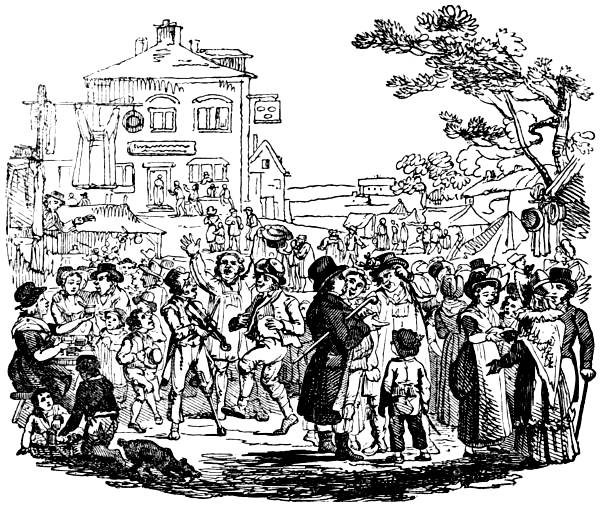
Hiring Servants at a Statute Fair.
This engraving may illustrate Mr. Pare’s account of the Warwickshire “statute” or “mop,”[49] and the general appearance of similar fairs for hiring servants. Even in London, bricklayers, and other house-labourers, still carry their respective implements to the places where they stand for hire: for which purpose they assemble in great numbers in Cheapside and at Charing-cross, every morning, at five or six o’clock. It is further worthy of observation, that, in old Rome, there were particular spots in which servants applied for hire.
Dr. Plott, speaking of the Statutes for hiring servants, says, that at Bloxham the carters stood with their whips in one place, and the shepherds with their crooks in another; but the maids, as far as he could observe, stood promiscuously. He adds, that this custom seems as old as our Saviour; and refers to Matt. xx. 3, “And he went out about the third hour and saw others standing idle in the market-place.”
In the statistical account of Scotland, it is said that, at the parish of Wamphray, “Hiring fairs are much frequented: those who are to hire wear a green sprig in their hat: and it is very seldom that servants will hire in any other place.”
Of ancient chartered fairs may be instanced as an example, the fair of St. Giles’s Hill or Down, near Winchester, which William the Conqueror instituted and gave as a kind of revenue to the bishop of Winchester. It was at first for three days, but afterwards by Henry III., prolonged to sixteen days. Its jurisdiction extended seven miles round, and comprehended even Southampton, then a capital and trading town. Merchants who sold wares at that time within that circuit forfeited them to the bishop. Officers were placed at a considerable distance, at bridges and other avenues of access to the fair, to exact toll of all merchandise passing that way. In the mean time, all shops in the city of Winchester were shut. A court, called the pavilion, composed of the bishop’s justiciaries and other officers, had power to try causes of various sorts for seven miles round. The bishop had a toll of every load or parcel of goods passing through the gates of the city. On St. Giles’s eve the mayor, bailiffs, and citizens of Winchester delivered the keys of the four gates to the bishop’s officers. Many and extraordinary were the privileges granted to the bishop on this occasion, all tending to obstruct trade and to oppress the people. Numerous foreign merchants frequented this fair; and several streets were formed in it, assigned to the sale of different commodities. The surrounding monasteries had shops or houses in these streets, used only at the fair; which they held under the bishop, and often let by lease for a term of years. Different counties had their different stations.
According to a curious record of the establishment and expenses of the household of Henry Percy, the fifth earl of Northumberland, A.D. 1512, the stores of his lordship’s house at Wresille, for the whole year, were laid in from fairs. The articles were “wine, wax, beiffes, muttons, wheite, and malt.” This proves that fairs were then the principal marts for purchasing necessaries in large quantities, which are now supplied by frequent trading towns: and the mention of “beiffes and muttons,” (which are salted oxen and sheep,) shows that at so late a period they knew little of breeding cattle.
The monks of the priories of Maxtoke in Warwickshire, and of Bicester in Oxfordshire, in the time of Henry VI., appear to have laid in yearly stores of various, yet common necessaries, at the fair of Stourbridge, in Cambridgeshire, at least one hundred miles distant from either monastery.
February 14. VALENTINE’S DAY.
Now each fond youth who ere essay’d An effort in the tinkling trade, Resumes to day; and writes and blots About true-love and true-love’s-knots; And opens veins in ladies’ hearts; (Or steels ’em) with two cris-cross darts,— (There must be two) Stuck through (and through) His own: and then to s’cure ’em better He doubles up his single letter— Type of his state, (Perchance a hostage To double fate) For single postage Emblem of his and my Cupidity; With p’rhaps like happy end—stupidity.
French Valentines.
Menage, in his Etymological Dictionary, has accounted for the term “Valentine,” by stating that Madame Royale, daughter of Henry the Fourth of France, having built a palace near Turin, which, in honour of the saint, then in high esteem, she called the Valentine, at the first entertainment which she gave in it, was pleased to order that the ladies should receive their lovers for the year by lots, reserving to herself the privilege of being independent of chance, and of choosing her own partner. At the various balls which this gallant princess gave during the year, it was directed that each lady should receive a nosegay from her lover, and that, at every tournament, the knight’s trappings for his horse should be furnished by his allotted mistress, with this proviso, that the prize obtained should be hers. This custom, says Menage, occasioned the parties to be called “Valentines.”[50]
An elegant writer, in a journal of the present month, prepares for the annual festival with the following
LEGEND OF ST. VALENTINE.
From Britain’s realm, in olden time, By the strong power of truths sublime. The pagan rites were banish’d; And, spite of Greek and Roman lore, Each god and goddess, fam’d of yore, From grove and altar vanish’d. And they (as sure became them best) To Austin and Paulinius’ hest Obediently submitted, And left the land without delay— Save Cupid, who still held a sway Too strong to passively obey, Or be by saints outwitted. For well the boy-god knew that he Was far too potent, e’er to be Depos’d and exil’d quietly From his belov’d dominion; And sturdily the urchin swore He ne’er, to leave the British shore, Would move a single pinion. The saints at this were sadly vex’d, And much their holy brains perplex’d, To bring the boy to reason; And, when they found him bent to stay, They built up convent-walls straightway, And put poor Love in prison. But Cupid, though a captive made, Soon met, within a convent shade, New subjects in profusion: Albeit he found his pagan name Was heard by pious maid and dame With horror and confusion. For all were there demure and coy, And deem’d a rebel heathen boy A most unsaintly creature; But Cupid found a way with ease His slyest vot’ries tastes to please, And yet not change a feature. For, by his brightest dart, the elf Affirm’d he’d turn a saint himself, To make their scruples lighter; So gravely hid his dimpled smiles, His wreathed locks, and playful wiles, Beneath a bishop’s mitre. Then Christians rear’d the boy a shrine. And youths invok’d Saint Valentine To bless their annual passion; And maidens still his name revere, And, smiling, hail his day each year— A day to village lovers dear, Though saints are out of fashion.
A. S.
Monthly Magazine.
Another is pleased to treat the prevailing topic of the day as one of those “whims and oddities,” which exceedingly amuse the reading world, and make e’en sighing lovers smile.
SONG For the 14th of February. By a General Lover.
“Mille gravem telis exhaustâ pene pharetrâ.”
Apollo has peep’d through the shutter, And waken’d the witty and fair; The boarding-school belle’s in a flutter, The twopenny post’s in despair: The breath of the morning is flinging A magic on blossom, on spray; And cockneys and sparrows are singing In chorus on Valentine’s Day. Away with ye, dreams of disaster, Away with ye, visions of law, Of cases I never shall master, Of pleadings I never shall draw: Away with ye, parchments and papers. Red tapes, unread volumes, away; It gives a fond lover the vapours To see you on Valentine’s Day. I’ll sit in my nightcap, like Hayley, I’ll sit with my arms crost, like Spain, Till joys, which are vanishing daily, Come back in their lustre again: Oh, shall I look over the waters, Or shall I look over the way, For the brightest and best of Earth’s daughters, To rhyme to on Valentine’s Day? Shall I crown with my worship, for fame’s sake, Some goddess whom Fashion has starr’d, Make puns on Miss Love and her namesake. Or pray for a pas with Brocard? Shall I flirt, in romantic idea, With Chester’s adorable clay, Or whisper in transport, “Si mea[51] Cum Vestris——” on Valentine’s Day? Shall I kneel to a Sylvia or Celia, Whom no one e’er saw or may see, A fancy-drawn Laura Amelia, An ad libit. Anna Marie? Shall I court an initial with stars to it, Go mad for a G. or a J. Get Bishop to put a few bars to it, And print it on Valentine’s Day? Alas! ere I’m properly frantic With some such pure figment as this. Some visions, not quite so romantic, Start up to demolish the bliss; Some Will o’ the Wisp in a bonnet Still leads my lost wit quite astray, Till up to my ears in a sonnet I sink upon Valentine’s Day. The Dian I half bought a ring for, On seeing her thrown in the ring; The Naiad I took such a spring for, From Waterloo Bridge, in the spring; The trembler I saved from a robber, on My walk to the Champs Elysée!— The warbler that fainted at Oberon, Three months before Valentine’s Day. The gipsy I once had a spill with, Bad lack to the Paddington team! The countess I chanced to be ill with From Dover to Calais by steam; The lass that makes tea for Sir Stephen, The lassie that brings in the tray; It’s odd—but the betting is even Between them on Valentine’s Day. The white hands I help’d in their nutting; The fair neck I cloak’d in the rain; The bright eyes that thank’d me for cutting My friend in Emmanuel-lane; The Blue that admires Mr. Barrow; The Saint that adores Lewis Way; The Nameless that dated from Harrow Three couplets last Valentine’s Day. I think not of Laura the witty, For, oh! she is married at York! I sigh not for Rose of the City, For, ah! she is buried at Cork! Adèle has a braver and better To say what I never could say; Louise cannot construe a letter Of English on Valentine’s Day. So perish the leaves in the arbour, The tree is all bare in the blast! Like a wreck that is drifting to harbour, I come to thee, Lady, at last. Where art thou so lovely and lonely? Though idle the lute and the lay, The lute and the lay are thine only, My fairest, on Valentine’s Day. For thee I have open’d my Blackstone, For thee I have shut up myself; Exchanged my long curls for a Caxton, And laid my short whist on the shelf; For thee I have sold my old Sherry, For thee I have burn’d my new play; And I grow philosophical—very! Except upon Valentine’s Day.
Φ
New Monthly Magazine.
In the poems of Elizabeth Trefusis there is a “Valentine” with an expression of feeling which may well conclude the extracts already produced.
When to Love’s influence woman yields, She loves for life! and daily feels Progressive tenderness!—each hour Confirms, extends, the tyrant’s power! Her lover is her god! her fate!— Vain pleasures, riches, worldly state, Are trifles all!—each sacrifice Becomes a dear and valued prize, If made for him, e’en tho’ he proves Forgetful of their former loves.
AIR AND EXERCISE For Ladies.
There is a notion, that air spoils the complexion. It is possible, that an exposure to all weathers might do so; though if a gipsy beauty is to be said to have a bad complexion, it is one we are very much inclined to be in love with. A russeton apple has its beauty as well as a peach. At all events, a spoilt complexion of this sort is accompanied with none of the melancholy attending the bad complexions that arise from late hours, and spleen, and plodding, and indolence, and indigestion. Fresh air puts a wine in the blood that lasts from morning to night, and not merely for an hour or two after dinner. If ladies would not carry buttered toast in their cheeks, instead of roses, they must shake the blood in their veins, till it spins clear. Cheerfulness itself helps to make good blood; and air and exercise make cheerfulness. When it is said, that air spoils the complexion, it is not meant that breathing it does so, but exposure to it. We are convinced it is altogether a fallacy, and that nothing but a constant exposure to the extremes of heat and cold has any such effect. The not breathing the fresh air is confessedly injurious; and this might be done much oftener than is supposed. People might oftener throw up their windows, or admit the air partially, and with an effect sensible only to the general feelings. We find, by repeated experiments, that we can write better and longer with the admission of air into our study. We have learnt also, by the same experience, to prefer a large study to a small one; and here the rich, it must be confessed, have another advantage over us. They pass their days in large airy rooms—in apartments that are field and champain, compared to the closets that we dignify with the name of parlours and drawing-rooms. A gipsy and they are in this respect, and in many others, more on a footing; and the gipsy beauty and the park beauty enjoy themselves accordingly. Can we look at that extraordinary race of persons—we mean the gipsies—and not recognise the wonderful physical perfection to which they are brought, solely by their exemption from some of our most inveterate notions, and by dint of living constantly in the fresh air? Read any of the accounts that are given of them, even by writers the most opposed to their way of life, and you will find these very writers refuting themselves and their proposed ameliorations by confessing that no human beings can be better formed, or healthier, or happier than the gipsies, so long as they are kept out of the way of towns and their sophistications. A suicide is not known among them. They are as merry as the larks with which they rise; have the use of their limbs to a degree unknown among us, except by our new friends the gymnasts; and are as sharp in their faculties as the perfection of their frames can render them. A glass of brandy puts them into a state of unbearable transport. It is a superfluous bliss; wine added to wine: and the old learn to do themselves mischief with it, and level their condition with stockbrokers and politicians. Yet these are the people whom some wiseacres are for turning into bigots and manufacturers. They had much better take them for what they are, and for what Providence seems to have intended them—a memorandum to keep alive among us the belief in nature, and a proof to what a physical state of perfection the human being can be brought, solely by inhaling her glorious breath, and being exempt from our laborious mistakes. If the intelligent and the gipsy life could ever be brought more together, by any rational compromise, (and we do not despair of it, when we see that calculators begin to philosophize,) men might attain the greatest perfection of which they are capable. Meanwhile the gipsies have the advantage of it, if faces are any index of health and comfort. A gipsy with an eye fit for a genius, it is not difficult to meet with; but where shall we find a genius, or even a fundholder, with the cheek and health of a gipsy?
There is a fact well known to physicians, which settles at once the importance of fresh air to beauty, as well as health. It is, that in proportion as people stay at home, and do not set their lungs playing as they ought, the blood becomes dark, and lags in its current; whereas the habit of inhaling the air out of doors reddens it like a ruby, and makes it clear and brisk. Now the darker the blood, the more melancholy the sensations, and the worse the complexion.
It is common with persons who inherit a good stock of health from their ancestors, to argue that they take no particular pains to preserve it, and yet are well. This may be true; and it is also true, that there is a painstaking to that effect, which is superfluous and morbid, and helps to do more harm than good. But it does not follow from either of these truths, that a neglect of the rational means of retaining health will ultimately be good for any body. Healthy people may live a good while upon their stock. Children are in the habit of doing it. But healthy children, especially those who are foolishly treated upon an assumption that health consists in being highly fed, and having great beef-eating cheeks, very often turn out sickly at last; and grown-up people, for the most part, at least in great towns, have as little really good health, as children in general are given credit for the reverse. Nature does indeed provide liberally for abuses; but the abuse will be felt at last. It is generally felt a long while before it is acknowledged. Then comes age, with all its train of regrets and superstitions; and the beauty and the man, besides a world perhaps of idle remorse, which they would not feel but for their perverted blood, could eat their hearts out for having been such fools as not to secure a continuance of good looks and manly feelings, for want of a little handsome energy.
The ill taste of existence that is so apt to come upon people in middle life, is too often attributed to moral causes. Moral they are, but very often not in the sense imagined. Whatever causes be mixed up with them, the greatest of all is, in ninety-nine instances out of a hundred, no better or grander than a non-performance of the common duties of health. Many a fine lady takes a surfeit for a tender distress; and many a real sufferer, who is haunted by a regret, or takes himself for the most ill-used of bilious old gentlemen, might trace the loftiest of his woes to no better origin than a series of ham-pies, or a want of proper use of his boots and umbrella.[52]
A SONG.
Young Joe, he was a carman gay, As any town could show; His team was good, and, like his pence, Was always on the go; A thing, as every jackass knows, Which often leads to wo! It fell out that he fell in love, By some odd chance or whim, With Alice Payne—beside whose eyes All other eyes were dim: The painful tale must out—indeed, She was A Pain to him. For, when he ask’d her civilly To make one of they two, She whipp’d her tongue across her teeth, And said, “D’ye think it true, I’d trust my load of life with sich A waggoner as you? “No, no—to be a carman’s wife Will ne’er suit Alice Payne; I’d better far a lone woman For evermore remain, Than have it said, while in my youth, My life is on the wain!” “Oh, Alice Payne! Oh, Alice Payne! Why won’t you meet with me?” Then up she curl’d her nose, and said, “Go axe your axletree; I tell you, Joe, this—once for all— My joe you shall not be.” She spoke the fatal “no,” which put A spoke into his wheel— And stopp’d his happiness, as though She’d cry wo! to his weal:— These women ever steal our hearts, And then their own they steel. So round his melancholy neck Poor Joe his drag-chain tied, And hook’d it on a hook—“Oh! what A weight is life!” he cried; Then off he cast himself—and thus The cast-off carman died! Howbeit, as his son was set, (Poor Joe!) at set of sun, They laid him in his lowly grave, And gravely that was done; And she stood by, and laugh’d outright— How wrong—the guilty one! But the day of retribution comes Alike to prince and hind, As surely as the summer’s sun Must yield to wintry wind: Alas! she did not mind his peace— So she’d no peace of mind. For when she sought her bed of rest, Her rest was all on thorns; And there another lover stood, Who wore a pair of horns: His little tiny feet were cleft, And cloven, like a fawn’s; His face and garb were dark and black, As daylight to the blind; And a something undefinable Around his skirt was twin’d— As if he wore, like other pigs, His pigtail out behind. His arms, though less than other men’s, By no means harm-less were: Dark elfin locks en lock’d his brow— You might not call them hair; And, oh! it was a gas-tly sight To see his eye-balls glare. And ever, as the midnight bell Twelve awful strokes had toll’d, That dark man by her bedside stood, Whilst all her blood run cold; And ever and anon he cried, “I could a tail unfold!” And so her strength of heart grew less, For heart-less she had been; And on her pallid cheek a small Red hectic spot was seen: You could not say her life was spent Without a spot, I wean. And they who mark’d that crimson light Well knew the treach’rous bloom— A light that shines, alas! alas! To light us to our tomb: They said ’twas like thy cross, St. Paul’s, The signal of her doom. And so it prov’d—she lost her health, When breath she needed most— Just as the winning horse gets blown Close by the winning-post. The ghost, he gave up plaguing her— So she gave up the ghost.
H. L.
London. MODERN IMPROVEMENTS.
In the annals of the world there have never been such rapid changes and such vast improvements as have occurred in this metropolis during the last seven years. We have no occasion now to refer to Pennant to produce exclamations of surprise at the wonderful changes in London; our own recollections are sufficient. Oxford-street seems half a mile nearer to Charing Cross than in the days of our youth. Swallow-street, with all the dirty courts in its vicinity, have been swallowed up, and replaced by one of the most magnificent streets in Europe; a street, which may vie with the Calle d’Alcala in Madrid, with the Quartier du Chapeau Rouge at Bourdeaux, or the Place de Louis Quinze at Paris. We must, for the present, overlook the defects of the architectural detail of this street, in the contemplation of the great and general improvement which its construction has produced in the metropolis.
Other streets are proposed by the same active genius under which Regent-street has been accomplished; the vile houses which surrounded and hid the finest portico in London—that of St. Martin’s church—are already taken down; a square is to be formed round this building, with two large openings into the Strand, and plans are already in agitation to lay open other churches in the same manner. Even the economical citizens have given us a peep at St. Bride’s—being ashamed again to hide beauties which accident had given them an opportunity of displaying to greater advantage. One street is projected from Charing Cross to the British Museum, terminating in a square, of which the church in Hart-street is to form the centre; another is intended to lead to the same point from Waterloo-bridge, by which this structure, which is at present almost useless, will become the great connecting thoroughfare between the north and south sides of the Thames: this street is, indeed, a desideratum to the proprietors of the bridge, as well as to the public at large. Carlton-house is already being taken down—by which means Regent-street will terminate at the south end, with a view of St. James’s Park, in the same manner as it does at the north end, by an opening into the Regent’s Park.
Such is the general outline of the late and the projected improvements in the heart of the metropolis; but they have not stopped here. The king has been decorating Hyde Park with lodges, designed by Mr. Decimus Burton, which are really gems in architecture, and stand unrivalled for proportion, chasteness, and simplicity, amidst the architectural productions of the age.
Squares are already covering the extensive property of lord Grosvenor in the fields of Chelsea and Pimlico; and crescents and colonnades are planned, by the architect to the bishop of London, on the ground belonging to the diocese at Bayswater.
But all suburban improvements sink into insignificance, when compared with what has been projected and attained within the last seven years in the Regent’s Park. This new city of palaces has appeared to have started into existence like the event of a fairy tale. Every week showed traces of an Aladdin hand in its progress, till, to our astonishment, we ride through streets, squares, crescents, and terraces, where we the other day saw nothing but pasture land and Lord’s-cricket-ground;—a barn is replaced by a palace—and buildings are constructed, one or two of which may vie with the proudest efforts of Greece and Rome.
The projector, with true taste, has called the beauties of landscape to the aid of architectural embellishment; and we accordingly find groves, and lawns, and streams intersecting the numerous ranges of terraces and villas; while nature, as though pleased at the efforts of art, seems to have exerted herself with extraordinary vigour to emulate and second the efforts of the artist.
In so many buildings, and amidst so much variety, there must, consequently, be many different degrees of architectural excellence, and many defects in architectural composition; but, taken as a whole, and the short time occupied in its accomplishment, the Regent’s Park may be considered as one of the most extraordinary creations of architecture that has ever been witnessed. It is the only speculation of the sort where elegance seems to have been considered equally with profit in the disposition of the ground. The buildings are not crowded together with an avaricious determination to create as much frontage as possible; and we cannot bestow too much praise on the liberality with which the projector has given up so much space to the squares, roads, and plantations, by which he has certainly relinquished many sources of profit for the pleasure and convenience of the public.
It is in the contemplation of these additions and improvements to our metropolis, that we doubly feel the blessings and effects of that peace which has enabled the government, as well as private individuals, to attempt to make London worthy of the character it bears in the scale of cities; and we are happy now to feel proud of the architectural beauty, as we always have of the commercial influence, of our metropolis.[53]
THE SPELLS OF HOME.
There blend the ties that strengthen Our hearts in hours of grief, The silver links that lengthen Joys visits when most brief! Then, dost thou sigh for pleasure? O! do not widely roam! But seek that hidden treasure At home, dear home!
Bernard Barton.
By the soft green light in the woody glade, On the banks of moss where thy childhood play’d; By the waving tree thro’ which thine eye First look’d in love to the summer sky; By the dewy gleam, by the very breath Of the primrose-tufts in the grass beneath, Upon thy heart there is laid a spell— Holy and precious—oh! guard it well! By the sleepy ripple of the stream, Which hath lull’d thee into many a dream; By the shiver of the ivy-leaves, To the wind of morn at thy casement-eaves; By the bees’ deep murmur in the limes, By the music of the Sabbath-chimes; By every sound of thy native shade, Stronger and dearer the spell is made. By the gathering round the winter hearth, When twilight call’d unto household mirth, By the fairy tale or the legend old In that ring of happy faces told; By the quiet hours when hearts unite In the parting prayer, and the kind “good-night;” By the smiling eye and the loving tone, Over thy life has the spell been thrown. And bless that gift!—it hath gentle might, A guardian power and a guiding light! It hath led the freeman forth to stand In the mountain-battles of his land; It hath brought the wanderer o’er the seas, To die on the hills of his own fresh breeze; And back to the gates of his father’s hall, It hath won the weeping prodigal. Yes! when thy heart in its pride would stray, From the loves of its guileless youth away; When the sullying breath of the world would come, O’er the flowers it brought from its childhood’s home; Think thou again of the woody glade, And the sound by the rustling ivy made; Think of the tree at thy parent’s door, And the kindly spell shall have power once more!
F. H.
Monthly Magazine.
BOOKS.
’Twere well with most, if books, that could engage Their childhood, pleased them at a riper age; The man approving what had charmed the boy, Would die at last in comfort, peace, and joy; And not with curses on his art, who stole The gem of truth from his unguarded soul.
Cowper.
If there be one word in our language, beyond all others teeming with delightful associations, Books is that word. At that magic name what vivid retrospections of by-gone times, what summer days of unalloyed happiness “when life was new,” rush on the memory! even now the spell retains its power to charm: the beloved of my youth is the solace of my declining years: such is the enduring nature of an early attachment to literature.
The first book that inspired me with a taste for reading, was Bunyan’s Pilgrim’s Progress; never shall I forget the intense emotion with which I perused this pious and interesting fiction: the picturesque descriptions and quaint moralities blended with this fine allegory, heightened the enchantment, which to a youthful and fervid imagination, “unsated yet with garbage,” was complete. From henceforward my bias was determined; the passion grew with my growth, and strengthened with my strength; and I devoured all the books that fell in my way, as if “appetite increased by what it fed on.” My next step was,—I commenced collector. Smile, if you will, reader, but admire the benevolence of creative wisdom, by which the means of happiness are so nicely adjusted to the capacity for enjoyment: for, slender, as in those days were my finances, I much doubt if the noble possessor of the unique edition of Boccaccio, marched off with his envied prize at the cost of two thousand four hundred pounds, more triumphantly, than I did with my sixpenny pamphlet, or dog’s eared volume, destined to form the nucleus of my future library.
The moral advantages arising out of a love of books are so obvious, that to enlarge upon such a topic might be deemed a gratuitous parade of truisms; I shall therefore proceed to offer a few observations, as to the best modes of deriving both pleasure and improvement from the cultivation of this most fascinating and intellectual of all pursuits. Lord Bacon says, with his usual discrimination, “Some books are to be tasted, others to be swallowed, and some few to be chewed and digested;” this short sentence comprises the whole practical wisdom of the subject, and in like manner by an extension of the principle, the choice of a library must be regulated. “Few books, well selected, are best,” is a maxim useful to all, but more especially to young collectors: for let it be remembered, that economy in our pleasures invariably tends to enlarge the sphere of our enjoyments. Fuller remarks, “that it is a vanity to persuade the world one hath much learning by getting a great library;” and the supposition is equally erroneous, that a large collection necessarily implies a good one. The truth is, were we to discard all the works of a mere temporary interest, and of solemn trifling, that incumber the fields of literature, the magnitude of numerous vast libraries would suddenly shrink into most diminutive dimensions, for the number of good original authors is comparatively few; study therefore quality rather than quantity in the selection of your books. As regards the luxuries of the library, keep a rigid watch upon your inclinations; for though it must not be denied that there is a rational pleasure in seeing a favourite author elegantly attired, nothing is more ridiculous than this taste pushed to the extreme; for then this refined pursuit degenerates into a mere hobbyhorse, and once fairly mounted, good-by to prudence and common sense! The Bibliomaniac is thus pleasantly satirized by an old poet in the “Shyp of Fooles.”
Styll am I besy bok assemblynge, For to have plenty it is a pleasaunt thynge In my conceit, and to have them ay in hand, But what they mene do I not understande!
When we survey our well-furnished bookshelves, the first thought that suggests itself, is the immortality of intellect. Here repose the living monuments of those master spirits destined to sway the empire of mind; the historian, the philosopher, and the poet, “of imagination all compact!” and while the deeds of mighty conquerors hurry down the stream of oblivion, the works of these men survive to after-ages; are enshrined in the memories of a grateful posterity, and finally stamp upon national character the permanent impress of their genius.
Happy we, who are early taught to cherish the society of these silent friends, ever ready to amuse without importunity, and instruct without the austerity of reproof. Let us rest assured that it is “mind that makes the body rich,” and that in the cultivation of our intellect we secure an inexhaustible store of present gratification, and a source of pleasurable recollections which will never fail to cheer the evening of life.
J. H.
ETIQUETTE.
Philosophy may rave as it will, “little things are great to little men,” and the less the man, the greater is the object. A king at arms is, in his own estimation, the greatest king in Europe, and a German baron is not more punctilious than a master of the ceremonies. The first desire with all men is power, the next is the semblance of power; and it is perhaps a happy dispensation that those who are cut off from the substantial rights of the citizen, should find a compensation in the “decorations” of the slave; as in all other moral cases the vices of the individual are repressed by those of the rest of the community. The pride of Diogenes trampled on the pride of Plato; and the vanity of the excluded may be trusted for keeping within bounds the vanity of the preeminent and the privileged. The great enemy, however, of etiquette is civilisation, which is incessantly at work, simplifying society. Knowledge, by opening our eyes to the substances of things, defends us from the juggle of forms; and Napoleon, when he called a throne a mere chair, with gilt nails driven into it, epitomised one of the most striking results of the revolutionary contest. Strange that he should have overlooked or disregarded the fact in the erection of his own institutions! Ceremonial is a true paper currency, and passes only as far as it will be taken. The representative of a thousand pounds, unbacked by credit, is a worthless rag of paper, and the highest decoration which the king can confer, if repudiated by opinion, is but a piece of blue riband. Here indeed the sublime touches the ridiculous, for who shall draw the line of demarcation between my lord Grizzle and the gold stick? between Mr. Dymock, in Westminster-hall, and his representative “on a real horse” at Covent-garden?—Every day the intercourse of society is becoming more and more easy, and a man of fashion is as little likely to be ceremonious in trifles, as to appear in the costume of sir Charles Grandison, or to take up the quarrels of lord Herbert of Cherbury.[54]
INDICATIONS. Written in the Frost. For the Table Book.
I know that the weather’s severe, by the noses That run between eyes smartly lash’d by the fair; By the coxcombs that muff-led are smiling at roses Got into the cheeks, and got out of the air. By the skates, (slipp’ry fish) for the Serpentine’s Fleet By the rise of the coal; by the shot-birds that fall By the chilly old people that creep to the heat; And the ivy-green branches that creep to the wall. By the chorus of boys sliding over the river, The grumbles of men sliding over the flags; The beggars, poor wretches! half naked, that shiver! The sportsmen, poor horsemen! turn’d out on their nags! By the snow standing over the plant and the fountain; The chilbain-tribes, whose understanding is weak; The wild-ducks of the valley, the drift of the mountain, And, like Niobé, street-plugs all tears from the Creek: And I know, by the icelets from nature’s own shops, By the fagots just cut, and the cutting wind’s tone, That the weather will freeze half the world if it stops, If it goes, it will thaw t’other half to the bone.
Jan 27. *, *, P.
ADOPTION.
There is a singular system in France relative to the adoption of children. A family who has none, adopts as their own a fine child belonging to a friend, or more generally to some poor person, (for the laws of population in the poor differ from those in the rich;) the adoption is regularly enregistered by the civil authorities, and the child becomes heir-at-law to the property of its new parents, and cannot be disinherited by any subsequent caprice of the parties; they are bound to support it suitably to their rank, and do every thing due to their offspring.[55]
A Royal Simile.
“Queen Elizabeth was wont to say, upon the commission of sales, that the commissioners used her like strawberry-wives, that laid two or three great strawberries at the mouth of their pottle, and all the rest were little ones; so they made her two or three great prices of the first particulars, but fell straightways.”[56]