Volume 2 — Vol. II.—42.
Reading edition
The Broom-maker’s at Shirley Common, Surrey.
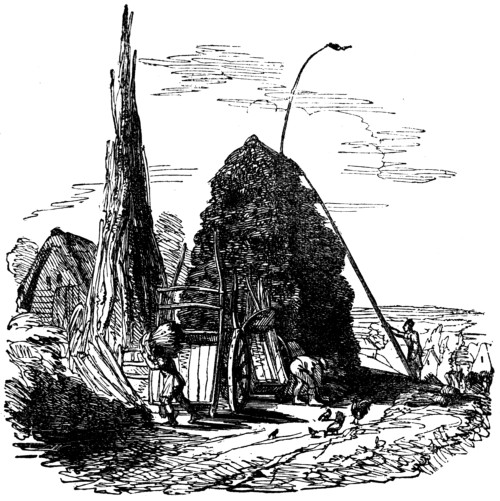
The Broom-maker’s at Shirley Common, Surrey.
A homely picture of a homely place, Where rustic labour plies its honest toil, And gains a competence.
*
On a fine summer’s day I alighted, with my friend W——, from the roof of a stage-coach at Croydon, for a by-way walk, in a part unknown to both. We struck to the eastward through Addiscombe—it is scarcely a village, and only remarkable for the East India Company having seated it with a military establishment; which, as peaceable persons, we had no desire to see, though we could not help observing some cannon in a meadow, as smooth-shaven, and with as little of nature-like aspect, as a drill-sergeant’s face. Further onward we met a well-mounted horseman, whom some of my old readers may easily imagine I could not fail to remember—“mine host” of the “Swan” at West Wickham—the recognition was mutual and being in search of an adventure, I asked him for a direction to any little public-house within a mile or two, that was worth looking at on account of its antiquity and rustic appearance. He despaired of any thing “absolutely” of the kind in the neighbourhood; but, from his description of what he thought might be “something” near it, we took a lane to the left, and soon came to the house. Like too many of our ancient churches it had been “repaired and beautified”—deprived of every thing venerable—and was as unpicturesque as the overseers of the reparations could make it. We found better entertainment within than without—a cheerful invitation to the bar, where we had a cool glass of good ale with a biscuit, and the sight of a fine healthy family as they successively entered for something or other that was wanted. Having refreshed and exchanged “good-morning” with the good-natured proveditors of “good entertainment for man and horse,” we turned to the left, and at a stone’s throw crossed into a lane, having a few labourers’ cottages a little way along on the right, and soon came to the Broom-maker’s, represented in the engraving.
We had a constant view all the way up the lane, from beyond the man climbing the ladder, of the flickering linen at the point of the rod waving on the broom-stack. The flag was erected by the labourers on the carrying of the last shoulder-load of the rustic pile—an achievement quite as important to the interests of the Broom-maker, as the carrying of Seringapatam to the interests of the “Honourable Company.”
Having passed the Broom-maker’s, which stands at the corner of the lane we had come up, and being then in the road across Shirley Common towards Addington, we interchanged expressions of regret that we had not fallen in with any thing worth notice. A look-back induced a halt; we returned a few steps, and taking seats at the angle on the bank, I thought I perceived “capabilities,” in the home-view before our eyes, for a Table Book notice. The loaded man, near the pile of poling, is represented proceeding towards a spot at some thirty yards distance, where a teamed waggon-frame was standing. It belonged to the master of the place—a tall, square-shouldered, middle-aged, active man, who looked as one having authority-who laboured, and was a master of labourers. He, and another man, and a lad, were employed, “all without hurry or care,” in loading the wain with poling. As I stood observing their progress he gave me a frank “Good-day, sir!” and I obtained some information from him respecting his business. His name is on his carts “John Bennett, Shirley Common.” He calls himself a “Broom-maker and Wood-dealer,” and he has more the character of a Wood-cutter than the figure of the Wood-man in the popular print. He and his men cut the materials for broom-making chiefly from the neighbouring common, and the wood he deals in from adjacent woods and copses. He sells the greater part of his brooms to shopkeepers and other consumers in Streatham and Camberwell. Much of his poling is sent farther off. A good deal, he told me, had gone to the duke of Devonshire for fencing; the load then preparing was for like use on a farm at Streatham, belonging to Mr. Hoare, of the Golden Cross, Charing Cross. He eyed W—— seated on the bank, sketching the spot, and said, that as soon as he had finished loading the wain, he would show us what was “going on in-doors.” Accordingly when he had concluded he walked with me to W——, who, by that time, had nearly finished. Seeing what had been effected in that way, he had “a sort of notion that the gentleman might like, perhaps, to take off an old broom-maker, then at work, inside—as curious an old chap as a man might walk a summer’s day without seeing—one that nobody could make either head or tail of—what you call an original.”
W—— and I were as desirous of something new as were the ancient inhabitants of Athens; and in search of it we entered the broom-manufactory—a small, warm, comfortable barn, with a grateful odour in it from the heath and birch-wood. Four or five persons were busy at work. Foremost within the door was the unmistakeable old “original.” Like his fellow-workmen he wore a leathern apron, and a heavy leathern sleeve on the left arm; and with that hand and arm he firmly held and compressed the heath into round bundles, of proper consistency and size, and strongly bound them with the other. He was apparently between sixty and seventy years of age, and his labour, which to a young man seemed light, was to him heavy, for it required muscular strength. There was some difficulty in getting him to converse. He was evidently suspicious; and, as he worked, his apprehensions quickened him to restlessness and over-exertion. To “take him off” while thus excited, and almost constantly in a bending posture, was out of the question. I therefore handed him a jug of his master’s home-brewed, and told him our wish. His countenance lighted up, and I begged him to converse with me for a few minutes, and to look me full in the face; I also assured him of the “wherewithal” for a jug of ale at night. He willingly entered into the compact, but the inquietude natural to his features was baffling to the hand that held the pencil. By this time the rumour that “Old Davy” was having his head “taken off” brought his master’s wife, and her daughters and sons, from the cottage, and several workmen from another outhouse, to witness the execution, Opposite to him was W—— with his sketch-book; his desire for a “three-quarter” view of the “original” occasioned me to seat myself on a heap of birch sideways, that the old man’s face might be directed to me in the required position. The group around us was numerous and differently interested: some kept their eyes upon “Old Davy;” others upon me, while I talked to him; as many as could command a view of the sketch-book were intent upon the progress of the portrait; and a few, who were excluded, endeavoured on tiptoe, and with outstretched necks, to obtain peeps at what was going on. W. steadily employed on the likeness—the old man “sitting,” cunningly smiling, looking unutterably wise at me, while W—— was steadily endeavouring for the likeness—the surrounding spectators, and the varied expressions of their various faces—the gleams of broken light from the only opening that admitted it, the door-way—the broad masses of shadow, and the rich browns of the shining birch and spreading heath, rudely and unequally piled, formed a picture which I regretted that W—— was a prominent figure in, because, engaged as he was, he could neither see nor sketch it.
This old labourer’s eccentricity was exceedingly amusing. He said his name was David Boxall; he knew not, or would not know, either where he was born, or where he had worked, or any thing more of himself, than that there he was; “and now,” said he, “make of me what you can.” “Ah!” said his master, in a whisper, “if you can make anything of him, sir, it’s more than we have been able to do.” The old fellow had a dissenting “humph” for every thing advanced towards him—except the ale-jug. The burthen of his talk was—he thought about nothing, cared about nothing—not he—why should he? Yet he was a perpetual inquirer. Craftily leering his quick-glancing eye while he asked a question, he waited, with a sarcastic smile, for an answer; and when given, out came his usual gruff “humph,” and “how do you know?” He affected to listen to explanations, while he assumed a knowing grin, to persuade his hearers that he knew better. His knowledge, however, was incommunicable, and past all finding out. He continually indulged in “hum!” and “ha!” and a sly look; and these, to his rustic auditors, were signs of wisdom. He was what they called a “knowing old chap.” He had been the best broom-maker in the manufactory, and had earned excellent wages. When I saw him he was infirm, and did not get more than fourteen or sixteen shillings a week. Mr. Bennett’s men are paid piece-work, and can easily earn a guinea week. After the sketching was over, and his people had retired to their labour, we walked with him through his little garden of fruit-trees and vegetables to another shed, where they fashioned broom-handles, and some common husbandry implements of wood. On recrossing the garden he gathered us cherries from the trees, and discoursed on his hives of bees by the hedge-side. Having given something to his men to spend in drink, and to “Old Davy” something especially, we brought off his head, which would cost more to exhibit than a better subject, and therefore it has since rested without disturbance.
From the Broom-maker’s at Shirley Common, we had a pleasant walk into Addington, where there is a modern-built palace of the archbishop of Canterbury, with extensive old gardens and large hot-houses, and several good houses. We had passed Mr. Maberly’s seat and grounds on our way. A turn in the road gave us a view of Addington church in a retired spot, beyond a row of town-built dwellings, with little gardens in front, and a shop or two. The parish clerk lives in one of them. Upon request he accompanied us, with the keys, to the church, of ancient structure, lately trimmed up, and enclosed by a high wall and gates. There was nothing within worth seeing, except a tomb with disfigured effigies, and a mutilated ill-kept register-book, which, as it belonged to the immediate parish of the archbishop, seemed very discreditable. The “Cricketers,” nearly opposite to the church, accommodated us with as good refreshment as the village afforded, in a capacious parlour. The house is old, with a thatched roof. We found it an excellent resting-place; every way better, as an inn, than we could have expected in a spot so secluded. We had rambled and loitered towards it, and felt ourselves more wearied when about to depart than we wished; and, as a farmer’s family cart stood at the door, with the farmer himself in it, I proposed to W. to attempt gaining a lift. The farmer’s son, who drove it, said, that it was going our way, and that a ride was at our service. The driver got up in front, W. followed, and when I had achieved the climbing, I found him in conflict with a young calf, which persisted in licking his clothes. He was soon relieved from the inconvenience, by its attentions, in like manner, being shifted to me. The old farmer was a little more than “fresh,” and his son a little less. We had a laughable jolt upstanding, along a little frequented road; and during our progress I managed to bind the calf to good behaviour. Leaving West Wickham on our left, and its pleasant church and manor-house on the right, we ascended Keston Common, and passed over it, as we had nearly all the way, in merry conversation with the old farmer, who dwelt with great glee on his youthful fame, as one of the best cricket-players in Kent. We alighted before we came to the “Fox” public-house, where our companions accepted of a magnum of stiff grog in recompense for their civility. From thence we skirted Holwood, till we arrived at my old “head-quarters,” the “Cross” at Keston; and there we were welcomed by “mine host,” Mr. Young, and took tea. A walk to Bromley, and a stage from thence, brought us to “the Elephant”—and so home.
*
THE WOOD FEAST.
To the Editor.
Sir,—In the autumn it is customary at Templecoomb, a small village in Somersetshire, and its neighbourhood, for the steward of the manor to give a feast, called the “Wood feast,” to farmers and other consumers that buy their wood for hurdles, rick-fasts in thatching, poles, spikes, and sundry other uses.
When the lots are drawn in the copses, and each person has paid down his money, the feast is provided “of the best,” and few attend it but go home with the hilarity which good cheer inspires. This annual treat has its uses; for the very recollection of the meeting of old friends and keeping of old customs gives an impetus to industry which generally secures for his lordship his tenants’ Wood money—most excellent fuel for the consumption of the nobility.
I am, Sir, your constant reader, *, *, *.
Sept. 1827.
CHOOSING COMMON CONSTABLES.
For the Table Book.
It is annually the custom to hold a meeting, duly summoned, on Startley Common, Wilts, for the choice of new constables for the hundreds of the county. Lots are cast for those who are to serve for the ensuing year; and afterwards the parties present adjourn to a house for refreshment, which costs each individual about seventeen shillings. This may almost be regarded as an equivalent for serving the office—the lots mostly fall on the absentees.
P.
Garrick Plays. No. XXXVI.
[From “Love’s Dominion, a Dramatic Pastoral,” by Richard Flecknoe, 1634.]
Invocation to Silence.
Still-born Silence, thou that art Floodgate of the deeper heart; Offspring of a heavenly kind; Frost o’ th’ mouth and thaw o’ th’ mind; Secresy’s Confident, and he That makes religion Mystery; Admiration’s speaking’st tongue,— Leave thy desart shades, among Reverend Hermits’ hallow’d cells, Where retir’d’st Devotion dwells: With thy Enthusiasms come; Seize this Maid, and strike her dumb.
Fable.
Love and Death o’ th’ way once meeting, Having past a friendly greeting, Sleep their weary eye-lids closing, Lay them down, themselves reposing; When this fortune did befall ’em, Which after did so much appal ’em; Love, whom divers cares molested, Could not sleep; but, whilst Death rested, All away in haste he posts him. But his haste full dearly costs him; For it chanced, that, going to sleeping, Both had giv’n their darts in keeping Unto Night; who (Error’s Mother) Blindly knowing not th’ one from th’ other, Gave Love Death’s, and ne’er perceiv’d it, Whilst as blindly Love receiv’d it: Since which time, their darts confounding, Love now kills, instead of wounding; Death, our hearts with sweetness filling, Gently wounds, instead of killing.
[From “Andronicus,” a Tragedy, by Philonax Lovekin, 1661.]
Effect of Religious Structures on different minds.
Crato. I grieve the Chapel was defaced; ’twas stately. Cleobulus. I love no such triumphant Churches— They scatter my devotion; whilst my sight Is courted to observe their sumptuous cost, I find my heart lost in my eyes; Whilst that a holy horror seems to dwell Within a dark obscure and humble cell. Crato. But I love Churches, mount up to the skies For my devotion rises with their roof: Therein my soul doth heav’n anticipate.
Song for Sleep.
Come, Somnus, with thy potent charms, And seize this Captive in thy arms; And sweetly drop on every sense Thy soul-refreshing influence. His sight, smell, hearing, touch, and taste, Unto the peace do thou bind fast.— On working brains, at school all day, At night thou dost bestow a play, And troubled minds thou dost set free; Thou mak’st both friends and foes agree: All are alike, who live by breath, In thee, and in thy brother Death.
[From “Don Quixote,” a Comedy, in three parts, by Thomas D’Urfey, 1694.]
Dirge, at the hearse of Chrysostom.
Sleep, poor Youth, sleep in peace, Relieved from love and mortal care; Whilst we, that pine in life’s disease, Uncertain-bless’d, less happy are. Couch’d in the dark and silent grave, No ills of fate thou now can’st fear; In vain would tyrant Power enslave, Or scornful Beauty be severe. Wars, that do fatal storms disperse, Far from thy happy mansion keep; Earthquakes, that shake the universe, Can’t rock thee into sounder sleep. With all the charms of peace possest, Secure from life’s torment or pain, Sleep, and indulge thyself with rest; Nor dream thou e’er shalt rise again.[369]
C. L.
ÆSOP IN RUSSIA. Peter the Great’s Summer Garden.
Schræder, a celebrated Swedish gardener, was employed by the czar to execute a plan he had approved of, for the gardens of his summer palace. The work was already far advanced, and among the different parts that were finished, were two large divisions adjoining to the principal avenue, opposite to each other, enclosed with a hedge, and covered with turf. The czar, who came often to see the progress of his undertaking, on observing the two grass-plots, conceived a design of converting this place of mere amusement into a kind of school. “I am very well satisfied,” said the czar to the gardener, “with your performance, as well as with the variety and beauty of the several divisions that are finished: however, you must not be angry if I change the form of these two spots of ground. I should wish that the persons who walk in the garden might find the means of cultivating their minds; but in what way can we contrive this?”
“Sire,” said the gardener, “I know no other than to put books on the seats, protected from the rain, that those who walk in the garden may read when they sit down.”
“This is not far from my meaning,” said the czar, laughing, “but, books in a public garden! that will never do. Another idea has struck me. I should like to erect statues here, representing the different subjects of Æsop’s fables. For this purpose the ground must be differently laid out, that the division of the several parts may correspond with the fables I am speaking of.”
Schræder executed his orders with all possible intelligence and despatch, and much to the satisfaction of the emperor.
The garden consisted of four squares, with walks in the form of labyrinths leading to them. The angles were ornamented with figures, representing different subjects from Æsop’s fables, with a jet d’eau concealed in a little basin, under moss or ruins, and surrounded with shells brought from lake Ilmen, or that of Novogorod. Most of the animals were as large as life, and of lead, gilt. They ejected water from their mouths, according to their various attitudes. In this way the walks were ornamented with sixty fables, forming as many jets d’eau. At the entrance was a statue of Æsop, likewise of lead, and gilt.
The czar very naturally supposed that few people would be able to discover the meaning of these figures, and that fewer would comprehend the instruction they were designed to convey. His majesty therefore ordered a post to be placed near each of them, and to these posts sheets of tin were fastened, on which the fables and their morals were written in the Russian language.
This place was the czar’s favourite walk; in its shades he often passed whole hours, recreating himself among these creatures of his creation.
This garden was afterwards nearly destroyed by a terrible tempest and inundation. The trees it contained were torn up by the roots, and the green hedges and figures of animals damaged, either by the fall of the timber or by the elements. The trees were raised, put into their places again, and propped up; but as it was not possible to repair the injuries done to the figures, the czar’s “summer garden” ceased to be a “garden of instruction.”
LOVE OF GARDENS In distinguished Men.
Juvenal represents Lucan reposing in a garden.[370] Tasso pictures Rinaldo sitting beneath the shade in a fragrant meadow: Virgil describes Anchises seated beneath sweet-scented bay-trees; and Eneas, as reclining, remote from all society, in a deep and winding valley.[371] Gassendi, who ingrafted the doctrine of Galileo on the theory of Epicurus, took not greater pleasure in feasting his youthful imagination by gazing on the moon, than Cyrus, in the cultivation of flowers.—“I have measured, dug, and planted the large garden, which I have at the gate of Babylon,” said that prince; “and never, when my health permit, do I dine until I have laboured two hours in my garden: if there is nothing to be done, I labour in my orchard.” Cyrus is also said to have planted all the Lesser Asia. Ahasuerus was accustomed to quit the charms of the banquet to indulge the luxury of his bower:[372] and the conqueror of Mithridates enjoyed the society of his friends, and the wine of Falernium, in the splendid gardens, which were an honour to his name. Dion gave a pleasure-garden to Speucippus as a mark of peculiar regard.[373] Linnæus studied in a bower: Buffon in his summer-house; and when Demetrius Poliorcetes took the island of Rhodes, he found Protogenes at his palette, painting in his arbour. Petrarch was never happier than when indulging the innocent pleasures of his garden.—“I have made myself two,” says he, in one of his epistles; “I do not imagine they are to be equalled in all the world: I should feel myself inclined to be angry with fortune, if there were any so beautiful out of Italy.”
Many of the wisest and the best of men have signalized their love of gardens and shrubberies, by causing themselves to be buried in them; a custom once in frequent practice among the ancient Jews.[374] Plato was buried in the groves of Academus; and sir William Temple, though he expected to be interred in Westminster abbey, gave orders for his heart to be enclosed in a silver casket, and placed under a sun-dial, in that part of his garden immediately opposite the window of his library, from which he was accustomed to contemplate the beauties and wonders of the creation, in the society of a beloved sister.[375]
DUTCH ROYAL GARDEN AND SCHEVELING SCENERY. Described by the Deputation of the Caledonian Horticultural Society.
August 26, 1817. Late in the afternoon, we took a walk to the northward of the Hague, on the Amsterdam road, and entered a forest of large and ancient trees, by much the finest which we have seen on the continent, and evidently several centuries old. Many oaks, elms, and beeches were magnificent. Some of the oaks, at two feet from the ground, measured twelve feet in circumference, and had free and clean boles to the height of about forty feet. This wood, in all probability, gave rise to the name of the city; for haag (the Dutch for Hague) signifies thicket or wood. It was originally a seat of the counts of Holland, and is often to this day called Graaf’s Haag, or Earl’s Wood.[376]
Although we had no guide, we easily found the palace called the “House in the Wood,” about two miles distant from the Hague; and having inquired for the gardener, Mr. Jacobus Munts, we readily procured access to the royal garden. It is kept in good order, and is now arranged in what is here reckoned the English style, the old formal hedges, and fantastically shaped trees, having been in a great measure removed. The grounds are now traversed by serpentine walks, laid with sand: these wind among groves of forest-trees, which have never been subjected to the shears; but the flexures are much too regular. Water, as usual, is the only defence, or line of separation, from the conterminous[377] fields, or from the high road. These ditches, though broad, brimful, and kept tolerably clean, have a dull aspect. Shrubs and flowers are planted in small compartments, cut out in the grassy covering of the lawn. The figures of these compartments are different, circles, ovals, and crescents. A bed of dahlias was now in flower, but presented nothing uncommon. Indeed, we learned that the collection had been procured from Antwerp only the year before. The plants in the borders and shrubberies were in general of the more common kinds; but some rarities also appeared. Among these the passiflora cœrulea was here displaying its gorgeous flowers in the shrubbery; but we observed that it was contained in a pot sunk in the earth, and not well concealed. Rosa Pennsylvanica was very abundant, and seemed not only to be healthy, but to produce its flowers freely.
Close by the palace is a small greenhouse, erected in 1815 for the princess of Orange. It contains a few pretty good plants; but there is nothing becoming royalty either in the size of the house or the choice nature of the collection. Datura arborea was now in flower, and filled the place with its odour; and the white variety of vinca rosea was in bloom. There are here no hot-houses for the forcing of fruit; nor did there appear to be any thing remarkable among the hardy fruits cultivated in the garden.
This garden at the House in the Wood, is the only one worth visiting at the Hague, with the exception perhaps of Mr. Fagel’s. The Portland gardens, belonging to the Bentincks, though celebrated in former times, are now in a neglected and even ruinous condition.
SCHEVELING. Avenues of Trees.
August 27, 1817. Early this morning we walked towards the fishing village of Scheveling, by a grand avenue lined with trees, of which all Dutchmen are justly proud. The length of this avenue is nearly a mile and a half; and it is so straight and so level, that the village church very soon appeared at the termination of the vista next the sea. The tallest and finest trees are Dutch elm, abele, oak, and beech. Many of these are of great size, and have probably seen more than two centuries.[378] Sycamore, hornbeam, birch, and different species of willow, are occasionally interspersed. There are properly three roads in this noble avenue: a central one for carriages, one for horsemen, and another for foot-passengers. The breadth of the plantation, on each side, is on an average about seventy feet. In some places, the old trees appear to have been cut down; but their places are now supplied by others. Almost all the new-planted trees are white poplars, which are of rapid growth.
Fishery—Fishing Vessels, &c.
We breakfasted in the Hoff van Holland inn, the windows of which look out upon the ocean. In addition to the usual repast of coffee and rolls, a countryman of our own, whom we chanced here to meet, had shrimps served to breakfast, which had been shown to him all alive a few minutes before: by our desire, we had tong-vischen, or soles, fresh from the sea. While at breakfast, we observed, that more than two dozen of small sloops, which we easily recognised to be fishing-busses, were making directly for the low sandy beach, although it was at present a lee-shore, with a considerable surf. The sails were of various hues; Isabella yellow, chocolate brown, and milk white; and this intermixture of colours, set off by the brilliancy of a clear morning sun, increased the picturesque effect. Not a little to our surprise, the crews did not shorten sail, till their barks were just involved among the waves and breakers; and in this odd situation, generally after taking the ground, we saw them deliberately cast anchor. The propriety of the shape given to the hulls of these busses, was now manifest to us; a small British-built sloop would have been in danger of breaking up, while they shoved along among the breakers in perfect security. Indeed, that Dutch vessels in general should, of design, be built strong or clumsy, and have their hulks well rounded below, can only appear surprising to those who have not witnessed the nature of the seas which they have to navigate at home, where they must often take the ground, and where they not unfrequently sail right against the shore. As soon as the anchors were cast, the boatmen, wading up to the middle in the waves, brought out the fish on their shoulders; the sands were covered with persons of both sexes and of all ages, who began to carry off the cargoes, in broad baskets, on their heads. The principal kinds of fish were plaice, turbot, sole, skate, and thornback; a very few cod and smelts made up the list. The Dutch gave the name schol to our plaice: and our sole they call tong. Their name for the smelt is spiering; which nearly approaches that by which this little fish is distinguished in the Edinburgh market, viz. spirling.
Coast—Fishwomen—Cart Dogs.
A continuous broad and high bank of sand lines the coast as far as we could see, and forms the powerful protection of this part of Holland against the inroads of the ocean. Without this provision of nature, the country would be inundated by every extraordinary tide and gale; for it may be truly said, “the broad ocean leans against the land.” On the sand-hills, the same kind of plants prevail as in similar situations in England; sea-holly and buckthorn, asparago and Galium verum, with sea-marran, arundo arenaria, which last is encouraged here, being found very useful in binding the sand. In some places wheat-straw had been dibbled in, as at Ostend, in order to promote the same object. Considering Scheveling as a fishing-village, we were greatly pleased with it: it was extremely neat and clean, and formed a perfect contrast with our Newhaven and Fisherrow,[379] the lanes of which are generally encumbered with all sorts of filth. We must confess, too, that in tidiness of dress and urbanity of manners, the fishwomen of Scheveling are equally superior to those of the Scottish villages just mentioned.
As we returned to the Hague, numbers of the inhabitants were also on their way to the fish-market, some carrying baskets of fish on their heads, and others employing three or four dogs to convey the fish in small light carts. We had read in books, of these draught dogs being well used, and fat and sleek; but we regret to say, that those which we saw were generally poor half-starved looking animals, bearing no equivocal marks of ill usage. The diligence with which they sped their way to town, with their cargoes, in a sultry day, with tongues lolling to the ground, seemed to entitle them to better treatment.
Fish-market—Storks
We traced the steps of some of our Scheveling companions to the fish-market. As might be expected, the market proved commodious and clean, and well supplied with water. Salmon was pretty common; carp was plentiful; and a single John Dory and a single sturgeon appeared on a stall. At some seasons, we believe, sturgeons are abundant, being taken in numbers at the mouths of the Rhine, when about to ascend that river. Four tame storks were stalking up and down in the market. They were in full plumage; and did not appear to have been pinioned, so as to disable them from flying. Their food consists wholly of the garbage which they pick up about the fish-stalls. A small house, like a dog’s kennel, is appropriated to their use; for the stork seems to be held as sacred by the Dutch as by the Mahomedans.[380]
Michaelmas.
CRABBING FOR HUSBANDS
To the Editor.
Sir,—At this season “village maidens” in the west of England go up and down the hedges gathering Crab-apples, which they carry home, putting them into a loft, and form with them the initials of their supposed suitors’ names. The initials, which are found on examination to be most perfect on old “Michaelmas Day,” are considered to represent the strongest attachments, and the best for the choice of husbands. This custom is very old, and much reliance is placed on the appearances and decomposition of the Crabs. Should this trifle be worthy of being added to your extensive notices of manners and localities, I shall be encouraged to forward you other little remembrances of like tendency. In the interim, give me leave to assure you, Sir, that I am your gratified reader,
Puceron.
A Young Ash Tree, SHIRLEY HEATH, WARWICKSHIRE, Used for Charms.
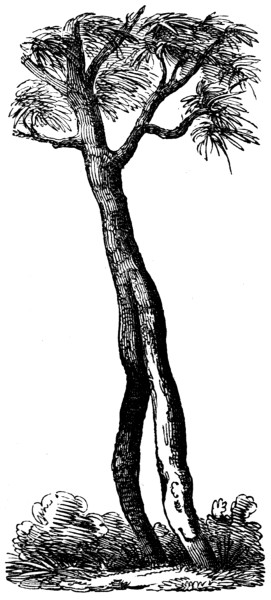
A Young Ash Tree, SHIRLEY HEATH, WARWICKSHIRE, Used for Charms.
Mr. Brand mentions, as a popular superstition, that if a tree of any kind is split—and weak, rickety, or ruptured children drawn through it, and afterwards the tree is bound, so as to make it unite, as the tree heals and grows together, so will the child acquire strength.
Sir John Cullum, who saw this operation twice performed, thus describes it:—“For this purpose a young ash was each time selected, and split longitudinally, about five feet: the fissure was kept wide open by my gardener; whilst the friend of the child, having first stripped him naked, passed him thrice through it, almost head foremost. As soon as the operation was performed, the wounded tree was bound up with a packthread; and, as the bark healed, the child was to recover. The first of the young patients was to be cured of the rickets, the second of a rupture.” This is a very ancient and extensive piece of superstition.
In the Gentleman’s Magazine, for October, 1804, is an engraving of an ash tree, then growing by the side of Shirley-street, (the road leading from Hockley House to Birmingham,) at the edge of Shirley-heath, in the parish of Solihull, Warwickshire. It is stated that this tree is “close to the cottage of Henry Rowe, whose infant son, Thomas Rowe, was drawn through the trunk or body of it in the year 1791, to cure him of a rupture, the tree being then split open for the purpose of passing the child through it.” The writer proceeds to say, “The boy is now thirteen years and six months old: I have this day, June 10, 1804, seen the ash tree and Thomas Rowe, as well as his father, Henry Rowe, from whom I have received the above account; and he superstitiously believes that his son Thomas was cured of the rupture, by being drawn through the cleft in the said ash tree, and by nothing else.”
Another writer concerning the same tree says, “The upper part of a gap formed by the chisel has closed, but the lower remains open. [As represented in the plate, from whence the engraving at the head of this article is taken.] The tree is healthy and flourishing. Thomas Chillingworth, son of the owner of an adjoining farm, now about 34, was, when an infant of a year old, passed through a similar tree, now perfectly sound, which he preserves with so much care that he will not suffer a single branch to be touched, for it is believed the life of the patient depends on the life of the tree; and that the moment it is cut down, be the patient ever so distant, the rupture returns, and a mortification ensues, and terminates in death. Rowe’s son was passed through the present tree in 1792, at the age of one or two. It is not, however, uncommon for persons to survive for a time the felling of the tree. In one case the rupture returned suddenly, and mortification followed. These trees are left to close of themselves, or are closed with nails. The wood-cutters very frequently meet with the latter. One felled on Bunnan’s farm was found full of nails. This belief is so prevalent in this part of the country, that instances of trees that have been employed in the cure are very common. The like notions obtain credit in some parts of Essex.”
The same writer proceeds to observe a superstition “concerning the power of ash trees to repel other maladies or evils, such as Shrew-mice; the stopping one of which animals alive into a hole bored in an ash is imagined an infallible preventive of their ravages in lands.”
On this there are some particulars in point related by the Rev. Gilbert White, in his “Natural History and Antiquities of Selborne,” a parish near Alton, in Hampshire. “In a farm-yard near the middle of this village stands, at this day, a row of pollard-ashes, which, by the seams and long cicatrices down their sides, manifestly show that in former times they have been cleft asunder. These trees, when young and flexible, were severed and held open by wedges, while ruptured children, stripped naked, were pushed through the apertures, under a persuasion that, by such a process, the poor babes would be cured of their infirmity. As soon as the operation was over, the tree, in the suffering part, was plastered with loam, and carefully swathed up. If the parts coalesced and soldered together, as usually fell out, where the feat was performed with any adroitness at all, the party was cured; but where the cleft continued to gape, the operation, it was supposed, would prove ineffectual. Having occasion to enlarge my garden not long since, I cut down two or three such trees, one of which did not grow together. We have several persons now living in the village, who, in their childhood, were supposed to be healed by this superstitious ceremony, derived down perhaps from our Saxon ancestors, who practised it before their conversion to Christianity.”
Again, as respects shrew-mice, Mr. White says, “At the south corner of the plestor, or area, near the church, there stood, about twenty years ago, a very old grotesque hollow pollard-ash, which for ages had been looked on with no small veneration as a shrew-ash. Now a shrew-ash is an ash, whose twigs or branches, when gently applied to the limbs of cattle, are immediately to relieve the pains which a beast suffers from the running of a shrew-mouse over the part affected: for it is supposed that a shrew-mouse is of so baneful and deleterious a nature, that wherever it creeps over a beast, be it horse, cow, or sheep, the suffering animal is afflicted with cruel anguish, and threatened with the loss of the use of the limb. Against this accident, to which they were continually liable, our provident forefathers always kept a shrew-ash at hand; which, when once medicated, would maintain its virtue for ever. A shrew-ash was made thus:—Into the body of the tree a deep hole was bored with an auger, and a poor devoted shrew-mouse was thrust in alive, and plugged in, no doubt, with several quaint incantations long since forgotten. As the ceremonies necessary for such a consecration are no longer understood, all succession is at an end, and no such tree is known to subsist in the manor or hundred. As to that on the plestor, the late vicar stubbed and burnt it, when he was waywarden, regardless of the remonstrances of the by-standers, who interceded in vain for its preservation, urging its power and efficacy, and alleging that it had been
‘Religione patrum multos servata per annos.’”
Mr. Ellis, in a note on this practice of enclosing field-mice, cites a letter to Mr. Brand, dated May 9, 1806, from Robert Studley Vidal, Esq. of Cornborough, near Biddeford, a gentleman to whom Mr. Brand was much indebted for information on the local customs of Devonshire. Mr. Vidal says:—“An usage of the superstitious kind has just come under my notice, and which, as the pen is in my hand, I will shortly describe, though I rather think it is not peculiar to these parts. A neighbour of mine, on examining his sheep the other day, found that one of them had entirely lost the use of its hinder parts. On seeing it, I expressed an opinion that the animal must have received a blow across the back, or some other sort of violence which had injured the spinal marrow, and thus rendered it paralytic: but I was soon given to understand, that my remarks only served to prove how little I knew of country affairs, for that the affection of the sheep was nothing uncommon, and that the cause of it was well known; namely, a mouse having crept over its back. I could not but smile at the idea; which my instructor considering as a mark of incredulity, he proceeded very gravely to inform me, that I should be convinced of the truth of what he said by the means which he would use to restore the animal; and which were never known to fail. He accordingly despatched his people here and there in quest of a field-mouse; and having procured one, he told me that he should carry it to a particular tree at some distance, and, enclosing it within a hollow in the trunk, leave it there to perish. He further informed me, that he should bring back some of the branches of the tree with him, for the purpose of their being drawn now and then across the sheep’s back; and concluded by assuring me, with a very scientific look, that I should soon be convinced of the efficacy of this process; for that, as soon as the poor devoted mouse had yielded up his life a prey to famine, the sheep would be restored to its former strength and vigour. I can, however, state, with certainty, that the sheep was not at all benefited by this mysterious sacrifice of the mouse. The tree, I find, is of the sort called witch-elm, or witch-hazel.”
TREES Poetically and Nationally regarded.
A gentleman, who, on a tour in 1790, visited the burial-place of Edmond Waller, in the church-yard of Beaconsfield, describes the poet’s splendid tomb as enclosed, or cradled, with spiked iron palisadoes, inserted into a great old ash tree, under which his head reposes. “This umbrageous tree overshadows the whole mausoleum. As the pagan deities had each their favourite tree—Jupiter, the oak; Apollo, the laurel; Venus, the myrtle; Minerva, the olive; &c.—so poets and literary men have imitated them herein; and all lovers of solitude are, like the Lady Grace of Sir John Vanbrugh, fond of a cool retreat from the noon-day’s sultry heat under a great tree.”[381]
A modern author, whose works are expressive of beauty and feeling, and from whom an elegant extract on “Gardens” in a former page has been derived, adverts to the important use which the poets have made of trees by way of illustration. He says—
Homer frequently embellishes his subjects with references to them; and no passage in the Iliad is more beautiful, than the one where, in imitation of Musæus, he compares the falling of leaves and shrubs to the fall and renovation of great and ancient families.—Illustrations of this sort are frequent in the sacred writings.—“I am exalted like a cedar in Libanus,” says the author of Ecclesiastes, “and as a cypress tree upon the mountain of Hermon. I was exalted like a palm tree in Engeddi, and as a rose plant in Jericho; as a fair olive in a pleasant field, and grew up as a plane tree by the water; as a turpentine tree I stretched out my branches, and my branches are the branches of honour and grace; as a vine brought I forth pleasant savour, and my flowers are the fruits of honour and victory.”—In the Psalms, in a fine vein of allegory, the vine tree is made to represent the people of Israel: “Thou hast brought a vine out of Egypt; thou hast cut out the heathen, and planted it. Thou didst cause it to take deep root, and it filled the land. The hills were covered with its shadow, and the boughs thereof were like the goodly cedars.”
In Ossian, how beautiful is the following passage of Malvina’s lamentation for Oscar:—“I was a lovely tree in thy presence, Oscar, with all my branches round me; but thy death came like a blast from the desert, and laid my green head low; the spring returned with its showers, but no green leaf of mine arose.” Again, where old and weary, blind and almost destitute of friends, he compares himself to a tree that is withered and decayed:—“But Ossian is a tree that is withered; its branches are blasted and bare; no green leaf covers its boughs:—from its trunk no young shoot is seen to spring; the breeze whistles in its grey moss; the blast shakes its head of age; the storm will soon overturn it, and strew all its dry branches with thee, Oh Dermid, and with all the rest of the mighty dead, in the green winding vale of Cona.”
That traveller esteemed himself happy, who first carried into Palestine the rose of Jericho from the plains of Arabia; and many of the Roman nobility were gratified, in a high degree, with having transplanted exotic plants and trees into the orchards of Italy. Pompey introduced the ebony on the day of his triumph over Mithridates; Vespasian transplanted the balm of Syria, and Lucullus the Pontian cherry. Auger de Busbeck brought the lilac from Constantinople; Hercules introduced the orange into Spain; Verton the mulberry into England:—and so great is the love of nations for particular trees, that a traveller never fails to celebrate those by which his native province is distinguished. Thus, the native of Hampshire prides himself upon his oaks; the Burgundian boasts of his vines, and the Herefordshire farmer of his apples. Normandy is proud of her pears; Provence of her olives; and Dauphiné of her mulberries; while the Maltese are in love with their own orange trees. Norway and Sweden celebrate their pines; Syria her palms; and since they have few other trees of which they can boast, Lincoln celebrates her alders, and Cambridge her willows! The Paphians were proud of their myrtles, the Lesbians of their vines; Rhodes loudly proclaimed the superior charms of her rose trees; Idumea of her balsams; Media of her citrons, and India of her ebony. The Druses boast of their mulberries; Gaza of her dates and pomegranates; Switzerland of her lime trees; Bairout of her figs and bananas; Damascus of her plums; Inchonnaugan of its birch, and Inchnolaig of its yews. The inhabitants of Jamaica never cease to praise the beauty of their manchenillas; while those of Tobasco are as vain of their cocoas.—The natives of Madeira, whose spring and autumn reign together, take pride in their cedars and citrons; those of Antigua of their tamarinds, while they esteem their mammee sappota to be equal to any oak in Europe, and their mangos to be superior to any tree in America. Equally partial are the inhabitants of the Plains of Tahta to their peculiar species of fan palm; and those of Kous to their odoriferous orchards. The Hispaniolans, with the highest degree of pride, challenge any one of the trees of Europe or Asia to equal the height of their cabbage trees—towering to an altitude of two hundred and seventy feet:—Even the people of the Bay of Honduras have imagination sufficient to conceive their logwood to be superior to any trees in the world; while the Huron savages inquire of Europeans, whether they have any thing to compare with their immense cedar trees.[382]
THE PEARL. A Persian Fable.
Imitated from the Latin of Sir W. Jones.
Whoe’er his merit underrates, The worth which he disclaims creates. It chanc’d a single drop of rain Fell from a cloud into the main: Abash’d, dispirited, amaz’d, At last her modest voice she rais’d: “Where, and what am I? Woe is me! What a mere drop in such a sea!”— An oyster yawning, where she fell, Entrapp’d the vagrant in his shell; In that alembic wrought—for he Was deeply vers’d in alchemy— This drop became a pearl; and now Adorns the crown on George’s brow.
Discoveries OF THE ANCIENTS AND MODERNS. No. XI.
Comets.
Cassini, and after him sir Isaac Newton, by their close observations and accurate calculations respecting the nature and courses of comets, have given certainty to the opinions of the old philosophers; or, to speak with more propriety, they have recalled and fixed our attention upon what had before been advanced by the ancients on these subjects. For, in treating of the nature of these stars, their definitions of them, the reasons they assign for the rarity of their appearance, and the apologies they make for not having yet formed a more exact theory, are all in the very terms that Seneca had already used. In the time of that philosopher, the observations previously made of the returns of comets, were not sufficiently collected to establish the theory of these phenomena. Their appearances were so very rare, that they had not afforded an opportunity to determine, whether their course was regular or not. The Greeks, however, before Seneca’s time, had remarked to the same effect, and were applying themselves to researches of this kind.
Seneca says, that the Chaldeans looked upon comets as planetary bodies; and Diodorus Siculus, in giving an account of the extent of knowledge among the Egyptians, praises them for the application with which they studied the stars and their courses; and remarks, that they had collected, observations very ancient and very exact, fully informing them of the several motions, orbits, stations, &c. of the planets. He adds, that they could foretell earthquakes, inundations, and “the return of comets.”
Aristotle says, that Anaxagoras apprehended comets to be an assemblage of many wandering stars; which, by their approximation, and the mutual blending of their rays, rendered themselves visible to us. This notion, though far from being philosophical, was yet far preferable to that of some great moderns, such as Kepler and Hevelius, who supposed that comets were formed out of air, as fishes are out of water.
Pythagoras, however, who approached very near to the times of Anaxagoras, held an opinion worthy of the most enlightened age. He looked upon “comets as stars, which circulated regularly, though elliptically, about the sun, and which appeared to us only in particular parts of their orbit, and at considerable distances of time.”
Seneca, more than any other, has discussed this subject like a true philosopher. He relates all the different opinions respecting comets, and seems to prefer that of Artemidorus, who imagined, “that there was an immense number of them, but that their orbits were so situated, that, so far from being always within view, they could only be seen at one of the extremities.” He reasons upon this with equal elegance and solidity. “Why should we be astonished,” says he, “that comets, which are so rare a spectacle in the world, have not yet come under certain rules; or that we have not hitherto been able to determine, where begins or ends the course of planets, as ancient as the universe, and whose returns are at such distant intervals? The time will come,” he exclaims, with enthusiasm, “when posterity will be amazed at our ignorance in things so very evident; for what now appears to us obscure, will one day or other, in the course of ages, and through the industry of our descendants, become manifestly clear; but, a small number of years, passed between study and the indulgence of passion, are not of avail for researches so important, as those which propose to themselves the comprehension of natures so remote.”
The moderns have said nothing satisfactory respecting comets, but what is to be found in the writings of the ancients; except what later observations have furnished them with, which Seneca judged to be so necessary, and which only could be collected through a long succession of ages.
The Moon.
The ancients discovered very early, that “the moon had no light of its own, but shone with that which it reflected from the sun.” This, after Thales, was the sentiment of Anaxagoras, and that of Empedocles, who thence accounted not only for the mildness of its splendour, but the imperceptibility of its heat, which our modern experiments confirm: for with all the aid of burning glasses, we have never yet found it practicable to obtain the least warmth from any combination of its rays.
With a telescope, we easily discern in the moon parts more elevated and more bright than others, which are judged to be mountains; and means have been found to measure their elevation. We discern also other parts, lower and less bright, which must be vallies, lying between those mountains. There are other parts, which reflecting less light, and presenting one uniform smooth surface, may therefore be supposed large pieces of water. As the moon, then, has its collections of water, its atmosphere, its mountains, and its vallies; it is thence inferred, that there may also be rain there, and snow, and all the other aerial commotions which are natural to such a situation; and our idea of the wisdom and power of God suggests to us, that he may have placed creatures there to inhabit it.
The ancients, who had not the aid of the telescope, supplied the defect of that instrument by extraordinary penetration. They deduced all those consequences that are admitted by the moderns; for they discovered long before, by the mental eye, whatever has since been presented to bodily sight through the medium of telescopes. We have seen in how sublime a manner they entered into the views of the Supreme Being in his destination of the planets, and the multitude of stars placed by him in the firmament. We have already seen, that they looked upon them as so many suns, about which rolled planets of their own, such as those of our solar system; maintaining that those planets contained inhabitants, whose natures they presume not to describe, though they suppose them not to yield to those of ours, either in beauty or dignity.
Orpheus is the earliest author whose opinion on this subject hath come down to us. Proclus presents us with three verses of that eminent ancient, wherein he positively asserts, that “the moon was another earth, having in it mountains, vallies,” &c.
Pythagoras, who followed Orpheus in many of his opinions, taught likewise, that “the moon was an earth like ours, replete with animals, whose nature he presumed not to describe,” though he was persuaded they were of a more noble and elegant kind than ours, and not liable to the same infirmities.
Cicero ascribes a similar sentiment to Democritus, when, in explaining his theory, he says, that, according to it, Quintus Luctatius Catulus, for instance, might without end be multiplied into an infinity of worlds. It were easy to multiply quotations, in proof that this opinion was common among the ancient philosophers. There is a very remarkable passage of Stobæus, wherein he gives us Democritus’s opinion about the nature of the moon, and the cause of those spots which we see upon its disk. That great philosopher imagined, that “those spots were no other than shades, formed by the excessive height of the lunar mountains,” which intercepted the light from the lower parts of that planet, where the vallies formed themselves into what appeared to us as shades or spots.
Plutarch went still farther, alleging, that there were embosomed in the moon, vast seas and profound caverns. These, his conjectures, are built upon the same foundation with those of the moderns. He says, that those deep and extensive shades which appear upon the disk of that planet, must be occasioned by the “vast seas” it contains, which are incapable of reflecting so vivid a light, as the more solid and opaque parts; or “by caverns extremely wide and deep, wherein the rays of the sun are absorbed,” whence those shades and that obscurity which we call the spots of the moon. Xenophanes said, that those immense cavities were inhabited by another race of men, who lived there, as we do upon this earth.
MEDICAL AND LEGAL DUALITY.
Two Physicians.
A gentleman calling on a friend, found two physicians with him: he wrote the following lines on the back of his card:—
“By one physician might your work be done, But two are like a double-barrell’d gun; From one discharge sometimes a bird has flown, A second barrel always brings it down.”
Two Lawyers.
An opulent farmer applied about a law-suit to an attorney, who told him he could not undertake it, being already engaged on the other side; at the same time he said, that he would give him a letter of recommendation to a professional friend, which he did. The farmer, out of curiosity, opened it, and read as follows:
“Here are two fat wethers fallen out together, If you’ll fleece one, I’ll fleece the other, And make ’em agree like brother and brother.”
The farmer carried this epistle to the person with whom he was at variance. Its perusal cured both parties, and terminated the dispute.
THE HAUNTED MILL.
For the Table Book.
——————Can such things be, And overcome us like a summer’s cloud, Without our special wonder?
At the basis of the Wolds, in the north riding of Yorkshire, creeps a sluggish stream, on whose bank may be seen the ruins of a mill, which our good forefathers supposed to be haunted. I often gaze upon those ruins with great interest; not so much for its picturesque beauty, which, like a flower in the wilderness, makes solitude less lonely, as for the many endearing claims it has upon my memory, by way of association. It stands near the home of my childhood, it reminds me of the companions of my youth, and tells of pleasures long departed.
It is now nearly ten years since I listened to a story, which haunts me like the recollection of a fearful dream; perhaps, because of its locality, or rather, of its having been told me as a fact. Be it as it may, I have thought it worth the relating; and trust that the readers of the Table Book will at least be interested.
The mill, at the time referred to, had been uninhabited for some ten or twelve years. It had found an occupier in the person of Joe Davis. The inhabitants of the distant, though nearest village, endeavoured to frighten Joe, the miller, by telling him of its being haunted. He laughed at what he called their idle fears, bade them keep their superstitious nonsense for their children’s ears; and laughingly added, that if nought but ghosts visited the mill, he stood a good chance of getting what he most required after a hard day’s work—a quiet rest.
When Joe took possession of the mill, he was as jolly a fellow as ever lived, and a fine buxom wife had he, and three rosy children. His cup of happiness was filled to the brim; his song, merry as the lark’s, and his loud, hearty laugh, were alternately to be heard above the rush of the dam, and the click-clacking of the wheel. When his work was done, it was a treat to see him playing with his children at blindman’s-buff, or hide and seek, or dandling them upon his knee.
All went on well for some time; but in a few months Joe became an altered man. There was a visible difference in his face and manner. At first, a shade was seen to overcast his hitherto unclouded brow—then his cheek became robbed of its bloom, and his step lost its buoyancy. His laughter (when he did laugh, which was seldom) seemed laboured, and was followed by a sigh; and the song—that favourite song, which he had so often sung to Mary in his courtship—faltered on his lips. Instead of clinging to his home and family as usual, he deserted them; and when the straying villager kindly questioned him as to the change, he would not answer, but shake his head, and hurry onwards.
One day Mary found her husband unusually depressed. “Come, come,” said she, “I’m sure all is not right within.” She hung fondly upon his neck—kissed him, and besought him to make her the partner of his sorrow; he raised his head, gazed at her affectionately, and endeavoured to smile away her apprehensions—but it would not do. He dashed the tear from his eye, and rushed out of the room.
Joe Davis had dreamed a dream; or, as my narrator informed me, had seen a vision. Sitting one evening in his little parlour, with his wife and children before him, he, on a sudden, leaned back in his chair—his eyes became glazed, and were rivetted on the picture of his wife holding three roses in her hand, which hung over the mantelpiece—he thought that he beheld a shadow of himself bend over the picture, that the roses began to fade, and, in fading, he distinctly saw the faces of his children, while the portrait of his wife by degrees became colourless. Such was the dream which gave him so much concern—such was the prophecy which ere long was to be fulfilled.
Joe left his house, telling Mary he would return before night. The darkness set in, but he did not make his appearance. Poor Mary, as the night advanced, became mistrustful—she looked at the clock, and listened for his approaching step. It was nearly midnight; and, save the melancholy monotonous ticking of the clock, and the low breathing of her sweet children, who were sleeping near, all was silent as the grave—when, on a sudden, the eldest child cried out, “Father, how cold you are!”—Mary started, and beheld the death-pale face of her husband kissing her children—she shrieked wildly, and fell senseless on the floor.
When Mary came to herself the fire was out, and the clock had stopped. She endeavoured to calm her agitated mind, and thought she heard the noise of the dam, and her husband singing the chorus—
We’ll always be merry together, together, We’ll always be merry together.
She listened, and thought of her children, whom (by the revealment of one of the secrets of her prison-house) she knew were dead. The rest of that horrible night was a (——)
The morning came with its beautiful purple light—the lark hailed it with his matin-song—the flower bloomed at the very door-stone of the mill—the schoolboy whistled as he passed, as if in mockery of her woe. The light of reason had passed from Mary Davis. In the course of the day the body of her husband was found in the dam, but Mary knew it not.—
Say, gentle reader, did not Heaven deal kindly to her in bidding her taste the waters of oblivion?
——I shall never forget the story.
Q. T. M.
COUNSELS AND SAYINGS, By Dr. A. Hunter.
Accustom yourself to reflect.
Seek wisdom, and you will be sure to find her; but if you do not look for her, she will not look for you.
Do, as you would be done by.
Use yourself to kindness and compassion, and you may expect kindness and compassion in return.
Have you a Friend?
If you have a grievance on your mind you may tell it to your friend, but first be sure that he is your friend.
Educate your Children properly.
An university implies a seminary, where all the young men go the same way. What that way is, fathers and grandfathers best know.
Obstinacy is Weakness.
Obstinacy of temper proceeds from pride, and, in general, from ignorant pride, that refuses to be taught.
Regulate your Temper.
We can bear with a man who is only peevish when the wind is in the east; but it is intolerable to live with one who is peevish in every point of the compass.
True Generosity is delicately minded.
Blame no man for what he cannot help. We must not expect of the dial to tell us the hour after the sun is set.
GERMAN EPIGRAMS
Honourable Service.
If one have serv’d thee, tell the deed to many: Hast thou serv’d many—tell it not to any.—Opitz.
A Mother’s Love.
E’er yet her child has drawn its earliest breath A mother’s love begins—it glows till death— Lives before life—with death not dies—but seems The very substance of immortal dreams.—Wernicke.
Epitaph.
What thou art reading o’er my bones, I’ve often read on other stones; And others soon shall read of thee, What thou art reading now of me.—Fleming.
Adam’s Sleep.
He laid him down and slept:—and from his side, A woman in her magic beauty rose, Dazzled and charm’d he call’d that woman “Bride,” And his first sleep became his last repose.—Besser.
Epitaph.
Here lies, thank God, a woman, who Quarrell’d and storm’d her whole life through: Tread gently o’er her mouldering form, Or else you’ll rouse another storm.—Weckherlin.
PRUSSIAN COURT MOURNING.
Frederick the first king of Prussia was an extremely vain man, and continually engaged in frivolous pursuits. His queen, Sophia Charlotte, the sister of our George I. was a woman of a very superior mind. In her last illness she viewed the approach of death with much calmness and serenity; and when one of her attendants observed how severely it would afflict the king, and that the misfortune of losing her would plunge his majesty into the deepest despair, the queen said, with a smile, “With respect to him, I am perfectly at ease. His mind will be completely occupied in arranging the ceremonial of my funeral, and if nothing goes wrong in the procession, he will be quite consoled for his loss.”
MI-EAU IN AMERICA.
A New York paper says, that a lad in that city, on delivering his milk, was asked why the milk was so warm. “I don’t know,” he replied, with much simplicity, “unless they put in warm water instead of cold.”
A CAPITAL EXTEMPORE
To the Author of some Bad Lines, on the River Dee.
Had I been U, And in the Q, As easy I might B. I’d let U C, Whilst sipping T, Far better lines on D.
PETITION OF THE LETTER H TO ITS DECIDED ENEMIES.
Whereas, by you I have been driven From House, from Home, from Hope, and Heaven, And placed, by your most learn’d society, In Evil, Anguish, and Anxiety; And used, without the least pretence, With Arrogance and Insolence. I hereby ask full restitution, And beg you’ll change your elocution.
ANSWER.
Whereas we’ve rescued you, ingrate, From Hell, from Horror, and from Hate— From Horseponds—Hanging in a halter, And consecrated you in—altar. We think you need no restitution, And shall not change our elocution.
Hezekiah Hulk, Huntsman.
Milford, June, 1827.
THE GLORIOUS MEMORY.
Sir Jonah Barrington lately met rather a noted corporator of Dublin in Paris, and in the course of conversation inquired why, after the king’s visit to the metropolis of Ireland, and his conciliatory admonitions, the corporation still appeared to prefer the “Boyne Water” and “King William.” The answer was characteristic. “Lord bless you, sir Jonah,” replied the corporator, “as for the Wather we don’t care a farthing about that; but if we once gave up ould King William, we’d give up all our enjoyments! Only for the Glorious Memory we would not have a toast to get drunk with—eh! sir Jonah?”
ERRATA.
Col. 397, line 18, for “modern Europe,” read “northern Europe.”
Col. 430. In the Will of John Keats, for “losses of the sale of books,” read “hopes of the sale of books.”