Volume 2 — Vol. II.—34.
Reading edition
My Desk.
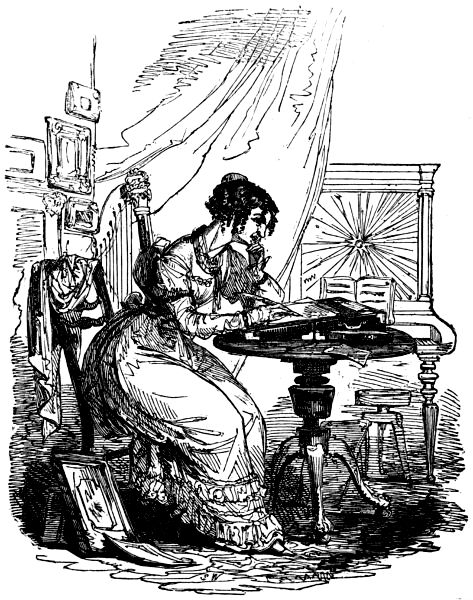
My Desk.
For the Table Book.
Every one will agree with me, that this is the favourite article of furniture. Every one is fond of it as of an old friend—a faithful and trustworthy one—to whom has been confided both joys and sorrows. It is most likely the gift of some cherished, perhaps departed being, reminding us by its good qualities of the beloved giver. We have no scruple in committing our dearest secrets to its faithful bosom—they are never divulged. The tenderest billet-doux, the kindest acknowledgments, the sweetest confessions of a mistress—the cruellest expressions and bitterest reproaches of a friend lost to us for ever through the false and malignant representations of an enemy—or perhaps the youthful effusions of our own brain, which we occasionally draw forth from the recesses of the most secretly contrived pigeon-hole, and read over à la dérobée, with a half blush (at our self-love) and a smile partly painful from revived recollections of days gone, never to return—all these we may unhesitatingly deposit in this personification of deskretion.
The very posture assumed at a desk bespeaks confidence and security. The head inclined over it, and the bosom leaning in gentle trustingness against this kind and patient friend.
By this description I would present to the “mind’s eye” of the reader a plain unostentatious piece of furniture, of too simple an exterior to be admitted any where than in the study—square in shape, mahogany, bound with brass at the corners, a plate of the same metal on the top, of just a sufficient size to contain one’s own initials and those of the giver. I detest those finicking machines one finds wrapped up in an oilskin case in a drawing-room; made of rosewood, inlaid with silver, or mother-of-pearl, and lined with blue velvet. It seems like an insult to the friendly character of a desk, to dress him smartly, seat him in a fine apartment, and refuse to avail yourself of the amicable services he tenders you.—The contents of these coxcombical acquaintances are seldom better than its fair owner’s private journal, (which no one thinks worthy of perusal—herself of course excepted,) her album, and scrap-book, the honourable Mr. Somebody’s poetical effusions, and the sentimental correspondence of some equally silly young lady, her dearest friend.
Then there is the clerk’s desk in a counting-house—there are no pleasant associations connected with that mercantile scaffolding, with its miniature balustrades at the top, partly intersected with accounts, bills, and papers of all sorts, (referring to business,) and surrounded by files clinging by their one hook. Above all this is seen the semicircular scalp of a brown wig, which, as it is raised to reply to your question, gradually discovers two eyes scowling at you from beneath a pair of glaring spectacles, a little querulous turned-up nose, and a mouth whose lines have become rigid with ill-humour, partly occasioned by a too sedentary life.
Again, there is the pulpit desk, with its arrogant crimson cushion—telling a tale of clerical presumption.
Lastly, there is the old bachelor’s desk. (Nay, do not curl up the corners of your pretty mouths at me, sweet ladies—it may be worth while to take a peep at it—at least, I cannot prevail upon myself to omit it in this notice of desks.) It is of the plain and quiet description formerly mentioned, and very neatly and orderly arranged, both inside and out. The latter is kept bright and shining by the indefatigable hands of Sally the housemaid; who, while she breathes upon the plate to give it a polish, at the same time breathes a wish (to herself) that her breath possessed the magic power of unfastening locks, and so enabling her to see “what the old gentleman keeps in this here box to make him so fond on it.” The interior he takes infinite care to keep in complete and exact order himself. Each particular compartment has its appropriate contents consigned to it. The fold-down nearest to him, as he sits at it, contains a small miniature within a red morocco case, of a placid and gentle-faced girl, whose original sleeps for ever in the bosom of the cold earth—a little box, containing a ring set with brilliants, and enclosing a lock of her hair—all her letters carefully tied up with green ribbon—a miniature edition of Shakspeare, and Milton, with his name written in them in her hand-writing. In the opposite fold, near the receptacle for the pens, wafers, ink, &c. are his own little writings, (for we are to suppose him fond of his pen, and as having occasionally indulged that fondness,) of all of which he preserves neat copies, some private memoranda, and an old pocket-book, given to him by his old friend and school-fellow, admiral ——, when he left England that year as a midshipman.
In the drawer are different letters from his friends; and, perhaps, at the very back of it, a little hoard of gold pieces, bright and new from the mint.
As I now lean upon my old friend and companion—my desk—I render it my grateful acknowledgments for the many pleasant hours I have spent over it; and also for its having been the means of my passing an agreeable quarter of an hour with my gentle reader, of whom I now take a courteous leave.
July, 1827. M. H.
WRITING DESKS.
There is not any mention of writing-desks among the ancients. They usually wrote upon the knee in the manner wherein Angelica Kauffman represents the younger Pliny, as may be seen in a modern engraving; and yet it appears from Stolberg, quoted by Mr. Fosbroke, that desks resembling ours have been found in Herculaneum. Writing-desks in the middle ages slanted so much, as to form an angle of forty-five degrees: their slant till within the last two centuries was little less.
Topographiana.
WILTS’ LOCAL CUSTOM. DANCING ROUND THE HARROW.
To the Editor.
Dear sir,—I hand you the following authentic particulars which happened in the pleasant village of S****n B****r, and gave rise to “dancing round the harrow:” if worthy of being chronicled in the Table Book, they are yours.
John Jones, not finding his lovesuit successful with his master’s daughter, because her father, a farmer, rebuked him, took umbrage, threw down his whip on the “harrow” in the field, left the team, and, sans cérémonie, went to sea.
The farmer and his daughter Nancy were variously affected by this circumstance.—“Comfortable letters” were hoped for, news was expected from some corner of the world, but no tidings arrived as to the fate or designs of honest John. Village gossips often talked of the poor lad. The farmer himself, who was a good sort of man, began to relent; for Nancy’s cheeks were not so rosy as formerly; she was dull at milking time. Observers at church whispered,—“How altered Nancy R* appears!” * * *
After a lapse of about six years appearances change favourably. John returns from sea auspiciously—meets his Nancy with open arms—her father finds him disposed to make her happy—John requests forgiveness, and is pardoned—his steadiness and attachment are tried and approved—and—suffice it to say—John and Nancy are married. He assists her father in the duties of the farm as his years decline, while she supplies the absence of her mother, buried in the family grave of the church-yard of her native village. * * * *
As soon as the wedding took place, a “harrow” was brought on the grass-plot in the fore-close, when the villagers invited danced round it till daybreak. * * * *
This “dancing round the harrow” was kept on several anniversaries of the wedding-day; a young family and the old projector’s decease occasioned its discontinuance; but, on each of these occasions, John does not forget to present, instead, a not less acceptable offering, a good supper to his workfolks in remembrance of his advance in life.
I am, dear sir,
Goat and Boots, Yours very truly,
August 3, 1827. Jehoiada.
For the Table Book.
BAKEWELL, DERBYSHIRE. Ancient Monuments and Inscriptions in the Church.
Upon the tablet over the mural monument in the chantry of the Holy Cross, is the following inscription:
Godfrey Foljambe, Knight, and Avena his wife, (who afterwards married Richard de Greene, Knight,) Lord and Lady of the Manors of Hassop, Okebrook, Elton, Stanton, Darley, Overhall, and Lokhawe, founded this Chantry in honor of the Holy Cross, in the 39th year of the Reign of King Edward the 3rd, 1366. Godfrey died on Thursday next after the Feast of the Ascension of our Lord, in the 50th year of the reign of the same King; and Avena died on Saturday next after the Feast of the Nativity of the blessed Virgin Mary, in the 6th year of the reign of Richard 2nd, 1383.
N. B. The Dates are taken from the Escheat Rolls, which contain the Inquisitum post mortem, 50th Edward 3. No. 24.
In the Vestry, there is an effigy in alabaster, of sir Thomas Wendersley de Wendersley, who was mortally wounded at the battle of Shrewsbury, 4th Henry IV., 1403, and was buried at Bakewell, where formerly were several shields of the arms of his family carved in wood. (See Brailsford’s “Monumental Inscriptions of Derbyshire.”)
Adjoining the vestry are several handsome monuments of the Vernon and Manners’ families.
In the centre is the tomb or cenotaph of sir George Vernon, inscribed thus:
Here lyeth Sir George Vernon, Knight, deceased, ye daye of Ano 156 and Dame Margaret his Wife, dowghter of Sr Gylbert Tayllboys, deceased the daye of 156 and also Dame Mawde his Wyffe, dowghter to Sir Ralphe Langfoot, deceased the daye of Ano 1566, whose solles God p—don—.
On the right is a monument to sir John Manners, with this inscription:
Here lyeth Sir John Manners, of Haddon, Knt. Second Sonne of Thomas Erle of Rutland, who died the 4th of June, 1611, and Dorothy his Wife, one of the Dawghters and heires of Sir George Vernon, of Haddon, Knt. who deceased the 24th day of June, in the 26th yeere of the Rayne of Queene Elizabeth, 1584.
To the right of the window, on a mural monument, is the following:
Heere lyeth buryed John Manners, Gentn 3 Son̄e of Sir John Man̄ers, Knight, who dyed the 16th day of July, in the Yeere of our Lord God 1590, being of the Age of 14 yeeres.
To the left is an elegant monument to sir John Manners, with this inscription:
George Manners of Haddon, Knt. here awaits the resurrection of the just in Christ. He married Grace, second daughter of Henry Pierrepoint, Knt. who afterwards bore him 4 sons and 5 daughters, and lived with him in Holy Wedlock 30 years, she caused him to be buried with his forefathers, and then placed this monument at her own expence, as a perpetual Memorial of their conjugal faith, and she united the figure of his body with hers, having resolwed that their bones and ashes should be laid together. He died 23rd Apl. 1623, aged 54—She died - - - aged - - -.
Beneath this monument, on an alabaster grave-stone on the floor, are some figures engraved round them, with an inscription, now obliterated, and the arms of Eyre impaled with Mordaunt.
In the Chancel.
Upon an alabaster tomb, repaired, and the inscription cut, and filled up with black in 1774, (by Mr. Watson.)
Here lies John Vernon, son and heir of Henry Vernon, who died the 12th of August 1477, whose soule God pardon.
August, 1827. E. J. H.
For the Table Book.
ERASMUS.
Quæritur, unde tibi sit nomen Erasmus? Eras-mus.
Resp.
Si sum Mus ego, te judice Summus ero.
Joannis Audoeni, lib. vii. epig. 34.
That thou wast great Erasmus none dispute; Yet, by the import of thy name, wast small: For none its truth can readily refute Thou wast—a Mouse,—Eras-Mus after all.
The Reply of Erasmus.
Hence, if a Mouse, thy wit must this confess:— I will be Sum-mus:—Can’st thou make me less?
J. R. P.
Garrick Plays. No. XXX.
[From a “Woman’s a Weathercock,” a Comedy, by Nathaniel Field, 1612.]
False Mistress.
Scudmore alone; having a letter in his hand from Bellafront, assuring him of her faith.
Scud. If what I feel I could express in words, Methinks I could speak joy enough to men To banish sadness from all love for ever. O thou that reconcilest the faults of all Thy frothy sex, and in thy single self Confines! nay has engross’d, virtue enough To frame a spacious world of virtuous women! Had’st thou been the beginning of thy sex, I think the devil in the serpent’s skin Had wanted cunning to o’er-come thy goodness; And all had lived and died in innocency, The whole creation—. Who’s there?—come in— Nevill (entering.) What up already, Scudmore? Scud. Good morrow, my dear Nevill? Nev. What’s this? a letter! sure it is not so— Scud. By heav’n, you must excuse me. Come, I know You will not wrong my friendship, and your manners, To tempt me so. Nev. Not for the world, my friend. Good morrow— Scud. Nay, Sir, neither must you Depart in anger from this friendly hand. I swear I love you better than all men, Equally with all virtue in the world: Yet this would be a key to lead you to A prize of that importance— Nev. Worthy friend, I leave you not in anger,—what d’ye mean?— Nor am I of that inquisitive nature framed, To thirst to know your private businesses. Why, they concern not me: if they be ill, And dangerous, ’twould grieve me much to know them; If good, they be so, though I know them not: Nor would I do your love so gross a wrong, To covet to participate affairs Of that near touch, which your assured love Doth not think fit, or dares not trust me with. Scud. How sweetly doth your friendship play with mine, And with a simple subtlety steals my heart Out of my bosom! by the holiest love That ever made a story, you are a man With all good so replete, that I durst trust you Ev’n with this secret, were it singly mine. Nev. I do believe you. Farewell, worthy friend. Scud. Nay, look you, this same fashion does not please me. You were not wont to make your visitation So short and careless. Nev. ’Tis your jealousy, That makes you think it so; for, by my soul, You’ve given me no distaste in keeping from me All things that might be burdensome, and oppress me.— In truth, I am invited to a Wedding; And the morn faster goes away from me, That I go toward it: and so good morrow— Scud. Good morrow, Sir. Think I durst show it you— Nev. Now, by my life, I not desire it, Sir Nor ever lov’d these prying list’ning men, That ask of others ’states and passages: Not one among a hundred but proves false, Envious and sland’rous, and will cut that throat He twines his arms about. I love that Poet, That gave us reading “Not to seek ourselves Beyond ourselves.” Farewell. Scud. You shall not go. I cannot now redeem the fault I have made To such a friend, but in disclosing all. Nev. Now, if you love me, do not wrong me so; I see you labour with some serious thing, And think, like fairies’ treasure, to reveal it Will burst your breast,—’tis so delicious, And so much greater than the continent. Scud. O you have pierced my entrails with your words, And I must now explain all to your eyes. (Gives him the Letter.) Read; and be happy in my happiness. Nev. Yet think on’t; keep thy secret and thy friend Sure and entire. Oh give not me the means To become false hereafter; or thyself A probable reason to distrust thy friend, Though he be ne’er so near. I will not see it. Scud. I die, by heav’n, if you deny again. I starve for counsel; take it, look upon it. If you do not, it is an equal plague As if it been known and published. For God’s sake, read; but with this caution,— By this right hand, by this yet unstain’d sword, Were you my father flowing in these waves, Or a dear son exhausted out of them, Should you betray the soul of all my hopes, Like the two Brethren (though love made them Stars) We must be never more both seen again. Nev. I read it, fearless of the forfeiture:— Yet warn you, be as cautelous not to wound My integrity with doubt, on likelihoods From misreport, but first exquire the truth, (reads.) Scud. She is the food, the sleep, the air I live by— Nev. (having read the Letter.) O heav’n, we speak like Gods, and do like Dogs!— Scud. What means my— Nev. This day this Bellafront, this rich heir Is married unto Count Frederick; And that’s the Wedding I was going to. Scud. I prithee do not mock me;—married!— Nev. It is no matter to be plaid withal; But yet as true, as women all are false. Scud. O that this stroke were thunder to my breast, For, Nevill, thou hast spoke my heart in twain; And with the sudden whirlwind of thy breath Hast ravish’d me out of a temperate soil, And set me under the red burning zone. Nev. For shame, return thy blood into thy face Know’st not how slight a thing a Woman is? Scud. Yes; and how serious too.—
Scudmore, afterwards, forsaken.
Scud. Oh God! What an internal joy my heart has felt, Sitting at one of these same idle plays, When I have seen a Maid’s Inconstancy Presented to the life; how glad my eyes Have stole about me, fearing lest my looks Should tell the company contented there, I had a Mistress free of all such thoughts.
He replies to his friend, who adjures him to live.
Scud. The sun is stale to me; to-morrow morn, As this, ’twill rise, I see no difference; The night doth visit me but in one robe; She brings as many thoughts, as she wears stare When she is pleasant, but no rest at all: For what new strange thing should I covet life then; Is she not false whom only I thought true? Shall Time (to show his strength) make Scudmore live, Till (perish the vicious thought) I love not thee; Or thou, dear friend, remove thy heart from me!—
C. L.
Ancient Music SUPERIOR TO MODERN.
“That the music of the ancients,” says Jeremy Collier, “could command farther than the modern, is past dispute. Whether they were masters of a greater compass of notes, or knew the secret of varying them the more artificially; whether they adjusted the intervals of silence more exactly, had their hands or their voices further improved, or their instruments better contrived; whether they had a deeper insight into the philosophy of nature, or understood the laws of the union of the soul and body more thoroughly; and thence were enabled to touch the passions, strengthen the sense, or prepare the medium with greater advantage; whether they excelled us in all, or in how many of these ways, is not so clear however, this is certain, that our improvements in this kind are little better than ale-house crowds (fiddles) with respect to theirs.”
The effects of music among the ancients, are said to have been almost miraculous. The celebrated ode of Dryden has made every one acquainted with the magic power of Timotheus over the emotions of the human heart. And all, who have read any thing of ancient history, must have remarked the wonderful effects attributed to the musical instrument in the hand of a master.
Among a hundred other stories, which evince the power of music, is the following:
Pythagoras was once likely to be troubled at his lecture, by a company of young men, inflamed with wine, and petulant with the natural insolence of youthful levity. The philosopher wished to repress their turbulence; but forbore to address them in the language of philosophy, which they would either not have attended to, or have treated with derision. He said nothing; but ordered the musician to play a grave majestic tune, of the Doric style. The effect was powerful and instantaneous. The young men were brought to their sober senses, were ashamed of their wanton behaviour, and with one accord tore off the chaplets of flowers with which they had decorated their temples in the hour of convivial gaiety. They listened to the philosopher. Their hearts were opened to instruction by music, and the powerful impression being well timed, produced in them a permanent reformation.
How desirable is it to revive the music of Pythagoras! How concise a method of philosophizing to the purpose! What sermon or moral lecture would have produced a similar effect so suddenly?
But nothing of this kind was ever produced by the most successful efforts of modern music. Let us suppose a case somewhat similar to the preceding. Let us imagine a number of intoxicated rakes entering the theatre with a professed intention to cause a riot. Such a case has often been real. The music in the orchestra has done all that it could do to sooth the growing rage; but it was as impotent and contemptible as a pistol against a battery. It would be a fine thing for the proprietors, if a tune or two could save the benches, and the fiddlers preclude the carpenters. But Timotheus and the Doric strains are no more; yet, surely, in so general a study of music it might be expected that something of their perfection might be revived.[313]
MUSICAL ANECDOTES.
A grand Movement.
A musical instrument-maker of Bremen was on the point of failure, and his creditors watched him so close, that he could not get a pin’s worth carried away. He bethought himself of a singular stratagem for deceiving his watchmen. He got together about a hundred and fifty musicians, his friends, in the shop, and set them all playing with the different instruments there, the overture of the “Gazza Ladra.” As it was night, at each movement of the orchestra, he contrived to throw some article of furniture from the back window, and the fall was so managed, that, from the noise of the instruments, no one perceived it. At last, to finish the affair so happily begun, at the end of the concert, each musician went out with his instrument. The artist went out last, and locked the shop-door, leaving nothing to his creditors but a bust of Ramus.
An Accompaniment.
The most singular spit in the world is that of the count de Castel Maria, one of the most opulent lords of Treviso. This spit turns one hundred and thirty different roasts at once, and plays twenty-four tunes, and whatever it plays, corresponds to a certain degree of cooking, which is perfectly understood by the cook. Thus, a leg of mutton à l’Anglaise, will be excellent at the 12th air; a fowl à la Flamande, will be juicy at the 18th, and so on. It would be difficult, perhaps, to carry farther the love of music and gormandizing.[314]
BEETHOVEN.
Ludwig von Beethoven was born in 1770 at Bonn, where his father was then tenor singer in the chapel of the elector of Cologne. At an unusually early age he was able to perform that first of all works for forming a finished player on the organ or the piano-forte, the preludes and fugues of Sebastian Bach, called “Le Clavecin bien tempéré.” At this time he displayed equal progress in composition; for, in the same year, he published variations to a march, sonatas, and songs, all for the piano-forte.
In 1792, he was sent by the elector to Vienna, as court-organist, to study the theory of music under the celebrated J. Haydn, who, on leaving Vienna for London two years after, intrusted his pupil to the care of the learned Albrechtsberger. He was then more distinguished for his performance than his composition. Judging by the criticisms of his early works, harshness of modulation, melodies more singular than pleasing, and an evident struggle to be original, were among the principal faults of which he was accused. Severe as these critics were on him as a composer, they were lavish in their praises of him as a player. In their opinion, no one could equal him in spirit and brilliancy of execution; and nothing more was wanting to perfect his performance, than more precision and distinctness of touch. His greatest power consisted in extemporary performance, and in the art of varying any given theme without the least premeditation. In this he approached nearest to Mozart, and has never had a rival since.
The precarious situation of the court of Cologne during the war, and the death of the elector in 1801, in whom the art of music lost one of its most zealous patrons, induced Beethoven to choose Vienna as his permanent residence. As original and independent in his general way of thinking, as in his musical productions, a decided enemy to flattery, an utter stranger to every thing dishonourable, he disdained to court the favour of any one, however wealthy or high in rank. He has consequently resided nearly thirty years in that splendid metropolis, in open hostility with many; and in friendship with only a few, whom the admiration of his great genius will not allow to take offence, either at the singularity of his manner, or the candour with which he gives his honest opinions. Till very lately, he had hardly any other emolument than what his compositions produced him, and consequently he was too often in circumstances very unworthy of such a great genius.
In Austria, the native composers have experienced a neglect similar to that which Frederick the Great displayed to the literati of Prussia. Salieri, the Italian, has all the honours and emoluments of principal maestro di capella to their majesties; whereas the inimitable Beethoven relies entirely on his own strength, without the smallest portion of imperial munificence. It must have been a consideration like this, together with the increase of difficulties, that determined him, in 1809, to accept an offer from the new Westphalian court of Jerome Buonaparte, of the situation of maestro di capella. Fortunately, for the honour of Vienna and of Austria, the archduke Rudolph, and the princes Lobkowitz and Kinsky, induced him to alter this resolution. In expressions at once the most favourable and delicate, these princes had a document drawn up, by which they settled on Beethoven an annuity of 4000 florins, with no other condition, than that so long as he derives the benefit of it, he must reside at Vienna, or in some other part of the Austrian dominions; but he cannot travel into foreign countries, unless with the consent of his patrons. Vienna has thus become the place of his abode during the principal part of his life. Although he had a great wish to see foreign countries, particularly England, he has never applied for leave of absence to the archduke Rudolph, who is now his only patron, the princes Lobkowitz and Kinsky being dead. It has, however, been doubted whether his presence would add, either here or any where else, to his celebrity. His warmth of temper, extreme frankness, and singularity of manners, (which he is little able to rule according to the prescribed forms of society,) his little reserve in judging of people, and above all, his great deafness, seem little calculated to endear his person to the true admirers of his genius. Notwithstanding these foibles, which more frequently belong to great than to ordinary men, his character, as a man and as a citizen, ranks deservedly high. There is a rectitude in his moral conduct, which ensures to him the esteem of every honourable person.
Beethoven’s works are universally acknowledged to be, for the greater part, productions of the highest order. In the loftier strains of composition, he has attained so eminent a rank, that it is difficult to say who excels him. In many of his orchestral symphonies, overtures, quartettos for the violin, concertos, trios, and sonatas for the piano-forte, he may be placed without the slightest presumption by the side of Haydn and Mozart. His overture to the “Men of Prometheus,” and his piano-forte concerto in C minor, Op. 37, would alone be sufficient to immortalize him. They will ever be heard with delight after any overture or concerto, even of Mozart. A list of his works is copied from that very excellent periodical work, the “Harmonicon,” into the “Biographical Dictionary of Musicians,” from whence the present notice of Beethoven is derived.
The talents of a Haydn and Mozart raised instrumental composition in Germany to an astonishing elevation; and Beethoven may be said not only to have maintained the art in that stupendous altitude, but even in some respects to have brought it to still higher perfection. Reichardt, in his letters from Vienna, says, “Haydn drew his quartets from the pure source of his sweet and unsophisticated nature, his captivating simplicity and cheerfulness; in these works he is still without an equal. Mozart’s mightier genius and richer imagination took a more extended range, and embodied in several passages the most profound and sublime qualities of his own mind. Moreover, he was much greater as a performer than Haydn, and as such, expected more from instruments than the latter did. He also allowed more merit to highly wrought and complicated compositions, and thus raised a gorgeous palace within Haydn’s fairy bower. Of this palace Beethoven was an early inmate; and in order adequately to express his own peculiar forms of style, he had no other means but to surmount the edifice with that defying and colossal tower, which no one will probably presume to carry higher with impunity.”
“If any man,” says the Quarterly Musical Review, “can be said to enjoy an almost universal admiration as a composer, it is Beethoven; who, disdaining to copy his predecessors in any, the most distant, manner, has, notwithstanding, by his energetic, bold, and uncommon style of writing, carried away the prize from our modern Olympus. His peculiar beauties may be enumerated as follows: originality of invention—uncommon passages—a very energetic manner—imitative passages almost innumerable—and abstruse scientific modulation. The first of these peculiarities, no sincere lover of music who has heard any of his symphonies will refuse to admit; and it is principally to this prominent feature in all his works that the fame he has acquired is owing. There is something in the first movements of all his overtures and symphonies, which, to the hearer, conveys a clear impression that the piece is not similar to any he ever heard before by other composers. The frequent employment of discords unresolved with a full harmony, the apparent sombre cast of expression by a continual richness and depth of the bass, the evident preparation for some beautiful allegro or vivace movement; all these conspire to raise the author in our estimation, and to keep our attention alive. Yet, when he does lead us to the quick, it is not upon a light, unmeaning, or dance-like passage, that he chooses to work; conscious of his resources, he gives an excellent subject, gradually rising into importance as the instruments one after the other join in the stringed chorus; and when (as Maister Mace would say) ‘that vast concording unity’ of the whole band comes ‘thundering in,’ we perceive with what admirable skill the orchestra are brought together, and afterwards, to the latter part of the piece, continue our admiration of the scientific manner in which the parts are worked up. The conclusion leaves us in regret.”
In Beethoven’s “Mount of Olives,” the introductory symphony is considered to be so affecting and appropriate as to be equal, if not superior, to Haydn’s introduction, or representation of “Chaos” in the “Creation.” The whole is a striking instance of his originality of invention. With respect to his energetic manner, nearly the whole of his works abound with specimens of this description of beauty. Yet, however, in the midst of his energy, variety, and abstruseness, ideas may sometimes be discovered which create enthusiasm solely from their simplicity. Of this description is the well-known passage in his “Battle Sinfonia,” where the one fifer is supposed to be heard attempting to rally the disordered ranks of the French army, by playing their national air of “Malbrouk,” which he performs in a minor key, from his own presumed thirst and fatigue.
It is said that Beethoven does not write down a single note of his compositions till he has mentally completed them, and that he holds his own earlier compositions in contempt. He usually passes the summer at the pleasant village of Baden, about twelve miles from Vienna. He is very deaf, but can hear without the assistance of any machine, when addressed loudly and distinctly. His principal amusement in the country is taking long walks in the most romantic parts of the vicinity; these excursions he sometimes extends even through the night.[315]
ANNE DE MONTMORENCY.
Of the sanguinary character of this constable of France some idea may be formed by the specimen which Brantome has given of his favourite orders.—“Go! Let me see those rascals stabbed or shot directly! Hang me that fellow on yonder tree! Hack me to pieces those scoundrels this moment, who dared to defend that church against the king’s forces! Set fire to that village, d’ye hear! Burn me all the country for a mile round this spot!”
Fac-simile of a French Assignat for Ten Sous, Referred to in the following Communication
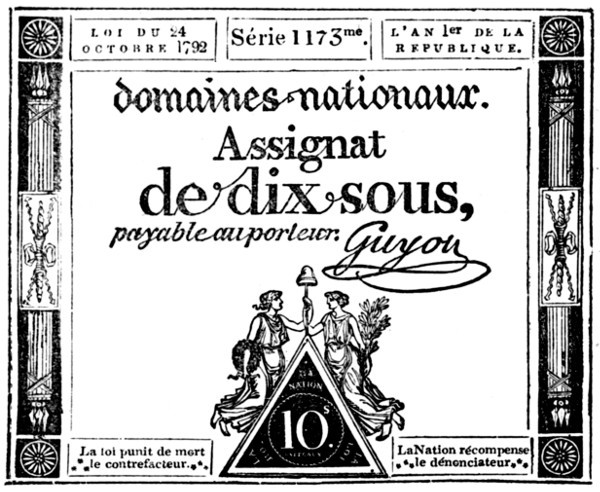
Fac-simile of a French Assignat for Ten Sous, Referred to in the following Communication.
To the Editor.
Dear sir,—Perhaps you may esteem the enclosed as a curiosity worthy of a place in the Table Book. It is a genuine specimen of the assignats used in lieu of money during the French revolution. I believe there are very few now to be had. It was given to me by a French gentleman, whose father (a native of Normandy) had lost considerable sums by them. He had unfortunately converted most of his property into assignats, as a precaution during those times, which, although eventually of so much benefit to the French nation, were so distressing while they lasted. But when the use of coin was resumed, he found his intention frustrated, and himself deprived of all his fortune.
This gentleman had been the means of assisting the duke and duchess of Chartres in their escape to England, after having concealed them for some time in his own house. They left him with reiterated assurances of liberal recompense and future patronage, should they ever be so fortunate as to return to their native country:—they did return—but their Norman benefactor was forgotten—he never heard any thing more of them.—“Telle est la récompense de loyauté!” was the concluding remark of his son, who related the story to me. He was a pleasant specimen of a Frenchman—light, kind-hearted, and extremely enthusiastic; but his enthusiasm was equally bestowed on the most important or the most trivial occasion. I have seen him rise from his seat, stretch his clasped hands out at full length, and utter with rapturous ecstasy through his clenched teeth, “Ah, Dieu! que c’étoit beau!” when perhaps the subject of his eulogy was the extraordinary leap of some rope-dancer, or the exaggerated shout of some opera-singer, whose greatest recommendation was, that she possessed “une voix à enlever le toit.” He had a habit of telling immensely long stories, and always forgot that you had heard him relate them often and often before. He used to tack his sentences together by an awful “alors,” which was the sure sign of his being in the humour (although by the by he never was otherwise) for telling one of his pet anecdotes, or, more properly interminable narratives, for such he made them by his peculiar tact at spinning them out. He had three special favourites;—the one above related of aristocratic ingratitude;—another about Buonaparte’s going incognito every morning, while he was at Boulogne sur Mer, to drink new milk at the cottage of an old woman, with whom he used to take snuff, and talk quite familiarly;—and the last and best-beloved, an account of his own good fortune in having once actually spoken with the emperor Napoleon Buonaparte himself! He had been an officer on board one of the ships belonging to the flotille destined for the invasion of England, and almost adored Buonaparte as a sort of God. He was perhaps as affectionate-hearted a human being as could possibly exist, and I never heard him speak bitterly against any one, excepting Messieurs les Clergés.
I have digressed considerably, but the assignat is merely a matter of curiosity to look at, and does not admit of much comment.
I am, dear sir, Your respectful admirer, M. H.
June 28, 1827.
BUYING AND SELLING.
A merchant shall hardly keep himself from doing wrong; and an huckster shall not be freed from sin.
As a nail sticketh fast between the joinings of the stones; so doth sin stick close between buying and selling. Ecclesiasticus.
It has been observed in the House of Commons, “That commerce tends to corrupt the morals of a people.” If we examine the expression, we shall find it true, in a certain degree.
Perhaps every tradesman can furnish out numberless instances of small deceit. His conduct is marked with a littleness, which though allowed by general consent, is not strictly just. A person with whom I have long been connected in business, asked if I had dealt with his relation whom he had brought up, and who had lately entered into commercial life. I answered in the affirmative. He replied, “He is a very honest fellow.” I told him I saw all the finesse of a tradesman about him. “Oh, rejoined my friend, a man has a right to say all he can in favour of his own goods.”
Nor is the seller alone culpable. The buyer takes an equal share in the deception. Though neither of them speak their sentiments, they well understand each other. Whilst a treaty is agitating, the buyer pronounces against the article; but when finished, the seller whispers to his friend, “It is well sold,” and the buyer smiles at the bargain. The commercial track is a line of minute deceits.
But, on the other hand, it does not seem possible for a man in trade to pass this line, without wrecking his reputation; which, if once broken, can never be made whole. The character of a tradesman is valuable; it is his all; therefore, whatever seeds of the vicious kind may shoot forth in the mind, they are carefully watched and nipped in the bud, that they may never blossom into action.
Having stated the accounts between morality and trade, I shall leave the reader to draw the balance, and only ask, “Whether the people in trade are more corrupt than those out?” If the curious reader will lend an attentive ear to a pair of farmers in the market, bartering for a cow, he will find as much dissimulation as at St. James’s, or at any other saint’s, but couched in more homely phrase. The man of well-bred deceit is “infinitely your friend—it would give him immense pleasure to serve you!” while the man in the frock “will be —— if he tells you a word of a lie!”
Having occasion for a horse, in 1759, I mentioned it to an acquaintance, and informed him of the uses the animal was wanted for; he assured me he had one that would exactly suit; which he showed in the stable, and held the candle pretty high, “for fear of affecting the straw.” I told him it was needless to examine him, for I should rely upon his word, being conscious he was too much my friend to deceive me; I therefore bargained, and caused him to be sent home. But by the light of the sun which next morning illumined the heavens, I perceived the horse was “greased” on all fours. I therefore, in gentle terms, upbraided my friend with duplicity, when he replied with some warmth, “I would cheat my own brother in a horse.” Had this honourable friend stood a chance of selling me a horse once a week, his own interest would have prevented him from deceiving me.
A man enters into business with a view of acquiring a fortune—a laudable motive! That property which arises from honest industry is an honour to its owner; the repose of his age, the reward of a life of attention; but great as the advantage seems, yet, being of a private nature, it is one of the least in the mercantile walk. For the intercourse occasioned by traffic gives a man a view of the world, and of himself; removes the narrow limits that confine his judgment, expands the mind, opens his understanding, removes his prejudices, and polishes his manners. Civility and humanity are ever the companions of trade; the man of business is the man of liberal sentiment: if he be not the philosopher of nature he is the friend of his country. A barbarous and commercial people is a contradiction.[316]
LONGEVITY Of a remarkable Highlander.
In August, 1827, John Macdonald expired in his son’s house, in the Lawnmarket, at the advanced age of one hundred and seven years. He was born in Glen Tinisdale, in the Isle of Skye, and, like the other natives of that quarter, was bred to rural labour. Early one morning in his youth, when looking after his black cattle, he was surprised by the sight of two ladies, as he thought, winding slowly round a hill, and approaching the spot where he stood. When they came up, they inquired for a well or stream, where a drink of water could be obtained. He conducted them to the “Virgin Well,” an excellent spring, which was held in great reverence on account of its being the scene of some superstitious and legendary tales. When they had quenched their thirst, one of the ladies rewarded Macdonald with a shilling, the first silver coin of which he was possessed. At their own request he escorted them to a gentleman’s house at some distance, and there, to his great surprise and satisfaction, he learned that the two “ladies” were Flora Macdonald and prince Charles Stewart.
This was the proudest incident in Macdonald’s patriarchal life; and, when surrounded by his Celtic brethren, he used to dilate on all the relative circumstances with a sort of hereditary enthusiasm, and more than the common garrulity of age. He afterwards turned joiner, and bore a conspicuous part in the building of the first protestant church which was erected in the island of North Uist. He came to Edinburgh twenty-three years before his death, and continued to work at his trade till he was ninety-seven years of age.
Macdonald was a temperate, regular-living man, and never paid a sixpence to a surgeon for himself, nor had an hour’s sickness in the whole course of his life. He used to dance regularly on New-year’s day, along with some Highland friends, to the bagpipe. On New-year’s day, 1825, he danced a reel with the father, the son, the grandson, and great-grandson, and was in more than his usual spirits. His hearing was nothing impaired, and till within three weeks of his demise he could have threaded the finest needle with facility, without glasses.[317]
Discoveries OF THE ANCIENTS AND MODERNS. No. V.
Having examined what knowledge the ancients had in logic and metaphysics, we are now to consider with the same impartiality, what general or particular discoveries they made in physics, astronomy, mathematics, mechanics, and the other sciences.
Of Bodies—the Incorporeality of their Elements.—Leibnitz.
Although the distance may appear considerable between metaphysics and physics, yet an idea of their connection runs through the whole system of Leibnitz. He founds this on the principle, employed long ago by Archimedes, “that there must be a sufficient reason for every thing.” Leibnitz inquires, why bodies are extended in length, breadth, and thickness. He holds, that to discover the origin of extension, we must come at something unextended, and without parts; in short, at existences entirely simple; and he contends, that “things extended” could have had no existence, but for “things entirely simple.”
The foundations of this system were, in effect, long since laid by Pythagoras and his disciples. Traces of it are in Strato of Lampsacus, who succeeded Theophrastus in the Lyceum; in Democritus; in Plato, and those of his school; and in Sextus Empiricus, who has even furnished entire arguments to Leibnitz for establishing “the necessity of seeking for the reason of compound things, in those which never had external existence.” Moderatus Gaditanus, in relation to the numbers of Pythagoras, says, “Numbers are, so to speak, an assemblage of units, a progressive multitude which arises from unity, and finds there its ultimate cause.” And Hermias, expounding the doctrine of the Pythagoreans, says, that, according to them, “the unit, or simple essence, was the origin and principle of all things.”
Sextus Empiricus deems it unworthy of a philosopher to advance, that what falls under the notice of our senses, could be the principle of all things; for things sensible ought to be derived from what is not so. Things compounded of other things cannot possibly be themselves a principle; but what constitutes those things may. Those who affirm that atoms, similar parts, particles, or those bodies which only are to be apprehended by the intellect itself, are the primary elements of all things, in one respect say true, in another not. In so far as they acknowledge for principles, only such things as fall not under our senses, they are right; but they are wrong in apprehending those to be corporeal principles: for as those bodies which fall not under our senses, precede those which do, they themselves are preceded also by what is of another nature: and as the letters are not a discourse, though they go into the composition of it, neither are the elements of body, body: but since they must be either corporeal or incorporeal, it follows, that they are incorporeal. To this end he argues, that “bodies are composed of incorporeal principles, not to be comprehended but by the mind itself.”
To the same effect, Scipio Aquilianus, treating of the opinion of Alcmæon, the Pythagorean, concerning the principles of things, reduces it to a syllogism. “What precedes body in the order of nature, is the principle of body; number is such a thing; therefore number is the principle of body. The second of these propositions is proved thus:—Of two things, that is the first, which may be conceived independent of the other, whilst that other cannot of it. Now number may be conceived independently of body, but not body of number; wherefore number is antecedent to body in the order of nature.”
Marcilius Ficinus imputes to Plato the same notion, and gives us the substance of that philosopher’s thoughts. “The different species of all sorts of compounds may be traced out to something which in itself is uncompounded; as the boundaries of body to a point, which has no boundary; numbers to a unit, which consists not of numbers; and elements to what has nothing in it mixt or elementary.” Marcilius Ficinus expresses the system in a few words. “Compounds are reducible into things uncompounded, and these again into what is still more simple.” One sees here those compounds of Leibnitz, which, when reduced to their simple parts, terminate in the Deity for their cause and source.
Plotinus also affirms, that “there must be in bodies some principle, or substratum, entirely different from any thing corporeal.”
These quotations accord with passages in Plutarch concerning Heraclitus. There are passages in Stobæus, from Epicurus, Xenocrates, and Diodorus, to a similar purport; and a remarkable one in Hebrews xi. 3. “Through faith we understand that the worlds were framed by the word of God, so that things which are seen were not made of things which do appear.”[318]
It every where appears that Leibnitz drew many of his notions from Plato; and he defines his “monads,” just as Plato does his ideas, τα ὁντπως ὁντα, “things really existing.” An erudite German says, “I am assured by one of my friends, who was himself informed of it by a learned Italian, who went to Hanover to satisfy an ardent desire he had of being acquainted with Mr. Leibnitz, and spent three weeks with him, that this great man, at parting, said to him: ‘Sir you have often been so good as to insinuate, that you looked upon me as a man of some knowledge. Now, sir, I’ll show you the sources whence I drew it all;’ and immediately taking him by the hand, led him into his study, showing him all the books he had; which were Plato, Aristotle, Plutarch, Sextus Empiricus, Euclid, Archimedes, Pliny, Seneca, and Cicero.”
Leibnitz and Parmenides agree in these particulars:—
1. The existence and essence of things are different.
2. The essence of things existent, is without the things themselves.
3. There are, in nature, similar and dissimilar things.
4. The similar are conceived, as in existence essentially the same.
5. Whatever exists is reducible to certain classes, and specific forms.
6. All those forms have their existence in the unity; that is, in God; and hence the whole is one.
7. Science consists in the knowledge, not of individuals, but of kinds or species.
8. This knowledge differs from that of things existing externally.
9. Forms or ideas, as they exist in God, escape the observation of men.
10. Hence men perceive nothing perfectly.
11. Our mental notions are but the shades or resemblances of ideas.
Of Animated Nature.—Buffon.
Buffon’s theory respecting universal matter, generation, and nutrition, so much resembles what was taught by some of the ancients, that it is difficult not to think that his ideas drew their origin from that first school. It appears indeed, that he had attentively read the ancients, and knew how to value them. He says himself, that “the ancients understood much better, and made a greater progress in the natural history of animals and minerals, than we have done. They abounded more in real observations; and we ought to have made much better advantage of their illustrations and remarks.” Yet Buffon does not seem to have perceived the analogy which every where reigns between his system and that of the ancients.
Anaxagoras thought that bodies were composed of small, similar, or homogeneous particles; that those bodies, however, admitted a certain quantity of small particles that were heterogene, or of another kind; but that to constitute any body to be of a particular species, it sufficed, that it was composed of a great number of small particles, similar and constitutive of that species. Different bodies were masses of particles similar among themselves; dissimilar, however, relatively to those of any other body, or to the mass of small particles belonging to a different species. Thus, the ancients taught, that blood was formed of many drops or particles, each of which had blood in it; that a bone was formed of many small bones, which from their extreme littleness evaded our view; and these similar parts they called ομοιομερειας similaritates. Likewise, that nothing was properly liable to generation, or corruption, to birth, or to death; generations of every kind, being no other than an assemblage of small particles constituent of the kind; and the destruction of a body being no other than the disunion of many small bodies of the same sort, which always preserving a natural tendency to reunite, produce again, by their conjunction with other similar particles, other bodies of the same species. Vegetation and nutrition were but means employed by nature for the continuation of beings; thus, the different juices of the earth being composed of a collection of innumerable small particles intermixed, constituting the different parts of a tree or flower for example, take, according to the law of nature, different arrangements; and by the motion originally impressed upon them, proceed till, arriving at the places destined and proper for them, they collect themselves and halt, to form all the different parts of that tree or flower; in the same manner as many small imperceptible leaves go to the formation of the leaves we see, many little parts of the fruits of different kinds to the composition of those which we eat; and so of the rest. The same, with respect to the nutrition of animals. The bread we eat, and the other aliments we take, turn themselves, according to the ancients, into hair, veins, arteries, nerves, and all the other parts of our body; because there are, in those aliments, the constituent parts of blood, nerves, bones, hair, &c. which, uniting with one another, make themselves by their coalition perceptible, which they were not before, because of their infinite littleness.
Empedocles believed, that matter had in it a living principle, a subtile active fire, which put all in motion; and this Buffon calls, by another name, “organized matter, always active; or animated organic matter.” According to Empedocles, “this matter was distributed through the four elements, among which it had an uniting force to bind them, and a separating to put them asunder; for the small parts either mutually embraced, or repelled one another; whence nothing in reality perished, but every thing was in perpetual vicissitude.”
Empedocles had a sentiment, which Buffon follows, in the same terms; where he says, that “the sexes contain all the small parts analogous to the body of an animal, and necessary to its production.”
Plotinus, investigating what might be the reason of this sympathy and attraction in nature, discovered it to proceed from such a “harmony and assimilation of the parts, as bound them together when they met,” or repelled them when they were dissimilar; he says, that it is the variety of these assimilations that concurs to the formation of an animal; and calls this binding, or dissolving force, “the magic of the universe.”
Anaxagoras thought as Buffon does, that there is no preexistent seed, involving infinite numbers of the same kind one within another; but an ever active organic matter, always ready so to adapt itself, as to assimilate, and render other things conformable to that wherein it resides. The species of animals and vegetables can never therefore exhaust themselves; but as long as an individual subsists, the species will be always new. It is as extensive now as it was at the beginning, and all will subsist of themselves, till they are annihilated by the Creator.
It would be easy to show, that in morals and politics, as in physics, the most eminent moderns have said nothing new. Hobbes has advanced nothing, but what he found in the writings of the Grecian and Latin philosophers; and above all, in those of Epicurus. Montesquieu also assumes from the ancients the principles of his system; and Machiavel those of his politics from Aristotle, though we have attributed to his genius the whole honour of having invented them. But these discussions would detain the reader too long; we hasten therefore to another field of contemplation, not less fruitful of testimony, in support of the position, that the most celebrated philosophers among the moderns have taken what they advance from the works of the ancients.
For the Table Book.
GRASSHOPPERS.
“Sauter de branche en branche.”
The stream may flow, the wheel may run, The corn in vain be brown’d in sun, And bolting-mills, like corks, be stoppers; Save that their clacks, like noisy rain, Make floor of corn in root and grain By virtue of their Hoppers. And London sportsmen (sportsmen?) meet To shoot at sparrows twenty feet Like ginger-beer escaping,—poppers: Pigeons are thus humanely shot. And thus they go to pie and pot, Poor pulse and crum-b-led Hoppers! Trees in their shrouds resemble men, And they who “cut may come again,” To take their tithe as legal loppers: Soldiers and sailors, after wars, In spite of glory, fame, and stars,— Are they not pen-sion Hoppers? Yet more than these, in summer’s even, There hop, between the blades of Heaven And hailstones pearly droppers, Insects of mirth, whose songs so shrill Delight the ears of vale and hill, The grassy, green—Grass-Hoppers.
Aug. 1827. J. R. P.
For the Table Book.
WASPS.
A grocer’s shop at Camberwell—“the Grasshopper”—is much visited by wasps for the sweets of the sugar hogsheads. The shop is closed on Sundays, but they find entrance into it by creeping privately through the keyhole of the door.
C. W. P.
THE BARLEY-MOW.
To the Editor.
My dear sir,—Nothing could possibly exceed the heartfelt pleasure I enjoyed when the last load was drawn into the farm-yard; and the farmer, and his men and women, witnessed the completion of the “Barley-mow.” Their huzzas filled the scenery, and the barns and church replied. The carters and horses were trimmed with boughs and wild flowers. The hedges siding the lanes, and the patriarch elms and walnut-trees, as the survivors of templar consecrations to the demesne, took their tithes, to the joy of birds; and the fields had still a generous strewing of ears for the peasant-gleaners, who, like ants, collected a small store for the days of frost and adversity. The farmer’s heart gladdened with the reward of his labours. The ale-bottle, when held upward, gurgled its choice liquid into many thirsty throats. Every thing and every body showed satisfaction. The housewife came forth with a rake in her hand, in her sun-shielding gloves and broad flat bonnet, and she sung the rejoicings of her peace in a minor key, suitable to her taste of harmony. Her daughter too came tripping in a lightsome gait and charming advance, towards her sire and myself, with cake and cider, dimpling and exhilarating.
By this time the “Barley-mow” was coning to a point, and the stray ears were plucked out of its bulging sides.
The evening closing into eternity, the peaceful aspect of nature sweetly accorded with the quiet sensations of thankfulness, glowing in the grateful breasts of the persons cast in this out-of-town spot. The increasing pall of dusk, when the work was ended, drew the labourers into a circle within their master’s welcome domicile. Here the farmer and his wife and family were assembled, and, without pride’s distinction, regaled the sharers of their summer-toil with that beverage that warms the feelings of hope into real joy. This was the triumph of the “Barley-mow.” Every tongue praised, as every energy assisted it. It was a heartfelt celebration. Songs were sung, and they danced down the midnight. The foot of Time stepped lightly, till the weather-featured clock toll’d the end of the joyful recreation. Sincerity, unity, and hospitality were blended: the master was satisfied with his servants—the servants were thankful with their means of support. My thoughts rebounded high, as my sympathies awakened to so much happiness in so small a compass. Ere satiety arrived the companions separated. My candle was ready; I shook hands with my friends; and, after penning you this outline, retired with benevolent impressions and aspirations in behalf of a cheerful country life, arising from contented habits and industrious courses.
The two following stanzas were audible for a long time in the neighbouring ruralries:
Let the scythe and sickle lie Undisturb’d for many a day Labour stoops without a sigh, And grisly care is gay Bless the harrow and the plough. Bless the glorious Barley-mow! Now the miller’s hoppers play; Now the maltster’s kiln is dry Empty casks prepare the way, And mirth is in the eye: Praise the sun and trim the bough,— Hail the golden Barley-mow!
I am, my dear sir, Yours very truly, J. R. P.
T——n T——e, August 1, 1827.
HANGING THE SHUTTLE.
To the Editor.
Sir,—The custom of “hanging the shuttle” arose out of the introduction of a “spring loom,” which an eminent clothier at Langley ventured, in 1794, to have erected in one of his cottages, built for the use of his men.
One person performing nearly as much work in this loom as two persons, the weavers in the neighbourhood met at the “Plough,” to consider the best means of opposing the success of the one-shuttle stranger.
After sundry resolutions were passed, declarative that spring-looms would prove hurtful to weavers of the old school, they suspended a shuttle to a bacon rack by a skein of tangled yarn over the table round which they sat. Meeting every Saturday-night at this inn, they pledged their affiance to the “shuttle,” and continued the custom till their meetings were fruitless.
The “hanging the shuttle” over them signified that no honest weaver should work a spring-loom to the injury of his fellow-workman. This prejudice having subsided and most of the weavers that assembled at the “Plough” being dead, their sons agree to the prevailing and supposed improvements.
I am, sir, Yours respectfully, *, *, P.
July 28, 1827.
For the Table Book.
THE STEPS OF PERFECTION. Paraphrased from the Latin of John Owen.
Faith, Hope, and Charity.
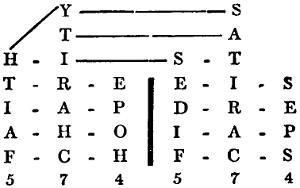
When Virtue her examples drew in heaven, Seven steps to reach them were to mortals given:— Hope, so desirous to be first, attains Four of the Seven: but Faith five precepts gains: Love is the chief, for Love the two excels, And in the virtue of Perfection dwells.
P.
NEWSPAPER ORTHOGRAPHY, 1682.
From the “True Protestant Mercury,” No. 162.
Advertisement.
Lost, a Flowered silk Manto (Mantua) Gown of a sable and Gold Coulor, lined with Black, betwixt Arniseed Clere (St. Agnes le Clair) and the White Houses at Hogsden (Hoxton) on Wednesday last, the 19th instant, about 4 or 5 a clock in the Afternoon. Any one that can give Intelligence of the said Manto Gown to Mr. Blewit’s, at the Rose and Crown in Loathberry, shall have 10s. for their pains.
Poetry.
For the Table Book.
THE DESTRUCTION OF SENNACHERIB’S ARMY.
And it came to pass that night, that the Angel of the Lord went out, and smote in the camp of the Assyrians an hundred fourscore and five thousand: and when they arose early in the morning, behold, they were all dead corpses!—2 Kings, xix. 35.
The sun in his beauty had sunk to rest, And with magic colours illumin’d the west, Casting o’er the temple his brightest gold, The temple,—Jehovah’s dwelling of old: The flowers were clos’d by the evening breeze, That sadly sigh’d through Lebanon’s trees; The moon was up, so pale and bright, (She look’d more beautiful that night,) Whilst numerous stars were round her gleaming— Stars in silent beauty beaming. The Fiend of Fear his dark wings spread O’er the city of God, and fill’d it with dread; But the king at the altar prostrate lay, And plac’d on Jehovah’s arm his stay; In anxious watching he pass’d the night, Waiting the return of the morning light, When forth his embattled hosts should move, The power of Jehovah on the Heathen to prove! The Assyrian hosts were proud in their might, And in revelry spent the commencement of night, ’Till the power of wine o’er their coward-souls creeping, Each man in his armour lay prostrate, sleeping! At the midnight watch the angel of God O’er the Assyrian camp spread his wings abroad: On his brow was plac’d a crown of light, Which shone like a meteor in the gloom of night, And quench’d, with its brightness, the moon’s pale sheen, Which her sickly rays flung over the scene: His flowing robe in large folds roll’d, Spangled with gems and bright with gold! As over the Assyrian camp he pass’d, He breathed upon them a poisonous blast— It blanch’d their cheeks-and without a groan Each soul was hurried to his long, long home! At the morning watch in the Assyrian camp Was heard no sound of the war-horse tramp! The bright sun rose, like a bridegroom dress’d, And illumin’d the camp from east to west; But there was no spear in his bright beam gleaming, Nor polish’d mail his reflected light streaming: The spear and the armour were cover’d with rust, And prostrate the warrior lay down in the dust! To arms! to arms! the trumpet sounded— The echoes in mockery the blast resounded! Sennacherib waited his embattled host, The pride of his heart and his impious boast;— The trumpet was sounded again and again, Its shrill notes echoing o’er the prostrate slain;— But his bands were bound in the slumber of death, Nor heeded the war-stirring clarion’s breath! The angel of God had pass’d over the host— In the grasp of Death lay Sennacherib’s host!
O. N. Y.
July, 1827.
For the Table Book.
NIXON’S PROPHECIES.—MR. CANNING.
Mr. Canning’s decease on the 8th of August, 1827, occasioned the following article in the newspapers.
The Death of Mr. Canning predicted by Nixon, the Astrologer.
In an old book, entitled The Prophecies of Robert Nixon, printed in the year 1701, is the following prophetic declaration, which appears to refer to the late melancholy event, which has deprived the English nation of one of her brightest ornaments:—“In the year 1827 a man will raise himself by his wisdom to one of the most exalted offices in the state. His king will invest him with great power, as a reward for his zeal. England will be greatly rejoiced. A strong party will enter into a league against him, but their envy and hatred will not prevail. The power of God, which reigneth over all, will cut him off in his prime, and the nation will bitterly bemoan her loss. Oh, England? beware of thy enemies. A great friend thou wilt lose in this man.”
The preceding is a prediction made after the event—a mere “hoax” on the credulous. There is nothing of the kind among the prophecies imputed to Nixon, who was not an astrologer, and probably existed nowhere but in the imagination of the writer of the manuscript copied by the “Lady Cowper.”
BUSH EELS.
At this season when persons, at inns in Lincolnshire, ask for “eel-pie,” they are presently provided with “bush eels;” namely, snakes, caught for that purpose in the bushes, and sold to the landlords cheaply, which are made into stews, pies, and fries.
P.