Volume 1 — Vol. I.—9.
Reading edition
Monument at Lucerne, designed by Thorwaldsen
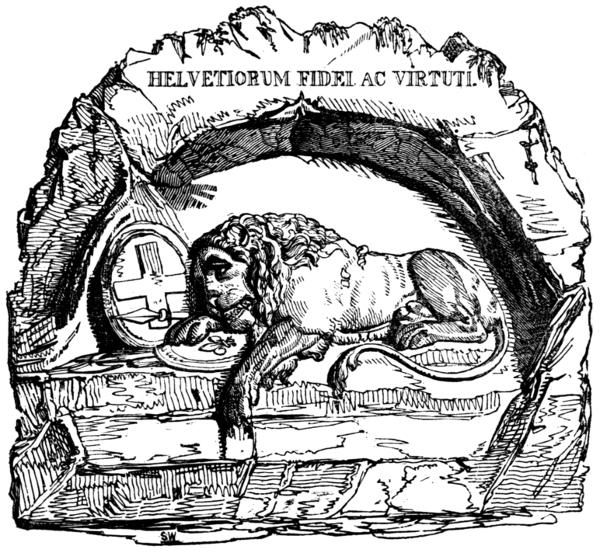
Monument at Lucerne, designed by Thorwaldsen, To the Memory of the Swiss Guards who were massacred at the Tuilleries, on the Tenth of August, 1792.
The engraving above is executed from a clay figure, modelled by a Swiss artist from the original. It was obligingly sent to the editor, for the present purpose, by the gentleman to whom it belongs. The model was presented to him by a friend, who, in answer to his inquiries on the subject, wrote him a letter, of which the following is an extract:—
“The Terra Incognita you mention comes from Lucerne, in Switzerland, and is the model of a colossal work, cut in the solid rock, close to that city, on the grounds of general Pfyffer. It is from a design furnished by Thorwaldsen, which is shown close by. The ‘L’envoi,’ as don Armado calls it, is as follows:—‘The Helvetian lion, even in death, protects the lilies of France.’ The monument was executed by the Swiss, in memory of their countrymen, who were massacred, on the 10th of August, at the Tuilleries, in defending Louis XVI. from the sans culottes. The names of those who perished are engraved beneath the lion.”
The particulars of the dreadful slaughter, wherein these helpless victims fell, while defending the palace and the person of the unfortunate monarch, are recorded in different works within the reach of every person who desires to be acquainted with the frightful details. About sixty who were not killed at the moment, were taken prisoners, and conducted to the town-hall of the commons of Paris, for summary trial: but the ferocious females who mingled in the mobs of those terrifying times, rushed in bodies to the place, with cries of vengeance, and the unhappy men were delivered up to their fury, and every individual was murdered on the spot.
Garrick Plays. No. VI.
[From the “Chaste Maid in Cheapside,” a Comedy, by Thomas Middleton, 1620.]
Citizen to a Knight complimenting his Daughter.
Pish, stop your words, good Knight, ’twill make her blush else, Which are wound too high for the Daughters of the Freedom; Honour, and Faithful Servant! they are compliments For the worthy Ladies of White Hall or Greenwich; Ev’n plain, sufficient, subsidy words serve us, Sir.
Master Allwit (a Wittol) describes his contentment.
I am like a man Finding a table furnish’d to his hand, (As mine is still for me), prays for the Founder, Bless the Right worshipful, the good Founder’s life: I thank him, he[67] has maintain’d my house these ten years; Not only keeps my Wife, but he keeps me. He gets me all my children, and pays the nurse Weekly or monthly, puts me to nothing, Rent, nor Church dues, not so much as the Scavenger; The happiest state that ever man was born to. I walk out in a morning, come to breakfast, Find excellent cheer, a good fire in winter; Look in my coal-house, about Midsummer eve, That’s full, five or six chaldron new laid up; Look in my back yard, I shall find a steeple Made up with Kentish faggots, which o’erlooks The water-house and the windmills. I say nothing, But smile, and pin the door. When she lies in, (As now she’s even upon the point of grunting), A Lady lies not in like her; there’s her imbossings, Embroiderings, spanglings, and I know not what, As if she lay with all the gaudy shops In Gresham’s Burse about her; then her restoratives, Able to set up a young ’Pothecary, And richly store the Foreman of a Drug shop; Her sugars by whole loaves, her wines by rundlets, I see these things, but like a happy man I pay for none at all, yet fools think it mine; I have the name, and in his gold I shine: And where some merchants would in soul kiss hell, To buy a paradise for their wives, and dye Their conscience in the blood of prodigal heirs, To deck their Night-piece; yet, all this being done, Eaten with jealousy to the inmost bone; These torments stand I freed of. I am as clear From jealousy of a wife, as from the charge. O two miraculous blessings! ’tis the Knight, Has ta’en that labour quite out of my hands. I may sit still, and play; he’s jealous for me, Watches her steps, sets spies. I live at ease. He has both the cost and torment; when the string Of his heart frets, I feed fat, laugh, or sing. ******* I’ll go bid Gossips[68] presently myself, That’s all the work I’ll do; nor need I stir, But that it is my pleasure to walk forth And air myself a little; I am tyed To nothing in this business; what I do Is merely recreation, not constraint.
Rescue from Bailiffs by the Watermen.
——I had been taken by eight Serjeants, But for the honest Watermen, I am bound to ’em. They are the most requiteful’st people living; For, as they get their means by Gentlemen, They’re still the forward’st to help Gentlemen. You heard how one ’scaped out of the Blackfriars[69] But a while since from two or three varlets, Came into the house with all their rapiers drawn, As if they’d dance the sword-dance on the stage, With candles in their hands, like Chandlers’ Ghosts! Whilst the poor Gentleman, so pursued and banded, Was by an honest pair of oars safe landed.
[From “London Chanticleers,” a rude Sketch of a Play, printed 1659, but evidently much older.]
Song in praise of Ale.
1.
Submit, Bunch of Grapes, To the strong Barley ear; The weak Wine no longer The laurel shall wear.
2.
Sack, and all drinks else, Desist from the strife; Ale’s the only Aqua Vitæ, And liquor of life.
3.
Then come, my boon fellows, Let’s drink it around; It keeps us from grave, Though it lays us on ground.
4.
Ale’s a Physician, No Mountebank Bragger; Can cure the chill Ague, Though it be with the Stagger.
5.
Ale’s a strong Wrestler, Flings all it hath met; And makes the ground slippery, Though it be not wet.
6.
Ale is both Ceres, And good Neptune too; Ale’s froth was the sea, From which Venus grew.
7.
Ale is immortal; And be there no stops In bonny lads’ quaffing, Can live without hops.[70]
8.
Then come, my boon fellows, Let’s drink it around; It keeps us from grave, Though it lays us on ground.
C. L.
The Drama.
CHARLOTTE CHARKE.
The novel called “Mr. Dumont,” by this unfortunate woman, was published in the year 1755 in one volume, twelves, by H. Slater, of Drury-lane, who may be presumed to have been the bookseller that accompanied Mr. Whyte to her miserable dwelling, for the purpose of hearing her read the manuscript. Since the account at col. 125, I met with an advertisement of November, 1742, from whence it appears that she and her daughter, “Miss Charke,” performed at one of those places of public amusement at that period, when, to evade the law, under pretence of a musical entertainment, a play and the usual afterpiece were frequently represented by way of divertisement, although they constituted the sole attraction. The notice referred to is altogether a curiosity: it runs thus:—
“For the Benefit of a Person who has a mind to get Money: At the New Theatre in James-street near the Haymarket, on Monday next, will be performed a Concert of vocal and instrumental Musick, divided into Two Parts. Boxes 3s. Pit 2s. Gallery 1s. Between the two parts of the Concert will be performed a Tragedy, call’d The Fatal Curiosity, written by the late Mr. Lillo, author of George Barnwell. The part of Mrs. Wilmot by Mrs. Charke (who originally performed it at the Haymarket;) The rest of the parts by a Set of People who will perform as well as they can, if not as well as they wou’d, and the best can do no more. With variety of Entertainments, viz. Act I. A Preamble on the Kettle drums, by Mr. Job Baker, particularly, Larry Grovy, accompanied with French Horns. Act II. A new Peasant Dance by Mons. Chemont and Madem Peran, just arriv’d piping hot from the Opera at Paris. To which will be added a Ballad-Opera, call’d The Devil to Pay; The part of Nell by Miss Charke who performed Princess Elizabeth at Southwark. Servants will be allow’d to keep places on the stage—Particular care will be taken to perform with the utmost decency, and to prevent mistakes, the Bills for the day will be blue and black, &c.”
*
THE BLOODY HAND.
For the Table Book.
One December evening, the year before last, returning to T—, in the northern extremity of W—, in a drisling rain, as I approached the second milestone, I observed two men, an elder and a younger, walking side by side in the horse-road. The elder, whose appearance indicated that of a labourer in very comfortable circumstances, was in the path directly in front of my horse, and seemed to have some intention of stopping me; on my advancing, however, he quietly withdrew from the middle of the road to the side of it, but kept his eyes firmly fixed on me, which caused also, on my part, a particular attention to him. He then accosted me, “Sir, I beg your pardon.”—“For what, my man?”—“For speaking to you, sir.”—“What have you said, then?”—“I want to know the way to S—.”—“Pass on beyond those trees, and you will see the spire before you.”—“How far is it off, sir?”—“Less than two miles.”—“Do you know it, sir?”—“I was there twenty minutes ago.”—“Do you know the gentleman there, sir, that wants a man to go under ground for him?”—“For what purpose?” (imagining, from the direction in which I met the man, that he came from the mining districts of S—, I expected that his object was to explore the neighbourhood for coals.) His answer immediately turned the whole train of my ideas. “To go under ground for him, to take off the bloody hand from his carriage.”—“And what is that to be done for?”—“For a thousand pounds, sir. Have you not heard any thing of it, sir?”—“Not a word.”—“Well, sir, I was told that the gentleman lives here, at S—, at the hall, and that he offers a thousand pounds to any man that will take off the bloody hand from his carriage.”—“I can assure you this is the first word I have heard on the subject.”—“Well, sir, I have been told so;” and then, taking off his hat, he wished me a good morning.
I rode slowly on, but very suddenly heard a loud call, “Stop, sir, stop!” I turned my horse, and saw the man, who had, I imagined, held a short parley with his companion, just leaving him, and running towards me, and calling out, “Stop, sir.” Not quite knowing what to make of this extraordinary accost and vehement call, I changed a stout stick in my left hand to my right hand, elevated it, gathered up the reins in my left, and trotted my horse towards him; he then walked to the side of the road, and took off his hat, and said, “Sir, I am told that if the gentleman can get a man to go under ground for him, for seven years, and never see the light, and let his nails, and his hair, and his beard grow all that time, that the king will then take off the bloody hand from his carriage.”—“Which then is the man who offers to do this? is it you, or your companion?”—“I am the man, sir.”—“O, you intend to undertake to do this?”—“Yes, sir.”—“Then all that I can say is, that I now hear the first word of it from yourself.” At this time the rain had considerably increased, I therefore wished the man a good morning, and left him.
I had not, however, rode above a hundred and fifty yards before an idea struck me, that it would be an act of kindness to advise the poor man to go no further on such a strange pursuit; but, though I galloped after them on the way I had originally directed them, and in a few minutes saw two persons, who must have met them, had they continued their route to S—, I could neither hear any thing of them, nor see them, in any situation which I could imagine that they might have taken to as a shelter from the heavy rain. I thus lost an opportunity of endeavouring to gain, from the greatest depths of ignorance, many points of inquiry I had arranged in my own mind, in order to obtain a developement of the extraordinary idea and unfounded offer, on which the poor fellow appeared to have so strongly set his mind.
On further inquiry into the origin of this strange notion of the bloody hand in heraldry, and why the badge of honour next to nobility, and perpetuated from the ancient kings of Ulster, should fall, in two centuries, into indelible disgrace, I find myself in darkness equal to that of the anticipated cavern of the poor deluded man, and hitherto without an aid superior to himself. Under these circumstances, present the inquiry to you, and shall be among many others, greatly gratified to see it set in a clear light by yourself, or some friendly correspondent.
I am, sir,
1827.— —.
Music.
ORGANS IN CHURCHES. The Temple Church.
After the Restoration, the number of workmen in England being found too few to answer the demand for organs, it was thought expedient to make offers of encouragement for foreigners to come and settle here; these brought over Mr. Bernard Schmidt and —— Harris; the former, for his excellence in his art, deserves to live in the remembrance of all who are friends to it.
Bernard Schmidt, or, as we pronounce the name, Smith, was a native of Germany, but of what city or province in particular is not known. He brought with him two nephews, the one named Gerard, the other Bernard; to distinguish him from these, the elder had the appellation of father Smith. Immediately upon their arrival, Smith was employed to build an organ for the royal chapel at Whitehall, but, as it was built in great haste, it did not answer the expectations of those who were judges of his abilities. He had been but a few months here before Harris arrived from France, with his son Renatus, who had been brought up in the business of organ-making under him; they met with little encouragement, for Dallans and Smith had all the business of the kingdom: but, upon the decease of Dallans in 1672, a competition arose between these two foreigners, which was attended with some remarkable circumstances. The elder Harris was in no degree a match for Smith, but his son Renatus was a young man of ingenuity and perseverance, and the contest between Smith and the younger Harris was carried on with great spirit. Each had his friends and supporters, and the point of preference between them was hardly determined by that exquisite piece of workmanship by Smith, the organ now standing in the Temple church; of the building whereof, the following is the history.
On the decease of Dallans and the elder Harris, Renatus Harris and father Smith became great rivals in their employment, and there were several trials of skill betwixt them; but the famous contest was at the Temple church, where a new organ was going to be erected towards the latter end of king Charles II.’s time. Both made friends for that employment; and as the society could not agree about who should be the man, the master of the Temple and the benchers proposed that each should set up an organ on each side of the church. In about half or three quarters of a year this was done: Dr. Blow, and Purcell, who was then in his prime, showed and played father Smith’s organ on appointed days to a numerous audience; and, till the other was heard, everybody believed that father Smith would certainly carry it.
Harris brought Lully, organist to queen Catharine, a very eminent master, to touch his organ. This rendered Harris’s organ popular, and the organs continued to vie with one another near a twelvemonth.
Harris then challenged father Smith to make additional stops against a set time; these were the vox humane, the cremona or violin-stop, the double courtel or bass flute, with some others.
These stops, as being newly invented, gave great delight and satisfaction to a numerous audience; and were so well imitated on both sides, that it was hard to adjudge the advantage to either: at last it was left to the lord chief justice Jeffries, who was of that house; and he put an end to the controversy by pitching upon father Smith’s organ; and Harris’s organ being taken away without loss of reputation, Smith’s remains to this day.
Now began the setting up of organs in the chiefest parishes of the city of London, where, for the most part, Harris had the advantage of father Smith, making two perhaps to his one; among them some are very eminent, viz. the organ at St. Bride’s, St. Lawrence near Guildhall, St. Mary Axe, &c.
Notwithstanding Harris’s success, Smith was considered an able and ingenious workman; and, in consequence of this character, he was employed to build an organ for the cathedral of St. Paul. The organs made by him, though in respect of the workmanship they are inferior to those of Harris, and even of Dallans, are yet justly admired; and, for the fineness of their tone, have never yet been equalled.
Harris’s organ, rejected from the Temple by judge Jeffries, was afterwards purchased for the cathedral of Christ-church, at Dublin, and set up there. Towards the close of George II.’s reign, Mr. Byfield was sent for from England to repair it, which he objected to, and prevailed on the chapter to have a new one made by himself, he allowing for the old one in exchange. When he had got it, he would have treated with the parishioners of Lynn, in Norfolk, for the sale of it: but they, disdaining the offer of a second-hand instrument, refused to purchase it, and employed Snetzler to build them a new one, for which they paid him seven hundred pounds. Byfield dying, his widow sold Harris’s organ to the parish of Wolverhampton for five hundred pounds, and there it remains to this day. An eminent master, who was requested by the churchwardens of Wolverhampton to give his opinion of this instrument, declared it to be the best modern organ he had ever touched.[71]
MISERIES OF TRAVELLING.
Steam versus Coach.
For the Table Book.
“Now there is nothing gives a man such spirits, Leavening his blood as Cayenne doth a curry, As going at full speed——”
Don Juan, c. 10. v. 72.
If the number of persons who have been killed, maimed, and disfigured for life, in consequence of stage-coach mishaps, could be ascertained, since the first establishment of steam-packets in this country, and, on the other hand, the number who have been similarly unfortunate by steam-boilers bursting, we should find that the stage-coach proportion would be in the ratio of ten to one! A solitary “blow up” of a steam-packet is “noised and proclaimed” from the Land’s End to the other extremity of the island; while hundreds of coach-accidents, and many of them fatal, occur, which are never heard of beyond the village, near to which the casualty takes place, or the neighbouring ale-house. These affairs it is to the interest of the proprietors to “hush up,” by means of a gratuity to the injured, rather than have their property ruined by an exposure in a court of justice. Should a poor man have a leg or an arm broken, through the carelessness of a drunken coachman, his poverty prevents his having recourse to law. Justice, in these cases, nine times in ten, is entirely out of the question, and an arrangement, between him and the proprietors, is easily effected; the unfortunate fellow rather receiving fifty or a hundred pounds “hush money,” than bring his action, when, perhaps, from some technical informality in the proceedings, (should he find a lawyer willing to act for him, being poor,) he would be nonsuited, with all the costs of both parties on his own shoulders, and be, moreover, ruined for ever, in both purse and person. These remarks were suggested by reading an American work, some time since, on the above subject, from which I have extracted the following
Stage-coach Adventures.
Inside.—Crammed full of passengers—three fat, fusty, old men—a young mother and sick child—a cross old maid—a poll-parrot—a bag of red herrings—double-barreled gun, (which you are afraid is loaded)—and a snarling lap-dog, in addition to yourself—awaking out of a sound nap, with the cramp in one leg, and the other in a lady’s band-box—pay the damage (four or five shillings) for “gallantry’s sake”—getting out in the dark, at the half-way-house, in the hurry stepping into the return coach, and finding yourself the next morning at the very spot you had started from the evening before—not a breath of air—asthmatic old man, and child with the measles—windows closed in consequence—unpleasant smell—shoes filled with warm water—look up and find it’s the child—obliged to bear it—no appeal—shut your eyes, and scold the dog—pretend sleep, and pinch the child—mistake—pinch the dog, and get bit—execrate the child in return—black looks—“no gentleman”—pay the coachman, and drop a piece of gold in the straw—not to be found—fell through a crevice—coachman says, “he’ll find it”—can’t—get out yourself—gone—picked up by the ’ostler.—No time for “blowing up”—coach off for next stage—lose your money—get in—lose your seat—stuck in the middle—get laughed at—lose your temper—turn sulky, and turned over in a horse-pond.
Outside.—Your eye cut out by the lash of a clumsy coachman’s whip—hat blown off, into a pond, by a sudden gust of wind—seated between two apprehended murderers, and a noted sheep-stealer in irons, who are being conveyed to gaol—a drunken fellow, half asleep, falls off the coach, and, in attempting to save himself, drags you along with him into the mud—musical guard, and driver, “horn mad”—turned over—one leg under a bale of cotton, the other under the coach—hands in breeches pockets—head in a hamper of wine—lots of broken bottles versus broken heads—cut and run—send for surgeon—wounds dressed—lotion and lint, four dollars—take post-chaise—get home—lay down, and laid up.
Inside and Outside.—Drunken coachman—horse sprawling—wheel off—pole breaking, down hill—axle-tree splitting—coach overturning—winter, and buried in the snow—one eye poked out with an umbrella, the other cut open by the broken window—reins breaking—impudent guard—hurried at meals—imposition of innkeepers—five minutes and a half to swallow three and sixpennyworth of vile meat—waiter a rogue—“Like master, like man”—half a bellyfull, and frozen to death—internal grumblings and outward complaints—no redress—walk forward while the horses are changing—take the wrong turning—lose yourself and lose the coach—good-by to portmanteau—curse your ill luck—wander about in the dark and find the inn at last—get upon the next coach going the same road—stop at the next inn—brandy and water, hot, to keep you in spirits—warm fire—pleasant company—heard the guard cry “All right?”—run out, just in time to sing out “I’m left,” as the coach turns the corner—after it “full tear”—come up with it, at the end of a mile—get up “all in a blowze”—catch cold—sore throat—inflammation—doctor—warm bath—fever—Die.
Gaspard.
THE UGLY CLUB.
From a New York Paper.
The members of the Ugly Club are requested to attend a special meeting at Ugly-hall, 4, Wall street, on Monday-evening next, at half-past seven o’clock precisely, to take into consideration the propriety of offering to the committee of defence the services of their ugly carcasses, firm hearts, sturdy bodies, and unblistered hands.—His Ugliness being absent, this meeting is called by order of
His Homeliness.
Aug. 13.
Antiquities.
SCIPIO’S SHIELD.
In 1656, a fisherman on the banks of the Rhone, in the neighbourhood of Avignon, was considerably obstructed in his work by some heavy body, which he feared would injure the net; but by proceeding slowly and cautiously, he drew it ashore untorn, and found that it contained a round substance, in the shape of a large plate or dish, thickly encrusted with a coat of hardened mud; the dark colour of the metal beneath induced him to consider it as iron. A silversmith, accidentally present, encouraged the mistake, and, after a few affected difficulties and demurs, bought it for a trifling sum, immediately carried it home, and, after carefully cleaning and polishing his purchase, it proved to be of pure silver, perfectly round, more than two feet in diameter, and weighing upwards of twenty pounds. Fearing that so massy and valuable a piece of plate, offered for sale at one time and at one place, might produce suspicion and inquiry, he immediately, without waiting to examine its beauties, divided it into four equal parts, each of which he disposed of, at different and distant places.
One of the pieces had been sold, at Lyons, to Mr. Mey, a wealthy merchant of that city, and a well-educated man, who directly saw its value, and after great pains and expense, procured the other three fragments, had them nicely rejoined, and the treasure was finally placed in the cabinet of the king of France.
This relic of antiquity, no less remarkable for the beauty of its workmanship, than for having been buried at the bottom of the Rhone more than two thousand years, was a votive shield, presented to Scipio, as a monument of gratitude and affection, by the inhabitants of Carthago Nova, now the city of Carthagena, for his generosity and self-denial, in delivering one of his captives, a beautiful virgin, to her original lover. This act, so honourable to the Roman general, who was then in the prime vigour of manhood, is represented on the shield, and an engraving from it may be seen in the curious and valuable work of Mr. Spon.
The story of “Scipio’s chastity,” which this shield commemorates, is related by Livy to the following effect.—The wife of the conquered king, falling at the general’s feet, earnestly entreated that the female captives might be protected from injury and insult.—Scipio assured her, that she should have no reason to complain.
“For my own part,” replied the queen, “my age and infirmities almost ensure me against dishonour, but when I consider the age and complexion of my fellow captives, (pointing to a crowd of females,) I feel considerable uneasiness.”
“Such crimes,” replied Scipio, “are neither perpetrated nor permitted by the Roman people; but if it were not so, the anxiety you discover, under your present calamities, to preserve their chastity, would be a sufficient protection:” he then gave the necessary orders.
The soldiers soon after brought him, what they considered as a rich prize, a virgin of distinction, young, and of such extraordinary beauty, as to attract the notice and admiration of all who beheld her. Scipio found that she had been betrothed, in happier days, to Allucius, a young Spanish prince, who was himself a captive. Without a moment’s delay, the conqueror sent for her parents and lover, and addressed the latter in the following words:
“The maid to whom thou wert shortly to have been married has been taken prisoner: from the soldiers who brought her to me, I understand that thy affections are fixed upon her, and indeed her beauty confirms the report. She is worthy of thy love; nor would I hesitate, but for the stern laws of duty and honour, to offer her my hand and heart. I return her to thee, not only inviolate, but untouched, and almost unseen; for I scarcely ventured to gaze on such perfection; accept her as a gift worthy receiving. The only condition, the only return I ask, is, that thou wilt be a friend to the Roman people.”
The young prince in a transport of delight, and scarcely able to believe what he saw and heard, pressed the hand of Scipio to his heart, and implored ten thousand blessings on his head. The parents of the happy bridegroom had brought a large sum of money, as the price of her redemption; Scipio ordered it to be placed on the ground, and telling Allucius that he insisted on his accepting it as a nuptial gift directed it to be carried to his tent.
The happy pair returned home, repeating the praises of Scipio to every one, calling him a godlike youth, as matchless in the success of his arms, as he was unrivalled in the beneficent use he made of his victories.
Though the story is known to most readers, its relation, in connection with the discovery of the valuable present from the conquered city to its illustrious victor, seemed almost indispensable, and perhaps the incident can scarcely be too familiar.
A Bronze Antique, found in the Thames
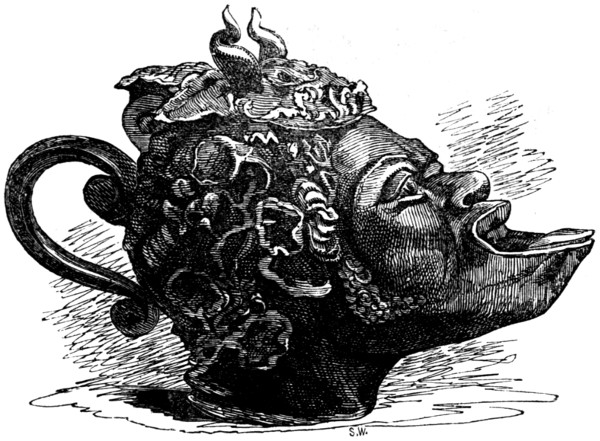
A Bronze Antique, found in the Thames, In digging for the Foundation of new London Bridge, January, 1827.
It is presumed that this article, from its peculiar curiosity, will be welcomed by every lover and preserver of antiquities.
To the Editor.
Sir,—The remarkable vessel from which this drawing is taken, was discovered a few days since, by a labourer employed in sinking one of the coffer-dams for the new London bridge, embedded in clay, at a depth of about thirty feet from the bed of the river. It is of bronze, not cast, but sculptured, and is in so perfect a state, that the edges of the different parts are as sharp as if the chisel had done its office but yesterday. The only portion which has suffered decay is the pin that attached the lid to the other part, which crumbled away as soon as exposed to the air.
At first, it was conjectured that this vessel was used for a lamp; but the idea was soon abandoned, as there was no part calculated to receive the wick; and the space to contain the oil was so small that it would not have admitted of more oil than was sufficient for one hour’s consumption, or two, at farthest.
One of the members of the Antiquarian Society has given it as his opinion, that it was used for sacrificial purposes, and intended to receive wine, which, after being put in, was to be poured out through the mouth, the under jaw being evidently protruded to an unnatural distance on this account.
The upper part of the head forms the lid, which the horns serve as a handle to raise; the bottom of the neck is flat, so that it may stand securely.
That it represents a head of Bacchus will be evident, at first glance, as it is encircled with a torse of ivy; but the features being those of a Nubian, or Carthaginian, prove that it must have an older date than that of the Romans, who borrowed their first ideas of Bacchic worship from the Egyptians. Perhaps it might have been part of their spoils from Carthage itself, and have been highly valued on that account. Certain however it is, that this curiosity (destined for the British Museum) must have laid below the bosom of father Thames for many centuries; but how it came there, and at such a depth in the clay, we can only guess at; and till Jonathan Oldbuck, alias Monkbarns, rise from the dead to set us right, it is to be feared that there will be left nothing but conjecture respecting it.
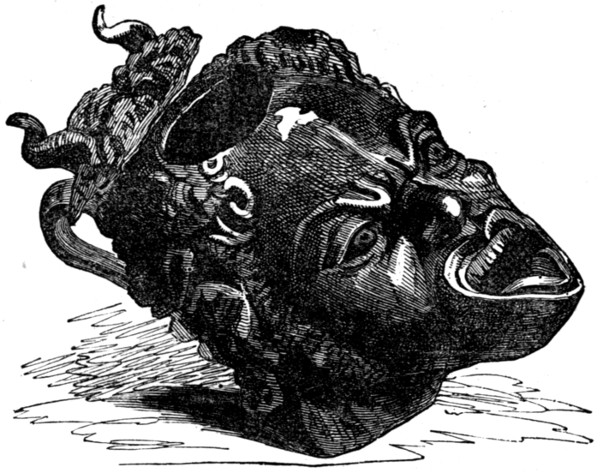
Another View of the same ancient Bronze, Showing the Mouth, and the Orifice at the top of the Head.
There is some account, but not very well supported, of the course of the Thames having once been diverted; should this however be true, it is possible that the head, of which we are now speaking, might have been dropped on the then dry bottom; the bed of the river must, in that case, have been afterwards considerably raised.
I remain, yours, respectfully, M. Blackmore.
Wandsworth, Feb. 9, 1827.
P. S. The Romans always represent their satyrs with Roman noses, and I believe that Bacchus alone is crowned with ivy; the fauns and the rest being crowned with vine leaves.
It would be easy to compose a dissertation respecting Bacchus, which would be highly interesting, and yet throw little light on this very remarkable vessel. The relation of any thing tending to elucidate its probable age or uses will be particularly esteemed.
In addition to the favour of Mr. Blackmore’s letter and drawing, he obligingly obtained the vessel itself, which being placed in the hands of Mr. S. Williams, he executed the present engravings of the exact size of the original: it is, as Mr. Blackmore has already mentioned, in the finest possible preservation.
Probably the insertion of this remarkable relique of antiquity, turned up from the soil of our metropolitan river, may induce communications to the Table Book of similar discoveries when they take place. At no time were ancient remains more regarded: and illustrations of old manners and customs, of all kinds, are here especially acceptable.
JACK O’ LENT.
This was a puppet, formerly thrown at, in our own country, during Lent, like Shrove-cocks. Thus, in “The Weakest goes to the Wall,” 1600, we read of “a mere anatomy, a Jack of Lent;” and in Greene’s “Tu quoque,” of “a boy that is throwing at his Jack o’ Lent;” and again, in the comedy of “Lady Alimony,” 1659:
———“Throwing cudgels At Jack a Lents or Shrove-cocks.”
Also, in Ben Jonson’s “Tale of a Tub:”
———“On an Ash-Wednesday, When thou didst stand six weeks the Jack o’ Lent, For boys to hurl three throws a penny at thee.”
So, likewise, in Beaumont and Fletcher’s “Tamer tamed:”
———“If I forfeit, Make me a Jack o’ Lent, and break my shins For untagg’d points and counters.”
Further, in Quarles’ “Shepheard’s Oracles,” 1646, we read:
“How like a Jack a Lent He stands, for boys to spend their Shrove-tide throws, Or like a puppet made to frighten crows.”[72]
From the “Jack o’ Lent,” we derive the familiar term among children, “Jack o’ Lanthorn.”
Shrove Tuesday AND Ash Wednesday.
The copious particulars respecting these festivals, which have been brought together in another place,[73] admit of some addition.
In France and other parts of the continent, the season preceding Lent is universal carnival. At Marseilles, the Thursday before Lent is called le Jeudi gras, and Shrove Tuesday le Mardi gras. Every body joins in masquerading on these nights, and both streets and houses are full of masks the whole night long. The god of fritters, if such a god there be, who is worshipped in England only on Shrove Tuesday, is worshipped in France on both the Thursday and Tuesday. Parties meet at each other’s houses to a supper of fritters, and then set off masquerading, which they keep up to a very late hour in the morning.
On Ash-Wednesday, which has here much more the appearance of a festival than of a fast, there is a ceremony called “interring the carnival.” A whimsical figure is dressed up to represent the carnival, which is carried in the afternoon in procession to Arrens, a small village on the sea-shore, about a mile out of the town, where it is pulled to pieces. This ceremony is attended in some way or other by every inhabitant of Marseilles, whether gentle or simple, man or woman, boy or girl. The very genteel company are in carriages, which parade backwards and forwards upon the road between the town and the village, for two or three hours, like the Sunday processions in Hyde-park. Of the rest of the company, some make parties to dine at Arrens, or at the public-houses on the road; others make water parties; but the majority only go and walk about, or sit upon the rocks to see and be seen. It was one of the most delightful evenings imaginable; the air was inexpressibly mild; the road where the carriages parade is about half way up the rocks, and this long string of carriages constantly moving, the rocks filled with thousands and thousands of spectators, and the tranquil sea gilded by the setting sun, and strewed over with numberless little barks, formed altogether one of the most beautiful and picturesque scenes that could be presented. We sat down on a little detached piece of rock almost encircled by the sea, that we might have full enjoyment of it, and there remained till some time after the glorious sun had disappeared for the night, when we walked home by a lovely bright moonlight, in a milder evening, though in the month of February, than we often find in England at Midsummer.[74]
Naogeorgus, in the “Popish Kingdome,” mentions some burlesque scenes practised formerly on Ash Wednesday. People went about in mid-day with lanterns in their hands, looking after the feast days which they had lost on this the first day of the Lent fast. Some carried herrings on a pole, crying “Herrings, herrings, stinking herrings! no more puddings!”
And hereto joyne they foolish playes, and doltish doggrel rimes, And what beside they can invent, belonging to the times.
Others, at the head of a procession, carried a fellow upon staves, or “stangs,” to some near pond or running stream, and there plunged him in, to wash away what of feasting-time might be in him. Some got boys to accompany them through the town singing, and with minstrels playing, entered the houses, and seizing young girls harnessed them to a plough; one man held the handles, another drove them with a whip, a minstrel sung drunken songs, and a fellow followed, flinging sand or ashes as if he had been sowing, and then they drove
—— both plough and maydens through some pond or river small, And dabbled all with durt, and wringing wett as they may bee To supper calle, and after that to daunsing lustilee.
Quinquagesima. Carnival in Spain.
“Carnival,” properly so called, according to Mr. Blanco White, is limited to Quinquagesima Sunday, and the two following days, a period which the lower classes pass in drinking and rioting in those streets where the meaner sort of houses abound, and especially in the vicinity of the large courts, or halls, called Corrales, surrounded with small rooms or cells, where numbers of the poorest inhabitants live in filth, misery, and debauch. Before these horrible places, are seen crowds of men, women, and children, singing, dancing, drinking, and pursuing each other with handfuls of hair-powder. I have never seen, however, an instance of their taking liberties with any person above their class; yet, such bacchanals produce a feeling of insecurity, which makes the approach of those spots very unpleasant during the carnival.
At Madrid, where whole quarters of the town, such as Avapiés and Maravillas, are inhabited exclusively by the rabble, these “Saturnalia” are performed upon a larger scale. Mr. White says, I once ventured with three or four friends, all muffled in our cloaks, to parade the Avapiés during the carnival. The streets were crowded with men, who, upon the least provocation, real or imaginary, would have instantly used the knife, and of women equally ready to take no slight share in any quarrel: for these lovely creatures often carry a poniard in a sheath, thrust within the upper part of the left stocking, and held up by the garter. We were, however, upon our best behaviour, and by a look of complacency on their sports, and keeping at the most respectful distance from the women, came away without meeting with the least disposition to insolence or rudeness.
A gentleman, who, either out of curiosity or depraved taste, attends the amusements of the vulgar, is generally respected, provided he is a mere spectator, and appears indifferent to the females. The ancient Spanish jealousy is still observable among the lower classes; and while not a sword is drawn in Spain upon a love-quarrel, the knife often decides the claims of more humble lovers. Yet love is by no means the main instigator of murder among us. A constitutional irritability, especially in the southern provinces, leads, without any more assignable reason, to the frequent shedding of blood. A small quantity of wine, nay, the mere blowing of the easterly wind, called “Solano,” is infallibly attended with deadly quarrels in Andalusia. The average of dangerous or mortal wounds, on every great festival at Seville, is, I believe, about two or three. We have, indeed, a well-endowed hospital named de los Herídos, which, though open to all persons who meet with dangerous accidents, is, from this unhappy disposition of the people, almost confined to the wounded. The large arm-chair, where the surgeon in attendance examines the patient just as he is brought in, usually upon a ladder, is known in the whole town by the name of “Silla de los Guapos,” the Bullies’ chair. Every thing, in fact, attests both the generality and inveteracy of that horrible propensity among the Spaniards.[75]
THE LIEGE ALMANAC.
The celebrated almanac of “Francis Moore, physician,” to whose predictions thousands are accustomed to look with implicit confidence and veneration, is rivalled, on the continent, by the almanac of Liège, by “Matthew Laensberg,” who there enjoys an equal degree of celebrity.
Whether the name of Laensberg is a real or an assumed name is a matter of great doubt. A tradition, preserved in the family of the first printers of the work, ascribes it to a canon of St. Bartholomew, at Liège, who lived about the conclusion of the sixteenth century, or at the beginning of the seventeenth. This is further corroborated, by a picture of a canon of that church which still exists, and which is conjectured by many to represent the inventor of the celebrated almanac of Liège. Figure to yourself an old man, seated in an arm chair, his left hand resting on a globe, and his right holding a telescope. At his feet are seen different mathematical instruments, several volumes and sheets of paper, with circles and triangles drawn upon them. His eyes are large and prominent; he has a dull, heavy look, a nose in the form of a shell, and large ears, which are left uncovered by a greasy cap. His large mouth, half open, announces surliness and pedantry; frightful wrinkles furrow his face, and his long bushy beard covers an enormous band. This man is, besides, muffled up in an old cassock, patched in several places. Under his hideous portrait is the inscription “D. T. V. Bartholomæi Canonicus et Philosophiæ Professor.”
Such is the picture given by a person who examined this portrait, and who, though he was at the pains to search the registers of the chapter of Liège, was unable to find any name that at all corresponded with the above designation. Hence it may be fairly concluded, that the canon, whose portrait has just been exhibited, assumed the name of Matthew Laensbert, or Laensberg, as well as the title of professor of philosophy, for the purpose of publishing his almanac, with the prognostications, which have rendered it so celebrated.
The earliest of these almanacs known to exist is of the year 1636. It bears the name of Matthew Lansbert, mathematician, and not Laensberg, as it is now written. In the middle of the title is seen the portrait of an astronomer, nearly resembling that which is still placed there. After the printer’s name, are the words, “with permission of the superior powers.” This is repeated in the eleven first almanacs, but in that for 1647, we find, “with the favour and privilege of his highness.” This privilege, granted by Ferdinand of Bavaria, prince of Liège, is actually inserted. It gives permission to Leonard Streete to print Matthew Laensberg’s almanac, and forbids other printers to make copies of it, upon pain of confiscation, and other penalties.
The name of this prophet, spelt Lansbert in the first almanacs, has since been regularly written Laensberg. It is to this privilege of the prince bishop of Liège that Voltaire alludes in these lines of his Epistle to the king of Denmark:—
Et quand vous écrirez sur l’almanac de Liège, Ne parlez des saisons qu’avec un privilège.
The four first pages of the Liège almanac for 1636, are occupied by a piece entitled “The Twelve Celestial Signs governing the Human Body.” Cancer, for instance, governs the breast, the belly, and the lungs, with all their diseases. This was at that time the fashionable system of astrology, which was succeeded by many others, equally ill-founded, and equally popular. Yet it is a fact, that could scarcely be believed, were it not stated in an advertisement prefixed, that the physicians manifested a jealousy lest the prophet of Liège should extend his dominion over the healing art. They obtained an order that every thing relating to the influence of the celestial signs on diseases should be suppressed, and this retrenchment took place, for the first time, in 1679. The principal part, however, was preserved, and still ensures the success of this wonderful performance. It consists of general predictions concerning the variations of the seasons, and the occurrences of the year. In each month are marked the days when there will be rain, and those that will be dry; whether there will be snow or hail, high winds, storms, &c. Sterne alludes to this in his Tristram Shandy, when he says, “I have observed this 26th of March, 1759, a rainy day, notwithstanding the almanac of Liège.”
The general predictions mention the occurrences that are to take place in every month. Accident has frequently been wonderfully favourable to the prophet; and he owes all his reputation and celebrity to the luck of having announced the gaining of a battle, or the death of some distinguished person. An anecdote of Madame Du-barri, at that time all-powerful at the court of Louis XIV., is not a little singular.
When the king was attacked with the malady which put an end to his life, that lady was obliged to leave Versailles. She then had occasion, says the author of her life, to recollect the almanac of Liège, which had given her great uneasiness, and of which she had suppressed all the copies she was able. Amongst the predictions for the month of April, in that almanac, was the following: “A lady, in the highest favour, will act her last part.” She frequently said, “I wish this odious month of April were over.” According to the prediction, she had really acted “her last part,” for the king died in the following month, May 1774.[76]
DISCOVERY OF MADEIRA.
In the year 1344, in the reign of Peter IV. king of Arragon, the island of Madeira, lying in 32 degrees, was discovered, by an Englishman, named Macham, who, sailing from England to Spain with a lady whom he had carried off, was driven to the island by a tempest, and cast anchor in the harbour or bay, now called Machico, after the name of Macham. His mistress being sea-sick, he took her to land, with some of his company, where she died, and the ship drove out to sea. As he had a tender affection for his mistress, he built a chapel or hermitage, which he called “Jesus,” and buried her in it, and inscribed on her tombstone his and her name, and the occasion of their arrival there. In the island are very large trees, of one of which he and his men made a boat, and went to sea in it, and were cast upon the shore of Africa, without sail or oars. The Moors were infinitely surprised at the sight of them, and presented Macham to their king, who sent him and his companions to the king of Castile, as a prodigy or miracle.
In 1395, Henry III. of Castile, by the information of Macham, persuaded some of his mariners to go in search of this island, and of the Canaries.
In 1417, king John II. of Castile, his mother Catherine being then regent, one M. Ruben, of Bracamont, admiral of France, having demanded and obtained of the queen the conquest of the Canaries, with the title of king for a kinsman of his, named M. John Betancourt, he departed from Seville with a good army. And it is affirmed, that the principal motive that engaged him in this enterprise was, to discover the island of Madeira, which Macham had found.
Tomb of Macham’s Anna.
The following elegiac stanzas are founded on the preceding historical fact. Macham, having consigned the body of his beloved mistress to the solitary grave, is supposed to have inscribed on it the following pathetic lines:—
O’er my poor Anna’s lowly grave No dirge shall sound, no knell shall ring; But angels, as the high pines wave, Their half-heard ‘Miserere’ sing! No flow’rs of transient bloom at eve, The maidens on the turf shall strew; Nor sigh, as the sad spot they leave, Sweets to the sweet a long adieu! But in this wilderness profound, O’er her the dove shall build her nest; And ocean swell with softer sound, A Requiem to her dream of rest! Ah! when shall I as quiet be, When not a friend or human eye Shall mark, beneath the mossy tree, The spot where we forgotten lie? To kiss her name on this cold stone, Is all that now on earth I crave; For in this world I am alone— Oh! lay me with her in the grave.
Health.
GOOD EATING.
That “a sharp stomach is the best sauce,” is a saying as true as it is common. In Ulrick Hutton’s book on the virtues of guaiacum, there is a very singular story on this subject.
The relations of a rich German ecclesiastic, carrying him to drink the waters for the recovery of his health, and passing by the house of a famous quack, he inquired what was the reverend gentleman’s distemper? They told him a total debility, loss of appetite, and a great decay in his senses. The empiric, after viewing his enormous chin, and bodily bulk, guessed rightly at the cause of his distemper, and proposed, for a certain sum, to bring him home, on a day fixed, perfectly cured. The patient was put into his hands, and the doctor treated him in the following manner:—He furnished him every day with half a pound of excellent dry biscuit; to moisten this, he allowed him three pints of very good spring water; and he suffered him to sleep but a few hours out of the twenty-four. When he had brought him within the just proportion of a man, he obliged him to ring a bell, or work in the garden, with a rolling-stone, an hour before breakfast, and four hours in the afternoon. At the stated day the doctor produced him, perfectly restored.
Nice eating destroys the health, let it be ever so moderate; for the stomach, as every man’s experience must inform him, finds greater difficulty in digesting rich dishes than meats plainly dressed. To a sound man sauces are needless; to one who is diseased, they nourish not him, but his distemper; and the intemperance of his taste betrays him into the hands of death, which could not, perhaps, have mastered his constitution. Lewis Cornaro brought himself into a wretched condition, while a young man, by indulging his taste; yet, when he had once taken a resolution of restraining it, nature did that which physic could not; it restored him to perfect health of body, and serenity of mind, both of which he enjoyed to extreme old age.
Books.
READING ALOUD. By Margaret Duchess of Newcastle. 1671.
—— To read lamely or crookedly, and not evenly, smoothly, and thoroughly, entangles the sense. Nay, the very sound of the voice will seem to alter the sense of the theme; and though the sense will be there in despite of the ill voice, or ill reading, yet it will be concealed, or discovered to its disadvantages. As an ill musician, (or indeed one that cannot play at all,) instead of playing, puts the fiddle out of tune, (and causeth a discord,) which, if well played upon, would sound harmoniously; or if he can play but one tune, plays it on all sorts of instruments; so, some will read with one tone or sound of voice, though the passions and numbers are different; and some again, in reading, wind up their voices to such a passionate screw, that they whine or squeal, rather than speak or read: others fold up their voices with such distinctions, that they make that triangular which is four-square; and that narrow, which should be broad; and that high, which should be low; and low, that should be high: and some again read so fast, that the sense is lost in the race. So that writings sound good or bad, as the readers, and not as their authors are: and, indeed, such advantage a good or ill reader hath, that those that read well shall give a grace to a foolish author; and those that read ill, do disgrace a wise and a witty one. But there are two sorts of readers; the one that reads to himself, and for his own benefit; the other, to benefit another by hearing it: in the first, there is required a good judgment, and a ready understanding: in the other, a good voice and a graceful delivery: so that a writer must have a double desire; the one, that he may write well; the other, that he may be read well.
Aphorisms. By Lavater.
Who in the same given time can produce more than many others, has vigour; who can produce more and better, has talents; who can produce what none else can, has genius.
Who, without pressing temptation, tells a lie, will, without pressing temptation, act ignobly and meanly.
Who, under pressing temptations to lie, adheres to truth, nor to the profane betrays aught of a sacred trust, is near the summit of wisdom and virtue.
All affectation is the vain and ridiculous attempt of poverty to appear rich.
Who has no friend and no enemy, is one of the vulgar; and without talents, powers, or energy.
The more honesty a man has, the less he affects the air of a saint—the affectation of sanctity is a blot on the face of piety.
Love as if you could hate and might be hated, is a maxim of detested prudence in real friendship, the bane of all tenderness, the death of all familiarity. Consider the fool who follows it as nothing inferior to him who at every bit of bread trembles at the thought of its being poisoned.
There are more heroes than saints (heroes I call rulers over the minds and destinies of men;) more saints than humane characters. He, who humanizes all that is within and around himself, adore: I know but of one such by tradition.
He who laughed at you till he got to your door, flattered you as you opened it—felt the force of your argument whilst he was with you—applauded when he rose, and, after he went away, execrated you—has the most indisputable title to an archdukedom in hell.
Let the four-and-twenty elders in heaven rise before him who, from motives of humanity, can totally suppress an arch, full-pointed, but offensive bon mot.
Manners.
THE PARLIAMENT CLUBS.
Before the year 1736, it had been usual for gentlemen of the House of Commons to dine together at the Crown-tavern in Palace-yard, in order to be in readiness to attend the service of the house. This club amounted to one hundred and twenty, besides thirty of their friends coming out of the country. In January, 1736, sir Robert Walpole and his friends began to dine in the same manner, at the Bell and Sun in King-street, Westminster, and their club was one hundred and fifty, besides absent members. These parties seem to have been the origin of Brookes’s and White’s clubs.
RIGHT AND LEFT HAND.
Dr. Zinchinelli, of Padua, in an essay “On the Reasons why People use the Right Hand in preference to the Left,” will not allow custom or imitation to be the cause. He affirms, that the left arm cannot be in violent and continued motion without causing pain in the left side, because there is the seat of the heart and of the arterial system; and that, therefore, Nature herself compels man to make use of the right hand.
THE DEATH OF LEILA.
For the Table Book.
’Twas moonlight—Leila sat retir’d Upon the tow’ring beach, Watching the waves, “like one inspir’d” With things beyond her reach: There was a calmness on the water Suited to Sorrow’s hapless daughter, For consolation seem’d to be Mixt up with its solemnity! The stars were shedding far and wide Their twinkling lights of peerless blue; And o’er the undulating tide The breeze on balmy pinions flew; The scene might well have rais’d the soul Above misfortune’s dark controul, Had not the hand of Death been laid On that belov’d and matchless maid! I watch’d the pale, heart-broken girl, Her shatter’d form, her look insane,— I saw her raven locks uncurl With moisture from the peaceful main: I saw her wring her hands with grief, Like one depriv’d of Hope’s relief, And then she sigh’d, as if bereft Of the last treasure heav’n had left! Slowly I sought the cheerless spot Where Leila lay, absorb’d in care, But she, poor girl! discern’d me not, Nor dreamt that friendship linger’d there! Her grief had bound her to the earth, And clouded all her beauty’s worth; And when her clammy hand I press’d, She seem’d of feeling dispossess’d! Yet there were motion, sense, and life, Remaining in that shatter’d frame, As if existing by the strife Of feelings none but Love can name! I spoke, she answer’d not—I took Her hand with many a fearful look— Her languid eyes I gaz’d upon, And press’d her lips—but she was gone!
B. W. R.
Islington, 1827.
Omniana.
RATTING.
There are three methods proposed for lessening the number of rats.
I. Introduce them at table as a delicacy. They would probably be savoury food, and if nature has not made them so, the cook may. Rat pie would be as good as rook pie; and four tails intertwisted like the serpents of the delphic tripod, and rising into a spiral obelisk, would crest the crust more fantastically than pigeon’s feet. After a while they might be declared game by the legislature, which would materially expedite their extirpation.
II. Make use of their fur. Rat-skin robes for the ladies would be beautiful, warm, costly, and new. Fashion requires only the two last qualities; it is hoped the two former would not be objectionable.
III. Inoculate some subjects with the small-pox, or any other infectious disease, and turn them loose. Experiments should first be made, lest the disease should assume in them so new a form as to be capable of being returned to us with interest. If it succeeded, man has means in his hand which would thin the hyenas, wolves, jackals, and all gregarious beasts of prey.
N. B. If any of our patriotic societies should think proper to award a gold medal, silver cup, or other remuneration to either of these methods, the projector has left his address with the editor.[77]
BUNGAY HAND-BILL.
(Copy.) PONY LOST.
On February 21st, 1822, this devil bade me adieu.
Lost, stolen, or astray, not the least doubt but run away, a mare pony that is all bay:—if I judge pretty nigh, it is about eleven hands high;—full tail and mane, a pretty head and frame;—cut on both shoulders by the collar, not being soft nor hollow:—it is about five years old, which may be easily told;—for spirit and for speed, the devil cannot her exceed.
Whoever can give information or bring the said runaway to me, John Winter, Glass-stainer and Combustible-maker, Upper Olland Street, Bungay, shall be handsomely rewarded for their trouble.
NOMINATIVE CASE.
Sancho, prince of Castile, being present at a papal consistory at Rome, wherein the proceedings were conducted in Latin, which he did not understand, and hearing loud applause, inquired of his interpreter what caused it: “My lord,” replied the interpreter, “the pope has caused you to be proclaimed king of Egypt.” “It does not become us,” said the grave Spaniard, “to be wanting in gratitude; rise up, and proclaim his holiness caliph of Bagdad.”
DISCOUNT FOR CASH.
The following anecdote is related in a journal of the year 1789:—
A service of plate was delivered at the duke of Clarence’s house, by his order, accompanied by the bill, amounting to 1500l., which his royal highness deeming exorbitant, sent back, remarking, that he conceived the overcharge to be occasioned by the apprehension that the tradesman might be kept long out of his money. He added, that so far from its being his intention to pay by tedious instalments, or otherwise distress those with whom he dealt, he had laid it down as an invariable principle, to discharge every account the moment it became due. The account was returned to his royal highness the next morning, with three hundred pounds taken off, and it was instantly paid.
SPORTING.
A wit said of the late bishop of Durham, when alive, “His grace is the only man in England who may kill game legally without a stamped license: if actually taken with a gun in his hand, he might exclaim in the words of his own grants—‘I Shute, by divine permission.’”
March.
“Stop and Read.”
We have seen this requisition on the walls till we are tired: in a book it is a novelty, and here, I hope it may enforce its claim. For thy sake, gentle reader, I am anxious that it should; for, if thou hast a tithe of the pleasure I had, from the perusal of the following verses, I expect commendation for bidding thee “stop and read.”
The First of March.
The bud is in the bough And the leaf is in the bud, And Earth’s beginning now In her veins to feel the blood, Which, warm’d by summer’s sun In th’ alembic of the vine, From her founts will overrun In a ruddy gush of wine. The perfume and the bloom That shall decorate the flower, Are quickening in the gloom Of their subterranean bower; And the juices meant to feed Trees, vegetables, fruits, Unerringly proceed To their preappointed roots. How awful the thought Of the wonders under ground, Of the mystic changes wrought In the silent, dark profound; How each thing upwards tends By necessity decreed, And a world’s support depends On the shooting of a seed! The Summer’s in her ark, And this sunny-pinion’d day Is commission’d to remark Whether Winter holds her sway; Go back, thou dove of peace, With the myrtle on thy wing, Say that floods and tempests cease, And the world is ripe for Spring. Thou hast fann’d the sleeping Earth Till her dreams are all of flowers, And the waters look in mirth For their overhanging bowers; The forest seems to listen For the rustle of its leaves, And the very skies to glisten In the hope of summer eves. Thy vivifying spell Has been felt beneath the wave, By the dormouse in its cell, And the mole within its cave; And the summer tribes that creep, Or in air expand their wing, Have started from their sleep, At the summons of the Spring. The cattle lift their voices From the valleys and the hills, And the feather’d race rejoices With a gush of tuneful bills; And if this cloudless arch Fills the poet’s song with glee, O thou sunny first of March, Be it dedicate to thee!
This beautiful poem has afforded me exquisite gratification. Till I saw it printed in Mr. Dyce’s “Specimens of British Poetesses,” I was ignorant that a living lady had written so delightfully. Without a friend at my elbow to instruct me whether I should prefix “Miss” or “Mrs.” to her felicitous name, I transcribe—as I find it in Mr. Dyce’s volume—Felicia Hemans.