Volume 2 — Vol. II.—53.
Reading edition
George Bloomfield.
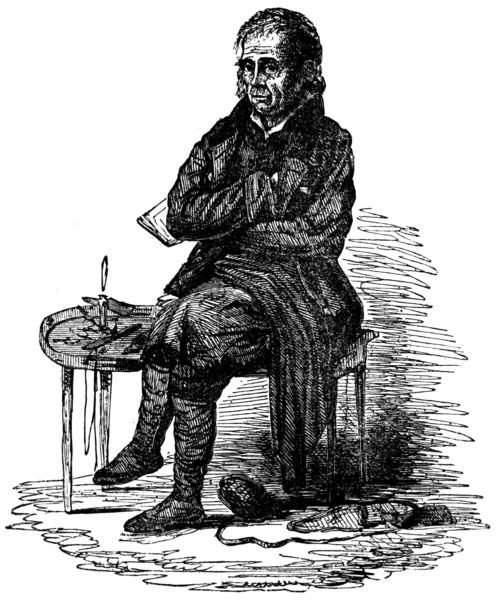
George Bloomfield.
This portrait of the elder brother of Robert Bloomfield, “the Farmer’s Boy,” is here presented from a likeness recently drawn in water colours from the life, and communicated to the Table Book for the purpose of the present engraving.
The late Mr. Capel Llofft, in a preface to Robert Bloomfield’s “Farmer’s Boy,” relates Robert’s history, from a narrative drawn up by George Bloomfield. It appears from thence, that their father died when Robert was an infant under a year old; that their mother had another family by John Glover, a second husband; and that Robert, at eleven years old, was taken by a kind farmer into his house, and employed in husbandry work. Robert was so small of his age, that his master said he was not likely to get his living by hard labour; his brother George informed his mother, if she would let him have Robert, he would take him and teach him his own trade, shoemaking; another brother, Nathaniel, offered to clothe him; and the mother and Robert, who was then fifteen years old, took coach, and came to London to George Bloomfield. “I have him in my mind’s eye,” says George; “a little boy; not bigger than boys generally are at twelve years old. When I met him and his mother at the inn, (in Bishopsgate-street,) he strutted before us, dressed just as he came from keeping sheep, hogs, &c.—his shoes filled full of stumps in the heels. He, looking about him, slipt up—his nails were unused to a flat pavement. I remember viewing him as he scampered up—how small he was—little thought that little fatherless boy would be one day known and esteemed by the most learned, the most respected, the wisest, and the best men of the kingdom.” Robert developed his talents under the fostering of George, to whose protection he was left by their mother. “She charged me,” says George, “as I valued a mother’s blessing, to watch over him, to set good examples for him, and never to forget that he had lost his father.” Her injunctions were strictly observed till Robert was eighteen, when George, having housed him, and taught him his trade, quitted London, and left Robert to pursue shoemaking and playing on the violin. “Robert told me in a letter,” says George, “‘that he had sold his fiddle, and got a wife.’ Like most poor men, he got a wife first, and had to get household stuff afterward. It took him some years to get out of ready furnished lodgings. At length, by hard working, &c. he acquired a bed of his own, and hired the room up one pair of stairs, at No. 14, Bell-alley, Coleman-street. The landlord kindly gave him leave to sit and work in the light garret, two pair of stairs higher. In this garret, amid six or seven other workmen, his active mind employed itself in composing the Farmer’s Boy.” George, with filial piety and fondness, tells of his mother’s pains to imbue Robert’s mind in infancy with just principles. “As his reason expanded,” continues George, “his love of God and man increased with it. I never knew his fellow for mildness of temper and goodness of disposition; and since I left him, universally is he praised by those who know him best, for the best of husbands, an indulgent father, and quiet neighbour.”
The progress and melancholy termination of Robert Bloomfield’s life are familiar to most readers of sensibility: they may not know, perhaps, that his brother George has long struggled with poverty, and is now an aged man, overwhelmed by indigence.
Two letters, written to a friend by a gentleman of Thetford, Mr. Faux, and some manuscripts accompanying them in George Bloomfield’s hand-writing, are now before me. They contain a few particulars respecting George Bloomfield and his present situation, which are here made known, with the hope of interesting the public in the behalf of a greatly distressed and very worthy man. The following extract from one of Mr. Faux’s letters introduces George Bloomfield’s circumstances, and conveys an idea of his character: it will be seen that he, too, is a versifier.
“Thetford, Oct. 15, 1827.
“I have found the letter you allude to, regarding his application to the overseers of St. Peter’s. I was rather inclined to send you a bundle of his letters and poetry, but I hardly think it fair without first consulting poor old George, and obtaining his permission. The letter enclosed, in answer to my invitation to him to be present on the day the duke of Grafton laid the first stone of the Pump-room, will show you what a shy bird he is. His presence on that occasion would have been highly beneficial to him; but his extreme modesty has been a drawback upon him through life, leaving him generally with a coat ‘scarcely visible.’ I believe he has been always poor, and yet a more temperate man never lived.”——
The following is the note above referred to.
From George Bloomfield to Mr. Faux.
“Wednesday, 3 o’clock.
“I was just folding the papers to take them to Stone, when the Master Fauxes came in, with great good nature in their countenances, and delivered their father’s very kind invitation. I feel truly grateful for the kindness: but when I can, without offence, avoid being seen, I have, through life, consulted my sheepish feelings. I have been accused of ‘making myself scarce,’ and been always considered an ‘unsocial’ fellow: it is a task to me to go into a situation where I am likely to attract attention, and the observation of men. In childhood I read of an invisible coat—I have sometimes worn a coat scarcely visible; but I want a coat that would render me invisible. I hope to be excused without giving offence, as I should be very ill at ease.
“Mr. Faux would have been presented with the enclosed papers a fortnight back, but I waited a favourable opportunity. This week I had but little work to do.—Lo, lo! here they are.”
A poem by George Bloomfield, called “The Spa,” which, being of local interest, has scarcely passed beyond provincial circles, induced the following public testimonial to his talents and virtues.
Lines addressed to George Bloomfield, by the Rev. Mr. Plumtree, late Fellow of Clare Hall, Cambridge.
Hail, aged minstrel! well thine harp thou’st strong, Tuneful and pleasingly of Thetford sung; Her abbey nunnery, and her mounds of war, Her late discovered, healing, blessed, Spa; And with a skilful hand, and master’s art, Hast poured the tribute of a grateful heart. Thy talent must not sleep. Resume thy lyre, And bid it in some deeper notes respire. Thy great Creator and thy Saviour claim The emanations of a poet’s flame. Poets and prophets once were names entwin’d: Ah, why was virtue e’er from verse disjoin’d? Ah, why have Christians lent a willing ear To strains ’twas sin to sing, ’twas sin to hear? Will Christians listen to a Byron’s lay? To Bloomfield, rather, admiration pay. His simple verse, with piety enjoin’d, More grateful steal on my attentive mind; And if it thrills with less tumultuous joy, It is a pleasure free from all alloy. Then, aged minstrel, strike thy lyre again, And o’er the land be heard thy pleasing strain. And, oh! may Britain’s sons thy lay regard, And give the aged minstrel his reward: Not the cheap recompense of empty praise, Nor e’en the crown of never-fading bays; But such as may effectually assuage The wants and cares of thy declining age; And the last lay that shall thy lyre employ, Accompany a “heart” that sings for joy.
The hand of the “aged minstrel” is now too weak to strike the lyre; nor will his voice again be heard. Mr. James Burrell Faux, of Thetford, Norfolk, is anxious for immediate assistance in George Bloomfield’s behalf; and to that gentleman communications and contributions should be addressed. All that the Table Book can do, is thus to make known the necessity of the case, and to entreat pecuniary relief from those who have hearts to feel, and ability to give.
Garrick Plays. No. XLVI.
SERIOUS FRAGMENTS. 1.
Misery lays stronger bonds of love than Nature; and they are more one, whom the same misfortune joined together, than whom the same womb gave life. H. Killigrew.
2.
Dying Person.
————— my soul The warm embraces of her flesh is now, Ev’n now forsaking; this frail body must Like a lost feather fall from off the wing Of Vanity—
W. Chamberlain.
3.
——————eternity: Within whose everlasting springs we shall Meet with those joys, whose blasted embryos were Here made abortive—
W. Chamberlain.
4.
Crown declined by a Spiritual person.
I know no more the way to temporal rule, Than he that’s born, and has his years come to him, On a rough desart—
Middleton.
5.
To a Votaress.
Keep still that holy and immaculate fire, You chaste lamp of eternity; ’tis a treasure Too precious for death’s moment to partake, The twinkling of short life.—
Middleton.
6.
The fame that a man wins himself is best; That he may call his own: honours put to him Make him no more a man than his clothes do, Which are as soon ta’en off; for in the warmth The heat comes from the body, not the weeds; So man’s true fame must strike from his own deeds.
Middleton.
7.
Adventurers.
The sons of Fortune, she has sent us forth To thrive by the red sweat of our own merits.—
Middleton.
8.
New made Honour.
————— forgetfulness Is the most pleasing virtue they can have. That do spring up from nothing; for by the same. Forgetting all, they forget whence they came.
Middleton.
9.
Œnone forsaken.
Beguil’d, disdain’d, and out of love, live long, thou Poplar tree, And let thy letters grow in length to witness this with me. Ah Venus, but for reverence unto thy sacred name, To steal a silly maiden’s love I might account it blame.— And if the tales I hear be true, and blush for to recite, Thou dost me wrong to leave the plains, and dally out of sight, False Paris! this was not thy vow, when thou and I were one, To range and change old love for new; but now those days be gone.
Peel.
10.
Epilepsy.
—your [Cæsar’s] disease the Gods ne’er gave to man, But such a one as had a spirit too great For all his body’s passages to serve it; Which notes the excess of your ambition.
Chapman.
11.
We are not tried but in our misery. He is a cunning coachman, that can turn well in a narrow room. Anon.
12.
Gray hairs.
—— upon whose reverend head The milk-white pledge of wisdom sweetly spreads.—
Lodge.
13.
Ladies Dancing.
—— a fine sweet earthquake, gently moved By the soft wind of whispering silks.—
Decker.
14.
—— sharp witted Poets; whose sweet verse Makes heav’nly Gods break off their nectar draughts. And lay their ears down to the lowly earth—
Anon.
15.
Grandsires’ Love.
Old men do never truly doat, untill Their children bring them babies.
Shirley.
16.
To a false Mistress.
——— thy name, sweeten’d once the name of him that spake it.—
Shirley.
17.
Herod, jealous, to Mariamne.
Hast thou beheld thyself, and could’st thou stain So rare perfection?—ev’n for love of thee I do profoundly hate thee.
Lady Elizabeth Carew.
18.
Cleopatra.
The wanton Queen, that never loved for Love.—
Lady E. Carew.
19.
Conceit of a Princess’ love.
’Twas but a waking dream, Wherein thou madest thy wishes speak, not her; In which thy foolish hopes strive to prolong A wretched being: so sickly children play With health-loved toys, which for a time delay, But do not cure the fit.
Rowley.
20.
Changing colour at sudden news.
Why look’st thou red, and pale, and both, and neither?—
Chapman.
21.
Rich Usurer to his Mistress.
I will not ’joy my treasure but in thee, And in thy looks I’ll count it every hour; And thy white arms shall be as bands to me, Wherein are mighty lordships forfeited.— Then triumph, Leon, richer in thy love. Than all the hopes of treasure I possess. Never was happy Leon rich before; Nor ever was I covetous till now, That I see gold so ’fined in thy hair.
Chapman.
22.
Puritan.
——— his face demure, with hand On breast, as you have seen a canting preacher. Aiming to cheat his audience, wanting matter. Sigh, to seem holy, till he thought on something.—
Anon.
23.
Sects.
Eternity, which puzzles all the world To name the inhabitants that people it; Eternity, whose undiscover’d country We fools divide before we come to see it, Making one part contain all happiness, The other misery, then unseen fight for it. All sects pretending to a right of choice, Yet none go willingly to take a part.
Anon.
24.
Man is a vagabond both poor and proud, He treads on beasts who give him clothes and food; But the Gods catch him wheresoe’er he lurks, Whip him, and set him to all painful works: And yet he brags he shall be crown’d when dead. Were ever Princes in a Bridewell bred? Nothing is sinfully begot but he: Can base-born Bastards lawful Sovereigns be?
Crowne.
25.
Wishes for Obscurity.
How miserable a thing is a Great Man!— Take noisy vexing Greatness they that please; Give me obscure and safe and silent ease. Acquaintance and commerce let me have none With any powerful thing but Time alone: My rest let Time be fearful to offend, And creep by me as by a slumbering friend; Till, with ease glutted, to my bed I steal, As men to sleep after a plenteous meal. Oh wretched he who, call’d abroad by power, To know himself can never find an hour! Strange to himself, but to all others known, Lends every one his life, but uses none; So, e’er he tasted life, to death he goes; And himself loses, e’er himself he knows.
Crowne.
26. Mind constituted to Goodness.
—— you may do this, or any thing you have a mind to; even in your fantasy there is a secret counsel, seeing that all your actions, nay all your pleasures, are in some exercise of virtue— H. Killigrew.
27.
Returned Pilgrim.
To man how sweet is breath! yet sweetest of all That breath, which from his native air doth fall. How many weary paces have I measured, How many known and unknown dangers past, Since I commenced my tedious pilgrimage, The last great work of my death-yielding age! Yet am I blest, that my returning bones Shall be rak’t up in England’s peaceful earth.
Anon.
28.
Usury.
Nature in all inferior things hath set A pitch or term, when they no more shall get Increase and offspring. Unrepaired houses Fall to decay; old cattle cease to breed; And sapless trees deny more fruit or seed: The earth would heartless and infertile be. If it should never have a jubilee. Only the Usurer’s Money ’genders still; The longer, lustier; age this doth not kill. He lives to see his Money’s Money’s Money Even to a hundred generations reach.
Anon.
29.
Love defined by contraries.
Fie, fie, how heavy is light Love in me!— How slow runs swift Desire!—this leaden air, This ponderous feather, merry melancholy; This Passion, which but in passion Hath not his perfect shape.—
Day.
30.
Good Faith.
What are we but our words? when they are past, Faith should succeed, and that should ever last.
31.
Weeping for good news.
I knew your eye would be first served; That’s the soul’s taster still for grief or joy.
Rowley
32.
Forsaken Mistress.
I thought the lost perfection of mankind Was in that man restored; and I have grieved, Lost Eden too was not revived for him; And a new Eve, more excellent than the first, Created for him, that he might have all The joys he could deserve: and he fool’d me To think that Eve and Eden was in me: That he was made for me, and I for him.
Crowne.
33.
Love surviving Hope.
’Tis a vain glory that attends a Lover, Never to say he quits; and, when Hope dies, The gallantry of Love still lives, is charm’d With kindness but in shadow.
Browne.
34.
Warriors.
I hate these potent madmen, who keep all Mankind awake, while they by their great deeds Are drumming hard upon this hollow world, Only to make a sound to last for ages.
Crowne.
35.
Life.
What is’t we live for? tell life’s finest tale— To eat, to drink, to sleep, love, and enjoy, And then to love no more! To talk of things we know not, and to know Nothing but things not worth the talking of.
Sir R. Fane, jun.
36.
Brother, supposed dead, received by a Sister: she shews him a letter, disclosing an unworthy action done by him; at which he standing abashed, she then first congratulates him:
—— now I meet your love. Pardon me, my brother; I was to rejoyce at this your sadness, before I could share with you in another joy. H. Killigrew.
37.
Person just dead.
’Twas but just now he went away; I have not yet had time to shed a tear; And yet the distance does the same appear, As if he had been a thousand years from me. Time takes no measure in eternity.
Sir Robert Howard.
38.
French Character.
The French are passing courtly, ripe of wit; Kind, but extreme dissemblers: you shall have A Frenchman ducking lower than your knee, At the instant mocking ev’n your very shoe-tyes.
Ford.
39.
Love must die gently.
I hoped, your great experience, and your years, Would have proved patience rather to your soul, Than to break off in this untamed passion. Howe’er the rough hand of the untoward world Hath molded your proceedings in this matter, Yet I am sure the first intent was love. Then since the first spring was so sweet and warm, Let it die gently; ne’er kill it with a scorn.
Anon.
40.
Poetic Diction.
——— worthiest poets Shun common and plebeian forms of speech, Every illiberal and affected phrase, To clothe their matter; and together tye Matter and form with art and decency.
Chapman.
41.
Author Vanity.
———the foolish Poet, that still writ All his most self-loved verse in paper royal, Or parchment ruled with lead, smooth’d with the pumice, Bound richly up, and strung with crimson strings; Never so blest as when he writ and read The ape-loved issue of his brain; and never But joying in himself, admiring ever—
Chapman.
42.
Good wit to be husbanded.
——— as of lions it is said, and eagles, That when they go, they draw their seres and talons Close up, to shun rebating of their sharpness: So our wit’s sharpness, which we should employ In noblest knowledge, we should never waste In vile and vulgar admirations.
Chapman.
43. Impossibility of attaining, a bar to desire.
Nothing is more ordinary, than for my Lady to love her Gentleman; or Mistress Anne, her father’s man. But if a country clown coming up hither, and seeking for his lawyer in Gray’s Inn, should step into the walks, and there should chance to spy some mastership of nature; some famed Beauty, that for a time hath been the name; he would stand amazed, perhaps wish that his Joan were such, but further would not be stirred. Impossibility would
stop more bold desires, And quench those sparks that else would turn to fires.
Edmund Prestwick.
44. Theory of men’s choice in a Beauty.
1.—She has a most complete and perfect beauty; nor can the greatest critic in this sort find any fault with the least proportion of her face, but yet methought I was no more taken with it, than I should be with some curious well-drawn picture.
2.—That is somewhat strange.
1.—In my mind, not at all; for it is not always that we are governed by what the general fancy of the world calls beauty; for each soul hath some predominant thoughts, which when they light on ought that strikes on them, there is nothing does more inflame. And as in music that pleaseth not most, which with the greatest art and skill is composed; but those airs that do resemble and stir up some dormant passion, to which the mind is addicted; so, I believe, never yet was any one much taken with a face, in which he did not espy ought that did rouse and put in motion some affection that hath ruled in his thoughts, besides those features which, only for the sake of common opinion, we are forced to say do please. E. Prestwick.
C. L.
GENERAL REMINISCENCES OF THREE, THIRD, and THRICE.
“Thrice the brindled rat hath mewed— Thrice to thine and thrice to mine, And thrice again to make up nine.”—Shakspeare.
The ordinal, cardinal, or numeral, Three, possesses stronger power of associating application than any other figure in history, or literature. From the first notice of the Creation, Ælohim is understood to signify the Trinity. When the third day was created, the sun, moon, and stars, were set in the firmament. Christ’s resurrection was on the third day, and his crucifixion between two thieves. Noah’s sons were Shem, Ham, and Japheth. Job’s daughters were Keziah, Jemima, and Kerenhappuck; his comforters were Eliphaz, Bildad, and Zophar. Time is divided into three parts. The ancients rose at the third hour. The Brahmins have their Birmah, Vishnu, and Siva; the Persians their Oromanes, Mithra, and Mithras; the Egyptians their Osiris, Isis, and Orus; the Arabians their Allah, Al Uzza, and Manah; the Phœnicians and Tyrians their Belus, Urania, and Adonis; the Greeks their Jupiter, Neptune, and Pluto. Aristotle, Plutarch, and Macrobius, wrote on the doctrine of numbers. Clotho, Lachesis, and Atropos, were three Fates. The children that endured the fiery furnace were Shadrach, Meshach, and Abednego. Jupiter’s thunderbolt had three forks; Neptune’s trident, three prongs; Cerberus three heads. The Pythian priestess sat on a tripod.[512] There were the three Parcæ; the three Furies; three attributes of the sun, Sol, Apollo, and Liber; of the moon, Hecate, Diana, and Luna. David prayed three times a day. The Hindoos make three suppressions of the breath when meditating on the triliteral syllable O’M. The Sabians prayed morning, noon, and night. Three bows of the head, and three prostrations are peculiar to some nations. In England, are king, lords, and commons. The ancients washed their eyes three times; drunk potions out of three cups. The Salians beat the ground three times in their dance. Three times were allowed for execrations, for spitting on the ground and sneezing. Juno Lucina was invoked three times in favour of childbirth. Three steps were allowed to ascend the throne or the altar. Persons dipped thrice into wells for cure. Persons were touched thrice for the king’s evil. Three parts of the old world only were known. The three professions are law, divinity, and physic. Three chirps of a cricket is said to be a sign of death. Coleridge makes his mastiff bitch howl three times for his Lady Christabel. The papist crosses himself three times. The raven’s croak, or the owl’s triad screech, indicates (it is said) ill omens. Three crows in a gutter betoken good to the beholder. The funeral bell is tolled thrice for the death of a man. The third attack of apoplexy is thought fatal. The third finger of the left hand bears the marriage ring. A Latin motto is tria una in juncta. The witches in Macbeth ask, “When shall we three meet again?” There are signs of the Three Crowns, Three Pigeons, Three Cups, Three Tuns, Three Brewers, Three Johns, Three Bells, and others, to an infinite degree. In the church service are the clerk, curate, and preacher; three priests serve at the papal shrine. In the courts of justice are the judge, the jury, and the culprit. In physic, the physician’s consultation is three. An arbitration is three. A dual public-house sign is, with the gazer added quaintly, “We three loggerheads be.” The three warnings are celebrated. The Jews boasted of Abraham, Isaac, and Jacob. The United Kingdom is England, (Wales included,) Ireland, and Scotland. Who has not read of Three-fingered Jack? of Octavius, Lepidus, and Anthony? A nest of chests is three. The British toast is echoed by hip! hip! huzzah! Three signals decided the fate of Lucius Junius. In the third year of Cyrus the name of Belteshazzar was revealed to Daniel: his prophecy was, that “three kings should stand up in Persia;” and Daniel mourned three weeks by reason of his vision. The beast that he saw, had three ribs in the mouth of it. The householder went about the third hour, and saw others standing idle in the market-place. Daniel’s petition was made three times. In the Revelations, the third part of the creatures which were in the sea and had life, died. Faith, Hope, and Charity, are three virtues. The priests’ abodes in Eziekel were three chambers. In the prophecy it says, “A third part of the hair shall be burnt; a third part fall by the sword; a third part scattered by the wind.” Demosthenes says, “Three years after, he met with the same fate as Æschines, and was also banished from Athens.” History unites an Aristides, a Cimon, and a Phocion. Peter’s denial was given by the cock crowing thrice. Homer, in his Frogs and Mice, says,
“Three warlike sons adorned my nuptial bed, Three sons, alas! before their father, dead.”
Pope Alexander III., 1182, compelled the kings of England and France to hold the stirrups of his saddle when he mounted his horse. King Richard III. put an end to the civil wars between the houses of York and Lancaster, 1483. Peter III. was deposed 1762. Virgil, 565, lib. viii. says, Nascenti cui tres animas Feronia mater—ter letho sternendus erat: and again, tres ulnas—tribus nodis. Milton’s three fierce spirits were Ariel, Arioch, and Ramiel. Lord Nelson’s ship, the Victory, attacked the Trinidad.[513] Fairs are usually chartered for three days. Persons used to walk three times round Horn church. The pawnbroker has three balls. A hearth has a poker, tongs, and shovel.[514] The sentinel asks—“Who comes there?” thrice, before he dares level his firelock at the intruder. Three candles in a room are said to indicate death in the family. The bashaw wears three tails. The passion flower has three spires.
Thus, it will be readily seen, how intimately the number three has been, and is, connected with events and circumstances, hypothetical and absolute. Were the subject worth tracing further, scarcely a poetic or prose writer, but is liberal in the use of this number. Considering, however, that the adductions already given are such as to satisfy the most fastidious disciples of the square root, need I perform a triple evolution in this threefold science of pure and mixed numbers? I conclude by apologising for not having treated the subject like a lexicographer, in technical and alphabetical routine. J. R. P.
December, 1827.
For the Table Book.
DESTRUCTION OF JERUSALEM.
Ελευσονται (γαρ) ημεραι εν αις ουκ αφησονται λιθος επι λιθω ος ου καταλυθησεται.
Luc. Ev. c. xxi. v. 6.
1.
Hark! again to the onset—the portals gape wide— And the warriors stream forth in the rush of their pride, The cold reckless eye of the Roman glows red, At the sound of their deathlike and trumpetless tread; For he knows that the workings of frenzy are there, The triumph of death and the might of despair. Hearts—that wildly live on but to riot in pain— Lips—that laugh, as in scorn, at the links of the chain— And full many a plume shall yon eagle let fall, Ere she wing her fierce flight o’er the rift of the wall; Ere she soar on the dark cloud of conquest and rest, On the rock of that temple, the strength of her hest.
2.
Thy foes are around thee, fair city of peace!— Thy sons are fast sinking, the wicked increase— Yet proudly, ev’n now, thy high-place dost thou hold, Girt round with the pomp of their steel and their gold; And a pearl of rich price, on thine hill-top art thou, Meet to jewel the crown of a conqueror’s high brow. Yet deem not thy sons to that haughty array, Will fling thee unheeded, unbled for away. Shall the proud heathen tread where thy prophets have trod? Shall, the Flamen exult in the “Holy of God?” No—the hearts of thy children are one,—to hurl back The merciless wrath of the Gentiles’ attack. For the home of their fathers towers yet in their eye, As they lived will they live, as they died will they die.
3.
But weak is thine armour, and worthless thy might, A fiercer than man strives against thee in fight, And in vain shall the chiefs of thy battle withstand The voice of his thunder, the bolt in his hand; His wrath knows no refuge, his might knows no bar. The stout spear he rendeth, and burns the swift car. Thou shalt crumble to nought in the day of his wrath, Like the reed trampled down in the whirlwind’s wild path.
4.
Weep, daughter of Judah! that tempest hath come, And it laugheth to scorn the mild vengeance of Rome. Weep, daughter of Judah! a vengeance so dread Is bursting e’en now o’er thy desolate head, That the stern Roman eyes it with doubt and with fear. O’er the cheek of the conqueror there steals a soft tear Aye! the heathen for thee feels a pang of regret— —One blaze—and thy sun shall for ever be set;
5.
One short flickering blaze;—and then passeth away The glory of years in the work of a day: The fair crown of Jacob lies trod in the dust. And shipwreck’d is now the strong hold of his trust; Tho’ the foxes have holes, and the fowls have a nest, Yet the “seed of the Promised” finds nowhere to rest; And despised shall he live on, in darkness and night, Till a Salem more blessed shall gladden his sight; The courts of whose house, in their measureless girth, Shall compass the tribes and the thousands of earth; Where none, save in triumph, their voices shall raise, And no trump shall peal forth save the trumpet of praise, In a realm far above, o’er that red eagle’s nest, Where the proud cease from wrong, and the poor are at rest.
B.
APOSTLE SPOONS.
To the Editor.
Dear Sir,—In Roger North’s Life of his brother, Sir Dudley North, (4to. London, 1744,) occurs the following passage, which, in connection with the account you gave your readers (Every-Day Book, vol. i. p. 176,) of “Apostle Spoons,” may be acceptable to you.
Mr. North, after some opposition, was elected sheriff of London; and after stating this, his biographer thus proceeds: “When all the forms of this shrieval instalment were over, Mr. North received the honour of knighthood ... and, as the custom of feasting, lately laid aside, was now resumed, Mr. North took a great hall, that belonged to one of the companies, and kept his entertainments there. He had diverse very considerable presents from friends and relations, besides the compliments of the several companies inviting themselves and wives to dinner, dropping their guineys, and taking apostles’ spoons in the room of them; which, with what they ate and drank, and such as came in the shape of wives, (for they often gratified a she-friend or relation with that preferment,) carried away, made but an indifferent bargain. The Middle Templars, (because of his relation to the lord chief justice North, who was of that Society,) came with a compliment, and a purse of one hundred guineys, and were entertained. The mirth and rejoicing that was in the city, as well at these feasts as at private entertainments, is scarce to be expressed.”
In perusing this quaintly written volume, there occur two or three passages, which deserve to be ranked as aphorisms. For your own reading I here add them:—
“Better a loss at sea than a bad debt on land. The former has no worse consequence than itself; but the other draws loss of time and pains, which might be employed to more profit.”
“Whoever serves a community, and does not secure his reward, will meet with quarrels instead of thanks, for all the good he may have done it.”
Sir Dudley was wont to remark, “Lay nothing to heart which you cannot help.” A most useful principle of life.
I am, &c.
Whitehaven, J. G.
Sept. 12, 1827.
PATIENT COURTSHIP.
For the Table Book.
I knew a man that went courting his sweetheart the distance of three miles every evening for fourteen years, besides dodging her home after church, Sunday afternoons; making above 15,000 miles. For the first seven years he only stood and courted in the door-porch; but for the remaining period, he ventured (what a liberty after a septennial attachment!) to hang his hat on a pin in the passage and sit in the kitchen settle. The wedding—a consummation devoutly to be wished—was solemnized when Robert and Hannah were in their “sear and yellow leaf.” They had no family “to cry their fading charms into the grave.” Though their courtship had been long, cool, and deliberate, they were not the happiest couple in the village; to that union of temper, which is so essential in wedded life, they were strangers.
*, *, P.
OLD AND FAITHFUL SERVANTS.
“In their death they were not divided.”
2 Samuel i. 23.
To the Editor
Sir,—The following memorial I copied from a tablet, on the right hand side of the clergyman’s desk, in the beautiful little church at Hornsey. The scarceness of similar inscriptions make this valuable.
S. T. L.
“Erected to the memory of Mary Parsons, the diligent, faithful, and affectionate servant, in a family during a period of 57 years. She died on the 22d day of November, 1806, aged 85.
“Also to the memory of Elizabeth Decker, the friend and companion of the above; who, after an exemplary service of 47 years in the same family, died on the 2d of February, 1809, aged 75.
“Their Remains, by their mutual request, WERE INTERRED IN THE SAME GRAVE.”
Discoveries OF THE ANCIENTS AND MODERNS. No. XXXVI.
Merely a cursory mention of all the important discoveries in geometry, mathematics, and philosophy, for which we are indebted to the ancients, would form a large book; yet a few of these particulars will be adverted to by way of concluding the series of articles under the present title.
Ancient Philosophers.
Thales was the first we know of who predicted eclipses. He pointed out the advantages that must arise from a due observation of the little bear or polar star; and taught that the earth was round, and the ecliptic in an oblique position.
Pytheas also, by accurate observations at Marseilles, more than 300 years before Christ, determined the obliquity of the ecliptic, by means of the solstitial shadow of the sun upon a dial. He found the height of the gnomon was to the length of the shadow as 600 to 2131⁄8; whence he concluded, that the obliquity of the ecliptic was 23° 49′. When Gassendi was at Marseilles with the celebrated Peiresc, he reiterated the experiment, and found it very just.
Thales went to the Egyptians to be instructed in geometry, and himself instructed them in that science. He showed them how to measure the pyramids by the length of their shades, and to determine the measure of inaccessible heights and distances, by the proportion of the sides of a triangle. He demonstrated the various properties of the circle; he discovered, respecting the isosceles triangle, that the angles at its base were equal; and he was the first who found, that in right lines cutting one another, the opposite angles are equal.
Anaximander, the successor of Thales, was the inventor of the armillary sphere, and of sun-horologes, or dials; he was likewise the first who drew a geographical map.
Pythagoras was the first who gave sure and fundamental precepts in music. Struck by the difference of sounds which issued from the hammers of a forge, but came into unison at the fourth, and fifth, and eighth percussions, he conjectured that this must proceed from the difference of weight in the hammers; he weighed them, and found he had conjectured right. Upon this he wound up some musical strings, in number equal to the hammers, and of a length proportioned to their weight; and found, that at the same intervals, they corresponded with the hammers in sound. Upon this principle he devised the monochord; an instrument of one string, capable of determining the various relations of sound. He also made many fine discoveries in geometry.
Plato by his studies in mathematics was enabled to devise the analytic method, or that geometric analysis, which enables us to find the truth we are in quest of, out of the proposition itself which we want to resolve. He it was who at length solved the famous problem, respecting the duplication of the cube. To him also is ascribed the solution of the problem concerning the trisection of an angle; and the discovery of conic sections.
Hipparchus discovered the elements of plane and spherical trigonometry.
Diophantes, who lived 360 years before Jesus Christ, was the inventor of algebra. It was from this science that the ancients drew those long and difficult demonstrations which we meet with in their works. They are presumed to have aimed at concealing a method which furnished them with so many beautiful and difficult demonstrations; and to have preferred the proving of their propositions by reasonings ad absurdum, rather than hazard the disclosure of the means by which they arrived more directly at the result of what they demonstrated. We meet with strong traces of algebra in the 13th book of Euclid. From the time of Diophantes, algebra made but small progress, till that of Vietus, who restored and perfected it, and was the first who marked the known quantities by the letters of the alphabet. Descartes afterwards applied it to geometry.
Aristarchus was the first who suggested a method of measuring the distance of the sun from the earth, by means of the half section of the moon’s disk, or that phasis of it wherein it appears to us when it is in its quadratures.
Hipparchus was the first who calculated tables of the motion of the sun and moon, and composed a catalogue of the fixed stars. He was also the first who, from the observation of eclipses, determined the longitude of places upon earth: but his highest honour is, that he laid the first foundations for the discovery of the precession of the equinoxes.
Archimedes discovered the square of the parabola, the properties of spiral lines, the proportion of the sphere to the cylinder, and the true principles of statics and hydrostatics. His sagacity is evident from the means he adopted to discover the quantity of silver that was mixed along with the gold, in the crown of king Hieron. He reasoned upon the principle, that all bodies immerged in water lose just so much of their weight, as a quantity of water equal to them in bulk weighs. Hence he drew this consequence, that gold being more compact must lose less of its weight, and silver more; and that a mingled mass of both, must lose in proportion to the quantities mingled. Weighing therefore the crown in water and in air, and two masses, the one of gold, the other of silver, equal in weight to the crown; he thence determined what each lost of their weight, and so solved the problem. He likewise invented a perpetual screw, valuable on account of its being capable to overcome any resistance; and the screw that still goes by his own name, used in the elevating of water. He alone defended the city of Syracuse, by opposing to the efforts of the Romans the resources of his genius. By means of machines, of his own construction, he rendered Syracuse inaccessible. Sometimes he hurled upon the land forces stones of such enormous size, as crushed whole phalanxes of them at once. When they retired from the walls, he overwhelmed them with arrows innumerable, and beams of a prodigious weight, discharged from catapults and balistæ. If their vessels approached the fort, he seized them by the prows with grapples of iron, which he let down upon them from the wall, and rearing them up in the air, to the great astonishment of every body, shook them with such violence, as either to break them in pieces, or sink them to the bottom. When they kept at a distance from the haven, he focalized fire from heaven, and wrapped them in sudden and inevitable conflagration. He once said to king Hieron, “Give me but a place to stand upon, and I will move the earth.” The king was amazed by the declaration, and Archimedes gave him a specimen of his power by launching singly by himself a ship of a prodigious size. He built for the king an immense galley, of twenty banks of oars, containing spacious apartments, gardens, walks, ponds, and every convenience required by regal dignity. He constructed a sphere, representing, the motions of the stars, which Cicero esteemed one of the inventions which did the highest honour to human genius. He perfected the manner of augmenting the mechanic powers, by the multiplication of wheels and pullies; and carried mechanics so far, that his works surpass imagination.
Mechanics.
The immense machines, of astonishing force, which the ancients adapted to the purposes of war, prove their amazing proficiency in mechanics. It is difficult to conceive how they reared their bulky moving towers: some of them were a hundred and fifty-two feet in height, and sixty in compass, ascending by many stories, having at bottom a battering ram, of strength sufficient to beat down walls; in the middle, a drawbridge, to be let down upon the wall of the city attacked, afforded easy passage into the town for the assailants; and at top a body of men, placed above the besieged, harassed them without risk to themselves. An engineer at Alexandria, defending that city against the army of Julius Cæsar, by means of wheels, pumps, and other machinery, drew from the sea prodigious quantities of water, and discharged it upon the adverse army to their extreme discomfiture.
The mechanical enterprise and skill of the ancients are evidenced by their vast pyramids existing in Egypt, and the magnificent ruins of the cities of Palmyra and Balbec. Italy is filled with monuments of the greatness of ancient Rome.
Ancient Cities.
The finest cities of Europe convey no idea of the grandeur of ancient Babylon, which being fifteen leagues in circumference, was encompassed with walls two hundred feet in height, and fifty in breadth, whose sides were adorned with gardens of a prodigious extent, which arose in terraces one above another, to the very summit of the walls. For the watering of these gardens there were machines, which raised the water of the Euphrates to the highest of the terraces. The tower of Belus, arising out of the middle of the temple, was of so vast a height, that some authors have not ventured to assign its altitude; others put it at a thousand paces.
Ecbatane, the capital of Media, was eight leagues in circumference, and surrounded with seven walls in form of an amphitheatre, the battlements of which were of various colours, white, black, scarlet, blue, and orange; all of them covered with silver or with gold.
Persepolis was a city, which all historians speak of as one of the most ancient and noble of Asia. There remain the ruins of one of its palaces, which measured six hundred paces in front, and still displays relics of its former grandeur.
The Lake Mœris and the Pyramids.
The lake Mœris was a hundred and fifty leagues in circuit, and entirely the work of one Egyptian king, who caused that immense compass of ground to be hollowed, to receive the waters of the Nile, when it overflowed its usual level, and to serve as a reservoir for watering Egypt by means of canals, when the river was not of sufficient height to overflow and fertilize the country. From the midst of this lake arose two pyramids, of six hundred feet in height.
The other pyramids of Egypt, in bulk and solidity so far surpass whatever we know of edifices, that we should be ready to doubt their having existed, did they not still subsist. One of the sides of the base of the highest pyramid measures six hundred and sixty feet. The free-stones which compose it are each of them thirty feet long. The moderns are at a loss to imagine by what means such huge and heavy masses were raised to a height of above four hundred feet.
The Colossus of Rhodes.
This was another marvellous production of the ancients. Its fingers were as large as statues; few were able with outstretched arms to encompass the thumb. Ships passed between its legs.
Stupendous Statues.
Semiramis caused the mountain Bagistan, between Babylon and Media, to be cut out into a statue of herself, which was seventeen stadia high, that is, above half a French league; and around it were a hundred other statues, of proportionable size, though less large.
It was proposed to Alexander the Great, to make a statue of him out of mount Athos, which would have been a hundred and fifty miles in circumference, and ten miles in height. The design was to make him hold in his left hand a city, large enough to contain ten thousand inhabitants; and in the other an urn, out of which should flow a river into the sea.
Bridges—Glazed Windows.
In the structures of the ancients, the hardness of their cement equals that of marble itself. The firmness of their highways has never been equalled. Some were paved with large blocks of black marble. Their bridges, some of which still remain, are indubitable monuments of the greatness of their conceptions. The Roman bridge at Gard, near Nismes, is one of them. It serves at once as a bridge and an aqueduct, goes across the river Gardon, and connects two mountains, between which it is enclosed. It comprehends three stories; the third is the aqueduct, which conveys the waters of the Eure into a great reservoir, to supply the amphitheatre and city of Nismes. Trajan’s bridge over the Danube had twenty piers of free-stone, some of which are still standing, a hundred and fifty feet high, sixty in circumference, and distant one from another a hundred and seventy.
Among the ornaments and conveniences of ancient buildings was glass. They decorated their rooms with glasses, as mirrors. They also glazed their windows, so as to enjoy the benefit of light, without being injured by the air. This they did very early; but before they discovered that manner of applying glass, the rich made use of transparent stones in their windows, such as agate, alabaster, phengifes, talc, &c.
Curious Mechanism.
The works of the ancients in miniature were excellent. Archytas, who was contemporary with Plato, constructed a wooden pigeon, which imitated the flight and motions of a living one. Cicero saw the whole of Homer’s Iliad written in so fine a character that it could be contained in a nutshell.[515] Myrmecides, a Milesian, made an ivory chariot, so small and so delicately framed, that a fly with its wing could at the same time cover it; and a little ivory ship of the same dimensions. Callicrates, a Lacedemonian, formed ants and other little animals out of ivory, so extremely small, that their component parts were scarcely to be distinguished. One of these artists wrote a distich in golden letters, which he enclosed in the rind of a grain of corn.
Microscopes, &c.
Whether, in such undertakings as our best artists cannot accomplish without the assistance of microscopes, the ancients were so aided, is doubtful, but it is certain that they had several ways of helping and strengthening the sight, and of magnifying small objects. Jamblichus says of Pythagoras, that he applied himself to find out instruments as efficacious to aid the hearing, as a ruler, or a square, or even optic glasses, διοπτρα, were to the sight. Plutarch speaks of mathematical instruments which Archimedes made use of, to manifest to the eye the largeness of the sun; which may be meant of telescopes. Aulus Gellius having spoken of mirrors that multiplied objects, makes mention of those which inverted them; and these of course must be concave or convex glasses. Pliny says that in his time artificers made use of emeralds to assist their sight, in works that required a nice eye; and to prevent us from thinking that it was on account of its green colour only that they had recourse to it, he adds, that they were made concave the better to collect the visual rays; and that Nero used them in viewing the combats of the gladiators.
Sculpture.
Admirable monuments remain to us of the perfection to which the ancients carried the arts of sculpture and design. The Niobé and the Laocoon, the Venus de Medicis, the Hercules stifling Antæus, that other Hercules who rests upon his club, the dying gladiator, and that other in the vineyard of Borghese, the Apollo Belvedere, the maimed Hercules, and the Equerry in the action of breaking a horse on mount Quirinal, loudly proclaim the superiority of the ancients in those arts. These excellences are to be observed upon their medals, their engraved precious stones, and their cameos.
Painting.
Of ancient painting the reliques are so few and so much injured by time, that to form a proper judgment of it, is at first difficult. Yet if due attention be paid to pictures discovered at Rome, and latterly in the ruins of Herculaneum, the applause which the painters of antiquity received from their contemporaries may seem to have been merited. Among the ancient paintings in fresco, still at Rome, are a reclining Venus at full length, in the palace of Barbarini; the Aldovrandine nuptials; a Coriolanus, in one of the cells of Titus’s baths; and seven other pieces, in the gallery of the college of St. Ignatius; taken out of a vault at the foot of mount Palatine; among which are a satyr drinking out of a horn, and a landscape with figures, both of the utmost beauty. There are also a sacrificial piece, consisting of three figures, in the Albani collection; and an Œdipus, and a sphynx, in the villa Altieri; which all formerly belonged to the tomb of Ovid. From these specimens an advantageous judgment may be formed of the ability of the masters who executed them. Others, discovered at Herculaneum, disclose a happiness of design and boldness of expression, that could only have been achieved by accomplished artists. Theseus vanquishing the minotaur, the birth of Telephus, Chiron and Achilles, and Pan and Olympe, have innumerable excellencies. There were found also, among the ruins of that city, four capital pictures, wherein beauty of design seems to vie with the most skilful management of the pencil. They appear of an earlier date than those spoken of, which belong to the first century; a period when painting, as Pliny informs us, was in its decline.
Mosaic.
Of this work, which the Romans made use of in paving their apartments, a beautiful specimen, described by Pliny, was found in the ruins of Adrian’s villa at Tivoli. It represents a basin of water, with four pigeons around its brim; one of them is drinking, and in that attitude its shadow appears in the water. Pliny says, that on the same pavement the breaking up of an entertainment was so naturally represented, that you would have thought you really saw the scattered fragments of the feast.
Music.
The ancients have the whole merit of having laid down the first exact principles of music; and the writings of the Pythagoreans, of Aristoxenes, Euclid, Aristides, Nichomachus, Plutarch, and many others, even such of them as still remain, contain in them every known theory of the science. They, as well as we, had the art of noting their tunes, which they performed by means of letters either contracted, or reversed, placed upon a line parallel to the words, and serving for the direction, the one of the voice, the other of the instrument. The scale itself, of which Guy Aretin is the supposed inventor, is no other than the ancient one of the Greeks a little enlarged, and what Guy may have taken from a Greek manuscript, written above eight hundred years ago, which Kircher says he saw at Messina in the library of the Jesuists, wherein he found the hymns noted just as in the manner of Aretin. The ancient lyre was certainly a very harmonious instrument, and was so constructed, and so full of variety in Plato’s time, that he regarded it as dangerous, and too apt to relax the mind. In Anacreon’s time, it had already obtained forty strings. Ptolemy and Porphyry describe instruments resembling the lute and theorb, having a handle with keys belonging to it, and the strings extended from the handle over a concave body of wood. There is to be seen at Rome an ancient statue of Orpheus, with a musical bow in his right hand, and a kind of violin in his left. In the commentaries of Philostrates by Vigenere, is a medal of Nero with a violin upon it. The flute was carried to so high a degree of perfection by the ancients, that there were various kinds of them, and so different in sound, as to be wonderfully adapted to express all manner of subjects.
Tertullian mentions an organ invented by Archimedes. “Behold,” says Tertullian, “that astonishing and admirable hydraulic organ of Archimedes, composed of such a number of pieces, consisting each of so many different parts, connected together by such a quantity of joints, and containing such a variety of pipes for the imitation of voices, conveyed in such a multitude of sounds, modulated into such a diversity of tones, breathed from so immense a combination of flutes; and yet all taken together, constitute but one single instrument.”
That the ancients knew and practised harmony is evident from Plato, Macrobius, and other early writers. Aristotle, speaking of the revolutions of the several planets, as perfectly harmonizing with one another, they being all of them conducted by the same principle, draws a comparison from music to illustrate his sentiments. “Just as in a chorus,” says he, “of men and women, where all the variety of voices, through all the different tones, from the bass to the higher notes, being under the guidance and direction of a musician, perfectly correspond with one another, and form a full harmony.” Aurelius Cassiodorus defines symphony to be “the art of so adjusting the base to the higher notes, and them to it, through all the voices and instruments, whether they be wind or stringed instruments, that thence an agreeable harmony may result.” Horace speaks expressly of the bass and higher tones, and the harmony resulting from their concurrence. It is true, however, that the ancients did not much use harmony in concert. One fine voice alone, accompanied with one instrument, regulated entirely by it, pleased them better than mere music without voices, and made a more lively impression on their feeling minds; and this is what even we ourselves every day experience.
The effects ascribed to the music of the ancients are surprising. Plutarch reports of Antigenidas, that by playing on the flute, he so roused the spirit of Alexander, that he started from the table, and flew to his arms. Timotheus when touching his lyre so inflamed him with rage, that drawing his sabre he suddenly slew one of his guests; which Timotheus no sooner perceived, than altering the air from the Phrygian to a softer measure, he calmed his passions, and infused into him the tenderest feelings of grief and compunction for what he had done. Jamblichus relates like extraordinary effects of the lyres of Pythagoras and Empedocles. Plutarch informs us of a sedition quelled at Lacedemon by the lyre of Terpander; and Boetius tells of rioters having been dispersed by the musician Damon.
The delicacy of the ancient airs much surpassed ours; and it is in this respect, principally, that we may be said to have lost their music. Of their three kinds of music, the diatonic, chromatic, and the enharmonic, there exists now only the first, which teaches the dividing the notes into semi-notes: whereas the chromatic divided each note into three, and the enharmonic into four parts. The difficulty there was to find voices and hands proper to execute the chromatic kind, brought it first into neglect, and then into oblivion; and for the same reason the enharmonic, which was still more difficult, has not come down to us. All which now remains of the ancient music, is that which knows of no other refinement than the demi-note, instead of those finer kinds, which carried on the division of a note into threes and fours. The variety of manner in which the ancient music was performed, placed it in a rank of dignity superior to ours. Our modes are but of two kinds, the flat and sharp; whereas the ancients modified theirs into five, the principal of which were the Ionic, the Lydian, the Phrygian, the Doric, and the Æolic; each adapted to express and excite different passions: and by that means, especially, to produce such effects as have been just noticed, and which are incontestable from the authentic manner in which they have been recorded.
Note—Here, if it were not necessary to close this series of papers, they would be extended somewhat further for the purpose of relating the long-reaching views of the ancients on other topics; but nothing can conveniently be added save a passage from the author whose volume has supplied the preceding materials. “Having received from our ancestors the product of all their meditations and researches, we ought daily to add what we can to it, and by that means contribute all in our power to the increase and perfection of knowledge.”
Seneca, speaking eighteen centuries ago, of “the inventions of the wise,” claims them as an inheritance.—“To me,” he says, “they have been transmitted; for me they have been found out. But let us in this case act like good managers, let us improve what we have received; and convey this heritage to our descendants in better condition than it came to us. Much remains for us to do, much will remain for those who come after us. A thousand years hence, there will still be occasion, and still opportunity to add something to the common stock. But had even every thing been found out by the ancients, there would still this remain to be done anew—to put their inventions into use, and make their knowledge ours.”
MANNERS IN THE SEVENTEENTH CENTURY.
To the Editor.
Sir,—If the following extracts should suit the Table Book, they are at your service.
J. S. Morley, November, 1827.
1637. The bishop of Chester, writing to the archbishop of York, touching the entertainment given by the Chester men to Mr. Prynne, when on his road to Caernarvon castle, has occasion to mention the reception given to Prynne by the wife of Thomas Aldersey, the alderman, relates, “That, on her examination, she swears, that Peter and Robert Ince brought Prynne home to her house, where she was sitting with other gossips, and neither expected nor invited Prynne; neither did she send for a drop of wine for him, or bestowed any other gift upon him, but the offer of a taste of a pint of wine, which she and her gossips were then a drinking.”
New Discovery of the Prelate’s Tyranny, p. 224.
1637. There came in my tyme to the college, Oxford, one Nathaniel Conopios, out of Greece; he was the first I ever saw drink coffee, which custom came not into England till thirty years after.
1640. Found my father at Bathe extraordinary weake; I returned home with him in his litter.
1652. Having been robbed by two cutthroats near Bromley, I rode on to London, and got 500 tickets printed.
The robber refusing to plead, was pressed to death.
1654. May. Spring Garden till now had been the usual rendezvous for the ladys and gallants at this season. I now observed how the women began to paint themselves, formerly a most ignominious thing, and only used by prostitutes.
Evelyn.
1660. Jan. 16. I staid up till the bellman came by with his bell just under my window, and cried “Past one of the clock, and a cold frosty window morning.”
When friends parted, they said, “God be with you.”
My dining-room was finished with green serge hanging and gilt leather.
Jan. 2. I had been early this morning to Whitehall, at the Jewel office, to choose a piece of gilt plate for my lord, in return of his offering to the king, (which it seems is usual at this time of year, and an earl gives 20 pieces in gold in a purse to the king,) I choose a gilt tankard, weighing 31 ounces and a half, and he is allowed 30 ounces, so I paid 12s. for the ounce and half over what he is to have: but strange it was for me to see what a company of SMALL FEES I was called upon by a great many to pay there, which I perceive is the manner that courtiers do get their estates.
September. I did send for a cup of tea (a China drink,) of which I had never drank before.
November. To sir W. Batten’s to dinner, he having a couple of servants married to-day; and so there was a great number of merchants and others of good quality, on purpose after dinner to make an offering, which, when dinner was done, we did; and I gave 10s. and no more, though most of them did give more, and did believe that I did also.
1661. Feb. Sir W. Batten sent my wife half a dozen pair of gloves and a pair of silk stockings and garters for her valentines.
May. We went to Mrs. Browne’s, where sir W. Pen and I were godfathers, and Mrs. Jordan and Shipman godmothers. And there before and after the christening we were with the woman above in her chamber. I did give the midwife 10s. and the nurse 5s. and the maid 2s. But forasmuch I expected to give the name to the child but did not, I forbore then to give my plate, which I had in my pocket, namely, six spoons and a porringer of silver.
July. A messenger brought me word that my uncle was dead. I rode over and found my uncle’s corps in a coffin, standing upon joynt-stools in the chimney in the hall, but it began to smell, and so I caused it to be set forth in the yard all night, and watched by my aunt. In the morning my father and I read the will; after that done we went about getting things, as ribands and gloves, ready for the burial, which in the afternoon was done; we served the people with wine and other things.
November. To church, and heard a simple fellow upon the praise of church musique, and exclaiming against men’s wearing their hats on in church.
Civet cats, parrots, and apes, sent as presents to ladies; and gentlemen lighted home by link-boys.
Pepys.
The faire and famous comedian, Roxalana, was taken to be the earle of Oxford’s misse, as at this time they began to call lewd women.
Dined at Chaffinch’s house warming.
Evelyn.
1663. October. To Guildhall; we went up and down to see the tables. By and by the lord mayor came into the hall to dinner, with the other great lords, bishops, &c. I set near Creed. We had plenty of good wine, but it was very unpleasing that we had no napkins, or knives, nor change of trenchers, and drunk out of earthern pitchers and wooden dishes.
1664. Home to bed, having got a strange cold in my head, by flinging off my hat at dinner.
To my lord chancellor’s (sir Orlando Bridgman, lord keeper,) in the garden, where we conversed above an hour, walking up and down, and he would have me walk with my hat on.
1665. At this time I have two tierces of claret, two quarter casks of canary, and a smaller vessel of sack; a vessel of tent, another of Malaga, and another of white wine, all in my own cellar.
1666. February. This morning came up to my wife’s bedside little Will Mercer to be her valentine; and brought her name writ upon blue paper in gold letters, done by himself very prettily. But I am also this year my wife’s valentine, and it will cost me 5l. I find that Mrs. Pierce’s little girl is my valentine, she having drawn me. But here I do first observe the fashion of drawing of mottos, as well as names: my wife’s motto was “Most courteous, most fair;” mine I have forgot. One wonder I observed to-day, that there was no musique in the morning to call up our new married people, which was very mean methinks.
1667. June. Find my wife making tea, a drink which her potticary tells her is good for her cold and defluxions.
A flaggon of ale and apples drunk out of a wood cup as a Christmas draught.
1669. May. My wife got up by 4 o’c. to go to gather May Dew, which Mrs. Turner hath taught her is the only thing in the world to wash her face with.
Pepys.
1671. To lord Arlington’s, where we found M’lle Querouaille; it was universally reported, that the fair lady was bedded one of these nights to the king, who was often here; and the stocking flung after the manner of a married bride; however, ’twas with confidence believed she was first made a misse, as they call these unhappy creatures, with solemnity at this time.
1683. I went with others into the duchess of Portsmouth’s dressing-roome within her bedchamber, where she was in her morning loose garment, her maids combing her, newly out of her bed, his majesty and gallants standing about her.
1685. January 25, Sunday. Dr. Dove preached before the king. I saw this evening such a scene of profuse gaming, and the king in the midst of his three concubines, as I had never seen before, luxurious dallying and prophaneness.
February 6. The king died. I can never forget the inexpressible luxury and prophaneness, gaming, and all dissoluteness, and, as it were, total forgetfulness of God, (it being Sunday evening,) which this day se’nnight I was witnesse of. The king sitting and toying with his concubines Portsmouth, Cleavland, and Mazarine, &c. and a French boy singing love songs; whilst about twenty of the great courtiers and other dissolute persons were at basset round a large table, a bank of at least 2000 in gold before them.
Evelyn.