Volume 2 — Vol. II.—48.
Reading edition
Source of the Ravensbourne.
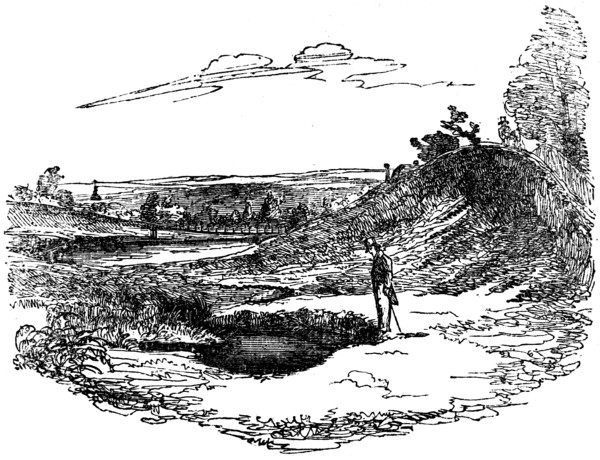
Source of the Ravensbourne.
On Keston Heath wells up the Ravensbourne, A crystal rillet, scarce a palm in width, Till creeping to a bed, outspread by art, It sheets itself across, reposing there: Thence, through a thicket, sinuous it flows, And crossing meads, and footpaths, gath’ring tribute. Due to its elder birth, from younger branches, Wanders, in Hayes and Bromley, Beckenham vale, And straggling Lewisham, to where Deptford Bridge Uprises in obeisance to its flood, Whence, with large increase it rolls on, to swell The master current of the “mighty heart” Of England.
*
Before I had seen Keston I heard, at West Wickham, that it had been the site of a Roman camp, and that a Roman bath was still there. It was from curiosity towards this piece of antiquity that I first visited the spot, in company with my friend W——. The country people, whom we met on our way, spoke of it as the “Old Bath,” and the “Cold Bath,” and as a water of great virtue, formerly bathed in, and still resorted to, by persons afflicted with weak or sprained limbs, which by dipping in this bath became cured.
Our walk from Wickham was remarkably pleasant; we passed noble oaks of many centuries’ growth, and descended from the broad open highway into an old road on our left, a ravine, or intrenchment perchance, clothed with tendril plants and blossoming briars, festooning and arching over wild flowers growing amid the verdure of its high banks. Here we paced up hill, till we reached an open, lofty tract of heathland, in a rude, uncultivated, picturesque state, with a few houses in distant parts, surrounded by thriving plantations. On our left were the woodlands of the pleasant village of Hayes, remarkable for having been the seat of the great earl of Chatham, and the birthplace of his well-remembered son. On our right were the heights of Holwood, and fine forest scenery. Near a cluster of cottages immediately before us there was a mill, with its sails going; these we scarcely glanced at, but made our way to an old alehouse, the sign of the Fox, where an ancient labourer, sitting at the door, directed us to “the Bath.” We found it in a romantic little bottom, immediately under the gates of Holwood.
The delightful landscape, from the opening of this dell towards London and beyond it, so much engaged our attention, that for a while we forgot the “Bath,” on the brink of which we were standing. There is no appearance of its having been a bathing-place, and certainly it has not the least character of a Roman bath. It is simply a well of fine pellucid water, which gently overflowing threads a small winding channel in the herbage, and suddenly expands, till it seems bounded by an embankment and line of trees. This is the road to the pleasant inn “Keston Cross.” In the distance are the Kentish and Essex hills, with the dome of the metropolitan cathedral. Presuming that information respecting the spring might be obtained at Holwood we reascended, and inquired of several labourers employed in levelling and gravelling the avenue; but we derived nothing satisfactory till a Keston man, working at a distance, came up, and told us that it was the source of the Ravensbourne.
I had formerly heard and read of a tradition respecting this spring, and now that I unexpectedly found myself upon its margin, recollection of the story heightened the interest of the scene. The legend runs, that when Cæsar was encamped here his troops were in great need of water, and none could be found in the vicinity. Observing, however, that a raven frequently alighted near the camp, and conjecturing that it was for the purpose of quenching its thirst, he ordered the coming of the bird to be watched for, and the spot to be particularly noted; this was done, and the result was as he anticipated. The object of the raven’s resort was this little spring; from thence Cæsar derived a supply of water for the Roman legions, and from the circumstance of its discovery the spring was called the Raven’s bourne, or the Raven’s brook. From the lodge at Holwood, W. obtained the loan of a chair, and taking his seat on the brink of the well, sketched the view represented in his engraving of it above.
If the account of Holwood[465] in 1792 be correct, this spring, there called “Cæsar’s Spring,” was then a public cold bath, ornamented with trees, and a dressing-house on the brink. Hasted, in 1778,[466] gives a view of the Roman intrenchments on Holwood Hill, and figures the ancient road to the spring of the Ravensbourne, as running down to it from where Holwood gates now stand: he also figures the spring with twelve trees planted round it. Now, however, there is not a vestige of tree or building, but there are in the ground the stumps of a poled fencing, which was standing within recollection. On further examination I found the well bricked round, but the bricks at the top edge had decayed, or been thrown in; and the interior brickwork is lined with hair moss and other water-weeds. On the side opposite to that whereon a man is represented in the engraving. I traced the remains of steps for descending into the well as a bath. Its circle is about nine feet in diameter. At what time it commenced, or ceased, to be used as a bath, is uncertain.
Here, then, about twelve miles from London, in a delightful country, is a spring, rendered venerable by immemorial tradition and our ancient annals; and which, during eighteen centuries, from the time of its alleged discovery by Cæsar, has remained open to general use. Sorry therefore am I to add, that there are rumours of a wish to enclose this public relic of bygone ages. I invite public attention to the place and to the report. Even at this season the lover of natural scenery will find charms at the source of the Ravensbourne, and be able to imagine the beauty of the surrounding country in summer. Had I a right of common on Keston Heath, rather than assist in a base “homage,” to colourably admit the enclosure of “Cæsar’s Spring,” I would surrender my own right, and renounce community and neighbourhood with the heartless hirelings, who would defraud themselves and the public of the chief attraction to Keston Common. At so small a distance from London I know of nothing so remarkable in history as this spring. On no pretence ought the public to be deprived of it. There are rights of nature as well as of property: when the claims of the latter are urged too pertinaciously against the former, it is time to cry out; and if middle men do not interfere to prevent the oppression, they will, in their turn, cry aloud when there will be none to help them.
Garrick Plays. No. XLII.
[From “Thyestes,” a Tragedy, by John Crowne, 1681.]
Atreus, having recovered his Wife, and Kingdom, from his brother Thyestes, who had usurped both, and sent him into banishment, describes his offending Queen.
Atreus (solus). ——— still she lives; ’Tis true, in heavy sorrow: so she ought, If she offended as I fear she has. Her hardships, though, she owes to her own choice. I have often offer’d her my useless couch; For what is it to me? I never sleep: But for her bed she uses the hard floor. My table is spread for her; I never eat: And she’ll take nothing but what feeds her grief.
Philisthenes, the Son of Thyestes, at a stolen interview with Antigone, the daughter of Atreus, is surprised by the King’s Spies: upon which misfortune Antigone swooning, is found by Peneus.
Antigone. Peneus, an ancient retainer to the Court of Mycenæ.
Peneus. Ha! what is she that sleeps in open air? Indeed the place is far from any path, But what conducts to melancholy thoughts; But those are beaten roads about this Court. Her habit calls her, Noble Grecian Maid; But her sleep says, she is a stranger here. All birds of night build in this Court, but Sleep; And Sleep is here made wild with loud complaints, And flies away from all. I wonder how This maid has brought it to her lure so tame. Antigone, (waking from her swoon). Oh my Philisthenes! Peneus. She wakes to moan; Aye, that’s the proper language of this place! Antigone. My dear, my poor Philisthenes! I know ’tis so! oh horror! death! hell! oh— Peneus. I know her now; ’tis fair Antigone, The daughter and the darling of the King. This is the lot of all this family.[467] Beauteous Antigone, thou know’st me well; I am old Peneus, one who threescore years Has loved and serv’d thy wretched family. Impart thy sorrows to me; I perhaps In my wide circle of experience May find some counsel that may do thee good. Antigone. O good old man! how long have you been here? Peneus. I came but now. Antigone. O did you see this way Poor young Philisthenes? you know him well. Peneus. Thy uncle’s son, Thyestes’ eldest son— Antigone. The same, the same— Peneus. No; all the Gods forbid I should meet him so near thy father’s Court. Antigone. O he was here one cursed minute past. Peneus. What brought him hither? Antigone. Love to wretched me. Our warring fathers never ventured more For bitter hate than we for innocent love. Here but a minute past the dear youth lay, Here in this brambly cave lay in my arms; And now he is seized! O miserable me—(tears her hair.) Peneus. Why dost thou rend that beauteous ornament? In what has it offended? hold thy hands. Antigone. O father, go and plead for the poor youth; No one dares speak to the fierce King but you— Peneus. And no one near speaks more in vain than I; He spurns me from his presence like a dog. Antigone. Oh, then— Peneus. She faints, she swoons, I frighten’d her, Oh I spake indiscretely. Daughter, child, Antigone, I’ll go, indeed I’ll go. Antigone. There is no help for me in heav’n or earth. Peneus. There is, there is; despair not, sorrowful maid. All will be well. I’m going to the King, And will with pow’rful reasons bind his hands; And something in me says I shall prevail. But to whose care shall I leave thee the while?— For oh! I dare not trust thee to thy grief. Antigone. I’ll be disposed of, father, as you please, Till I receive the blest or dreadful doom. Peneus. Then come, dear daughter, lean upon my arm, Which old and weak is stronger yet than thine; Thy youth hath known more sorrow than my age. I never hear of grief, but when I’m here; But one day’s diet here of sighs and tears Returns me elder home by many years.
Atreus, to entrap his brother Thyestes; who has lived a concealed life, lurking in woods, to elude his vengeance; sends Philisthenes and old Peneus to him with offers of reconciliation, and an invitation to Court, to be present at the nuptials of Antigone with Philisthenes.
Thyestes. Philisthenes. Peneus.
Thy. Welcome to my arms, My hope, my comfort! Time has roll’d about Several months since I have seen thy face, And in its progress has done wond’rous things. Phil. Strange things indeed to chase you to this sad Dismal abode; nay, and to age, I think: I see that winter thrusting itself forth Long, long before its time, in silver hairs. Thy. My fault, my son; I would be great and high, Snow lies in summer on some mountain tops. Ah, Son! I’m sorry for thy noble youth, Thou hast so bad a father; I’m afraid, Fortune will quarrel with thee for my sake. Thou wilt derive unhappiness from me, Like an hereditary ill disease. Phil. Sir, I was born, when you were innocent; And all the ill you have contracted since, You have wrought out by painful penitence; For healthy joy returns to us again; Nay, a more vigorous joy than e’er we had. Like one recover’d from a sad disease, Nature for damage pays him double cost, And gives him fairer flesh than e’er he had.
Thyestes is won from his retirement by the joint representations of Philisthenes and Peneus, of the apparent good faith, and returning kindness of his brother; and visits Mycenæ:—his confidence; his returning misgivings.
Thyestes. Philisthenes. Peneus.
Thy. O wondrous pleasure to a banish’d man, I feel my loved long look’d-for native soil! And oh! my weary eyes, that all the day Had from some mountain travell’d toward this place, Now rest themselves upon the royal towers Of that great palace where I had my birth. O sacred towers, sacred in your height, Mingling with clouds, the villas of the Gods Whither for sacred pleasures they retire; Sacred because you are the work of Gods; Your lofty looks boast your divine descent: And the proud city which lies at your feet, And would give place to nothing but to you, Owns her original is short of yours. And now a thousand objects more ride fast On morning beams, and meet my eyes in throngs; And see, all Argos meets me with loud shouts! Phil. O joyful sound! Thy. But with them Atreus too— Phil. What ails my father, that he stops, and shakes, And now retires? Thy. Return with me, my son, And old friend Peneus, to the honest beasts, And faithful desart, and well-seated caves; Trees shelter man, by whom they often die, And never seek revenge: no villainy Lies in the prospect of an humble cave. Pen. Talk you of villainy, of foes, and fraud. Thy. I talk of Atreus. Pen. What are these to him? Thy. Nearer than I am, for they are himself. Pen. Gods drive these impious thoughts out of your mind. Thy. The Gods for all our safety put them there.— Return, return with me. Pen. Against our oaths? I cannot stem the vengeance of the Gods. Thy. Here are no Gods: they’ve left this dire abode. Pen. True race of Tantalus! who parent-like Are doom’d in midst of plenty to be starved. His hell and yours differ alone in this: When he would catch at joys, they fly from him; When glories catch at you, you fly from them. Thy. A fit comparison; our joys and his Are lying shadows, which to trust is hell.
The day of the pretended Nuptials.—Atreus feigns a returning love for his Queen.
Ærope. O this is too much joy for me to bear: You build new palaces on broken walls. Atreus. Come, let our new-born pleasures breathe sweet air; This room’s too vile a cabinet for gold. Then leave for ever, Love, this doleful place, And leave behind thee all thy sorrows here; And dress thyself as this great day requires. ’Twill be thy daughter’s nuptials; and I dream’d, The Sun himself would be asham’d to come, And be a guest in his old tarnish’d robe; But leave my Court,[468] to enlighten all the globe.—
Peneus to Atreus, dissuading him from his horrid purpose.
Pen. Fear you not men or Gods? Atr. The fear of Gods ne’er came in Pelops’ House. Pen. Think you there are no Gods? Atr. I find all things So false, I am sure of nothing but of wrongs.—
Atreus. Thyestes.
A Table, and a Banquet.
Atr. Come, brother, sit. Thy. May not Philisthenes Sit with us, Sir? Atr. He waits upon the Bride. A deeper bowl. This to the Bridegroom’s health. Thy. This to the Gods for this most joyful day.— Now to the Bridegroom’s health. Atr. This day shall be To Argos an eternal festival. Thy. Fortune and I to day both try our strengths. I have quite tired her left hand Misery; She now relieves it with her right-hand Joy, Which she lays on me with her utmost force; But both shall be too weak for my strong spirit. Atr. (aside). So, now my engines of delight have screw’d The monster to the top of arrogance; And now he’s ready for his deadly fall. Thy. O these extremes of misery and joy Measure the vast extent of a man’s soul. My spirit reaches Fortune’s East and West. She has oft set and ris’n here; yet cannot get Out of the vast dominion of my mind.— Ho! my proud vaunting has a sudden check; See, from my head my crown of roses falls; My hair, tho’ almost drown’d beneath sweet oils, With strange and sudden horrors starts upright: Something I know not what bids me not eat; And what I have devour’d[469] within me groans; I fain would tear my breast to set it free;— And I have catch’d the eager thirst of tears, Which all weak spirits have in misery. I, who in banishment ne’er wept, weep now. Atr. Brother, regard it not; ’tis fancy all. Misery, like night, is haunted with ill spirits, And spirits leave not easily their haunts; ’Tis said, sometimes they’ll impudently stand A flight of beams from the forlorn of day, And scorn the crowing of the sprightly cocks:— Brother, ’tis morning with our pleasure yet. Nor has the sprightly wine crow’d oft enough. See in great flagons at full length it sleeps, And lets these melancholy thoughts break in Upon our weaker pleasures. Rouse the wine, And bid him chase these fancies hence for shame. Fill up that reverend unvanquish’d Bowl, Who many a giant in his time has fallen, And many a monster; Hercules not more. Thy. If he descends into my groaning breast, Like Hercules, he will descend to hell— Atr. And he will vanquish all the monsters there. Brother, your courage with this Hero try; He o’er our House has reign’d two hundred years, And he’s the only king shall rule you here. Thy. What ails me, I cannot heave it to my lips? Atr. What, is the bowl too heavy? Thy. No; my heart. Atr. The wine will lighten it. Thy. The wine will not Come near my lips. Atr. Why should they be so strange? They are near a-kin. Thy. A-kin? Atr. As possible; father and son not nearer. Thy. What do you mean? Atr. Does not good wine beget good blood? Thy. ’Tis true. Atr. Your lips then and the wine may be a-kin. Off with your kindred wine; leave not a drop To die alone, bewilder’d in that bowl. Help him to heave it to his head; that’s well.
(Thyestes drinks. A clap of thunder. The lights go out.)
Thy. What pond’rous crimes pull heav’n upon our heads? Nature is choak’d with some vast villainy, And all her face is black. Atr. Some lights, some lights. Thy. The sky is stunn’d, and reels ’twixt night and day; Old Chaos is return’d. Atr. It is to see A young One born, more dreadful than herself; That promises great comfort to her age, And to restore her empire. Thy. What do you mean? Atr. Confusion I have in thy bowels made. Thy. Dire thoughts, like Furies, break into my mind With flaming brands, and shew me what he means. Where is Philisthenes? Atr. Ask thy own bowels: Thou heard’st them groan; perhaps they now will speak. Thy. Thou hast not, Tyrant—what I dare not ask? Atr. I kill’d thy Son, and thou hast drunk his blood.
C. L.
For the Table Book
THEATRALIA.
Tom Durfey
Once got fifty guineas (according to tradition) for singing a single song to queen Anne in ridicule of “the princess Sophia, electress and duchess dowager of Hanover,” (as she is called in the oath of allegiance,) naturally no great favourite with the then reigning monarch. The only lines of this satirical production that have come down to us are the following; and, until now, only the two first of the stanza have been preserved by Durfey’s biographers:—
“The crown’s far too weighty For shoulders of eighty; She could not sustain such a trophy; Her hand, too, already Has grown so unsteady She can’t hold a sceptre; So Providence kept her Away.—Poor old Dowager Sophy.”
“Merry Tom” had sung before the king in the former reign, and Charles II., as is well known, was very fond of his company.
Liston’s Marriage.
The following got into circulation just after Mr. Liston was united to Miss Tyrer but never was published:—
Liston has married Fanny Tyrer: He must, like all the town, admire her, A pretty actress, charming voice! But some, astonish’d at his choice Of one, compar’d with him, so small She scarcely seem’d a wife at all, Express’d their wonder: his reply Show’d that he had “good reason why.”— “We needs must when the devil drives; And since all married men say, wives Are of created things the worst, I was resolv’d I would be curst With one as small as I could get her. The smaller, as I thought, the better. I need not fear to lay my fist on, Whene’er ’tis needed, Mrs. Liston: And since, ’like heathen Jew or Carib, I like a rib, but not a spare-rib, I got one broad as she is long— Go and do better, if I’m wrong.”
Charles Jennens, Esq.
One of the most singular characters of his day was Charles Jennens, Esq., a sort of literary Bubb Doddington. Being born to a good estate, from his boyhood he was ridiculously fond of show and pomp, and his style of writing was of a piece with his style of living. It has been said, that he put together the words of Handel’s “Messiah:” that he had something to do with them is true; but he had a secretary of the name of Pooley, a poor clergyman, who executed the principal part of the work, and, till now, has obtained no part of the credit. Charles Jennens, Esq. took it into his head, (perhaps the most rational notion he had ever indulged,) that the majority of Shakspeare’s commentators were mere twaddling antiquaries, without taste or talent; but he adopted an unfortunate way of proving it: he himself published an edition of Hamlet, Lear, Othello, and one or two more tragedies. He was of course laughed at for his attempt, and George Steevens tried to show a little of the wit, for which his friends gave him credit, and of the ill-nature for which he deserved it. Jennens published a pamphlet in reply, the greater part his own writing, which for years was his delight and solace: his poor secretary used to have the task of reading it from beginning to end, whenever his patron called for it, on giving an entertainment to his friends. Jennens commented, explained, and enforced, as he proceeded. In some of the biographical accounts of this personage it is asserted gravely, that for some time after the appearance of this tract he carefully looked over the newspapers every day, to learn if the success and severity of his attack had not compelled Dr. Johnson, Malone, Steevens, or Warburton, to hang themselves. This depends upon the following epigram, written at the time, and now only existing in MS., but which obtained a wide circulation, and is attributed, perhaps correctly, to Steevens. The only objection to this supposition is, that if it had been Steevens’s it is strange how his vanity could keep it out of the public prints, though after all it possesses but little merit:—
“After Mister Charles Jennens produc’d his Defence, He saw all the papers at Martyr’s, To learn if the critics had had the good sense To hang themselves in their own garters. He thought they could never out-live it. The sot Is ready to hang himself, ’cause they have not.”
When we called Jennens a literary Bubb Doddington, we ought to have remembered that Doddington had talents, but Jennens had none.
Elliston’s Epigram.
The following has been handed about as from the pen of Mr. Elliston, now of the Surrey theatre. It may be his or it may not, but whichever way the fact be, it can do him no harm to publish it. The point is in the Greek Anthology, though we do not suppose that Mr. E. went there for it.
The best Wine.
“What wine do you esteem the first, And like above the rest?” Ask’d Tom—said Dick—“My own is worst, My friend’s is always best.”
Sir John Hill
Was a Polish knight and an English physician, more celebrated by Garrick’s epigrams than by his own dramatic compositions, consisting of two farces, The Maiden’s Whim and The Rout. He wrote books enough on all subjects “to build his own papyral monument,” if the grocers and trunk-makers had not committed such havoc among them, even before his death. That event was produced by taking his own remedy for the gout, and it is thus commemorated.
On the Death of Doctor Hill.
“Poor Doctor Hill is dead!”—“Good lack! Of what disorder?”—“An attack Of gout.”—“Indeed! I thought that he Had found a wondrous remedy.”— “Why so he had, and when he tried He found it true—the Doctor died!”
GOUT.
The contest among medical men for the most proper mode of curing this complaint cannot but produce a smile, when we recollect that the afflicted have recourse to various and opposite remedies with success.
We have heard of a man who would find his pains alleviated by drinking a wineglass full of verjuice, while a table-spoonful of wine would torture him almost to distraction.
There were two counsellors, some years ago, who generally cured themselves in a very pleasant manner; one, who was accustomed to drink water constantly, would cure himself by drinking wine; and the other, who invariably took his bottle or more of wine a day, was constantly cured by the use of water.
Others, by living on a milk diet only, have entirely cured themselves.
Some years ago there was a man in Italy who was particularly successful in the cure of the gout: his mode was to make his patients sweat profusely, by obliging them to go up and down stairs, though with much pain to themselves.
A quack in France acquired great reputation for the cure of this malady, by the use of a medicine he called “Tincture of the Moon,” of which he administered some drops every morning in a basin of broth. It was never used by any but the richest persons; for the price of a bottle full, not larger than a common sized smelling bottle, was eighty louis d’ors. Furetière mentions this quack, and says he possessed many valuable secrets. He adds, that the surprising cures, to which he was witness, by the “Tincture of the Moon,” astonished all the faculty at Paris. The operation of this medicine was insensible.
Stories OF THE Craven Dales. No. II.[470]
He had been in Yorkshire dales, Amid the winding scars; Where deep and low the hamlets lie Beneath a little patch of sky, And little patch of stars.—Wordsworth.
The Legend of the Troller’s Gill.
On the steep fell’s height shone the fair moonlight, And its beams illum’d the dale, And a silvery sheen cloth’d the forest green, Which sigh’d to the moaning gale. From Burnsal’s tower the midnight hour Had toll’d, and its echo was still, And the elfin band, from faërie land, Was upon Elboton hill. ’Twas silent all, save the waters’ fall, That with never ceasing din, Roar and rush, and foam and gush, In Loupscar’s troubled linn. From his cot he stept, while the household slept, And he carroll’d with boist’rous glee, But he ne hied to the green hill’s side, The faerie train to see. He went not to roam with his own dear maid Along by a pine-clad scar, Nor sing a lay to his ladye love, ’Neath the light of the polar star. The Troller, I ween, was a fearless wight, And, as legends tell, could hear The night winds rave, in the Knave Knoll cave,[471] Withouten a sign of fear. And whither now are his footsteps bent? And where is the Troller bound? To the horrid gill of the limestone hill, To call on the Spectre Hound! And on did he pass, o’er the dew-bent grass, While the sweetest perfumes fell, From the blossoming of the trees which spring In the depth of that lonely dell. Now before his eyes did the dark gill rise, No moon-ray pierced its gloom, And his steps around did the waters sound Like a voice from a haunted tomb. And there as he stept, a shuddering crept O’er his frame, scarce known to fear, For he once did dream, that the sprite of the stream Had loudly called—Forbear! An aged yew in the rough cliffs grew, And under its sombre shade Did the Troller rest, and with charms unblest, He a magic circle made. Then thrice did he turn where the streamers burn,[472] And thrice did he kiss the ground, And with solemn tone, in that gill so lone, He call’d on the Spectre Hound! And a burning brand he clasp’d in his hand, And he nam’d a potent spell, That, for Christian ear it were sin to hear, And a sin for a bard to tell.[473] And a whirlwind swept by, and stormy grew the sky, And the torrent louder roar’d, While a hellish flame, o’er the Troller’s stalwart frame From each cleft of the gill was pour’d. And a dreadful thing from the cliff did spring, And its wild bark thrill’d around— Its eyes had the glow of the fires below— ’Twas the form of the Spectre Hound! *** When on Rylstonne’s height glow’d the morning light, And, borne on the mountain air, The Priorie[474] bell did the peasants tell ’Twas the chanting of matin prayer, By peasant men, where the horrid glen Doth its rugged jaws expand, A corse was found, where a dark yew frown’d, And marks were imprest on the dead man’s breast— But they seem’d not by mortal hand. *** In the evening calm a funeral psalm Slowly stole o’er the woodland scene— The harebells wave on a new-made grave In “Burnsall’s church-yard green.” That funeral psalm in the evening calm, Which echo’d the dell around, Was his, o’er whose grave blue harebells wave, Who call’d on the Spectre Hound!
The above ballad is founded on a tradition, very common amongst the mountains of Craven. The spectre hound is Bargest. Of this mysterious personage I am able to give a very particular account, having only a few days ago seen Billy B——y, who had once a full view of it. I give the narrative in his own words; it would detract from its merit to alter the language.
Billy B——’s Adventure.
“You see, sir, as how I’d been a clock-dressing at Gurston [Grassington], and I’d staid rather lat, and may be gitten a lile sup o’ spirit, but I war far from being drunk, and knowed every thing that passed. It war about 11 o’clock when I left, and it war at back end o’t’ year, and a most admīrable [beautiful] neet it war. The moon war varra breet, and I nivvr seed Rylstone-fell plainer in a’ my life. Now, you see, sir, I war passin down t’ mill loine, and I heerd summut come past me—brush, brush, brush, wi’ chains rattling a’ the while; but I seed nothing; and thowt I to mysel, now this is a most mortal queer thing. And I then stuid still, and luik’d about me, but I seed nothing at aw, nobbut the two stane wa’s on each side o’t’ mill loine. Then I heerd again this brush, brush, brush, wi’ the chains; for you see, sir, when I stuid still it stopped; and then, thowt I, this mun be a Bargest, that sae much is said about: and I hurried on towards t’ wood brig, for they say as how this Bargest cannot cross a watter; but lord, sir, when I gat o’er t’ brig, I heerd this same thing again; so it mud either hev crossed t’ watter, or gone round by t’ spring heed! [About thirty miles!] And then I becam a valliant man, for I war a bit freeten’d afore; and thinks I, I’ll turn and hev a peep at this thing; so I went up Greet Bank towards Linton, and heerd this brush, brush, brush, wi’ the chains a’ the way, but I seed nothing; then it ceased all of a sudden. So I turned back to go hame, but I’d hardly reach’d t’ door, when I heerd again this brush, brush, brush, and the chains going down towards t’ Holin House, and I followed it, and the moon there shone varra breet, and I seed its tail! Then, thowt I, thou owd thing! I can say Ise seen thee now, so I’ll away hame. When I gat to t’ door, there war a girt thing like a sheep, but it war larger, ligging across t’ threshold of t’ door, and it war woolly like; and says I, ‘git up,’ and it wouldn’t git up—then says I, ‘stir thysel,’ and it wouldn’t stir itsel! And I grew valliant, and I rais’d t’ stick to baste it wi’, and then it luik’d at me, and sich oies! [eyes] they did glower, and war as big as saucers, and like a cruelled ball; first there war a red ring, then a blue one, then a white one; and these rings grew less and less till they cam to a dot! Now I war nane feer’d on it, tho’ it girn’d at me fearfully, and I kept on saying ‘git up,’ and ‘stir thysel,’ and t’ wife heerd as how I war at t’ door, and she cam to oppen it; and then this thing gat up and walked off, for it war mare feer’d o’ t’ wife than it war o’ me! and I told t’ wife, and she said it war Bargest; but I nivver seed it since, and that’s a true story!”
In the glossary to the Rev. Mr. Carr’s “Horæ Momenta Cravenæ,” I find the following—“Bargest, a sprite that haunts towns and populous places. Belg. birg, and geest, a ghost.” I really am not a little amused at Mr. Carr’s derivation, which is most erroneous. Bargest is not a town ghost, nor is it a haunter “of towns and populous places;” for, on the contrary, it is said in general to frequent small villages and hills. Hence the derivation may be berg, Germ., a hill, and geist, a ghost; i.e. a hill ghost: but the real derivation appears to me to be bär, Germ., a bear, and geist, a ghost; i.e. a bear ghost, from its appearing in the form of a bear or large dog, as Billy B——’s narrative shows.[475]
The appearance of the spectre hound is said to precede a death; which tradition will be more fully illustrated in my next legend, “The Wise Woman of Littondale.” Like most other spirits Bargest is supposed to be unable to cross a water; and in case any of my Craven readers should ever chance to meet with his ghostship, it may be as well to say, that unless they give him the wall he will tear them to pieces, or otherwise illtreat them, as he did one John Lambert, who, refusing to let him have the wall, was so punished for his want of manners, that he died in a few days.
This superstition has in one instance been productive of good. A few years ago an inhabitant of Threshfield kept a huge he-goat, which the wags of the village would sometimes turn into the lanes, in the night-time, with a chain about his neck, to frighten the farmers on their return from Kettlewell market. They once determined to terrify a badger, or miller, as he returned from the market, by driving the animal with the chains, &c. into the lane through which the man of meal was to pass. About ten o’clock the miller, on entering Threshfield with his cart, espies the goat; and hearing the chains, overwhelmed with terror, he conjectures it to be Bargest, that was sent to take him away for his dishonest dealings; the miller stops his cart, and kneeling down in it, thus prayed, to the great amusement of the young rogues behind the wall:—“Good Lord, don’t let the devil take me this time, and I’ll never cheat any more; do let me get safe home, and I’ll never raise my meal again so extravagantly as I have done of late.” He did get safe home, and was as good as his word till he discovered the trick, when he returned to his old malpractices; exemplifying the old epigram—
“The devil was sick, the devil a monk would be, The devil got well, the devil a monk was he.”
In the second verse of the legend of “The Troller’s Gill,” it is said,
And the elfin band from faërie land Was upon Elbōton hill.
Elboton is the largest of five or six very romantic green hills, that seem to have been formed by some tremendous convulsion of nature, at the foot of that fine chain of fells, which extends from Rylstone to Burnsall, and is said to have been, from “time whereof the memory of man runneth not to the contrary,” the haunt of faëries; numbers of these pretty little creatures having been seen there by several men of honour and veracity in this neighbourhood, one of whom has had a faëry in his hand! The elfin train has been visible in many parts of our district, but I know of no place they frequent more than Elboton. One of these diminutive beings, called Hob, is reputed to be a watchful preserver of the farmer’s property, and a most industrious workman. At Close-house, near Skipton in Craven, Hob used to do as much work in one night as twenty human workmen could in the same time; and, as I have been informed by an individual, who resided there about twenty years ago, Hob was accustomed to house the hay, stack the corn, and churn the butter, as well as perform several other offices, which tended materially to lessen the labour of the husbandman and the dairy maid. The occupier of Close-house at that time, thinking to make Hob some return for his kindness and assiduity, laid out a new red cloak for him, which so offended the good faëry, that he ceased his labours, and left the place. On the spot where the cloak was left, the following stanza was found,
Hob red coat, Hob red hood, Hob do you no harm, but no more good.[476]
Loupscar, alluded to in the third verse, is a place in the Wharfe near Burnsall, where the river is pent in with rocks, and boils along in a confined channel, and then discharges itself into a pool of tremendous depth, forming, as Dr. Whitaker says in his history, “a scene more dreadful than pleasing.” The channel of the Wharfe is in general craggy, and the river abounds with similar vortices to Loupscar; the two most celebrated of which are the Gastrills above Grassington, and the Strid, in Bolton woods. The latter will be recognised by the poetical reader, as the fatal gulf where the Boy of Egremond was drowned, whose story Rogers has versified with such exquisite pathos.
“The Troller’s Gill” is in Skyram pastures, beyond Appletreewick. I visited it a few days ago, when the torrent was considerably swollen by the recent heavy rains amongst the mountains. The roar of the water, the terrific grandeur of the overhanging crags, and its loneliness, united to heighten the terrors of the place. To an inhabitant of London, the scene of the wolf’s glen, in the Drury version of “Der Freischütz,” may give some faint idea of it. Dr. Whitaker thought Troller’s Gill “wanted the deep horror of Gordale,” near Malham. There is certainly more sublimity and grandeur about Gordale; but as to horror, I think it nothing to “the Troller’s Gill.” This, however, is a matter of taste.
The last verses allude to the beautiful and ancient custom, still universally prevalent throughout our district, of chanting a solemn dirge at funerals, till the corpse reaches the church-yard gateway. I know of nothing more affecting to a stranger than to meet, at evening, a funeral train proceeding along one of our romantic vallies, while the neighbouring rocks are resonant with the loud dirge sung by the friends of the departed. Long may this custom continue! Too many of our old customs fall into misuse by the ridicule thrown on them by dissenters, as being popish, &c.; but I am happy to say, that in Craven the dissenters are great encouragers of funeral dirges. In Mrs. Heman’s sacred melody, “Last Rites,” this stanza alludes to the practice:—
By the chanted psalm that fills Reverently the ancient hills, Learn, that from his harvests done, Peasants bear a brother on To his last repose!
Grassington in Craven, T. Q. M. Nov. 6, 1827.
The Second Series of WHIMS AND ODDITIES, With Forty Original Designs, BY THOMAS HOOD.
“What demon hath possessed thee, that thou wilt never forsake that impertinent custom of punning?”
Scriblerus.
If I might be allowed to answer the question instead of Mr. Hood, I should say, that it is the same demon which provokes me to rush directly through his new volume in preference to half a dozen works, which order of time and propriety entitle to previous notice. This book detains me from my purposes, as a new print in a shop-window does a boy on his way to school; and, like him, at the risk of being found fault with for not minding my task, I would talk of the attractive novelty to wights of the same humour. It comes like good news, which nobody is ignorant of, and every body tells to every body, and sets business at a stand-still. It puts clean out of my head all thought of another engraving for the present sheet, though I know, good reader, that already “I owe you one”—perhaps two:—never mind! you shall have “all in good time;” if you don’t, I’ll give you leave to eat me. With such a tender, the most untender will, or ought to be, as content as “the blacks of Niger at its infant rill,” seated at their “white-bait,” the thirty-eighth cut—in Mr. Hood’s book, very near “the end,”—a very inviting one to Shylock-kind of people, who have not
“———seen, perchance, unhappy white folks cook’d, And then made free of negro corporations.”—p. 149.
Mr. Hood begins—to be modest—with pleading guilty to what he calls “some verbal misdemeanours,” and then, leaving “his defence to Dean Swift, and the other great European and oriental pundits,” puts himself upon his country. But by whom is he arraigned, save a few highwaymen in the “march of intellect,” who sagely affirm, that “a man who would make a pun would pick a pocket!”—a saying devised by some wag, to the use and behoof of these doldrums, who never hear a good thing, but they button up their pockets and features, and walk off with nothing about them of likeness to humanity but the biforked form. For capital likenesses of such persons, turn to the story of “Tim Turpin,” and look first, to pay due honour, at the engravings of “the Judges of a-size,” and then at “Jurors—not con-jurors.” Portraits of this order could not have been drawn by any other than a close and accurate observer of character. Indeed, that Mr. Hood is eminently qualified in this respect, he has before abundantly testified; especially by “The Progress of Cant,” a print that must occupy a distinguished place in a history of Character and Caricature, whenever such a work shall be written.[477] In this new series of “Whims and Oddities,” he presents a sketch, called “Infant Genius;”—a little boy delighted with having rudely traced an uncouth figure; such a “drawing” as excites a good mistaken mother to declare, “the little fellow has quite a genius, and will be very clever if he only has encouragement:”—and thus many a child’s talent for fine-drawing—which, at the tailoring trade, might have secured the means of living—has been misencouraged to the making up of fifth-rate artists with a starvation income. The engraving of the “Infant Genius” illustrates the following poem.
The Progress of Art.
O happy time!—Art’s early days! When o’er each deed, with sweet self-praise, Narcissus-like I hung! When great Rembrandt but little seem’d, And such old masters all were deem’d As nothing to the young! Some scratchy strokes—abrupt and few So easily and swift I drew, Suffic’d for my design; My sketchy, superficial hand, Drew solids at a dash—and spann’d A surface with a line. Not long my eye was thus content. But grew more critical—my bent Essay’d a higher walk; I copied leaden eyes in lead— Rheumatic hands in white and red, And gouty feet—in chalk. Anon my studious art for days Kept making faces—happy phrase, For faces such as mine! Accomplish’d in the details then I left the minor parts of men, And drew the form divine. Old gods and heroes—Trojan—Greek, Figures—long after the antique, Great Ajax justly fear’d; Hectors of whom at night I dreamt, And Nestor, fringed enough to tempt Bird-nesters to his beard. A Bacchus, leering on a bowl, A Pallas, that outstar’d her owl, A Vulcan—very lame; A Dian stuck about with stars, With my right hand I murder’d Mars— (One Williams did the same.) But tir’d of this dry work at last, Crayon and chalk aside I cast, And gave my brush a drink! Dipping—“as when a painter dips In gloom of earthquake and eclipse”— That is—in Indian ink. Oh then, what black Mont Blancs arose. Crested with soot, and not with snows; What clouds of dingy hue! In spite of what the bard has penn’d, I fear the distance did not “lend Enchantment to the view.” Not Radcliffe’s brush did e’er design Black Forests, half so black as mine, Or lakes so like a pall; The Chinese cake dispers’d a ray Of darkness, like the light of Day And Martin over all. Yet urchin pride sustain’d me still, I gaz’d on all with right good-will, And spread the dingy tint; “No holy Luke helped me to paint. The Devil surely, not a saint. Had any finger in’t”. But colours came!—like morning light, With gorgeous hues displacing night, Or spring’s enliven’d scene: At once the sable shades withdrew; My skies got very, very blue; My trees extremely green. And wash’d by my cosmetic brush, How beauty’s cheek began to blush; With locks of auburn stain— (Not Goldsmith’s Auburn)—nut-brown hair, That made her loveliest of the fair; Not “loveliest of the plain!” Her lips were of vermilion hue; Love in her eyes, and Prussian blue, Set all my heart in flame!— A young Pygmalion, I adored The maids I made—but time was stor’d With evil—and it came! Perspective dawn’d—and soon I saw My houses stand against its law; And “keeping” all unkept! My beauties were no longer things For love and fond imaginings; But horrors to be wept! Ah! why did knowledge ope my eyes? Why did I get more artist-wise? It only serves to hint, What grave defects and wants are mine; That I’m no Hilton in design— In nature no Dewint! Thrice happy time!—Art’s early days! When o’er each deed with sweet self-praise, Narcissus-like I hung! When great Rembrandt but little seem’d, And such old masters all were deem’d As nothing to the young!
In verification of the old saying, “Once a man, twice a child,” Mr. Hood tells of “A School for Adults,”—and gives a picture of aged men, baldheaded and wigged, whose education had been neglected, studying their A, B, C. A letter from one of them at a preparatory school is exceedingly amusing. The article is preceded by a dramatic scene.
Servant. How well you saw Your father to school to-day, knowing how apt He is to play the truant. Son. But is he not yet gone to school? Servant. Stand by, and you shall see.
Enter three old men, with satchels, singing.
All three. Domine, domine, duster, Three knaves in a cluster. Son. O this is gallant pastime. Nay, come on Is this your school? was that your lesson, ha? 1st Old Man. Pray, now, good son, indeed, indeed— Son. Indeed You shall to school. Away with him; and take Their wagships with him, the whole cluster of them. 2d Old Man. You shan’t send us, now, so you shan’t— 3d Old Man. We be none of your father, so we be’nt.— Son. Away with ’em, I say; and tell their school-mistress What truants they are, and bid her pay ’em soundly. All three. Oh! oh! oh! Lady. Alas! will nobody beg pardon for The poor old boys? Traveller. Do men of such fair years here go to school? Native. They would die dunces else These were great scholars in their youth; but when Age grows upon men here, their learning wastes, And so decays, that, if they live until Threescore, their sons send ’em to school again; They’d die as speechless else as new-born children. Traveller. ’Tis a wise nation, and the piety Of the young men most rare and commendable: Yet give me, as a stranger, leave to beg Their liberty this day. Son. ’Tis granted. Hold up your heads; and thank the gentleman, Like scholars, with your heels now. All three. Gratias! gratias! gratias! [Exit, singing.]
“The Antipodes,” by R. Brome.
No reader of the first series of the “Whims and Oddities” can have forgotten “The Spoiled Child” of “My Aunt Shakerly,” or the unhappy lady herself; and now we are informed that “towards the close of her life, my aunt Shakerly increased rapidly in bulk: she kept adding growth unto her growth,
“Giving a sum of more to that which had too much,”
till the result was worthy of a Smithfield premium. It was not the triumph, however, of any systematic diet for the promotion of fat,—(except oyster-eating there is no human system of stall-feeding,)—on the contrary, she lived abstemiously, diluting her food with pickle-acids, and keeping frequent fasts in order to reduce her compass; but they failed of this desirable effect. Nature had planned an original tendency in her organization that was not to be overcome:—she would have fattened on sour krout.
“My uncle, on the other hand, decreased daily; originally a little man, he became lean, shrunken, wizened. There was a predisposition in his constitution that made him spare, and kept him so:—he would have fallen off even on brewer’s grains.
“It was the common joke of the neighbourhood to designate my aunt, my uncle, and the infant Shakerly, as ‘Wholesale, Retail, and For Exportation;’ and, in truth, they were not inapt impersonations of that popular inscription,—my aunt a giantess, my uncle a pigmy, and the child being ‘carried abroad.’”—This is the commencement of an article entitled “The Decline of Mrs. Shakerly.”
A story of “the Absentee,” and of the “absent tea,” on a friend’s visit to him, is painfully whimsical. Akin to it is an engraving of a person who had retired to rest coming down stairs in his shirt, and shorts, and great alarm, with a chamber-light in his hand, and the top of his nightcap in a smothering blaze, exclaiming
“Don’t you smell Fire?”
Run!—run for St. Clement’s engine! For the pawnbroker’s all in a blaze, And the pledges are frying and singing— Oh! how the poor pawners will craze! Now where can the turncock be drinking? Was there ever so thirsty an elf?— But he still may tope on, for I’m thinking That the plugs are as dry as himself. The engines!—I hear them come rumbling: There’s the Phœnix! the Globe! and the Sun! What a row there will be, and a grumbling, When the water don’t start for a run! See! there they come racing and tearing, All the street with loud voices is fill’d; Oh! it’s only the firemen a-swearing At a man they’ve run over and kill’d! How sweetly the sparks fly away now, And twinkle like stars in the sky; It’s a wonder the engines don’t play now But I never saw water so shy! Why there isn’t enough for a snipe, And the fire it is fiercer, alas! Oh! instead of the New River pipe, They have gone—that they have—to the gas! Only look at the poor little P——’s On the roof—is there any thing sadder? My dears, keep fast hold, if you please, And they won’t be an hour with the ladder! But if any one’s hot in their feet, And in very great haste to be sav’d, Here’s a nice easy bit in the street, That M‘Adam has lately unpav’d! There is some one—I see a dark shape At that window, the hottest of all,— My good woman, why don’t you escape? Never think of your bonnet and shawl: If your dress is’nt perfect, what is it For once in a way to your hurt? When your husband is paying a visit There, at Number Fourteen, in his shirt! Only see how she throws out her chancy! Her basins, and teapots, and all The most brittle of her goods—or any, But they all break in breaking their fall: Such things are not surely the best From a two-story window to throw— She might save a good iron bound chest, For there’s plenty of people below! O dear! what a beautiful flash! How it shone thro’ the window and door; We shall soon hear a scream and a crash, When the woman falls thro’ with the floor! There! there! what a volley of flame, And then suddenly all is obscur’d!— Well—I’m glad in my heart that I came;— But I hope the poor man is insur’d!
There are ballads in the “New Series” that rival “Sally Brown and Ben the Carpenter” in the former volume. Of this class are “Mary’s Ghost;” the story of “Tim Turpin,” mentioned before; and another of “Jack Hall,” showing, how Jack was an undertaker’s mute—how Jack sometimes drove the hearse—how Jack was in league with resurrection-men, and stole the bodies he buried—how Death met Jack in St. Pancras burying-ground, and shook hands with him—how Death invited Jack home to supper—how Jack preferred going to the Cheshire Cheese, and Death didn’t—how Jack was brought to Death’s door, and what he saw there—how Jack was obliged to go in, and Death introduced him to his friends as “Mr. Hall the body-snatcher”—how Jack got off without bidding them good night—how Jack was indisposed—how twelve doctors came to visit Jack without taking fees—how Jack got worse, and how he confessed he had sold his own body twelve different times to the twelve doctors—how the twelve doctors did not know Jack was so bad—how the twelve doctors disputed in Jack’s room which should have his body till twelve o’clock—how Jack then departed, the twelve doctors couldn’t tell how—and how, as Jack’s body could not be found, the twelve doctors departed, and not one of them was satisfied.
In the forementioned ballads there are many “verbal misdemeanours,” at which the author cautiously hints in his preface with some tokens of deprecation:—“Let me suggest,” he says, “that a pun is somewhat like a cherry: though there may be a slight outward indication of partition—of duplicity of meaning—yet no gentleman need make two bites at it against his own pleasure. To accommodate certain readers, notwithstanding, I have refrained from putting the majority in italics.” He is equally sinful and considerate in his prose: as, for instance, in the following character, which fairly claims a place with those of bishop Earle, sir Thomas Overbury, and even Butler.
“A Ballad Singer
Is a town-crier for the advertising of lost tunes. Hunger hath made him a wind instrument; his want is vocal, and not he. His voice had gone a-begging before he took it up and applied it to the same trade it was too strong to hawk mackerel, but was just soft enough for Robin Adair. His business is to make popular songs unpopular,—he gives the air, like a weathercock, with many variations. As for a key, he has but one—a latch-key—for all manner of tunes; and as they are to pass current amongst the lower sorts of people, he makes his notes like a country banker’s, as thick as he can. His tones have a copper sound, for he sounds for copper; and for the musical divisions he hath no regard, but sings on, like a kettle, without taking any heed of the bars. Before beginning he clears his pipe with gin; and he is always hoarse from the thorough draft in his throat. He hath but one shake, and that is in winter. His voice sounds flat, from flatulence; and he fetches breath, like a drowning kitten, whenever he can. Notwithstanding all this his music gains ground, for it walks with him from end to end of the street.
“He is your only performer that requires not many entreaties for a song; for he will chant, without asking, to a street cur or a parish post. His only backwardness is to a stave after dinner, seeing that he never dines; for he sings for bread, and though corn has ears, sings very commonly in vain. As for his country, he is an Englishman, that by his birthright may sing whether he can or not. To conclude, he is reckoned passable in the city, but is not so good off the stones.”
An incurable joker subjects himself to the inconvenience of not being believed, though he speak the truth; and therefore the following declaration of the author of “Whims and Oddities” is questionable. He says:—
“A Mad Dog
Is none of my bugbears. Of the bite of dogs, large ones especially, I have a reasonable dread; but as to any participation in the canine frenzy, I am somewhat sceptical. The notion savours of the same fanciful superstition that invested the subjects of Dr. Jenner with a pair of horns. Such was affirmed to be the effect of the vaccine matter—and I shall believe what I have heard of the canine virus, when I see a rabid gentleman, or gentlewoman, with flap ears, dew-claws, and a brushtail!——
“I put no faith in the vulgar stories of human beings betaking themselves, through a dog-bite, to dog-habits: and consider the smotherings and drownings, that have originated in that fancy, as cruel as the murders for witchcraft. Are we, for a few yelpings, to stifle all the disciples of Loyola—Jesuits’ bark—or plunge unto death all the convalescents who may take to bark and wine?
“As for the hydrophobia, or loathing of water, I have it mildly myself. My head turns invariably at thin washy potations. With a dog, indeed, the case is different—he is a water-drinker; and when he takes to grape-juice, or the stronger cordials, may be dangerous. But I have never seen one with a bottle—except at his tail.
“There are other dogs who are born to haunt the liquid element, to dive and swim—and for such to shun the lake or the pond would look suspicious. A Newfoundlander, standing up from a shower at a door-way, or a spaniel with a parapluie, might be innocently destroyed. But when does such a cur occur?”
Mr. Hood answers the question himself by “hydrophobia” of his own creation, namely, an engraving of a dog, on whom he makes “each particular hair to stand an end;” and whom he represents walking biped-fashion; he hath for his shield, as Randle Holme would say, an umbrella vert, charged with the stick thereof, as a bend or.
“The career of this animal,” says Mr. Hood, “is but a type of his victim’s—suppose some bank clerk. He was not bitten, but only splashed on the hand by the mad foam or dog-spray: a recent flea-bite gives entrance to the virus, and in less than three years it gets possession. Then the tragedy begins. The unhappy gentleman first evinces uneasiness at being called on for his New River rates. He answers the collector snappishly, and when summoned to pay for his supply of water, tells the commissioners, doggedly, that they may cut it off. From that time he gets worse. He refuses slops—turns up a pug nose at pump water—and at last, on a washing-day, after flying at the laundress, rushes out, ripe for hunting, to the street. A twilight remembrance leads him to the house of his intended. He fastens on her hand—next worries his mother—takes a bit apiece out of his brothers and sisters—runs a-muck, ‘giving tongue,’ all through the suburbs—and finally, is smothered by a pair of bed-beaters in Moorfields.
“According to popular theory the mischief ends not here. The dog’s master—the trainer, the friends, human and canine—the bank clerks—the laundresses—sweet-heart—mother and sisters—the-two bed-beaters—all inherit the rabies, and run about to bite others.”
But, is not this drollery on hydrophobia feigned? Is it not true that a certain bootmaker receives orders every July from the author of “Whims and Oddities,” for boots to reach above the calf, of calf so inordinately stout as to be capable of resisting the teeth of a dog, however viciously rabid, and with underleathers of winter thickness, for the purpose of kicking all dogs withal, in the canicular days? These queries are not urged upon Mr. H. with the tongue of scandal; of that, indeed, he has no fear, for he dreads no tongue, but (to use his quotation from Lord Duberly) the “vermicular tongue.” This little exposure of his prevailing weakness he has provoked, by affecting to discredit what his sole shakes at every summer.
The “New Series of Whims and Oddities” abounds with drolleries. Its author’s “Forty Designs” are all ludicrous; and, that they have been engraven with fidelity there can be little doubt, from his compliment to the engraver. “My hope persuades me,” he says, “that my illustrations cannot have degenerated, so ably have I been seconded by Mr. Edward Willis; who, like the humane Walter, has befriended my offspring in the wood.”[478] Though the engravings are indescribably expressive, yet a few may be hinted at, viz.
“Speak up, sir!” a youth on his knees, vehemently declaring his love, yet in a tone not sufficiently loud, to a female on a sofa, who doth “incline her ear” with a trumpet, to assist the auricle.
“In and out Pensioners,” exemplifying the “Suaviter in modo,” and “Fortiter in re.”
“The spare bed,” uncommonly spare.
“Why don’t you get up behind?” addressed by a donkey-rider—who does not sit before—to a boy on the ground.
“Banditti,” street minstrels.
“Dust O!” Death collecting his dust—critically speaking, this might be objected to.
“Crane-iology;” a crane, with its bill calliper-wise, speculating on a scull, and ascertaining its developements.
“A Retrospective Review;” very literal.
“She is all heart;” a very hearty body.
“The last visit;” quacks.
“The Angel of Death;” one of them—very fine.
“Joiners;” Vicar and Moses.
“Drill and Broadcast;” nature and art.
“High-born and Low-born;” odd differences.
“Lawk! I’ve forgot the brandy!” abominably provoking—only look!
“Comparative Physiology” is “a wandering camel-driver and exhibitor, parading, for a few pence, the creature’s outlandlish hump, yet burthened himself with a bunch of flesh between the shoulders.”—
“Oh would some power the giftie gi’ us To see oursel’s as others see us!”
Mr. Hood’s talents are as versatile as his imagination is excursive: and it would be difficult to decide, whether he excels in the ludicrous or the grave. He depicts a pathetic scene with infinitely delicate and discriminative touches, and his powers are evidently equal to a high order of poetical grandeur. His “Sally Holt and the Death of John Hayloft,” is an exquisite specimen of natural feeling.
“Nature, unkind to Sally Holt as to Dogberry, denied to her that knowledge of reading and writing, which comes to some by instinct. A strong principle of religion made it a darling point with her to learn to read, that she might study in her Bible: but in spite of all the help of my cousin, and as ardent a desire for learning as ever dwelt in scholar, poor Sally never mastered beyond A-B-ab. Her mind, simple as her heart, was unequal to any more difficult combinations. Writing was worse to her than conjuring. My cousin was her amanuensis: and from the vague, unaccountable mistrust of ignorance, the inditer took the pains always to compare the verbal message with the transcript, by counting the number of the words.
“I would give up all the tender epistles of Mrs. Arthur Brooke, to have read one of Sally’s epistles; but they were amatory, and therefore kept sacred: for plain as she was, Sally Holt had a lover.
“There is an unpretending plainness in some faces that has its charm—an unaffected ugliness, a thousand times more bewitching than those would-be pretty looks that neither satisfy the critical sense, nor leave the matter of beauty at once to the imagination. We like better to make a new face than to mend an old one. Sally had not one good feature, except those which John Hayloft made for her in his dreams; and to judge from one token, her partial fancy was equally answerable for his charms. One precious lock—no, not a lock, but rather a remnant of very short, very coarse, very yellow hair, the clippings of a military crop, for John was a corporal—stood the foremost item amongst her treasures. To her they were curls, golden, Hyperian, and cherished long after the parent-head was laid low, with many more, on the bloody plain of Salamanca.
“I remember vividly at this moment the ecstasy of her grief at the receipt of the fatal news. She was standing near the dresser with a dish, just cleaned, in her dexter hand. Ninety-nine women in a hundred would have dropped the dish. Many would have flung themselves after it on the floor; but Sally put it up, orderly, on the shelf. The fall of John Hayloft could not induce the fall of the crockery. She felt the blow notwithstanding; and as soon as she had emptied her hands, began to give way to her emotions in her own manner. Affliction vents itself in various modes, with different temperaments: some rage, others compose themselves like monuments. Some weep, some sleep, some prose about death, and others poetize on it. Many take to a bottle, or to a rope. Some go to Margate, or Bath.
“Sally did nothing of these kinds. She neither snivelled, travelled, sickened, maddened, nor ranted, nor canted, nor hung, nor fuddled herself—she only rocked herself upon the kitchen chair!
“The action was not adequate to her relief. She got up—took a fresh chair—then another—and another—and another,—till she had rocked on all the chairs in the kitchen.
“The thing was tickling to both sympathies. It was pathetical to behold her grief, but ludicrous that she knew no better how to grieve.
“An American might have thought that she was in the act of enjoyment, but for an intermitting O dear! O dear! Passion could not wring more from her in the way of exclamation than the tooth-ache. Her lamentations were always the same, even in tone. By and by she pulled out the hair—the cropped, yellow, stunted, scrubby hair; then she fell to rocking—then O dear! O dear!—and then Da Capo.
“It was an odd sort of elegy; and yet, simple as it was, I thought it worth a thousand of lord Littelton’s!
“‘Heyday, Sally! what is the matter?’ was a very natural inquiry from my aunt, when she came down into the kitchen; and if she did not make it with her tongue, at least it was asked very intelligibly by her eyes. Now Sally had but one way of addressing her mistress, and she used it here. It was the same with which she would have asked for a holiday, except that the waters stood in her eyes.
“‘If you please, ma’am,’ said she, rising up from her chair, and dropping her old curtsey, ‘if you please, ma’am, it’s John Hayloft is dead;’ and then she began rocking again, as if grief was a baby that wanted jogging to sleep.”——
The many “stories of storm-ships and haunted vessels, of spectre shallops, and supernatural Dutch-doggers—the adventures of Solway sailors, with Mahound in his bottomless barges, and the careerings of the phantom-ship up and down the Hudson,” suggest to Mr. Hood a story entitled “The Demon-Ship.” This he illustrates by an engraving called “The Flying-Dutchman,” representing the aerial ascent of a native of the Low Countries, by virtue of a reversal of the personal gravity, which, particularly in a Hollander, has been commonly understood to have a tendency downwards. Be this as it may, Mr. Hood’s tale is illustrated by the tail-piece referred to. The story itself commences with a highly wrought description of a sea-storm, of uncommon merit, which will be the last extract from his interesting volume that can be ventured, viz.:—
’Twas off the Wash—the sun went down—the sea look’d black and grim, For stormy clouds, with murky fleece, were mustering at the brim; Titanic shades! enormous gloom!—as if the solid night Of Erebus rose suddenly to seize upon the light! It was a time for mariners to bear a wary eye, With such a dark conspiracy between the sea and sky! Down went my helm—close reef’d—the tack held freely in my hand— With ballast snug—I put about, and scudded for the land. Loud hiss’d the sea beneath her lee—my little boat flew fast, But faster still the rushing storm came borne upon the blast. Lord! what a roaring hurricane beset the straining sail! What furious sleet, with level drift, and fierce assaults of hail! What darksome caverns yawn’d before! what jagged steeps behind! Like battle-steeds, with foamy manes, wild tossing in the wind. Each after each sank down astern, exhausted in the chase, But where it sank another rose and gallop’d in its place; As black as night—they turn to white, and cast against the cloud A snowy sheet, as if each surge upturn’d a sailor’s shroud:— Still flew my boat; alas! alas! her course was nearly run! Behold yon fatal billow rise—ten billows heap’d in one! With fearful speed the dreary mass came rolling, rolling, fast, As if the scooping sea contain’d one only wave at last! Still on it came, with horrid roar, a swift pursuing grave; It seem’d as though some cloud had turn’d its hugeness to a wave! Its briny sleet began to beat beforehand in my face— I felt the rearward keel begin to climb its swelling base! I saw its alpine hoary head impending over mine! Another pulse—and down it rush’d—an avalanche of brine. Brief pause had I, on God to cry, or think of wife and home; The waters clos’d—and when I shriek’d, I shriek’d below the foam!