Volume 1 — Vol. I.—3.
Reading edition
The Newsman.
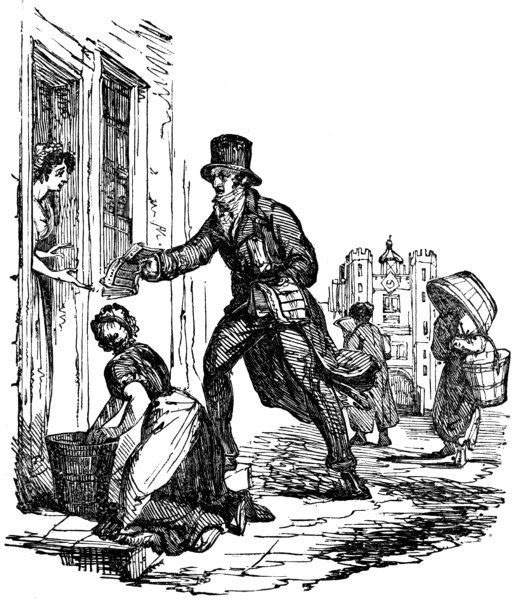
The Newsman.
“I, that do bring the news.”
Shakspeare.
Our calling, however the vulgar may deem, Was of old, both on high and below, in esteem. E’en the gods were to much curiosity given, For Hermes was only the Newsman of heaven. Hence with wings to his cap, and his staff, and his heels, He depictured appears, which our myst’ry reveals, That news flies like wind, to raise sorrow or laughter, While leaning on Time, Truth comes heavily after.
Newsmen’s Verses, 1747.
The newsman is a “lone person.” His business, and he, are distinct from all other occupations, and people.
All the year round, and every day in the year, the newsman must rise soon after four o’clock, and be at the newspaper offices to procure a few of the first morning papers allotted to him, at extra charges, for particular orders, and despatch them by the “early coaches.” Afterwards, he has to wait for his share of the “regular” publication of each paper, and he allots these as well as he can among some of the most urgent of his town orders. The next publication at a later hour is devoted to his remaining customers; and he sends off his boys with different portions according to the supply he successively receives. Notices frequently and necessarily printed in different papers, of the hour of final publication the preceding day, guard the interests of the newspaper proprietors from the sluggishness of the indolent, and quicken the diligent newsman. Yet, however skilful his arrangements may be, they are subject to unlooked for accidents. The late arrival of foreign journals, a parliamentary debate unexpectedly protracted, or an article of importance in one paper exclusively, retard the printing and defer the newsman. His patience, well-worn before he gets his “last papers,” must be continued during the whole period he is occupied in delivering them. The sheet is sometimes half snatched before he can draw it from his wrapper; he is often chid for delay when he should have been praised for speed; his excuse, “All the papers were late this morning,” is better heard than admitted, for neither giver nor receiver has time to parley; and before he gets home to dinner, he hears at one house that “Master has waited for the paper these two hours;” at another, “Master’s gone out, and says if you can’t bring the paper earlier, he won’t have it all;” and some ill-conditioned “master,” perchance, leaves positive orders, “Don’t take it in, but tell the man to bring the bill; and I’ll pay it and have done with him.”
Besides buyers, every newsman has readers at so much each paper per hour. One class stipulates for a journal always at breakfast; another, that it is to be delivered exactly at such a time; a third, at any time, so that it is left the full hour; and among all of these there are malecontents, who permit nothing of “time or circumstance” to interfere with their personal convenience. Though the newsman delivers, and allows the use of his paper, and fetches it, for a stipend not half equal to the lowest paid porter’s price for letter-carrying in London, yet he finds some, with whom he covenanted, objecting, when it is called for,—“I’ve not had my breakfast,”—“The paper did not come at the proper time,”—“I’ve not had leisure to look at it yet,”—“It has not been left an hour,”—or any other pretence equally futile or untrue, which, were he to allow, would prevent him from serving his readers in rotation, or at all. If he can get all his morning papers from these customers by four o’clock, he is a happy man.
Soon after three in the afternoon, the newsman and some of his boys must be at the offices of the evening papers; but before he can obtain his requisite numbers, he must wait till the newsmen of the Royal Exchange have received theirs, for the use of the merchants on ’Change. Some of the first he gets are hurried off to coffee-house and tavern keepers. When he has procured his full quantity, he supplies the remainder of his town customers. These disposed of, then comes the hasty folding and directing of his reserves for the country, and the forwarding of them to the post-office in Lombard-street, or in parcels for the mails, and to other coach-offices. The Gazette nights, every Tuesday and Friday, add to his labours,—the publication of second and third editions of the evening papers is a super-addition. On what he calls a “regular day,” he is fortunate if he find himself settled within his own door by seven o’clock, after fifteen hours of running to and fro. It is now only that he can review the business of the day, enter his fresh orders, ascertain how many of each paper he will require on the morrow, arrange his accounts, provide for the money he may have occasion for, eat the only quiet meal he could reckon upon since that of the evening before, and “steal a few hours from the night” for needful rest, before he rises the next morning to a day of the like incessant occupation: and thus from Monday to Saturday he labours every day.
The newsman desires no work but his own to prove “Sunday no Sabbath;” for on him and his brethren devolves the circulation of upwards of fifty thousand Sunday papers in the course of the forenoon. His Sunday dinner is the only meal he can ensure with his family, and the short remainder of the day the only time he can enjoy in their society with certainty, or extract something from, for more serious duties or social converse.
The newsman’s is an out-of-door business at all seasons, and his life is measured out to unceasing toil. In all weathers, hail, rain, wind, and snow, he is daily constrained to the way and the fare of a wayfaringman. He walks, or rather runs, to distribute information concerning all sorts of circumstances and persons, except his own. He is unable to allow himself, or others, time for intimacy, and therefore, unless he had formed friendships before he took to his servitude, he has not the chance of cultivating them, save with persons of the same calling. He may be said to have been divorced, and to live “separate and apart” from society in general; for, though he mixes with every body, it is only for a few hurried moments, and as strangers do in a crowd.
Cowper’s familiar description of a newspaper, with its multiform intelligence, and the pleasure of reading it in the country, never tires, and in this place is to the purpose.
This folio of four pages, happy work! Which not ev’n critics criticise; that holds Inquisitive Attention, while I read, Fast bound in chains of silence, which the fair, Though eloquent themselves, yet fear to break, What is it, but a map of busy life, Its fluctuations, and its vast concerns? Houses in ashes, and the fall of stocks, Births, deaths, and marriages——————— ——————————The grand debate, The popular harangue, the tart reply, The logic, and the wisdom, and the wit, And the loud laugh——————————— Cat’racts of declamation thunder here; There forests of no meaning spread the page, In which all comprehension wanders lost; While fields of pleasantry amuse us there, With merry descants on a nation’s woes. The rest appears a wilderness of strange But gay confusion; roses for the cheeks, And lilies for the brows of faded age, Teeth for the toothless, ringlets for the bald, Heav’n, earth, and ocean, plunder’d of their sweets, Nectareous essences, Olympian dews, Sermons, and city feasts, and fav’rite airs, Æthereal journies, submarine exploits, And Katerfelto, with his hair an end At his own wonders, wand’ring for his bread. ’Tis pleasant, through the loopholes of retreat, To peep at such a world; to see the stir Of the great Babel, and not feel the crowd; To hear the roar she sends through all her gates, At a safe distance, where the dying sound Falls a soft murmur on th’ uninjured ear. Thus sitting, and surveying thus, at ease, The globe and its concerns, I seem advanced To some secure and more than mortal height, That lib’rates and exempts us from them all.
This is an agreeable and true picture, and, with like felicity, the poet paints the bearer of the newspaper.
Hark! ’tis the twanging horn o’er yonder bridge, That with its wearisome but needful length Bestrides the wintry flood, in which the moon Sees her unwrinkled face reflected bright;— He comes, the herald of a noisy world, With spatter’d boots, strapp’d waist, and frozen locks News from all nations lumb’ring at his back. True to his charge, the close pack’d load behind Yet careless what he brings, his one concern Is to conduct it to the destin’d inn; And, having dropp’d th’ expected bag, pass on. He whistles as he goes, light-hearted wretch, Cold and yet cheerful: messenger of grief Perhaps to thousands, and of joy to some; To him indiff’rent whether grief or joy.
Methinks, as I have always thought, that Cowper here missed the expression of a kind feeling, and rather tends to raise an ungenerous sentiment towards this poor fellow. As the bearer of intelligence, of which he is ignorant, why should it be
“To him indiff’rent whether grief or joy?”
If “cold, and yet cheerful,” he has attained to the “practical philosophy” of bearing ills with patience. He is a frozen creature that “whistles,” and therefore called “light-hearted wretch.” The poet refrains to “look with a gentle eye upon this wretch,” but, having obtained the newspaper, determines to enjoy himself, and cries
Now stir the fire, and close the shutters fast, Let fall the curtains, wheel the sofa round, And, while the bubbling and loud-hissing urn Throws up a steamy column, and the cups, That cheer, but not inebriate, wait on each, So let us welcome peaceful ev’ning in.
This done, and the bard surrounded with means of enjoyment, he directs his sole attention to the newspaper, nor spares a thought in behalf of the wayworn messenger, nor bids him “God speed!” on his further forlorn journey through the wintry blast.
In London scarcely any one knows the newsman but a newsman. His customers know him least of all. Some of them seem almost ignorant that he has like “senses, affections, passions,” with themselves, or is “subject to the same diseases, healed by the same means, warmed and cooled by the same winter and summer.” They are indifferent to him in exact ratio to their attachment to what he “serves” them with. Their regard is for the newspaper, and not the newsman. Should he succeed in his occupation, they do not hear of it: if he fail, they do not care for it. If he dies, the servant receives the paper from his successor, and says, when she carries it up stairs, “If you please, the newsman’s dead:” they scarcely ask where he lived, or his fall occasions a pun—“We always said he was, and now we have proof that he is, the late newsman.” They are almost as unconcerned as if he had been the postman.
Once a year, a printed “copy of verses” reminds every newspaper reader that the hand that bore it is open to a small boon. “The Newsman’s Address to his Customers, 1826,” deploringly adverts to the general distress, patriotically predicts better times, and seasonably intimates, that in the height of annual festivities he, too, has a heart capable of joy.
——————— “although the muse complains And sings of woes in melancholy strains, Yet Hope, at last, strikes up her trembling wires, And bids Despair forsake your glowing fires. While, as in olden time, Heaven’s gifts you share, And Englishmen enjoy their Christmas fare; While at the social board friend joins with friend, And smiles and jokes and salutations blend; Your Newsman wishes to be social too, And would enjoy the opening year with you: Grant him your annual gift, he will not fail To drink your health once more with Christmas ale: Long may you live to share your Christmas cheer, And he still wish you many a happy year!”
The losses and crosses to which newsmen are subject, and the minutiæ of their laborious life, would form an instructive volume. As a class of able men of business, their importance is established by excellent regulations, adapted to their interests and well-being; and their numerous society includes many individuals of high intelligence, integrity, and opulence.
*
The Drama.
License for enacting a Play.
To the Editor.
Sir,—As many of your readers may not have had an opportunity of knowing the form and manner in which dramatic representations were permitted, by the Master of the Revels, upon the restoration of the Stuarts, I submit a transcript of a licence in my possession. It refers to a drama, called “Noah’s Flood,” apparently not recorded in any dramatic history. It is true, Isaac Reed, in the “Biographia Dramatica,” 1782, vol. ii. p. 255, cites “Noah’s Flood, or the Destruction of the World, an opera, 1679, 4to.,” and ascribes it to “Edward Ecclestone,” but it is questionable whether this was the “play” for which the license below was obtained, as Reed, or perhaps George Steevens, the commentator, who assisted the former considerably in the compilation of that work, as it appeared in 1782, expressly entitles it “an opera.”
Reed states his inability to furnish any particulars of Ecclestone, and his continuator, Mr. Stephen Jones, has not added a single word. Ecclestone was a comedian, though I cannot immediately cite my authority. His opera of “Noah’s Flood,” which is excessively scarce, is said, by Reed, to be “of the same nature with Dryden’s ‘State of Innocence,’ but falls infinitely short of the merit of that poem.” This may be readily believed; for we are informed that the unhappy bookseller, to prevent the whole impression rotting on his shelves, again obtruded it for public patronage, with a new title, “The Cataclasm, or General Deluge of the World,” 1684, 4to.; and again as “The Deluge, or Destruction of the World,” 1691, 4to., with the addition of sculptures. These attempts probably exhausted the stock on hand, as, some years afterwards, it was reprinted in 12mo., with the title of “Noah’s Flood, or the History of the General Deluge,” 1714. Many plays were reprinted by Meares, Feales, and others, at the commencement of the last century, as stock-plays; and Reed’s assertion, that this was an imposition, is correct, so far as it came forth as a new production, the preface stating that the author was unknown.
The license alluded to is on a square piece of parchment, eleven inches high, by thirteen wide. The office seal, red wax, covered by a piece of white paper, is engraved in one of the volumes of George Chalmers’s “Apology for the Believers of the Shakspeare Papers.”
The License.
“To all Mayors Sherriffs Justices of the Peace Bayliffs Constables Headboroughs, and all other his Maties. Officers, true Leigmen & loueing Subiects, & to euery of them greeting. Know yee that wheras George Bayley of London Musitioner desires of me a Placard to make Shew of a Play called Noah’s fflood wth other Seuerall Scenes. These are therfore by vertue of his Maties. Lettrs. Pattents made ouer vnto me vnder the great Seale of England to licence & allow the said George Bayley wth eight Servants wch are of his Company to make shew of the said Play called Noah’s flood wth other Scenes requireing you and euery of you in his Maties Name to pmitt & Suffer the said Persons to shew the said Play called Noah’s flood, and to be aiding & assisting them & euery of them if any wrong or iniury be offered vnto him or any of them Provided that he and they doe not act any thing offensiue against ye lawes of God or of the Land, and that he & they doe make shew of the said Noah’s flood at lawfull times wth Exception of the Lords Day or any other Day in the time of Devine Service, or on any other day prohibited by Proclamation or other lawfull Authority. And this Licence to continue for a year and noe longre from the day of the date hearof and to Serue throughout the Kingdome of England Scotland & Ireland & all other his Maties. Territories & Dominions the said Geo. Bayly haueing giuen me security for his good behauiour that hee doe not intrench vpon the lawes of the land. Giuen at his Maties. Office of the Revills vnder my hand & Seale of the said Office the fowerteenth day of Aprill one thousand six hundred sixty and two & in the fowerteenth year of the raigne of o’r Soueraigne Lord Charles ye Second by the grace of God of England Scotland ffrance and Ireland King Defender of the faith &c.
J. Poyntz.”
A marginal memorandum, below the seal, contains a direction to the persons named in this license, thus:—
“You are to allow him either Town hall Guild hall Schoole house or some other convenient place for his use & to continue in any one place for ye space of fforty Daies.”
The above transcript is literal in every respect: and trusting that it may be deemed worthy insertion,
I am, Sir, &c. Will o’ the Whisp.
The identical seal of the office of the Revels, mentioned in the preceding letter, was engraven on wood, and is now in the possession of Francis Douce, Esq. F. S. A.
THOMAS AIRAY, The Grassington Manager and his Theatrical Company, Craven, Yorkshire.
For the Table Book.
“Nothing like this in London!”
John Reeve in Peregrine Proteus.
At this season, every thing appears dull and lifeless in the neighbourhood of my favourite mountain village. In my younger days it was otherwise. Christmas was then a festival, enlivened by a round of innocent amusements, which the present enlightened age has pronounced superstitious or trifling. Formerly we had a theatre, at this season, and perhaps a few particulars relating to it may not be uninteresting.
Gentle reader! should you ever visit Skipton-in-Craven, go on the market-day, and stand opposite to the vicarage-house in the High-street; there you will see a cart with this inscription, “Thomas Airay, Grassington and Skipton carrier.” Keep your eye on that cart, and about the hour of three in the afternoon you will behold approach the owner, a little, fat, old man, with reddish whiskers and a jolly face, that Liston or John Reeve would not be ashamed to possess. In that countenance a mere tyro in physiognomy may discover a roguish slyness, a latent archness, a hidden mine of fun and good humour. Then when Airay walks, mark his stately gait, and tell me if it does not proclaim that he has worn the sock and buskin, and trod the Thespian floor: he was the manager of the Grassington theatre—the “Delawang” of Craven.
I fancy some rigid moralist bestowing a cold glance on poor Tom, and saying to himself, “Ah, old man, this comes of acting; had you, in your youth, followed some industrious pursuit, nor joined an idle strolling company, instead of now being a country carrier, you might have been blessed with a comfortable independence!” Think not so harshly of Airay; though not the manager of a patent theatre, nor of one “by royal authority,” he never was a stroller, nor an associate with vagabonds, nor did he ever, during his theatrical career, quake under the terrors of magisterial harshness, or fear the vagrant act.
No idle, worthless, wandering man was he, But in the dales, of honest parents bred, Train’d to a life of honest industry, He with the lark in summer left his bed, Thro’ the sweet calm, by morning twilight shed, Walking to labour by that cheerful song, And, making a pure pleasure of a tread, When winter came with nights so dark and long, ’Twas his, with mimic art, to amuse a village throng!
Tom Airay’s sole theatre was at Grassington; and that was only “open for the season”—for a few weeks in the depth of winter, when the inclemency of the weather, which in these mountainous parts is very severe, rendered the agricultural occupations of himself and companions impossible to be pursued. They chose rather to earn a scanty pittance by acting, than to trouble their neighbours for eleemosynary support.
The corps dramatique of Tom Airay consisted chiefly of young men, (they had no actresses,) who moved in the same line of life as the manager, and whose characters were equally respectable with his, which was always unassailable; for, setting aside our hero’s occasionally getting tipsy at some of the neighbouring feasts, nothing can be said against him. He is a worthy member of society, has brought up a large family respectably, and, if report speak truth, has realized about a thousand pounds.
Few of Tom Airay’s company are living, and the names of many have escaped me. There was honest Peter W——, whose face peeped from behind the green curtain like the full moon. He was accounted a bit of a wag: ever foremost in mischief, he, more than once, almost blew up the stage by gunpowder, half suffocated the audience by assafœtida, and was wont to put hot cinders in the boots of his associates. He has “left the mimic scene to die indeed,” and sleeps peacefully under the beautiful lime-trees of Kirby Malhamdale church-yard, undisturbed by the murmur of that mountain stream, which, rippling over its pebbly channel, hymns, as it were, his requiem. Then there was Isaac G——, the fiddler and comic singer: he exists no longer. There was Waddilove, and Frankland of Hetton, and Bill Cliff, the Skipton poet and bailiff—all dead! There were, also, the Hetheringtons, and Jack Solomon the besom maker, and Tommy Summersgill the barber and clock maker, and Jack L—— the politician of Threshfield, who regarded John Wilkes as his tutelary saint, and settled in the Illinois, from whence he occasionally sends a letter to his old friends, informing them what a paltry country England is, what a paradise the new world is, and how superior the American rivers are to those
“That through our vallies run Singing and dancing in the gleams Of summer’s cloudless sun.”
Besides these, there were fifteen or sixteen others from Arncliffe, Litton, Coniston, Kilnsay, and the other romantic villages that enliven our heath-clad hills.
The “Grassington theatre,” or rather “playhouse,” for it never received a loftier appellation, where (to borrow the phraseology of the Coburg) our worthies received their “nightly acclamations of applause,” has been pulled down, but I will endeavour to describe it. It was an old limestone “lathe,” the Craven word for barn, with huge folding-doors, one containing a smaller one, through which the audience was admitted to the pit and gallery, for there were no boxes. Yet on particular occasions, such as when the duke of Devonshire or earl of Thanet good-naturedly deigned to patronise the performances, a “box” was fitted up, by railing off a part of the pit, and covering it, by way of distinction, with brown paper, painted to represent drapery. The prices were, pit sixpence, and gallery threepence. I believe they had no half price. The stage was lighted by five or six halfpenny candles, and the decorations, considering the poverty of the company, were tolerable. The scenery was respectable; and though sometimes, by sad mishap, the sun or moon would take fire, and expose the tallow candle behind it, was very well managed—frequently better than at houses of loftier pretension. The dresses, as far as material went, were good; though not always in character. An outlaw of the forest of Arden sometimes appeared in the guise of a Craven waggoner, and the holy friar, “whose vesper bell is the bowl, ding dong,” would wear a bob wig, cocked hat, and the surplice of a modern church dignitary. These slight discrepancies passed unregarded by the audience; the majority did not observe them, and the few who did were silent; there were no prying editors to criticise and report. The audience was always numerous, (no empty benches there) and respectable people often formed a portion. I have known the village lawyer, the parson of the parish, and the doctor comfortably seated together, laughing heartily at Tom Airay strutting as Lady Randolph, his huge Yorkshire clogs peeping from beneath a gown too short to conceal his corduroy breeches, and murdering his words in a manner that might have provoked Fenning and Bailey from their graves, to break the manager’s head with their weighty publications. All the actors had a bad pronunciation. Cicero was called Kikkero, (which, by the by, is probably the correct one;) Africa was called Afryka, fatigued was fattygewed, and pageantry was always called paggyantry. Well do I remember Airay exclaiming, “What pump, what paggyantry is there here!” and, on another occasion, saying, “Ye damons o’ deeth come sattle my swurd!” The company would have spoken better, had they not, on meeting with a “dictionary word,” applied for information to an old schoolmaster, who constantly misled them, and taught them to pronounce in the most barbarous mode he could devise; yet such was the awe wherewith they were accustomed to regard this dogmatical personage, and the profound respect they paid to his abilities, that they received his deceiving tricks with thankfulness. One of them is too good to be omitted: Airay, in some play or farce, happened to meet with this stage direction, “they sit down and play a game at piquet;” the manager did not understand the term “piquet,” and the whole of the corps dramatique were equally ignorant—as a dernier ressort, application was made to their old friend, the knight of the birch, who instructed them that “piquet” was the French word for pie-cut, and what they had to do was to make a large pie, and sit round a table and eat it; and this, on the performance of the piece, they actually did, to the great amusement of the few who were acquainted with the joke. When Tom was informed of the trick, he wittily denominated it a substantial one.
The plays usually performed at Grassington were of the regular drama, the productions of Shakspeare, Dryden, Otway, or Lillo. George Barnwell has many a time caused the Craven maids to forget “Turpin,” and “Nevison,” and bloody squires, and weep at the shocking catastrophe of the grocer’s apprentice. Melodramas were unknown to them, and happy had it been for the dramatic talent of this country if they had remained unknown elsewhere; for since these innovations, mastiff dogs, monkeys, and polichinellos have followed in rapid succession, and what monstrum horrendum will next be introduced, is difficult to conceive. We may say,
“Alas, for the drama, its day has gone by.”
At the time of Airay’s glory, had the word melodrama been whispered in his ear, he would probably have inquired what sort of a beast it was, what country it came from, and whether one was in the tower?—Grassington being too poor to support a printer, the play-bills were written, and by way of making the performances better known, the parish bellman was daily employed to cry the play in a couplet composed by the manager. I only remember one.
Guy in his youth, our play we call, At six to the hay-mow[23] hie ye all!
This not only apprized the inhabitants of the play for the evening, but frequently the novelty of the mode induced a passing stranger to honour the house with his presence. It was also preferable to printing, for that was an expense the proceeds of the house could not afford.
While thus hastily sketching the peculiarities of Airay and his associates, it would be unjust not to state in conclusion, that their performances were always of a moral character; if any indelicate sentiment or expression occurred in their plays, it was omitted; nothing was uttered that could raise a blush on the female cheek. Nor were the audiences less moral than the manager: not an instance can be recorded of riot or indecency. In these respects, Tom Airay’s theatre might serve as a model to the patent houses in town, wherein it is to be feared the original intent of the stage, that of improving the mind by inculcating morality, is perverted. Whenever Airay takes a retrospective glance at his theatrical management, he can do it with pleasure; for never did he pander to a depraved appetite, or render his barn a spot wherein the vicious would covet to congregate.
T. Q. M.
Literary Novelty.
“The Sybil’s Leaves, or a Peep into Futurity, published by Ackermann, Strand, and Lupton Relfe, Cornhill,” consist of sixty lithographic verses on as many cards, in a case bearing an engraved representation of a party in high humour consulting the cards. Thirty of them are designed for ladies, and as many for gentlemen: a lady is to hold the gentleman’s pack, and vice versa. From these packs, each lady or gentleman wishing to have “the most important points infallibly predicted” is to draw a card.
The idea of telling fortunes at home is very pleasant; and the variety of “the Sybil’s Leaves” assists to as frequent opportunities of re-consultation as the most inveterate craver can desire. A lady condemned by one of the leaves to “wither on the virgin thorn,” on turning over a new leaf may chance to be assured of a delightful reverse; and by a like easy process, a “disappointed gentleman” become, at last, a “happy man.”
The ancient River Fleet at Clerkenwell.
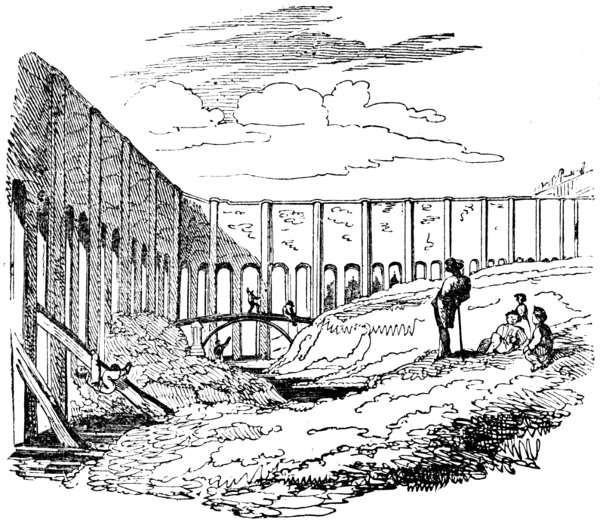
The ancient River Fleet at Clerkenwell.
Lo! hither Fleet-brook came, in former times call’d the Fleet-river, Which navies once rode on, in present times hidden for ever, Save where water-cresses and sedge mark its oozing and creeping, In yonder old meadows, from whence it lags slowly—as weeping Its present misgivings, and obsolete use, and renown— And bearing its burdens of shame and abuse into town, On meeting the buildings sinks into the earth, nor aspires To decent-eyed people, till forced to the Thames at Blackfri’rs.
*
In 1825, this was the first open view nearest London of the ancient River Fleet: it was taken during the building of the high-arched walls connected with the House of Correction, Cold-bath-fields, close to which prison the river ran, as here seen. At that time, the newly-erected walls communicated a peculiarly picturesque effect to the stream flowing within their confines. It arrived thither from Bagnigge-wells, on its way to a covered channel, whereby it passes between Turnmill-street, and again emerging, crosses Chick-lane, now called West-street, near Field-lane, at the back of which it runs on, and continues under Holborn-bridge, Fleet-market, and Bridge-street, till it reaches the Thames, close to the stairs on the west side of Blackfriars-bridge. The bridge, whereby boys cross the stream in the engraving, is a large iron pipe for conveying water from the New River Company’s works, to supply the houses in Grays-inn-lane. A few years ago, the New River water was conducted across this valley through wooden pipes. Since the drawing was made, the Fleet has been diverted from the old bed represented in the print, through a large barrel drain, into the course just mentioned, near Turnmill-street. This notice of the deviation, and especially the last appearance of the river in its immemorial channel, may be of interest, because the Fleet is the only ancient stream running into London which is not yet wholly lost to sight.
The River Fleet at its source, in a field on the London side of the Hampstead ponds, is merely a sedgy ditchling, scarcely half a step across, and “winds its sinuosities along,” with little increase of width or depth, to the road from the Mother Red Cap to Kentish Town, beneath which road it passes through the pastures to Camden Town; and in one of these pastures, the canal, running through the Tunnel at Pentonville to the City-road, is conveyed over it by an arch. From this place its width increases, till it reaches towards the west side of the road leading from Pancras Workhouse to Kentish Town. In the rear of the houses on that side of the road, it becomes a brook, washing the edge of the garden in front of the premises late the stereotype-foundery and printing-offices of Mr. Andrew Wilson, which stand back from the road; and, cascading down behind the lower road-side houses, it reaches the Elephant and Castle, in front of which it tunnels to Battle-bridge, and there levels out to the eye, and runs sluggishly to Bagnigge-wells, where it is at its greatest width, which is about twelve feet across; from thence it narrows to the House of Correction, and widens again near Turnmill-street, and goes to the Thames, as above described.
In a parliament held at Carlile, in 35 Edward I., 1307, Henry Lacy earl of Lincoln complained that, in former times, the course of water running under Holborn-bridge and Fleet-bridge into the Thames, had been of such breadth and depth that ten or twelve ships at once, “navies with merchandise,” were wont to come to Fleet-bridge, and some of them to Holborn-bridge; yet that, by filth of the tanners and others, and by raising of wharfs, and especially by a diversion of the water in the first year of king John, 1200, by them of the New Temple, for their mills without Baynard’s Castle, and by other impediments, the course was decayed, and ships could not enter as they were used. On the prayer of the earl, the constable of the Tower, with the mayor and sheriffs of London, were directed to take with them honest and discreet men to inquire into the former state of the river, to leave nothing that might hurt or stop it, and to restore it to its wonted condition. Upon this, the river was cleansed, the mills were removed, and other means taken for the preservation of the course; but it was not brought to its old depth and breadth, and therefore it was no longer termed a river, but a brook, called Turne-mill or Tremill Brook, because mills were erected on it.
After this, it was cleansed several times; and particularly in 1502, the whole course of Fleet Dike, as it was then called, was scoured down to the Thames, so that boats with fish and fuel were rowed to Fleet-bridge and Holborn-bridge.
In 1589, by authority of the common council of London, a thousand marks were collected to draw several of the springs at Hampstead-heath into one head, for the service of the City with fresh water where wanted, and in order that by such “a follower,” as it was termed, the channel of the brook should be scoured into the Thames. After much money spent, the effect was not obtained, and in Stow’s time, by means of continual encroachments on the banks, and the throwing of soil into the stream, it became worse clogged than ever.[24]
After the Fire of London, the channel was made navigable for barges to come up, by the assistance of the tide from the Thames, as far as Holborn-bridge, where the Fleet, otherwise Turnmill-brook, fell into this, the wider channel; which had sides built of stone and brick, with warehouses on each side, running under the street, and used for the laying in of coals, and other commodities. This channel had five feet water, at the lowest tide, at Holborn-bridge, the wharfs on each side the channel were thirty feet broad, and rails of oak were placed along the sides of the ditch to prevent people from falling into it at night. There were four bridges of Portland stone over it; namely, at Bridewell, Fleet-street, Fleet-lane, and Holborn.
When the citizens proposed to erect a mansion-house for their lord mayor, they fixed on Stocks-market, where the Mansion-house now stands, for its site, and proposed to arch the Fleet-ditch, from Holborn to Fleet-street, and to remove that market to the ground they would gain by that measure. In 1733, therefore, they represented to the House of Commons, that although after the Fire of London the channel of the Fleet had been made navigable from the Thames to Holborn-bridge, yet the profits from the navigation had not answered the charge; that the part from Fleet-bridge to Holborn-bridge, instead of being useful to trade, had become choked with mud, and was therefore a nuisance, and that several persons had lost their lives by falling into it. For these and other causes assigned, an act passed, vesting the fee simple of the site referred to in the corporation for ever, on condition that drains should be made through the channel, and that no buildings on it should exceed fifteen feet in height. The ditch was accordingly arched over from Holborn to Fleet-bridge, where the present obelisk in Bridge-street now stands, and Fleet-market was erected on the arched ground, and opened with the business of Stocks-market, on the 30th of September, 1737.
In 1765, the building of Blackfriars-bridge rendered it requisite to arch over the remainder, from Fleet-bridge to the Thames; yet a small part remained an open dock for a considerable time, owing to the obstinate persistence of a private proprietor.[25]
Previous to the first arching of the Fleet, Pope, in “The Dunciad,” imagined the votaries of Dulness diving and sporting in Fleet-ditch, which he then called
The king of dykes! than whom no sluice of mud With deeper sable blots the silver flood.
“I recollect,” says Pennant, “the present noble approach to Blackfriars-bridge, the well-built opening of Chatham-place, a muddy and genuine ditch.” It has of late been rendered a convenient and capacious sewer.
During the digging of Fleet-ditch, in 1676, with a view to its improvement after the Fire of London, between the Fleet-prison and Holborn-bridge, at the depth of fifteen feet, several Roman utensils were discovered; and, a little lower, a great quantity of Roman coins, of silver, copper, brass, and various other metals, but none of gold; and at Holborn-bridge, two brass lares, or household gods, of the Romans, about four inches in length, were dug out; one a Ceres, and the other a Bacchus. The great quantity of coins, induces a presumption that they were thrown into this river by the Roman inhabitants of the city, on the entry of Boadicea, with her army of enraged Britons, who slaughtered their conquerors, without distinction of age or sex. Here also were found arrow-heads, spur-rowels of a hand’s breadth, keys, daggers, scales, seals with the proprietors’ names in Saxon characters, ship counters with Saxon characters, and a considerable number of medals, crosses, and crucifixes, of a more recent age.[26]
Sometime before the year 1714, Mr. John Conyers, an apothecary in Fleet-street, who made it his chief business to collect antiquities, which about that time were daily found in and about London, as he was digging in a field near the Fleet not far from Battle-bridge, discovered the body of an elephant, conjectured to have been killed there, by the Britons, in fight with the Romans; for, not far from the spot, was found an ancient British spear, the head of flint fastened into a shaft of good length.[27] From this elephant, the public-house near the spot where it was discovered, called the Elephant and Castle, derives its sign.
There are no memorials of the extent to which the river Fleet was anciently navigable, though, according to tradition, an anchor was found in it as high up as the Elephant and Castle, which is immediately opposite Pancras workhouse, and at the corner of the road leading from thence to Kentish-town. Until within these few years, it gave motion to flour and flatting mills at the back of Field-lane, near Holborn.[28]
That the Fleet was once a very serviceable stream there can be no doubt, from what Stow relates. The level of the ground is favourable to the presumption, that its current widened and deepened for navigable purposes to a considerable extent in the valley between the Bagnigge-wells-road and Gray’s-inn, and that it might have had accessions to its waters from other sources, besides that in the vicinity of Hampstead. Stow speaks of it under the name of the “River of Wels, in the west part of the citie, and of old so called of the Wels;” and he tells of its running from the moor near the north corner of the wall of Cripplegate postern. This assertion, which relates to the reign of William the Conqueror, is controverted by Maitland, who imagines “great inattention” on the part of the old chronicler. It is rather to be apprehended, that Maitland was less an antiquary than an inconsiderate compiler. The drainage of the city has effaced proofs of many appearances which Stow relates as existing in his own time, but which there is abundant testimony of a different nature to corroborate; and, notwithstanding Maitland’s objection, there is sufficient reason to apprehend that the river of Wells and the Fleet river united and flowed, in the same channel, to the Thames.
January.
If you are ill at this season, there is no occasion to send for the doctor—only stop eating. Indeed, upon general principles, it seems to me to be a mistake for people, every time there is any little thing the matter with them, to be running in such haste for the “doctor;” because, if you are going to die, a doctor can’t help you; and if you are not—there is no occasion for him.[29]
Angling in January.
Dark is the ever-flowing stream, And snow falls on the lake; For now the noontide sunny beam Scarce pierces bower and brake; And flood, or envious frost, destroys A portion of the angler’s joys. Yet still we’ll talk of sports gone by, Of triumphs we have won, Of waters we again shall try, When sparkling in the sun; Of favourite haunts, by mead or dell. Haunts which the fisher loves so well. Of stately Thames, of gentle Lea, The merry monarch’s seat; Of Ditton’s stream, of Avon’s brae, Or Mitcham’s mild retreat; Of waters by the meer or mill, And all that tries the angler’s skill.
Annals of Sporting.
Plough Monday.
The first Monday after Twelfth-day is so denominated, and it is the ploughman’s holyday.
Of late years at this season, in the islands of Scilly, the young people exercise a sort of gallantry called “goose-dancing.” The maidens are dressed up for young men, and the young men for maidens; and, thus disguised, they visit their neighbours in companies, where they dance, and make jokes upon what has happened in the island; and every one is humorously “told their own,” without offence being taken. By this sort of sport, according to yearly custom and toleration, there is a spirit of wit and drollery kept up among the people. The music and dancing done, they are treated with liquor, and then they go to the next house of entertainment.[30]
Topography.
Willy-Howe, Yorkshire.
For the Table Book.
There is an artificial mount, by the side of the road leading from North Burton to Wold Newton, near Bridlington, in Yorkshire, called “Willy-howe,” much exceeding in size the generality of our “hows,” of which I have often heard the most preposterous stories related. A cavity or division on the summit is pointed out as owing its origin to the following circumstance:—
A person having intimation of a large chest of gold being buried therein, dug away the earth until it appeared in sight; he then had a train of horses, extending upwards of a quarter of a mile, attached to it by strong iron traces; by these means he was just on the point of accomplishing his purpose, when he exclaimed—
“Hop Perry, prow Mark, Whether God’s will or not, we’ll have this ark.”
He, however, had no sooner pronounced this awful blasphemy, than all the traces broke, and the chest sunk still deeper in the hill, where it yet remains, all his future efforts to obtain it being in vain.
The inhabitants of the neighbourhood also speak of the place being peopled with fairies, and tell of the many extraordinary feats which this diminutive race has performed. A fairy once told a man, to whom it appears she was particularly attached, if he went to the top of “Willy-howe” every morning, he would find a guinea; this information, however, was given under the injunction that he should not make the circumstance known to any other person. For some time he continued his visit, and always successfully; but at length, like our first parents, he broke the great commandment, and, by taking with him another person, not merely suffered the loss of the usual guinea, but met with a severe punishment from the fairies for his presumption. Many more are the tales which abound here, and which almost seem to have made this a consecrated spot; but how they could at first originate, is somewhat singular.
That “Hows,” “Carnedds,” and “Barrows,” are sepulchral, we can scarcely entertain a doubt, since in all that have been examined, human bones, rings, and other remains have been discovered. From the coins and urns found in some of them, they have been supposed the burial-places of Roman generals. “But as hydrotaphia, or urn-burial, was the custom among the Romans, and interment the practice of the Britons, it is reasonable to conjecture, where such insignia are discovered, the tumuli are the sepulchres of some British chieftains, who fell in the Roman service.” The size of each tumulus was in proportion to the rank and respect of the deceased; and the labour requisite to its formation was considerably lessened by the number employed, each inferior soldier being obliged to contribute a certain quantum to the general heap. That the one of which we are speaking is the resting-place of a great personage may be easily inferred, from its magnitude; its name also indicates the same thing, “Willy-howe,” being the hill of many, or the hill made by many; for in Gibson’s Camden we find “Willy and Vili among the English Saxons, as Viele at this day among the Germans, signified many. So Willielmus, the defender of many. Wilfred, peace to many.” Supposing then a distinguished British chieftain, who fell in the imperial service, to have been here interred, we may readily imagine that the Romans and Britons would endeavour to stimulate their own party by making his merits appear as conspicuous as possible; and to impress an awe and a dread on the feelings of their enemies, they would not hesitate to practise what we may call a pardonable fraud, in a pretension that the fairies were his friends, and continued to work miracles at his tomb. At the first glance, this idea may seem to require a stretch of fancy, but we can more readily reconcile it when we consider how firm was the belief that was placed in miracles; how prevalent the love that existed, in those dark ages of ignorance and superstition, to whatever bore that character; and how ready the Romans, with their superior sagacity, would be to avail themselves of it. The Saxons, when they became possessed of the country, would hear many strange tales, which a species of bigoted or unaccountable attachment to the marvellous would cause to be handed down from generation to generation, each magnifying the first wonder, until they reached the climax, whence they are now so fast descending. Thus may probably have arisen the principal feature in the history of their origin.
This mode of sepulture appears to be very ancient, and that it was very general is sufficiently demonstrated by the hills yet remaining in distant parts of the world. Dr. Clarke, who noticed their existence in Siberia and Russian-Tartary, thinks the practice is alluded to in the Old Testament in these passages: “They raised a great heap of stones on Achan;” “and raised a great heap of stones on the king of Ai;” “they laid a heap of stones on Absalom.” In the interior of South Africa, the Rev. J. Campbell “found a large heap of small stones, which had been raised by each passenger adding a stone to the heap; it was intended as a monument of respect to the memory of a king, from a remote nation, who was killed in the vicinity, and whose head and hands were interred in that spot.”
The number of these mounds in our own country is very considerable; and I trust they will remain the everlasting monuments of their own existence. Their greatest enemy is an idle curiosity, that cannot be satisfied with what antiquaries relate concerning such as have been examined, but, with a vain arrogance, assumes the power of digging though them at pleasure. For my own part, I must confess, I should like to be a witness of what they contain, yet I would hold them sacred, so far as not to have them touched with the rude hand of Ignorance. Whenever I approach these venerable relics, my mind is carried back to the time when they were young; since then, I consider what years have rolled over years, what generations have followed generations, and feel an interest peculiarly and delicately solemn, in the fate of those whose dust is here mingled with its kindred dust.
T. C.
Bridlington.
Horn Church in Essex.
For the Table Book.
In reply to the inquiry by Ignotus, in the Every-Day Book, vol. ii. p. 1650, respecting the origin of affixing horns to a church in Essex, I find much ambiguity on the subject, and beg leave to refer to that excellent work, “Newcourt’s Repertorium,” vol. ii. p. 336, who observes, on the authority of Weaver, “The inhabitants here say, by tradition, that this church, dedicated to St. Andrew, was built by a female convert, to expiate for her former sins, and that it was called Hore-church at first, till by a certain king, but by whom they are uncertain, who rode that way, it was called Horned-church, who caused those horns to be put out at the east end of it.”
The vane, on the top of the spire, is also in the form of an ox’s head, with the horns. “The hospital had neither college nor common seal.”
m.
Customs.
The present Boar’s Head Carol.
For the Table Book.
Mr. Editor,—In reading your account of the “Boar’s Head Carol,” in your Every-Day Book, vol. i. p. 1619, I find the old carol, but not the words of the carol as sung at present in Queen’s College, Oxford, on Christmas-day. As I think it possible you may never have seen them, I now send you a copy as they were sung, or, more properly, chanted, in the hall of Queen’s, on Christmas-day, 1810, at which time I was a member of the college, and assisted at the chant.
A boar’s head in hand bear I, Bedeck’d with bays and rosemary; And I pray you, my masters, be merry, Quot estis in convivio.— Caput apri defero, Reddens laudes Domino. The boar’s head, as I understand, Is the rarest dish in all this land; And when bedeck’d with a gay garland Let us servire cantico.— Caput apri, &c. Our steward hath provided this, In honour of the King of bliss: Which on this day to be served is In reginensi atrio.— Caput apri, &c.
I am, &c. A Quondam Queensman.
Beating the Lapstone.
For the Table Book.
There is a custom of “beating the lapstone,” the day after Christmas, at Nettleton, near Burton. The shoemakers beat the lapstone at the houses of all water-drinkers, in consequence of a neighbour, Thomas Stickler, who had not tasted malt liquor for twenty years, having been made tipsy by drinking only a half pint of ale at his shoemaker’s, at Christmas. When he got home, he tottered into his house, and his good dame said, “John, where have you been?—why, you are in liquor?”—“No, I am not,” hiccuped John, “I’ve only fell over the lapstone, and that has beaten my leg, so as I can’t walk quite right.” Hence the annual practical joke—“beating the lapstone.”
P.
Manners.
Gambling-houses a Century ago.
From “The London Mercury” of January 13, 1721-2.
There are, it seems, in the parish of Covent-garden, twenty-two such houses, some of which clear sometimes 100l., and seldom less than 40l. a night. They have their proper officers, both civil and military, with salaries proportionable to their respective degrees, and the importance they are of in the service, viz.
A commissioner, or commis, who is always a proprietor of the gaming-house: he looks in once a night, and the week’s account is audited by him and two others of the proprietors.
A director, who superintends the room.
The operator, the dealer at faro.
Croupees two, who watch the card, and gather the money for the bank.
A puff, one who has money given him to play, in order to decoy others.
A clerk, who is a check upon the puff, to see that he sinks none of that money.—A squib is a puff of a lower rank, and has half the salary of a puff.
A flasher, one who sits by to swear how often he has seen the bank stript.
A dunner, waiters.
An attorney, or solicitor.
A captain, one who is to fight any man that is peevish or out of humour at the loss of his money.
An usher, who takes care that the porter, or grenadier at the door, suffers none to come in but those he knows.
A porter, who, at most of the gaming-houses, is a soldier hired for that purpose.
A runner, to get intelligence of all the meetings of the justices of the peace, and when the constables go upon the search.
Any link-boy, coachman, chairman, drawer, or other person, who gives notice of the constables being upon the search, has half a guinea.
Omniana.
Taste.
Taste is the discriminating talisman, enabling its owner to see at once the real merits of persons and things, to ascertain at a glance the true from the false, and to decide rightly on the value of individuals.
Nothing escapes him who walks the world with his eyes touched by this ointment; they are open to all around him—to admire, or to condemn—to gaze with rapture, or to turn away with disgust, where another shall pass and see nothing to excite the slightest emotion. The fair creation of nature, and the works of man afford him a wide field of continual gratification. The brook, brawling over its bed of rocks or pebbles, half concealed by the overhanging bushes that fringe its banks—or the great river flowing, in unperturbed majesty, through a wide vale of peace and plenty, or forcing its passage through a lofty range of opposing hills—the gentle knoll, and the towering mountain—the rocky dell, and the awful precipice—the young plantation, and the venerable forest, are alike to him objects of interest and of admiration.
So in the works of man, a foot-bridge, thrown across a torrent, may be in it as gratifying to the man of taste as the finest arch, or most wonderful chain-bridge in the world; and a cottage of the humblest order may be so beautifully situated, so neatly kept, and so tastefully adorned with woodbine and jessamine, as to call forth his admiration equally with the princely residence of the British landholder, in all its pride of position, and splendour of architecture.
In short, this faculty is applicable to every object; and he who finds any thing too lofty or too humble for his admiration, does not possess it. It is exercised in the every-day affairs of life as much as in the higher arts and sciences.—Monthly Magazine.
Two Ravens, abroad.
On the quay at Nimeguen, in the United Provinces, two ravens are kept at the public expense; they live in a roomy apartment, with a large wooden cage before it, which serves them for a balcony. These birds are feasted every day with the choicest fowls, with as much exactness as if they were for a gentleman’s table. The privileges of the city were granted originally upon the observance of this strange custom, which is continued to this day.
Two Ravens, at home.
In a MS. of the late Rev. Mr. Gough, of Shrewsbury, it is related, that one Thomas Elkes, of Middle, in Shropshire, being guardian to his eldest brother’s child, who was young, and stood in his way to a considerable estate, hired a poor boy to entice him into a corn field to gather flowers, and meeting them, sent the poor boy home, took his nephew in his arms, and carried him to a pond at the other end of the field, into which he put the child, and there left him. The child being missed, and inquiry made after him, Elkes fled, and took the road to London; the neighbours sent two horsemen in pursuit of him, who passing along the road near South Mims, in Hertfordshire, saw two ravens sitting on a cock of hay making an unusual noise, and pulling the hay about with their beaks, on which they went to the place, and found Elkes asleep under the hay. He said, that these two ravens had followed him from the time he did the fact. He was brought to Shrewsbury, tried, condemned, and hung in chains on Knockinheath.
The last Tree of the Forest.
Whisper, thou tree, thou lonely tree, One, where a thousand stood! Well might proud tales be told by thee, Last of the solemn wood! Dwells there no voice amidst thy boughs, With leaves yet darkly green? Stillness is round, and noontide glows— Tell us what thou hast seen! “I have seen the forest-shadows lie Where now men reap the corn; I have seen the kingly chase rush by, Through the deep glades at morn. “With the glance of many a gallant spear And the wave of many a plume, And the bounding of a hundred deer It hath lit the woodland’s gloom. “I have seen the knight and his train ride past, With his banner borne on high; O’er all my leaves there was brightness cast From his gleamy panoply. “The pilgrim at my feet hath laid His palm-branch ’midst the flowers, And told his beads, and meekly pray’d, Kneeling at vesper-hours. “And the merry men of wild and glen, In the green array they wore, Have feasted here with the red wine’s cheer, And the hunter-songs of yore. “And the minstrel, resting in my shade, Hath made the forest ring With the lordly tales of the high crusade, Once loved by chief and king. “But now the noble forms are gone, That walk’d the earth of old; The soft wind hath a mournful tone, The sunny light looks cold. “There is no glory left us now like the glory with the dead:— I would that where they slumber low, My latest leaves were shed.” Oh! thou dark tree, thou lonely tree, That mournest for the past! A peasant’s home in thy shade I see, Embower’d from every blast. A lovely and a mirthful sound Of laughter meets mine ear; For the poor man’s children sport around On the turf, with nought to fear. And roses lend that cabin’s wall A happy summer-glow, And the open door stands free to all, For it recks not of a foe. And the village-bells are on the breeze That stirs thy leaf, dark tree!— —How can I mourn, amidst things like these, For the stormy past with thee?
F. H. New Monthly Magazine.
Miss Polly Baker.
Towards the end of 1777, the abbé Raynal calling on Dr. Franklin found, in company with the doctor, their common friend, Silas Deane. “Ah! monsieur l’abbé,” said Deane, “we were just talking of you and your works. Do you know that you have been very ill served by some of those people who have undertaken to give you information on American affairs?” The abbé resisted this attack with some warmth; and Deane supported it by citing a variety of passages from Raynal’s works, which he alleged to be incorrect. At last they came to the anecdote of “Polly Baker,” on which the abbé had displayed a great deal of pathos and sentiment. “Now here,” says Deane, “is a tale in which there is not one word of truth.” Raynal fired at this, and asserted that he had taken it from an authentic memoir received from America. Franklin, who had amused himself hitherto with listening to the dispute of his friends, at length interposed, “My dear abbé,” said he, “shall I tell you the truth? When I was a young man, and rather more thoughtless than is becoming at our present time of life, I was employed in writing for a newspaper; and, as it sometimes happened that I wanted genuine materials to fill up my page, I occasionally drew on the stores of my imagination for a tale which might pass current as a reality—now this very anecdote of Polly Baker was one of my inventions.”
Bread Seals.
The new conundrum of “bread pats,” as the ladies call the epigrammatic impressors that their work-boxes are always full of now, pleases me mightily. Nothing could be more stupid than the old style of affiche—an initial—carefully engraved in a hand always perfectly unintelligible; or a crest—necessarily out of its place, nine times in ten, in female correspondence—because nothing could be more un-“germane” than a “bloody dagger” alarming every body it met, on the outside of an order for minikin pins! or a “fiery dragon,” threatening a French mantua-maker for some undue degree of tightness in the fitting of the sleeve! and then the same emblem, recurring through the whole letter-writing of a life, became tedious. But now every lady has a selection of axioms (in flower and water) always by her, suited to different occasions. As, “Though lost to sight, to memory dear!”—when she writes to a friend who has lately had his eye poked out. “Though absent, unforgotten!”—to a female correspondent, whom she has not written to for perhaps the three last (twopenny) posts; or, “Vous le meritez!” with the figure of a “rose”—emblematic of every thing beautiful—when she writes to a lover. It was receiving a note with this last seal to it that put the subject of seals into my mind; and I have some notion of getting one engraved with the same motto, “Vous le meritez,” only with the personification of a horsewhip under it, instead of a “rose”—for peculiar occasions. And perhaps a second would not do amiss, with the same emblem, only with the motto, “Tu l’auras!” as a sort of corollary upon the first, in cases of emergency! At all events, I patronise the system of a variety of “posies;” because where the inside of a letter is likely to be stupid, it gives you the chance of a joke upon the out.—Monthly Magazine
Bleeding for our Country.
It is related of a Lord Radnor in Chesterfield’s time, that, with many good qualities, and no inconsiderable share of learning, he had a strong desire of being thought skilful in physic, and was very expert in bleeding. Lord Chesterfield knew his foible, and on a particular occasion, wanting his vote, came to him, and, after having conversed upon indifferent matters, complained of the headach, and desired his lordship to feel his pulse. Lord Radnor immediately advised him to lose blood. Chesterfield complimented his lordship on his chirurgical skill, and begged him to try his lancet upon him. “A propos,” said lord Chesterfield, after the operation, “do you go to the house today?” Lord Radnor answered, “I did not intend to go, not being sufficiently informed of the question which is to be debated; but you, that have considered it, which side will you be of?”—The wily earl easily directed his judgment, carried him to the house, and got him to vote as he pleased. Lord Chesterfield used to say, that none of his friends had been as patriotic as himself, for he had “lost his blood for the good of his country.”
Social Happiness.
A Village New Year.
For the Table Book.
“Almack’s” may be charming,—an assembly at the “Crown and Anchor,” and a hop of country quality at the annual “Race Ball,” or a more popular “set to” at a fashionable watering-place, may delight—but a lady of city or town cannot conceive the emotions enjoyed by a party collected in the village to see the “old year” out and the “new year” in. At this time, the “country dance” is of the first importance to the young and old, yet not till the week has been occupied by abundant provisions of meat, fruit tarts, and mince pies, which, with made wines, ales, and spirits, are, like the blocks for fuel, piled in store for all partakers, gentle and simple. Extra best beds, stabling, and hay, are made ready,—fine celery dug,—the china service and pewter plates examined,—in short, want and wish are anticipated, nothing is omitted, but every effort used to give proofs of genuine hospitality. This year, if there is to be war in Portugal, many widowed hearts and orphan spirits may be diverted from, not to, a scene which is witnessed in places where peace and plenty abound. However, I will not be at war by conjecture, but suppose much of the milk of human kindness to be shared with those who look at the sunny side of things.
After tea, at which the civilities of the most gallant of the young assist to lighten the task of the hostess, the fiddler is announced, the “country dance” begins, and the lasses are all alive; their eyes seem lustrous and their animal spirits rise to the zero of harmonious and beautiful attraction. The choosing of partners and tunes with favourite figures is highly considered. Old folks who have a leg left and are desirous of repeating the step (though not so light) of fifty years back, join the dance; and the floor, whether of stone or wood, is swept to notes till feet are tired. This is pursued till suppertime at ten o’clock. Meantime, the “band” (called “waits” in London) is playing before the doors of the great neighbours, and regaled with beer, and chine, and pies; the village “college youths” are tuning the handbells, and the admirers of the “steeple chase” loiter about the church-yard to hear the clock strike twelve, and startle the air by high mettle sounds. Methodist and Moravian dissenters assemble at their places of worship to watch out the old year, and continue to “watch” till four or five in the new year’s morning. Villagers, otherwise disposed, follow the church plan, and commemorate the vigils in the old unreformed way. After a sumptuous supper,—at which some maiden’s heart is endangered by the roguish eye, or the salute and squeeze by stealth, dancing is resumed, and, according to custom, a change of partners takes place, often to the joy and disappointment of love and lovers. At every rest—the fiddler makes a squeaking of the strings—this is called kiss ’em! a practice well understood by the tulip fanciers. The pipes, tobacco, and substantials are on the qui vive, by the elders in another part of the house, and the pint goes often to the cellar.
As the clock strikes a quarter to twelve, a bumper is given to the “old friend,” standing, with three farewells! and while the church bells strike out the departure of his existence, another bumper is pledged to the “new infant,” with three standing hip, hip, hip—huzzas! It is further customary for the dance to continue all this time, that the union of the years should be cemented by friendly intercourse. Feasting and merriment are carried on until four or five o’clock, when, as the works of the kitchen have not been relaxed, a pile of sugar toast is prepared, and every guest must partake of its sweetness, and praise it too, before separation. Headaches, lassitude, and paleness, are thought little of, pleasure suppresses the sigh, and the spirit of joy keeps the undulations of care in proper subjection—Happy times these!—Joyful opportunities borrowed out of youth to be repaid by ripened memory!—snatched, as it were, from the wings of Time to be written on his brow with wrinkles hereafter.
R. P.