Volume 2 — Vol. II.—31.
Reading edition
Ancient Door of Bromley Church.
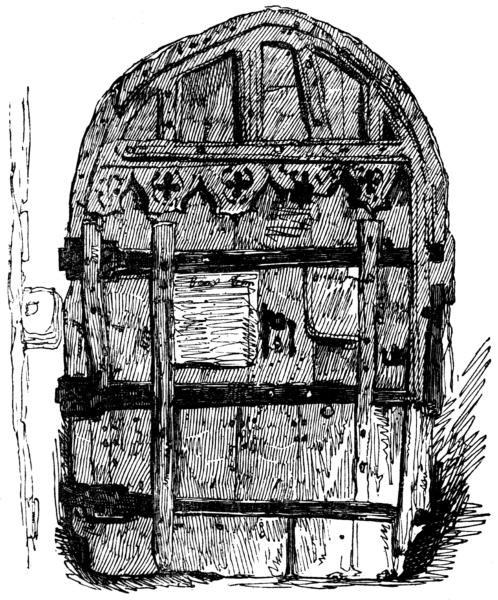
Ancient Door of Bromley Church.
On our visit to Bromley church, as soon as the modern outer gates of the porch were unlocked, we were struck by the venerable appearance of the old inner oak door; and, instead of taking a view of the church, of which there are several prints, Mr. Williams made a drawing of the decayed portal, from whence he executed the present engraving. On the hinge-side of the engraving, there is a representation of the outer edge of the door.
This door formerly hung on the western stone jamb; but, for warmth, and greater convenience, the churchwardens, under whose management the edifice was last repaired, put up a pair of folding-doors covered with crimson cloth; yet, with respectful regard, worthy of imitation in other places, they preserved this vestige of antiquity, and were even careful to display its time-worn front. For this purpose the door has been attached to the eastern jamb, so that if it were shut its ornamented side would be hidden; instead whereof, it is kept open by a slight fastening against the eastern form, or settle, within the porch.
It may be remembered by readers of the Every Day Book,[280] that, on St. Mark’s eve, our ancestors “watched the church-porch,” as they do to the present day in some parts of Yorkshire and the north of England, from eleven o’clock at night till one in the morning. This done thrice, on the third year they were supposed to have seen the ghosts of those who were to die the next year pass by into the church. When any one sickens that is thought to have been seen in this manner, it is presently whispered about that he will not recover, for that such or such an one, who watched on St. Mark’s eve, says so. This idle superstition is in such force, that if the patients themselves hear of it, they almost despair of recovery: many are said to have actually died by their imaginary fears. The like irrational belief and fond practice prevail on St. John’s eve. “I am sure,” says a writer in the “Connoisseur,” “that my own sister Hetty, who died just before Christmas, stood in the church-porch last Midsummer eve, to see all that were to die that year in our parish; and she saw her own apparition.” It is told of a company of these “watchers,” that one of them fell into a sound sleep, so that he could not be waked, and while in this state his ghost or spirit was seen by the rest of his companions knocking at the church-door.
In relation to this church-watching on St. Mark’s and St. John’s eve, there is a narrative in the “Athenian Oracle,” published by John Dunton:—“Nine others besides myself went into a church-porch, with an expectation of seeing those who should die that year; but about eleven o’clock I was so afraid that I left them, and all the nine did positively affirm to me, that about an hour after, the church-doors flying open, the minister, (who it seems was very much troubled that night in his sleep,) with such as should die that year, did appear in order: which persons they named to me, and they appeared then all very healthful; but six of them died in six weeks after, in the very same order that they appeared.”[281]
Before mention of the “church-porch,” it might have been more orderly to have noticed the “church-yard-porch.” There is one at Bromley, though more modern than the fine “lich-gate” at Beckenham already engraved and described.[282] Sir John Sinclair records of some parishioners in the county of Argyll, that “though by no means superstitious, (an observation which in the sequel seems very odd,) they still retain some opinions handed down by their ancestors, perhaps from the time of the Druids. It is believed by them, that the spirit of the last person that was buried watches round the church-yard till another is buried, to whom he delivers his charge.” Further on, in the same work,[283] is related, that “in one division of this county, where it was believed that the ghost of the person last buried kept the gate of the church-yard till relieved by the next victim of death, a singular scene occurred, when two burials were to take place in one church-yard on the same day. Both parties staggered forward as fast as possible to consign their respective friend in the first place to the dust: if they met at the gate, the dead were thrown down till the living decided, by blows, whose ghost should be condemned to porter it.”
Bromley church-door is a vestige; for on examination it will be found not perfect. It is seven feet four inches in height, and in width four feet eight inches: the width of the door-way, between the stone jambs, is two inches more; the width of the door itself, therefore, has been reduced these two inches; and hence the centre of the ornaments in relief is not in the centre of the door in its present state. It is a good specimen of the fast-decaying, and often prematurely removed, fine doors of our old churches. The lock, probably of like age with the door, and also of wood, is a massive effectual contrivance, two feet six inches long, seven inches and a half deep, and five inches thick; with a bolt an inch in height, and an inch and a half in thickness, that shoots out two inches on the application of the rude heavy key, which as to form and size is exactly depictured in the following page. It seemed good to introduce the engraving, both in respect to the antiquity of the original, and to the information it conveys of the devices of our ancestors for locking-up.
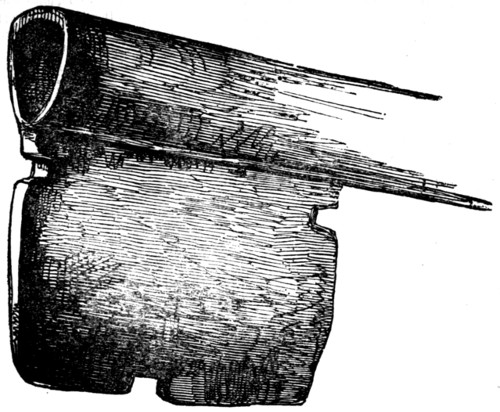
Ancient Key of Bromley Church.
Keys varied in their form according to the age wherein they were made, and the purposes for which they were used. Anciently, the figure of the key of the west door of the church was put in the register. This was mostly done on the delivery of the church keys to the “ostiarii,” who were officers, created with much ceremony, to whom the keys were intrusted: the bishops themselves delivered the keys, and the deacons the doors of the respective churches.[284]
While W. drew the door of Bromley church I had ample opportunity to make measurements and look about; and I particularly noticed a capital large umbrella of old construction, which I brought out and set up in the church-yard: with its wooden handle, fixed into a movable shaft, shod with an iron point at the bottom, and struck into the ground, it stood seven feet high; the awning is of a green oiled-canvass, such as common umbrellas were made of forty years ago, and is stretched on ribs of cane. It opens to a diameter of five feet, and forms a decent and capacious covering for the minister while engaged in the burial-service at the grave. It is in every respect a more fitting exhibition than the watchbox sort of vehicle devised for the same purpose, and in some church-yards trundled from grave to grave, wherein the minister and clerk stand, like the ordinary of Newgate and a dying malefactor at the new drop in the Old Bailey. An unseemly thing of this description is used at St. George’s in the Borough.
The church of Bromley, an ancient spacious edifice with a square tower, has been much modernised, yet to the credit of the inhabitants it retains its old Norman font. It is remarkable, that it is uncertain to what saint it was dedicated: some ascribe it to St. Peter and St. Paul; others to St. Blaise; but it is certain that Browne Willis, with all his industry and erudite research, was unable to determine the point. This I affirm from a MS. memorandum before me in his hand-writing. It abounds with monuments, though none are of very old standing. There was formerly a tomb to Water de Henche, “persone de Bromleghe, 1360.”[285] Among the mural tablets are the names of Elizabeth, wife to “the great moralist” Dr. Johnson; Dr. Hawkesworth, a resident in Bromley, popular by his “Adventurer;” and Dr. Zachary Pearce. The latter was successively rector of St. Bartholomew’s by the Royal Exchange, vicar of St. Martin’s in the Fields, dean of Winchester, bishop of Bangor, dean of Westminster, and bishop of Rochester. His principal literary labours were editorial—“Longinus de Sublimitate,” “Cicero de Officiis,” and “Cicero de Oratore.” He wrote in the “Spectator,” No. 572, upon “Quacks,” and No. 633 upon “Eloquence;” and No. 121 in the “Guardian,” signed “Ned Mum.” The chief of this prelate’s other works were Sermons. There is a cenotaph to him in Westminster Abbey; a distinction he was entitled to by his learning and virtues.
Dr. Zachary Pearce is remarkable for having desired to resign his deanery and bishopric. In 1763, being then seventy-three years old, he told his majesty in his closet that he found the business of his stations too much for him; that he was afraid it would grow more so as he advanced in years, and desired to retire, that he might spend more time in his devotions and studies. Afterwards, one of the law lords doubted the practicability of resigning a bishopric, but on further consideration the difficulty disappeared. The king then gave his consent, and the bishop kissed hands upon it; but lord Bath requesting the bishopric and deanery of the king for Dr. Newton, then bishop of Bristol, the ministry thought that no church dignities should pass from the crown but through their hands, and opposed the resignation, as the shortest way of keeping the bishopric from being disposed of otherwise than they liked. On this occasion the law lord, earl Mansfield, who had been doubtful, and who soon after had seen clear, doubted again, and Dr. Pearce was told by the king he must think no more about resigning the bishopric. In 1768 he resigned the deanery of Westminster, and wrote
THE WISH.
From all Decanal cares at last set free, (O could that freedom still more perfect be) My sun’s meridian hour, long past and gone; Dim night, unfit for work, comes hast’ning on; In life’s late ev’ning, thro’ a length of day, I find me gently tending to decay: How shall I then my fated exit make? How best secure my great eternal stake? This my prime wish, to see thy glorious face, O gracious God, in some more happy place; Till then to spend my short remains of time In thoughts, which raise the soul to truths sublime; To live with innocence, with peace and love, As do those saints who dwell in bliss above: By prayers, the wings which faith to reason lends, O now my soul to Heav’n’s high throne ascends: While here on earth, thus on my bended knee, O Power divine, I supplicate to thee; May I meet Death, when his approach is made, Not fend of life, nor of his dart afraid; Feel that my gain, which I esteem’d a loss: Heav’n is the gold refin’d, earth but the dross.
Bishop Pearce lived and laboured till June 29, 1774, when he died in the eighty-fourth year of his age.
There is a neat monument by Nollekens over the north gallery of the church, with a remarkable inscription:—“Sacred to the memory of Thomas Chase, Esq. formerly of this parish, born in the city of Lisbon the 1st of November, 1729; and buried under the ruins of the same house where he first saw the light in the ever-memorable and terrible earthquake which befell that city the 1st of November, 1755: when after a most wonderful escape, he by degrees recovered from a very deplorable condition, and lived till the 20th of Nov 1788, aged 59 years.”
On the outside of the church a monumental stone, fixed in the wall, records a memorable and affecting instance of gratitude in noble terms:—
Near this Place lies the Body of ELIZABETH MONK, Who departed this Life On the 27th Day of August, 1753, Aged 101: She was the Widow of John Monk, late of this Parish, Blacksmith, Her second Husband, To whom she had been a wife near fifty Years, By whom she had no Children; And of the Issue of the first Marriage none lived to the second; But VIRTUE Would not suffer her to be Childless: An Infant, to whom, and to whose Father and Mother she had been Nurse (Such is the Uncertainty of temporal Prosperity) Became dependent upon Strangers for the Necessaries of Life: To him she afforded the Protection of a Mother. This parental Charity Was returned with filial Affection; And she was supported, in the Feebleness of Age, by him whom she had cherished in the Helplessness of Infancy. LET IT BE REMEMBERED, That there is no Station in which Industry will not obtain Power to be liberal, Nor any Character on which Liberality will not confer Honor [II-105, II-106] She had been long prepared, by a simple and unaffected Piety, For that awful moment, which, however delayed, Is universally sure. How few are allowed an equal Time of Probation! How many, by their Lives, appear to presume upon more!
To preserve the memory of this person; and yet more, to perpetuate the lesson of her life, this stone was erected by voluntary contribution.
An intelligent inhabitant of Bromley, in the year 1747, mentions a discovery, with some accompanying remarks, appropriate to the present notice:—
“In the year 1733, the present clerk of the parish church of Bromley in Kent, by his digging a grave in that church-yard, close to the east end of the chancel wall, dug up a funeral crown, or garland, which is most artificially wrought in fillagree work with gold and silver wire, in resemblance of myrtle, (with which plant the funebrial garlands of the ancients were composed,[286]) whose leaves are fastened to hoops of larger wire of iron, now something corroded with rust, but both the gold and silver remain to this time very little different from their original splendour. It was also lined with cloth of silver, a piece of which, together with part of this curious garland, I keep as a choice relic of antiquity.
“Besides these crowns, (which were buried with deceased virgins,) the ancients had also their depository garlands, the use of which was continued even till of late years (and perhaps are still retained in many parts of this nation, for my own knowledge of these matters extends not above twenty or thirty miles round London,) which garlands, at the funerals of the deceased, were carried solemnly before the corpse by two maids, and afterwards hung up in some conspicuous place within the church, in memorial of the departed person, and were (at least all that I have seen) made after the following manner, viz. the lower rim or circlet was a broad hoop of wood, whereunto was fixed, at the sides thereof, part of two other hoops crossing each other at the top, at right angles, which formed the upper part, being about one-third longer than the width; these hoops were wholly covered with artificial flowers of paper, dyed horn, or silk, and more or less beauteous, according to the skill or ingenuity of the performer. In the vacancy of the inside, from the top, hung white paper, cut in form of gloves, whereon was wrote the deceased’s name, age, &c. together with long slips of various coloured paper or ribbons. These were many times intermixed with gilded or painted empty shells of blown eggs, as farther ornaments; or, it may be, as emblems of the bubbles or bitterness of this life; whilst other garlands had only a solitary hour-glass hanging therein, as a more significant symbol of mortality.
“About forty years ago these garlands grew much out of repute, and were thought by many as very unbecoming decorations for so sacred a place as the church; and at the reparation or new beautifying several churches where I have been concerned, I was obliged, by order of the minister and churchwardens, to take the garlands down, and the inhabitants were strictly forbidden to hang up any more for the future. Yet notwithstanding, several people, unwilling to forsake their ancient and delightful custom, continued still the making of them, and they were carried at the funerals, as before, to the grave, and put therein upon the coffin over the face of the dead; this I have seen done in many places.”[287]
Garrick Plays. No. XXVII.
[From the “Gentleman of Venice,” a Tragi-Comedy by James Shirley, 1655.]
Giovanni, of noble extraction, but brought up a Gardener, and ignorant of any greater birth, loves Bellaura, a Princess; and is beloved again.
Bellaura. Giovanni.
Bell. How now, Giovanni; What, with a sword! You were not used to appear Thus arm’d. Your weapon is a spade, I take it. Gio. It did become my late profession, Madam: But I am changed— Bell. Not to a soldier? Gio. It is a title, Madam, will much grace me; And with the best collection of my thoughts I have ambition to the wars. Bell. You have? Gio. O ’tis a brave profession and rewards All loss we meet, with double weight in glory; A calling, Princes still are proud to own; And some do willingly forget their crowns, To be commanded. ’Tis the spring of all We here entitle fame to; Emperors, And all degrees of honours, owing all Their names to this employment; in her vast And circular embraces holding Kings, And making them; and yet so kind as not To exclude such private things as I, who may Learn and commence in her great arts.—My life Hath been too useless to my self and country; ’Tis time I should employ it, to deserve A name within their registry, that bring The wealth, the harvest, home of well-bought honour. Bell. Yet I can see Through all this revolution, Giovanni, ’Tis something else has wrought this violent change. Pray let me be of counsel with your thoughts, And know the serious motive; come, be clear. I am no enemy, and can assist Where I allow the cause. Gio. You may be angry, Madam, and chide it as a saucy pride In me to name or look at honour; nor Can I but know what small addition Is my unskilful arm to aid a country. Bell. I may therefore justly suspect there is Something of other force, that moves you to The wars. Enlarge my knowledge with the secret. Gio. At this command I open my heart. Madam, I must confess there is another cause, Which I dare not in my obedience Obscure, since you will call it forth; and yet I know you will laugh at me— Bell. It would ill Become my breeding, Giovanni— Gio. Then, Know, Madam, I am in love. Bell. In love with whom? Gio. With one I dare not name, she is so much Above my birth and fortunes. Bell. I commend Your flight. But does she know it? Gio. I durst never Appear with so much boldness to discover My heart’s so great ambition; it is here still A strange and busy guest. Bell. And you think absence May cure this wound— Gio. Or death— Bell. I may presume You think she’s fair— Gio. I dare as soon question your beauty, Madam, The only ornament and star of Venice, Pardon the bold comparison; yet there is Something in you, resembles my great Mistress. She blushes—(aside). Such very beams disperseth her bright eye, Powerful to restore decrepit nature; But when she frowns, and changes from her sweet Aspect, (as in my fears I see you now, Offended at my boldness), she does blast Poor Giovanni thus, and thus I wither At heart, and wish myself a thing lost in My own forgotten dust.
C. L.
JAMES THOMSON.
A volume, entitled the “English Gentleman’s Library Manual,” contains the following remarkable anecdotes respecting the author of “The Seasons.”
Memoranda communicated by James Robertson, Esq. of Richmond, in Surrey, late Surgeon to the Household at Kew, October 17, 1791, to Thomas Parke, Esq. the Poet, and by him to the Earl of Buchan.
Parke. Have you any objection, sir, to my taking down memorandums to a conversation?
Robertson. Not in the least, I will procure you pen, ink, and paper immediately.
I understand, sir, you knew Thomson long?
I became acquainted with him in the year 1726, when he published his poem of Winter. He lived opposite to me, in Lancaster-court, in the Strand. I went to the East Indies soon after, which caused a chasm in our acquaintance; but, on my return, our intimacy was strengthened, and continued to the hour of his death. I do not know any man, living or dead, I ever esteemed more highly, and he was attached to me. I had once a complaint of a consumptive nature, which confined me much at home, and he was so good as to come often from Kew-lane to sit with me.
Did you know Amanda?
Know her? Yes, sir, I married her sister. Amanda was a Miss Young, daughter to captain Gilbert Young, of the Gulyhill family, in Dumfriesshire, and was married afterwards to admiral Campbell. She was a fine sensible woman, and poor Thomson was desperately in love with her. Mr. Gilbert Young, her nephew, left my house this very morning. Thomson, indeed, was never wealthy enough to marry.
Mr. Collins, the brewer, has told me, that he was so heedless in his money concerns, that in paying him a bill for beer, he gave him two bank notes rolled together instead of one. Collins did not perceive the mistake till he got home, and when he returned the note Thomson appeared perfectly indifferent about the matter, and said he had enough to go on without it! Mr. Robertson smiled at this anecdote, and said it was like him.
He was not, I believe, one of the weeping philosophers. He was no Heraclitus?
No, he was not, indeed. I remember his being stopped once between London and Richmond, and robbed of his watch, and when I expressed my regret for his loss, “Pshaw, damn it,” said he, “I am glad they took it from me, ’twas never good for any thing.”
Was he national in his affections?
He had no prejudices whatever; he was the most liberal of men in all his sentiments.
I have been told that he used to associate with parson Cromer, and some other convivials, at the Old Orange Tree, in Kew-lane?
Relaxation of any kind was to him frequently desirable, and he could conform to any company. He was benevolent and social, both in his writings and in his life; as his friend, Dr. Armstrong, said on another occasion, he practised what he preached. Lord L.’s character of him as an author was perfectly just, that in his last moments he had no cause to wish any thing blotted he had ever written.
I hear he kept very late hours?
No, sir, very early; he was always up at sunrise, but then he had never been in bed.
Did you ever correspond with him?
Very seldom. We were so much together there was little opportunity or occasion for it.
You do not happen to have any reliques of his hand-writing?
I don’t think I have; but when I get my breath a little better I will look among my papers to try if I can find any.
The kind old gentleman was warmed with the subject, and even set forward to his escritoire in the pursuit, but returned only with a letter from the late Dr. Armstrong, which he flattered himself contained something relative to Thomson. In this he was mistaken. It was a rhapsody of thanks in return for being presented with a large bottle of spirits; but it was well worth an airing. This, said Mr. R., will show you the intimate terms I was upon with Johnny Armstrong, who wrote that beautiful poem, the “Art of Preserving the Health.” He was a very ingenious and excellent man.
Did you know Dr. Patrick Murdoch, who wrote Thomson’s Life?
Ay, very well, and esteemed him. Pattie, as I always called him, had a good heart.
Pope, as I have heard, used often to visit Thomson?
Yes, frequently. Pope has sometimes said, Thomson, I’ll walk to the end of your garden, and then set off to the bottom of Kew-foot-lane and back. Pope, sir, courted Thomson, and Thomson was always admitted to Pope whether he had company or not; but Pope had a jealousy of every eminent writer; he was a viper that gnawed the file.
Was Pope a great talker?
Pope, when he liked his company, was a very agreeable man. He was fond of adulation, and when he had any dislike was a most bitter satirist.
Thomson, I think, was very intimate with David Mallet, the editor of Bolingbroke?
Sir, that person’s name was properly “Malloch;” but I used to call him “Moloch” in our festive moments, and Thomson enjoyed the jest. Sir, he had not Thomson’s heart; he was not sound at the core; he made a cat’s-paw of Thomson, and I did not like the man on that account.
Thomson had two cousins or nephews, who were gardeners, did they live with him?
No, they did not live with him, they lived upon him. He was so generous a man, that if he had but two eggs he would have given them both away.
Were you acquainted with Mr. Gray, who lived at Richmond Hill?
Yes, I knew a John Gray, who was a victualler. He purchased Thomson’s collection of prints and drawings after his decease, but I believe purely out of ostentation.
You must have had great influence over him, sir, from several circumstances you have mentioned, but wish to be suppressed?
Without ostentation or vanity, sir, I really very often have wondered how I came to have so much, and the rest of his friends wondered too; for I do say it most sincerely, that I never could find out what made Thomson and many of these geniuses so partial to me as they appeared.
Then, sir, I suspect you are the only one who could not make the discovery?
Sir, I was not fishing for a compliment, I do assure you.
If you had, sir, I should not have snatched so eagerly at your bait.
I suppose you attended Thomson in a medical as well as in a social capacity?
Yes, Armstrong and myself were with him till his last moments. I was in the room with him when he died. A putrid fever carried him off in less than a week. He seemed to me to be desirous not to live, and I had reason to think that my sister-in-law was the occasion of this. He could not bear the thoughts of her being married to another.
Pray did you attend his funeral?
Indeed I did, and a real funeral it was to me, as Quin said when he spoke the prologue to “Coriolanus”—“I was in truth no actor there.”
Did you hear Quin speak that prologue, sir?
Yes, I could not have been absent.
Were you the only intimate friend who paid the last tribute of respect to Thomson’s remains?
No, sir, Quin attended, and Mallet, and another friend, whose name I do not recollect. He was interred in the north-west corner of Richmond church, just where the christening pew now stands. I pointed out the place to the sexton’s widow, that she might show it to strangers.
Did you know Andrew Millar, the bookseller?
I knew him well. He took a box near Thomson’s, in Kew-lane, to keep in with him as an author who might be profitable to him. Andrew was a good-natured man, and not an unpleasant companion, but he was a little contracted in mind by his business, and had the dross of a bookseller about him.
Did you know Paterson?
Yes. Paterson had been clerk to a counting-house in the city, went for some time abroad, and on his return was amanuensis to Thomson, was his deputy as surveyor-general to the Leeward Islands, and succeeded him in that office, but he did not live long to enjoy it, I believe not more than two years.
Collins, the poet, and Hammond, author of the “Love Elegies,” visited Thomson?
Yes. Ah! poor Collins, he had much genius, but half mad. Hammond was a gentleman, and a very pleasant man. Yet Thomson, I remember, one day called him a burnished butterfly. Quin, the comedian, was a sincere friend of Thomson; he was naturally a most humane and friendly man, and only put on the brute when he thought it was expected from him by those who gave him credit for the character.
Was the anecdote of Quin and Thomson true?
Yes, I believe it was.
Boswell surmised that Thomson was a much coarser man than is commonly allowed?
Sir, Thomson was neither a petit-maître nor a boor; he had simplicity without rudeness, and a cultivated manner without being courtly. He had a great aversion to letter-writing, and did not attempt much of prose composition of any kind. His time for composition was generally at the dead of night, and was much in his summer-house, which, together with every memorial of his residence, is carefully preserved by the honourable Mrs. Boscawen.
Did you know, sir, of any other attachments of Thomson’s, except that to his Amanda?
No, I believe he was more truly attached to my little wife and her sister than to any one else, next to Amanda. Mr. H., of Bangor, said he was once asked to dinner by Thomson, but could not attend. One of his friends, who was there, told him that there was a general stipulation agreed on by the whole company, that there should be no hard drinking. Thomson acquiesced, only requiring that each man should drink his bottle. The terms were accepted unconditionally, and when the cloth was removed, a three-quart bottle was set before each of his guests. Thomson had much of this kind of agreeable humour. Mr. Aikman, the painter, and Dr. De la Cour, a physician and ingenious writer, were intimate and beloved friends of Thomson. Mr. Aikman was a gentleman of competent estate, and was always friendly to Thomson.
Sir, I cordially thank you for this kindness, in suffering yourself to be teased with interrogations; and when lord Buchan’s tablet on the grave of the poet shall be imposed in Richmond church, I shall hope to see you tripping across the green to take a peep at it.
Sir, if I can crawl across for such a gratification, I shall certainly do it.
We then twice shook hands and parted. Intelligent old gentleman! Little was I aware that his lengthened eve of life was so very near its close! He was taken seriously ill a few hours after I left him, Monday, October 24, and on the Friday following he died, and was buried on Saturday, the 4th of November, by the south side of Richmond church.
Mors ultima linea rerum est.
(Signed) T. P.
QUIPOES.
The Peruvians had a method of expressing their meaning by narrow knotted ribands of various colours, which they called “Quipoes:” a certain number of knots of one colour, divided by so many of another, expressed particular meanings; and served these simple and innocent people in place of the art of writing. P.
SPANISH MYSTERIES.
Of all the dramatic works of Lope de Vega, the Lives of the Saints are in every respect the most irregular. Allegorical characters, buffoons, saints, peasants, students, kings, God, the infant Jesus, the devil, and the most heterogeneous beings that the wildest imagination could bring together, are introduced. Music seems always to have been an indispensable accessary. Lope de Vega’s spiritual comedy, entitled the Life of Saint Nicolas de Tolentino,[288] commences with a conversation maintained by a party of students, who make a display of their wit and scholastic learning. Among them is the future saint, whose piety shines with the brighter lustre when contrasted with the disorderly gaiety of those by whom he is surrounded. The devil disguised by a mask joins the party. A skeleton appears in the air; the sky opens, and the Almighty is discovered sitting in judgment, attended by Justice and Mercy, who alternately influence his decisions. Next succeeds a love intrigue between a lady named Rosalia, and a gentleman named Feniso. The future saint then reenters attired in canonicals, and delivers a sermon in redondillas. The parents of the saint congratulate themselves on possessing such a son; and this scene forms the conclusion of the first act. At the opening of the second a party of soldiers are discovered; the saint enters accompanied by several monks, and offers up a prayer in the form of a sonnet. Brother Peregrino relates the romantic history of his conversion. Subtle theological quiddities ensue, and numerous anecdotes of the lives of the saints are related. St. Nicolas prays again through the medium of a sonnet. He then rises in the air, either by the power of faith, or the help of the theatrical machinery; and the Holy Virgin and St. Augustin descend from heaven to meet him. The sonnet by which St. Nicolas performs this miracle is the most beautiful in this sacred farce. In the third act the scene is transferred to Rome, where two cardinals exhibit the holy sere-cloth to the people by torch-light. Music performed on clarinets adds to the solemnity of this ceremony, during which pious discourses are delivered. St. Nicolas is next discovered embroidering the habit of his order; and the pious observations which he makes, while engaged in this occupation, are accompanied by the chanting of invisible angels. The music attracts the devil, who endeavours to tempt St. Nicolas. The next scene exhibits souls in the torments of purgatory. The devil again appears attended by a retinue of lions, serpents, and other hideous animals; but in a scene, which is intended for burlesque, (graciosamente,) a monk armed with a great broom drives off the devil and his suite. At the conclusion of the piece the saint, whose beatification is how complete, descends from heaven in a garment bespangled with stars. As soon as he touches the earth, the souls of his father and mother are released from purgatory, and rise through a rock; the saint then returns hand-in-hand with his parents to heaven, music playing as they ascend.[289]
PORTUGUESE MYSTERIES.
One of the spiritual dramas of Gil Vicente, performed at Lisbon, commences with shepherds, who discourse and enter a chapel, which is decorated with all the apparatus necessary for the celebration of the festival of Christmas. The shepherds cannot sufficiently express their rustic admiration of the pomp exhibited in the chapel. Faith (La Fé) enters as an allegorical character. She speaks Portuguese, and after announcing herself to the shepherds as True Faith, she explains to them the nature of faith, and enters into an historical relation of the mysteries of the incarnation. This is the whole subject of the piece.
Another of these dramas, wherein the poet’s fancy has taken a wider range, presents scenes of a more varied nature. Mercury enters as an allegorical character, and as the representative of the planet which bears his name. He explains the theory of the planetary system and the zodiac, and cites astronomical facts from Regiomontanus, in a long series of stanzas in the old national style. A seraph then appears, who is sent down from heaven by God, in compliance with the prayers of Time. The seraph, in the quality of a herald, proclaims a large yearly fair in honour of the Holy Virgin, and invites customers to it. A devil next makes his appearance with a little stall which he carries before him. He gets into a dispute with Time and the seraph, and asserts, that among men such as they are, he shall be sure to find purchasers for his wares. He therefore leaves to every customer his free choice. Mercury then summons eternal Rome as the representative of the church. She appears, and offers for sale Peace of Mind, as the most precious of her merchandise. The devil remonstrates, and Rome retires. Two Portuguese peasants now appear in the market: one is very anxious to sell his wife, and observes, that if he cannot sell her, he will give her away for nothing, as she is a wicked spendthrift. Amidst this kind of conversation a party of peasant women enter, one of whom, with considerable comic warmth, vents bitter complaints against her husband. She tells, with a humorous simplicity, that her ungrateful husband has robbed her garden of its fruits before they were ripe; that he never does any thing, but leads a sottish life, eating and drinking all day, &c. The man who has already been inveighing against his wife immediately recognises her, and says,—“That is my slippery helpmate.” During this succession of comic scenes the action does not advance. The devil at last opens his little stall and displays his stock of goods to the female peasants; but one of them, who is the most pious of the party, seems to suspect that all is not quite right with regard to the merchandise, and she exclaims—“Jesus! Jesus! true God and man!” The devil immediately takes to flight, and does not reappear; but the seraph again comes forward and mingles with the rustic groups. The throng continues to increase; other countrywomen with baskets on their heads arrive; and the market is stored with vegetables, poultry, and other articles of rural produce. The seraph offers Virtues for sale; but they find no purchasers. The peasant girls observe, that in their village money is more sought after than virtue, when a young man wants a wife. One of the party, however, says, that she wished to come to the market because it happened to fall on the festival of the mother of God; and because the Virgin does not sell her gifts of grace, but distributes them gratis. This observation crowns the theological morality of the piece, which terminates with a hymn of praise, in the popular style, in honour of the Holy Virgin.[290]
POACHING.
A poor itinerant player, caught performing the part of a poacher, and being taken before the magistrates assembled at a quarter sessions for examination, one of them asked him what right he had to kill a hare? when he replied in the following ludicrous parody on Brutus’s speech to the Romans, in defence of the death of Cæsar:—
“Britons, hungry-men, and epicures! hear me for my cause; and be silent—that you may hear; believe me for mine honour, and have respect to mine honour, that you may believe: censure me in your wisdom; and awake your senses that you may the better judge. If there be any in this assembly, any dear friend of this hare, to him I say, that a player’s love for hare is no less than his. If, then, that friend demand why a player rose against a hare, this is my answer,—not that I loved hare less, but that I loved eating more. Had you rather this hare were living, and I had died starving—than that this hare were dead, that I might live a jolly fellow? As this hare was pretty, I weep for him; as he was nimble, I rejoice at it; as he was plump, I honour him; but, as he was eatable, I slew him. There are tears, for his beauty; joy, for his condition; honour, for his speed; and death, for his toothsomeness. Who is here so cruel, would see a starved man? If any, speak, for him have I offended. Who is here so silly, that would not take a tit bit? If any, speak, for him have I offended. Who is here so sleek, that does not love his belly? If any, speak, for him have I offended.”
“You have offended justice, sirrah,” cried one of the magistrates, out of all patience at this long and strange harangue.
“Then,” cried the culprit, guessing at the hungry feelings of the bench, “since justice is dissatisfied, it must needs have something to devour—Heaven forbid I should keep any gentleman from his dinner—so, if you please, I’ll wish your worships a good day, and a good appetite.”
HAPPY UNION.
Quin used to say, that of all the bans of marriage he ever heard, none gave him such pleasure as the union of delicate Ann Chovy with good John Dory. This sentiment was worthy of such a disciple of Apicius.
S. S. S.
Fine View. LEITH HILL, NEAR DORKING.
Extracted from a letter from Mr. Dennis to Mr. Serjeant, near seventy years ago.
In a late journey which I took into the wild of Sussex, I passed over a hill, which showed me more transporting sights than ever I had seen before, either in England or Italy. The prospects which in Italy pleased me most were the Valdarno from the Apennines of Rome, and the Mediterranean from the mountain of Viterbo; of Rome at forty, and the Mediterranean at fifty miles distant from it; and that of the famous Campagna of Rome from Tivoli and Frescati, to the very foot of the mountain Viterbo, without any thing to intercept your sight.
But from an hill which I passed in my late journey into Sussex, I had a prospect more extensive than any of these, and which surpassed them at once in rural charms, in pomp, and magnificence. The hill which I speak of is called Leith-hill, and is about five miles southward from Dorking, about six miles from Box-hill, and near twelve from Epsom. It juts itself out about two miles beyond that range of hills, which terminate the north downs to the south. After conquering the hill itself the sight is enchantingly beautiful. Beneath lie open to our view all the wilds of Surrey and Sussex, and a great part of that of Kent, admirably diversified in every part of them with woods, and fields of corn and pasture, and everywhere adorned with stately rows of trees. This beautiful vale is thirty miles in breadth, and sixty in length, terminating on the south by the majestic range of hills and the sea. About noon on a serene day you may, at thirty miles distance, see the waters of the sea through a chasm of the mountains. And that which, above all, makes it a noble and wonderful prospect is, that at the same time you behold this noble sight, by a little turn of your head towards the north, you look full over Box-hill, and see the country beyond it, between that and London, and St. Paul’s, at twenty-five miles distance, with Highgate and Hampstead beyond it all. It may perhaps appear incredible to some, that a place which affords so great and so surprising a prospect should have remained so long in obscurity, and that it is unknown to the very visitors of Epsom and Box-hill. But, alas! we live in a country more fertile of great things, than of men to admire them.
Whoever talked of Cooper’s-hill, till sir John Denham made it illustrious?—How long did Milton remain in obscurity, while twenty paltry authors, little and vile compared to him, were talked of and admired? But in England, nineteen in twenty like by other people’s opinions, and not by their own.
PARSIMONY.
Augustine Pentheny, Esq. who died on the 23d of November, 1810, in the eighty-third year of his age, at an obscure lodging in Leeson-street, Dublin, was a miser of the most perfect drawing that nature ever gave to the world. He was born in the village of Longwood, county of Meath, and became a journeyman-cooper. Very early in life he was encouraged to make a voyage to the West Indies, to follow his trade, under the patronage of his maternal uncle, another adventurer of the name of Gaynor, better known among his neighbours by the name of “Peter Big Brogues,” from the enormous shoes he was mounted in on the day he set out on his travels. Peter acquired an immense fortune, and lived to see his only child married to sir G. Colebrook, chairman to the East India Company, and a banker in London, to whom Peter gave with his daughter two hundred thousand pounds. His nephew, Anthony, acquired the enormous sum of three hundred thousand pounds in the islands of Antigua and Santa Cruz.
Anthony Pentheny saw mankind only through one medium—money. His vital powers were so diverted from generous or social objects by the prevailing passion of gold, that he could discover no trait in any character, however venerable or respectable, that was not seconded by riches; in fact, any one that was not rich he considered as an inferior animal, neither worthy of notice, nor safe to be admitted into society. This feeling he extended to female society, and, if possible, with a greater degree of disgust. A woman he considered only as an incumbrance on a man of property, and therefore he could never be prevailed upon to admit one into his confidence. Wedlock he utterly and uniformly rejected. His wife was the public funds, and his children dividends; and no parent or husband ever paid more deference or care to the objects of his affection. He was never known to diminish his immense hoard, by rewarding a generous action; or to alleviate distress, or accidental misfortune, by the application of a single shilling. It could scarcely be expected that a man would give gifts or bestow gratuities, who was a niggard of comforts to himself. The evening before he died, some busy friend sent a respectable physician to him. The old miser evinced no dislike, until he recollected the doctor might expect a fee; this alarmed him, and immediately raising himself in the bed, he addressed his “medical friend” in the following words: “Doctor, I am a strong man, and know my disorder, and could cure myself, but as Mr. Nangle has sent you to my assistance, I shall not exchange you for any other person, if we can come to an understanding; in fact, I wish to know what you will charge for your attendance until I am recovered.” The doctor answered “eight guineas.” “Ah! sir,” said the old man, “if you knew my disorder you would not be exorbitant; but to put an end to this discussion, I will give you six guineas and a half.” The doctor assented, and the patient held out his arm with the fee, to have his pulse considered, and laid himself down again.
Old Pentheny’s relations were numerous, but, in his opinion, wholly unqualified, by want of experience in the management of money, to nurse his wealth, and therefore he bequeathed the entire of it to a rich family in the West Indies, with the generous exception of four pounds annually to a faithful servant, who had lived with him twenty-four years. In his will he expresses great kindness for “poor John,” and says he bequeaths the four pounds for his kind services, that his latter days might be spent in comfortable independence! He appointed Waller Nangle, Esq. and major O’Farrell, his executors, and the right hon. David La Touche and lord Fingal, trustees. Like Thellusson, he would not allow his fortune to pass to his heirs immediately, as he directed that the entire should be funded for fourteen years, and then, “in its improved state,” be at the disposal of the heirs he had chosen.
ON A LADY, A Great Cardplayer, who married a Gardener.
Trumps ever ruled the charming maid, Sure all the world must pardon her, The Destinies turn’d up a spade— She married John the gardener.
Discoveries OF THE ANCIENTS AND MODERNS. No. III.
The Innate Ideas of Descartes and Leibnitz, derived from Plato, Heraclitus, Pythagoras, and the Chaldeans—the System of Mallebranche from the same Source, and St. Augustine.
The innate perception of first truths, maintained by Descartes and Leibnitz, which raised such warm and subtle disputes among metaphysicians, is a doctrine derived from Plato. That great philosopher, who acquired the surname of divine, by having written best on the subject of Deity, entertained a very peculiar sentiment respecting the origin of the soul. He calls it “an emanation of the divine essence, from whom it imbibed all its ideas; but that having sinned, it was degraded from its first estate, and condemned to a union with body, wherein it is confined as in a prison; that its forgetfulness of its former ideas was the necessary consequence of this penalty.” He adds, that “the benefit of philosophy consists in repairing this loss, by gradually leading back the soul to its first conceptions, accustoming it by degrees to recognise its own ideas, and by a full recollection of them to comprehend its own essence, and the true nature of things.” From that Platonic principle of the soul’s “divine emanation,” it naturally followed, that, having formerly had within itself the knowledge of every thing, it still retained the faculty of recalling to mind its immortal origin and primeval ideas. Descartes and Leibnitz reasoned in the very same manner, in admitting eternal and first truths to be imprinted on the soul:—they substitute indeed the creation and preexistence of souls, in place of the “divine emanation” of them taught by Plato; but they defend their system by the same sort of arguments.
Mallebranche entered the lists in defence of Descartes’s principles, and took upon him to support an opinion respecting the nature of ideas, which caused universal astonishment by its apparent singularity, and was treated as almost extravagant; although he advanced nothing but what might be defended by the authority of the finest geniuses of antiquity. After having defined ideas to be “the immediate, or nearest objects of the mind when it perceives any thing.” Mallebranche demonstrates the reality of their existence, by displaying their qualities, which never can belong to nothing, that have no properties. He then distinguishes between sentiments and ideas; considers the five different ways, whereby the mind comes at the view of external objects; shows the fallacy of four of them, and establishes the preeminence of the fifth, as being that alone which is conformable to reason, by saying, that it is absolutely necessary God should have in himself the ideas of all essences, otherwise he never could have given them existence. He undertakes to prove, that God, by his presence, is nearly united to our souls; insomuch, that he may be called the place of spirits, as space is of bodies; and thence he concludes, that the soul may discern in God whatever is representative of created things, if it be the will of God to communicate himself in that manner to it. He remarks, that God, or the universal intelligence, contains in himself those ideas which illuminate us; and that his works having been formed on the model of his ideas, we cannot better employ ourselves than in contemplating them, in order to discover the nature and properties of created things.
Mallebranche was treated as a visionary for having advanced these sentiments, although he accompanied them with the most solid and judicious proofs that metaphysics could afford; but he was never charged with plagiarism, though his system and manner of proof exist literally in ancient authors. After reciting passages from the “Oracula Chaldæorum,” which he reveres as a divine oracle, he says, “The gods here declare where the existence of ideas is to be found, even in God himself, who is their only source; they being the model according to which the world was formed, and the spring from which every thing arose. Others, by applying immediately to the divine ideas themselves, are enabled to discover sublime truths; but as for our part, we are content to be satisfied with what the gods themselves have declared in favour of Plato, in assigning the name of ideas to causes purely intellectual; and affirming, that they are the archetypes of the world, and the thoughts of the supreme father; that, in effect, they reside in the paternal intellect, and emanate from him to concur in the formation of the world.”
Pythagoras and his disciples understood almost the same thing by their numbers, that Plato did by his ideas. The Pythagorists expressed themselves with regard to numbers in the same terms as Plato uses, calling them “τα ὁντως ὁντα, real existences, the only things truly endowed with essence, eternally invariable.” They give them also the appellation of incorporeal entities, by means of which all other beings participate of existence.
Heraclitus adopted those first principles of the Pythagoreans, and expounded them in a very clear and systematic manner. “Nature,” says he, “being in a perpetual flow, there must belong to it some permanent entities, on the knowledge of which all science is founded, and which may serve as the rule of our judgment in fleeting and sensible objects.”
Democritus also taught, that the images of objects are emanations of the Deity, and are themselves divine; and that our very mental ideas are so too. Whether the doctrine be true or erroneous is not here a subject of inquiry: the present purpose being merely to show the analogy between the principles of Mallebranche and those of the ancients.
Plato, who, of all the ancient philosophers, deservedly ranks the highest, for the clearness and accuracy wherewith he hath explained and laid open this system, gives the appellation of “ideas” to those eternal intellectual substances, which were, with regard to God, the exemplary forms or types of all that he created; and are, with regard to men, the object of all science, and of their contemplation when they would attain to the knowledge of sensible things. “The world,” according to Plato, “always existed in God’s ideas; and when at length he determined to produce it into being, such as it is at present, he created it according to those eternal models, forming the sensible into the likeness of the intellectual world.” Admitting, with Heraclitus, the perpetual fluctuation of all sensible things, Plato perceived that there could be no foundation for science, unless there were things real and permanent to build it upon, which might be the fixed object of knowledge, to which the mind might have recourse, whenever it wanted to inform itself of sensible things. We clearly see that this was Plato’s apprehension of things; and we need only look at the passages quoted from him to be convinced, that whatever Mallebranche said on the subject, he derived from Plato.
Mallebranche would not have been railed against as impious, had his antagonists known to whom he was indebted for his opinions and reasonings; and that St. Augustine himself had said, “Ideas are eternal and immutable; the exemplars, or archetypes of all created things; and, in short, exist in God.” In this respect he differs somewhat from Plato, who separated them from the divine essence: but we may easily discern a perfect conformity between the father of the church and the modern philosopher.
Leibnitz was in some measure of the opinion of father Mallebranche; and it was natural that he should be, for he derived his principles from the same ancient sources. His “monads” were “entities truly existing; simple substances; the eternal images of universal nature.”
In this inquiry, concerning the discoveries and thoughts of the ancients attributed to the moderns, it has appeared advisable that their views of the mind, or intellectual system, should precede their consideration of sensible qualities, and the system of the universe. To persons unaccustomed to such investigations, the succeeding papers will be more interesting.
DISTRESSES OF MEN OF GENIUS.
Pope Urban VIII. erected an hospital for the benefit of decayed authors, and called it “The Retreat of the Incurables,” intimating that it was equally impossible to reclaim the patients from poverty or poetry.
Homer is the first poet and beggar of note among the ancients: he was blind, sung his ballads about the streets, and his mouth was oftener filled with verses than with bread.
Plautus, the comic poet, was better off; for he had two trades: he was a poet for his diversion, and helped to turn a mill in order to gain a living.
Terence was a slave, and Boethius died in a jail.
Among the Italians, Paulo Burghese, almost as good a poet as Tasso, knew fourteen different trades, and yet died because he could get no employment in either of them.
Tasso was often obliged to borrow a crown from a friend, to pay for a month’s subsistence. He has left us a pretty sonnet to his cat, in which he begs the light of her eyes to write by, being too poor to buy a candle.
Bentivoglio, whose comedies will last with the Italian language, dissipated a noble fortune in acts of benevolence, fell into poverty in his old age, and was refused admittance into an hospital which, in his better days, he had himself paid for building.
In Spain, the great Cervantes died of hunger; and Camoens, equally celebrated in Portugal, ended his days in an hospital.
In France, Vaugelas was surnamed “the Owl,” from having been obliged to keep within all day, and only venturing out by night, through fear of his creditors. In his last will, he bequeathed every thing towards the discharge of his debts, and desired his body to be sold, to that end.
Cassander was one of the greatest geniuses of his time, but barely able to procure his livelihood.
In England, the last days of Spenser, Otway, Butler, and Dryden are our national reproach.
S. S. S.
ON CHANGE. No. II.
For the Table Book.
Noah is now a tailor, No. 63, Pall-mall.
Ham, a watchmaker, No. 47, Skinner-street, Snow-hill.
Isaac, a fishmonger, No. 8, Cullum-street.
Jacob, an umbrella and parasol maker, No. 42, Burlington Arcade.
Israel is a surgeon in Keppell-street, Russel-square.
Joseph is a pencil manufacturer, No. 7, Oxford-street.
Joshua, a grocer, No. 155, Regent-street.
Simon, a ship broker, No. 123, Fenchurch-street.
Joel, an auctioneer, No. 44, Clifton-street, Finsbury.
Paul, a manufacturer of mineral waters, No. 5, Bow-street, Covent-garden.
Matthew, a brush maker, No. 106, Upper Thames-street.
Mark, a malt factor, No. 74, Mark-lane.
Luke, a boot maker, No. 142, Cheapside; and
John, a solicitor, No. 6, Palsgrave-place, Temple-bar.
July, 1827 Sam Sam’s Son.
THE GRETNA GREEN PARSONS.
The first person that twined the bands of Hymen this way is supposed to have been a man named Scott, who resided at the Rigg, a few miles from the village of Gretna, about 1750 or 1760. He was accounted a shrewd, crafty fellow, and little more is known of him.
George Gordon, an old soldier, started up as his successor. He always appeared on marriage occasions in an antiquated full military costume, wearing a large cocked hat, red coat, jack boots, and a ponderous sword dangling at his side. If at any time he was interrogated “by what authority he joined persons in wedlock?” he boldly answered, “I have a special license from government, for which I pay fifty pounds per annum.” He was never closely examined on the subject, and a delusion prevailed during his life, that a privilege of the kind really existed.
Several persons afterwards attempted to establish themselves in the same line, but none were so successful as Joseph Paisley, who secured by far the greatest run of business, in defiance of every opposition. It was this person who obtained the appellation of the “Old blacksmith,” probably on account of the mythological conceit of Vulcan being employed in rivetting the hymeneal chains. Paisley was first a smuggler, then a tobacconist, but never, at any time, a blacksmith. He commenced his mock pontifical career about 1789. For many years he was careful not to be publicly seen on such occasions, but stole through by-paths to the house where he was called to officiate, and he there gave a certificate miserably written, and the orthography almost unintelligible, with a feigned signature. An important trial arose out of one of his marriages; and on being summoned to London in consequence, to undergo an examination, he was so much alarmed that he was induced to consult a gentleman of the Scotch bar on the occasion. His legal adviser stated as his opinion, that using a feigned name was decidedly a misdemeanour, and recommended the mock parson to effect, if possible, the destruction of the original certificate, and substitute another in which he should appear by his own name, and merely as a witness to the parties’ declaration that they were married persons. Afterwards, he invariably adopted the plan of merely subscribing his own name as a witness in future; and this has been the usual course of his successors. From that period he made no secret of his profession, but openly walked the street when called upon to officiate, dressed in his canonicals, with the dignity of a bishop! He was long an object of curiosity to travellers. He was tall, and had been well proportioned, but at his death he was literally an overgrown mass of fat, weighing twenty-five stone. He was grossly ignorant, and insufferably coarse in his manners, and possessed a constitution almost proof against the ravages of spirituous liquors; for though an habitual drinker, he was rarely ever seen drunk: for the last forty years of his life he daily discussed a Scotch pint, equal to two English quarts, of brandy. On one occasion, a bottle companion, named “Ned the turner,” sat down with him on a Monday morning to an anker of strong cogniac, and before the evening of the succeeding Saturday they kicked the empty cask out at the door; neither of them were at any of the time drunk, nor had they had the assistance of any one in drinking.
After the decease of Paisley, the field lay more open for competition in the trade, and the different candidates resorted to different means to acquire the best share. Ultimately the post-boys were taken into partnership, who had the power of driving to whichever house they pleased: each mock-parson had his stated rendezvous; and so strong did this description of opposition run, that at last the post-boys obtained one entire half of the fees, and the business altogether got worse. The rates were lowered to a trifle, and the occupation may now be said, in common with others, to have shared the effects of bad times and starvation prices.
There are two principal practitioners at present, one of whom was originally a chaise-driver; the other, David Laing, an old soldier, who figured as a witness on the trial of the Wakefields. At home they exhibit no parade of office; they may be seen in shabby clothes at the kitchen firesides of the pot-houses of the village, the companions of the sots of the country, and disrespected by every class.
A BLACK DREAM.
A number of years bygone, a black man, named Peter Cooper, happened to marry one of the fair towns-women of Greenock, who did not use him with that tenderness that he conceived himself entitled to. Having tried all other arts to retrieve her lost affections in vain, Peter at last resolved to work upon her fears of punishment in another world for her conduct in this. Pretending, therefore, to awake one morning extravagantly alarmed, his helpmate was full of anxiety to know what was the matter; and having sufficiently, as he thought, whetted her curiosity, by mysteriously hinting that “he could a tale unfold,” at length Peter proceeded as follows:—“H—ll ob a dream last night. I dream I go to Hebben and rap at de doa, and a gent’man com to de doa wid black coat and powda hair. Whoa dere?—Peeta Coopa.—Whoa Peeta Coopa? Am not know you.—Not knowa Peeta Coopa! Look de book, sa.—He take de book, and he look de book, and he could’na find Peeta Coopa.—Den I say, Oh! lad, oh! look again, finda Peeta Coopa in a corna.—He take de book, an he look de book, an at last he finda Peeta Coopa in lilly, lilly (little) corna.—‘Peeta Coopa,—cook ob de Royal Charlotte ob Greenock.’ Walk in, sa.—Den I walk in, and dere was every ting—all kind of vittal—collyflower too—an I eat, an I drink, an I dant, an I ting, an I neva be done; segar too, by Gum.—Den I say, Oh! lad, oh! look for Peeta Coopa wife. He take de book, an he look all oba de book, many, many, many a time, corna an all; an he couldna finda Peeta Coopa wife. Den I say, Oh! lad, oh! look de black book; he take de black book, an he look de black book, and he finda Peeta Coopa wife fust page,—‘Peeta-Coopa-wife, buckra-woman, bad-to-her-husband.’”[291]
A MUCH-INJURED MAN.
George Talkington, once a celebrated horse-dealer at Uttoxeter, who died on the 8th of April, 1826, at Cheadle, Cheshire, in his eighty-third year, met with more accidents than probably ever befell any other human being. Up to the year 1793 they were as follows:—Right shoulder broken; skull fractured, and trepanned; left arm broken in two places; three ribs on the left side broken; a cut on the forehead; lancet case, flue case, and knife forced into the thigh; three ribs broken on the right side; and the right shoulder, elbow, and wrist dislocated; back seriously injured; cap of the right knee kicked off; left ancle dislocated; cut for a fistula; right ancle dislocated and hip knocked down; seven ribs broken on the right and left sides; kicked in the face, and the left eye nearly knocked out; the back again seriously injured; two ribs and breast-bone broken; got down and kicked by a horse, until he had five holes in his left leg; the sinew just below the right knee cut through, and two holes in that leg, also two shocking cuts above the knee; taken apparently dead seven times out of different rivers.
Since 1793, (when a reference to these accidents was given to Mr. Madely, surgeon, of Uttoxeter,) right shoulder dislocated and collar-bone broken; seven ribs broken; breast-bone laid open, and right shoulder dislocated; left shoulder dislocated, and left arm broken; two ribs broken; and right thigh much bruised near the pope’s eye. In 1819, then in his seventy-sixth year, a lacerated wound in the calf of the leg, which extended to the foot, mortification of the wound took place, which exposed all the flexor tendons of the foot, also the capsular ligaments of the ancle joint; became delirious, and so continued upwards of three weeks: his wonderful recovery from this accident was attributed chiefly to the circumstance of a friend having supplied him with a quantity of old Madeira, a glass of which he took every two hours for eight weeks, and afterwards occasionally. Since then, in 1823, in his eightieth year he had a mortification of the second toe of the right foot, with exfoliation of the bone, from which he recovered, and at last died from gradually declining old age. He was the father of eighteen children, by one wife, in fifteen years, all of whom he survived, and married again at the age of seventy-four.[292]
GRAMMATICAL CONSTRUCTION.
A farmer’s son, just returned from a boarding school, was asked “if he knew grammar?”—“Oh yes, father!” said the pupil, “I know her very well;—Grammer sits in the chair fast asleep.”
P.