Volume 1 — Vol. I.—6.
Reading edition
The Font of Harrow Church.
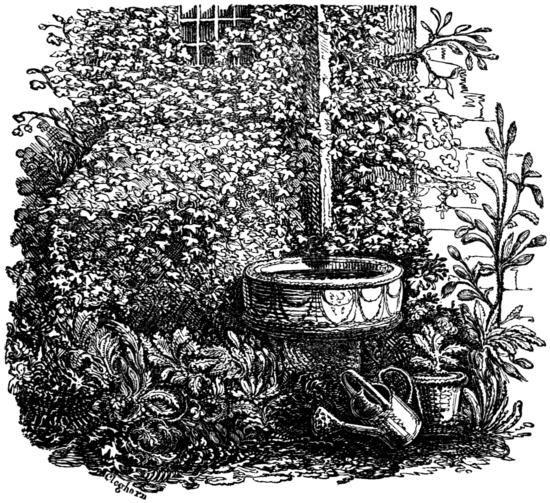
The Font of Harrow Church.
—————————— thus saved From guardian-hands which else had more depraved.
Some years ago, the fine old font of the ancient parish church of Harrow-on-the-Hill was torn from that edifice, by the “gentlemen of the parish,” and given out to mend the roads with. The feelings of one parishioner (to the honour of the sex, a female) were outraged by this act of parochial Vandalism; and she was allowed to preserve it from destruction, and place it in a walled nook, at the garden front of her house, where it still remains. By her obliging permission, a drawing of it was made the summer before last, and is engraved above.
On the exclusion of Harrow font from the church, the parish officers put up the marble wash-hand-basin-stand-looking-thing, which now occupies its place, inscribed with the names of the churchwardens during whose reign venality or stupidity effected the removal of its precessor. If there be any persons in that parish who either venerate antiquity, or desire to see “right things in right places,” it is possible that, by a spirited representation, they may arouse the indifferent, and shame the ignorant to an interchange: and force an expression of public thanks to the lady whose good taste and care enabled it to be effected. The relative situation and misappropriation of each font is a stain on the parish, easily removable, by employing a few men and a few pounds to clap the paltry usurper under the spout of the good lady’s house, and restore the noble original from that degrading destination, to its rightful dignity in the church.
*
Garrick Plays. No. III.
[From the “Rewards of Virtue,” a Comedy, by John Fountain, printed 1661.]
Success in Battle not always attributable to the General.
——— Generals oftimes famous grow By valiant friends, or cowardly enemies; Or, what is worse, by some mean piece of chance. Truth is, ’tis pretty to observe How little Princes and great Generals Contribute oftentimes to the fame they win. How oft hath it been found, that noblest minds With two short arms, have fought with fatal stars; And have endeavour’d with their dearest blood To mollify those diamonds, where dwell The fate of kingdoms; and at last have faln By vulgar hands, unable now to do More for their cause than die; and have been lost Among the sacrifices of their swords; No more remember’d than poor villagers, Whose ashes sleep among the common flowers, That every meadow wears: whilst other men With trembling hands have caught a victory, And on pale foreheads wear triumphant bays. Besides, I have thought A thousand times; in times of war, when we Lift up our hands to heaven for victory; Suppose some virgin Shepherdess, whose soul Is chaste and clean as the cold spring, where she Quenches all thirsts, being told of enemies, That seek to fright the long-enjoyed Peace Of our Arcadia hence with sound of drums, And with hoarse trumpets’ warlike airs to drown The harmless music of her oaten reeds, Should in the passion of her troubled sprite Repair to some small fane (such as the Gods Hear poor folks from), and there on humble knees Lift up her trembling hands to holy Pan, And beg his helps: ’tis possible to think, That Heav’n, which holds the purest vows most rich, May not permit her still to weep in vain, But grant her wish, (for, would the Gods not hear The prayers of poor folks, they’d ne’er bid them pray); And so, in the next action, happeneth out (The Gods still using means) the Enemy May be defeated. The glory of all this Is attributed to the General, And none but he’s spoke loud of for the act; While she, from whose so unaffected tears His laurel sprung, for ever dwells unknown.[43]
Unlawful Solicitings.
When I first Mention’d the business to her all alone, Poor Soul, she blush’d, as if already she Had done some harm by hearing of me speak, Whilst from her pretty eyes two fountains ran So true, so native, down her fairest cheeks; As if she thought herself obliged to cry, ’Cause all the world was not so good as she.
Proportion in Pity.
There must be some proportion still to pity Between ourselves and what we moan: ’tis hard For Men to be ought sensible, how Moats Press Flies to death. Should the Lion, in His midnight walks for prey, hear some poor worms Complain for want of little drops of dew, What pity could that generous creature have (Who never wanted small things) for those poor Ambitions? yet these are their concernments, And but for want of these they pine and die.
Modesty a bar to preferment.
Sure ’twas his modesty. He might have thriven Much better possibly, had his ambition Been greater much. They oftimes take more pains Who look for Pins, than those who find out Stars.
Innocence vindicated at last.
Heav’n may awhile correct the virtuous; Yet it will wipe their eyes again, and make Their faces whiter with their tears. Innocence Conceal’d is the Stoln Pleasure of the Gods, Which never ends in shame, as that of Men Doth oftimes do; but like the Sun breaks forth, When it hath gratified another world; And to our unexpecting eyes appears More glorious thro’ its late obscurity.
Dying for a Beloved Person.
There is a gust in Death, when ’tis for Love, That’s more than all that’s taste in all the world. For the true measure of true Love is Death; And what falls short of this, was never Love: And therefore when those tides do meet and strive And both swell high, but Love is higher still, This is the truest satisfaction of The perfectest Love: for here it sees itself Indure the highest test; and then it feels The sum of delectation, since it now Attains its perfect end; and shows its object, By one intense act, all its verity: Which by a thousand and ten thousand words It would have took a poor dilated pleasure To have imperfectly express’d.
Urania makes a mock assignation with the King, and substitutes the Queen in her place. The King describes the supposed meeting to the Confident, whom he had employed to solicit for his guilty passion.
Pyrrhus, I’ll tell thee all. When now the night Grew black enough to hide a sculking action; And Heav’n had ne’er an eye unshut to see Her Representative on Earth creep ’mongst Those poor defenceless worms, whom Nature left An humble prey to every thing, and no Asylum but the dark; I softly stole To yonder grotto thro’ the upper walks, And there found my Urania. But I found her, I found her, Pyrrhus, not a Mistress, but A Goddess rather; which made me now to be No more her Lover, but Idolater. She only whisper’d to me, as she promised, Yet never heard I any voice so loud; And, tho’ her words were gentler far than those That holy priests do speak to dying Saints, Yet never thunder signified so much. And (what did more impress whate’er she said) Methought her whispers were my injured Queen’s, Her manner just like her’s! and when she urged, Among a thousand things, the injury I did the faithful’st Princess in the world; Who now supposed me sick, and was perchance Upon her knees offering up holy vows For him who mock’d both Heav’n and her, and was Now breaking of that vow he made her, when With sacrifice he call’d the Gods to witness: When she urged this, and wept, and spake so like My poor deluded Queen, Pyrrhus, I trembled; Almost persuaded that it was her angel Spake thro’ Urania’s lips, who for her sake Took care of me, as something she much loved. It would be long to tell thee all she said, How oft she sigh’d, how bitterly she wept: But the effect—Urania still is chaste; And with her chaster lips hath promised to Invoke blest Heav’n for my intended sin.
C. L.
THE CUSHION DANCE.
For the Table Book.
The concluding dance at a country wake, or other general meeting, is the “Cushion Dance;” and if it be not called for when the company are tired with dancing, the fiddler, who has an interest in it which will be seen hereafter, frequently plays the tune to remind them of it. A young man of the company leaves the room; the poor young women, uninformed of the plot against them, suspecting nothing; but he no sooner returns, bearing a cushion in one hand and a pewter pot in the other, than they are aware of the mischief intended, and would certainly make their escape, had not the bearer of cushion and pot, aware of the invincible aversion which young women have to be saluted by young men, prevented their flight by locking the door, and putting the key in his pocket. The dance then begins.
The young man advances to the fiddler, drops a penny in the pot, and gives it to one of his companions; cushion then dances round the room, followed by pot, and when they again reach the fiddler, the cushion says in a sort of recitative, accompanied by the music, “This dance it will no farther go.”
The fiddler, in return, sings or says, for it partakes of both, “I pray, kind sir, why say you so?”
The answer is, “Because Joan Sanderson won’t come to.”
“But,” replies the fiddler, “she must come to, and she shall come to, whether she will or no.”
The young man, thus armed with the authority of the village musician, recommences his dance round the room, but stops when he comes to the girl he likes best, and drops the cushion at her feet; she puts her penny in the pewter pot, and kneels down with the young man on the cushion, and he salutes her.
When they rise, the woman takes up the cushion, and leads the dance, the man following, and holding the skirt of her gown; and having made the circuit of the room, they stop near the fiddler, and the same dialogue is repeated, except, as it is now the woman who speaks, it is John Sanderson who won’t come to, and the fiddler’s mandate is issued to him, not her.
The woman drops the cushion at the feet of her favourite man; the same ceremony and the same dance are repeated, till every man and woman, the pot bearer last, has been taken out, and all have danced round the room in a file.
The pence are the perquisite of the fiddler.
H. N.
P.S. There is a description of this dance in Miss Hutton’s “Oakwood Hall.”
The Cushion Dance.
For the Table Book.
“Saltabamus.”
The village-green is clear and dight Under the starlight sky; Joy in the cottage reigns to night, And brightens every eye: The peasants of the valley meet Their labours to advance, And many a lip invites a treat To celebrate the “Cushion Dance.” A pillow in the room they hide, The door they slily lock; The bold the bashful damsels chide, Whose heart’s-pulse seem to rock: “Escape?”—“Not yet!—no key is found!”— “Of course, ’tis lost by chance;”— And flutt’ring whispers breathe around “The Cushion Dance!—The Cushion Dance!” The fiddler in a corner stands, He gives, he rules the game; A rustic takes a maiden’s hands Whose cheek is red with shame: At custom’s shrine they seal their truth, Love fails not here to glance;— Happy the heart that beats in youth, And dances in the “Cushion Dance!” The pillow’s carried round and round, The fiddler speaks and plays; The choice is made,—the charm is wound, And parleys conquer nays:— “For shame! I will not thus be kiss’d, Your beard cuts like a lance; Leave off—I’m sure you’ve sprained my wrist By kneeling in this ‘Cushion Dance!’” “’Tis aunt’s turn,—what in tears?—I thought You dearly loved a joke; Kisses are sweeter stol’n than bought, And vows are sometimes broke. Play up!—play up!—aunt chooses Ben; Ben loves so sweet a trance! Robin to Nelly kneels again, —Is Love not in the ‘Cushion dance?’” Laughter is busy at the heart, Cupid looks through the eye, Feeling is dear when sorrows part And plaintive comfort’s nigh, “Hide not in corners, Betsy, pray,” “Do not so colt-like prance; One kiss, for memory’s future day, —Is Life not like a ‘Cushion Dance?’” “This Dance it will no further go!” “Why say you thus, good man?” “Joan Sanderson will not come to!” “She must,—’tis ‘Custom’s’ plan:” “Whether she will or no, must she The proper course advance; Blushes, like blossoms on a tree, Are lovely in the ‘Cushion Dance.’” “This Dance it will no further go!” “Why say you thus, good lady?” “John Sanderson will not come to!” “Fie, John! the Cushion’s ready:” “He must come to, he shall come to, ’Tis Mirth’s right throne pleasance; How dear the scene, in Nature’s view To Lovers in a ‘Cushion Dance!’” “Ho! princum prancum!”—Love is blest, Both Joan and John submit; Friends smiling gather round and rest. And sweethearts closely sit;— Their feet and spirits languid grown, Eyes, bright in silence, glance Like suns on seeds of beauty sown, And nourish’d in the “Cushion Dance.” In times to come, when older we Have children round our knees; How will our hearts rejoice to see Their lips and eyes at ease. Talk ye of Swiss in valley-streams, Of joyous pairs in France; None of their hopes-delighting dreams Are equal to the “Cushion Dance.” ’Twas here my Maiden’s love I drew By the hushing of her bosom; She knelt, her mouth and press were true, And sweet as rose’s blossom:— E’er since, though onward we to glory, And cares our lives enhance, Reflection dearly tells the “story”— Hail!—hail!—thou “happy Cushion Dance.”
J. R. Prior.
Islington.
ST. SEPULCHRE’S BELL.
For the Table Book.
On the right-hand side of the altar of St. Sepulchre’s church is a board, with a list of charitable donations and gifts, containing the following item:—
£. s. d.
1605. Mr. Robert Dowe gave for ringing the greatest bell in this church on the day the condemned prisoners are executed, and for other services, for ever, concerning such condemned prisoners, for which services the sexton is paid £1. 6s. 8d. 50 0 0
Looking over an old volume of the Newgate Calendar, I found some elucidation of this inscription. In a narrative of the case of Stephen Gardner, (who was executed at Tyburn, February 3, 1724,) it is related that a person said to Gardner, when he was set at liberty on a former occasion, “Beware how you come here again, or the bellman will certainly say his verses over you.” On this saying there is the following remark:—
“It has been a very ancient practice, on the night preceding the execution of condemned criminals, for the bellman of the parish of St. Sepulchre, to go under Newgate, and, ringing his bell, to repeat the following verses, as a piece of friendly advice to the unhappy wretches under sentence of death:—
All you that in the condemn’d hold do lie, Prepare you, for to-morrow you shall die; Watch all, and pray, the hour is drawing near, That you before the Almighty must appear: Examine well yourselves, in time repent, That you may not to eternal flames be sent. And when St. Sepulchre’s bell to-morrow tolls, The Lord above have mercy on your souls! Past twelve o’clock!”
In the following extract from Stowe’s London,[44] it will be shown that the above verses ought to be repeated by a clergyman, instead of a bellman:—
“Robert Doue, citizen and merchant taylor, of London, gave to the parish church of St. Sepulchres, the somme of £50. That after the several sessions of London, when the prisoners remain in the gaole, as condemned men to death, expecting execution on the morrow following: the clarke (that is the parson) of the church shoold come in the night time, and likewise early in the morning, to the window of the prison where they lye, and there ringing certain toles with a hand-bell appointed for the purpose, he doth afterwards (in most Christian manner) put them in mind of their present condition, and ensuing execution, desiring them to be prepared therefore as they ought to be. When they are in the cart, and brought before the wall of the church, there he standeth ready with the same bell, and, after certain toles, rehearseth an appointed praier, desiring all the people there present to pray for them. The beadle also of Merchant Taylors’ Hall hath an honest stipend allowed to see that this is duely done.”
Probably the discontinuance of this practice commenced when malefactors were first executed at Newgate, in lieu of Tyburn. The donation most certainly refers to the verses. What the “other services” are which the donor intended to be done, and for which the sexton is paid £1. 6s. 8d., and which are to be “for ever,” I do not know, but I presume those services (or some other) are now continued, as the board which contains the donation seems to me to have been newly painted.
Edwin S——.
Carthusian-street, Jan. 1827.
THE DEATH OF THE RED KING
“Come, listen to a tale of times of old; Come, for ye know me.”
Southey.
Who is it that rides thro’ the forest so green, And gazes with joy on the beautiful scene, With the gay prancing war-horse, and helmeted head? ’Tis the monarch of England, stern William the Red. Why starts the proud courser? what vision is there? The trees are scarce mov’d by the still breathing air— All is hush’d, save the wild bird that carols on high, The forest bee’s hum, and the rivulet’s sigh. But, lo! a dark form o’er the pathway hath lean’d ’Tis the druid of Malwood, the wild forest-fiend The terror of youth, of the aged the fear— The prophet of Cadenham, the death-boding seer! His garments were black as the night-raven’s plume. His features were veil’d in mysterious gloom, His lean arm was awfully rais’d while he said, “Well met, England’s monarch, stern William the Red! “Desolation, death, ruin, the mighty shall fall— Lamentation and woe reign in Malwood’s wide hall! Those leaves shall all fade in the winter’s rude blast, And thou shalt lie low ere the winter be past.” “Thou liest, vile caitiff, ’tis false, by the rood, For know that the contract is seal’d with my blood, ’Tis written, I never shall sleep in the tomb Till Cadenham’s oak in the winter shall bloom! “But say what art thou, strange, unsearchable thing, That dares to speak treason, and waylay a king?”— “Know, monarch, I dwell in the beautiful bowers Of Eden, and poison I shed o’er the flowers. “In darkness and storm o’er the ocean I sail, I ride on the breath of the night-rolling gale— I dwell in Vesuvius, ’mid torrents of flame, Unriddle my riddle, and tell me my name!” O pale grew the monarch, and smote on his breast, For who was the prophet he wittingly guess’d: “O, Jesu-Maria!” he tremblingly said, “Bona Virgo!”—he gazed—but the vision had fled. ’Tis winter—the trees of the forest are bare, How keenly is blowing the chilly night air! The moonbeams shine brightly on hard-frozen flood, And William is riding thro’ Cadenham’s wood. Why looks he with dread on the blasted oak tree? Saint Swithin! what is it the monarch can see? Prophetical sight! ’mid the desolate scene, The oak is array’d in the freshest of green! He thought of the contract, “Thou’rt safe from the tomb, Till Cadenham’s oak in the winter shall bloom;” He thought of the druid—“The mighty shall fall, Lamentation and woe reign in Malwood’s wide hall.” As he stood near the tree, lo! a swift flying dart Hath struck the proud monarch, and pierc’d thro’ his heart; ’Twas the deed of a friend, not the deed of a foe, For the arrow was aim’d at the breast of a roe. In Malwood is silent the light-hearted glee, The dance and the wassail, and wild revelrie; Its chambers are dreary, deserted, and lone, And the day of its greatness for ever hath flown. A weeping is heard in Saint Swithin’s huge pile— “Dies Iræ” resounds thro’ the sable-dight aisle— ’Tis a dirge for the mighty, the mass for the dead— The funeral anthem for William the Red!
Aquila.
London. Described by a Writer in 1634.
I will first take a survey of the long-continued deformity in the shape of your city, which is of your buildings.
Sure your ancestors contrived your narrow streets in the days of wheel-barrows, before those greater engines, carts, were invented. Is your climate so hot, that as you walk you need umbrellas of tiles to intercept the sun? or are your shambles so empty, that you are afraid to take in fresh air, lest it should sharpen your stomachs? Oh, the goodly landscape of Old Fish-street! which, if it had not the ill luck to be crooked, was narrow enough to have been your founder’s perspective; and where the garrets, perhaps not for want of architecture, but through abundance of amity, are so narrow, that opposite neighbours may shake hands without stirring from home. Is unanimity of inhabitants in wide cities better exprest than by their coherence and uniformity of building, where streets begin, continue, and end, in a like stature and shape?[45] But yours, as if they were raised in a general resurrection, where every man hath a several design, differ in all things that can make a distinction. Here stands one that aims to be a palace, and next it, one that professes to be a hovel; here a giant, there a dwarf; here slender, there broad; and all most admirably different in faces, as well as in their height and bulk. I was about to defy any Londoner, who dares to pretend there is so much ingenious correspondence in this city, as that he can show me one house like another; yet your houses seem to be reversed and formal, being compared to the fantastical looks of the moderns, which have more ovals, niches, and angles, than in your custards, and are enclosed with pasteboard walls, like those of malicious Turks, who, because themselves are not immortal, and cannot dwell for ever where they build, therefore wish not to be at charge to provide such lastingness as may entertain their children out of the rain; so slight and prettily gaudy, that if they could move, they would pass for pageants. It is your custom, where men vary often the mode of their habits, to term the nation fantastical; but where streets continually change fashion, you should make haste to chain up your city, for it is certainly mad.
You would think me a malicious traveller, if I should still gaze on your mis-shapen streets, and take no notice of the beauty of your river, therefore I will pass the importunate noise of your watermen, (who snatch at fares, as if they were to catch prisoners, plying the gentry so uncivilly, as if they had never rowed any other passengers than bear-wards,) and now step into one of your peascod-boats, whose tilts are not so sumptuous as the roofs of gondolas; nor, when you are within, are you at the ease of a chaise-à-bras.
The commodity and trade of your river belong to yourselves; but give a stranger leave to share in the pleasure of it, which will hardly be in the prospect and freedom of air; unless prospect, consisting of variety, be made up with here a palace, there a wood-yard; here a garden, there a brewhouse; here dwells a lord, there a dyer; and between both, duomo commune.
If freedom of air be inferred in the liberty of the subject, where every private man hath authority, for his own profit, to smoke up a magistrate, then the air of your Thames is open enough, because it is equally free. I will forbear to visit your courtly neighbours at Wapping, not that it will make me giddy to shoot your bridge, but that I am loath to describe the civil silence at Billingsgate, which is so great, as if the mariners were always landing to storm the harbour; therefore, for brevity’s sake, I will put to shore again, though I should be so constrained, even without my galoshes, to land at Puddle-dock.
I am now returned to visit your houses where the roofs are so low, that I presumed your ancestors were very mannerly, and stood bare to their wives; for I cannot discern how they could wear their high-crowned hats: yet I will enter, and therein oblige you much, when you know my aversion to a certain weed that governs amongst your coarser acquaintance, as much as lavender among your coarser linen; to which, in my apprehension, your sea-coal smoke seems a very Portugal perfume. I should here hasten to a period, for fear of suffocation, if I thought you so ungracious as to use it in public assemblies; and yet I see it grow so much in fashion, that methinks your children begin to play with broken pipes instead of corals, to make way for their teeth. You will find my visit short; I cannot stay to eat with you, because your bread is too heavy, and you distrain the light substance of herbs. Your drink is too thick, and yet you are seldom over curious in washing your glasses. Nor will I lodge with you, because your beds seem no bigger than coffins; and your curtains so short, as they will hardly serve to enclose your carriers in summer, and may be held, if taffata, to have lined your grandsire’s skirts.
I have now left your houses, and am passing through your streets, but not in a coach, for they are uneasily hung, and so narrow, that I took them for sedans upon wheels. Nor is it safe for a stranger to use them till the quarrel be decided, whether six of your nobles, sitting together, shall stop and give way to as many barrels of beer. Your city is the only metropolis in Europe, where there is wonderful dignity belonging to carts.
I would now make a safe retreat, but that methinks I am stopped by one of your heroic games called foot-ball; which I conceive (under your favour) not very conveniently civil in the streets, especially in such irregular and narrow roads as Crooked-lane. Yet it argues your courage, much like your military pastime of throwing at cocks; but your metal would be much magnified (since you have long allowed those two valiant exercises in the streets) were you to draw your archers from Finsbury, and, during high market, let them shoot at butts in Cheapside. I have now no more to say, but what refers to a few private notes, which I shall give you in a whisper, when we meet in Moorfields, from whence (because the place was meant for public pleasure, and to show the munificence of your city) I shall desire you to banish your laundresses and bleachers, whose acres of old linen make a show like the fields of Carthagena, when the five months’ shifts of the whole fleet are washed and spread.[46]
A FATHER’S HOME.
For the Table Book.
When oppress’d by the world, or fatigu’d with its charms, My weary steps homeward I tread— ’Tis there, midst the prattlers that fly to my arms, I enjoy purer pleasures instead. Hark! the rap at the door is known as their dad’s, And rushing at once to the lock, Wide open it flies, while the lasses and lads Bid me welcome as chief of the flock. Little baby himself leaves the breast for a gaze Glad to join in th’ general joy, While with outstretched arms and looks of amaze He seizes the new purchas’d toy. Then Harry, the next, climbs the knee to engage His father’s attention again; But Bob, springing forward almost in a rage, Resolves his own rights to maintain. Oh, ye vot’ries of pleasure and folly’s sad crew, From your midnight carousals depart! Look here for true joys, ever blooming and new, When I press both these boys to my heart. Poor grimalkin purs softly—the tea-kettle sings, Midst glad faces and innocent hearts, Encircling my table as happy as kings, Right merrily playing their parts. And Bill (the sly rogue) takes a lump, when he’s able, Of sugar, so temptingly sweet, And, archly observing, hides under the table The spoil, till he’s ready to eat. While George, the big boy, talks of terrible “sums” He perform’d so correctly at school; Bill leeringly tells, with his chin on his thumbs, “He was whipt there for playing the fool!” This raises a strife, till in choleric mood Each ventures a threat to his brother, But their hearts are so good, let a stranger intrude, They’d fight to the last for each other. There Nan, the sweet girl, she that fags for the whole, And keeps the young urchins in order, Exhibits, with innocence charming the soul, Her sister’s fine sampler and border. Kitty sings to me gaily, then chatting apace Helps her mother to darn or to stitch, Reminding me most of that gay laughing face Which once did my fond heart bewitch. While she! the dear partner of all my delight, Contrives them some innocent play; Till, tired of all, in the silence of night, They dream the glad moments away. Oh, long may such fire-side scenes be my lot! Ye children, be virtuous and true! And think when I’m aged, alone in my cot, How I minister’d comfort to you. When my vigour is gone, and to manhood’s estate Ye all shall be happily grown, Live near me, and, anxious for poor father’s fate Show the world that you’re truly my own.
Stanmore Toll-House.
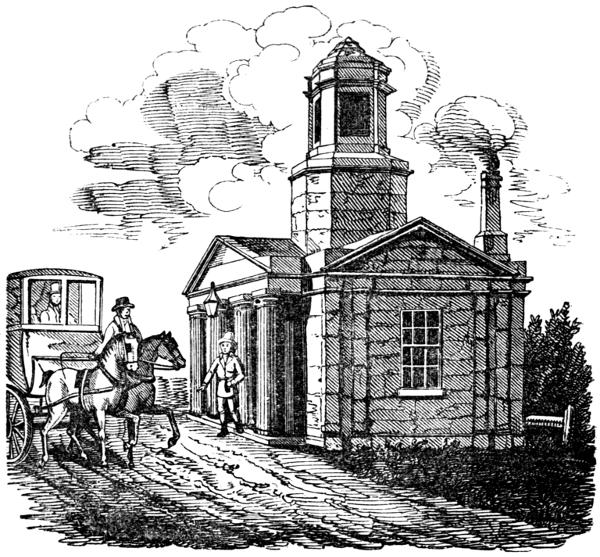
Stanmore Toll-House.
Its ornamental look, and public use, Combine to render it worth observation.
Our new toll-houses are deservedly the subject of frequent remark, on account of their beauty. The preceding engraving is intended to convey an idea of Stanmore-gate, which is one of the handsomest near London. The top is formed into a large lantern; when illuminated, it is an important mark to drivers in dark nights.
It may be necessary to add, that the present representation was not destined to appear in this place; but the indisposition of a gentleman engaged to assist in illustrating this work, has occasioned a sudden disappointment.
“STATUTES” AND “MOPS.”
To the Editor.
Sir,—Although your unique and curious work, the Every-Day Book, abounds with very interesting accounts of festivals, fairs, wassails, wakes, and other particulars concerning our country manners, and will be prized by future generations as a rare and valuable collection of the pastimes and customs of their forefathers, still much of the same nature remains to be related; and as I am anxious that the Country Statute, or Mop, (according to the version of the country people generally,) should be snatched from oblivion, I send you a description of this custom, which, I hope, will be deemed worthy a place in the Table Book. I had waited to see if some one more competent to a better account than myself would achieve the task, when that short but significant word Finis, attached to the Every-Day Book, arouses me from further delay, and I delineate, as well as I am able, scenes which, but for that work, I possibly should have never noticed.
Some months ago I solicited the assistance of a friend, a respectable farmer, residing at Wootton, in Warwickshire, who not only very readily promised to give me every information he possessed on the subject, but proposed that I should pass a week at his farm at the time these Statutes were holding. So valuable an opportunity of visiting them and making my own observations, I, of course, readily embraced. Before I proceed to lay before you the results, it may be as well, perhaps, to give something like a definition of the name applied to this peculiar custom, as also when and for what purpose the usage was established. “Statutes,” or “Statute Sessions,” otherwise called “Petit Sessions,” are meetings, in every hundred of each shire in England where they are held, to which the constables and others, both householders and servants, repair for the determining of differences between masters and servants; the rating, by the sheriff or magistrates, of wages for the ensuing year; and the bestowing of such people in service as are able to serve, and refuse to seek, or cannot get masters.
The first act of parliament for regulating servants’ wages passed in the year 1351, 25th Edward III. At an early period labourers were serfs, or slaves, and consequently there was no law upon the subject. The immediate cause of the act of Edward III. was that plague which wasted Europe from 1347 to 1349, and destroyed a great proportion of its inhabitants. The consequent scarcity of labourers, and the high price demanded for labour, caused those who employed them to obtain legislative enactments, imposing fines on all who gave or accepted more than a stipulated sum. Since that period there have been various regulations of a similar nature. By the 13th of Richard II. the justices of every county were to meet once a year, between Easter and Michaelmas, to regulate, according to circumstances, the rates of wages of agricultural servants for the year ensuing, and cause the same to be proclaimed. But though this power was confirmed to the justices by the 5th of Elizabeth, this part of the custom of Statute Sessions is almost, if not quite, fallen into disuse. It is probable that in the years immediately succeeding the first enactment the population was so restored as to cause the laws to be relaxed, though they still remain as an example of the wisdom of past ages. However this may be, it is certain, that all that is at present understood by “Statutes,” or, as the vulgar call them, “Mops,” is the assembling of masters and servants, the former to seek the latter, and the latter to obtain employment of the former. It is undoubtedly a mutual accommodation; for although the servants now rate and ask what wages they think fit, still they have an opportunity of knowing how wages are usually going, and the masters have hundreds, and, in some cases, thousands of servants to choose from.
The “Statute” I first attended was held at Studley, in Warwickshire, at the latter end of September. On arriving, between twelve and one o’clock, at the part of the Alcester road where the assembly was held, the place was filling very fast by groups of persons of almost all descriptions from every quarter. Towards three o’clock there must have been many thousands present. The appearance of the whole may be pretty accurately portrayed to the mind of those who have witnessed a country fair; the sides of the roads were occupied with stalls for gingerbread, cakes, &c., general assortments of hardware, japanned goods, waggoner’s frocks, and an endless variety of wearing apparel, suitable to every class, from the farm bailiff, or dapper footman, to the unassuming ploughboy, or day-labourer.
The public-houses were thoroughly full, not excepting even the private chambers. The scene out of doors was enlivened, here and there, by some wandering minstrel, or fiddler, round whom stood a crowd of men and boys, who, at intervals, eagerly joined to swell the chorus of the song. Although there was as large an assemblage as could be well remembered, both of masters and servants, I was given to understand that there was very little hiring. This might happen from a twofold cause; first, on account of its being one of the early Statutes, and, secondly, from the circumstance of the servants asking what was deemed (considering the pressure of the times) exorbitant wages. The servants were, for the most part, bedecked in their best church-going clothes. The men also wore clean white frocks, and carried in their hats some emblem or insignia of the situation they had been accustomed to or were desirous to fill: for instance, a waggoner, or ploughboy, had a piece of whipcord in his hat, some of it ingeniously plaited in a variety of ways and entwined round the hatband; a cow-man, after the same manner, had some cow-hair; and to those already mentioned there was occasionally added a piece of sponge; a shepherd had wool; a gardener had flowers, &c. &c.
The girls wishing to be hired were in a spot apart from the men and boys, and all stood not unlike cattle at a fair waiting for dealers. Some of them held their hands before them, with one knee protruding, (like soldiers standing at ease,) and never spoke, save when catechised and examined by a master or mistress as to the work they had been accustomed to; and then you would scarce suppose they had learned to say anything but “Ees, sur,” or “No, sur,” for these were almost the only expressions that fell from their lips. Others, on the contrary, exercised no small degree of self-sufficient loquacity concerning their abilities, which not unusually consisted of a good proportion of main strength, or being able to drive or follow a variety of kinds of plough. Where a master or mistress was engaged in conversation with a servant they were usually surrounded by a group, with their mouths extended to an angle of near forty-five degrees, as if to catch the sounds at the aperture; this in some, perhaps, was mere idle curiosity, in others, from desire to know the wages asked and given, as a guide for themselves. I observed a seeming indifference about the servants in securing situations. They appeared to require a certain sum for wages, without reference to any combination of circumstances or the state of the times; and however exorbitant, they rarely seemed disposed to meet the master by proposing something lower; they would stand for some time and hear reasons why wages should be more moderate, and at the conclusion, when you would suppose they were either willing, in some measure, to accede to the terms, or to offer reasons why they should not, you were mortified to know, that the usual answer was, “Yo’ll find me yarn it, sur,” or “I conna gue for less.”
When a bargain is concluded on at a “Statute,” it is the custom to ratify it immediately, and on the spot, by the master presenting to the servant what is termed “earnest money,” which is usually one shilling, but it varies according to circumstances; for instance, if a servant agrees to come for less than he at first asked, it is, perhaps, on the condition that his earnest is augmented, probably doubled or trebled, as may be agreed on.
The contract arises upon the hiring: if the hiring be general, without any particular time limited, the law construes it to be hiring for one year; but the contract may be made for any longer or shorter period. Many farmers are wary enough to hire their servants for fifty-one weeks only, which prevents them having any claim upon that particular parish in case of distress, &c. We frequently find disputes between two parishes arising out of Statute-hirings brought to the assizes or sessions for settlement.
When the hiring is over, the emblems in the hats are exchanged for ribbons of almost every hue. Some retire to the neighbouring grounds to have games at bowls, skittles, or pitching, &c. &c., whilst the more unwary are fleeced of their money by the itinerant Greeks and black legs with E. O. tables, pricking in the garter, the three thimbles &c. &c. These tricksters seldom fail to reap abundant harvests at the Statutes. Towards evening each lad seeks his lass, and they hurry off to spend the night at the public-houses, or, as is the case in some small villages, at private houses, which, on these occasions, are licensed for the time being.
To attempt to delineate the scenes that now present themselves, would on my part be presumption indeed. It rather requires the pencil of Hogarth to do justice to this varied picture. Here go round the
“Song and dance, and mirth and glee;”
but I cannot add, with the poet,
“In one continued round of harmony:”
for, among such a mingled mass, it is rare but that in some part discord breaks in upon the rustic amusements of the peaceably inclined. The rooms of the several houses are literally crammed, and usually remain so throughout the night, unless they happen to be under restrictions from the magistrates, in which case the houses are shut at a stated hour, or the license risked. Clearances, however, are not easily effected. At a village not far from hence, it has, ere now, been found necessary to disturb the reverend magistrate from his peaceful slumbers, and require his presence to quell disturbances that almost, as a natural consequence, ensue, from the landlords and proprietors of the houses attempting to turn out guests, who, under the influence of liquor, pay little regard to either landlord or magistrate. The most peaceable way of dealing, is to allow them to remain till the morning dawn breaks in and warns them home.
The time for Statute-hiring commences about the beginning of September, and usually closes before old Michaelmas-day, that being the day on which servants enter on their new services, or, at least, quit their old ones. Yet there are some few Statutes held after this time, which are significantly styled “Runaway Mops;” one of this kind is held at Henley-in-Arden, on the 29th of October, being also St. Luke’s fair. Three others are held at Southam, in Warwickshire, on the three successive Mondays after old Michaelmas-day. To these Statutes all repair, who, from one cause or other, decline to go to their new places, together with others who had not been fortunate enough to obtain situations. Masters, however, consider it rather hazardous to hire at these Statutes, as they are in danger of engaging with servants already hired, who capriciously refuse to go to their employment; and if any person hire or retain a servant so engaged, the first hirer has his action for damages against the master and servant; yet, if the new master did not know his servant had been hired before, no action will lie against him, except he refuse to give him up on information and demand. Characters are sometimes required by the master hiring; and these, to the great detriment of society, are given in such a loose and unreserved manner, that (to use the language of the author of the Rambler) you may almost as soon depend on the circumstance of an acquittal at the Old Bailey by way of recommendation to a servant’s honesty, as upon one of these characters.
If a master discovers that a servant is not capable of performing the stipulated work, or is of bad character, he may send the servant to drink the “earnest money;” and custom has rendered this sufficient to dissolve the contract. On the other hand, if a servant has been deceived by the master in any particular, a release is obtained by returning the “earnest.” If, however, there is no just ground of complaint, it is at the master’s option to accept it, and vice versâ. The Statutes I have visited for the purpose of gaining these particulars are Studley, Shipston-on-Stour, and Aston-Cantlow, all in Warwickshire. I observed no particular difference either in the business or the diversions of the day, but Studley was by far the largest. At Stratford-on-Avon, and some other places, there is bull-roasting, &c., which, of course, adds to the amusement and frolic of the visitors.
I believe I have now pretty well exhausted my notes, and I should not have been thus particular, but that I believe Statute-hiring is a custom peculiar to England. I shall conclude by making an extract from Isaac Bickerstaffe’s “Love in a Village.” In scenes the 10th and 11th there is a green, with the prospect of a village, and the representation of a Statute, and the following conversation, &c. takes place:—
Hodge. This way, your worship, this way. Why don’t you stand aside there? Here’s his worship a-coming.
Countrymen. His worship!
Justice Woodcock. Fy! fy! what a crowd’s this! Odds, I’ll put some of them in the stocks. (Striking a fellow.) Stand out of the way, sirrah.
Hodge. Now, your honour, now the sport will come. The gut-scrapers are here, and some among them are going to sing and dance. Why, there’s not the like of our Statute, mun, in five counties; others are but fools to it.
Servant Man. Come, good people, make a ring; and stand out, fellow-servants, as many of you as are willing and able to bear a-bob. We’ll let my masters and mistresses see we can do something at least; if they won’t hire us it sha’n’t be our fault. Strike up the Servants’ Medley.
AIR.
Housemaid. I pray, gentles, list to me, I’m young and strong, and clean, you see; I’ll not turn tail to any she, For work that’s in the country. Of all your house the charge I take, I wash, I scrub, I brew, I bake; And more can do than here I’ll speak, Depending on your bounty. Footman. Behold a blade, who knows his trade. In chamber, hall, and entry: And what though here I now appear, I’ve served the best of gentry. A footman would you have, I can dress, and comb, and shave; For I a handy lad am: On a message I can go, And slip a billet-doux, With your humble servant, madam. Cookmaid. Who wants a good cook my hand they must cross; For plain wholesome dishes I’m ne’er at a loss; And what are your soups, your ragouts, and your sauce, Compared to old English roast beef? Carter. If you want a young man with a true honest heart, Who knows how to manage a plough and a cart, Here’s one to your purpose, come take me and try; You’ll say you ne’er met with a better than I, Geho, dobin, &c. Chorus. My masters and mistresses hither repair, What servants you want you’ll find in our fair; Men and maids fit for all sorts of stations there be, And as for the wages we sha’n’t disagree.
Presuming that these memoranda may amuse a number of persons who, chiefly living in large towns and cities, have no opportunity of being otherwise acquainted with “Statutes,” or “Mops,” in country-places,
I am, &c. W. Pare
Birmingham.
HAM AND STILTON.
For the Table Book.
The Poet’s Epistle of Thanks to a Friend at Birmingham.
“Perlege Mæonio cantatas carmine ranas, Et frontem nugi, solvere disce meis.”
Mary.
Dear Friend,—I feel constrain’d to say, The present sent the other day Claims my best thanks, and while design’d To please the taste, it warm’d my mind. Nor, wonder not it should inspire Within my breast poetic fire! The Cheese seem’d like some growing state, Compos’d of little folks and great; Though we denominate them mites, They call each other Stiltonites. And ’tis most fit, where’er we live, The land our epithet should give: Romans derive their name from Rome, And Turks, you know, from Turkey come. Gazing with “microscopic eye” O’er Stilton land, I did espy Such wonders, as would make those stare Who never peep’d or travell’d there. The country where this race reside Abounds with crags on ev’ry side: Its geographic situation Is under constant variation; Now hurried up, then down again— No fix’d abode can it maintain: And, like the Lilliputian clime, We read about in olden time, Huge giants compass it about, Who dig within, and cut without, And at a mouthful—direful fate! A city oft depopulate! And, then, in Stilton, you must know There is a spot, call’d Rotten-row; A soil more marshy than the rest, Therefore by some esteem’d the best. The natives here, whene’er they dine, Drink nothing but the choicest wine; Which through each street comes flowing down, Like water in New Sarum’s town. In such a quarter, you may guess, The leading vice is drunkenness. Come hither any hour of day, And you shall see whole clusters lay Reeling and floundering about, As though it were a madman’s rout. Those who dwell nearer the land’s end, Where rarely the red show’rs descend, Are in their turns corporeal More sober and gymnastical Meandering in kindred dust, They gauge, and with the dry-rot burst, For we may naturally think, They live not long who cannot drink. Alas! poor Stilton! where’s the muse To sing thy downfall will refuse? Melpomene, in mournful verse, Thy dire destruction will rehearse: Comus himself shall grieve and weep, As notes of woe his gay lyre sweep; For who among thy countless band The fierce invaders can withstand? Nor only foreign foes are thine— Children thou hast, who undermine Thy massive walls that ’girt thee round. And ev’ry corner seems unsound. A few more weeks, and we shall see Stilton, the fam’d-will cease to be! Before, however, I conclude, I wish to add, that gratitude Incites me to another theme Beside coagulated cream. ’Tis not about the village Ham, Nor yet the place call’d Petersham— Nor more renowned Birmingham: Nor is it fried or Friar Bacon, The Muse commands me verse to make on. Nor pigmies, (as the poet feigns,) A people once devour’d by cranes, Of these I speak not—my intention Is something nearer home to mention; Therefore, at once, for pig’s hind leg Accept my warmest thanks, I beg. The meat was of the finest sort, And worthy of a dish at court. Lastly, I gladly would express The grateful feelings I possess For such a boon—th’ attempt is vain, And hence in wisdom I refrain From saying more than what you see— Farewell! sincerely yours,
B.C.
To E. T. Esq. Jan. 1827.
LOVES OF THE NEGROES. At New Paltz, United States. Phillis Schoonmaker v. Cuff Hogeboon.
This was an action for a breach of the marriage promise, tried before ’squire De Witt, justice of the peace and quorum. The parties, as their names indicate, were black, or, as philanthropists would say, coloured folk. Counsellor Van Shaick appealed on behalf of the lady. He recapitulated the many verdicts which had been given of late in favour of injured innocence, much to the honour and gallantry of an American jury. It was time to put an end to these faithless professions, to these cold-hearted delusions; it was time to put a curb upon the false tongues and false hearts of pretended lovers, who, with honied accents, only woo’d to ruin, and only professed to deceive. The worthy counsellor trusted that no injurious impressions would be made on the minds of the jury by the colour of his client—
“’Tis not a set of features, This tincture of the skin, that we admire.”
She was black, it was true; so was the honoured wife of Moses, the most illustrious and inspired of prophets. Othello, the celebrated Moor of Venice, and the victorious general of her armies, was black, yet the lovely Desdemona saw “Othello’s visage in his mind.” In modern times, we might quote his sable majesty of Hayti, or, since that country had become a republic, the gallant Boyer.—He could also refer to Rhio Rhio, king of the Sandwich Islands, his copper-coloured queen, and madame Poki, so hospitably received, and fed to death by their colleague the king of England—nay, the counsellor was well advised that the brave general Sucre, the hero of Ayacucho, was a dark mulatto. What, then, is colour in estimating the griefs of a forsaken and ill-treated female? She was poor, it was true, and in a humble sphere of life; but love levels all distinctions; the blind god was no judge, and no respecter of colours; his darts penetrated deep, not skin deep; his client, though black, was flesh and blood, and possessed affections, passions, resentments, and sensibilities; and in this case she confidently threw herself upon the generosity of a jury of freemen—of men of the north, as the friends of the northern president would say, of men who did not live in Missouri, and on sugar plantations; and from such his client expected just and liberal damages.
Phillis then advanced to the bar, to give her testimony. She was, as her counsel represented, truly made up of flesh and blood, being what is called a strapping wench, as black as the ace of spades. She was dressed in the low Dutch fashion, which has not varied for a century, linsey-woolsey petticoats, very short, blue worsted stockings, leather shoes, with a massive pair of silver buckles, bead ear-rings, her woolly hair combed, and face sleek and greasy. There was no “dejected ’haviour of visage”—no broken heart visible in her face—she looked fat and comfortable, as if she had sustained no damage by the perfidy of her swain. Before she was sworn, the court called the defendant, who came from among the crowd, and stood respectfully before the bench. Cuff was a good-looking young fellow, with a tolerably smartish dress, and appeared as if he had been in the metropolis taking lessons of perfidious lovers—he cast one or two cutting looks at Phillis, accompanied by a significant turn up of the nose, and now and then a contemptuous ejaculation of Eh!—Umph!—Ough!—which did not disconcert the fair one in the least, she returning the compliment by placing her arms a-kimbo, and surveying her lover from head to foot. The court inquired of Cuff whether he had counsel? “No, massa, (he replied) I tell my own ’tory—you see massa ’Squire, I know de gentlemen of de jury berry vell—dere is massa Teerpenning, of Little ’Sophus, know him berry vell—I plough for him;—den dere is massa Traphagan, of our town—how he do massa?—ah, dere massa Topper, vat prints de paper at Big ’Sophus—know him too;—dere is massa Peet Steenberg—know him too—he owe me little money:—I know ’em all massa ’Squire;—I did go to get massa Lucas to plead for me, but he gone to the Court of Error, at Albany;—Massa Sam Freer and massa Cockburn said they come to gib me good character, but I no see ’em here.”
Cuff was ordered to stand aside, and Phillis was sworn.
Plaintiff said she did not know how old she was; believed she was sixteen; she looked nearer twenty-six; she lived with Hons Schoonmaker; was brought up in the family. She told her case as pathetically as possible:—
“Massa ’Squire,” said she, “I was gone up to massa Schoonmaker’s lot, on Shaungum mountain, to pile brush; den Cuff, he vat stands dare, cum by vid de teem, he top his horses and say, ‘How de do, Phillis?’ or, as she gave it, probably in Dutch, ‘How gaud it mit you’ ‘Hail goot,’ said I; den massa he look at me berry hard, and say, Phillis, pose you meet me in the nite, ven de moon is up, near de barn, I got sumting to say—den I say, berry bell, Cuff, I vill—he vent up de mountain, and I vent home; ven I eat my supper and milk de cows, I say to myself, Phillis, pose you go down to de barn, and hear vat Cuff has to say. Well, massa ’Squire, I go, dare was Cuff sure enough, he told heaps of tings all about love; call’d me Wenus and Jewpeter, and other tings vat he got out of de playhouse ven he vent down in the slope to New York, and he ax’d me if I’d marry him before de Dominie, Osterhaut, he vat preached in Milton, down ’pon Marlbro’. I say, Cuff, you make fun on me; he say no, ‘By mine zeal, I vil marry you, Phillis;’ den he gib me dis here as earnest.”—Phillis here drew from her huge pocket an immense pair of scissars, a jack knife, and a wooden pipe curiously carved, which she offered as a testimony of the promise, and which was sworn to as the property of Cuff, who subsequently had refused to fulfil the contract.
Cuff admitted that he had made her a kind of promise, but it was conditional. “I told her, massa ’Squire, that she was a slave and a nigger, and she must wait till the year 27, then all would be free, cording to the new constitution; den she said, berry vell, I bill wait.”
Phillis utterly denied the period of probation; it was, she said, to take place “ben he got de new corduroy breeches from Cripplely Coon, de tailor; he owe three and sixpence, and massa Coon won’t let him hab ’em vidout de money: den Cuff he run away to Varsing; I send Coon Crook, de constable, and he find um at Shaudakin, and he bring him before you, massa.”
The testimony here closed.
The court charged the jury, that although the testimony was not conclusive, nor the injury very apparent, yet the court was not warranted in taking the case out of the hands of the jury. A promise had evidently been made, and had been broken; some differences existed as to the period when the matrimonial contract was to have been fulfilled, and it was equally true and honourable, as the court observed, that in 1827 slavery was to cease in the state, and that fact might have warranted the defendant in the postponement; but of this there was no positive proof, and as the parties could neither read nor write, the presents might be construed into a marriage promise. The court could see no reason why these humble Africans should not, in imitation of their betters, in such cases, appeal to a jury for damages; but it was advisable not to make those damages more enormous than circumstances warranted, yet sufficient to act as a lesson to those coloured gentry, in their attempts to imitate fashionable infidelity.
The jury brought in a verdict of “Ten dollars, and costs, for the plaintiff.”
The defendant not being able to pay, was committed to Kingston jail, a martyr to his own folly, and an example to all others in like cases offending.
THE RETROSPECT.
I have not heard thy name for years; Thy memory ere thyself is dead; And even I forget the tears That once for thy lov’d sake were shed. There was a time when thou didst seem The light and breath of life to me— When, e’en in thought, I could not dream That less than mine thou e’er could be:— Yet now it is a chance that brought Thy image to my heart again; A single flower recall’d the thought— Why is it still so full of pain? The jasmine, round the casement twin’d, Caught mine eye in the pale moonlight. It broke my dream, and brought to mind Another dream—another night. As then, I by the casement leant, As then, the silver moonlight shone But not, as then, another bent Beside me—I am now alone. The sea is now between us twain As wide a gulf between each heart; Never can either have again An influence on the other’s part. Our paths are different; perchance mine May seem the sunniest of the two: The lute, which once was only thine, Has other aim, and higher view. My song has now a wider scope Than when its first tones breath’d thy name; My heart has done with Love—and hope Turn’d to another idol—Fame. ’Tis but one destiny; one dream Succeeds another—like a wave Following its bubbles—till their gleam Is lost, and ended in the grave. Why am I sorrowful? ’Tis not One thought of thee has brought the tear In sooth, thou art so much forgot, I do not even wish thee here. Both are so chang’d, that did we meet We might but marvel we had lov’d: What made our earliest dream so sweet?— Illusions—long, long since remov’d. I sorrow—but it is to know How still some fair deceit unweaves— To think how all of joy below Is only joy while it deceives. I sorrow—but it is to feel Changes which my own mind hath told:— What, though time polishes the steel, Alas! it is less bright than cold. Have more smiles, and fewer tears; But tears are now restrain’d for shame: Task-work the smiles my lip now wears, That once like rain and sunshine came. Where is the sweet credulity, Happy in that fond trust it bore, Which never dream’d the time would be When it could hope and trust no more? Affection, springing warmly forth— Light word, light laugh, and lighter care Life’s afternoon is little worth— The dew and warmth of morning air. I would not live again love’s hour; But fain I would again recall The feelings which upheld its power— The truth, the hope, that made it thrall. I would renounce the worldliness, Now too much with my heart and me; In one trust more, in one doubt less, How much of happiness would be!— Vainer than vain! Why should I ask Life’s sweet but most deceiving part? Alas! the bloom upon the cheek Long, long outlives that of the heart.
L. E. L.—Monthly Magazine.
TIMBER IN BOGS.
It is stated in the second report of the commissioners on the bogs of Ireland, that three distinct growths of timber, covered by three distinct masses of bog, are discovered on examination. But whether these morasses were at first formed by the destruction of whole forests, or merely by the stagnation of water in places where its current was choked by the fall of a few trees, and by accumulations of branches and leaves, carried down from the surrounding hills, is a question.
Professor Davy is of opinion, that in many places where forests had grown undisturbed, the trees on the outside of the woods grew stronger than the rest, from their exposure to the air and sun; and that, when mankind attempted to establish themselves near these forests, they cut down the large trees on their borders, which opened the internal part, where the trees were weak and slender, to the influence of the wind, which, as is commonly to be seen in such circumstances, had immediate power to sweep down the whole of the internal parts of the forest. The large timber obstructed the passage of vegetable recrement, and of earth falling towards the rivers; the weak timber, in the internal part of the forest after it had fallen, soon decayed, and became the food of future vegetation.
Mr. Kirwan observes, that whatever trees are found in bogs, though the wood may be perfectly sound, the bark of the timber has uniformly disappeared, and the decomposition of this bark forms a considerable part of the nutritive substance of morasses. Notwithstanding this circumstance, tanning is not to be obtained in analysing bogs; their antiseptic quality is however indisputable, for animal and vegetable substances are frequently found at a great depth in bogs, without their seeming to have suffered any decay; these substances cannot have been deposited in them at a very remote period, because their form and texture is such as were common a few centuries ago. In 1786 there were found, seventeen feet below the surface of a bog in Mr. Kirwan’s district, a woollen coat of coarse, but even, network, exactly in the form of what is now called a spencer; a razor, with a wooden handle, some iron heads of arrows, and large wooden bowls, some only half made, were also found, with the remains of turning tools: these were obviously the wreck of a workshop, which was probably situated on the borders of a forest. The coat was presented by him to the Antiquarian Society. These circumstances countenance the supposition, that the encroachments of men upon forests destroyed the first barriers against the force of the wind, and that afterwards, according to sir H. Davy’s suggestion, the trees of weaker growth, which had not room to expand, or air and sunshine to promote their increase, soon gave way to the elements.
MODES OF SALUTATION.
Greenlanders have none, and laugh at the idea of one person being inferior to another.
Islanders near the Philippines take a person’s hand or foot, and rub it over their face.
Laplanders apply their noses strongly against the person they salute.
In New Guinea, they place leaves upon the head of those they salute.
In the Straits of the Sound they raise the left foot of the person saluted, pass it gently over the right leg, and thence over the face.
The inhabitants of the Philippines bend very low, placing their hands on their cheeks, and raise one foot in the air, with the knee bent.
An Ethiopian takes the robe of another and ties it about him, so as to leave his friend almost naked.
The Japanese take off a slipper, and the people of Arracan their sandals, in the street, and their stockings in the house, when they salute.
Two Negro kings on the coast of Africa, salute by snapping the middle finger three times.
The inhabitants of Carmene, when they would show a particular attachment, breathe a vein, and present the blood to their friend as a beverage.
If the Chinese meet, after a long separation, they fall on their knees, bend their face to the earth two or three times, and use many other affected modes. They have also a kind of ritual, or “academy of compliments,” by which they regulate the number of bows, genuflections, and words to be spoken upon any occasion. Ambassadors practise these ceremonies forty days before they appear at court.
In Otaheite, they rub their noses together.
The Dutch, who are considered as great eaters, have a morning salutation, common amongst all ranks, “Smaakelyk eeten?”—“May you eat a hearty dinner.” Another is, “Hoe vaart awe.”—“How do you sail?” adopted, no doubt, in the early periods of the republic, when they were all navigators and fishermen.
The usual salutation at Cairo is, “How do you sweat?” a dry hot skin being a sure indication of a destructive ephemeral fever. Some author has observed, in contrasting the haughty Spaniard with the frivolous Frenchman, that the proud, steady gait and inflexible solemnity of the former, were expressed in his mode of salutation, “Come esta?”—“How do you stand?” whilst the “Comment vous portez-vous?” “How do you carry yourself?” was equally expressive of the gay motion and incessant action of the latter.
The common salutation in the southern provinces of China, amongst the lower orders, is, “Ya fan?”—“Have you eaten your rice?”
In Africa, a young woman, an intended bride, brought a little water in a calabash, and kneeling down before her lover, desired him to wash his hands; when he had done this, the girl, with a tear of joy sparkling in her eyes, drank the water; this was considered as the greatest proof she could give of her fidelity and attachment.
Omniana.
POETRY.
For the Table Book.
The poesy of the earth, sea, air, and sky, Though death is powerful in course of time With wars and battlements, will never die. But triumph in the silence of sublime Survival. Frost, like tyranny, might climb The nurseling germs of favourite haunts; the roots Will grow hereafter. Terror on the deep Is by the calm subdu’d, that Beauty e’en might creep On moonlight waves to coral rest. The fruits Blush in the winds, and from the branches leap To mossy beds existing in the ground. Stars swim unseen, through solar hemispheres, Yet in the floods of night, how brightly round The zone of poesy, they reflect the rolling years.
P.
A Bad Sign.
During a late calling out of the North Somerset yeomanry, at Bath, the service of one of them, a “Batcome boy,” was enlivened by a visit from his sweetheart; after escorting her over the city, and being fatigued with showing her what she had “ne’er zeed in all her life,” he knocked loudly at the door of a house in the Crescent, against which a hatchment was placed, and on the appearance of the powdered butler, boldly ordered “two glasses of scalded wine, as hot as thee canst make it.” The man, staring, informed him he could have no scalded wine there—’twas no public-house. “Then dose thee head,” replied Somerset, “what’st hang out thik there zign var.”
INSCRIPTION For a Tomb to the Memory of Captain Hewitson, of the Ship, Town of Ulverston.
By James Montgomery, Esq.
Weep for a seaman, honest and sincere, Not cast away, but brought to anchor here; Storms had o’erwhelm’d him, but the conscious wave Repented, and resign’d him to the grave: In harbour, safe from shipwreck, now he lies, Till Time’s last signal blazes through the skies: Refitted in a moment, then shall he Sail from this port on an eternal sea.