Volume 2 — Vol. II.—45.
Reading edition
St. John’s Well, at Harpham, Yorkshire.
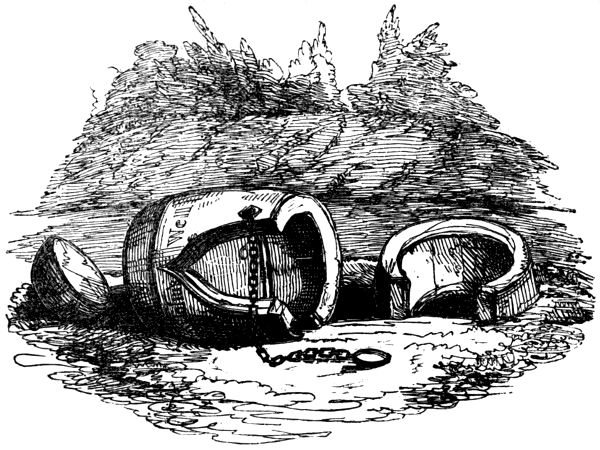
St. John’s Well, at Harpham, Yorkshire.
To the Editor.
The preceding sketch was made on the 17th instant. The well stands by the roadside. The covering stones, though heavy, were at that time laid as above represented, having just before been knocked over by some waggon. Although but a poor subject for the pencil, it is an object of interest from its connection with St. John of Beverley.
“St. John of Beverley may be challenged by this county (York) on a threefold title; because therein he had his
“1. Birth; at Harpham, in this county, in the East Riding.
“2. Life; being three and thirty years, and upwards, archbishop of York.
“3. Death; at Beverley, in this county, in a college of his own foundation.
“He was educated under Theodorus the Grecian, and archbishop of Canterbury. Yet was he not so famous for his teacher as for his scholar, Venerable Bede, who wrote this John’s life; which he hath so spiced with miracles, that it is of the hottest for a discreet man to digest into his belief.”
See “Fuller’s Worthies,” in which a lengthened account of St. John may be found.
Bridlington, July 30, 1827. T. C.
Respecting the subject of the engraving, T. C. subsequently writes: “The stones over St. John’s Well were replaced when I passed it on the 9th of October, 1827.”
Concerning St. John of Beverley, not having “Fuller’s Worthies” at hand to refer to, a few brief particulars are collected from other sources. If the curious reader desires more, he may consult my authorities, and “old Fuller,” as recommended by T. C.
St. John of Beverley.
On his return from pupilage under St. Theodorus, in Kent, St. John of Beverley settled at Whitby, in the monastery of St. Hilda, till, in the reign of Alfred, he was made bishop of Hexham, which see he vacated in favour of St. Wilfrid, and sometime afterwards was seated in the archi-episcopal chair of York. He occasionally retreated to a monastery he had built at Beverley, which was then a forest, called Endeirwood, or Wood of the Deiri. In 717 he resigned the see of York to his chaplain, St. Wilfrid the younger, and finally retired to Beverley, where he died on the 7th of May, 721.[406]
According to Bede, St. John of Beverley being at a village near Hexham, there was brought to him a youth wholly dumb, and with a disorder in the head, “which entirely hindred the grouth of haires, except a few which, like bristles, stood in a thinn circle about the lower part of his head.” He desired the child “to putt forth his tongue, which the holy man took hold of, and made the sign of the crosse upon it. And having done this, he bid him speak: Pronounce, said he to him, gea, gea, (that is, yea, yea.) This the child pronounced distinctly, and presently after other words of more syllables; and, in conclusion, whole sentences: so that, before night, by frequent practice, he was able to expresse his thoughts freely.” Then St. John “commanded a surgeon to use his skill; and in a short time, by such care, but principally by the prayers and benedictions of the good prelat, he became of a lovely and chearfull countenance, adorned with beautifully curled haire, and ready in speech. This miracle was wrought in his first diocese.”[407] Notwithstanding the author of the “Church History of Brittany” calls this a “miracle,” the story rather proves that John of Beverley used a judicious method to remove impediments of speech, and obtained the growth of the boy’s hair by surgical aid.
The same writer adds, on the same authority, that the wife of “a count, named Puch,” was cured of a forty days’ sickness, by John of Beverley giving her holy water, which he had used in dedicating the count’s church. Also, according to him, when the lusty men of Beverley drag wild bulls into the church-yard (to bait them) in honour of the saint, they “immediately loose all their fury and fiercenes, and become gentle as lambes, so that they are left to their freedom to sport themselves.” William of Malmsbury relates this “as a thing usually performed, and generally acknowledged by the inhabitants of Beverley, in testimony of the sanctity of their glorious patron.”
Again, it is related in the Breviary of the church of Sarum, concerning St. John of Beverley, that while he governed in the see of York, “he was praying one day in the porch of St. Michael, and a certain deacon peeping in saw the Holy Ghost sitting upon the altar, excelling in whiteness a ray of the sun:” and the face of this deacon, whose name was Sigga, “was burnt by the heat of the Holy Spirit,” so that the skin of his cheek was shrivelled up; and his face was healed by the touch of the saint’s hand: and “the saint adjured him, that whilst he lived he would discover this vision to no man.”[408]
The more eminent fame of the patron of Beverley is posthumous. In 937, when England was invaded by the Norwegians, Danes, Picts, and certain chiefs of the Scottish isles, under Analaf the Dane, king Athelstan, marching with his army through Yorkshire to oppose them, met certain pilgrims returning from Beverley, who “informed him of the great miracles frequently done there, by the intercession of St. John.” Whereupon the king, with his army, went to Beverley, and entering into the church there performed his devotions before St. John’s tomb; and, earnestly begging his intercession, rose up before the clergy, and vowed, that if victory were vouched to him by the saint’s intercession, he would enrich that church with many privileges and plentiful revenues. “In token of which,” said he, “I leave this my knife upon the altar, which at my return I will redeem with an ample discharge of my vow.” Then he caused an ensign, duly blessed, to be taken out of the church, and carried before him. And at the sea-coast “he received a certain hope of victory by a vision, in which St. John of Beverley, appearing to him, commanded him to passe over the water, and fight the enemy, promising him the upper hand.” Athelstan was suddenly surprised by Analaf; but a sword fell “as from heaven” into the king’s scabbard, and he “not only drove Analafe out of his camp, but courageously sett upon the enemy, with whose blood he made his sword drunk, which he had received from heaven.” This battle, which was fought at Dunbar, was the bloodiest since the coming of the Saxons. The victory was entirely for the English: five kings were slain, and among them the Scottish king Constantine. Athelstan, returning in triumph, passed by the church of St. John at Beverley, where he redeemed his knife. He bestowed large possessions on the church, with privilege of sanctuary a mile round; ordaining that whoever should infringe it should forfeit eight pounds to the church; if within the three crosses, at the entrance of the town, twenty-four pounds; if within the church-yard, seventy-two pounds; but, if in sight of the relics, the penalty was the same that was due to the most enormous capital crime. A testimony of this privilege of sanctuary at Beverley was a chair of stone, thus inscribed:—“This stone chair is called Freed-stoole, or the Chaire of Peace: to which any offender flying shall enjoy entire security.” In the charter of the privilege, “King Athelstan,” saith mine author, “expressed it elegantly, in this distich:—
As free make I thee, As heart may think or eye may see.”[409]
Moreover, respecting the great victory of Athelstan, an ancient biographer of the saints[410] relates, that the king prayed that through the intercession of St. John of Beverley he might show some evident sign, whereby both future and present ages might know, that the Scots ought, of right, to be subject to the English. And thereupon, saith this writer, “the king with his sword smote upon a hard rock by Dunbar, and to this day it is hollowed an ell deep by that stroke.”[411] This, saith another author, was near Dunbar castle; and “king Edward the first, when there was question before pope Boniface of his right and prerogative over Scotland, brought this historie for the maintenance and strength of his cause.”[412]
The monastery of St. John at Beverley having been destroyed by the Danes, king Athelstan founded in that place a church and college of canons, of which church St. Thomas à Becket was some time provost.[413] In 1037, the bones of St. John were “translated” into the church by Alfric, archbishop of York, and the feast of his translation ordained to be kept at York on the 25th of October.[414] “On the 24th of September, 1664, upon opening a grave in the church of Beverley a vault was discovered of free-stone, fifteen feet long and two broad; in which there was a sheet of lead, with an inscription, signifying that the church of Beverley having been burnt in the year 1188, search had been made for the relics of St. John, anno 1197, and that his bones were found in the east part of the sepulchre and there replaced. Upon this sheet lay a box of lead, in which were several pieces of bones, mixed with a little dust, and yielding a sweet smell: all these were reinterred in the middle alley of the church.”[415] Another writer[416] states the exhumation to have taken place “on the thirteenth of September, not the twenty-fourth;” and he adds, “that these relics had been hid in the beginning of the reign of king Edward VI.”
It must not be omitted, that the alleged successful intercession of St. John of Beverley in behalf of the English against the Scotch, is said to have been paralleled by patronage as fatal to the French. The memorable battle of Agincourt was fought in the year 1415, on the anniversary of the translation of St. John of Beverley, and Henry V. ascribed the decisive victory to the saint’s intercession. In a provincial synod, under Henry Chicheley, archbishop of Canterbury, is a decree, at the instance of that king, “whereby it appeares, that this most holy bishop, St. John of Beverley, hath been an ayde to the kings of England in the necessitie of their warres, not only in auncient, but allsoe in these later ages.”[417] In consequence of this ascription, his festivals were ordained to be celebrated annually through the whole kingdom of England. The anniversary of his death has ceased to be remembered from the time of the Reformation; but that of his translation is accidentally kept as a holiday by the shoemakers, in honour of their patron, St. Crispin, whose feast falls on the same day.
*
BEVERLEY THE STRONG MAN.
In March 1784, a porter of amazing strength, named Beverley, was detected in stealing pimento on board a ship in the river Thames. A number of men were scarcely able to secure him; and when they did, they were under the necessity of tying him down in a cart, to convey him to prison. The keeper of the Poultry Counter would not take him in; they were therefore obliged to apply for an order to carry him to Newgate. Beverley was supposed to have been the strongest man of his time in England.[418]
Garrick Plays. No. XXXIX.
[From the “Ambitious Statesman,” a Tragedy, by John Crowne, 1679.]
Vendome, returning from the wars, hears news, that Louize is false to him.
Ven. (solus.) Wherere I go, I meet a wandering rumour, Louize is the Dauphin’s secret mistress. I heard it in the army, but the sound Was then as feeble as the distant murmurs Of a great river mingling with the sea; But now I am come near this river’s fall, Tis louder than the cataracts of Nile. If this be true, Doomsday is near, and all the heavens are falling.— I know not what to think of it, for every where I meet a choking dust, such as is made After removing all a palace furniture: If she be gone, the world in my esteem Is all bare walls; nothing remains in it But dust and feathers, like a Turkish inn, And the foul steps where plunderers have been.—
Valediction.
Vendome (to his faithless Mistress.) Madam, I’m well assur’d, you will not send One poor thought after me, much less a messenger, To know the truth; but if you do, he’ll find, In some unfinish’d part of the creation, Where Night and Chaos never were disturb’d, But bed-rid lie in some dark rocky desart, There will he find a thing—whether a man, Or the collected shadows of the desart Condens’d into a shade, he’ll hardly know; This figure he will find walking alone, Poring one while on some sad book at noon By taper-light, for never day shone there: Sometimes laid grovelling on the barren earth, Moist with his tears, for never dew fell there: And when night comes, not known from day by darkness, But by some faithful messenger of time, He’ll find him stretcht upon a bed of stone, Cut from the bowels of some rocky cave, Offering himself either to Sleep or Death; And neither will accept the dismal wretch: At length a Slumber, in its infant arms, Takes up his heavy soul, but wanting strength To bear it, quickly lets it fall again; At which the wretch starts up, and walks about All night, and all the time it should be day; Till quite forgetting, quite forgot of every thing But Sorrow, pines away, and in small time Of the only man that durst inhabit there, Becomes the only Ghost that dares walk there.
Incredulity to Virtue.
Vendome. Perhaps there never were such things as Virtues, But only in men’s fancies, like the Phœnix; Or if they once have been, they’re now but names Of natures lost, which came into the world, But could not live, nor propagate their kind.
Faithless Beauty.
Louize. Dare you approach? Vendome. Yes, but with fear, for sure you’re not Woman. A Comet glitter’d in the air o’ late, And kept some weeks the frighted kingdom waking. Long hair it had, like you; a shining aspect; Its beauty smiled, at the same time it frighten’d; And every horror in it had a grace.
[From “Belphegor,” a Comedy, by John Wilson, 1690.]
Doria Palace described.
That thou’d’st been with us at Duke Doria’s garden! The pretty contest between art and nature; To see the wilderness, grots, arbours, ponds; And in the midst, over a stately fountain, The Neptune of the Ligurian sea— Andrew Doria—the man who first Taught Genoa not to serve: then to behold The curious waterworks and wanton streams Wind here and there, as if they had forgot Their errand to the sea. And then again, within That vast prodigious cage, in which the groves Of myrtle, orange, jessamine, beguile The winged quire with a native warble, And pride of their restraint. Then, up and down, An antiquated marble, or broken statue, Majestic ev’n in ruin. And such a glorious palace: Such pictures, carving, furniture! my words Cannot reach half the splendour. And, after all, To see the sea, fond of the goodly sight, One while glide amorous, and lick her walls, As who would say Come Follow; but, repuls’d, Rally its whole artillery of waves, And crowd into a storm!
[From the “Floating Island,” a Comedy, by the Rev. W. Strode, acted by the Students of Christ-Church, Oxford, 1639.]
Song.
Once Venus’ cheeks, that shamed the morn, Their hue let fall; Her lips, that winter had out-born, In June look’d pale: Her heat grew cold, her nectar dry; No juice she had but in her eye, The wonted fire and flames to mortify. When was this so dismal sight?— When Adonis bade good night.
C. L.
PLAYERS—GHOST LAYERS.
For the Table Book.
Christian Malford, Wilts.
It required a large portion of courage to venture abroad after sunset at Christian Malford, for somebody’s apparition presented itself to the walker’s imagination. Spritely gossips met near their wells with their crooked sticks and buckets, to devise means for laying the disturbed returners and their once native associates; but a party of strolling players did more towards sending the spectres to the “tomb of all the Capulets,” than the divinations of feminine power.
Application being made to the magistrate, who was not exempt from the superstitious and revered infection, that plays might be performed in the malthouse, said to be so daringly haunted, a timely caution was given as to “Beelzebub and his imps,” and permission was granted, and bills were circulated by the magnanimous manager himself. He was a polite man, a famous anecdote retailer, retainer, and detailer, an excellent spouter, and a passable singer. His dress and address were eccentric. The hessians he wore, by fit necessity, were of the buskin order; and, as bread was then dear, a sixpenny loaf might have supplied the absence of calves. His pigtail-wig, hat, and all his apparel indeed, served, when on the dramatic floor, most aptly the variations required in his wardrobe.
I remember, when the “Miller of Mansfield” was played, the bell rang, the baize was drawn up by a stable-halter, the fiddler began to scrape a ditty by way of overture; but, before the miller could appear, a smockfrock was called for, from one of the frocked rustics in the gallery, (the back seats of the scaffolding.) This call was generously obeyed. A youth pulled off his upper-all, proudly observing, that “the player should have it, because his was a sacred persuasion.” The miller appeared, and the play proceeded, with often repeated praises of the frock. On another night, “Richard” was personated by a red-haired woman, an active stroller of the company. Her manner of enacting the deformed and ambitious Glo’ster so charmed the village censors, that for three weeks successively nothing else would please but “Richard.” Nor was the effect less operative in the field, (not of Bosworth)—Virgil’s “Bucolics and Georgics” were travestied. Reaphooks, sithes, pitchforks, and spades were set in contact in the daytime, to the great amusement and terror of quiet people.—The funds of the company being exhausted, the Thespians tramped off rather suddenly, leaving other bills than playbills behind them. Ever after this the ghosts of the malthouse disappeared, the rustics of the valley crying, as they triumphantly passed, “Off with his head!” and others, replying in the words of Hamlet, “Oh! what a falling off is here!”
ΠΡΙ.
Oct. 1827.
EX-THESPIANISM.
For the Table Book.
I am the son of a respectable attorney, who sent me, when very young, to an excellent school, at which I conducted myself much to the satisfaction of my superiors. It was customary for the scholars to enact a play at Christmas, to which the friends of the master were invited. On one of these occasions, when I was now nearly head-boy, I was called upon to perform the part of Charles Surface, in the admirable comedy of the School for Scandal. I studied the character, and played it with great applause, and shortly afterwards left the school, and was sent by my father to Boulogne to finish my education.
There were then at that place a number of English gentlemen, who were endeavouring to establish a company of amateurs. On their request I joined them, and made my first appearance upon a regular stage in the character of Shylock. It was a decided hit! I was received throughout with “unbounded applause,” and the next day was highly gratified by reading “honourable mention” of my performance in the newspapers. I repeated this and other characters several times with undiminished success; but, in the very zenith of my popularity, I was recalled to England by my father, who, having heard of my operations, began to fear (what afterwards proved to be the case) that I should be induced to adopt that as a profession, which I had hitherto considered merely as an amusement.
Soon after my return home my father articled me to himself, but it was impossible for me to forget my success at Boulogne, and my inclination for the stage ripened into a determination to become an actor. I secretly applied to Mr. Sims, of the Harp, who procured me an engagement in a sharing company in the west of England, where I was to do the “low comic business” and “second tragedy.” I spent some of the money that I had saved in buying wigs and a few other stage-requisites, and left my paternal roof with three pounds in my pocket.
My exchequer not being in a state to afford me the luxury of riding, I was compelled to walk the last thirty miles of my journey. Upon my arrival at ——, my first care was to inquire for the theatre, when I was directed to a barn, which had been dignified by that appellation. I was received with all possible civility by the company, which consisted of the manager, his wife, and three gentlemen. I was informed by the manager that Jane Shore was the play for that evening, and that he should expect me to perform the part of Belmont, and also that of Bombastes Furioso in the afterpiece. The wardrobe of the theatre was unable to afford me a dress superior to my own for the part of Belmont, I therefore played that character “accoutred as I was,” viz. in a blue coat, buff waistcoat, striped trowsers, and Wellington’s. The audience was very select, consisting only of ten persons, who seemed totally indifferent to the performance, for they never once, in the course of the evening, gave any indication of pleasure, or the reverse, but witnessed our efforts to amuse with the most provoking apathy. Between the pieces I was much surprised by one of the gentlemen requesting the loan of my hat for a few minutes, as he was about to sing a song, and he assured me that there was no hat in the company, save mine, which was worthy to appear before the audience. At the conclusion of the performance we shared the receipts, which, after deducting the expenses of the house, amounted to one shilling and sixpence each. We continued to act for some time, sharing (three nights a week) from about one shilling and sixpence to two shillings each, which sum did not at all equal my sanguine expectations. Frequently have I performed kings and princes after having breakfasted upon a turnip.
I soon found that this mode of living did not suit me, for I was becoming exceedingly spare. I therefore resolved to quit the company, and return to London. Having informed the manager of my intention, I departed, and arrived in the metropolis with twopence in my pocket. I proceeded to my father’s house, where I was received with kindness, and where I still continue. I have relinquished all my pretensions to the sock, having learned from experience that which it was not in the power of reason to convince me of.
Gilbertus.
SILCHESTER, HANTS.
For the Table Book.
Every thing in this world is subject to change, and the strongest buildings to decay. The ancient Vindonum of the Romans, from whence Constantius issued several of his edicts, does not form an exception to this rule. From being a principal Roman station, it is now a heap of ruins.
Silchester is situated about eleven miles from Reading, on the side of a hill, or rather on a level spot between two, and commands most beautiful views: from its being surrounded by woodland, a stranger would be unaware of his approach to it, until he arrived at the spot. The circumference of the walls is about two miles; they possess four gates, east, north, west, and south, and are in some places twelve or fourteen feet high, and four or five feet in width; there are many fine trees (as was observed by Leland in his time) growing out of them: the wall was surrounded by a deep and broad ditch, which is now in some places nearly filled up by the ruins of the wall, and beyond which is “the external vallum, very perfect and easily to be traced out round the whole city; its highest parts, even in the present state, are at least fifteen feet perpendicular from the bottom of the ditch. A straight line, drawn from the top of this bank to the wall on the north-east side, measured thirty-four yards, its full breadth.”[419]
Between the outside of the walls and the furthest vallum was the Pomœrium, which is defined by Livy to be that space of ground both within and without the walls, which the augurs, at the first building of cities, solemnly consecrated, and on which no edifices were suffered to be raised.[420] Plutarch is of a different opinion, and ascribes the derivation of Pomœrium to pone mœnia, and states that it signifies the line marked out for the wall at the first foundation of a city.[421]
About a hundred and fifty yards from the north-east angle of the wall is a Roman amphitheatre, the form of which is similar to that near Dorchester, with high and steep banks, now covered with a grove of trees, and has two entrances. The elevation of the amphitheatre consists of a mixture of clay and gravel: the seats were ranged in five rows one above the other; the slope between each measuring about six feet: each bank progressively rises, (and increases proportionably in width,) to a considerable height in the centre. The area of the amphitheatre is about twenty-five yards in diameter, as near as I could guess; it is commonly covered with water, and is become a complete marsh, having a drain across the centre, and is filled up with rushes. I was informed by the woman who showed it, that some gentlemen a short time since procured a shovel, and found a fine gravel bottom at about a foot deep.
The only buildings within the walls are the farm-house and the parish church, which is an ancient structure, built of brick and flint, in the form of the letter T. The interior of the church is plain and neat; the font is of an octagonal form, of plain stone; the pulpit is also octagonal, made of oak, and is remarkably neat; over it is a handsome carved oak sounding-board, surmounted by a dove, with an olive-branch in its mouth, and round the board, at the lower part, in seven compartments, is the following inscription:—“The Gyift of James Hore, Gent. 1639.” The ascent to the pulpit is from the minister’s reading-desk, which also serves for a seat for his family. The chancel is separated from the body of the church by a handsome carved screen, in excellent preservation. In the south wall of the church, under a low pointed arch, is the recumbent figure of a female, carved in stone, of a very remote date, with the feet resting against an animal, (probably a dog,) the head of which is much damaged: there is also an angel’s head, which has been broken off from some part of the monument, and is of course loose; from what part it came I was unable to discover.
In the chancel affixed to the north wall is the following inscription on a handsome white marble monument; it is surmounted by a crown of glory, and at the bottom is a death’s head:—
Vive ut Vivas. Hic juxta situs est Johannis Paris, D.D. Collegii Trinitatis apud Cantabrigiensis Socius Senior & hujus Ecclesiæ Rector: de quo nisi opera loquantur Siletur. O I[422]
There are also monuments of the Baynards, the Cusanzes, and the Blewets, which families were owners of the manor from the time of the conquest for some generations.
On the south side of the city is a small postern under the wall, called by the common people “Onion’s hole,” and is so designated from a traditional account of a giant of that name; the coins which have been discovered are called from the cause “Onion’s pennies.”
A fair field is here open for the researches of the antiquarian; and it is much to be regretted that a good account of the place is not yet published. “The History and Antiquities of Silchester,” whence I have cited, is a pamphlet of thirty-two pages, and affords but little information. Hoping to see justice done to the place, I beg to subscribe myself, &c.
J. R. J.
TO THE NIGHTSHADE.
For the Table Book.
Lovely but fearful, Thy stem clings round a stronger power, Like a fond child that trusts and grows More beautiful in feeling’s hour. Rich is thy blossom, Shaped like a turban, with a spire Of orange in a purple crest, And humid eye of sunny fire. When the day wakens, Thou hearest not the happy airs Breathed into zephyr’s faery dreams, By insects’ wings, like leaves, in pairs. Summer—when over— Quits thee, with clust’ring berries red. Hanging like grapes, and autumn’s cold Chills what the noon-day’s sunbeams fed. Thou art like beauty, Gentle to touch and quickly faded; ’Tis death to taste thee void of skill, And thou, like death, art nightly shaded.
*, *, P.
Sept. 1827.
The Velocitas, Or Malton, Driffield, and Hull Fly Boat
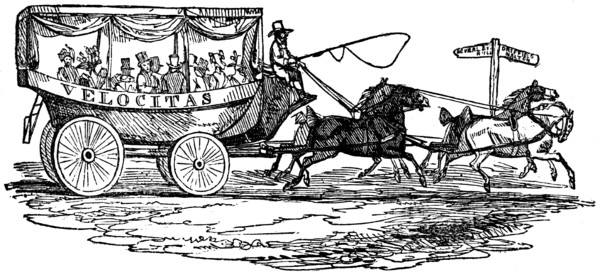
The Velocitas, Or Malton, Driffield, and Hull Fly Boat.
To the Editor.
A carriage bearing this name, of which the above is a sketch, forms a neat, safe, pleasant, and commodious conveyance from Malton, by way of Driffield, to Hull every other day, and from Hull to Malton on the intermediate days, during the summer months. The vehicle is, in fact, a boat on wheels, driven like a stage-coach, and furnished on each side of the body with a seat, extending the whole length, on which the passengers are ranged. The top is covered with a permanent awning, to which a curtain appended may be drawn up or let down at pleasure, so as to enjoy a view of the country, or shut out the sun and weather.
Bridlington, Oct. 1827. T. C.
SHEEPSHEARING IN CUMBERLAND.
To the Editor.
Sir,—The letters of W. C., in a recent number of the Table Book, recalled to my mind four of the happiest years of my life, spent in Cumberland, amongst the beautiful lakes and mountains in the neighbourhood of Keswick, where I became acquainted with a custom which I shall attempt to describe.
A few days previous to the “clipping,” or shearing of the sheep, they are washed at a “beck,” or small river, not far from the mountain on which they are kept. The clippings that I have witnessed have generally been in St. John’s vale. Several farmers wash their sheep at the same place; and, by that means, greatly assist each other. The scene is most amusing. Imagine to yourself several hundred sheep scattered about in various directions; some of them enclosed in pens by the water-side; four or five men in the water rolling those about that are thrown in to them; the dames and the pretty maidens supplying the “mountain dew” very plentifully to the people assembled, particularly those that have got themselves well ducked; the boys pushing each other into the river, splashing the men, and raising tremendous shouts. Add to these a fine day in the beginning of June, and a beautiful landscape, composed of mountains, woods, cultivated lands, and a small meandering stream; the farmers and their wives, children, and servants, with hearty faces, and as merry as summer and good cheer can make them: and I am sure, sir, that you, who are a lover of nature in all her forms, could not wish a more delightful scene.
I will now proceed to the “clipping” itself. Early in the forenoon of the appointed day, the friends and relatives of the farmer assemble at his house, for they always assist each other, and after having regaled themselves with hung-beef, curds, and home-brewed ale, they proceed briskly to business. The men seat themselves on their stools, with shears in their hands, and the younger part of the company supply them with sheep from the fold; which, after having been sheared, have the private mark of the farmer stamped upon them with pitch. In the mean time the lasses are fluttering about, playing numerous tricks; for which, by the by, they get paid with interest by kisses; and the housewife may be seen busy in preparing the supper, which generally comprises all that the season affords. After the “clipping” is over, and the sheep driven on to the fells, (mountains,) they adjourn in a body to the house; and then begins a scene of rustic merriment, which those who have not witnessed it, can have no conception of. The evening is spent in drinking home-brewed ale, and singing. Their songs generally bear some allusion to the subject in question, and are always rural. But what heightens the pleasure is, that there is no quarrelling, and the night passes on in the utmost harmony. I have attended many of them, and never saw the slightest symptoms of anger in any of the party. They seldom break up till daylight makes its appearance next morning.
I am, sir, Your constant reader, A. W. R.
DR. GRAHAM.
For the Table Book.
In the year 1782, that extraordinary empiric of modern times, Dr. Graham, appeared in London. He was a graduate of Edinburgh, wrote in a bombastic style, and possessed a great fluency of elocution. He opened a mansion in Pall Mall, called “The Temple of Health;” the front was ornamented with an enormous gilt sun, a statue of Hygeia, and other attractive emblems. The rooms were superbly furnished, and the walls decorated with mirrors, so as to confer on the place an effect like that of an enchanted palace. Here he delivered “Lectures on Health, &c.” at the extravagant rate of two guineas each. As a further attraction, he entertained a female of beautiful figure, whom he called the “goddess of health.” He hired two men of extraordinary stature, provided with enormous cocked hats and showy liveries, to distribute bills from house to house about town.
These unusual means to excite curiosity were successful; but his two guinea auditors were soon exhausted; he then dropped to one guinea; afterwards to half a guinea; then to five shillings; and, subsequently, as he said, “for the benefit of all,” to two shillings and sixpence. When he could not “draw” at that price, he finally exhibited the “Temple of Health” at one shilling a head to daily crowds for several months.
Among the furniture of Dr. Graham’s temple was a celestial bed, which he pretended wrought miraculous effects on those who reposed on it: he demanded for its use during one night one hundred pounds; and such is the folly of wealth, that several personages of high rank acceded to his terms. He also pretended to have discovered “The Elixir of Life,” by taking of which a person might live as long as he pleased. When this was worn out, he recommended “earth bathing,” and sanctioned it by his own practice. During one hour every day, he admitted spectators to view him and the goddess of health immersed naked in the ground to their chins. The doctor’s head was dressed and powdered, and the goddess’s was arranged in the highest fashion of the times. He carried this exhibition to every provincial town wherein he could obtain permission of the magistrates. The goddess nearly fell a victim to the practice, and the doctor, in spite of his enormous charges and his “Elixir of life,” died in poor circumstances at the age of fifty-two.
Dr. Graham’s brother married the celebrated Mrs. Macaulay, the historian, and Dr. Arnold, of Leicester, the respectable author of an able treatise on insanity, married his sister. It is generally understood that the lady who performed the singular part of the “Goddess of Health” was Emma, afterwards the wife of sir William Hamilton, and the personal favourite of the celebrated lord Nelson. She died in misery—
Deserted in her utmost need By those her former bounty fed.
Sam Sam’s Son.
Sept. 1, 1827.
STORKS.
The storks of the Low Countries are mentioned more than once in the journal of the gentlemen deputed by the “Caledonian Horticultural Society” to visit the gardens of our continental neighbours. Their route from Antwerp to Rotterdam is marked by the following entry:—
August 22, 1817. “In the course of our progress into this land of meadows and waters, we had been making inquiries about the storks (Ardea Ciconia, L.) which every year visit Holland in the breeding season; and we learned that the great flock had taken its departure about ten days before. We observed several of their nests, set like wicker-baskets on the roofs of the dwelling-houses; and we had the good fortune to see one solitary dam still covering her brood, on account probably of the young one not having been sufficiently fledged to enable it to accompany the main body. We persuaded the conductor to allow us to get out of the carriage, and examine this rarity: the bird showed no sort of alarm, the ooyevaar (as our Dutch friends called it) being privileged in Holland. In many places where a new house is built a nest-box is erected on the gable, or on the ridge of the roof, partly to invite the bird to make a settlement, and partly perhaps to save the thatch of the roof, in case it should come without invitation.” It is remarked by way of note, that “previous to the great migration the storks assemble in large groups, and make an unusual noise. It is known that they winter chiefly in Egypt. Pope has finely alluded to their remarkable instinct:—
Who calls the council, states the certain day? Who forms the phalanx, and who points the way?
In the beginning of May they return, like swallows, to their former haunts, the old birds carefully seeking out their accustomed nests. Sometimes, though rarely, a stray stork crosses the channel, and is seen on the English coast. It is there incessantly persecuted; it commonly perches on the roof of some thatched farm-house, where its experience leads it to hope for protection,—but it is not the dwelling of a quiet Dutch boor;[423] some pseudo-sportsman of a farmer shoots the poor bird while at roost.”
Of the numerous families which frequent the sides of rivers and the sea-beach, that of the stork is the best known and the most celebrated. It contains two species, the white and the black. They are exactly of the same form, and have no external difference but that of colour.
The black stork prefers desert tracts, perches on trees, haunts unfrequented marshes, and breeds in the heart of forests.
The white stork, on the contrary, settles beside dwellings; inhabits towers, chimnies, and ruins. The friend of man, it shares his habitations, and even his domain. It fishes in his rivers, pursues its prey into his gardens, and takes up its abode in the midst of cities, without being disturbed by the noise and bustle. On the Temple of Concord, in the capitol of Rome, were many storks’ nests. The fact is memorialized on the medals of the emperor Adrian, and alluded to by Juvenal in his first satire.
The stork flies steadily and with vigour; holds its head straight forward, and stretches back its legs, to direct its motion; soars to a vast height, and performs distant journies even in tempestuous seasons. It arrives in Germany about the eighth or tenth of May, and is seen before that time in the provinces of France. Gesner says, it precedes the swallow, and enters Switzerland in the month of April, and sometimes earlier. It arrives in Alsace in March, or even in the end of February. The return of the storks is ever auspicious, as it announces the spring. They instantly indulge those tender emotions which that season inspires: Aldrovandus paints with warmth their mutual signs of felicity, the eager congratulations, and the fondling endearments of the male and female, on their coming home from their distant journey. “When they have arrived at their nest—good God! what sweet salutation; what gratulation for their prosperous return! what embraces! what honied kisses! what gentle murmurs they breathe!” It is to be observed, that they always settle in the same spots, and, if their nest has been destroyed, they rebuild it with twigs and aquatic plants, usually on lofty ruins, or the battlements of towers; sometimes on large trees beside water, or on the point of bold cliffs. In France it was formerly customary to place wheels on the house-tops, to entice the stork to nestle. The practice still subsists in Germany and Alsace: and in Holland square boxes are planted on the ridge, with the same view.
When the stork is in a still posture it rests on one foot, folds back its neck, and reclines its head on its shoulder. It watches the motions of reptiles with a keen eye, and commonly preys on frogs, lizards, serpents, and small fish, which it finds in marshes by the sides of the streams, and in wet vales.
It walks like the crane with long measured strides. When irritated or discomposed, or influenced by affection to its mate, it makes with its bill a repeated clattering, which the ancients express by the significant words crepitat and glotterat, [424] and which Petronius accurately marks by the epithet crotalistria,[425] formed from crotalum, the castanet or rattle. In this state of agitation it bends its head back, so that the lower mandible appears uppermost, the bill lies almost parallel on the back, and the two mandibles strike violently against each other; but in proportion as it raises up its neck the clattering abates, and ceases when the bird has resumed its ordinary posture. This is the only noise the stork ever makes, and, as it seems dumb, the ancients supposed it had no tongue.
The stork does not lay more than four eggs, oftener not more than two; they are of a dirty and yellowish white, rather smaller, but longer than those of a goose. The male sits when the female goes in quest of food; the incubation lasts a month; both parents are exceedingly attentive in bringing provisions to the young, which rise up to receive it, and make a sort of whistling noise. The male and female never leave the nest at once; but, while the one is employed in searching for prey, the other stands near the spot on one leg, and keeps an eye constantly on the brood. When first hatched the young are covered with a brown down, and their long slender legs not having yet strength enough to support them, they creep upon their knees. When their wings begin to grow, they essay their force in fluttering about the nest; though it often happens that in this exercise some of them fall, and are unable to regain their lodgment. After they venture to commit themselves to the air, the mother leads and exercises them in small circumvolutions around the nest, and conducts them back. About the latter end of August, when the young storks have attained strength, they join the adults, and prepare for migration.
The Greeks have placed the rendezvous of the storks in a plain of Asia, called the “Serpent’s District,” where they congregated, as they do now in some parts of the Levant, and even in Europe, as in Brandenburg and elsewhere. Shaw says, in his Travels, “It is remarked that the storks before they pass from one country into another, assemble a fortnight beforehand, from all the neighbouring parts, in a plain; holding once a day a divan, as they say in that country, as if their object was to fix the precise time of their departure and the place of their retreat.”
When they convene previous to their departure, they make a frequent clattering with their bill, and the whole flock is in tumultuary commotion; all seem eager to form acquaintance, and to consult on the projected route, of which the signal in our climate is the north wind. Then the vast body rises at once, and in a few seconds is lost in the air. Klein relates, that having been called to witness this sight he was a moment too late, and the whole flock had already disappeared. Indeed this departure is the more difficult to observe, as it is conducted in silence, and often during the night. Belon says, that their departure is not remarked, because they fly without noise or cries, while the cranes and wild-geese, on the contrary, scream much on the wing. It is asserted, that in their passage, before they venture to cross the Mediterranean, they alight in great numbers in the neighbourhood of Aix in Provence. Their departure appears to be later in warm countries; for Pliny says, that “after the retreat of the stork it is improper to sow.”
It was remarked by the Jewish prophet, that “the stork in the heaven knoweth her appointed time,” (Jeremiah viii. 7.;) but though the ancients observed the migrations of these birds, they do not seem to have been certain as to the countries of their retirement. Modern travellers acquaint us more accurately. “It is perfectly ascertained,” says Belon, “that the storks winter in Egypt and in Africa; for we have seen the plains of Egypt whitened by them in the months of September and October. At that season, when the waters of the Nile have subsided, they obtain abundance of food; but the excessive heats of summer drive them to more temperate climates; and they return again in winter, to avoid the severity of the cold: the contrary is the case with the cranes, which visit us with the geese in winter, when the storks leave us.” This remarkable difference is owing to that of the climates which these birds inhabit; the geese and ducks come from the north, to escape the rigours of the winter; the storks leave the south, to avoid the scorching heats of summer. It was a common opinion in the time of Albertus Magnus that the storks do not retire in winter, but lurk in caverns, or even at the bottom of lakes. Klein relates, that two storks were dragged out of the water in the pools near Elbing. Gervais of Tillebury speaks of other storks that were found clustered in a lake near Arles; Merula, in Aldrovandus, speaks of some which fishermen drew out of the lake of Como; and Fulgosus, of others that were fished near Metz. Martin Schoockius, who wrote a treatise on the stork in 1648, supports these testimonies. But the history of the migrations of the storks is too well known, not to attribute to accidents the facts just mentioned, if they indeed may be relied on.
Belon says, that he saw storks wintering round Mount Amanus, near Antioch; and passing about the end of August towards Abydus, in flocks of three or four thousand, from Russia and Tartary. They cross the Hellespont; and on the summits of Tenedos divide into squadrons, and disperse themselves northwards.
Dr. Shaw says, that about the middle of May, 1722, “Our vessel, being anchored under Mount Carmel, I saw three flocks of storks, each of which was more than three hours in passing, and extended a half mile in breadth.” Maillet relates, that he saw the storks descend, towards the end of April, from Upper Egypt, and halt on the grounds of the Delta, which the inundation of the Nile soon obliges them to leave.
Crows sometimes intermingle with the storks in their passage, which has given rise to the opinion of St. Basil and Isidorus, that the crows serve to direct and escort the storks. The ancients also speak much of the combats between the storks and ravens, jays, and other species of birds, when their flocks, returning from Lybia and Egypt, met about Lycia and the river Xanthus.
Storks, by thus removing from climate to climate, never experience the severities of winter; their year consists of two summers, and twice they taste the pleasures natural to the season. This is a remarkable peculiarity of their history; and Belon positively assures us, that the stork has its second brood in Egypt.
It is said, that storks are never seen in England, unless they are driven upon the island by some storm. Albin remarks, as a singular circumstance, that there were two of these birds at Edgeware, in Middlesex; and Willoughby declares, that a figure which he gives was designed from one sent from the coast of Norfolk, where it had accidentally dropped. Nor does the stork occur in Scotland, if we judge from the silence of Sibbald. Yet it often penetrates the northern countries of Europe; into Sweden, over the whole of Scania, into Denmark, Siberia, Mangasea on the river Jenisca, and as far as the territories of the Jakutes. Great numbers are seen also in Hungary, Poland, and Lithuania. They are also met with in Turkey, and in Persia, where Bruyn observed their nest carved on the ruins of Persepolis; and according to that author, they are dispersed through the whole of Asia, except the desert parts, which they seem to shun, and the arid tracts, where they cannot subsist.
Aldrovandus assures us, that storks are never found in the territory of Bologna; they are rare even through the whole of Italy, where Willoughby, during a residence of twenty-eight years, saw them only once. Yet it appears, from Pliny and Varro, that anciently they were there common; and we can hardly doubt but that, in their route from Germany to Africa, or in their return, they must pass over Italy and the islands of the Mediterranean. Kœmpfer affirms, that they reside the whole year in Japan; which therefore, if he is correct, is the only country where they are stationary; in all others, they retire a few months after their arrival. In France, Lorraine and Alsace are the provinces where these birds are the most numerous; there they breed; and few towns or villages in Lower Alsace are without storks’ nests on their belfries.
The stork is of a mild disposition, neither shy nor savage; it is easily tamed; and may be trained to reside in our gardens, which it will clear of insects and reptiles. It has almost always a grave air, and a mournful visage; yet, when roused by example, it shews a certain degree of gaiety; for it joins the frolics of children, hopping and playing with them. Dr. Hermann, of Strasburg, says, “I saw in a garden, where the children were playing at hide and seek, a tame stork join the party, run its turn when touched, and distinguish the child, whose turn it was to pursue the rest, so well as to be on its guard.” In the domestic condition the stork lives to a great age, and endures the severities of our winters. Heerkens, of Groningen, author of a Latin poem on the stork, says that he kept one fifteen years; and speaks of another which lived twenty-one years in the fish-market of Amsterdam, and was interred with solemnity by the people. Olaus Borrichius mentions a stork aged more than twenty-two years, which became gouty.
To the stork are ascribed the virtues of temperance, conjugal fidelity, and filial and paternal piety. There is a history, famous in Holland, of “the Delft stork;” which, in the conflagration of that city, after having in vain attempted to rescue her young, perished with them in the flames. It is certain, that the stork bestows much time on the education of its young, and does not leave them till they have strength sufficient for their defence and support; when they begin to flutter out of the nest, the mother bears them on her wings, protects them from danger, and sometimes perishes with them rather than she will forsake them. The stork shows tokens of attachment to its old haunts, and even gratitude to the persons who have treated it with kindness. It has been heard to rap at the door in passing, as if to tell its arrival, and give a like sign of adieu on its departure. But these moral qualities are nothing in comparison of the affection and tender offices which these birds lavish on their aged and infirm parents. The young and vigorous storks frequently carry food to others, which, resting on the brink of the nest, seem languid and exhausted, either from accidental injuries or the infirmities of years.
The ancients assert, that nature has implanted in brutes this venerable piety, as an example to man, in whose breast the delicious sentiment is often obliterated. The law which compelled the maintenance of parents was enacted in honour of the stork, and inscribed by its name. Aristophanes draws from its conduct a bitter satire on the human race.
Ælian alleges, that the moral qualities of the stork were the chief cause of the respect and veneration which it enjoyed among the Egyptians; and the notion which the common people among whom it resorts still entertain, that its settling on a house betokens prosperity, is perhaps a vestige of the ancient opinion.
An ancient writer affirms, that the storks, worn out with old age, repair to certain islands in the ocean, where, in reward for their piety, they are changed into men. In auguries, the appearance of the stork denoted union and concord. Its departure in the time of public calamity was regarded as a dismal presage; Paul, the deacon, says, that Attila, having purposed to raise the siege of Aquileia, was determined to renew his operations, upon seeing storks retiring from the city and leading away their young. In hieroglyphics it signified piety and beneficence, virtues which its name expressed in the most ancient languages; and we often see the emblem, as on the two beautiful medals of L. Antonius, given in Fulvius Ursinus, and in two others of Q. Metellus, surnamed “the Pious,” as reported by Paterculus. Dr. Shaw says, that the Mahometans have a great esteem and veneration for it. It is almost as sacred among them as the ibis was among the Egyptians; and they would look upon a person as profane, who should kill or even harm it. So precious were storks held in Thessaly, which country they cleared of serpents, that the slayer of one of these birds was punished with death. They were not eaten among the Romans; and a person who, from a strange sort of luxury, ordered one to be brought to his table, drew upon himself the direful obloquy of the whole people. Nor is the flesh of this bird recommended by its quality—formed by nature for our friend, and almost our domestic, it was never destined to be our victim.[426]
VARIA.
For the Table Book.
Newspaper Readers.
Shenstone, the poet, divides the readers of a newspaper into seven classes. He says—
1. The illnatured look at the list of bankrupts.
2. The poor to the price of bread.
3. The stockjobber to the lies of the day.
4. The old maid to marriages.
5. The prodigal to the deaths.
6. The monopolizers to the hopes of a wet and bad harvest.
7. The boarding-school and all other young misses, to all matters relative to Gretna Green.
Fires in London.
From the registry of fires for one year, commencing Michaelmas 1805, it appears, that there were 366 alarms of fire, attended with little damage; 31 serious fires, and 155 alarms occasioned by chimneys being on fire, amounting in all to 552 accidents of this nature. The offices calculate on an alarm of fire every day, and about eight serious fires in every quarter of the year.
Henry VIII. and his Peers.
When we advert to early parts of the history of this country, we cannot but be thankful to heaven for the progress of just principles, and the security we derive from the laws. In the reign of Henry VIII. that monarch wanted to carry some measure through the house of lords, contrary to its wishes. The peers hesitated in the morning, but consented in the afternoon. Some of their body waited on him to inform him thereof, when the tyrant made reply, “It is well you did it, or by this time half your heads would have been upon Temple Bar.”
Female Sheriffs and Justices.
Nicholas, earl of Thanet, was succeeded by his next brother John, the fourth earl, born 7th August, 1638. He also succeeded his mother Margaret, countess of Thanet, as baron Clifford, Westmoreland, and Vescey, who by her last will, dated June 19, 1676, gave the Yorkshire and Westmoreland estates to this John for life; she died the 14th August following, and he then succeeded her in the sheriffdoms of Westmoreland and Cumberland, where it frequently happened that female heiresses became possessed of them.
There are several instances of women bearing that office, as may be seen in most of the treatises in which that duty is mentioned. Those things required by it, not proper to be undertaken by a female, were intrusted to a deputy, or shire clerk.
Not only the office of sheriff, but even justice of peace, has been in the hands of the fair sex. Among the Harleian manuscripts is a very remarkable note, taken from Mr. Attorney-general Noy’s readings in Lincoln’s-inn, in 1632, in which, upon the point whether the office of a justice of a forest might be executed by a woman, it was said, that Margaret, countess of Richmond, mother to Henry VII., was a justice of peace; that the lady Bartlet was made a justice of peace by queen Mary in Gloucestershire; and that in Sussex, one Rouse, a woman, did usually sit upon the bench at assizes and sessions among the other justices, gladio-cincta, girded with a sword. It is equally certain, that Anne, countess of Pembroke, exercised the office of hereditary sheriff of Westmoreland, and at the assizes of Appleby sat with the judges on the bench, which puts this point beyond a question.
Sam Sam’s Son
WOMEN.
It is the opinion of Mr. J. P. Andrews, that antiquarians are by no means apt to pay great attention to the fair sex. He says,
“Their Venus must be old, and want a nose.”
He instances, as among those who have “set themselves most warmly” against females, old Antony à Wood, whose diary affords some specimens of grotesque dislike.
Page 167. “He” (sir Thomas Clayton) “and his family, most of them womankind, (which before were looked upon, if resident in the college, a scandal and abomination thereunto,) being no sooner settled,” &c. than “the warden’s garden must be altered, new trees planted, &c. All which, though unnecessary, yet the poor college must pay for them, and all this to please a woman!”
P. 168. “Frivolous expenses to pleasure his proud lady.”
P. 173. “Yet the warden, by the motion of his lady, did put the college to unnecessary charges and very frivolous expenses. Among which were a very large looking-glass, for her to see her ugly face and body to the middle, and perhaps lower.”
P. 252. “Cold entertainment, cold reception, cold, clownish woman.”
P. 257. “Dr. Bathurst took his place of vice-chancellor, a man of good parts, and able to do good things, but he has a wife that scorns that he should be in print. A scornful woman! Scorns that he was dean of Wells! No need of marrying such a woman, who is so conceited that she thinks herself fit to govern a college or a university.”
P. 270. “Charles lord Herbert, eldest son of Henry, marquis of Worcester, was matriculated as a member of Ch. Ch. Ætat 16. natus Lond. I set this down here, because the father and ancestors were all catholics, but because the mother is a presbyterian, a Capel, she (against the father’s will, as it is said) will have him bred a protestant; so that by this change the catholics will lose the considerablest family in England, and the richest subject the king has.”
Selden, too, is cited as an antiquarian inattentive to gallantry.
“It is reason,” says he, “a man that will have a wife should be at the charge of her trinkets, and pay all the scores she sets on him. He that will keep a monkey it is fit he should pay for the glasses he breaks.”
But ladies can, if they please, retaliate severely. A gentleman who had married a second wife, indulged himself in recurring too often in conversation to the beauty and virtues of his first consort. He had, however, barely discernment enough to discover that the subject was not an agreeable one to his present lady. “Excuse me, madam,” said he, “I cannot help expressing my regrets for the dear deceased.” “Upon my honour,” said the lady, “I can most heartily affirm that I am as sincere a mourner for her as you can be.”
DOWER.
There was an absolute necessity for providing a dower for the widow in the thirteenth century, because women at that period had no personal fortune to entitle them to a jointure by way of marriage. Shiernhook, and all the writers upon the ancient laws of the northern nations, dwell much upon the morgengavium; i. e. the present made by the husband to his wife the morning after consummation. It is singular, therefore, that we have no traces of such a custom. In the Philippine islands, a certain proportion of the dower is paid to the intended wife after liberty of conversing with her; a greater share for the permission of eating with her; and the balance upon consummation.[427]
SANS CHANGER.
For the Table Book.
The maiden, with a vivid eye, Whose breath is measured by her sigh; The maiden, with a lovely cheek, Whose blushes in their virtue break; Whose pulse and breath would die unblest If not by changeless Love carest;— ’Tis she that gives her partner’s life The perfect and the happy wife Sans changer. If choice be true, she proves a friend Whose friendship fails not to the end; She sweetens dear affection’s power That lasteth to life’s parting hour: Her heart beats that her love might go Through every pang her Love’s could know, And yields its latest throb, to give Truth to that heart she loves, to live Sans changer.
———.
CASUALTIES OF THE ANCIENTS.
To the Editor.
Your having, sir, inserted certain “Antipathies” which I communicated to your work, encourages me to hope you will find some “Casualties” not unacceptable.
Anacreon, according to Pliny and Valerius Maximus, was choked with the kernel of a raisin, and Tarquinius Priscus with a fishbone; the senator Fabius with a hair; and the very sight of a physician in a dream, frighted Andragorus out of his life. Homer, Rutilius, Rusciacus, and Pomperanus were overwhelmed with grief. Zeuxis and Philemon died with laughing; the one at the picture of an old woman which himself had drawn, the other at an ass eating of figs. Polycryta,[428] Philippides, and Diagorus were carried away with a sudden joy; and the tyrant Dionysius and Sophocles by excessive triumph at the news of a victory. The bald head of Æschylus cost him dearly; for an eagle hovering over it mistook it for a stone, and thinking to break an oyster upon it, gave him a mortal wound.[429] Archimedes was killed by a soldier, as he was making diagrams in the sand; and Pindar, in the theatre, by his repose as he lay on the knees of his dear Theoxenus.[430]
Like the people in Pliny, we pay tribute for a shadow. Every age, condition, and family has its peculiar evils. Cares and sorrows intermingle with our possessions and gratifications. We taste myrrh in our wine; and while we crop rosebuds to crown our heads, we prick our fingers. We do not so properly enjoy our pleasures, as suffer them.
“The portion of man is like that of a rose, which at first is fair as the morning, when it newly springs from the clefts of its hood, and full with the dew of heaven as the fleece of a lamb; but when a ruder breath has forced open its virgin modesty, and dismantled its retirements, it begins to decline to the symptoms of a sickly age; it bows the head and breaks the stalk, and at night having lost some of its leaves, and all its beauty, falls into the lap of noisome weeds.”[431]
ΠΡΙ
THE HOUR OF PRIME.
Mira d’intorno, Silvio, Quanto il mondo ha di vago, e di gentile, Opra e d’amore: *** *** Amante e il cielo, Amante La terra, Amante il mare. Al fine, Ama ogni cosa.
Pastor Fido.
Ask why the violet perfume throws O’er all the ambient air; Ask why so sweet the summer rose, Ask why the lily’s fair. If these, in words, could answer frame, Or characters could trace, They’d say, the frolic zephyrs came And courted our embrace. And we (unskill’d in that false lore That teaches how to feign, While days and years fly swiftly o’er, And ne’er return again,) A prompt obedience ready paid To Nature’s kind command, And meeting Zephyr in the glade, We took his proffer’d hand. And loving thus, we led along In jocund mirth the hours; The bee bestow’d her ceaseless song, The clouds refreshing show’rs. From out the Iris’ radiant bow In gayest hues we drest, And all our joy is, that we know We have been truly blest. Believe not in the sombre lay Of one[432] who lov’d grief’s theme, That “have been blest” is “title gay” “Of misery’s extreme.” Discard so woe-begone a muse In melancholy drown’d, And list’ a mightier bard[433] who strews His laughing truths around. “The rose distill’d is happier far Than that which, with’ring on the thorn, Lives, grows, and dies a prey to care In single blessedness forlorn.” Mark then the lesson, O ye fair! The pretty flow’rets teach, The truths they tell more precious are Than coquetry can reach. Or all cold prudence e’er design’d To cloud affection’s beams, To cross with doubts the youthful mind, Or cheat it with fond dreams. Leave then at once all fond delay, Nor lose the hour of prime, For nought can call back yesterda Nor stop the hand of time. And youth and beauty both have wings, No art can make them stay, While wisdom soft, but ceaseless sings, “Enjoy them while you may.”
E. E.
For the Table Book.
THE SOLDIER’S RETURN. A Fragment.
The sound of trumpet, drum and fife Are fit for younger men, He seeks the calm retreat of life, His Mary and his glen.
——Many days and nights the wounded soldier travelled with his knapsack and stick to reach his native place, and find solace in the bosom of his relatives. The season merged into the solstice of winter, the roads were bad, his feet were tender, and his means were scanty. Few persons in years could have borne the fatigue and hardships he endured; but if he could find his wished-for Mary, he trusted all would be well—his spirit could not break while the hope of his earliest attachment survived. He had fought hard in the conflict of the battle-field—the conflict of love had not smoothed his “wrinkled front.” He trudged onward, and persevered till he reached the cottage of his nativity. It was humble but neat. He drew the latch, crossed the threshhold, and entered the domicile. An elderly female was lying on a bed. Her niece sat by the bedside reading to her. The maiden rose, and, putting the book aside, questioned his name and business. He threw down his knapsack; he caught the countenance, though faded from its youth, like his, of his dear, bedridden Mary, and, clasping his hands with hers, sat many hours reciting his history, and listening in tears to her afflictions, occasioned by his roving disposition. He now, to make reparation, seasoned her hopes by promises of final rest with her till their suns should set together in the sphere of earthly repose; for Mary was the only person living of all his once numerous companions in the Glen—
———.