Volume 2 — Vol. II.—33.
Reading edition
Robert Millhouse
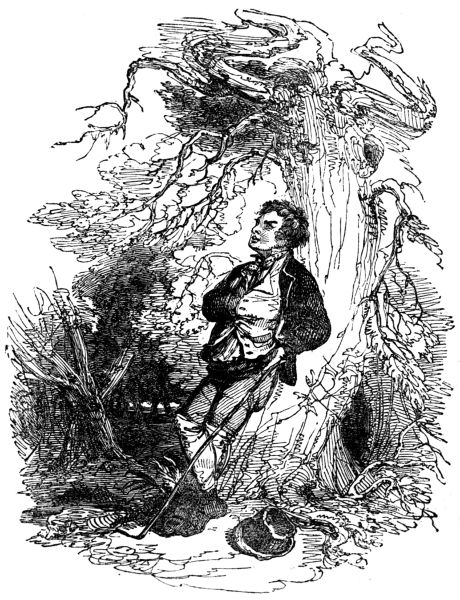
—————————— some monitor unseen, Calls for the song.—the call shall be obey’d; For ’tis that silent monitor, I ween, Which led my youth, to many a green-wood shade; Show’d me the spring, in thousand blooms array’d, And bade me look towards Heaven’s immensity: This is a power that schoolmen never made, That comes all unsolicited and free, To fire the youthful bard—lo! this is Poesy!
The Song of the Patriot.
Robert Millhouse
——The talented author of the poem from whence the motto is extracted is scarcely known to fame, and not at all to fortune. His unostentatious little volume, entitled “The Song of the Patriot, Sonnets, and Songs,” was thrown accidentally in my way; and its perusal occasions me to acquaint the readers of the Table Book with its uncommon merit. I do not know any thing concerning the poet beyond what I have derived from printed particulars, which I now endeavour to diffuse. That he is highly esteemed by a discriminating brother bard in his native county, is apparent by the following beautiful address to him in the Nottingham Mercury:—
Stanzas.
My thoughts are of a solitary place, Where twilight dwells, where sunbeams rarely fall; And there a wild-rose hangs in pensive grace, Reflected in a fountain clear and small; Above them rise dark shadowy trees and tall, Whilst round them grow rank night-shades in the gloom, Which seem with noxious influence to pall The fountain’s light, and taint the flower’s perfume; As fainly they would mar what they might not out-bloom. These, mind me, Millhouse! of thy spirit’s light, That twilight makes in life so dark as thine! And though I do not fear the rose may blight, Or that the fountain’s flow may soon decline; Hope, is there none, the boughs which frown malign, High over-head, should let in heaven’s sweet face; Yet shall not these their life unknown resign, For nature’s votaries, wandering in each place, Shall find their secret shade, and marvel at their grace.
It appears from a small volume, published in 1823, entitled “Blossoms—by Robert Millhouse—being a Selection of Sonnets from his various Manuscripts,” that the Rev. Luke Booker, LL. D. vicar of Dudley, deemed its author “a man whose genius and character seemed to merit the patronage of his country, while his pressing wants, in an equal degree, claimed its compassion.” The doctor “presumed to advocate his case and his cause” before the “Literary Fund,” and a donation honourable to the society afforded the poet temporary relief. This, says Millhouse, was “at a time when darkness surrounded me on every side.” In a letter to Dr. Booker, lamenting the failure of a subscription to indemnify him for publishing his poems, when sickness had reduced a wife and infant child to the borders of the grave, he says, “I am now labouring under indisposition both of body and mind; which, with the united evils of poverty and a bad trade, have brought on me a species of melancholy that requires the utmost exertions of my philosophy to encounter.” About this period he wrote the following:—
To a Leafless Hawthorn.
Hail, rustic tree! for, though November’s wind Has thrown thy verdant mantle to the ground: Yet Nature, to thy vocal inmates kind, With berries red thy matron-boughs has crown’d Thee do I envy: for, bright April show’rs Will bid again thy fresh green leaves expand; And May, light floating in a cloud of flow’rs, Will cause thee to re-bloom with magic hand. But, on my spring, when genial dew drops fell, Soon did life’s north-wind curdle them with frost; And, when my summer-blossom op’d its bell, In blight and mildew was its beauty lost.
Before adducing other specimens of his talents, it seems proper to give some account of the poet; and it can scarcely be better related than in the following
Memoir of Robert Millhouse, by his elder Brother, John Millhouse.
Robert Millhouse was born at Nottingham the 14th of October, 1783, and was the second of ten children. The poverty of his parents compelled them to put him to work at the age of six years, and when ten he was sent to work in a stocking-loom. He had been constantly sent to a Sunday school, (the one which was under the particular patronage of that truly philanthropic ornament of human nature, the late Mr. Francis Wakefield,) till about the last-mentioned age, when a requisition having been sent by the rector of St. Peter’s parish, Dr. Staunton, to the master of the school, for six of his boys to become singers at the church, Robert was one that was selected; and thus terminated his education, which merely consisted of reading, and the first rudiments of writing.
When sixteen years old he first evinced an inclination for the study of poetry, which originated in the following manner.—Being one day at the house of an acquaintance, he observed on the chimney-piece two small statues of Shakspeare and Milton, which attracting his curiosity, he read on a tablet in front of the former, that celebrated inscription—
“The cloud-capt towers, the gorgeous palaces, The solemn temples, the great globe itself, Yea, all which it inherit, shall dissolve; And like the baseless fabric of a vision, Leave not a wreck behind!”
Its beauty and solemnity excited in his mind the highest degree of admiration At the first opportunity he related the occurrence to me with apparent astonishment, and concluded by saying, “Is it not Scripture?” In reply, I told him it was a passage from Shakspeare’s play of the “Tempest,” a copy of which I had in my possession, and that he had better read it. For, although he had from his infancy been accustomed to survey with delight the beautiful scenery which surrounds Nottingham, had heard with rapture the singing of birds, and been charmed with the varied beauties of the changing seasons; and though his feelings were not unfrequently awakened by hearing read pathetic narratives, or accounts of the actions and sufferings of great and virtuous men, yet he was totally ignorant that such things were in any wise connected with poetry.
He now began to read with eagerness such books as I had previously collected, the principal of which were some of the plays of Shakspeare, Paradise Lost, Pope’s Essay on Man, the select poems of Gray, Collins, Goldsmith, Prior, and Parnell, two volumes of the Tatler, and Goldsmith’s Essays, all of the cheapest editions. But, ere long, by uniting our exertions, we were enabled to purchase Suttaby’s miniature edition of Pope’s Homer, Dryden’s Virgil, Hawkesworth’s translation of Telemachus, Mickle’s version of the Lusiad, Thomson’s Seasons, Beattie’s Minstrel, &c. These were considered as being a most valuable acquisition; and the more so, because we had feared we should never be able to obtain a sight of some of them, through their being too voluminous and expensive.
In 1810 he became a soldier in the Nottinghamshire militia, joined the regiment at Plymouth, and shortly afterwards made an attempt at composition.
It will readily be expected that now, being separated, we should begin to correspond with each other; and one day, on opening a letter which I had just received from him, I was agreeably surprised at the sight of his first poetical attempt, the “Stanzas addressed to a Swallow;” which was soon after followed by the small piece written “On finding a Nest of Robins.” Shortly after this the regiment embarked at Plymouth, and proceeded to Dublin; from which place, in the spring of 1812, I received in succession several other efforts of his muse.
Being now desirous of knowing for certain whether any thing he had hitherto produced was worthy to appear in print, he requested me to transmit some of them to the editor of the Nottingham Review, with a desire that, if they met with his approbation, he would insert them in his paper; with which request that gentleman very promptly complied. Having now a greater confidence in himself, he attempted something of a larger kind, and produced, in the summer of 1812, the poem of “Nottingham Park.”
In 1814 the regiment was disembodied, when he again returned to the stocking-loom, and for several years entirely neglected composition. In 1817 he was placed on the staff of his old regiment, now the Royal Sherwood Foresters; and in the following year became a married man. The cares of providing for a family now increased his necessities; he began seriously to reflect on his future prospects in life; and perceiving he had no other chance of bettering his condition than by a publication, and not having sufficient already written to form a volume, he resolved to attempt something of greater magnitude and importance than he had hitherto done; and in February, 1819, began the poem of “Vicissitude.” The reader will easily conceive that such a theme required some knowledge of natural and moral philosophy, of history, and of the vital principles of religion. How far he has succeeded in this poem is not for me to say; but certain it is, as may be expected from the narrowness of his education, and his confined access to books, his knowledge is very superficial: however, with unceasing exertions, sometimes composing while at work under the pressure of poverty and ill-health, and at other times, when released from his daily labour, encroaching upon the hours which ought to have been allotted to sleep, by the end of October, 1820, the work was brought to a conclusion.
To his brother’s narrative should be added, that Robert Millhouse’s “Vicissitude,” and other poems, struggled into the world with great difficulty, and were succeeded by the volume of “Blossoms.” The impression of both was small, their sale slow, and their price low; and nearly as soon as each work was disposed of, the produce was exhausted by the wants of the author and his family.
Fresh and urgent necessities have required fresh exertions, and the result is “The Song of the Patriot, Sonnets, and Songs,” a four-shilling volume, “printed for the Author and sold by R. Hunter, St. Paul’s Church-yard, and J. Dunn, Nottingham.” The book appeared in the autumn of last year, after poor Millhouse had suffered much privation from the bad state of the times. It was published with a slender list of subscribers—only seventy-seven!—and, though intended to improve his situation, has scarcely defrayed the bills of the stationer and printer.
The author of “The Song of the Patriot” anticipated the blight of his efforts. In the commencement of that poem, he says:—
—— ’Tis difficult for little men To raise their feeble pigmy heads so high, As to attract the glance of passing ken Where giant shoulders intercept the sky; And ah! ’tis difficult for such as I, To wake fit strains where mighty minstrels sing; Perhaps, even this, shall but be born and die: Not fated to enjoy a second spring, But like some hawk-struck bird, expire on new-fledg’d wing.
In this poem there are stanzas expressed with all a poet’s fire, and all a patriot’s heartfelt devotion to his country.
Land of my fathers! may thy rocky coast Long be the bulwark of thy free-born race; Long may thy patriots have just cause to boast That mighty Albion is their native place; Still be thy sons unequall’d in the chase Of glory, be it science, arts, or arms; And first o’erweening conquerors to disgrace; Yet happier far, when Peace in all her charms, Drives out from every land the din of war’s alarms. Potent art thou in poesy—Yet there still Is one thing which the bard hath seldom scann’d; That national, exalting local thrill, Which makes our home a consecrated land: ’Tis not enough to stretch the Muses’ wand O’er states, where thy best blood has purchas’d fame; Nor that thy fertile genius should expand To cast o’er foreign themes the witching flame: This hath thy lyre perform’d, and won a glorious name. Be every hill and dale, where childhood wanders, And every grove and nook, the lover knows, And every stream, and runlet that meanders, And every plain that covers freedom’s foes The dwelling-place of Song,—and where repose The great immortal worthies of our isle Be hallow’d ground—and when the pilgrim goes To hail the sacred dust, and muse awhile, Be heard the free-born strain to blanch the tyrant’s smile.
The patriotism of that people, traces of whose victories are observable in many of our customs, has been well discriminated. “In the most virtuous times of the Roman republic their country was the idol, at whose shrine her greatest patriots were at all times prepared to offer whole hecatombs of human victims: the interests of other nations were no further regarded, than as they could be rendered subservient to the gratification of her ambition; and mankind at large were considered as possessing no rights, but such as might with the utmost propriety be merged in that devouring vortex. With all their talents and their grandeur, they were unprincipled oppressors, leagued in a determined conspiracy against the liberty and independence of mankind.”[304] Every English patriot disclaims, on behalf of his country, the exclusive selfishness of Roman policy; and Millhouse is a patriot in the true sense of the word. His “Song of the Patriot” is a series of energetic stanzas, that would illustrate the remark. At the hazard of exceeding prescribed limits, two more are added to the specimens already quoted.
A beacon, lighted on a giant hill; A sea-girt watch-tower to each neighbouring state; A barrier, to control the despot’s will; An instrument of all-directing fate Is Britain; for whate’er in man is great, Full to that greatness have her sons attain’d; Dreadful in war to hurl the battle’s weight; Supreme in arts, in commerce unrestrain’d; Peerless in magic song, to hold the soul enchain’d. In wealth and power stupendous is our isle! Obtain’d by Labour’s persevering hand: And heaven-born Liberty extends her smile To the remotest corners of our land: The meanest subject feels her potent wand; Peasant and peer are by one law controll’d; And this it is, that keeps us great and grand: This is the impulse makes our warriors bold, And knits more close the bond our fathers seal’d of old.
The prevailing feature in Robert Millhouse’s effusions is of a domestic nature. He loves his country, and deems his birthplace and the hearth of his family its brightest spots. One of his sonnets combines these feelings:—
Home.
Scenes of my birth, and careless childhood hours. Ye smiling hills, and spacious fertile vales! Where oft I wander’d, plucking vernal flowers, And revell’d in the odour-breathing gales; Should fickle Fate, with talismanic wand, Bear me afar where either India glows, Or fix my dwelling on the Polar land, Where Nature wears her ever-during snows; Still shall your charms my fondest themes adorn, When placid evening paints the western sky, And when Hyperion wakes the blushing Morn, To rear his gorgeous sapphire throne on high. For, to the guileless heart, where’er we roam, No scenes delight us like our much-lov’d Home.
A man so humble, with such acquirements as have been here exemplified, and so unfortunate as to have derived little from their exercise but pain and disappointment, may be imagined to have penned the following address in distress and despondency:—
To Genius.
O born of heaven, thou Child of magic Song! What pangs, what cutting hardships wait on thee, When thou art doom’d to cramping Poverty; The pois’nous shafts from Defamation’s tongue,— The jeers and tauntings of the blockhead throng, Who joy to see thy bold exertions fail; While Hunger, pinching as December’s gale, Brings moody dark Despondency along. And, should’st thou strive Fame’s lofty mount to scale, The steps of its ascent are cut in sand; And half-way up,—a snake-scourge in her hand, Lurks pallid Envy, ready to assail: And last, if thou the top, expiring, gain, When Fame applauds, thou hearest not the strain.
In this sheet there is not room to further make known, or plead at greater length, the claims of Robert Millhouse to notice and protection. I should blush for any reader of poetical taste, with four shillings to spare, who, after perusing the preceding extracts, would hesitate to purchase the poet’s last little volume. I should more than blush for the more wealthy, who are reputed patrons of talent, if they decline to seek out and effectually succour him. I am, and am likely to remain, wholly unacquainted with him: my only wish is to induce attention to a talented and estimable individual, who is obscure and neglected, because he is unobtrusive and modest.
August 8, 1827. *
AN INFERNAL PALINDROME.
[Palindrome. A word or sentence which is the same read backward as forwards: as, madam; or this sentence Subi dura a rudibus. Johnson.]
Whence did Geoffry Crayon derive “The Poor Devil Author,” the title to one of his “Tales of a Traveller,” but from a legendary story, according to which the devil is acquainted with versification, although his lines are constructed in a very remarkable manner; for they can be read forward and backward, and preserve the same sense. There is a specimen of this “literary ingenuity” in the present volume of the Table Book, (col. 28.) The “Lives of the Saints” afford another, viz:—
St. Martin (of whom there is an account in the Every-Day Book, vol. i. p. 1469) having given up the profession of a soldier, and being elected bishop of Tours, when prelates neither kept carriages, horses, nor servants, had occasion to go to Rome, in order to consult his holiness upon some important ecclesiastical matter. As he was walking gently along the road, he met the devil, who politely accosted him, and ventured to observe how fatiguing and indecorous it was for him to perform so long a journey on foot, like the commonest of cockle-shell-chaperoned pilgrims. The saint knew well the drift of Old Nick’s address, and commanded him immediately to become a beast of burthen, or jumentum; which the devil did in a twinkling, by assuming the shape of a mule. The saint jumped upon the fiend’s back, who, at first, trotted cheerfully along, but soon slackened his pace. The bishop, of course, had neither whip nor spurs, but was possessed of a much more powerful stimulus, for, says the legend, he made the sign of the cross, and the smarting devil instantly galloped away. Soon, however, and naturally enough, the father of sin returned to sloth and obstinacy, and Martin hurried him again with repeated signs of the cross, till twitched and stung to the quick by those crossings so hateful to him, the vexed and tired reprobate uttered the following distich in a rage:—
Signa te, Signa: temere me tangis et angis: Roma tibi subito motibus ibit amor.
That is—“Cross, cross thyself—thou plaguest and vexest me without necessity; for, owing to my exertions, Rome, the object of thy wishes, will soon be near.” The singularity of this distich, consists, as hinted above, in its being palindromical; or it reads backwards as well as in the common way—Angis, the last word of the first line, makes signa—et makes te—and so on to the beginning. Amor, the last of the last line, read backwards, makes Roma—ibit makes tibi—and so forth.
These lines have been quoted imperfectly and separately in “Encyclopedies” and other books, under the words “Palindromical verses;” but the reader will not easily meet with the legendary tale, which gives them historical consistence and meaning.
Garrick Plays. No. XXIX.
[From the “Gentleman Usher,” a Comedy, by G. Chapman, 1606.]
Vincentio, a Prince (to gain him over to his interest in a love-affair) gulls Bassiolo, a formal Gentleman Usher to a Great Lord, with commendations of his wise house-ordering at a great Entertainment.
Vinc.—besides, good Sir, your Show did shew so well— Bass. Did it indeed, my Lord? Vinc. O Sir, believe it, ’Twas the best fashion’d and well-order’d thing, That ever eye beheld: and therewithal, The fit attendance by the servants used, The gentle guise in serving every guest, In other entertainments; every thing About your house so sortfully disposed, That ev’n as in a turn-spit (call’d a Jack) One vice[305] assists another; the great wheels, Turning but softly, make the less to whirr About their business; every different part Concurring to one commendable end: So, and in such conformance, with rare grace Were all things order’d in your good Lord’s house. Bass. The most fit Simile that ever was. Vinc. But shall I tell you plainly my conceit, Touching the man that (I think) caused this order? Bass. Aye, good my Lord. Vinc. You note my Simile? Bass. Drawn from the turn-spit—— Vinc. I see, you have me. Even as in that quaint engine you have seen A little man in shreds stand at the winder, And seems to put in act all things about him, Lifting and pulling with a mighty stir,— Yet adds no force to it, nor nothing does: So, though your Lord be a brave gentleman, And seems to do this business, he does nothing. Some man about him was the festival robe That made him shew so glorious and divine. Bass. I cannot tell, my Lord; but I should know, If any such there were. Vinc. Should know, quoth you? I warrant, you know well. Well, some there be, Shall have the fortune to have such rare men (Like brave Beasts to their arms) support their state; When others, of as high a worth and breed, Are made the wasteful food of them they feed.— What state hath your Lord made you for your service? ******
The same Bassiolo described.
Lord’s Daughter.—his place is great; for he is not only My father’s Usher, but the world’s beside, Because he goes before it all in folly.
[From the “Bastard,” a Tragedy, Author Unknown, 1652.]
Lover’s Frown.
Roderiguez. Thy uncle, Love, holds still a jealous eye On all my actions; and I am advised, That his suspicious ears Are still behind the hangings; that the servants Have from him in command to watch who visits. ’Tis safest, in my judgment, in his presence That thou forbear to cast a smile upon me; And that, like old December, I should look With an unpleasant and contracted brow. Varina. What, can’st thou change thy heart, my dear, that heart Of flesh thou gav’st me, into adamant, Or rigid marble? can’st thou frown on me? Rod. You do mistake me, sweet, I mean not so To change my heart; I’ll change my countenance, But keep my heart as loyal as before. Var. In truth I cannot credit it, that thou Can’st cast a frown on me; I prithee, try. Rod. Then thus: (he tries, and cannot; they smile on each other.) Var. I prithee, sweet, betake thyself to school; This lesson thou must learn; in faith thou art out. Rod. Well, I must learn, and practice it, or we Shall blast our budding hopes. Var. Come, try again. Rod. But if I try, and prove a good proficient; If I do act my part discretely, you Must take it as a play, not as a truth; Think it a formal, not a real frown. Var. I shall—— Rod. Then thus: i’faith, minion, I’ll look to thee. (she swoons.) Rod. Why, how now, sweet!—I did mistrust thy weakness: Now I have learn’d my part, you are to seek. Var. ’Faith, ’twas my weakness; when I did perceive A cloud of rage condensed on thy brow, My heart began to melt.——
[From “Love Tricks,” a Comedy, by James Shirley.]
Passionate Courtship.
Infortunio. I must have other answer, for I love you. Selina. Must! but I don’t see any necessity that I must love you. I do confess you are A proper man. Inf. O do not mock, Selina; let not excellence, Which you are full of, make you proud and scornful. I am a Gentleman; though my outward part Cannot attract affection, yet some have told me, Nature hath made me what she need not shame. Yet look into my heart; there you shall see What you cannot despise, for there you are With all your graces waiting on you; there Love hath made you a throne to sit, and rule O’er Infortunio; all my thoughts obeying, And honouring you as queen. Pass by my outside, My breast I dare compare with any man. Sel. But who can see this breast you boast of so? Inf. O ’tis an easy work; for though it be Not to be pierced by the dull eye, whose beam Is spent on outward shapes, there is a way To make a search into its hidden’st passage. I know you would not love, to please your sense. A tree, that bears a ragged unleav’d top In depth of winter, may when summer comes Speak by his fruit he is not dead but youthful, Though once he shew’d no sap: my heart’s a plant Kept down by colder thoughts and doubtful fears. Your frowns like winter storms make it seem dead, But yet it is not so; make it but yours, And you shall see it spring, and shoot forth leaves Worthy your eye, and the oppressed sap Ascend to every part to make it green, And pay your love with fruit when harvest comes. Sel. Then you confess your love is cold as yet, And winter’s in your heart. Inf. Mistake me not, Selina, for I say My heart is cold, not love. Sel. And yet your love is from your heart, I’ll warrant. Inf. O you are nimble to mistake. My heart is cold in your displeasures only, And yet my love is fervent; for your eye, Casting out beams, maintains the flame it burns in. Again, sweet Love, My heart is not mine own, ’tis yours, you have it; And while it naked lies, not deign’d your bosom To keep it warm, how can it be but cold, In danger to be frozen? blame not it, You only are in fault it hath no heat. Sel. Well, Sir; I know you have rhetoric, but I Can without art give you a final answer. Inf. O stay, and think awhile; I cannot relish You should say final: sweet, deliberate; It doth concern all the estate I have; I mean not dunghill treasure, but my life Doth stand or fall to it; if your answer be That you can love me, be as swift as light’ning; But if you mean to kill me, and reject My so long love-devotions, which I’ve paid As to an altar, stay a little longer, And let me count the riches I shall lose By one poor airy word; first give me back That part of Infortunio that is lost Within your love; play not the tyrant with me.
C. L.
RIDICULE.
In many cases ridicule might be used in the place of severe chastisement, and sometimes with a more lasting effect, especially among young people. One scheme of this kind was tried with great success by the elder Dr. Newcome, who governed a school at Hackney about forty years ago. When a pupil mistook in the pronunciation of a Latin word, he used to make the faulty lad repeat after him, before the whole school, “Nos Germăni, non curămus, quantītătem, syllābărum.” The penalty of uttering, in false quantity, this absurd assertion, supposed to be made by a German, importing that “His countrymen minded not how they pronounced Latin,” was more dreaded by the boys than the ferula or the rod.
RIDICULOUS SITUATIONS.
Literary Nurserymen.
Melancthon studied the gravest points of theology, while he held his book in one hand, and in the other the edge of a cradle, which he incessantly rocked.
“M. Esprit, a celebrated author and scholar, has been caught by me,” says M. Marville, “reading Plato with great attention, considering the interruptions which he met, from the necessity of frequently sounding his little child’s whistle.”
A Princess a-pick-a-pack.
The great constable of France, Anne de Montmorency, a man whose valour and military skill was only exceeded by his pride, his cruelty, and his bigotry, was ordered by Francis I. to carry on his shoulders, or any way that he could contrive it, his niece, the princess of Navarre, to the altar, where she was, against her will, to be married to the duc de Cleves. Brantome observes, that this was a hard task, as the little lady was so loaded with jewels, and rich brocade of gold and silver, that she could scarcely walk. The whole court were amazed at the king’s command; the queen of Navarre was pleased, as she wished her daughter to be humbled, on account of her having imbibed Lutheran principles; but the constable was much hurt, at being exposed to the ridicule of the whole world, and said, “It is henceforward over with me; my favour at court is passed away:” accordingly, he was dismissed as soon as the wedding was over.
The Quintain.
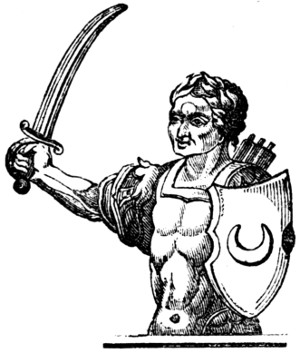
The Quintain.
Running at the “Quintain,” an old sport formerly common in England, unexpectedly occurs, and is sufficiently described, in the following report of a recent fashionable entertainment:—
Court Circular.
Viscount and viscountess Gage gave a grand fête on Friday, (August 3, 1827,) at their seat at Firle-place, Sussex, to about a hundred and sixty of the nobility and gentry, at which the ancient game of quintain was revived. The sports commenced by gentlemen riding with light spiked staves at rings and apples, suspended by a string, after which they changed their weapons to stout poles, and attacked the two quintains, which consisted of logs of wood fashioned to resemble the head and body of a man, and set upright upon a high bench, on which they were kept by a chain passing through the platform, and having a weight suspended to it, so that if the log was not struck full and forcibly the figure resumed its seat. One was also divided in the middle, and the upper part being fixed on a pivot turned, if not struck in the centre, and requited its assailant by a blow with a staff, to which was suspended a small bag of flour.
The purses for unhorsing this quintain were won by John Slater and Thomas Trebeck, Esqrs. The other figure which did not turn, opposed a lance towards the assailant’s face, and the rider was to avoid the lance, and unhorse the quintain at the same time. The purses were won by Sheffield Neave, Esq. and the hon. John Pelham.
A third pair of purses were offered for unhorsing the quintain, by striking on a coloured bell, which hooped round the waist of the figure, thereby raising the weight, which was considerable, by a much shorter lever than when struck higher up. This was a feat requiring great strength of arm and firmness of seat, and though not fairly won according to the rules of the game, the purses were ultimately assigned to the very spirited exertions of Messrs. Cayley and Gardener.
Viscountess Gage distributed the prizes to the conquerors.
About six o’clock the numerous party sat down to a cold collation of upwards of three hundred dishes, consisting of every delicacy the season could possibly afford, including the choicest collection of fruits, and wines of the finest quality: after which many recontinued the game of quintain; others diverted themselves at rifling the target. The ladies amused themselves at archery. In the evening the assemblage of nobility and gentry retired to the grand hall, where fashionable quadrilles concluded the amusements of the day.[306]
Combating the quintain is presumed to have preceded jousts and tournaments. It was originally nothing more than the trunk of a tree, or a post, set up for the practice of tyros in chivalry. Afterwards a staff or spear was fixed in the earth, and a shield being hung upon it was the mark to strike at: the dexterity of the performer consisted in smiting the shield so as to break the ligatures, and throw it to the ground. In process of time this diversion was improved, and instead of the staff and the shield, the resemblance of a human figure carved in wood was introduced. To render its appearance formidable it was generally made in the likeness of an armed Turk or Saracen, with a shield on his left arm, and brandishing a club or sabre with his right. The quintain was placed upon a pivot, so as to move round with facility. In running at this figure the horseman directed his lance to strike the forehead, between the eyes or on the nose; for if he struck wide of those parts, especially upon the shield, the quintain turned about with much velocity, and unless he was exceedingly careful gave him a severe blow upon the back with the wooden sabre; when this occurred it was deemed disgraceful to the performer, and excited the laughter and ridicule of the spectators.
The quintain is more particularly described by the late Mr. Strutt in his account of “The Sports and Pastimes of the People of England,” a large quarto volume, with plates, which, from its increasing scarcity and price, is scarcely attainable by the general reader. The above representation of the armed quintain is one of a series of illustrations for a new and correct edition of Mr. Strutt’s “Sports,” which is now preparing for the press under the superintendence of the editor of the Table Book. It will be accurately printed in octavo. Each of the engravings will be fac-simile, and of the same size as the engravings in the quarto volume. The price of the new edition will not exceed one-sixth of the cost of the original, and it will be published in shilling parts.
DAVID LOVE.
For the Table Book.
Died, on Tuesday afternoon, June 12th, 1827, David Love; of whom there is a portrait, with a memoir, in the Every-Day Book, vol. ii. p. 225, with a further notice at p. 1575. He had nearly attained his seventy-seventh year; and, till within a few weeks of his death, pursued his avocation of “walking stationer” in Nottingham. It was unnecessary for him to take out an hawker’s license, as the commodities in which he dealt were entirely of his own manufacture.
According to the memoirs of David Love’s life, (a curious specimen of “autobiography,”) which he published in twenty-four penny numbers, in 1824, and which he sold very numerously, he was born near Edinburgh in the year 1750; at three years of age he was abandoned by his father, and his mother shortly afterwards became blind; he led her about, and was an “unlucky urchin;” when older grown he worked in a coal-pit, but broke his arm, and was discharged, and commenced hawking tracts and small books. At twenty-five he was worth upwards of three pounds. Then, thinking of settling in the world, he wooed, won, and married a young woman: a small shop was established, which succeeded at first; but finding his fortune wasting, he paid his first court to the Muses, by composing two songs, of which the titles only are now extant:—“The Pride and Vanity of Young Women, with Advice to Young Men, that they may take care who they marry;” and “The Pride and Vanity of Young men, with Advice to the Maids, to beware of being ensnared by their Flatteries and enticing Words.” These versifyings he printed, and first started at a distant fair. Their sale exceeded his expectations; he discontinued his shop, paid his debts, and soon after (during the American war) enlisted into the duke of Buccleugh’s regiment of South Fencibles. His wife quickly presented him with a son, which being “the first man child born in the regiment,” the duke accepted as his name-son. After experiencing the vicissitudes of a soldier’s life, and getting out of the “black hole” two or three times by his verses, he was discharged, in consequence of a weakness in his arm. He then had his soldier’s poems printed, resumed his old trade of walking stationer, turned his face to the south, and was the more successful the farther he went from home. After travelling for some years he settled at Gosport, commenced bookseller with his old stock of old books, and printed a fourpenny volume of original poems. He then lived for three years in London, and composed many poems. Bristol was his next place of residence, and there he performed several remarkable cures out of an old receipt-book, but was too conscientious to turn quack doctor. Here, he saw his father, who died shortly after, “a repenting sinner,” aged ninety-three. Still travelling, he reached Newbury, in Berkshire, where he tells us he was “converted,” and he dates his “new birth” on the 17th of April, 1796. Many pages of his work are occupied by his religious experience, and various texts of scripture, whence he derived consolation.
In 1804 David Love buried his wife, (aged fifty-one,) after a long illness, at Rugby, in Warwickshire. He journeyed to Leicester, and thence to Nottingham, where he from that time continued to reside, except at intervals, and where he married again. In eighteen months his second wife died suddenly, also at Rugby. The following is the commencement of a long elegy on the subject:—
“In this vain world my troubles still abound, My two wives lie in Rugby burial ground; Both of one name, and both of them one age, And in one house both were called off the stage.”
These lines refer to a singular coincidence respecting his wives; both their maiden names were Mary Thompson, and both were aged fifty-one at their death. In 1810, May 21, he married his third and surviving wife at St. Mary’s church, Nottingham; and, excepting a journey to Edinburgh, and another to London, they lived in various parts of the town till his decease. David’s forte lay principally in religious acrostics and hymns, for which he had a good demand among the pious inhabitants. The following is inserted as being a short one:—
To Ann Short, Who said, “I am short of every thing.”
A m short, O Lord, of praising thee,
N othing I can do right;
N eedy and naked, poor I be,
S hort, Lord, I am of sight:
H ow short I am of love and grace!
O f every thing I’m short:
R enew me, then I’ll follow peace
T hrough good and bad report.
In person David was below the middle stature; his features were not unhandsome for an old man; his walk was exceedingly slow, deliberately placing one foot before the other, in order perhaps to give his customers time to hear what he had got; his voice was clear, and strongly marked with the Scotch accent. He possessed a readiness of wit and repartee, which is often united with aspiring talents in lower life. A tribute to Love’s memory, written on the day of his burial, may not be unacceptable
Elegy, written in St Mary’s Church yard, Nottingham.
The sexton tolls the knell of David Love, The funeral train treads slowly thro’ the street, Old General,[307] wand in hand, with crape above, Conducts the pageant with demeanour meet. Now stops the mournful train beside the grave, And all the air a solemn stillness holds; Save when the clerk repeats his twanging stave, And on the coffin fall the pattering moulds; Save that from yonder grass-surrounded stone, The whining schoolboy loudly does complain Of such, as crowding round his mossy throne, Invade his tottering transitory reign. Beneath those rugged stones, that corner’s shade, And trodden grass in rough mis-shapen heap, (Unless by Friday’s art away convey’d,[308]) In order due, what various bodies sleep. The call of “coals,” the cry of sooty sweep, The twist machine[309] loud lumbering over head; The jacks’ shrill whirring,[310] oft disturbing sleep— No more shall rouse them from their well-flock’d bed. For them no more the Indian weed shall burn, Or bustling landlord fill his beverage rare; No shopmates hail their comrade’s wish’d return, Applaud his song, and in his chorus share. Perhaps in this hard-beaten spot is laid Some head once vers’d in the mechanic powers, Hands that the bat at cricket oft have sway’d, Or won the cup for gooseberries and flowers. Slow through the streets on tottering footsteps borne, Muttering his humble ditties he would rove, Singing “Goose Fair,” [311] or “Tread Mill” where forlorn Consign’d by Lincoln ’squires trod David Love. One week I miss’d him from the market-place, Along the streets where he was wont to be; Strange voices came, but his I could not trace, Before the ’Change, nor by Sheep-lane was he. And now with honour due, in sad array Slow through the church-yard paths we’ve seen him borne; Approach and hear (if thou wilt hear) the lay In which the bard’s departed worth we mourn.
Epitaph.
Here rests his head upon the lap of earth, A minstrel old in Nottingham well known, In Caledonia was his humble birth, But England makes his aged bones her own. Long were his verses, and his life was long, Wide, as a recompense, his fame was spread; He sold for halfpence (all he had) a song, He earn’d by them (’twas all he wish’d) his bread. No farther I his merits can disclose, His widow dwells where David late abode; Go, buy his life, wrote by himself, which shows His service to his country, and his God.
G.
Nottingham, June 14, 1827.
THINGS WORTH REMEMBERING.
Be Honest.
If you only endeavour to be honest, you are struggling with yourself.
A Definition.
Truth is the conformity of expression to thought.
Take Care.
Equivocation is a mean expedient to avoid the declaration of truth, without verbally telling a lie.
Keep an Account.
Our debts and our sins are always greater than we think of.
There’s no such thing as Ill Luck.
It is true that some misfortunes are inevitable; but, in general, they proceed from our own want of judgment and foresight.
Our Enjoyments are conditional.
If we had it in our power to gratify every wish, we should soon feel the effects of a surfeit.
Our real Wants are few.
The stomach tires of every thing but bread and water.
Moderate your Desires.
Take away your expensive follies, and you will have little occasion to complain of hard times.
Many a Little makes a Mickle.
When a shopkeeper has company, he may have two candles; but when alone, one candle will be sufficient for common purposes. The saving will nearly find his wife in shoes.
As the Twig is bent, the Tree inclines.
If you give your children an improper education, their future misfortunes will lie at your door.
There are true and false Facts.
History should be read with caution. It often presents us with false and delusive pictures; and, by the gay colouring of the artist, excites our admiration of characters really odious.
Discoveries OF THE ANCIENTS AND MODERNS. No. IV.
Of Sensible Qualities.
The most eminent philosophers of antiquity, Democritus, Socrates, Aristippus the chief of the Cyrenaïc sect, Plato, Epicurus, and Lucretius, affirmed, that cold and heat, odours and colours, were no other than sensations excited in our minds, by the different operations of the bodies surrounding us, and acting on our senses; even Aristotle himself was of opinion, that “sensible qualities exist in the mind.” Yet when Descartes, and after him Mallebranche, taught the very same truths, they were ascribed to these moderns, owing to the outcry they made, as if the opposite error, which they attacked in the schoolmen, had been that of all ages; and nobody deigned to search whether, in reality, it was so or not. Were we to bring into review all that the ancients have taught on this subject, we should be surprised at the clearness with which they have explained themselves, and at a loss to account how opinions came to be taken for new, which had been illustrated in their writings with such force and precision.
Democritus was the first who disarrayed body of its sensible qualities. He affirmed, that “the first elements of things having in them naturally neither whiteness nor blackness, sweetness nor bitterness, heat nor cold, nor any other quality, it thence follows, that colour, for example, exists only in our imagination or perception of it; as also, that bitterness and sweetness, which exist only in being perceived, are the consequences of the different manner in which we ourselves are affected by the bodies surrounding us, there being nothing in its own nature yellow or white, or red, sweet or bitter.” He indicates what kind of atoms produce such and such sensations: round atoms, for example, the taste of sweetness; pointed and crooked, that of tartness; bodies composed of angular and coarse parts, introducing themselves with difficulty into the pores, cause the disagreeable sensations of bitterness and acidity, &c. The Newtonians imitate this reasoning everywhere, in explaining the different natures of bodies.
Sextus Empiricus, explaining the doctrine of Democritus, says, “that sensible qualities, according to that philosopher, have nothing of reality but in the opinion of those who are differently affected by them, according to the different dispositions of their organs; and that from this difference of disposition arise the perceptions of sweet and bitter, heat and cold; and also, that we do not deceive ourselves in affirming that we feel such impressions, but in concluding that exterior objects must have in them something analogous to our feelings.”
Protagoras, the disciple of Democritus, carried farther than ever Democritus did the consequences of his system; for admitting with his master the perpetual mutability of matter which occasioned a constant change in things, he thence concluded, that whatever we see, apprehend, or touch, is just as they appear; and that the only true rule or criterion of things, was in the perception men had of them. From Protagoras, bishop Berkeley seems to have derived his idea, “that there is nothing in external objects but what the sensible qualities existing in our minds induce us to imagine, and of course that they have no other manner of existence; there being no other substratum for them, than the minds by which they are perceived, not as modes or qualities belonging to themselves, but as objects of perception to whatever is percipient.”
We should think we were listening to the two modern philosophers, Descartes and Mallebranche, when we hear Aristippus, the disciple of Socrates, exhorting men “to be upon their guard with respect to the reports of sense, because it does not always yield just information; for we do not perceive exterior objects as they are in themselves, but only as they affect us. We know not of what colour or smell they may be, these being only affections in ourselves. It is not the objects themselves that we are enabled to comprehend, but are confined to judge of them only by the impressions they make upon us; and the wrong judgments we form of them in this respect is the cause of all our errors. Hence, when we perceive a tower which appears round, or an oar which seems crooked in the water, we may say that our senses intimate so and so, but ought not to affirm that the distant tower is really round, or the oar in the water crooked: it is enough, in such a case, to say with Aristippus and the Cyrenaïc sect, that we receive the impression of roundness from the tower, and of crookedness from the oar; but it is neither necessary nor properly in our power to affirm, that the tower is really round, or the oar broken; for a square tower may appear round at a distance, and a straight stick always seems crooked in the water.”[312]
Everybody talks of whiteness and sweetness, but they have no common faculty to which they can with certainty refer impressions of this kind. Every one judges by his own apprehensions, and nobody can affirm that the sensation which he feels when he sees a white object, is the same with what his neighbour experiences in regard to the same object. He who has large eyes will see objects in a different magnitude from him whose eyes are little, and he who hath blue eyes, discern them under different colours from him who hath grey; whence it comes, that we give common names to things, of which, however, we judge very variously.
Epicurus, admitting the principles of Democritus, thence deduces “that colour, cold, heat, and other sensible qualities are not inherent in the atoms, but the result of their assemblage; and that the difference between them flows from the diversity of their size, figure, and arrangement; insomuch, that any number of atoms in one disposition creates one sort of sensation; and in another, another: but their own primary nature remains always the same.”
The moderns have treated this matter with much penetration and sagacity, yet they have scarcely advanced any thing but what had been said before by the ancient philosophers just quoted, and by others who might be cited to the same effect.
For the Table Book.
MR. EPHRAIM WAGSTAFF, HIS WIFE AND PIPE.
About the middle of Shoemaker-row, near to Broadway, Blackfriars, there resided for many years a substantial hardwareman, named Ephraim Wagstaff. He was short in stature, tolerably well favoured in countenance, and singularly neat and clean in his attire. Everybody in the neighbourhood looked upon him as a “warm” old man; and when he died, the property he left behind him did not bely the preconceived opinion. It was all personal, amounted to about nineteen thousand pounds; and, as he was childless, it went to distant relations, with the exception of a few hundred pounds bequeathed to public charities.
The family of Ephraim Wagstaff, both on the male and female sides, was respectable, though not opulent. His maternal grandfather, he used to say, formed part of the executive government in the reign of George I., whom he served as petty constable in one of the manufacturing districts during a long period. The love of office seems not to have been hereditary in the family; or perhaps the opportunities of gratifying it did not continue; for, with that single exception, none of his ancestors could boast of official honours. The origin of the name is doubtful. On a first view, it seems evidently the conjunction of two names brought together by marriage or fortune. In the “Tatler” we read about the staff in a variety of combinations, under one of which the popular author of that work chose to designate himself, and thereby conferred immortality on the name of Bickerstaff. Our friend Ephraim was no great wit, but he loved a joke, particularly if he made it himself; and he used to say, whenever he heard any one endeavouring to account for his name, that he believed it originated in the marriage of a Miss Staff to some Wag who lived near her; and who, willing to show his gallantry, and at the same time his knowledge of French customs, adopted the fashion of that sprightly people, by adding her family name to his own. The conjecture is at least probable, and so we must leave it.
At the age of fifty-two it pleased heaven to deprive Mr. Wagstaff of his beloved spouse Barbara. The bereavement formed an era in his history. Mrs. Wagstaff was an active, strong woman, about ten years older than himself, and one sure to be missed in any circle wherein she had once moved. She was indeed no cipher. Her person was tall and bony, her face, in hue, something between brown and red, had the appearance of having been scorched. Altogether her qualities were truly commanding. She loved her own way exceedingly; was continually on the alert to have it; and, in truth, generally succeeded. Yet such was her love of justice, that she has been heard to aver repeatedly, that she never (she spoke the word never emphatically) opposed her husband, but when he was decidedly in the wrong. Of these occasions, it must also be mentioned, she generously took upon herself the trouble and responsibility of being the sole judge. There was one point, however, on which it would seem that Mr. Wagstaff had contrived to please himself exclusively; although, how he had managed to resist so effectually the remonstrances and opposition which, from the structure of his wife’s mind he must necessarily have been doomed to encounter, must ever remain a secret. The fact was this: Ephraim had a peculiarly strong attachment to a pipe; his affection for his amiable partner scarcely exceeding that which he entertained for that lively emblem of so many sage contrivances and florid speeches, ending like it—in smoke. In the times of his former wives (for twice before had he been yoked in matrimony) he had indulged himself with it unmolested. Not so with Mrs. Wagstaff the third. Pipes and smoking she held in unmitigated abhorrence: but having, by whatever means, been obliged to submit to their introduction, she wisely avoided all direct attempts to abate what she called among her friends “the nuisance;” and, like a skilful general, who has failed of securing victory, she had recourse to such stratagems as might render it as little productive as possible to the enemy. Ephraim, aware how matters stood, neglected no precaution to guard against his wife’s manœuvres—meeting, of course, with various success. Many a time did her ingenuity contrive an accident, by which his pipe and peace of mind were at once demolished; and, although there never could be any difficulty in replacing the former by simply sending out for that purpose, yet he has confessed, that when he contemplated the possibility of offering too strong an excitement to the shrill tones of his beloved’s voice, (the only pipe she willingly tolerated,) he waved that proceeding, and submitted to the sacrifice as much the lesser evil. At length Mrs. Wagstaff was taken ill, an inflammation on her lungs was found to be her malady, and that crisis appeared to be fast approaching, when
The doctor leaves the house with sorrow, Despairing of his fee to-morrow.
The foreboding soon proved correct; and, every thing considered, perhaps it ought not to excite much surprise, that when Ephraim heard from the physician that there was little or no chance of her recovery, he betrayed no symptoms of excessive emotion, but mumbling something unintelligibly, in which the doctor thought he caught the sound of the words “Christian duty of resignation,” he quietly filled an additional pipe that evening. The next day Mrs. Wagstaff expired, and in due time her interment took place in the church-yard of St. Ann, Blackfriars, every thing connected therewith being conducted with the decorum becoming so melancholy an event, and which might be expected from a man of Mr. Wagstaff’s gravity and experience. The funeral was a walking one from the near vicinity to the ground; and but for an untimely slanting shower of rain, no particular inconvenience would have been felt by those who were assembled on that occasion; that casualty, however, caused them to be thoroughly drenched; and, in reference to their appearance, it was feelingly observed by some of the bystanders, that they had seldom seen so many tears on the faces of mourners.—
To be continued—(perhaps.)
Nemo.
AN ULTRA-MARINER.
According to father Feyjoo, in the month of June, 1674, some young men were walking by the sea-side in Bilboa, and one of them, named Francis de la Vega, of about fifteen years of age, suddenly leaped into the sea, and disappeared presently. His companions, after waiting some time, and he not returning, made the event public, and sent an account of it to De la Vega’s mother, at Lierganès, a small town in the archbishopric of Burgos. At first she discredited his death, but his absence occasioned her fond doubts to vanish, and she mourned his untimely loss.
About five years afterwards some fishermen, in the environs of Cadiz, perceived the figure of a man sometimes swimming, and sometimes plunging under the water. On the next day they saw the same, and mentioned it as a very singular circumstance to several people. They threw their nets, and baiting the swimmer with some pieces of bread, they at length caught the object of their attention, which to their astonishment they found to be a well-formed man. They put several questions to him in various languages, but he answered none. They then took him to the convent of St. Francis, where he was exorcised, thinking he might be possessed by some evil spirit. The exorcism was as useless as the questions. At length, after some days, he pronounced the word Lierganès. It happened that a person belonging to that town was present when he uttered the name, as was also the secretary of the Inquisition, who wrote to his correspondent at Lierganès, relating the particulars, and instituting inquiries relative to this very extraordinary man; and he received an account of the young man who had disappeared in the manner before related.
On this information, it was determined that the marine man should be sent to Lierganès; and a Franciscan friar, who was obliged to go there on other business, undertook to conduct him the following year. When they came within a quarter of a league of the town, the friar ordered the young man to go before and show him the way. He made no answer, but led the friar to the widow De la Vega’s house. She recollected him instantly, and embracing him, cried out, “This is my son, that I lost at Bilboa!” Two of his brothers who were present also knew him immediately, and embraced him with equal tenderness. He, however, did not evince the least sensibility, or the smallest degree of surprise. He spoke no more at Lierganès than at Cadiz, nor could any thing be obtained from him relative to his adventure. He had entirely forgotten his native language, except the words pan, vino, tabaco, “bread, wine, tobacco;” and these he uttered indiscriminately and without application. They asked him if he would have either of these articles; he could make no reply.
For several days together he would eat large quantities of bread, and for as many days following he would not take the least food of any kind. If he was directed to do any thing, he would execute the commission very properly, but without speaking a word: he would carry a letter to where it was addressed, and bring an answer back in writing. He was sent one day with a letter to St. Ander; to get there it was necessary to cross the river at Padrenna, which is more than a league wide in that spot; not finding a boat in which he could cross it, he threw himself in, swam over, and delivered the letter as directed.
At this time Francis de la Vega was nearly six feet in height, and well formed, with a fair skin, and red hair as short as a new-born infant’s. He always went bare-footed, and had scarcely any nails either on his hands or feet. He never dressed himself but when he was told to do it. The same with eating; what was offered to him he accepted, but he never asked for food.
In this way he remained at his mother’s for nine years, when he again disappeared, without any apparent cause, and no one knew how. It may be supposed, however that the motive or feeling which induced his first disappearance influenced the second. Some time afterwards it was reported that an inhabitant of Lierganès again saw Francis de la Vega in some port of Asturias; but this was never confirmed.
When this very singular man was first taken out of the sea at Cadiz, it is said that his body was entirely covered with scales, but they fell off soon after his coming out of the water. They also add, that different parts of his body were as hard as shagreen.
Father Feyjoo adds many philosophical reflections on the existence of this phenomenon, and on the means by which a man may be enabled to live at the bottom of the sea. He observes, that if Francis de la Vega had preserved his reason and the use of speech, he would have given us more instruction and information in marine affairs, than all the naturalists combined.
ANTIPATHIES.
Erasmus, though a native of Rotterdam, had such an aversion to fish, that the smell of it threw him into a fever.
Ambrose Paré mentions a gentleman, who never could see an eel without fainting.
There is an account of another gentleman, who would fall into convulsions at the sight of a carp.
A lady, a native of France, always fainted on seeing boiled lobsters. Other persons of the same country experienced the same inconvenience from the smell of roses, though they were particularly partial to the odour of jonquils or tuberoses.
Joseph Scaliger and Peter Abono never could drink milk.
Cardan was particularly disgusted at the sight of eggs.
Uladislaus, king of Poland, could not bear to see apples.
If an apple was shown to Chesne, secretary to Francis I., he bled at the nose.
A gentleman, in the court of the emperor Ferdinand, would bleed at the nose on hearing the mewing of a cat, however great the distance might be from him.
Henry III. of France could never sit in a room with a cat.
The duke of Schomberg had the same aversion.
M. de Lancre gives an account of a very sensible man, who was so terrified at seeing a hedgehog, that for two years he imagined his bowels were gnawed by such an animal.
The same author was intimate with a very brave officer, who was so terrified at the sight of a mouse, that he never dared to look at one unless he had his sword in his hand.
M. Vangheim, a great huntsman in Hanover, would faint, or, if he had sufficient time, would run away at the sight of a roasted pig.
John Rol, a gentleman in Alcantara, would swoon on hearing the word lana, wool, pronounced, although his cloak was woollen.
The philosophical Boyle could not conquer a strong aversion to the sound of water running through a pipe.
La Mothe le Vayer could not endure the sound of musical instruments, though he experienced a lively pleasure whenever it thundered.
The author of the Turkish Spy tells us that he would rather encounter a lion in the deserts of Arabia, provided he had but a sword in his hand, than feel a spider crawling on him in the dark. He observes, that there is no reason to be given for these secret dislikes. He humorously attributes them to the doctrine of the transmigration of the soul; and as regarded himself, he supposed he had been a fly, before he came into his body, and that having been frequently persecuted with spiders, he still retained the dread of his old enemy.
THE LACTEALS IN A MOLE.
A curious observer of nature will be delighted to know, that the lacteal vessels are more visible in a mole, than in any animal whatever. The view, however, is not of long duration. These vessels are rendered visible by the mode of killing the animal, which is by a wire gin that compresses the thoracic duct, thereby preventing the ascent of the chyle upwards. The time of demonstration is about half an hour after death. This curious fact was unknown to anatomists, till mentioned by Dr. A. Hunter, in his volume of maxims on men and manners.
LOUIS GONZAGA TO MARIE MANCINI. Florence, 1649.
Il cantar che nel anima si sente. Il pin ne sente l’alma, il men l’orecchio. I worshippe thee thou silverre starre, As thron’d amid the vault of blue, Rushes thy queenlye splendoure farre, O’er mountain top and vale of dewe. Yette more I love thy infante ray, As risinge from its easterne cave, With circlinge, fearfulle, fonde delaye, It seemes to kisse the crimsone wave. I love the proud and solemne sweepe Of harpe and trumpette’s harmonye, Like swellinges of the midnighte deepe, Like anthemes of the opening skye. But lovelier to my heart the tone That dies along the twilighte’s winge, Just heard, a silver sigh, and gone, As if a spiritte touch’d the stringe. Sweete Marie! swiftlye comes the noone That gives thy beautye all its rayes, And thou shalte be the rose, alone, And heartes shall wither in its blaze. Yette there are eyes had deeper loved That rosebudde in its matine-beam, The dew droppe on its blushe unmoved— And shalle mye love be all a dreame?
Pulci.
POINTS OF CHARACTER.
A Prime Minister.
The late sir Robert Walpole was from his youth fond of field sports, and retained his attachment to them until prevented by the infirmities of age from their further enjoyment. He was accustomed to hunt in Richmond Park with a pack of beagles. Upon receiving a packet of letters, he usually opened that from his gamekeeper first; and in the pictures taken of him, he preferred being drawn in his sporting dress.
A Prelate.
Bishop Juxon, who attended Charles I. on the scaffold, retired after the king’s death to his own manor of Little Compton, in Gloucestershire, where, as Whitlocke tells us in his Memorials, “he much delighted in hunting, and kept a pack of good hounds, and had them so well ordered and hunted, chiefly by his own skill and direction, that they exceeded all other hounds in England for the pleasure and orderly hunting of them.”
A Huntsman.
Mr. Woolford, a sporting gentleman, as remarkable for politeness in the field as for the goodness of his fox-hounds, was one evening thus addressed by his huntsman: “An’ please your honour, sir,” twirling his cap and quid at the same time, “I should be glad to be excused going to-morrow to Woolford-wood, as I should like to go to see my poor wife buried.” “I am sorry for thee, Tom,” said his master, “we can do one day without thee: she was an excellent wife.” On the following morning, however, Tom was the first in the field. “Heyday!” quoth Mr. W., “did not I give you leave to see the remains of your poor wife interred?” “Yes, your honour, but I thought as how we should have good sport, as it is a fine morning; so I desired our Dick, the dog-feeder, to see her earth’d.”