Volume 2 — Vol. II.—50.
Reading edition
The Running Horse at Merrow, Surrey.
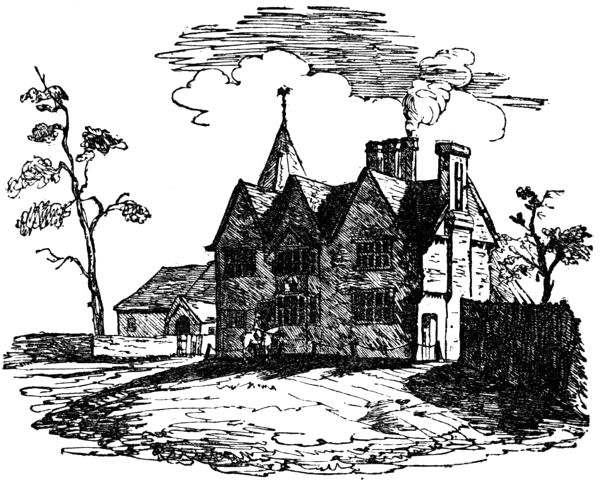
The Running Horse at Merrow, Surrey.
The first point of peculiarity that strikes the traveller on approaching the “Running Horse” is the pictorial anomaly on the front of the house—the sign represents a race-horse with a rider on its back; but the painter has given us a horse standing as still as most horses would be glad to do after having been running horses for more than half a century. Our “Running Horse” then, stands hard by the church in the village of Merrow, (olim Merewe,) about two miles from Guildford, in Surrey, on the road leading from the latter place to London by way of Epsom. It is at the intersection of the high roads leading to Epsom, to Guildford, to Stoke, and to Albury, Shere, and Dorking. The latter road passes over Merrow Downs, upon which, at the distance of a quarter of a mile from our hostel, is the course whereon Guildford races are annually held.
Guildford races formerly attracted a very numerous assemblage of spectators. The elderly inhabitants of the above-named ancient borough relate that, such was the influx of company, not a bed was to be had in Guildford unless secured some weeks before the sports commenced. From some cause, the nature of which the good people of Guildford have never been able satisfactorily to ascertain, the races have, for several years, gradually declined in celebrity and importance, and at present they are too often but thinly attended. The programme of the sports, which annually issues from the Guildford press, is embellished with a wood-cut, an impression I believe of the same block that has been used for the last century. The course is not considered by sportsmen a good one, but its situation, and the views it commands, are delightful.
When king George the First was at lord Onslow’s at Clandon, (the adjoining parish,) he gave a plate of one hundred guineas to be run for; and this is now the principal attraction to the proprietors of horses. The members for the borough of Guildford also give a plate of fifty pounds, and there is generally a subscription plate besides.
Our hostel, the “Running Horse” at Merrow, is the place of rendezvous for all the “running horses.” Its stable doors bear highly characteristic and interesting trophies of the honours obtained by their former temporary inmates. The best formed pumps that ever trod the floors of Almack’s or the saloons of Carlton palace, are not more delicately turned than the shoes, (albeit they are of iron,) which, having done their duty on the course, and brought their high-mettled wearers first to the winning-post, are now securely nailed against the honoured portals, as memorials of his success. They are placed heel to heel, and within the oval is carved, in rude characters, the name of the horse, with the day on which he won for his master the purse of gold. What an association of ideas does the simple record convey! Here, on a fine warm evening in June, the evening preceding
————“the great, th’ important day, Big with the fate of jockey and of horse,”
arrived the majestic “Cydnus.” His fine proportions were hid from vulgar gaze, by cloths of purest white. As he walked slowly up the village street ridden by his jockey, a stripling of sixteen, his approach was hailed by the acclamations of the village boys, and the calmer admiration of the men, all looking forward to their holiday on the succeeding day. “Here, I say; here, here;—here comes one of the racers!—There’s a purty creatur! law—look at his long legs—law, Jem, I say, look what long steps he do take—fancy how he must gallop, if he walks so—purty fellur!—I’m sure he’ll win—mind if he don’t now!” Meanwhile the noble animal arrives at the inn door—high breeding, whether in biped or quadruped, is not to be kept waiting—out comes the host in an important bustle, with the bright key of the stable door swinging upon his finger. He shows the way to the best stall, and then takes his station at the door to keep out the inquisitive gazers, while the jockey and trainer commence their tender offices of cleaning and refreshing the horse after his unusual exercise of walking the public road. This done, he is fed, clothed, and left to his repose upon as soft a bed as clean straw will make, while the jockey and trainer adjourn to the house, the admiration of the knot of idlers who are there assembled to hear the pedigree, birth, parentage, education, and merits of “the favourite.” Other horses soon arrive, and the conversation takes a more scientific turn, while the jockies make their own bets, and descant learnedly upon those of their masters, till they betake themselves to rest, “perchance to dream” of the important event of the succeeding day.
Long before the dew has left the short herbage on the neighbouring downs, the jockies are busily engaged in the stables; and before the sun’s heat has exceeded that of an April noon, they are mounted, and gently cantering over the turf, with the double object of airing their horses and showing them the course over which, in a few hours, they are urged, at their utmost speed, in the presence of admiring thousands. What an elating thought for the youthful rider of “the favourite;” with what delight does he look forward to the hour when the horse and his rider will be the objects of attraction to hundreds of fair one’s eyes glancing upon him with looks of admiration and interest; while, in his dapper silk jacket and cap of sky-blue and white, he rides slowly to the weighing-place, surrounded by lords and gentlemen “of high degree.” Within a short space the vision is realized—more than realized—for he has won the first heat “by a length.” In the next heat he comes in second, but only “half a neck” behind, and his horse is still fresh. The bell rings again for saddling; and the good steed is snuffing the air, and preparing for renewed exertions, while his rider “hails in his heart the triumph yet to come.” The bell rings for starting—“They are off,” cry a hundred voices at once. Blue and white soon takes the lead. “Three to one”—“five to one”—“seven to one”—are the odds in his favour; while at the first rise in the ground he gives ample proof to the admiring “cognoscenti” that he “must win.” A few minutes more, and a general hum of anxious voices announces that the horses are again in sight. “Which is first?”—“Oh, blue and white still.”—“I knew it; I was sure of it.” Here comes the clerk of the course flogging out the intruders within the rails, and here comes the gallant bay—full two lengths before the only horse that, during the whole circuit of four miles, has been once within speaking distance of him. He keeps the lead, and wins the race without once feeling the whip. Here is a moment of triumph for his rider! he is weighed again, and receives from his master’s hand the well-earned reward of his “excellent riding.” The horse is carefully reclothed, and led back to his stable, where his feet are relieved from the shoes which are destined to assist in recording, to successive generations of jockies, the gallant feats, performed by
“Hearts that then beat high for praise, But feel that pulse no more.”
Our hostel, however, must not be thus quitted.—The date inscribed within the circle above the centre window is, I think, 1617. (I have a memorandum of it somewhere, but have mislaid it.) The house is plastered and washed with yellow; but its gables, Elizabethan chimnies, and projecting bay window, (a very proper kind of window for a “running horse,”) render it a much more picturesque building than I have been able to represent it on the small scale of my drawing. In front of it, at about the distance of thirty yards, there was formerly a well of more than a hundred feet in depth; the landlord used to repair this well, receiving a contribution from all who made use of it; but other wells have of late years been dug in the neighbourhood, and the use of this has subsequently been confined to the inmates of the public-house.
The church of Merrow, of which there is a glimpse in the background, is worthy of further notice than I have the means of affording in the present communication.
Philippos. November, 1827.
WILLIAM CAPON, The Scene Painter.
To the Editor.
Sir,—Presuming you may not have been acquainted with the late Mr. William Capon, whose excellence as a gothic architectural scene-painter has not been equalled by any of his compeers, I venture a few particulars respecting him.
My acquaintance with Mr. Capon commenced within only the last five or six years, but his frank intimacy and hearty good-will were the same as if our intercourse had been of longer date. A memoir of him, in the “Gentleman’s Magazine,” seems to me somewhat deficient in its representation of those qualities.
The memoir just noticed assigns the date of his birth at Norwich to have been October 6, 1757; and truly represents, that though wanting but ten days of arriving at the seventieth year of his age when he died, his hale appearance gave little indication of such a protracted existence. He laboured under an asthmatic affection, of which he was accustomed to complain, while his fund of anecdote, and his jocular naïveté in recitation, were highly amusing. His manner of relating many of the follies of theatrical monarchs, now defunct, was wont to set the table in a roar; and could his reminiscences be remembered, they would present a detail quite as amusing as some that have recently diverted the town. Kemble he deified; he confessed that he could not get rid of old prejudices in favour of his old friend; and, to use his own phrase, “there never was an actor like him.” I have often seen him in ecstasy unlock the glazed front of the frame over his drawing-room chimney-piece, that enclosed a singularly beautiful enamel portrait of that distinguished actor, which will shortly be competed for under the auctioneer’s hammer. Some of his finest drawings of the Painted Chamber at Westminster, framed with the richness of olden times, also decorated this room, which adjoined his study on the same floor. His larger drawings had green silk curtains before them; and these he would not care to draw, unless he thought his visitors’ ideas corresponded with his own respecting the scenes he had thus depicted. The most valuable portion of his collection was a series of drawings of those portions of the ancient city of Westminster, which modern improvements have wholly annihilated. During the course of demolition, he often rose at daybreak, to work undisturbed in his darling object; and hence, some of the tones of morning twilight are so strictly represented, as to yield a hard and unartist-like appearance.
It was a source of disquiet to Mr. Capon that the liberality of publishers did not extend to such enlargements of Smith’s Westminster, as his own knowledge would have supplied. In fact, such a work could not be accomplished without a numerous list of subscribers; and as he never issued a prospectus, the whole of his abundant antiquarian knowledge has died with him, and the pictorial details alone remain.
Mr. Capon was, greatly to his inconvenience, a creditor of the late Richard Brinsley Sheridan, of whom he was accustomed to speak with evident vexation. He had been induced to enter into the compromise offered him by the committee of management of Drury-lane theatre, and give a receipt barring all future claims. This galled him exceedingly; and more than once he hinted suspicions respecting the conflagration of the theatre, which evinced that he had brooded over his losses till his judgment had become morbid.
But he is gone, and in him society has lost an amiable and respected individual. To the regret of numerous friends he expired on the 26th of September at his residence, No. 4, North-street, Westminster.
I am, &c.
November 3, 1827. A. W.
Garrick Plays. No. XLIII.
[From “Brutus of Alba,” a Tragedy, by Nahum Tate, 1678.]
Ragusa, and four more Witches, about to raise a storm.
Rag. ’Tis time we were preparing for the storm. Heed me, ye daughters of the mystic art; Look that it be no common hurricane, But such as rend the Caspian cliffs, and from Th’ Hyrcanian hills sweep cedars, roots and all. Speak; goes all right? All. Uh! Uh! Uh! Uh! 1st W. The cricket leaves our cave, and chirps no more. 2d W. I stuck a ram, but could not stain my steel. 3d W. His fat consumed in th’ fire, and never smok’d. 4th W. I found this morn upon our furnace wall Mysterious words wrought by a slimy snail, Whose night-walk fate had guided in that form. 2d W. Thou’rt queen of mysteries, great Ragusa. How hast thou stemm’d the abyss of our black science, Traced dodging nature thro’ her blind ’scape-roads, And brought her naked and trembling to the light! Rag. Now to our task— Stand off; and, crouching, mystic postures make, Gnawing your rivel’d knuckles till they bleed, Whilst I fall prostrate to consult my art, And mutter sounds too secret for your ear. (storm rises.) Rag. The storm’s on wing, comes powdering from the Nore; Tis past the Alps already, and whirls forward To th’ Appenine, whose rifted snow is swept To th’ vales beneath, while cots and folds lie buried. Thou Myrza tak’st to-night an airy march To th’ Pontic shore for drugs; and for more speed On my own maple crutch thou shalt be mounted, Which bridled turns to a steed so manageable, That thou may’st rein him with a spider’s thread. 4th W. And how if I o’ertake a bark in the way? Rag. Then, if aloft thou goest, to tinder scorch The fauns; but if thou tak’st a lower cut, Then snatch the whips off from the steersman’s hand, And sowce him in the foam. 4th W. He shall be drench’d. (storm thickens.) Rag. Aye, this is music! now methinks I hear The shrieks of sinking sailors, tackle rent, Rudders unhing’d, while the sea-raveners swift Scour thro’ the dark flood for the diving corpses. (the owl cries.) Ha! art thou there, my melancholy sister? Thou think’st thy nap was short, and art surpris’d To find night fallen already. More turf to th’ fire, till the black mesh ferment; Burn th’ oil of basilisk to fret the storm. That was a merry clap: I know that cloud Was of my Fricker’s rending, Fricker rent it; 0 ’tis an ardent Spirit: but beshrew him, ’Twas he seduced me first to hellish arts. He found me pensive in a desart glin, Near a lone oak forlorn and thunder-cleft, Where discontented I abjured the Gods, And bann’d the cruel creditor that seiz’d My Mullees,[500] sole subsistence of my life. He promised me full twelve years’ absolute reign To banquet all my senses, but he lied, For vipers’ flesh is now my only food, My drink of springs that stream from sulph’rous mines; Beside with midnight cramps and scalding sweats I am almost inured for hell’s worst tortures.— I hear the wood-nymphs cry; by that I know My charm has took— but day clears up, And heavenly light wounds my infectious eyes. 1st W. Now, sullen Dame, dost thou approve our works? Rag. ’Twas a brave wreck: O, you have well perform’d. 2d W. Myrza and I bestrid a cloud, and soar’d To lash the storm, which we pursued to th’ City, Where in my flight I snatch’d the golden globe, That high on Saturn’s pillar blaz’d i’ th’ air. 3d W. I fired the turret of Minerva’s fane. 4th W. I staid i’ th’ cell to set the spell a work. The lamps burnt ghastly blue, the furnace shook; The Salamander felt the heat redoubled, And frisk’d about, so well I plied the fire. Rag. Now as I hate bright day, and love moonshine, You shall be all my sisters in the art: I will instruct ye in each mystery; Make ye all Ragusas. All. Ho! Ho! Ho! Rag. Around me, and I’ll deal to each her dole. There’s an elf-lock, tooth of hermaphrodite, A brace of mandrakes digg’d in fairy ground, A lamprey’s chain, snake’s eggs, dead sparks of thunder Quench’d in its passage thro’ the cold mid air, A mermaid’s fin, a cockatrice’s comb Wrapt i’ the dried caul of a brat still-born. Burn ’em.— In whispers take the rest, which named aloud Would fright the day, and raise another storm. All. Ho! Ho! Ho! Ho!
Soziman, a wicked Statesman, employs Ragusa for a charm.
Rag.—my drudges I’ll employ To frame with their best arts a bracelet for thee, Which, while thou wear’st it lock’d on thy left arm, Treason shall ne’er annoy thee, sword and poison In vain attempt; Nature alone have power Thy substance to dissolve, nor she herself Till many a winter-shock hath broke thy temper. Soz. Medea for her Jason less performed! My greatening soul aspires to range like thee, In unknown worlds, to search the reign of Night. Admitted to thy dreadful mysteries, I should be more than mortal. Rag. Near my cell, Mong’st circling rocks (in form a theatre) Lies a snug vale— Soz. With horror I have view’d it; Tis blasted all and bare as th’ ocean beech, And seems a round for elves to revel in. Rag. With my attendants there each waining moon My dreadful Court I hold, and sit in state:— And when the dire transactions are dispatch’d, Our zany Spirits ascend to make us mirth With gambals, dances, masks and revelling songs, Till our mad din strike terror through the waste, Spreads far and wide to th’ cliffs that bank the main, And scarce is lost in the wide ocean’s roar. Here seated by me thou shalt view the sports, Whilst demons kiss thy foot, and swear thee homage.
Ragusa, with the other Witches, having finished the bracelet.
Rag. Proceed we then to finish our black projects.— View here, till from your green distilling eyes The poisonous glances center on this bracelet, A fatal gift for our projecting son;— Seven hours odd minutes has it steept i’ th’ gall Of a vile Moor swine-rooted from his grave. Now to your bloated lips apply it round, And with th’ infectious dew of your black breaths Compleat its baleful force.
[From the “Fatal Union,” a Tragedy; Author Unknown.]
Dirge.
Noblest bodies are but gilded clay. Put away But the precious shining rind, The inmost rottenness remains behind. Kings, on earth though Gods they be, Yet in death are vile as we. He, a thousand Kings before, Now is vassal unto more. Vermin now insulting lie, And dig for diamonds in each eye; Whilst the sceptre-bearing hand Cannot their inroads withstand. Here doth one in odours wade, By the regal unction made; While another dares to gnaw On that tongue, his people’s law. Fools, ah! fools are we that so contrive, And do strive, In each gaudy ornament, Who shall his corpse in the best dish present.
C. L.
ISLE OF WIGHT
To the Editor.
Hay Harvest Custom.
Sir,—Perhaps you may deem the following singular tenure from “Horsey’s Beauties of the Isle of Wight, 1826,” worth adding to those already perpetuated in the Every-Day Book, and your present agreeable continuation of it.
At the foot of St. John’s Wood are two meadows, one on each hand, the main road running between them. These meadows are known by the name of Monk’s Meads. It is a remarkable circumstance, that the first crop of hay they produce annually is reaped, not by the owner, nor the person who may rent the land, but by the tenant of Newnham farm, which is situated upwards of two miles distant, and has no connection whatever with the land. There is a legend attaching to this circumstance. The tale is, that one of the monks of Quarr was in the habit of visiting the family that once occupied Newnham farm, and as his visits were pretty frequent, and he was accustomed to put up his horse at the farmer’s expense, he bequeathed to the tenant of Newnham farm the first crop of hay which these meadows produce annually, each meadow to be reaped for his benefit every alternate year; and the warrant for his doing so was to be the continuance of a rude image in the wall of the house. Whether this be the legal tenure or not is another question; one thing is certain, the idol is preserved in the wall, the farmer comes on the specific day for the crop, and the produce is carried to Newnham.
I am, &c.
May 17, 1827 Dick Dick’s Son.
ORIGIN OF HAY-BAND?
For the Table Book.
Many of our origins and customs are derived from the Romans. In the time of Romulus, a handful of hay was used in his ranks instead of a flag; and his military ensign, who commanded a number of soldiers, was called a band, or ancient bearer. Thus it will appear, that a twisted band of hay being tied round a larger quantity of hay, for its support, it is, agreeably to the derivation, properly called a hay-band.
This word might serve for the tracing a variety of “bands,”—as the “band of gentleman pensioners,”—the “duke of York’s band,” cum multis, et cæt.
P.
BRISTOL HIGH CROSS.
For the Table Book.
The High Cross, which formerly stood at Bristol, was first erected in 1373 in the High-street, near the Tolsey; and in succeeding times it was adorned with the effigies of four kings, who had been benefactors to the city, viz. king John facing north to Broad-street, king Henry III. east to Wine-street, king Edward III. west to Corn-street, and king Edward IV. south to High-street.
After the original Cross had stood three hundred and sixty years at the top of High-street, a silversmith who resided in the house (now 1827) called the Castle Bank, facing High-street and Wine-street, offered to swear that during every high wind his premises and his life were endangered by the expected fall of the Cross!—A petition, too, was signed by several respectable citizens! to the corporation for its removal, with which that body complied with great reluctance, and saw its demolition with great regret!
In the year 1633 it was taken down, enlarged, and raised higher, and four other statues were then added, viz. king Henry VI. facing east, queen Elizabeth west, king James I. south, and king Charles I. north; the whole was painted and gilded, and environed with iron palisadoes.
In 1733, being found incommodious by obstructing the passage of carriages, it was again taken down, and erected in the centre of College-green, the figures facing the same points as before. On that occasion it was painted in imitation of grey marble, the ornaments were gilt, and the figures were painted in their proper colours.
About the year 1762 it was discovered that it prevented ladies and gentlemen from walking eight or ten abreast, and its final ruin resolved upon; and it was once more taken down by the order of the Rev. Cuts Barton, then dean, and strange to say, as if there were no spot in the whole city of Bristol whereon this beautiful structure could be again erected, it was given by the “very reverend” gentleman to Mr. Henry Hoare of Stourton, who afterwards set it up in his delightful gardens there.
The following extracts from some old newspapers preserved by the Bristol antiquary, the late Mr. George Symes Catcott, are interesting.
“August 21, 1762.—Several workmen are now employed in raising the walls in College-green, and taking down the High Cross, which, when beautified, will be put up in the middle of the grass-plot near the lower green, about thirty yards from where it now stands.”
“A.D. 1764—Epigram:—
“Ye people of Bristol deplore the sad loss Of the kings and the queens that once reigned in your Cross; Tho’ your patrons they were, and their reigns were so good, Like Nebuchadnezer they’re forced to the wood. Your great men’s great wisdom you surely must pity, Who’ve banished what all men admir’d from the city.”
“October, 1764.—To the printer (of one of the Bristol newspapers)—
“Sir,—By inserting the following in your paper you will oblige, &c.:—
“In days of yore, when haughty France was tamed, In that great battle, which from Cressy’s named, Our glorious Edward and his Godlike son To England added what from France they’d won. In this famed reign the High Cross was erected, And for its height and beauty much respected. Succeeding times (for gratitude then reigned On earth, nor was by all mankind disdained) The Cross adorned with four patron kings, So History assures the muse that sings; Some hundred years it stood, to strangers shown As the palladium of this trading town: Till in king Charles the first’s unhappy reign ’Twas taken down, but soon was raised again: In bulk and height increased, four statues more Were added to the others, there before: Then gilded palisadoes fenc’d it round— A Cross so noble grac’d no other ground. There long it stood, and oft admir’d had been, Till mov’d from thence to adorn the College-green. There had it still remained; but envious fate, Who secret pines at what is good or great, Raised up the ladies to conspire its fall, For boys and men, and dogs defiled it all. For those faults condemned, this noble pile Was in the sacred college stow’d a while. From thence these kings, so very great and good, Are sent to grace proud Stourton’s lofty wood.
“R. S.”
Mr. Britton observes, that “the improvements and embellishments of this Cross in 1633 cost the chamber of Bristol 207l. Its height from the ground was thirty-nine feet six inches. After taking it down in 1733 it was thrown into the Guildhall, where it remained till some gentlemen of the College-green voluntarily subscribed to have it re-erected in the centre of that open space; but here it was not suffered long to continue, for in 1763 the whole was once more levelled with the ground, and thrown into a secluded corner of the cathedral, so insensible were the Bristolians of its beauty and curiosity. Mr. Hoare expended about 300l. in its removal to and re-erection at Stourton. The present structure at Stourton, however, varies in many particulars from the original Cross. It constitutes not only an unique garden ornament in its present situation, but is singularly beautiful for its architectural character, its sculpture, and its eventful history.”
1821.—A clergyman of Bristol (the Rev. Mr. Sayer) having an occasion to write to sir R. C. Hoare, bart. received in reply a letter containing the following paragraph:—“I am glad to hear that the citizens of Bristol show a desire to restore the ancient monuments of their royal benefactors; pray assure them, that I shall be very happy to contribute any assistance, but my original is in such a tottering state that no time should be lost.”
Thus the beautiful High Cross which once adorned the city of Bristol may now, through the liberality of sir R. C. Hoare, be transplanted (if we may use the expression) to its native soil, after a banishment of fifty-seven years. Its reappearance in the College-green would be beautiful and highly appropriate.
At a meeting of the Bristol Philosophical and Literary Society on the 19th April, 1827, Mr. Richard Smith read a paper from Thomas Garrard, Esq. the chamberlain of Bristol, on the subject of the High Cross, together with a brief notice of “the well of St. Edith” in Peter-street. The latter, as well as the remains of the Cross, are still preserved at sir R. C. Hoare’s at Stourton. Many other interesting particulars may be found in the Bristol Mirror, April 28, 1827.
August, 1827. A. B.
ORIGIN OF THE WORD TAILOR.
To the Editor.
Dear Sir,—Bailey derives “tailor from tailler, French, a maker of garments:” but when a boy I remember perfectly well, my grandfather, who was facetious, and attached to the usages of the past, acquainting me with his origin of the word “tailor.” He stated it nearly thus:—“The term tailor originated between a botcher (a man that went from farm-house to farm-house, and made and repaired clothes by the day) and his wife—who, going to a town fair without her husband, returned in a storm at a late hour, all bespattered with mud. The wearied botcher had searched for her in vain, till meeting a neighbour, who told him his wife was gone home draggletailed, he exclaimed, ‘God be praised! she’s where she ought to be; but the De’el take the tail-’o’her.’ His brother villagers ever after called him (not the botcher) but the tail o’her—hence tailor. The Devil among the Tailors perhaps owes its origin to a similar freak.”
Speaking of a tail, the following from Bailey may not be inappropriate.—“Kentish long tails. The Kentish men are said to have had tails for some generations, by way of punishment, as some say; for the Kentish pagans abusing Austin the monk and his associates, by beating them, and opprobriously tying fish-tails to them; in revenge of which, such appendages grew to the hind parts of all that generation. But the scene of this lying wonder was not in Kent, but at Carne, in Dorsetshire. Others again say, it was for cutting off the tail of Saint Thomas of Canterbury’s horse; who, being out of favour with Henry II., riding towards Canterbury upon a poor sorry horse, was so served by the common people. Credat Judæus Apella.”
“Animals’ tails” were worn at country festivals by buffoons and sportmakers; for which, see “Plough Monday,” in the Every-Day Book; and also, see Liston, in Grojan, “I could a tail unfold!” &c.
Yours truly, *, *, P.
For the Table Book.
THE CLERK IN THE DARK.
“Set forth, but not allowed to be sung in all Churches, of all the people together.”
Once on a time, ’twas afternoon, And winter—while the weary day Danced off with Phœbus—to the tune Of “O’er the hills and far away”—— I went to church, and heard the clerk Preface the psalm with “Pardon me, But really friends it is so dark, Do all I may I cannot see”—— The “quire” that used the psalms to chant Not dreaming to be thus misled— Struck up in chorus jubilant, The clerk’s apology instead! MORAL. “The force of habit” should not keep Our trust in other heads so sure, That reason may drop off to sleep. Or sense enjoy a sinecure.
A. X.
For the Table Book.
CINDERELLA.
Of all the narratives either of fact or of fiction there are none, I will pledge my veracity, like the Fairy Tales of the Nursery, for interesting all the best feelings of our nature, and for impressing an imperishable and beautiful morality upon the heart. Was there ever, can you imagine—was there ever a young woman hardened and heartless enough to explore a forbidden closet, after she had perused the romantic history of Bluebeard? Would she not fearfully fancy that every box, bag, and bottle, jar, jelly, and jam-pot was grinning hideously at her in the person of one of the departed Mrs. Bluebeards? In fact, there is not a tale that does not convey some fine instruction, and, I would venture to affirm, that does not produce more salutary influence on the youthful mind, than all that Dr. Gregory and Mrs. Chapone, Dr. Fordyce and Miss Hannah More, have ever, in their wearisome sagacity, advised.
Of the whole of these entertaining stories, perhaps the best, and deservedly the most popular, is the History of Cinderella. How deeply do we sympathise in her cinders! how do we admire her patient endurance and uncomplaining gentleness,—her noble magnanimity in not arranging her sisters’ tresses amiss—for presuming to be her miss-tresses—and finally, how do we rejoice at her ultimate and unexpected prosperity! Judge then of my horror, imagine my despair, when I read the New Monthly Magazine, and saw this most exquisite story derived from the childish folly of a strolling player! The account, which is in a paper entitled “Drafts on La Fitte,” states, that the tale originated in an actual occurrence about the year 1730 at Paris. It is to this effect:—An actor, one Thevenard, saw a shoe, where shoes are frequently to be seen, viz. at a cobbler’s stall, and, like a wise man, fell deeply in love with it. He immediately took his stand by the stall all the rest of the day—but nobody came for the shoe. Next morning “Ecce iterum Crispinus,” he was with the cobbler again, still nobody came: however, to make a short story of a long one, day after day the poor actor stood there, till the proprietor of the shoe applied for it, in the person of a most elegant young woman; when monsieur Thevenard took the opportunity of telling her, he admired her foot so much he was anxious to gain her hand; to this modest desire she kindly complied, and they were accordingly married. Thus ends this pitiful account. He must have had an inventive fancy, indeed, who could manufacture the sweet story of Cinderella out of such meagre materials—it was making a mountain out of a molehill! The gentle and interesting Cinderella dwindles down into a girl, whose only apparent merit was her economy in having her shoe patched—and the affable and affluent prince melts away into a French actor. Were the prize of squeezing her foot into the little slipper only to become the bride of an actor, I should imagine the ladies would not have been quite so anxious to stand in her shoes!
Now, gentle reader, as I have told you what is not the origin of my story, it is but incumbent on me to tell you what is.—In the thirteenth book of the “Various History” of Ælian is the real genuine narrative from which Cinderella is derived—it is the twenty-third anecdote: and the similarity of the two stories is so great, that, I trust, a simple repetition of it will prove beyond a doubt the antiquity, as well as the rank, of my favourite Cinderella. Of all the Egyptians, says the historian, Rhodope was reckoned the most beautiful;—to her, when she was bathing, Fortune, ever fond of sudden and unexpected catastrophes, did a kindness more merited by her beauty than her prudence. One day, when she was bathing, she judiciously left her shoes on the bank of the stream, and an eagle (naturally mistaking it for a sheep or a little child) pounced down upon one of them, and flew off with it. Flying with it directly over Memphis, where king Psammeticus[501] was dispensing justice, the eagle dropped the shoe in the king’s lap. Of course the king was struck with it, and admiring the beauty of the shoe and the skill and proportion of the fabrication, he sent through all the kingdom in search of a foot that would fit it; and having found it attached to the person of Rhodope, he immediately married her.
P.S.—I have given my authority, chapter and verse, for my story; but still farther to substantiate it, I am willing to lay both my name and address before the reader.
Mr. Smith,
November, 1827. London.
HORÆ CRAVENÆ.
For the Table Book.
Hitchingstone Feast.—Cowling Moons.
On the highest part of Sutton Common, in Craven, is a huge block of solid granite, of about fifty yards in circumference, and about ten yards high. It is regarded as a great natural curiosity, and has for generations been a prominent feature in the legends and old wife’s tales of the neighbourhood. On the west side is an artificial excavation, called “The Chair,” capable of containing six persons comfortably, though I remember it once, at a pinch, in a tremendous thunder shower, containing eight. On the north side is a similar excavation, called “The Churn,” from its resemblance to that domestic utensil; on the top is a natural basin, fourteen yards in circumference. This stone is the boundary-mark for three townships and two parishes, viz. the townships of Sutton, Cowling, and Laycock, and the parishes of Kildwick and Keighley. From time immemorial it has been customary to hold a feast round Hitchingstone on the 1st of August, the amusements at which are of a similar nature with those of the village feasts and tides (as they are called in some places) in the vicinity, as dancing, racing, &c. At a short distance from Hitchingstone are two smaller stones, one on the east, called Kidstone, the other on the north-east, called Navaxstone; whence the three names are derived I am ignorant.
The inhabitants of Cowling, or Cowling-head, the village from which the township takes its name, are known in Craven as “Moons;” an epithet of derision, which is said to have had its origin from the following circumstance:—Cowling-head is a wild mountain village, and the inhabitants are not famed for travelling much; but it is told, that once upon a time, a Cowling shepherd got so far from home as Skipton, (six miles;) on entering Skipton it was a fine moonlight night, and the shepherd is said to have made this sagacious remark: “How like your Skipton moon is to our Cowling-head moon.” Be the story true or not, the inhabitants are called “Moons;” and in the vulgar vocabulary of Craven a silly fellow is called a “Cowling moon.” Not knowing a single inhabitant of Cowling I cannot speak of their civilization; but it does not say much for their advancement in knowledge, that the Joannites have a chapel amongst them, and remain true to their prophetess; who, as they suppose,
——— is but vanish’d from the earth awhile, To come again with bright unclouded smile.
While residing a few days at a gentleman’s house in the neighbourhood, I frequently observed the Cowling Joannites, with their long beards, rambling up and down the fells. A friend likened them to the ancient Druid priests, but I thought they more resembled goats, and formed no bad substitute for that animal, which is almost wholly banished from the fells of the district.
He’s got t’Oil-bottle in his Pocket.
This is a Craven saying, and is applied to a person, who, like the heathen Janus, has two faces; in other words, one who acts with duplicity, who will flatter you to your face, and malign you behind your back. Alas! how many are there amongst all ranks, and in all places, who have “got t’oil bottles in their pockets.”
Swine Harry.
This is the name of a field on the side of Pinnow, a hill in Lothersdale, in Craven; and is said to have derived its name from the following singular circumstance. A native of the valley was once, at the dead of night, crossing the field with a pig which he had stolen from a neighbouring farmyard; he led the obstinate animal by a rope tied to its leg, which was noosed at the end where the thief held it. On coming to a ladder-style in the field, being a very corpulent man, and wishing to have both hands at liberty, but not liking to release the pig, he transferred the rope from his hands to his neck; but when he reached the topmost step his feet slipped, the pig pulled hard on the other side, the noose tightened, and on the following morning he was found dead. I believe this story to be a fact; it was told me by an aged man, who said it happened in his father’s time.
Sept. 2, 1827. T. Q. M.
THOMAS SMITH, A Quack Extraordinary.
For the Table Book.
The following advertisement, somewhat abridged from the original, which must have been put forth upwards of a century ago, abundantly proves, that quackery and puffing had made some progress even at that period:—
“In King-street, Westminster, at the Queen’s-arms and Corn-cutter, liveth Thomas Smith; who, by experience and ingenuity, has learnt the art of taking out and curing all manner of corns, without pain, or drawing blood. He likewise takes out all manner of nails, which cause any disaster, trouble, or pain, which no man in England can do the like. He cures the tooth-ache in half an hour, let the pain be never so great, and cleanses and preserves the teeth. He can, with God’s assistance, perform the same in a little time.
“I wear a silver badge, with three verses; the first in English, the second in Dutch, the third in French, with the States of Holland’s crownet on the top, which was gave me as a present by the States-general of Holland, for the many cures, &c. My name on the badge underwritten, Thomas Smith, who will not fail, God willing, to make out every particular in this bill, &c.
“The famousest ware in England, which never fails to cure the tooth-ache in half an hour, price one shilling the bottle. Likewise a powder for cleansing the teeth, which makes them as ivory without wearing them, and without prejudice to the gums, one shilling the box. Also two sorts of water for curing the scurry in the gums; though they are eaten away to the bottom, it will heal them, and cause them to grow as firm as ever, very safe, without mercury, or any unwholesome spirit. To avoid counterfeits, they are only sold at his own house, &c., price of each bottle half a crown, or more, according to the bigness, with directions.”—Harl. MSS.
Smith is mentioned in the Tatler. He used to go out daily in quest of customers, and made a periodical call at all the coffee-houses then in London.
H. M. L.
DUNCHURCH, COW, AND CALF.
To the Editor.
Sir,—I am confidently assured, that the following coincidences really occur. You may not perhaps deem them unworthy of the very small space they will occupy in your amusing columns, of which I have ever been a constant reader. T. R.
At Dunchurch, near Coventry, is an inn, or public-house, called the Dun Cow, which supplies its landlord with the milk of existence. He is actually named Duncalf; the product of his barrels may be, therefore, not unaptly termed,—mother’s milk.
Discoveries OF THE ANCIENTS AND MODERNS. No. XIV.
The Circulation of the Blood, &c.
Two thousand years have elapsed since the time of Hippocrates, and there has scarcely been added a new aphorism to those of that great man, notwithstanding all the care and application of so many ingenious men as have since studied medicine.
There exist evident proofs that Hippocrates was acquainted with the circulation of the blood. Almelooven, in vindication of this father of medicine not having more amply treated of this subject in his works, assigns this reason, that Hippocrates having many other important matters to discuss, judged that to enlarge upon what was so well known, and had been so well explained by others, was as needless as it would have been to have written an Iliad after Homer. It is less requisite here to cite passages as proofs of Hippocrates’s knowledge on this vital principle in the animal economy, than to state the fact of his acquaintance with it. Briefly it may suffice to mention, that Hippocrates compares the course of rivers, which return to their sources in an unaccountable and extraordinary manner, to the circulation of the blood. He says, that “when the bile enters into the blood it breaks its consistence, and disorders its regular course.” He compares the admirable mechanism of the blood “to clues of thread, whose filaments overlap each other;” and he says, that “in the body it performs just such a circuit, always terminating where it began.”
Mr. Dutens is of opinion that Plato, Aristotle, Julius Pollux, Apuleius, and other ancients, treat the circulation of the blood as well known in their time. To that end he cites passages from their writings, and proceeds to affirm, that what reduces to a very small degree the honour of Harvey’s claim to the discovery is, that Servetus had treated of it very distinctly before him, in the fifth part of his book De Christianismi Restitutione; a work so very scarce, that there are but few who can boast of having seen it in print. Mr. Wotton, in his Reflections upon the Ancients and Moderns, cites this passage of Servetus entire. In this passage Servetus distinguishes three sorts of spirits in the human body, and says that blood, “which he calls a vital spirit, is dispersed through the body by the anastomosis, or mutual insertion of two vessels, at their extremities, into one another.” Here it deserves observation, that Servetus is the first who employed that term to express the communication between the veins and arteries. He makes “the expanded air in the lungs contribute to the formation of blood, which comes to them from the right ventricle of the heart, by the canal of the pulmonary artery.” He says, that “the blood is there refined and perfected by the action of the air, which subtilises it and blends itself with that vital spirit, which the expanded heart then receives as a fluid proper to carry life every where.” He maintains that “this conveyance and manner of preparing the blood in the lungs is evident from the junction of the veins with the arteries in this viscera.” And he concludes with saying, that “the heart having received the blood thus prepared by the lungs sends it forth again by the artery of its left ventricle, called the aorta, which distributes it into all parts of the body.” Andreas Cesalpinus, who lived likewise in the sixteenth century, has two passages which completely contain all that we know about the circulation of the blood. He explains at length “how the blood, gushing from the right ventricle of the heart through the pulmonary artery to pass into the lungs, enters anastomosically into the pulmonary veins, to be conveyed to the left ventricle of the heart, and afterwards distributed by the aorta into all parts of the body.” Let it be remarked, that, according to Boerhaave, the first edition of Cesalpin’s book was at Venice in 1571; that is, almost sixty years before Harvey’s work appeared, who studied at Padua, which is not far from Venice; and spent a considerable part of his time there.
Johannes Leonicenus says, that the famous Paul Sarpi, otherwise known by the name of Father Paul, was he who discovered the circulation of the blood, and first discerned “the valves of the veins, which, like the suckers of a pump, open to let the blood pass, but shut to prevent its return;” and that he communicated this secret to Fabricius ab Aquapendente, professor of medicine at Padoua in the sixteenth century, and successor to Fallopius, who discovered it to Harvey, at that time studying physic under him in the university of Padoua.
SERVETUS.
His Books—Christianismi Restitutio—De Trinitate Erroribus—De Trinitate Dialogorum.
Mr. Dutens, in the course of his remarks on Servetus’s discourse concerning the circulation of the blood, observes as follows:—
“Servetus published on this subject two different books. That for which he was burnt at Geneva, in 1553, is entitled Christianismi Restitutio, and had been printed but a month before his death. The care they took to burn all the copies of it at Vienne in Dauphiny, at Geneva, and at Frankfort, rendered it a book of the greatest scarcity. Mention is made of one copy of it in the catalogue of Mr. de Boze’s books, p. 40, which has been regarded as the only one extant. I have had in my hands a surreptitious copy of it, published at London, which formerly belonged to Dr. Friend; in the 143d, 144th, and 145th pages of which occurs the passage (on the circulation.) The book is in quarto, but without the name of the place where it was printed, or the time when, and is incomplete, the bishop of London having put a stop to the impression, which, if I mistake not, was about the year 1730. Care should be taken not to confound this with another work of his, printed in 12mo. in 1531, without mention of the place where, but supposed to be at Lyons. It is entitled De Trinitatis Erroribus Libri Septem, per Michaelem Serveto, alias Reves, ab Aragonia Hispanum; and there is along with it another treatise, printed in 1532, entitled Dialogorum de Trinitate, Lib. 2. de Justitia Regni Christi, Capitula 4. per Michaelem Serveto, alias Reves, ab Aragonià Hispanum. This last, which is very scarce, and sold once for one hundred pistoles, (that is 40l. sterl.) is in the library of the duke of Roxburgh at London, where I have seen it, but it contains not the passage referred to, which is only to be met with in the corrected and enlarged edition of that work, published in 1553, and entitled Christianismi Restitutio.”
Dr. Sigmond, in a recent work, entitled “The Unnoticed Theories of Servetus,” speaks of a Life of Servetus in the Historical Dictionary;[502] another, ascribed to M. de la Roche, in the “Bibliothèque Angloise,” with extracts relating to Servetus’s Theory of the Circulation of the Blood; and a third, by M. D’Artigny, in the “Mémoires des Hommes Illustres,” who extracted the history of the trial from the archives of the archbishop of Vienne in Dauphine. “And I have lately read with considerable pleasure,” says Dr. Sigmond, “an Apology for the Life of Servetus, by Richard Wright; not because he adds any thing to our previous knowledge of his life and conduct, but that a spirit of candour and liberality entitles the volume to much consideration. He has evidently not met with the Christianismi Restitutio.”
In relation to this latter work by Servetus, Dr. Sigmond says, “The late Dr. Sims, for many years president of the Medical Society of London, bequeathed to me his copy of Servetus, to which he has prefixed the following note:—‘The fate of this work has been not a little singular; all the copies, except one, were burned along with the author by the implacable Calvin. This copy was secreted by D. Colladon, one of the judges. After passing through the library of the landgrave of Hesse Cassel, it came into the hands of Dr. Mead, who endeavoured to give a quarto edition of it; but before it was nearly completed, it was seized by John Kent, messenger of the press, and William Squire, messenger in ordinary, on the 29th of May, 1723, at the instance of Dr. Gibson, bishop of London, and burnt, a very few copies excepted. The late duke de Valliere gave near 400 guineas for this copy, and at his sale it brought 3810 livres. It contains the first account of the circulation of the blood, above 70 years before the immortal Harvey published his discovery.’”
“In justice to the memory of my late valued friend,” says Dr. Sigmond, “I must state my conviction that this copy is not the original one; at the same time, I firmly believe he imagined it to be that which he has described. Yet he was well known as an accurate man, as a judicious collector of books: and, indeed, to him is the Medical Society of London indebted for its valuable and admirable library.” Dr. Sigmond’s correction of Dr. Sims’s note is substantial; but it may be corrected still further. Dr. Sims mistook as to the book having brought 3810 livres at the duke de Valliere’s sale. The duke gave that sum for the book at the sale of M. Gaignat in 1769, and when the duke’s library was sold in 1784, it produced 4120 livres. There is a particular account of it in the catalogue of that collection, by De Bure, tom. i. p. 289. That copy has hitherto been deemed unique. Is Dr. Sigmond’s another copy of Servetus’s own edition?
Dr. Sigmond’s own work, printed last year, is itself scarce, in consequence of having been suppressed or withdrawn from publication.[503] This circumstance, and the curiosity of its purpose, may render an exemplifying extract from it agreeable:—
“I have quoted,” says Dr. S., “the whole of Servetus’s theories verbatim. Those that relate to the phenomena of mind, as produced by the brain, will at this time have an additional interest, when Gall and Spurzheim have attracted the attention of philosophers to the subject. With some degree of boldness he has fixed upon the ventricles of the brain, and the choroid plexus, as the seat of that ray divine which an immortal Creator has shed upon man, and man alone. The awe and veneration with which such a subject must be approached, are increased by the conviction that though we may flatter our fond hopes with the idea that some knowledge has been gained, we are still lost in the same labyrinth of doubt and uncertainty that we ever were.
“After giving his description of the passage of the blood from the right ventricle of the heart through the lungs, to the left ventricle of the heart, he gives his reasons for his belief in his doctrine of the circulation, and observes that Galen was unacquainted with the truth. He then commences that most extraordinary passage upon the seat of the mind. The blood, he supposes, having received in its passage through the lungs the breath of life, is sent by the left ventricle into the arteries; the purest part ascends to the base of the brain, where it is more refined, especially in the retiform plexus. It is still more perfected in the small vessels, the capillary arteries, and the choroid plexus, which penetrate every part of the brain, enter into the ventricles, and closely surround the origin of the nerves. From the vital spirit it is now changed into the animal spirit, and acts upon the mass of brain, which is incapable of reasoning without this stimulus. In the two ventricles of the brain is placed the power of receiving impressions from external objects; in the third is that of reasoning upon them; in the fourth is that of remembering them. From the communication through the foramina of the ethmoid bone, the two ventricles receive a portion of external air to refresh the spirit, and to give new animation to the soul. If these ventricles are oppressed by the introduction of noxious vapour, epilepsy is produced, if a fluid presses on the choroid plexus, apoplexy; and whatever affects this part of the brain causes loss of mental power.
“I have transcribed his notions on vegetable and animal life: they are more curious than correct. They are contained in the second Dialogue on the Trinity, which is remarkable from its being the best proof that the doctrines of Servetus were completely at variance with the Unitarianism of which he was accused. It is a dialogue between Peter and Michael, ‘modum generationis Christi docens, quod ipse non sit creatura, nec finitæ potentiæ, sed vere adorandus, verusque Deus.’
“He here enters very minutely into the soul, as the breath of life; and the whole of the theories he has advanced are in support of the passages in the Bible, relative to the Almighty pouring into the nostrils of man the breath of life. A long metaphysical and theological discussion, difficult to be understood, follows; but not one syllable can be found contrary to the precepts of Christianity, or to the pure faith he wished to instil into the mind. In another part of the work there is a dissertation upon the heart as the origin of faith, which he believes, on the authorities he cites from the Bible, to be the seat of some degree of mental power. The heart, he supposes, deliberates upon the will, but the will obeys the brain.”
Persons disposed to inquiries of the nature last adverted to, may peruse a remarkable paper on the functions of the heart, as connected with volition, by sir James Mackintosh; it was drawn up in consequence of a table conversation with Mr. Benjamin Travers, and is inserted by that gentleman in an appendix to his work on Constitutional Irritation.[504]
It remains further to be observed respecting Servetus, that, according to Dr. Sigmond, another of his theories was, that “in the blood is the life.” His notions “on vegetable and animal life,” are in his work “De Trinitatis Erroribus, Libri VII.” 12mo. 1531. This book appears in the “Bibliotheca Parriana,” by Mr. Bohn, with the following MS. remarks on it by Dr. Parr.
“Liber rarissimus. I gave two guineas for this book.” S. P.
“Servetus was burnt for this book. He might be a heretic, but he was not an infidel. I have his life, in Latin, written by Allwoerden, which should be read by all scholars and true Christians.” S. P.
Dr. Sigmond’s opinion of Servetus evidently concurs with Dr. Parr’s. Towards the close of Dr. Sigmond’s Introduction to his “Dissertatio, quædam de Serveto complectens,” he says, “Of his religious opinions I have but little to say: the bitter prejudices, the violent hatred, the unmanly persecutions that disgraced the early introduction of a reformed religion, have fortunately given place to the milder charities of true Christianity. The penalty of death, by the most cruel torture, would not now be inflicted on a man who offered to the world crude and undigested dreams, or the visionary fancies of a disturbed imagination; and these, to say the very worst, are the sins for which Servetus expired at the stake, surrounded by the books his ardent and unconquerable spirit had dared to compose.
A sincere love of Christianity beams forth in every page of the work I have before me. His great anxiety was to restore religion to that purity, which he believed it to have lost. The doctrine he opposed was not that of Christ; it was that of the churchmen who had established, in his name, their own vain and fleeting opinions. The best proof that Calvin and Melancthon had deserted the mild, the charitable, the peaceful religion of truth, and that they followed not the divine precepts of their gentle Master, was, and is, that they pursued, even unto death, a helpless, poor, and learned man.”
It is well known that Servetus was denounced by Calvin to the government of Geneva, and that the civil authorities referred the case back to Calvin. “At the instance of Mr. Calvin and his associates he was condemned to be burnt alive; which sentence was executed October 27, 1553. He was upwards of two hours in the fire; the wood being green, little in quantity, and the wind unfavourable.”[505] It is not now the fashion to burn a man for heresy: the modern mode is to exaggerate and distort his declared opinions; drive him from society by forging upon him those which he disclaims; wound his spirit, and break his heart by continued aspersions; and, when he is in his grave, award him the reputation of having been an amiable and mistaken man.
*
LINES, On seeing in the Table Book the Signature of a brother, W. W. K.
Where’er those well-known characters I see, They are, and ever will be, dear to me! How oft in that green field, beneath the shade Of beechen-boughs, whilst other youngsters play’d, Have I, a happy schoolboy, o’er and o’er, Conn’d those dear signs, which now I read once more! How oft, as on the daisied grass I laid, Full pleas’d, the W. W. K. I’ve read!— When once espied, how tedious ’twas to wait The crippled postman’s well-known shuffling gait, As, slowly creeping down the winding lane, With such a sluggish pace he onward came; Or if in school,—his ring no sooner heard, Than home, with all its sweets, to mind recurr’d; And whilst the letter’s page its news reveal’d, The gath’ring drop my boyish sight conceal’d! Something then whisper’d, Bill, that life begun So well, the same still happily would run; That tho’ for years the briny sea divide, Or be it good, or ill, that each betide, The same fond heart would throb in either’s breast, Fondness by years and stealing time increas’d! So, as in early days it first became, Shall it in riper life, be still the same, That by and by, when we’re together laid ’Neath the green moss-grown pile—it may be said, As lonely footsteps tow’rds our hillock turn, “They were in life and death together one!”
DOVER PIG.
To the Editor.
Sir,—To the fact of the underwritten narrative there are many living witnesses of high respectability. Anatomists and philosophers may not think it unworthy their notice, and the lovers of the marvellous will doubtless be interested by a subject which assimilates with the taste of all.
On the 14th of December, 1810, several considerable falls of the cliffs, both east and westward of Dover, took place; and one of these was attended by a fatal domestic catastrophe. A house, situated at the base of that part of the cliffs between Moat’s Bulwark and where the Dover Gas Company’s works are built, was buried, with its inmates, consisting of the father, mother, and five of their children, and a sister’s child. The father only was dug from the ruins alive. All his family perished with the ruin of his household property.
Behind the house, which stood just clear of the cliffs’ base, in an excavation, was a pig-sty; which, when the cliff fell, was inhabited by a solitary and very fat hog, supposed to weigh about eight score. In the midst of his distress, the unfortunate owner of the quadruped forgot this animal; and when it occurred to his recollection, so much time had passed since the accident, that the pig was numbered with the dead. In the ensuing summer, on the evening of the 23d of May, some workmen of the Ordnance department, going home from labour, stopped, as they had sometimes done before, to contemplate the yet remaining ruin. While thus engaged, a sound broke the silence of the moment. It seemed like the feeble grunting of a hog. The men listened, and the sound was repeated, till it ceased to be matter of doubt. One of them immediately went to the commanding officer of the Ordnance, and returned with a party of the miners, who set to work; and as soon as they had cleared away the chalk from before the chasm, the incarcerated animal came staggering forth, more like the anatomy of a pig than a living one. Its skin was covered with a long shaggy coat: the iris had disappeared from its eyes; and the pupils were pale, and had almost lost their colour. Nothing beyond these particulars was apparent externally. With great attention to its feeding, the creature recovered from its debility, and its coat fell off, and was renewed as before. When I saw this hog in the following November, the eyes were of a yellowish tint, and the iris only discoverable by a faint line round the pupil; no defect showed itself in the vision of the organ: and, but for being told that the pig before me was the one buried alive for six months, there was nothing about it to excite curiosity. To the owner it had been a source of great profit, by its exhibition, during the summer season, at the neighbouring towns and watering-places; and, finally, it ended its existence in the way usual to its race, through the hands of the butcher.
I have stated the supposed weight of this long-buried quadruped at the time of its incarceration, to be about eight score, or twenty stone; when liberated, it was weighed, and had lost half of its former quantity, being then four score. A peculiar character of the pig is—its indiscriminate gluttony and rapid digestion. The means by which the life of this particular animal was sustained during the long period of its imprisonment, may be worth the consideration of the zootomist.
I am, &c.
September, 1827. K. B.
ANECDOTES.
Juries.
Levinz reports a case in the King’s Bench, “Foster v. Hawden,” “wherein the jury, not agreeing, cast lots for their verdict, and gave it according to lot; for which, upon the motion of Levinz, the verdict was set aside, and the jury were ordered to attend next term to be fined.”
On an appeal of murder, reported in Coke, the killing was not denied by the murderer, but he rested his defence upon a point of law, viz. that the deceased had provoked him, by mocking him; and he therefore contended that it was not murder. The judges severally delivered their opinions, that it was murder; but the jury could not agree. They however came to the following understanding—“That they should bring in, and offer their verdict not guilty; and if the court disliked thereof, that then they should all change their verdict, and find him guilty.” They brought in a verdict of Not Guilty. The court demurred, and sent them back; when, according to the above understanding, they returned again in a few minutes with a verdict of Guilty.
In 1752, Owen, a bookseller, was prosecuted by the attorney-general, on information, for a libel. The direction of the lord chief justice Lee to the jury does not appear at full length in the State Trials, but it seems that he “declared it as his opinion, that the jury ought to find the defendant guilty.” The jury brought in their verdict “Not Guilty.” The report proceeds to state, “that the jury went away; but at the desire of the attorney-general, they were called into court again, and asked this leading question: viz. “Gentlemen of the Jury, do you think the evidence laid before you, of Owen’s publishing the book by selling it, is not sufficient to convince you that the said Owen did sell this book.” Upon which the foreman, without answering the question, said, “Not guilty, not guilty;” and several of the jury said, “That is our verdict, my lord, and we abide by it.” Upon which the court broke up, and there was a prodigious shout in the hall.”
A Question—Mal-apropos.
When Dr. Beadon was rector of Eltham, in Kent, the text he one day took to preach from was, “Who art thou?” After reading it he made a pause, for the congregation to reflect on the words; when a gentleman, in a military dress, who at the instant was proceeding up the middle aisle of the church, supposing it a question addressed to him, replied, “I, sir, am an officer of the sixteenth regiment of foot, on a recruiting party here; and have come to church, because I wish to be acquainted with the neighbouring clergy and gentry.” This so deranged the divine and astonished the congregation, that the sermon was concluded with considerable difficulty.
GLASS.
Pliny informs us, the art of making glass was accidentally discovered by some merchants who were travelling with nitre, and stopped near a river issuing from Mount Carmel. Not readily finding stones to rest their kettles on, they employed some pieces of their nitre for that purpose. The nitre, gradually dissolving by the heat of the fire, mixed with the sand, and a transparent matter flowed, which was, in fact, glass. It is certain that we are more indebted to chance than genius for many of the most valuable discoveries.
VARIA.
For the Table Book.
Tomb of King Alfred.
Many Englishmen, who venerate the name of Alfred, will learn, with surprise and indignation, that the ashes of this patriot king, after having been scattered by the rude hands of convicts, are probably covered by a building at Winchester, erected in 1788 for the confinement of criminals. No one in the neighbourhood was sufficiently interested towards his remains to attempt their discovery or preservation.
Old Law Books.
It is remarkable, that the oldest book in the German law is entitled “Spiegel,” or the Looking-glass which answers to our “Mirror of Justices:” it was compiled by Eckius de Reckaw, and is inserted in Goldastus’s Collectanea. One of the ancient Icelandish books is likewise styled “Speculum Regale.” There is also in Schrevelius’s Teutonic Antiquities a collection of the ancient laws of Pomerania and Prussia, under the title of “Speculum.” Surely all this cannot be the effect of pure accident.
Curious Will of an Attorney.
Mr. Lambe, an attorney, who died at Cambridge in the year 1800, left about eleven hundred pounds; and directed his executors (three gentlemen of the university) to appropriate the sum of eight hundred pounds as they might think proper. For this arduous task he bequeathed them one hundred pounds each.
S. S. S.
Epitaphs.
For the Table Book.
‘These tell in homely phrase who lie below.’
Blair.
In Bois Church-yard, near Chesham, Bucks.
In Memory of Mrs. Elizabeth, Wife of Mr. Edward Pinchbeck, of Chesham, who departed this Life 1st Oct. 1781, aged 60 years. Here a painful head is at rest, Its violent throbbings are o’er; Her dangerous mortified breast, Neither throbs nor aches any more. Her eyes, which she seldom could close Without opiates to give her some rest, Are now most sweetly composed, With her whom her soul did love best.
On a Rail in Chesham Church-yard.
In memory of Sarah Bachelor, wife of Benjamin Bachelor, daughter of Joseph and Sarah Barnes, who departed this life May 23d, 1813, aged 25 years.
These three lines are on the reverse of the rail in question:—
My time was short not long in this world to stay God Summon’d me and I was snatch’d away pray God to bless And friends be kind to my husband and children left behind.
A plain white marble slab, placed over the remains of the illustrious Boerhaven, in St. Peter’s, Leyden, bears only these four words in black letters.
Salutifero Boerhavii Genio Sacrum.
J. J. K.
A FILL UP.
For the Table Book.
There is nothing I find so difficult to fill up as my spare time. Talk as they will about liberty, it is after all nothing but a sort of independent ennui—a freedom we are better without, if we do not know how to use it. To instance myself:—the first thing I do on the cessation of my daily avocations, which terminate rather early, is to throw my two legs upon one chair, and recline my back against another—when, after a provoking yawn of most ambiguous import, I propound to myself with great gravity—what the deuce shall I do? A series of questions instantly occur, which are as instantly answered—generally in the negative. Shall I read Blackstone?—no: Coke upon Littleton?—worse still: Fearne on Contingent Remainders?—horrid idea!—it was recommended the other day to a young friend of mine, who before he got to the end of the first page was taken with a shivering fit, from which he has not yet recovered—no, no; confound the law! I had enough of that this morning—What’s to be done then? The Table Book does not come out till to-morrow—Scott’s novels (unfashionable wretch) I don’t like,—have read the Epicurean already twenty times—and know Byron by heart. Take up my flute, mouthpiece mislaid, and can’t play without—determined to try, notwithstanding it should be my three thousandth failure; accordingly, blow like a bellows for about half an hour—can make nothing of it, suddenly stop, and throw the instrument to the other end of the room—forgetting the glass in the bookcase, the largest pane of which it goes through with a loud crash. Still musical, persist in humming a favourite air I have just thought of—hit the tune to a T, and immediately strike up a most delightful strain, beginning “Sounds delicious,” &c., when a cry comes from the parlour, “We really must leave the house if that horrid noise is to be continued!”—Rather galled by this rub—begin to get angry—start up from my two chairs and walk briskly to the fireplace—arrange my hair pettishly—then stick my hands in my pockets, and begin to muse—glass catches my eye—neckcloth abominably out of order, instinctively untie and tie it again—tired of standing—sit down to my desk—commence a Sonnet to the Moon, get on swimmingly to the fifth line, and then—a dead stop—no rhyme to be got, and the finest idea I ever had in my life in danger of being lost—this will never do—determined to bring it in somewhere, and after a little alteration introduce it most satisfactorily into a poem I had begun yesterday on Patience, till, upon reading the whole over, I find it has nothing whatever to do with the subject; and disgusted with the failure tear up both poem and sonnet in a tremendous rage. Still at a loss what to do—at length I have it—got a communication for the Table Book—I’ll take a walk and leave it—
Gulielmus.