← Table of contents
Integration of the Armed Forces, 1940-1965

CHAPTER 9

Reading edition

The Postwar Navy

That Army concerns and problems dominated the discussions of race relations in the armed forces in the postwar years is understandable since the Army had the largest number of Negroes and the most widely publicized segregation policy of all the services. At the same time the Army bore, unfairly, the brunt of public criticism for all the services' race problems. The Navy, committed to a policy of integration, but with relatively few Negroes in its integrated general service or in the ranks of the segregated Marine Corps and the new Air Force, its racial policy still fluid, merely attracted less attention and so escaped many of the charges hurled at the Army by civil rights advocates both in and out of the federal government. But however different or unformed their racial policies, all the services for the most part segregated Negroes in practice and all were open to charges of discrimination.
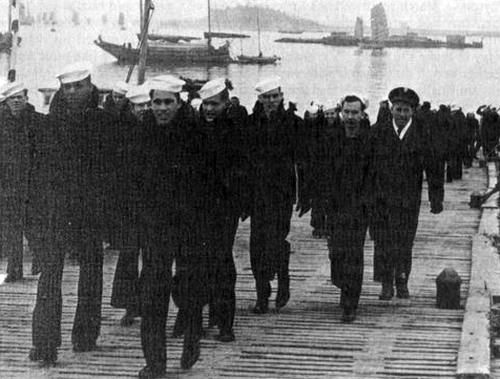
Shore Leave in Korea.

Shore Leave in Korea. Men of the USS Topeka land in Inch'on, 1948.

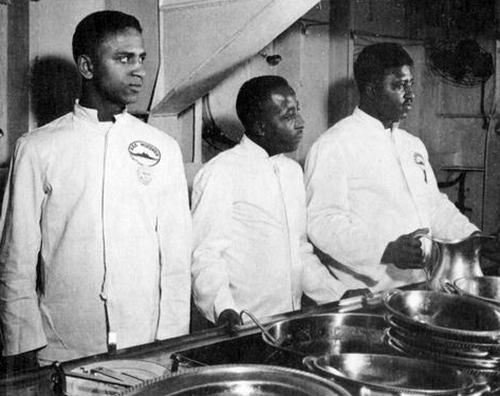
But during the chaotic months of demobilization a different picture began to emerge. Although Negroes continued to number about 5 percent of the Navy's enlisted strength, their position altered radically. The average strength figures for 1946 showed 3,300 Negroes, 16 percent of the total black strength, serving in the integrated general service while 17,300, or 84 percent, were classified as stewards. By mid-1948 the outlook was somewhat brighter, but still on the average only 38 percent of the Negroes in the Navy held jobs in the general service while 62 percent remained in the nonwhite Steward's Branch. At this time only three black officers remained on active duty. Again, what Navy officials saw as military efficiency helps explain this postwar retreat. Because of its rapidly sinking manpower needs, the Navy could afford to set higher enlistment standards than the Army, and the fewer available spaces in the general service went overwhelmingly to the many more eligible whites who applied. Only in the Steward's Branch, with its separate quotas and lower enlistment standards, did the Navy find a place for the many black enlistees as well as the thousands of stewards ready and willing to reenlist for peacetime service.

The Steward's Branch
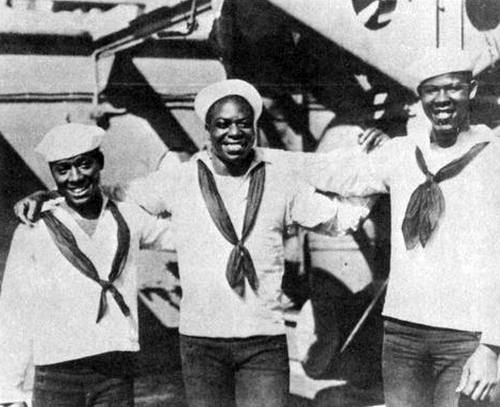
Mess Attendants, USS Bushnell, 1918

Mess Attendants, USS Bushnell, 1918

Mess Attendants, USS Wisconsin, 1953

Mess Attendants, USS Wisconsin, 1953

Black Officers
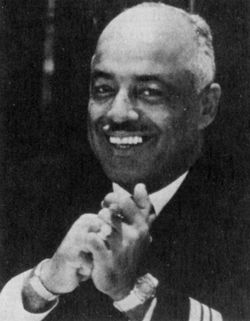
Commander Nelson
Commander Nelson

Commander Nelson

Despite procurement failures and within the limitations of general segregation policy, the Navy treated black officers with scrupulous fairness during the war. The Bureau of Naval Personnel insisted they be given the privileges of rank in wardroom and ashore, thus crushing an attempt by authorities at Great Lakes to underwrite a tacit ban on the use of the officers' club by Negroes. In fact, integration proved to be more the rule than the exception in training black officers. The small number of black candidates made segregated classes impractical, and after graduation of the first group of black officers at Great Lakes, Negroes were accepted in all officer candidate classes. As part of this change, the Special Programs Unit successfully integrated the Navy's officer candidate school in the posh hotels of still-segregated Miami Beach.

The Bureau of Naval Personnel offered what it considered a reasonable explanation. As a group, black reserve officers were considerably overage for their rank and were thus at a severe disadvantage in the fierce competition for regular commissions. The average age of the first class of black officers was over thirty-one years. All had been commissioned ensigns on 17 March 1944, and all had received one promotion to lieutenant, junior grade, by the end of the war. When age and rank did coincide, black reservists were considered for transfer. For example, on 15 March 1947 Ens. John Lee, a former V-12 graduate assigned as gunnery officer aboard a fleet auxiliary craft, received a regular commission, and on 6 January 1948 Lt. (jg.) Edith DeVoe, one of the four black nurses commissioned in March 1945, was transferred into the Regular Navy. The following October Ens. Jessie Brown was commissioned and assigned to duty as the first black Navy pilot.

Public Image and the Problem of Numbers
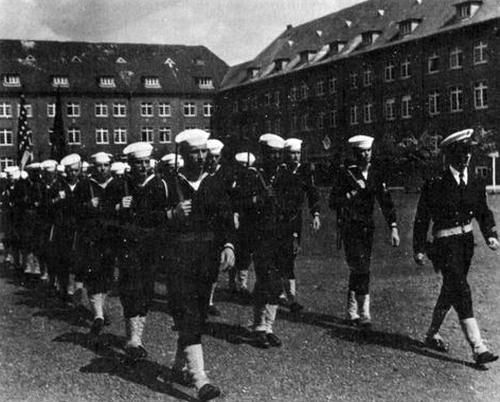
Naval Unit Passes in Review

Naval Unit Passes in Review, Naval Advanced Base, Bremerhaven, Germany, 1949.
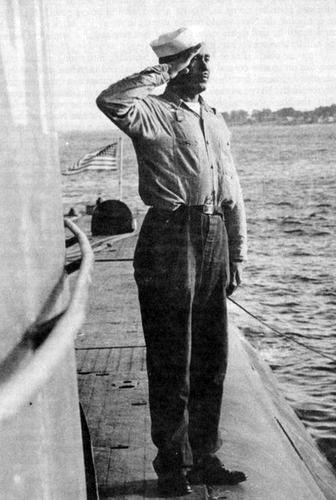
Submariner
Submariner

Submariner

Here the practical need for change ran headlong into strong military tradition. An integrated general service was traditional and therefore acceptable; an integrated servants' branch was not. Faced with the choice of a small number of Negroes in the Navy and the attendant charges of racism or a change in its traditions, the Navy accepted the former. Lack of interest on the part of the black community was not a particularly pressing problem for the Navy in the immediate postwar years. Indeed, it might well have been a source of comfort for the military traditionalists who, armed with an unassailable integration policy, could still enjoy a Navy little changed from its prewar condition. Nevertheless, the lack of black volunteers for general service was soon to be discussed by a presidential commission, and in the next fifteen years would become a pressing problem when the Navy, the first service with a policy of integration, would find itself running behind in the race to attract minority members.

Notes in this chapter

Note 1 · Although the services developed different racial policies out of their separate circumstances, all three were reacting to the same set of soNote 2 · The Army also had its problems with tradition. It endured tremendous inner conflict before it decided to drop the cavalry in favor of mechanNote 3 · Still, tradition could work two ways, and in the case of the Navy, at least, the postwar decision to liberalize racial practices can be tracNote 4 · Forrestal was convinced that in order to succeed racial reform must first be accepted by the men already in uniform; integration, if quietlyNote 5 · If efficiency explains why the Navy's general service remained disproportionately white, tradition explains how segregation and racial excluNote 6 · To black publicists and other advocates of civil rights, the Navy's postwar manpower statistics were self-explanatory: the Navy was discrimiNote 7 · The Navy's difficulty in this regard stemmed from the fact that the demobilization program under which it geared down from a 3.4 million-manNote 8 · At the same time the Bureau of Naval Personnel launched a vigorous program to induce reservists to switch to the Regular Navy. In October 19Note 9 · The major concern of the civil rights groups was not so much the number of Negroes in the Regular Navy, although this remained far below theNote 10 · The Navy itself had reason to be concerned. The Steward's Branch created efficiency problems and was a constant source of embarrassment to tNote 11 · The Navy had a ready defense for its management of the branch. Its spokesmen frequently explained that it performed an essential function, eNote 12 · There was truth in these assertions. Stewards had taken advantage of relaxed regulations, flocking into the Regular Navy during the first moNote 13 · The Navy's defense was logical, but not too convincing. Technically the Steward's Branch was open to all, but in practice it remained strictNote 14 · Some individuals in the department were aware of this resentment in the black community and pushed for reform in the Steward's Branch. The ANote 15 · But more to the point Granger also pushed for reform in the standards of the Steward's Branch. He recognized that educational and other requNote 16 · From within the Navy itself Lt. Dennis D. Nelson, one of the first twelve Negroes commissioned and still on active duty, added his voice to Note 17 · Nelson had a host of suggestions for the Steward's Branch: eliminate the branch as a racially separate division of labor in the Navy, providNote 18 · In summing up these recommendations for the Secretary of the Navy in January 1949, Nelson reminded Sullivan that only 37 percent of the NavyNote 19 · Despite its continued defense of the status quo in the Steward's Branch, the Bureau of Naval Personnel was not insensitive to criticism. To Note 20 · The Navy had a racial problem of more immediate concern to men like Lieutenant Nelson, one of three black officers remaining on active duty.Note 21 · The officers graduated into a number of assignments. Some saw duty aboard district and yard craft, others at departmental headquarters in WaNote 22 · Exceptions to the assignment rule increased during the last months of the war. The Special Programs Unit had concluded that restricting blacNote 23 · Fechteler's prediction proved accurate. By V-J day, the Navy's black officers, both line and staff, were serving competently in many occupatNote 24 · There were several reasons for the rapid demobilization of black officers. Some shared the popular desire of reserve officers to return to cNote 25 · In a sense, the black officers had the cards stacked against them. As Nelson later explained, the bureau did not extend to its black line ofNote 26 · Prospects for an increase in black officers were dim. With rare exception the Navy's officers came from the academy at Annapolis, the officeNote 27 · Nor were many black officers forthcoming from the Navy's two other sources. Officer candidate schools, severely reduced in size after the waNote 28 · Statistics pointed at least to the possibility that racial discrimination existed in the NROTC system. Unlike the Army and Air Force programNote 29 · Lester Granger blamed the lack of black candidates on the fact that so few Negroes attended the schools; undoubtedly, more Negroes would havNote 30 · Others disagreed. From the first the Special Programs Unit had rejected the clamor for forming V-12 units in predominantly black colleges, aNote 31 · Of lesser moment because of the small size of the WAVES and the Nurse Corps, the role of black women in the postwar Navy nevertheless concerNote 32 · But criticism persisted. In February 1948 the Navy could count six black WAVES out of a total enlisted force of 1,700, and during hearings oNote 33 · Black nurses presented a different problem. Two of the wartime nurses had resigned to marry and the third was on inactive status attending cNote 34 · Individual black nurses no doubt had cogent reasons for failing to apply for Navy commissions, but the fact that only one applied called attNote 35 · Several reasons were suggested for this attitude. Assistant Secretary Brown placed the blame, at least in part, on the gap between policy anNote 36 · The Navy's major racial problem by 1948 was the shockingly small number of Negroes in the service. In November 1948, a presidential electionNote 37 · Lt. Comdr. Edward Hope, a black reserve officer assigned to officer procurement, concluded that the black community, especially veterans, diNote 38 · The cause of confusion among black students over Navy policy was easy to pinpoint, for memories of the frustrations and insults suffered by
Explore with AITake your curiosity a little further.

Reading settings