CHAPTER 4
Reading edition
World War II: The Marine Corps and the Coast Guard
The racial policies of both the Marine Corps and the Coast Guard were substantially the same as the Navy policy from which they were derived, but all three differed markedly from each other in their practical application. The differences arose partly from the particular mission and size of these components of the wartime Navy, but they were also governed by the peculiar legal relationship that existed in time of war between the Navy and the other two services.
By law the Marine Corps was a component of the Department of the Navy, its commandant subordinate to the Secretary of the Navy in such matters as manpower and budget and to the Chief of Naval Operations in specified areas of military operations. In the conduct of ordinary business, however, the commandant was independent of the Navy's bureaus, including the Bureau of Naval Personnel. The Marine Corps had its own staff personnel officer, similar to the Army's G-1, and, more important for the development of racial policy, it had a Division of Plans and Policies that was immediately responsible to the commandant for manpower planning. In practical terms, the Marine Corps of World War II was subject to the dictates of the Secretary of the Navy for general policy, and the secretary's 1942 order to enlist Negroes applied equally to the Marine Corps, which had no Negroes in its ranks, and to the Navy, which did. At the same time, the letters and directives of the Chief of Naval Operations and the Chief of Naval Personnel implementing the secretary's order did not apply to the corps. In effect, the Navy Department imposed a racial policy on the corps, but left it to the commandant to carry out that policy as he saw fit. These legal distinctions would become more important as the Navy's racial policy evolved in the postwar period.
The First Black Marines
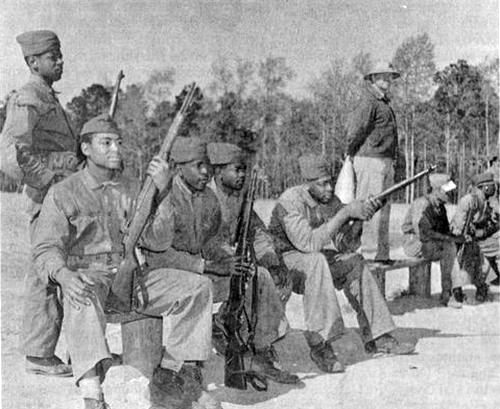
Marines of the 51st Defense Battalion await turn on rifle range, Montford Point, 1942.
Segregation was the common practice in all the services in 1942, as indeed it was throughout much of American society. If this practice appeared somehow more restrictive in the Marine Corps than it did in the other services, it was because of the corps' size and traditions. The illusion of equal treatment and opportunity could be kept alive in the massive Army and Navy with their myriad units and military occupations; it was much more difficult to preserve in the small and specialized Marine Corps. Given segregation, the Marine Corps was obliged to put its few black marines in its few black units, whose small size limited the variety of occupations and training opportunities.
Yet the size of the corps would undergo considerable change, and on balance it was the Marine Corps' tradition of an all-white service, not its restrictive size, that proved to be the most significant factor influencing racial policy. Again unlike the Army and Navy, the Marine Corps lacked the practical experience with black recruits that might have countered many of the alarums and prejudices concerning Negroes that circulated within the corps during the war. The importance of this experience factor comes out in the reminiscences of a senior official in the Division of Plans and Policies who looked back on his 1942 experiences:
Category: I II III IV V
Percentage: 0.11 5.14 24.08 59.63 11.04
If these figures are used as a base, slightly more than 70 percent of all black enlisted men, more than 11,000, scored in the two lowest categories, a meaningless racial statistic in terms of actual numbers because the smaller percentage of the much larger group of white draftees in these categories gave the corps more whites than blacks in groups IV and V. Yet the statistic was important because low-scoring Negroes, unlike the low-scoring whites who could be scattered throughout the corps' units, had to be concentrated in a small number of segregated units to the detriment of those units. Conversely, the corps had thousands of Negroes with the mental aptitude to serve in regular combat units and a small but significant number capable of becoming officers. Yet these men were denied the opportunity to serve in combat or as officers because the segregation policy dictated that Negroes could not be assigned to a regular combat unit unless all the billets in that unit as well as all replacements were black—a practical impossibility during World War II.
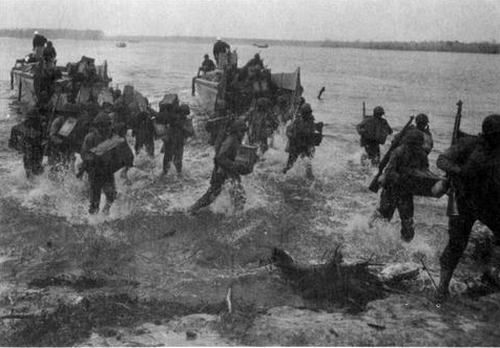
Shore Party in Training, Camp Lejeune, 1942
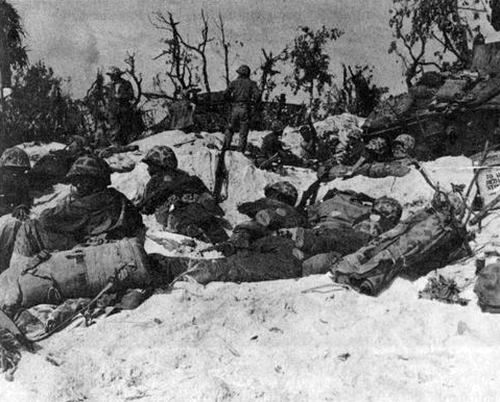
D-day on Peleliu. Support troops participate in the landing of 1st Marine Division.
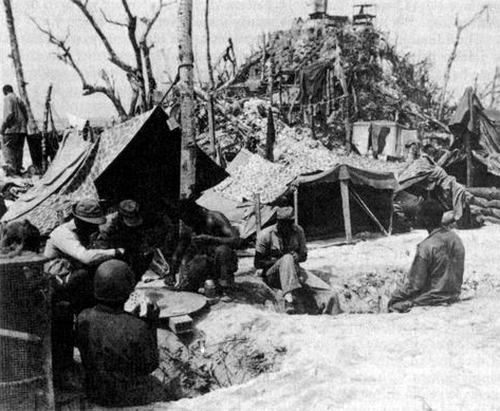
Medical Attendants at Rest, Peleliu, October, 1944
Before being sent overseas, black units underwent segregated field training, although the length of this training varied considerably according to the type of unit. Depot companies, for example, were labor units pure and simple, organized to perform simple tasks, and many of them were sent to the Pacific less than two weeks after activation. In contrast, the 51st Defense Battalion spent two months in hard field training, scarcely enough considering the number of raw recruits, totally unfamiliar with gunnery, that were being fed regularly into what was essentially an artillery battalion.
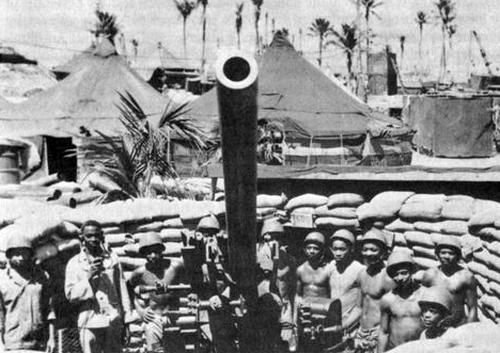
Gun Crew of the 52d Defense Battalion on duty, Central Pacific, 1945.
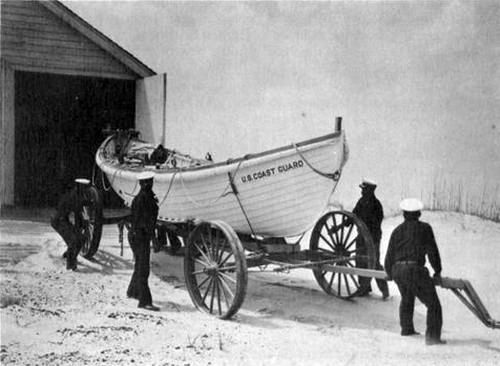
Crewmen of USCG Lifeboat Station, Pea Island, North Carolina, ready surf boat for launching.
Personal prejudices aside, the desire for social harmony and the fear of the unknown go far toward explaining the Marine Corps' wartime racial policy. A small, specialized, and racially exclusive organization, the Marine Corps reacted to the directives of the Secretary of the Navy and the necessities of wartime operation with a rigid segregation policy, its black troops restricted to about 4 percent of its enlisted strength. A large part of this black strength was assigned to labor units where Negroes performed valuable and sometimes dangerous service in the Pacific war. Complaints from civil rights advocates abounded, but neither protests nor the cost to military efficiency of duplicating training facilities were of sufficient moment to overcome the sentiment against significant racial change, which was kept to a minimum. Judged strictly in terms of keeping racial harmony, the corps policy must be considered a success. Ironically this very success prevented any modification of that policy during the war.
New Roles for Black Coast Guardsmen
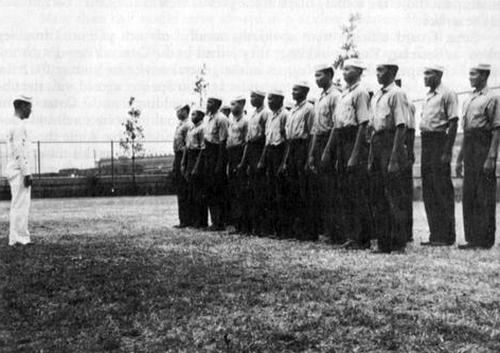
Coast Guard Recruits at Manhattan Beach Training Station, New York.
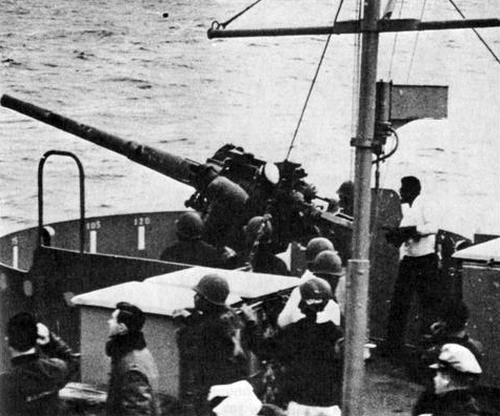
Stewards at Battle Station on the afterdeck of the cutter Campbell.
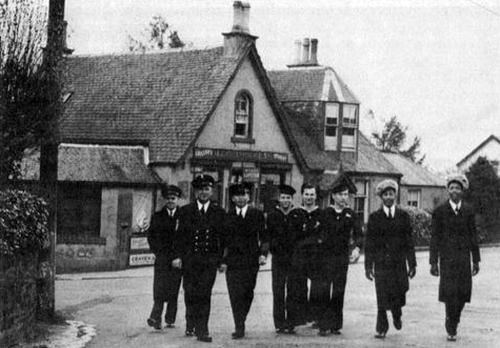
Shore Leave in Scotland. (The distinctive uniform of the Coast Guard steward is shown.)
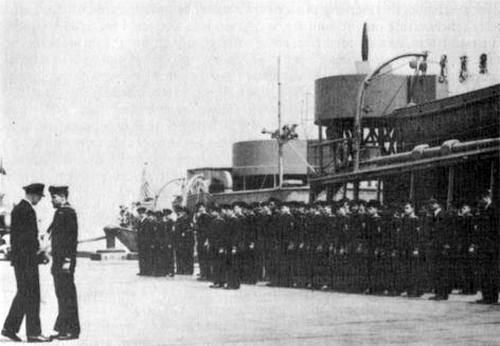
Commander Skinner and Crew of the Uss Sea Cloud. Skinner officiates at awards ceremony.
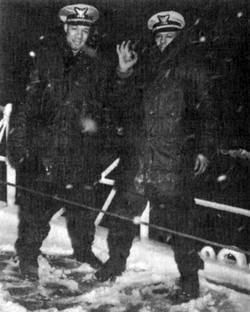
Ensign Jenkins and Lieutenant Samuels, first black Coast Guard officers, on board the Sea Cloud.
These men commanded integrated enlisted seamen throughout the rest of the war. Samuels became the first Negro in this century to command a Coast Guard vessel in wartime, first as captain of Lightship No. 115 and later of the USCGC Sweetgum in the Panama Sea Frontier. Russell was transferred from the integrated Hoquim to serve as executive officer on a cutter operating out of the Philippines in the western Pacific, assuming command of the racially mixed crew shortly after the war.
This very real progress toward equal treatment and opportunity for Negroes in the Coast Guard must be assessed with the knowledge that the progress was experienced by only a minuscule group. Negroes never rose above 2.1 percent of the Coast Guard's wartime population, well below the figures for the other services. This was because the other services were forced to obtain draft-age men, including a significant number of black inductees from Selective Service, whereas the Coast Guard ceased all inductions in early 1944.