CHAPTER 3
Reading edition
World War II: The Navy
Development of a Wartime Policy
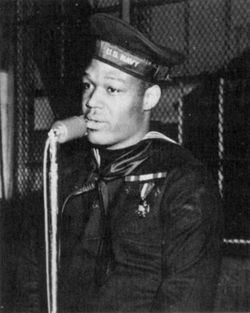
Dorie Miller
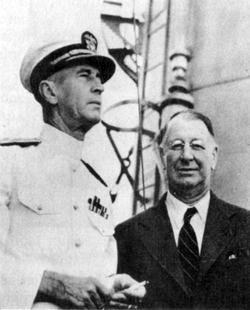
Admiral King and Secretary Knox on the USS Augusta.
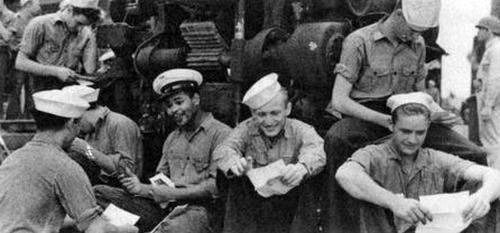
Crew Members of Uss Argonaut relax and read mail, Pearl Harbor, 1942.
When the General Board met on 23 January to consider the secretary's request, it became apparent that the minority report on the role of Negroes in the Navy had gained at least one convert among the senior officers. One board member, the Inspector General of the Navy, Rear Adm. Charles P. Snyder, repeated the arguments lately advanced by Addison Walker. He suggested that the board consider employing Negroes in some areas outside the servant class: in the Musician's Branch, for example, because "the colored race is very musical and they are versed in all forms of rhythm," in the Aviation Branch where the Army had reported some success in employing Negroes, and on auxiliaries and minor vessels, especially transports. Snyder noted that these schemes would involve the creation of training schools, rigidly segregated at first, and that the whole program would be "troublesome and require tact, patience, and tolerance" on the part of those in charge. But, he added, "we have so many difficulties to surmount anyhow that one more possibly wouldn't swell the total very much." Foreseeing that segregation would become the focal point of black protest, he argued that the Navy had to begin accepting Negroes somewhere, and it might as well begin with a segregated general service.
Adamant in its opposition to any change in the Navy's policy, the Bureau of Navigation ignored Admiral Snyder's suggestions. The spokesman for the bureau warned that the 5,000 Negroes under consideration were just an opening wedge. "The sponsors of the program," Capt. Kenneth Whiting contended, "desire full equality on the part of the Negro and will not rest content until they obtain it." In the end, he predicted, Negroes would be on every man-of-war in direct proportion to their percentage of the population. The Commandant of the Marine Corps, Maj. Gen. Thomas Holcomb, echoed the bureau's sentiments. He viewed the issue of black enlistments as crucial.
If we are defeated we must not close our eyes to the fact that once in they [Negroes] will be strengthened in their effort to force themselves into every activity we have. If they are not satisfied to be messmen, they will not be satisfied to go into the construction or labor battalions. Don't forget the colleges are turning out a large number of well-educated Negroes. I don't know how long we will be able to keep them out of the V-7 class. I think not very long.
The commandant called the enlistment of Negroes "absolutely tragic"; Negroes had every opportunity, he added, "to satisfy their aspiration to serve in the Army," and their desire to enter the naval service was largely an effort "to break into a club that doesn't want them."
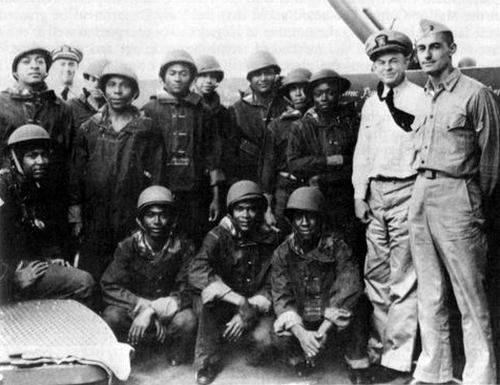
Messmen Volunteer As Gunners, Pacific task force, July 1942.
A Segregated Navy
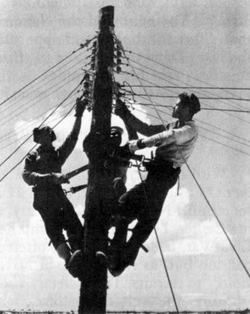
Electrician Mates string power lines in the Central Pacific.
On top of this blow, the Navy came under fire from another quarter. The President was evidently still thinking about Negroes in the Navy. He wrote to the secretary on 22 February:
I guess you were dreaming or maybe I was dreaming if Randall Jacobs is right in regard to what I am supposed to have said about employment of negroes in the Navy. If I did say that such employment should be stopped, I must have been talking in my sleep. Most decidedly we must continue the employment of negroes in the Navy, and I do not think it the least bit necessary to put mixed crews on the ships. I can find a thousand ways of employing them without doing so.
The point or the thing is this. There is going to be a great deal of feeling if the Government in winning this war does not employ approximately 10% of negroes—their actual percentage to the total population. The Army is nearly up to this percentage but the Navy is so far below it that it will be deeply criticized by anybody who wants to check into the details.
Perhaps a check by you showing exactly where all white enlisted men are serving and where all colored enlisted men are serving will show you the great number of places where colored men could serve, where they are not serving now—shore duty of all kinds, together with the handling of many kinds of yard craft.
To smooth the racial adjustments implicit in these plans, the Bureau of Naval Personnel developed two operating rules: Negroes would be assigned only where need existed, and, whenever possible, those from northern communities would not be used in the south. These rules caused some peculiar adjustments in administration. Negroes were not assigned to naval districts for distribution according to the discretion of the commander, as were white recruits. Rather, after conferring with local commanders, the bureau decided on the number of Negroes to be included in station complements and the types of jobs they would fill. It then assigned the men to duty accordingly, and the districts were instructed not to change the orders without consulting the bureau. Subsequently the bureau reinforced this rule by enjoining the commanders to use Negroes in the ratings for which they had been trained and by sending bureau representatives to the various commands to check on compliance.
Although the Navy boasted that Negroes served in every rating and at every task, in fact almost all were used in a limited range of occupations. Denied general service assignments on warships, trained Negroes were restricted to the relatively few billets open in the harbor defense, district, and small craft service. Although assigning Negroes to these duties met the President's request for variety of opportunity, the small craft could employ only 7,700 men at most, a minuscule part of the Navy's black strength.
Most Negroes performed humbler duties. By mid-1944 over 38,000 black sailors were serving as mess stewards, cooks, and bakers. These jobs remained in the Negro's eyes a symbol of his second-class citizenship in the naval establishment. Under pressure to provide more stewards to serve the officers whose number multiplied in the early months of the war, recruiters had netted all the men they could for that separate duty. Often recruiters took in many as stewards who were equipped by education and training for better jobs, and when these men were immediately put into uniforms and trained on the job at local naval stations the result was often dismaying. The Navy thus received poor service as well as unwelcome publicity for maintaining a segregated servants' branch. In an effort to standardize the training of messmen, the Bureau of Naval Personnel established a stewards school in the spring of 1943 at Norfolk and later one at Bainbridge, Maryland. The change in training did little to improve the standards of the service and much to intensify the feeling of isolation among many stewards.
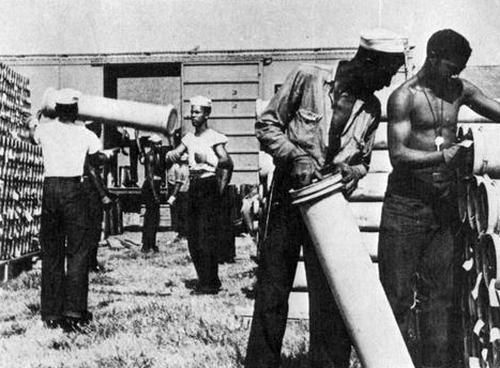
Laborers at Naval Ammunition Depot. Sailors passing 5-inch canisters, St. Julien's Creek, Virginia.
Another 12,000 Negroes served as artisans and laborers at overseas bases. Over 7,000 of these were Seabees, who, with the exception of two regular construction battalions that served with distinction in the Pacific, were relegated to "special" battalions stevedoring cargo and supplies. The rest were laborers in base companies assigned to the South Pacific area. These units were commanded by white officers, and almost all the petty officers were white.
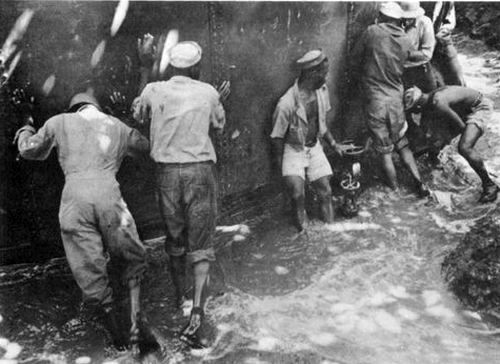
Seabees in the South Pacific righting an undermined water tank.
Another major cause of unrest among black seamen was the matter of rank and promotion. With the exception of the Coast Guard, the naval establishment had no black officers in 1943, and none were contemplated. Nor was there much opportunity for advancement in the ranks. Barred from service in the fleet, the nonrated seamen faced strong competition for the limited number of petty officer positions in the shore establishment. In consequence, morale throughout the ranks deteriorated.
The constant black complaint, and the root of the Navy's racial problem, was segregation. It was especially hard on young black recruits who had never experienced legal segregation in civilian life and on the "talented tenth," the educated Negroes, who were quickly frustrated by a policy that decided opportunity and assignment on the basis of color. They particularly resented segregation in housing, messing, and recreation. Here segregation off the job, officially sanctioned, made manifest by signs distinguishing facilities for white and black, and enforced by military as well as civilian police, was a daily reminder for the Negro of the Navy's discrimination.
Progressive Experiments
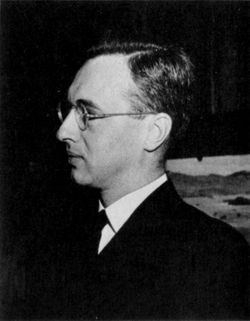
Commander Sargent
Since the inception of black enlistment there had been those in the Bureau of Naval Personnel who argued for the establishment of a group to coordinate plans and policies on the training and use of black sailors. Various proposals were considered, but only in the wake of the racial disturbances of 1943 did the bureau set up a Special Programs Unit in its Planning and Control Activity to oversee the whole black enlistment program. In the end the size of the unit governed the scope of its program. Originally the unit was to monitor all transactions involving Negroes in the bureau's operating divisions, thus relieving the Enlisted Division of the critical task of distributing billets for Negroes. It was also supposed to advise local commanders on race problems and interpret departmental policies for them. When finally established in August 1943, the unit consisted of only three officers, a size which considerably limited its activities. Still, the unit worked diligently to improve the lot of the black sailor, and eventually from this office would emerge the plans that brought about the integration of the Navy.
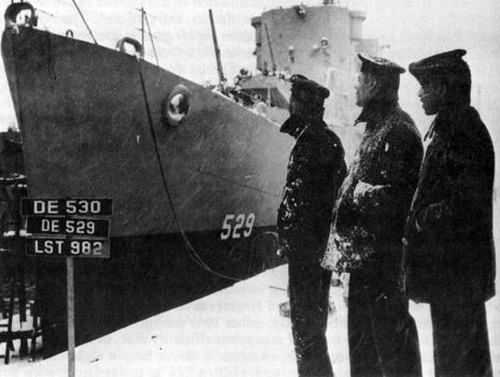
USS Mason. Sailors look over their new ship.
Despite these evidences of command concern, black promotions continued to lag in the Navy. Again at the Special Programs Unit's urging, the Bureau of Naval Personnel began to limit the number of rated men turned out by the black training schools so that more nonrated men already on the job might have a better chance to win ratings. The bureau instituted a specialist leadership course for rated Negroes at Great Lakes and recommended in January 1944 that two Negroes so trained be included in each base company sent out of the country. It also selected twelve Negroes with backgrounds in education and public relations and assigned them to recruiting duty around the country. The bureau expanded the black petty officer program because it was convinced by the end of 1943 that the presence of more black leaders, particularly in the large base companies, would improve discipline and raise morale. It was but a short step from this conviction to a realization that black commissioned officers were needed.
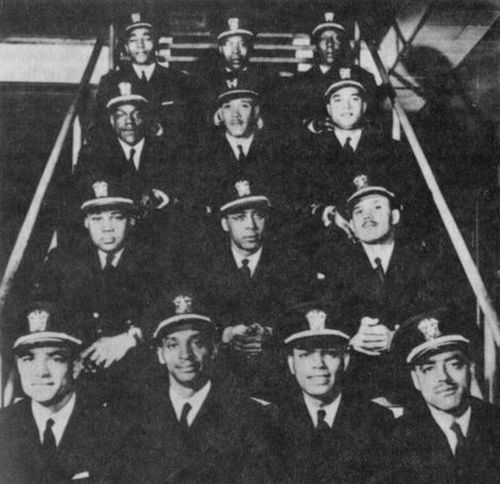
First Black Officers in the Navy. From left to right: (top row) John W. Reagan, Jesse W. Arbor, Dalton L. Baugh; (second row) Graham E. Martin, W. O. Charles B. Lear, Frank C. Sublett; (third row) Phillip S. Barnes, George Cooper, Reginald Goodwin; (bottom row) James E. Hare, Samuel E. Barnes, W. Sylvester White, Dennis D. Nelson II.
On 1 January 1944 the first sixteen black officer candidates, selected from among qualified enlisted applicants, entered Great Lakes for segregated training. All sixteen survived the course, but only twelve were commissioned. In the last week of the course, three candidates were returned to the ranks, not because they had failed but because the Bureau of Naval Personnel had suddenly decided to limit the number of black officers in this first group to twelve. The twelve entered the U.S. Naval Reserve as line officers on 17 March. A thirteenth man, the only candidate who lacked a college degree, was made a warrant officer because of his outstanding work in the course.
Two of the twelve new ensigns were assigned to the faculty at Hampton training school, four others to yard and harbor craft duty, and the rest to training duty at Great Lakes. All carried the label "Deck Officers Limited—only," a designation usually reserved for officers whose physical or educational deficiencies kept them from performing all the duties of a line officer. The Bureau of Naval Personnel never explained why the men were placed in this category, but it was clear that none of them lacked the physical requirements of a line officer and all had had business or professional careers in civil life.
Operating duplicate training facilities for officer candidates was costly, and the bureau decided shortly after the first group of black candidates was trained that future candidates of both races would be trained together. By early summer ten more Negroes, this time civilians with special professional qualifications, had been trained with whites and were commissioned as staff officers in the Medical, Dental, Chaplain, Civil Engineer, and Supply Corps. These twenty-two men were the first of some sixty Negroes to be commissioned during the war.
Further complicating the task of selecting suitable officers for black units was the fact that when the Bureau of Naval Personnel asked unit commanders to recommend men for such duty many commanders used the occasion to rid themselves of their least desirable officers. The Special Programs Unit then tried to develop its own source of officers for black units. It discovered a fine reservoir of talent among the white noncommissioned officers who ran the physical training and drill courses at Great Lakes. These were excellent instructors, mature and experienced in dealing with people. In January 1944 arrangements were made to commission them and to assign them to black units.
Improvement in the quality of officers in black units was especially important because the attitude of local commanders was directly related to the degree of segregation in living quarters and recreational facilities, and such segregation was the most common source of racial tension. Although the Navy's practice of segregating units clearly invited separate living and recreational facilities, the rules were unwritten, and local commanders had been left to decide the extent to which segregation was necessary. Thus practices varied greatly and policy depended ultimately on the local commanders. Rather than attack racial practices at particular bases, the unit decided to concentrate on the officers. It explained to these leaders the Navy's policy of equal treatment and opportunity, a concept basically incompatible with many of their practices.
Scholarly and objective, the pamphlet was an important document in the history of race relations in the Navy. In language similar to that used in the War Department's pamphlet on race, the Bureau of Naval Personnel stated officially for the first time that discrimination flowed of necessity out of the doctrine of segregation:
Forrestal Takes the Helm
Forrestal accepted Jacob's argument that as long as the war continued any move toward integrating the fighting ships was impractical. At the same time, he agreed with the Special Programs Unit that large concentrations of Negroes in shore duties lowered efficiency and morale. Forrestal compromised by ordering the bureau to prepare as an experiment a plan for the integration of some fleet auxiliary ships. On 20 May 1944 he outlined the problem for the President:
Secretary Forrestal also won the support of the Chief of Naval Operations for the move, but Admiral King still considered integration in the fleet experimental and was determined to keep strict control until the results were known. On 9 August 1944 King informed the commanding officers of twenty-five large fleet auxiliaries that Negroes would be assigned to them in the near future. As Forrestal had suggested, King set the maximum number of Negroes at 10 percent of the ship's general service. Of this number, 15 percent would be third-class petty officers from shore activities, selected as far as possible from volunteers and, in any case, from those who had served the longest periods of shore duty. Of the remainder, 43 percent would be from Class A schools and 42 percent from recruit training. The basic 10 percent figure proved to be a theoretical maximum; no ship received that many Negroes.
The crew was carefully indoctrinated in the fact that Negro personnel should not be subjected to discrimination of any sort and should be treated in the same manner as other members of the crew.
Admitting Negroes to the WAVES was another matter considered by the new secretary in his first days in office. In fact, the subject had been under discussion in the Navy Department for some two years. Soon after the organization of the women's auxiliary, its director, Capt. Mildred H. McAfee, had recommended that Negroes be accepted, arguing that their recruitment would help to temper the widespread criticism of the Navy's restrictive racial policy. But the traditionalists in the Bureau of Naval Personnel had opposed the move on the grounds that WAVES were organized to replace men, and since there were more than enough black sailors to fill all billets open to Negroes there was no need to recruit black women.
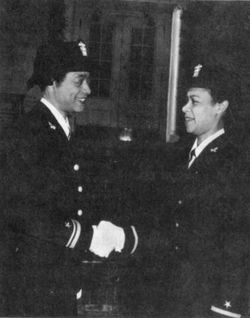
Lieutenant Pickens and Ensign Wills. First black WAVE officers, members of the final graduating class at Naval Reserve Midshipmen's School (WR), Northhampton, Massachusetts.
By July 1945 the Navy had trained seventy-two black WAVES at Hunter College Naval Training School in a fully integrated and routine manner. Although black WAVES were restricted somewhat in specialty assignments and a certain amount of separate quartering within integrated barracks prevailed at some duty stations, the Special Programs Unit came to consider the WAVE program, which established a forceful precedent for the integration of male recruit training, its most important wartime breakthrough, crediting Captain McAfee and her unbending insistence on equal treatment for the achievement.
Forrestal won the day in these early experiments, but he was a skillful administrator and knew that there was little hope for any fundamental social change in the naval service without the active cooperation of the Navy's high-ranking officers. His meeting with Admiral King on the subject of integration in the summer of 1944 has been reported by several people. Lester Granger, who later became Forrestal's special representative on racial matters, recalled:
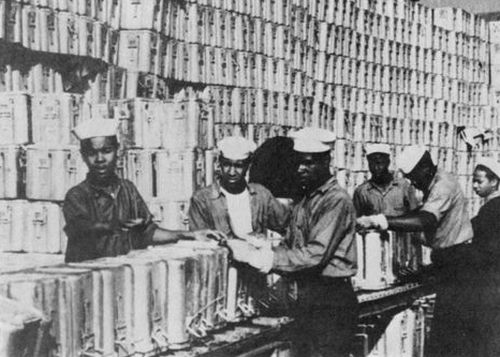
Sailors in the General Service Move Ammunition
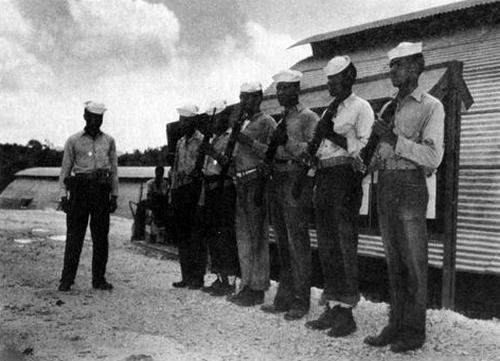
Security Watch in the Marianas. Ratings of these men guarding an ammunition depot include boatswain, second class, seaman, first class, and fireman, first class.
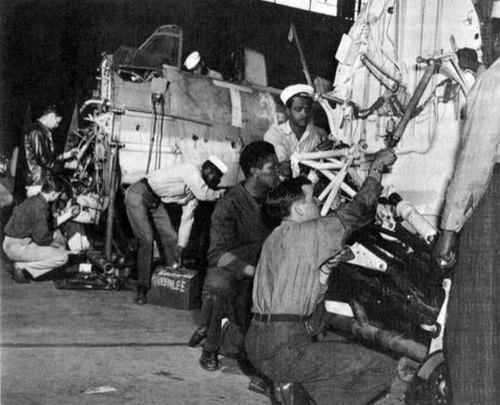
Specialists Repair Aircraft, Naval Air Station, Seattle, Washington, 1945.
A hunger strike developed as a protest against discrimination in a Seabee battalion at Port Hueneme, California, in March 1945. There was no violence. The thousand strikers continued to work but refused to eat for two days. The resulting publicity forced the Navy to investigate the charges; as a result, the commanding officer, the focus of the grievance, was replaced and the outfit sent overseas.
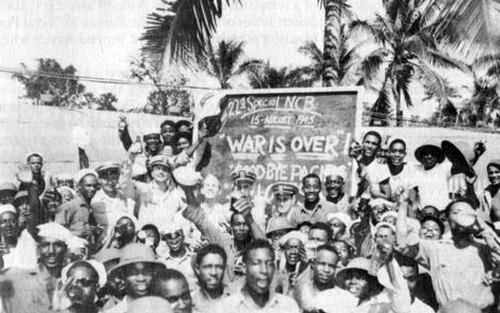
The 22d Special Construction Battalion Celebrates V-J Day
The Navy's wartime progress in race relations was the product of several forces. At first Negroes were restricted to service as messmen, but political pressure forced the Navy to open general service billets to them. In this the influence of the civil rights spokesmen was paramount. They and their allies in Congress and the national political parties led President Roosevelt to demand an end to exclusion and the Navy to accept Negroes for segregated general service. The presence of large numbers of black inductees and the limited number of assignments for them in segregated units prevented the Bureau of Naval Personnel from providing even a semblance of separate but equal conditions. Deteriorating black morale and the specter of racial disturbance drove the bureau to experiment with all-black crews, but the experiment led nowhere. The Navy could never operate a separate but equal fleet. Finally in 1944 Forrestal began to experiment with integration in seagoing assignments.
The influence of the civil rights forces can be overstated. Their attention tended to focus on the Army, especially in the later years of the war; their attacks on the Navy were mostly sporadic and uncoordinated and easily deflected by naval spokesmen. Equally important to race reform was the fact that the Navy was developing its own group of civil rights advocates during the war, influential men in key positions who had been dissatisfied with the prewar status of the Negro and who pressed for racial change in the name of military efficiency. Under the leadership of a sympathetic secretary, himself aided and abetted by Stevenson and other advisers in his office and in the Bureau of Naval Personnel, the Navy was laying plans for a racially integrated general service when Japan capitulated.
Still, the fact that reforms had been attempted in a service that had so recently excluded Negroes was evidence of progress. Secretary Forrestal was convinced that the Navy's hierarchy had swung behind the principle of equal treatment and opportunity, but the real test was yet to come. Hope for a permanent change in the Navy's racial practices lay in convincing its tradition-minded officers that an integrated general service with a representative share of black officers and men was a matter of military efficiency.