CHAPTER 1
Reading edition
Introduction
In the quarter century that followed American entry into World War II, the nation's armed forces moved from the reluctant inclusion of a few segregated Negroes to their routine acceptance in a racially integrated military establishment. Nor was this change confined to military installations. By the time it was over, the armed forces had redefined their traditional obligation for the welfare of their members to include a promise of equal treatment for black servicemen wherever they might be. In the name of equality of treatment and opportunity, the Department of Defense began to challenge racial injustices deeply rooted in American society.
For all its sweeping implications, equality in the armed forces obviously had its pragmatic aspects. In one sense it was a practical answer to pressing political problems that had plagued several national administrations. In another, it was the services' expression of those liberalizing tendencies that were permeating American society during the era of civil rights activism. But to a considerable extent the policy of racial equality that evolved in this quarter century was also a response to the need for military efficiency. So easy did it become to demonstrate the connection between inefficiency and discrimination that, even when other reasons existed, military efficiency was the one most often evoked by defense officials to justify a change in racial policy.
The Armed Forces Before 1940
Yet the fact that the British themselves were taking large numbers of Negroes into their ranks proved more important than revolutionary idealism in creating a place for Negroes in the American forces. Above all, the participation of both slaves and freedmen in the Continental Army and the Navy was a pragmatic response to a pressing need for fighting men and laborers. Despite the fear of slave insurrection shared by many colonists, some 5,000 Negroes, the majority from New England, served with the American forces in the Revolution, often in integrated units, some as artillerymen and musicians, the majority as infantrymen or as unarmed pioneers detailed to repair roads and bridges.
Again, General Jackson's need for manpower at New Orleans explains the presence of the Louisiana Free Men of Color in the last great battle of the War of 1812. In the Civil War the practical needs of the Union Army overcame the Lincoln administration's fear of alienating the border states. When the call for volunteers failed to produce the necessary men, Negroes were recruited, generally as laborers at first but later for combat. In all, 186,000 Negroes served in the Union Army. In addition to those in the sixteen segregated combat regiments and the labor units, thousands also served unofficially as laborers, teamsters, and cooks. Some 30,000 Negroes served in the Navy, about 25 percent of its total Civil War strength.
The influence of the idealism fostered by the abolitionist crusade should not be overlooked. It made itself felt during the early months of the war in the demands of Radical Republicans and some Union generals for black enrollment, and it brought about the postwar establishment of black units in the Regular Army. In 1866 Congress authorized the creation of permanent, all-black units, which in 1869 were designated the 9th and 10th Cavalry and the 24th and 25th Infantry.
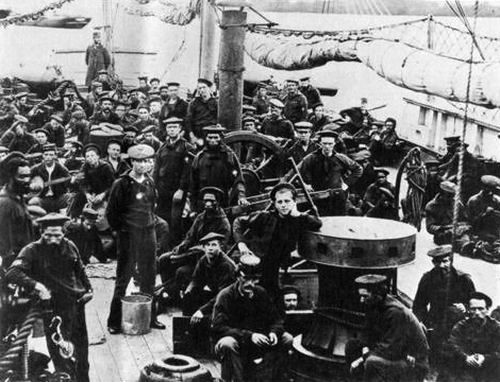
Crewmen of the USS Miami During the Civil War
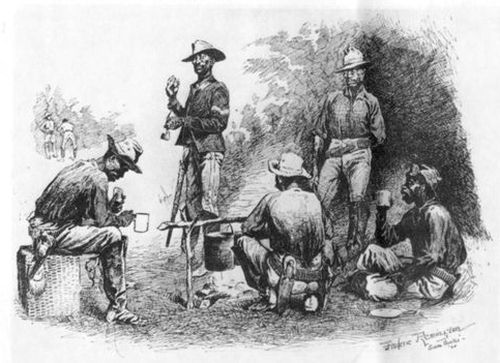
Buffalo Soldiers. (Frederick Remington's 1888 sketch.)]
Black assignments reflected the opinion, expressed repeatedly in Army staff studies throughout the war, that when properly led by whites, blacks could perform reasonably well in segregated units. Once again Negroes were called on to perform a number of vital though unskilled jobs, such as construction work, most notably in sixteen specially formed pioneer infantry regiments. But they also served as frontline combat troops in the all-black 92d and 93d Infantry Divisions, the latter serving with distinction among the French forces.
Civil Rights and the Law in 1940
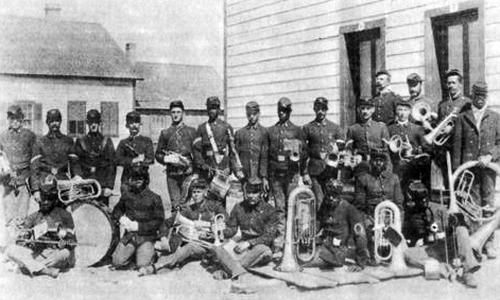
Integration in the Army of 1888. The Army Band at Fort Duchesne, Utah, composed of soldiers from the black 9th Cavalry and the white 21st Infantry.
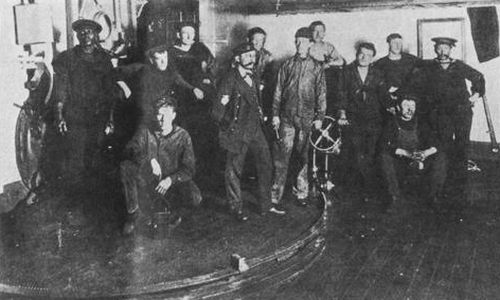
Gunner's Gang on the USS Maine.
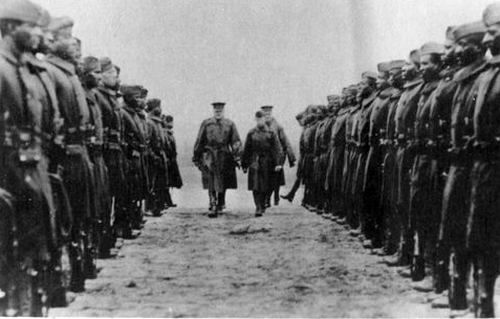
General Pershing, AEF Commander, Inspects Troops of the 802d (Colored) Pioneer Regiment in France, 1918.
No filibuster was attempted, and the Wagner amendment passed the Senate easily, 53 to 21. It provided
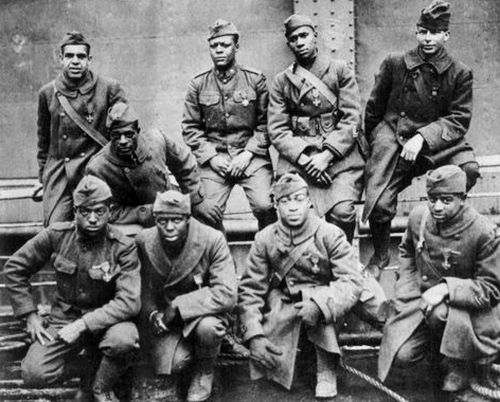
Heroes of the 369th Infantry. Winners of the Croix de Guerre arrive in New York Harbor, February 1919.
The Fish amendment had little immediate impact upon the services' racial patterns. As long as official policy permitted separate draft calls for blacks and whites and the officially held definition of discrimination neatly excluded segregation—and both went unchallenged in the courts—segregation would remain entrenched in the armed forces. Indeed, the rigidly segregated services, their ranks swollen by the draft, were a particular frustration to the civil rights forces because they were introducing some black citizens to racial discrimination more pervasive than any they had ever endured in civilian life. Moreover, as the services continued to open bases throughout the country, they actually spread federally sponsored segregation into areas where it had never before existed with the force of law. In the long run, however, the 1940 draft law and subsequent draft legislation had a strong influence on the armed forces' racial policies. They created a climate in which progress could be made toward integration within the services. Although not apparent in 1940, the pressure of a draft-induced flood of black conscripts was to be a principal factor in the separate decisions of the Army, Navy, and Marine Corps to integrate their units.
To Segregate Is To Discriminate
As with all the administration's prewar efforts to increase opportunities for Negroes in the armed forces, the Selective Service Act failed to excite black enthusiasm because it missed the point of black demands. Guarantees of black participation were no longer enough. By 1940 most responsible black leaders shared the goal of an integrated armed forces as a step toward full participation in the benefits and responsibilities of American citizenship.
The White House may well have thought that Walter White of the NAACP singlehandedly organized the demand for integration in 1939, but he was merely applying a concept of race relations that had been evolving since World War I. In the face of ever-worsening discrimination, White's generation of civil rights advocates had rejected the idea of the preeminent black leader Booker T. Washington that hope for the future lay in the development of a separate and strong black community. Instead, they gradually came to accept the argument of one of the founders of the National Association for the Advancement of Colored People, William E. B. DuBois, that progress was possible only when Negroes abandoned their segregated community to work toward a society open to both black and white. By the end of the 1930's this concept had produced a fundamental change in civil rights tactics and created the new mood of assertiveness that Myrdal found in the black community. The work of White and others marked the beginning of a systematic attack against Jim Crow. As the most obvious practitioner of Jim Crow in the federal government, the services were the logical target for the first battle in a conflict that would last some thirty years.
Presidential promises notwithstanding, the NAACP set out to make integration of the services a matter of overriding interest to the black community during the war. The organization encountered opposition at first when some black leaders were willing to accept segregated units as the price for obtaining the formation of more all-black divisions. The NAACP stood firm, however, and demanded at its annual convention in 1941 an immediate end to segregation.