CHAPTER 7
Reading edition
A Problem of Quotas
The War Department encountered overwhelming problems when it tried to put the Gillem Board's recommendations into practice, and in the end only parts of the new policy for the use of black manpower were ever carried out. The policy foundered for a variety of reasons: some implicit in the nature of the policy itself, others the result of manpower exigencies, and still others because of prejudices lingering in the staff, the Army, and the nation at large.
Assistant Secretary Petersen was perturbed at the mounting evidence of opposition. Specifically, he believed Spaatz's comments indicated a lack of accord with Army policy, and he wanted the Army Air Forces told that "these basic matters are no longer open for discussion." He also wanted to establish a troop basis that would lead, without the imposition of arbitrary percentages, to the assignment of a "fair proportion" of black troops to all major commands and their use in all kinds of duties in all the arms and services. Petersen considered the composite unit one of the most important features of the new policy, and he wanted "at least a few" such units organized soon. He mentioned the assignment of a black parachute battalion to the 82d Airborne Division as a good place to begin.
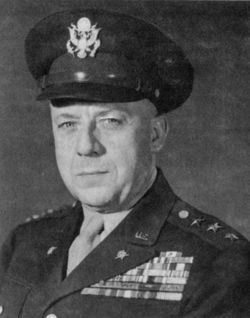
General Paul
The Quota in Practice
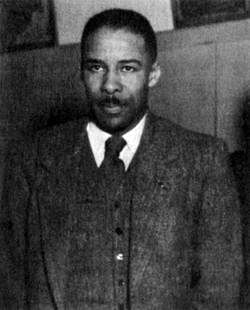
Marcus Ray
While the new enlistment policy would help restore the Gillem Board's quantitative equilibrium to the Army, the secretary's exception allowing reenlistment of regulars would only intensify the qualitative imbalance between black and white soldiers. The nation's biracial educational system had produced an average black soldier who scored well below the average white soldier on all the Army's educational and training tests. The segregation policy had only complicated the problem by denying the talented Negro the full range of Army occupations and hence an equal chance for advancement. With the suspension of first-time enlistments, the qualitative imbalance was sure to grow, for now the highly qualified civilian would be passed over while the less qualified soldier was permitted to reenlist.
Nevertheless it is also clear that the traditionalists considered the quota a means of permanently limiting black soldiers to a percentage equivalent to Negroes in the population. Assistant Secretary McCloy belonged to neither group. More than a year before in reviewing the Gillem Board's work he had declared: "I do not see any place for a quota in a policy that looks to utilization of Negroes on the basis of ability."
Broader Opportunities
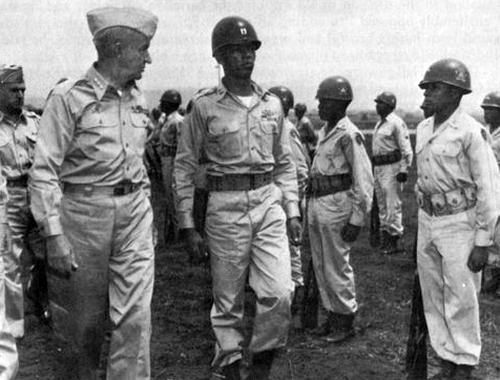
General Eichelberger, Eighth Army Commander, inspects 24th Infantry troops, Camp Majestic, Japan, June 1947.
But the practice of attaching rather than assigning black units continued until the end of 1949. Only then, and increasingly during 1950, did the Army begin to assign a number of black units as organic parts of combat divisions. More noteworthy, Negroes began to be assigned to fill the spaces in parts of white units. Thus the 3d Battalion of the 9th Infantry and the 3d Battalion of the 188th became black units in 1950.
Assignments
The survey attested to a dismal lack of progress in the development of specialist training for Negroes. Although all the commanders of the zone of interior armies reported that Negroes had equal opportunity with whites to attend Army schools, in fact more than half of all the Army's courses were not open to black soldiers regardless of their qualifications. The Ordnance Department, for example, declared that all its technical courses were open to qualified Negroes, but as late as November 1947 the Ordnance School in Atlanta, Georgia, had openings for 440 whites but none for blacks.
Ironically, the results of the Hodes survey were announced just four days short of Circular 124's first birthday. Along with the other surveys and directives of the past year, it demonstrated that in several important particulars the Gillem Board's recommendations were being only partially and indifferently followed. Obviously, some way must be found to dispel the atmosphere of indifference, and in some quarters hostility, that now enveloped Circular 124.
A New Approach
A new approach was possible mainly because General Paul and his staff had amassed considerable experience during the past year in how to use black troops. They had come to understand that the problems inherent in broadening the employment of black soldiers—the procurement of desirable black recruits, their training, especially school training for military occupational specialties, and their eventual placement in spaces that used that training—were interrelated and that progress in one of these areas was impossible without advances in the other two. In November 1947 the Personnel and Administration Division decided to push for a modest step-by-step increase in the number of jobs open to Negroes, using this increase to justify an expansion of school quotas for Negroes and a special recruitment program.
Mindful of the strong opposition to his recent attempts to train Negroes for new overhead assignments, General Paul did not see how occupational specialties could be increased until new units or converted white ones were formed, or, for that matter, how school quotas could be increased unless positions for Negroes existed to justify the training. He believed that the Army should first widen the employment of black units and individuals in overhead spaces, and then follow up with increased school quotas and special recruitment. Paul had already learned from recent surveys that the number of available overhead positions would allow only a modest increase in the number of specialized jobs available to Negroes; any significant increase would require the creation of new black units. Given the limitations on organized units, any increase would be at the expense of white units.
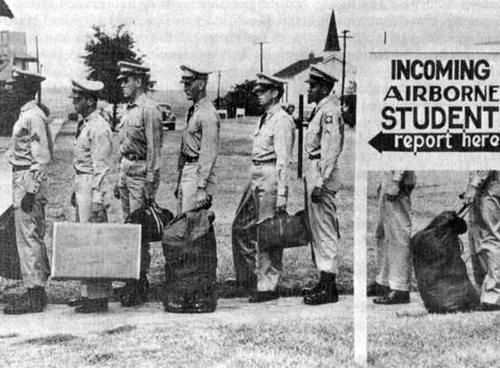
Army Specialists Report for Airborne Training, Fort Bragg, North Carolina, 1948.
The Adjutant General assigned Maj. James D. Fowler, a black graduate of West Point, class of 1941, to perform all these tasks. Fowler surveyed the nineteen newly converted units and recommended that 1,134 men, approximately 20 percent of those enlisted for the special expansion of the general reserve, be trained in thirty-seven courses of instruction—an increase of 103 black spaces in these courses. Examining worldwide Army strength to determine deficiencies in school-trained specialties in black units, he recommended a total increase of 172 spaces in another thirty-seven courses. Studying the organizational tables of more than two hundred military bases, Fowler recommended that black school quotas for another eleven military occupational specialties, for which there were currently no black quotas, be set at thirty-nine spaces.
The Quota System: An Assessment
The Personnel and Organization Division made no further requests for increased school quotas for Negroes, and even those increases already approved were short-lived. As soon as the needs of the converted units were met, the school quotas for Negroes were reduced to a level sufficient to fill the replacement needs of the black units. By March 1949, spaces for black students in the replacement stream courses had declined from the 237 recommended by Major Fowler to eighty-two; the number of replacement stream courses open to Negroes fell from 48 percent of all courses offered to 19.8 percent. Fowler had expected to follow up his study of school quotas in the Military Police, Signal Corps, and Medical Corps with surveys of other schools figuring in the Career Guidance Program, but since no additional overhead positions were ever converted from white to black, no further need existed for school quota studies. The three-point study suggested by Paul to find ways to increase school quotas for Negroes was never made.
The War Department's problems with its segregation policy were only intensified by its insistence on maintaining a racial quota. Whatever the authors' intention, the quota was publicized as a guarantee of black participation. In practice it not only restricted the number of Negroes in the Army but also limited the number and variety of black units that could be formed and consequently the number and variety of jobs available to Negroes. Further, it restricted the openings for Negroes in the Army's training schools.
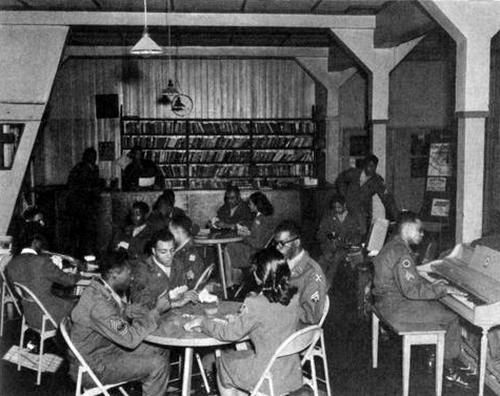
Bridge Players, Seaview Service Club, Tokyo, Japan, 1948
At the same time, enlistment policies combined with Selective Service regulations to make it difficult for the Army to produce from its black quota enough men with the potential to be trained in those skills required by a variety of units. Attracted by the superior economic status promised by the Army, the average black soldier continued to reenlist, thus blocking the enlistment of potential military leaders from the increasing number of educated black youths. This left the Army with a mass of black soldiers long in service but too old to fight, learn new techniques, or provide leadership for the future. Subject to charges of discrimination, the Army only fitfully and for limited periods tried to eliminate low scorers to make room for more qualified men. Yet to the extent to which it failed to attract educated Negroes and provide them with modern military skills, it failed to perform a principal function of the peacetime Army, that of preparing a cadre of leaders for future wars.
The accuracy of test scores can be ignored when the subject is viewed from the perspective of manpower utilization. In the five years after World War II, the actual number of white soldiers who scored in the lowest test categories equaled or exceeded the number of black soldiers. The Army had no particular difficulty using these white soldiers to advantage, and in fact refused to discharge all Class V men in 1946. Segregation was the heart of the matter; the less gifted whites could be scattered throughout the Army but the less gifted blacks were concentrated in the segregated black units.
Reversing the coin, what could the Army do with the highly qualified black soldier? His technical skills were unneeded in the limited number and variety of black units; he was barred from white units. In an attempt to deal with this problem, the Gillem policy directed that Negroes with special skills or qualifications be employed in overhead detachments. Such employment, however, depended in great part on the willingness of commanders to use school-trained Negroes. Many of these officers complained that taking the best qualified Negroes out of black units for assignment to overhead detachments deprived black units of their leaders. Furthermore, overhead units represented so small a part of the whole that they had little effect on the Army's problem.
The racial quota also complicated the postwar reduction in Army strength. Since the strength and composition of the Army was fixed by the defense budget and military planning, the majority of new black soldiers produced by the quota could be organized into units only at the expense of white units already in existence. In light of past performance of black units and in the interests of efficiency and economy, particularly at a time of reduced operating funds and a growing cold war, how could the Army justify converting efficient white units into less capable black units? The same question applied to the formation of composite units. Grouping lower scoring black units with white units, many of the Army staff believed, would lower the efficiency of the whole and complicate the Army's relations with the civilian community. As a result, the black units remained largely separate, limited in number, and tremendously overstrength throughout the postwar period.
Some of these problems, at least, might have been solved had the Army created a special staff group to oversee the new policy, a key proposal of the Gillem Board. The Personnel and Administration Division was primarily interested in individuals, in trying to place qualified Negroes on an individual basis; the Organization and Training Division was primarily concerned with units, in trying to expand the black units to approximate the combat to service ratio of white units. These interests conflicted at times, and with no single agency possessing overriding authority, matters came to an impasse, blocking reform of Army practices. Instead, the staff played a sterile numbers game, seeking to impose a strict ratio everywhere. But it was impossible to have a 10 percent proportion of Negroes in every post, in every area, in every overseas theater; it was equally impossible to have 10 percent in every activity, in every arm and service, in every type of task. Yet wherever the Army failed to organize its black strength by quota, it was open to charges of racial discrimination.
It would be a mistake to overlook the signs of racial progress achieved under the Gillem Board policy. Because of its provisions thousands of Negroes came to serve in the postwar Regular Army, many of them in a host of new assignments and occupations. But if the policy proved a qualified success in terms of numbers, it still failed to gain equal treatment and opportunity for black soldiers, and in the end the racial quotas and diverse racial units better served those who wanted to keep a segregated Army.