CHAPTER 21
Reading edition
Equal Treatment and Opportunity Redefined
By 1962 the civil rights leaders and their allies in the Kennedy administration were pressing the Secretary of Defense to end segregation in the reserve components and in housing, schools, and public accommodations in communities adjacent to military installations. Such an extension of policy, certainly the most important to be contemplated since President Truman's executive order in 1948, would involve the Department of Defense in the fight for servicemen's civil rights, thrusting it into the forefront of the civil rights movement.
The Secretary Makes a Decision
Some of McNamara's closest advisers and some civil rights advocates in the Kennedy administration, increasingly critical of current practices, were anxious to instruct the secretary in the need for a new racial outlook. But their efforts were counterbalanced by the influence of defenders of the status quo, primarily the manpower bureaucrats in the secretary's office and their colleagues in the services. These men opposed substantive change not because they objected to the reformers' goals but because they doubted the wisdom and propriety of interfering in what they regarded as essentially a domestic political issue.
One group, from whom Adam Yarmolinsky, McNamara's special assistant, might be singled out as the most prominent member, developed arguments for a new racial policy that would encourage the services to modify local laws and customs in ways more favorable to black servicemen. Unlike earlier reformers in the department who acted primarily out of an interest in military efficiency, these men were basically civil libertarians, or "social movers," as Secretary of the Air Force Zuckert called them. They were allied with like-minded new frontiersmen, including the President's special counsel on minority affairs and Attorney General Kennedy, who were convinced that Congress would enact no new civil rights legislation in 1962. The services, this group argued, had through their recent integration found themselves in the vanguard of the national campaign for equal treatment and opportunity for Negroes, and to some it seemed only logical that they be used to retain that lead for the administration. These men had ample proof, they believed, for the proposition that the services' policies had already influenced reforms elsewhere. They saw a strong connection, for example, between the new Interstate Commerce Commission's order outlawing segregation in interstate travel and the services' efforts to secure equal treatment for troops in transit. In effect, in the name of an administration handicapped by an unwilling legislature, they were asking the services to fly the flag of civil rights.
If their motives differed from those of their predecessors, their rhetoric did not. Yarmolinsky and his colleagues argued that racial discrimination, particularly discrimination in housing and public accommodations, created a serious morale problem among black GIs, a contention strongly supported by the recent Civil Rights Commission findings. While the services had always denied responsibility for combating discrimination outside the military reservation, these officials were confident that the connection between this discrimination and military efficiency could be demonstrated. They were also convinced that segregated housing and the related segregation of places of public accommodation were particularly susceptible to economic pressure from military authorities.

Adam Yarmolinsky
This last argument was certainly not new. For some time civil rights spokesmen had been urging the services to use economic pressure to ease discrimination. Specifically, Congressman Powell, and later a number of civil rights groups, had called on the armed forces to impose off-limits sanctions for all servicemen against businesses that discriminated against black servicemen. Clear historical precedent seemed to exist for the action demanded by the controversial Harlem legislator because from earliest time the services had been declaring establishments and whole geographical areas off limits to their officers and men in order to protect their health and welfare. In view of the services' contention that equal treatment and opportunity were important to the welfare of servicemen, was it not reasonable, the spokesmen could ask, for the armed forces to use this powerful economic weapon against those who discriminated?
Those defense officials calling for further changes also argued that even the limited reforms already introduced by the administration faced slow going in the Department of Defense. This point was of particular concern to Robert Kennedy and his assistants in the Justice Department who agreed that senior defense officials lacked neither the zeal nor the determination to advance the civil rights of black servicemen but that the uniformed services were not, as Deputy Secretary Gilpatric expressed it, "putting their hearts and souls into really carrying out all of these directives and policies." Reflecting on it later, Gilpatric decided that the problem in the armed forces was one of pace. The services, he believed, were willing enough to carry out the policies, but in their own way and at their own speed, to avoid the appearance of acting as the agent of another federal department.
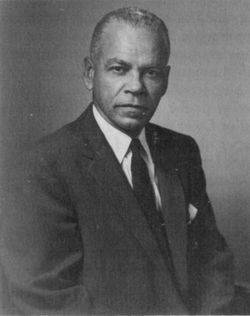
James Evans
All these arguments failed to convince Assistant Secretary for Manpower Runge, some officials in the general counsel's office, and principal black adviser on racial affairs James Evans, among others. This group and their allies in the services could point to a political fact of life: to interfere with local segregation laws and customs, specifically to impose off-limits sanctions against southern businessmen, would pit the administration against powerful congressmen, calling down on it the wrath of the armed services and appropriation committees. To the charge that this threat of congressional retaliation was simply an excuse for inaction, the services could explain that unlike the recent integration of military units, which was largely an executive function with which Congress, or at least some individual congressmen, reluctantly went along, sanctions against local communities would be considered a direct threat by scores of legislators. "Even one obscure congressman thus threatened could light a fire over military sanctions," Evans later remarked, "and there were plenty of folks around who were eager to fan the flames."
Even more important, the department's equal opportunity bureaucracy argued, was the need to protect the physical well-being of the individual black soldier. In a decade when civil rights beatings and murders were a common occurrence, these men knew that Evans was right when he said "by the time Washington could enter the case the young man could be injured or dead." Operating under the principle that the safety and welfare of the individual transcended the civil rights of the group, these officials wanted to forbid the men, both the black and the increasing number of white activists, to disobey local segregation laws and customs.
Many of the manpower officials carefully differentiated between equal treatment, which had always been at the heart of the Defense Department's reforms, and civil rights, which they were convinced were a constitutional matter and belonged in the hands of the courts and the Justice Department. The principle of equal treatment and opportunity was beyond criticism. Its application, a lengthy and arduous task that had occupied and still concerned the services' racial advisers, had brought the Department of Defense to unparalleled heights of racial harmony. Convinced that the current civil rights campaign was not the business of the Defense Department, they questioned the motives of those who were willing to make black GI's the stalking horse for their latest and perhaps transient enthusiasm, in the process inviting congressional criticism of the department's vital racial programs. In short, Assistant Secretary Runge and his colleagues argued that the administration's civil rights campaign should be led by the Justice Department and by the Department of Health, Education, and Welfare, not the Defense Department, which had other missions to perform.
The Gesell Committee
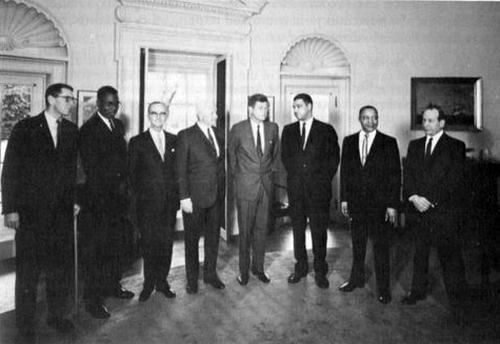
The Gesell Committee Meets With the President. Left to right: Laurence I. Hewes III, Executive Secretary; Nathaniel S. Colley; Benjamin Muse; Gerhard A. Gesell; President Kennedy; Whitney M. Young, Jr.; John H. Sengstacke; and Abe Fortas.
In the end the committee's reputation would rest not so much on its carefully developed catalog of racial discrimination. After all, others, most notably the Civil Rights Commission, had recently documented the problems encountered by black servicemen, although not in the detail offered by the Gesell group, and had convincingly tied this discrimination to black morale and military efficiency. The committee's major contribution lay rather in its establishment of a new concept in command responsibility that directly attacked the traditional parochialism of the services' social concerns:
In effect the committee proposed a new racial policy for the Department of Defense, one that would translate the services' promise of equality of treatment and opportunity into a declaration of civil liberties. To that end it recommended the adoption of a set of techniques radically new to the thinking of the military commanders, one that grew out of the committee's own experiences in the field.
Chairman Gesell later recollected how this recommendation developed:
The reason for this enthusiasm was a report that faithfully reflected the realities of discrimination suffered by black servicemen and proposed solutions based on conclusions drawn by the members from their months of discussion and investigation. The committee's conclusions and recommendations were the natural reaction of a group of humane and sensible men to the overwhelming evidence of continued discrimination against black servicemen. National policy, the committee told the President, required that this discrimination be eliminated, for
The committee wanted responsibility for eliminating these color distinctions in the services shifted to the local commander. Commanders, it believed, needed to improve their communication with black servicemen and should be "held accountable to discover and remedy discrimination" in their commands. The committee, in short, wanted racial sensitivity made a function of command.
Command responsibility for equal opportunity, the committee emphasized, was particularly important "in the area of most pressing concern, off-base discrimination." It wanted local commanders to attack discrimination in the community by seeking the voluntary compliance of local businessmen and by establishing biracial community committees. The committee asserted that despite the services' claims to the contrary the Department of Defense had made no serious effort to achieve off-base compliance with its anti-discrimination measures through voluntary action. Commanders had been given little guidance thus far, and a carefully planned program of voluntary action should be given a chance. If it failed, commanders should be able to employ sanctions against the offending businesses; if sanctions failed, the services should consider closing installations in offending areas. The committee again stressed the need to fix responsibility for the program on local commanders. A commander's performance should be monitored and rated, and offices should be established in the Department of Defense and in the individual services to devise programs, monitor their progress, and bring base commanders into close working relationship with other interested and responsible federal agencies.
Although their recommendations were later excoriated by critics as a radical usurpation of state sovereignty and a threat to civil liberties, the committee had meant only to provide a graduated solution to a national defense problem. Let reform begin with the local commander's improving conditions on his base and pressing for voluntary changes in the local community. Only when this tactic failed—and the committee predicted that failure would be a rare occurrence—should the services employ economic sanctions.
Reaction to a New Commitment
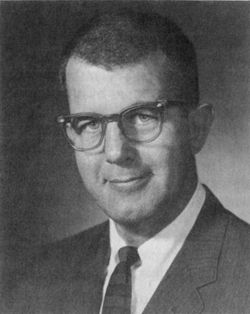
Alfred Fitt
Despite the opposition to these recommendations, Fitt saw room for compromise between the committee and the services. Noting, for example, that the services wanted to do their own monitoring of their commander's performance, Fitt agreed this would be acceptable so long as the Secretary of Defense could monitor the monitors. Adding that officers, like other human beings, tended to concentrate on the tasks that would be reviewed by superiors, he wanted to see a judgment of a commander's ability to handle discrimination matters included in the narrative portion of his efficiency report. On the question of sanctions, Fitt pointed out to McNamara that the services now understood that their equal opportunity responsibilities extended beyond the limits of the military reservation but that several of their objections to the use of sanctions were sound. He suggested the secretary approve the use of sanctions in discrimination cases but place severe restraints on their imposition, restricting the decision to the secretary's office.
The directive, in reality an outline of the Department of Defense's civil rights responsibilities and the prototype of subsequent secretarial orders dealing with race, was published on 26 July 1963, the fifteenth anniversary of Harry Truman's executive order. It read in part:
II. Responsibilities.
A. Office of the Secretary of Defense:
1. Pursuant to the authority vested in the Secretary of Defense and the provisions of the National Security Act of 1947, as amended, the Assistant Secretary of Defense (Manpower) is hereby assigned responsibility and authority for promoting equal opportunity for members of the Armed Forces.
In the performance of this function he shall (a) be the representative of the Secretary of Defense in civil rights matters, (b) give direction to programs that promote equal opportunity for military personnel, (c) provide policy guidance and review policies, regulations and manuals of the military departments, and (d) monitor their performance through periodic reports and visits to field installations.
2. In carrying out the functions enumerated above, the Assistant Secretary of Defense (Manpower) is authorized to establish the Office of Deputy Assistant Secretary of Defense (Civil Rights).
B. The Military Departments:
1. The military departments shall, with the approval of the Assistant Secretary of Defense (Manpower), issue appropriate instructions, manuals and regulations in connection with the leadership responsibility for equal opportunity, on and off base, and containing guidance for its discharge.
2. The military departments shall institute in each service a system for regularly reporting, monitoring and measuring progress in achieving equal opportunity on and off base.
C. Military Commanders:
After some thirty months in office, Robert McNamara had made a most decisive move in race relations. In the name of fulfilling Harry Truman's pledge of equal treatment and opportunity he announced an aggressive new policy. Not only would the department work to eliminate discrimination in the armed forces, but when servicemen were affected it would work in the community as well. Even more ominous to the secretary's critics was the fact that the new policy revealed McNamara's willingness, under certain circumstances, to use the department's economic powers to force these changes. This directive marked the beginning of McNamara's most active period of participation in the civil rights revolution of the 1960's.
Critics also discussed the directive in terms of military efficiency. The secretary had given the commanders a new mission, Senator John Stennis of Mississippi noted, that "can only be detrimental to military tradition, discipline, and morale." Elaborating on this idea, Congressman L. Mendel Rivers of South Carolina predicted that the new policy would destroy the merit promotion system. Henceforth, Rivers forecast, advancement would depend on acceptance of integration; henceforth, racial quotas would "take the place of competence for purposes of promotion." Others were alarmed at the prospect of civil rights advisers on duty at each base and outside the regular chain of command. This outrage, Congressman H. R. Gross of Iowa charged, "would create the biggest army of snoopers and informers that the military has ever heard of."
The Gesell Committee: Final Report
The committee wanted the recommendations on off-base discrimination contained in its initial report also applied overseas. Ignoring the oft made distinction about the guest status of overseas service, it wanted the Department of State enlisted in a campaign against discrimination in public accommodations, including the use of off-limits sanctions when necessary. The committee also called for a continuing review to insure equal opportunity in assignments to attache and mission positions.
Although many people strongly associate the Gesell Committee with the use of economic coercion against race discrimination in the community, the committee's emphasis was always on the local commander's role in achieving voluntary compliance with the department's equal opportunity policies. Economic sanction was conceived of as a last resort. The directive of the Secretary of Defense that endorsed these recommendations was also denounced for embracing sanctions, although here the charges were even less appropriate because the use of sanctions was severely circumscribed. It remained to be seen how far command initiative and voluntary compliance could be translated by the services into concrete gains.