CHAPTER 8
Reading edition
Segregation's Consequences
The Army staff had to overcome tremendous obstacles in order to carry out even a modest number of the Gillem Board's recommendations. In addition to prejudices the Army shared with much of American society and the institutional inertia that often frustrates change in so large an organization, the staff faced the problem of making efficient soldiers out of a large group of men who were for the most part seriously deficient in education, training, and motivation. To the extent that it overcame these difficulties, the Army's postwar racial policy must be judged successful and, considered in the context of the times, progressive.
Nevertheless, the Gillem Board policy was doomed from the start. Segregation was at the heart of the race problem. Justified as a means of preventing racial trouble, segregation only intensified it by concentrating the less able and poorly motivated. Segregation increased the problems of all commanders concerned and undermined the prestige of black officers. It exacerbated the feelings of the nation's largest minority toward the Army and multiplied demands for change. In the end Circular 124 was abandoned because the Army found it impossible to fight another war under a policy of racial quotas and units. But if the quota had not defeated the policy, other problems attendant on segregation would probably have been sufficient to the task.
Discipline and Morale Among Black Troops
By any measure of discipline and morale, black soldiers as a group posed a serious problem to the Army in the postwar period. The standard military indexes—serious incidents statistics, venereal disease rates, and number of courts-martial—revealed black soldiers in trouble out of all proportion to their percentage of the Army's population. When these personal infractions and crimes were added to the riots and serious racial incidents that continued to occur in the Army all over the world after the war, the dimensions of the problem became clear.
In 1945, when Negroes accounted for 8.5 percent of the Army's average strength, black prisoners entering rehabilitation centers, disciplinary barracks, and federal institutions were 17.3 percent of the Army total. In 1946, when the average black strength had risen to 9.35 percent of the Army's total, 25.9 percent of the soldiers sent to the stockade were Negroes. The following tabulation gives their percentage of all military prisoners by offense:
Military Offenses Negro Percentage
Absent without leave 13.4
Desertion 17.4
Misbehavior before the enemy 1.9
Violation of arrest or confinement 12.6
Discreditable conduct toward superior 49.6
Civil Offenses
Murder 62.2
Rape 53.1
Robbery 33.1
Manslaughter 46.3
Burglary and housebreaking 29.0
Larceny 17.2
Forgery 8.9
Assault 59.0
Source: Correction Branch, TAGO, copy in CMH.
The most common explanation offered for such statistics is that fundamental injustices drove these black servicemen to crime. Probably more to the point, most black soldiers, especially during the early postwar period, served in units burdened with many disadvantaged individuals, soldiers more likely to get into trouble given the characteristically weak leadership in these units. But another explanation for at least some of these crime statistics hinged on commanders' power to define serious offenses. In general, unit commanders had a great deal of discretion in framing the charges brought against an alleged offender; indeed, where some minor offenses were concerned officers could even conclude that a given infraction was not a serious matter at all and simply dismiss the soldier with a verbal reprimand and a warning not to repeat his offense. Whereas one commander might decide that a case called for a charge of aggravated assault, another, faced with the same set of facts, might settle for a charge of simple assault. If it is reasonable to assume that, as a part of the pattern of discrimination, Negroes accused of offenses like misconduct toward superiors, AWOL, and assault often received less generous treatment from their officers than white servicemen, then it is reasonable to suspect that statistics on Negroes involved in crime may reflect such discriminatory treatment.
Less important but still a serious internal problem for the Army was a parallel rise in the incidence of venereal disease. Various reasons have been advanced for the great postwar rise in the Army's venereal disease rate. It is obvious, for example, that the rapid conversion from war to peacetime duties gave many American soldiers new leisure and freedom to engage in widespread fraternization with the civilian population. Serious economic dislocation in the conquered countries drove many citizens into a life of prostitution and crime. By the same token, the breakdown of public health services had removed a major obstacle to the spread of social disease. But whatever the reasons, a high rate of venereal disease—the overseas rate was three times greater than the rate reported for soldiers in the United States—reflected a serious breakdown in military discipline, posed a threat to the combat effectiveness of the commands, and produced lurid rumors and reports on Army morality.
The disproportionate black crime and disease rates were symptomatic of a condition that also revealed itself in the racially oriented riots and disturbances that continued to plague the postwar Army. Sometimes black soldiers were merely reacting to blatant discrimination countenanced by their officers, to racial insults, and at times even to physical assaults, but nevertheless they reacted violently and in numbers. The resulting incidents prompted investigations, recriminations, and publicity.
While the Cooke group was still studying the specific charges of the Senate's Investigations Committee, Secretary Patterson decided on a general review of the situation. He ordered Ray to tour European installations and report on how the Gillem Board policy was being put into effect overseas. Ray visited numerous bases and housing and recreation areas in Germany, Italy, France, Switzerland, and Austria. He examined duties, living conditions, morale, and discipline. He also looked into race relations and community attitudes. His month's tour, ending on 17 December 1946, reinforced his conviction that substandard troops—black and white—were at the heart of the Army's crime and venereal disease problem. Ray supported the efforts of local commanders to discharge these men, although he wanted the secretary to reform and standardize the method of discharge. In his analysis of the overseas situation, the civilian aide avoided any specific allusion to the nexus between segregation and racial unrest. In a rare burst of idealism, however, he did condemn those who would exclude Negroes from combat units and certain occupations because of presumed prejudices on the part of the German population. To bow to such prejudices, he insisted, was to negate America's aspirations for the postwar world. In essence, Ray's formula for good race relations was quite simple: institute immediately the reforms outlined in the Gillem Board Report.
In all other respects a lucid progress report on the Gillem Board policy, Ray's analysis was weakened by his failure to point out the effect of segregation on the performance and attitude of black soldiers. Ray believed that the Gillem Board policy, with its quota system and its provisions for the integration of black specialists, would eventually lead to an integrated Army. Preoccupied with practical and imminently possible racial reforms, Ray, along with Secretary Patterson and other reformers within the Army establishment, tended to overlook the tenacious hold that racial segregation had on Army thought.
This hold was clearly illustrated by the reaction of the Army staff to Ray's recommendations. Speaking with the concurrence of the other staff elements and the approval of the Deputy Chief of Staff, General Paul warned that very little could be accomplished toward the long-range objective of the Gillem Board—integration—until the Army completed the long and complex task of raising the quality and lowering the quantity of black soldiers. He also considered it impractical to use Negroes in overhead positions, combat units, and highly technical and professional positions in exact proportion to their percentage of the population. Such use, Paul claimed, would expend travel funds already drastically curtailed and further complicate a serious housing situation. He admitted that the deep-seated prejudice of some Army members in all grades would have a direct bearing on the progress of the Army's new racial policy.
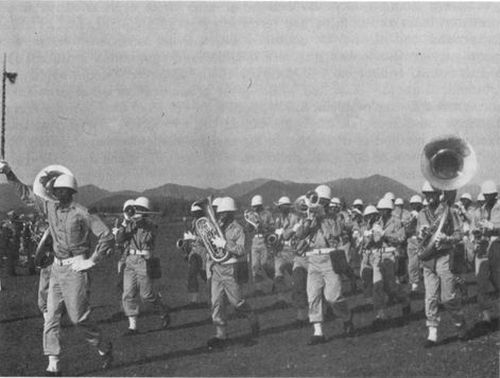
24th Infantry Band, Gifu, Japan, 1947
Ray's proposals and the reaction to them formed a kind of watershed in the War Department's postwar racial policy. Just ten months after the Gillem Board Report was published, the Army staff made a judgment on the policy's effectiveness: the presence of Negroes in numbers approximating 10 percent of the Army's strength and at the current qualitative level made it necessary to retain segregation indefinitely. Segregation kept possible troublemakers out of important combat divisions, promoted efficiency, and placated regional prejudices both in the Army and Congress. Integration must be postponed until the number of Negroes in the Army was carefully regulated and the quality of black troops improved. Both, the staff thought, were goals of a future so distant that segregated units were not threatened.
In face of this impasse between the secretary and the Army staff there slowly evolved what proved to be a new racial policy. Never clearly formulated—Circular 124 continued in effect with only minor changes until 1950—the new policy was based on the substantially different proposition that segregation would continue indefinitely while the staff concentrated on weeding out poorly qualified Negroes, upgrading the rest, and removing vestiges of discrimination, which it saw as quite distinct from segregation. At the same time the Army would continue to operate under a strict 10 percent quota of Negroes, though not necessarily within every occupation or specialty. The staff overlooked the increasingly evident connection between segregation and racial unrest, thereby assuring the continuation of both. From 1947 on, integration, the stated goal of the Gillem Board policy, was ignored, while segregation, which the board saw as an expedient to be tolerated, became for the Army staff a way of life to be treasured. It was from this period in 1947 that Circular 124 and the Gillem Board Report began to gain their reputations as regressive documents.
Improving the Status of the Segregated Soldier
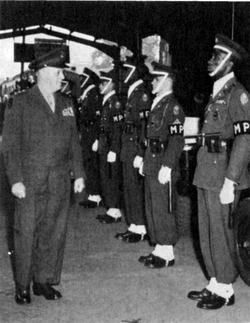
General Huebner inspects the 529th Military Police Company, Giessen, Germany, 1948.
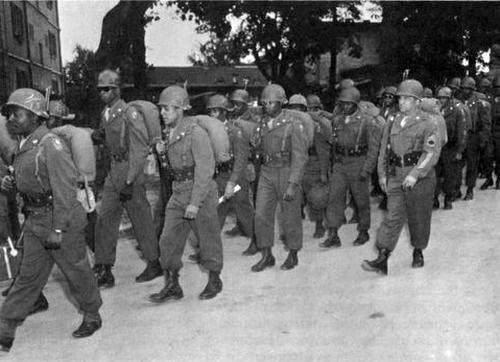
Reporting to Kitzingen. Men of Company B, 371st Infantry Battalion, arrive for refresher course in basic military training.
General Paul did not argue the point. Admitting that the 4.1 percent figure was "an objective to be achieved over a period of time," he could do little but instruct the commanders concerned to indicate in future requisitions that they wanted black officers as fillers or replacements in black units. Clearly, as long as the number of black officers remained so low, the provisions of Circular 124 calling for black officers to replace whites or supplement the officer strength of units containing men with low test scores would have to be ignored.
Discrimination and the Postwar Army
Ray reminded Assistant Secretary of War Petersen that the Fort Jackson area had been the scene of many racial disturbances since 1941 and that an increase in the black troop population would only intensify the hostile community attitude. He wanted to substitute Fort Dix and Fort Ord for Fort Jackson. He also had another suggestion: Why not assign black training companies to white battalions, especially in those training centers that drew their populations from northern, eastern, and western communities?
Segregation in Theory and Practice
But here, in the eyes of the Army's critics, was the rub: after three years of racial reform segregation not only remained but had been perfected. No longer would the Army be plagued with the vast all-black divisions that had segregated thousands of Negroes in an admittedly inefficient and often embarrassing manner. Instead, Negroes would be segregated in more easily managed hundreds. By limiting integration to the battalion level (the lowest self-sustaining unit in the Army system), the Army could guarantee the separation of the races in eating, sleeping, and general social matters and still hope to escape some of the obvious discrimination of separate units by making the black battalions organic elements of larger white units. The Army's scheme did not work. Schooling and specialty occupations aside, segregation quite obviously remained the essential fact of military life and social intercourse for the majority of black soldiers, and all the evidence of reasonable and genuine reform that came about under the Gillem Board policy went aglimmering. The Army was in for some rough years with its critics.
First, segregation was necessary to preserve the internal stability of the Army. Prejudice was a condition of American society, General of the Army Dwight D. Eisenhower told a Senate committee in 1948, and the Army "is merely one of the mirrors that holds up to our faces the United States of America." Since society separated the races, it followed that if the Army allowed black and white soldiers to live and socialize together it ran the very real risk of riots and racial disturbances which could disrupt its vital functions. Remembering the contribution of black platoons to the war in Europe, General Eisenhower, for his part, was willing to accept the risk and integrate the races by platoons, believing that the social problems "can be handled," particularly on the large posts. Nevertheless he made no move toward integrating by platoons while he was Chief of Staff. Later he explained that
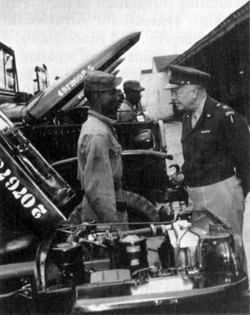
Inspection by the Chief of Staff. General Dwight D. Eisenhower talks with a soldier of the 25th Combat Team Motor Pool during a tour of Fort Benning, Georgia, 1947.
"Liquor and women," Lt. Gen. John C. H. Lee pronounced, were the major ingredients of racial turmoil in the Army. Although General Lee had been a prime mover in the wartime integration of combat platoons, he wanted the Army to avoid social integration because of the disturbances he believed would attend it. As General Omar N. Bradley saw it, the Army could integrate its training programs but not the soldier's social life. Hope of progress would be destroyed if integration was pushed too fast. Bradley summed up his postwar attitude very simply: "I said let's go easy—as fast as we can."
Second, segregation was an efficient way to isolate the poorly educated and undertrained black soldier, especially one with a combat occupational specialty. To integrate Negroes into white combat units, already dangerously understrength, would threaten the Army's fighting ability. When he was Chief of Staff, Eisenhower thought many of the problems associated with black soldiers, problems of morale, health, and discipline, were problems of education, and that the Negro was capable of change. "I believe," he said, "that a Negro can improve his standing and his social standing and his respect for certain of the standards that we observe, just as well as we can." Lt. Gen. Wade H. Haislip, the Deputy Chief of Staff for Administration, concluded that the Army's racial mission was education. All that Circular 124 meant, he explained, "was that we had to begin educating the Negro soldiers so they could be mixed sometime in the future." Bradley observed in agreement that "as you begin to get better educated Negroes in the service," there is "more reason to integrate." The Army was pledged to accept Negroes and to give them a wide choice of assignment, but until their education and training improved they had to be isolated.
Third, segregation was the only way to provide equal treatment and opportunity for black troops. Defending this paternalistic argument, Eisenhower told the Senate:
In general, the Negro is less well educated ... and if you make a complete amalgamation, what you are going to have is in every company the Negro is going to be relegated to the minor jobs, and he is never going to get his promotion to such grades as technical sergeant, master sergeant, and so on, because the competition is too tough. If, on the other hand, he is in smaller units of his own, he can go up to that rate, and I believe he is entitled to the chance to show his own wares.
Fourth, segregation was necessary because segments of American society with powerful representatives in Congress were violently opposed to mixing the races. Bradley explained that integration was part of social evolution, and he was afraid that the Army might move too fast for certain sections of the country. "I thought in 1948 that they were ready in the North," he added, "but not in the South." The south "learned over the years that mixing the races was a vast problem." Bradley continued, "so any change in the Army would be a big step in the South." General Haislip reasoned, you "just can't do it all of a sudden." As for the influence of those opposed to maintaining the Army's social status quo, Haislip, who was the Vice Chief of Staff during part of the Gillem Board period, recalled that "everybody was floundering around, trying to find the right thing to do. I didn't lose any sleep over it [charges of discrimination]." General Eisenhower, as he did so often during his career, accurately distilled the thinking of his associates:
I believe that the human race may finally grow up to the point where it [race relations] will not be a problem. It [the race problem] will disappear through education, through mutual respect, and so on. But I do believe that if we attempt merely by passing a lot of laws to force someone to like someone else, we are just going to get into trouble. On the other hand, I do not by any means hold out for this extreme segregation as I said when I first joined the Army 38 years ago.
These arguments might be specious, as a White House committee would later demonstrate, but they were not necessarily guileful, for they were the heartfelt opinions of many of the Army's leaders, opinions shared by officials of the other services. These men were probably blind to the racism implicit in their policies, a racism nurtured by military tradition. Education and environment had fostered in these career officers a reverence for tradition. Why should the Army, these traditionalists might ask, abandon its black units, some with histories stretching back almost a century? Why should the ordered social life of the Army post, for so long a mirror of the segregated society of most civilian communities, be so uncomfortably changed? The fact that integration had never really been tried before made it fraught with peril, and all the forces of military tradition conspired to support the old ways.
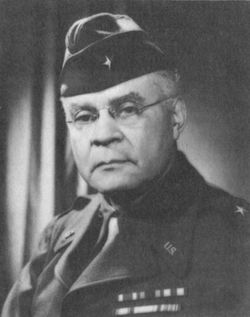
General Davis
In discussing prejudice and discrimination it is necessary to compare the Army with the rest of American society. Examining the question of race relations in the Army runs the risk of distorting the importance given the subject by the nation as a whole in the postwar period. While resistance to segregation was undoubtedly growing in the black community and among an increasing number of progressives in the white community, there was as yet no widespread awareness of the problem and certainly no concerted public effort to end it. This lack of perception might be particularly justified in the case of Army officers, for few of them had any experience with black soldiers and most undoubtedly were not given to wide reading and reflecting on the subject of race relations. Moreover, the realities of military life tended to insulate Army officers from the main currents of American society. Frequently transferred and therefore without roots in the civilian community, isolated for years at a time in overseas assignments, their social life often centered in the military garrison, officers might well have been less aware of racial discrimination.
Perhaps because of the insulation imposed on officers by their duties, the Army's leaders were achieving reforms far beyond those accepted elsewhere in American society. Few national organizations and industries could match the Army in 1948 for the number of Negroes employed, the breadth of responsibility given them, and the variety of their training and occupations. Looked at in this light, the Army of 1948 and the men who led it could with considerable justification be classed as a progressive force in the fight for racial justice.
Segregation: An Assessment
The Gillem Board era began with Secretary Patterson accepting the theory of racially separate but equal service as an anodyne for temporary segregation; it ended with Secretary Royall embracing a permanent separate but equal system as a shield to protect the racial status quo. While Patterson and his assistants accepted restriction on the number of Negroes and their assignment to segregated jobs and facilities as a temporary expedient, military subordinates used the Gillem Board's reforms as a way to make more efficient a segregation policy that neither they nor, they believed, society in general was willing to change. Thus, despite some real progress on the periphery of its racial problem, the Army would have to face the enemy in Korea with an inefficient organization of its men.
The Army's postwar policy was based on a false premise. The Gillem Board decided that since Negroes had fought poorly in segregated divisions in two world wars, they might fight better in smaller segregated organizations within larger white units. Few officers really believed this, for it was commonly accepted throughout the Army that Negroes generally made poor combat soldiers. It followed then that the size of a unit was immaterial, and indeed, given the manpower that the Army received from reenlistments and Selective Service, any black unit, no matter its size, would almost assuredly be an inefficient, spiritless group of predominately Class IV and V men. For in addition to its educational limitations, the typical black unit suffered a further handicap in the vital matter of motivation. The Gillem Board disregarded this fact, but it was rarely overlooked by the black soldier: he was called upon to serve as a second-class soldier to defend what he often regarded as his second-class citizenship. In place of unsatisfactory black divisions, Circular 124 made the Army substitute three unsatisfactorily mixed divisions whose black elements were of questionable efficiency and a focus of complaint among civil rights advocates. Commanders at all levels faced a dilemma implicit in the existence of white and black armies side by side. Overwhelmed by regulations and policies that tried to preserve the fiction of separate but equal opportunity, these officers wasted their time and energy and, most often in the case of black officers, lost their self-confidence.
In calling for the integration of small black units rather than individuals, the Gillem Board obviously had in mind the remarkably effective black platoons in Europe in the last months of World War II. But even this type of organization was impossible in the postwar Army because it demanded a degree of integration that key commanders, especially the major Army component commanders, were unwilling to accept.
These real problems were intensified by the normal human failings of prejudice, vested interest, well-meaning ignorance, conditioned upbringing, shortsightedness, preoccupation with other matters, and simple reluctance to change. The old ways were comfortable, and the new untried, frightening in their implications and demanding special effort. Nowhere was there enthusiasm for the positive measures needed to implement the Gillem Board's recommendations leading to integration. This unwillingness to act positively was particularly noticeable in the Organization and Training Division, in the Army Ground Forces, and even to some extent in the Personnel and Administration Division itself.
The situation might have improved had the Gillem Board been able or willing to spell out intermediate goals. For the ultimate objective of using black soldiers like white soldiers as individuals was inconceivable and meaningless or radical and frightening to many in the Army. Interim goals might have provided impetus for gradual change and precluded the virtual inertia that gripped the Army staff. But at best Circular 124 served as a stopgap measure, allowing the Army to postpone for a few more years any substantial change in race policy. This postponement cost the service untold time and effort devising and defending a system increasingly under attack from the black community and, significantly, from that community's growing allies in the administration.