CHAPTER 18
Reading edition
Integration of the Marine Corps
Even more so than in the Army, the history of racial equality in the Marine Corps demonstrates the effect of the exigencies of war on the integration of the armed forces. The Truman order, the Fahy Committee, even the demands of civil rights leaders and the mandates of the draft law, all exerted pressure for reform and assured the presence of some black marines. But the Marine Corps was for years able to stave off the logical outcome of such pressures, and in the end it was the manpower demands of the Korean War that finally brought integration.
Most significantly, the war provided a rising generation of Marine Corps officers with a first combat experience with black marines. The competence of these Negroes and the general absence of racial tension during their integration destroyed long accepted beliefs to the contrary and opened the way for general integration. Although the corps continued to place special restrictions on the employment of Negroes and was still wrestling with the problem of black stewards well into the next decade, its basic policy of segregating marines by race ended with the cancellation of the last all-black unit designation in 1951. Hastily embraced by the corps as a solution to a pressing manpower problem, integration was finally accepted as a permanent manpower policy.
Impetus for Change
A revision of Defense Department manpower policy combined with the demands of the war to change all that. The imposition of a qualitative distribution of manpower by the Secretary of Defense in April 1950 meant that among the thousands of recruits enlisted during the Korean War the Marine Corps would have to accept its share of the large percentage of men in lower classification test categories. Among these men were a significant number of black enlistees who had failed to qualify under previous standards. They were joined by thousands more who were supplied through the nondiscriminatory process of the Selective Service System when, during the war, the corps began using the draft. The result was a 100 percent jump in the number of black marines in the first year of war, a figure that would be multiplied almost six times before war inductions ran down in 1953. (Table 11)
Table 11—black Marines, 1949-1955
Date Officers Enlisted Men Percent of Corps
July 1949 0 1,525 1.6
July 1950 0 1,605 1.6
January 1951 2 2,077 1.2
July 1951 3 3,145 1.6
January 1952 3 8,315 3.7
July 1952 NA 13,858 6.0
January 1953 10 14,479 6.1
July 1953 13 15,729 6.0
November 1953 18 16,906 6.7
June 1954 19 15,682 6.5
January 1955 19 12,456 5.7
A second factor forcing a change in racial policy was the manpower demands imposed upon the corps by the war itself. When General MacArthur called for the deployment of a Marine regimental combat team and supporting air group on 2 July 1950, the Secretary of the Navy responded by sending the 1st Provisional Marine Brigade, which included the 5th Marine Regiment, the 1st Battalion of the 11th Marines (Artillery), and Marine Air Group 33. By 13 September the 1st Marine Division and the 1st Marine Air Wing at wartime strength had been added. Fielding these forces placed an enormous strain on the corps' manpower, and one result was the assignment of a number of black service units, often combined with white units in composite organizations, to the combat units.
The pressures of battle quickly altered this neat arrangement. Theoretically, every marine was trained as an infantryman, and when shortages occurred in combat units commanders began assigning black replacements where needed. For example, as the demand for more marines for the battlefield grew, the Marine staff began to pull black marines from routine duties at the Marine Barracks in New Jersey, Pennsylvania, and Hawaii and send them to Korea to bring the fighting units up to full strength. The first time black servicemen were integrated as individuals in significant numbers under combat conditions was in the 1st Provisional Marine Brigade during the fighting in the Pusan Perimeter in August 1950. The assignment of large numbers of black marines throughout the combat units of the 1st Marine Division, beginning in September, provided the clearest instance of a service abandoning a social policy in response to the demands of the battlefield. The 7th Marines, for example, an organic element of the 1st Marine Division since August 1950, received into its rapidly expanding ranks, along with many recalled white reservists and men from small, miscellaneous Marine units, a 54-man black service unit. The regimental commander immediately broke up the black unit, assigning the men individually throughout his combat battalions.
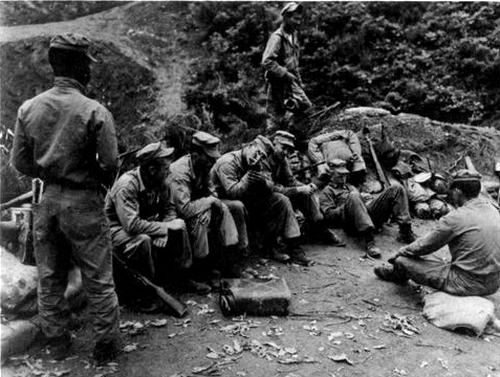
Marines on the Kansas Line, Korea. Men of the 1st Marines await word to move out.
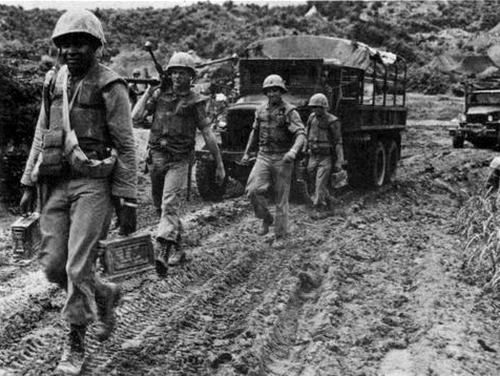
Marine Reinforcements. A light machine gun squad of 3d Battalion, 1st Marines, arrives during the battle for "Boulder City."
Assignments
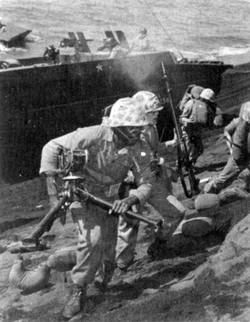
Training Exercises on Iwo Jima, March 1954.
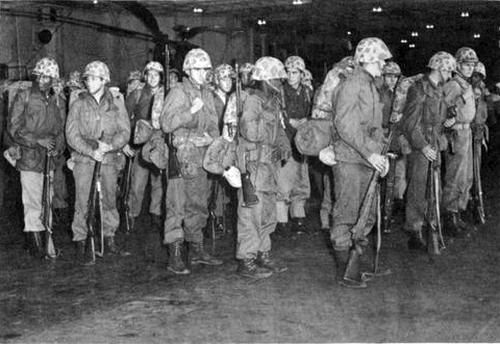
Marines From Camp Lejeune on the USS Valley Forge for training exercises, 1958.
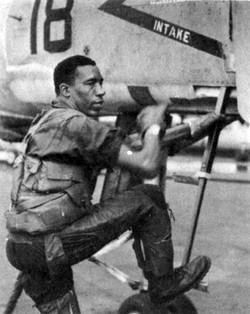
Colonel Petersen (1968 photograph).
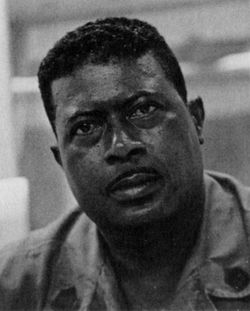
Sergeant Major Huff
As for the noncommissioned officers, there were a number of senior enlisted black marines in the 1950's, many of them holdovers from the World War II era, and Negroes were being promoted to the ranks of corporal and sergeant in appreciable numbers.
By 1962 there were 13,351 black enlisted men, 7.59 percent of the corps' strength, and 34 black officers (7 captains, 25 lieutenants, and 2 warrant officers) serving in integrated units in all military occupations. These statistics illustrate the racial progress that occurred in the Marine Corps during the 1950's, a change that was both orderly and permanent, and, despite the complicated forces at work, in essence a gift to the naval establishment from the Korean battlefield.