← Table of contents
Integration of the Armed Forces, 1940-1965

CHAPTER 14

Reading edition

The Fahy Committee Versus the Department of Defense
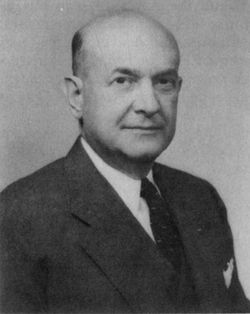
Secretary of Defense Johnson

Secretary of Defense Johnson

The Committee's Recommendations
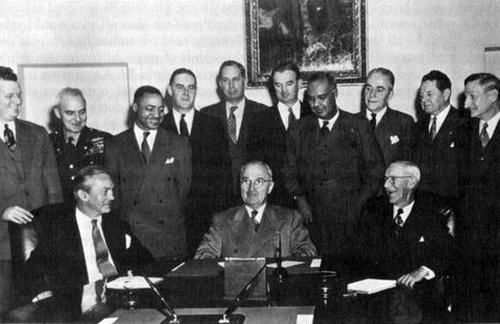
Fahy Committee With President Truman

Fahy Committee With President Truman and Armed Services Secretaries. Seated with the President are Secretary Forrestal and Committeeman A. J. Donahue. Standing from the left: Chairman of the Personnel Policy Board Thomas R. Reid; Chief of Staff of the Personnel Policy Board Brig. Gen. Charles T. Lanham; Committeemen John H. Sengstacke and William M. Stevenson; Secretary Royall; Secretary Symington; Committeemen Lester Granger and Dwight R. Palmer; Secretary Sullivan; and Charles Fahy.]

The Army offered other reasons. Its leaders testified that the unlimited induction of Negroes into an integrated Army would seriously affect enlistments and the morale of troops. Morale in particular affected battle efficiency. Again General Bradley testified.
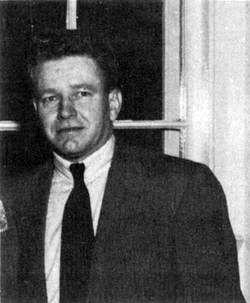
E. W. Kenworthy
E. W. Kenworthy

E. W. Kenworthy

Never one to waste time, Fahy summarized the committee's activities thus far, outlined its dealings with Army witnesses, and then handed out copies of the Army's response to Secretary Johnson's directive. Fahy was inclined to recommend approval, a course agreed to by the black officers present, but he nevertheless turned courteously to the personnel expert from the Department of the Army and asked him for his opinion of the official Army position. Davenport did not hesitate. "The directive [the Army's response to Secretary Johnson's 6 April directive] isn't worth the paper it's written on," he answered. It called for sweeping changes in the administration of the Army's training programs, he explained, but would produce no change because personnel specialists at the training centers would quickly discover that their existing procedures, which excluded so many qualified black soldiers, would fit quite comfortably under the document's idealistic but vague language. The Army's response, Davenport declared, had been very carefully drawn up to retain segregation rather than to end it.
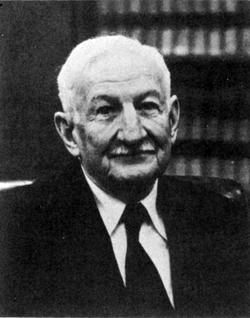
Charles Fahy
Charles Fahy

Charles Fahy (a later portrait).

Chairman Fahy seemed annoyed by this declaration. After all, he had listened intently to the Army's claims and promises and was inclined to accept the Army's proposal as a slow, perhaps, but certain way to bring about racial integration. He was, however, a tough-minded man and was greatly impressed by the analysis of the situation presented by the Army employee. When Davenport asked him to reexamine the directive with eyes open to the possibility of deceit, Fahy walked to a corner of the room and reread the Army's statement in the light of Davenport's charges. Witnesses would later remember the flush of anger that came to his face as he read. His committee was going to have to hear more from Davenport.
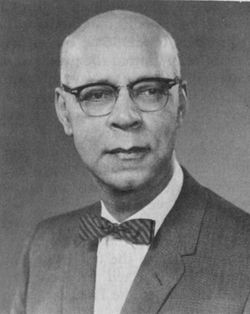
Roy Davenport
Roy Davenport

Roy Davenport

One question led to another. If there were no authorizations for black soldiers in 198 specialties, what were the chances for qualified Negroes to attend schools that trained men for these specialties? It turned out that of the 106 school courses available after a man finished basic training, only twenty-one were open to Negroes. That is, 81 percent of the courses offered by the Army were closed to Negroes. The Army denied that discrimination was involved. Since existing black units could not use the full range of the Army's military occupational specialties, went the official line of reasoning, it would be wasteful and inefficient to train men for nonexistent jobs in those units. It followed that the Organization and Training Division must exclude many Negroes from being classified in specialties for which they were qualified and from Army schools that would train others for such unneeded specialties.

While the committee's logic was unassailable when applied to the plight of a relatively small number of talented and qualified black soldiers, a different solution would have to prevail when the far larger number of Negroes ineligible for Army schooling either by talent, inclination, or previous education was considered. Here the Army's plea for continued segregation in the name of military efficiency carried some weight. How could it, the Army asked, endanger the morale and efficiency of its fighting forces by integrating these men? How could it, with its low enlistment standards, abandon its racial quota and risk enlarging the already burdensome concentration of "professional black privates?" The committee admitted the justice of the Army's claim that the higher enlistment score required by the Navy and Air Force resulted in the Army's getting more than its share of men in the low-test categories IV and V. And while Kenworthy believed that immediate integration was less likely to cause serious trouble than the Army's announced plan of mixing the races in progressively smaller units, he too accepted the argument that it would be dangerous to reassign the Army's group of professional black privates to white units. Fahy saw the virtue of the Army's position here; his committee never demanded the immediate, total integration of the Army.

The committee also suggested to the Air Force that it establish a common enlistment standard along with the other services. Commenting that the Air Force had apparently been able to use efficiently thousands of men with test scores below ninety in the past, the committee doubted that the contemporary differential in Air Force and Army standards was justified. With a bow to Secretary Symington's new and limited integration policy, the committee deferred further recommendations.

Before Johnson could act on his personnel group's recommendations, the Army and Navy formally submitted their second replies to his directive on the executive order. Surprisingly, the services provided a measure of support for the Fahy Committee. For its part, the Navy was under particular pressure to develop an acceptable program. It, after all, had been the first to announce a general integration policy for which it had, over the years, garnered considerable praise. But now it was losing this psychological advantage under steady and persistent criticism from civil rights leaders, the President's committee, and, finally, the Secretary of Defense himself. Proud of its racial policy and accustomed to the rapport it had always enjoyed with Forrestal, the Navy was suddenly confronted with a new Secretary of Defense who bluntly noted its "lack of any response" to his 6 April directive, thus putting the Navy in the same league as the Army.
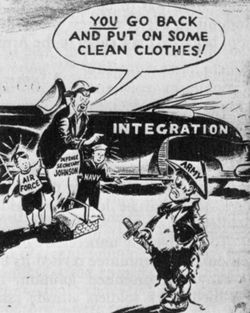
Press Notice
Press Notice

Press Notice. Rejection of the Army's second proposal as seen by the Afro-American, June 14, 1949.

A Summer of Discontent

Assignments

The quota and assignments issues remained the center of controversy between the Army and the committee. Although Fahy was prepared to postpone a decision on the quota while negotiations continued, he was unwilling to budge on the assignments issue. As the committee had repeatedly emphasized, the question of open, integrated assignment of trained Negroes was at the heart of its program. Without it the opening of Army schools and military occupational specialties would be meaningless and the intent of Executive Order 9981 frustrated.
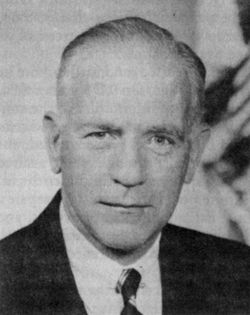
Secretary of the Army Gray

Secretary of the Army Gray

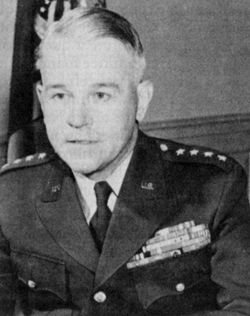
General Collins
General Collins

General Collins

Secretary of Defense Johnson was also optimistic, but he warned Gordon Gray that many complex problems remained and asked the Army for periodic reports. His request only emphasized the fact that the Army's new regulation lacked the machinery for monitoring compliance with its provisions for integration. As the history of the Gillem Board era demonstrated, any attempt to change the Army's traditions demanded not only exact definition of the intermediate steps but also establishment of a responsible authority to enforce compliance.

Quotas

In the wake of the Army's new assignment regulation, the committee turned its full attention to the last of its major recommendations, the abolition of the numerical quota. Despite months of discussion, the disagreement between the Army and the committee over the quota showed no signs of resolution. Simply put, the Fahy Committee wanted the Army to abolish the Gillem Board's racial quota and to substitute a quota based on General Classification Test scores of enlistees. The committee found the racial quota unacceptable in terms of the executive order and wasteful of manpower since it tended to encourage the reenlistment of low-scoring Negroes and thereby prevented the enlistment of superior men. None of the Negroes graduating from high school in June 1949, for example, no matter how high their academic rating, could enlist because the black quota had been filled for months. Quotas based on test scores, on the other hand, would limit enlistment to only the higher scoring blacks and whites.

An Assessment

Thus ended a most active period in the history of armed forces integration, a period of executive orders, presidential conferences, and national hearings, of administrative infighting broadcast to the public in national headlines. The Fahy Committee was the focus of this bureaucratic and journalistic excitement. Charged with examining the policies of the services in light of the President's order, the committee could have glanced briefly at current racial practices and automatically ratified Secretary Johnson's general policy statement. Indeed, this was precisely what Walter White and other civil rights leaders expected. But the committee was made of sterner stuff. With dedication and with considerable political acumen, it correctly assessed the position of black servicemen and subjected the racial policies of the services to a rigorous and detailed examination, the first to be made by an agency outside the Department of Defense. As a result of this scrutiny, the committee clearly and finally demonstrated that segregation was an inefficient way to use military manpower; once and for all it demolished the arguments that the services habitually used against any demand for serious change. Most important is the fact that the committee kept alive the spirit of reform the Truman order had created. The committee's definition of equal treatment and opportunity became the standard by which future action on racial issues in the armed forces would be measured.

Throughout its long existence, the Fahy Committee was chiefly concerned with the position of the Negro in the Army. After protracted argument it won from the Army an agreement to abolish the racial quota and to open all specialties in all Army units and all Army schools and courses to qualified Negroes. Finally, it won the Army's promise to cease restricting black servicemen to black units and overhead installations alone and to assign them instead on the basis of individual ability and the Army's need.
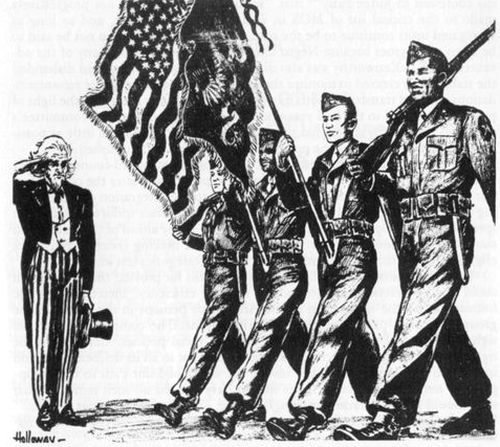
No Longer a Dream
No Longer a Dream

"No Longer a Dream." The Pittsburgh Courier's reaction to the services' agreements with the Fahy Committee, May 20, 1950.

To its lasting honor the Fahy Committee succeeded in spelling out for the nation's military leaders how these principles, these "high standards of democracy" as President Truman called them in his order, must be applied in the services.

Notes in this chapter

Note 1 · Given James Forrestal's sympathy for integration, considerable cooperation could be expected between members of his department and the CommiNote 2 · Willing to cooperate, Forrestal still wanted to chart his own course. Both he and his successor, Louis A. Johnson, made it quite clear that Note 3 · At the same time Secretary of Defense Forrestal was aware that the interests of a committee enjoying White House support could not be ignoreNote 4 · The Personnel Policy Board, established by Forrestal to help regulate the military and civilian policies of his large department, was the loNote 5 · Undeterred by members' calling for more investigation and debate before the board prepared a common policy, Chairman Thomas R. Reid and his Note 6 · Favorably received in the secretary's office, the proposed directive came too late for speedy enactment. On 3 March Forrestal resigned, and Note 7 · Perhaps it was just as well, for the Reid-Lanham draft had serious defects. It failed to address the problems of qualitative imbalance in thNote 8 · The service objections to a carefully spelled out policy were in themselves quite convincing to Lanham and Reid. Reid agreed with Eugene ZucNote 9 · Reid appreciated this distinction, and while he was willing to abandon the idea of a policy directive spelling out matters of personnel admiNote 10 · Although responsible for preparing the secretary's directive, Reid and Lanham had second thoughts about it. They were concerned lest the serNote 11 · The directive reflected Louis Johnson's personality, ambition, and administrative strategy. If many of his associates questioned his personaNote 12 · If such was his motive, the secretary was taking a chance. Announcing his directive to the press transformed what could have been an innocuoNote 13 · Not all the board members agreed. In the wake of the Army and Navy replies, some saw the possible need for separate service policies rather Note 14 · The Air Force plan had been in existence for some time, its implementation delayed because Symington had agreed with Royall in January that Note 15 · To achieve maximum benefit from the Air Force plan, Reid and his associates had to link it publicly with the inadequate replies from the othNote 16 · Despite Royall's not so subtle warning, Reid's scheme worked. The Secretary of Defense explicitly and publicly approved the Air Force prograNote 17 · If there was ever any question of what their programs should contain, the services had only to turn to the Fahy Committee for plenty of adviNote 18 · The armed forces had just won a great world war, and the opinions of the military commanders, Fahy reasoned, would carry much weight with thNote 19 · That the committee expected the Secretary of Defense to take the lead in racial affairs, refraining from dictating policy itself, did not meNote 20 · The trouble, the committee quickly learned, lay in trying to convince the Army of the practical necessity for integration. On one hand the ANote 21 · I consider that a unit has high morale when the men have confidence in themselves, confidence in their fellow members of their unit, and conNote 22 · Underlying all these discussions of morale and efficiency lurked a deep-seated suspicion of the combat reliability and effectiveness of blacNote 23 · Although these beliefs were highly debatable, they were tenaciously held by many senior officials and were often couched in terms that were Note 24 · But in time the Fahy Committee found a way, first suggested by its executive secretary, to turn the efficiency argument around. Certainly a Note 25 · I wonder if the one chance of getting something done isn't to meet the military on their own ground—the question of military efficiency. TheNote 26 · The committee did not have to convince the Navy or the Air Force of the practical necessity for integration. With four years of experience iNote 27 · Even while the Air Force and the Navy were assuring Fahy of their belief in the efficiency of integration, they hastened to protect themselvNote 28 · Kenworthy predicted that attacking the Army's theory of military efficiency would require considerable research by the committee into Army pNote 29 · Kenworthy decided that the time had come for Fahy to meet Davenport, particularly since the chairman was inclined to be impressed with, and Note 30 · If efficiency was to be the keynote of the committee's investigation, Davenport explained, it would be a simple thing to prove that the ArmyNote 31 · This reasoning was in the interest of segregation, not efficiency, and Davenport and others were able to prove to the committee's satisfactiNote 32 · In fact, military efficiency was a potent weapon which, if skillfully handled, might well force the Army into important concessions leading Note 33 · One solution to the problem, reducing the number of soldiers with low aptitude by forcing the other services to share equally in the burden Note 34 · Having gained some experience, the committee was now able to turn the Army's efficiency argument against the racial quota. It decided that tNote 35 · Fahy was not sure, he later admitted, how best to proceed at this point with the efficiency issue, but his committee obviously had to come uNote 36 · The committee's recommendations, sent to the Personnel Policy Board in late May 1949, are easily summarized.[14-55] Questioning why the NavyNote 37 · It showed no such reluctance when it came to the Army. It wanted the Army to abolish racial considerations in the designation of military ocNote 38 · As it was, the committee's program for gradual change proved to be a rather large dose for senior service officials. An Army representative Note 39 · Chairman Reid temporized somewhat in his recommendations to Secretary Johnson. He admitted that the whole question of parity of entrance staNote 40 · Secretary Johnson's rejection of the Navy's response made a reexamination of its race program imperative, but it was still reluctant to follNote 41 · But even here the Navy proved unexpectedly conciliatory. Replying to the Secretary of Defense a second time on 23 May, Acting Secretary Dan Note 42 · The question of parity of enlistment standards aside, the Navy's program generally followed the suggestions of the Fahy Committee, and ChairNote 43 · To some extent the Army had an advantage over the Navy in its dealings with Johnson and Fahy. It never had an integration policy to defend, Note 44 · The Army's response found the Fahy Committee and the office of the Secretary of Defense once again in agreement. The committee rejected GrayNote 45 · Members of the Fahy Committee met with Johnson and Reid on 1 June. Despite the antagonism that was growing between the Secretary of Defense Note 46 · General Lanham endorsed the committee's belief that there was a need for practical, intermediate steps when he drafted a response to the ArmNote 47 · But the Army received no such specific instruction. Although Johnson rejected the Army's second reply and demanded another based on a carefuNote 48 · The committee approached its negotiations with the Army with considerable optimism. Kenworthy was convinced that the committee's moderate anNote 49 · To remove any unnecessary obstacle to what Fahy hoped would be fruitful sessions, the committee revised its initial recommendations to the ANote 50 · After meeting first with Gray and then the Chief of Staff, Fahy called the sessions "frank and cordial" and saw some prospect of accord, altNote 51 · The committee argued that if the Army was to train men according to their ability, hence efficiently, and in accord with the principle of eqNote 52 · The committee and the Army had reached a stalemate. As a staff member of the Personnel Policy Board put it, their latest proposal and counteNote 53 · The Army staff did prepare another reply for the Secretary of Defense, and on 16 September Gray met with Fahy and others to discuss it. GeneNote 54 · Fahy made his prediction before Secretary of Defense Johnson took a course of action that, in effect, rendered the committee's position unteNote 55 · It is not difficult to understand Johnson's reasons for ignoring the President's committee. He had been forced to endure public criticism ovNote 56 · Unfortunately for Johnson the gambit failed. While Fahy admitted that the Army's newest proposal was an improvement, for several reasons he Note 57 · The committee's stand received support from the black press and numerous national civil rights organizations, all of which excoriated the ArNote 58 · The President's statement signaled a victory for the committee; its extent became apparent only when the Army tried to issue a new circular,Note 59 · President Truman ordered his military aide to read the committee's 11 October suggestion and "then take [it] up with Johnson."[14-96] As a rNote 60 · Chairman Fahy was fully aware of the leverage these actions gave his committee, although he and his associates now had few illusions about tNote 61 · Kenworthy was able to turn this incident to the committee's advantage. He made a practice of never locking his Pentagon office door nor his Note 62 · A furious secretary, learning of the second message from the press stories, did enter the case. Branding the document a violation of his annNote 63 · The Army staff's draft revision of the Gillem Board circular, sent to the committee on 25 November, reflected Gray's 30 September plan.[14-1Note 64 · At first glance it would seem that the revision of Circular 124 supported the assignment of Negroes to white units, as indeed Secretary GrayNote 65 · Fahy was determined to have the Army's plan modified, and furthermore he had learned during the past few weeks how to get it done. On 9 DeceNote 66 · White House pressure undoubtedly played a major role in the resolution of the assignment issue. When on 14 December 1949 the committee preseNote 67 · While neither Gray nor Collins could even remotely be described as social reformers, both were pragmatic leaders, prepared to accept changesNote 68 · Gray was perhaps more cautious than Collins. Confessing later that he had never considered the question of equal opportunity until Fahy brouNote 69 · The trouble was, as Roy Davenport later noted, Gordon Gray was a lawyer, not a personnel expert, and he failed to grasp the full implicationNote 70 · Fahy reduced the whole problem to the case of one qualified black soldier denied a job because of color and pictured the loss to the Army anNote 71 · Agreement followed rapidly on the heels of the meeting of the principals. Roy Davenport presented the committee members with the final draftNote 72 · Fahy reported to Truman that the new Army policy was consistent with the executive order. Its paragraphs on assignments spelled out the prinNote 73 · Specifically, the committee wanted no enlistment to be decided by race. The Army would open all enlistments to anyone who scored ninety or aNote 74 · The Army's reply was based on the premise that "the Negro strength of the Army must be restricted and that the population ratio is the most Note 75 · The committee quickly pointed out that the Army had neglected to subtract from the monthly figure of 11,000 blacks those physically and mentNote 76 · On 14 December 1949 the Army, offering to compromise on the quota, retired from its statistical battle with the committee. It would accept tNote 77 · Niles warned the President that the racial imbalance which had for so long frustrated equal treatment and opportunity for Negroes in the ArmNote 78 · Secretary Gray, aware that the Army's arguments would not move the committee, was sure that the President did not want to see a spectacular Note 79 · At the President's request, Gray outlined a program for open recruitment, fixing April as the date when all vacancies would be open to all qNote 80 · Despite the President's optimism, the Fahy Committee was beginning to have doubts about just how everything would work out. Specifically, soNote 81 · Niles, anxious to settle the issue, tried to reconcile the differences[14-135] and successfully persuaded the committee to omit a reference Note 82 · The President proceeded along these lines. Several months after the committee presented its final report, Freedom to Serve,[14-139] in a pubNote 83 · As for the other services, the committee secured from the Navy a pledge to give petty officer status to chief stewards and stewards of the fNote 84 · The Fahy Committee won from the services a commitment to equal treatment and opportunity and a practical program to achieve that end. Yet evNote 85 · The Army's concern with disproportionate balance was always linked to a concern with the influx of men, mostly black, who scored poorly on tNote 86 · Even the Army's promise to enlarge gradually the number of specialties open to Negroes was not carried out expeditiously. By July 1950, the Note 87 · Roy Davenport later suggested that such pessimism was ill-founded. Other factors were at work within the Army in 1950, particularly after thNote 88 · The Fahy Committee has been given full credit for proving that segregation could not be defended on grounds of military efficiency, thereby Note 89 · The same ethics stood forth in the conclusion of the committee's final report, raising that practical summary of events to the status of an
Explore with AITake your curiosity a little further.

Reading settings