CHAPTER 24
Reading edition
Conclusion
The Defense Department's response to the recommendations of the Gesell Committee marked the close of a well-defined chapter in the racial history of the armed forces. Within a single generation, the services had recognized the rights of black Americans to serve freely in the defense of their country, to be racially integrated, and to have, with their dependents, equal treatment and opportunity not only on the military reservation but also in nearby communities. The gradual compliance with Secretary McNamara's directives in the mid-1960's marked the crumbling of the last legal and administrative barriers to these goals.
Why the Services Integrated
In retrospect, several causes for the elimination of these barriers can be identified. First, if only for the constancy and fervor of its demands, was the civil rights movement. An obvious correlation exists between the development of this movement and the shift in the services' racial attitudes. The civil rights advocates—that is, those spokesmen of the rapidly proliferating civil rights organizations and their allies in Congress, the White House, and the media—formed a pressure group that zealously enlisted political support for equal opportunity measures. Their metier was presidential politics. In several elections they successfully traded their political assistance, an unknown quantity, for specific reform. Their influence was crucial, for example, in Roosevelt's decision to enlist Negroes for general service in the World War II Navy and in all branches of the Army and in Truman's proclamation of equal treatment and opportunity; it was notable in the adjudication of countless discrimination cases involving individual black servicemen both on and off the military base. Running through all their demands and expressed more and more clearly during this period was the conviction that segregation itself was discrimination. The success of their campaign against segregation in the armed forces can be measured by the extent to which this proposition came to be accepted in the counsels of the White House and the Pentagon.
Because the demands of the civil rights advocates were extremely persistent and widely heard, their direct influence on the integration of the services has sometimes been overstressed. In fact, for much of the period their most important demands were neutralized by the logical-sounding arguments of those defending the racial status quo. More to the point, the civil rights revolution itself swept along some important defense officials. Thus the reforms begun by James Forrestal and Robert McNamara testified to the indirect but important influence of the civil rights movement.
Resisting the pressure for change was a solid bloc of officials in the services which held out for the retention of traditional policies of racial exclusion or segregation. Professed loyalty to military tradition was all too often a cloak for prejudice, and prejudice, of course, was prevalent in all the services just as it was in American society. At the same time traditionalism simply reflected the natural inclination of any large, inbred bureaucracy to preserve the privileges and order of an earlier time. Basically, the military traditionalists—that is, most senior officials and commanders of the armed forces and their allies in Congress—took the position that black servicemen were difficult to train and undependable in battle. They cited the performance of large black combat units during the world wars as support for their argument. They also rationalized their opposition to integration by saying that the armed forces should not be an instrument of social change and that the services could only reflect the social mores of the society from which they sprang. Thus, in their view, integration not only hindered the services' basic mission by burdening them with undependable units and marginally capable men, but also courted social upheaval in military units.
The story of integration in the armed forces has usually, and with some logic, been told in terms of the conflict between the "good" civil rights advocates and the "bad" traditionalists. In fact, the history of integration goes beyond the dimensions of a morality play and includes a number of other influences both institutional and individual.
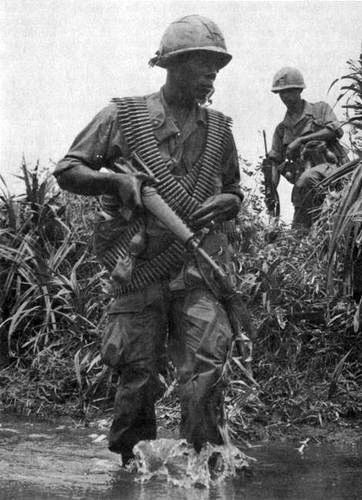
Vietnam Patrol. Men of the 35th Infantry advance during "Operation Baker."
Paralleling the influence of the law, the quest for military efficiency was another institutional factor that affected the services' racial policies. The need for military efficiency had always been used by the services to rationalize racial exclusion and segregation; later it became the primary consideration in the decision of each service to integrate its units. Reinforcing the efficiency argument was the realization by the military that manpower could no longer be considered an inexhaustible resource. World War II had demonstrated that the federal government dare not ignore the military and industrial potential of any segment of its population. The reality of the limited national manpower pool explained the services' guarantee that Negroes would be included in the postwar period as cadres for the full wartime mobilization of black manpower. Timing was somewhat dependent on the size and mission of the individual service; integration came to each when it became obvious that black manpower could not be used efficiently in separate organizations. In the case of the largest service, the Army, the Fahy Committee used the failure to train and use eligible Negroes in unfilled jobs to convince senior officials that military efficiency demanded the progressive integration of its black soldiers, beginning with those men eligible for specialist duties. The final demonstration of the connection between efficiency and integration came from those harried commanders who, trying against overwhelming odds to fight a war in Korea with segregated units, finally began integrating their forces. They found that their black soldiers fought better in integrated units.
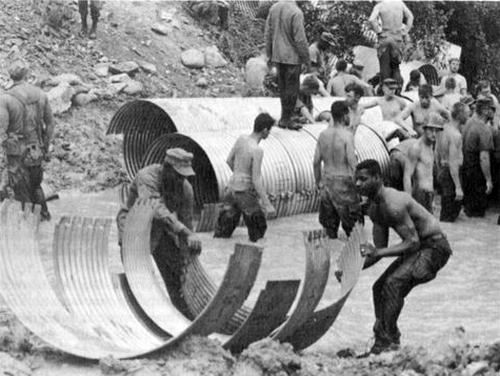
Marine Engineers in Vietnam. Men of the 11th Engineer Battalion move culverts into place in a mountain stream during "Operation Pegasus."
Later, military efficiency would be the rationale for the Defense Department's fight against discrimination in the local community. The Gesell Committee was used by Adam Yarmolinsky and others to demonstrate to Secretary McNamara if not to the satisfaction of skeptical military traditionalists and congressional critics that the need to solve a severe morale problem justified the department's intrusion. Appeals to military efficiency, therefore, became the ultimate justification for integrating the units of the armed forces and providing for equal treatment of its members in the community.
Beyond the demands of the law and military efficiency, the integration of the armed forces was also influenced by certain individuals within the military establishment who personified America's awakening social conscience. They led the services along the road toward integration not because the law demanded it, nor because activists clamored for it, nor even because military efficiency required it, but because they believed it was right. Complementing the work of these men and women was the opinion of the American serviceman himself. Between 1940 and 1965 his attitude toward change was constantly discussed and predicted but only rarely solicited by senior officials. Actually his opinion at that time is still largely unknown; documentary evidence is scarce, and his recollections, influenced as they are by the intervening years of the civil rights movement, are unreliable. Yet it was clearly the serviceman's generally quiet acceptance of new social practices, particularly those of the early 1950's, that ratified the services' racial reforms. As a perceptive critic of the nation's racial history described conditions in the services in 1962:
Indeed, it could be argued, American servicemen of the 1950's became a positive if indirect cause of racial change. By demonstrating that large numbers of blacks and whites could work and live together, they destroyed a fundamental argument of the opponents of integration and made further reforms possible if not imperative.
How the Services Integrated, 1946-1954
The Navy was the acknowledged pioneer in integration. Its decision during World War II to assign black and white sailors to certain ships was not entirely a response to pressures from civil rights advocates, although Secretary James Forrestal relied on his friends in the Urban League, particularly Lester Granger, to teach him the techniques of integrating a large organization. Nor was the decision solely the work of racial reformers in the Bureau of Naval Personnel, although this small group was undoubtedly responsible for drafting the regulations that governed the changes in the wartime Navy. Rather, the Navy began integrating its general service because segregation proved painfully inefficient. The decision was largely the result of the impersonal operation of the 1940 draft law. Although imperfectly applied during the war, the anti-discrimination provision of that law produced a massive infusion of black inductees. The Army, with its larger manpower base and expandable black units, could evade the implications of a nondiscrimination clause, but the sheer presence of large numbers of Negroes in the service, more than any other force, breached the walls of segregation in the Navy.
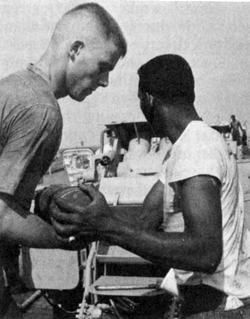
Loading a Rocket Launcher. Crewmen of the USS Carronade participating in a coordinated gunfire support action near Chu Lai, Vietnam.
The Navy experiment with an all-black crew had proved unsatisfactory, and only so many shore-based jobs were considered suitable for large segregated units. Bowing to the argument that two navies—one black, one white—were both inefficient and expensive, Secretary Forrestal began to experiment with integration during the last months of the war and finally announced a policy of integration in February 1946. The full application of this new policy would wait for some years while the Navy's traditional racial attitudes warred with its practical desire for efficiency.
The Air Force was the next to end segregation. Again, immediate outside influences appeared to be slight. Despite the timing of the Air Force integration directive in early 1949 and Secretary Stuart Symington's discussions of the subject with Truman and the Fahy Committee, plans to drop many racial barriers in the Air Force had already been formulated at the time of the President's equal opportunity order in 1948. Nor is there any evidence of special concern among Air Force officials about the growing criticism of their segregation policy. The record clearly reveals, however, that by late 1947 the Air staff had become anxious over the manpower requirements of the Gillem Board Report, which enunciated the postwar racial policy that the Air Force shared with the Army.
The Gillem Board Report would hardly be classified as progressive by later standards; its provisions for reducing the size of black units and integrating a small number of black specialists were, in a way, an effort to make segregation less wasteful. Nevertheless, with all its shortcomings, this postwar policy contained the germ of integration. It committed the Army and Air Force to total integration as a long-range objective, and, more important, it made permanent the wartime policy of allotting 10 percent of the Army's strength to Negroes. Later branded by the civil rights spokesmen as an instrument for limiting black enlistment, the racial quota committed the Army and its offspring, the Air Force, not only to maintaining at least 10 percent black strength but also to assigning black servicemen to all branches and all job categories, thereby significantly weakening the segregated system. Although never filled in either service, the quotas guaranteed that a large number of Negroes would remain in uniform after the war and thus gave both services an incentive to desegregate.
Once again the Army could postpone the logical consequences of its racial policy by the continued proliferation of its segregated combat and service units. But the new Air Force almost immediately felt the full force of the Gillem Board policy, quickly learning that it could not maintain 10 percent black strength separate but equal. It too might have continued indefinitely enlarging the number of service units in order to absorb black airmen. Like the Army, it might even have ignored the injunction to assign a quota of blacks to every military occupation and to every school. But it was politically impossible for the Air Force to do away with its black flying units, and it became economically impossible in a time of shrinking budgets and manpower cuts to operate separate flying units for the small group of Negroes involved. It was also unfeasible, considering the small number of black rated officers and men, to fill all the positions in the black air units and provide at the same time for the normal rotation and advanced training schedules. Facing these difficulties and mindful of the Navy's experience with integration, the Air Force began serious discussion of the integration of its black pilots and crews in 1947, some months before Truman issued his order.
Committed to integrating its air units and rated men in 1949, the Air staff quietly enlarged its objectives and broke up all its black units, thereby making the Air Force the first service to achieve total integration. There were several reasons for this rapid escalation in what was to have been a limited program. As devised by General Edwards and Colonel Marr of the Air staff the plan demanded that all black airmen in each command be conscientiously examined so that all might be properly reassigned, further trained, retained in segregated units, or dismissed. The removal of increasing numbers of eligible men from black units only hastened the end of those organizations, a tendency ratified by the trouble-free acceptance of the program by all involved.
The integration of the Army was more protracted. The Truman order in 1948 and the Fahy Committee, the White House group appointed to oversee the execution of that order, focused primarily on the segregated Army. There is little doubt that the President's action had a political dimension. Given the fact that the Army had become a major target of the President's own Civil Rights Commission and that it was a highly visible practitioner of segregation, the equal opportunity order would almost have had to be part of the President's plan to unite the nation's minorities behind his 1948 candidacy. The order was also a logical response to the threat of civil disobedience issued by A. Philip Randolph and endorsed by other civil rights advocates. In a matter of weeks after Truman issued his integration order, Randolph dropped his opposition to the 1948 draft law and his call for a boycott of the draft by Negroes.
It remained for the Fahy Committee to translate the President's order into a working program leading toward integration of the Army. Like Randolph and other activists, the committee quickly concluded that segregation was a denial of equal treatment and opportunity and that the executive order, therefore, was essentially a call for the services to integrate. After lengthy negotiations, the committee won from the Army an agreement to move progressively toward full integration. Gradual integration was disregarded, however, when the Army, fighting in Korea, was forced by a direct threat to the efficiency of its operations to begin wide-scale mixing of the races. Specifically, the proximate reason for the Army's integration in the Far East was the fact that General Ridgway faced a severe shortage of replacements for his depleted white units while accumulating a surplus of black replacements. So pressing was his need that even before permission was received from Washington integration had already begun on the battlefield. The reason for the rapid integration of the rest of the Army was more complicated. The example of Korea was persuasive, as was the need for a uniform policy, but beyond that the rapid modernization of the Army was making obsolete the large-scale labor units traditionally used by the Army to absorb much of its black quota. With these units disappearing, the Army had to find new jobs for the men, a task hopelessly complicated by segregation.
The postwar racial policy of the Marine Corps struck a curious compromise between that of the Army and of the Navy. Adopting the former's system of segregated units and the latter's rejection of the 10 percent racial quota, the corps was able to assign its small contingent of black marines to a few segregated noncombatant duties. But the policy of the corps was only practicable for its peacetime size, as its mobilization for Korea demonstrated. Even before the Army was forced to change, the Marine Corps, its manpower planners pressed to find trained men and units to fill its divisional commitment to Korea, quietly abandoned the rules on segregated service.
While progressives cited the military efficiency of integration, traditionalists used the efficiency argument to defend the racial status quo. In general, senior military officials had concluded on the basis of their World War II experience that large black units were ineffective, undependable in close combat, and best suited for supply assignments. Whatever their motives, the traditionalists had reached the wrong conclusion from their data. They were correct when they charged that, despite competent and even heroic performance on the part of some individuals and units, the large black combat units had, on average, performed poorly during the war. But the traditionalists failed, as they had failed after World War I, to see the reasons for this poor performance. Not the least of these were the benumbing discrimination suffered by black servicemen during training, the humiliations involved in their assignments, and the ineptitude of many of their leaders, who were most often white.
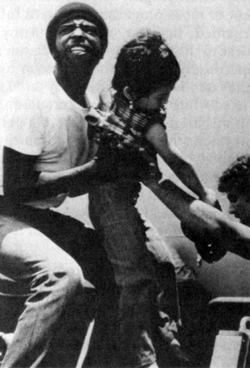
American Sailors help evacuate Vietnamese child.
Above all, the postwar manpower planners drew the wrong conclusion from the fact that the average General Classification Test scores of men in World War II black units fell significantly below that of their white counterparts. The scores were directly related to the two groups' relative educational advantages which depended to a large extent on their economic status and the geographic region from which they came. This mental average of servicemen was a unit problem, for at all times the total number of white individuals who scored in low-aptitude categories IV and V greatly outnumbered black individuals in those categories. This greater number of less gifted white servicemen had been spread thinly throughout the services' thousands of white units where they caused no particular problem. The lesser number of Negroes with low aptitude, however, were concentrated in the relatively few black units, creating a serious handicap to efficient performance. Conversely, the contribution of talented black servicemen was largely negated by their frequent assignment to units with too many low-scoring men. Small units composed in the main of black specialists, such as the black artillery and armor units that served in the European theater during World War II, served with distinction, but these units were special cases where the effect of segregation was tempered by the special qualifications of the carefully chosen men. Segregation and not mental aptitude was the key to the poor performance of the large black units in World War II.
Competence in a great many skills became increasingly important for servicemen in the postwar period as the trend toward technical complexity and specialization continued in all the services. Differences in recruiting gave some services an advantage. The Navy and Air Force, setting stricter standards of enlistment, could fill their ranks with high-scoring volunteers and avoid enlisting large groups of low-scoring men, often black, who were eventually drafted for the Army. While this situation helped reduce the traditional opposition to integration in the Navy and Air Force, it made the Army more determined to retain separate black units to absorb the large number of low-scoring draftees it was obligated to take. A major factor in the eventual integration of the Army—and the single most significant contribution of the Secretary of Defense to that end—was George Marshall's decision to establish a parity of enlistment standards for the services. On the advice of his manpower assistant, Anna Rosenberg, Marshall abolished the special advantage enjoyed by the Navy and Air Force, making all the services share in the recruitment of low-scoring men. The common standard undercut the Army's most persuasive argument for restoring a racial quota and maintaining segregated units.
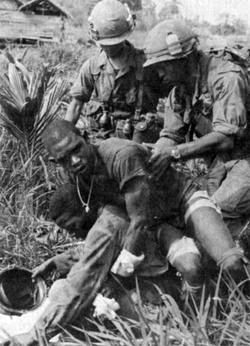
Booby Trap Victim from Company B, 47th Infantry, resting on buddy's back, awaits evacuation.
In the years from 1946 to 1954, then, several forces converged to bring about integration of the regular armed forces. Pressure from the civil rights advocates was one, idealistic leadership another. Most important, however, was the services' realization that segregation was an inefficient way to use the manpower provided by a democratic draft law or a volunteer system made democratic by the Secretary of Defense. Each service reached its conclusion separately, since each had a different problem in the efficient use of manpower and each had its own racial traditions. Accordingly, the services saw little need to exchange views, develop rivalries, or imitate one another's racial policies. There were two exceptions to this situation: both the Army and Air Force naturally considered the Navy's integration experience when they were formulating postwar policies, and the Navy and Air Force fought the Army's proposals to experiment with integrated units and institute a parity of enlistment standards.
Equal Treatment and Opportunity
Segregation officially ended in the active armed forces with the announcement of the Secretary of Defense in 1954 that the last all-black unit had been disbanded. In the little more than six years after President Truman's order, some quarter of a million blacks had been intermingled with whites in the nation's military units worldwide. These changes ushered in a brief era of good feeling during which the services and the civil rights advocates tended to overlook some forms of discrimination that persisted within the services. This tendency became even stronger in the early 1960's when the discrimination suffered by black servicemen in local communities dramatized the relative effectiveness of the equal treatment and opportunity policies on military installations. In July 1963, in the wake of another presidential investigation of racial equality in the armed forces, Secretary of Defense McNamara outlined a new racial policy. An extension of the forces that had produced the abolition of segregated military units, the new policy also vowed to carry the crusade for equal treatment and opportunity for black servicemen outside the military compound into the civilian community beyond. McNamara's 1963 directive became the model for subsequent racial orders in the Defense Department.
This enlargement of the department's concept of equal treatment and opportunity paralleled the rise of the modern civil rights movement, which was reaching its apogee in the mid-1960's. McNamara later acknowledged the influence of the civil rights activists on his department during this period. But the department's racial progress cannot be explained solely as a reaction to the pressures exerted by the civil rights movement. Several other factors lay behind the new and broader policy. The Defense Department was, for instance, under constant pressure from black officers and men who were not only reporting inequities in the newly integrated services and complaining of the remaining racial discrimination within the military community but were also demanding the department's assistance in securing their constitutional rights from the communities outside the military bases. This was particularly true in the fields of public education, housing, and places of entertainment.
The services as well as the Defense Department's manpower officials resisted these demands and continued in the early 1960's to limit their racial reforms to those necessary but exclusively internal matters most obviously connected with the efficient operation of their units. Reinforcing this resistance was the reluctance on the part of most commanders to break with tradition and interfere in what they considered community affairs. Nor had McNamara's early policy statements in response to servicemen's demands come to grips with the issue of discrimination in the civilian community. At the same time, some reformers in the Defense Department had allied themselves with like-minded progressives throughout the administration and were searching for a way to carry out President Kennedy's commitment to civil rights. These individuals were determined to use the services' early integration successes as a stepping-stone to further civil rights reforms while the administration's civil rights program remained bogged down in Congress.
Although these reformers believed that the armed forces could be an effective instrument of social change for society at large, they clothed their aims in the garb of military efficiency. In fact, military efficiency was certainly McNamara's paramount concern when he supported the idea of enlarging the scope of his department's racial programs and when in 1962 he readily accepted the proposal to appoint the Gesell Committee to study the services' racial program.
The Gesell Committee easily documented the connection, long suspected by the reformers, between discrimination in the community and poor morale among black servicemen and the link between morale and combat efficiency. More important, with its ability to publicize the extent of discrimination against black servicemen in local communities and to offer practical recommendations for reform, the committee was able to stimulate the secretary into action. Yet not until his last years in office, beginning with his open housing campaign in 1967, did McNamara, who had always championed the stand of Adam Yarmolinsky and the rest, become a strong participant.
McNamara promptly endorsed the Gesell Committee's report, which called for a vigorous program to provide equal opportunity for black servicemen, ordering the services to launch such a program in communities near military bases and making the local commander primarily responsible for its success. He soft-pedaled the committee's controversial provision for the use of economic sanctions against recalcitrant businessmen, stressing instead the duty of commanders to press for changes through voluntary compliance. These efforts, according to Defense Department reports, achieved gratifying results in the next few years. In conjunction with other federal officials operating under provisions of the 1964 Civil Rights Act, local commanders helped open thousands of theaters, bowling alleys, restaurants, and bathing beaches to black servicemen. Only in the face of continued opposition to open housing by landlords who dealt with servicemen, and then not until 1967, did McNamara decide to use the powerful and controversial weapon of off-limits sanctions. In short order his programs helped destroy the patterns of segregation in multiple housing in areas surrounding most military bases.
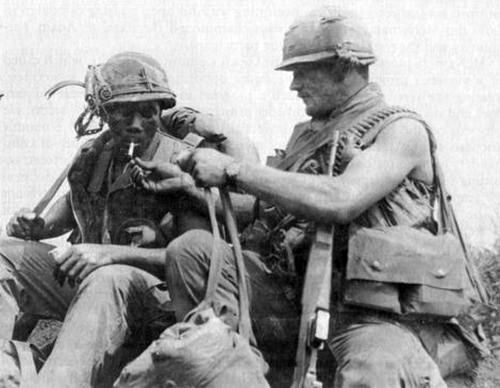
Camaraderie. A soldier of Company C, 7th Infantry, lights a cigarette for a marine from D Company, 26th Marines, during "Operation Pegasus" near Khe Sanh.
In retrospect, the attention paid by defense officials and the services to off-base discrimination in the 1960's may have been misdirected; many of these injustices would eventually have succumbed to civil rights legislation. Certainly more attention could have been paid to the unfinished business of providing equal treatment and opportunity for black servicemen within the military community. Discrimination in matters of promotion, assignment, and military justice, overlooked by almost everyone in the early 1960's, was never treated with the urgency it deserved. To have done so might have averted at least some of the racial turmoil visited on the services in the Vietnam era.
But these shortcomings merely point to the fact that the services were the only segment of American society to have integrated, however imperfectly, the races on so large a scale. In doing so they demonstrated that a policy of equal treatment and opportunity is more than a legal concept; it also ordains a social condition. Between the enunciation of such a policy and the achievement of its goals can fall the shadow of bigotry and the traditional way of doing things. The record indicates that the services surmounted bigotry and rejected the old ways to a gratifying degree. To the extent that they were successful in bringing the races together, their efficiency prospered and the nation's ideal of equal opportunity for all citizens was fortified.
Note on Sources
The search for source materials used in this volume provided the writer with a special glimpse into the ways in which various government agencies have treated what was until recently considered a sensitive subject. Most important documents and working papers concerning the employment of black servicemen were, well into the 1950's and in contrast to the great bulk of personnel policy papers, routinely given a security classification. In some agencies the "secret" or "confidential" stamp was considered sufficient to protect the materials, which were filed and retired in a routine manner and, therefore, have always been readily available to the persistent and qualified researcher. But, as any experienced staff officer could demonstrate, other methods beyond mere classification can be devised to prevent easy access to sensitive material.
Thus, subterfuges were employed from time to time by officials dealing with racial subjects. In some staff agencies, for example, documents were collected in special files, separated from the normal personnel or policy files. In other instances the materials were never retired in a routine matter, but instead remained for many years scattered in offices of origin or, less often, in some central file system. If some officials appear to have been overly anxious to shield their agency's record, they also, it should be added, possessed a sense of history and the historical import of their work. Though the temptation may have been strong within some agencies to destroy papers connected with past controversies, most officials scrupulously preserved not only the basic policy documents concerning this specialized subject, but also much of the back-up material that the historian treasures.
The problem for the modern researcher is that these special collections and reserved materials, no longer classified and no longer sensitive, have fallen, largely unnoted, into a sea of governmental paper beyond the reach of the archivist's finding aids. The frequently expressed comment of the researcher, "somebody is withholding something," should, for the sake of accuracy, be changed to "somebody has lost track of something."
This material might never have been recovered without the skilled assistance of the historical offices of the various services and Office of the Secretary of Defense. At times their search for lost documents assumed the dimensions of a detective story. In partnership with Marine Corps historian Ralph Donnelly, for example, the author finally traced the bulk of the World War II racial records of the Marine Corps to an obscure and unmarked file in the classified records section of Marine Corps headquarters. A comprehensive collection of official documents on the employment of black personnel in the Navy between 1920 and 1946 was unearthed, not in the official archives, but in a dusty file cabinet in the Bureau of Naval Personnel's Management Information Division.
The search also had its frustrations, for some materials seem permanently lost. Despite persistent and imaginative work by the Coast Guard's historian, Truman Strobridge, much of the documentary record of that service's World War II racial history could not be located. The development of the Coast Guard's policy has had to be reconstructed, painstakingly and laboriously, from other sources. The records of many Army staff agencies for the period 1940-43 were destroyed on the assumption that their materials were duplicated in The Adjutant General's files, an assumption that frequently proved to be incorrect. Although generally intact, the Navy's records of the immediate post-World War II period also lack some of the background staff work on the employment of black manpower. Fortunately for this writer, the recent, inadvertent destruction of the bulk of the Bureau of Naval Personnel's classified wartime records occurred after the basic research for this volume had been completed, but this lamentable accident will no doubt cause problems for future researchers.
Thanks to the efforts of the services' historical offices and the wonder of photocopying, future historians may be spared some of the labor connected with the preparation of this volume. Most of the records surviving outside regular archives have been identified and relocated for easy access. Copies of approximately 65 percent of all documents cited in this volume have been collected and are presently on file in the Center of Military History, from which they will be retired for permanent preservation.
Official Archival Material
The bulk of the official records used in the preparation of this volume is in the permanent custody of the National Archives and Records Service, Washington, D.C. The records of most military agencies for the period 1940-54 are located in the Modern Military Records Branch or in the Navy and Old Army Branch of the National Archives proper. Most documents dated after 1954, along with military unit records (including ships' logs), are located in the General Archives Division in the Washington National Records Center, Suitland, Maryland. The Suitland center also holds the other major group of official materials, that is, all those documents still administered by the individual agencies but stored in the center prior to their screening and acquisition by the National Archives. These records are open to qualified researchers, but access to them is controlled by the records managers of the individual agencies, a not altogether felicitous arrangement for the researcher, considering the bulk of the material and its lack of organization.
The largest single group of materials consulted were those of the various offices of the Army staff. Although these agencies have abandoned the system of classifying all documents by a decimal-subject system, the system persisted in many offices well into the 1960's, thereby enabling the researcher to accomplish a speedy, if unrefined, screening of pertinent materials. Even with this crutch, the researcher must still comb through thousands of documents created by the Secretary of War (later Secretary of the Army), his assistant secretary, the Chief of Staff, and the various staff divisions, especially the Personnel (G-1), Organization and Training (G-3), and Operations Divisions, together with the offices of The Adjutant General, the Judge Advocate General, and the Inspector General. The War Department Special Planning Division's files are an extremely important source, especially for postwar racial planning, as are the records of the three World War II major commands, the Army Ground, Service, and Air Forces. Although illuminating in regard to the problem of racial discrimination, the records of the office of the secretary's civilian aide are less important in terms of policy development. Finally, the records of the black units, especially the important body of documents related to the tribulations of the 92d Infantry Division in World War II and the 24th Infantry Regiment in Korea, are also vital sources for this subject.
The records managers in the Office of the Secretary of Defense also used the familiar 291.2 classification to designate materials related to the subject of Negroes. (An exception to this generalization were the official papers of the secretary's office during the Forrestal period when a Navy file system was generally employed.) The most important materials on the subject of the Defense Department's racial interests are found in the records of the Office of the Secretary of Defense. The majority of these records, including the voluminous files of the Assistant Secretary (Manpower) so helpful for the later sections of the study, have remained in the custody of the department and are administered by the Office of the Deputy Assistant Secretary of Defense (Administration). After 1963 the Office of the Deputy Assistant Secretary (Civil Rights) and its successor organizations loom as a major source. Many of the official papers were eventually filed with those of the Assistant Secretary (Manpower) or have been retained in the historical files of the Equal Opportunity Office of the Secretary of Defense. The records of the Personnel Policy Board and the Office of the General Counsel, both part of the files of the Office of the Secretary of Defense, are two more important sources of materials on black manpower.
A subject classification system was not universally applied in the Navy Department during the 1940's and even where used proved exceedingly complicated. The records of the Office of the Secretary of the Navy are especially strong in the World War II period, but they must be supplemented with the National Archives' separate Forrestal papers file. Despite the recent loss of records, the files of the Bureau of Naval Personnel remain the primary source for documents on the employment of black personnel in the Navy. Research in all these files, even for the World War II period, is best begun in the Records Management offices of those two agencies. More readily accessible, the records of the Chief of Naval Operations and the General Board, both of considerable importance in understanding the Navy's World War II racial history, are located in the Operational Archives Branch, Naval Historical Division, Washington Navy Yard. This office has recently created a special miscellaneous file containing important documents of interest to the researcher on racial matters that have been gleaned from various sources not easily available to the researcher.
Copies of all known staff papers concerning black marines and the development of the Marine Corps' equal opportunity program during the integration period have been collected and filed in the reference section of the Director of Marine Corps History and Museums, Headquarters, U.S. Marine Corps. Likewise, most of the very small selection of extant official Coast Guard records on the employment of Negroes have been identified and collected by the Coast Guard historian. The log of the Sea Cloud, the first Coast Guard vessel in modern times to boast a racially mixed crew, is located in the Archives Branch at Suitland.
The Air Force has retained control of a significant portion of its postwar personnel records, and the researcher would best begin work in the Office of the Administrative Assistant, Secretary of the Air Force. This office has custody of the files of the Secretary of the Air Force, his assistant secretaries, the Office of the Chief of Staff, and the staff agencies pertinent to this story, especially the Deputy Chief of Staff, Personnel, and the Director of Military Personnel. The records of black air units, as well as the extensive and well-indexed collection of official unit and base histories and studies and reports of the Air staff that touch on the service's racial policies, are located in the Albert F. Simpson Historical Research Center, Maxwell AFB, Alabama. These records are supplemented, and sometimes duplicated, by the holdings of the Suitland Records Center and the Office of Air Force History, Boiling Air Force Base, Washington, D.C. Other Air Force files of interest, particularly in the area of policy planning, can be found in the holdings of the National Archives' Modern Military Branch.
The records of the Selective Service System also provide some interesting material, but most of this has been published by the Selective Service in its Special Groups (Special Monograph Number 10, 2 vols. [Washington: Government Printing Office, 1953]). Far more important are the records of the War Manpower Commission, located in the National Archives, which, when studied in conjunction with the papers of the Secretaries of War and Navy, reveal the influence of the 1940 draft law on the services' racial policies.
Personal Collections
The official records of the integration of the armed forces are not limited to those documents retired by the governmental agencies. Parts of the story must also be gleaned from documents that for various reasons have been included in the personal papers of individuals. Documents created by government officials, as well as much unofficial material of special interest, are scattered in a number of institutional or private repositories. Probably the most noteworthy of these collections is the papers of the President's Committee on Equality of Treatment and Opportunity in the Armed Forces (the Fahy Committee) in the Harry S. Truman Library. In addition to this central source, the Truman Library also contains materials contributed by Philleo Nash, Oscar Chapman, and Clark Clifford, whose work in the White House was intimately, if briefly, concerned with armed forces integration. The President's own papers, especially the recently opened White House Secretary's File, contain a number of important documents.
Documents of special interest can also be found in the Roosevelt Papers at the Franklin D. Roosevelt Library and among the various White House files preserved in the Dwight D. Eisenhower Library. The Central White House file in the John F. Kennedy Library, along with the papers of Harris Wofford and Gerhard Gesell, are essential to the history of equal opportunity in the early 1960's. Most of these collections are well indexed.
The James V. Forrestal Papers, Princeton University Library, while helpful in tracing the Urban League's contribution to the Navy's integration policy, lack the focus and comprehensiveness of the Forrestal Papers in the National Archives' Office of the Secretary of the Navy file. Another collection of particular interest for the naval aspects of the story is the Dennis D. Nelson Papers, in the custody of the Nelson family in San Diego, California, with a microfilm copy on file in the Navy's Operational Archives Branch in Washington. The heart of this collection is the materials Nelson gathered while writing "The Integration of the Negro in the United States Navy, 1776-1947," a U.S. Navy monograph prepared in 1948. The Nelson collection also contains a large group of newspaper clippings and other rare secondary materials of special interest. The Maxie M. Berry Papers, in the custody of the equal opportunity officer of the U.S. Coast Guard headquarters, offer a rare glimpse into the life of black Coast Guardsmen during World War II, especially those assigned to the all-black Pea Island Station, North Carolina.
The U.S. Army Military History Research Collection at Carlisle Barracks, Pennsylvania, has acquired the papers of James C. Evans, the long-time Civilian Aide to the Secretaries of War and Defense, and those of Lt. Gen. Alvan C. Gillem, Jr., the chairman of the Army's special personnel board that bears his name. The Evans materials contain a rare collection of clippings and memorandums on integration in the armed forces; the Gillem Papers are particularly interesting for the summaries of testimony before the Gillem Board.
The papers of the National Association for the Advancement of Colored People in the Manuscript Division, Library of Congress, are useful, especially if used in conjunction with that library's Arthur B. Spingarn Papers, in assessing the role of the civil rights leaders in bringing about black participation in World War II. The collection of secondary materials on Negroes in the armed forces in the Schomburg Collection, New York Public Library, however, is disappointing, considering the prominence of that institution.
Finally, the U.S. Army Center of Military History, Washington, D.C., has on file those materials collected by the author in the preparation of this volume, including not only those items cited in the footnotes, but also copies of hundreds of official documents and correspondence with various participants, together with the unique body of documents and notes collected by Lee Nichols in his groundbreaking research on integration. Of particular importance among the documents in the Center of Military History are copies of many Bureau of Naval Personnel documents, the originals of which have since been destroyed, as well as copies of the bulk of the papers produced by the Fahy Committee.
Interviews
The status of black servicemen in the integration era has attracted considerable attention among oral history enthusiasts. The author has taken advantage of this special source, but oral testimony concerning integration must be treated cautiously. In addition to the usual dangers of fallible memory that haunt all oral history interviews, the subjects of some of these interviews, it should be emphasized, were separated from the events they were recalling by a civil rights revolution that has changed fundamentally the attitudes of many people, both black and white. In some instances it is readily apparent that the recollections of persons being interviewed have been colored by the changes of the 1950's and 1960's, and while their recitation of specific events can be checked against the records, their estimates of attitudes and influences, not so easily verified, should be used cautiously. Much of this danger can be avoided by a skillful interviewer with special knowledge of integration. Because of the care that went into the interviews conducted in the U.S. Air Force Oral History Program, which are on file at the Albert F. Simpson Historical Research Center, they are particularly dependable. This is especially true of those used in this study, for they were conducted by Lt. Col. Alan Gropman and Maj. Alan Osur, both serious students of the subject. Particular note should be made of the especially valuable interviews with former Secretary of the Air Force Eugene M. Zuckert and several of the more prominent black generals.
The extensive Columbia University Oral History Collection has several interviews of special interest, in particular the very revealing interview with the National Urban League's Lester Granger. Read in conjunction with the National Archives' Forrestal Papers, this interview is a major source for the Navy's immediate postwar policy changes. Similarly, the Kennedy Library's oral history program contains several interviews that are helpful in assessing the role of the services in the Kennedy administration's civil rights program. Of particular interest are the interviews with Harris Wofford, Roy Wilkins, and Theodore Hesburgh.
The U.S. Marine Corps Oral History Program, whose interviews are on file in Marine Corps headquarters, and the U.S. Navy Oral History Collection, copies of which can be found in the Navy's Operational Archives Branch, contain several interviews of special interest to researchers in racial history. Mention should be made of the Marine Corps interviews with Generals Ray A. Robinson and Alfred G. Noble and the Navy's interviews with Captains Mildred McAfee Horton and Dorothy Stratton, leaders of the World War II WAVES and SPARS.
Finally, included in the files of the Center of Military History is a collection of notes taken by Lee Nichols, Martin Blumenson, and the author during their interviews with leading figures in the integration story. The Nichols notes, covering the series of interviews conducted by that veteran reporter in 1953-54, include such items as summaries of conversations with Harry S. Truman, Truman K. Gibson, Jr., and Emmett J. Scott.
Printed Materials
Many of the secondary materials found particularly helpful by the author have been cited throughout the volume, but special attention should be drawn to certain key works in several categories. In the area of official works, Ulysses Lee's The Employment of Negro Troops in the United States Army in World War II series (Washington: Government Printing Office, 1966) remains the definitive account of the Negro in the World War II Army. The Bureau of Naval Personnel's "The Negro in the Navy," Bureau of Naval Personnel History of World War II (mimeographed, 1946, of which there is a copy in the bureau's Technical Library in Washington), is a rare item that has assumed even greater significance with the loss of so much of the bureau's records. Presented without attribution, the text paraphrases many important documents accurately. Margaret L. Geis's "Negro Personnel in the European Command, 1 January 1946-30 June 1950," part of the Occupation Forces in Europe series (Historical Division, European Command, 1952), Ronald Sher's "Integration of Negro and White Troops in the U.S. Army, Europe, 1952-1954" (Historical Division, Headquarters, U.S. Army, Europe, 1956), and Charles G. Cleaver, "Personnel Problems," vol. III, pt. 2, of the "History of the Korean War" (Military History Section, Headquarters, Far East Command, 1952), are important secondary sources for guiding the student through a bewildering mass of materials. Alan M. Osur's Blacks in the Army Air Forces During World War II: The Problem of Race Relations (Washington: Government Printing Office, 1977) and Alan Gropman's The Air Force Integrates, 1945-1964 (Washington: Government Printing Office, 1978), both published by the Office of Air Force History, and Henry I. Shaw, Jr., and Ralph W. Donnelly's Blacks in the Marine Corps (Washington: Government Printing Office, 1975) provided official, comprehensive surveys of their subjects. Finally, there is in the files of the Center of Military History a copy of the transcripts of the National Defense Conference on Negro Affairs (26 April 1948). Second only to the transcripts of the Fahy Committee hearings in comprehensiveness on the subject of postwar racial policies, this document also provides a rare look at the attitudes of the traditional black leadership at a crucial period.
As the footnotes indicate, congressional documents and newspapers were also important resources mined in the preparation of this volume. Of particular interest, the Center of Military History has on file a special guide to some of these sources prepared by Lt. Col. Reinhold S. Schumann (USAR). This guide analyzes the congressional and press reaction to the 1940 and 1948 draft laws and to the Fahy and Gesell Committee reports.
In his Blacks and the Military in American History: A New Perspective (New York: Praeger, 1974), Jack D. Foner provides a fine general survey of the Negro in the armed forces, including an accurate summary of the integration period. Among the many specialized studies on the integration period itself, cited throughout the text, several might provide a helpful entree to a complicated subject. The standard account is Richard M. Dalfiume's Desegregation of the United States Armed Forces: Fighting on Two Fronts, 1939-1953 (Columbia, Missouri: University of Missouri Press, 1969). Carefully documented and containing a very helpful bibliography, this work tends to emphasize the influence of the civil rights advocates and Harry Truman on the integration process. The reader will also benefit from consulting Lee Nichols's pioneer work, Breakthrough on the Color Front (New York: Random House, 1954). Although lacking documentation, Nichols's journalistic account was devised with the help of many of the participants and is still of considerable value to the student. The reader may also want to consult Richard J. Stillman II's short survey, Integration of the Negro in the U.S. Armed Forces (New York: Praeger, 1968), principally for its statistical information on the post-Korean period.
The role of President Truman and the Fahy Committee in the integration of the armed forces has been treated in detail by Dalfiume and by Donald R. McCoy and Richard T. Ruetten in Quest and Response: Minority Rights and the Truman Administration (Lawrence, Kansas: The University of Kansas Press, 1973). A valuable critical appraisal of the short-range response of the Army to the Fahy Committee's work appeared in Edwin W. Kenworthy's "The Case Against Army Segregation," Annals of the American Academy of Political and Social Science 275 (May 1951):27-33. In addition, the reader may want to consult William C. Berman's The Politics of Civil Rights in the Truman Administration (Columbus: Ohio State University Press, 1970) for a general survey of civil rights in the Truman years.
The expansion of the Defense Department's equal treatment and opportunity policy in the 1960's is explained by Adam Yarmolinsky in The Military Establishment: Its Impacts on American Society (New York: Harper & Row, 1971). This book is the work of a number of informed specialists sponsored by the 20th Century Fund. A general survey of President Kennedy's civil rights program is presented by Carl M. Brauer in his John F. Kennedy and the Second Reconstruction (New York: Columbia University Press, 1977). The McNamara era is treated in Fred Richard Bahr's "The Expanding Role of the Department of Defense as an Instrument of Social Change" (Ph.D. dissertation, George Washington University, 1970).
Concerning the rise of the civil rights movement itself, the reader would be advised to consult C. Vann Woodward's masterful The Strange Career of Jim Crow, 3d ed. rev. (New York: Oxford University Press, 1974), and the two volumes composed by Gesell Committee member Benjamin Muse, Ten Years of Prelude: The Story of Integration Since the Supreme Court's 1954 Decision (New York: The Viking Press, 1964), and The American Negro Revolution: From Nonviolence to Black Power, 1963-1967 (Bloomington: University of Indiana Press, 1968). Important aspects of the civil rights movement and its influence on American servicemen are discussed by Jack Greenberg in Race Relations and American Law (New York: Columbia University Press, 1959) and Eli Ginzberg, The Negro Potential (New York: Columbia University Press, 1956).
Finally, many of the documents supporting the history of the integration of the armed forces, including complete transcripts of the Fahy Committee hearings and the Conference on Negro Affairs, have been compiled by the author and Bernard C. Nalty in the multivolumed Blacks in the United States Armed Forces: Basic Documents (Wilmington: Scholarly Resources, 1977).