CHAPTER 11
Reading edition
The Postwar Air Force
The Air Force was a new service in 1947, but it was also heir to a long tradition of segregation. Most of its senior officers, trained in the Army, firmly supported the Army's policy of racially separate units and racial quotas. And despite continuing objections to what many saw as the Gillem Board's far too progressive proposals, the Air Force adopted the Army's postwar racial policy as its own. Yet after less than two years as an independent service the Air Force in late 1948 stood on the threshold of integration.
This sudden change in attitude was not so much the result of humanitarian promptings by service officials, although some of them forcibly demanded equal treatment and opportunity. Nor was it a response to civil rights activists, although Negroes in and outside the Air Force continued to exert pressure for change. Rather, integration was forced upon the service when the inefficiency of its racial practices could no longer be ignored. The inefficiency of segregated troops was less noticeable in the Army, where a vast number of Negroes could serve in a variety of expandable black units, and in the smaller Navy, where only a few Negroes had specialist ratings and most black sailors were in the separate Steward's Branch. But the inefficiency of separatism was plainly evident in the Air Force.
Like the Army, the Air Force had its share of service units to absorb the marginal black airman, but postwar budget restrictions had made the enlargement of service units difficult to justify. At the same time, the Gillem Board policy as well as outside pressures had made it necessary to include a black air unit in the service's limited number of postwar air wings. However socially desirable two air forces might seem to most officials, and however easy it had been to defend them as a wartime necessity, it quickly became apparent that segregation was, organizationally at least, a waste of the Air Force's few black pilots and specialists and its relatively large supply of unskilled black recruits. Thus, the inclination to integrate was mostly pragmatic; notably absent were the idealistic overtones sounded by the Navy's Special Programs Unit during the war. Considering the magnitude of the Air Force problem, it was probably just as well that efficiency rather than idealism became the keynote of change. On a percentage basis the Air Force had almost as many Negroes as the Army and, no doubt, a comparable level of prejudice among its commanders and men. At the same time, the Air Force was a new service, its organization still fluid and its policies subject to rapid modification. In such circumstances a straightforward appeal to efficiency had a chance to succeed where an idealistic call for justice and fair play might well have floundered.
Segregation and Efficiency
Unable to obtain enough Negroes qualified for flight training, the Army Air Forces asked the Ground and Service Forces to screen their personnel for suitable candidates, but a screening early in 1945 produced only about one-sixth of the men needed. Finally, the Air Forces recommended that the Army staff lower the General Classification Test score for pilot training from 110 to 100, a recommendation the Service and Ground Forces opposed because such a move would eventually mean the mass transfer of high-scoring Negroes to the Air Forces, thus depriving the Service and Ground Forces of their proportionate share. Although the Secretary of War approved the Air Forces proposal, the change came too late to affect the shortage of black pilots and specialists before the end of the war.
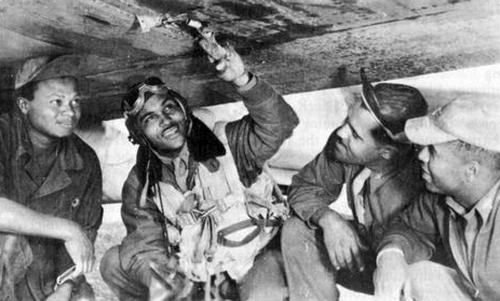
Damage Inspection. A squadron operations officer of the 332d Fighter Group points out a cannon hole to ground crew, Italy, 1945.
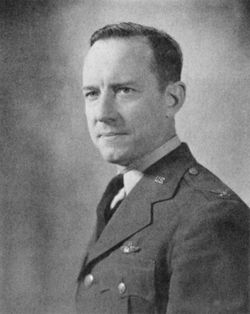
Colonel Parrish (1946 photograph).
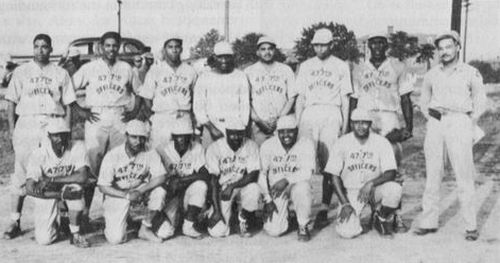
Officers' Softball Team representing the 477th Composite Group, Godwin Field, Kentucky.
These changes flew in the face of the Gillem Board Report, for however slightly that document may have changed the Army's segregation policy, it did demand at least a modest response to the call for equal opportunity in training, assignment, and advancement. The board clearly looked to the command of black units by qualified black officers and the training of black airmen to serve as a cadre for any necessary expansion of black units in wartime. Certainly the conversion of black bomber pilots to fighters did not meet these modest demands. In its defense the Army Air Forces in effect pleaded that there were too many Negroes for its present force, now severely reduced in size and lacking planes and other equipment, and too many of the black troops lacked education for the variety of assignments recommended by the board.
Segregation also prevented the use of Negroes on a broader professional scale. In April 1948, 84.2 percent of Negroes in the Air Force were working in an occupational specialty as against 92.7 percent of whites, but the number of Negroes in radar, aviation specialist, wire communications, and other highly specialized skills required to support a tactical air unit was small and far below the percentage of whites. The Air Force argued that since Negroes were assigned to black units and since there was only one black tactical unit, there was little need for Negroes with these special skills.
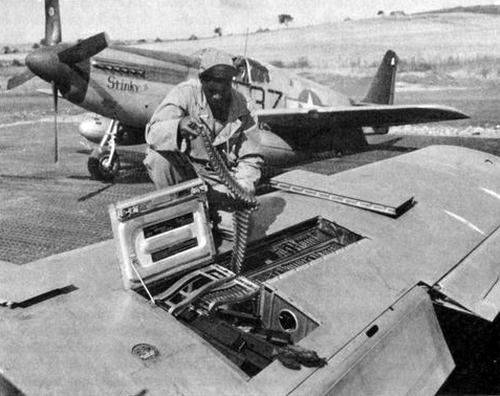
Checking Ammunition. An armorer in the 332d Fighter Group inspects the P-51 Mustang, Italy, 1945.
The Gillem Board had sought to expand the training and placement of skilled Negroes by going outside the regular black units and giving them overhead assignments. After the war some base commanders made such assignments unofficially, taking advantage of the abilities of airmen in the overmanned, all-black Squadron F's and assigning them to skilled duties. In one instance the base commander's secretary was a member of his black unit; in another, black mechanics from Squadron F worked on the flight line with white mechanics. But whatever their work, these men remained members of Squadron F, and often the whole black squadron, rather than individual airmen, found itself functioning as an overhead unit, contrary to the intent of the Gillem Board. Even the few Negroes formally trained in a specialty and placed in an integrated overhead unit did not approximate the Gillem Board's intention of training a cadre that would be readily expandable in an emergency.
Impulse for Change
In addition to the chronic problems associated with black enlistments and quotas, four very specific problems demonstrated clearly to Air Force officials the urgent need for a change in race policy. The first of these was the distribution of black airmen which threatened the operational efficiency of the Tactical Air Command. A second, related to the first, revolved around the personnel shortages in black tactical units that necessitated an immediate reorganization of those units, a reorganization both controversial and managerially inefficient. The third and fourth problems were related; the demands of black leaders for a broader use of black servicemen suddenly intensified, dovetailing with the personal inclinations of the Secretary of the Air Force, who was making the strict segregation of black officers and specialists increasingly untenable. These four factors coalesced during 1948 and led to a reassessment of policy and, finally, to a volte-face.
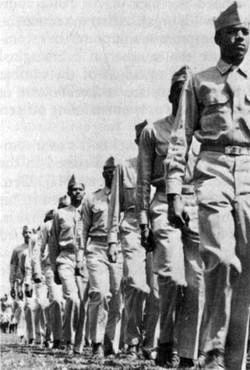
Squadron F, 318th AAF Battalion, in review, Lockbourne Air Force Base, Ohio, 1947.
Colonel Barr offered a solution that echoed the plea of Air Force commanders everywhere: revise Circular 124 to allow his organization to reduce the percentage of Negroes. Among a number of "compromise solutions" he recommended raising enlistment standards to reduce the number of submarginal airmen; designating Squadron E, the transportation squadron of the combat wings, a black unit; assigning all skilled black technicians to Lockbourne or declaring them surplus to the command; and selecting only outstanding officers to command black units.
[Integration] would be playing in the direction in which the negro press would like to force us. They are definitely attempting to force the Army and Air Force to solve the racial problem. As you know, they have been strongly advocating mixed companies of white and colored. For obvious reasons this is most undesirable and to do so would definitely limit the geographical locations in which such units could be employed. If the Air Forces go ahead and set a precedent, most undesirable repercussions may occur. Regardless of how the problem is solved, we would certainly come under strong criticism of the negro press. That must be expected.
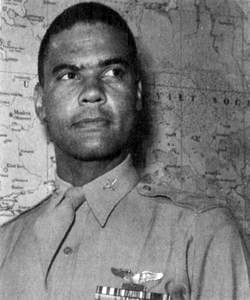
Colonel Davis
Couching his recommendations in terms of the Gillem Board policy, Evans faithfully summarized for the secretary the demands of black leaders. Specifically, he asked that Colonel Davis, the commander of Lockbourne Air Force Base, be sent for advanced military schooling without delay. Diversification of career was long overdue for Davis, the ranking black officer in the Air Force, as it was for others who were considered indispensable because of the small number of qualified black leaders. For Davis, most of all, the situation was unfair since he had always been in command of practically all rated black officers. Nor was it good for his subordinates. The Air Force should not hesitate to assign a white replacement for Davis. In effect, Evans was telling Symington that the black community would understand the necessity for such a move.
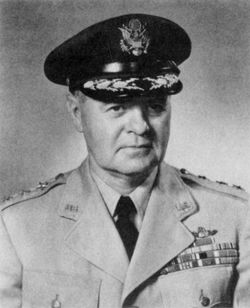
General Edwards
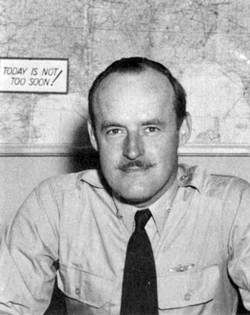
Colonel Marr
Edwards and his staff saw several advantages in complete integration. Wherever qualified black airmen had been permitted to compete with whites on their individual qualifications and abilities, the Negroes "achieved a certain amount of acceptance and recognition." Students in some schools lived and learned side by side as a matter of practical necessity. "This degree of integration and acceptance on a competitive basis has been eminently successful and has to a remarkable degree solved the 'Negro problem' for the training schools involved." At some bases qualified black airmen were administratively assigned to black units but actually performed duties in white units. Some commanders had requested that these men be permanently transferred and assigned to the white units because the men deserved higher grades but could not receive them in black units and because it was poor management to have individuals performing duties for one military organization and living under the administrative jurisdiction of another.
In the end consideration of full integration was dropped in favor of a program based on the Navy's postwar integration of its general service. Edwards and his personnel staff dismissed the Navy's problems with stewards and its difficulty in enlisting skilled Negroes as temporary embarrassments with little practical consequence. This problem apparently allowed an economic and efficient use of Negroes and also "relieved the Navy of the necessity for repeated efforts to justify an untenable position." They saw several practical advantages in a similar policy for the Air Force. It would allow the elimination of the 10 percent quota. The inactivation of some black units—"and the pronounced relief of the problems involved in maintaining those units under present conditions"—could be accomplished without injustice to Negroes and with benefit to the Air Force. Nor would the integration of qualified Negroes in technical and combat units appreciably alter current practices; according to contemporary estimates such skilled men would never total more that 1 percent of the service's manpower.
The logic of social justice might have led to total integration, but it would not have solved the Air Force's pressing problem of too many unskilled blacks. It was consideration of military efficiency, therefore, that led these personnel experts to propose a system of limited integration along the lines of the Navy's postwar policy. Such a system, they concluded, would release the Air Force from its quota obligation—and hence its continuing surplus of unskilled men—and free it to assign its relatively small group of skilled black recruits where they were needed and might advance.