CHAPTER 17
Reading edition
The Army Integrates
The integration of the United States Army was not accomplished by executive fiat or at the demand of the electorate. Nor was it the result of any particular victory of the civil rights advocates over the racists. It came about primarily because the definition of military efficiency spelled out by the Fahy Committee and demonstrated by troops in the heat of battle was finally accepted by Army leaders. The Army justified its policy changes in the name of efficiency, as indeed it had always, but this time efficiency led the service unmistakably toward integration.
Race and Efficiency: 1950
The Army's postwar planners based their low estimate of the black soldier's ability on the collective performance of the segregated black units in World War II and assumed that social unrest would result from mixing the races. The Army thus accepted an economically and administratively inefficient segregated force in peacetime to preserve what it considered to be a more dependable fighting machine for war. Insistence on the need for segregation in the name of military efficiency was also useful in rationalizing the prejudice and thoughtless adherence to traditional practice which obviously played a part in the Army's tenacious defense of its policy.
But the Army had promised the Fahy Committee in April 1950 it would abolish the quota. If carried out, such an agreement would complicate an orderly and controlled integration, and Collins's desire for change was clearly tempered by his concern for order and control. So long as peacetime manpower levels remained low and inductions through the draft limited, a program such as the one contemplated by the Chief of Staff was feasible, but any sudden wartime expansion would change all that. Fear of such a sudden change combined with the strong opposition to integration still shared by most Army officials to keep the staff from any initiative toward integration in the period immediately after the Fahy Committee adjourned.
A decision on these matters, the board stated, had to be based on combat effectiveness, not the use of black manpower, and what constituted maximum effectiveness was best left to the judgment of war-tested combat leaders. These men, "almost without exception," vigorously opposed integration. Ignoring the Army's continuing negotiations with the Fahy Committee on the matter, the board called for retaining the 10 percent quota. To remove the quota without imposing a higher entrance standard, it argued, would result in an influx of Negroes "with a corresponding deterioration of combat efficiency." In short, ignoring the political and budgetary realities of the day, the board called on Secretary Gray to repudiate the findings of the Fahy Committee and the stipulations of Executive Order 9981 and to maintain a rigidly segregated service with a carefully regulated percentage of black members.
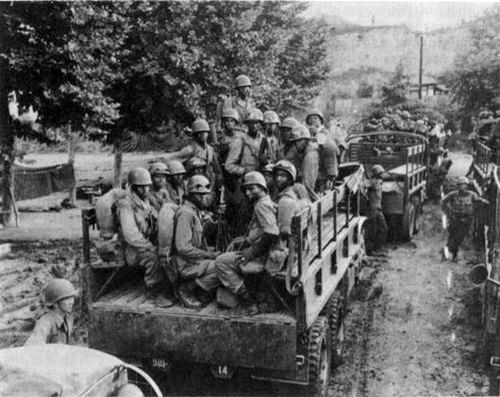
Moving Up. 25th Division infantrymen head for the front, Korea, July 1950.
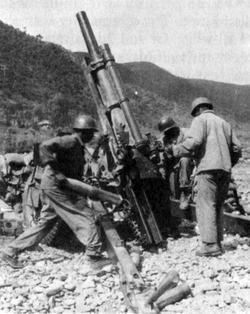
Men of Battery A, 159th Field Artillery Battalion, fire 105-mm. howitzer, Korea, August 1950.
Training
Training units in the United States were subject to many of the stresses suffered by the Eighth Army, and without fanfare they too began to integrate. There was little precedent for the change. True, the Army had integrated officer training in World War II and basic training at the Women's Army Corps Training Center at Fort Lee, Virginia, in April 1950. But beyond that only the rare black trainee designated for specialist service was assigned to a white training unit. Until 1950 there was no effort to mix black and white trainees because the Army's manpower experts always predicted a "social problem," a euphemism for the racial conflict they feared would follow integration at large bases in the United States.
Performance of Segregated Units
Kean went on to spell out his charges. The regiment was unreliable in combat, particularly on the defensive and at night; it abandoned positions without warning to troops on its flanks; it wasted equipment; it was prone to panic and hysteria; and some of its members were guilty of malingering. The general made clear that his charges were directed at the unit as an organization and not at individual soldiers, but he wanted the unit removed and its men reassigned as replacements on a percentage basis in the other units of the Eighth Army.
Lt. Gen. Walton H. Walker, the Eighth Army commander, accepted the inspector general's report, and the 24th Infantry remained on duty in Korea through the winter. Zundel meanwhile continued the investigation and in March 1951 offered a more comprehensive assessment of the 24th. It was a fact, for example, that 62 percent of the unit's troops were in categories IV and V as against 41 percent of the troops in the 35th Infantry and 46 percent in the 27th, the 25th Division's white regiments. The Gillem Board had recommended supplying all such units with 25 percent more officers in the company grades, something not done for the 24th Infantry. Some observers also reported evidence in the regiment of the lack of leadership and lack of close relationships between officers and men; absence of unit esprit de corps; discrimination against black officers; and poor quality of replacements.
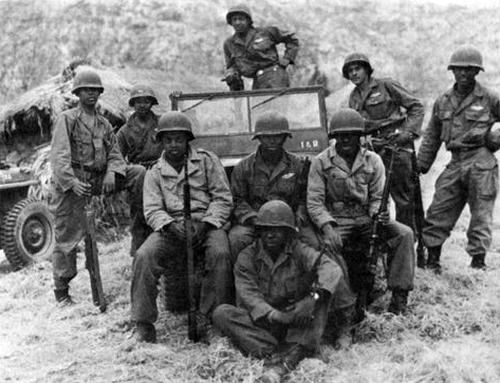
Survivors of an Intelligence and Reconnaissance Platoon, 24th Infantry, Korea, May 1951.
It would be hard to refute Marshall's contention that discrimination was a handmaiden of segregation. Not so Walter White's contention that the reports of the 24th Infantry's poor performance constituted an attempt to discredit the combat ability of black soldiers and return them to labor duties. The association's executive secretary had fought racial injustice for many decades, and, considering his World War II experiences with the breakup of the 2d Cavalry Division into labor units, his acceptance of a conspiracy theory in Korea was understandable. But it was inaccurate. The Army operated under a different social order in 1951, and many combat leaders in the Eighth Army were advocating integration. The number of black service units in the Eighth Army, some ninety in March 1951, was comparable to the number in other similar Army commands. Nor, for that matter, was the number of black combat units in the Eighth Army unusual. In March 1951 the Eighth Army had eighty-four such units ranging in size from regiment to detachment. Far from planning the conversion of black combat troops to service troops, most commanders were recommending their assignment to integrated combat units throughout Korea.
The 24th Infantry's experiences struck yet another blow at the Army's race policy. Reduce the size of black units, the Gillem Board had reasoned, and you will reduce inefficiency and discrimination. Such a course had not worked. The same troubles that befell the 92d Division in Italy were now being visited in Korea on the 24th Infantry, a unit rich with honors extending back to the Indian fighting after the Civil War, the War with Spain, and the Philippine Insurrection. The unit could also boast among its medal of honor winners the first man to receive the award in Korea, Pfc. William Thompson of Company M. Before its inactivation in 1951 the 24th had yet another member so honored, Sgt. Cornelius H. Carlton of Company H.
Final Arguments
The opinions of senior commanders long identified with segregated units in combat carried weight with the middle-ranking staff officers who, lacking such experience, were charged with devising policy. Behind the opinions expressed by many staff members there seemed to be a nebulous, often unspoken, conviction that Negroes did not perform well in combat. The staff officers who saw proof for their convictions in the troubles of the 24th Infantry ignored the possibility that segregated units, not individual soldiers, was the problem. Their attitude explains why the Army continued to delay changes made imperative by its experience in Korea.
Integration of the Eighth Army
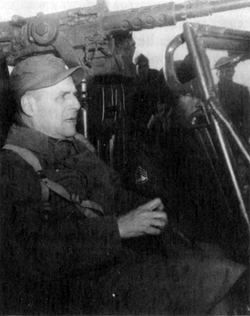
General Ridgway
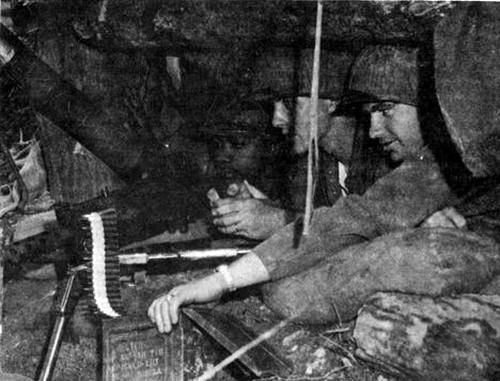
Machine Gunners of Company L, 14th Infantry, Hill 931, Korea, September 1952.
Integration was an established fact in Korea, but the question remained: could an attitude forged in the heat of battle be sustained on the more tranquil maneuver grounds of central Europe and the American south?
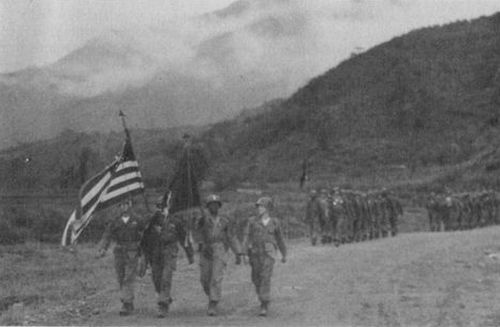
Color Guard, 160th Infantry, Korea, 1952.
Integration of the European and Continental Commands
The Chief of Staff's decision was especially timely for the European Command where General Thomas T. Handy faced manpower problems similar to if not so critical as those in the Far East. During 1951 Army strength in Europe had also risen sharply—from 86,000 to 234,000 men. Black strength had increased even more dramatically, from 8,876 (or 11 percent) to 27,267 (or 13 percent). The majority of black soldiers in Europe served in segregated units, the number of which more than doubled because of the Korean War. From sixty-six units in June 1950, the figure rose to 139 in March 1952. Most of these units were not in divisions but in service organizations; 113 were service units, of which fifty-three were transportation units.
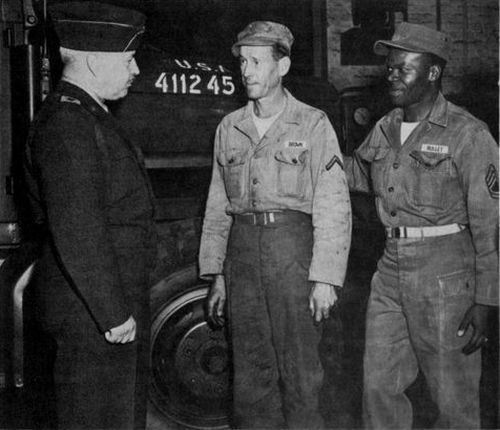
Visit With the Commander. Soldiers of the Ordnance Branch, Berlin Command, meet with Brig. Gen. Charles F. Craig.
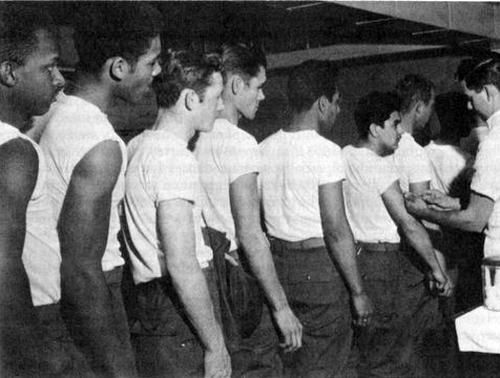
Brothers Under the Skin, inductees at Fort Sam Houston, Texas, 1953.
The on-post dance, a valuable morale builder, was usually restricted to one race because commanders were afraid of arousing antagonism in nearby communities. But even here restrictions were not uniform. Mutual use of dance floors by white and black couples was frequent though not commonplace and was accepted in officers' clubs, many noncommissioned officers' clubs, and at special unit affairs. The rules for social integration were flexible, and many adjustments could be made to the sentiments of the community if the commander had the will and the tact. Some commanders, unaware of what was being accomplished by progressive colleagues, were afraid to establish a precedent, and often avoided practices that were common elsewhere. Social scientists reviewing the situation suggested that the Army should acquaint the commanders with the existing wide range of social possibilities.
Table 9—Worldwide Distribution of Enlisted Personnel by Race, October 1952 (In Thousands)
Category European Command Far East Command Other Overseas Commands Continental United States Total
White 212.1 293.1 96.0 649.2 1,250.5
Black 35.6 41.5 5.8[a] 110.6 193.4
Total 247.7 334.6 101.8 759.8 1,445.9
Percent black 14.4 12.4 5.7 14.6 13.4
Tablenote a: Restrictions remained in effect on the assignment of Negroes to certain stations in USARPAC, TRUST, and USARCARIB.
Source: Memo, Chief, Per and Dist Br, G-1, for ACofS, G-1, 8 Oct 52, sub: Distribution of Negro Enlisted Personnel, G-1, 291.2.
Table 10—Distribution of Black Enlisted Personnel by Branch and Rank, 31 October 1952
Branch AUS Regular
Total Percent[b] Total Percent[b]
Armor 7,738 13.7 3,565 13.8
Artillery 33,684 16.9 14,854 19.9
Infantry 37,220 14.1 15,713 14.9
Adjutant General's Corps 1,074 8.8 663 10.8
Chemical Corps 1,504 15.5 633 20.1
Corps of Engineers 18,987 16.4 8,315 17.9
Military Police Corps 3,012 8.1 1,751 9.8
Finance Corps 68 2.4 51 5.3
Army Medical Service 9,896 12.2 4,439 12.9
Ordnance Corps 5,683 10.2 2,598 12.0
Quartermaster Corps 9,690 20.8 4,187 20.6
Signal Corps 6,923 8.2 3,192 8.7
Transportation Corps 16,380 31.2 8,765 38.2
Women's Army Corps 1,310 13.1 1,283 13.3
No Branch assignment[a] 42,643 11.4 17,779 11.7
Total 195,812[c] 87,788
Tablenote a: In training. Tablenote b: Figures show black percentage of total Army enlistments. Tablenote c: Discrepancy with Table 9, which is based on September figures.
Source: STM-30, 31 Oct 52.
The racial quota, in the guise of an "acceptable" percentage of Negroes in individual units, continued to operate long after the Army agreed to abandon it. No one, black or white, appears to have voiced in the early 1950's the logical observation that the establishment of a racial quota in individual Army units—whatever the percentage and the grounds for that percentage—was in itself a residual form of discrimination. Nor did anyone ask how establishing a race quota, clearly distinct from restricting men according to mental, moral, or professional standards, could achieve the "effective working level" posited by the Army's scientific advisers.
These questions would still be pertinent years later because the alternative to the racial quota—the enlistment and assignment of men without regard for color—would continue to be unacceptable to many. They would argue that to abandon the quota, as the services did in the 1960's, was to violate the concept of racial balance, which is yet another hallmark of an egalitarian society. For example, during the Vietnam War some black Americans complained that too many Negroes were serving in the more dangerous combat arms. Since men were assigned without regard to race, these critics were in effect asking for the quota again, reminding the service that the population of the United States was only some 11 percent black. And during discussions of the all-volunteer Army a decade later, critics would be asking how the white majority would react to an army 30 or even 50 percent black.
These considerations were clearly beyond the ken of the men who integrated the Army in the early 1950's. They concentrated instead on the perplexities of enlisting and assigning vast numbers of segregated black soldiers during wartime and closely watched the combat performance of black units in Korea. Integration provided the Army with a way to fill its depleted combat units quickly. The shortage of white troops forced local commanders to turn to the growing surplus of black soldiers awaiting assignment to a limited number of black units. Manpower restrictions did not permit the formation of new black units merely to accommodate the excess, and in any case experience with the 24th Infantry had strengthened the Army staff's conviction that black combat units did not perform well. However commanders may have felt about the social implications of integration, and whatever they thought of the fighting ability of black units, the only choice left to them was integration. When the Chief of Staff ordered the integration of the Far East Command in 1951, what had begun as a battlefield expedient became official policy.
Segregation became unworkable when the Army lost its power to limit the number of black soldiers. Abandonment of the quota on enlistments, pressed on the Army by the Fahy Committee, proved compatible with segregated units only so long as the need for fighting men was not acute. In Korea the need became acute. Ironically, the Gillem Board, whose work became anathema to the integrationists, accurately predicted the demise of segregation in its final report, which declared that in the event of another major war the Army would use its manpower "without regard to antecedents or race."